Japan Travel Comparisons: 27 Pairs Answered With Numbers

japan-japan.com has 27 comparison pages: 20 articles published on 12–14 October 2026 and 7 earlier pages. This page answers all of them in four groups, each with the number that settles it and the date we checked it.
The 27 comparisons at a glance
Find your question in the left column and read the answer. Open the comparison page for the full fare table. Rows without a date come from the japan-japan.com database.
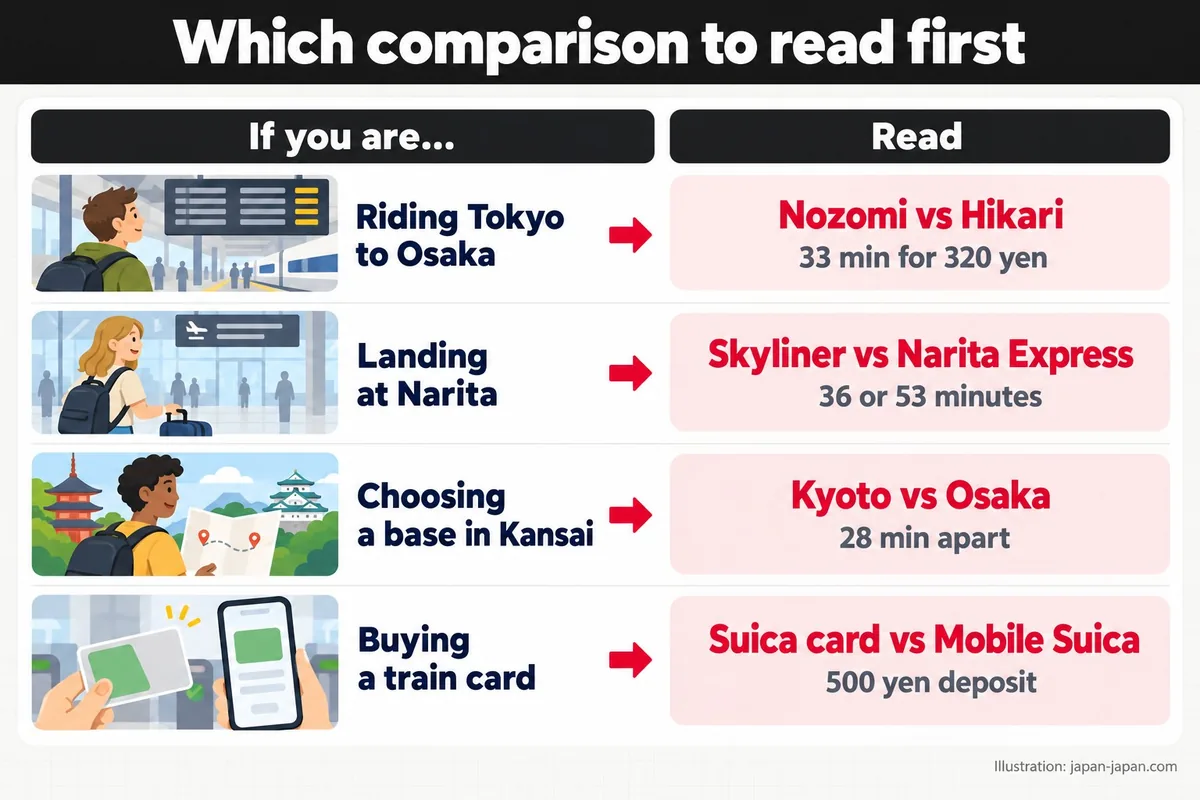
The picture above matches four trip moments to the comparison to read first.
| Comparison | The answer | Checked |
|---|---|---|
| Nozomi vs Hikari | Nozomi 33 min faster for 320 yen more. | JR, 14 October 2026 |
| Hikari vs Kodama | Hikari 2 h 54 min, Kodama 3 h 54 min. | JR West, 13 October 2026 |
| Mizuho vs Sakura | Mizuho 12 min faster for 530 yen more. | JR, 14 October 2026 |
| Kagayaki vs Hakutaka | Kagayaki 2 h 24 min; only Hakutaka has non-reserved seats. | JR West, 13 October 2026 |
| Green Car vs ordinary | Green Car 4,870 yen more by Nozomi. | JR Tokai Tours, 13 October 2026 |
| Reserved vs non-reserved | Non-reserved saves 850 yen on the Nozomi. | JR Central, 14 October 2026 |
| JR Pass vs Suica | Tokyo–Kyoto round trip 28,340 yen, pass 50,000 yen. | JR, 14 October 2026 |
| JR Pass Green vs Ordinary | Green 20,000 yen more for 7 days. | JAPAN RAIL PASS, 13 October 2026 |
| ICOCA vs PiTaPa | Pick ICOCA: 2,000 yen with a 500 yen deposit. | JR West, 13 October 2026 |
| Suica card vs Mobile Suica | Card has a 500 yen deposit; mobile has none. | JR East, 13 October 2026 |
| Suica vs PASMO | Both 500 yen deposit, 10 years unused. | japan-japan.com database |
| ICOCA vs Suica | Both charge a 220 yen refund fee. | japan-japan.com database |
| Welcome Suica vs Suica | Welcome Suica: no deposit, 28 days. | japan-japan.com database |
| JAL vs ANA | Same 115 cm, 10 kg carry-on. | Airlines, 13 October 2026 |
| Peach vs Jetstar Japan | Peach bag 3,100 yen, Jetstar Japan 4,600 yen. | Airlines, 3 and 12 October 2026 |
| Full-service vs low-cost | 10 kg carry-on against 7 kg. | Airlines, 13 October 2026 |
| Kansai Airport vs Itami | Itami is domestic only, 30 min by bus to Osaka Station. | Kansai Airports, 13 October 2026 |
| Skyliner vs Narita Express | Skyliner 36 min, 2,580 yen; N’EX 53 min, 3,140 yen. | Keisei and JR East, 13 October 2026 |
| Narita vs Haneda | Haneda about 30 minutes from Tokyo Station. | japan-japan.com database |
| Kyoto vs Osaka | 28 min and 580 yen apart. | JR, 14 October 2026 |
| Shinjuku vs Shibuya | Shibuya 37 min from Haneda; Shinjuku for day trips. | Keikyu and JR, 14 October 2026 |
| Hakone vs Kawaguchiko | Hakone 30 min closer, 1,730 yen cheaper. | Odakyu and Fujikyu, 14 October 2026 |
| Nikko vs Hakone vs Kamakura | Kamakura closest at 54 min. | JR, Odakyu and Tobu, 14 October 2026 |
| Ryokan vs hotel | Ryokan 5.7% of foreign guest-nights in 2025. | Japan Tourism Agency, 14 October 2026 |
| Kobe beef vs wagyu | Kobe needs BMS 6 or higher. | japan-japan.com database |
| teamLab Borderless vs Planets | Adults 3,800 to 5,600 yen at either. | japan-japan.com database |
| Tokyo Disneyland vs DisneySea | Disneyland rides from 81 cm; same price. | japan-japan.com database |
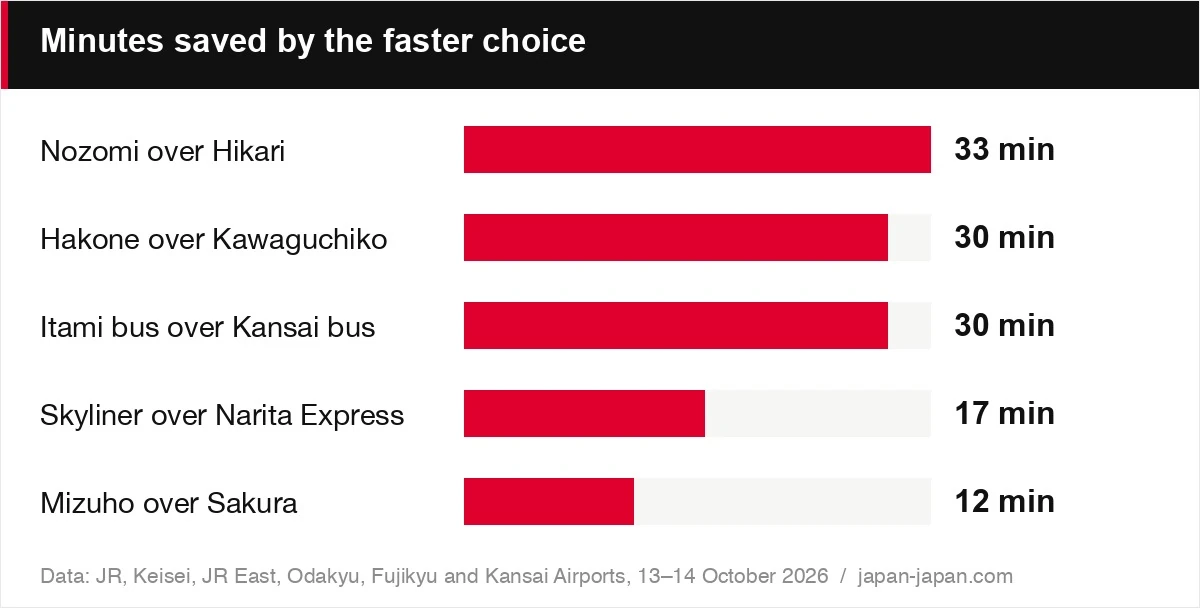
The chart below shows the minutes the faster choice saves in five pairs, from 12 min on the Mizuho to 33 min on the Nozomi.
| Item | Value | Note |
|---|---|---|
| Nozomi over Hikari | 33 min | Tokyo to Shin-Osaka |
| Hakone over Kawaguchiko | 30 min | From Shinjuku |
| Itami bus over Kansai bus | 30 min | To Osaka Station |
| Skyliner over Narita Express | 17 min | Different end stations |
| Mizuho over Sakura | 12 min | Shin-Osaka to Hiroshima |
Shinkansen trains and seats
The JR Central Tokaido Shinkansen guide for visitors gives 2 hours 21 minutes from Tokyo Station to Shin-Osaka. The departure boards color each train: yellow for Nozomi, red for Hikari, blue for Kodama.
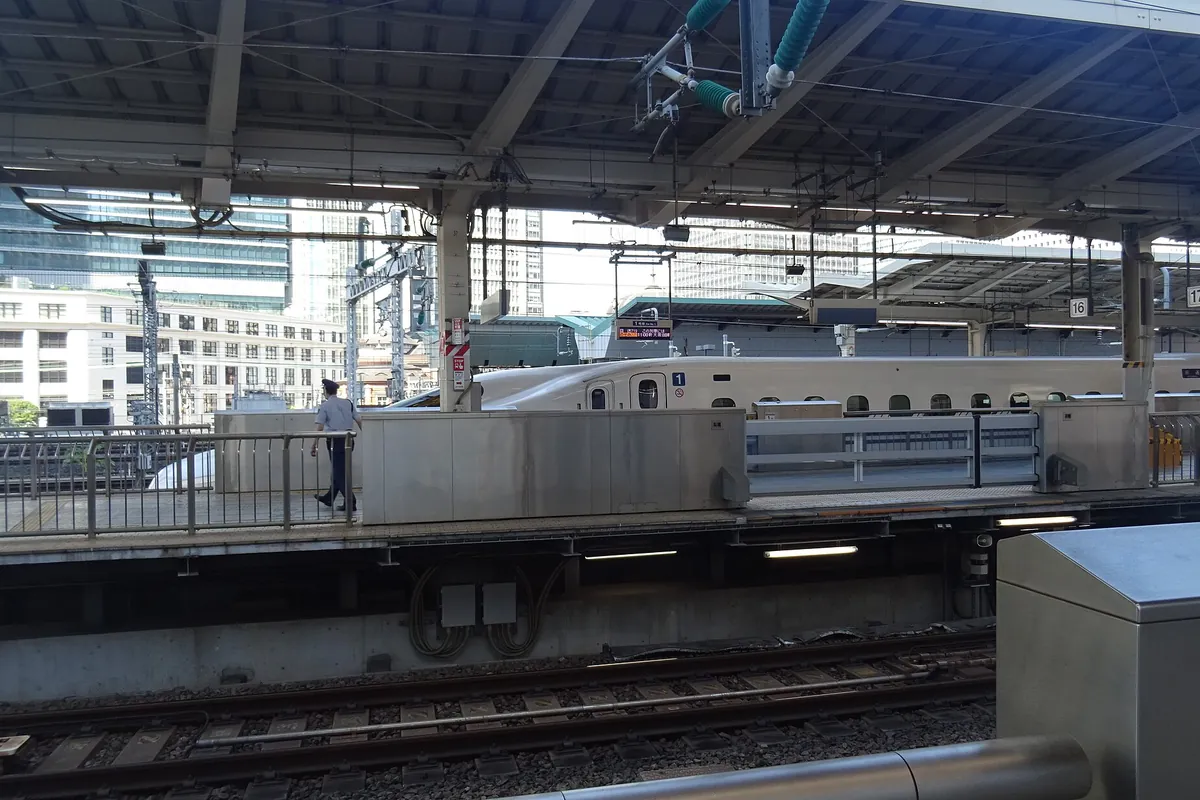
The photo shows a Tokaido Shinkansen train at Tokyo Station. Every way between the two cities is on our Tokyo to Osaka route page.
Nozomi vs Hikari
JR’s search for 14 October 2026 has the Nozomi reaching Shin-Osaka in 2 h 21 min. That is 33 min faster than the Hikari 707, for 320 yen more. With a Japan Rail Pass, ride the Hikari, because the Nozomi needs a 4,960 yen ticket (Nozomi vs Hikari).
Hikari vs Kodama
From Tokyo to Shin-Osaka, the typical Hikari takes 2 h 54 min and the all-stops Kodama 3 h 54 min. Both are free with a Japan Rail Pass. Only the Kodama has the Platt Kodama package (11,360 yen) (Hikari vs Kodama).
Mizuho vs Sakura
The Mizuho takes 1 h 20 min from Shin-Osaka to Hiroshima, 12 min faster than the Sakura 751, for 530 yen more. The Japan Rail Pass covers the Sakura, while the Mizuho needs a 4,170 yen ticket (Mizuho vs Sakura).
Kagayaki vs Hakutaka
To Kanazawa from Tokyo, the fastest Kagayaki takes 2 h 24 min and the fastest Hakutaka 2 h 53 min. Only the Hakutaka has non-reserved seats, at 14,070 yen against 14,600 yen reserved. Take the Hakutaka if you want to turn up and ride (Kagayaki vs Hakutaka).
Shinkansen Green Car vs ordinary
From Tokyo to Shin-Osaka by Nozomi, the Green Car costs 19,590 yen against 14,720 yen reserved. That is 4,870 yen, or 33%, more. It buys a wider 480 mm seat, a reading light and a footrest (Green Car vs ordinary).
Reserved vs non-reserved seats
A Nozomi non-reserved seat to Shin-Osaka costs 13,870 yen, 850 yen less than reserved. On the Hikari 707 the gap is 530 yen. Non-reserved seats are Cars 1–2 on the Nozomi, Cars 1–5 on the Hikari and Cars 1–6 and 13–16 on the Kodama (reserved vs non-reserved seats).
If you miss your train, JR Central lets you sit in the non-reserved cars of a later train that day on the same route. The chart below shows what the better option costs in four pairs. Only the Green Car goes over 1,000 yen.
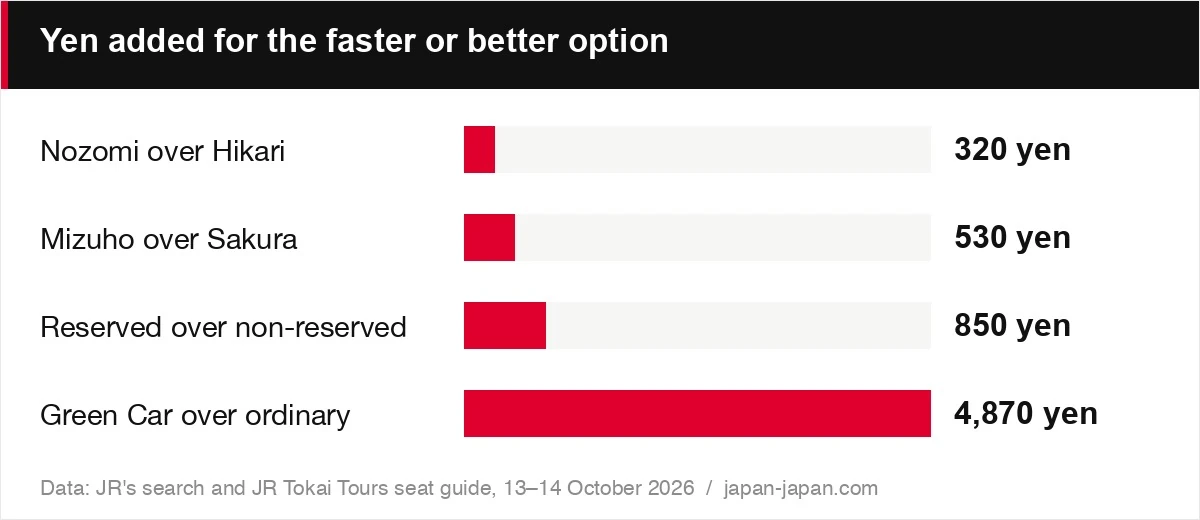
| Item | Value | Note |
|---|---|---|
| Nozomi over Hikari | 320 yen | Tokyo to Shin-Osaka |
| Mizuho over Sakura | 530 yen | Shin-Osaka to Hiroshima |
| Reserved over non-reserved | 850 yen | Nozomi, Tokyo to Shin-Osaka |
| Green Car over ordinary | 4870 yen | Nozomi, Tokyo to Shin-Osaka |
Rail passes and IC cards
A rail pass pays for long JR trips in advance. An IC card pays per ride on trains, subways and buses.
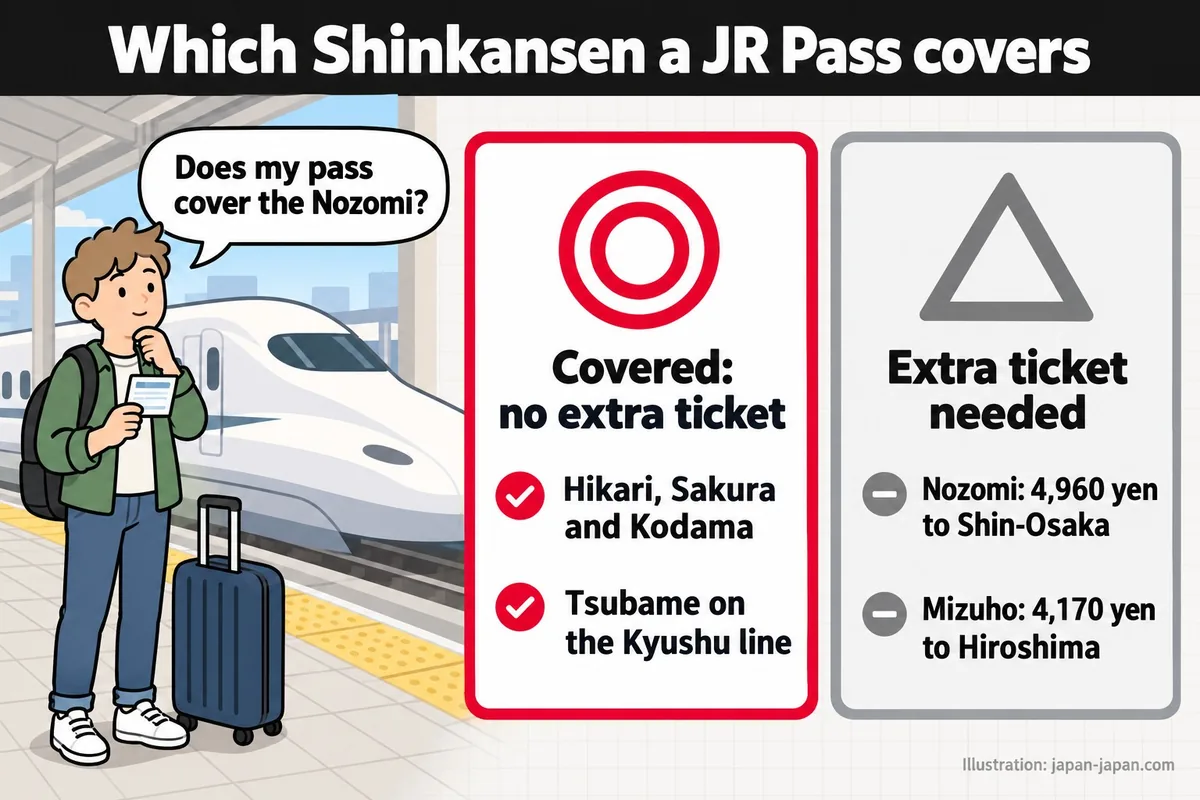
The picture above shows where the pass stops working. The JAPAN RAIL PASS routes and coverage page rules out every seat on the Nozomi and Mizuho. It points holders to the Hikari, Sakura, Kodama and Tsubame instead.
JR Pass vs Suica
JR’s fare search puts a Tokyo–Kyoto Nozomi round trip at 28,340 yen. The 7-day Japan Rail Pass costs 50,000 yen online, per the JAPAN RAIL PASS official prices page. Buy it only for more long JR rides, and use a Suica for subways and buses (JR Pass vs Suica).
JR Pass Green vs Ordinary
The 7-day Green pass costs 70,000 yen against 50,000 yen for Ordinary. The 20,000 yen gap works out to 2,857 yen a day, and Green Cars then cost nothing extra (JR Pass Green vs Ordinary).
ICOCA vs PiTaPa
Most visitors should pick ICOCA: 2,000 yen with a 500 yen deposit included. PiTaPa bills a bank account later, needs a screening and takes 2 weeks at the earliest to arrive (ICOCA vs PiTaPa).
Suica card vs Mobile Suica
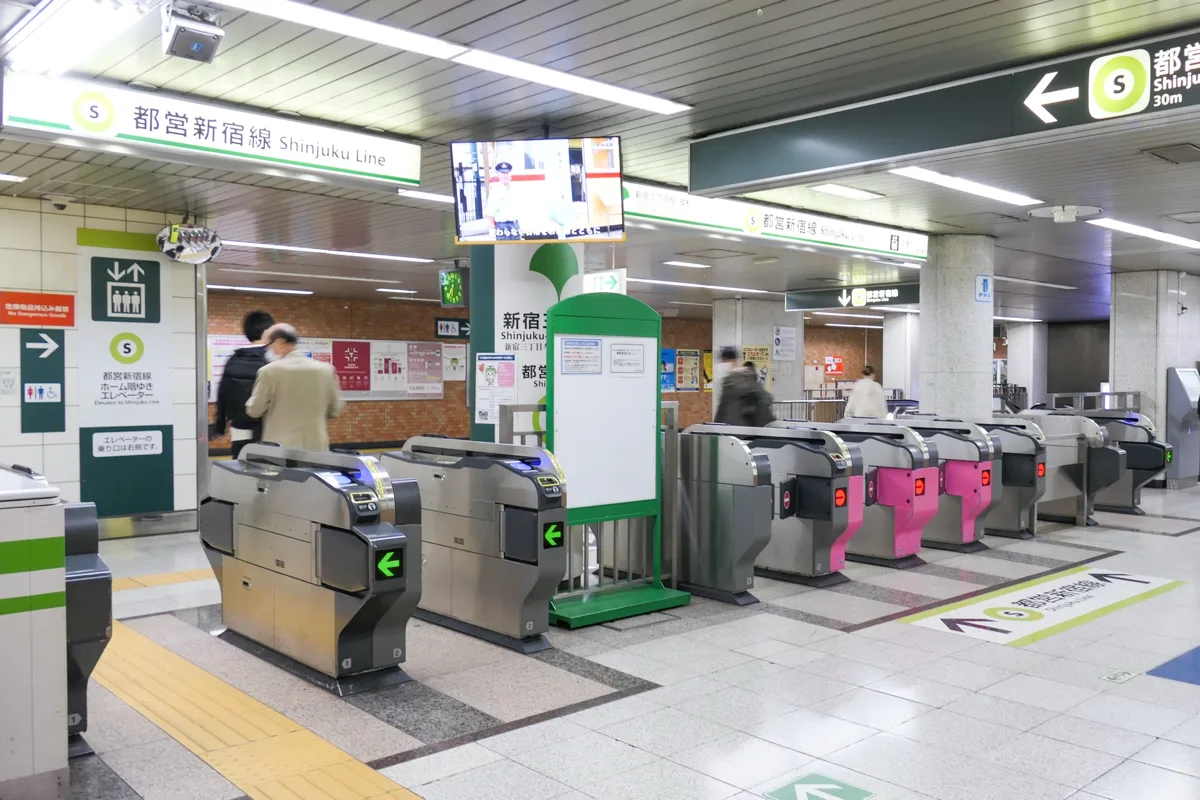
The JR East Suica card page includes a 500-yen deposit and takes top-ups in cash only. Mobile Suica has no deposit but needs a compatible phone. iPhone owners can go mobile, and Android phones without Osaifu-Keitai need the card (Suica card vs Mobile Suica).
A card holds up to 20,000 yen.
Suica vs PASMO
Suica comes from JR East and PASMO from PASMO Co., Ltd., and both cover the Tokyo area. Each holds a 500 yen deposit and goes invalid after 10 years unused (Suica vs PASMO).
ICOCA vs Suica
ICOCA is JR West’s card for Osaka and Kyoto, and Suica is JR East’s card for Tokyo. JR West says ICOCA works on railways and buses all across Japan. Both charge a 220 yen refund fee (ICOCA vs Suica).
Welcome Suica vs Suica
Welcome Suica has no deposit, lasts 28 days from purchase and gives no refunds. Buy it at JR EAST Travel Service Centers at airports and big stations. A regular Suica lasts 10 years unused (Welcome Suica vs Suica).
Flights and airports
The baggage numbers below come from each airline’s own rules, collected in our airline carry-on size table.
JAL vs ANA
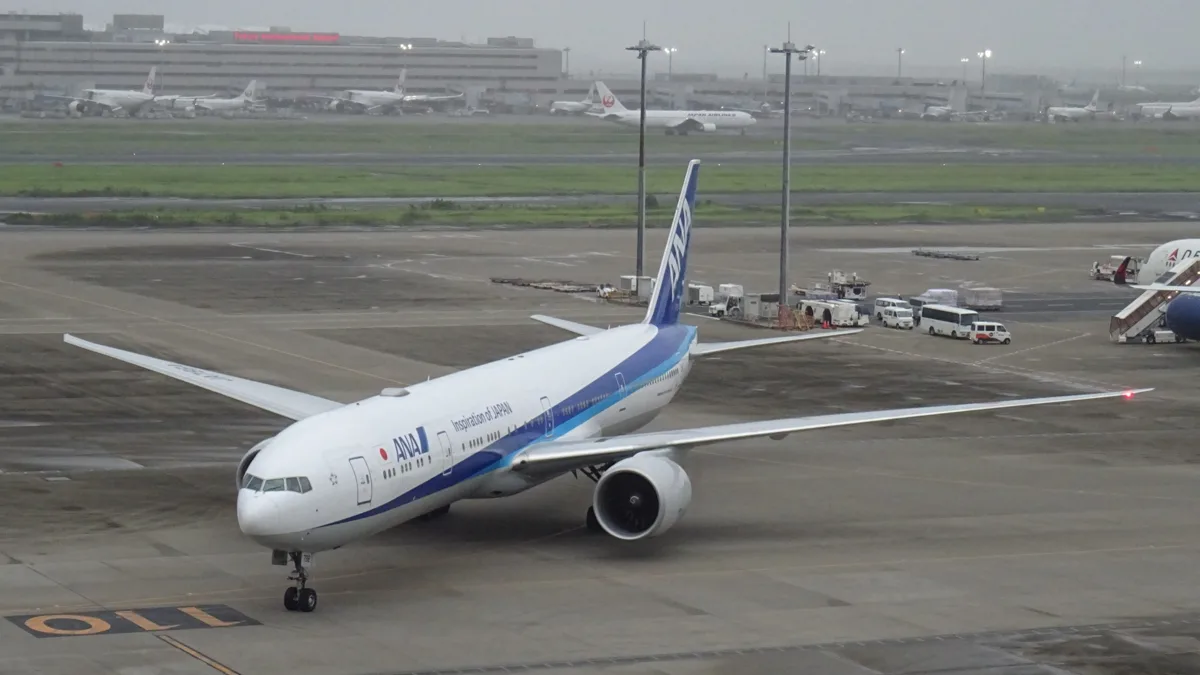
Both give the same 115 cm, 10 kg carry-on, but they use different terminals at Haneda and Narita. Domestic free bags are 20 kg per person on JAL and 23 kg per bag on ANA. The JAL international Economy seat page lists a seat pitch of approx. 84 to 86 cm (JAL vs ANA).
Peach vs Jetstar Japan
Peach costs less once you check a bag at the counter: 3,100 yen for 20 kg, against 4,600 yen for 15 kg on Jetstar Japan. Both allow 7 kg of carry-on. The Peach fare types page lists three fares, and Standard includes one checked bag (Peach vs Jetstar Japan).
Full-service vs low-cost airlines
JAL, ANA, Skymark, AIRDO, Solaseed Air and StarFlyer allow 10 kg of carry-on and a free checked bag. Peach, Jetstar Japan and Spring Japan allow 7 kg, with no free bag on their cheapest fares (full-service vs low-cost airlines).
Kansai Airport vs Itami
Flights from abroad into Osaka land at Kansai Airport, since the Kansai Airports official site labels Itami Domestic only. Itami Airport is closer: its bus reaches Osaka Station in 30 min for 730 yen. From Kansai the bus takes 60 min and costs 1,800 yen (Kansai Airport vs Itami).
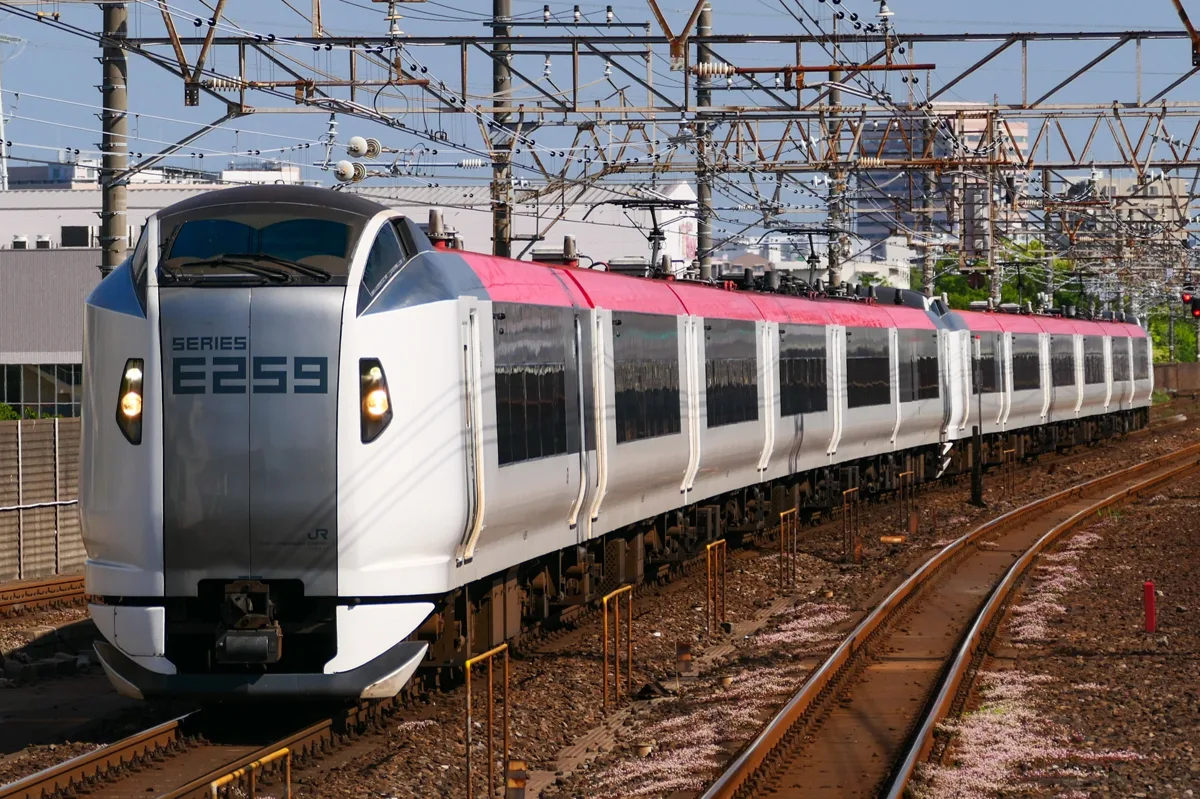
The photo shows the Narita Express, the JR train from Narita Airport to Tokyo Station and Shinjuku.
Skyliner vs Narita Express
The Skyliner reaches Nippori in 36 minutes for 2,580 yen. The fastest Narita Express reaches Tokyo Station in 53 minutes for 3,140 yen. The Keisei Skyliner tickets page says all Skyliner seats are reserved. Pick the train that stops nearest your hotel (Skyliner vs Narita Express, Narita Airport).
Narita vs Haneda
Haneda is about 30 minutes from Tokyo Station by train, while the Narita Express takes just under an hour. If two flights cost about the same, Haneda saves you time on the ground (Narita vs Haneda).
Cities, day trips, stays, food and sights
These eight comparisons cover where to stay, where to go for a day and what to see or eat.
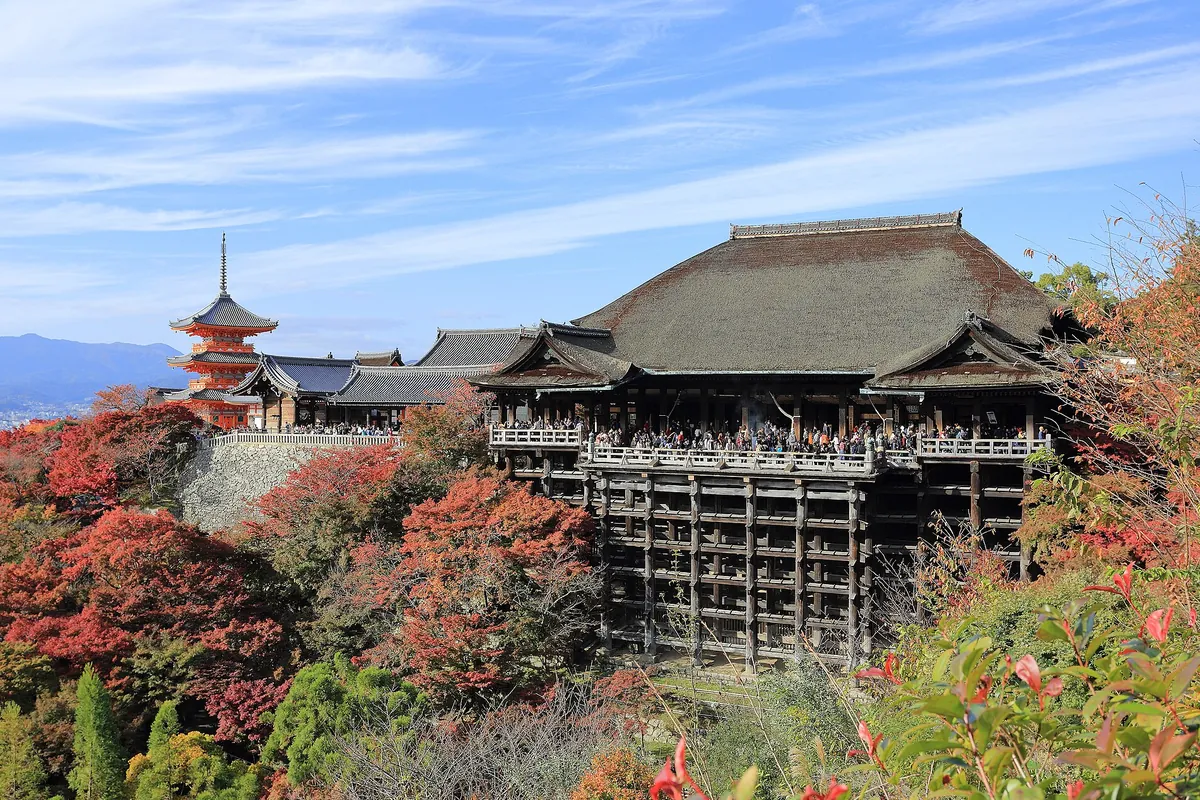
The photo shows Kiyomizu-dera in Kyoto, the city most visitors weigh against Osaka.
Kyoto vs Osaka
Stay in one city and day-trip the other: the JR Special Rapid links them in 28 min for 580 yen. Pick Kyoto if you come from Tokyo, as it is 14 min closer by Nozomi. Pick Osaka if you land at Kansai Airport (Kyoto vs Osaka, Osaka to Kyoto).
Kyoto also taxes every night. The Kyoto City accommodation tax page charges 200 yen per person per night when the room costs under 6,000 yen. Rooms from 6,000 to under 20,000 yen pay 400 yen. On your bill it reads 宿泊税 (shukuhakuzei, accommodation tax).
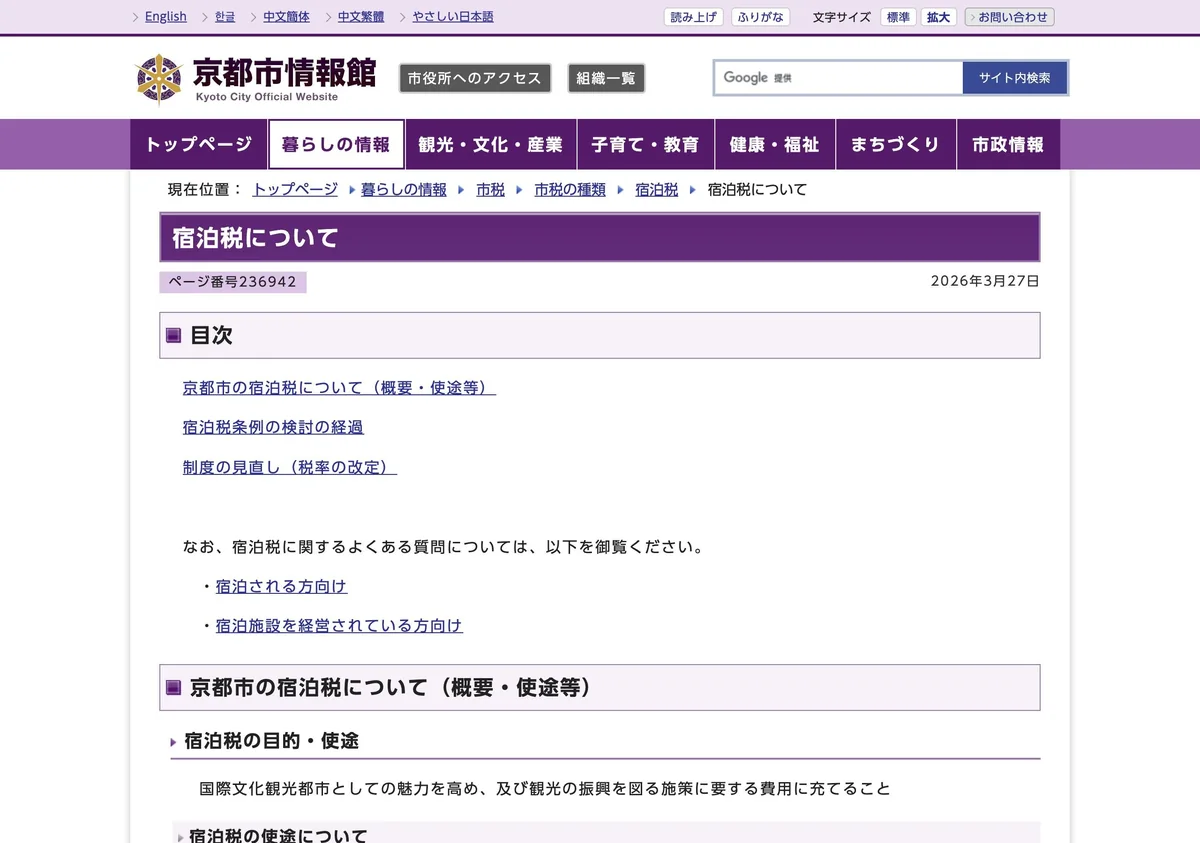
The screen above is that Kyoto City page in Japanese. Its rate table rises to 10,000 yen for rooms of 100,000 yen or more.
Shinjuku vs Shibuya
From Haneda, Shibuya is 37 min and 540 yen away, against 43 min and 590 yen for Shinjuku. Shinjuku suits day trips: the Romancecar to Hakone (2,470 yen) and the Fuji Excursion (4,200 yen) leave from there (Shinjuku vs Shibuya).
Hakone vs Kawaguchiko
From Shinjuku, the Romancecar reaches Hakone in 1 h 24 min for 2,470 yen. The Fuji Excursion takes 1 h 54 min to Kawaguchiko for 4,200 yen. Kawaguchiko gets 1,975 mm less rain a year (Hakone vs Kawaguchiko).
Nikko vs Hakone vs Kamakura
Kamakura is closest, 54 min by direct train from Tokyo Station. Hakone takes 1 h 24 min and Nikko 1 h 47 min. The cheapest one-way fares are 1,040, 1,270 and 3,050 yen (Nikko vs Hakone vs Kamakura).
Ryokan vs hotel
Japan’s Inns and Hotels Act has put ryokan and hotels under one licence since 15 June 2018. In 2025, ryokan took 5.7% of foreign guest-nights and business hotels 43.6% (Ryokan vs hotel).
Kobe beef vs wagyu
Kobe beef comes from Tajima cattle born, raised and slaughtered in Hyogo. It needs a marbling score of BMS 6 or higher and a quality grade of 4 or 5. About 5,500 head qualify each year (Kobe beef guide).
teamLab Borderless vs Planets
Planets in Toyosu is barefoot, with knee-deep water. Borderless at Azabudai Hills is shoes-on. Adults pay 3,800 to 5,600 yen at either, and Planets runs until the end of 2027 (teamLab compared).
Tokyo Disneyland vs DisneySea
Pick Tokyo Disneyland for small children, with rides from 81 cm, and DisneySea if everyone is 117 cm or taller. An adult 1-Day Passport costs 9,900 to 12,400 yen at both (Tokyo Disney Resort guide).
What 98 people living in Japan chose
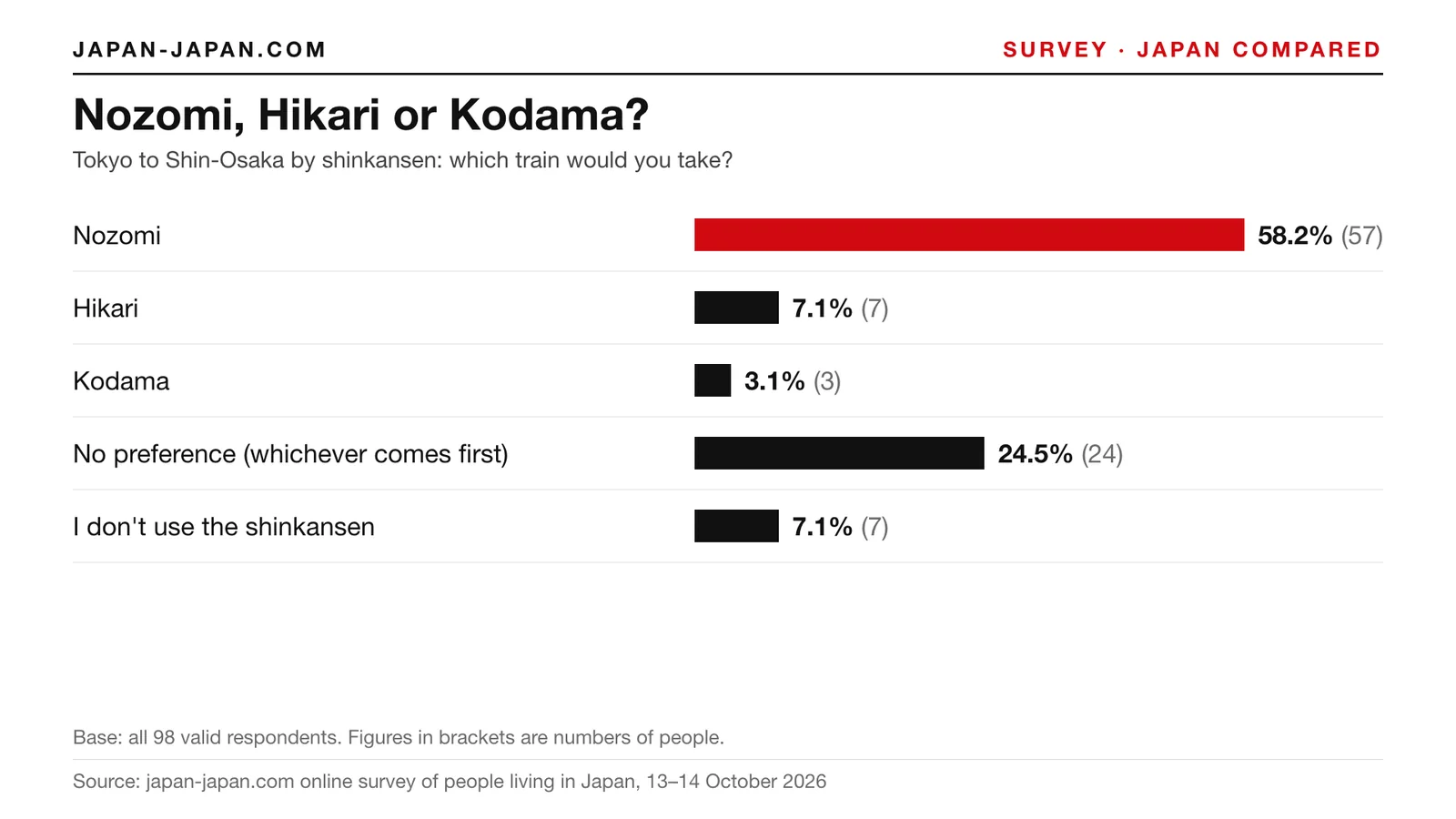
japan-japan.com also ran an online survey of 98 people living in Japan on 13–14 October 2026. These are residents’ picks, not travellers’ picks.
- Tokyo to Osaka: 58.2% chose the Nozomi.
- Flights abroad: 58.2% chose Haneda.
- Kyoto or Tokyo: 58.2% chose Kyoto.
- Tokyo Skytree: 65.3% recommend going up.
- Osaka: 78.6% find Osaka people friendlier.
The full results are in our survey of 98 people in Japan.
How these answers were checked
Each answer comes from an official page or from the japan-japan.com database, which takes its numbers from the same pages. The 20 comparison articles came out on 12–14 October 2026, and most figures were checked on 13 or 14 October 2026.
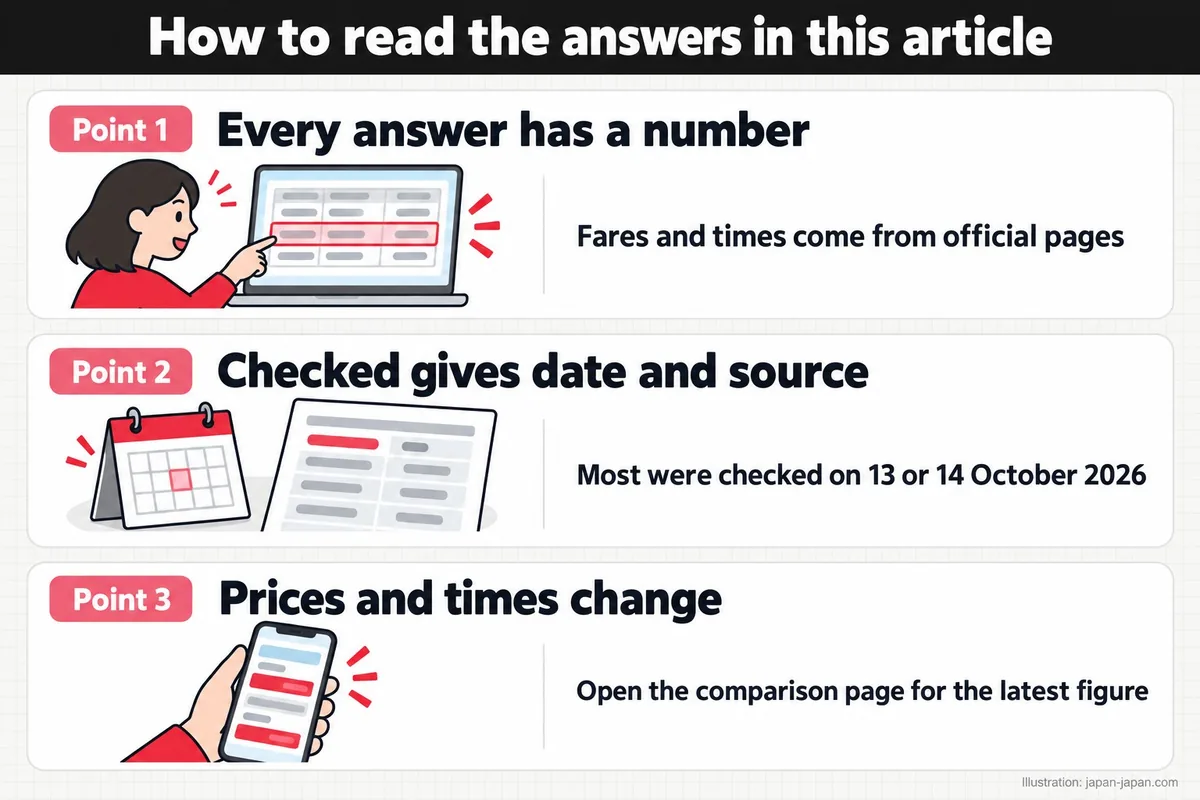
The picture sums up how to read the table: the number, the date and source, and the comparison page.
Fares change. The 7-day Japan Rail Pass rose to 53,000 yen at overseas agencies from 1 October 2026. Before you book, open the comparison page and its official source.
FAQ
Which shinkansen can I ride with a JR Pass?
You can ride the Hikari, Sakura, Kodama and Tsubame at no extra cost. The Nozomi and Mizuho need a separate ticket bought before boarding. It costs 4,960 yen for a Nozomi to Shin-Osaka.
Is the Shinkansen Green Car worth the extra cost?
From Tokyo to Shin-Osaka by Nozomi, it costs 4,870 yen more than a reserved seat. You get a 480 mm seat, a reading light and a footrest. On a 7-day JR Pass, Green works out to 2,857 yen a day.
Which airport train from Narita is cheaper?
The Skyliner, at 2,580 yen to Nippori against 3,140 yen for the Narita Express to Tokyo Station. The online Skyliner discount ticket costs 2,310 yen. The two end at different stations.
Should I stay in Kyoto or Osaka?
Stay in one and day-trip the other, 28 min apart for 580 yen. Choose Kyoto if you arrive from Tokyo and Osaka if you land at Kansai Airport.
About the author