Checked against the official page on · Report a correction
ICOCA is an electronic card for riding trains and, as electronic money, for shopping at various stores. JR-West says it works on railways and buses all across Japan. Suica is a prepaid IC card: tap it on the ticket gate and the fare is taken from the balance, and it also works as e-money in shops. JR-West's English page says the original design ICOCA exclusive to foreign visitors is for people with a passport issued by a government other than Japan who enter as a Temporary Visitor. Japanese nationals, including those with permanent residence abroad, cannot use it. The limit is 1 per person.
ICOCA and Suica side by side
| ICOCA | Suica | |
|---|---|---|
| Issued by | West Japan Railway (JR-West) | JR East |
| Main area | ICOCA Area (JR-West) | Tokyo area plus Sendai, Niigata, Aomori and more |
| Price | 2,000 yen (500 yen deposit included) | 1,000 / 2,000 / 3,000 / 4,000 / 5,000 / 10,000 yen |
| Deposit | 500 yen, returned with the card | 500 yen |
| Expiry | Can expire after 10 years unused | Invalid after 10 years unused |
| Refund | 220 yen fee per card | 220 yen fee; deposit back |
| Where to buy | JR-West ticket machines and Midori-no-madoguchi | JR East multifunction machines and ticket offices |
The details, card by card
Issued by
- ICOCA
- ICOCA is the IC card of West Japan Railway Co., Ltd. (JR-West), which holds the ICOCA registered trademark.
- Suica
- Suica is a JR East IC card that can be used on trains, buses and for shopping.
Main area
- ICOCA
- ICOCA is accepted throughout the ICOCA usage area, labeled ICOCA Area (JR-West), as well as in participating areas of other IC cards.
- Suica
- Suica works on trains, subways, buses and monorails in the Tokyo metropolitan area, and on some public transport in Sendai, Niigata, Aomori, Morioka, Akita, Hokkaido, Tokai, West Japan, Kyushu and Okinawa.
Price
- ICOCA
- An ICOCA card is 2,000 yen including a 500 yen deposit. Some ticket machines also sell it at 1,000, 3,000, 5,000 and 10,000 yen, each including the 500 yen deposit.
- Suica
- JR East lists Suica cards at 1,000, 2,000, 3,000, 4,000, 5,000 and 10,000 yen for adults and children.
Deposit
- ICOCA
- If you insert 2,000 yen when buying an ICOCA at a ticket machine, 1,500 yen goes on the card as balance. The 500 yen deposit is redeemed when you return the card to a JR-WEST Ticket Office.
- Suica
- A new Suica card includes a 500 yen deposit in its price, and the deposit is refunded when you return the card.
Expiry
- ICOCA
- JR West's ICOCA terms say that if none of card exchange, use or top-up of the balance, or commuter pass renewal happens for 10 years, JR West may invalidate the ICOCA in cases it has specially decided. The balance and deposit of an invalidated ICOCA cannot be claimed back.
- Suica
- A Suica card becomes invalid if it is not used for 10 years.
Refund
- ICOCA
- JR West's ICOCA terms say a customer who no longer needs an ICOCA can claim back the balance, and a fee of 220 yen per card is charged.
- Suica
- Return a JR East Suica at a JR East station: you get the balance minus a 220 yen fee, plus the 500 yen deposit.
Where to buy
- ICOCA
- At JR-West stations an ICOCA can be bought from ticket vending machines with the ICOCA mark or at a JR-WEST ticket office (Midori-no-madoguchi). The machine screen can be switched to English.
- Suica
- Inside the Suica area, My Suica (registered) and Suica cards are sold at JR East multifunction machines, Midori-no-madoguchi ticket offices and operator-assisted reserved-seat machines, and at Shinkansen-station ticket offices. Stations with only partial Suica support do not sell them.
ICOCA or Suica? What people living in Japan told us
We ran an online survey of people living in Japan on 13–14 October 2026. The shares below are of the 98 respondents, so they show what people who live in Japan use and recommend, not what visitors do.
We asked: “Which transport IC card do you use most?” The most common answer was “Suica” (41.8%). Next came “PASMO” (20.4%), “ICOCA” (15.3%), “Another regional card” (7.1%) and “PiTaPa” (4.1%). “I don't use one” was chosen by 11.2%.
We asked: “Which transport IC cards do you have? (all that apply)” Of the 98 respondents, 48.0% have Suica as a card or on a phone, 28.6% have PASMO and 22.4% have ICOCA. 28.6% have Mobile Suica, Mobile PASMO or Mobile ICOCA on a phone, and 10.2% have no transport IC card.
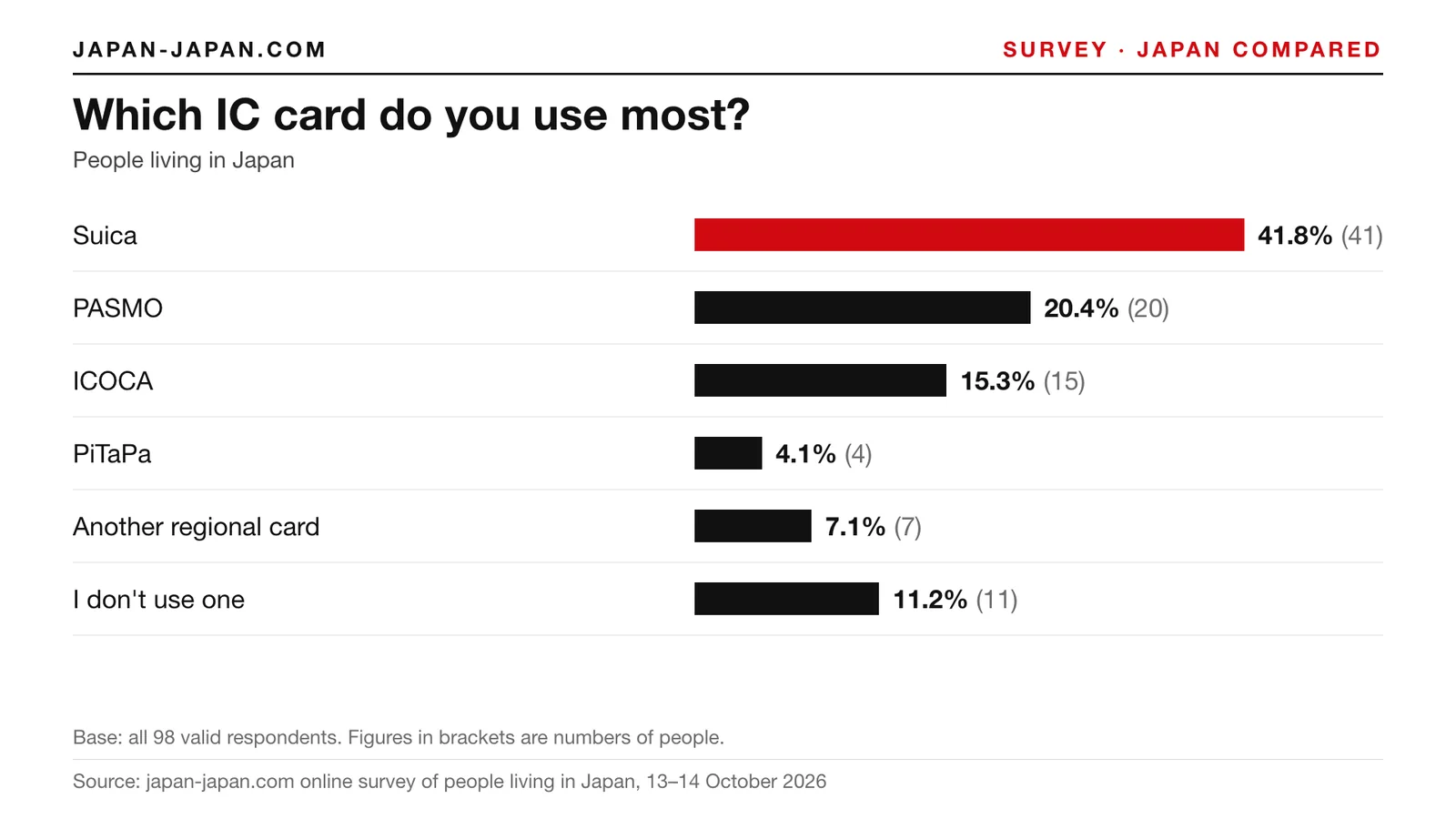
The transport IC card people in Japan use most. Source: japan-japan.com online survey of people living in Japan, 13–14 October 2026.

Transport IC cards people in Japan have. Source: japan-japan.com online survey of people living in Japan, 13–14 October 2026.
In their own words
“Handy, but it can't deal with unusual cases, for example when a line stops and you have to switch to another line instead.”
— Man in his 50s, Kinki (Osaka and Kyoto area). Original Japanese (excerpt): 「便利だけど、イレギュラーなケースには対応できない。例えば路線がストップして他線で振替輸送が必要なケースとか。」
Frequently asked questions
Is the issued by different on ICOCA and Suica?
ICOCA is the IC card of West Japan Railway Co., Ltd. (JR-West), which holds the ICOCA registered trademark. Suica is a JR East IC card that can be used on trains, buses and for shopping.
Is the main area different on ICOCA and Suica?
ICOCA is accepted throughout the ICOCA usage area, labeled ICOCA Area (JR-West), as well as in participating areas of other IC cards. Suica works on trains, subways, buses and monorails in the Tokyo metropolitan area, and on some public transport in Sendai, Niigata, Aomori, Morioka, Akita, Hokkaido, Tokai, West Japan, Kyushu and Okinawa.
Is the price different on ICOCA and Suica?
An ICOCA card is 2,000 yen including a 500 yen deposit. Some ticket machines also sell it at 1,000, 3,000, 5,000 and 10,000 yen, each including the 500 yen deposit. JR East lists Suica cards at 1,000, 2,000, 3,000, 4,000, 5,000 and 10,000 yen for adults and children.
Is the deposit different on ICOCA and Suica?
If you insert 2,000 yen when buying an ICOCA at a ticket machine, 1,500 yen goes on the card as balance. The 500 yen deposit is redeemed when you return the card to a JR-WEST Ticket Office. A new Suica card includes a 500 yen deposit in its price, and the deposit is refunded when you return the card.
Is the expiry different on ICOCA and Suica?
JR West's ICOCA terms say that if none of card exchange, use or top-up of the balance, or commuter pass renewal happens for 10 years, JR West may invalidate the ICOCA in cases it has specially decided. The balance and deposit of an invalidated ICOCA cannot be claimed back. A Suica card becomes invalid if it is not used for 10 years.
Read more
- ICOCA or PiTaPa? Fees, Screening and Discounts ComparedICOCA or PiTaPa: for most visitors, ICOCA. It is a 2,000 yen prepaid card you buy on th…
- Japan Travel Comparisons: 27 Pairs Answered With NumbersJapan travel comparisons, answered: the Nozomi is 33 min faster than the Hikari for 320…
- What 98 People in Japan Choose: 32 Travel ComparisonsWhat 98 people in Japan choose in 32 travel comparisons: 58.2% take the Nozomi, 58.2% p…
- Miyajima Ferry Is Free on a JR Pass, Plus a 100 Yen TaxThe Miyajima ferry is free on a JR Pass only on the JR-West boat, and you still pay the…
Sources for this page
- ICOCA on Apple Pay - ICOCA - How to use JR-WestWest Japan Railway Company (JR West)
- What’s a Suica (IC Card)?East Japan Railway Company (JR East)
- Usage Area - How to use JR-WestWest Japan Railway Company (JR West)
- SuicaEast Japan Railway Company (JR East)
- ご購入方法 │ ICOCA:JRおでかけネットWest Japan Railway Company (JR West)
- West Japan Railway Company - How to use JR-West : What is ICOCA?West Japan Railway Company (JR West)
- Official pageWest Japan Railway Company (JR West)
- Suica(カードタイプ)の購入方法|Suica(カードタイプ):JR東日本East Japan Railway Company (JR East)