Ryokan vs Hotel in Japan: Why Spend a Night in a Ryokan?
The visitor figures come from the Japan Tourism Agency’s Overnight Travel Statistics for 2025, final edition. The facility counts come from the Ministry of Health, Labour and Welfare (MHLW). Below are the old legal split, the counts, where foreign guests sleep and how to choose.
Ryokan vs hotel side by side
Until 2018, Japanese law did treat the two as different businesses. A hotel was a facility built mainly in the Western style. A ryokan was built mainly in the Japanese style. The rules on room size and room count were different too. The table puts the old rules, the last separate count and the 2025 figures next to each other.
| Item | Ryokan | Hotel |
|---|---|---|
| Licence before 15 June 2018 | Ryokan business, mainly Japanese-style | Hotel business, mainly Western-style |
| Licence since 15 June 2018 | Ryokan/hotel business | Ryokan/hotel business |
| Minimum room size before 2018 | 7 m² | 9 m² |
| Minimum room size now | 7 m² (9 m² with a bed) | 7 m² (9 m² with a bed) |
| Minimum number of rooms | 5 before 2018, now none | 10 before 2018, now none |
| Facilities, end of FY2017 | 38,622 with 688,342 rooms | 10,402 with 907,500 rooms |
| Room occupancy, 2025 | 38.2% | Business 75.3%, city 74.1% |
| Share of foreign guest-nights, 2025 | 5.7% | Business 43.6%, city 27.4%, resort 8.3% |
| Plan priced in the price index | Japanese-style room, two meals | Western-style room, breakfast |
Read the last rows with care. The occupancy and guest-night figures come from a survey in which each property picks its own type. So a ryokan in those rows is a place that calls itself a ryokan.
The Statistics Bureau uses the same split when it tracks prices for the consumer price index. It prices a ryokan as a Japanese-style room, one night with two meals. It prices a hotel as a Western-style room, one night with breakfast. That pair is a good shorthand for what you are buying in each case.
On a ryokan booking page you will often see the phrase 1泊2食付き (ippaku ni-shoku tsuki). It means one night with two meals: dinner on the day you arrive and breakfast the next morning.
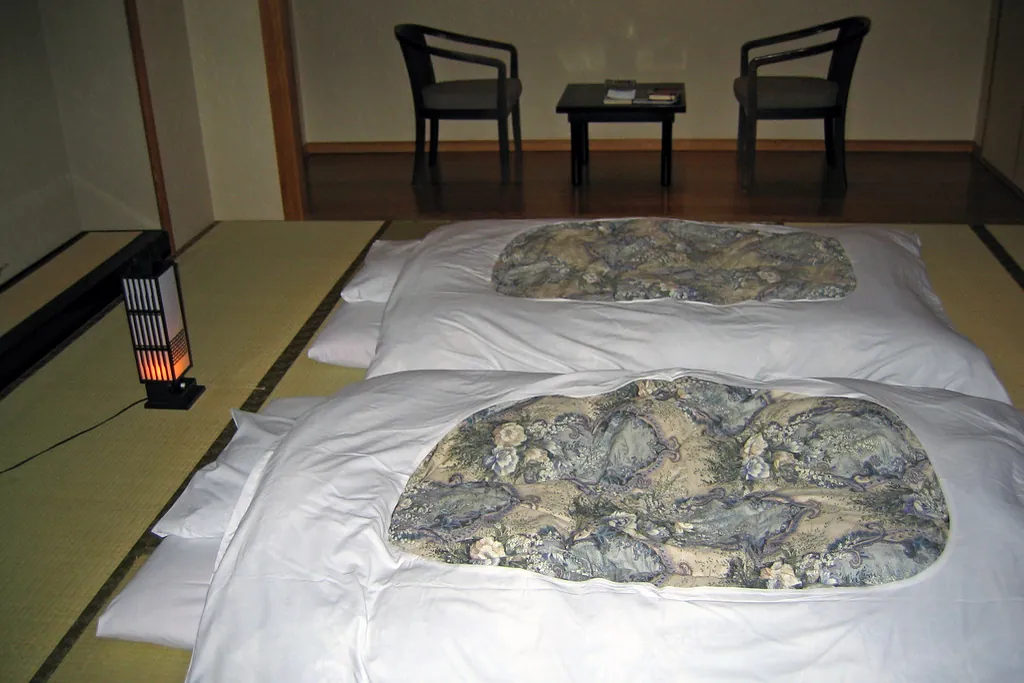
The photo shows the classic ryokan room, with tatami mats on the floor and futon bedding laid out for the night. The JNTO guide to staying at a Japanese ryokan lists the common elements. They are tatami flooring, futon bedding, private baths (sometimes outdoors), yukata robes, a kaiseki dinner and a Japanese breakfast. The JNTO guide to accommodation in Japan adds that some ryokan now offer Western beds instead of futon.
What the law says since 2018
Paid lodging in Japan needs a licence under the Inns and Hotels Act (Ryokangyo-ho). The e-Gov Japan’s Inns and Hotels Act (Ryokangyo-ho) text splits the lodging business into three types. They are ryokan/hotel business, simple lodging business and boarding-house business.
The definition of ryokan/hotel business is short. It covers lodging people for a fee in a facility, other than simple lodging or boarding houses. Nothing in that text separates a ryokan from a hotel.
The merger came from a 2017 amendment, which the MHLW described as deregulation. The MHLW summary of the 2018 Inns and Hotels Act amendment gives the dates. The cabinet order came out on 31 January 2018, and the change took effect on 15 June 2018. The Japan Tourism Agency explanation of the Inns and Hotels Act says the same in English. Hotel operation and inn operation became one inn and hotel operation from June 15, 2018.
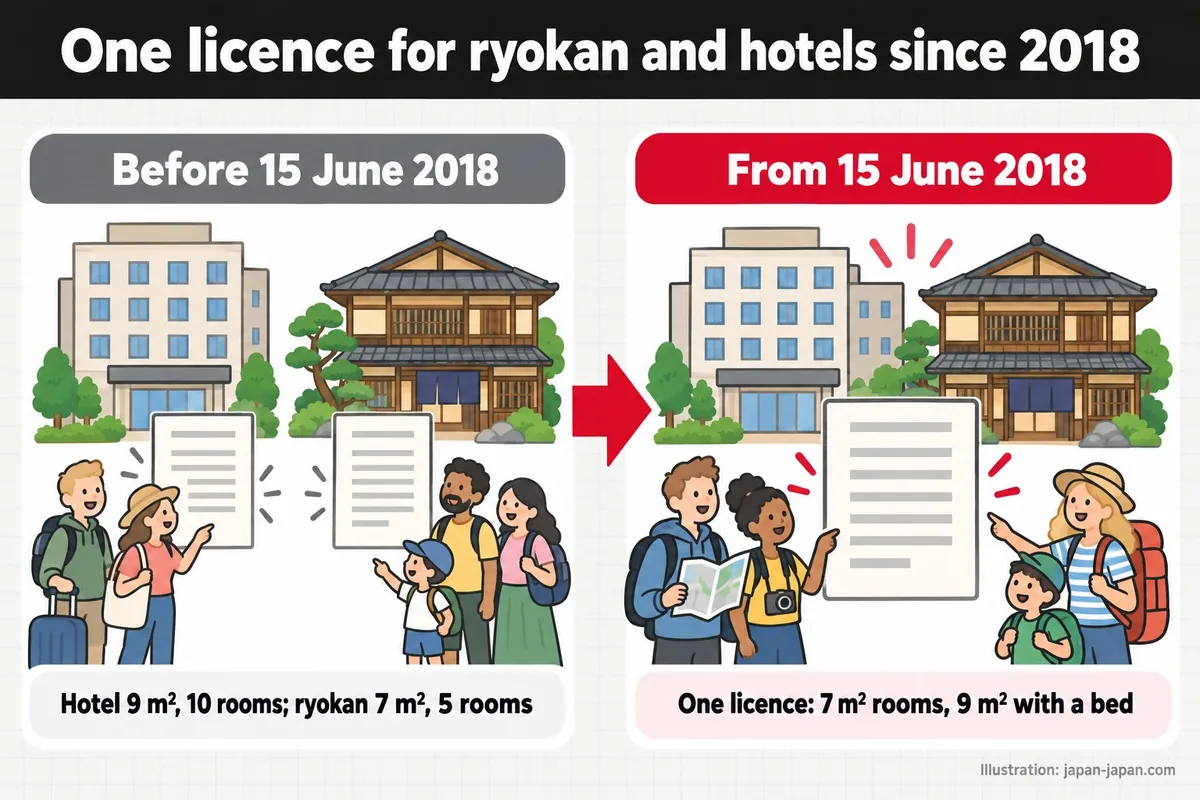
The illustration shows what changed on that date. Before it, hotel rooms had to be at least 9 m² and ryokan rooms at least 7 m². Hotels needed at least 10 rooms and ryokan at least 5 rooms. The amendment abolished both room-count minimums.
The e-Gov Inns and Hotels Act enforcement order now sets one rule for every ryokan/hotel room. Each guest room must be at least 7 m², or 9 m² if the room has a bed. The order does not mention tatami, futon or meals at all.
Simple lodging, the licence that hostels, pensions and many guesthouses use, has its own rule. The total guest-room floor area must be at least 33 m². If the operator applies for fewer than 10 guests, the minimum is 3.3 m² per guest.
So the word on the sign is the owner’s choice. A ryokan and a hotel on the same street can hold exactly the same licence. When you compare places, look at the room type and the meal plan on the booking page, and treat the name as a hint.
How many ryokan and hotels Japan has
The MHLW counted ryokan and hotels separately until March 2018. The MHLW Report on Public Health Administration FY2017 lodging table is the last one with two lines. At the end of FY2017, Japan had 38,622 ryokan with 688,342 rooms and 10,402 hotels with 907,500 rooms.
Ryokan were more numerous, but hotels had more rooms in total. The trend had been running for years. Ryokan fell from 41,899 in FY2014 to 38,622 in FY2017, while hotels rose from 9,879 to 10,402 over the same years.
After the merger the two went into one line. The MHLW Report on Public Health Administration FY2018 results notes the change. Its ryokan/hotel figures for FY2017 and earlier add the old two counts together.
The MHLW Report on Public Health Administration FY2024 lodging table gives the latest count. On 31 March 2025, the end of FY2024, Japan had 52,946 ryokan/hotel facilities with 1,780,679 guest rooms. Japan also had 44,901 simple lodging facilities and 491 boarding houses, or 98,338 licensed lodgings in all. Ryokan/hotel facilities rose 3.7% on the year before, and simple lodging rose 7.1%.
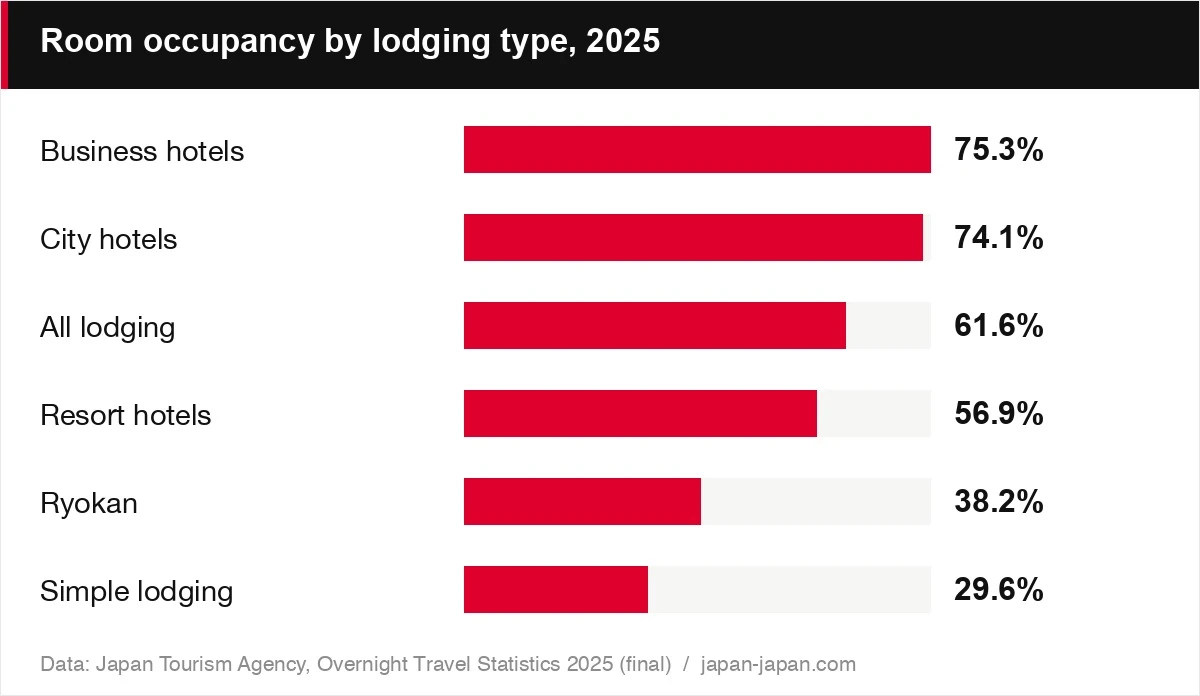
Occupancy tells a different story from the count. The Japan Tourism Agency Overnight Travel Statistics 2025 summary puts room occupancy at 61.6% across all lodging types in 2025. The chart breaks that figure down by type.
| Item | Value |
|---|---|
| Business hotels | 75.3 % |
| City hotels | 74.1 % |
| All lodging | 61.6 % |
| Resort hotels | 56.9 % |
| Ryokan | 38.2 % |
| Simple lodging | 29.6 % |
Business hotels filled 75.3% of their rooms and city hotels 74.1%. Resort hotels filled 56.9%. Ryokan filled 38.2%, and simple lodging 29.6%.
In this survey, each property ticks the type it thinks fits best: ryokan, resort hotel, business hotel, city hotel, simple lodging or company lodging. A low national rate for ryokan describes the whole group. It does not tell you whether one inn in Hakone has a room on your dates, so check the month you plan to travel.
Where foreign visitors actually sleep
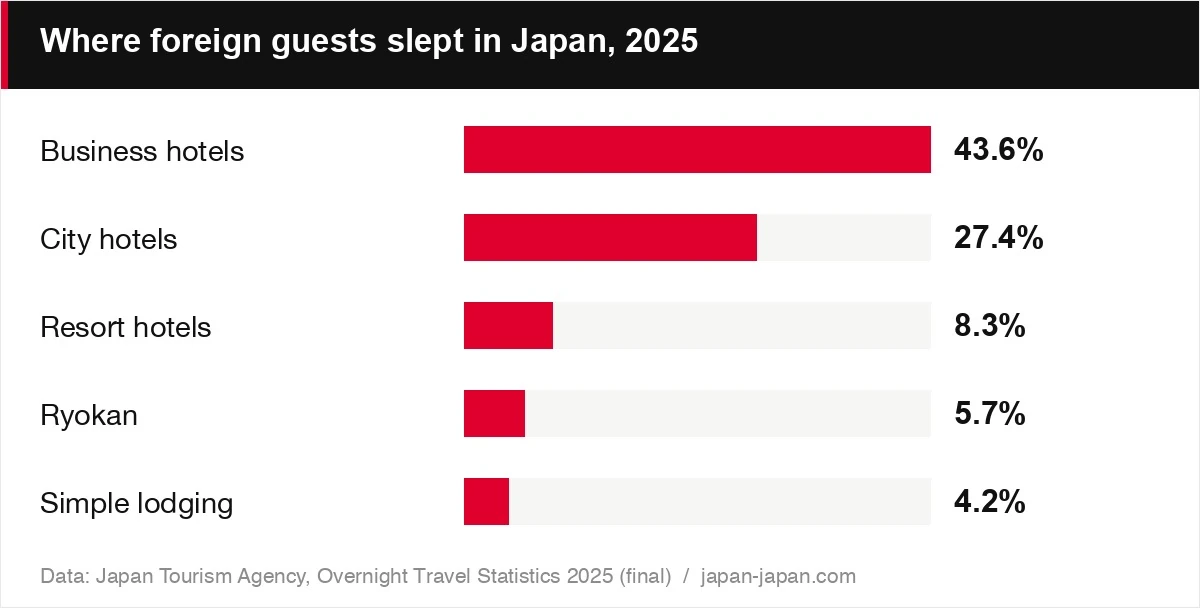
Foreign guests spent 179.92 million guest-nights in Japanese lodging in 2025, according to the final figures. That was up 9.4% on 2024 and up 55.6% on 2019.
The Japan Tourism Agency Overnight Travel Statistics 2025 final table splits those nights by lodging type. Business hotels took 78,366,460 nights, or 43.6%. City hotels took 49,288,560 (27.4%) and resort hotels 14,922,400 (8.3%). Ryokan took 10,276,160 nights (5.7%), and simple lodging took 7,643,950 (4.2%).
| Item | Value | Note |
|---|---|---|
| Business hotels | 43.6 % | 78,366,460 nights |
| City hotels | 27.4 % | 49,288,560 nights |
| Resort hotels | 8.3 % | 14,922,400 nights |
| Ryokan | 5.7 % | 10,276,160 nights |
| Simple lodging | 4.2 % | 7,643,950 nights |
The chart puts those shares side by side.
The type in these tables is the one each property picks for itself. That means the line between ryokan and hotel follows the owner’s label, the same way the sign on the door does.
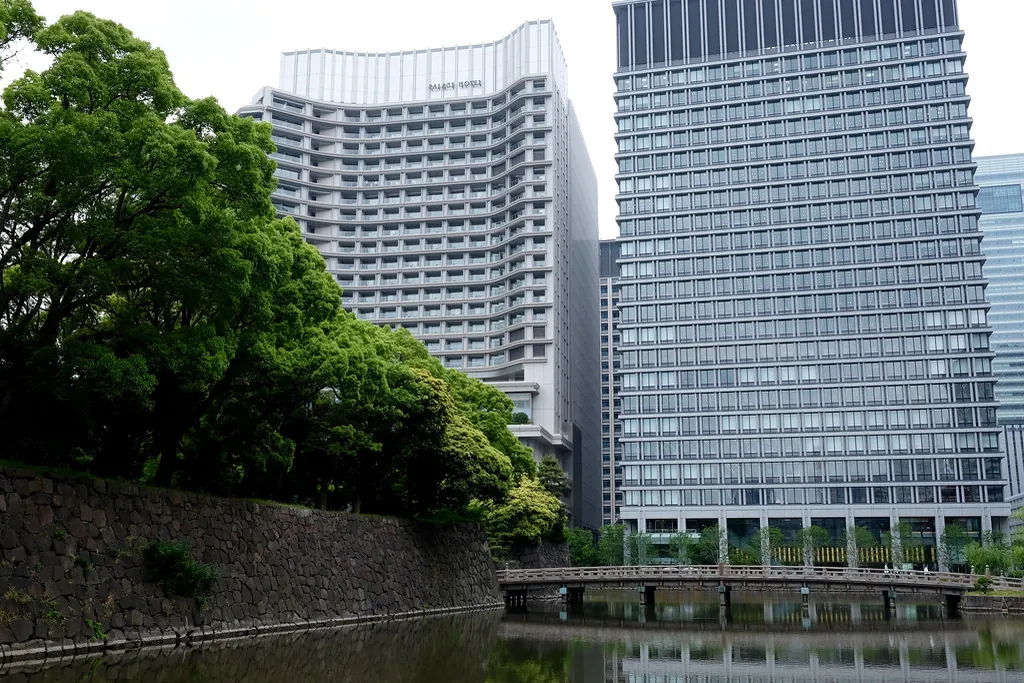
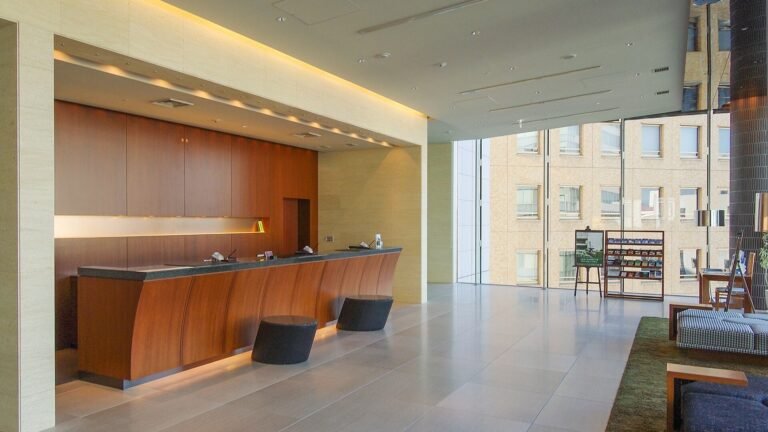
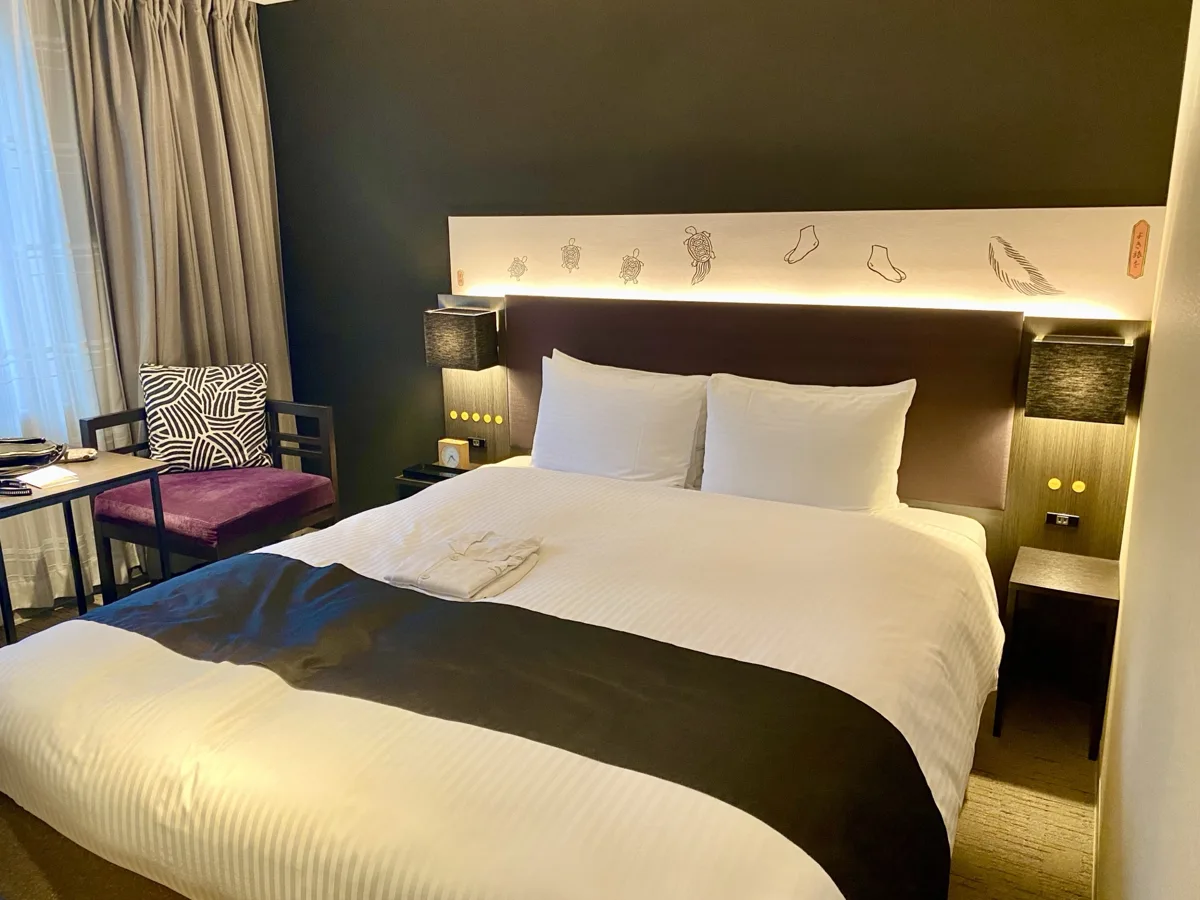
The photo shows a modern hotel building on a Tokyo street, the kind of property that took the largest share of foreign guest-nights. Is your first night near Tokyo Station? Our page on Haneda Airport to Tokyo Station shows the quickest listed way. It is about 33 min by Keikyu Line and JR for 540 yen, with one change at Shinagawa or Hamamatsucho.
Ryokan vs onsen: tatami, futon and the hot-spring bath
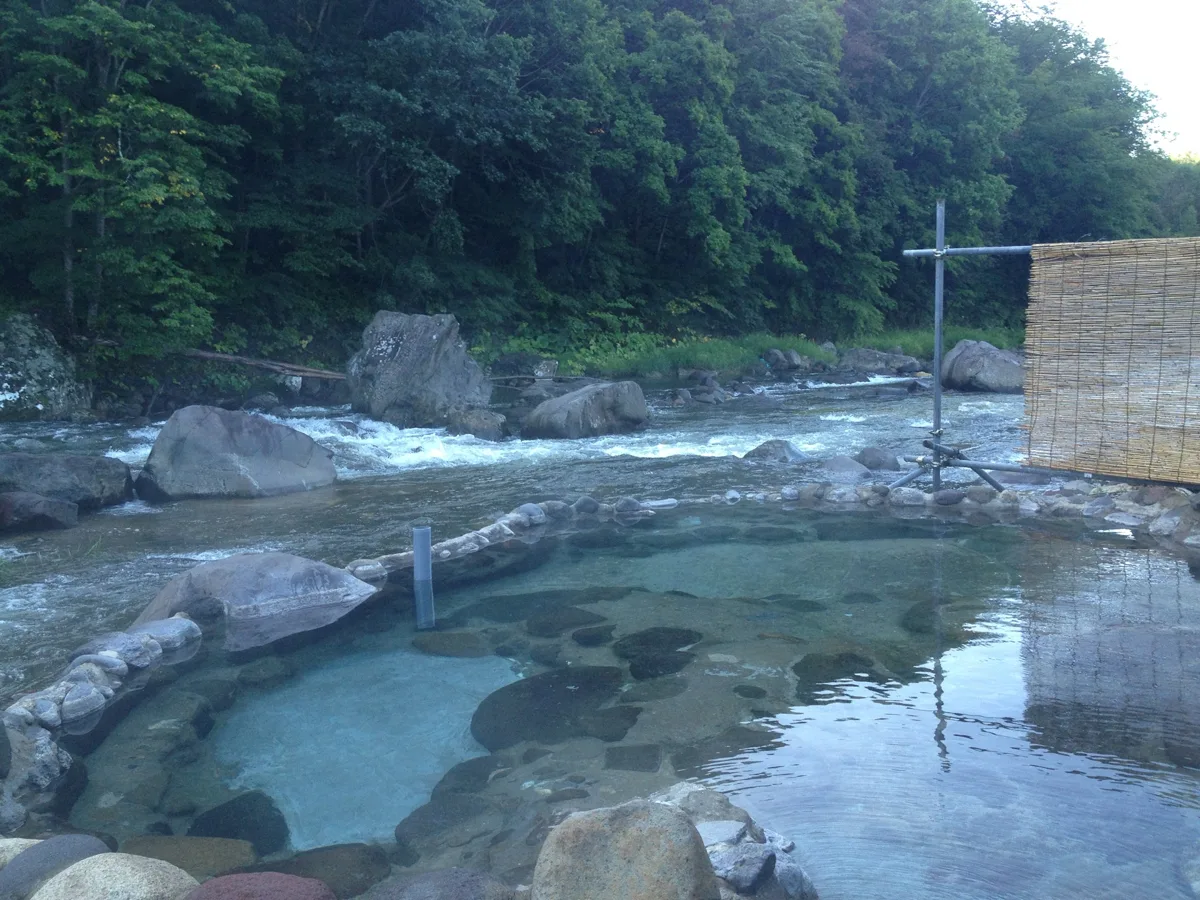
Many travellers search for ryokan vs onsen, but you do not have to choose between them. An onsen is a hot spring, or the bath fed by one. A ryokan is an inn.
The JNTO guide to bathing manners and tips names Ginzan in Yamagata and Hakone in Kanagawa as onsen towns built around natural hot springs. They offer stays at ryokan. The same guide says many cities also have day-use baths, so you can soak without staying the night.
JNTO’s ryokan guide says most ryokan have an onsen. Its accommodation guide says many ryokan have natural hot-spring baths, and some luxury inns offer a private onsen in the room.
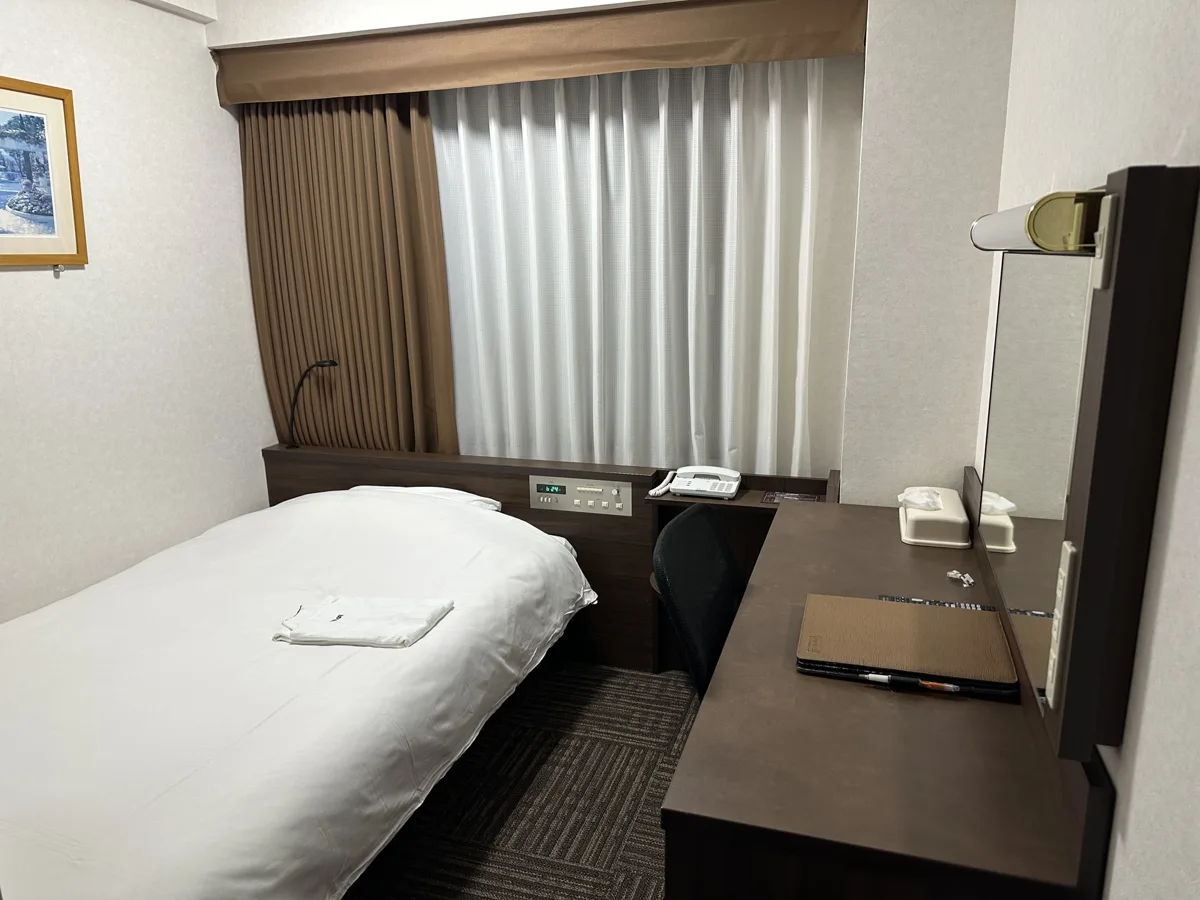
A ryokan night has three parts. The first is the room: tatami flooring and futon bedding, plus a yukata robe to wear around the inn. Staff will explain the customs, such as taking off your shoes indoors, bathing in the onsen and wearing the yukata.
The second is the meals. A ryokan stay typically includes a kaiseki dinner, a formal multi-course meal cooked with local, seasonal ingredients. A traditional Japanese breakfast follows the next morning. Depending on the ryokan, you eat in a shared dining hall or in your own room. Some ryokan offer stays without meals.
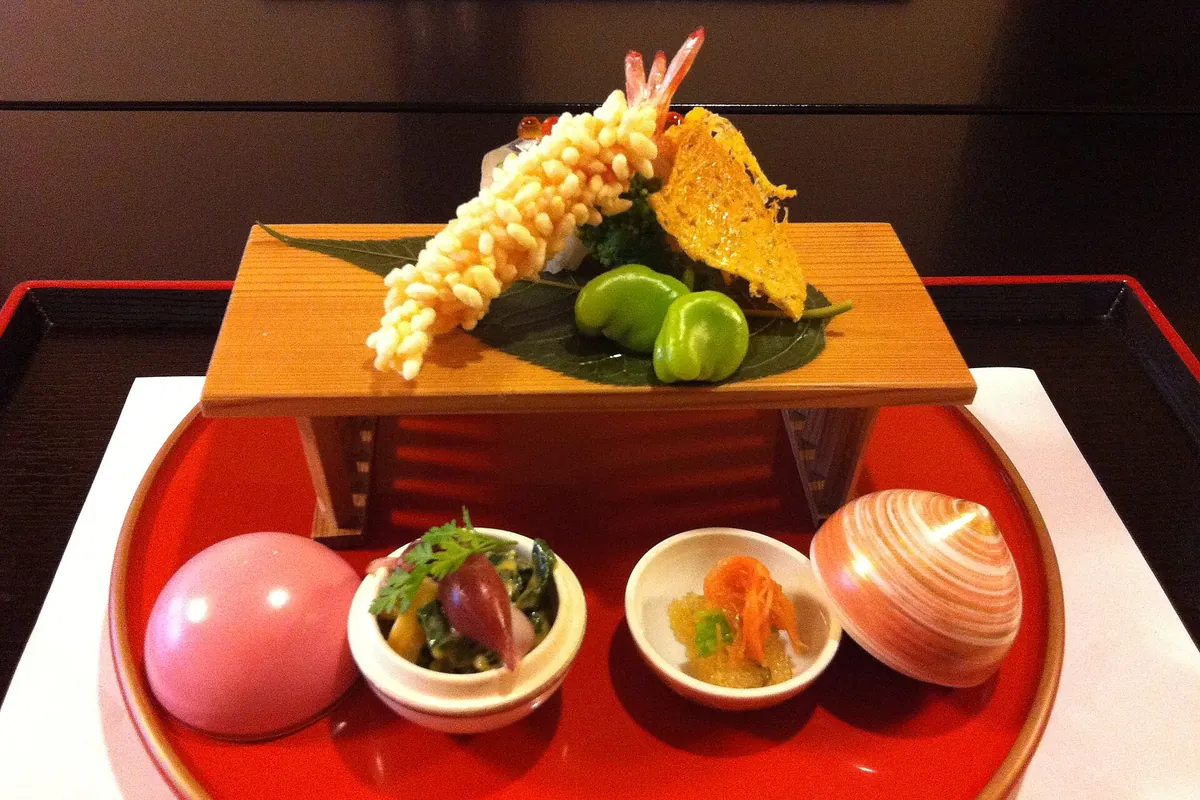
The photo shows a kaiseki dinner served on trays, course by course.
The third is the bath and its tax. Under the Local Tax Act, towns and cities with mineral-spring baths levy a bathing tax on bathers. The standard rate is ¥150 per person per day. The Ministry of Internal Affairs and Communications bathing tax page explains who collects it. Ryokan and similar businesses take it from guests and pay it to the town. JNTO notes that the amount varies by region but is usually about ¥150.
Price data for a ryokan night is thin. The Statistics Bureau Retail Price Survey lodging prices 2021 gives the last national average it recorded. In 2021, two adults sharing a room paid ¥18,470 each for one night with two meals on a weekday. The night before a holiday cost ¥21,740 each.
The Statistics Bureau Retail Price Survey notice page says the lodging survey stopped after December 2021. Treat those two figures as a 2021 reference point, not as today’s rates. For current costs, meals and bath etiquette, read our ryokan guide. If you have tattoos, check our guide to tattoo-friendly onsen before you book.
Ryokan or hotel: which one to book
Decide by what you want from each night, not by the name on the sign. The flow chart below asks two questions.
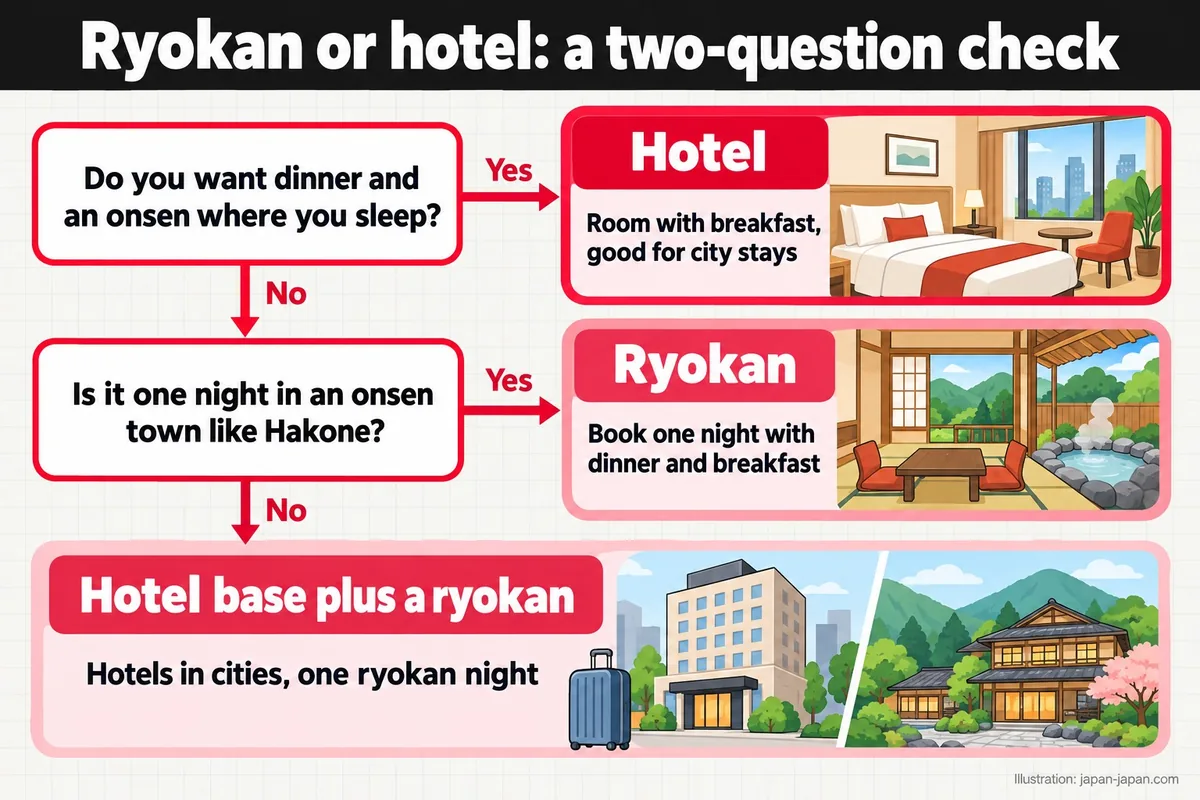
First, do you want dinner and an onsen bath at the place you sleep? If not, a hotel fits. Second, is it one night in an onsen town such as Hakone? If yes, book a ryokan. If you are touring cities for a week, use a hotel as your base and add one ryokan night.
Hakone is the easiest onsen night to add to a Tokyo trip. Our Tokyo to Hakone page compares three ways in. The Odakyu Romancecar takes 1 h 24 min from Shinjuku Station for 2,470 yen. The Odakyu Rapid Express plus the Hakone Tozan Train takes 1 h 40 min of riding time for 1,270 yen. The Kodama on the Tokaido Shinkansen plus the Hakone Tozan Train takes 46 min of riding time from Tokyo Station for 4,170 yen.
If you land at Haneda and go straight to the inn, see Haneda Airport to Hakone. Once you are there, the Hakone Freepass costs 6,000 yen for 2 days from Odawara, and 1,500 yen for children. The Romancecar needs a separate limited express ticket on top of the pass.
From Kyoto, the classic onsen night is in Kinosaki. Our Kyoto to Kinosaki Onsen page shows the Limited Express Kinosaki at 2 h 20 min for 5,370 yen with a reserved seat. The last train leaves Kyoto Station at 19:28, so plan to arrive before dinner.
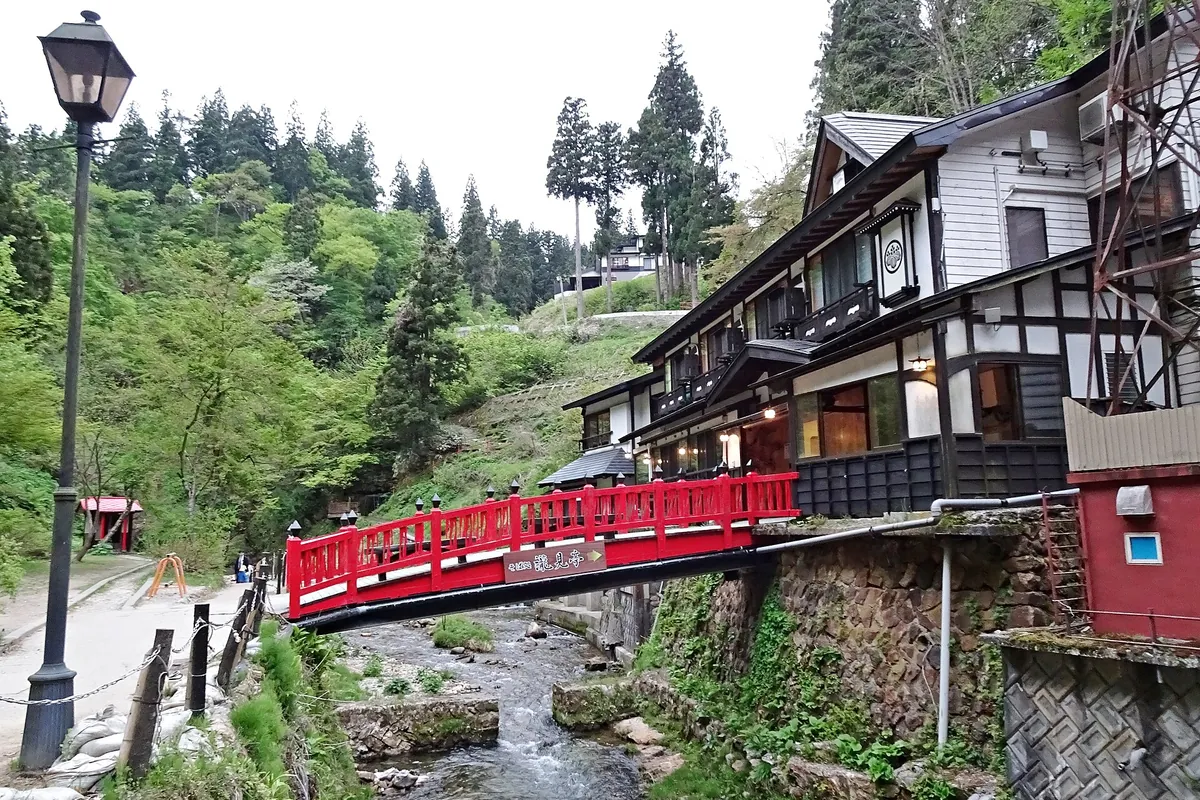
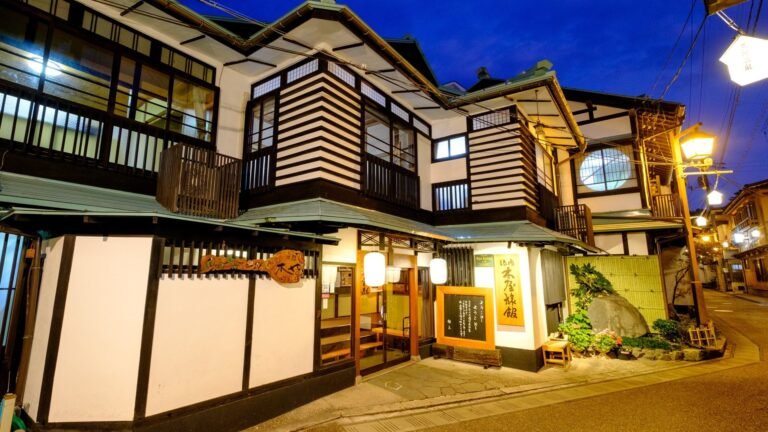
The photo shows Ginzan Onsen in Yamagata, one of the onsen towns JNTO names, with its wooden inns along the river. Places like this are where a ryokan night makes the most sense.
A hotel suits a different pattern. Are you moving between cities and staying several nights? If a room with breakfast is enough, a hotel matches what you need. On days when you move from a hotel to a ryokan, send your suitcase ahead with luggage forwarding and carry only an overnight bag.
Check how prices are shown. The JNTO accommodation guide says lodging carries a 10% consumption tax, as of 1 October 2019. Some cities also charge an accommodation tax at a fixed tiered rate. These taxes are usually included in the listed room rate. Our Japan hotel tax guide lists the city rates. Properties with onsen often add the bathing tax as well.
Our Hakone by month and Kusatsu Onsen by month pages help with timing. They show how full lodging was in each month of 2025, from Japan Tourism Agency data.
Minshuku, minpaku and temple stays
Ryokan and hotels are not the only choices. The JNTO guide to minshuku and guesthouses describes minshuku as family-run, guesthouse-style lodgings in the owner’s home, with moderately priced rooms. They are often in rural areas near resorts and holiday spots, and work much like a bed and breakfast. Expect tatami and futon, shared bathrooms, and in many cases you put away your own bedding in the morning.
A minpaku is a private home rented to travellers under the Private Lodging Business Act. The Japan Tourism Agency overview of the Private Lodging Business Act sets the limit at 180 days a year. Licensed lodging under the Inns and Hotels Act has no limit on operating days.
The MHLW information page on minpaku services says every minpaku host needs one of three things. The first is a licence under the Inns and Hotels Act. The second is a notification under the minpaku law, and the third is a certification under the National Strategic Special Zones Act. A home rented without any of these is illegal minpaku. Our guide to guesthouses, hostels and minpaku explains how to check a listing.
A temple stay, or shukubo, is a fourth option, with vegetarian meals and morning prayers. Our temple stay guide covers Koyasan, the best-known place to try one.
Ryokan or hotel: what 98 people in Japan said
On 13–14 October 2026, japan-japan.com ran an online survey of people living in Japan about 32 travel choices. 130 people answered. We removed answers that looked machine-written, one from outside Japan and most of those that contradicted themselves, which left 98. Shares below are of the 98 respondents unless a smaller group is named; they describe these people, not all travellers in Japan. See all 32 comparisons and how we asked.
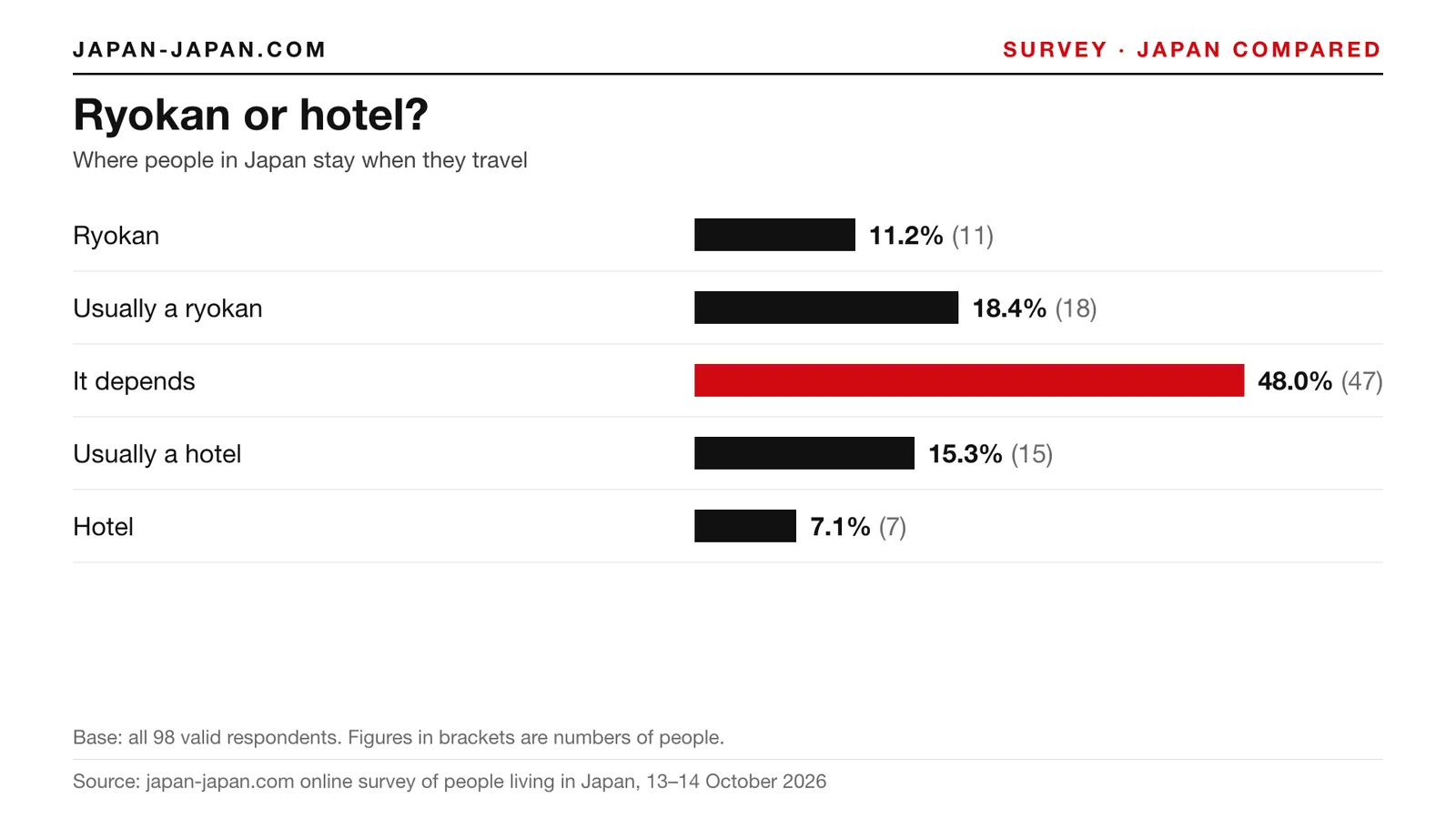
When they travel in Japan, 29.6% (29 people) stay at a ryokan or usually a ryokan, 22.4% (22 people) a hotel or usually a hotel, and 48.0% (47 people) said it depends. The reasons for a ryokan they named most were hot springs (72.4%), dinner and breakfast at the inn (58.2%) and views and gardens (36.7%); for a hotel, sleeping in a bed (56.1%), a lower price (43.9%) and eating where they like (38.8%).
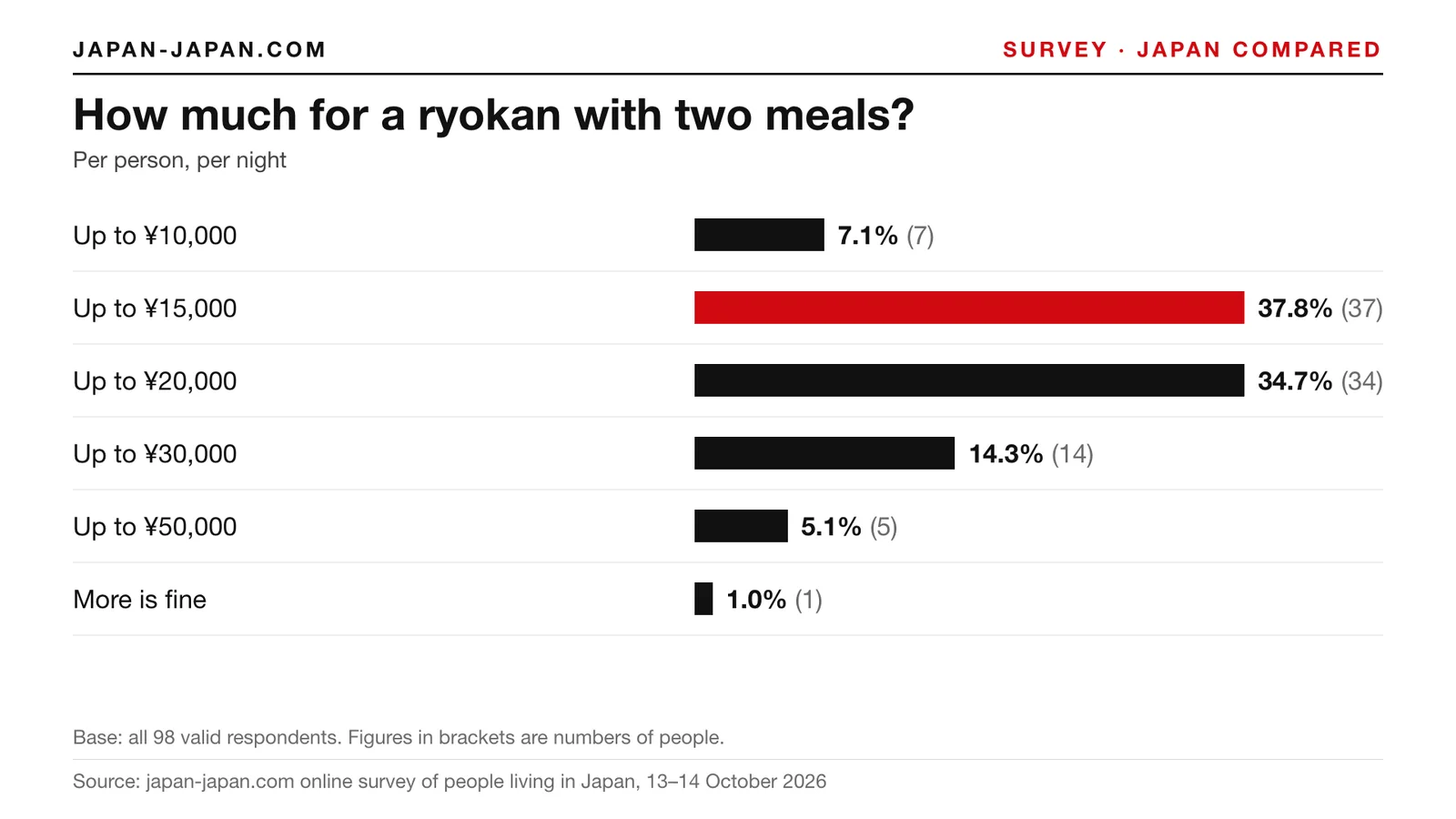
85.7% (84 people) would tell a friend coming to Japan to spend one night at a ryokan: 23.5% (23 people) definitely and 62.2% (61 people) if they can afford it. For one night with dinner and breakfast, 79.6% (78 people) would pay up to ¥20,000 per person; the most common answer was up to ¥15,000 (37.8%).
“If you want to feel Japan where you sleep, a ryokan. If you want to feel it while sightseeing, a hotel.”
— Woman in her 20s, Chubu. Original Japanese (excerpt): 「日本っぽさを宿泊先で味わいたいなら旅館。観光で味わいたいならホテル。」
“If in doubt, a hotel. Ryokan are their own thing.”
— Man in his 40s, Hokkaido. Original Japanese (excerpt): 「迷ったらホテル。旅館は独特」
FAQ
Is a ryokan the same as an onsen?
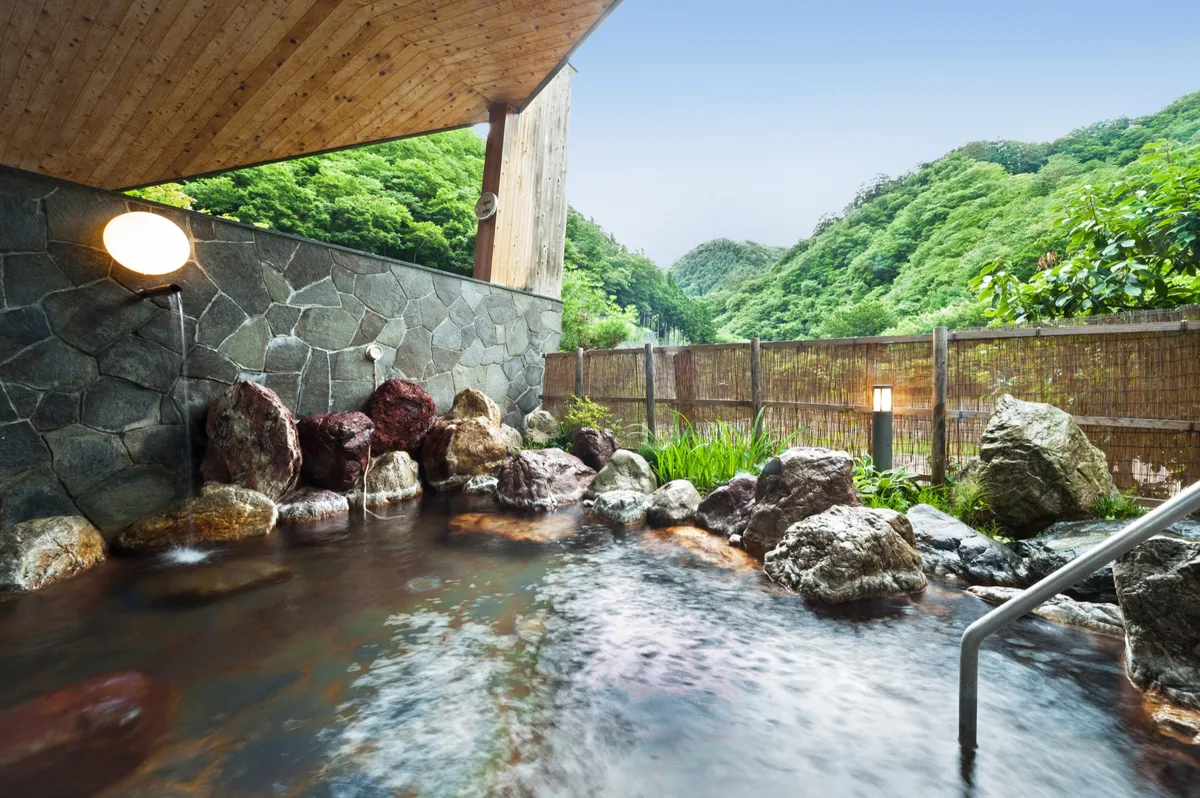
No. An onsen is a hot spring or the bath it feeds, and a ryokan is a traditional inn. JNTO says most ryokan have an onsen, and onsen towns such as Hakone and Ginzan are built around the springs. Many cities also have day-use baths you can visit without staying the night.
Is a ryokan legally a hotel in Japan?
Yes. Since 15 June 2018, ryokan and hotels share one category, ryokan/hotel business, under the Inns and Hotels Act. Before that date they had separate licences, with different minimum room sizes and room counts. The name on the sign is now the owner’s choice.
Can you stay at a ryokan without dinner?
Yes, at some ryokan. JNTO says some ryokan offer stays without meals, although most stays include a kaiseki dinner and a Japanese breakfast. Look for a room-only plan when you book. Then you are free to eat out in town.
How is a ryokan different from a minshuku or a minpaku?
A minshuku is a family-run guesthouse in the owner’s home, often with shared baths, where you usually put away your own futon. A minpaku is a private home rented under the Private Lodging Business Act, limited to 180 days a year. A ryokan holds the full ryokan/hotel licence and usually serves dinner and breakfast.
About the author