Checked against the official page on · Report a correction
Suica is a prepaid IC card: tap it on the ticket gate and the fare is taken from the balance, and it also works as e-money in shops. PASMO is an IC card for transportation and shopping. It pays train and bus fares and cashless payments at participating stores.
Suica and PASMO side by side
| Suica | PASMO | |
|---|---|---|
| Issued by | JR East | PASMO Co., Ltd. |
| Main area | Tokyo area plus Sendai, Niigata, Aomori and more | Metro Tokyo area |
| Price | 1,000 / 2,000 / 3,000 / 4,000 / 5,000 / 10,000 yen | 1,000 yen incl. 500 yen deposit |
| Deposit | 500 yen | 500 yen (refundable) |
| Expiry | Invalid after 10 years unused | Invalid after 10 years unused |
| Refund | 220 yen fee; deposit back | Return the card; balance + 500 yen deposit |
| Where to buy | JR East multifunction machines and ticket offices | Ticket machines and station pass counters; no credit cards |
The details, card by card
Issued by
- Suica
- Suica is a JR East IC card that can be used on trains, buses and for shopping.
- PASMO
- PASMO's rules define PASMO as the IC-chip card, able to record monetary value, that is issued by PASMO Co., Ltd.
Main area
- Suica
- Suica works on trains, subways, buses and monorails in the Tokyo metropolitan area, and on some public transport in Sendai, Niigata, Aomori, Morioka, Akita, Hokkaido, Tokai, West Japan, Kyushu and Okinawa.
- PASMO
- With PASMO you can travel all over the metro Tokyo area and use participating railway and bus networks across Japan by touching the card at the ticket gate or the bus farebox. PASMO is not accepted on all train and bus networks in Japan.
Price
- Suica
- JR East lists Suica cards at 1,000, 2,000, 3,000, 4,000, 5,000 and 10,000 yen for adults and children.
- PASMO
- PASMO's rules set the sale price of a PASMO at 1,000 yen including a 500 yen deposit. Operators may sell it at other prices in 1,000-yen steps, up to 20,000 yen.
Deposit
- Suica
- A new Suica card includes a 500 yen deposit in its price, and the deposit is refunded when you return the card.
- PASMO
- A 500 yen deposit is included in the price of a new PASMO card. It cannot be used for fares or shopping, and it is refunded when you turn in the card.
Expiry
- Suica
- A Suica card becomes invalid if it is not used for 10 years.
- PASMO
- A PASMO becomes invalid if it is not exchanged, used or topped up for 10 years, counted from the day after the last such use.
Refund
- Suica
- Return a JR East Suica at a JR East station: you get the balance minus a 220 yen fee, plus the 500 yen deposit.
- PASMO
- A PASMO you no longer need can be refunded if you return the card. The stored balance cannot be refunded on its own, and the 500 yen deposit is refunded with it.
Where to buy
- Suica
- Inside the Suica area, My Suica (registered) and Suica cards are sold at JR East multifunction machines, Midori-no-madoguchi ticket offices and operator-assisted reserved-seat machines, and at Shinkansen-station ticket offices. Stations with only partial Suica support do not sell them.
- PASMO
- You can buy a PASMO from a ticket machine at a participating transportation provider, or at the commuter pass ticket counter at the station. Purchase procedures differ by operator, and credit cards are not accepted.
Suica or PASMO? What people living in Japan told us
We ran an online survey of people living in Japan on 13–14 October 2026. The shares below are of the 98 respondents, so they show what people who live in Japan use and recommend, not what visitors do.
We asked: “A friend coming to Tokyo can't decide between Suica and PASMO. What would you tell them?” The most common answer was “They are the same” (38.8%). Next came “Suica” (20.4%), “Put one on your phone” (12.2%) and “PASMO” (2.0%). “Don't know” was chosen by 26.5%.
We asked: “Which transport IC card do you use most?” The most common answer was “Suica” (41.8%). Next came “PASMO” (20.4%), “ICOCA” (15.3%), “Another regional card” (7.1%) and “PiTaPa” (4.1%). “I don't use one” was chosen by 11.2%.
We asked: “Which transport IC cards do you have? (all that apply)” Of the 98 respondents, 48.0% have Suica as a card or on a phone, 28.6% have PASMO and 22.4% have ICOCA. 28.6% have Mobile Suica, Mobile PASMO or Mobile ICOCA on a phone, and 10.2% have no transport IC card.

Suica or PASMO for a friend coming to Tokyo. Source: japan-japan.com online survey of people living in Japan, 13–14 October 2026.
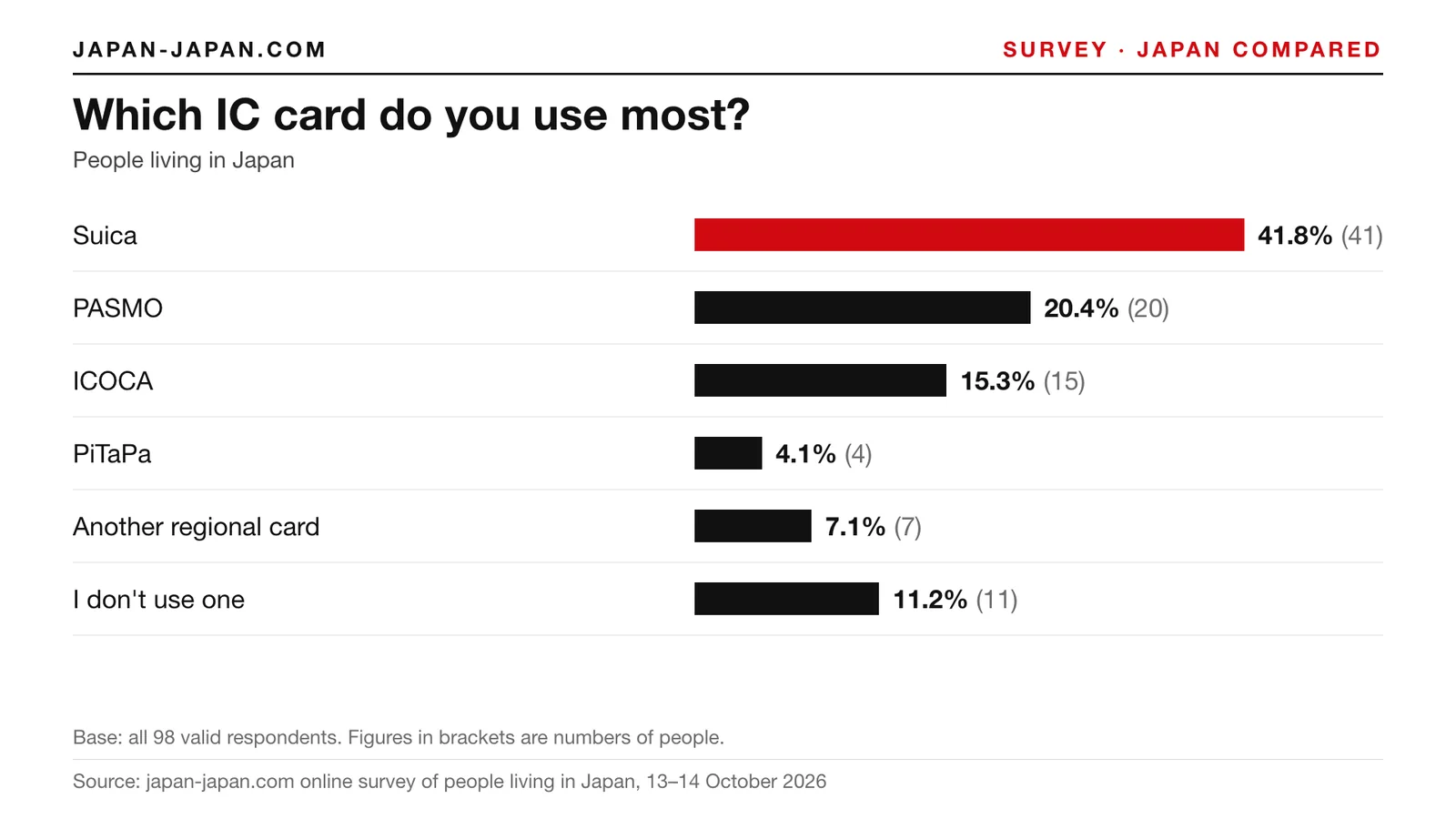
The transport IC card people in Japan use most. Source: japan-japan.com online survey of people living in Japan, 13–14 October 2026.
In their own words
“I went through the gate with PASMO but left the station on a shinkansen ticket, so for about three years the card still showed that I had never exited.”
— Woman in her 30s, Tohoku. Original Japanese (excerpt): 「入場時にパスモを使って駅構内に入ったが、新幹線の切符で退場してしまったので、3年くらい退場処理がされていなかった。」
“My child used their PASMO for the first time in a while and it was locked. The station had no staff, and I had already gone through the gate, so we were stuck.”
— Woman in her 30s, Tokyo. Original Japanese (excerpt): 「子供が久しぶりにPASMOを使おうとしたらロックがかかっていたし、無人駅だし、私(親)は先に改札を通ってしまっていて困りました。」
Frequently asked questions
Is the issued by different on Suica and PASMO?
Suica is a JR East IC card that can be used on trains, buses and for shopping. PASMO's rules define PASMO as the IC-chip card, able to record monetary value, that is issued by PASMO Co., Ltd.
Is the main area different on Suica and PASMO?
Suica works on trains, subways, buses and monorails in the Tokyo metropolitan area, and on some public transport in Sendai, Niigata, Aomori, Morioka, Akita, Hokkaido, Tokai, West Japan, Kyushu and Okinawa. With PASMO you can travel all over the metro Tokyo area and use participating railway and bus networks across Japan by touching the card at the ticket gate or the bus farebox. PASMO is not accepted on all train and bus networks in Japan.
Is the price different on Suica and PASMO?
JR East lists Suica cards at 1,000, 2,000, 3,000, 4,000, 5,000 and 10,000 yen for adults and children. PASMO's rules set the sale price of a PASMO at 1,000 yen including a 500 yen deposit. Operators may sell it at other prices in 1,000-yen steps, up to 20,000 yen.
Is the deposit different on Suica and PASMO?
A new Suica card includes a 500 yen deposit in its price, and the deposit is refunded when you return the card. A 500 yen deposit is included in the price of a new PASMO card. It cannot be used for fares or shopping, and it is refunded when you turn in the card.
Is the refund different on Suica and PASMO?
Return a JR East Suica at a JR East station: you get the balance minus a 220 yen fee, plus the 500 yen deposit. A PASMO you no longer need can be refunded if you return the card. The stored balance cannot be refunded on its own, and the 500 yen deposit is refunded with it.
Read more
- Japan Travel Comparisons: 27 Pairs Answered With NumbersJapan travel comparisons, answered: the Nozomi is 33 min faster than the Hikari for 320…
- What 98 People in Japan Choose: 32 Travel ComparisonsWhat 98 people in Japan choose in 32 travel comparisons: 58.2% take the Nozomi, 58.2% p…
- Suica Card or Mobile Suica: Which Should You Use in 2026?Suica card or Mobile Suica: the phone version skips the 500 yen deposit but needs a com…
- JR Pass vs Suica: Do You Need Both? Real Fares ComparedJR Pass vs Suica: Tokyo to Kyoto and back costs 28,340 yen on normal tickets, 21,660 ye…
Sources for this page
- What’s a Suica (IC Card)?East Japan Railway Company (JR East)
- PASMO取扱規則|PASMO(パスモ)PASMO Co., Ltd.
- SuicaEast Japan Railway Company (JR East)
- What is PASMO?|PASMOPASMO Co., Ltd.
- Purchasing a PASMO Card|PASMOPASMO Co., Ltd.
- Using PASMO|PASMOPASMO Co., Ltd.
- Suica(カードタイプ)の購入方法|Suica(カードタイプ):JR東日本East Japan Railway Company (JR East)