Kyoto vs Osaka: Is It Better to Stay in One and Day-Trip?
The JR times and fares in this guide are JR’s own search results for Wednesday 14 October 2026. They come from the Osaka to Kyoto route page and our other route pages, and count time on the train only.
Kyoto vs Osaka side by side
The table below puts the numbers that decide a base next to each other.
| Item | Kyoto | Osaka |
|---|---|---|
| From Tokyo (Nozomi) | 2 h 7 min, 14,170 yen | 2 h 21 min, 14,720 yen to Shin-Osaka |
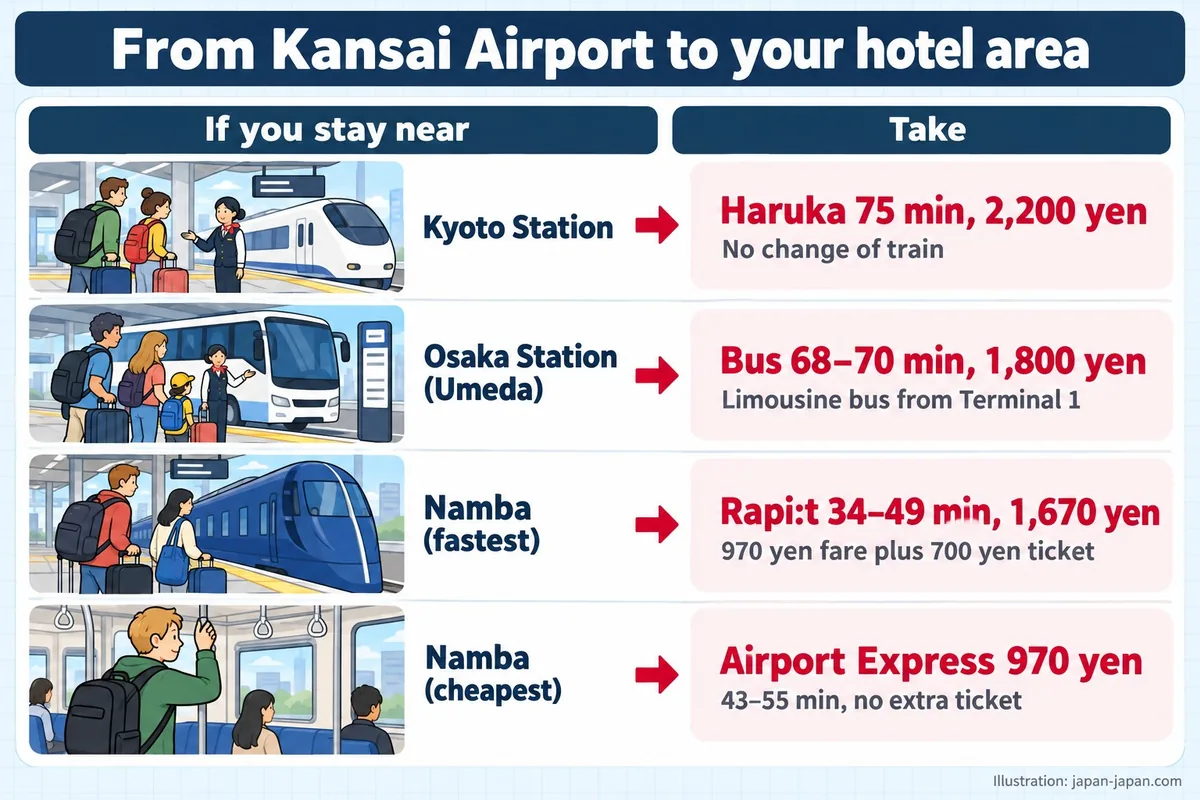
| From Kansai Airport | Haruka 75 min, 2,200 yen | Rapi:t 34–49 min, 1,670 yen to Namba |
| Accommodation tax per night | 200–10,000 yen | None under 5,000 yen, then 200–500 yen |
| 1-day city pass | Subway & Bus 1,100 yen | Enjoy Eco Card 820 yen, weekends 620 yen |
| Yearly precipitation | 1,523 mm | 1,338 mm |
| November average low | 8.4°C | 10.2°C |
| Hotel occupancy, Oct 2025 | 76.8% (Kyoto Prefecture) | 84.9% (Osaka Prefecture) |
The weather is close, with one steady gap. In the Japan Meteorological Agency’s 1991–2020 normals, Kyoto has a lower average low than Osaka in all 12 months. The widest gap is November: 8.4°C in Kyoto against 10.2°C in Osaka, a difference of 1.8°C. Afternoons are almost the same, and the August average high is 33.7°C in both cities.
Kyoto is also wetter. It gets 1,523 mm of precipitation a year against 1,338 mm in Osaka, so 185 mm more. July shows the biggest monthly gap: 223.6 mm in Kyoto and 174.4 mm in Osaka, a difference of 49.2 mm. Monthly figures, clothing levels and events are on the Kyoto weather by month and Osaka weather by month pages.
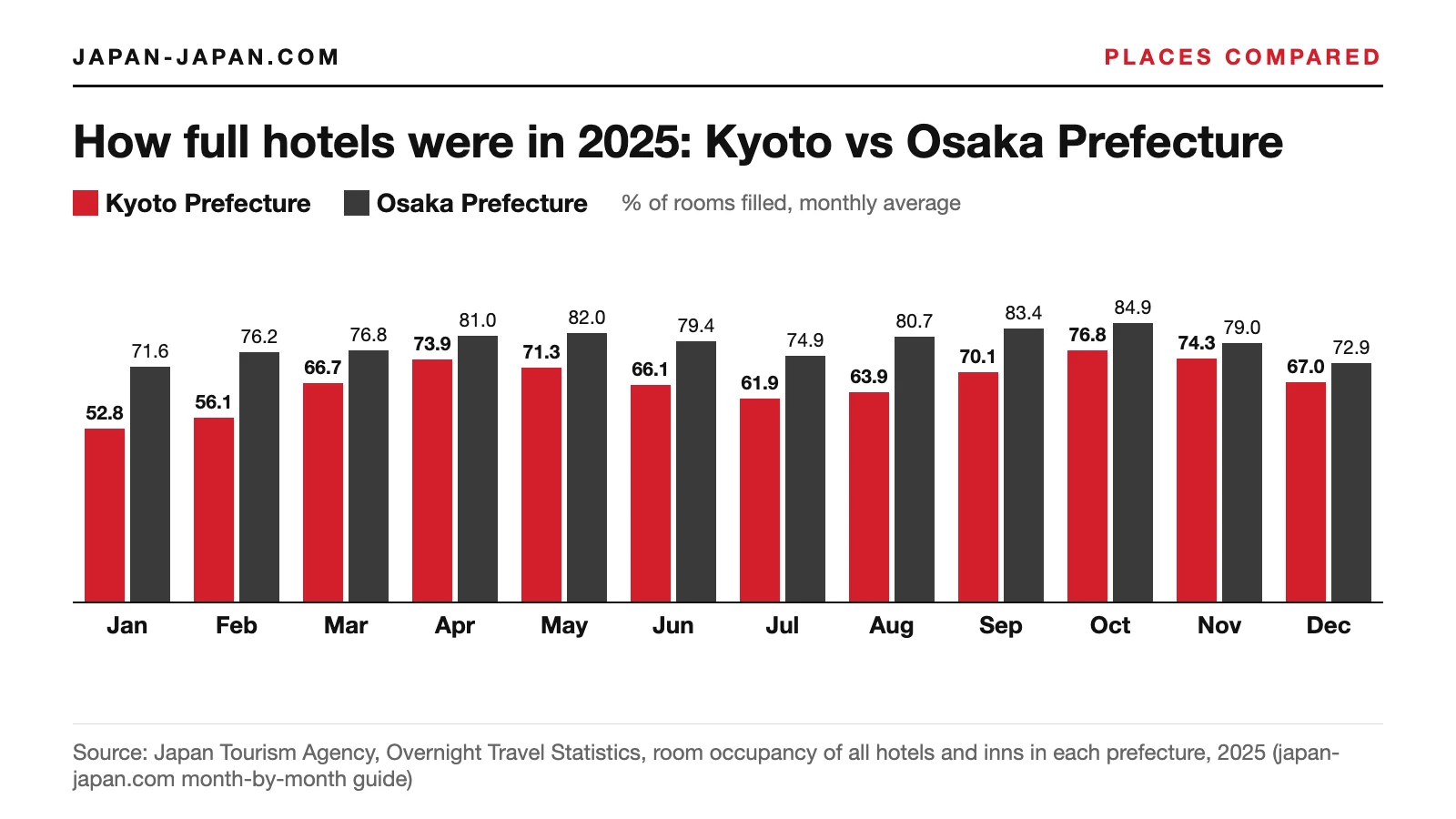
Hotels fill up differently. The Japan Tourism Agency’s 2025 figures for all hotels and inns show Osaka Prefecture fuller than Kyoto Prefecture in every month. In October 2025, the busiest month for both, room occupancy was 76.8% in Kyoto Prefecture and 84.9% in Osaka Prefecture. These are averages for each whole prefecture, not for the two cities alone.
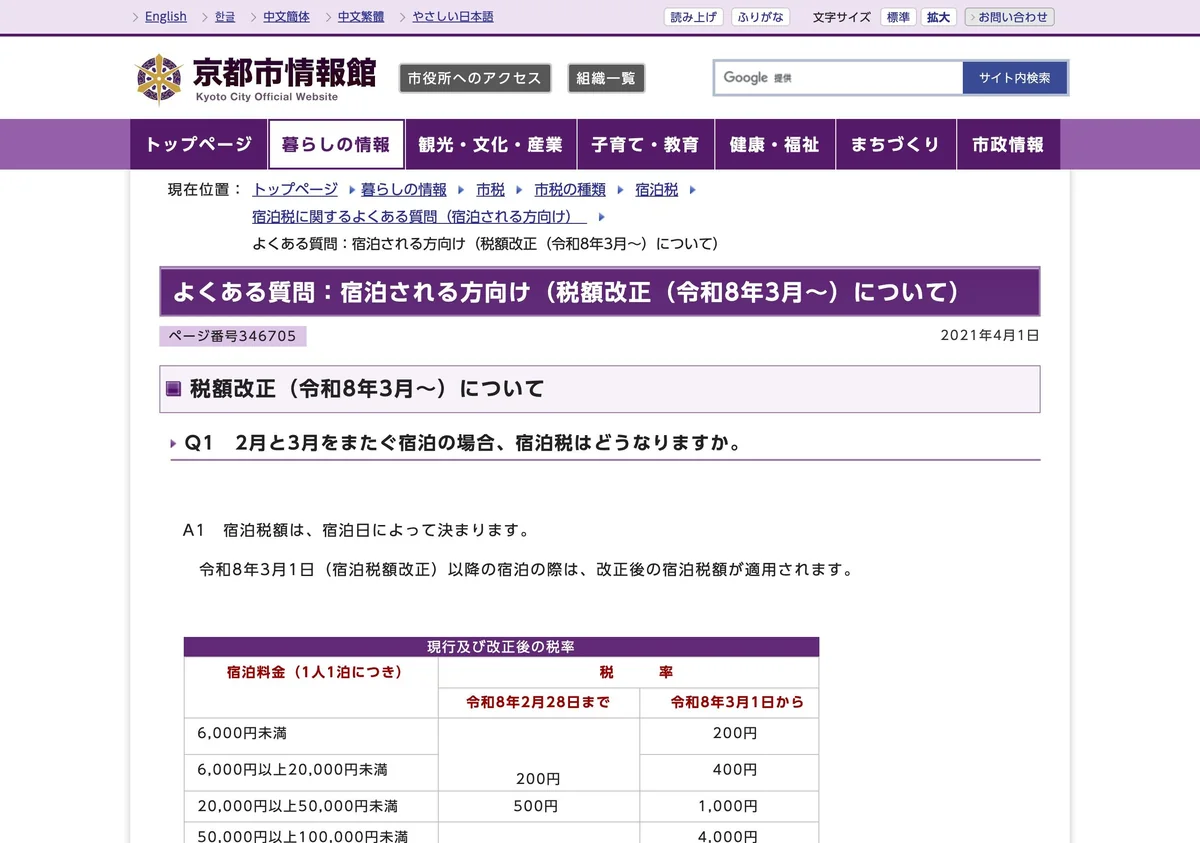
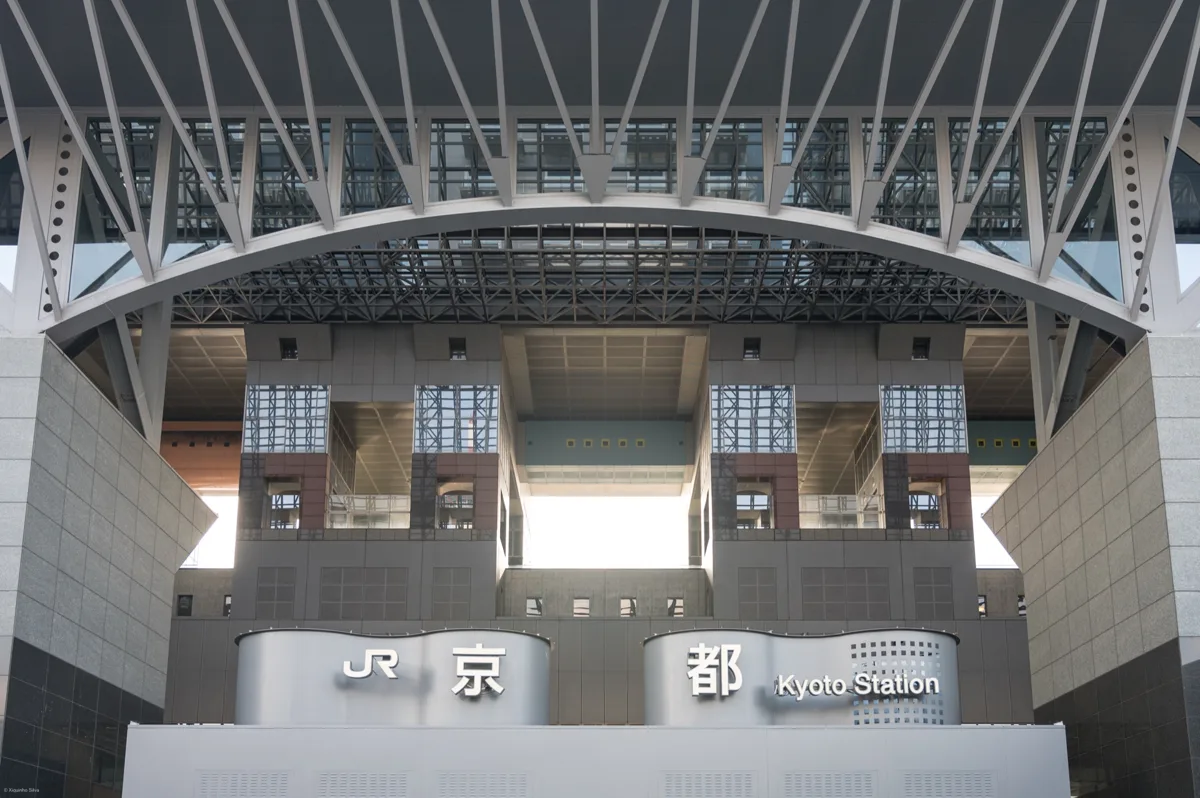
Kyoto’s accommodation tax is the most recent change in the table. The Kyoto City accommodation tax revision FAQ sets the rates until 28 February 2026 next to those from 1 March 2026. The page below shows that table.
Osaka to Kyoto by train: four ways
Four lines link the two cities, from four different stations in Osaka. Choose the one that starts near your hotel.
The photo shows a JR Special Rapid train.
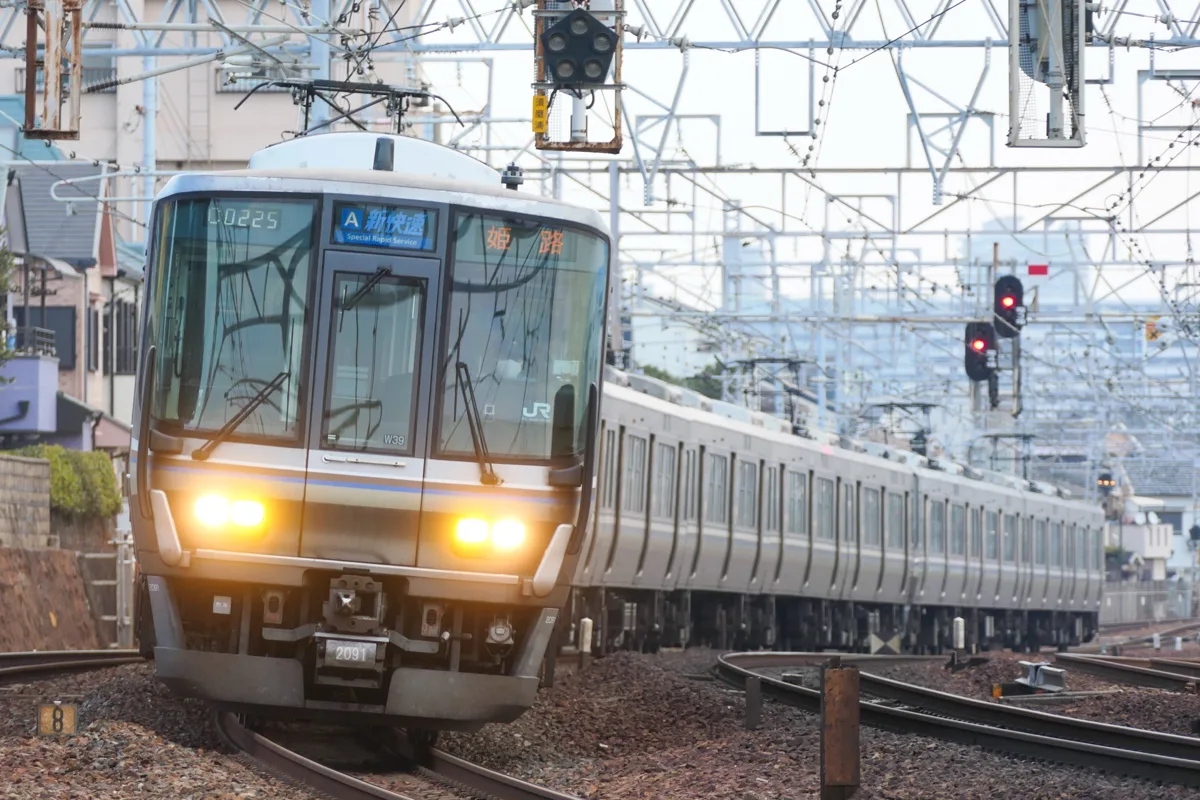
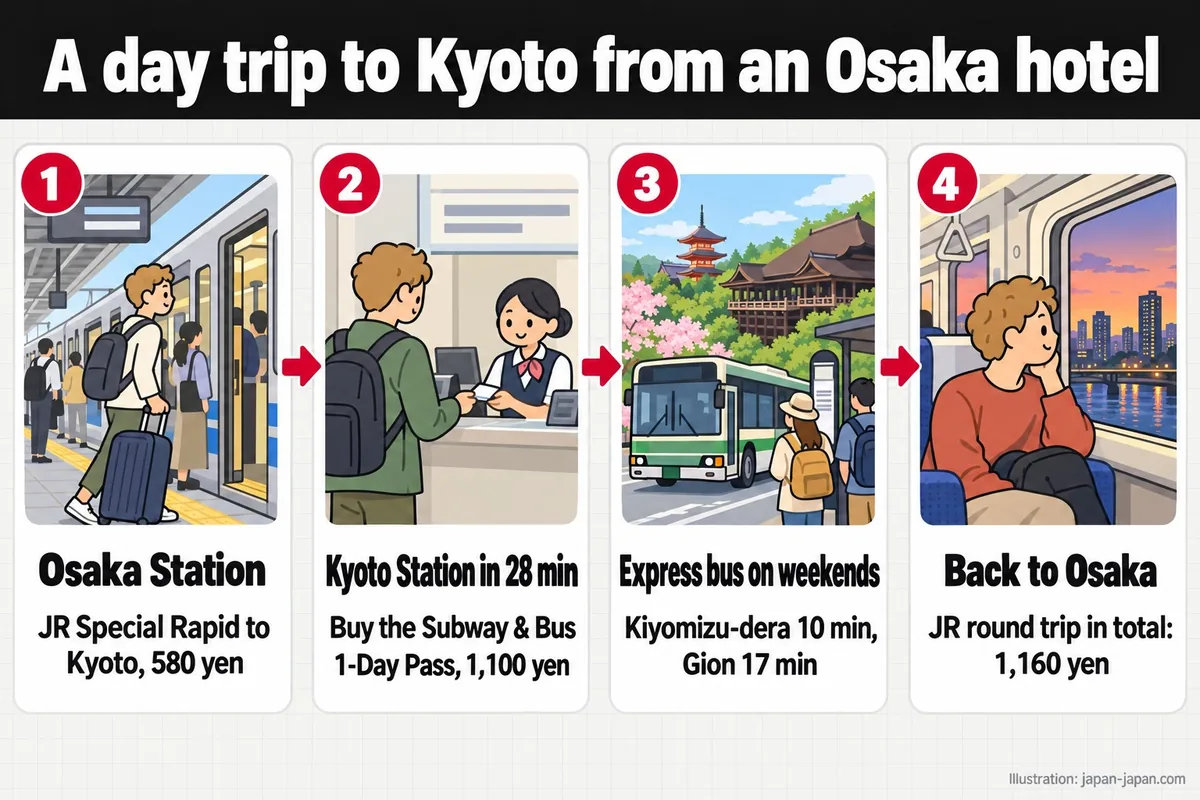
JR Special Rapid. This train needs only the 580 yen fare, with no seat ticket. The fastest run takes 28 min from Osaka Station to Kyoto Station (06:33 to 07:01), and a midday train runs 10:00 to 10:29. The first JR train leaves at 05:00 and the last at 00:00. A round trip costs 1,160 yen.
Tokaido Shinkansen. The Nozomi takes 13 min from Shin-Osaka to Kyoto for 1,450 yen. JR Central’s timetable for 14 October 2026 lists 164 trains from Shin-Osaka to Kyoto, from 06:00 to 22:30. Compared with the Special Rapid, the Shinkansen is 15 min quicker and 870 yen dearer, and it leaves from a different station.
Hankyu. Hankyu runs from Osaka-umeda to Kyoto-kawaramachi for 410 yen, by its official fare search for 14 October 2026. A Limited Express leaving at 14:50 arrives at 15:33, about 43 minutes. PRiVACE reserved seats need a 500 yen seat ticket on top of the fare.
Keihan. Keihan runs from Yodoyabashi to Gion-shijo for 490 yen, a distance of 48.6 km on its fare table. Keihan says its limited express takes about 50 minutes from Osaka to Kyoto with no transfer. The all-reserved Premium Car costs 500 yen extra on this trip, because the ride is longer than 34 km. Visitors from abroad can buy the KYOTO-OSAKA SIGHTSEEING PASS for 1,650 yen (1 day) or 1,850 yen (24 hours).
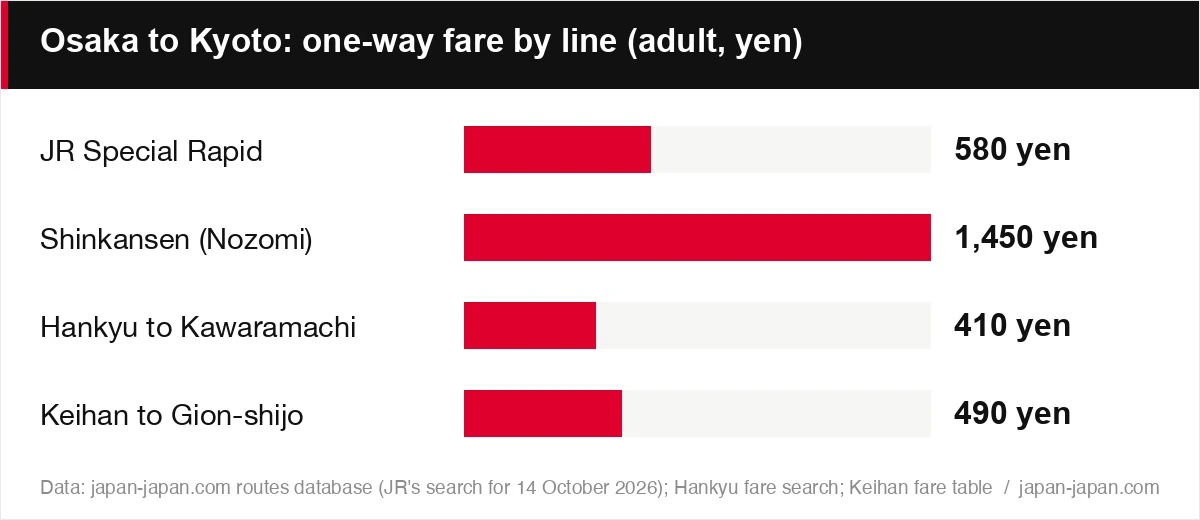
The chart below compares the adult one-way fare on all four lines.
| Item | Value | Note |
|---|---|---|
| JR Special Rapid | 580 yen | Osaka → Kyoto Station |
| Shinkansen (Nozomi) | 1450 yen | Shin-Osaka → Kyoto |
| Hankyu to Kawaramachi | 410 yen | From Osaka-umeda |
| Keihan to Gion-shijo | 490 yen | From Yodoyabashi |
Hankyu is the cheapest at 410 yen and the Nozomi the dearest at 1,450 yen.
Getting there from Tokyo and Kansai Airport
From Tokyo, the Shinkansen favours Kyoto. From Kansai Airport, the trains favour Osaka.
From Tokyo. The fastest Nozomi takes 2 h 7 min from Tokyo Station to Kyoto Station, for 14,170 yen with a reserved seat. That price is a basic fare of 8,360 yen plus a limited express charge of 5,810 yen. The same train reaches Shin-Osaka in 2 h 21 min, for 14,720 yen. So Kyoto is 14 min closer and 550 yen cheaper. A non-reserved seat costs 13,320 yen to Kyoto and 13,870 yen to Shin-Osaka.
JR Central lists 155 trains from Tokyo Station on 14 October 2026, the last at 21:24. Japan Rail Pass rules are on the Tokyo to Kyoto and Tokyo to Osaka route pages.
From Kansai Airport. Trains to Osaka are faster and cheaper than trains to Kyoto. Nankai’s Rapi:t reaches Namba in 34–49 min for 1,670 yen, which is a 970 yen fare plus a 700 yen limited express ticket. Nankai’s Airport Express takes 43–55 min to Namba at the plain 970 yen fare. A limousine bus runs to Namba (OCAT) in 50 min for 1,400 yen.
For Osaka Station (Umeda), JR’s Kansai Airport Rapid Service takes about 65 min with no change. The JR Haruka costs 1,800 yen there with the HARUKA One-way Ticket, and the limousine bus takes 68–70 min, also for 1,800 yen. For Kyoto Station, the Haruka takes about 75 min for 2,200 yen, and the limousine bus 85–88 min for 2,800 yen. The HARUKA One-way Ticket is only for holders of a foreign passport.
The illustration below sums up which ride to take for each hotel area.
See Kansai Airport to Kyoto, Kansai Airport to Osaka Station and Kansai Airport to Namba for each ride. Haruka tickets are on the Haruka airport express page. For Osaka’s two airports, read Kansai vs Itami Airport.
Accommodation tax and how full hotels get
Both places charge an accommodation tax per person per night, paid where you stay. Kyoto City taxes every guest, while Osaka Prefecture leaves cheap rooms out.
Kyoto City. From 1 March 2026, the Kyoto City accommodation tax rates page sets five bands by the room price per person per night.
- Under 6,000 yen: 200 yen.
- 6,000 yen to under 20,000 yen: 400 yen.
- 20,000 yen to under 50,000 yen: 1,000 yen.
- 50,000 yen to under 100,000 yen: 4,000 yen.
- 100,000 yen or more: 10,000 yen.
The room price means the room and its service charge, without meals or consumption tax. Until 28 February 2026, Kyoto had three amounts: 200 yen, 500 yen and 1,000 yen. The date of your stay sets the rate, so a night from 1 March 2026 pays the new amount even if you booked earlier. If you prepaid the old amount, you pay the difference to the property. The tax covers every guest, even at illegal private lodgings.
The page below is the Kyoto City tax page with the five bands, in Japanese.
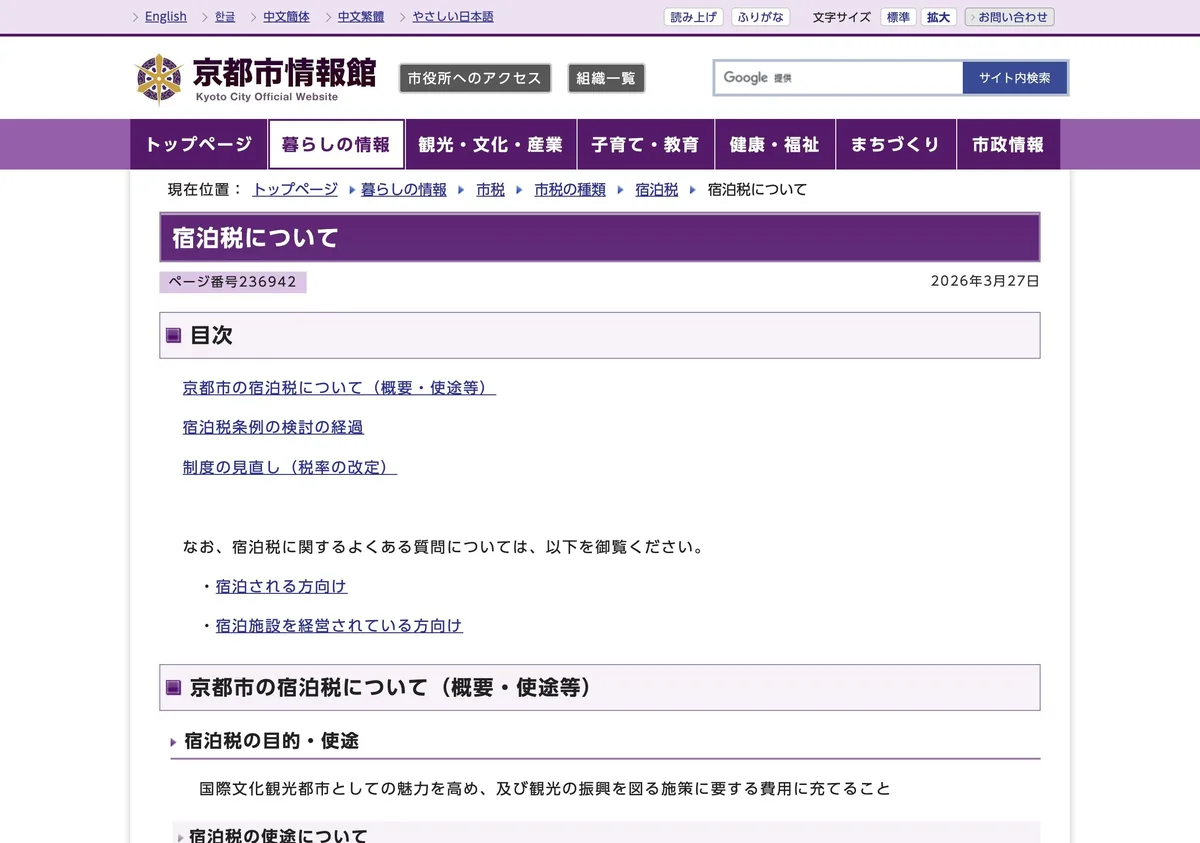
Pay the tax at your accommodation. If a booking website or travel agency already collected it, you do not pay it again.
Osaka Prefecture. The Osaka Prefecture accommodation tax revision page lists four bands from 1 September 2025.
- Under 5,000 yen: no tax.
- 5,000 yen to under 15,000 yen: 200 yen.
- 15,000 yen to under 20,000 yen: 400 yen.
- 20,000 yen or more: 500 yen.
Before that date, rooms under 7,000 yen paid nothing and the rest paid 100 yen, 200 yen or 300 yen. The Osaka Prefecture accommodation tax Q&A says it covers hotels, ryokan, simple lodgings and minpaku anywhere in the prefecture. It uses the room-only price without meals, and you pay it to the property with the room charge. Osaka Prefecture introduced the tax on 1 January 2017.
Rates for other cities are in the Japan accommodation tax guide.
How full hotels get. By the Japan Tourism Agency’s figures, Osaka Prefecture’s hotels were fuller than Kyoto Prefecture’s in all 12 months of 2025. Kyoto Prefecture peaked at 76.8% in October and dropped to 52.8% in January. Osaka Prefecture peaked at 84.9% in October and dropped to 71.6% in January. The gap was widest in February, at 20.1 points, and narrowest in November, at 4.7 points.
Sights: entry fees and opening hours
The Kyoto temples in this guide close between 17:00 and 18:00 on most days. The Osaka observation decks stay open until 21:45 or 22:30.
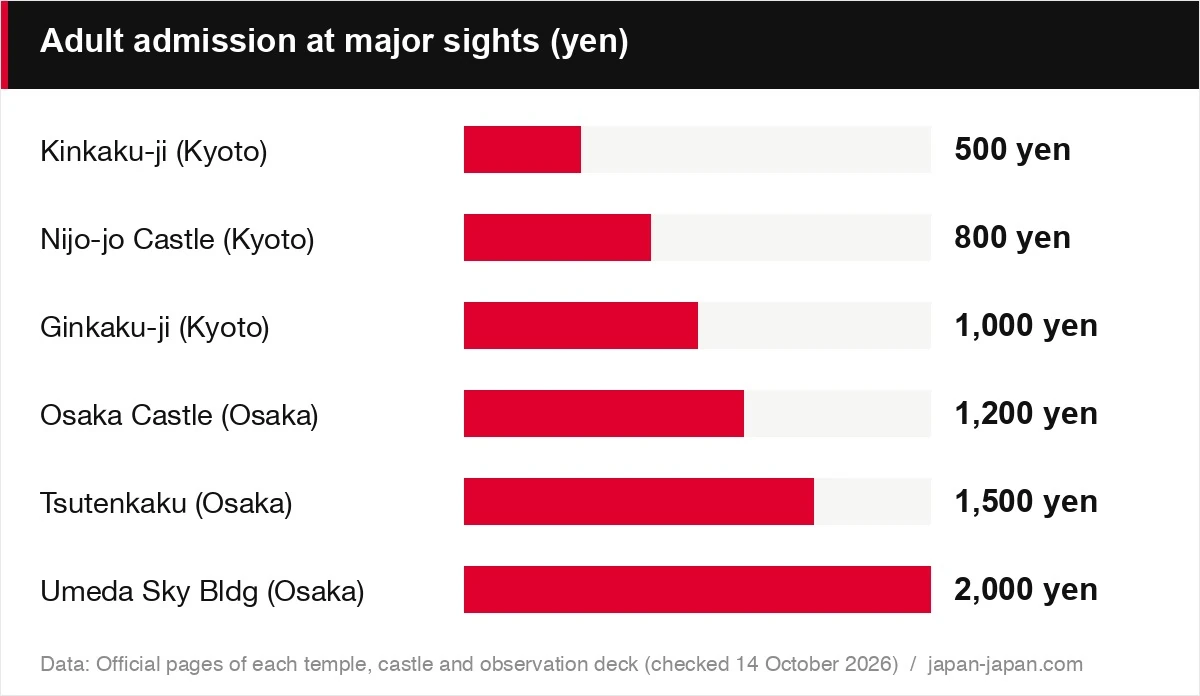
Kinkaku-ji. Open 9:00 to 17:00 every day of the year. Admission is 500 yen for adults.
Ginkaku-ji. Open 8:30 to 17:00 from 1 March to 30 November, and 9:00 to 16:30 from 1 December to the end of February. Admission is 1,000 yen for adults.
Nijo-jo Castle. The Nijo-jo Castle admission fees page lists 800 yen for castle admission and 1,300 yen with the Ninomaru-goten Palace. Entry runs from 8:45 to 16:00, the castle closes at 17:00, and it is shut from 29 to 31 December. The Ninomaru-goten Palace is also closed from 26 December to 3 January and on Tuesdays in January, July, August and December.
Kiyomizu-dera. The gates open at 6:00 and close at 18:00 for most of the year. They close at 18:30 from 1 July to 13 August and from 17 to 31 August. During the autumn night viewing, from 21 to 30 November 2026, they close at 21:30, with last entry at 21:00.
The photo shows the main hall and wooden stage of Kiyomizu-dera.
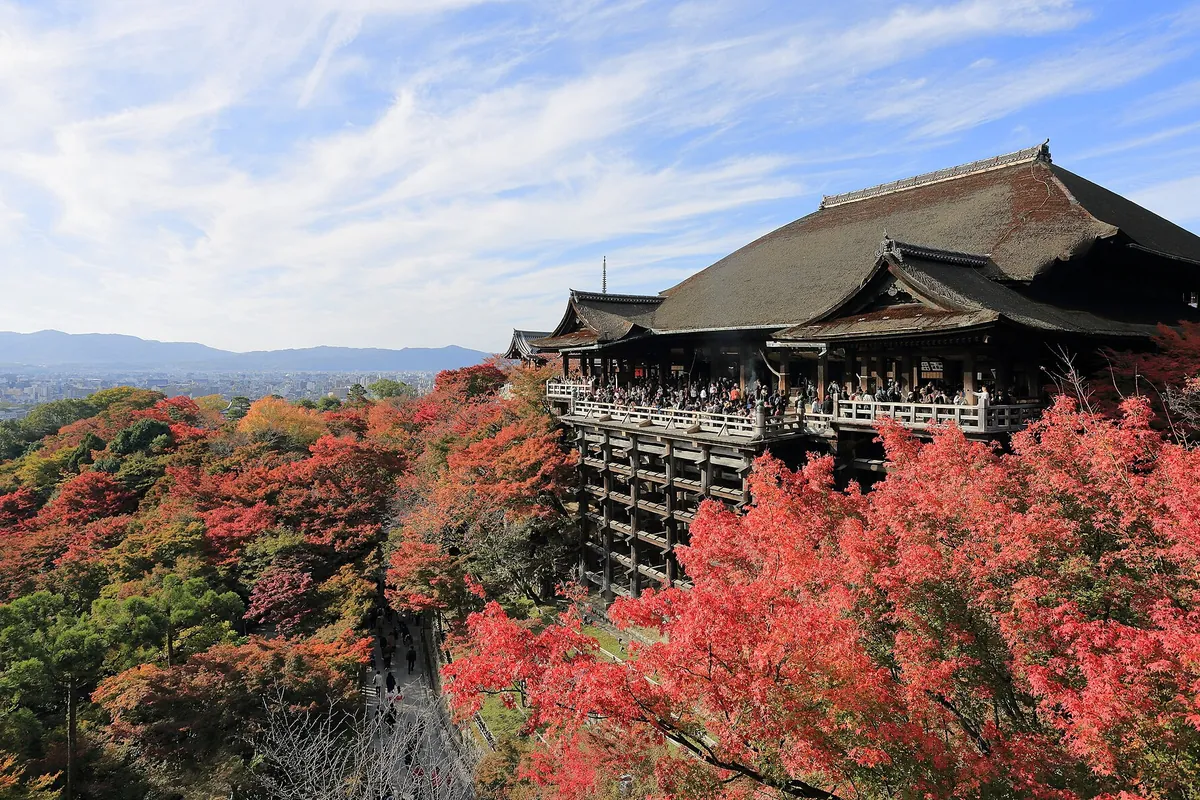
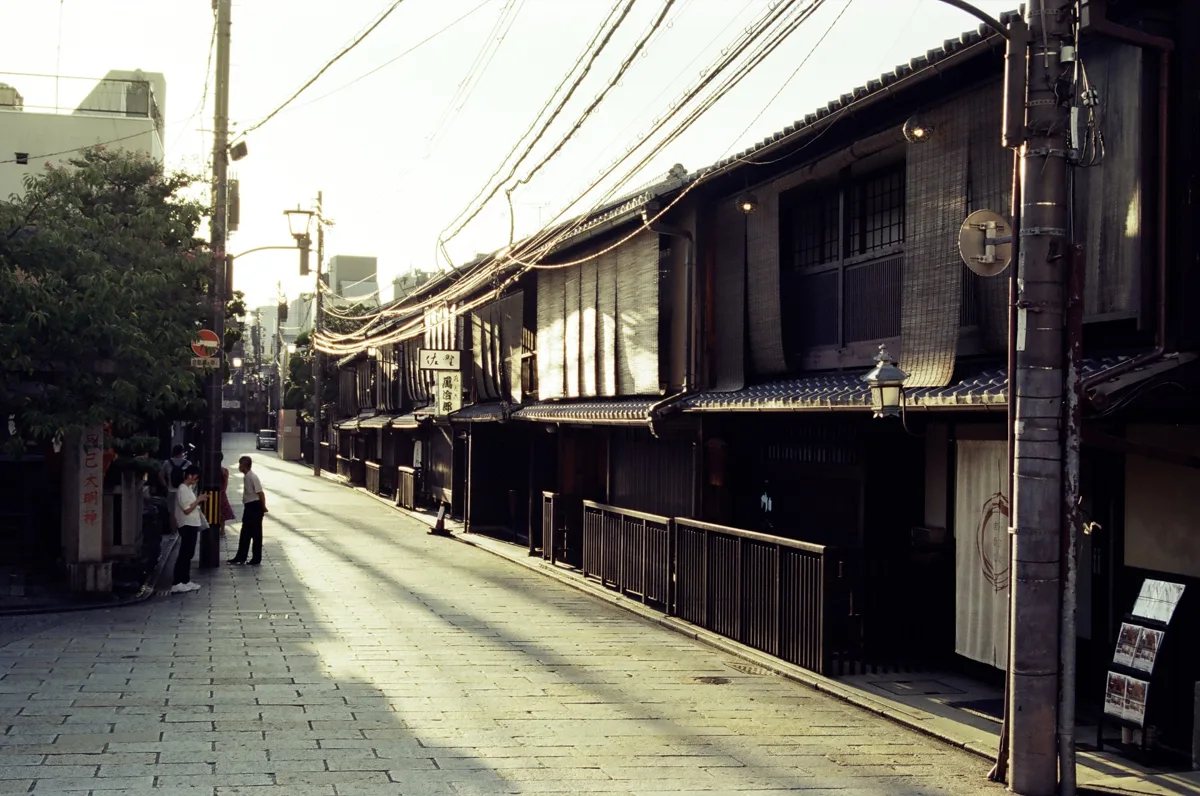
For Fushimi Inari Taisha, see the Fushimi Inari Shrine entrance fee guide. In Gion, the Gion-machi Minamigawa district council puts up notice boards against photography and entry on private roads. The Kyoto City autumn 2025 tourism manners measures page announced them. The district also asks visitors not to stop, touch, follow or photograph geiko and maiko without permission.
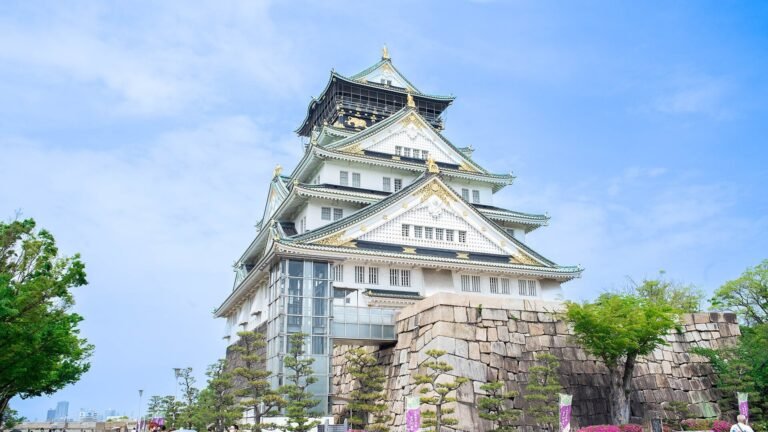
Osaka Castle Main Tower. Admission has been 1,200 yen for adults since 1 April 2025. Junior high school students and younger enter free. It opens from 9:00 to 18:00, with last entry at 17:30, and closes from 28 December to 1 January.
Tsutenkaku. The general observation deck costs 1,500 yen for adults and opens from 9:00 to 21:45. From 30 December 2026 to 3 January 2027, the adult price is 1,800 yen. You reserve an entry time when you buy the ticket.
Umeda Sky Building. The Kuchu Teien Observatory costs 2,000 yen for adults and opens from 9:30 to 22:30, with last entry at 22:00. The OSAKA AMAZING PASS gets you in free from 9:30 to 15:00.
Kaiyukan. The aquarium sets its prices by demand. Its October 2026 calendar shows adult tickets from 2,800 yen to 3,500 yen, depending on the day.
The chart below compares adult admission at six of these sights.
| Item | Value |
|---|---|
| Kinkaku-ji (Kyoto) | 500 yen |
| Nijo-jo Castle (Kyoto) | 800 yen |
| Ginkaku-ji (Kyoto) | 1000 yen |
| Osaka Castle (Osaka) | 1200 yen |
| Tsutenkaku (Osaka) | 1500 yen |
| Umeda Sky Bldg (Osaka) | 2000 yen |
For food markets, see Nishiki Market vs Kuromon vs Tsukiji. For teamLab, see teamLab in Tokyo, Kyoto, Osaka and Fukuoka.
Buses, subway and 1-day passes
Each city sells its own day pass, and each covers only that city’s lines.
Kyoto Subway and Bus 1-Day Pass. The Kyoto City Subway and Bus 1-Day Pass page sets the price at 1,100 yen for adults and 550 yen for children. It covers both subway lines and every city bus route, including outside the flat-fare zone. It works only on the day you first use it, not for 24 hours. At a subway ticket window, ask for a 地下鉄・バス1日券 (chikatetsu basu ichinichi-ken), which means subway and bus one-day ticket.
One city bus ride in the flat-fare zone costs 230 yen, and the Kyoto City Subway 1-Day Pass costs 800 yen. On the day you use the Kyoto Subway and Bus 1-Day Pass, Nijo-jo Castle charges adults 700 yen instead of 800 yen.
The photo shows a Kyoto City Bus.
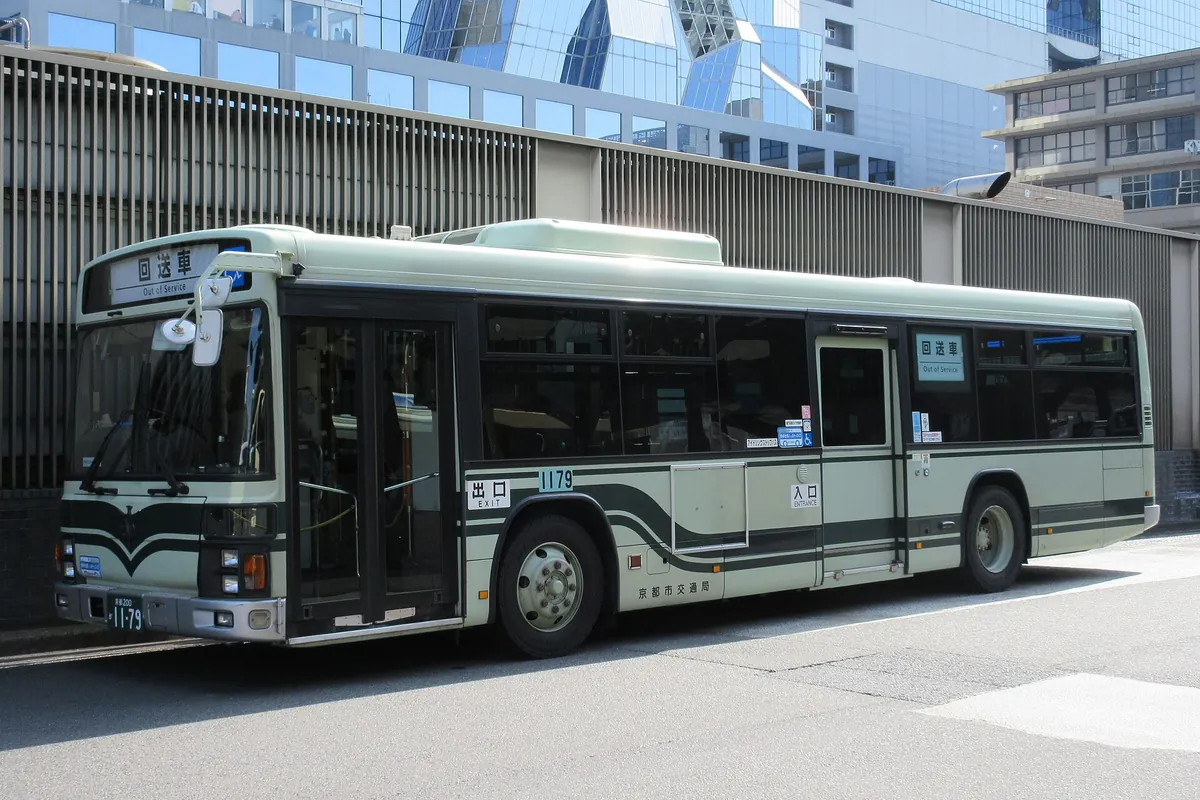
Sightseeing Limited Express Bus. Since 1 June 2024, Kyoto City Bus has run the EX100 and EX101 on Saturdays, Sundays and holidays. The fare is 500 yen for adults and 250 yen for children. From Kyoto Station it takes 10 min to Kiyomizu-dera (Gojozaka), 17 min to Gion and 30 min to Ginkakuji-mae. On those mornings, buses leave toward Kiyomizu-dera every 7–8 minutes. The Kyoto City Bus Sightseeing Limited Express Bus page confirms that the Subway and Bus 1-Day Pass is valid on it.
The old bus-only pass (700 yen) stopped selling on 30 September 2023 and could be used until 31 March 2024. In a 2018 survey, 90% of its buyers lived outside the city. The Kyoto City Bus 1-Day Pass page explains what replaced it.
The illustration below shows a day trip to Kyoto from a hotel in Osaka.
Osaka. The Enjoy Eco Card covers Osaka Metro and Osaka City Bus routes. It costs 820 yen on weekdays and 620 yen on Saturdays, Sundays and holidays. The OSAKA AMAZING PASS costs 3,500 yen for 1 day or 5,000 yen for 2 days. It adds the New Tram and private railways mainly within Osaka City, plus free entry to about 40 sightseeing spots. There is no child version.
For ICOCA and Suica, see IC cards in Kyoto, IC cards in Osaka and ICOCA or PiTaPa.
Kyoto or Osaka: where should you stay?
Decide by your route and your schedule. A base that turns out wrong costs only 28 min and 580 yen each way by JR.
- Arriving from Tokyo by Shinkansen: Kyoto. It is 14 min closer and 550 yen cheaper than Shin-Osaka.
- Flying in or out of Kansai Airport: Osaka. Namba is 34–49 min away by Rapi:t, or 970 yen by Airport Express.
- Early temple visits: Kyoto. Kiyomizu-dera opens at 6:00, and the first JR train from Osaka reaches Kyoto Station at 05:46.
- Evening views: Osaka. Umeda Sky Building stays open until 22:30 and Tsutenkaku until 21:45.
- Rooms under 5,000 yen a night: Osaka. Osaka Prefecture charges no tax below that price, and Kyoto City charges 200 yen.
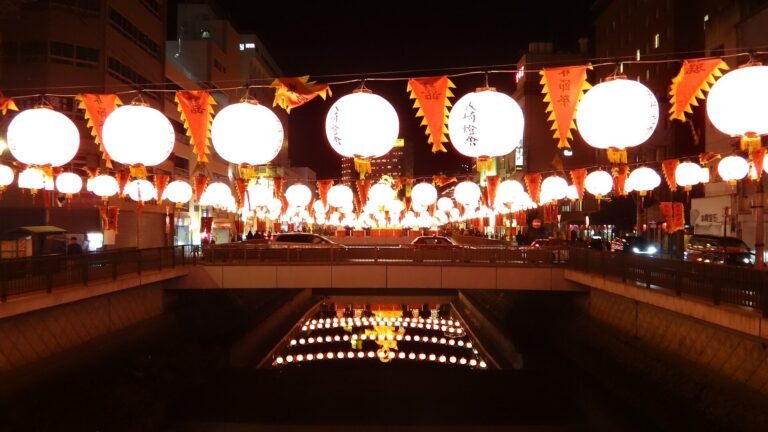
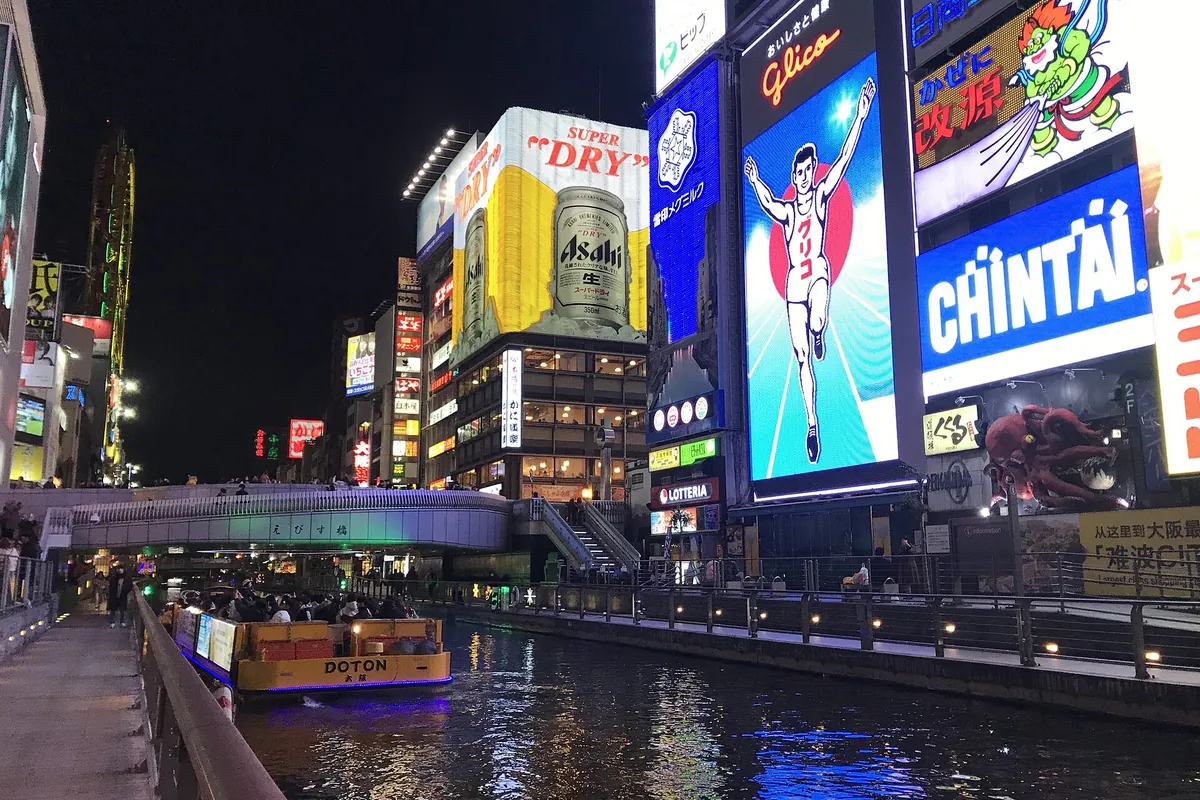
The photo shows the Dotonbori canal in Namba, Osaka.
Both cities work as a base for more day trips. From Kyoto, the JR Miyakoji Rapid reaches Nara in 47 min for 720 yen. The JR Rapid reaches Saga-Arashiyama in 11 min for 240 yen. From Osaka, the JR Yamatoji Rapid reaches Nara in 50 min for 840 yen. The JR Special Rapid reaches Sannomiya in Kobe in 21 min for 420 yen. Last trains are on the Kyoto to Nara, Osaka to Nara, Kyoto to Arashiyama and Osaka to Kobe pages.
In November, pack an extra layer for Kyoto, where the average low is 8.4°C against 10.2°C in Osaka. See Kyoto autumn leaves and crowds, Kyoto in November and Osaka in November.
The illustration below turns the two main questions into a quick check.
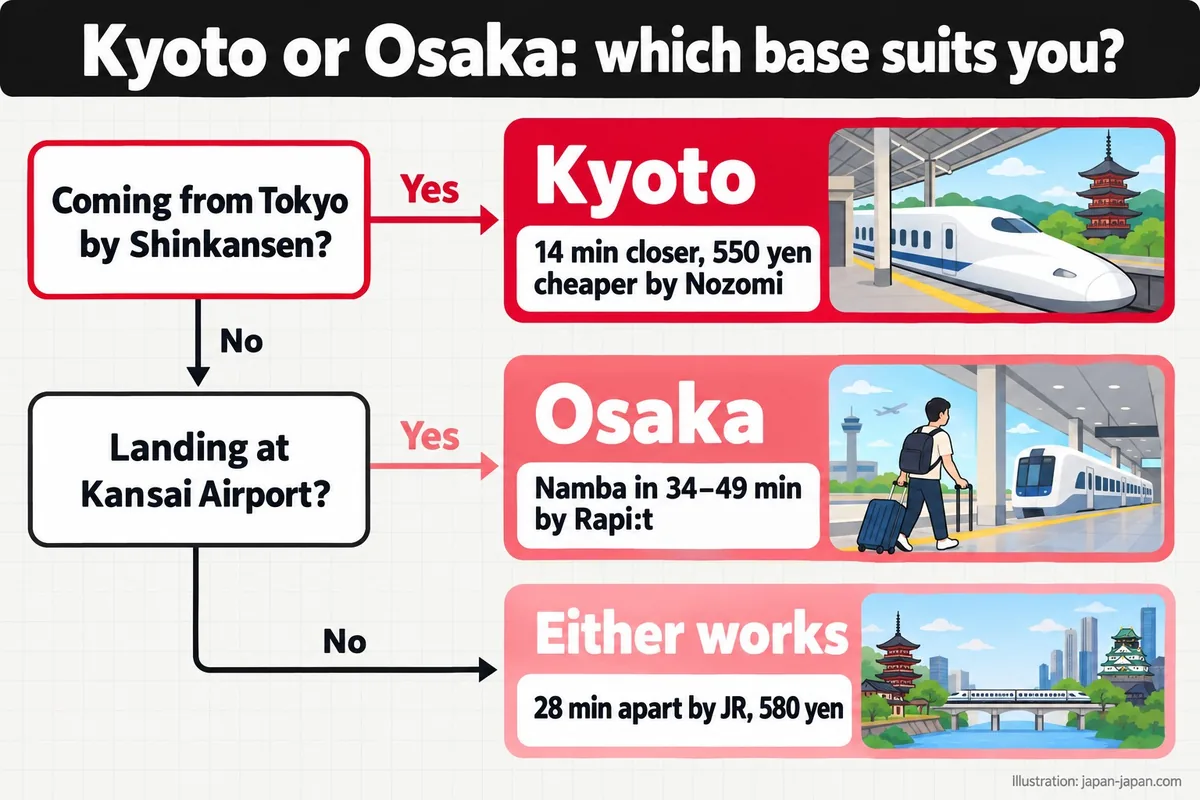
If you stay in Osaka and visit Kyoto for the day, the JR round trip is 1,160 yen. If you split your stay, send big bags ahead with luggage forwarding or leave them in coin lockers for the day. For a longer route, see the 10-day Japan itinerary.
Kyoto or Osaka: what 98 people in Japan would tell a friend
On 13–14 October 2026, japan-japan.com ran an online survey of people living in Japan about 32 travel choices. 130 people answered. We removed answers that looked machine-written, one from outside Japan and most of those that contradicted themselves, which left 98. Shares below are of the 98 respondents unless a smaller group is named; they describe these people, not all travellers in Japan. See all 32 comparisons and how we asked.
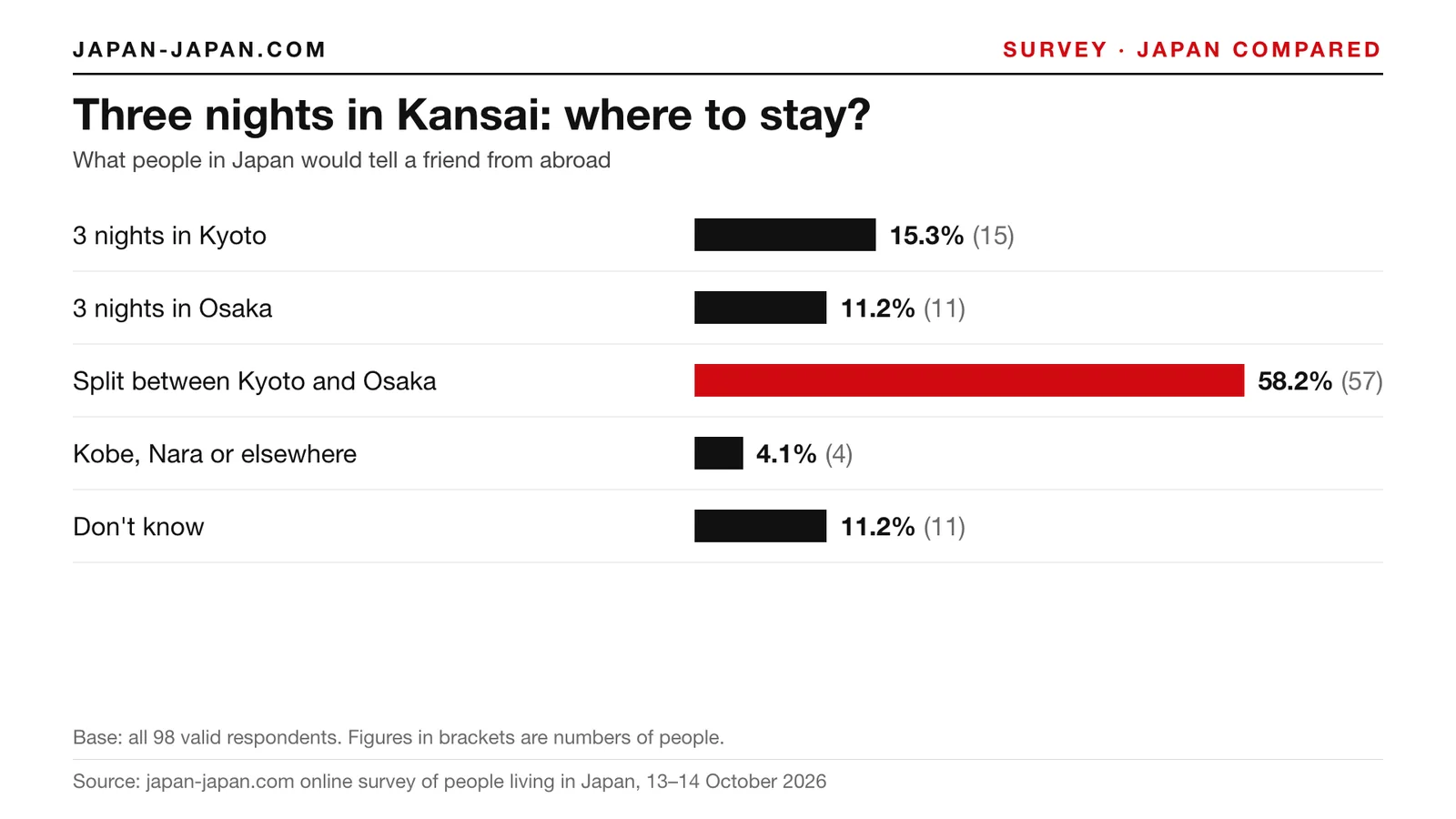
For a friend spending 3 nights in the Kansai area, 58.2% (57 people) would split the stay between Kyoto and Osaka. 15.3% (15 people) would stay all 3 nights in Kyoto and 11.2% (11 people) all 3 in Osaka. The reasons they gave most were being close to the sights (65.3%), good food (30.6%) and easy day trips (28.6%).
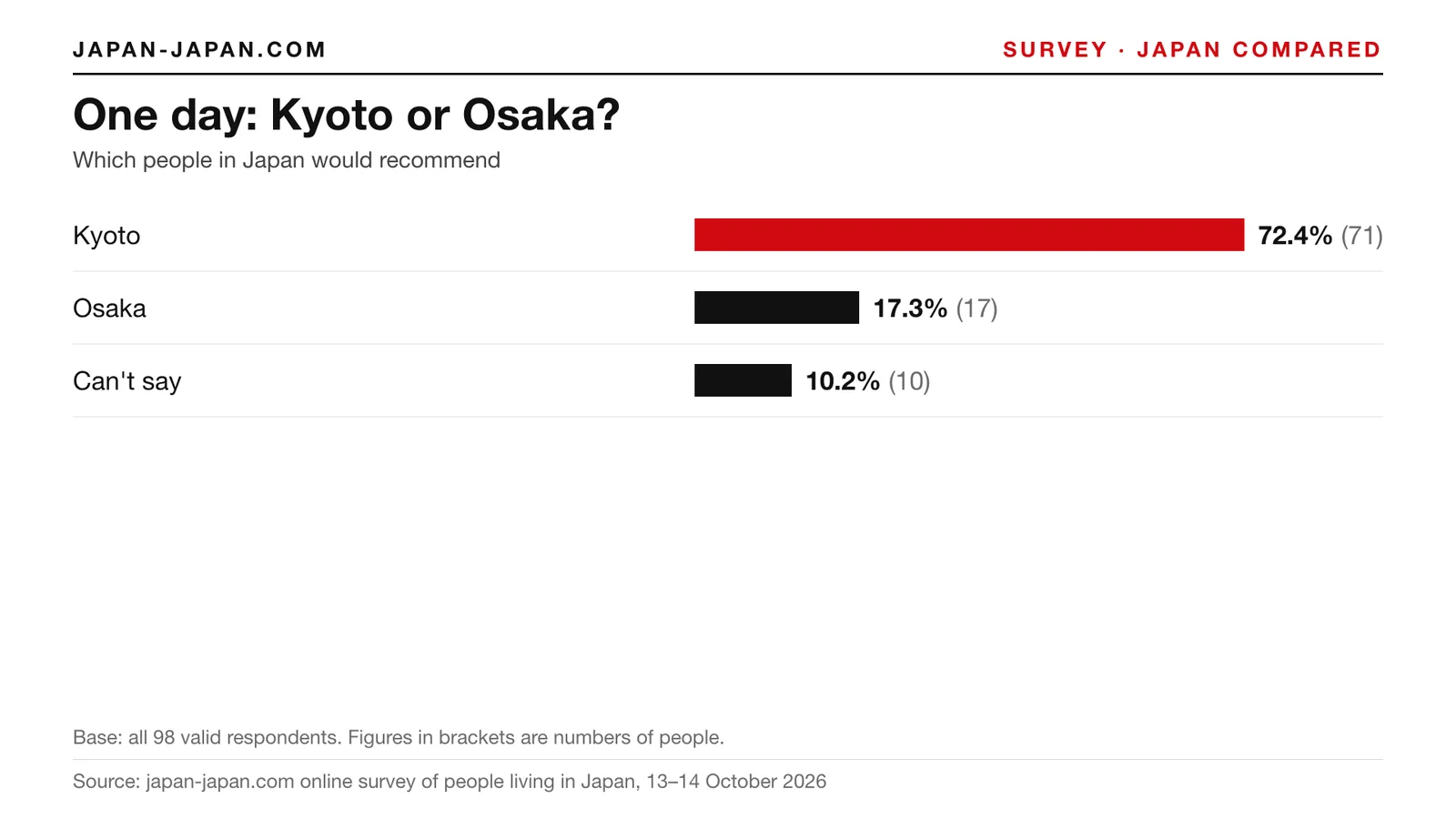
With just one day of sightseeing, 72.4% (71 people) would send a friend to Kyoto and 17.3% (17 people) to Osaka. If a first-time visitor could see only one city in Japan, 49.0% (48 people) chose Kyoto, 30.6% (30 people) Tokyo and 7.1% (7 people) Osaka.
“Osaka, because the food is good and lots of people are kind.”
— Woman in her 20s, Kinki (Osaka and Kyoto area). Original Japanese (excerpt): 「食べ物が美味しくて、優しい人が多いからです。」
FAQ
Is it better to stay in Kyoto or Osaka?
It depends on where you arrive. Stay in Kyoto if you come from Tokyo by Shinkansen: it is 14 min closer and 550 yen cheaper than Shin-Osaka. Stay in Osaka if you use Kansai Airport, where Rapi:t reaches Namba in 34–49 min.
How long does it take to get from Osaka to Kyoto?
The JR Special Rapid takes 28 min at the fastest from Osaka Station to Kyoto Station, for 580 yen. The Nozomi takes 13 min from Shin-Osaka for 1,450 yen. A Hankyu Limited Express takes about 43 minutes to Kyoto-kawaramachi for 410 yen, and Keihan’s limited express about 50 minutes.
Can you visit Kyoto as a day trip from Osaka?
Yes. A JR Special Rapid round trip from Osaka Station costs 1,160 yen. In Kyoto, the Subway and Bus 1-Day Pass costs 1,100 yen and also covers the weekend Sightseeing Limited Express Bus. The Kyoto temples in this guide close between 17:00 and 18:00 on most days, so start early.
Do you pay accommodation tax in both Kyoto and Osaka?
Yes, on different scales. Kyoto City charges every guest 200 yen to 10,000 yen per person per night, depending on the room price. Osaka Prefecture charges nothing for rooms under 5,000 yen, and 200 yen to 500 yen above that. In both places you pay at the property.
About the author