ICOCA or PiTaPa? Fees, Screening and Discounts Compared
The card price comes from the JR West ICOCA purchase page. The PiTaPa rules come from the PiTaPa (Surutto KANSAI) FAQ page. Both cards work on Osaka Metro, Hankyu and Kyoto City Bus. The choice comes down to how you pay and how fast you can get the card.
ICOCA and PiTaPa side by side
ICOCA is issued by JR West. PiTaPa is a payment service from Surutto KANSAI. The table puts the issuers’ own figures next to each other.
| Item | ICOCA | PiTaPa |
|---|---|---|
| How you pay | Prepaid: charge first | Postpay: monthly bank debit |
| Price | 2,000 yen (500 yen deposit included) | No joining or annual fee |
| How to get it | Ticket machine or Midori-no-madoguchi, same day | Online or paper application and screening |
| Delivery | On the spot | 2 weeks at the earliest online; 3 to 4 weeks on paper |
| Who can apply | Anyone; visitor design needs a foreign passport | Main members 18 or older, not high school students |
| Top-up | Cash, balance up to 20,000 yen | Not needed in the postpay area; cash elsewhere |
| Refund fee | 220 yen, deposit returned | 550 yen when you leave with a balance |
| Unused-year cost | None; can expire after 10 years unused | 1,100 yen maintenance fee |
| Paper statement | None | 150 yen per mailed statement |
ICOCA is a plain prepaid card. Put 2,000 yen into a ticket machine with the ICOCA mark. You get 1,500 yen of balance, and the other 500 yen is the deposit. The machine screen switches to English. JR West does not take credit cards for the purchase, so bring cash. Some machines also sell it at 1,000, 3,000, 5,000 and 10,000 yen, each with the same deposit. Our ICOCA card guide covers every place that sells it.
PiTaPa has no joining fee and no annual fee. Its costs sit elsewhere. The Basic Card charges 150 yen to mail each monthly paper statement. You avoid that fee by registering with PiTaPa Club or the PiTaPa app and getting the bill by email. If the card goes a full year with no train, bus or shopping use, PiTaPa charges a 1,100 yen maintenance fee per member.
JR-West also sells an original design ICOCA only for foreign visitors. The JR-West English guide to ICOCA for visitors lists the rules. You need a passport issued by a government other than Japan and Temporary Visitor status, and the limit is 1 card per person. It costs 2,000 yen, including the 500 yen deposit. Japanese nationals cannot use it, even with permanent residence abroad.
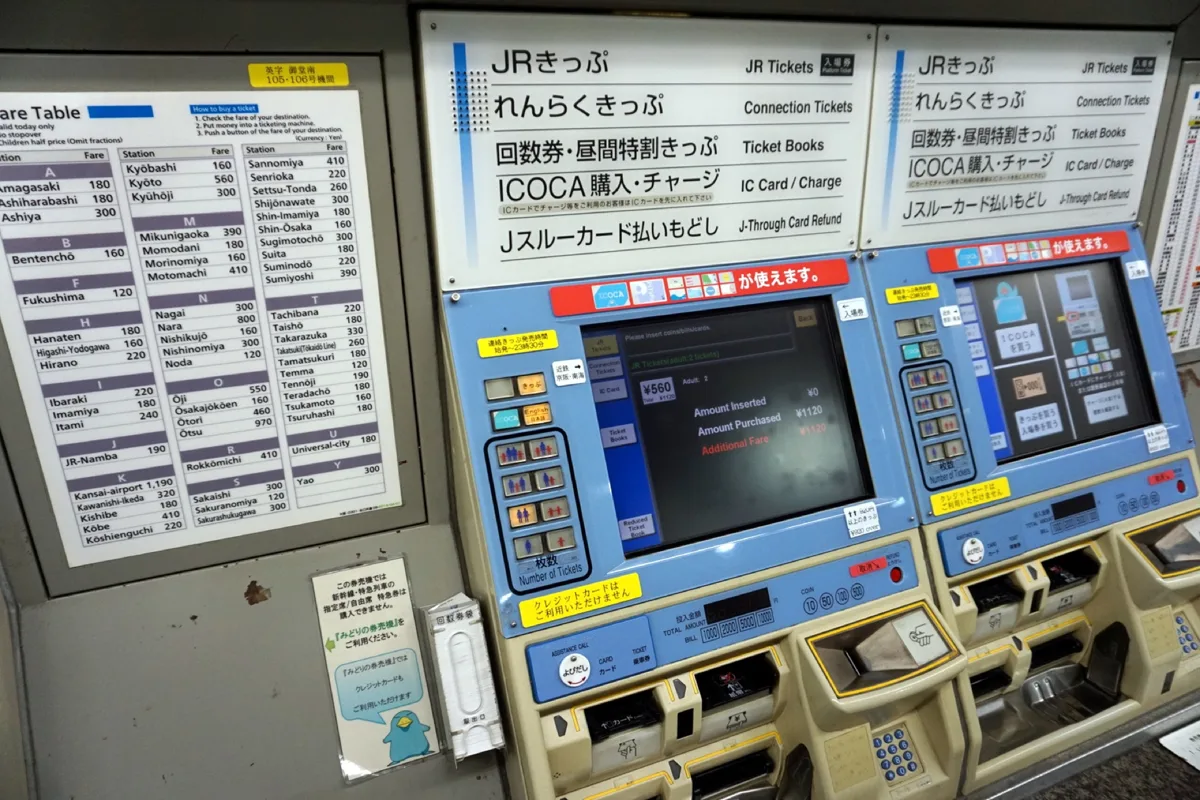
You buy the visitor card only at the JR ticket office at Kansai-airport Station. Look for the sign みどりの窓口 (Midori-no-madoguchi), which means JR ticket office. At Kansai-airport Station it has a counter with English and Chinese support, open from 5:30 to 23:00.
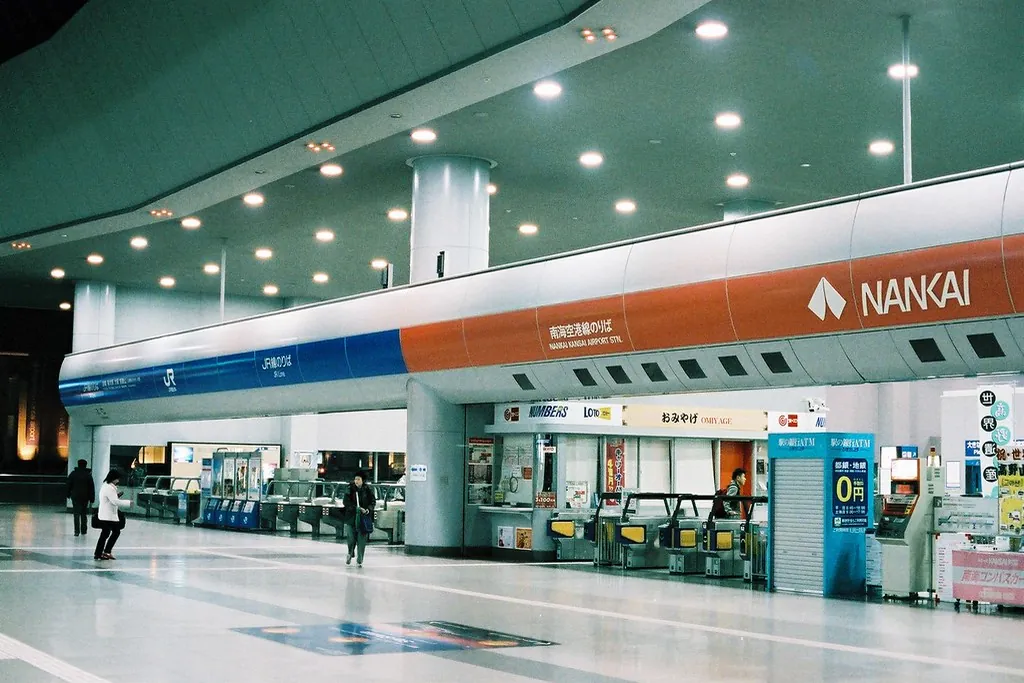
The station in the photo sits just outside the 2nd floor of Terminal 1, and both JR and Nankai sell ICOCA there. Our page on buying ICOCA at Kansai Airport shows the machines and the ticket office. If you also plan to visit Tokyo, our ICOCA vs Suica comparison covers how the two JR cards differ.
Prepaid vs postpay, and where each card works
ICOCA works like a wallet. You charge it first, and each fare comes off the balance. The JR West ICOCA charging rules page sets the limits: cash only, in steps of 1,000, 2,000, 3,000, 5,000 or 10,000 yen. You cannot charge past a 20,000 yen balance. Mobile ICOCA, ICOCA on Apple Pay and SMART ICOCA Quick Charge are the exceptions to the cash rule. Our guide to topping up an IC card shows the machines.
PiTaPa works like a monthly bill. It adds up what you ride and buy from the 1st to the last day of each month. The total is then debited from the bank account you named. On the Basic Card, the debit falls on the 10th of the second month after use.
Postpay only works in certain places. The PiTaPa usage area page splits the map into two kinds of zone. As of April 1, 2026, postpay works in the PiTaPa postpay area and in part of the JR West area. In the rest of the nationwide IC network, you must charge the card first, in cash.
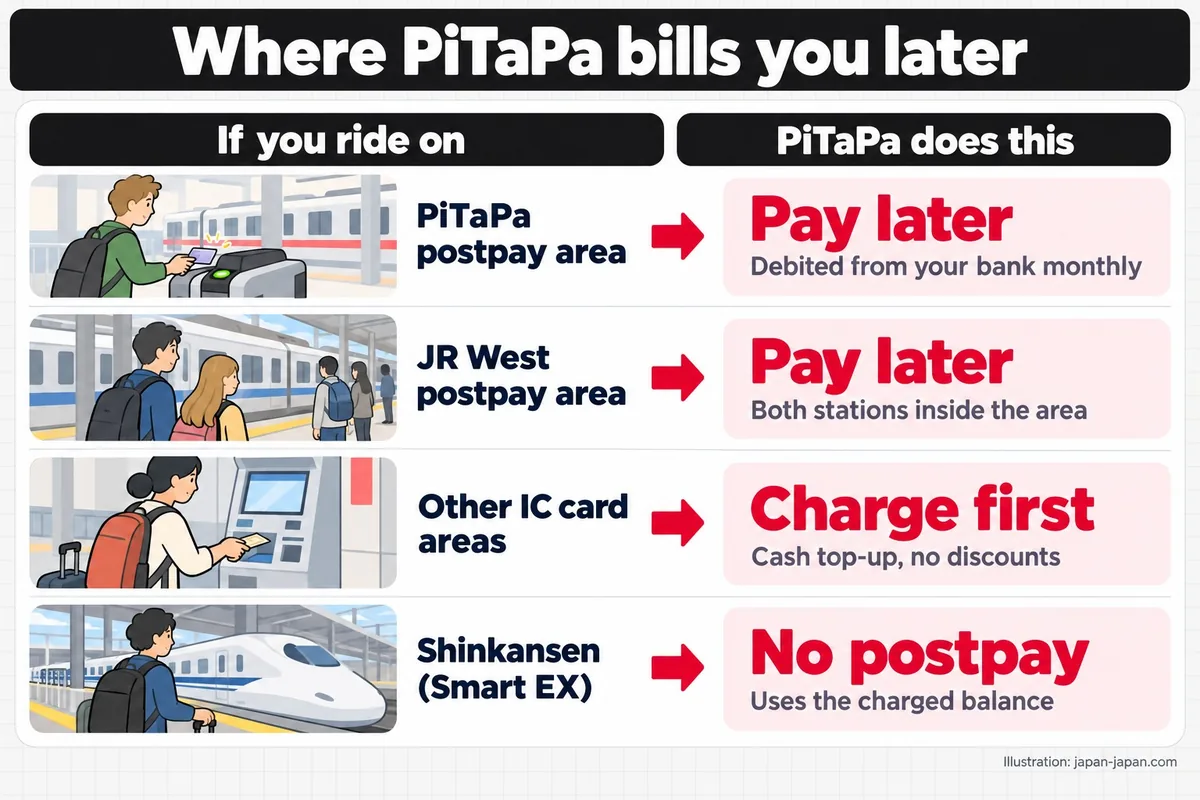
The lookup chart shows where PiTaPa bills you later and where it takes money from the balance. Shinkansen trips through Smart EX or the Shinkansen e-ticket never use postpay. JR West trips that start inside the postpay area and end outside it also come off the balance. Outside the postpay area, PiTaPa discounts do not apply.
Money charged onto a PiTaPa has its own rules. You cannot spend it on shopping or on fares inside the PiTaPa postpay area. If you register for auto-charge, it adds 2,000 yen when the balance drops to 1,000 yen or less at a postpay-area gate. JR West gates do not auto-charge.
ICOCA covers the same railways from the other side. JR-West says ICOCA works in the PiTaPa area, which it lists as Hankyu, Hanshin, Osaka Metro, Keihan, Kintetsu, Nankai and others. You charge it first and pay the ordinary fare, with no PiTaPa discount. ICOCA cannot pay at PiTaPa shopping member stores. At JR West stations, PiTaPa cannot pay at ICOCA member stores either.
For the systems most visitors ride, both cards work. Osaka Metro accepts PiTaPa and ICOCA on the subway and Osaka City Bus, where every adult fare is a flat 210 yen. Hankyu lists both, including Mobile ICOCA. Kyoto City Bus and Subway list both too. Our pages on IC cards in Osaka and IC cards in Kyoto go line by line.
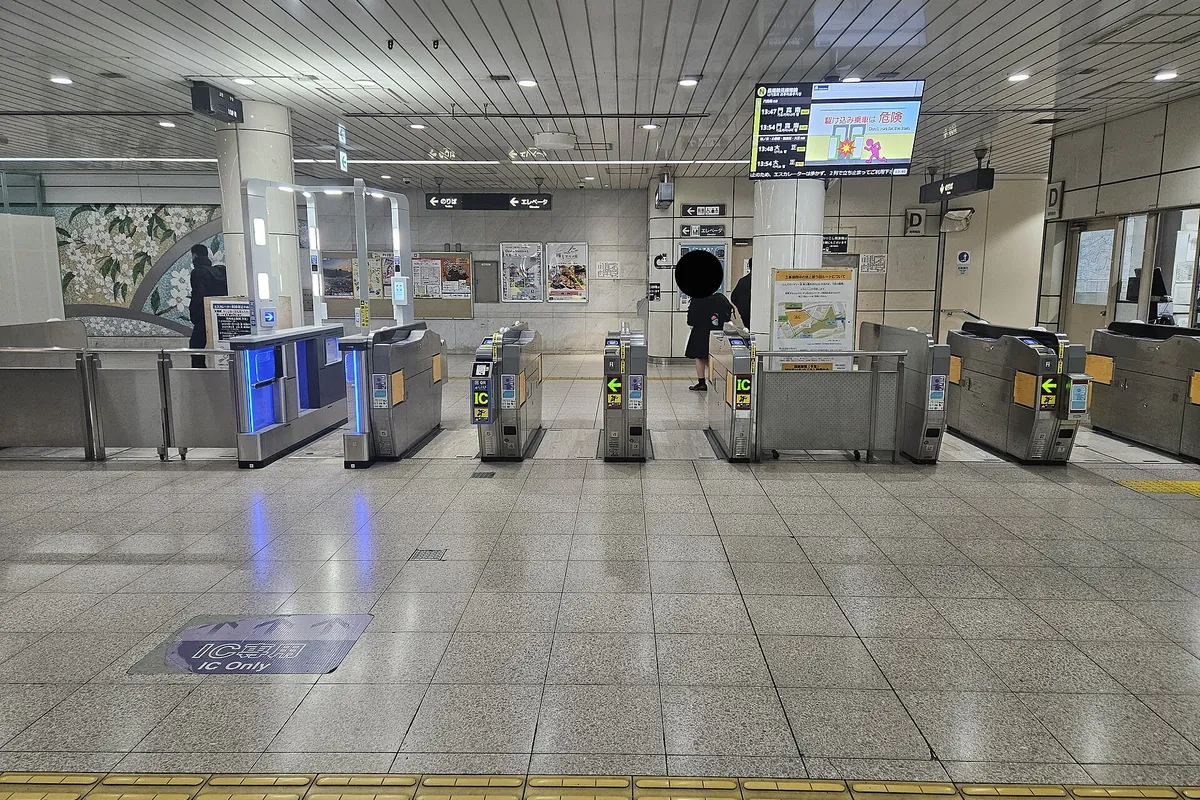
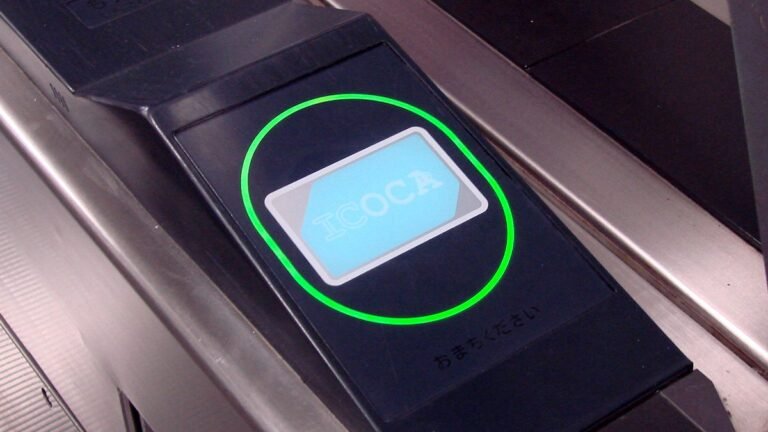
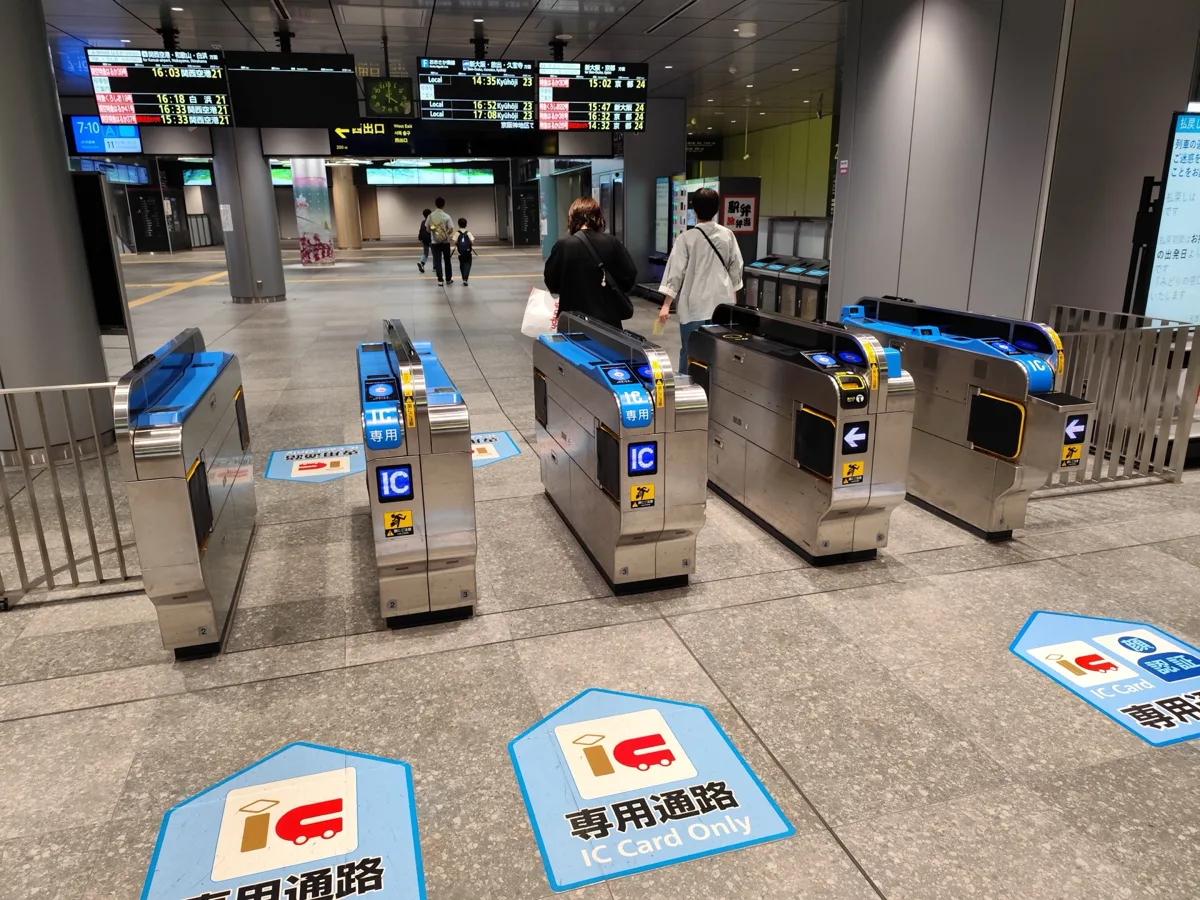
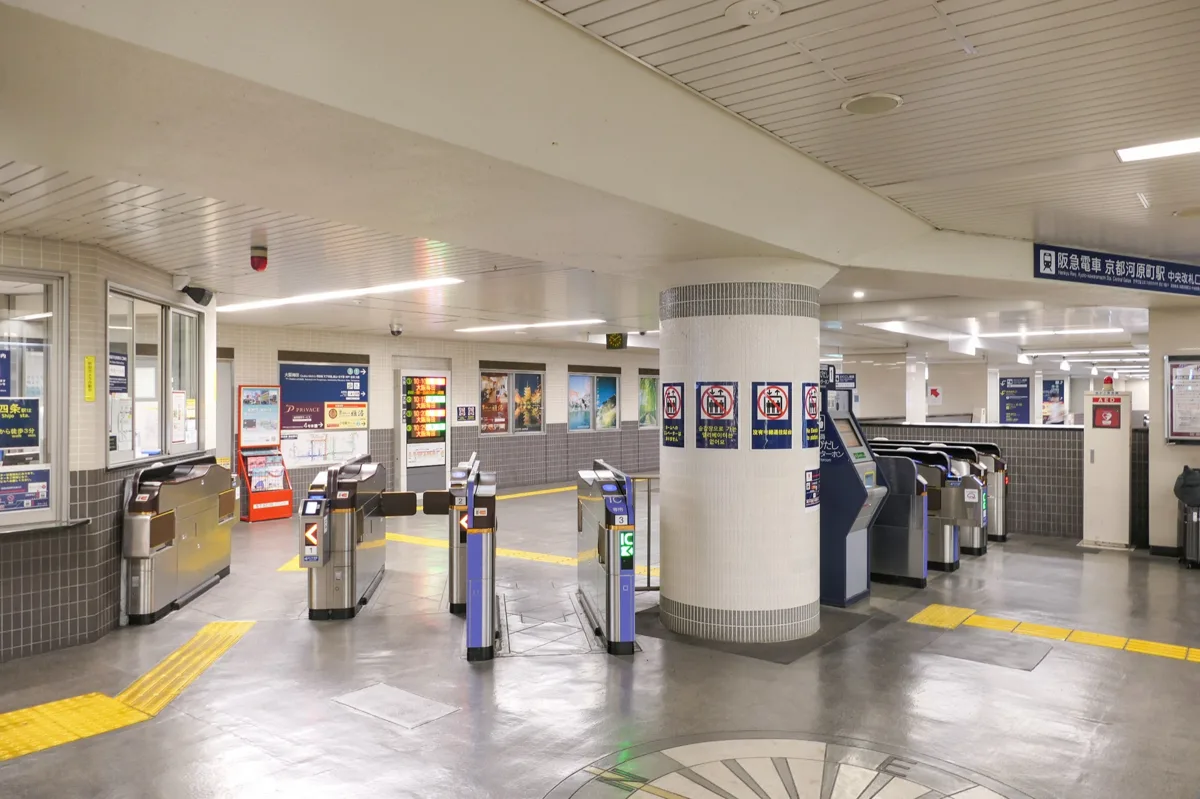
At an Osaka Metro gate like this one, you tap either card on the same reader. Keep only one card in your pass case. Nankai warns that the gate may fail to read PiTaPa and ICOCA when both sit in one case.
Getting a PiTaPa: screening, bank account and delivery
The PiTaPa FAQ page lists the conditions every applicant has to meet. Read them as a checklist before you apply.
- Age: Main members must be 18 or older. High school students cannot apply as main members.
- Screening: Every application goes through a set screening, and PiTaPa may refuse to issue a card.
- Workplace call: PiTaPa may call your workplace to confirm that you work there, or contact you directly.
- Bank account: Payment comes only from a personal bank account in the main member’s own name.
- Delivery: A paper application takes 3 to 4 weeks. An online application takes 2 weeks at the earliest.
Some banks cannot be set up online. For those, PiTaPa mails a payment account form to your home address. You write your name, stamp it with your bank seal and send it back with a copy of an identity document. Our PiTaPa card guide walks through the online form.
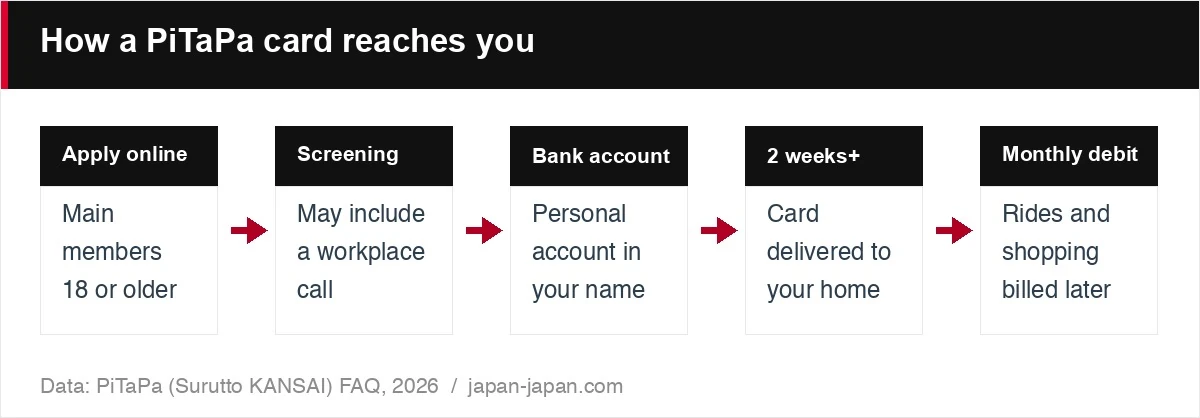
The flow shows the five stages between applying and the first monthly debit. Look at what they need. You need a bank account in your name and a home address for the card and forms. PiTaPa may also call your workplace. With a 2-week minimum, a card ordered on arrival day would land after many trips are over.
ICOCA skips all of this. You buy it at a ticket machine or a Midori-no-madoguchi window and ride at once. JR West says anyone can use the plain card, and there is no screening. The trade-off is that a lost plain ICOCA cannot be reissued, so treat the balance like cash.
Discounts: PiTaPa rates and ICOCA points
Each railway sets its own PiTaPa discount, and you get it on the monthly bill. The PiTaPa discount list (as of 1 October 2026) shows these general rates for adults:
- Osaka Metro and Osaka City Bus: Free Style (general) gives 10% off from the first ride, with no registration.
- Hankyu: No discount on rides 1 to 10 in a month, 10% off rides 11 to 30, and 15% off from ride 31.
- Kintetsu: 10% off the part of your monthly fares above 3,150 yen.
- JR West postpay area: 10% off each ride from the 11th ride on the same fare section in a month.
- Keihan, Nankai and Hanshin: 10% off from the 11th ride in a month.
Check the condition behind each percentage. Only the Osaka Metro rate starts with the first ride. Hankyu, JR West, Keihan, Nankai and Hanshin start at the 11th ride in one calendar month. Kintetsu starts only after 3,150 yen of fares in a month. A month runs from the 1st to the last day, so a trip that crosses a month end splits its count.
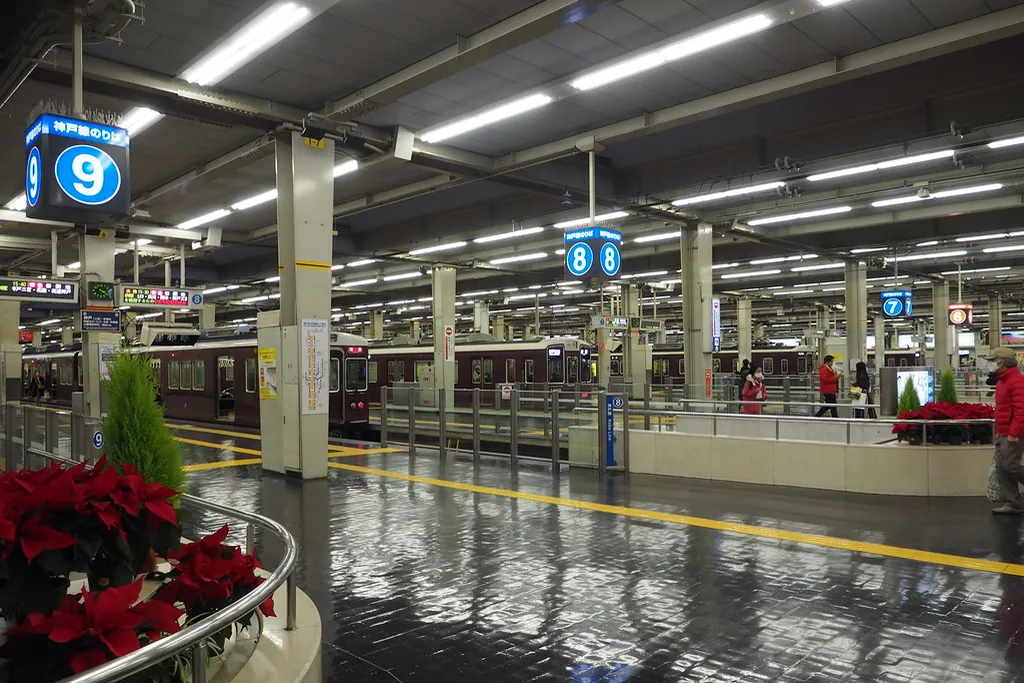
The photo shows Hankyu trains at Osaka-umeda Station. On Hankyu the PiTaPa rate climbs with use: 10% from ride 11 and 15% from ride 31.
ICOCA has its own reward, paid in WESTER points. The JR West ICOCA rail-use points page sets out two rail rewards. A plain ICOCA needs a free service registration first. Mobile ICOCA and ICOCA on Apple Pay need no registration.
- Ride-count points: From the 11th ride on the same fare section in a month, you earn 10% of the fare per ride.
- Time-zone points: On some sections in the Keihanshin area, you earn 10% of the fare from the 4th ride per section group in a month.
Time-zone points cover entries or exits between 10:00 and 17:00 on weekdays, and all day on weekends and holidays. JR West counts rides by fare section. In its example, Osaka to Kyobashi and Osaka to Nishikujo are both 180 yen trips. One ride on each counts as 2 rides in the 180 yen section.
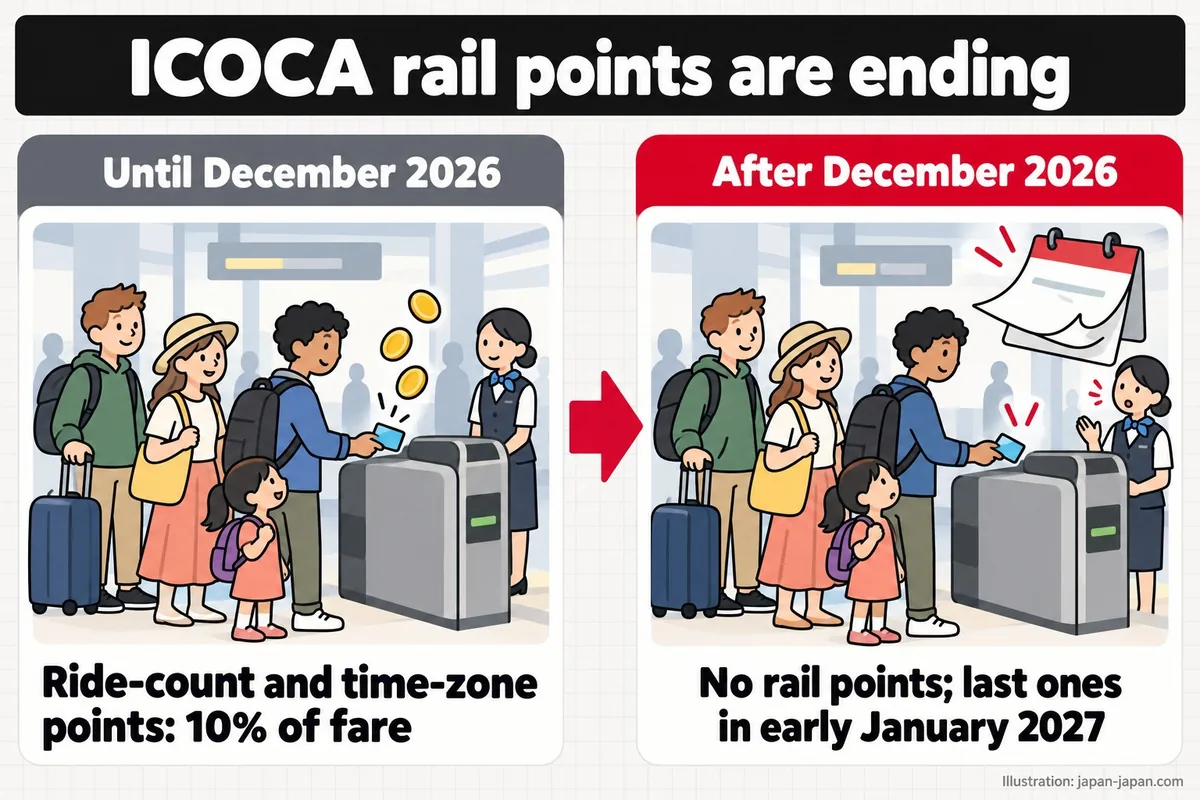
The before-and-after chart shows the change. JR West says time-zone points and ride-count points end with December 2026 usage. Points for December rides arrive in early January 2027. For a trip in 2027, plan on no ICOCA rail points at all.
Refunds, fees and Mobile ICOCA
Return an ICOCA at a station in the JR West ICOCA area when you leave. You get the balance minus a 220 yen fee, plus the 500 yen deposit. If the balance is no more than the 220 yen fee, you get only the 500 yen deposit back. JR West may cancel an ICOCA after 10 years with no use, charge or card exchange, and then the balance and deposit are lost.
PiTaPa returns charged money only when you leave, lose the card, renew it or get it reissued. If you leave by choice, or report the card lost or stolen, PiTaPa takes 550 yen per card. The rest goes to your bank account. Our IC card refunds guide compares the steps card by card.
| Item | Value | Note |
|---|---|---|
| ICOCA deposit | 500 yen | Returned with the card |
| ICOCA refund fee | 220 yen | |
| PiTaPa refund fee on leaving | 550 yen | |
| PiTaPa mailed statement | 150 yen | Per statement |
| PiTaPa unused-year fee | 1100 yen |
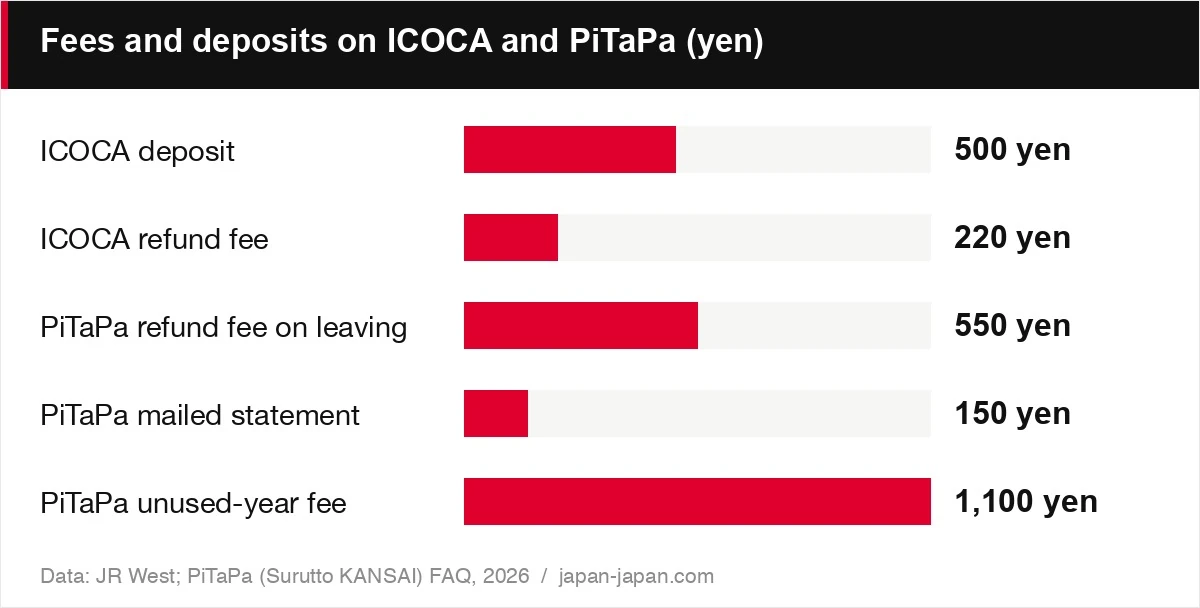
The chart lines up the fixed fees on both cards. The largest is the 1,100 yen PiTaPa fee for a year with no use. The ICOCA deposit of 500 yen is the one amount you get back.
A third option sits on your phone. ICOCA on Apple Pay works on an iPhone 8 or later with iOS 16.0 or later, or an Apple Watch Series 3 or later. Mobile ICOCA for Android needs a phone that had Android 10.0 or later at purchase, plus the latest Osaifu-Keitai app.
JR-West’s English page sets three conditions for iPhone. You sign in to iCloud with an Apple Account. Your device region is set to a country or region that supports Apple Pay. You hold a card issued by a card company in such a country or region. Check all three on your own phone before you count on it.
On Android, Mobile ICOCA needs a WESTER ID. It also needs a Visa, Mastercard, JCB, AMEX or Diners Club card in your own name that supports 3-D Secure 2.0. Our Mobile ICOCA guide has the setup steps for both phones.
Refunds on a phone take longer. You cannot refund ICOCA through Apple Wallet. JR West refunds it from the ICOCA app or the member website for a 220 yen fee. The balance goes to a bank account you name, about 2 to 6 weeks after you apply.
A physical card avoids that wait. You hand it in at a station in the JR West ICOCA area and get the money back there.
ICOCA vs PiTaPa: which card should you choose?
Choose by your situation, using the numbers above. Two questions settle it for most people: do you have a Japanese bank account, and can you wait for a card?
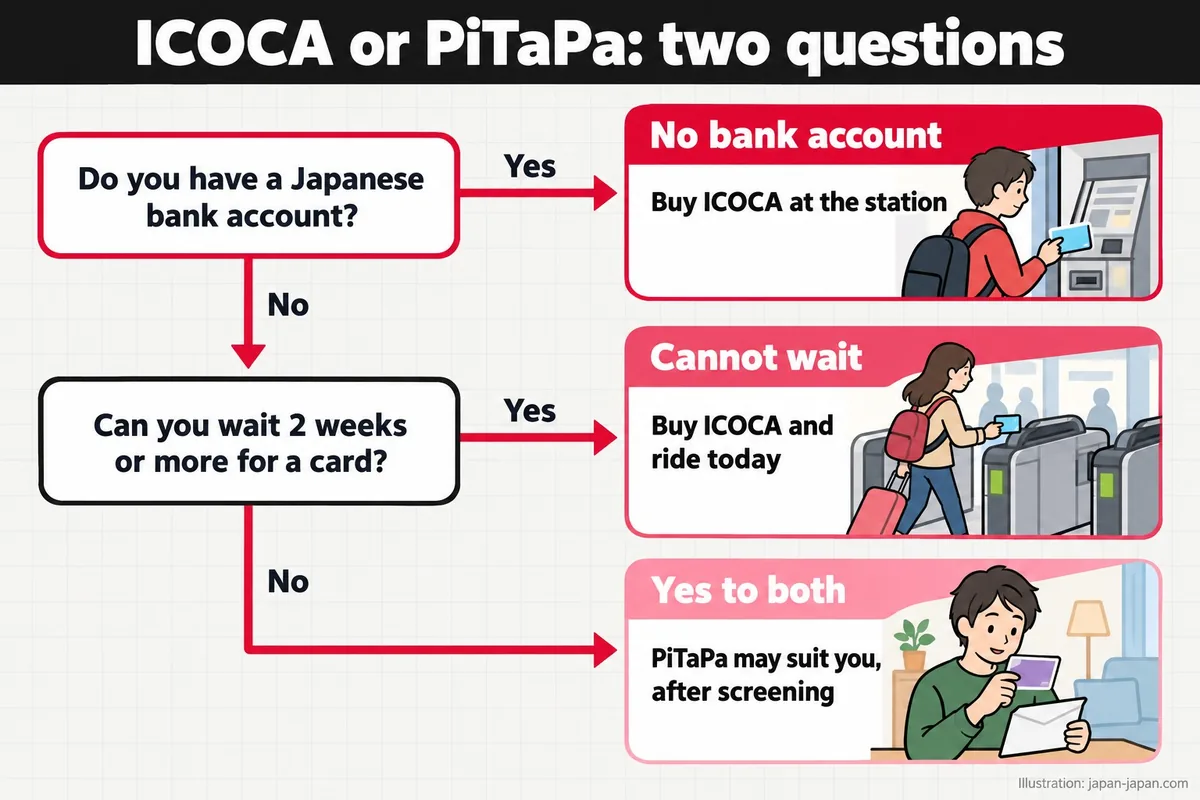
The two-question chart sends most visitors to ICOCA. PiTaPa still needs the screening even if you answer yes to both.
- No Japanese bank account, or arriving within days: Buy ICOCA at a JR West station for 2,000 yen. At Kansai-airport Station, the visitor design is open to foreign passport holders with Temporary Visitor status.
- A recent iPhone or Android phone: Mobile ICOCA works if your phone and card meet JR-West’s conditions. Check them before you land.
- Living in Kansai with a bank account: PiTaPa pays off if you ride the same route many times a month. The Hankyu and JR West rates start at the 11th ride.
- Going on to Tokyo: ICOCA also works in the Suica and PASMO areas. Our Suica card guide covers the Tokyo cards.
If you land at Kansai Airport, you can buy ICOCA at the station and ride into the city the same day. Our Kansai Airport guide lists the trains and buses into Osaka.
ICOCA or PiTaPa: what 98 people in Japan knew
On 13–14 October 2026, japan-japan.com ran an online survey of people living in Japan about 32 travel choices. 130 people answered. We removed answers that looked machine-written, one from outside Japan and most of those that contradicted themselves, which left 98. Shares below are of the 98 respondents unless a smaller group is named; they describe these people, not all travellers in Japan. See all 32 comparisons and how we asked.
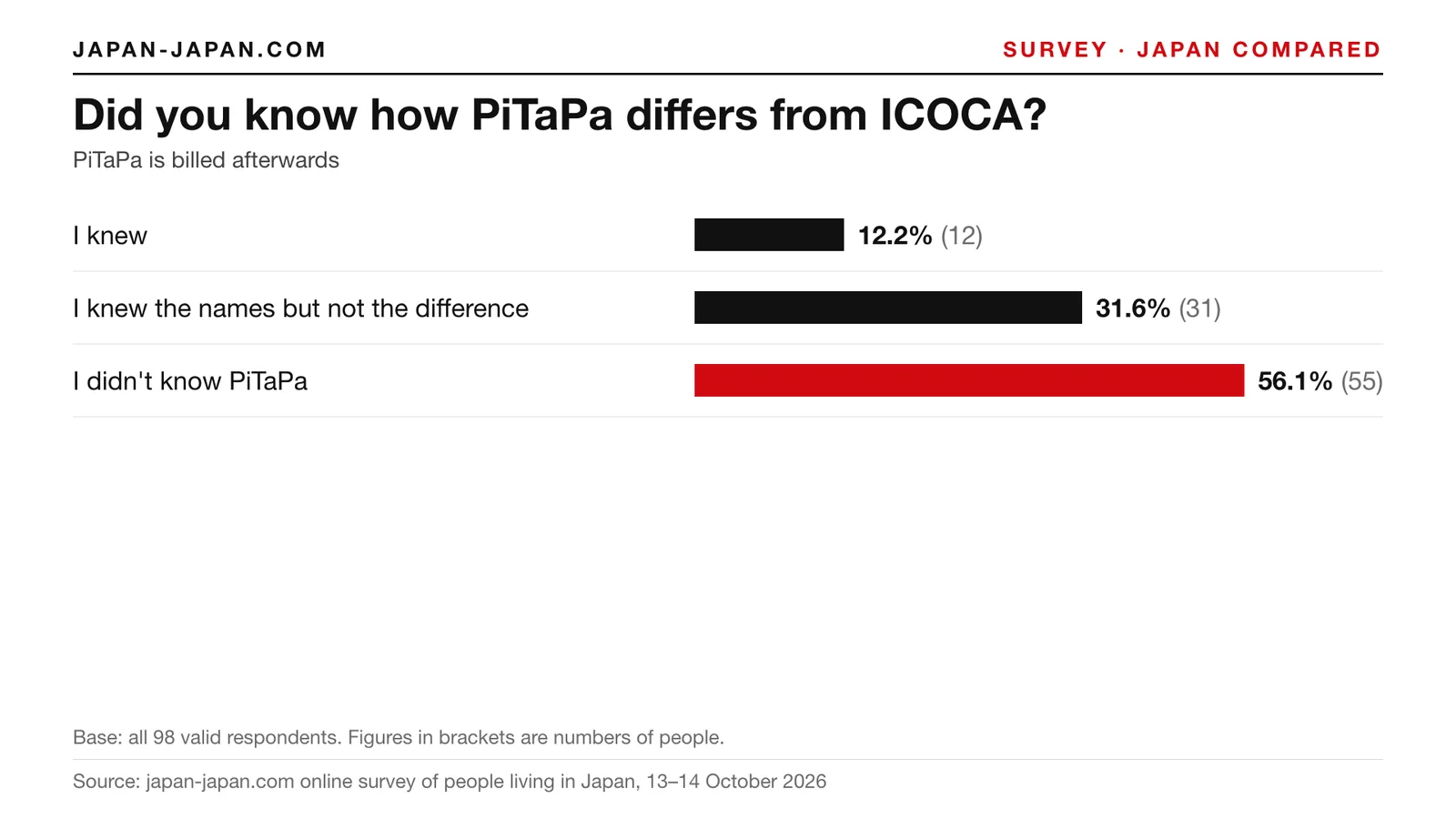
We asked whether they knew the difference between ICOCA and PiTaPa, which is billed afterwards. 56.1% (55 people) did not know PiTaPa, 31.6% (31 people) knew the names but not the difference, and 12.2% (12 people) knew.
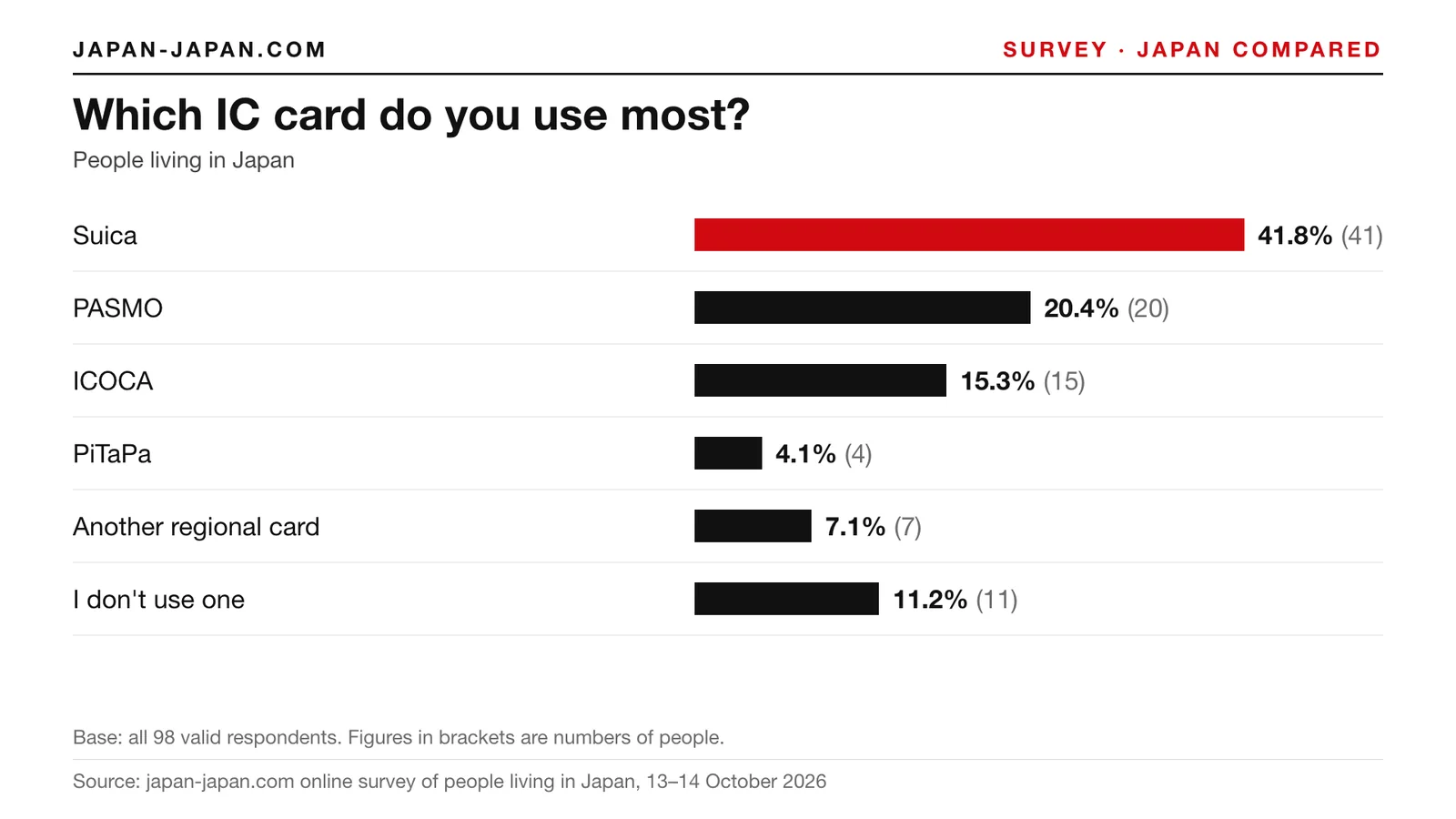
As the card they use most, 15.3% (15 people) named ICOCA and 4.1% (4 people) PiTaPa, against 41.8% (41 people) for Suica. 22.4% (22 people) have ICOCA as a card or on a phone, and 5.1% (5 people) have PiTaPa.
ICOCA vs PiTaPa FAQ
Can a tourist get a PiTaPa card?
PiTaPa sets the same conditions for every applicant. Main members must be 18 or older, pass a screening and pay from a personal bank account in their own name. The card arrives in 2 weeks at the earliest online, or 3 to 4 weeks by paper form. Visitors without a Japanese bank account and a home address in Japan should buy ICOCA.
Can I use ICOCA on Osaka Metro, Hankyu and Kyoto City Bus?
Yes. Osaka Metro, Hankyu and Kyoto City Bus all list ICOCA, and Hankyu also lists Mobile ICOCA. Charge the card before you ride, since ICOCA pays the ordinary fare from its balance. On Osaka City Bus every adult fare is a flat 210 yen.
Do ICOCA points still work after December 2026?
No, for rail use. JR West says time-zone points and ride-count points end with December 2026 usage. Points for December rides arrive in early January 2027.
Can I use PiTaPa outside Kansai?
Yes, in the nationwide IC card areas such as Suica and PASMO. There it works only as a prepaid card, so you charge it in cash first. Auto-charge does not work there, and PiTaPa discounts do not apply.
About the author