Hakuba Happoone Winter Resort: January Snow Averages 216 cm
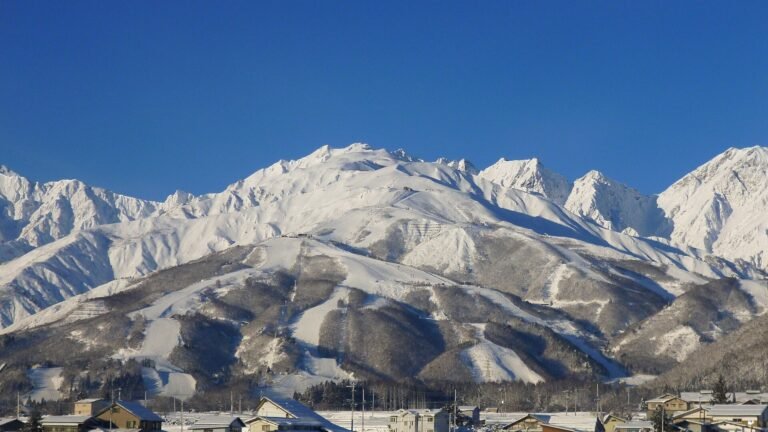
Happo-One is the big resort in the Hakuba valley in Nagano Prefecture. This guide covers the parts of a winter trip you can plan now: the snow month by month, the train from Tokyo, the rail passes, the New Year rush and your skis on the plane.
The figures for snow come from the Japan Meteorological Agency station in Hakuba village, at the foot of the mountain. The slopes sit higher, so expect more snow up there than the village numbers show.
Hakuba Happoone Winter Resort searches peak in January
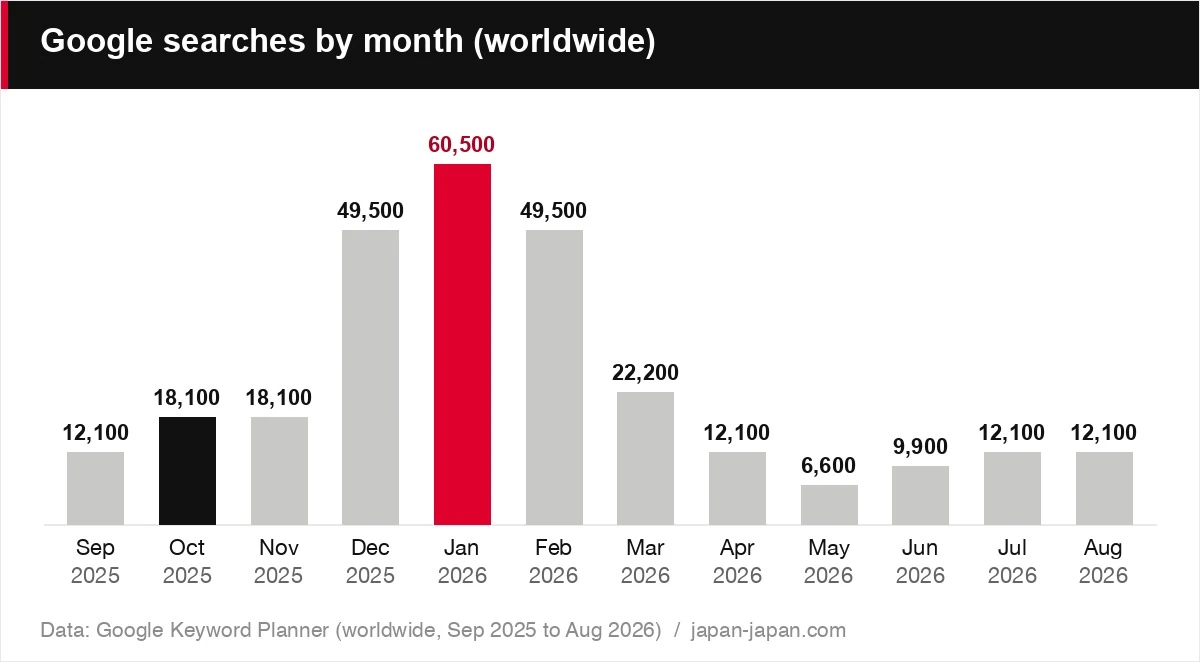
Interest in Hakuba builds fast once autumn ends. Worldwide, people searched for “hakuba happoone winter resort” 18,100 times in October 2025 and 60,500 times in January 2026, 3.3 times as many. December and February each had 49,500 searches.
| Month | Searches |
|---|---|
| Sep 2025 | 12,100 |
| Oct 2025 | 18,100 |
| Nov 2025 | 18,100 |
| Dec 2025 | 49,500 |
| Jan 2026 | 60,500 |
| Feb 2026 | 49,500 |
| Mar 2026 | 22,200 |
| Apr 2026 | 12,100 |
| May 2026 | 6600 |
| Jun 2026 | 9900 |
| Jul 2026 | 12,100 |
| Aug 2026 | 12,100 |
The chart shows the climb from 18,100 searches in October to the January peak, then a drop to 22,200 in March and 6,600 in May. That curve tracks the ski season itself.
The same pattern hits rooms and trains. When searches triple, so does demand for beds near the lifts. Book your dates in October or November, before the December jump. You get a wider choice of rooms close to the gondola and better seats on the Shinkansen.
Many people who look up Happo-One also look at other resorts in the valley. The related search “hakuba goryu resort” gets about 8,100 searches a month, and “things to do in hakuba” about 880. Plan a few days if you want to try more than one mountain.
Snow and temperatures in Hakuba by month
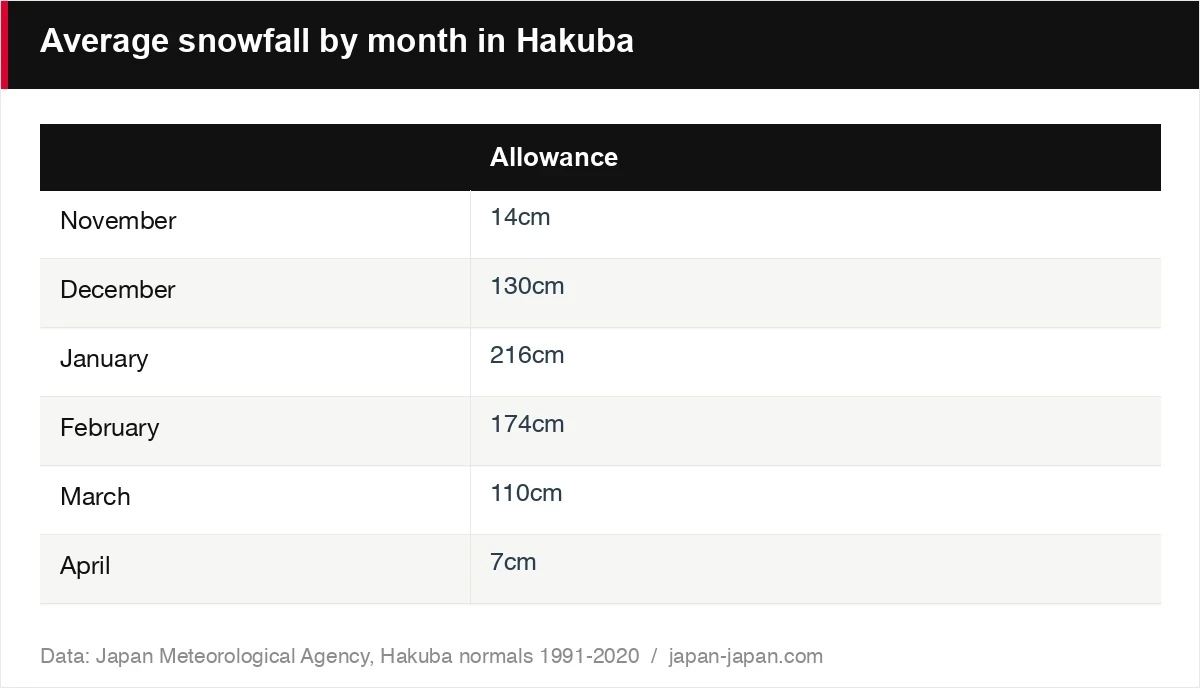
January and February are the snowiest months in Hakuba. The Japan Meteorological Agency Hakuba climate normals give average snowfall for each month, based on 30 years of data from 1991 to 2020.
| Item | Value |
|---|---|
| November | 14 cm |
| December | 130 cm |
| January | 216 cm |
| February | 174 cm |
| March | 110 cm |
| April | 7 cm |
In the chart, January is the tallest bar at 216 cm of snowfall, followed by February at 174 cm and December at 130 cm. March still averages 110 cm. November gets only 14 cm and April 7 cm, so the season’s real snow arrives in December.
Snow on the ground builds through the winter. The deepest snow cover in the village averages 46 cm in December, 82 cm in January and 97 cm in February. It is still 70 cm in March. Across the whole year, Hakuba gets 655 cm of snowfall.
Temperatures stay below freezing at night for most of the season. Use the table below to pack the right layers.
| Month | Average | Daily high | Daily low |
|---|---|---|---|
| December | -0.1°C | 4.5°C | -4.0°C |
| January | -2.8°C | 1.4°C | -7.2°C |
| February | -2.4°C | 2.6°C | -7.3°C |
| March | 1.2°C | 7.0°C | -3.6°C |
| April | 7.6°C | 14.6°C | 1.7°C |
February is the coldest month at night, with an average low of -7.3°C. January has the least sun, 71.3 hours for the month. March gives you 136.9 hours of sun and still plenty of snow on the ground, so it suits skiers who like clear days.
Pack for cold, wet snow days as well as dry ones. Hakuba averages 141.5 mm of precipitation in January and 125.9 mm in February, and most of it falls as snow. Bring a waterproof shell, warm gloves, a neck warmer and goggles that work in flat light.
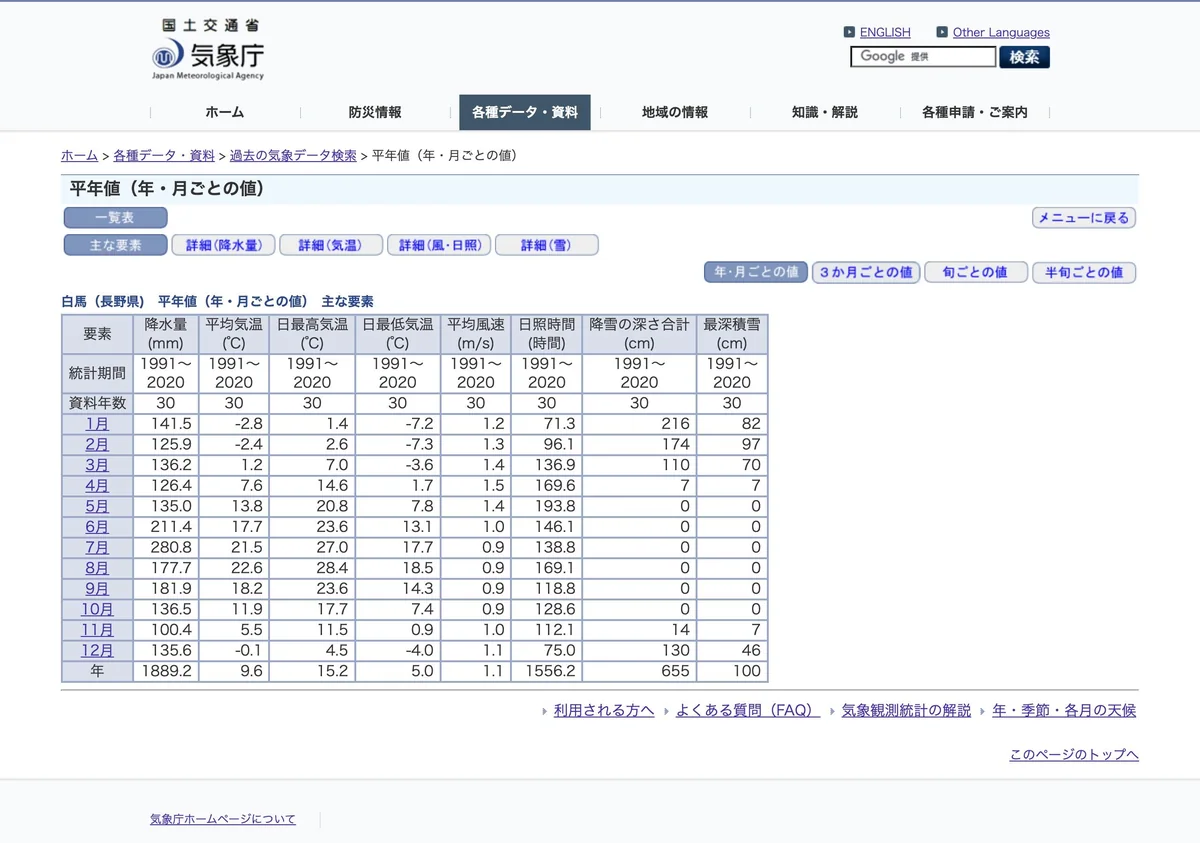
The screenshot above is the Japan Meteorological Agency page for the Hakuba station. The table lists each month in rows. Look for the column 降雪の深さ合計 (kousetsu no fukasa goukei), which means “total snowfall depth”, and the column 最深積雪 (saishin sekisetsu), “deepest snow cover”.
For month-by-month trip ideas around the prefecture, read our pages on Nagano in January and Nagano in February.
Lift tickets: Happo-One only or the Hakuba Valley pass
You have two kinds of ticket to choose from. A Happo-One ticket covers this one resort. A Hakuba Valley pass covers several resorts in the valley, so it suits a longer stay.
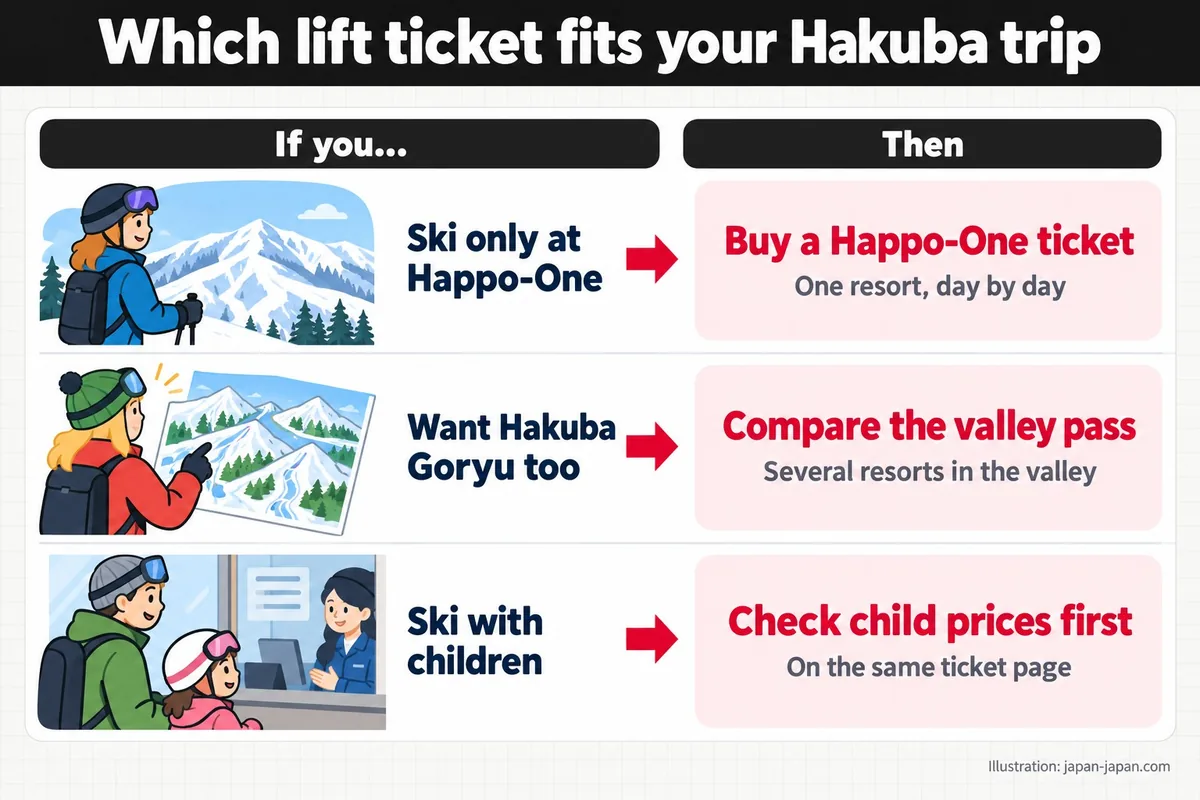
The illustration above sums up the choice. Count your ski days first. Then decide whether you want to ride other mountains in the valley, such as Hakuba Goryu.
For 2026-27 prices and season dates, go to the Hakuba Happo-one Snow Resort tickets and passes page. For the multi-resort ticket, check the Hakuba Valley All-Mountain pass prices 2026-27. Check the price for your exact ski dates, since prices can change during the season.
Here is how to choose:
- Stay at Happo-One for every ski day. Buy single-resort tickets for the days you ski.
- Plan one or two days at another resort. Compare the valley pass with single tickets at each resort.
- Ski with children. Look up the child prices on the same page before you go.
Think about the weather when you pick ski days. January in the village gets 71.3 hours of sun for the whole month, so many days are grey or snowing. Keep one flexible day in your plan. If a storm closes the upper lifts, you can move a ski day rather than lose it.
Buy your ticket before you queue. On a powder morning in January, the lines at the base build early, and a ticket in hand saves time at the window.
Getting to Hakuba from Tokyo by Shinkansen
The fastest way from Tokyo is the Hokuriku Shinkansen to Nagano, then a transfer to the valley. Our Tokyo to Nagano route page lists the Kagayaki at 1 h 17 min from Tokyo Station, for 8,450 yen with a reserved seat.
The first train leaves Tokyo Station at 06:16 and the last at 22:08. Take a morning train if you want to reach Hakuba in daylight and pick up rental gear the same day.
If you fly in, first get to Tokyo Station. Our guides cover Narita Airport to Tokyo Station and Haneda Airport to Tokyo Station. For the terminals, see the Narita Airport guide and the Haneda Airport guide.
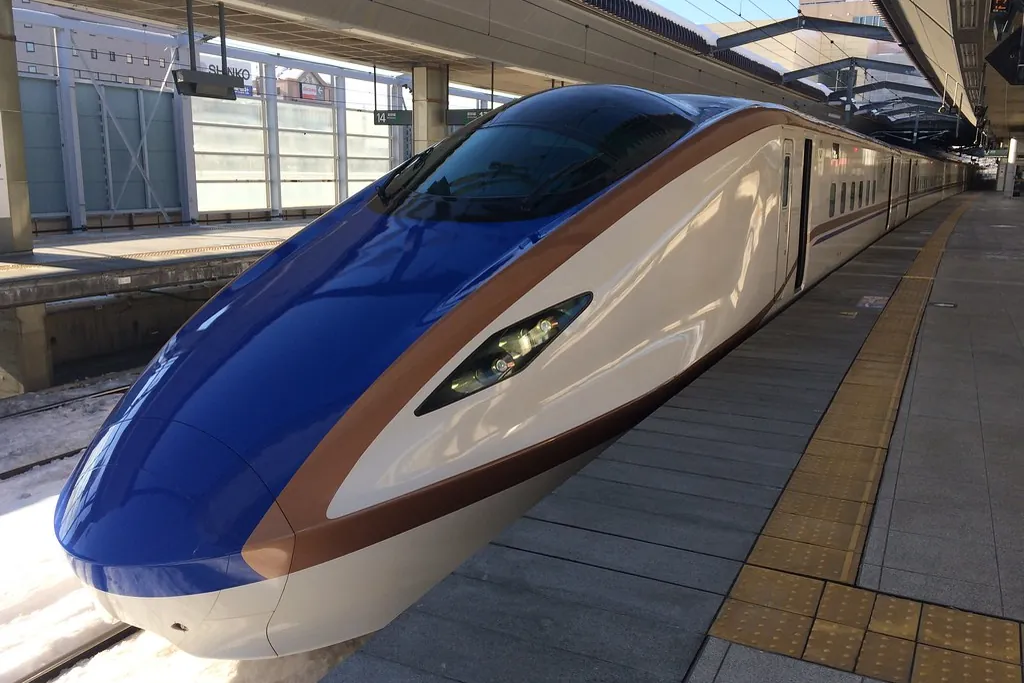
The photo above shows a Hokuriku Shinkansen train at Nagano Station, where you change for Hakuba.
Hakuba Station sits on the JR Oito Line, so rail passes that include this line also matter. Two JR passes cover the Shinkansen to Nagano. The table below compares them with a single ticket.
| Option | Time or validity | Adult price | What it covers |
|---|---|---|---|
| Kagayaki, Tokyo to Nagano | 1 h 17 min | 8,450 yen | Reserved seat, one way |
| JR EAST PASS | 5 or 10 days | From 35,000 yen | All JR East lines, Shinkansen included |
| Hokuriku Arch Pass | 7 days | 35,000 yen | Tokyo to Tsuruga, plus Chuo and Oito lines |
| JR EAST PASS (Nagano, Niigata area) | Sales ended | No longer sold | Replaced on 14 March 2026 |
The JR EAST PASS costs 35,000 yen for 5 days, and children pay 17,500 yen. It covers all JR East lines, including the Shinkansen. You can buy it online on JR-EAST Train Reservation and pick it up after you arrive in Japan.
The Hokuriku Arch Pass costs 35,000 yen for 7 days, and children pay 17,500 yen. On 14 March 2026 the price went up from 30,000 yen. The pass area also grew to the Tokyo area and the Chuo and Oito lines.
The old JR EAST PASS (Nagano, Niigata area) is gone. Sales ended on 13 March 2026, and the new JR EAST PASS replaced it. A pass bought by 13 March can still be used until it expires.
Book seats on the Hokuriku Shinkansen ahead of time in peak weeks. Seats sell out fastest on the days around New Year.
A single return trip to Nagano costs less than either pass. A pass pays off when you add long rides. Tokyo to Kanazawa, for example, takes 2 h 24 min by Kagayaki and costs 14,600 yen one way.
New Year 2026-27: when Hakuba gets busy
The New Year break is the busiest time to travel in Japan. Government offices close from Tuesday 29 December 2026 to Sunday 3 January 2027, and banks close from 31 December to 3 January.
New Year’s Day, Friday 1 January 2027, is the only national holiday in the break. Many people take Monday 28 December off as well. That gives them up to 9 days in a row from Saturday 26 December.
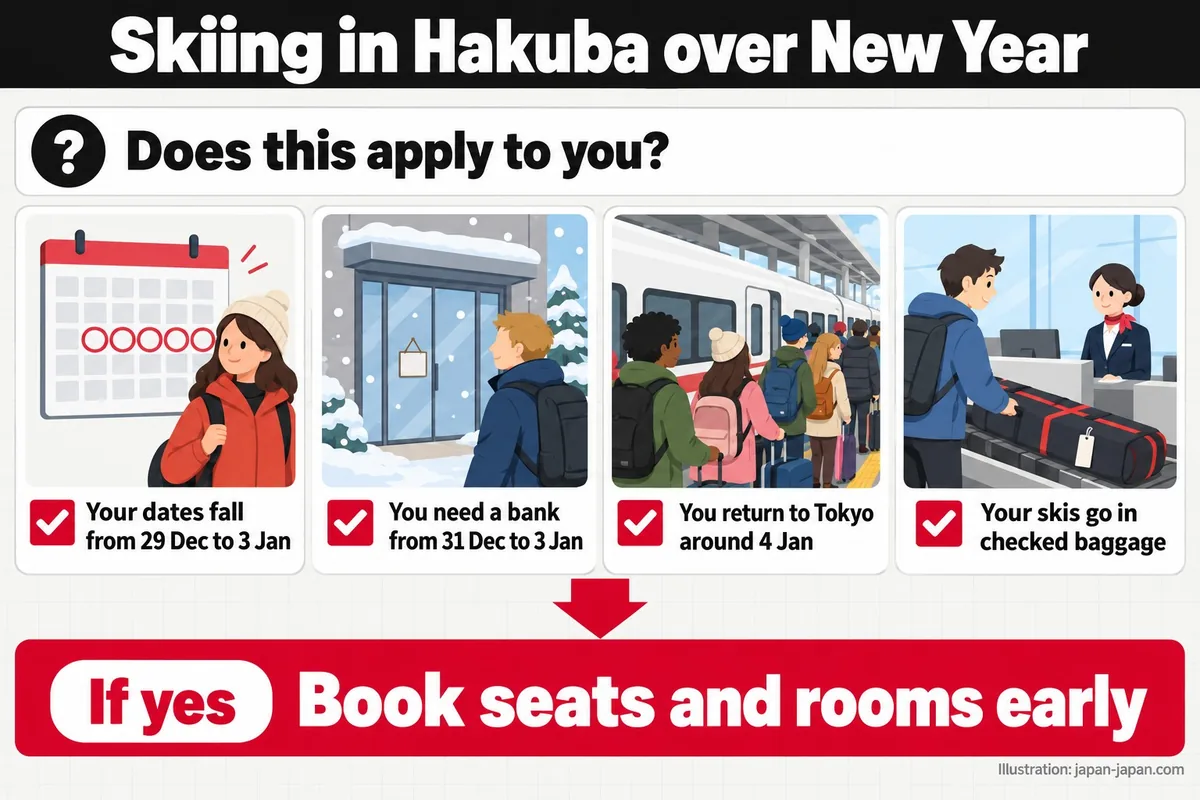
The illustration above is a quick check for anyone planning a ski trip over the holiday.
The return rush comes at the end. Last winter the busiest day was Sunday 4 January 2026, with 350,000 passengers heading to Tokyo. Avoid that day for your trip back if you can.
From 25 December 2026 to 5 January 2027, every Nozomi on the Tokaido Shinkansen is reserved-seat only. That rule covers the line to Kyoto and Osaka, but it shows how full trains get. Reserve your Hokuriku Shinkansen seats to Nagano early for the same days.
Our New Year 2026-27 holiday guide lists what closes and when. If you can move your dates, ski in mid-January. The holiday crowds are gone and January is still the month with the most snowfall.
For December plans, see Nagano in December. December averages 130 cm of snowfall in the village, so early-season trips can work, but January and February are more reliable.
Skis on the plane and other Japan ski resorts
You can fly with your own skis or snowboard. In Japan they go in checked baggage, and you cannot carry them into the cabin. Our skis and snowboards page has the full rule.
There are two exceptions. Short skis of 60 cm or less can go in the cabin. Ski poles can go in the cabin too, if they are 60 cm or less when folded and have no pointed metal tip.
Ski wax has its own rule. Solid wax is fine in both carry-on and checked bags. Spray wax must use no flammable or toxic gas, and each can is limited to 0.5 litres or 0.5 kg. The ski and snowboard wax page explains the rest.
Disposable hand warmers are allowed on flights, while fuel-type warmers are not. See our disposable hand warmers page. Each airline also sets its own size and fee for sports gear, so check the baggage rules by airline before you book.
If you want a second resort in another region, Niseko in Hokkaido is the common pick. The Niseko Tokyu Grand Hirafu 2026-27 winter season page gives a planned season from 28 November 2026 to 5 May 2027. Night skiing runs from 12 December 2026 to 22 March 2027, also planned.
Grand Hirafu has 22 courses served by 2 gondolas and 7 lifts. Its vertical drop is 940 m over 135 ha, and the longest run is 5,300 m. In January 2026 the resort measured 620 cm of snowfall at its Shirakaba course, about 850 m up. That number comes from the slope, not a village station, so do not compare it directly with Hakuba’s 216 cm.
Niseko’s snow also peaks in January. Grand Hirafu measured 386 cm in December 2025, 620 cm in January 2026 and 263 cm in February 2026. Its season runs later than many resorts, so it suits a spring trip in April too.
Getting to Niseko means a flight. Flights from Haneda to New Chitose take 1 h 30 min, with 56 a day, as our Tokyo to Sapporo route page shows. From New Chitose Airport, the resort is about 2 h 10 min by car or about 3 h 30 min by JR and bus.
For snow depth across Japan’s resorts, read our Japan Ski Report 2026-27. If your trip falls in February, the Sapporo Snow Festival 2027 guide pairs well with a few days in Niseko.
FAQ
What is the best month to ski at Hakuba Happo-One?
January has the most snowfall in Hakuba, 216 cm on average. February has the deepest snow cover, 97 cm in the village. Mid-January avoids the New Year crowds while the snow is at its best.
How long does it take to get from Tokyo to Hakuba Happo-One?
The Kagayaki Shinkansen takes 1 h 17 min from Tokyo Station to Nagano Station. From Nagano you transfer to the Hakuba valley. Leave Tokyo in the morning so you arrive in daylight.
Which rail pass works for a Hakuba ski trip?
The JR EAST PASS costs 35,000 yen for 5 days and covers all JR East lines, including the Shinkansen to Nagano. The Hokuriku Arch Pass costs 35,000 yen for 7 days and now includes the Oito Line. A single return trip to Nagano costs less than either pass.
Can I take my skis on the plane in Japan?
Yes, but only in checked baggage. Skis and snowboards cannot go in the cabin. Short skis of 60 cm or less and folding poles of 60 cm or less with no pointed metal tip are the exceptions.
About the author