Ryokan Inn Guide 2026: Prices, Meals, Onsen and Booking
A ryokan inn is usually priced per person, with dinner and breakfast included. Check-in starts at 15:00 or 16:00; JNTO's average is about 15,000 yen a night.
By Shunta Fujii
Ryokan inn: the short answer
A ryokan inn is Japan’s traditional style of lodging, usually charged per person with dinner and breakfast included. Check-in usually starts at 15:00 or 16:00, and the Japan National Tourism Organization (JNTO) puts the average at around 15,000 yen a night.
Most of what follows comes from the government’s Japan Tourism Agency, which answers common questions in an English Q&A for ryokan guests. Other facts come from JNTO’s ryokan guide and our airport transfer pages. Below, you will find the price rules, the night itself, dinner, the bath and bus times to five onsen towns. Hotel room types and city lodging taxes are in our guide to Japan hotels, so this page sticks to what changes at a ryokan.
Here are the key numbers in one place.
- Price: usually per person, with dinner and breakfast in the fee. JNTO’s average is around 15,000 yen a night.
- Times: check-in from 15:00 or 16:00, and check-out between 10:00 and 12:00 at most ryokan.
- Children: often no lodging fee at 3 and under, and usually the full fee from 12.
- Night: most ryokan have a curfew, such as midnight.
- Bath: no booking for the communal bath, and you wash your whole body before you get in.
Ryokan meaning: how a ryokan inn differs from a hotel
The word ryokan means a traditional Japanese inn. The Japan Tourism Agency describes the basic idea as a place to eat well and relax in a hot bath. That bath may be natural hot spring water or a large communal bath in the same style. According to JNTO, ryokan are said to date back to the 8th century. That may make them the oldest form of hotel in the world.
Ryokan range from traditional to modern, and from large resorts to private villas and city inns. JNTO lists the common basics: tatami floors, futon bedding, yukata robes, a kaiseki dinner and a Japanese breakfast. Private baths, sometimes outdoors, are on the same list. Staff explain the customs, such as taking your shoes off indoors, bathing in the onsen and wearing a yukata, a cotton robe. JNTO calls omotenashi, the Japanese word for hospitality, the cornerstone of a ryokan stay.
The Japan Tourism Agency also lists where a ryokan works like a hotel and where it does not. The table below sums it up.
| Topic | At a ryokan | Compared with a hotel |
|---|---|---|
| Price | Usually per person, and some ryokan now charge per room | Differs, since hotels charge per room |
| Meals | Dinner and breakfast are often in the fee | Differs |
| Children | The per-person fee can apply, depending on age | Differs |
| Check-in | Usually from 15:00 or 16:00 | Fairly similar |
| Cancellation | The fee rises as your date gets closer | Largely the same |
| Bed | A futon on tatami; more ryokan now offer beds | Differs |
Two more points matter on the night. Almost every ryokan room has its own shower and bathtub unit. Even so, most Japanese guests see a slow soak in the communal bath as an essential part of the stay. Most ryokan also have a curfew, a time after which you cannot go in or out.
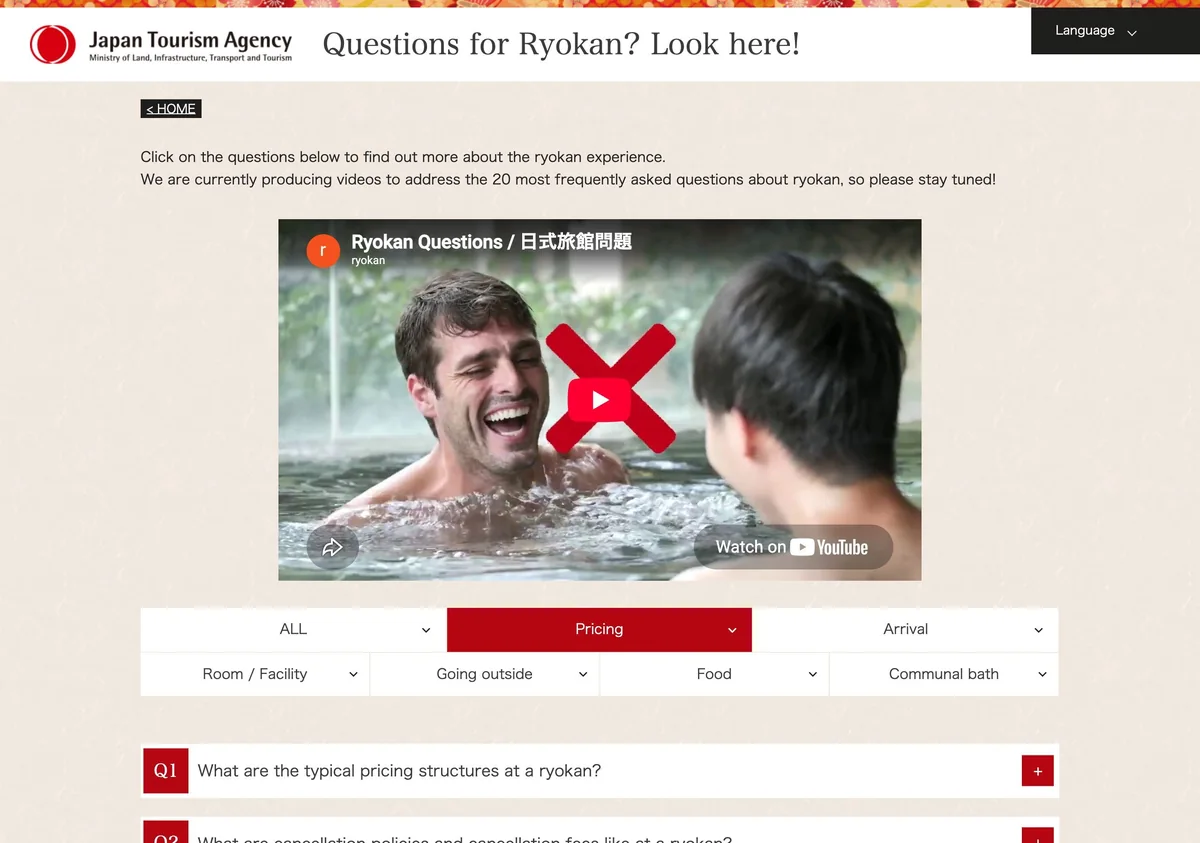
The agency’s ryokan Q&A splits its answers into six tabs, from Pricing and Arrival to Food and Communal bath. The screenshot below shows the Pricing tab and its first question, on how ryokan set their prices.
How to book a ryokan: prices, meals and children
A ryokan usually charges per person. The fee typically covers meals made with local food and the use of shared facilities such as the onsen. Some ryokan now charge per room, like a hotel. In that case a two-person room costs the same for one or two guests, and each guest beyond two pays a fee. JNTO puts the average price of a ryokan stay at around 15,000 yen a night, and high-end ryokan charge more.
Meal plans. You choose the meal plan when you book the room, because the ryokan prepares local, seasonal food in advance. The standard plan is one night with two meals, dinner and breakfast. More ryokan now also sell breakfast-only and simple stay plans, and some sell only those two. The table below shows what each plan includes.
| Plan | Meals included | Good to know |
|---|---|---|
| One night, two meals | Dinner and breakfast | The standard ryokan plan |
| Breakfast only | Breakfast | The fee leaves out the charge for dinner |
| Simple stay | None | The fee leaves out both meals |
A breakfast-only plan leaves dinner out of the fee, and a simple stay leaves out both meals. If the plan you want is not on the booking page, contact the ryokan and ask.
Children. The per-person fee can apply to children, and the amount depends on their age. Most ryokan do not charge a lodging fee for young children, for example 3 and under. If your young child needs meals or bedding, the ryokan may charge a small fee. Some ryokan charge a reduced fee, perhaps 50% or 70%, depending on the child’s age. Children aged 12 and over usually pay the full lodging fee. The illustration below sums up the four cases.
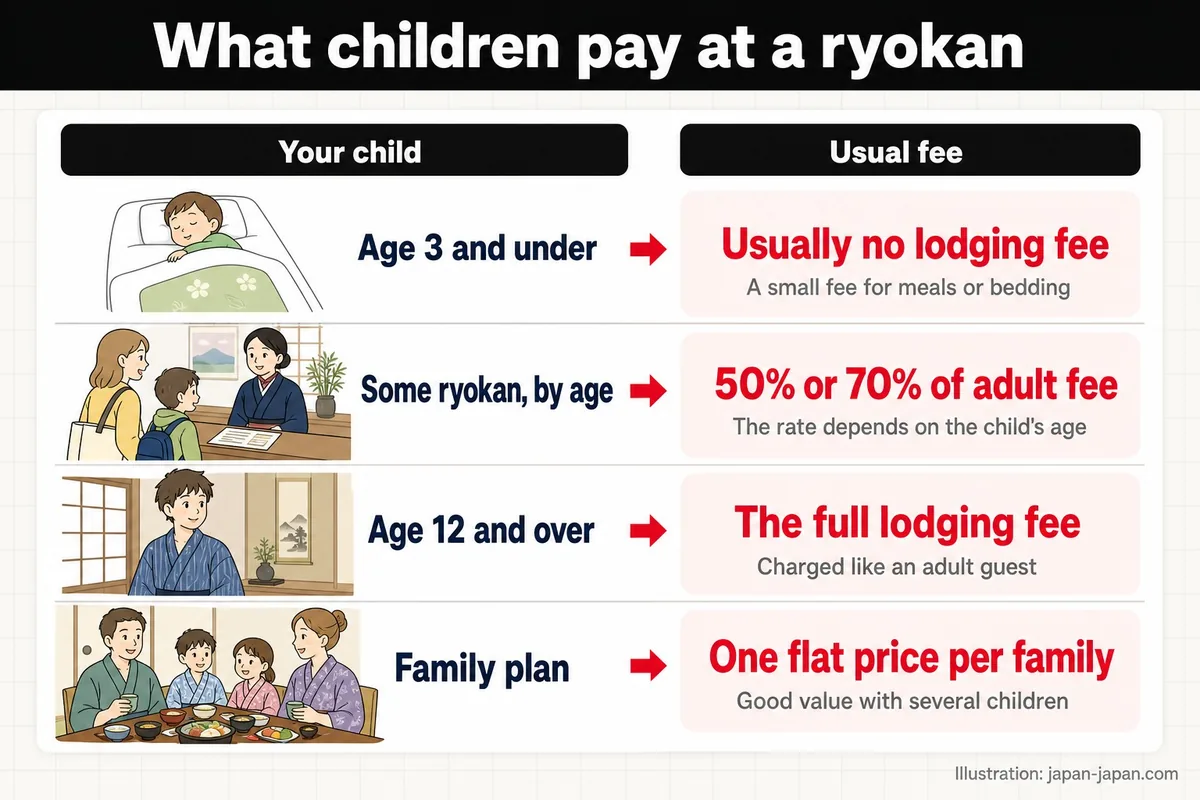
Some ryokan price children in two other ways. A family plan charges one flat price for the whole family, which can be good value with several children. Other ryokan charge a flat fee for each child, sometimes called a facility usage fee, because even small children use the onsen. When you book online, enter the exact number of children. Some ryokan also have children’s meals and special yukata for children.
Cancellation. Cancellation fees work much as they do at a hotel. The fee rises as your date gets closer, and on the day of arrival you pay the full cost. If you do not show up, you usually pay 100% of the fee.
Payment. Each ryokan or booking site sets when you pay: at the ryokan when you check out, in advance, or either. Booking sites that take payment in advance usually ask for a credit card. If you pay in advance, you are not asked to pay at the ryokan.
Lodging tax. Some towns add a lodging tax. The Japanese word is 宿泊税 (shukuhaku-zei). Niseko in Hokkaido has charged one since 1 November 2024. On 1 November 2026, the town switches from a fixed amount to a percentage of the room charge. The details are on Niseko town’s tax page (in Japanese). The same page sends you to the Hokkaido government’s website for the prefecture’s own lodging tax. For the amounts in other cities, see our Japan hotel guide.
Check-in, curfew and futon: a night at a ryokan inn
Check-in usually starts at 15:00 or 16:00. That is fairly similar to a hotel. The flow chart below follows one night, from check-in to check-out.
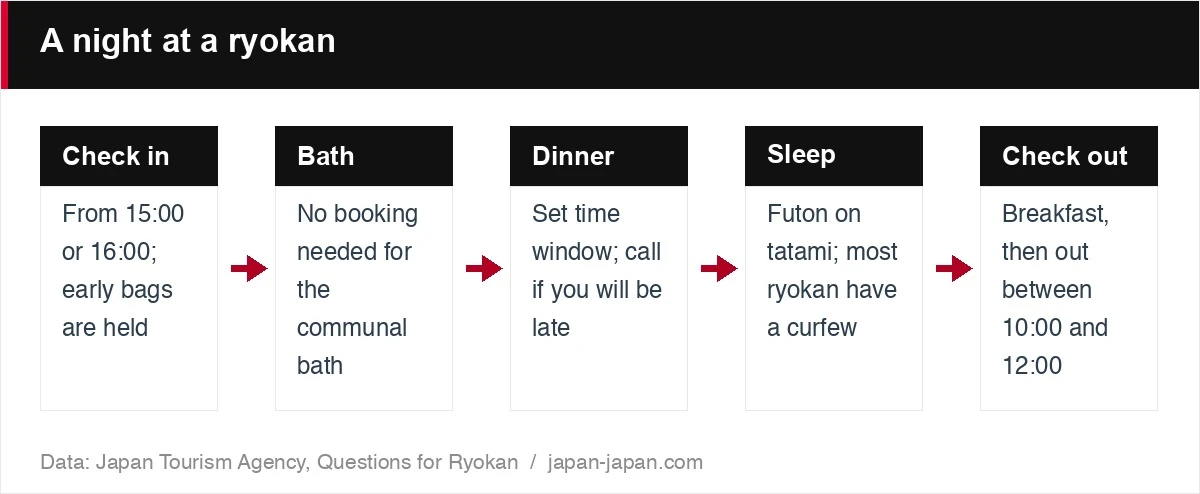
If you arrive early, almost every ryokan will keep your bags at the front desk. Dinner comes in a set time window, and if you arrive too late you may miss it. Call the ryokan if you will arrive well after the check-in time. At check-in, staff usually ask what time you want dinner and breakfast within the set window. The tourism agency suggests checking in early and using the bath before dinner.
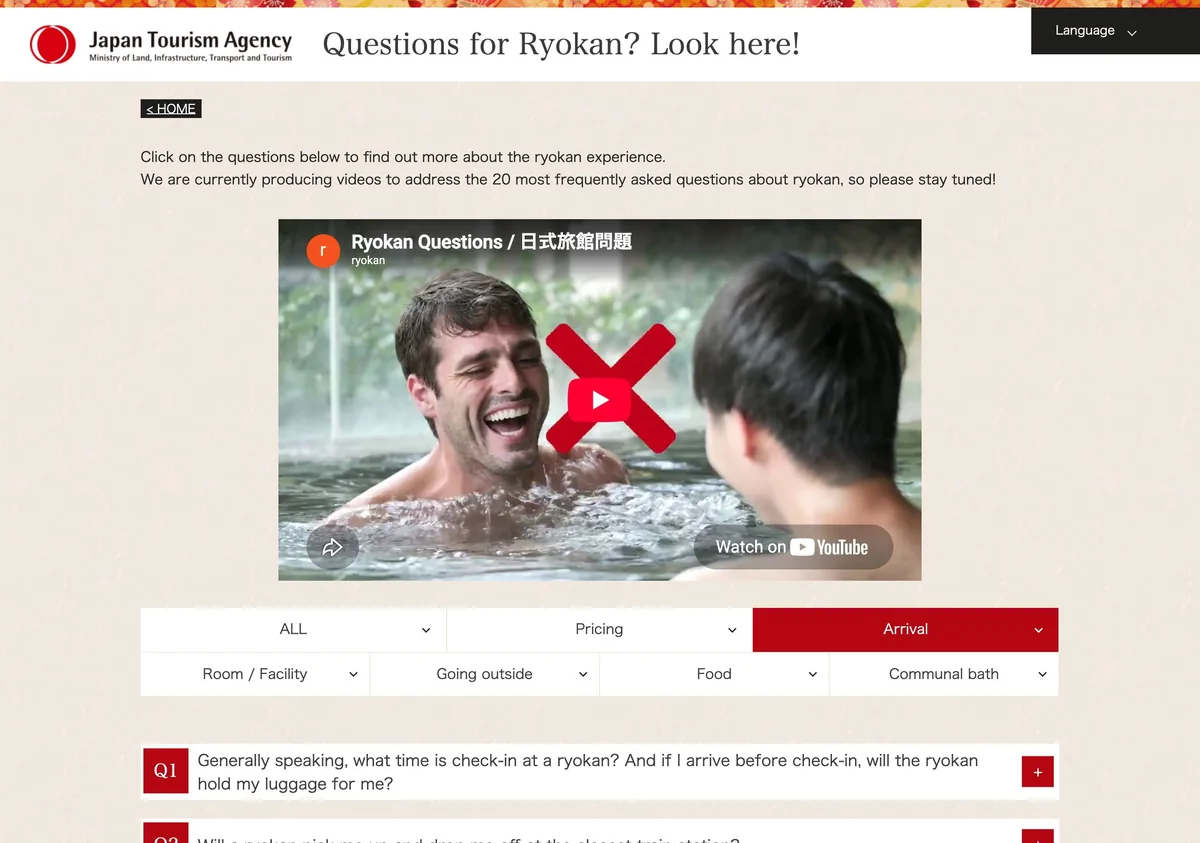
The agency’s Arrival answers also cover station pick-ups and parking. The screenshot below shows the Arrival tab and its first question, on check-in times and early luggage.
Your room will usually have low tables and legless chairs on a tatami floor, according to the agency’s room and facility answers. At night you sleep on a futon laid on the tatami. The agency’s explanations for the futon include a lack of space and a humid climate. A futon folds away each night and dries easily in the sun.
If you want a bed, ask the ryokan. More ryokan now offer Japanese-style rooms with beds, mixed Japanese and Western rooms, or fully Western rooms. Some also have Western tables and chairs for guests who prefer not to sit on the floor.
Most ryokan have Wi-Fi in the rooms and lobby, but check the ryokan’s website to be sure. Many ryokan add things to do, such as table tennis, karaoke, a massage room, a bar or a gift shop. A few offer hands-on experiences, like wearing a kimono or making soba noodles.
Most ryokan have a curfew, says the agency’s page on going out. After a set time, such as midnight, you cannot enter or leave the building. The agency says this is so guests get a good night’s sleep. Policies differ, so ask before you go out for the evening.
- Some ryokan have no curfew at all.
- Some have a curfew but keep staff at the front desk, who can let you in or out.
- Some give you a key if you expect to come back after curfew.
If you have a disability, tell the ryokan what you need when you book. Most ryokan are built in a traditional Japanese style, and a step in the lobby can be a problem. Many have added elevators, handrails, ramps or benches. Some hold Silver Star certification, set up in 1993 by the All Japan Ryokan Hotel Association. It also looks at food for older guests, staff training and access to a doctor.
Check-out at most ryokan is between 10:00 and 12:00 in the morning. If you miss it, policies differ, but the agency says ryokan generally handle it in a friendly way.
Kaiseki dinner and food requests
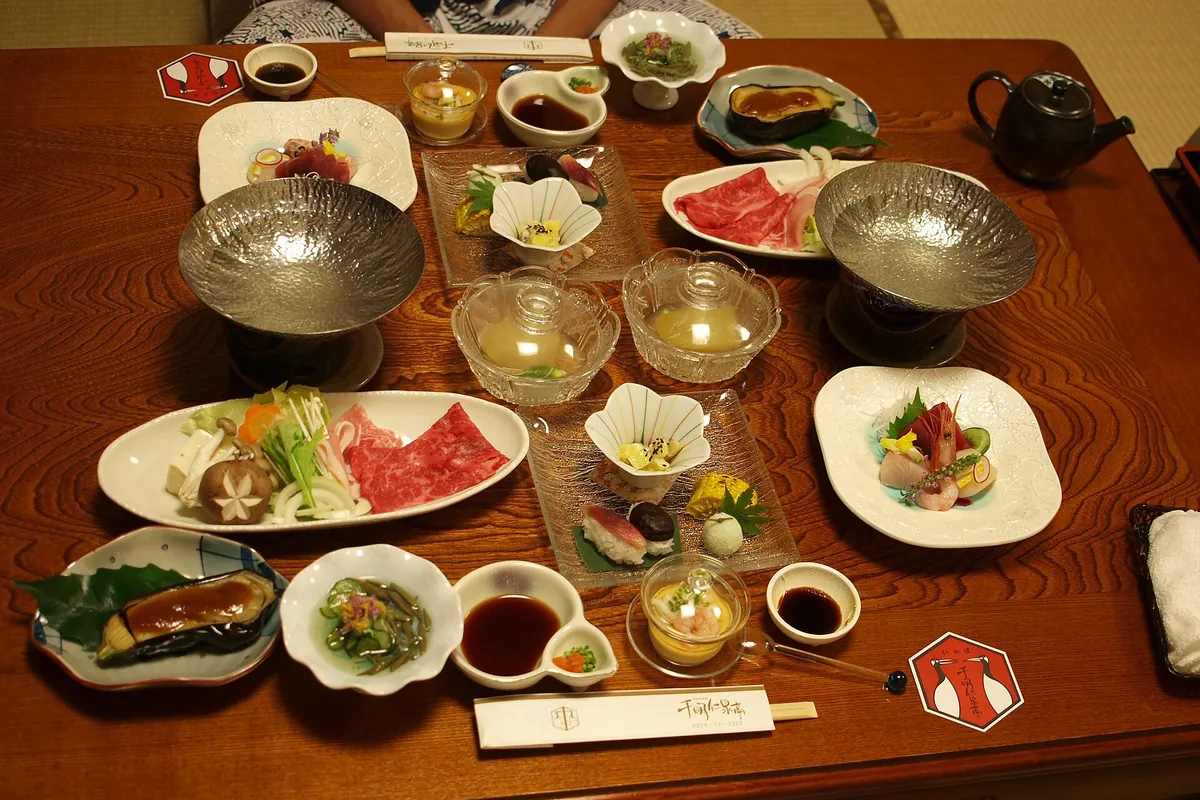
For many guests, the food is the main attraction of a ryokan stay. Most ryokan serve local cuisine made with locally produced, seasonal ingredients, according to the agency’s food answers. Many serve kaiseki, a traditional meal of many small courses. JNTO says a typical stay includes a kaiseki dinner and a traditional Japanese breakfast the next morning. Depending on the ryokan, you eat in a shared dining hall or in your room.
The photo below shows the kind of small, seasonal dishes a kaiseki dinner brings.
You book meals at the same time as the room. Most ryokan serve each meal in a set time period, and once it has passed you may not get that meal. If traffic will make you miss dinner, call the ryokan. A few ryokan serve dinner all evening, so you can eat when it suits you. Some ryokan sell stays without meals, but JNTO calls eating in-house an essential part of the experience.
Most ryokan will do what they can for food requests. Tell the ryokan in advance, if possible at least a few days before your stay. The tourism agency lists these as common requests from guests.
- I have trouble with raw fish.
- I’m allergic to (name the food).
- I’d like vegetarian meals.
- I’m vegan, so I don’t eat eggs or dairy.
- I can’t eat gluten.
Not every ryokan can meet every request. For what to ask about vegetarian, vegan and halal food, see our guide to vegetarian food in Japan.
Onsen at a ryokan: communal and private baths
Almost all ryokan have an onsen or another kind of communal bath. You do not need to book the communal bath. At many ryokan it stays open late at night and early in the morning, except while staff clean it. Check the bath hours at check-in, since baths close at set times for cleaning. To prevent accidents, the agency asks guests not to bathe in the middle of the night or after drinking a lot.
Some ryokan also have private onsen baths, which suit couples and families. They come in two kinds.
- A private onsen in your room, which you can use whenever you like.
- A private onsen you reserve for a set time. To book one, talk to the staff when you arrive.
Tattoo rules differ widely from ryokan to ryokan. Many Japanese link tattoos with organised crime, and most public bathing facilities in Japan have banned guests with tattoos. Some ryokan now have no restriction at all. Others decide case by case, and one or two small tattoos may be fine. Guests with tattoos can use a private bath in the room or a reserved bath without any issue. Our guide to tattoo-friendly onsen in Japan explains how to bathe with tattoos.
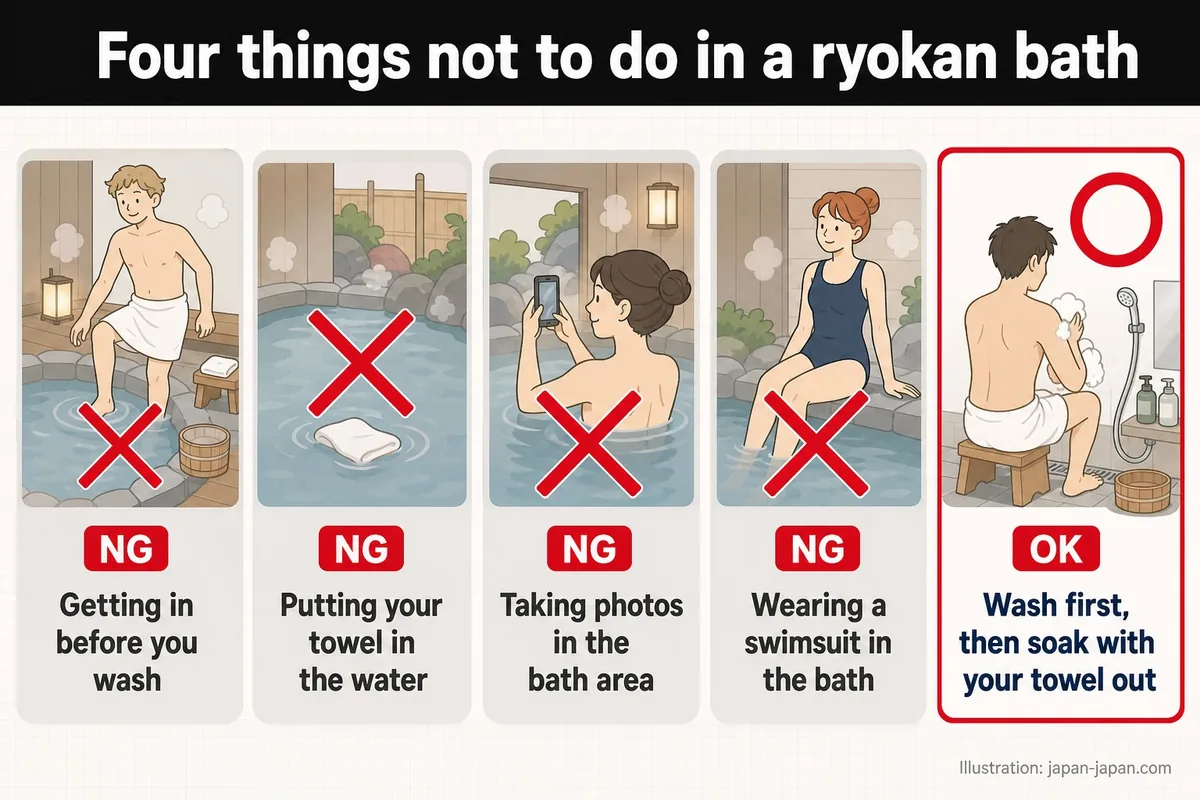
The communal bath is a shared space, so the agency’s bath answers set out a few rules.
- Wash your whole body in the shower before you get in.
- Splash some water over yourself with a washtub first. Some baths are very hot, and getting in too fast can make your blood pressure jump.
- Keep your towel out of the water.
- Tie up long hair.
- Do not take photos in the bathing area.
- Keep your voice down.
- Do not wear a swimsuit or any other clothing in the bath.
The illustration below shows four of these rules as things not to do.
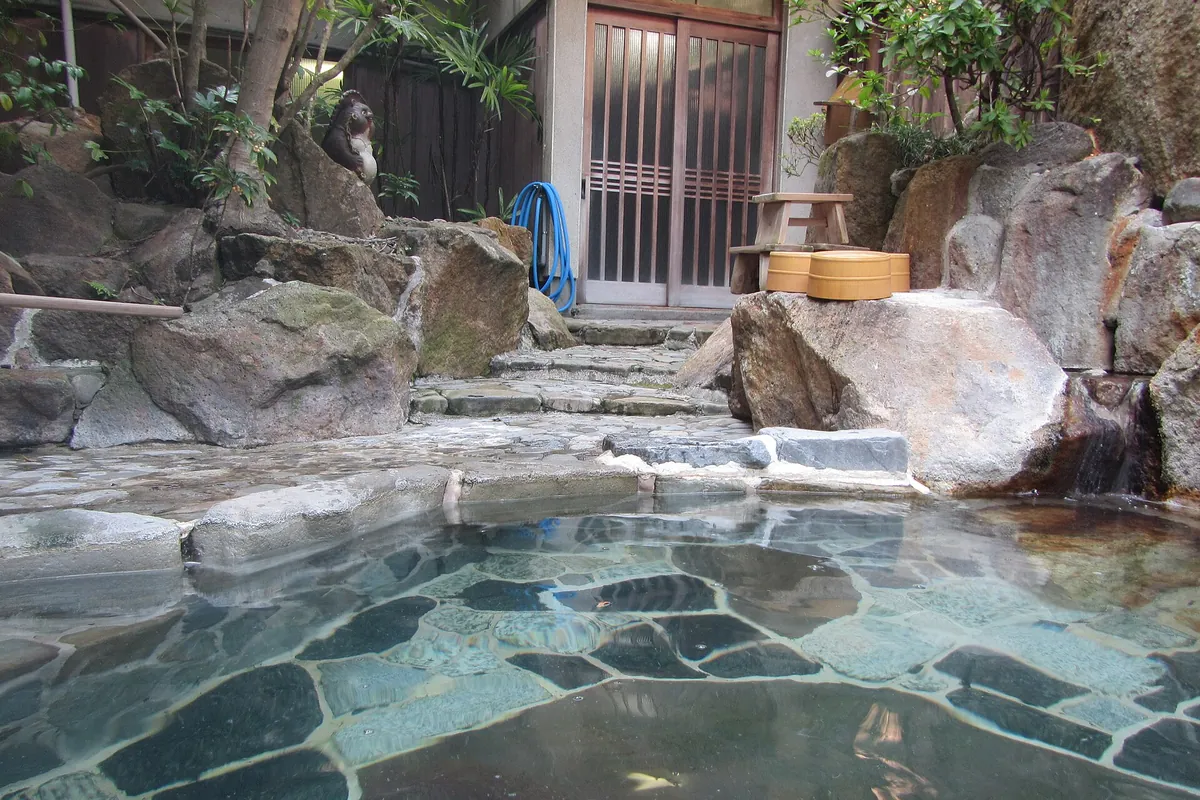
If your ryokan is in an onsen town, the agency suggests visiting the other onsen in the area too. The photo below shows an outdoor hot-spring bath at a ryokan.
Onsen ryokan towns: Hakone, Mt Fuji and Beppu
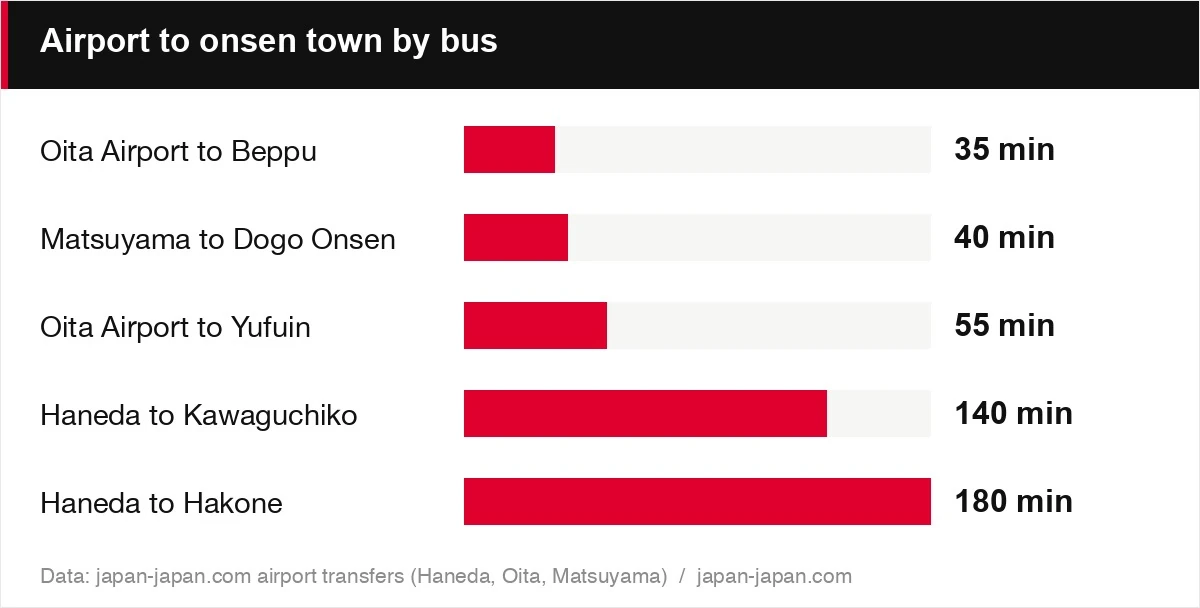
Many ryokan sit in natural settings, often far from train and bus links. Our airport transfer pages list a direct bus from the airport to five onsen towns, with no change needed. The chart below compares the quickest bus time on each route.
| Item | Value | Note |
|---|---|---|
| Oita Airport to Beppu | 35 min | Airport bus, 1,600 yen |
| Matsuyama to Dogo Onsen | 40 min | Limousine bus, 1,200 yen |
| Oita Airport to Yufuin | 55 min | Airport bus, 2,000 yen |
| Haneda to Kawaguchiko | 140 min | Keikyu Bus and Fujikyu Bus |
| Haneda to Hakone | 180 min | Keikyu Bus and Odakyu Highway Bus |
From Haneda Airport, one highway bus run by Keikyu Bus and Odakyu Highway Bus goes to Togendai on Lake Ashi, by way of Gotemba. The trip from Haneda to Hakone takes about 3 hours, or 180 minutes at the quickest.
For a ryokan near Mt Fuji, a highway bus run by Keikyu Bus and Fujikyu Bus goes to Mt Fuji Station and Kawaguchiko Station. The ride from Haneda to Mt Fuji and Kawaguchiko takes about 2 hours 20 minutes (140 minutes). Both buses leave from the same stops at Haneda: stop 7 at Terminal 3, stop 14 at Terminal 2 and stop 13 at Terminal 1.
In Kyushu, the airport bus from Oita Airport reaches Beppu in about 35 minutes for 1,600 yen. The airport sits on the coast across the bay, so the bus follows the water. The airport bus to Yufuin takes about 55 minutes and costs 2,000 yen. A taxi takes about 52 minutes and costs 18,500 yen.
In Shikoku, the limousine bus from Matsuyama Airport reaches Dogo Onsen in about 40 minutes for 1,200 yen. Dogo Onsen is one of the oldest hot springs in the country. The route bus takes about the same time for 830 yen.
Before you book, check how you will get from the nearest station to the ryokan. Some ryokan run a pick-up service and some do not. Where there is one, you almost always have to arrange it in advance. If public transport does not reach the ryokan, use its pick-up or rent a car. A ryokan that is much easier to reach by car will probably have a free parking area.
The illustration below is a short checklist for the day you travel.
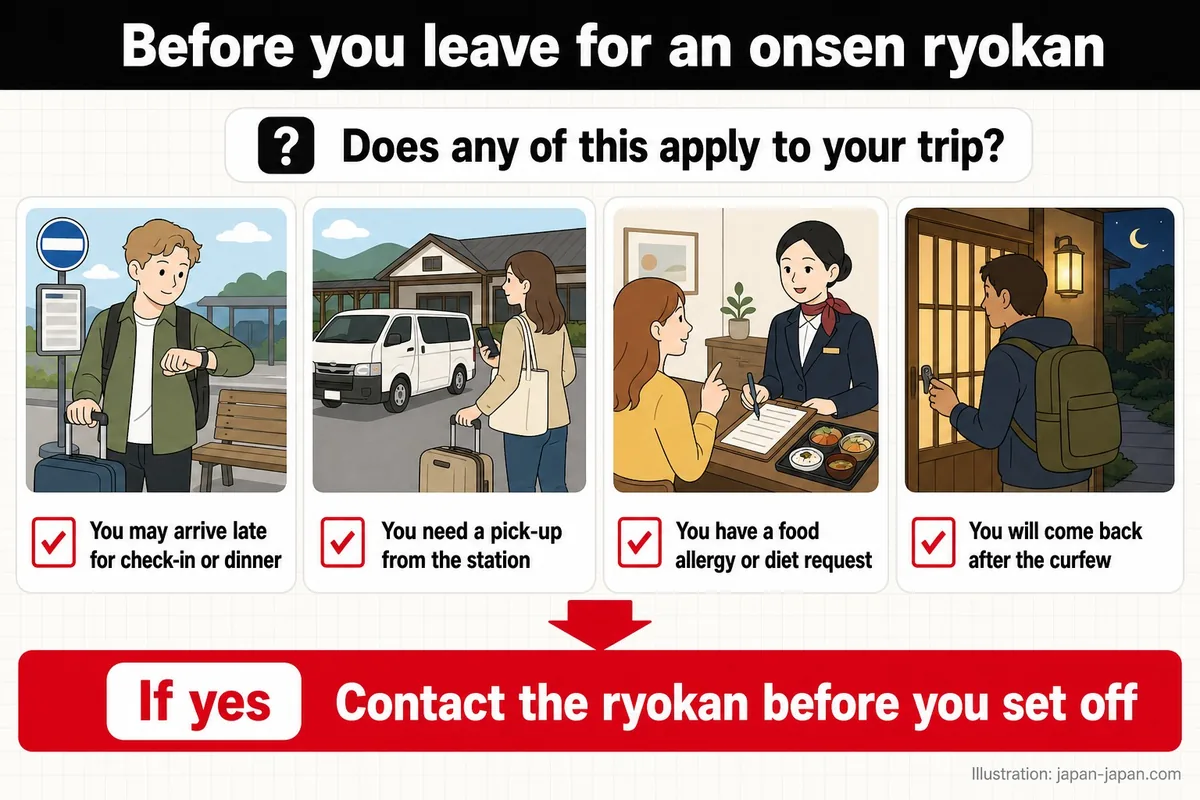
If you might be late, need a pick-up, have a food request or plan to stay out past curfew, contact the ryokan first. For the weather, what to wear and what’s on each month, see our pages on Hakone by month and Mount Fuji by month.
FAQ
How much does a ryokan cost per night?
JNTO puts the average ryokan stay at around 15,000 yen a night, and high-end ryokan charge more. The price is usually per person and normally includes dinner and breakfast. Breakfast-only and simple stay plans leave out the charge for dinner, or for both meals.
Do children pay full price at a ryokan?
Usually only from age 12, when many ryokan charge the full lodging fee. Most ryokan charge no lodging fee for young children, for example 3 and under, though meals or bedding may cost a little. Some charge 50% or 70% of the adult fee depending on age, and some offer a flat family plan.
What time is check-in and check-out at a ryokan?
Check-in usually starts at 15:00 or 16:00, and most ryokan set check-out between 10:00 and 12:00. If you arrive early, almost every ryokan will hold your luggage. Dinner runs in a set time window, so tell the ryokan if you will be late.
Can I use a ryokan bath if I have tattoos?
It depends on the ryokan. Some have no tattoo rules, and others decide case by case, where one or two small tattoos may be fine. Private baths in your room or reserved for your group are open to guests with tattoos without any issue.
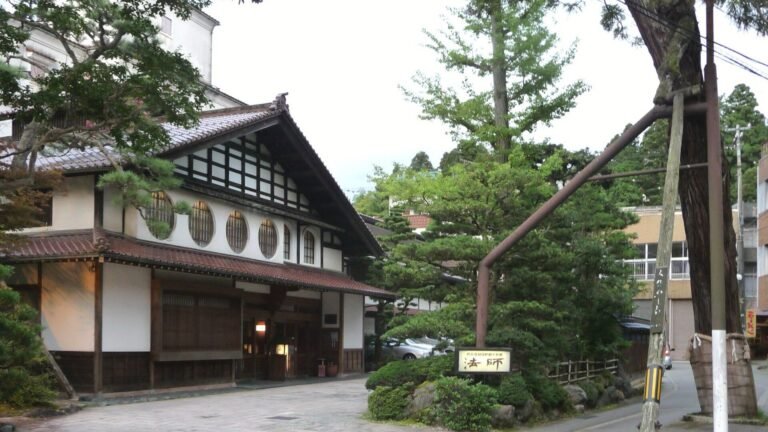
Photo: Hoshi Ryokan.jpg by Namazu-tron (CC BY-SA 3.0), via Wikimedia Commons.