Japanese medicine in English: OTC brands, doses and rules
What is inside 20 well-known Japanese over-the-counter medicines and 15 active ingredients: the dose and warnings translated from each package insert published by PMDA, the class printed on the box and who may sell it, and the official limits for taking medicine home.
Ibuprofen 150 mg in a dose of 2 tablets, up to 3 times a day, ages 15 and over.
第②類医薬品 · Designated class 2
Taking it to South Korea? The Korea Customs Service's press release of 17 July 2025 gives Japanese painkillers containing allylisopropylacetylurea, a psychotropic drug, as an example of medicine banned from being brought into Korea. EVE A's package insert lists allylisopropylacetylurea, 60 mg in 2 tablets.
Relief of menstrual pain (period pain), headache, toothache, throat pain, joint pain, muscle pain, neuralgia, lower back pain, pain from stiff shoulders, pain after tooth extraction, pain from bruises, earache, pain from fractures, pain from sprains and pain from injuries. Reducing fever when you have chills/fever.
Loxoprofen Sodium Hydrate 68.1 mg in a dose of 1 tablet, up to 2 times a day, with a 3rd dose allowed if the symptoms come back, ages 15 and over.
第1類医薬品 · Class 1Pharmacist only
Contains (in 1 tablet)
Loxoprofen Sodium Hydrate 68.1 mg
Listed for
Relief of headache, menstrual pain (period pain), toothache, pain after tooth extraction, throat pain, lower back pain, joint pain, neuralgia, muscle pain, pain from stiff shoulders, earache, pain from bruises, pain from fractures, pain from sprains and pain from injuries. Reducing fever when you have chills/fever.
Aspirin 660 mg in a dose of 2 tablets, up to 2 times a day, ages 15 and over.
第②類医薬品 · Designated class 2
Contains (in 2 tablets)
Aspirin 660 mg, Synthetic Hydrotalcite 200 mg
Listed for
(1) Relief of headache, menstrual pain (period pain), joint pain, neuralgia, lower back pain, muscle pain, pain from stiff shoulders, throat pain, toothache, pain after tooth extraction, pain from bruises, pain from sprains, pain from fractures, pain from injuries and earache. (2) Reducing fever when you have chills/fever.
Acetaminophen 300 mg in a dose of 1 tablet, up to 3 times a day, ages 15 and over.
第2類医薬品 · Class 2
Contains (in 1 tablet)
Acetaminophen 300 mg
Listed for
1) Relief of headache, menstrual pain (period pain), toothache, pain after tooth extraction, throat pain, earache, joint pain, neuralgia, lower back pain, muscle pain, pain from stiff shoulders, pain from bruises, pain from fractures, pain from sprains and pain from injuries. 2) Reducing fever when you have chills/fever.
Acetaminophen 300 mg and Dihydrocodeine Phosphate 8 mg in an adult dose (ages 15 and over) of 1 sachet, 3 times a day; smaller doses for ages 12 to 14.
第②類医薬品 · Designated class 2要確認 · Shop checks first
Taking it to South Korea? The Korea Customs Service lists codeine and dihydrocodeine as narcotics. Pabron Gold A Granules contains Dihydrocodeine Phosphate.
Relief of the various symptoms of a cold (cough, phlegm, sore throat, sneezing, runny nose, blocked nose, chills, fever, headache, joint pain, muscle pain).
Relief of the various symptoms of a cold (sore throat, fever, chills, headache, runny nose, blocked nose, sneezing, cough, phlegm, joint pain, muscle pain).
Dihydrocodeine Phosphate 5 mg in an adult dose (ages 15 and over) of 10 mL, 3 times a day, and up to 6 times a day depending on the situation, at least 4 hours apart; smaller doses for ages 12 to 14.
第②類医薬品 · Designated class 2要確認 · Shop checks first
Taking it to South Korea? The Korea Customs Service lists codeine and dihydrocodeine as narcotics. New Bron Solution Ace contains Dihydrocodeine Phosphate.
Drinking too much, heartburn, stomach discomfort, weak stomach, heavy stomach, overeating, stomach pain, indigestion, promotion of digestion, loss of appetite, excess stomach acid, a bloated feeling in the stomach/abdomen, nausea (queasy stomach, queasiness from a hangover/feeling ill after drinking, feeling sick), vomiting, a feeling of something stuck in the chest, belching, a heavy feeling in the stomach.
Stomach discomfort, weak stomach, heavy stomach, stomach pain, overeating, drinking too much, heartburn, nausea (queasiness, queasy stomach, queasiness from a hangover/feeling ill after drinking, feeling like vomiting, feeling sick), vomiting, loss of appetite, indigestion, excess stomach acid, belching, a feeling of something stuck in the chest, promotion of digestion, a bloated feeling in the stomach/abdomen, a heavy feeling in the stomach.
Loose stools, diarrhoea, food poisoning, stomach upset from drinking water, vomiting and diarrhoea, loose bowels, diarrhoea due to indigestion, toothache from tooth decay.
Eye fatigue, redness of the conjunctiva, itchy eyes, prevention of eye disease (after swimming, when dust or sweat gets in the eyes, etc.), eye inflammation caused by ultraviolet rays or other light rays (snow blindness, etc.), blurred vision (when there is a lot of eye discharge, etc.), blepharitis (sores on the eyelids), discomfort when wearing hard contact lenses.
In this database: Pabron Gold A Granules, Lulu Attack EX, New Bron Solution Ace. PMDA's OTC search: 2 products containing codeine (excluding dihydrocodeine) and 397 containing dihydrocodeine.
要確認 ingredient
On Japanese boxes
ジヒドロコデインリン酸塩 / コデインリン酸塩水和物
Products here
Pabron Gold A Granules, Lulu Attack EX, New Bron Solution Ace, Aneton Sekidome Eki
In this database: Drewell, Restamin Kowa sugar-coated tablets. PMDA's OTC search: 682 products containing diphenhydramine (including creams and other salts).
Nothing matched. Try a brand (EVE, Loxonin), an ingredient (ibuprofen) or a class (第1類).
Each product page translates its Japanese package insert (添付文書) line by line: what it is approved for, the dose, what not to do and when to ask for advice. Nothing on these pages is a recommendation of what to take.
Pharmacist only
第1類 · 要指導
要確認 age line
18
要確認 pack limit
5 days' supply (7 for colds)
Rules changed
1 May 2026
Follow the directions and dosage exactly. That line is on Japanese package inserts. Japan's tourism organisation JNTO advises asking a pharmacist or registered sales clerk if necessary.
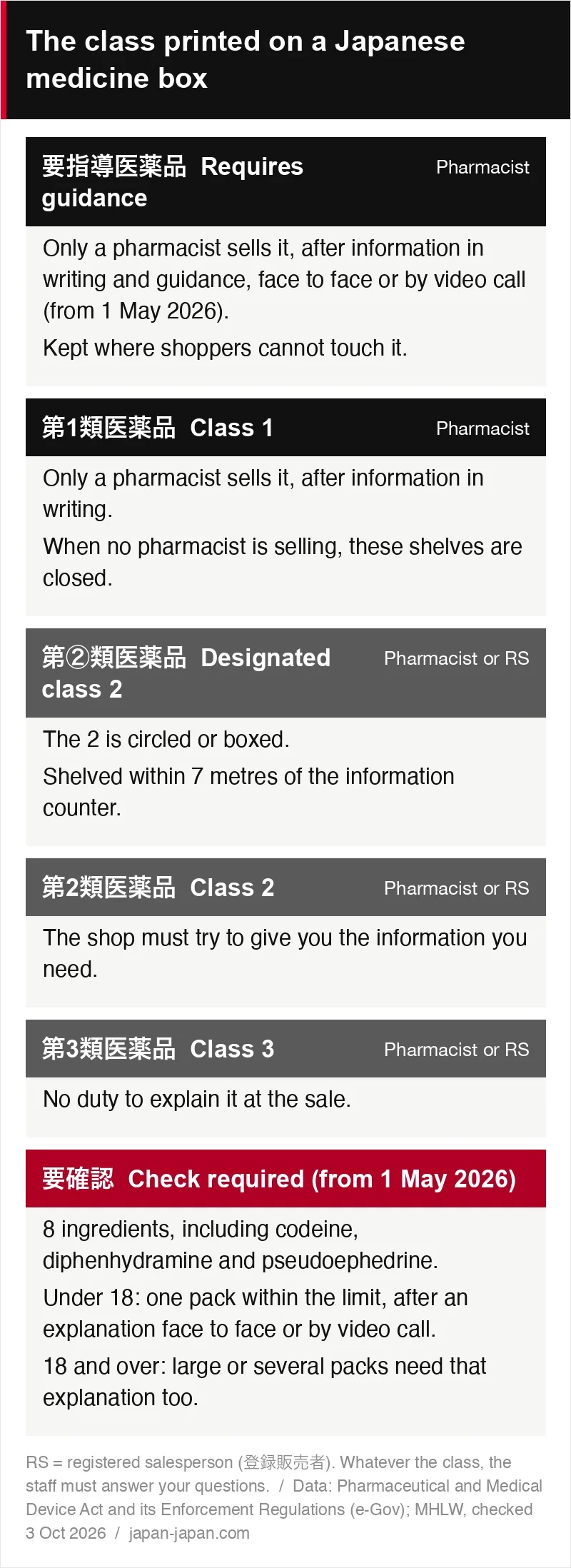
The class printed on the box decides who may sell the medicine and what the shop has to explain.
Chart: japan-japan.com, from the Pharmaceutical and Medical Device Act and its Enforcement Regulations (e-Gov) and MHLW.
Classes of OTC medicine in Japan (Pharmaceutical and Medical Device Act and Enforcement Regulations, checked 3 October 2026)Scroll →
The pharmacist must give the information in writing (on paper or on a screen). This can be skipped if you say you do not need it and the pharmacist judges you will use it properly.
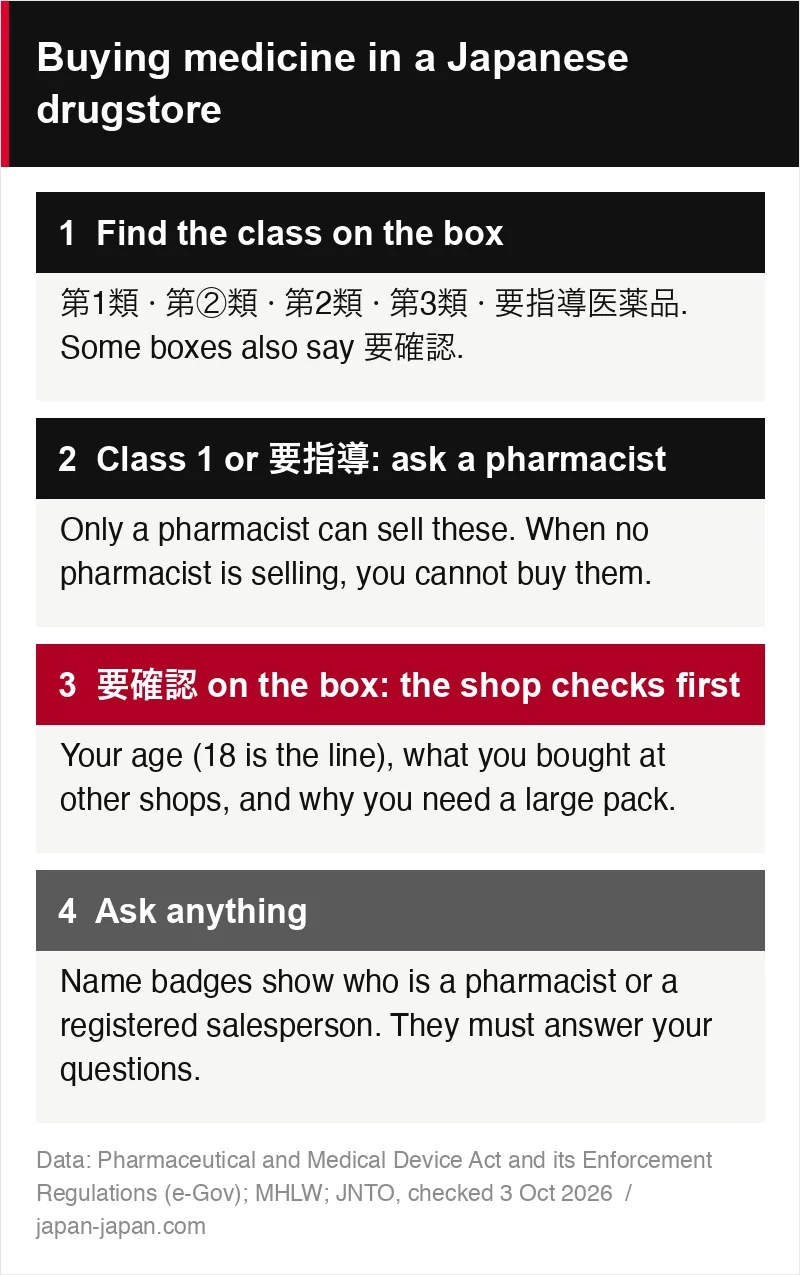
Chart: japan-japan.com, from the Pharmaceutical and Medical Device Act and its Enforcement Regulations (e-Gov), MHLW and JNTO.
要確認 on the box The box carries 要確認 (check required). On packs larger than the quantity the ministry sets, 要 is circled or boxed. Under 18: you can buy one pack within that quantity, after a pharmacist or registered salesperson explains it face to face or by video call. Larger packs and more than one pack cannot be sold to you.
Results of PMDA's search of OTC package inserts on 3 October 2026, one search per ingredient.
OTC package inserts that list the ingredient (PMDA search, 3 October 2026)
Ibuprofen excludes ibuprofen piconol, a different ingredient. Codeine excludes dihydrocodeine. Loxoprofen and diphenhydramine include patches and creams; aspirin includes aspirin aluminium.
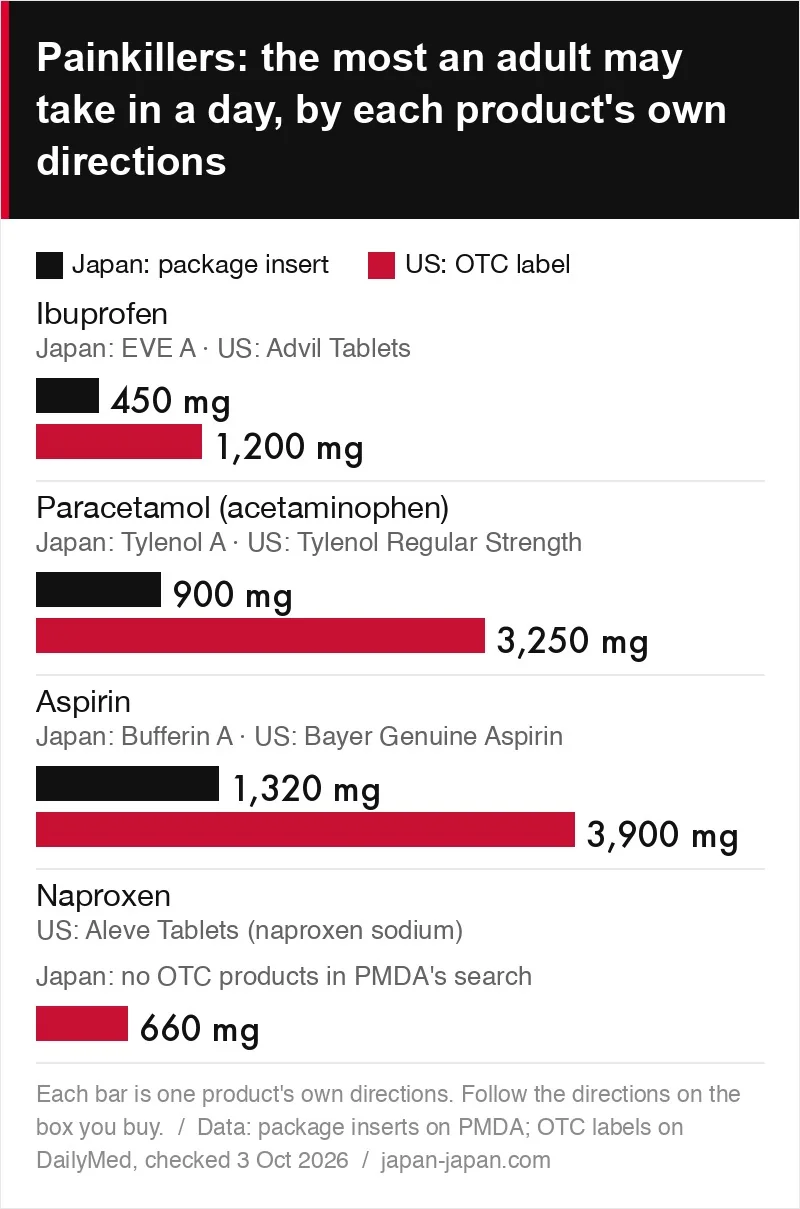
The most an adult may take in a day under each product's own directions.
Chart: japan-japan.com, from the package inserts on PMDA and the labels on DailyMed (checked 3 October 2026).
Most an adult may take in a day: Japanese package inserts (PMDA) and US OTC labels (DailyMed), checked 3 October 2026Scroll →
Ingredient
Japan: package insert
US: OTC label
Ibuprofen
EVE A: 450 mg
Advil Tablets: 1,200 mg
Paracetamol (acetaminophen)
Tylenol A: 900 mg
Tylenol Regular Strength: 3,250 mg
Aspirin
Bufferin A: 1,320 mg
Bayer Genuine Aspirin: 3,900 mg
Follow the directions and dosage exactly. That is the wording of the Japanese package inserts. Each number belongs to one product's directions.
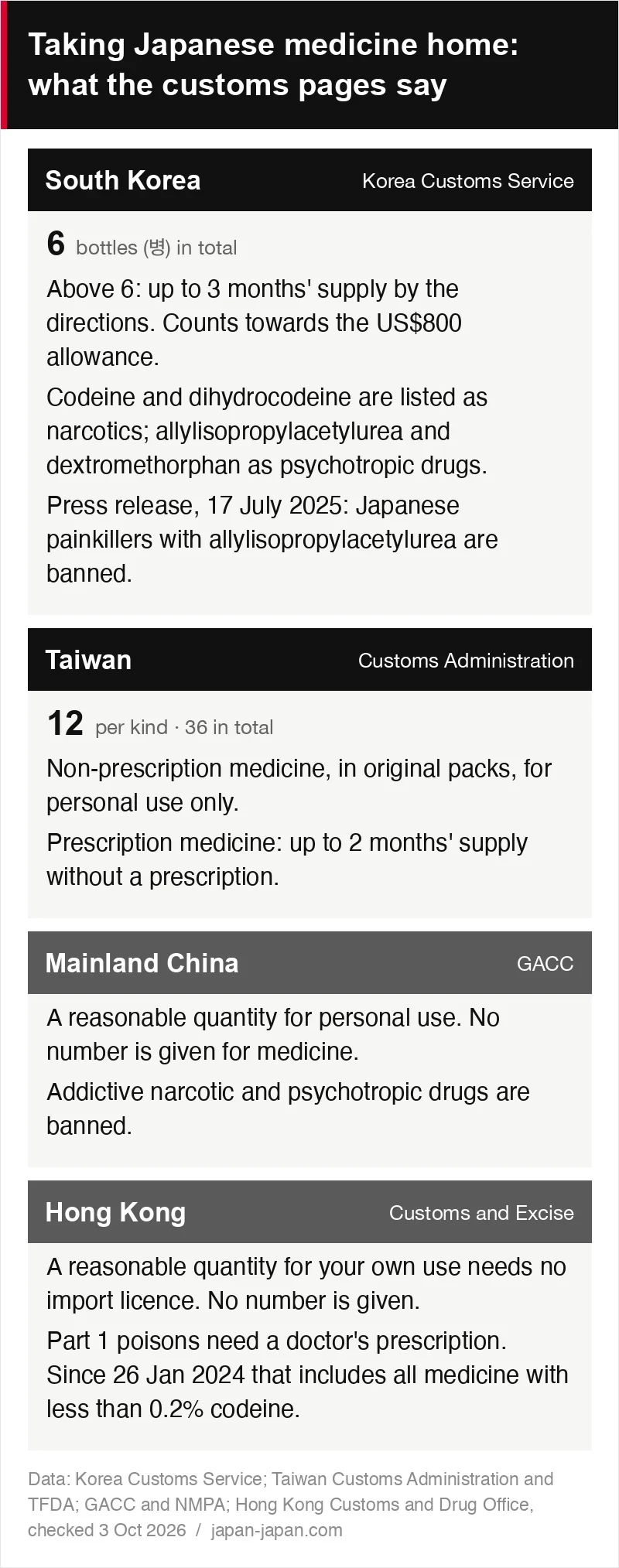
Only Taiwan and South Korea give a number for medicine in baggage.
Chart: japan-japan.com, from the customs pages of South Korea, Taiwan, mainland China and Hong Kong.
Medicine in a traveller's baggage: official customs pages (checked 3 October 2026)Scroll →
Going to
What the customs page says about medicine
South Korea
Medicine for your own use: 6 bottles (병) in total. Above 6, up to 3 months' supply by the directions. Gifts count as your own use, and the medicine counts towards the US$800 duty-free allowance.
Taiwan
Non-prescription medicine: up to 12 bottles (boxes, cans, bars, sticks) of one kind and 36 in total, counted in original packs, for personal use only.
Mainland China
Baggage is limited to a reasonable quantity for personal use: the normal quantity for the purpose of the trip and the length of stay. Gifts for relatives or friends count as personal use. No number is given for medicine.
Hong Kong
Medicine in your personal baggage, in a reasonable quantity for your own use, is exempt from the import licence. No number is given.
South Korea The Korea Customs Service's press release of 17 July 2025 gives, as examples, Japanese painkillers containing the psychotropic drug allylisopropylacetylurea, US cold medicines containing dextromethorphan and supplements containing melatonin, and says these medicines and foods are banned from being brought into Korea.
US brands and the Japanese products in this database that contain the same active ingredient. The amounts and doses differ; each product page has its own package insert.
US OTC brands (DailyMed labels) and Japanese OTC products with the same active ingredient (PMDA package inserts), checked 3 October 2026Scroll →
Yes. On 3 October 2026, PMDA's search of OTC package inserts returned 205 products containing ibuprofen. EVE A, for example, has 150 mg in a dose of 2 tablets.
Is Tylenol sold in Japan?
Tylenol A (タイレノールA) is sold in Japan as a class 2 medicine. Each tablet contains 300 mg of acetaminophen (paracetamol); the package insert sets the adult dose at 1 tablet, up to 3 times a day.
What do 第1類, 第2類 and 第3類 on a Japanese medicine box mean?
They are the classes of OTC medicine. 第1類 (class 1): Only a pharmacist may sell it. 第2類 and 第3類 (class 2 and 3): A pharmacist or a registered salesperson may sell it.
Why can't I buy some medicine when the pharmacist is not there?
Class 1 medicines (第1類医薬品) and medicines that require guidance (要指導医薬品) can only be sold by a pharmacist. Class 1 medicines are shelved in an area shoppers cannot enter, or in a locked case or other place shoppers cannot touch. When no pharmacist is selling, these shelves are closed.
What does 要確認 on a medicine box mean?
The box carries 要確認 (check required). On packs larger than the quantity the ministry sets, 要 is circled or boxed. From 1 May 2026, medicines containing any of 8 ingredients are designated abuse-prevention medicines (指定濫用防止医薬品): ephedrine, codeine, dihydrocodeine, diphenhydramine, dextromethorphan, pseudoephedrine, bromovalerylurea and methylephedrine, with their hydrates and salts. Medicines for external use are not included.
Can I take EVE painkillers to Korea?
The Korea Customs Service's press release of 17 July 2025 gives, as examples, Japanese painkillers containing the psychotropic drug allylisopropylacetylurea, US cold medicines containing dextromethorphan and supplements containing melatonin, and says these medicines and foods are banned from being brought into Korea. EVE A's package insert lists allylisopropylacetylurea at 60 mg per 2 tablets.
How much medicine can I take back to Taiwan?
Non-prescription medicine: up to 12 bottles (boxes, cans, bars, sticks) of one kind and 36 in total, counted in original packs, for personal use only.
Is melatonin sold over the counter in Japan?
On 3 October 2026, PMDA's search of OTC package inserts returned no products containing melatonin. Japan's health ministry lists melatonin among ingredients used only as medicines.
Japanese over-the-counter medicines (20 products) and 15 active ingredients: active ingredients and amounts, approved uses, dose by age, warnings and the class printed on the box, translated from the package inserts published by PMDA; number of OTC package inserts per ingredient in PMDA's search; rules for selling them from the Ministry of Health, Labour and Welfare; limits for taking medicine home from the customs of South Korea, Taiwan, mainland China and Hong Kong.
Doses, warnings and amounts are translated from the package inserts on PMDA's OTC search, checked on 3 October 2026. The rules come from Japan's Pharmaceutical and Medical Device Act, its Enforcement Regulations and the Ministry of Health, Labour and Welfare; the limits for taking medicine home from the customs and health authorities of South Korea, Taiwan, mainland China and Hong Kong; US doses from the labels on DailyMed.