Keisei Skyliner vs Narita Express: Where Is Your Hotel?

The Skyliner wins on minutes and price to its own two stations. The Narita Express wins when your hotel is near Tokyo Station, Shinagawa, Shibuya, Shinjuku or Yokohama, because it goes there without a change of train.
Keisei paints the Skyliner in a metallic indigo it calls wind blue. The photo below shows the train you will board at the airport.
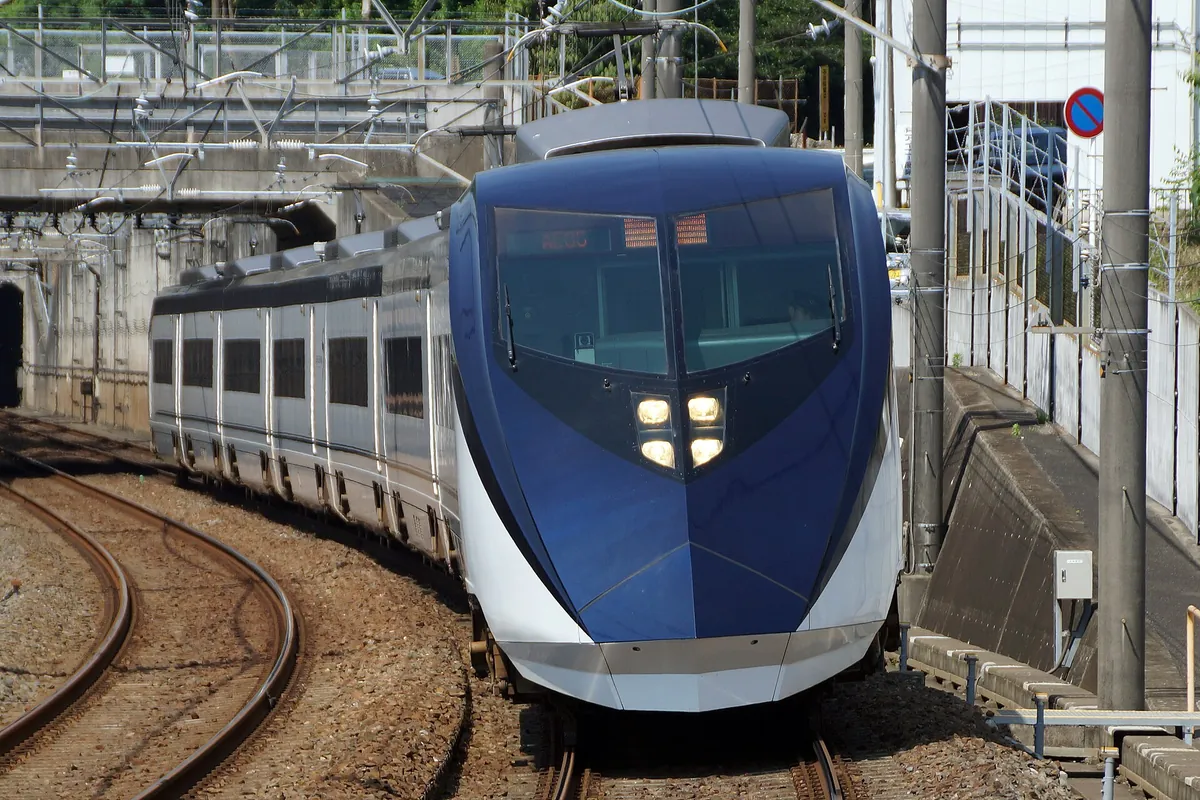
Keisei Skyliner vs Narita Express side by side
Both trains leave from the same two stations under the airport: Narita Airport Terminal 1 Station and Narita Airport Terminal 2·3 Station. Terminal 3 has no station of its own. From Terminal 3, walk to Terminal 2·3 Station or take the free bus.
The table lines up what each operator publishes. Our pages on the Keisei Skyliner and the Narita Express (N’EX) carry the full fare tables for adults and children.
| Item | Keisei Skyliner | Narita Express |
|---|---|---|
| Operator | Keisei Electric Railway (private railway) | JR East |
| Tokyo stops | Nippori, Keisei Ueno | Tokyo, Shinagawa, Shibuya, Shinjuku, Yokohama, Ofuna |
| Fastest time | 36 min to Nippori, 41 min to Keisei Ueno | 53 min to Tokyo Station |
| One way, adult | 2,580 yen (2,310 yen online) | 3,140 yen to Tokyo |
| Round trip deal | 4,500 yen online | 5,200 yen N’EX TOKYO Round Trip Ticket (non-Japanese passport) |
| Seats | All reserved | Reserved, or unreserved seat ticket at the same price |
| Large luggage | Space in every car, security cameras | Storage area with dial-type lock, first come, first served |
| Trains per hour | Three | Mostly two |
| Last train from Terminal 1 | 23:00 | 21:44 |
| JAPAN RAIL PASS | Not covered (private railway) | JR limited express, ordinary car |
Three rows decide the choice for most visitors: the Tokyo stop, the price and the last train. The Skyliner runs three services each hour. The Narita Express runs mostly two an hour, with 27 departure times on weekdays from Terminal 1.
Seating works differently on the two trains. Every Skyliner seat is reserved, so every passenger gets a seat. The JR East Narita Express fares and tickets page also sells a Limited Express Unreserved Seat Ticket at the same price as a reserved seat. With it you take any empty seat, or stand in the deck area if the train is full.
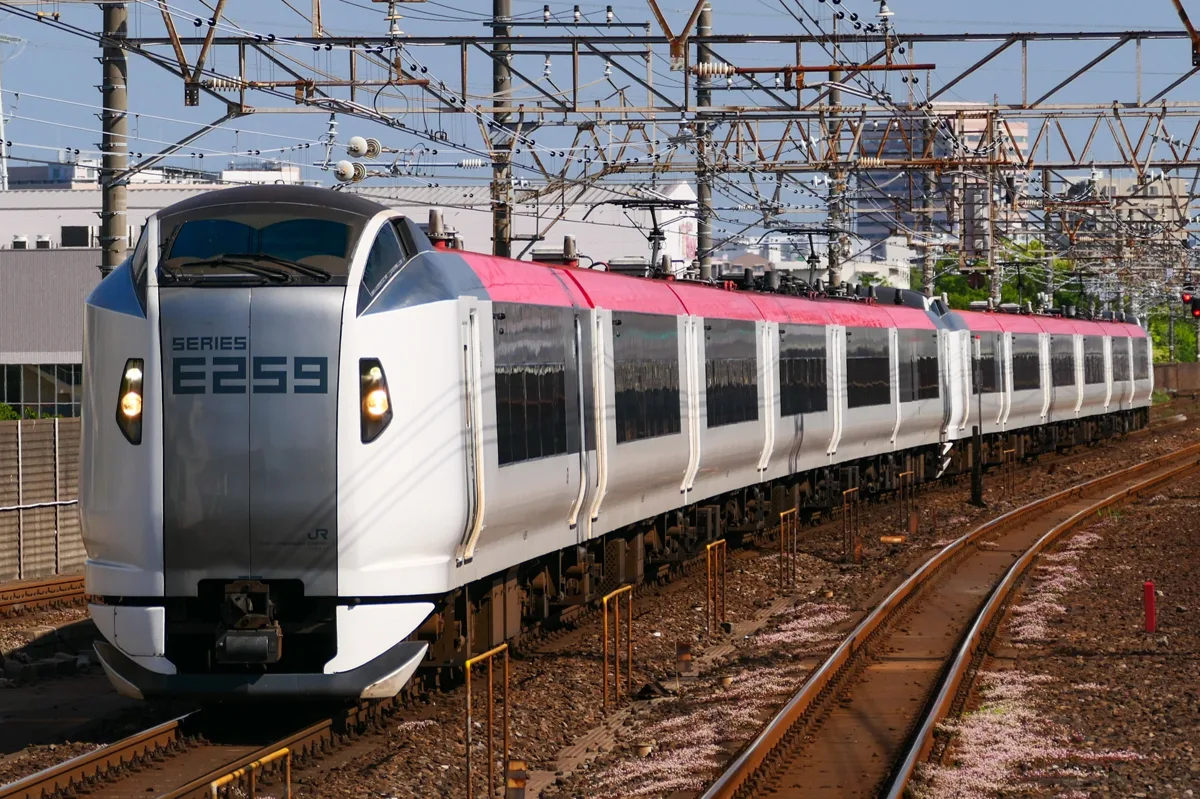
Where each train stops in Tokyo
This is the biggest difference between the two trains. The Skyliner runs non-stop from the airport to Nippori, then on to Keisei Ueno. Some Skyliner trains also stop at Shin-Kamagaya and Aoto on the way.
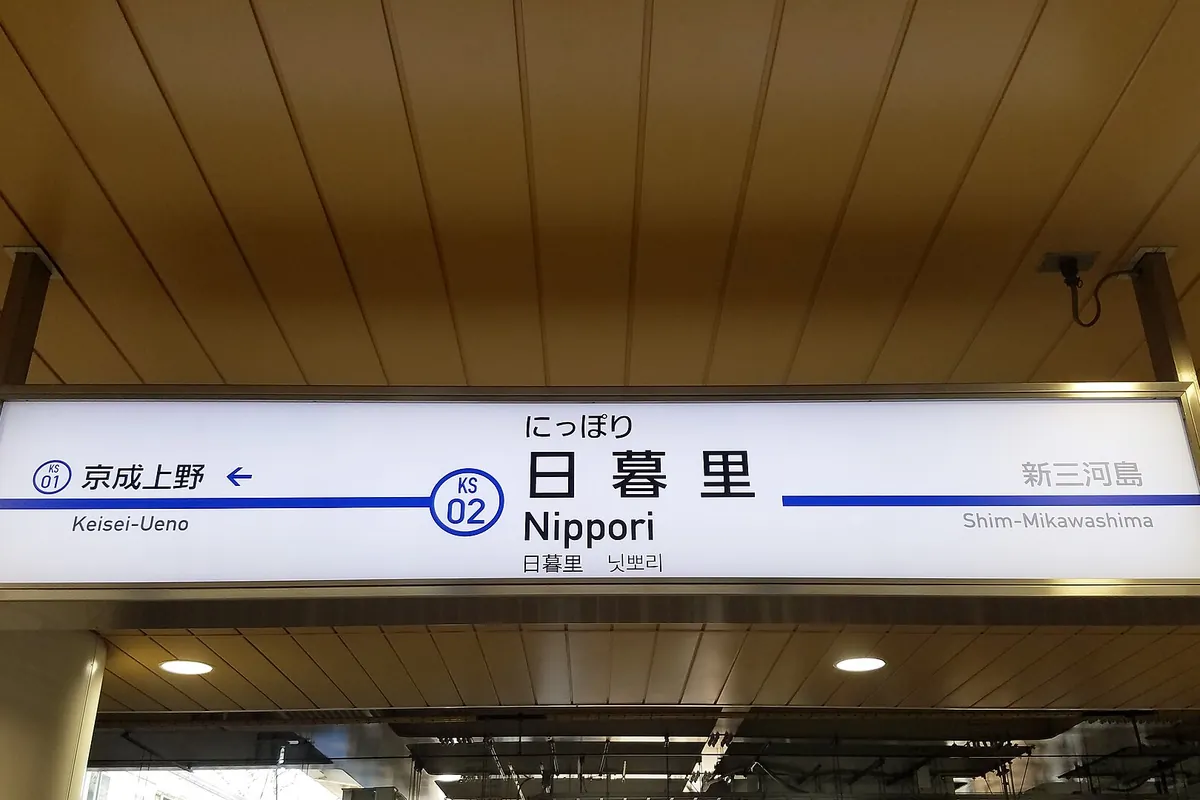
The Keisei Skyliner official page: speed, seats and luggage describes Nippori as the place for easy connections onto JR lines. The Keisei and JR stations at Nippori are joined, and Keisei keeps a JR Connection Counter there. Our Narita Airport to Ueno and Nippori page lists both stops with their times.
Nippori, in the photo below, is the change point for most Skyliner riders heading further into Tokyo.
The Narita Express covers more ground. The JR East Narita Express (N’EX) official page lists two routes. Trains bound for Shinjuku stop at Tokyo, Shinagawa, Shibuya and Shinjuku. Trains bound for Ofuna stop at Tokyo, Shinagawa, Yokohama and Ofuna. Some trains also stop at Narita, Sakura, Yotsukaido and Chiba.
Each stop has its own fare. A one-way ordinary seat costs 3,140 yen to Tokyo and 3,330 yen to Shinagawa, Shibuya or Shinjuku. Yokohama costs 4,480 yen and Ofuna 4,810 yen. The Skyliner charges the same 2,580 yen to Nippori and to Keisei Ueno. The chart below puts these one-way prices in order.
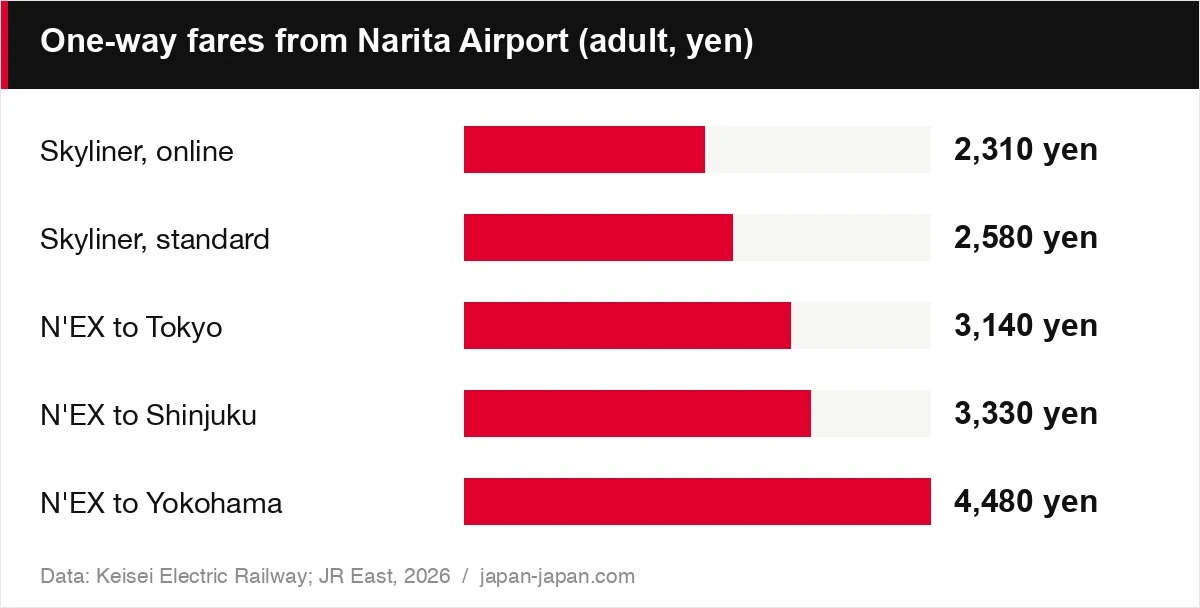
| Item | Value | Note |
|---|---|---|
| Skyliner, online | 2310 yen | Nippori or Keisei Ueno |
| Skyliner, standard | 2580 yen | Nippori or Keisei Ueno |
| N’EX to Tokyo | 3140 yen | Ordinary car |
| N’EX to Shinjuku | 3330 yen | Same to Shinagawa and Shibuya |
| N’EX to Yokohama | 4480 yen | Ordinary car |
Match the train to the area where you sleep:
- Ueno or Nippori: the Skyliner stops at both with no change. See our Ueno and Nippori route page.
- Tokyo Station: the Narita Express goes there in 53 minutes at the fastest. Compare it with the buses on Narita Airport to Tokyo Station.
- Shinjuku or Shibuya: the Narita Express is the only one of the two that runs there directly. Fares and buses are on Narita Airport to Shinjuku and Narita Airport to Shibuya.
- Shinagawa: both the Narita Express and Keisei’s Access Express run there. Details are on Narita Airport to Shinagawa.
- Asakusa: the airport lists Asakusa Station on the Toei Asakusa Line, which Keisei Access Express trains run onto. The Narita Airport to Asakusa page also lists a direct bus.
Flying into Haneda instead, or still choosing an airport? Our guide to getting from Narita or Haneda into Tokyo compares the two.
Fares, discount tickets and round trips
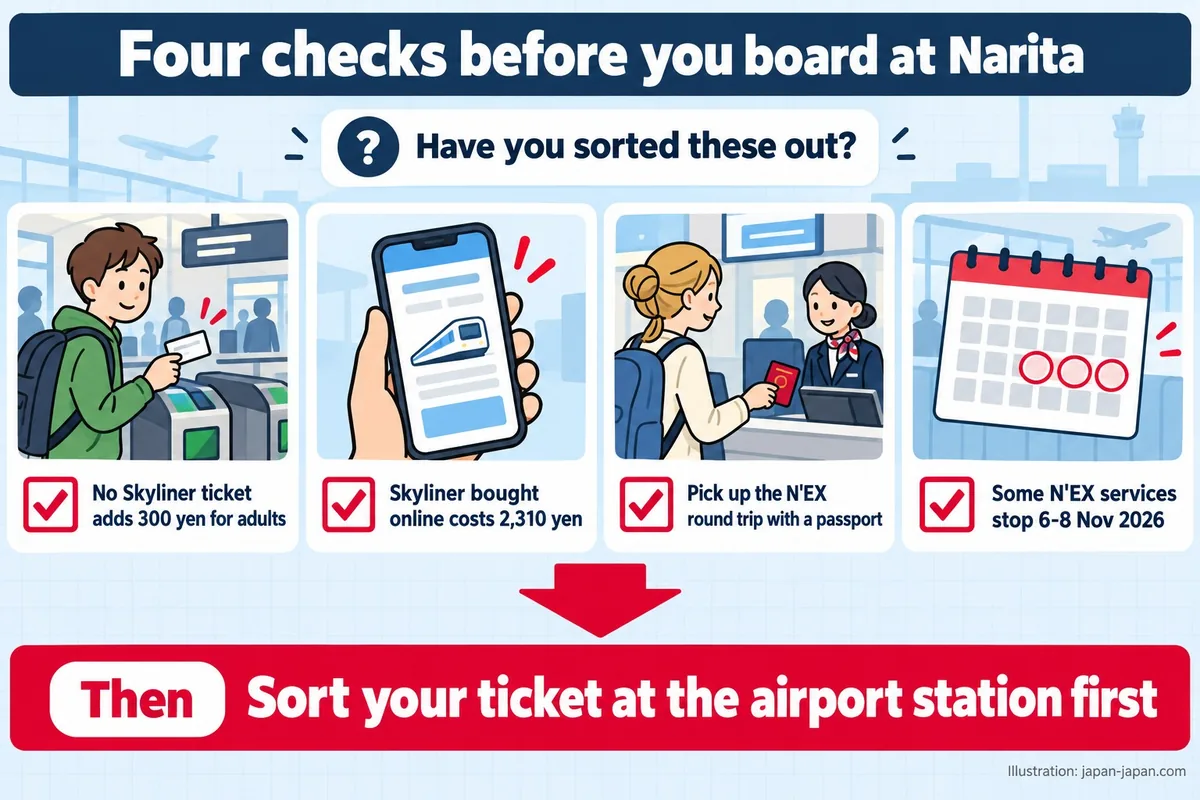
A standard one-way Skyliner ride costs 2,580 yen. That is a 1,280 yen basic fare plus a 1,300 yen Skyliner ticket, which reserves your seat. With a Suica or another IC card, the basic fare drops to 1,267 yen, but you still need the Skyliner ticket. Boarding without one adds 300 yen for adults and 150 yen for children.
The Keisei Skyliner discount ticket page lists the cheaper prices. Buy online, through a designated travel agency or aboard your flight, and one way costs 2,310 yen, a 270 yen discount. The online round trip costs 4,500 yen instead of 5,160 yen, which saves 660 yen. Children aged 6 to 11 pay 1,150 yen one way online.
Two rules come with the round trip. You can exchange it only at Narita Airport Terminal 1 Station and Terminal 2·3 Station, not at Ueno or Nippori. Skyliner e-tickets go on sale up to 30 days ahead. Keisei takes major credit cards only for the Skyliner ticket or the combined fare and Skyliner ticket, and other Keisei tickets need cash in yen.
The Keisei Skyliner & Tokyo Subway Ticket bundles a Skyliner ride between Narita Airport and Keisei Ueno with a subway pass. You choose one way or return, plus a 24, 48 or 72-hour pass for Toei Subway and Tokyo Metro. It stays valid for six months from the date of sale.
On the Narita Express, an ordinary seat to Tokyo costs 3,140 yen and the Green Car costs 3,910 yen, which is 770 yen more. JR East charges the same price all year. Children aged 6 to 11 pay half for the fare and the reserved seat, but the full adult price for Green Car tickets.
Visitors get a better deal with the N’EX TOKYO Round Trip Ticket. The JR East N’EX TOKYO Round Trip Ticket page sets it at 5,200 yen for adults and 2,600 yen for children aged 6 to 11. It covers one ride into the Tokyo area and one ride back within 14 days. The N’EX TOKYO Round Trip Ticket page in our pass database has the full rules.
- Who can buy it: anyone with a passport issued by a country other than Japan, including residents.
- Where to pick it up: only at Narita Airport Terminal 1 Station or Terminal 2·3 Station, with your passport.
- Order of rides: airport to Tokyo first, then Tokyo to the airport. The reverse is not allowed.
- Stations: the two rides can use different stations, such as Shinjuku in and Tokyo out.
- Changing trains: you can switch to other JR East trains in the covered area as long as you stay inside the ticket gates.
Two ordinary Narita Express tickets to Tokyo cost 6,280 yen, so the round trip ticket saves 1,080 yen. To Shinagawa, Shibuya or Shinjuku the ordinary round trip is 6,660 yen, and to Yokohama it is 8,960 yen. The Skyliner online round trip is still 700 yen cheaper than the N’EX ticket. The chart compares the four round-trip prices.
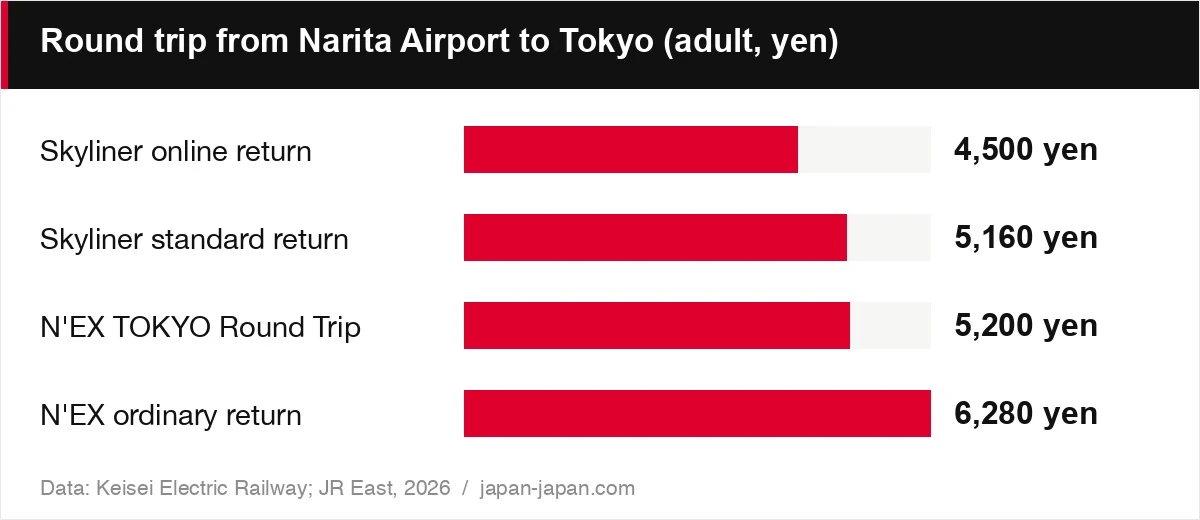
| Item | Value | Note |
|---|---|---|
| Skyliner online return | 4500 yen | Bought online |
| Skyliner standard return | 5160 yen | Two standard tickets |
| N’EX TOKYO Round Trip | 5200 yen | Valid 14 days |
| N’EX ordinary return | 6280 yen | Two tickets to Tokyo |
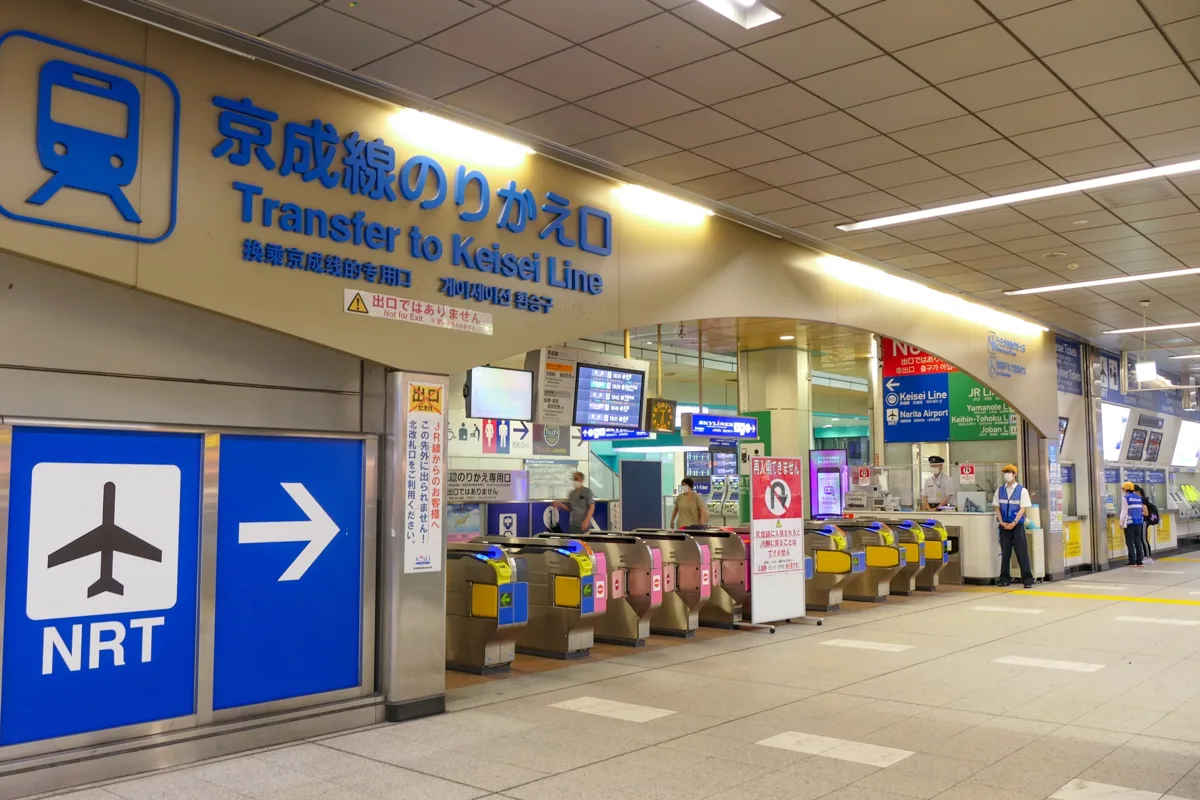
At the JR stations under the airport, look for the sign みどりの窓口 (Midori-no-Madoguchi), which means JR Ticket Office. Both airport stations keep this counter and the passport-reader ticket machines open from 6:30 to 21:45. Picking up a ticket can take time, so arrive at the counter well before your train.
The checklist below covers four things to sort out before you go down to the platform.
Luggage space, seats and Wi-Fi
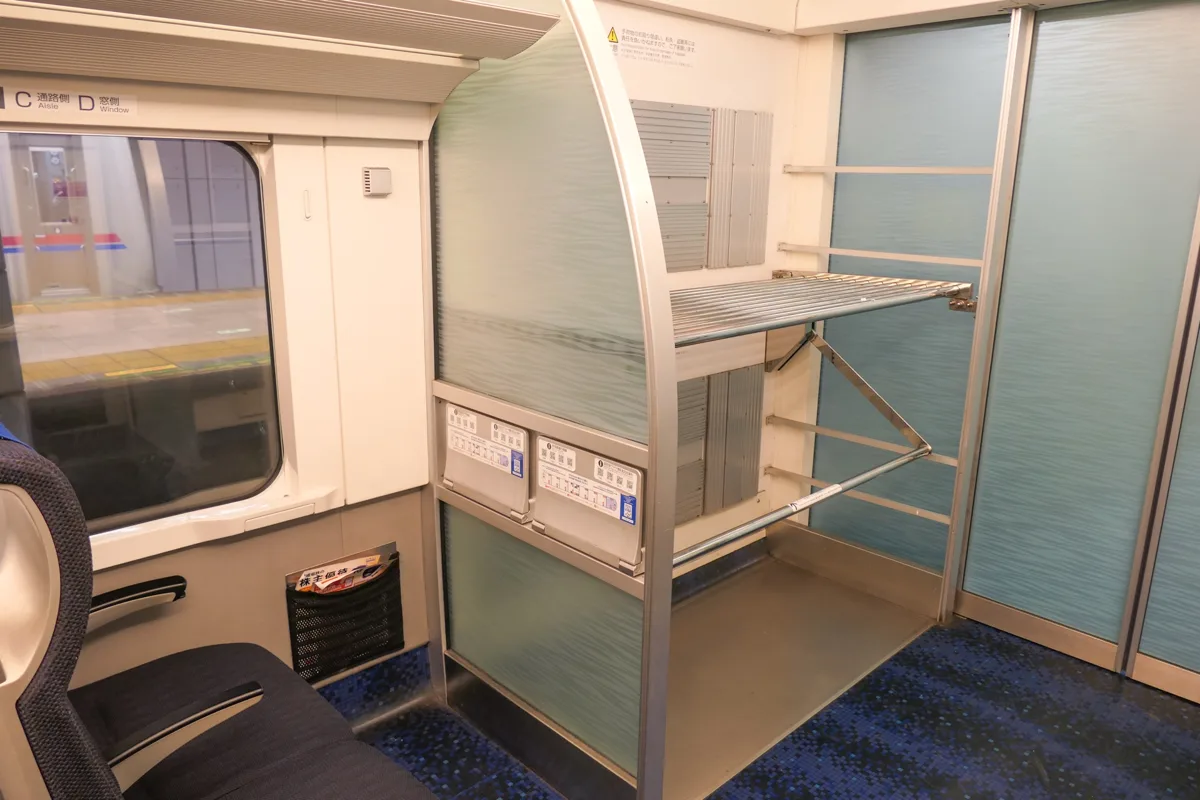
Both trains are built for airport travellers, and both carry big suitcases. Every Skyliner car has an oversized luggage space in the vestibule, 1.52 m wide. Security cameras watch the luggage space and the vestibule.
Skyliner seats have a pitch of 105 cm and a width of 47 cm. Every seat has a power outlet at its base. Japan uses 100V, so check whether your charger needs a voltage converter. KEISEI FREE Wi-Fi works free of charge on the Skyliner and at Keisei stations, including both airport stations, Nippori and Ueno.
The Narita Express has overhead racks plus storage areas for large luggage near the doors. You need no reservation for the large luggage area, but it works on a first-come, first-served basis. Each area has a dial-type lock, and security cameras cover the doorways and luggage areas. If the area is full, or your bag does not fit, keep it at your feet.
For comparison, the photo below shows the large luggage space at the end of a Skyliner car.
Ordinary Car seats on the Narita Express have a pitch of 1,020 mm, and Green Car seats 1,160 mm. Both have large seat tables and a power outlet on the front end of the armrest. The train has free Wi-Fi. Large screens on board show destinations, service status and flight information in four languages: English, Chinese, Korean and Japanese.
Travelling with several large cases? You can skip the train with your bags altogether. Our guide to sending luggage from the airport to your hotel covers the delivery counters at Narita.
First and last trains from Narita Airport
Late arrivals should check this section first. The last Skyliner leaves the airport at 23:00, while the last Narita Express leaves at 21:44.
The Keisei Skyliner timetable (Japanese) shows the first weekday Skyliner leaving Narita Airport Station at 7:23 and reaching Keisei Ueno at 8:29. On Saturdays and holidays the first train leaves at 7:30. The last train leaves at 23:00 every day, calls at Terminal 2·3 at 23:03 and reaches Keisei Ueno at 23:48. Keisei runs 44 Skyliners a day from the airport.
The early weekday trains are slower than the 36-minute fastest time. The 7:23 reaches Keisei Ueno at 8:29 and the 8:12 at 9:16, both more than an hour after leaving the airport.
The Narita Express leaves Narita Airport Station first at 7:37 and last at 21:44. JR East lists 27 departure times on weekdays and 28 on Saturdays and holidays. JR East also says some Narita Express services will be suspended from 6 to 8 November 2026.
| Train | Day | First from Terminal 1 | Last from Terminal 1 |
|---|---|---|---|
| Keisei Skyliner | Weekdays | 7:23 | 23:00 |
| Keisei Skyliner | Saturdays and holidays | 7:30 | 23:00 |
| Narita Express | Every day | 7:37 | 21:44 |
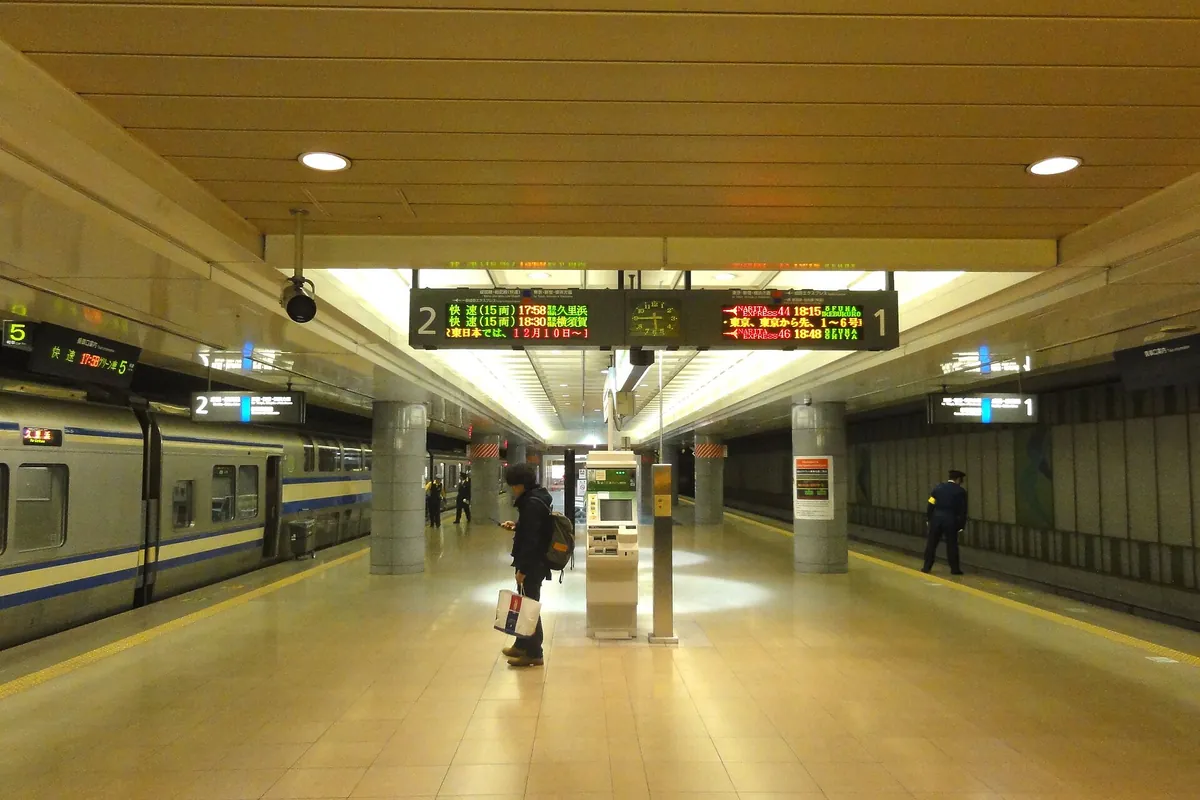
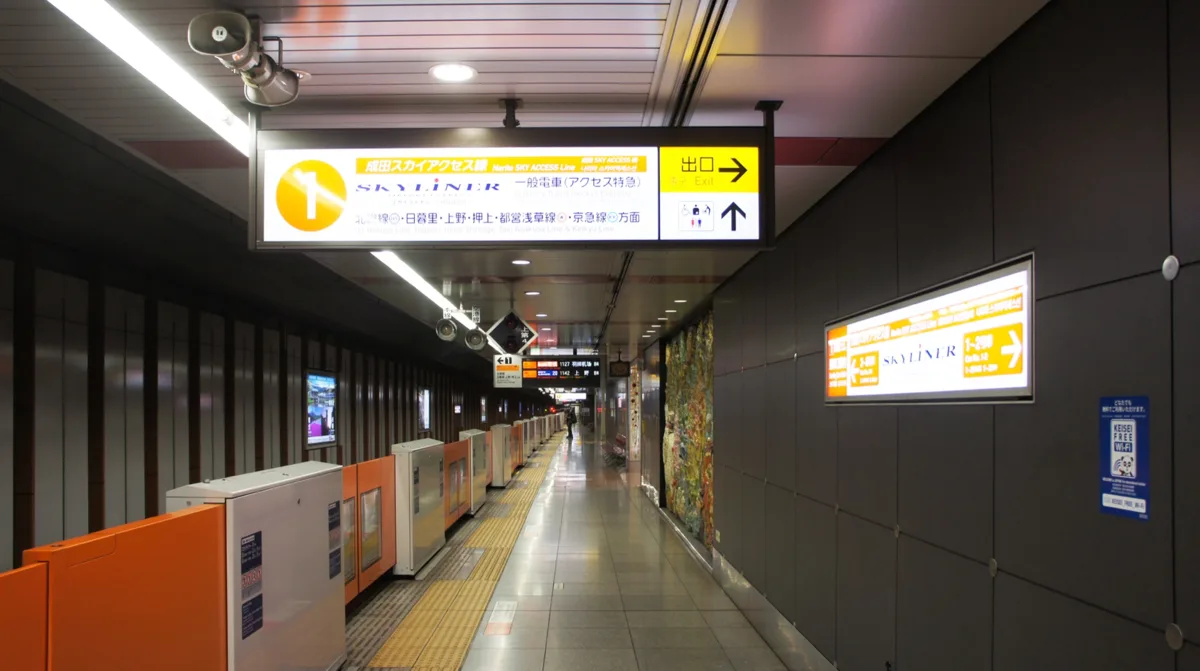
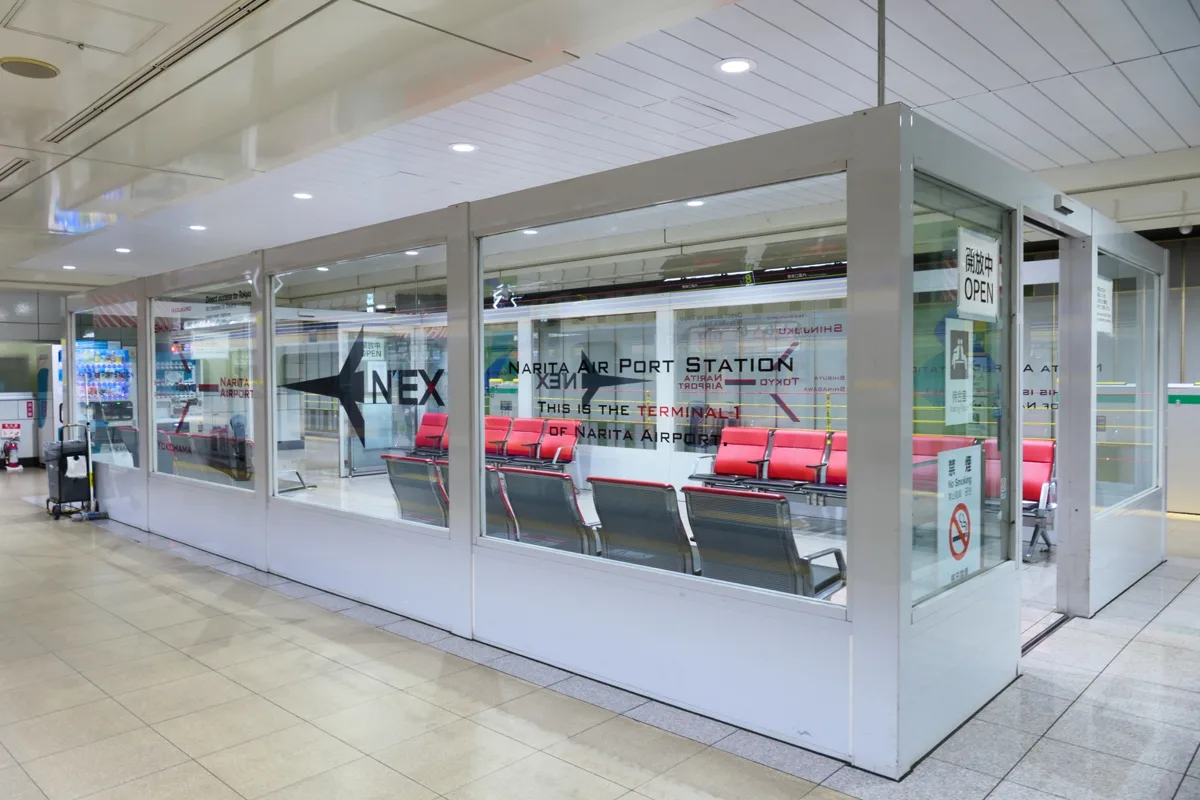
Both trains also stop at Terminal 2·3 Station a few minutes later. Narita Airport Station sits on B1F under Terminal 1. The station for Terminals 2 and 3 sits on B1F under Terminal 2. Our pages on Narita Airport Terminal 1 and Narita Airport Terminal 2 show how to find them. The photo below shows a platform at one of the airport stations.
JR Pass, Suica and Keisei’s cheaper trains
Your rail pass can decide the question for you. The JAPAN RAIL PASS official page on covered routes lists JR limited express trains among the services the pass covers. The pass covers ordinary cars on those trains, and the Narita Express is a JR East limited express. The same page says that on a private railway you pay the fare and fee for the section you ride. Keisei is a private railway, so the pass does not cover the Skyliner.
One catch for pass holders: you cannot book seats with a JAPAN RAIL PASS through JR-EAST Train Reservation. Reserve at the station instead. Read our JAPAN RAIL PASS page and our guide on whether the JR Pass is worth it before you buy.
Two regional JR East passes also work on the Narita Express with a reserved seat ticket. The JR EAST PASS costs 35,000 yen for 5 days. The JR TOKYO Wide Pass costs 16,000 yen for 3 days.
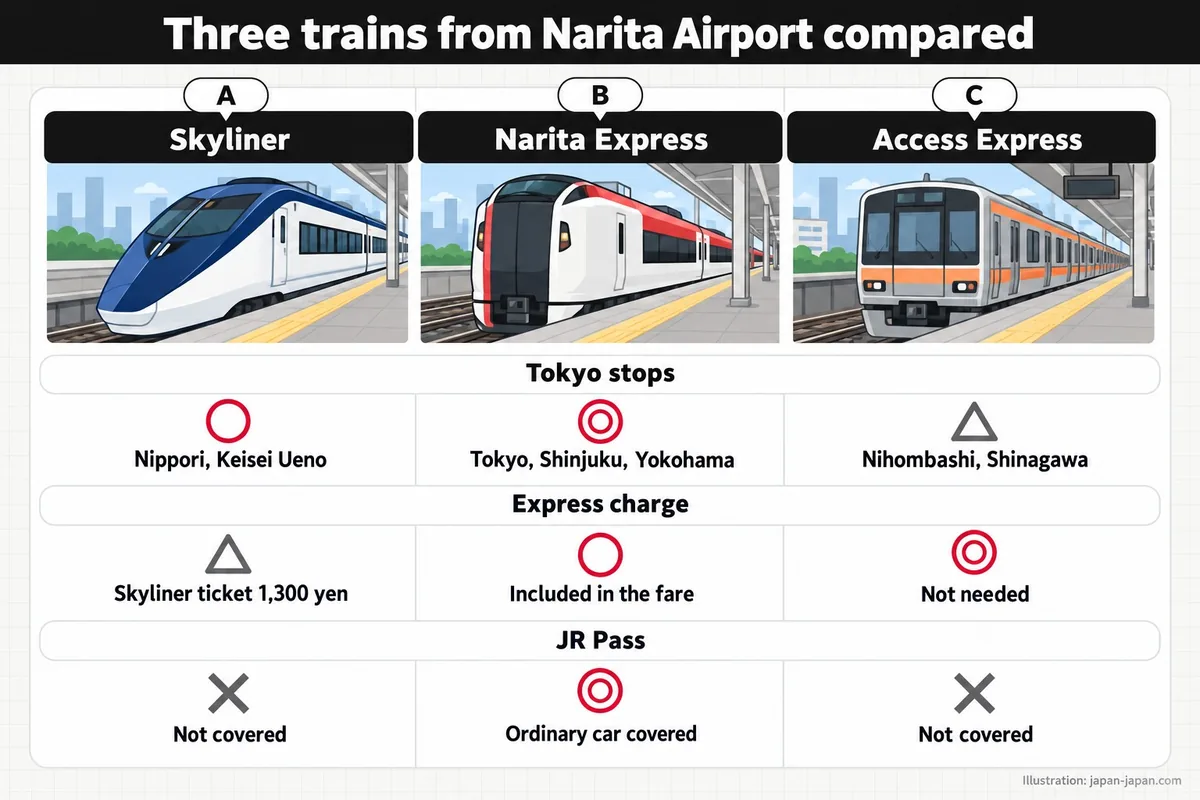
The illustration compares the Skyliner, the Narita Express and Keisei’s Access Express on stops, express charge and the JR Pass.
A Suica card pays the basic fare on both trains, but neither lets you ride on the card alone. On the Narita Express you also need a limited express ticket. On the Skyliner the IC fare is 1,267 yen, plus the 1,300 yen Skyliner ticket.
Keisei runs two cheaper trains with no limited express charge. The Keisei access from Narita Airport: three routes lists them. The Access Express runs through to Nihombashi, Shimbashi and Shinagawa without a change. The Keisei Main Line runs by way of Funabashi and has more trains.
| Keisei train | Extra charge | Example fare | Example time |
|---|---|---|---|
| Skyliner | Skyliner ticket 1,300 yen | 2,580 yen to Nippori | 36 min to Nippori |
| Access Express | None | 1,190 yen to Oshiage | 46 min to Oshiage |
| Keisei Main Line | None | 990 yen to Oshiage | 64 min from Terminal 2·3 |
Keisei Skyliner or Narita Express: which one to take
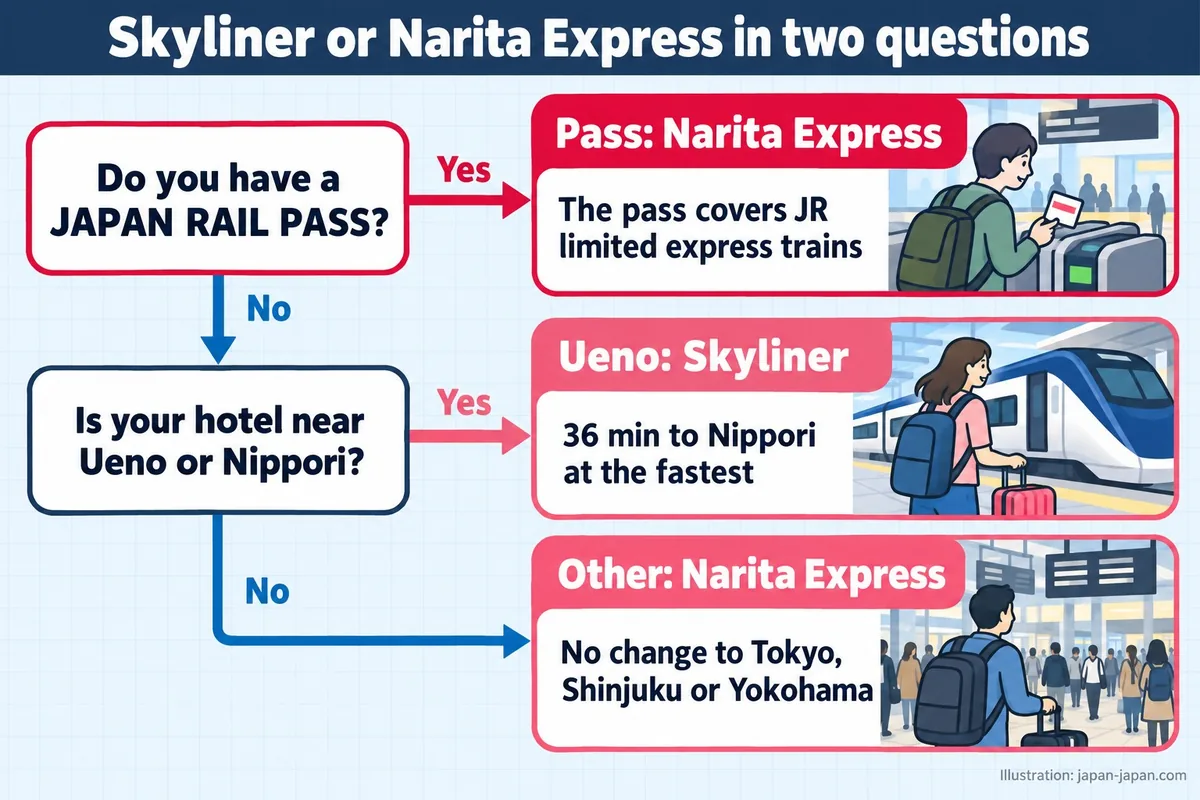
Decide by facts you already know: your hotel, your pass and your landing time. The flow chart below asks two questions and gives one answer.
Take the Skyliner if any of these fit:
- Your hotel is near Ueno or Nippori.
- You plan to change to a JR line at Nippori, where the stations are joined.
- You can buy online before you fly and pay 2,310 yen one way.
- You land after the last Narita Express at 21:44. The last Skyliner leaves at 23:00.
Take the Narita Express if any of these fit:
- Your hotel is near Tokyo Station, Shinagawa, Shibuya, Shinjuku or Yokohama, so you ride with no change.
- You hold a JAPAN RAIL PASS, which covers JR limited express trains.
- You have a non-Japanese passport and will use the 5,200 yen N’EX TOKYO Round Trip Ticket in both directions.
If you would rather skip any express charge, take the Access Express or the Keisei Main Line. Both trains carry big suitcases, but on the Narita Express the large luggage area is first come, first served. For lockers, bag delivery and everything else at the airport, see our Narita Airport guide.
Skyliner or Narita Express: what 98 people in Japan use
On 13–14 October 2026, japan-japan.com ran an online survey of people living in Japan about 32 travel choices. 130 people answered. We removed answers that looked machine-written, one from outside Japan and most of those that contradicted themselves, which left 98. Shares below are of the 98 respondents unless a smaller group is named; they describe these people, not all travellers in Japan. See all 32 comparisons and how we asked.
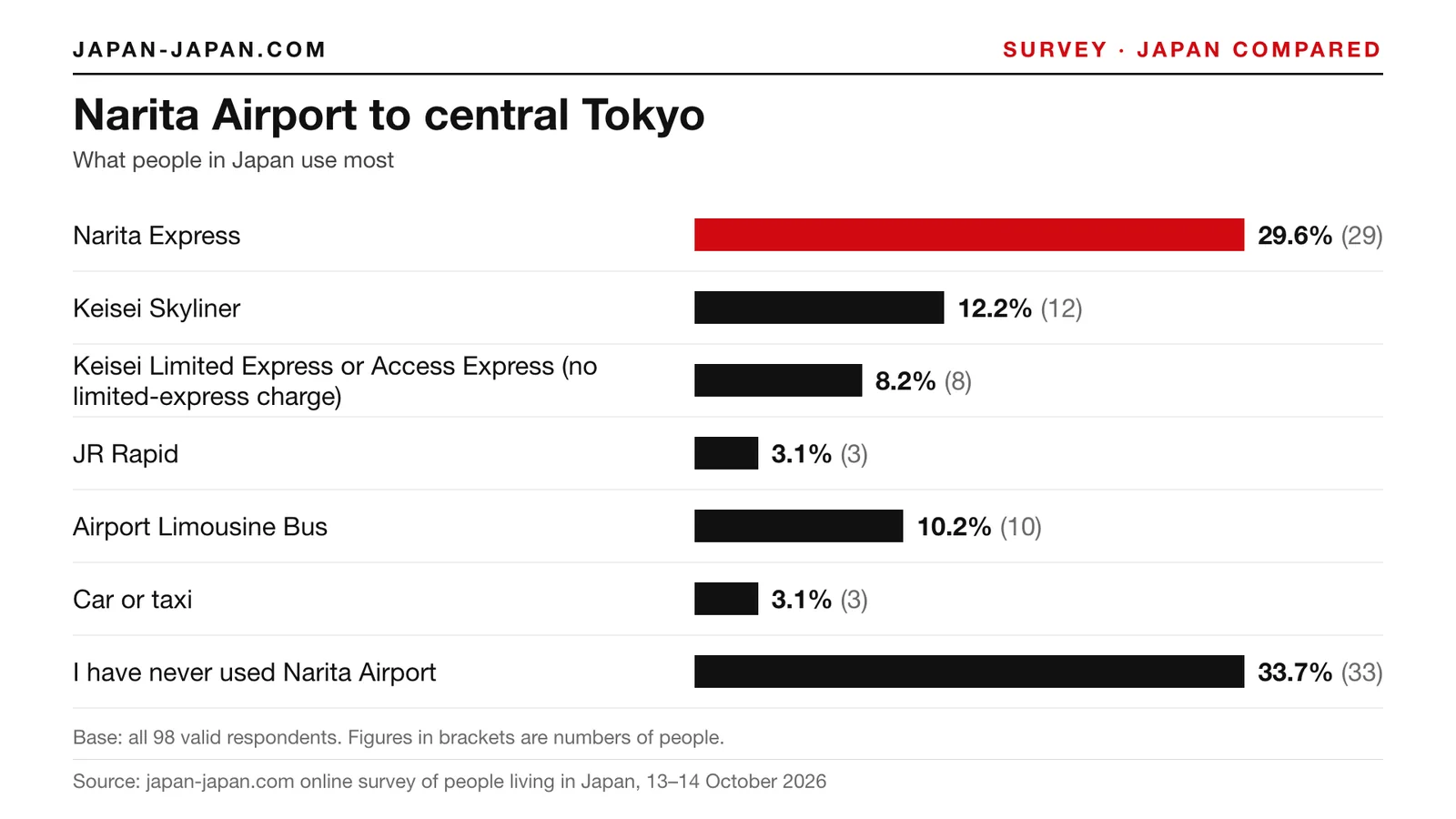
Asked how they mostly get from Narita Airport into central Tokyo, 29.6% (29 people) named the Narita Express and 12.2% (12 people) the Keisei Skyliner. Counting the cheaper trains too, 32.7% (32 people) mostly use JR and 20.4% (20 people) mostly use Keisei. 10.2% (10 people) take the Airport Limousine Bus, and 33.7% (33 people) have never used Narita Airport.
FAQ
Is the Skyliner cheaper than the Narita Express?
Yes, at standard prices to central Tokyo. The Skyliner costs 2,580 yen to Nippori or Keisei Ueno, and the Narita Express costs 3,140 yen to Tokyo Station. Bought online, the Skyliner is 2,310 yen, which is 830 yen cheaper.
Can I use the JR Pass on the Skyliner or the Narita Express?
The JAPAN RAIL PASS covers ordinary cars on JR limited express trains, and the Narita Express is a JR East limited express. The Skyliner belongs to Keisei, a private railway, so pass holders pay the full fare. You cannot reserve Narita Express seats with the pass through JR-EAST Train Reservation, so book at the station.
Do I need to book the Skyliner or the Narita Express in advance?
Every Skyliner seat is reserved, so you need a Skyliner ticket before you board, or you pay 300 yen extra. Tickets go on sale one month ahead, and e-tickets 30 days ahead. On the Narita Express you can buy a reserved seat up to one month ahead, or an unreserved seat ticket at the same price.
Which train should I take if I land at Narita late at night?
Take the Skyliner if you land late. The last Narita Express leaves Narita Airport Station at 21:44. The last Skyliner leaves at 23:00 and reaches Keisei Ueno at 23:48.
About the author



.jpg)


