Shinkansen Reserved vs Non-Reserved Seats: Worth Booking?
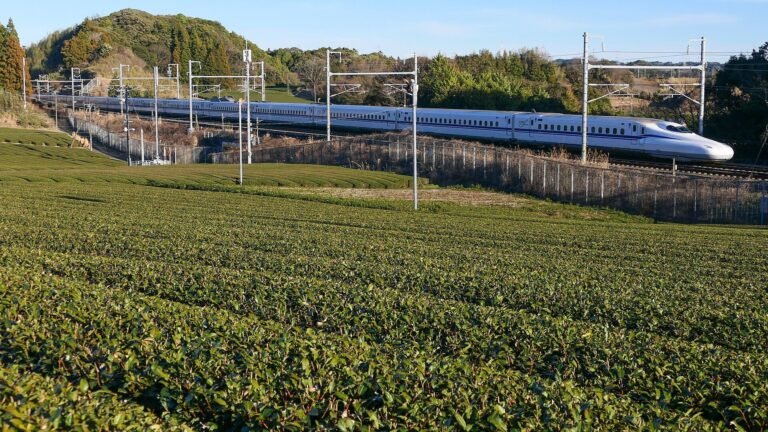
The prices come from JR Central’s search for Wednesday 14 October 2026. Our Tokyo to Osaka Shinkansen route page records them for one adult, one way. The gap is small on most trains. The real choice comes down to the date, your luggage and the Japan Rail Pass.
Reserved and non-reserved side by side
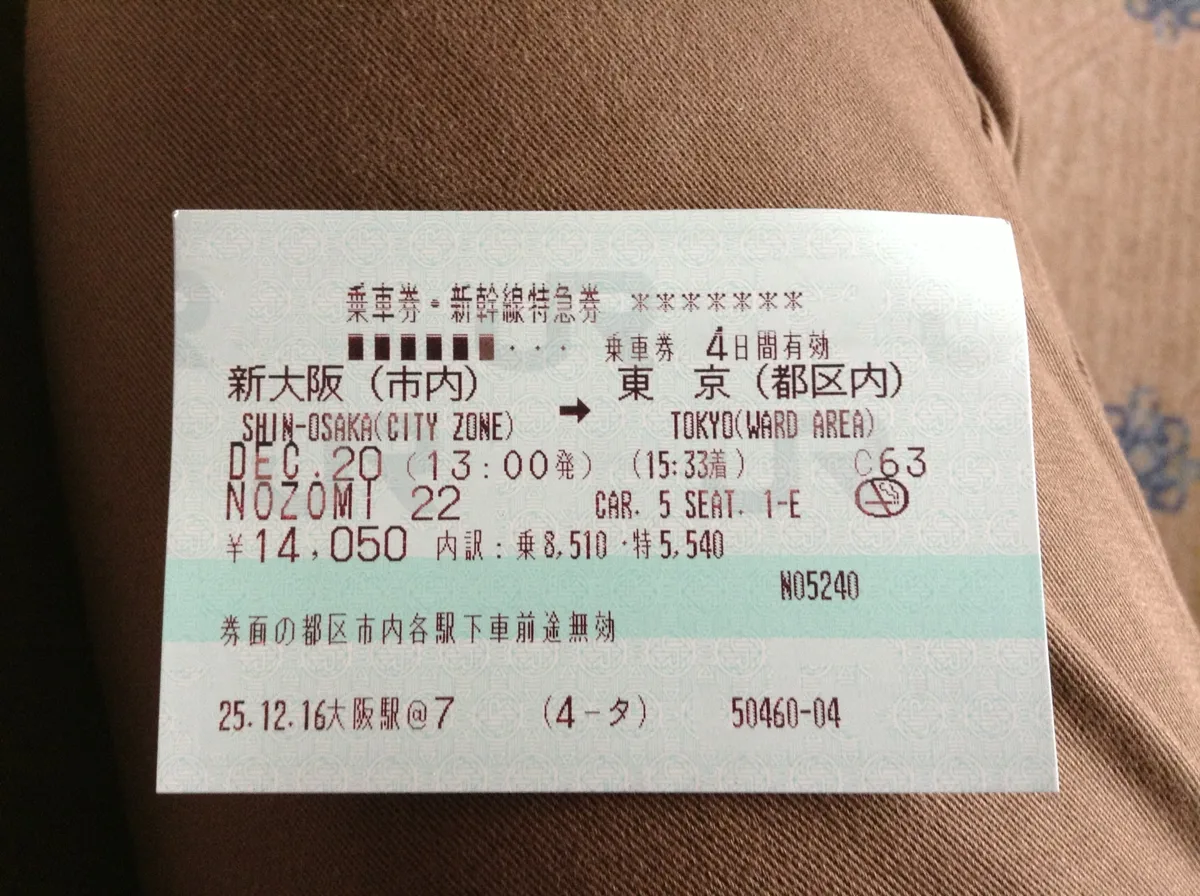
A reserved seat gives you one numbered seat on one train. A non-reserved ticket lets you sit in any free seat in the non-reserved cars of any train on your travel date, first come, first served. On tickets and ticket machines in Japanese, a reserved seat is 指定席 (shitei-seki) and a non-reserved seat is 自由席 (jiyu-seki).
The table below puts the two side by side for the Tokaido Shinkansen between Tokyo and Shin-Osaka.
| Item | Reserved seat | Non-reserved seat |
|---|---|---|
| Nozomi, Tokyo to Shin-Osaka | 14,720 yen | 13,870 yen |
| Hikari 707, Tokyo to Shin-Osaka | 14,400 yen | 13,870 yen |
| Price by season | +400 / +200 / -200 yen vs regular | Same all year |
| Your seat | One numbered seat on one train | First come, first served |
| Cars (16-car trains) | All other ordinary cars; Green Cars 8-10 | Nozomi 1-2, Hikari 1-5, Kodama 1-6 and 13-16 |
| Bag of 161-250 cm | Book a seat with an oversized baggage area | No such seats |
| Nozomi on all-reserved dates | Your booked seat | Standing in the deck only |
| Japan Rail Pass on the Hikari or Kodama | No extra cost | No extra cost |
The JR Tokai Tours Tokaido Shinkansen seats and non-reserved cars guide adds a few details. Every Tokaido Shinkansen train runs as a 16-car set, and the Green Cars are cars 8 to 10. Ordinary reserved seats exist on every train except some Kodama services. The same guide lists the non-reserved Hikari fare from Tokyo to Shin-Osaka at 13,870 yen, the same as the Nozomi.
Timing matters for reserved seats. Station counters and ticket machines start selling them at 10:00 one month before the travel date, on the same day of the previous month. Smart EX and Express Yoyaku open some seats one year ahead, from 5:30. Popular seats go first, such as window seats and the front and back rows.
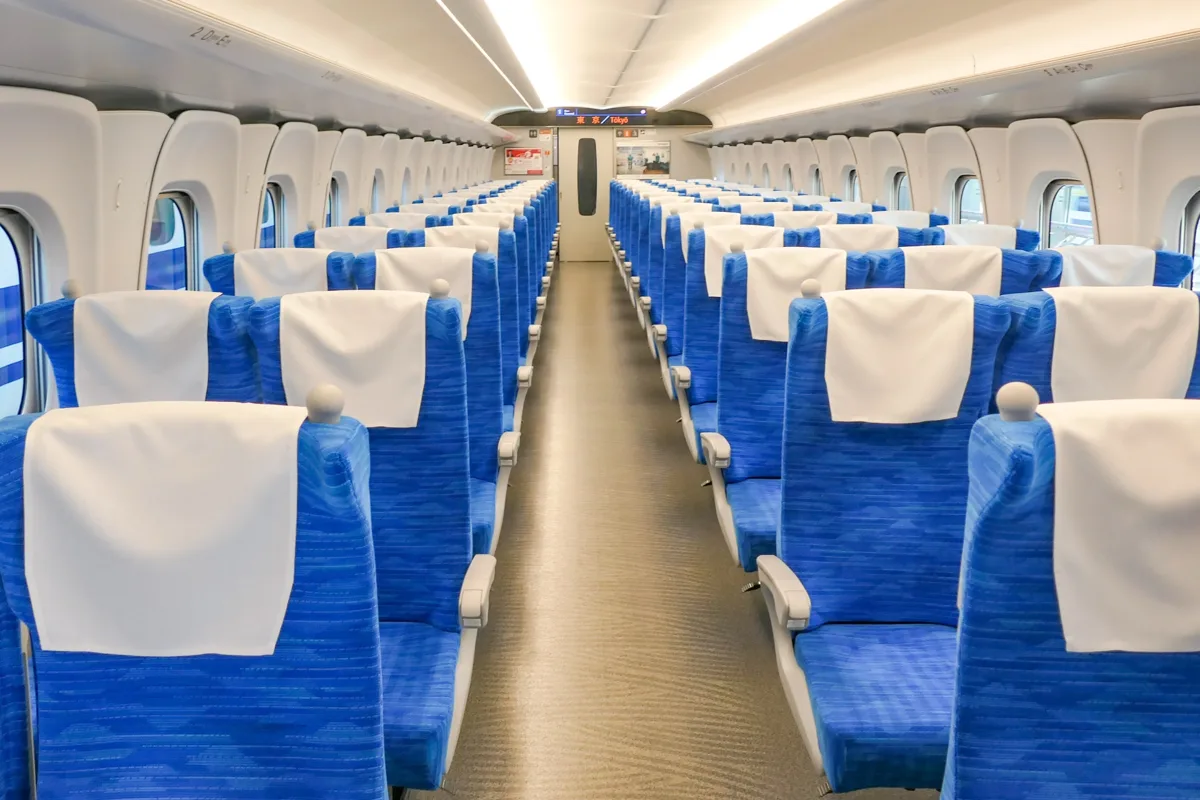
Ordinary cars have rows of three seats (A, B, C) and two seats (D, E), as in the photo below, whether they are reserved or not. The extra money buys certainty, not comfort.
A reserved ticket also has a safety net. The JR Central Tokaido Shinkansen guide for visitors covers a missed train. You can board the non-reserved section of any later train on the same day and route. QR tickets booked online can be changed for free up to 4 minutes before departure.
Price gap by route and season
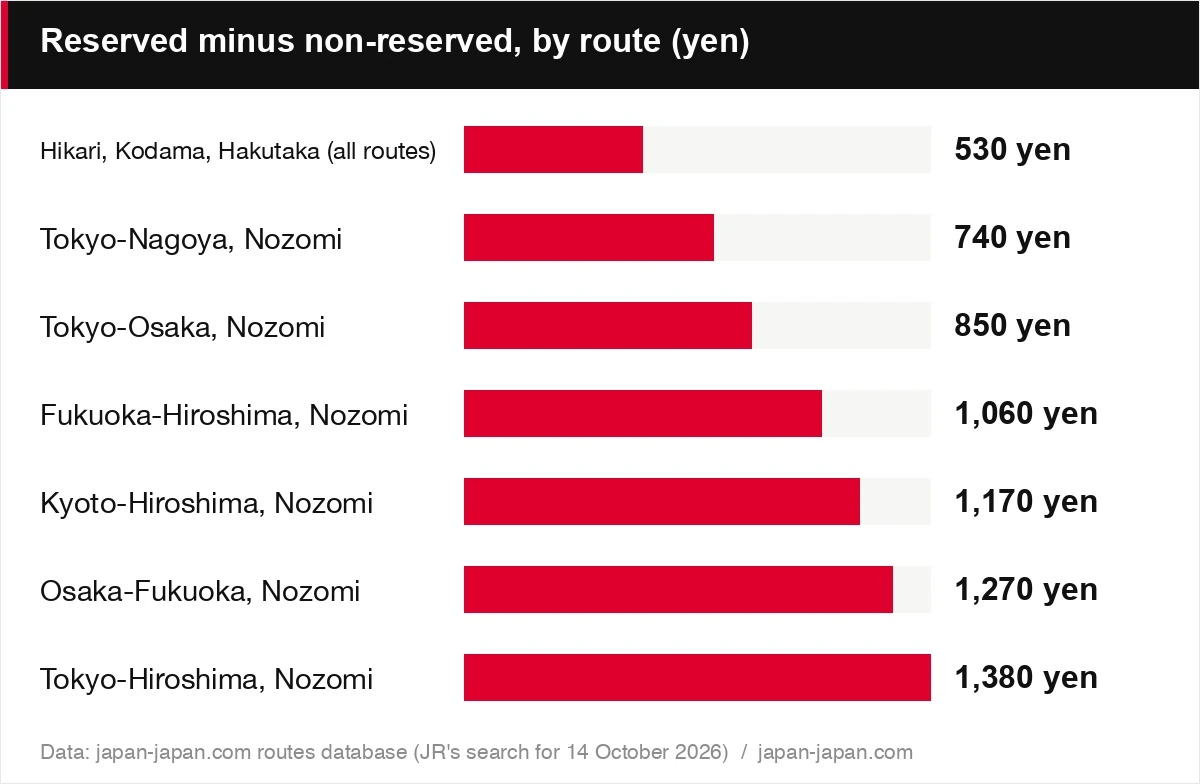
The 530 yen gap is a written rule. The JR Central non-reserved express fee rule sets the non-reserved express fee at the regular-season reserved fee minus 530 yen. JR East and JR Kyushu apply the same 530 yen rule. That is why the gap is 530 yen on every Hikari and Hakutaka route in our database.
The Nozomi is different. Between Tokyo and Hakata, a non-reserved seat on the Nozomi or Mizuho costs the same as a non-reserved seat on the Hikari, Sakura or Kodama. JR calls this the special express fee. The Nozomi reserved seat costs more than the Hikari reserved seat, so the gap grows with distance.
| Item | Value |
|---|---|
| Hikari, Kodama, Hakutaka (all routes) | 530 yen |
| Tokyo-Nagoya, Nozomi | 740 yen |
| Tokyo-Osaka, Nozomi | 850 yen |
| Fukuoka-Hiroshima, Nozomi | 1060 yen |
| Kyoto-Hiroshima, Nozomi | 1170 yen |
| Osaka-Fukuoka, Nozomi | 1270 yen |
| Tokyo-Hiroshima, Nozomi | 1380 yen |
| Tokyo-Fukuoka, Nozomi | 1590 yen |
The chart lists the gaps from our routes database. On the Tokyo to Nagoya Shinkansen route, the Nozomi costs 11,300 yen reserved and 10,560 yen non-reserved, a 740 yen gap. Tokyo to Hiroshima costs 19,760 yen against 18,380 yen, a 1,380 yen gap. The widest gap is on the Tokyo to Fukuoka Shinkansen route: 23,810 yen reserved and 22,220 yen non-reserved, so you save 1,590 yen.
Season changes the picture again, but only for reserved seats. The JR Central seasonal reserved-seat express fee rule adds 400 yen on super-peak days and 200 yen on peak days. Off-peak days take 200 yen off. Each amount is measured against the regular-season reserved fee.
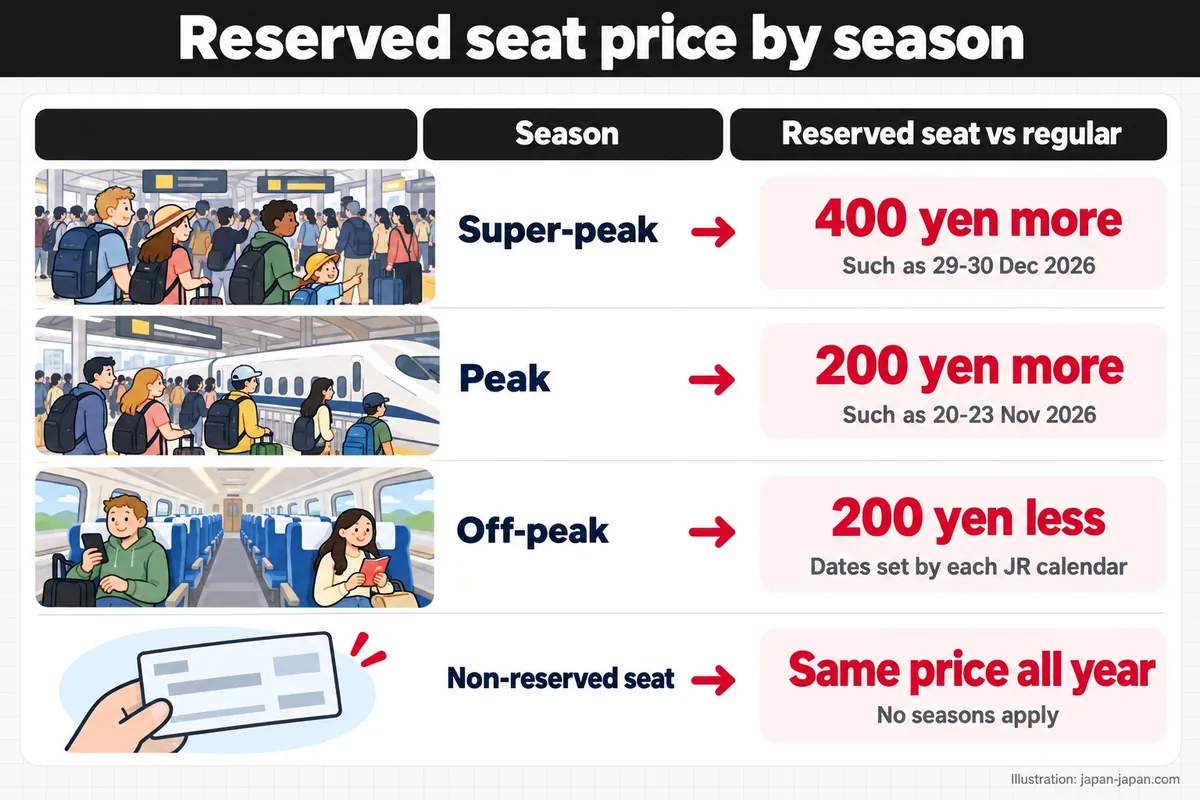
The illustration sums up the seasonal changes. A non-reserved seat keeps one price all year. So the gap grows by 400 yen on a super-peak day and shrinks by 200 yen on an off-peak day.
Two calendars decide which day is which. The JR East seasonal reserved-seat fees and calendars page shows both of them.
- JR Central, JR West, JR Shikoku and JR Kyushu: FY2026 super-peak days are 1–6 May, 7–8 and 15–16 Aug, 18–23 Sep, 29–30 Dec 2026 and 2–3 Jan 2027.
- JR East, the Hokuriku and the Hokkaido Shinkansen: super-peak days are 1–6 Jan, 27 Apr to 6 May, 10–19 Aug and 28–31 Dec.
- JR Kyushu: its conventional lines and the Nishi-Kyushu Shinkansen have no off-peak season.
The four levels are fairly new. JR Central, JR West, JR Shikoku and JR Kyushu added the super-peak level on 1 April 2023. JR East did the same from 1 April 2022.
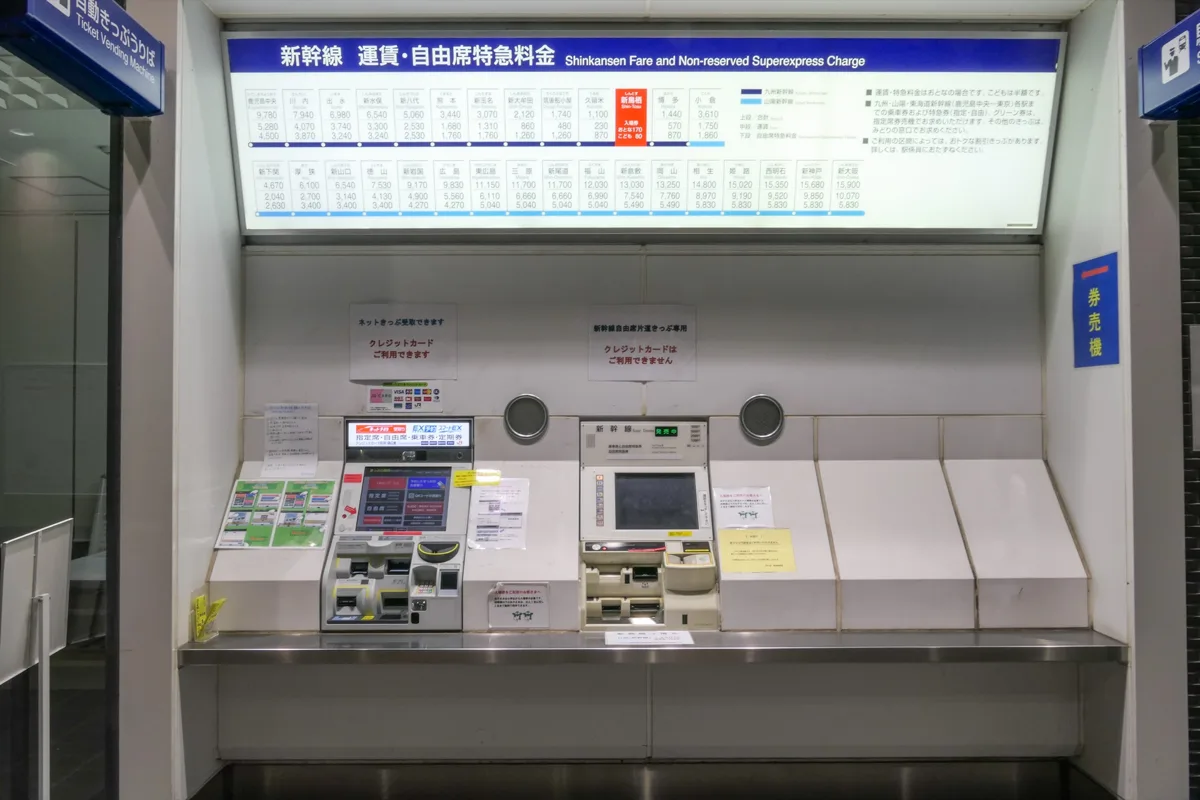
Which cars are non-reserved
JR Central publishes a short list. On the Tokaido Shinkansen the usual non-reserved cars are Nozomi cars 1–2, Hikari cars 1–5, and Kodama cars 1–6 and 13–16. It marks the list as subject to change. JR Tokai Tours adds that the Hikari numbers vary on some trains and the Kodama numbers vary by train.
The Nozomi gives non-reserved riders the least room. Its cars 1 and 2 hold 165 seats per train, yet the Nozomi is most of the timetable. On our Tokyo to Osaka route page, the 14 October 2026 timetable lists 116 Nozomi, 28 Hikari and 11 Kodama from Tokyo Station.
JR Tokai Tours gives two plain tips for finding a seat. Your chances are better if you board at the starting station or travel on a weekday daytime. The Hikari and Kodama are usually less crowded than the Nozomi. For the full difference between the two faster trains, see our Nozomi vs Hikari comparison.
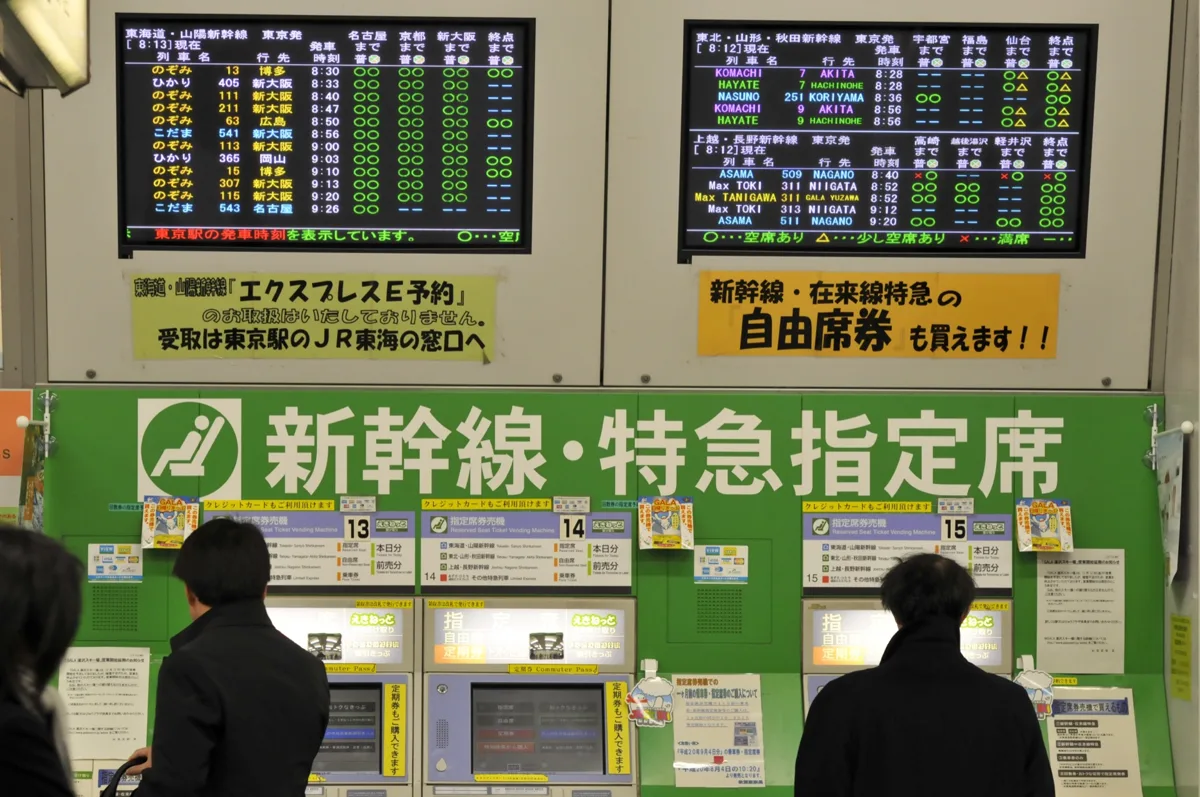
At the station, check the departure board. Train names are colour-coded: yellow for the Nozomi, red for the Hikari, blue for the Kodama. The board also shows the departure time, the destination and the platform.
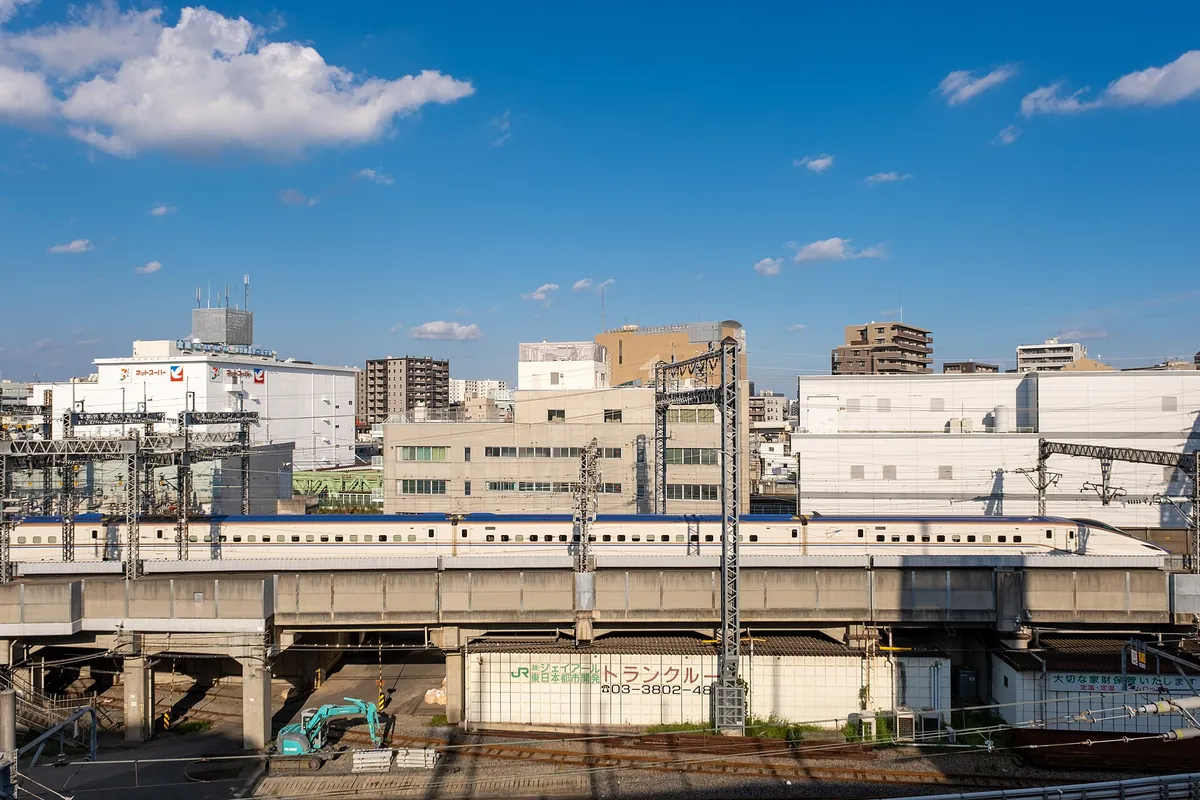
The Hokuriku Shinkansen works differently. The Kagayaki in the photo has reserved seats only, so the non-reserved fare on that line belongs to the slower Hakutaka. On our Tokyo to Kanazawa Shinkansen route, the Kagayaki costs 14,600 yen reserved and the Hakutaka 14,070 yen non-reserved. Tokyo to Nagano costs 8,450 yen on the Kagayaki and 7,920 yen non-reserved on the Asama. Our Kagayaki vs Hakutaka comparison covers the rest.
When a Kagayaki is full, JR may sell a standing ticket. The JR Central rule prices it at the regular-season reserved fee minus 530 yen, the same as a non-reserved fee.
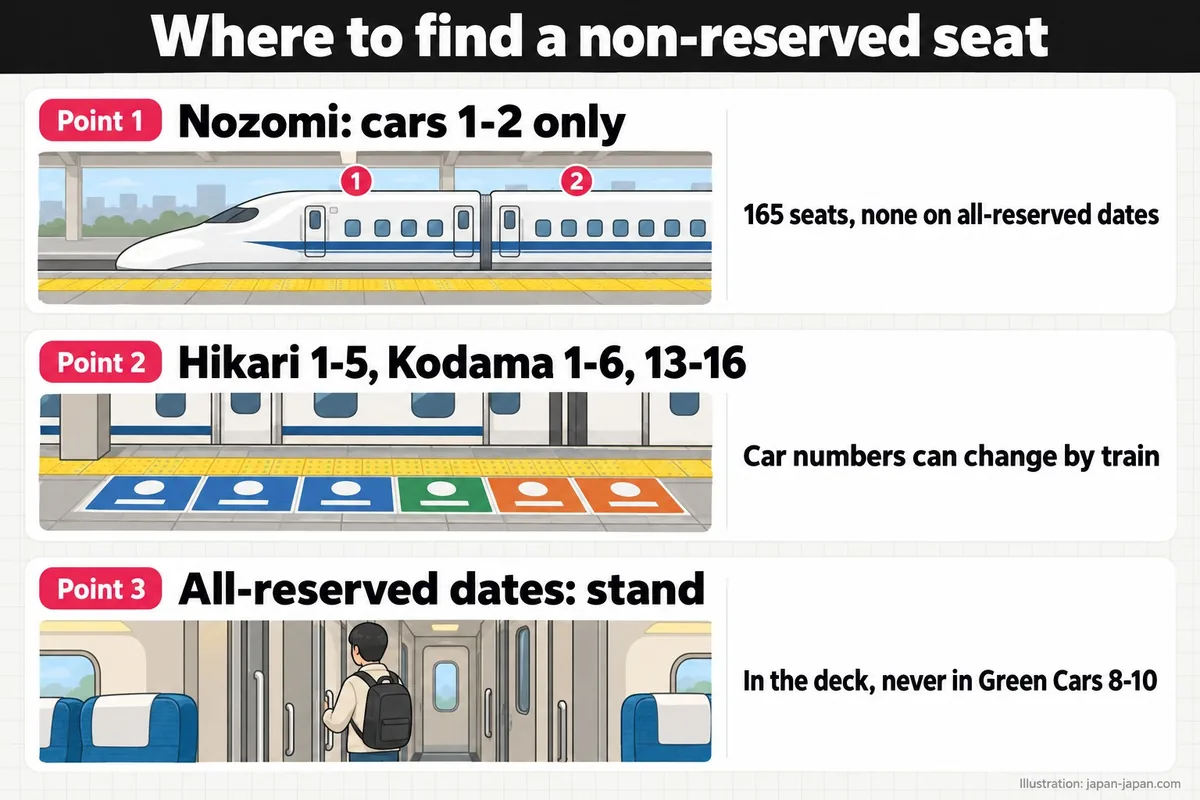
The illustration collects the three facts to remember: which cars, which trains and what happens on all-reserved dates. Outside the Nozomi, every train keeps its non-reserved cars all year, including the Hikari, Kodama, Mizuho, Sakura and Tsubame.
Nozomi all-reserved dates for 2026-27
Some dates have no Nozomi non-reserved seats at all.
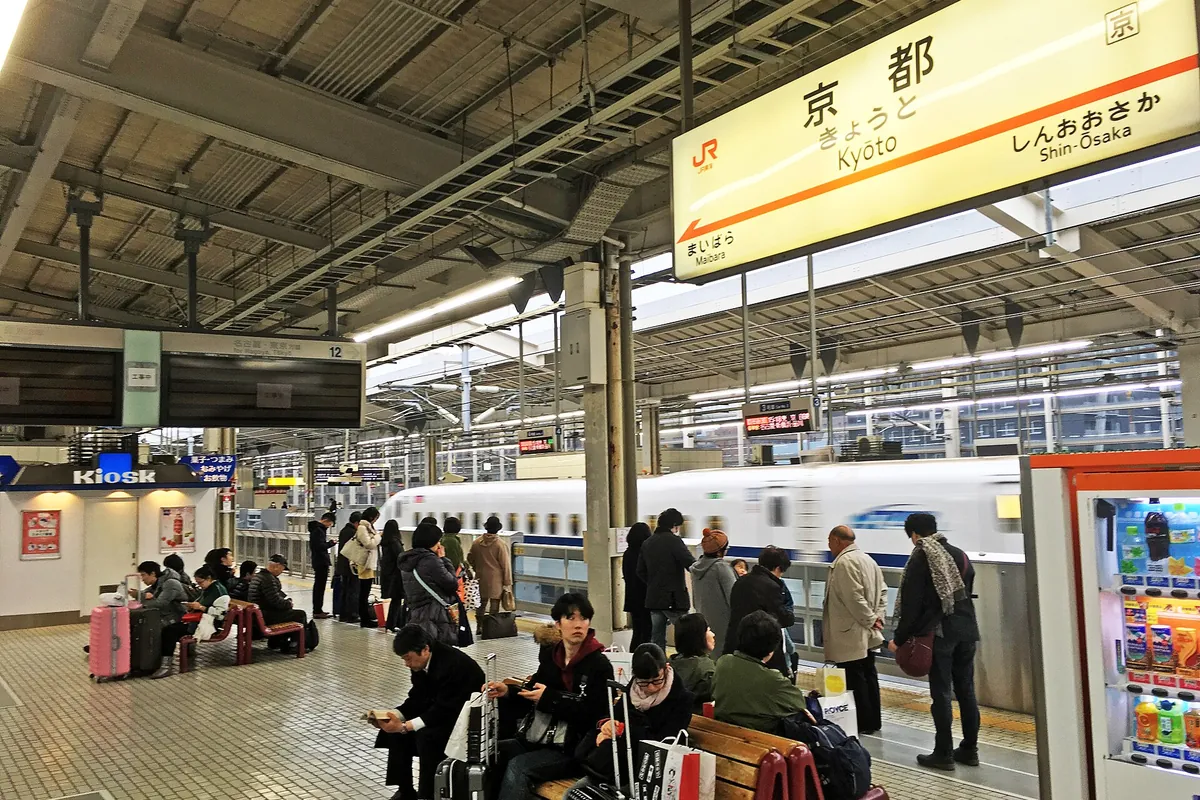
JR Central says platforms like the one in the photo stay crowded for hours over the holidays. So JR Central and JR West make every Nozomi between Tokyo and Hakata all-reserved on set dates. The JR Central Nozomi all-reserved periods notice says cars 1 and 2 switch from non-reserved to reserved during these periods. In FY2026 there are eight periods, and four have already passed.
| Period | Dates | Status |
|---|---|---|
| Golden Week | 24 Apr – 6 May 2026 | Ended |
| Obon | 7-16 Aug 2026 | Ended |
| Silver Week | 18-23 Sep 2026 | Ended |
| Sports Day weekend | 10-12 Oct 2026 | Ended |
| Labour Thanksgiving weekend | 21-23 Nov 2026 | Coming up |
| Year-end and New Year | 25 Dec 2026 – 5 Jan 2027 | Coming up |
| Coming-of-Age Day weekend | 9-11 Jan 2027 | Coming up |
| Vernal Equinox weekend | 20-22 Mar 2027 | Coming up |
The four periods still to come are 21–23 Nov 2026, 25 Dec 2026 to 5 Jan 2027, 9–11 Jan 2027 and 20–22 Mar 2027. If you travel then, book a reserved seat. For what else is busy on those days, see our pages on Japan’s November holidays and New Year in Japan.
A non-reserved ticket still gets you on board, but not into a seat. The JR Central Nozomi all-reserved seating notice in English lets you ride the Nozomi standing. The Green Cars (cars 8 to 10) are off limits. Staff normally ask standing passengers to stay in the deck of an ordinary car. On crowded trains you may not get on at all.
You can fix a non-reserved ticket before you travel. JR Central says you can change it to a reserved ticket once without a fee, paying only the price difference. Ask at the ticket window of a major station, or use one of the ticket machines that handle changes.
If you miss a reserved Nozomi on one of these dates, you have two choices. You can stand in the deck of a Nozomi ordinary car. Or take a same-day non-reserved seat on a Hikari, Kodama, Mizuho, Sakura or Tsubame.
These dates also fall on expensive days on the Tokaido calendar. The JR East page marks 20–23 Nov as peak days, with reserved seats 200 yen above regular. Over the year-end, 29–30 Dec and 2–3 Jan are super-peak, and 25–28 Dec, 31 Dec and 4 Jan are peak.
Big suitcases and the Japan Rail Pass
Large luggage pushes you toward a reserved seat. Our route pages set out the rule. Size means the total of length, width and height.
- Up to 160 cm: use the overhead racks, no reservation needed.
- 161 to 250 cm: reserve a seat with an oversized baggage area when you buy the ticket.
- No reservation: a 1,000 yen fee if you board with an oversized bag without one.
- Over 250 cm: the bag cannot go on the train.
The seats with an oversized baggage area are the last row of each reserved car, except cars 7 and 11, according to JR Tokai Tours. They cost the same as an ordinary reserved seat. Non-reserved cars have no such seats, so a non-reserved ticket does not work with a big suitcase. Sports gear, musical instruments, wheelchairs and baby strollers need no reservation, whatever their size. Bags up to 160 cm also fit the luggage spaces at the decks of cars 3, 5, 7, 9, 13 and 15.
If you would rather travel light, our guide to luggage forwarding in Japan explains how to send bags ahead to your hotel.
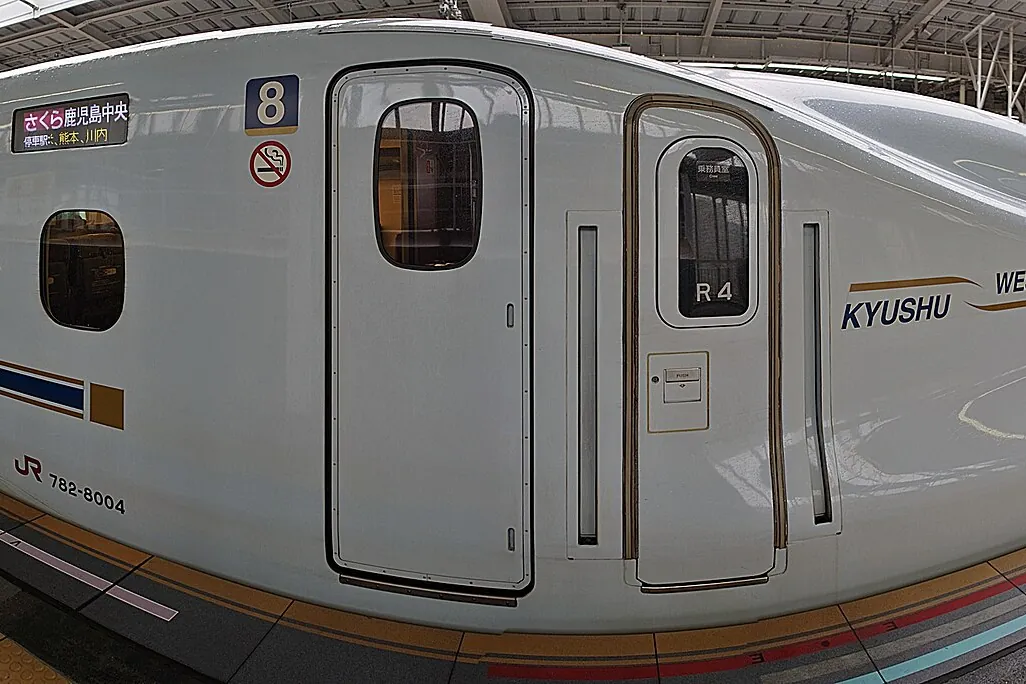
The Japan Rail Pass makes the choice easy on trains it covers, such as the Sakura in the photo. Our Japan Rail Pass guide notes that reserved seats cost nothing extra. Book them at a ticket machine, a JR ticket office or, if you bought the pass online, on the official website. The 7-day Ordinary Car pass costs 50,000 yen on the official website.
The pass does not cover the Nozomi or the Mizuho. Since 1 Oct 2023, pass holders can ride them with an extra ticket. The JAPAN RAIL PASS NOZOMI MIZUHO Ticket page lists Tokyo to Shin-Osaka at 4,960 yen and Tokyo to Nagoya at 4,180 yen. Our database records Tokyo to Hakata at 8,140 yen.
Three rules on that ticket favour a reserved seat.
- Same price: Green Car, reserved and non-reserved tickets all cost the same.
- One per ride: you need a new ticket each time you board a Nozomi or Mizuho.
- Refund fee: 340 yen for a reserved ticket and 220 yen for a non-reserved one.
Holders of an Ordinary Car pass cannot buy the Green Car version. On all-reserved dates, a non-reserved NOZOMI MIZUHO Ticket means you stand. JR Central recommends that pass holders book a reserved seat in advance.
Which seat should you buy?
Most travellers can decide with two questions. The flow below shows them in order.
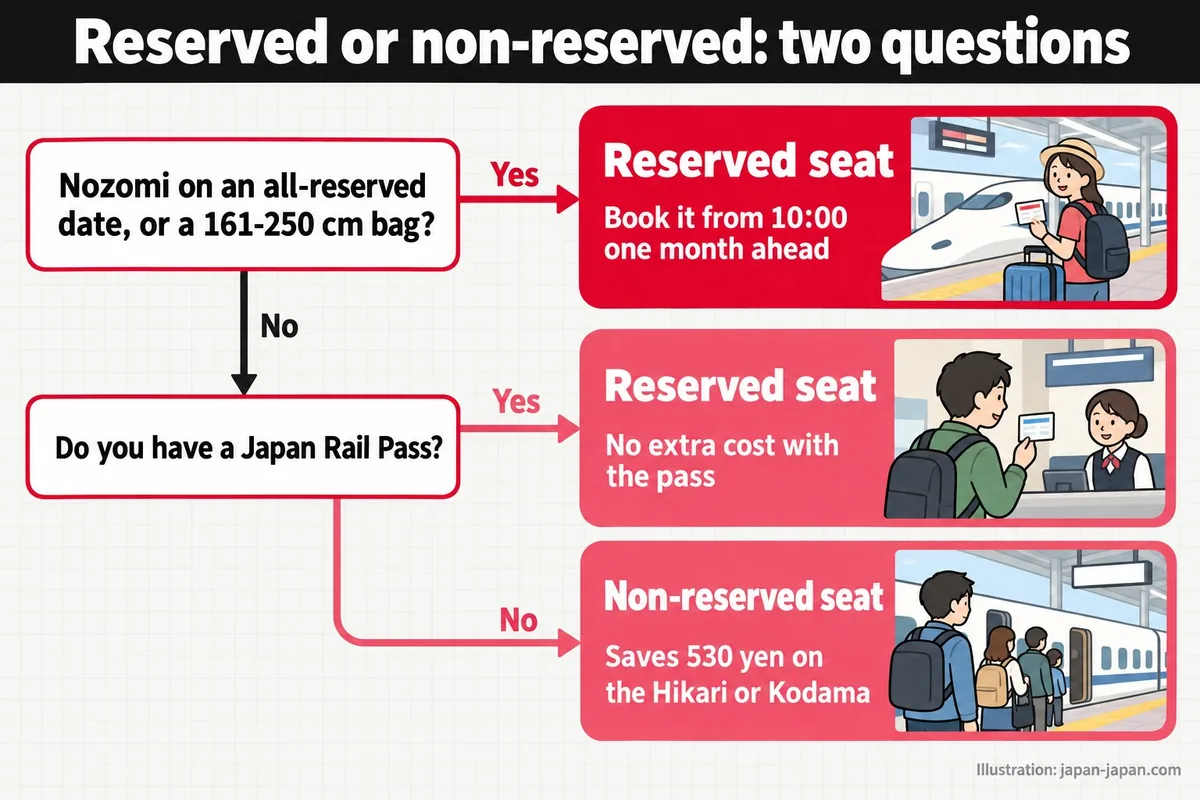
Book a reserved seat in these cases.
- You ride the Nozomi on an all-reserved date, such as 21–23 Nov 2026.
- Your bag measures 161 to 250 cm in total.
- You hold a Japan Rail Pass, because the seat costs nothing extra.
- You ride the Kagayaki, which has reserved seats only.
- You want to sit next to your travel partner or pick a seat, such as seat E on the Mt. Fuji side.
A non-reserved seat makes sense on the Hikari or Kodama outside the all-reserved dates. There you save 530 yen. It also suits a day when you do not know which train you will catch, since the ticket works on any train that day. Boarding at the starting station gives you the best chance of a seat.
On the Nozomi, the saving is larger, from 740 yen on Tokyo to Nagoya to 1,590 yen on Tokyo to Fukuoka. Against that, you get 165 seats in cars 1 and 2 to share with everyone else holding the same ticket.
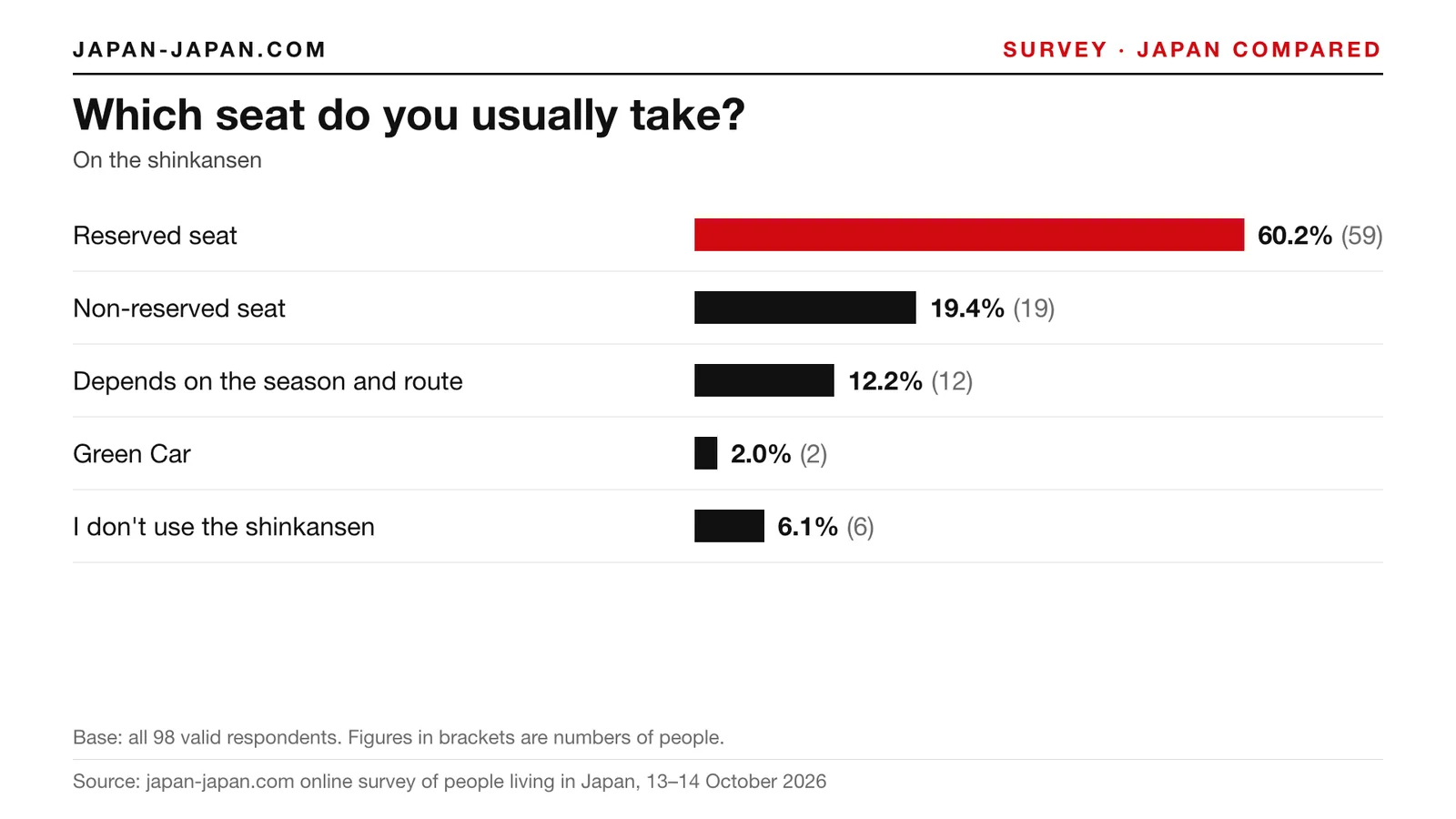
Reserved or non-reserved: what 98 people in Japan take
On 13–14 October 2026, japan-japan.com ran an online survey of people living in Japan about 32 travel choices. 130 people answered. We removed answers that looked machine-written, one from outside Japan and most of those that contradicted themselves, which left 98. Shares below are of the 98 respondents unless a smaller group is named; they describe these people, not all travellers in Japan. See all 32 comparisons and how we asked.
On the shinkansen, 60.2% (59 people) usually take a reserved seat and 19.4% (19 people) a non-reserved seat. 12.2% (12 people) said it depends on the season and route.
44.9% (44 people) knew that the Nozomi is all-reserved at New Year and on holiday weekends, with no non-reserved cars. Asked what to tell a visitor, two respondents wrote about seats:
“If you are bringing a suitcase on board, book a seat that comes with an oversized baggage area.”
— Woman in her 40s, Kanto (outside Tokyo). Original Japanese (excerpt): 「スーツケースを持って乗るなら特大荷物エリア付きの席を予約した方が良い」
“Better to avoid the non-reserved seats.”
— Man in his 60s, Kinki (Osaka and Kyoto area). Original Japanese (excerpt): 「自由席は避けたほうがいい。」
Shinkansen Reserved vs Non-Reserved FAQ
How much cheaper is a non-reserved seat on the Shinkansen?
It is 530 yen cheaper on the Hikari, Kodama and Hakutaka on a regular-season day. On the Nozomi the saving runs from 740 yen (Tokyo to Nagoya) to 1,590 yen (Tokyo to Fukuoka). On super-peak days the reserved seat costs 400 yen more, while the non-reserved price stays the same.
Can I ride the Nozomi with a non-reserved ticket during the all-reserved periods?
You can board, but you cannot sit. JR Central lets non-reserved ticket holders stand in the deck of an ordinary car, never in the Green Cars (cars 8 to 10). The Hikari, Kodama, Mizuho, Sakura and Tsubame keep their non-reserved cars on those dates.
Do I need a reserved seat for a large suitcase on the Shinkansen?
Yes, if the bag measures 161 to 250 cm in total. You reserve a seat with an oversized baggage area when you buy the ticket, at no extra cost over a reserved seat. Without one you pay a 1,000 yen fee, and bags over 250 cm cannot board.
Are reserved seats free with the Japan Rail Pass?
Yes, on the trains the pass covers, such as the Hikari, Kodama and Sakura. For the Nozomi and Mizuho you buy a NOZOMI MIZUHO Ticket, which costs the same for reserved and non-reserved seats. Tokyo to Shin-Osaka costs 4,960 yen.
About the author





.jpg)

.jpg)