Peach vs Jetstar Japan: Which Budget Airline Costs Less?

Those figures compare bags only. Ticket prices move with the date and the flight, so this guide leaves them out. It compares the fixed rules: what each fare includes, what a bag costs and where you check in. Both are Japan low-cost airlines with bases at Narita and Kansai, so you can often book the same trip on either one.
The cheapest bag on Peach is the 2,000 yen online price for a Minimum fare. Jetstar Japan says a bag bought in advance costs less than one bought at the airport. Its advance prices vary by route.
Peach and Jetstar Japan side by side
The table below puts the main rules of the two airlines in one place. Every row comes from the airlines’ and airports’ own pages, checked between 3 and 13 October 2026.
| Item | Peach | Jetstar Japan |
|---|---|---|
| Carry-on size | Under 115 cm, 3 sides added | 56 × 36 × 23 cm, each side |
| Carry-on weight | 7 kg, 2 items | 7 kg, 2 items (14 kg with +7kg) |
| Bag in the cheapest fare | Not included (Minimum) | Not included (Starter) |
| Domestic bag, airport counter | 3,100 yen, up to 20 kg | 4,600 yen, first 15 kg |
| Fare types | Minimum, Standard, Standard Plus | Starter, plus bundles such as Starter Plus, Flex, Flex Plus |
| Narita | Terminal 1, station on B1F | Terminal 3, no station |
| Kansai | Terminal 2, no station | Terminal 1, next to the station |
| Power banks | 2 max, 160Wh or less, no use on board | 2 max, 160Wh or less (approval over 100Wh), no use on board |
Three rows decide most trips. The bag price favours Peach on domestic flights. The carry-on allowance is a tie at 7 kg. The terminal row matters most on the day you fly, because Narita Terminal 3 and Kansai Terminal 2 have no train station of their own.
The fare structure looks different but works the same way. Peach sells three fare types, and the cheapest, Minimum, includes no checked bag and no seat choice. Jetstar Japan sells a Starter fare with the same bare contents, plus bundles that add a bag, a seat or flexibility. Full details for each airline sit on our Peach Aviation baggage page and our Jetstar Japan baggage page.
The power bank rules are almost identical. Jetstar Japan says they follow a notice from Japan’s transport ministry (MLIT). Each passenger may carry up to 2 power banks of 160Wh or less, in carry-on only. You cannot charge a phone from a power bank on board, or charge the power bank from the seat. Jetstar Japan adds one step: a power bank over 100Wh and up to 160Wh needs airline approval. Peach asks you to keep it out of the overhead bin and within sight. The Jetstar Japan travel alerts and brand change notice lists the ministry change. Our Peach power bank rules and Jetstar Japan power bank rules pages quote each airline.
Jetstar Japan is also heading for a new name. Qantas and Japan Airlines, its two major shareholders, announced a plan to move the airline to a new Japanese capital-led ownership. Qantas would sell its 33.32% stake and the Development Bank of Japan would join the shareholders. The notice expected the move to be complete by June 2027, after which the airline will change from the Jetstar brand to a new brand. Until then, all Jetstar Japan flights operate as scheduled and booked tickets stay valid.
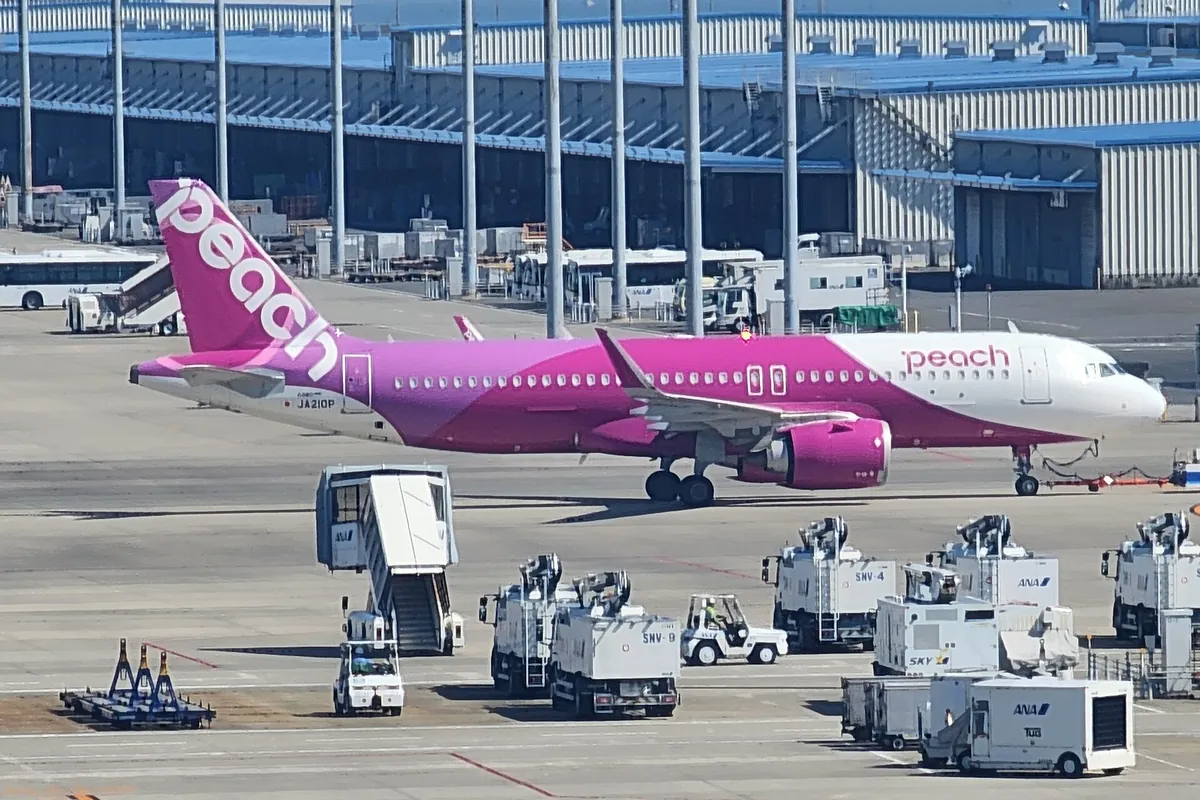
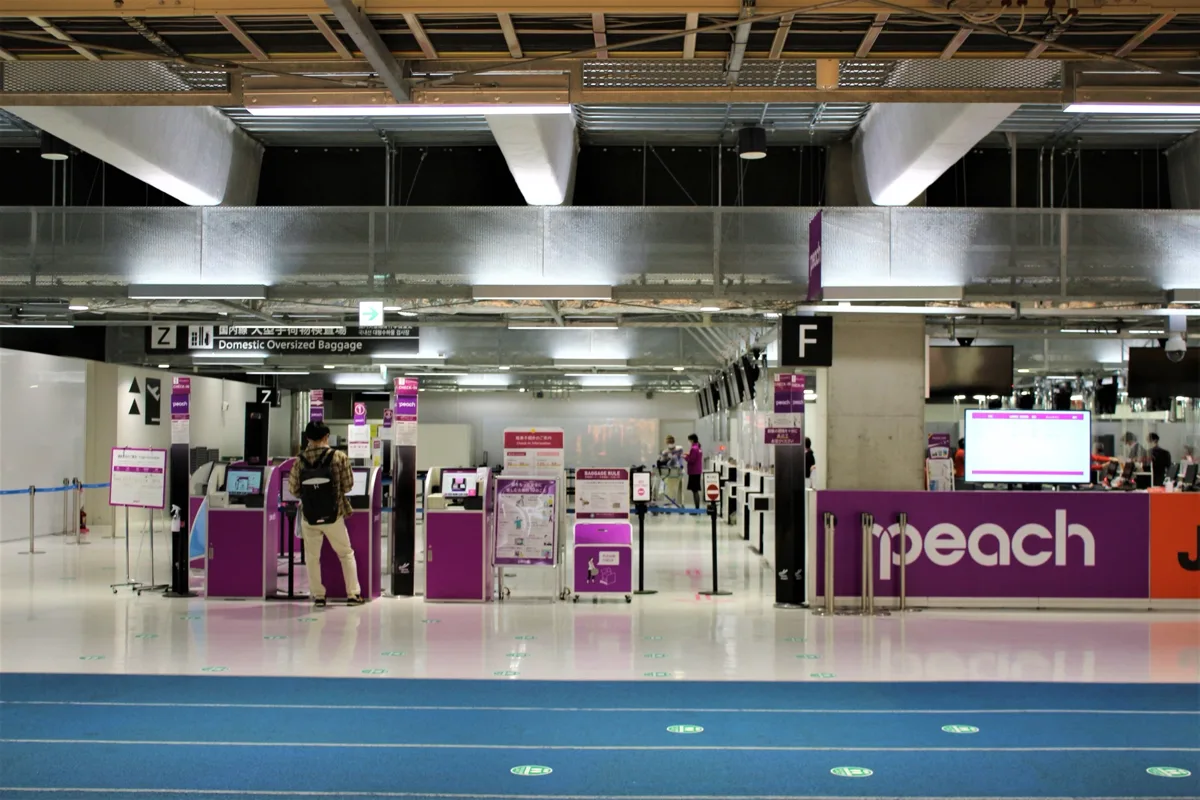
Peach, in its pink colours, is the airline in the photo below.
Carry-on: the same 7 kg, measured differently
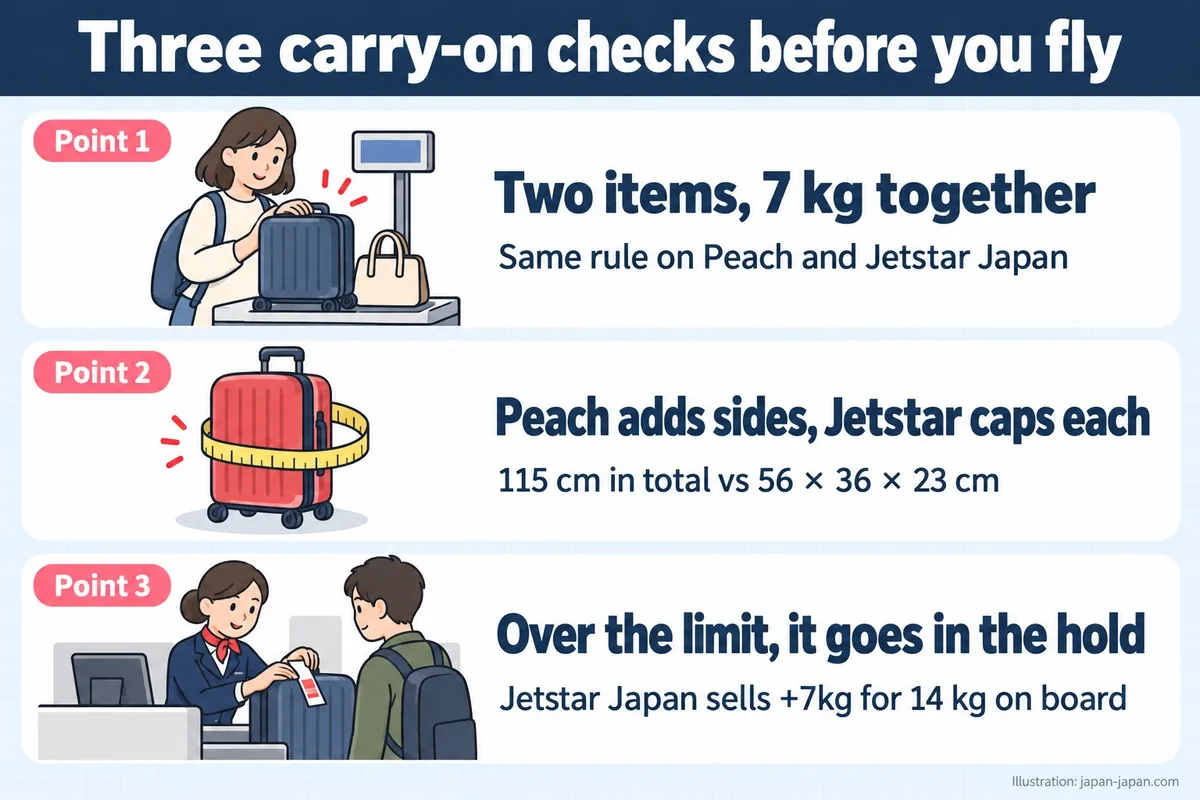
Both airlines let you bring two items into the cabin: one main bag and one small personal item. The two together must weigh 7 kg or less. The difference is how each airline measures the main bag.
The Peach Aviation carry-on baggage rules cap the total of the three sides: length, width and height must add up to less than 115 cm. Handles, pockets and wheels count. Duty-free shopping bought after security also counts toward the 7 kg.
The Jetstar carry-on baggage page caps each side instead. The main bag must not exceed 56 cm high, 36 cm wide and 23 cm deep, and it must fit in the overhead locker. The small item, such as a handbag or a thin laptop bag, must fit under the seat.
Those Jetstar sides add up to 115 cm, the same total as Peach. A bag can still pass one rule and fail the other. A bag 60 cm tall and 20 cm deep stays under the Peach total but breaks the Jetstar height limit. Measure the longest side first if you fly Jetstar Japan.
The illustration sums up the three checks to make before you pack the cabin bag.
If your bag is too heavy or too big, both airlines move it to the hold for a fee. On Peach, staff send it to the baggage counter as a paid checked bag. A bag that meets the size rule but will not fit in the bin also goes in the hold. Peach staff may check size, weight and the number of pieces by sight or with a scale.
Jetstar Japan gives you one extra choice. You can buy +7kg Extra Carry-On Baggage and take 14 kg on board, with no single item over 10 kg. On domestic flights it costs 5,000 yen at airport check-in and 5,500 yen at the boarding gate. Jetstar Japan says the option has limited seats per flight, so add it online if you want it. Otherwise, a bag over the limit at the gate goes in the hold for a 5,500 yen excess baggage fee on domestic flights.
One change applies to Jetstar Airways, the Australian airline, from 2 February 2027. Its flights move to one underseat bag of 40 × 30 × 20 cm. Jetstar Japan flights, with flight numbers starting GK, keep the 7 kg allowance across two items. Our carry-on size and weight by airline table lists both airlines next to the other carriers flying from Japan.
Checked bag fees: online, at the counter and at the gate
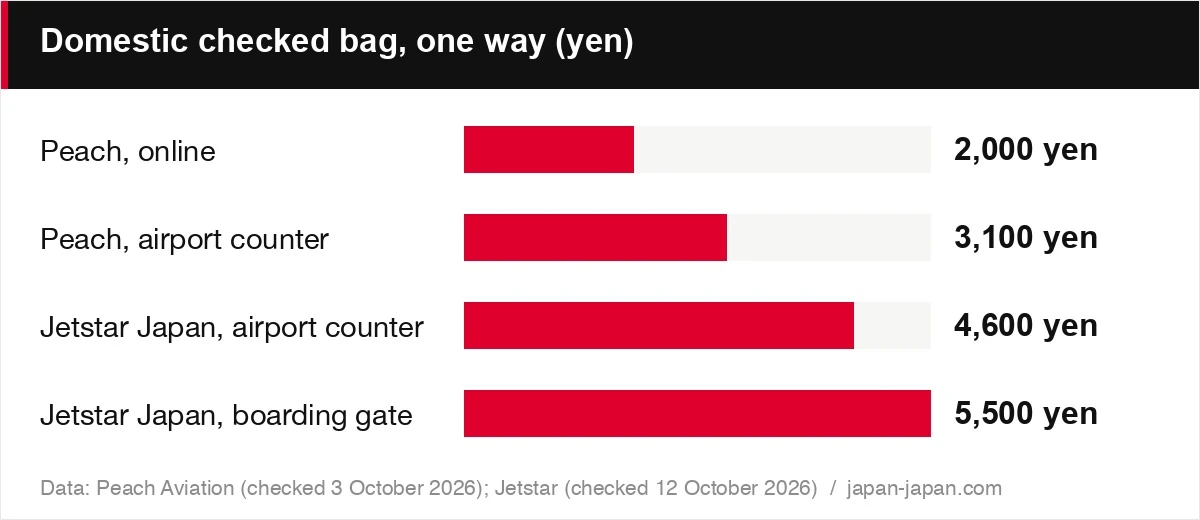
The chart shows what one domestic checked bag costs, one way, at each point where you can buy it. Peach’s prices cover a bag up to 20 kg. Jetstar Japan’s cover the first 15 kg.
| Item | Value | Note |
|---|---|---|
| Peach, online | 2000 yen | up to 20 kg |
| Peach, airport counter | 3100 yen | up to 20 kg |
| Jetstar Japan, airport counter | 4600 yen | first 15 kg |
| Jetstar Japan, boarding gate | 5500 yen | first 15 kg |
Peach charges the same bag price on every domestic route. The Peach Aviation fees and charges page lists 2,000 yen for the first bag online and 3,100 yen at the airport counter. So buying online saves 1,100 yen. Bags two to five cost the same per piece, and Standard and Standard Plus fares include the first bag free.
Each Peach bag can weigh up to 20 kg and measure up to 203 cm on the three sides added together. One person can check up to 5 bags, with a total of 100 kg. A bag over 20 kg and up to 32 kg pays a heavy baggage fee: 1,900 yen online or 3,000 yen at the counter. A bag of 204 cm or more pays an oversized option of the same amounts.
Jetstar Japan works on a weight allowance. You buy up to 40 kg per passenger, spread across any number of bags, with no single item over 32 kg. The Jetstar excess baggage charges at the airport page sets the domestic airport price at 4,600 yen for the first 15 kg. Each extra kilogram above that costs 1,000 yen at the airport. At the boarding gate the bag costs 5,500 yen, which is 900 yen more than the counter.
Jetstar Japan treats any item with one side over 100 cm as oversized. That handling fee is 2,500 yen when you book or in Manage Booking, and 3,000 yen at the airport.
For a round trip with one bag bought at the counter, the totals are 6,200 yen on Peach and 9,200 yen on Jetstar Japan. Bought online on Peach, the same bag costs 4,000 yen for the round trip. Paid at the Jetstar Japan gate both ways, it reaches 11,000 yen. Our Peach baggage fees by route and Jetstar Japan baggage fees pages hold the full price lists.
International flights cost more on both airlines. Peach prices bags by zone: online, a bag costs 2,600 yen to South Korea, 3,600 yen to Taiwan and Hong Kong, 6,100 yen to Thailand and Singapore, and 7,500 yen to China. Jetstar Japan charges 6,500 yen at the airport counter and 8,500 yen at the gate for international flights. Connect from a domestic to an international Jetstar flight, and you pay the international rate for the whole trip.
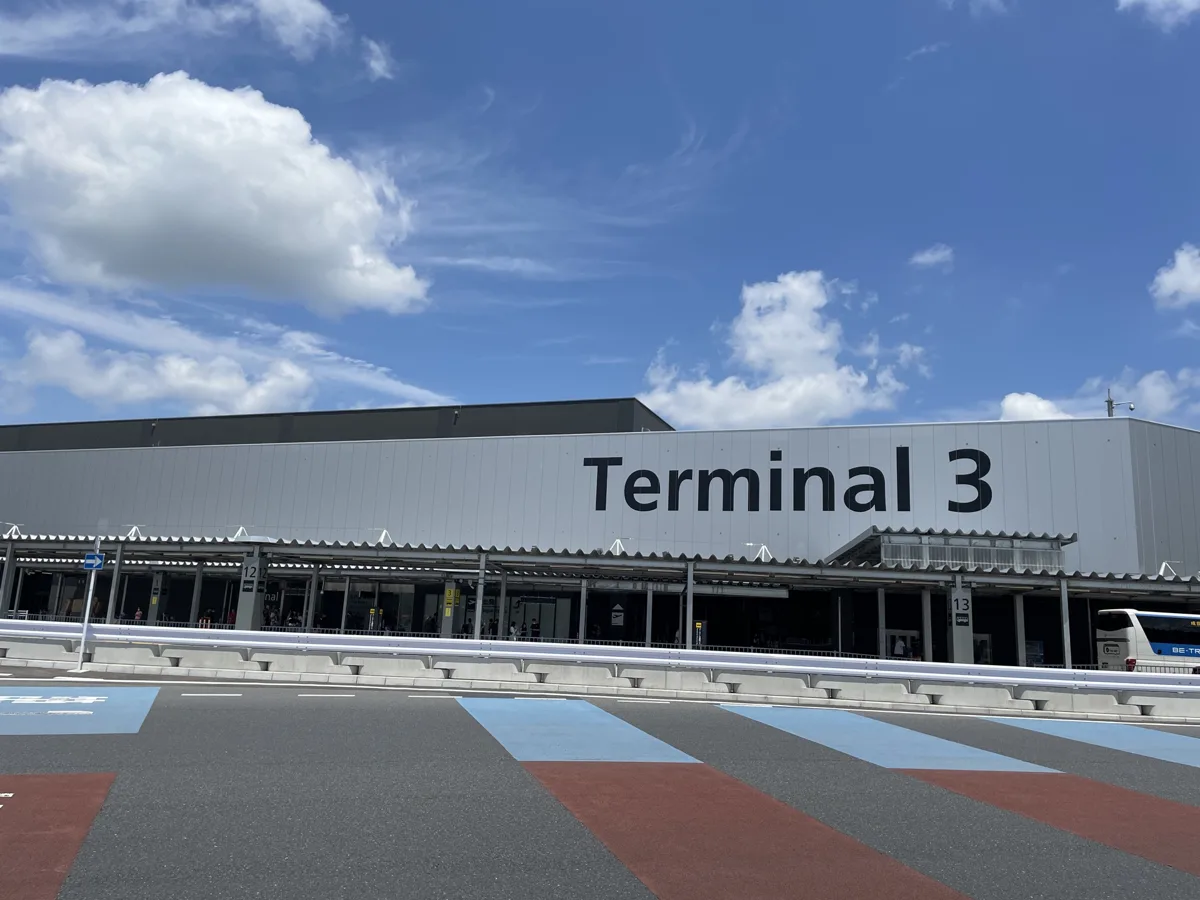
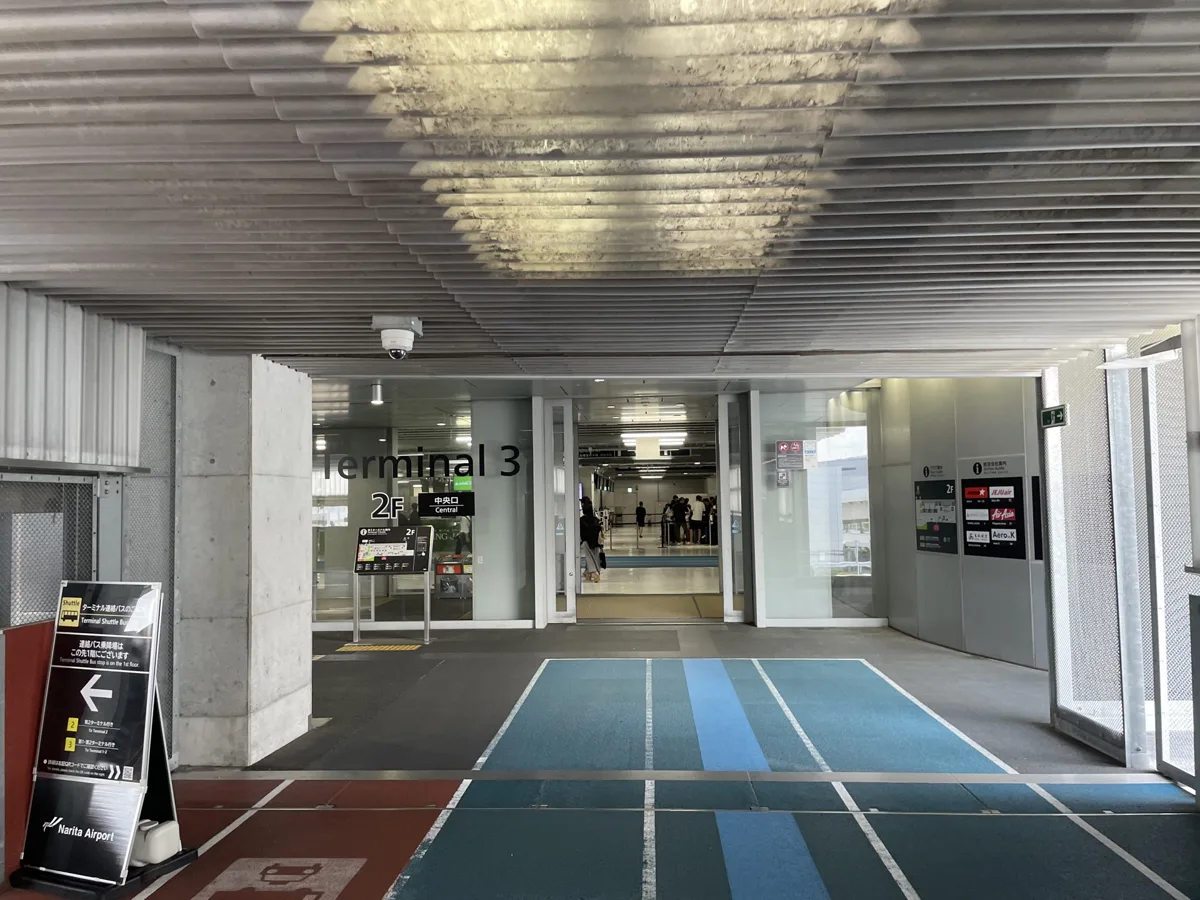
Jetstar Japan checks in at Narita Terminal 3, the building in the photo below.
Fare types and seat selection
Both airlines start with a bare fare and let you add items. The table shows what each fare or bundle includes for a checked bag and a seat.
| Fare | Checked bag | Seat selection |
|---|---|---|
| Peach Minimum | Paid: 2,000 yen online | Paid: 800–1,800 yen online |
| Peach Standard | 1 bag, up to 20 kg | Free: Back, Middle or Front |
| Peach Standard Plus | 1 bag, up to 20 kg | Free, or Fast Area for 1,000 yen |
| Jetstar Starter | Not included | Not included; random seat free |
| Jetstar Starter Plus | 20 kg | Standard seat |
| Jetstar Flex | Not included | Standard or upfront seat |
| Jetstar Flex Plus | 20 kg | Standard, upfront or extra legroom |
The Peach Aviation fare types comparison page sets out three fares. Minimum is the bare fare. Standard adds seat selection and one checked bag, with no ticketing fee. Standard Plus adds flight changes and refunds. All three include 2 carry-on bags up to 7 kg in total.
Minimum has extra costs worth counting. It carries a 640 yen ticketing fee per person, per flight. It allows no flight changes, and a cancellation loses the full amount. On Standard, a cancellation costs 1,000 yen up to 30 days before departure and 3,000 yen from 29 days before. On Standard Plus, a cancellation costs 500 yen and an online flight change is free.
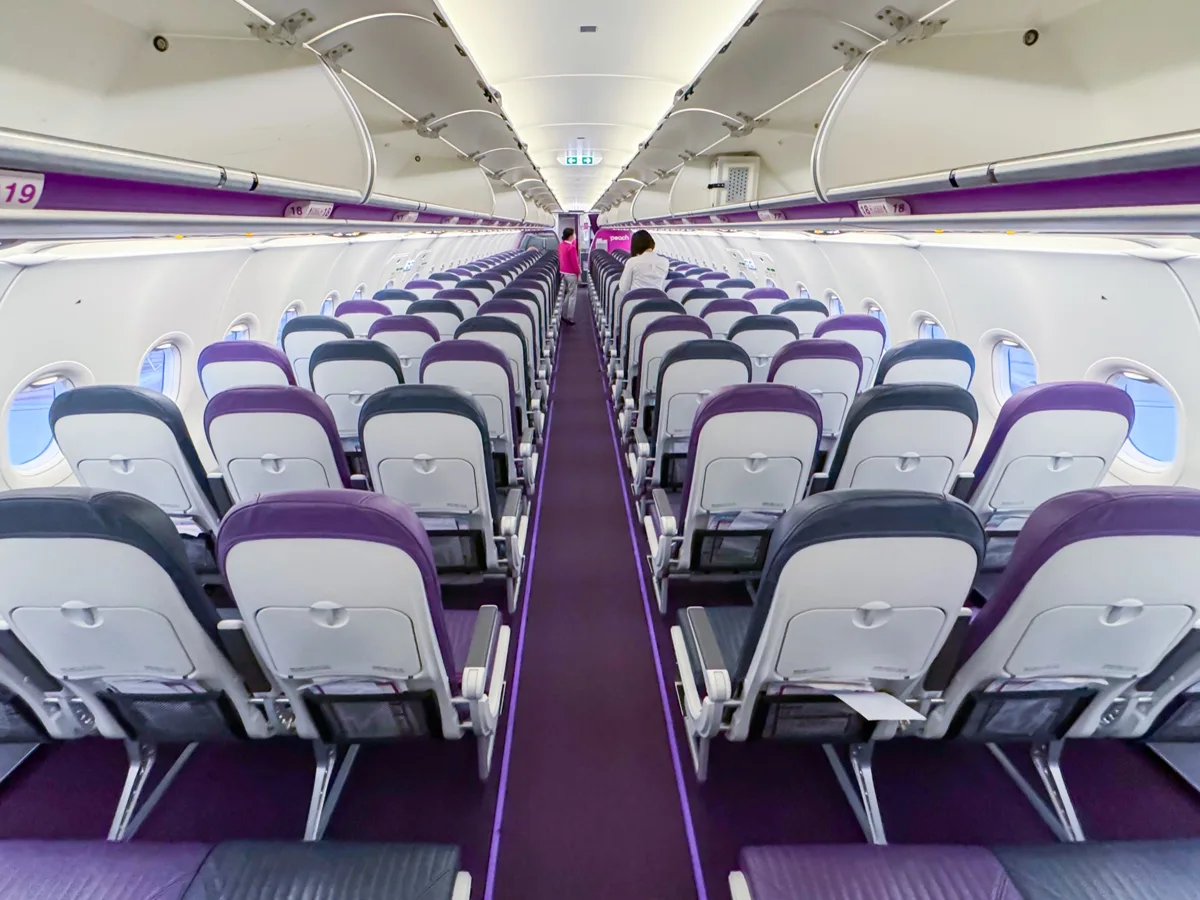
Peach splits the cabin into four seat areas. The Fast Area is the front row of 6 seats, with the most legroom and priority baggage delivery. The Front Area covers rows 2 to 10, the Middle Area rows 11 to 20, and the Back Area row 21 and beyond. On domestic flights booked online, Minimum passengers pay 800 yen for a Back seat, 1,200 yen for Middle and 1,800 yen for Front. Standard and Standard Plus choose from those three areas free. Only Standard Plus can buy a Fast Area seat, at 1,000 yen.
The Jetstar Starter fare product guide lists no checked bag and no seat selection. If you skip buying a seat, Jetstar assigns one at random at check-in, at no extra charge. You can change the date or time for a change fee plus any fare difference. Cancellation refunds are not part of Starter.
Jetstar’s bundles fill the gaps. The Jetstar Starter Plus bundle product guide includes a 20 kg checked bag and a standard seat. Flex includes a standard or upfront seat and free same-day flight changes, but no bag. Flex Plus includes a 20 kg bag and a standard, upfront or extra-legroom seat. Jetstar prices its paid seats by flight, and standard seats are the cheapest type.
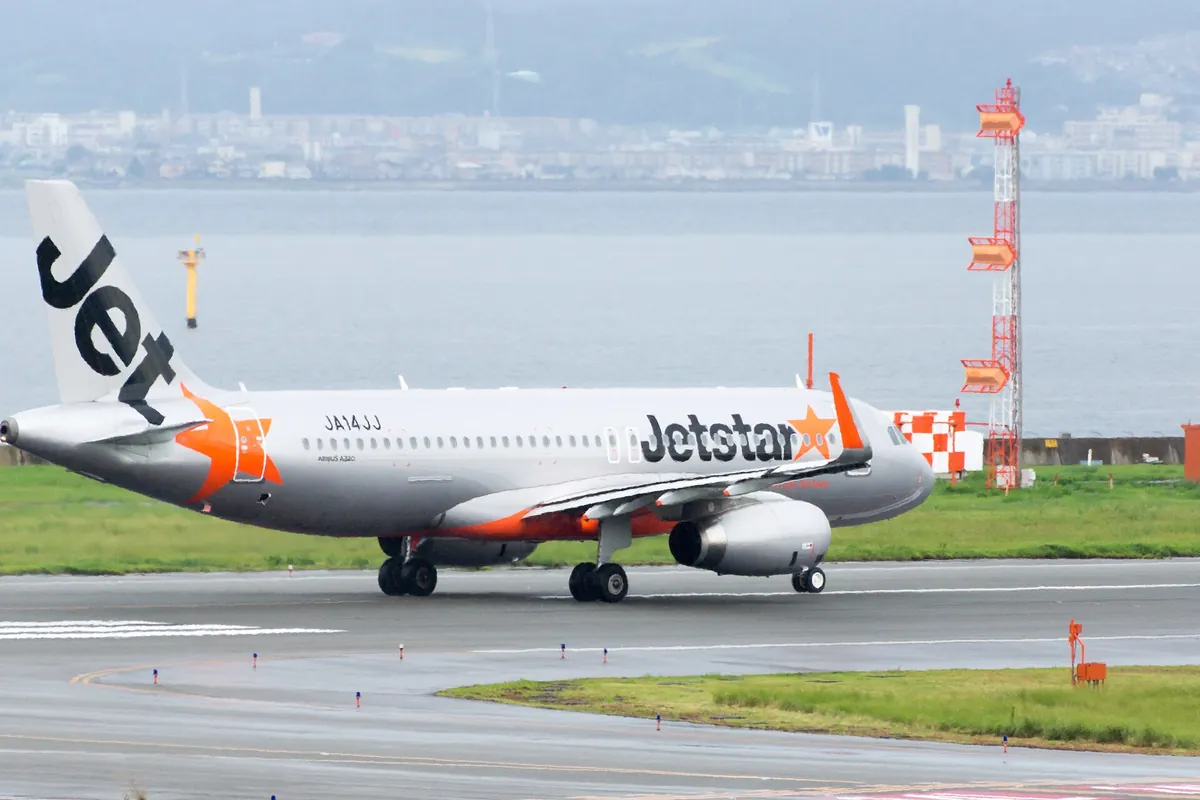
On legroom, Jetstar publishes its numbers. The Jetstar fleet specification page lists 25 Airbus A320s at Jetstar Japan. Seats are 45.4 cm wide, with an average pitch of 73.7 cm (29 in). The photo below shows a Jetstar Japan A320.
Terminals at Narita and Kansai
The airline you pick also picks your terminal. At each airport, one of the two airlines uses a terminal with a station, and the other uses one without. The lookup below shows the four cases.

At Narita, Peach uses Terminal 1. Narita Airport lists Peach in the North Wing on 4F for international flights and the South Wing on 1F for domestic flights. Narita Airport Station is under the terminal on B1F, with Keisei Skyliner and JR Narita Express trains. Our Narita Terminal 1 guide has the floor plan.
Jetstar Japan uses Narita Terminal 3, on 2F for both international and domestic flights. Terminal 3 has no station. From the ticket gates of Airport Terminal 2 Station, walk about 13 minutes through the connecting passage. You can also take the free shuttle bus, which takes about 3 minutes from bus stop 2 in front of Terminal 3. It runs from 05:08 to 23:13, every 5 to 6 minutes until 17:45 and every 3 to 4 minutes after that. The Narita Terminal 3 guide and our article on which airlines use each Narita terminal cover the walk in detail.
At Kansai, the roles swap. The Jetstar airports and terminals in Japan list puts Jetstar Japan in Terminal 1, on Level 2 for domestic flights and Level 4 for international. Terminal 1 sits next to Aeroplaza and Kansai Airport Station, as our Kansai Terminal 1 guide shows.
Peach uses Kansai Terminal 2, which has no station. A free shuttle bus runs from the Terminal 2 bus stop on 1F to Aeroplaza in 7 to 9 minutes. Kansai Airport Station is next to Aeroplaza. Between 07:00 and 20:00 a bus comes every 4 to 5 minutes. The Kansai Terminal 2 guide lists the shops and lockers. Peach also flies from Haneda.
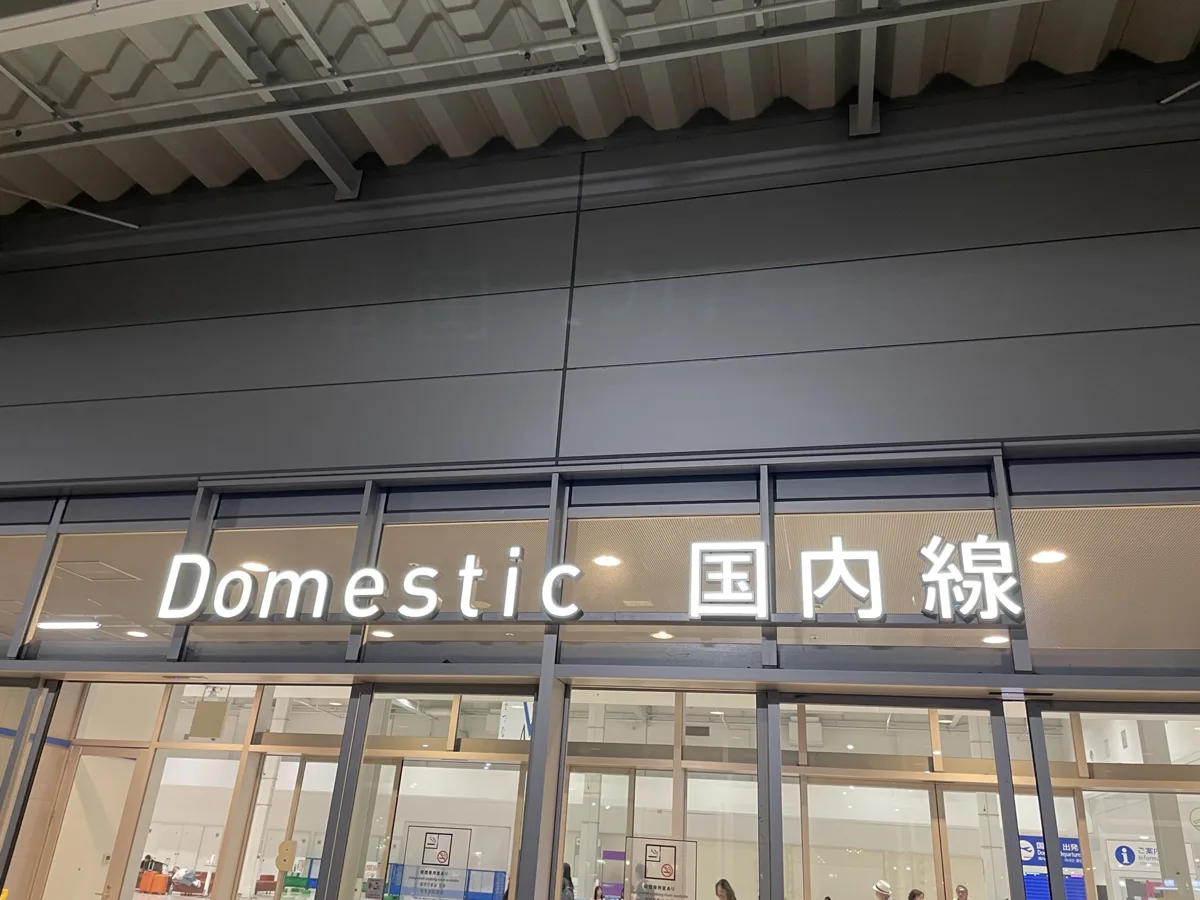
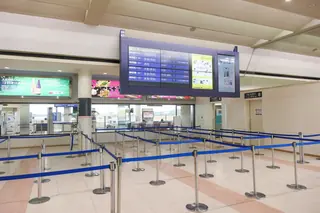
Kansai Terminal 2 is the low-cost terminal in the photo below.
Night timing differs between the two airports. Narita only allows flights from 06:00 to midnight. Narita Terminal 3 keeps its 1F and 2F lobbies open 24 hours, and LAWSON and Matsuya on 2F stay open all night. Terminal 1 keeps 1F and B1F open 24 hours, while 2F to 5F open from 05:00 to midnight. Kansai is open 24 hours, but some entrances close at night, and the Terminal 2 bus stops only between 01:00 and 02:00.
Allow time for the counter, too. Jetstar Japan closes domestic check-in 30 minutes before departure and the boarding gate 15 minutes before, according to our Jetstar Japan check-in deadlines page. Terminals can change, so read the terminal on your itinerary before you set off. For trains into the city, see our Narita Airport and Kansai Airport pages.
Which one should you choose?
Peach or Jetstar? Decide on your bags first, then on the terminal. The flow below asks two questions and gives three outcomes.
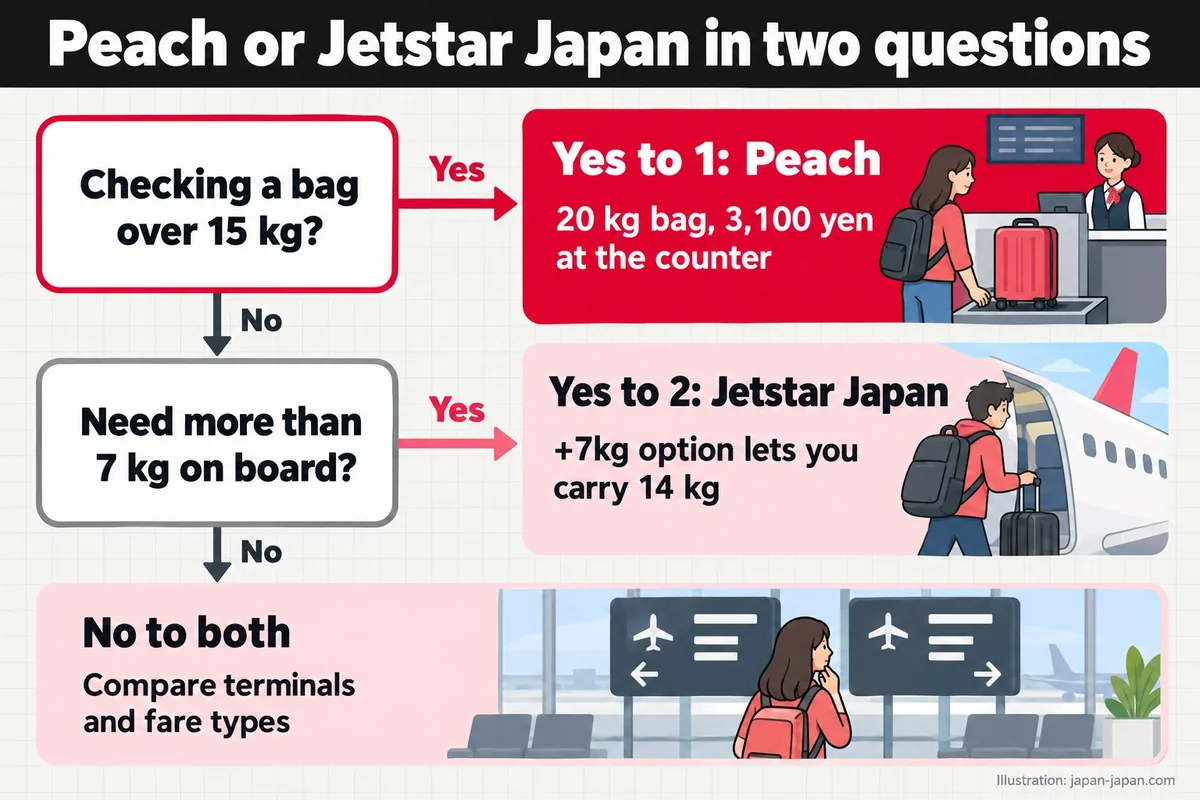
- One checked bag over 15 kg: choose Peach. Its domestic bag covers 20 kg for 3,100 yen at the counter, or 2,000 yen online. Jetstar Japan’s 4,600 yen counter price covers 15 kg, and each extra kilogram costs 1,000 yen.
- A seat and a bag in one fare: compare Peach Standard with Jetstar Starter Plus. Peach Standard includes one bag up to 20 kg and free choice of three seat areas. Starter Plus includes a 20 kg bag and a standard seat.
- More than 7 kg in the cabin: Jetstar Japan’s +7kg option takes you to 14 kg, for 5,000 yen at the domestic check-in counter. Peach has no cabin upgrade, so the extra weight goes in a checked bag.
- A quick start by train: pick the airline whose terminal has a station. That means Peach at Narita Terminal 1, or Jetstar Japan at Kansai Terminal 1.
- Plans that may change: Peach Standard Plus allows online flight changes free. Jetstar Flex includes free same-day changes.
The Peach Aviation vs Jetstar choice often comes down to these rules rather than the ticket price. Check both airlines’ current prices on the day you book, because the bag and seat prices above are the ones posted in October 2026.
Peach or Jetstar: what 98 people in Japan have flown
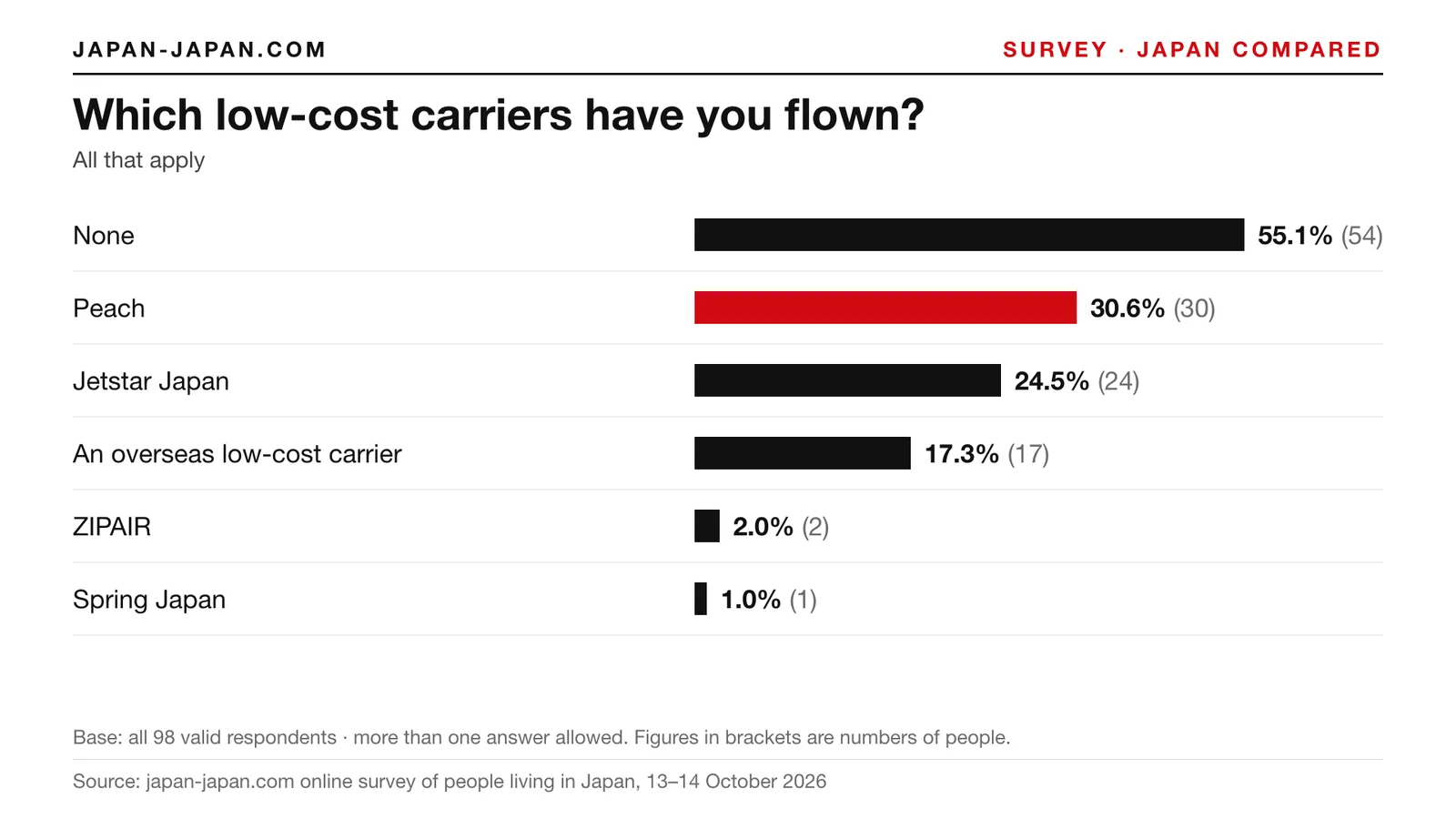
On 13–14 October 2026, japan-japan.com ran an online survey of people living in Japan about 32 travel choices. 130 people answered. We removed answers that looked machine-written, one from outside Japan and most of those that contradicted themselves, which left 98. Shares below are of the 98 respondents unless a smaller group is named; they describe these people, not all travellers in Japan. See all 32 comparisons and how we asked.
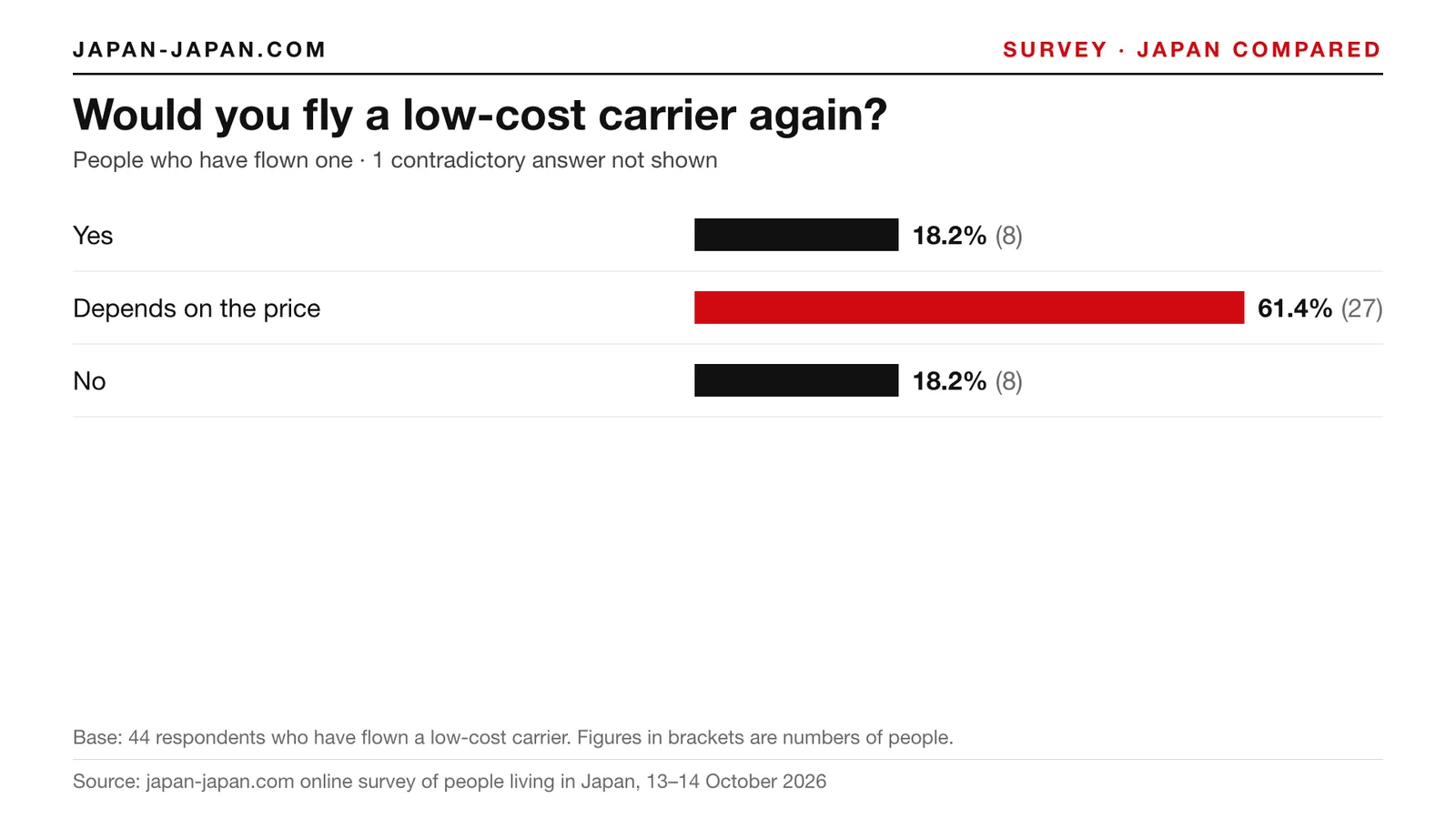
30.6% (30 people) have flown Peach and 24.5% (24 people) Jetstar Japan; 44.9% (44 people) have flown at least one low-cost carrier. Of those 44, 61.4% (27 of 44) said whether they fly one again depends on the price, 18.2% (8 of 44) said yes and 18.2% (8 of 44) said no.
Peach vs Jetstar Japan FAQ
Is Peach or Jetstar Japan cheaper for a checked bag?
Peach is cheaper on domestic flights. A bag bought at the airport counter costs 3,100 yen for up to 20 kg on Peach and 4,600 yen for up to 15 kg on Jetstar Japan. Bought online, the Peach bag drops to 2,000 yen.
Is the 7 kg carry-on limit the same on Peach and Jetstar Japan?
Yes. Both allow one main bag and one small item, weighing 7 kg together. Peach limits the three sides to under 115 cm in total. Jetstar Japan limits each side to 56 × 36 × 23 cm, and sells a +7kg option for 14 kg.
Which terminal do Peach and Jetstar Japan use at Narita and Kansai?
Peach uses Narita Terminal 1 and Kansai Terminal 2. Jetstar Japan uses Narita Terminal 3 and Kansai Terminal 1. Narita Terminal 3 and Kansai Terminal 2 have no station, so allow time for a walk or a free bus.
Is Jetstar Japan changing its name?
Yes. Jetstar Japan plans to move to new Japanese capital-led ownership, with the change expected to be complete by June 2027. The airline will then switch from the Jetstar brand to a new brand. Flights operate as scheduled until then.
About the author


.jpg)

_(02).jpg)

.jpg)


