Kagayaki vs Hakutaka: Which Should You Take to Kanazawa?
The times and fares come from our routes database. It uses JR’s own search for Wednesday 14 October 2026, for one adult travelling one way. The train counts and stops come from JR West’s timetable for Tuesday 13 October 2026.
Both trains run on the Hokuriku Shinkansen between Tokyo and Tsuruga. Both use the same 12-car E7 and W7 series trains. What separates them is how many stations each one stops at, and whether you can sit down without a reservation.
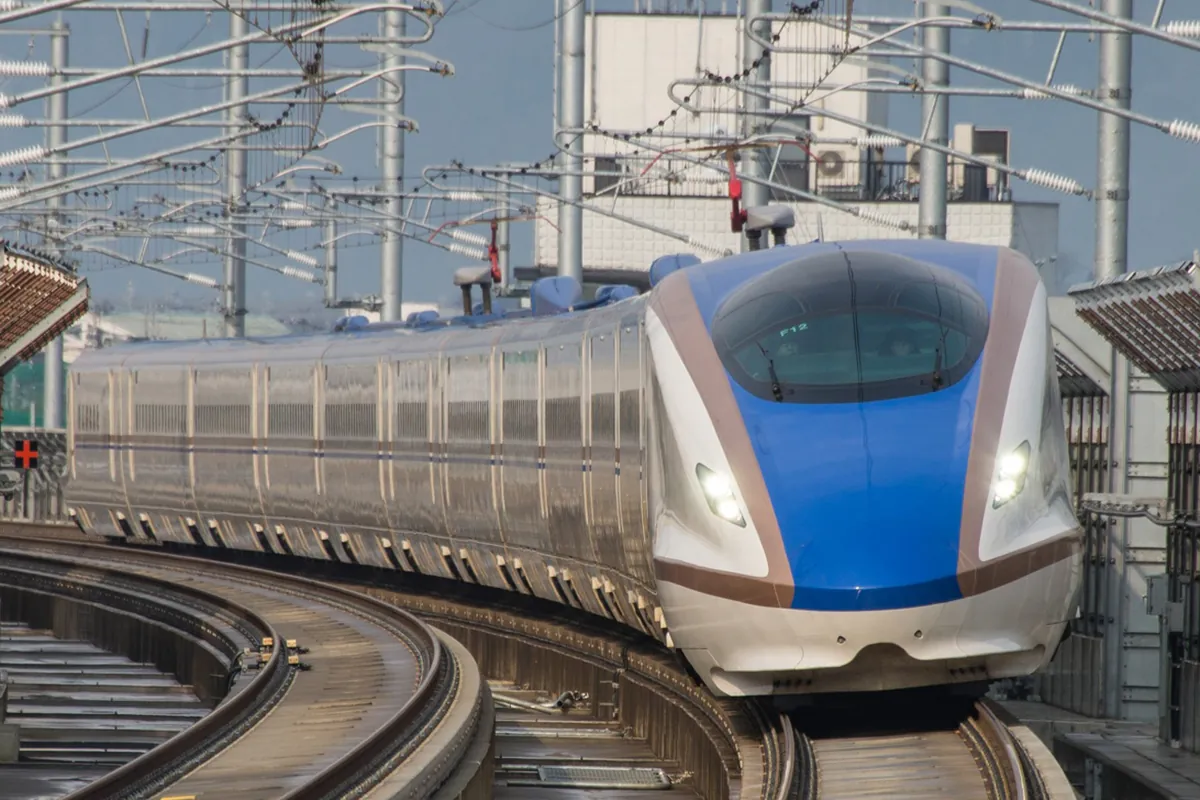
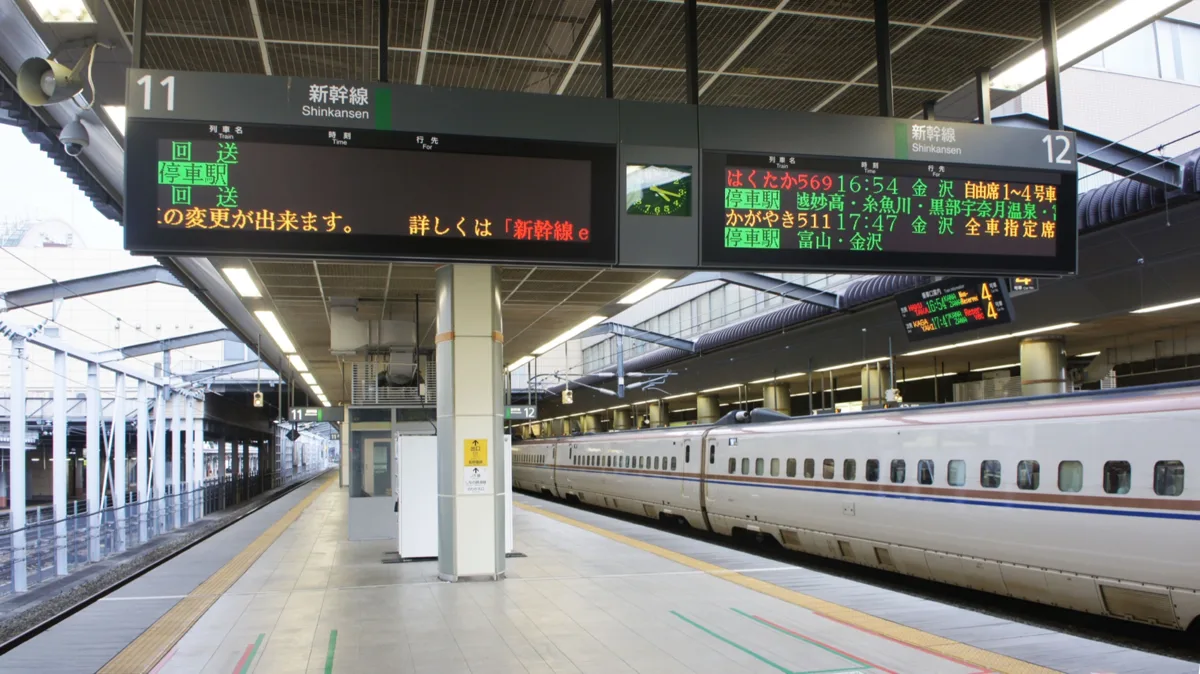
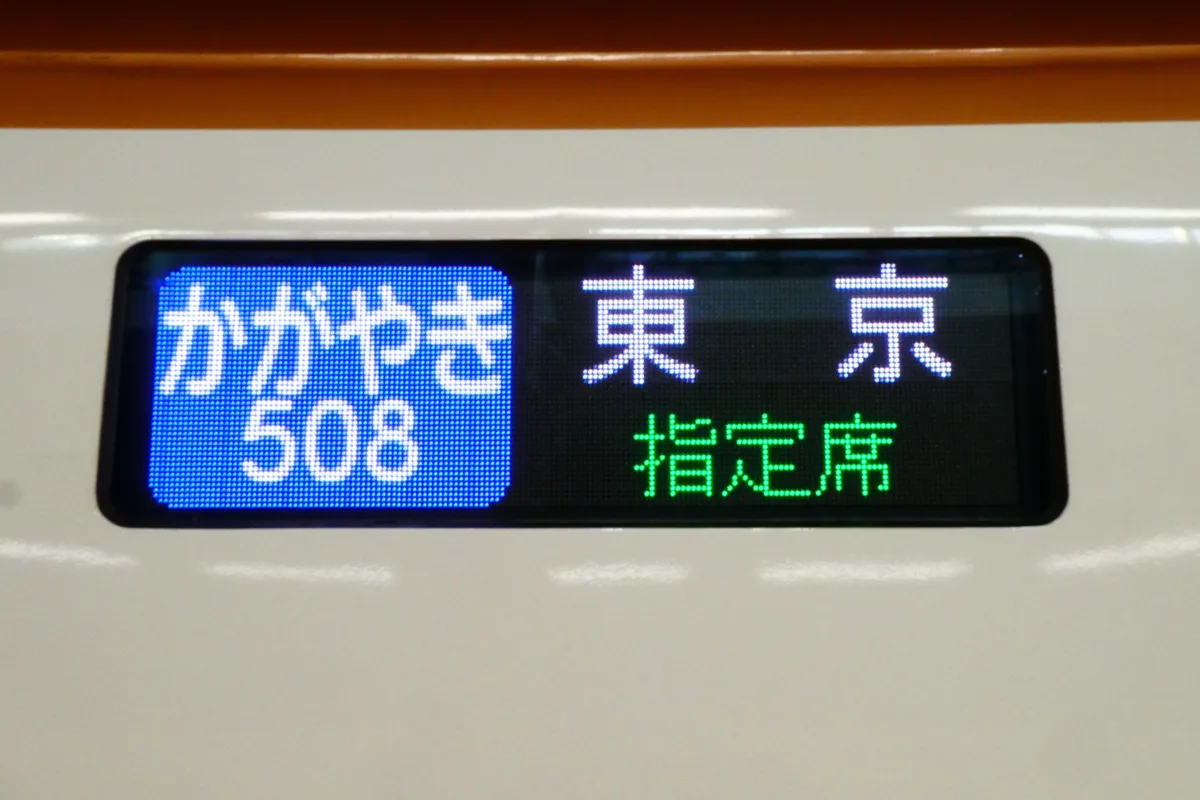
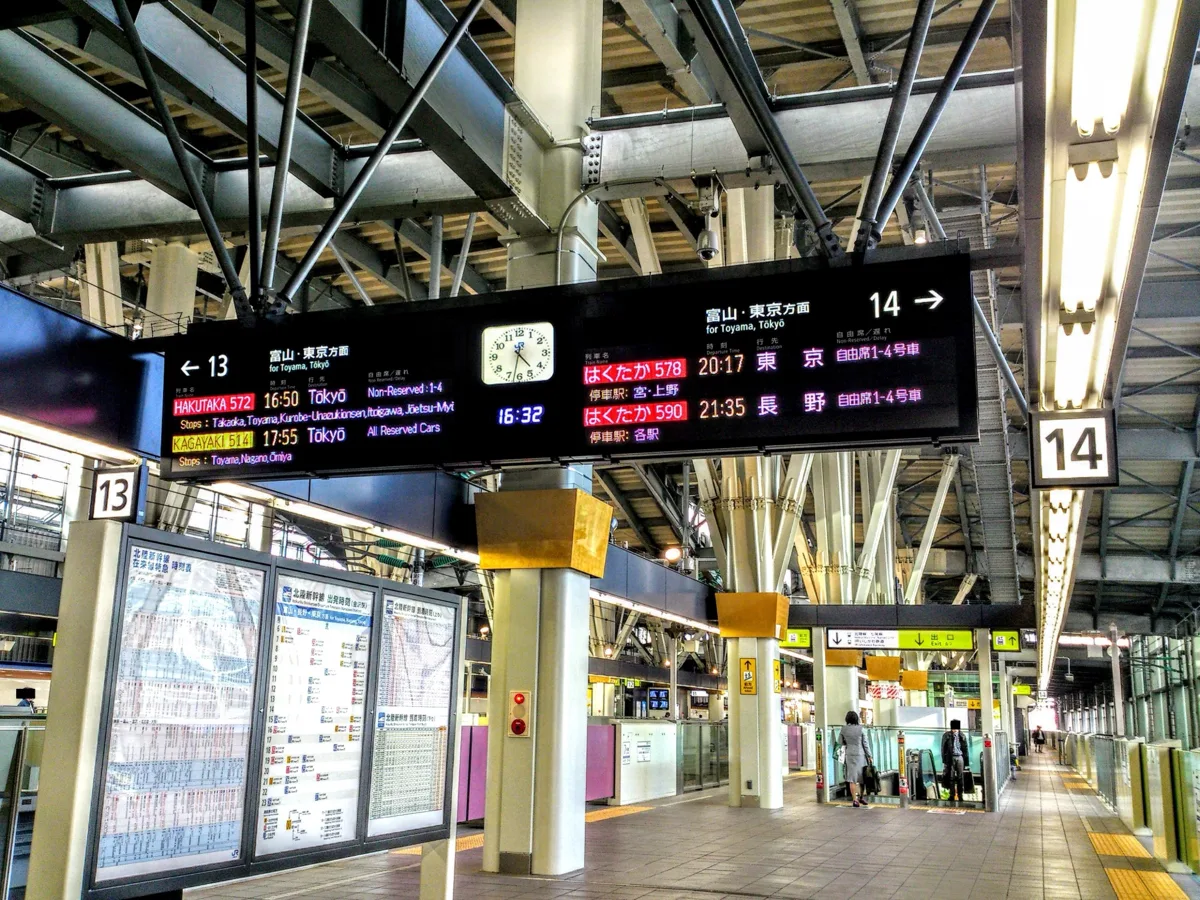
The photo shows a Hokuriku Shinkansen train. A Kagayaki and a Hakutaka look the same from the platform, so read the train name on the departure board before you board.
Kagayaki vs Hakutaka side by side
The table puts the two trains next to each other for the trip most visitors make: Tokyo to Kanazawa.
| Item | Kagayaki | Hakutaka |
|---|---|---|
| Tokyo to Kanazawa | 2 h 24 min to 2 h 34 min | 2 h 53 min to 3 h 13 min |
| Trains from Tokyo | 14 | 14 |
| Stations, Tokyo to Kanazawa | 5 (Kagayaki 503) | 12 (Hakutaka 561) |
| Non-reserved seats | None | Cars 1-4 (varies by train) |
| When every seat is sold | A standing ticket may be sold | Non-reserved cars |
| Seat, Tokyo to Kanazawa | 14,600 yen (reserved) | 14,070 yen (non-reserved) |
| Japan Rail Pass | No extra charge | No extra charge |
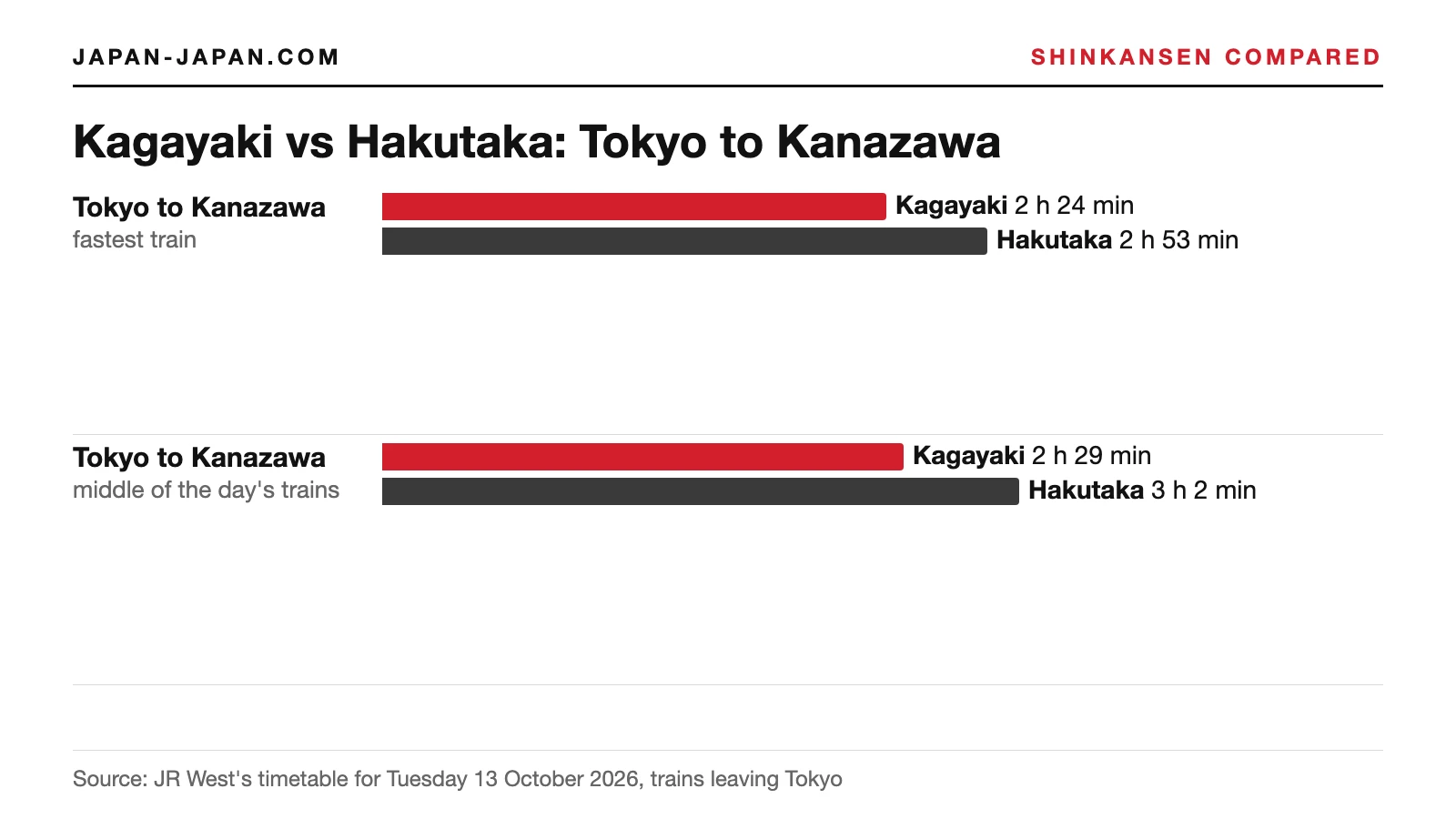
Start with the time rows. The JR West Hokuriku Shinkansen timetable 13 October 2026 lists 14 Kagayaki and 14 Hakutaka leaving Tokyo that day. The fastest Kagayaki took 2 h 24 min to Kanazawa and the slowest took 2 h 34 min. The Hakutaka ran from 2 h 53 min to 3 h 13 min.
A typical Kagayaki takes 2 h 29 min, and a typical Hakutaka takes 3 h 02 min.
The seats differ more than the times. The JR East Hokuriku Shinkansen route and train guide lists the Kagayaki as 12 cars with reserved seats only. The Hakutaka has non-reserved seats in cars 1 to 4, and JR East says those cars can change by train.
Our routes database prices a reserved seat from Tokyo to Kanazawa at 14,600 yen on the Kagayaki. A non-reserved seat costs 14,070 yen, and only the Hakutaka offers one.
A third train, the Asama, shares the line from Tokyo as far as Nagano. On 13 October 2026, 18 Asama left Tokyo, and none of them went on to Toyama or Kanazawa. If you are heading past Nagano, you need a Kagayaki or a Hakutaka.
Time and price from Tokyo to 4 stations
Our routes database covers four Hokuriku Shinkansen trips from Tokyo Station. For three of them, the fastest train is the Kagayaki 503, which leaves Tokyo at 07:20. For the fourth, Karuizawa, the fastest train is a Hakutaka.
- Nagano: Tokyo to Nagano takes 1 h 17 min at the fastest, for 8,450 yen reserved or 7,920 yen non-reserved.
- Toyama: Tokyo to Toyama takes 2 h 4 min at the fastest, for 13,180 yen reserved or 12,650 yen non-reserved.
- Kanazawa: Tokyo to Kanazawa takes 2 h 24 min at the fastest, for 14,600 yen reserved or 14,070 yen non-reserved.
- Karuizawa: Tokyo to Karuizawa takes 1 h on the Hakutaka 557, for 6,130 yen reserved or 5,600 yen non-reserved.
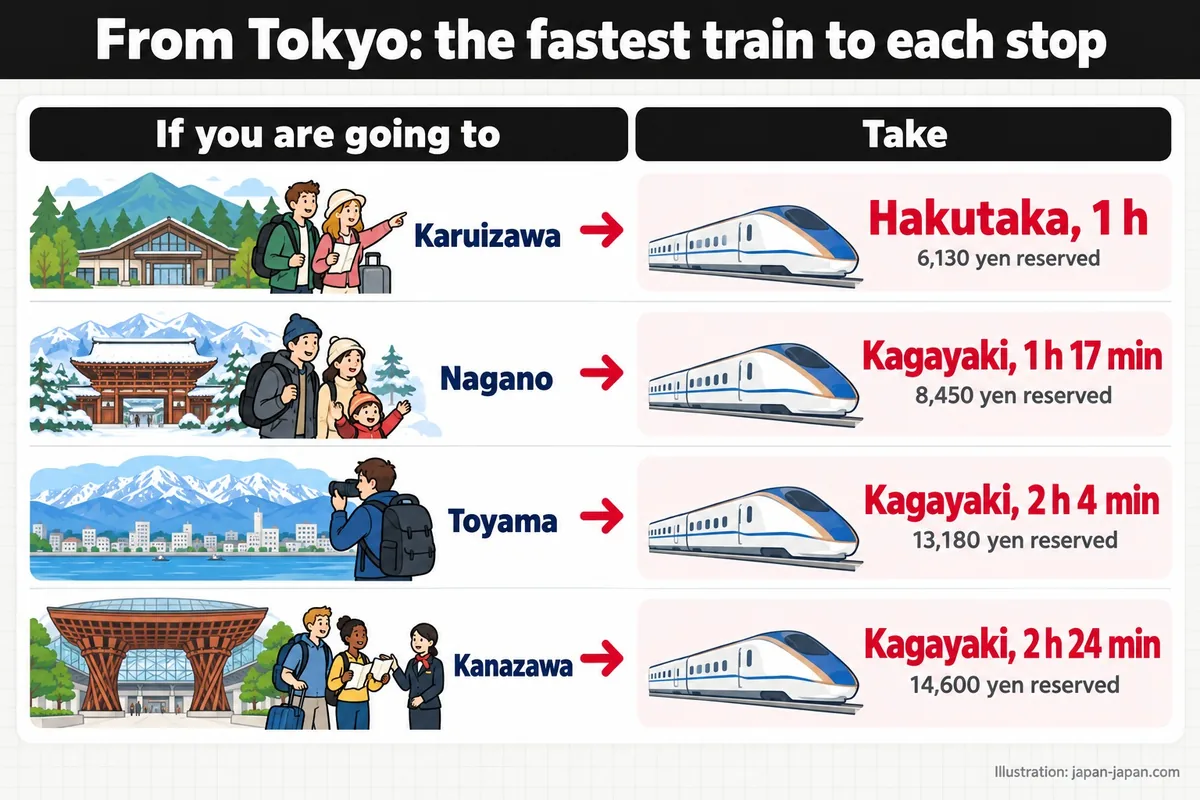
The lookup above gives the fastest train for each of the four stations. On all four trips, a non-reserved seat costs 530 yen less than a reserved seat.
The Hakutaka 557 leaves Tokyo at 09:32 and reaches Karuizawa at 10:32. The Kagayaki 503 runs straight through Karuizawa without stopping, so it cannot help you there.
Not every Kagayaki matches the record time. The Kagayaki 509 leaves Tokyo at 10:22 and reaches Kanazawa at 12:49, taking 2 h 27 min. The same train reaches Toyama in 2 h 7 min.
The first train to Kanazawa is the Kagayaki 501, which leaves Tokyo at 06:16 and arrives at 08:43. The last is the Kagayaki 519, leaving at 21:04 and arriving at 23:30. For Karuizawa, the first train leaves Tokyo at 06:28 and the last at 22:08.
The 14,600 yen to Kanazawa is a basic fare of 7,700 yen plus a limited express charge of 6,900 yen. The trip covers 450.5 km by JR’s fare distance. Children aged 6 to 11 pay half of the basic fare and half of the limited express charge.
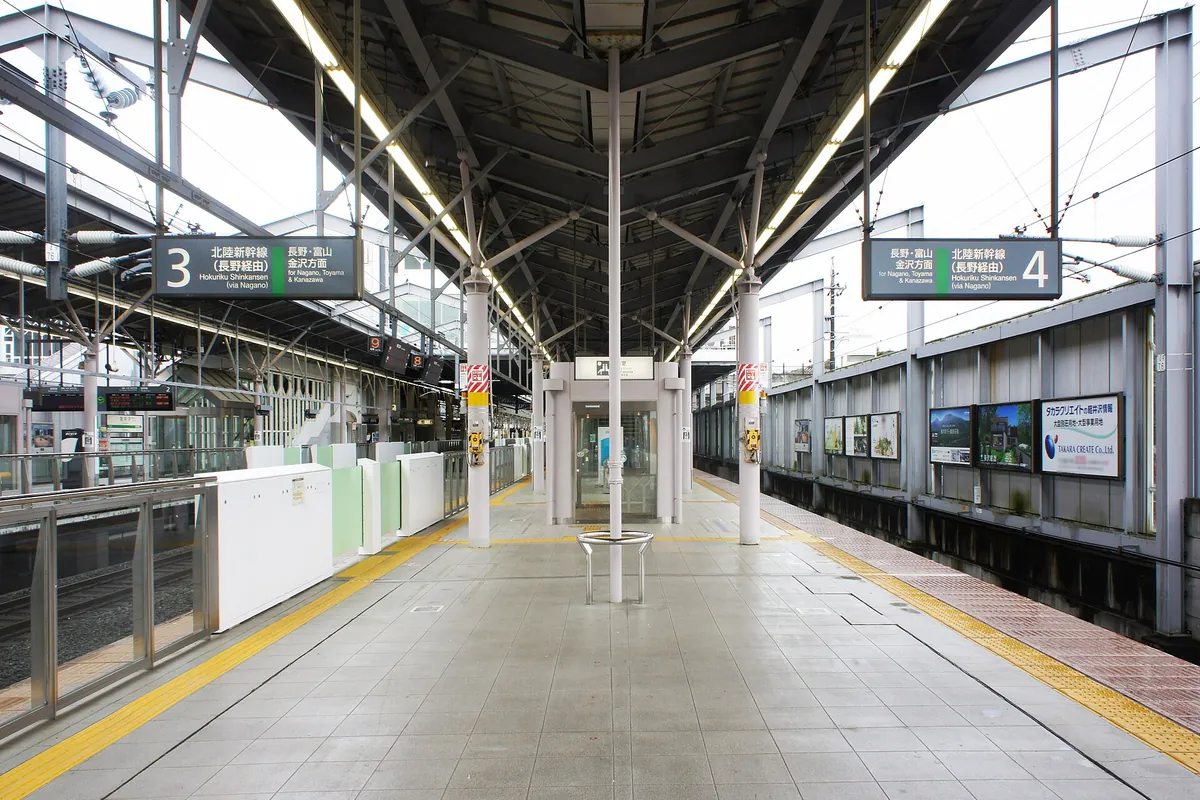
The photo shows Karuizawa Station. It is a Hakutaka stop, and the Kagayaki 503 passes it without stopping.
Stops and non-reserved cars
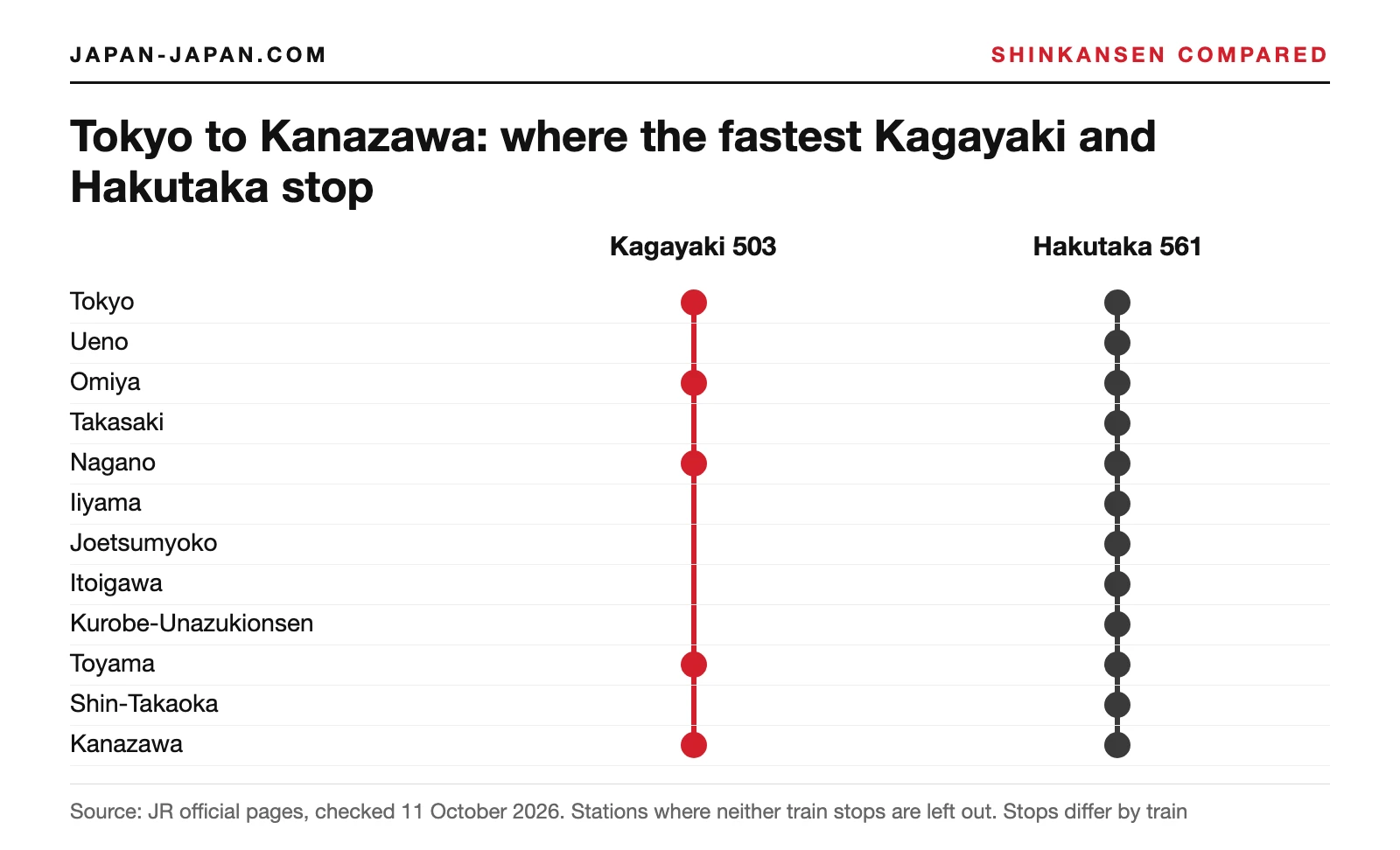
Stops change from train to train, so read the lists below as examples. The JR West timetable for Kagayaki 503 shows five stops between Tokyo and Kanazawa. They are Tokyo, Omiya, Nagano, Toyama and Kanazawa. The train passes Ueno, Karuizawa and Shin-Takaoka.
The JR West timetable for Hakutaka 561 shows 12 stations over the same stretch. They are Tokyo, Ueno, Omiya, Takasaki, Nagano, Iiyama, Joetsumyoko, Itoigawa, Kurobe-Unazukionsen, Toyama, Shin-Takaoka and Kanazawa. This train leaves Tokyo at 11:24 and reaches Kanazawa at 14:17.
Those extra stops are the reason the Hakutaka is slower. They are also the reason to take it. If you want Takasaki, Iiyama or Kurobe-Unazukionsen, a Kagayaki like the 503 will carry you straight past.
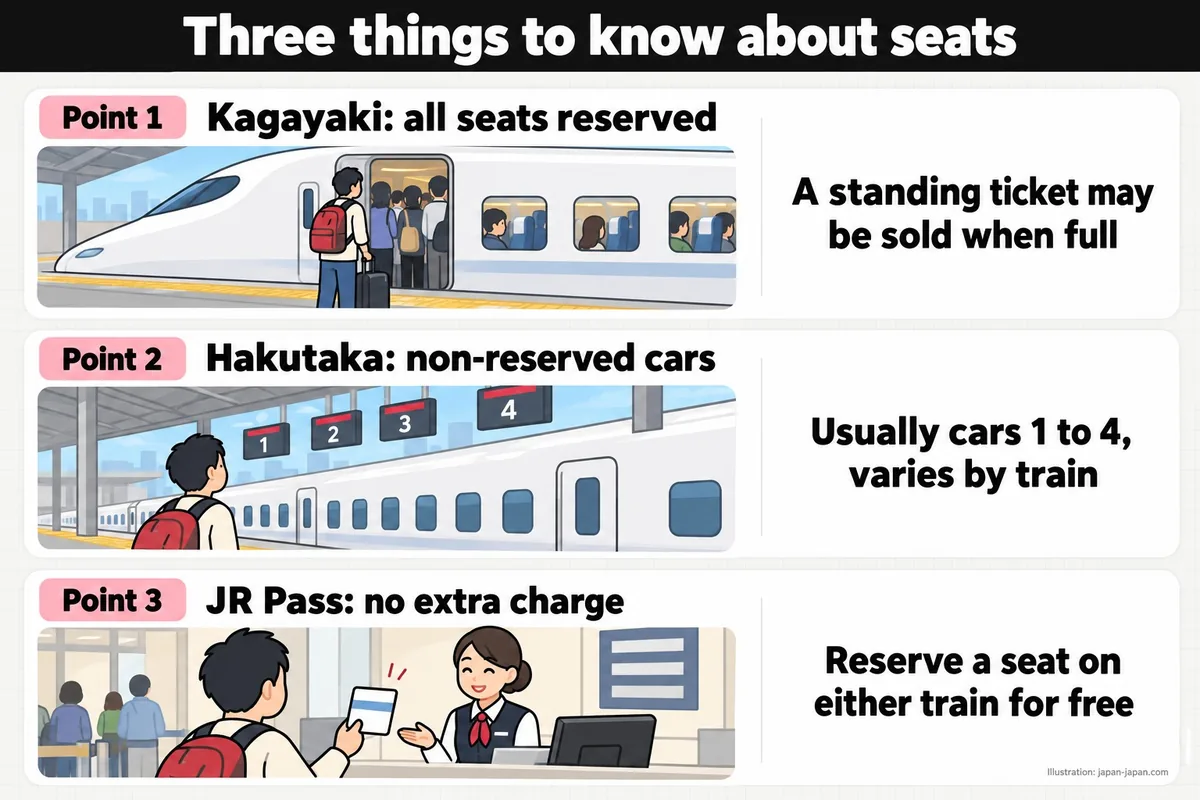
The three points above sum up the seats. The Kagayaki timetable lists every car as reserved, including the Green Car and GranClass.
When a Kagayaki is full, JR East may sell a standing ticket. The JR East reserved seat and standing ticket rules price it at the regular-season reserved seat charge minus 530 yen. With that ticket you ride, but you have no seat of your own.
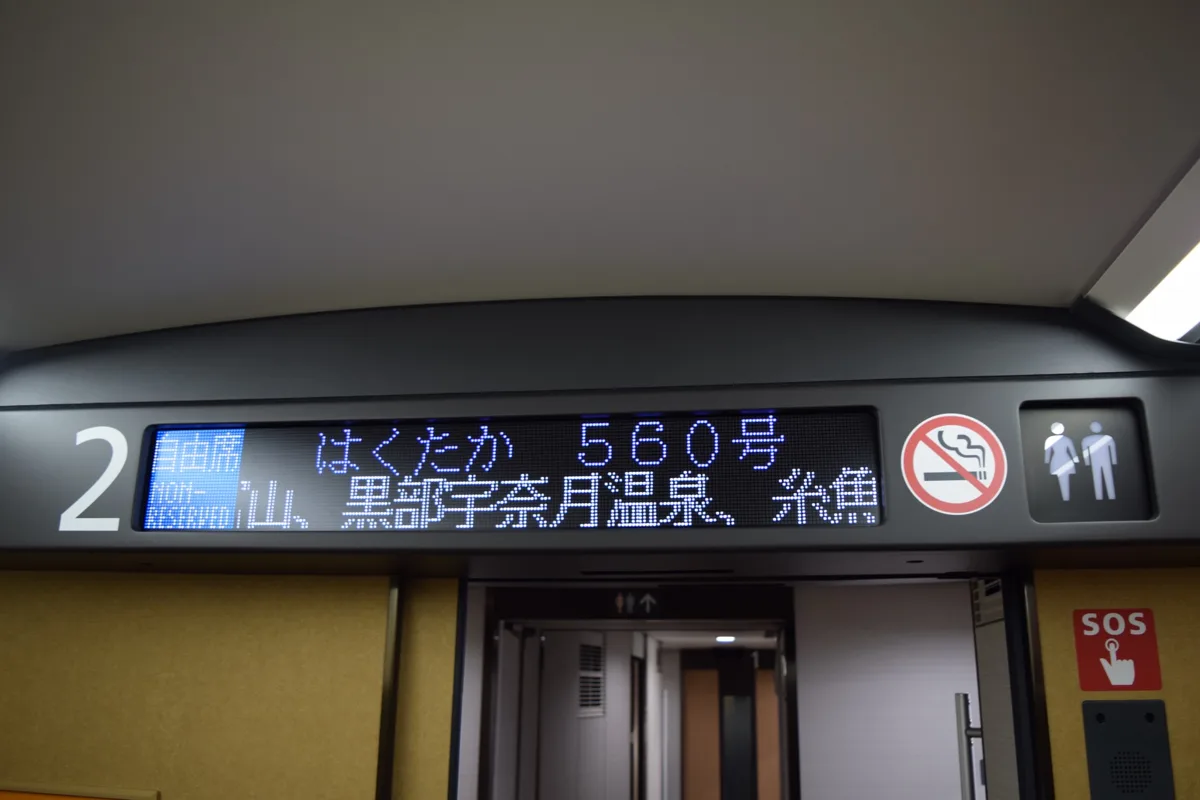
The Hakutaka gives you the other option. At the ticket office, ask for 自由席 (jiyuseki), which means a non-reserved seat. Then board one of the non-reserved cars and take any free seat.
The JR West E7 and W7 series Hokuriku Shinkansen page lists the exceptions. On the Hakutaka 551, 571, 573, 575 and 577, cars 1 to 5 are non-reserved, though car 5 becomes reserved on some days. On the Hakutaka 561 to 569 and 560 to 568, car 4 is reserved.
JR West also kept the Kagayaki all reserved after the line reached Tsuruga. On weekdays, car 9 of some trains is a TRAIN DESK car, a reserved car for people who want to work or study.
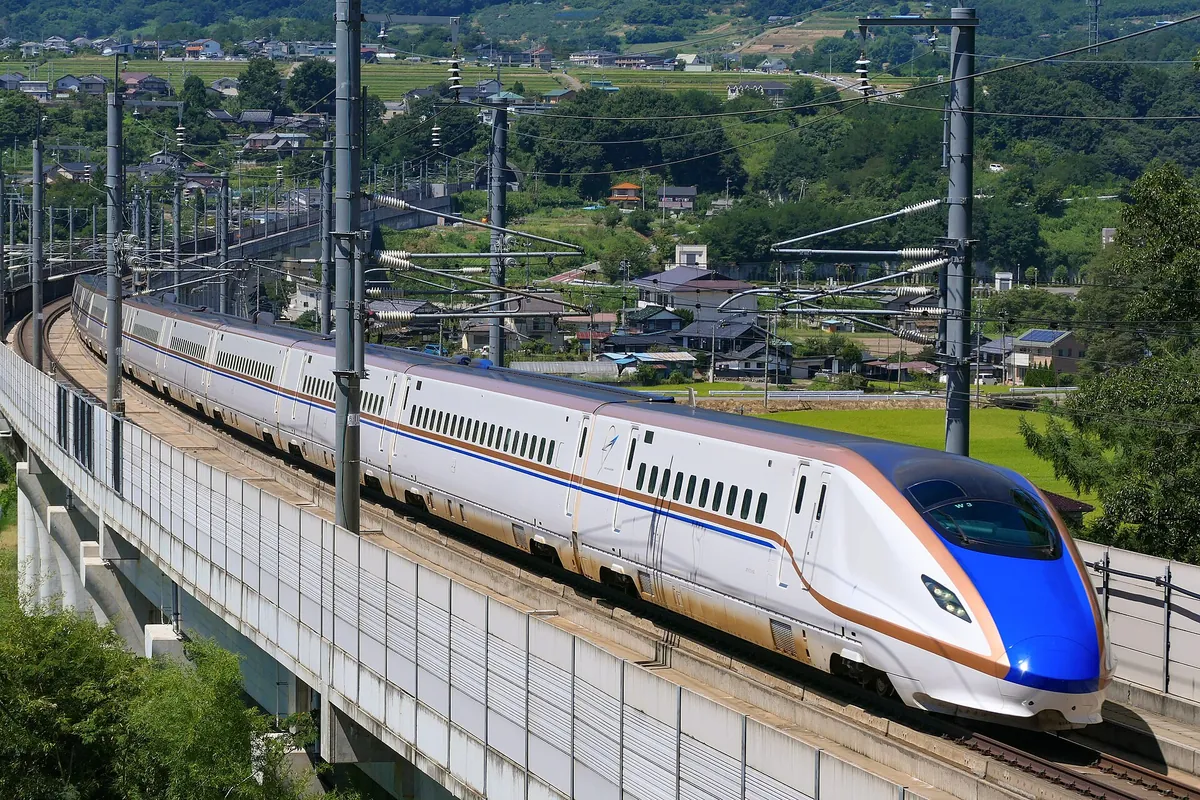
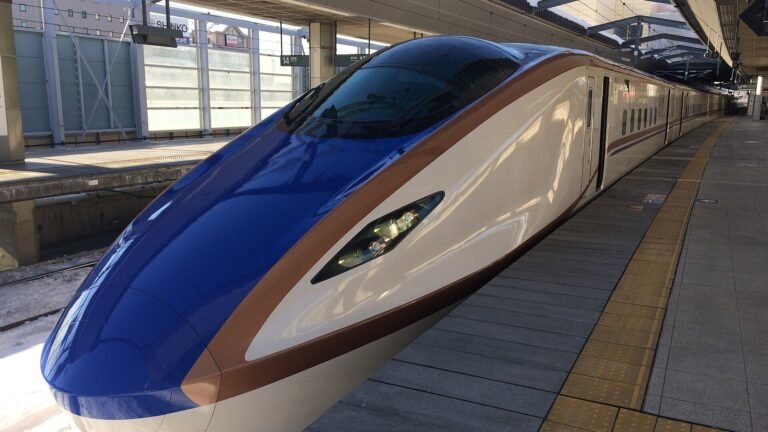
The photo shows a Hokuriku Shinkansen train at a platform. Before you board a Hakutaka without a reservation, check the car number, because the non-reserved cars change on some trains.
Beyond Kanazawa: Tsuruga and the Tsurugi
The Hokuriku Shinkansen grew in three steps. The Tokyo to Nagano section opened in 1997 as the Nagano Shinkansen. Nagano to Kanazawa followed in 2015, and Kanazawa to Tsuruga opened on 16 March 2024.
| Train | Trains from Tokyo | Through to Tsuruga | Tokyo to Kanazawa |
|---|---|---|---|
| Kagayaki | 14 | 10 | 2 h 24 min to 2 h 34 min |
| Hakutaka | 14 | 5 | 2 h 53 min to 3 h 13 min |
| Asama | 18 | None | Ends at Nagano |
The table counts the trains that left Tokyo on 13 October 2026. Of the 14 Kagayaki, 10 ran through to Tsuruga. Only 5 of the 14 Hakutaka did, so most Hakutaka end at Kanazawa or earlier.
Between Kanazawa or Toyama and Tsuruga, a third train runs as a shuttle: the Tsurugi. That day, 28 Tsurugi ran in the down direction. The JR West timetable for a Tsurugi train shows the Tsurugi 15 leaving Kanazawa at 09:55 and reaching Tsuruga at 10:36. It stops only at Fukui, which makes it the fastest Tsurugi at 41 min.
The Kagayaki keeps its few stops on this stretch too. The Kagayaki 503 leaves Kanazawa at 09:46 and passes Komatsu, Kaga-Onsen and Awara-Onsen. It stops at Fukui at 10:09 and reaches Tsuruga at 10:26.
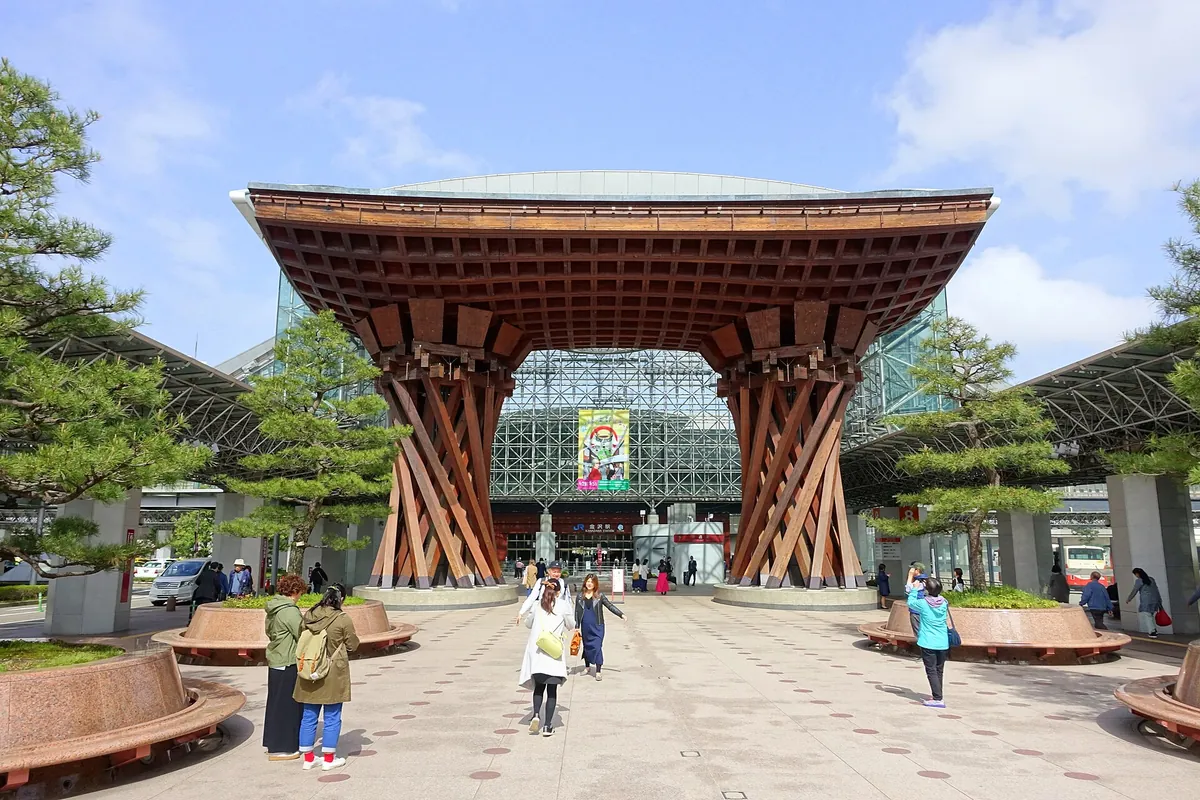
The photo shows the Tsuzumi Gate outside Kanazawa Station. Some Kagayaki and Hakutaka end here, and others continue to Fukui and Tsuruga.
From Kyoto or Osaka, take the Limited Express Thunderbird to Tsuruga and change to the Tsurugi. Kyoto to Kanazawa takes 1 h 41 min at the fastest, for 7,720 yen with a reserved seat. Osaka to Kanazawa takes 2 h 9 min at the fastest, for 9,410 yen.
With a Japan Rail Pass
The JAPAN RAIL PASS trains you can ride page lists all trains on the Hokuriku Shinkansen. That covers the Kagayaki, the Hakutaka and the Tsurugi at no extra charge. An Ordinary Car pass covers the ordinary cars, and a Green Car pass also covers the Green Cars.
Reserved seats cost nothing extra with the pass. Book them at a reserved seat ticket machine or a JR ticket office. If you bought the pass online, you can also book on the official website.

The steps above show how a pass holder gets onto a Kagayaki. Reserve the seat first, then go through the automatic ticket gate with the pass, or show it at a staffed gate. Carry your passport the whole time you use the pass.
Only foreign tourists who enter Japan with the Temporary Visitor status can use the pass. For the Hakutaka, you can skip the reservation and sit in a non-reserved car, but a reserved seat costs you nothing.
GranClass is the one exception on this line. In GranClass, the pass covers only the basic fare. You pay the limited express charge and the GranClass charge on top. The pass also cannot be used for TRAIN DESK cars.
The Tokaido Shinkansen works differently. There, the Nozomi and Mizuho need a separate ticket, as our Nozomi vs Hikari guide explains. The Hokuriku Shinkansen has no such train, so you can take the faster Kagayaki freely.
The Japan Rail Pass costs 50,000 yen for 7 days in an Ordinary Car on the official website. Children pay 25,000 yen. From an overseas travel agent, the same pass costs 53,000 yen.
A round trip from Tokyo to Kanazawa means two reserved seats at 14,600 yen each. Whether the pass pays off depends on the rest of your trip, so check whether the JR Pass is worth it for your own plan.
If your trip stays in this part of Japan, compare the Hokuriku Arch Pass. It costs 35,000 yen for 7 days, and children pay 17,500 yen. It covers the Hokuriku Shinkansen from Tokyo to Tsuruga, plus JR East and JR West trains within the pass area.
Which one should you take?
Pick by where you are going and what ticket you hold. Each line below starts from a real situation.
- Nagano, Toyama or Kanazawa in a hurry: Take the Kagayaki and book a reserved seat. It is the fastest train to all three.
- A smaller station: Take the Hakutaka to stops such as Karuizawa, Iiyama, Itoigawa or Shin-Takaoka. Check the timetable first, because stops differ by train.
- No reserved seat yet: Take the Hakutaka and sit in a non-reserved car. A full Kagayaki may only offer a standing ticket.
- The lowest fare: Take a non-reserved seat on the Hakutaka. It costs 530 yen less than a reserved seat.
- A Japan Rail Pass: Both trains cost nothing extra, so reserve a seat on the faster Kagayaki.
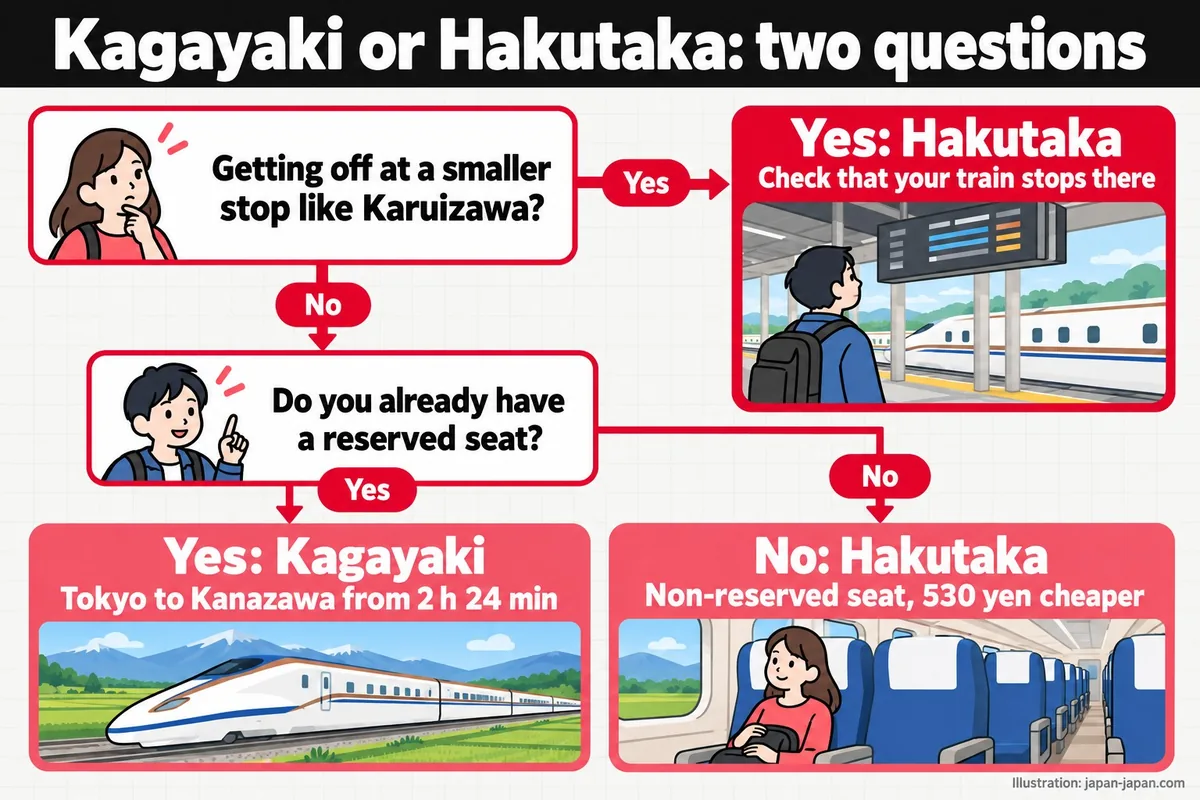
The flow above asks two questions. First, are you getting off at a smaller station? If not, do you already hold a reserved seat?
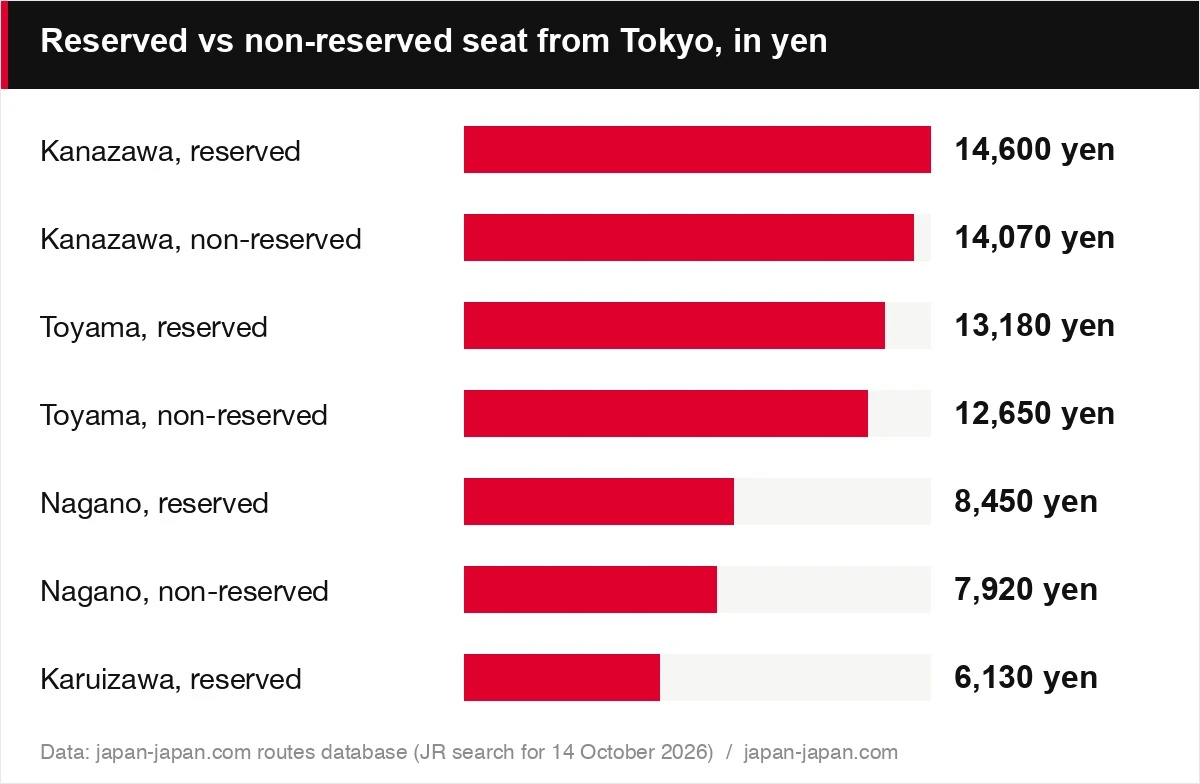
The chart below shows the reserved and non-reserved fares on each trip from Tokyo.
| Item | Value |
|---|---|
| Kanazawa, reserved | 14,600 yen |
| Kanazawa, non-reserved | 14,070 yen |
| Toyama, reserved | 13,180 yen |
| Toyama, non-reserved | 12,650 yen |
| Nagano, reserved | 8450 yen |
| Nagano, non-reserved | 7920 yen |
| Karuizawa, reserved | 6130 yen |
| Karuizawa, non-reserved | 5600 yen |
The gap stays at 530 yen whether you ride 1 h to Karuizawa or 2 h 24 min to Kanazawa.
For Tokyo to Shirakawa-go, both trains work with a bus. The Kagayaki plus a bus from Kanazawa takes 3 h 39 min of riding time for 17,400 yen. The Hakutaka plus the Kaetsuno highway bus from Shin-Takaoka takes 4 h 4 min for 16,250 yen.
Every bus between Kanazawa Station and Shirakawa-go needs a seat reservation. Book the bus when you book the train.
If you travel around New Year, check the holiday dates on our New Year holidays in Japan page first. Then book your reserved seat as soon as your dates are fixed.
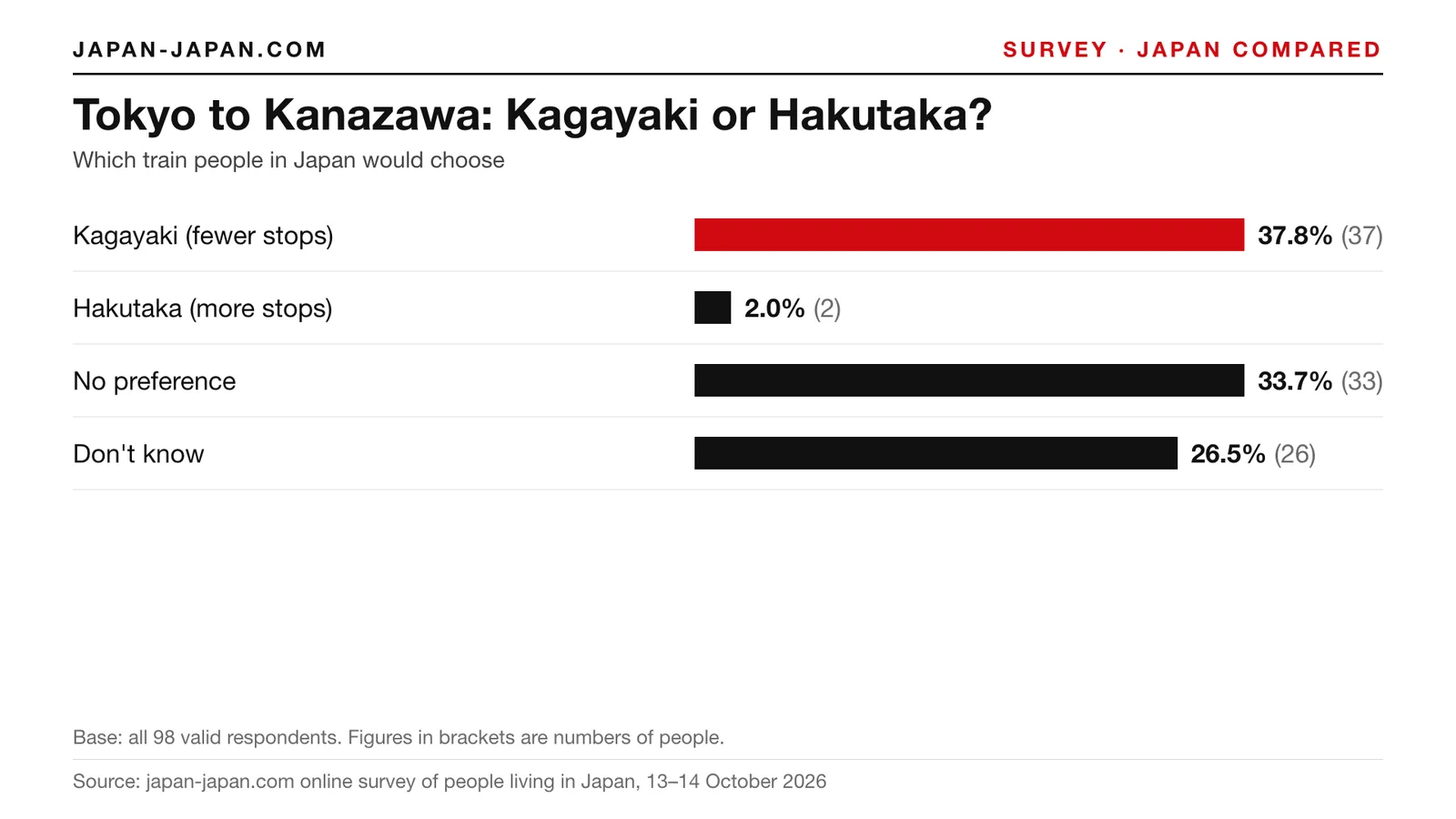
Kagayaki or Hakutaka: what 98 people in Japan chose
On 13–14 October 2026, japan-japan.com ran an online survey of people living in Japan about 32 travel choices. 130 people answered. We removed answers that looked machine-written, one from outside Japan and most of those that contradicted themselves, which left 98. Shares below are of the 98 respondents unless a smaller group is named; they describe these people, not all travellers in Japan. See all 32 comparisons and how we asked.
23.5% (23 people) have taken a Hokuriku Shinkansen train named in the survey: 14.3% (14 people) the Kagayaki and 13.3% (13 people) the Hakutaka.
Asked which they would take from Tokyo to Kanazawa, 37.8% (37 people) chose the Kagayaki, which makes fewer stops, and 2.0% (2 people) the Hakutaka. 33.7% (33 people) had no preference and 26.5% (26 people) did not know.
Kagayaki vs Hakutaka FAQ
Is the Kagayaki faster than the Hakutaka?
Yes. From Tokyo to Kanazawa, the Kagayaki takes 2 h 24 min to 2 h 34 min, and the Hakutaka takes 2 h 53 min to 3 h 13 min. The Kagayaki saves time by stopping at fewer stations.
Does the Kagayaki have non-reserved seats?
No. JR East lists the Kagayaki as reserved seats only, in all 12 cars. When it is full, JR East may sell a standing ticket at the reserved seat charge minus 530 yen.
Can I ride the Kagayaki with a Japan Rail Pass?
Yes. The pass covers all trains on the Hokuriku Shinkansen, including the Kagayaki, at no extra charge. Reserve a seat before you board, because every seat on the Kagayaki is reserved. GranClass costs extra.
Does the Kagayaki stop at Karuizawa?
The Kagayaki 503 runs straight through Karuizawa without stopping. For Karuizawa, take the Hakutaka: the Hakutaka 557 gets there from Tokyo in 1 h. The last train of the day to Karuizawa is the Asama 633 at 22:08.
About the author



.jpg)


