JR Pass Exchange Order: Where to Swap It Within 3 Months

The rest of this guide follows the steps in order. It covers buying the voucher, the price gap, the deadline, the counters, the exchange itself and refunds. For what the pass covers once you hold it, see our Japan Rail Pass page. If you are still deciding whether to buy one at all, read whether the JR Pass is worth it first.
What an exchange order is, and who sells it
An exchange order is a paper voucher. You buy it from a JR-designated sales office or agent outside Japan, before your trip. It is not a ticket. You cannot ride a single JR train with it, and a station gate will not accept it.
The Japan Rail Pass page on buying from overseas agencies lists the sellers. They are JTB Corp, Nippon Travel Agency, KINTETSU INTERNATIONAL, Tobu Top Tours, Japan Airlines, ANA Sales Americas in Los Angeles and JALPAK. Their associated agencies sell it too. The ANA Sales Americas office only sells the order if you also book an ANA Group flight.
The clerk who sells you the order explains who may use the pass. Listen closely here. JR will not cover your train costs in Japan if a counter refuses you because you do not qualify. The pass is for foreign nationals who enter Japan with the entry status of Temporary Visitor.
Three details on the voucher matter later:
- Issue date: Your 3-month exchange window starts on this date.
- Pass type: Green or Ordinary, 7, 14 or 21 days. You cannot change it at the counter.
- Local price and rate: The agent converts the yen price at the Bankers Selling Rate on the issue date. The order shows the price, the rate and the date.
The figure below shows the whole path from the agent’s desk to a pass in your hand. Each step has its own section further down.
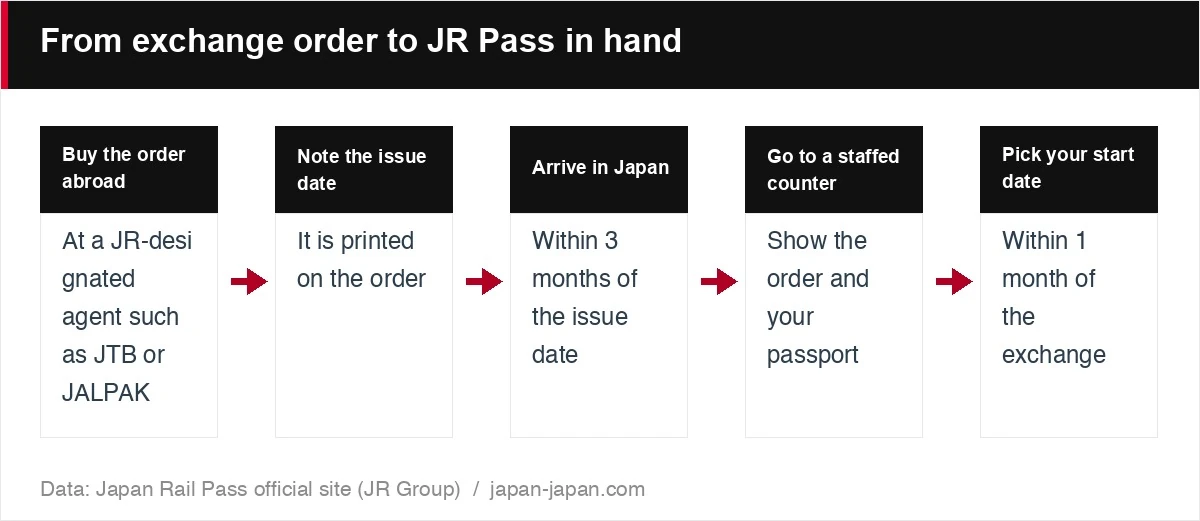
The other way to buy is the official website, JAPAN RAIL PASS Reservation. The Japan Rail Pass online purchase page says you need only a passport and a credit card in the buyer’s name. You get a reservation number instead of a paper order, and you can book Shinkansen and limited express seats before you land. One buyer can add up to 6 people who travel with them. The site takes orders from 4:00 a.m. to 11:30 p.m. Japan time. Japanese citizens living abroad cannot use it.

Many visitors pick up their pass at Tokyo Station, shown above, because several exchange counters sit inside it. Online buyers can also collect at selected machines in the JR East and JR West areas. Exchange order holders must use a staffed counter, as the next sections explain.
Agent price vs official online price in 2026
From 1 October 2026, overseas agents charge 53,000 yen for the 7-day Ordinary pass. That is up from 50,000 yen. The Japan Rail Pass types and prices page still lists 50,000 yen for the same pass bought on the official website. Every one of the six pass types now costs more through an agent.
| Pass (adult) | Official website | Overseas agent |
|---|---|---|
| 7-day Ordinary | 50,000 yen | 53,000 yen |
| 14-day Ordinary | 80,000 yen | 84,000 yen |
| 21-day Ordinary | 100,000 yen | 105,000 yen |
| 7-day Green | 70,000 yen | 74,000 yen |
| 14-day Green | 110,000 yen | 116,000 yen |
| 21-day Green | 140,000 yen | 147,000 yen |
Child passes follow the same pattern. A 7-day Ordinary child pass is 25,000 yen online and 27,000 yen from an agent. The 21-day Green child pass is 70,000 yen online and 74,000 yen from an agent.
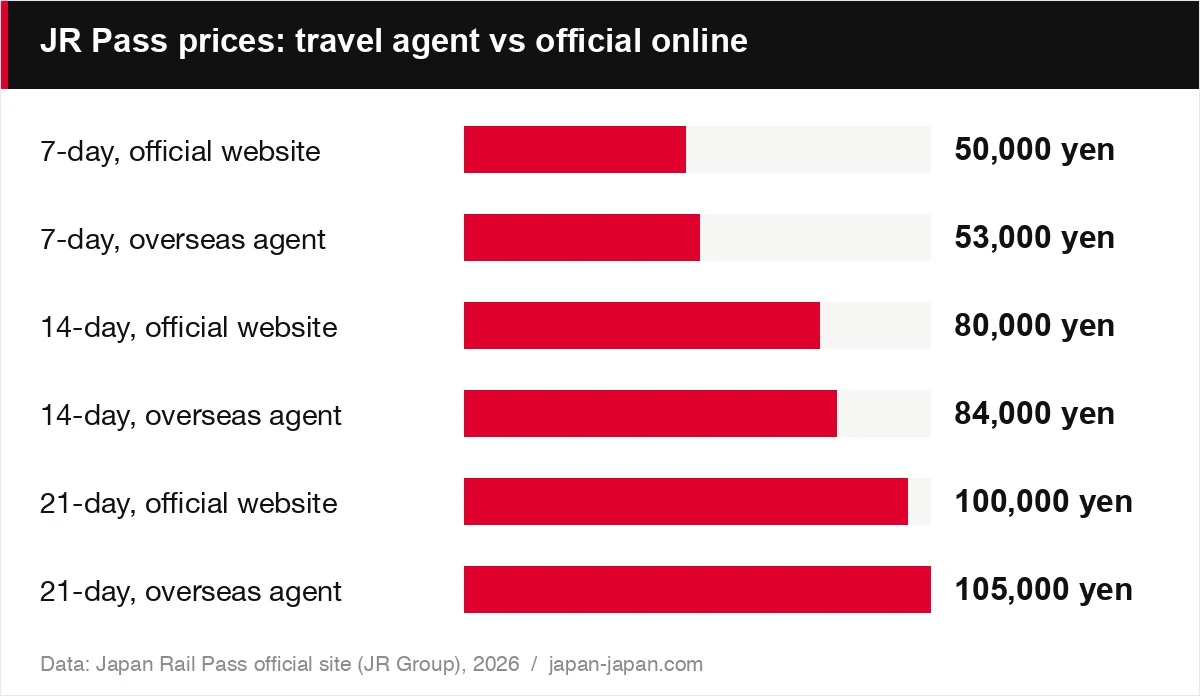
| Item | Value |
|---|---|
| 7-day, official website | 50,000 yen |
| 7-day, overseas agent | 53,000 yen |
| 14-day, official website | 80,000 yen |
| 14-day, overseas agent | 84,000 yen |
| 21-day, official website | 100,000 yen |
| 21-day, overseas agent | 105,000 yen |
The bars above put the three Ordinary passes side by side. The agent column is higher in every length, and the gap grows with the number of days.
JR counts a child as aged 6 to 11 at the time of use. Children aged 12 or older pay the adult price, even in elementary school. Exchange orders have one helpful exception. A child who is 11 on the issue date keeps the child price, even after turning 12.
So which route should you take? Buy online if you hold a credit card in your own name and want seats booked before you fly. Buy an exchange order if you prefer to pay a local agent in your own currency. It also suits people booking through an airline on the seller list. JR also notes that prices can change. If they do, the price printed on your exchange order applies, so an order bought early keeps its price.
Not sure you need Green Car seats? Our article on JR Pass Green vs Ordinary compares the two classes trip by trip.
The 3-month deadline and choosing your start date
Two dates control your exchange order. First, you must turn it in within three months of the issue date. Second, a counter will only exchange it from one month before the day you start using the pass.
JR gives its own example on the overseas purchase page. An order issued on April 15 has to be exchanged by July 14. If you plan to start using the pass on May 30, the earliest exchange date is April 30.
In practice, this sets the latest safe time to buy. If your flight lands more than three months after the agent issues the order, the counter will not accept it. Buy the order once your travel dates are firm, not half a year ahead.
You choose the start date at the counter. The start date does not have to be the exchange day. Many visitors exchange on arrival and set the start for a later morning, when they leave Tokyo or Osaka for a long trip. Pick the date with care, because JR cannot change the period of use once it issues the pass.
- One pass at a time: You cannot hold two passes with overlapping periods on the same passport, whatever their type.
- Fixed period: The pass works only within its period of use. JR will not extend it, even when trains stop for bad weather or a natural disaster.
- Allow time: Counters get busy, and the exchange can take a while. JR asks you to leave enough time before your train.
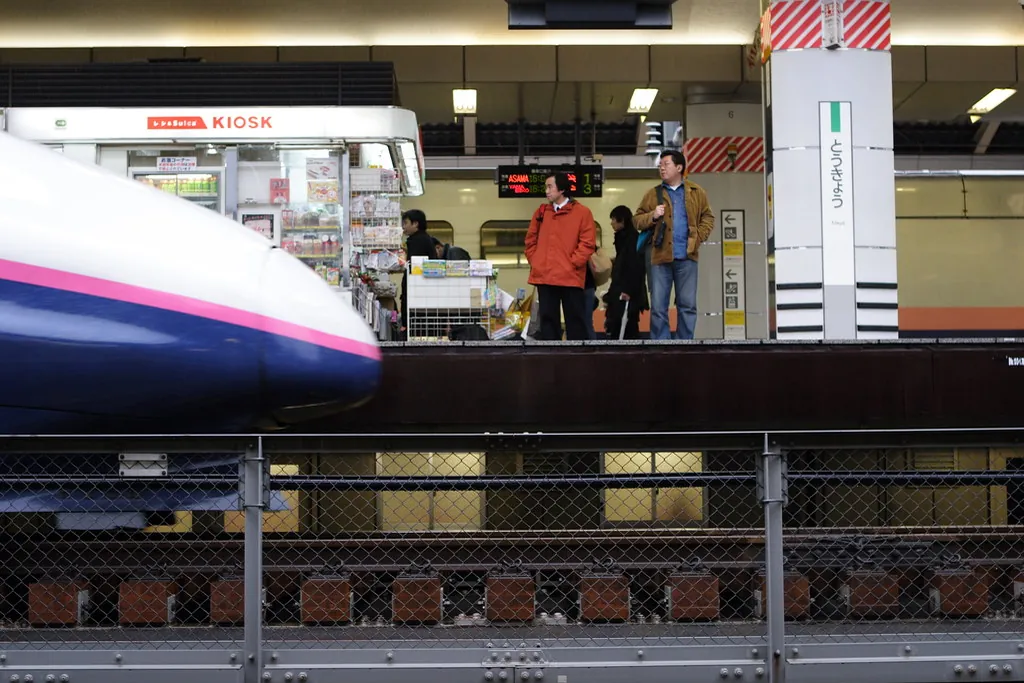
A Shinkansen at Tokyo Station, as in the photo, is often the first ride on a new pass. You can sit in any ordinary car on most Shinkansen, but not on the NOZOMI or MIZUHO, even in non-reserved seats. Those two trains need a separate ticket sold only to pass holders.
JR Pass exchange offices at airports and big stations
The Japan Rail Pass exchange locations page lists every counter in Japan. It has two columns: picking up passes bought online, and exchanging an order for a pass. Only counters marked for the second column take your order. The reserved seat ticket machines with a passport reader do not exchange orders at all. They only release passes bought online.
| Place | Counter | Hours |
|---|---|---|
| Narita Airport Terminal 1 | Ticket Office | 6:30-8:30, 19:00-21:45 |
| Narita Airport Terminal 2 and 3 | Ticket Office | 6:30-8:30, 20:00-21:45 |
| Haneda Airport Terminal 2 Station | Tourist Information Center (Welcome Center) | 6:00-22:00 |
| Kansai Airport | Ticket Office | 5:30-23:00 |
| Tokyo Station | JR-CENTRAL Ticket Office (Yaesu Central, Yaesu North) | 8:30-19:00 |
| Tokyo Station | JAPAN RAIL CAFE | 9:00-16:00 |
| Shin-Osaka Station | Travel Service Center SHIN-OSAKA | 8:00-22:00 |
| Kyoto Station | Ticket Office (JR-WEST Central) | 6:30-21:00 |
| New Chitose Airport | JR Information Desk | 8:30-19:00 |
| Hakata Station | JR-KYUSHU Ticket Office | 7:00-22:00 |
The table above covers the counters most visitors pass on arrival. Hours are the same on weekdays and weekends unless the table says otherwise.
Narita Airport
At Narita Airport, each terminal station has a JR EAST Travel Service Center and a ticket office. The Terminal 1 ticket office opens 6:30-8:30 and 19:00-21:45. The Terminal 2 and 3 ticket office opens 6:30-8:30 and 20:00-21:45. JR East posts the Travel Service Center hours on its own page. The passport-reader machines run 6:30-21:45, but again, only for online purchases.
Once you hold the pass, the Narita Express is a JR limited express, so the pass covers it. It reaches Tokyo Station in 53 minutes; the normal fare is 3,140 yen. See Narita Airport to Tokyo Station for buses and other options.
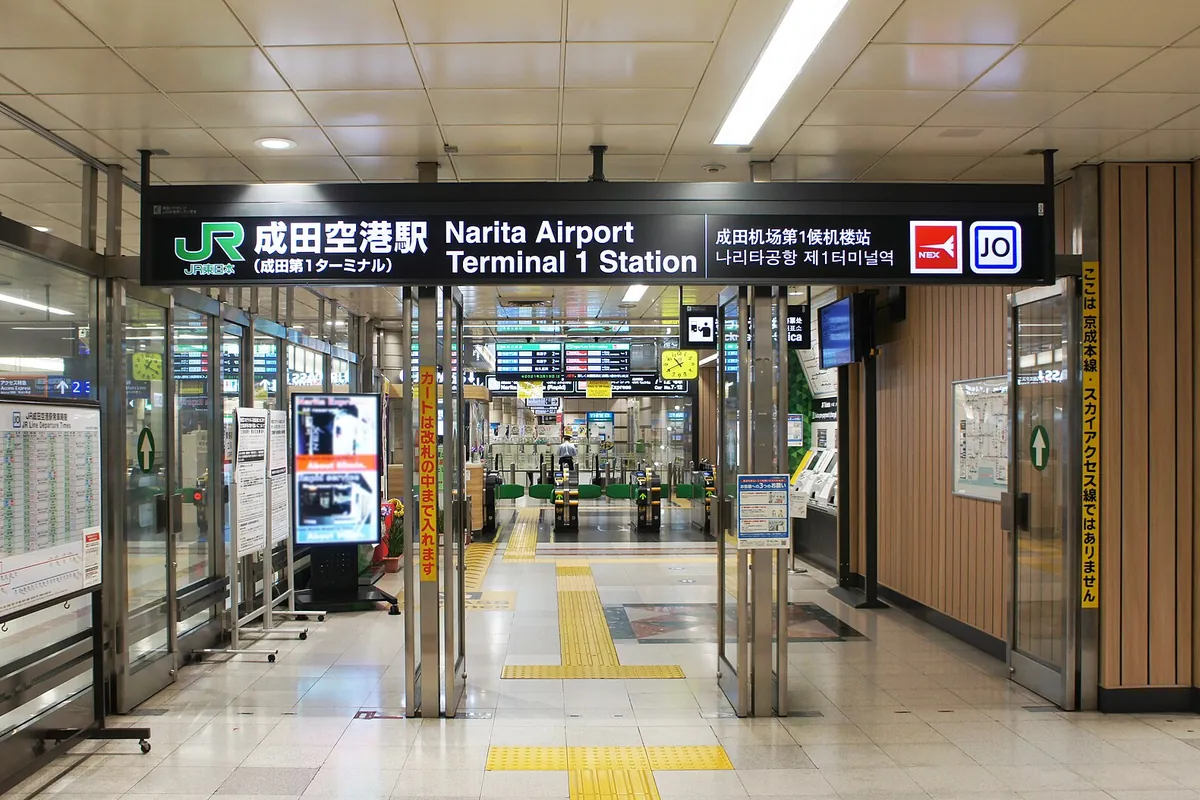
The photo shows the JR station area at Narita. Both terminal stations have a ticket office that takes exchange orders.
Haneda Airport
At Haneda Airport, the Tourist Information Center at the Terminal 2 Station (Welcome Center) exchanges orders from 6:00 to 22:00. The Terminal 3 Station has a JR EAST Travel Service Center at the Tokyo Monorail 2F ticket gate, on the arrival lobby side. The Terminal 3 passport-reader machines run 6:45-20:00 for online pickups only. The pass covers the Tokyo Monorail, so you can ride it into the city right after the exchange.
Kansai Airport
The Kansai Airport ticket office has the longest hours of the big airports: 5:30-23:00. From there the JR Haruka limited express runs to Shin-Osaka in 50 minutes (1,800 yen without a pass). It reaches Kyoto in 75 minutes (2,200 yen).
Tokyo, Osaka and Kyoto stations
Tokyo Station has several counters. The JR-CENTRAL Ticket Offices at Yaesu Central and Yaesu North open 8:30-19:00. JAPAN RAIL CAFE opens 9:00-16:00. The JR Tokai Tours Tokyo Office opens 9:00-19:00 on weekdays and 9:00-18:00 on weekends and holidays.
In the Kansai area, Travel Service Center SHIN-OSAKA opens 8:00-22:00, and two Shin-Osaka ticket offices open 6:00-22:00. The Osaka Station central ticket office also opens 6:00-22:00. At Kyoto Station, the JR-WEST Central ticket office opens 6:30-21:00. Its overseas customer counter, open 8:00-20:00, also handles exchanges.
Flying into Chubu Centrair near Nagoya? The Central Japan Travel Center at the airport exchanges orders from 9:00 to 19:00. The airport has no JR station, though. The pass does not cover the trip from the airport to the nearest JR stations, so pay that leg separately.
Landing late, and the New Year break
If your flight lands after the counters close, buy a normal ticket into the city for that night. Then exchange the order at a city station the next morning, before your first long ride.
Plan ahead around the New Year holidays in Japan. JR warns that some Travel Service Centers close over the year-end and New Year period. Some overseas agents also close, so buy your order before the break.
What to bring and how the exchange works
Bring two things: the original exchange order and the user’s own passport. A photo of the voucher or a copy will not do. If you lose the order or someone steals it, JR cannot issue a pass.
Run through the checklist above before you join the queue. The passport must show a Temporary Visitor stamp or sticker from your arrival. The Japan Rail Pass conditions for use state that JR registers your passport details to the pass. Only that person may use it, and the user has to complete the exchange at the ticket office.
The exchange itself takes a few steps:
- Find a counter on the exchange list that takes exchange orders. At most JR stations this is the ticket office, called みどりの窓口 (Midori-no-madoguchi), or a Travel Service Center.
- Hand over the exchange order and your passport. The clerk checks the Temporary Visitor status and the issue date.
- Tell the clerk your start date. It can be any day within one month of the exchange.
- Check the pass you receive: your name, the pass type and the period of use.
- Book seats right away if you know your trains. Reserved seats cost nothing extra with the pass.
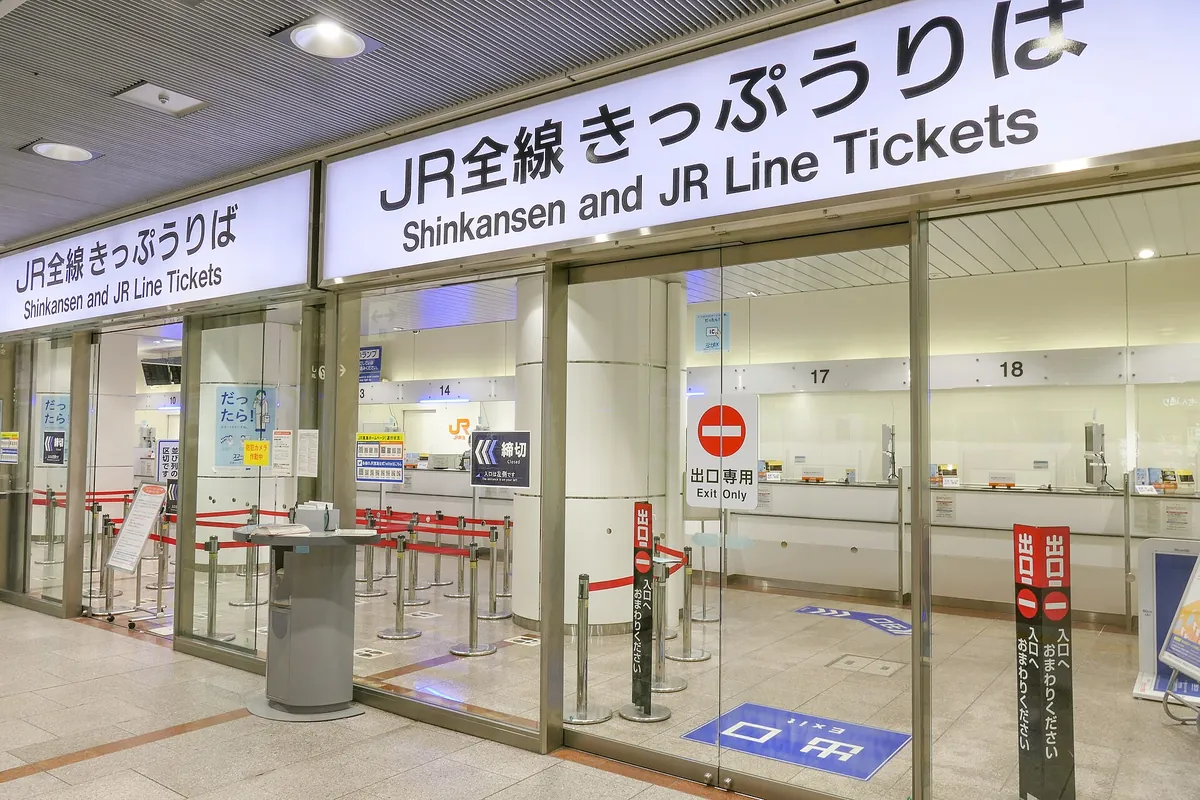
A JR ticket office like the one in the photo can also issue your reserved-seat tickets once the pass is in hand. So can the reserved seat ticket machines and the Travel Service Centers. The pass alone does not guarantee a seat, and some trains have no non-reserved cars at all.
On the day you ride, put the pass through the automatic gate, or show it at the staffed gate. The attendant there stamps it. Carry your passport at all times while you use the pass. Station staff and conductors can ask to see it.
For short city hops, many visitors also carry an IC card. Our comparison of the JR Pass and Suica shows which trips each one suits.
Lost, expired or plans changed: refunds
Where you get money back depends on whether you have exchanged the order yet. The overseas purchase page and the conditions for use split the cases this way.
Here is each one in more detail.
- Trip cancelled, order not exchanged: Return the order to the overseas agency where you bought it. That agency sets its own handling fee, so ask them about it.
- Pass exchanged but not used: Apply at an exchange office in Japan before the start date. JR keeps 10% of the yen sales price per pass. Cancel any reserved-seat tickets first.
- Pass already in use: No refund and no extension, even if storms or disasters stop the trains.
- Order or pass lost: A lost order cannot be exchanged, and JR cannot reissue a lost or stolen pass.
If you miss the 3-month deadline, counters will not exchange the order. Contact the agent who sold it. The agency handles any refund for an order that never became a pass.
Online purchases work differently. Before pickup, you cancel on the JAPAN RAIL PASS Reservation site until 11:30 p.m. Japan time on the day before the start date. After pickup, you apply at a ticket office and show the credit card you paid with. Either way, the fee is 560 yen per pass.
JR Pass exchange order FAQ
How long is a JR Pass exchange order valid?
You must exchange it within three months of the issue date printed on the order. You can exchange it from one month before the date you start using the pass. An order issued on April 15 has to be exchanged by July 14.
Can I exchange my JR Pass exchange order at the airport when I land late?
Yes, if a counter is still open. The Kansai Airport ticket office exchanges orders until 23:00 and the Haneda Terminal 2 Welcome Center until 22:00. The Narita Terminal 1 ticket office closes at 21:45. If you land after that, buy a normal ticket and exchange the order in the city the next day.
Can someone else exchange the order for me?
No. JR registers the user’s passport details to the pass, and the user has to exchange it at the ticket office. Each traveller brings their own passport with the Temporary Visitor status. The pass cannot pass to another person afterwards either.
Can I get a refund if I never exchange the order?
Yes, but only from the overseas agency that sold it, not from JR in Japan. The agency charges its own handling fee. Once you exchange the order, JR refunds an unused pass before its start date and keeps 10% of the sales price.
About the author



.jpg)
.jpg)

