JR Pass Green vs Ordinary: Who Should Buy the Green Pass?
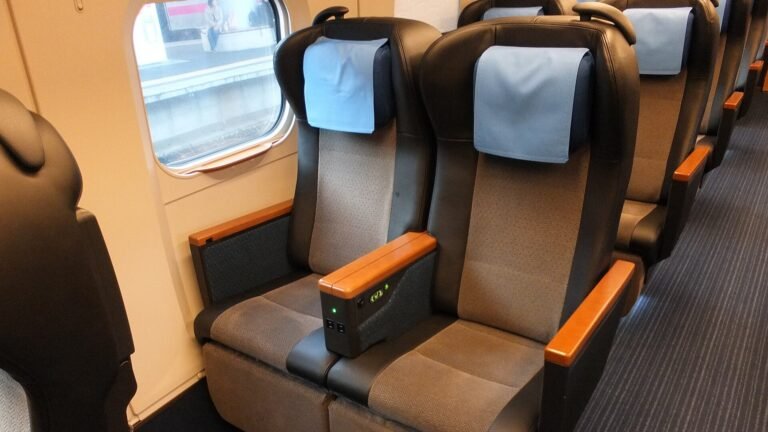
The Green pass suits travellers who take many long Shinkansen rides on lines where the covered trains carry Green Cars. Want a Green Car on just one or two trips? Buy the Ordinary pass and pay the Green Car charge on those trips.
Green and Ordinary passes side by side
The table below puts the two passes next to each other. Prices are for adults on the official website unless the row says otherwise. Every row comes from JR’s own pages and our Japan Rail Pass database page.
| Item | Green pass | Ordinary pass |
|---|---|---|
| 7 days, adult | 70,000 yen | 50,000 yen |
| 14 days, adult | 110,000 yen | 80,000 yen |
| 21 days, adult | 140,000 yen | 100,000 yen |
| 7 days, adult, overseas agent | 74,000 yen | 53,000 yen |
| 7 days, child (6 to 11) | 35,000 yen | 25,000 yen |
| Cars covered | Green and ordinary cars | Ordinary cars only |
| Sitting in a Green Car | No extra charge | Green Car charge + express charge |
| Nozomi Green Car with NOZOMI MIZUHO Ticket | Yes | No |
| GranClass | Basic fare only | Basic fare only |
| Refund before the first day | 560 yen fee | 560 yen fee |
Both passes come in 7, 14 and 21-day versions. Children aged 6 to 11 pay half the adult price. A child’s 7-day Green pass costs 35,000 yen, and a child’s Ordinary pass 25,000 yen. A 12-year-old counts as an adult.
The JAPAN RAIL PASS Green Car and ordinary car page sets out the core rule. With a Green Car pass you can use both ordinary and Green cars without paying additional fees. With an Ordinary Car pass you ride ordinary cars at no extra cost. Sitting in a Green Car on an Ordinary pass costs extra. The JAPAN RAIL PASS conditions for use say you pay the Green Car charge plus the limited or regular express charge.
The refund rules match. You can get a refund only before the first day of use, for a fee of 560 yen per pass. A pass from an overseas Exchange Order carries a 10% fee instead. Neither pass can be reissued if you lose it.
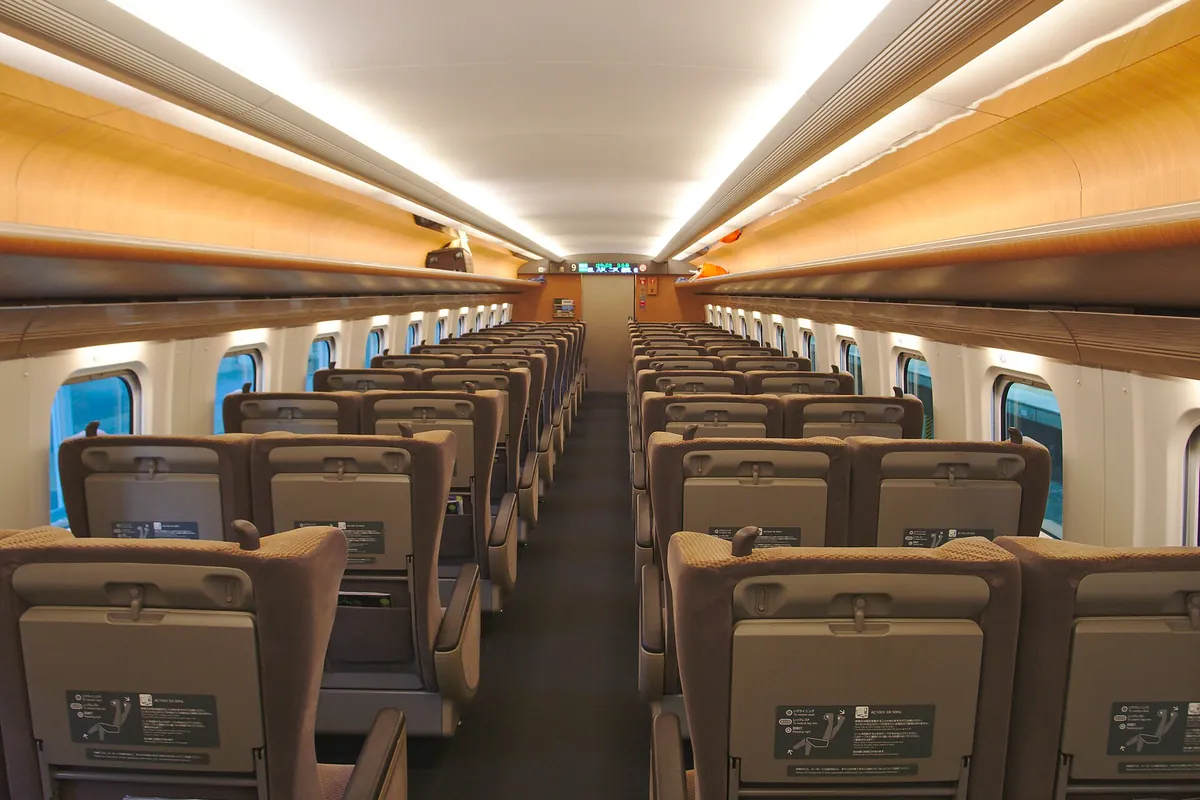
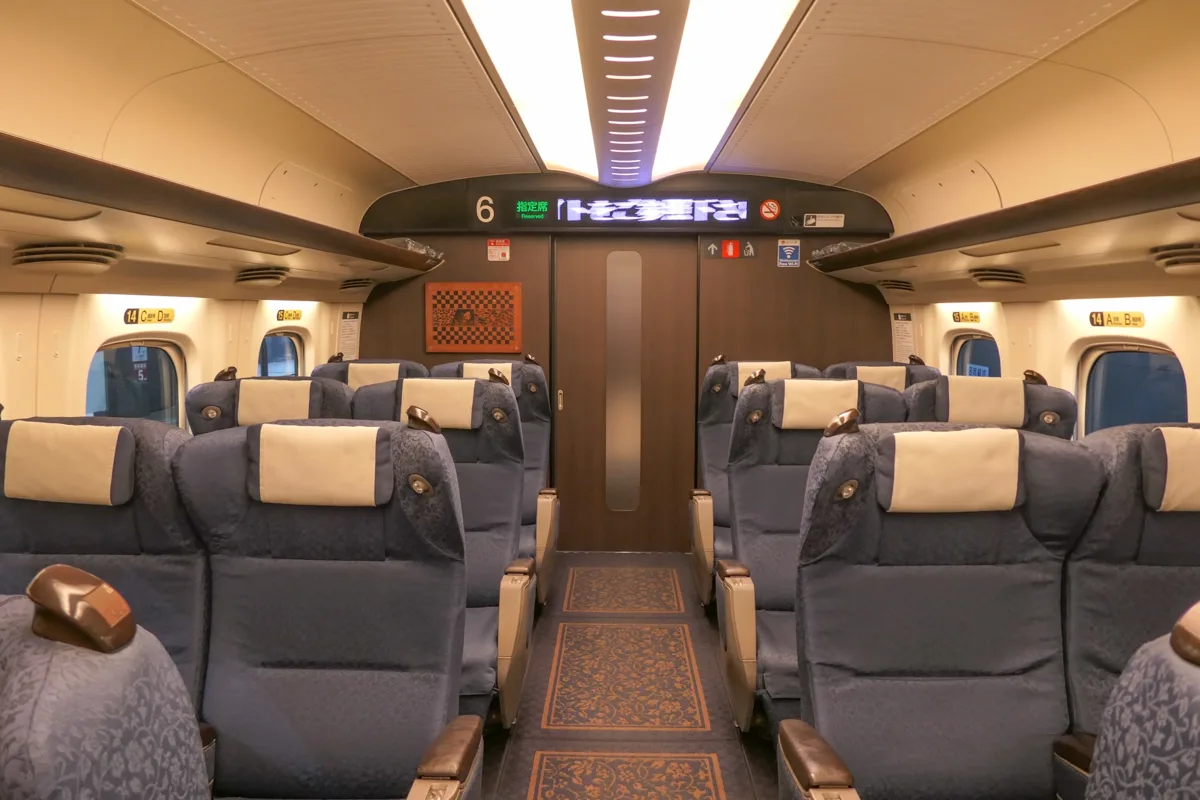
What does the extra money buy? On the Tokaido Shinkansen the Green Cars are cars 8 to 10. On the N700S train, a Green seat is 480 mm wide. Ordinary A and C seats are 440 mm, and the middle B seat is 460 mm. The JR Central Tokaido Shinkansen seats and facilities page says N700A trains have outlets at every Green Car seat. In their ordinary cars, outlets sit only at window seats and in the front and back rows.
The photo below shows a Shinkansen Green Car, with seats wider than those in an ordinary car.
Our Shinkansen Green Car vs Ordinary guide covers seat sizes, legroom and features car by car. This article sticks to the pass itself.
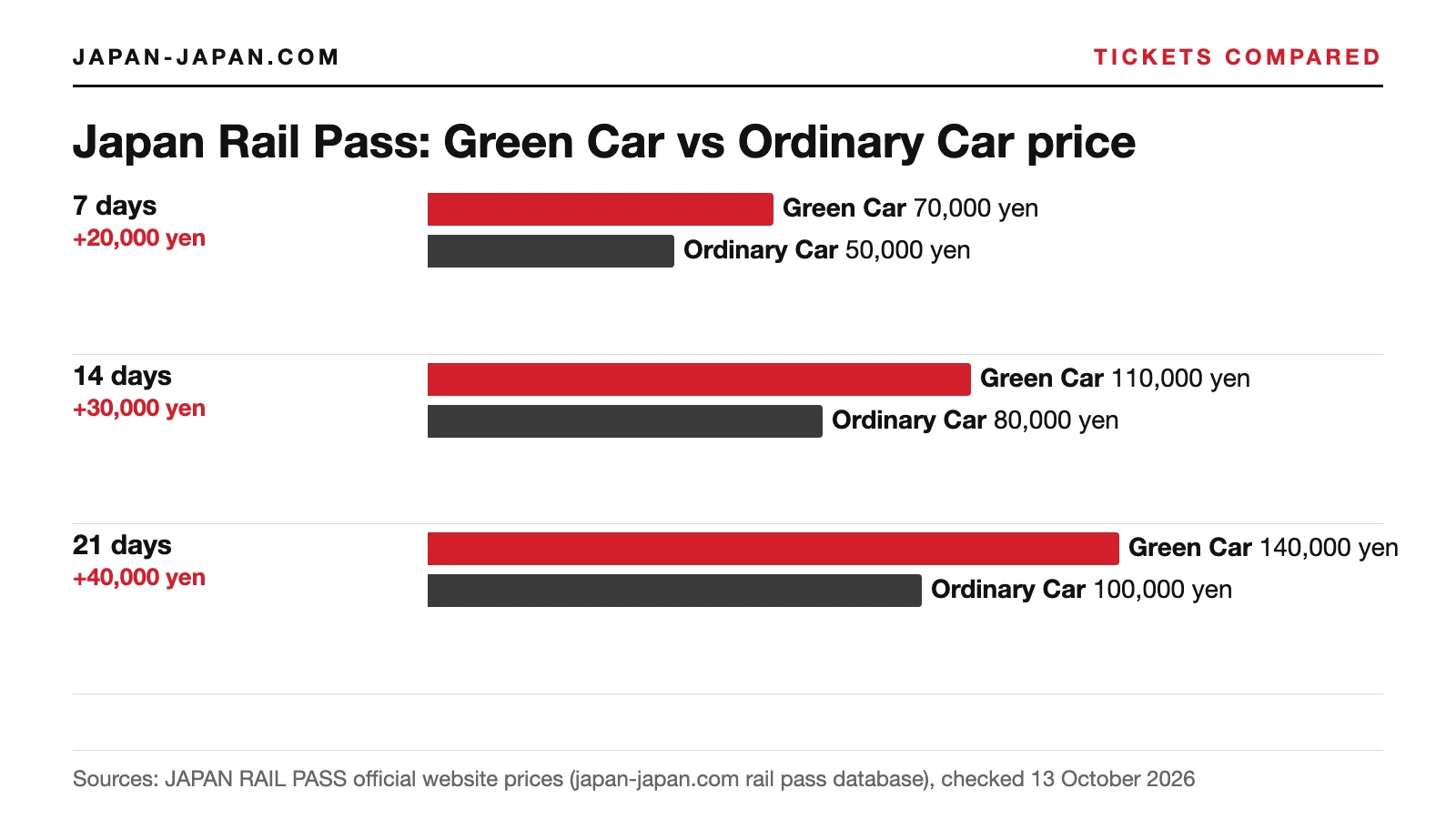
The price gap for 7, 14 and 21 days
On the official website, the Green pass costs 20,000 yen more for 7 days. The gap is 30,000 yen for 14 days and 40,000 yen for 21 days. That is 40%, 38% and 40% above the Ordinary pass. Spread over the days of the pass, the adult upgrade works out to 2,857 yen a day on the 7-day pass.
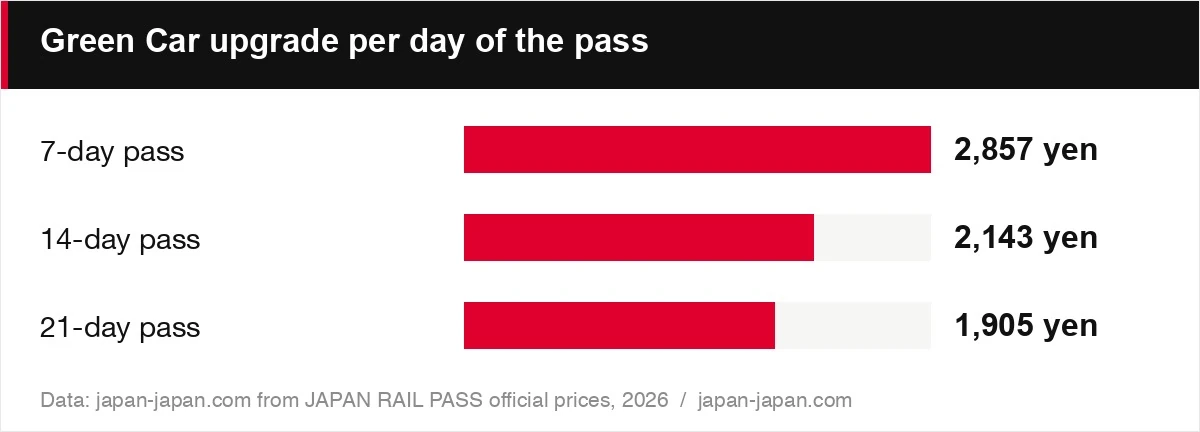
| Item | Value | Note |
|---|---|---|
| 7-day pass | 2857 yen | 20,000 yen gap |
| 14-day pass | 2143 yen | 30,000 yen gap |
| 21-day pass | 1905 yen | 40,000 yen gap |
The chart shows the daily cost falling as the pass gets longer. The 14-day upgrade comes to 2,143 yen a day, and the 21-day upgrade to 1,905 yen a day. If you stay three weeks and ride often, each Green Car day costs you less.
Overseas travel agents charge more for both types, and the gap is wider. From an agent, the 7-day pass costs 74,000 yen for Green and 53,000 yen for Ordinary, a difference of 21,000 yen. For 14 days it is 116,000 yen against 84,000 yen, a difference of 32,000 yen. For 21 days it is 147,000 yen against 105,000 yen, a difference of 42,000 yen.
For children the gap is half the adult one on the official website. A child pays 10,000 yen more for a 7-day Green pass, 15,000 yen more for 14 days and 20,000 yen more for 21 days.
Prices changed this autumn. On 9 April 2026 JR announced higher overseas-agency prices for purchases made on or after 1 October 2026. The 7-day Ordinary pass from an agent went from 50,000 yen to 53,000 yen. The JAPAN RAIL PASS notice on price changes says online prices stay frozen for a limited time. JR will announce the end of that freeze once it decides.
So today, buying on the official website is cheaper for both types. Online buyers also get to book seats on the JAPAN RAIL PASS Reservation website, which we cover below.
Green pass vs paying Green Car fares per trip
How much would a Green Car cost without any pass? From Tokyo to Shin-Osaka on the Nozomi, a Green Car seat costs 19,590 yen one way in the regular season. An ordinary reserved seat costs 14,720 yen, so the Green Car costs 4,870 yen more, or 33%. On the Hikari, the same trip costs 19,270 yen in the Green Car against 14,400 yen for a reserved seat. That is again 4,870 yen more.
The Green Car fares come from the seat guide of JR Tokai Tours, a JR Central group company. The reserved-seat fares come from our Tokyo to Osaka route page, which uses JR’s own search for Wednesday 14 October 2026.
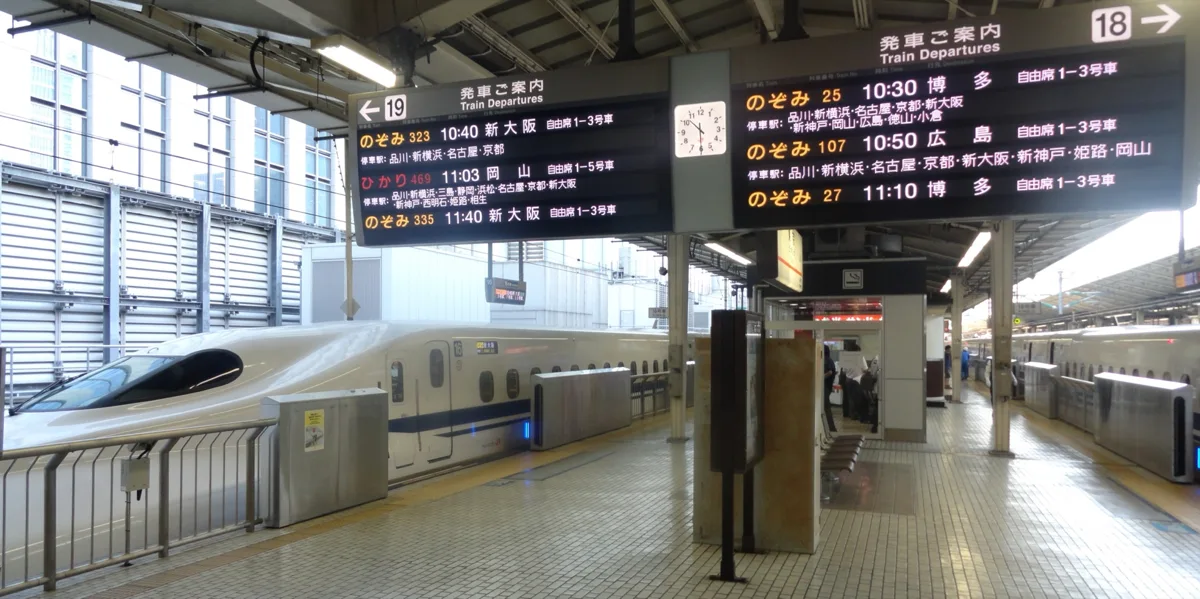
Most of these trips start at Tokyo Station, where Tokaido Shinkansen trains leave for Kyoto and Shin-Osaka, as in the photo below.
A Green Car fare has three parts: the basic fare, the limited express charge and the Green Car charge. Take Tokyo to Kyoto on the Nozomi. The reserved-seat fare is 14,170 yen. On a Green Car the limited express charge drops by 530 yen, and you add the 5,400 yen Green Car charge. That gives 19,040 yen, which is 4,870 yen more than the reserved seat. Smart EX members pay 18,840 yen for the same Green Car seat.
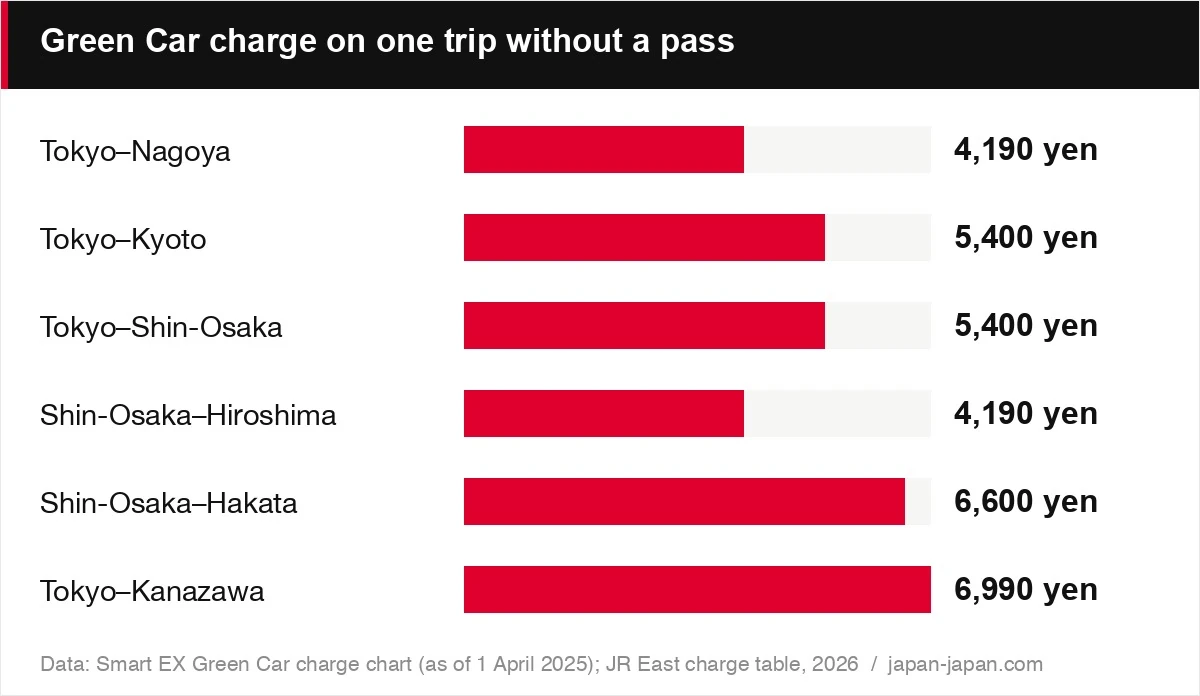
The Green Car charge itself depends on distance. The Smart EX Green Car charge chart lists 4,190 yen for Tokyo to Nagoya. Tokyo to Kyoto and Tokyo to Shin-Osaka are both 5,400 yen. Shin-Osaka to Hiroshima is 4,190 yen, and Shin-Osaka to Hakata is 6,600 yen. On the Hokuriku Shinkansen, the JR East Green Car and GranClass charge table lists 6,990 yen from Tokyo to Kanazawa.
| Item | Value | Note |
|---|---|---|
| Tokyo–Nagoya | 4190 yen | |
| Tokyo–Kyoto | 5400 yen | |
| Tokyo–Shin-Osaka | 5400 yen | |
| Shin-Osaka–Hiroshima | 4190 yen | |
| Shin-Osaka–Hakata | 6600 yen | |
| Tokyo–Kanazawa | 6990 yen | Hokuriku Shinkansen |
The chart compares these one-trip Green Car charges. Adults and children pay the same Green Car charge, and JR East’s table says so in plain terms. That matters for families: the child pass costs half, but a child’s per-trip Green Car charge does not.
Smart EX prices also move with the season. The Smart EX Green Car and reserved seat options page lists the changes for one adult. Prices drop 200 yen in the off-peak season, rise 200 yen in the peak season and rise 400 yen in the top season.
Whether any pass pays off is a separate question. A Tokyo to Kyoto round trip with reserved seats costs 28,340 yen, which is 21,660 yen less than the 7-day Ordinary pass. Our Tokyo to Kyoto route page lists the fares, and Is the JR Pass worth it? works through the common routes.
What the Green pass covers, and what it does not
A Green pass covers Green Cars on JR Shinkansen, limited express, express, rapid and local trains. On the Shinkansen, that means the Hikari, Sakura, Kodama and Tsubame on the Tokaido, Sanyo and Kyushu lines. It also means all trains on the Tohoku, Yamagata, Akita, Hokkaido, Joetsu, Hokuriku and Nishi Kyushu Shinkansen.
Local trains count too. Around Tokyo, an Ordinary pass holder who sits in a local-train Green Car pays a separate charge. JR East’s table lists it at 750 yen up to 50 km when stored on a Suica, or 1,010 yen as a paper ticket. A Green pass includes that Green Car.
Some trains have no Green Car at all. The official page names most Hikari and Kodama trains on the Sanyo Shinkansen between Shin-Osaka and Hakata. It also names some Series 800 Sakura and Tsubame trains on the Kyushu Shinkansen, and all Kamome trains on the Nishi Kyushu Shinkansen. On those trains a Green pass gives you nothing more than an Ordinary pass.
The illustration below draws the line between what the Green pass includes and what still costs extra.
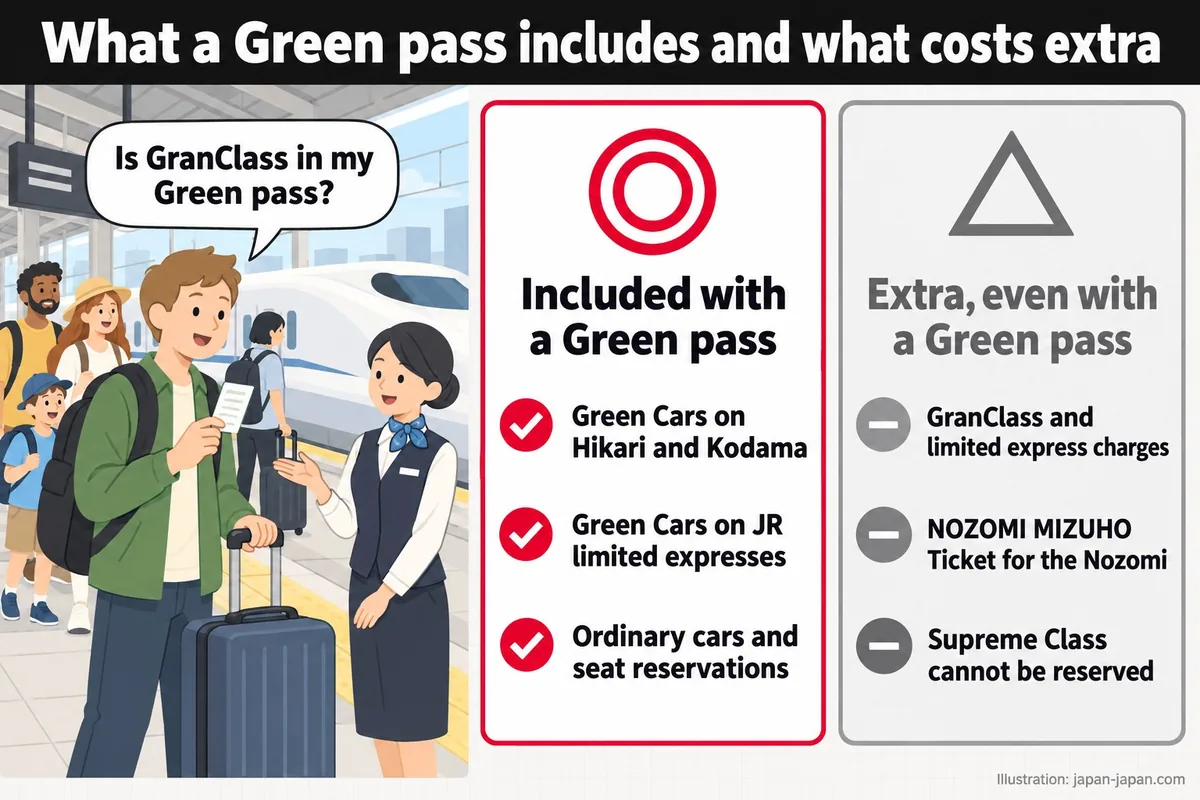
The Nozomi and Mizuho need a separate ticket on either pass. Buy the NOZOMI MIZUHO Ticket for your section before boarding; JR sells it from one month before the day of travel. The price is the same for a Green Car seat, an ordinary reserved seat and a non-reserved seat. It costs 4,960 yen for Tokyo to Shin-Osaka or Tokyo to Kyoto, and 6,500 yen for Tokyo to Hiroshima. Our Tokyo to Hiroshima route page shows how long each train takes.
The pass type decides which car you may use with that ticket. In JR’s table, a Green pass holder with the ticket may use the Green Car (marked ★). An Ordinary pass holder may not (marked ×). Without the ticket, the pass covers the Hikari. The Hikari 707 leaving Tokyo at 10:03 takes 2 h 54 min to Shin-Osaka. The fastest Nozomi takes 2 h 21 min. Our Nozomi vs Hikari comparison weighs the two.
GranClass is the top class on the Tohoku, Hokkaido, Hokuriku and Joetsu Shinkansen. It seats only 18 passengers, and its seats recline up to 45 degrees. Neither pass covers it in full. The pass pays only the basic fare, and you pay the limited express charge and the GranClass charge on top. From Tokyo to Kanazawa the GranClass charge is 17,990 yen on GranClass (A) trains such as the Kagayaki, and 11,190 yen on GranClass (B) trains. Our Tokyo to Kanazawa route page has the train times and the 14,600 yen reserved-seat fare.
The photo below shows GranClass on a Series E7 train, the type that runs on the Hokuriku Shinkansen.
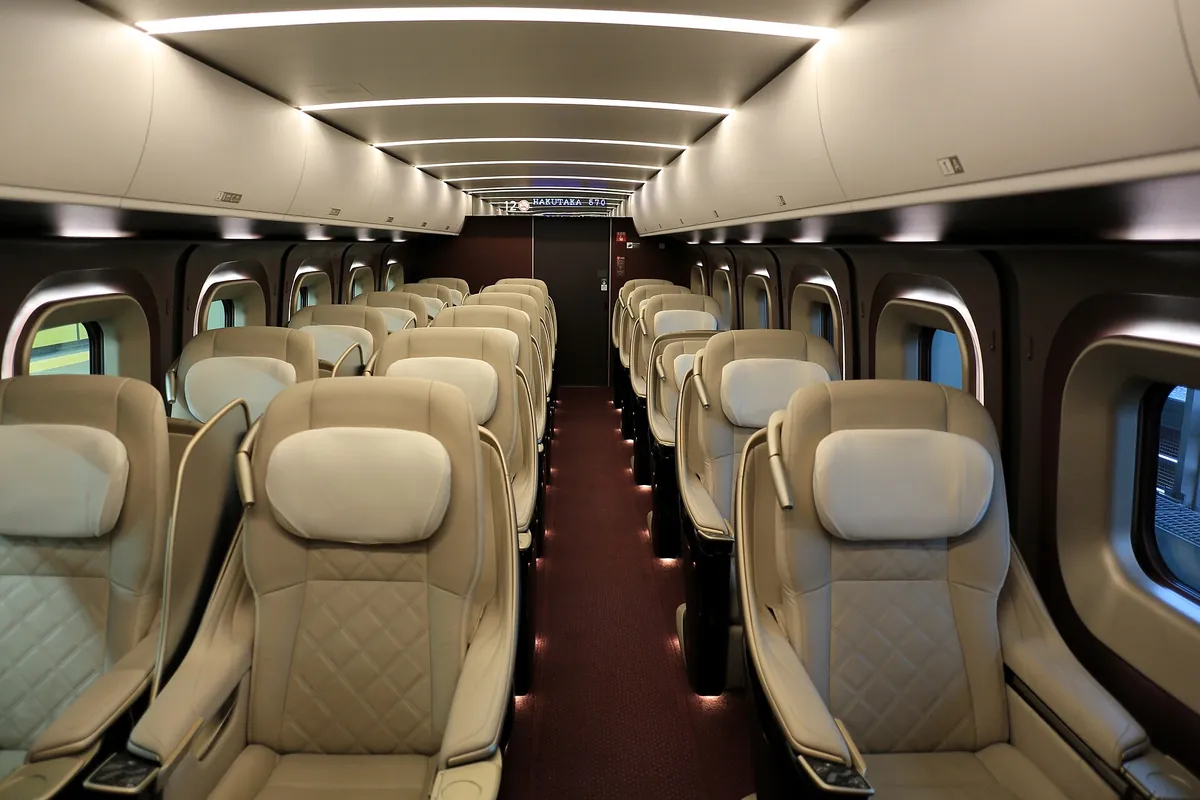
JR Central introduced Supreme Class on 1 October 2026. Its private cabins are in car 7, for up to two guests, and car 10, for one guest. The JR Central Supreme Class page says you need a Smart EX membership to reserve it. A JR Pass cannot reserve Supreme Class. If you want to use it, ask the train staff on board.
A few other premium seats cost extra on both passes. JR East’s Premium Green and JR Kyushu’s DX Green need a separate limited express charge and their own surcharge. Sleeping cars and Green private compartments also need extra charges on either pass.
Booking Green Car seats with the pass
Booking a seat costs nothing extra on either pass. A Green pass lets you pick a Green Car seat. The JAPAN RAIL PASS seat reservation guide gives three ways to book.
- Reserved seat ticket machine: book and print the seat ticket yourself at a JR station, without queuing at the counter.
- Ticket office: show your pass at a JR ticket office or a Travel Service Center.
- Online: if you bought the pass on the official website, book on JAPAN RAIL PASS Reservation. Then pick up the seat ticket at a machine or ticket office.
At the machine, the steps run in the order shown in the illustration below.
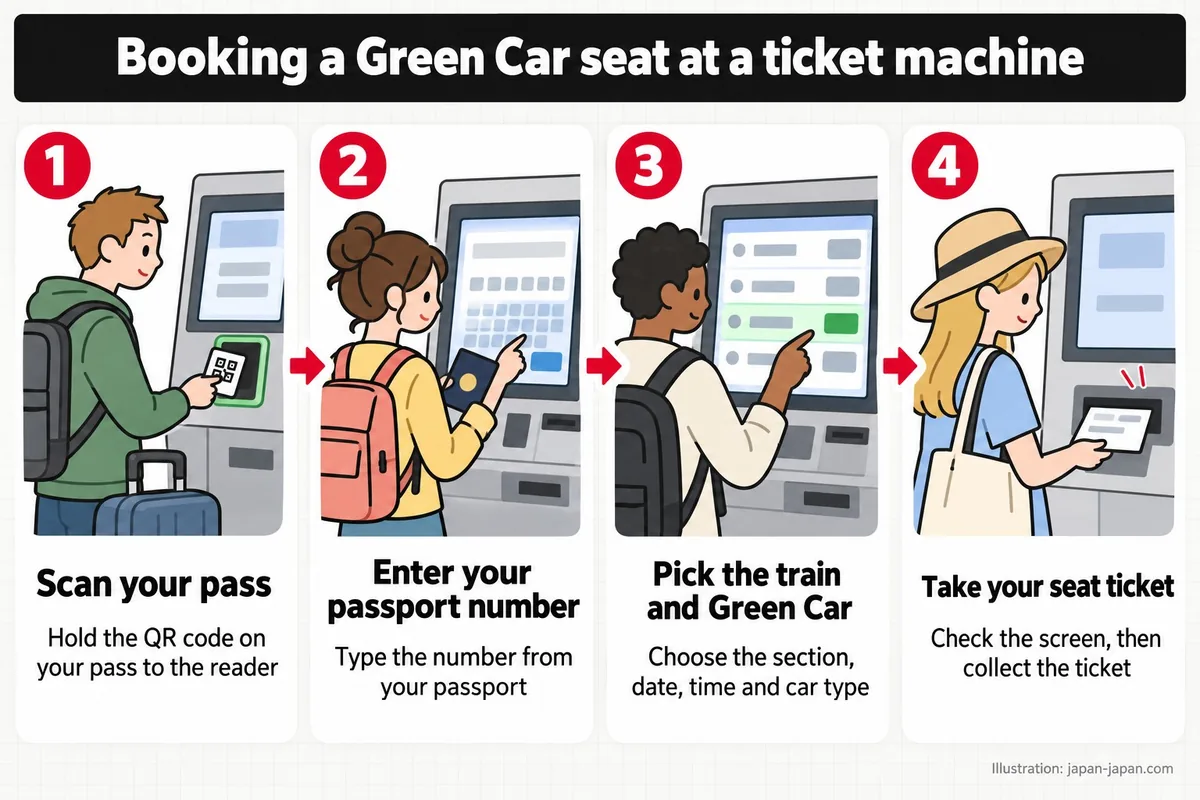
First, scan the QR code on your pass with the reader, or type the reservation number printed on it. Next, enter your passport number. Then enter the section, date and time, and pick the train and the car type. Choose the Green Car if you hold a Green pass. Check the screen and issue the ticket.
At a staffed counter, look for みどりの窓口 (Midori-no-madoguchi), which means the JR ticket office. Ticket offices and machines run from 4:00 a.m. to 11:30 p.m. at most, and hours vary by station. Some stations have no machine, and unmanned stations cannot book seats at all.
A JR ticket office or a row of reserved seat ticket machines looks like the photo below.
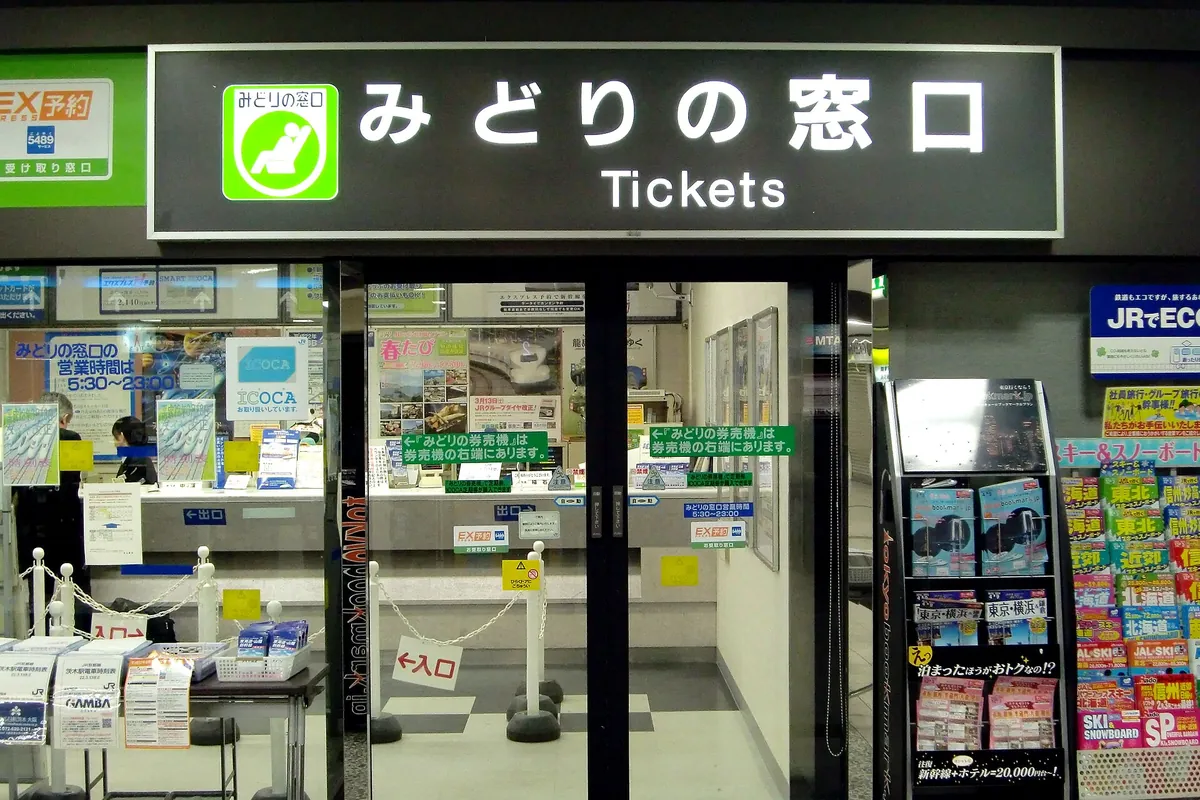
Book early around Japan’s busy travel weeks. JR names 1 to 6 May, 18 to 23 September, 7 to 16 August and 29 December to 3 January as the periods when seats are hardest to get. The year-end break is the busiest of all, and our New Year holiday page shows the dates.
Seat tickets have limits. You cannot hold two seat tickets for overlapping times on the same day. Through JAPAN RAIL PASS Reservation or a ticket machine, one pass can issue seat tickets for up to 110 trains.
Bringing a large suitcase? On the Tokaido, Sanyo and Kyushu Shinkansen, a bag measuring 161 to 250 cm in total needs a seat with an oversized baggage area. These are the last row of ordinary reserved cars and Green Cars, except cars 7 and 11. If you board with an oversized bag and no such seat, you pay a 1,000 yen fee.
Which pass should you buy?
Start with the trains you plan to ride. The seat class matters only where those trains have Green Cars you can use.
- Many Tokaido, Tohoku or Hokuriku Shinkansen rides: the covered trains on these lines carry Green Cars, so the Green pass gets regular use. The upgrade costs 2,857 yen a day on the 7-day pass.
- Mostly Sanyo Hikari or Kodama, or Kyushu and Nishi Kyushu: most Sanyo Hikari and Kodama and all Kamome trains have no Green Car. The Ordinary pass fits better.
- You want GranClass: either pass pays only the basic fare, and you pay the limited express charge and the GranClass charge.
- You plan to ride the Nozomi: only a Green pass plus the NOZOMI MIZUHO Ticket gets you a Nozomi Green Car seat. The ticket costs the same as for an ordinary seat.
- Families with children: the child’s Green pass costs 10,000 yen more for 7 days. A Green Car charge paid per trip costs a child the same as an adult.
- One or two Green Car rides only: buy the Ordinary pass and pay the Green Car charge plus the limited express charge on those rides. From Tokyo to Kyoto the Green Car charge alone is 5,400 yen.
- Three weeks of travel: the 21-day upgrade falls to 1,905 yen a day.
The lookup below matches common trip types to a pass.
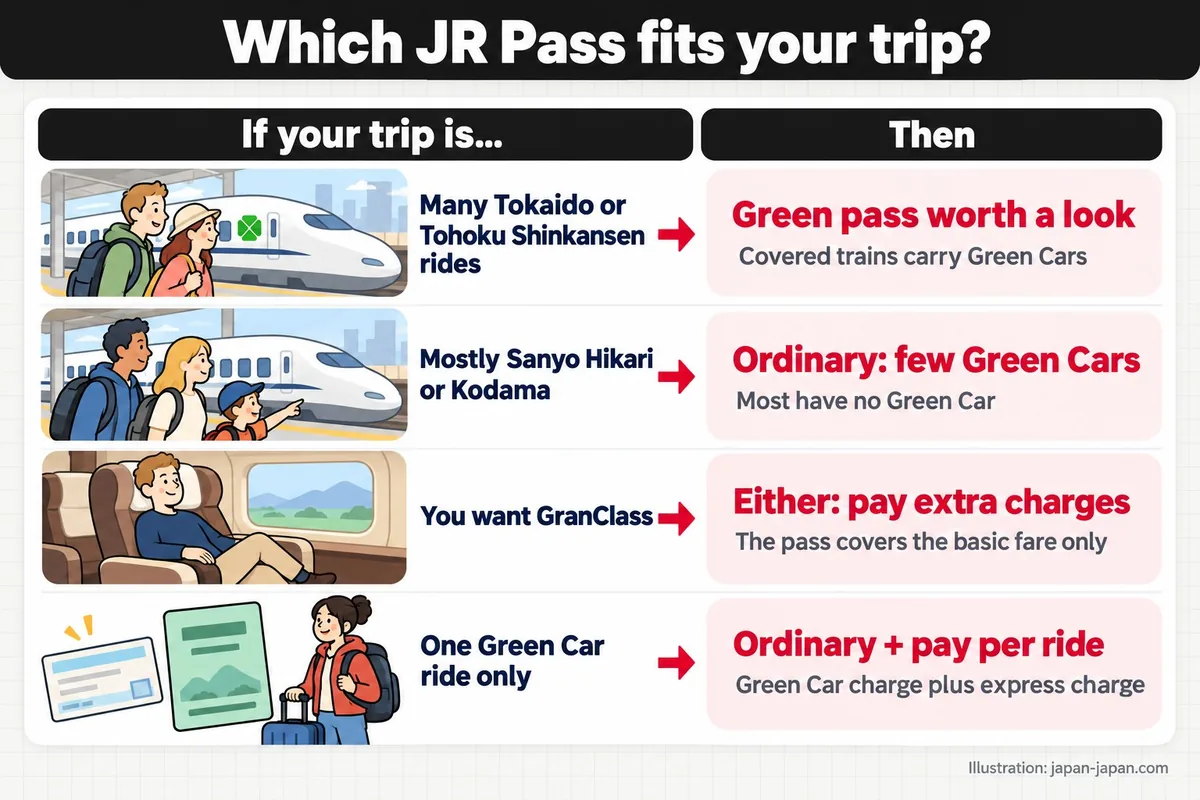
If you are still unsure, list your long rides first. Count the ones on trains with Green Cars, then compare the per-trip charges above with the daily gap for your pass length.
Green or Ordinary pass: what 98 people in Japan would tell a friend
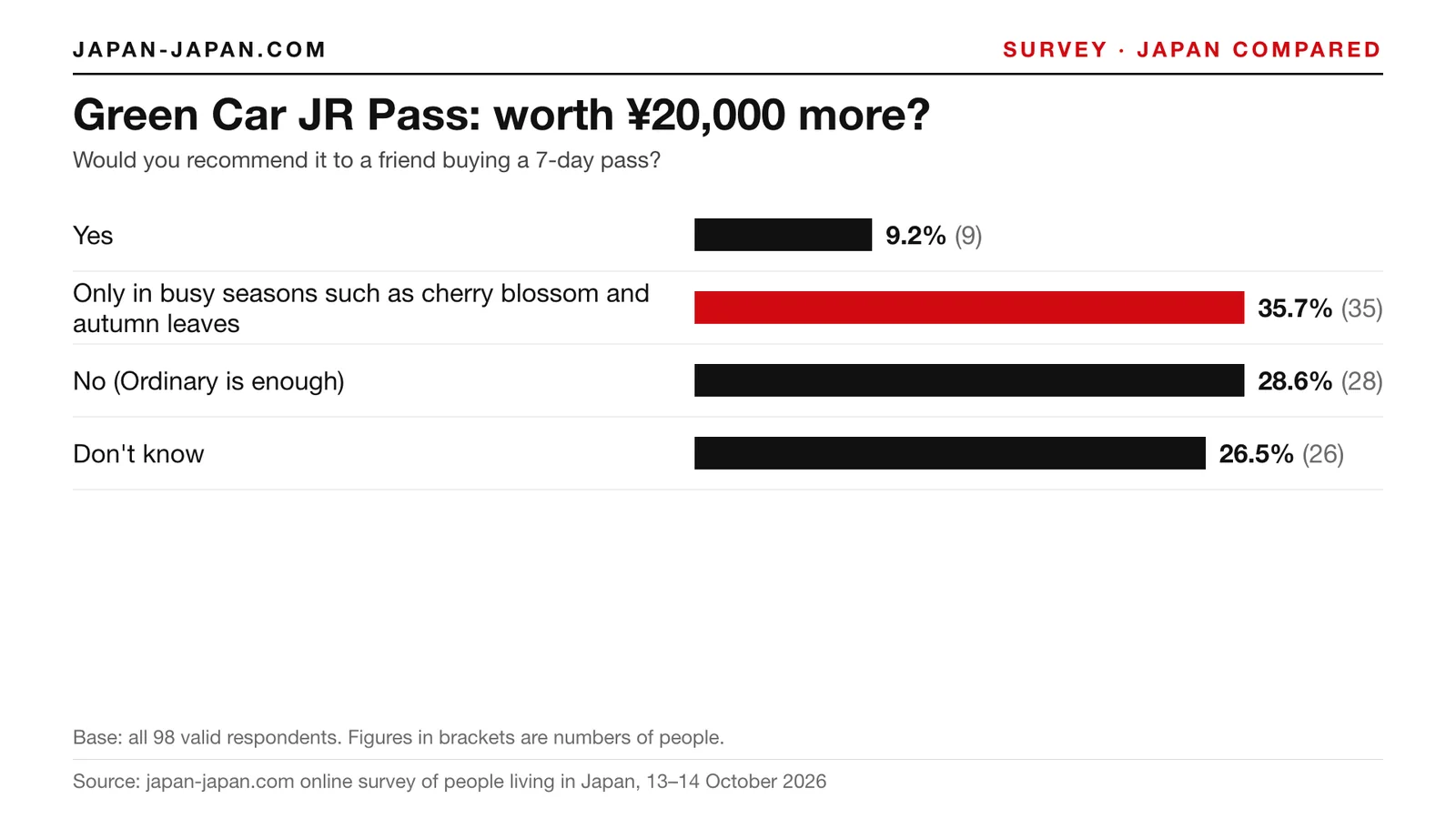
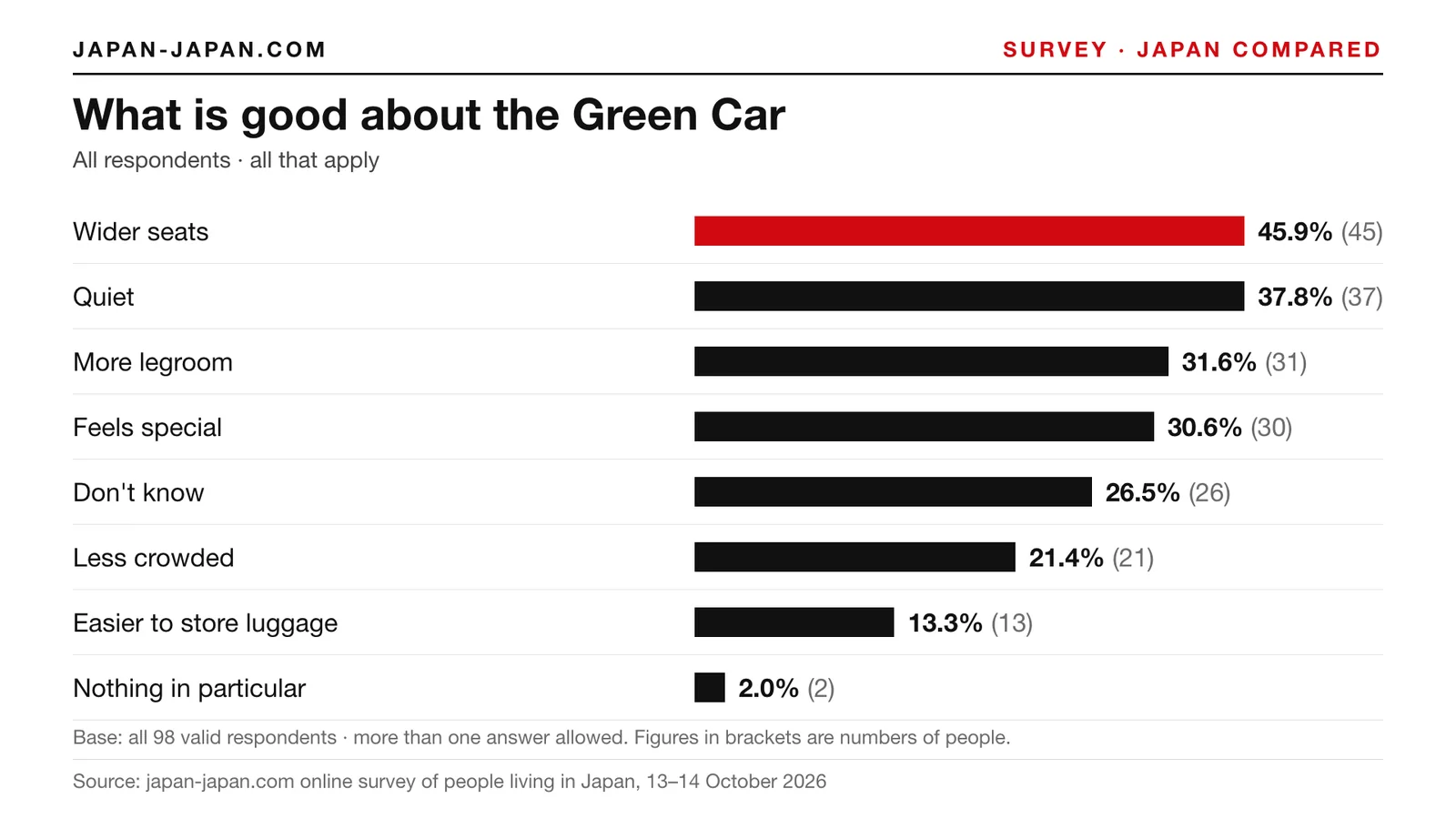
On 13–14 October 2026, japan-japan.com ran an online survey of people living in Japan about 32 travel choices. 130 people answered. We removed answers that looked machine-written, one from outside Japan and most of those that contradicted themselves, which left 98. Shares below are of the 98 respondents unless a smaller group is named; they describe these people, not all travellers in Japan. See all 32 comparisons and how we asked.
We asked what they would tell a friend from abroad buying a 7-day Japan Rail Pass: is the Green Car pass worth ¥20,000 more than the Ordinary pass? 35.7% (35 people) said only in busy seasons such as cherry blossom and autumn leaves, 28.6% (28 people) said no, Ordinary is enough, and 9.2% (9 people) said yes. 26.5% (26 people) did not know.
What they think the Green Car gives you: wider seats (45.9%), a quiet car (37.8%) and more legroom (31.6%).
JR Pass Green vs Ordinary FAQ
Is the Green Car JR Pass worth it?
It depends on how many rides you take in trains with Green Cars. The 7-day Green pass costs 20,000 yen more than Ordinary on the official website, or 2,857 yen a day. It gets the most use on the Tokaido, Tohoku and Hokuriku Shinkansen, and the least on the Sanyo Hikari and Kodama, most of which have no Green Car.
Can I ride a Green Car with an Ordinary Car JR Pass?
Yes, if you pay for it. JR’s conditions for use say you pay the Green Car charge plus the limited or regular express charge. From Tokyo to Kyoto the Green Car charge alone is 5,400 yen.
Does the Green Car JR Pass cover GranClass?
Only the basic fare. With either pass you pay the limited express charge and the GranClass charge for GranClass. From Tokyo to Kanazawa the GranClass charge is 17,990 yen on GranClass (A) trains.
Can I use a Green Car JR Pass on the Nozomi?
Yes, with the NOZOMI MIZUHO Ticket bought before boarding. With it, a Green pass holder can use the Nozomi Green Car, while an Ordinary pass holder cannot. The ticket costs 4,960 yen for Tokyo to Shin-Osaka, the same for every seat type.
About the author