Shinkansen Green Car vs Ordinary: What Does 4,870 Yen Buy?
These are one-way adult prices in the regular season. The Green Car prices come from the JR Tokai Tours Shinkansen seat types guide. JR Tokai Tours is a JR Central group company, and we checked its prices on 13 October 2026. The ordinary reserved prices come from our own route pages, which use JR’s search for Wednesday 14 October 2026.
Both seats ride the same train, at the same speed, to the same platform. You pay for the seat and what comes with it, and you arrive at the same time.
Green Car and ordinary car side by side
The table puts the two classes side by side. It uses the Tokaido Shinkansen between Tokyo and Shin-Osaka. Read it row by row: price first, then where you sit, then what is at your seat.
| Item | Green Car | Ordinary reserved |
|---|---|---|
| Tokyo to Shin-Osaka, Nozomi | 19,590 yen | 14,720 yen |
| Tokyo to Shin-Osaka, Hikari | 19,270 yen | 14,400 yen |
| Cars on the Tokaido Shinkansen | Cars 8 to 10 | Other cars; Nozomi cars 1 and 2 are non-reserved |
| Seat width (N700S) | 480 mm | 440 mm (A, C), 460 mm (B) |
| Outlets on the N700A | Every seat, in the armrest | Window seats and the front and back rows |
| Outlets on the N700S | Every seat | Every seat |
| Seat extras | Reading light, footrest, leg warmer | Seatback table and hook |
| Oversized baggage seats | Last row, book ahead | Last row, book ahead (not cars 7 and 11) |
| Children | Half fare, full Green charge | Half fare and express charge, ages 6 to 11 |
The ordinary car has rows of three seats (A, B and C) and two seats (D and E). JR Tokai Tours notes that the middle B seat is a little wider than the other ordinary seats. The Green Car is in the middle of the train, in cars 8, 9 and 10.
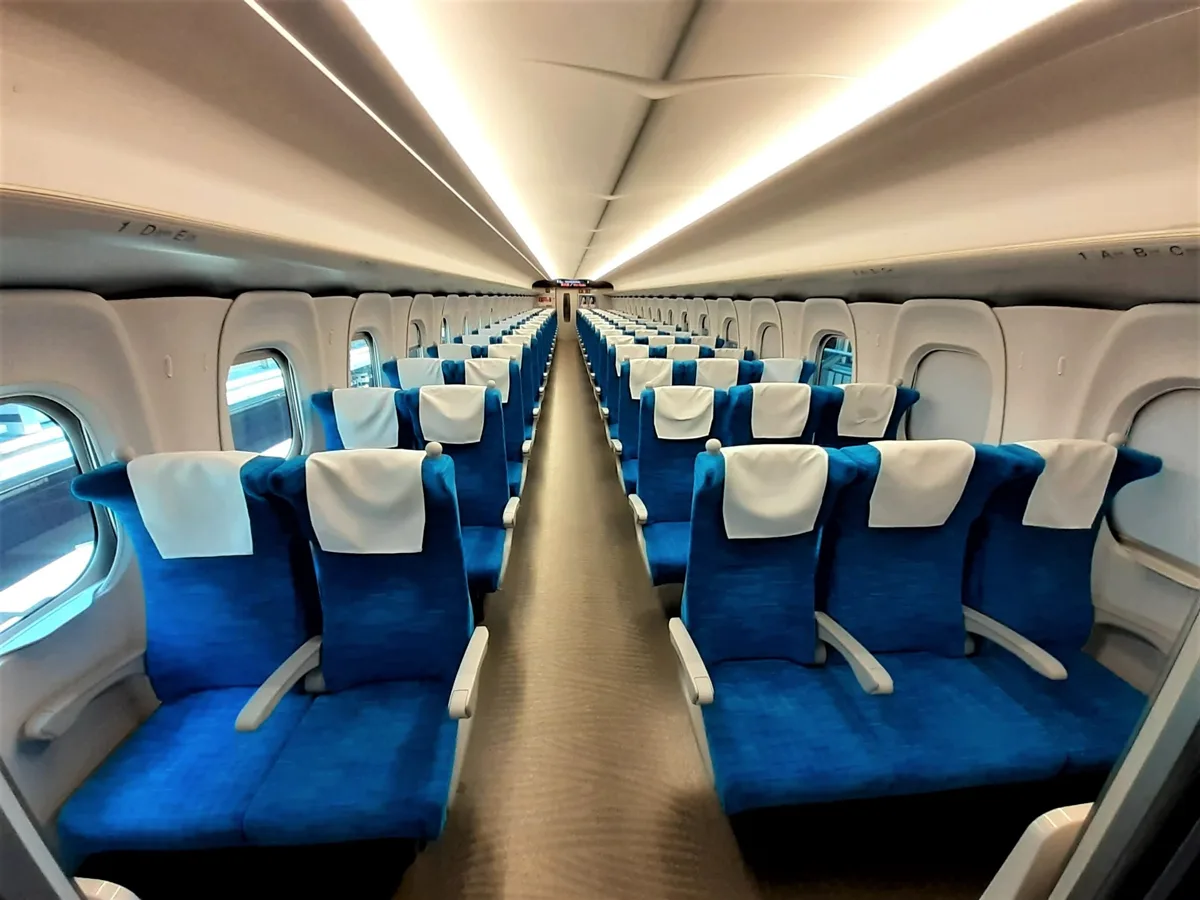
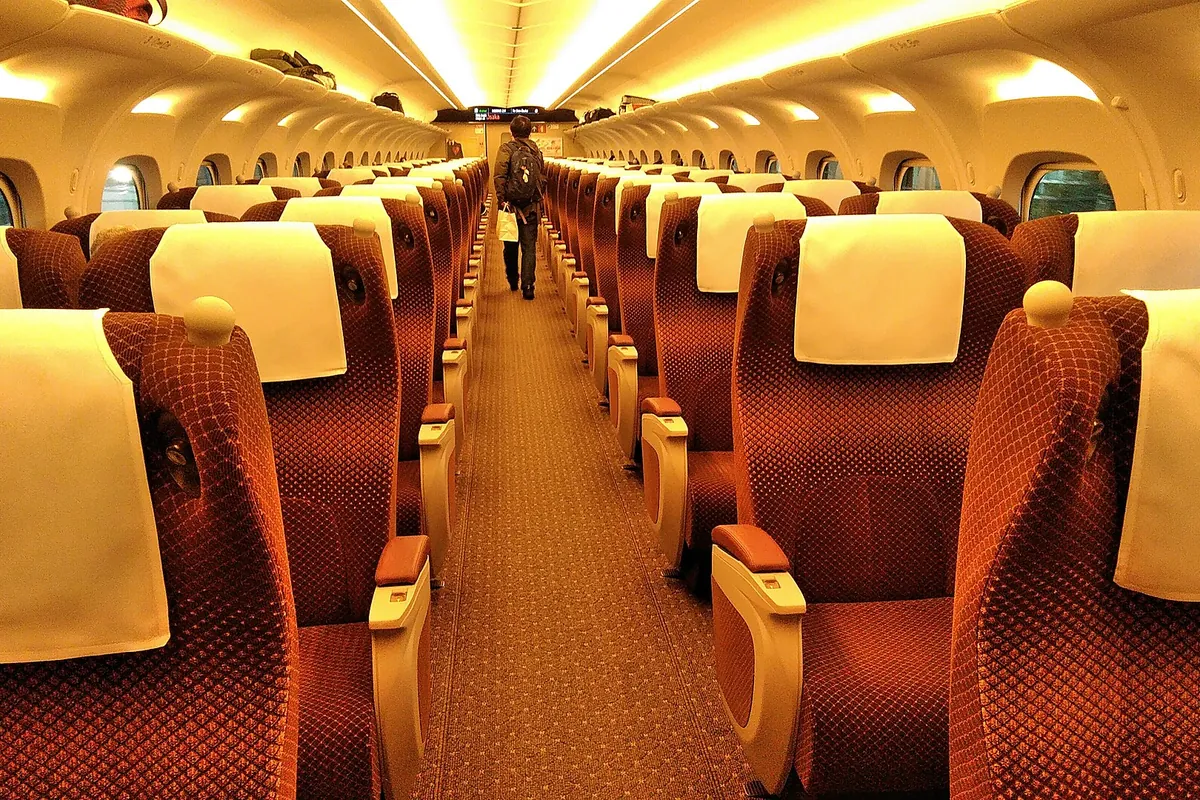
The photo below shows a standard ordinary car on the Tokaido Shinkansen. You can see the block of three seats on one side of the aisle and two on the other.
In the ordinary car you can choose a reserved seat or a non-reserved one. On the Nozomi, the non-reserved cars are cars 1 and 2, and the non-reserved fare from Tokyo to Shin-Osaka is 13,870 yen. If you are weighing those two ordinary options, our guide to Shinkansen reserved vs non-reserved seats covers the trade-off. This article compares the reserved ordinary seat with the Green Car, since that is the real choice for most visitors.
One perk only appears in the Green Car. On the Nozomi and the Hikari, Green Car passengers can order food and drinks from a QR code at the seat. Staff bring the order to them. The trolley service ended in October 2023, so in the ordinary car, buy food before you board.
Shinkansen Green Car vs ordinary price gap on 6 routes
We worked out the Green Car price on 6 routes. Then we set it against the reserved-seat fare on our route pages. All prices are for one adult, one way, in the regular season.
| Route and train | Green Car | Ordinary reserved | Gap |
|---|---|---|---|
| Tokyo to Shin-Osaka, Nozomi | 19,590 yen | 14,720 yen | 4,870 yen (33%) |
| Tokyo to Shin-Osaka, Hikari | 19,270 yen | 14,400 yen | 4,870 yen (34%) |
| Tokyo to Kyoto, Nozomi | 19,040 yen | 14,170 yen | 4,870 yen (34%) |
| Tokyo to Nagoya, Nozomi | 14,960 yen | 11,300 yen | 3,660 yen (32%) |
| Shin-Osaka to Hiroshima, Mizuho | 14,610 yen | 10,950 yen | 3,660 yen (33%) |
| Shin-Osaka to Hakata, Nozomi | 22,090 yen | 16,020 yen | 6,070 yen (38%) |
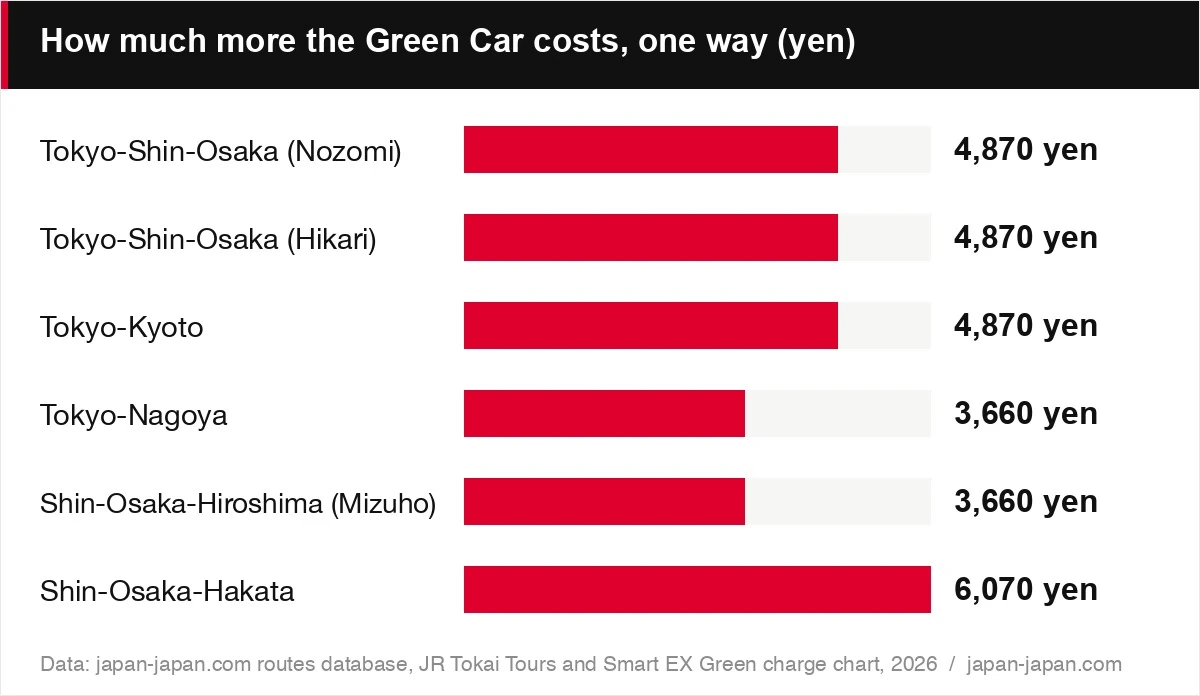
The chart shows only the gap, so you can see how it grows with distance. The longest route, Shin-Osaka to Hakata, has the largest gap at 6,070 yen.
| Item | Value | Note |
|---|---|---|
| Tokyo-Shin-Osaka (Nozomi) | 4870 yen | 33% more |
| Tokyo-Shin-Osaka (Hikari) | 4870 yen | 34% more |
| Tokyo-Kyoto | 4870 yen | 34% more |
| Tokyo-Nagoya | 3660 yen | 32% more |
| Shin-Osaka-Hiroshima (Mizuho) | 3660 yen | 33% more |
| Shin-Osaka-Hakata | 6070 yen | 38% more |
The gap follows a fixed rule. The JR Central ticket rules on Green Car charges set the Green Car’s limited express charge. It is the day’s reserved-seat charge minus 530 yen. You then add a Green charge set by distance. From Tokyo to Kyoto that means 14,170 yen, minus 530 yen, plus a 5,400 yen Green charge, for 19,040 yen.
The same sum works for each route. Tokyo to Nagoya and Shin-Osaka to Hiroshima both use a 4,190 yen Green charge, so both gaps are 3,660 yen. Shin-Osaka to Hakata uses a 6,600 yen Green charge, which gives the 6,070 yen gap.
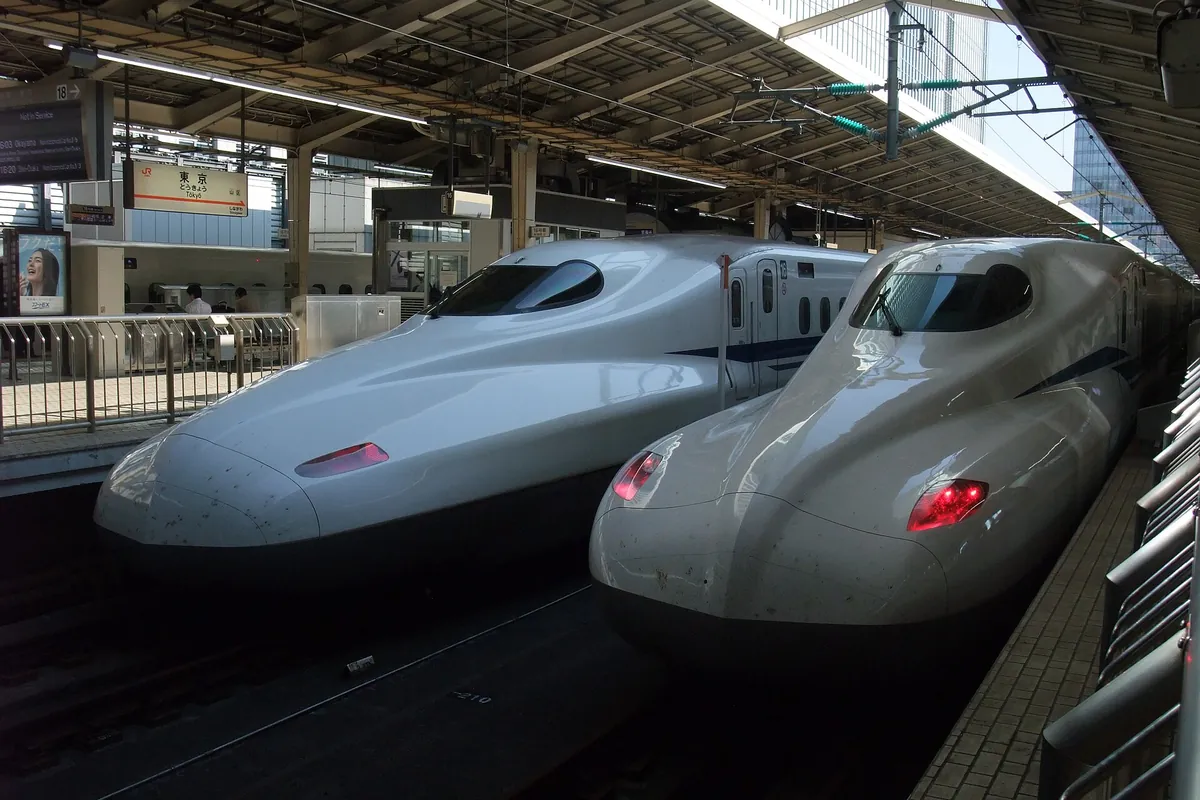
The photo below shows an N700S, the newest Tokaido Shinkansen train, at Tokyo Station. The seat widths in this article come from this model.
Booking online through Smart EX costs a little less. Smart EX members pay 18,840 yen for the Green Car from Tokyo to Kyoto and 14,760 yen from Tokyo to Nagoya. From Shin-Osaka, members pay 14,410 yen to Hiroshima and 21,890 yen to Hakata.
Each route has its own page with times and the last train. From Tokyo, see Tokyo to Osaka by Shinkansen, Tokyo to Kyoto and Tokyo to Nagoya. From Osaka, see Osaka to Hiroshima and Osaka to Fukuoka.
The Hokuriku Shinkansen to Kanazawa uses JR East’s table instead. On the JR East Green and GranClass charge table, the Green charge from Tokyo to Kanazawa is 6,990 yen. The reserved seat on the Kagayaki costs 14,600 yen on our Tokyo to Kanazawa route page.
Seats, outlets and luggage space
The illustration sums up what the Green Car adds at your seat. You get more width, power and light, and a place to rest your legs.
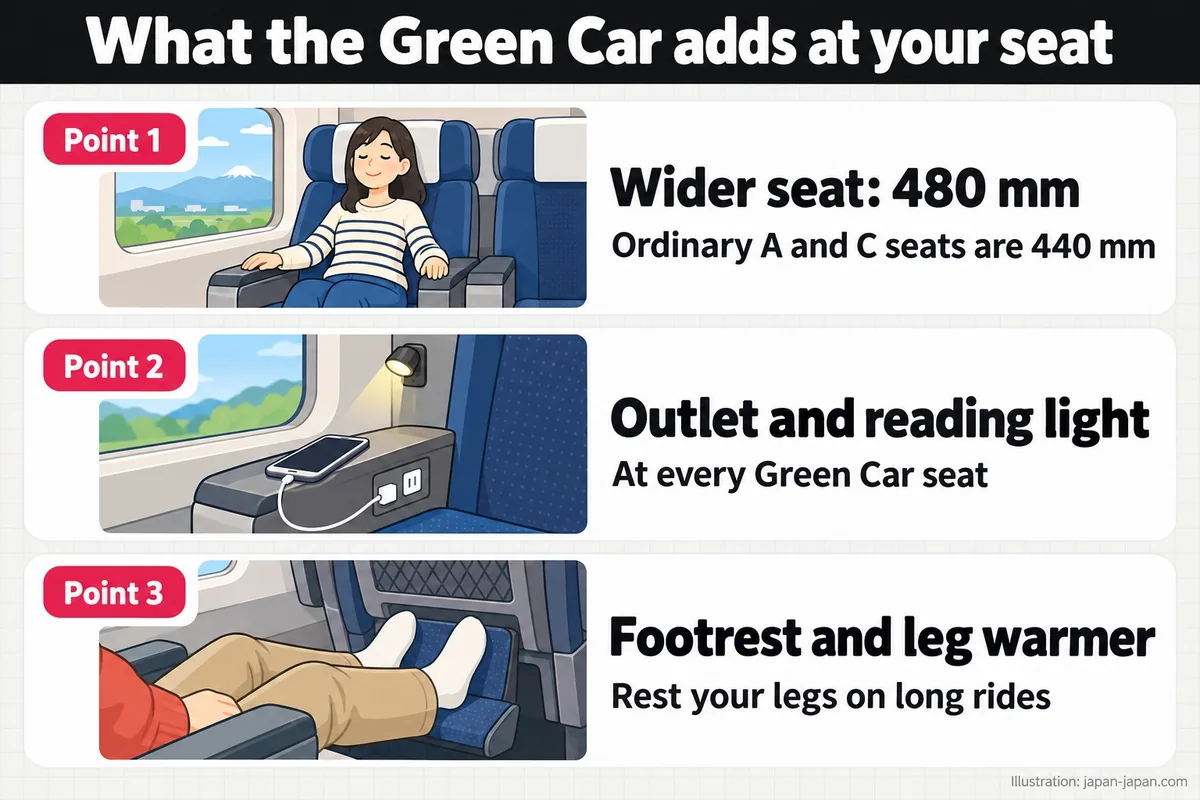
The JR Central N700S train page gives the seat widths. The Green Car seat is 480 mm wide. In the ordinary car, the A and C seats are 440 mm and the B seat is 460 mm. The seat at the wheelchair space is 430 mm.
The N700S Green seat comes with:
- A new reclining mechanism.
- A sliding seatback table and a table stored in the armrest.
- A reading light.
- A leg warmer and a footrest.
- A multipurpose hook.
The ordinary N700S seat also has the new reclining mechanism, a hook and a seatback table. The reading light, leg warmer and footrest are the Green Car extras.
Outlets depend on the train model. The JR Central Shinkansen onboard facilities page says every seat on the N700S has an outlet. On the N700A, every Green Car seat has one, but ordinary cars only have them at window seats and the very front and back rows. On the N700A the window-seat outlet sits near your feet, so JR Tokai Tours suggests a 1.5 m cable. Our guide to power outlets on the Shinkansen has more detail by train.
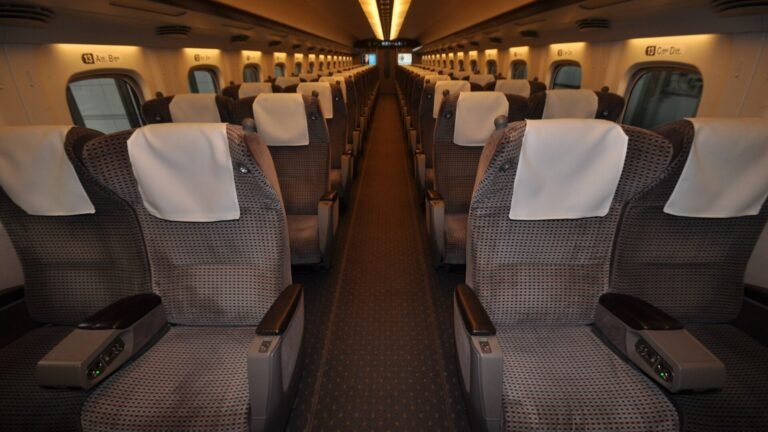
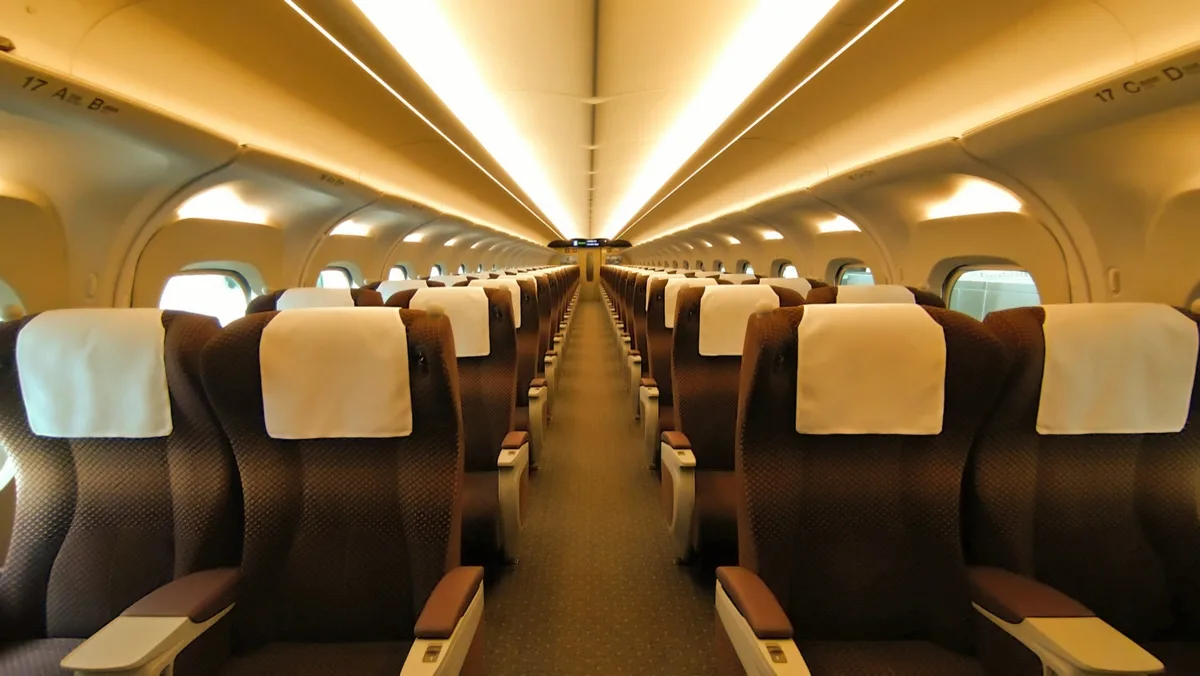
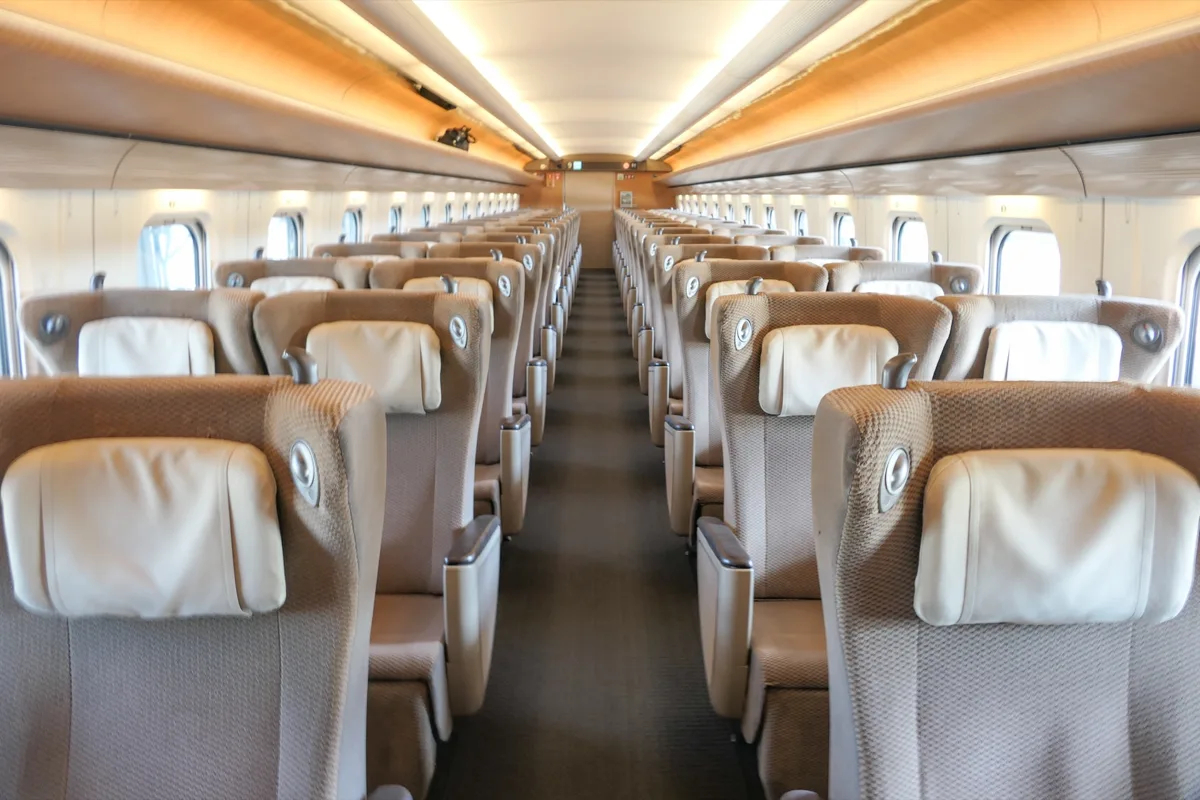
The photo shows a Green Car cabin. Look for the wider seats and the footrests.
One small warning for the ordinary car. Seats 12ABDE and 13ABDE in car 11 of the N700S are slightly narrow, according to JR Central.
Large bags follow the same rules in both classes. A bag whose length, width and height add up to 160 to 250 cm needs a seat with an oversized baggage area. The JR West N700 series seat guide puts these seats in the last row of each reserved car and each Green Car. Cars 7 and 11 are the exceptions. The seat costs nothing extra, but boarding with such a bag and no booking costs a 1,000 yen fee. Bags of 160 cm or less need no booking. They can go in the luggage areas on the decks of cars 3, 5, 7, 9, 13 and 15.
If you want to see Mount Fuji, pick the right letter. The Fuji side is the E seat in the ordinary car and the D seat in the Green Car, in both directions.
Supreme Class and GranClass above the Green Car
Two classes sit above the Green Car, on different lines.
Supreme Class started on the Tokaido Shinkansen on 1 October 2026. It is a private cabin. The JR Central Supreme Class page lists two sizes: car 7 for up to two guests and car 10 for one guest. From Tokyo to Shin-Osaka by Nozomi, the car 7 cabin costs 60,790 yen and the car 10 cabin 42,390 yen. From Tokyo to Nagoya the prices are 47,060 yen and 32,660 yen. These are adult, one-way, regular-season prices as of 17 June 2026.
You can only book Supreme Class through Smart EX, and you need a Smart EX membership. A second guest in the car 7 cabin buys their own ticket for the same train, in any seat class. Our Supreme Class guide has the full price list.
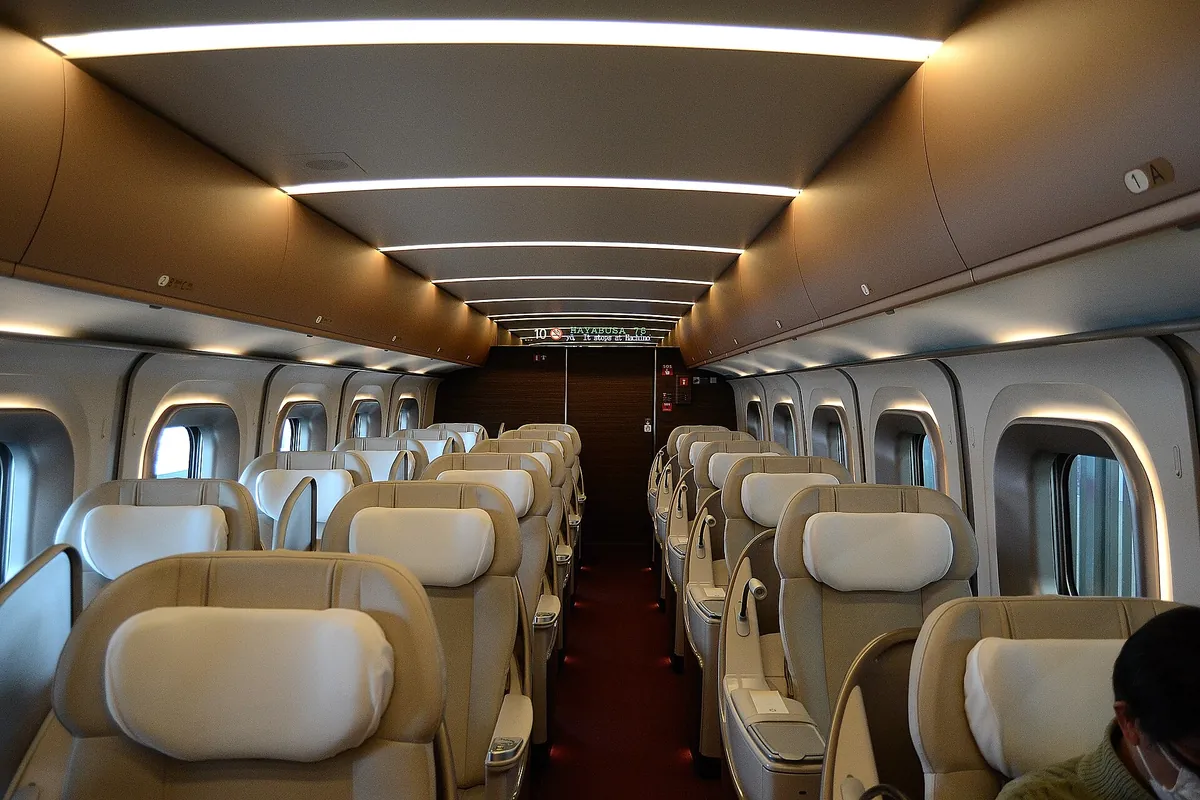
GranClass runs on the Tohoku and Hokkaido Shinkansen (E5 and H5), the Hokuriku Shinkansen (E7 and W7) and the Joetsu Shinkansen (E7). The JR East GranClass guide says each car holds only 18 passengers, and the seats recline up to 45 degrees.
The photo shows a GranClass cabin on a JR East train.
From Tokyo to Kanazawa the GranClass charge is 17,990 yen on the Kagayaki, which is GranClass (A). On other trains it is GranClass (B), at 11,190 yen. Some trains have GranClass seats but no attendant, drinks or light meal. These include every Yamabiko, Hayate, Nasuno, Hakutaka and Asama, and the Hayabusa between Tokyo and Sendai. JR Central’s rule page also states that its Green charge table does not apply to GranClass.
How Green Car fares and tickets work
To sit in the Green Car, you buy a Green ticket with your express ticket. At a ticket office, ask for a Green ticket: グリーン券 (guriin-ken, “Green ticket”). The steps below show the order.
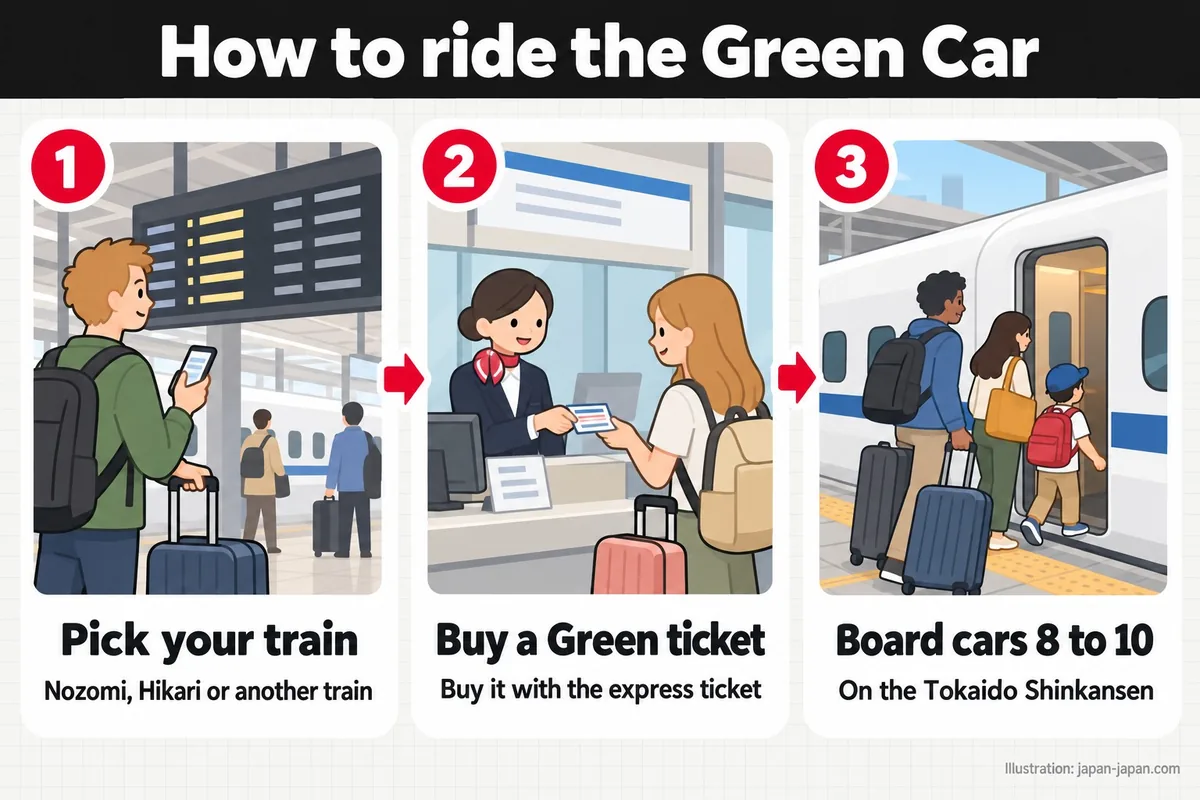
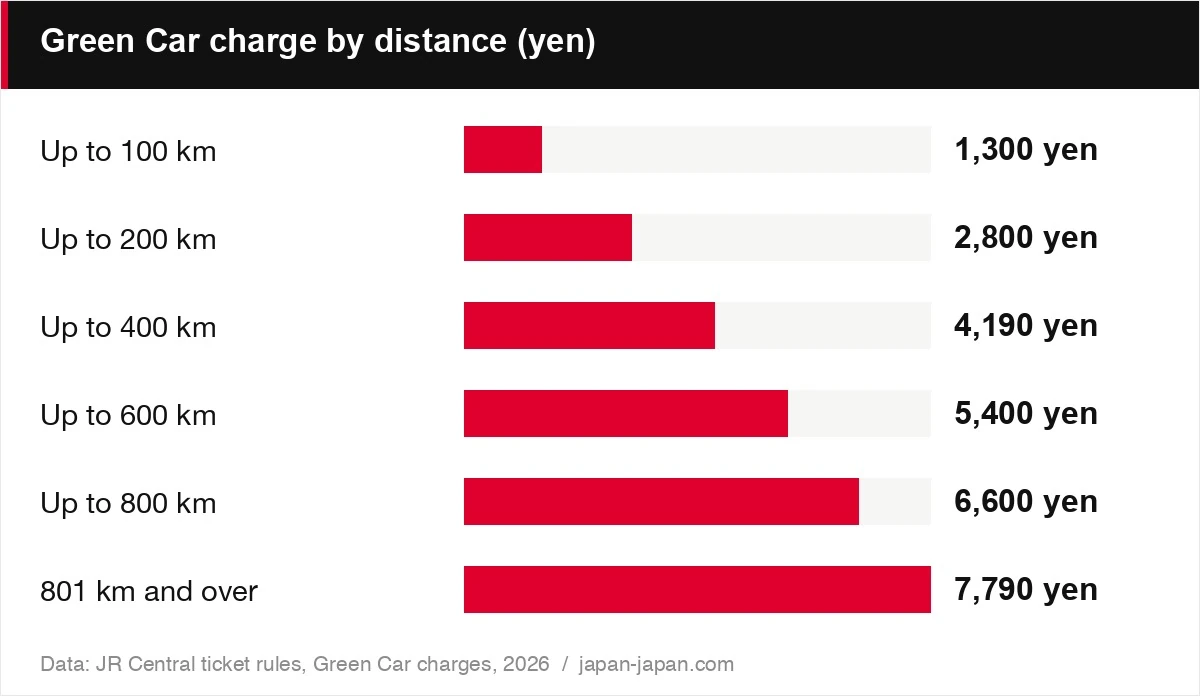
The Green charge depends on the distance you ride. The table below covers JR Central, JR Hokkaido, JR Shikoku and trips across JR companies. It also covers JR West, except the Hokuriku Shinkansen.
- Up to 100 km: 1,300 yen.
- Up to 200 km: 2,800 yen.
- Up to 400 km: 4,190 yen.
- Up to 600 km: 5,400 yen.
- Up to 800 km: 6,600 yen.
- 801 km and over: 7,790 yen.
The chart shows the same steps, so you can see how fast the charge climbs.
| Item | Value |
|---|---|
| Up to 100 km | 1300 yen |
| Up to 200 km | 2800 yen |
| Up to 400 km | 4190 yen |
| Up to 600 km | 5400 yen |
| Up to 800 km | 6600 yen |
| 801 km and over | 7790 yen |
Within JR East the first four steps are the same. Then the charge is 5,600 yen up to 700 km and 6,600 yen from 701 km. Adults and children pay the same Green charge in both tables.
Smart EX is the online booking service for the Tokaido, Sanyo and Kyushu Shinkansen, and it has an English site. The Smart EX seat options and seasonal prices page offers ordinary reserved seats, Green Car seats and non-reserved seats. You can book from 5:30 am one year before your trip, up to 4 minutes before departure. You can change the train as often as you like at no charge before you board. A refund before departure costs 320 yen.
Prices move with the season. Against the regular season, an adult pays 200 yen less in the off-peak season. The peak season adds 200 yen, and the busiest season adds 400 yen.
The Japan Rail Pass also comes in a Green Car version. On the official website, the 7-day Green Car pass costs 70,000 yen and the 7-day Ordinary pass 50,000 yen. The pass does not cover the Nozomi or the Mizuho. To ride them, pass holders buy a special ticket. A Green Car seat costs the same as an ordinary one: 4,960 yen from Tokyo to Shin-Osaka. Our Japan Rail Pass page has all the prices.
Which seat should you choose?
Two questions settle it for most trips.
The Green Car makes sense when:
- Your ride is long. Shin-Osaka to Hakata takes 2 h 28 min at the fastest, and the upgrade costs 6,070 yen.
- You want to work on a laptop on an N700A. Aisle and middle seats in its ordinary cars have no outlet.
- You want room to stretch, a footrest and a reading light.
- You already hold a Green Car Japan Rail Pass.
The ordinary reserved seat makes sense when:
- Your ride is short. Tokyo to Nagoya takes 1 h 33 min at the fastest, and the upgrade costs 3,660 yen.
- You travel as three and want to sit in one row. Only the ordinary car has three-seat rows.
- You want to keep costs down. On an N700S, every ordinary seat has an outlet anyway.
Big suitcases do not change the answer. In both classes, a bag of 161 to 250 cm needs a booked seat with an oversized baggage area. To travel light instead, send the suitcase ahead with luggage forwarding in Japan.
The train type matters as much as the seat. A Nozomi Green Car from Tokyo to Shin-Osaka costs 19,590 yen, and a Hikari Green Car costs 19,270 yen. Our comparison of Nozomi vs Hikari sets out the time you save.
Green Car or ordinary car: what 98 people in Japan said
On 13–14 October 2026, japan-japan.com ran an online survey of people living in Japan about 32 travel choices. 130 people answered. We removed answers that looked machine-written, one from outside Japan and most of those that contradicted themselves, which left 98. Shares below are of the 98 respondents unless a smaller group is named; they describe these people, not all travellers in Japan. See all 32 comparisons and how we asked.
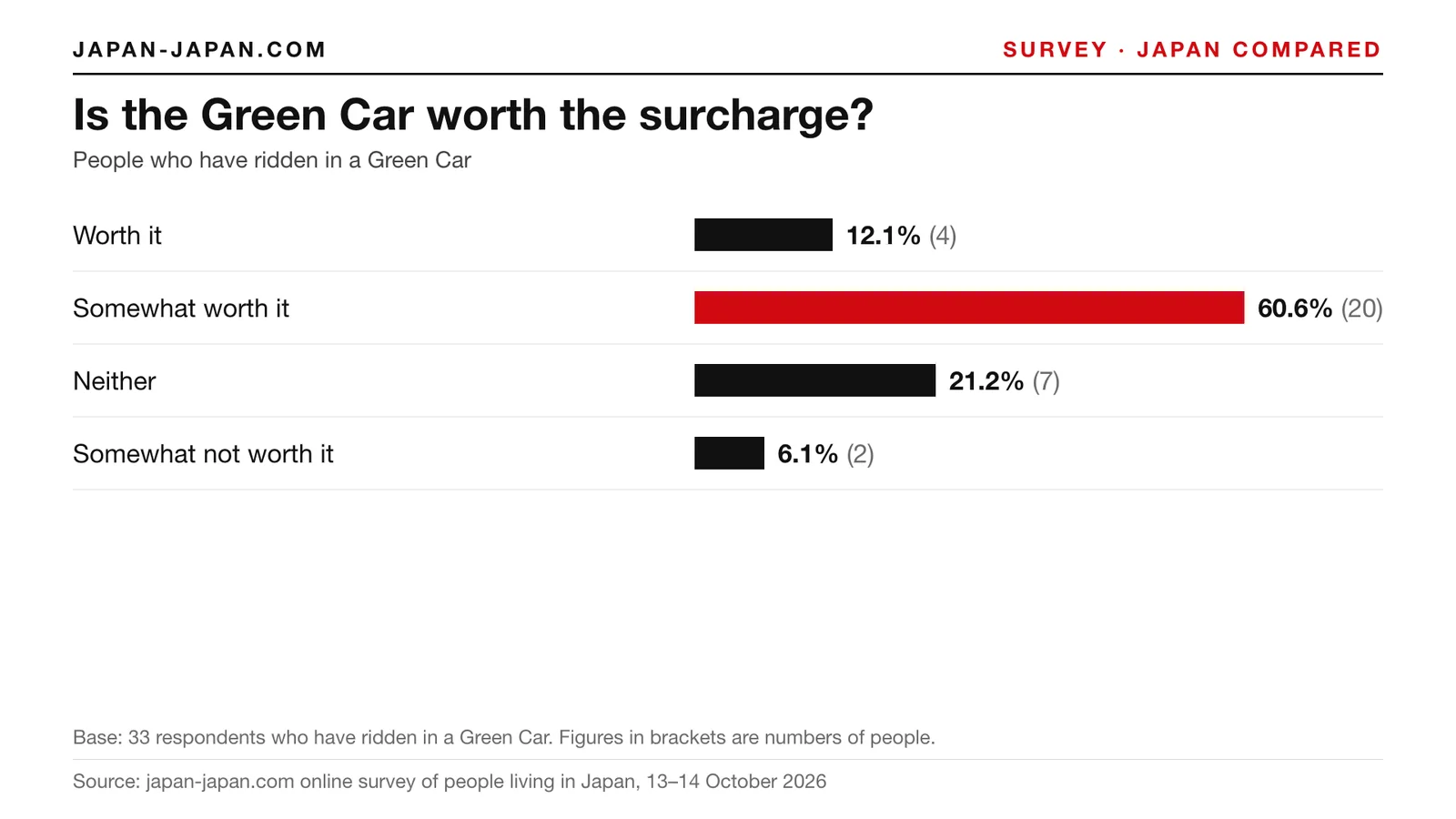
33.7% (33 people) have ridden in a shinkansen Green Car: 24.5% (24 people) paid themselves and 9.2% (9 people) travelled on company money. Of those 33, 72.7% (24 of 33) said the surcharge was worth it or somewhat worth it, and 6.1% (2 of 33) said it was not.
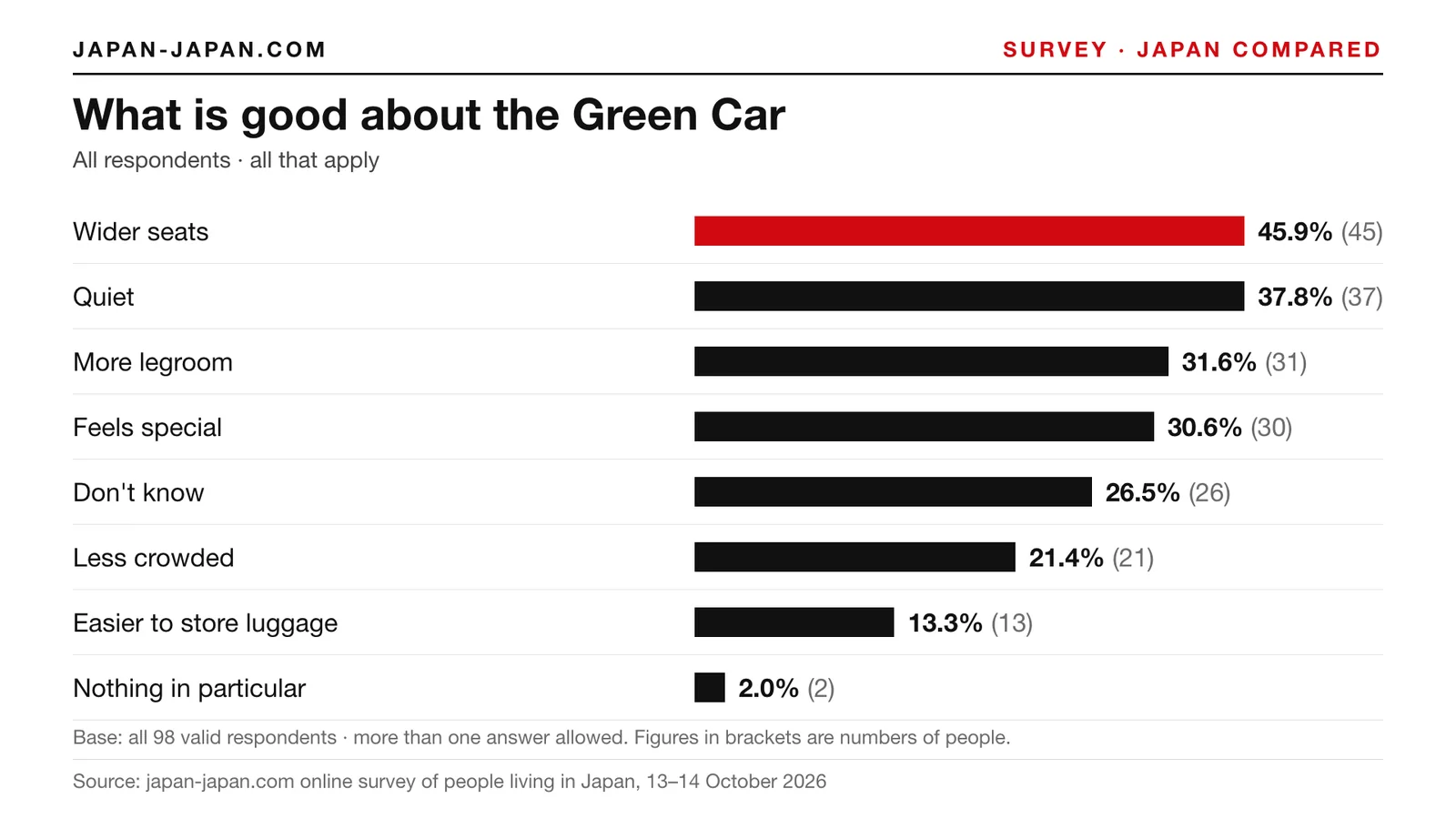
Asked what is good about the Green Car, all respondents named wider seats (45.9%), a quiet car (37.8%) and more legroom (31.6%). Day to day, 60.2% (59 people) usually take a reserved seat in an ordinary car, 19.4% (19 people) a non-reserved seat and 2.0% (2 people) the Green Car.
“There is plenty of legroom, so even though I’m tall, my legs and back didn’t ache by the time I arrived.”
— Man in his 50s, Tokyo. Original Japanese (excerpt): 「足元が広いので、身長が高い私でも足腰が痛くならずに目的地まで行くことができて良かったです。」
“The seats are wide and it’s quiet. But for a ride of just two hours, an ordinary reserved seat is enough.”
— Man in his 60s, Tokyo. Original Japanese (excerpt): 「席が広く、静か。たった2時間なら普通指定で十分。」
Shinkansen Green Car vs Ordinary FAQ
Is the Shinkansen Green Car worth the extra cost?
It costs 4,870 yen more from Tokyo to Shin-Osaka by Nozomi, 33% above an ordinary reserved seat. For that you get a 480 mm seat, a reading light and a footrest. On a short trip such as Tokyo to Nagoya, the 3,660 yen gap buys less time in that seat.
Which cars are the Green Cars on the Tokaido Shinkansen?
Cars 8, 9 and 10 on every Tokaido Shinkansen train. Some trains also have Supreme Class cabins in cars 7 and 10.
Do children pay less for a Green Car seat?
Children aged 6 to 11 pay half the basic fare and half the limited express charge. The Green charge itself is the same for adults and children, so the child discount on a Green Car is smaller.
Can I ride the Green Car with a Japan Rail Pass?
Yes, with the Green Car version of the pass. It costs 70,000 yen for 7 days on the official website, against 50,000 yen for the Ordinary pass. For the Nozomi and the Mizuho you still need the special ticket for pass holders.
About the author