Japan Itinerary 10 Days 2026-27: Route, Trains and Fares
10 days: Tokyo 4 nights, Hakone 1, Kyoto 3 and Osaka 1, then fly home from Kansai. Every train leg with official times and fares, and whether the JR Pass pays.
Japan itinerary 10 days: the short answer
Our 10-day Japan itinerary: Tokyo 4 nights, Hakone 1, Kyoto 3, Osaka 1. Land in Tokyo and fly home from Kansai Airport. The longest train leg takes 1 h 58 min, and the 50,000-yen JR Pass would not pay off.
Book an open-jaw ticket, flying into Haneda or Narita and home from Kansai. That saves the trip back east: the Nozomi between Shin-Osaka and Tokyo takes 2 h 21 min and costs 14,720 yen.
Each leg below carries the official time and fare from the timetables of JR Central, JR West, JR East, Odakyu and Keikyu. We keep them in our City to City and Airport transfers databases, with the first and last trains. Fares are for one adult, one way. After the day-by-day plan come the JR Pass sums, 7-day and 14-day versions, luggage rules and the busiest winter days.
The 10-day route, day by day
The table shows where you sleep and the train that starts each stage.
| Days | Stay | Train | Time, fare |
|---|---|---|---|
| Days 1–4 | Tokyo, 4 nights | Keikyu and JR from Haneda | 33 min, 540 yen |
| Day 5 | Hakone, 1 night | Romancecar from Shinjuku | 1 h 24 min, 2,470 yen |
| Days 6–8 | Kyoto, 3 nights | Hakone Tozan and Shinkansen | 1 h 58 min, 12,870 yen |
| Day 8 | Nara day trip | JR Miyakoji Rapid | 47 min, 720 yen |
| Day 9 | Osaka, 1 night | JR Special Rapid | 28 min, 580 yen |
| Day 10 | Fly home | JR Kansai Airport Rapid | About 65 min |
Day 1: land and get to Tokyo Station. From Haneda, the Keikyu Line and JR take 33 min for 540 yen, with one change at Shinagawa. The Tokyo Monorail and JR Yamanote Line cost 720 yen, changing at Hamamatsucho. See Haneda to Tokyo Station for the airport bus as well.
From Narita, the Narita Express reaches Tokyo Station in 53 min for 3,140 yen, with no change. The AIRPORT BUS TYO-NRT takes 65 min for 1,500 yen. See Narita to Tokyo Station for the bus stops, and Narita or Haneda to Tokyo Station if you have not booked a flight yet.
Days 2 and 3: Tokyo, one side per day. Spend one day on the east side, around Asakusa and Ueno, and one on the west side, in Shinjuku, Shibuya and Harajuku. The national museums in Tokyo and Kyoto close on Mondays, so plan museum visits for another day. When Monday is a public holiday, they open and close the next day instead. Shinjuku Gyoen, a large garden on the west side, does the same, as our public holidays guide explains.
Day 4: a day trip from Tokyo. Go to Kamakura for temples and the coast, or to Nikko for shrines in the mountains. Both pages give the fastest train and the last one back, and you keep your Tokyo hotel.
Day 5: Shinjuku to Hakone. The Odakyu Romancecar runs from Shinjuku to Hakone-Yumoto in 1 h 24 min for 2,470 yen. The cheaper way is the Odakyu Rapid Express plus the Hakone Tozan Train: 1 h 40 min of riding for 1,270 yen. Both are on our Tokyo to Hakone page.
Hakone Navi, the official guide of the Odakyu Hakone Group, splits Hakone into areas. Hakone-Yumoto has many restaurants and gift shops. Sengokuhara is full of art museums, and Lake Ashi has views of Mount Fuji. Sleep at a ryokan with hot-spring baths: our ryokan guide covers meals and booking, and tattoo-friendly onsen helps if you have tattoos.
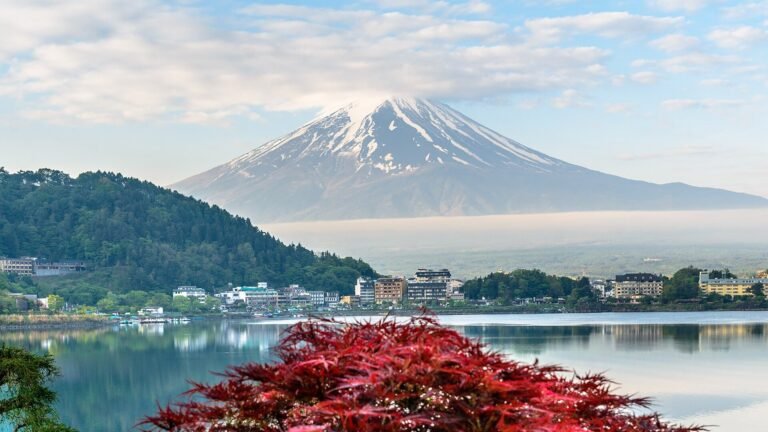
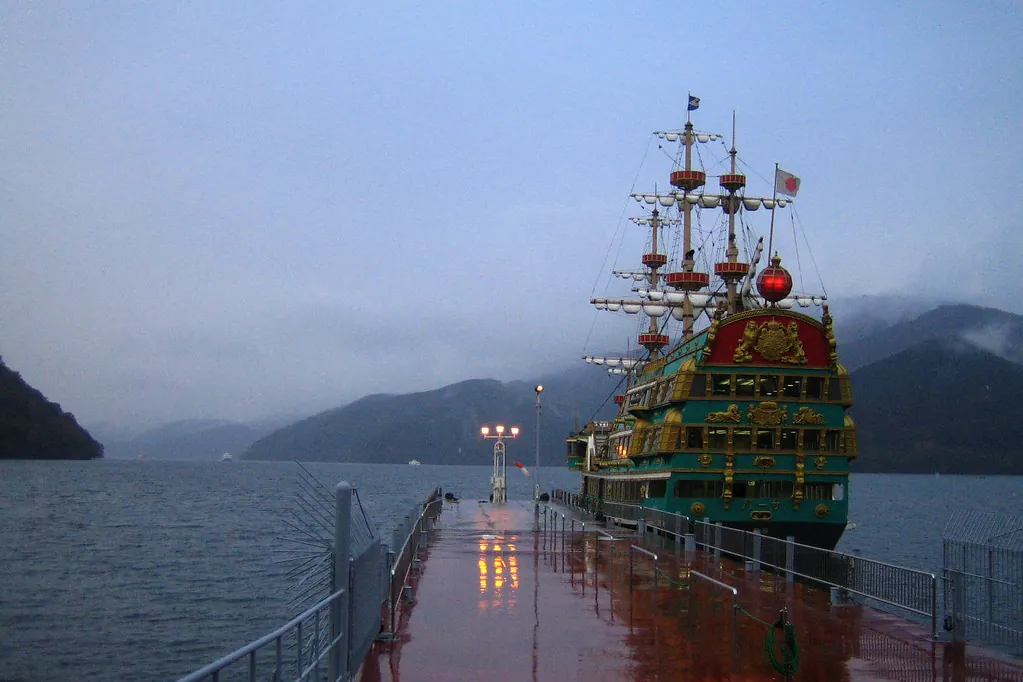
The photo below shows Lake Ashi, where the Hakone Sightseeing Cruise boats cross the water.
Day 6: Hakone to Kyoto. Ride the Hakone Tozan Train from Hakone-Yumoto to Odawara, 14 min for 360 yen. Between Odawara and Kyoto, the Shinkansen part takes 1 h 44 min for 12,510 yen, on a Hikari and a Nozomi. In all you ride 1 h 58 min, pay 12,870 yen and change twice, as our Kyoto to Hakone page shows. Hakone Navi sums up why this works: Hakone lies between Tokyo and western Japan, on the way to Kyoto and Osaka.
Day 7: Kyoto. The famous sights get very crowded at certain times and seasons. JNTO, Japan’s national tourism office, says to go early in the morning or late at night, when temples and shrines are lit up. Check the Kyoto Travel Congestion Forecast map first; its live cameras show how busy each spot is. Our Kyoto autumn leaves guide gives the quietest times in leaf season.
JNTO splits the city into areas. Pair Gion and Higashiyama with central Kyoto, or head west to Sagano and Arashiyama for the bamboo forests. Kyoto bans smoking on the street in the centre, including Kiyomizu, Gion and around Kyoto Station, and you can get a fine. In Gion, do not stop a geiko or maiko for a photo.
Day 8: Nara and back. The JR Miyakoji Rapid runs from Kyoto Station to Nara Station in 47 min for 720 yen. Trains to Nara leave Kyoto from 05:33 until 23:46, and our Kyoto to Nara page has the rest. Keep your Kyoto hotel for this night too.
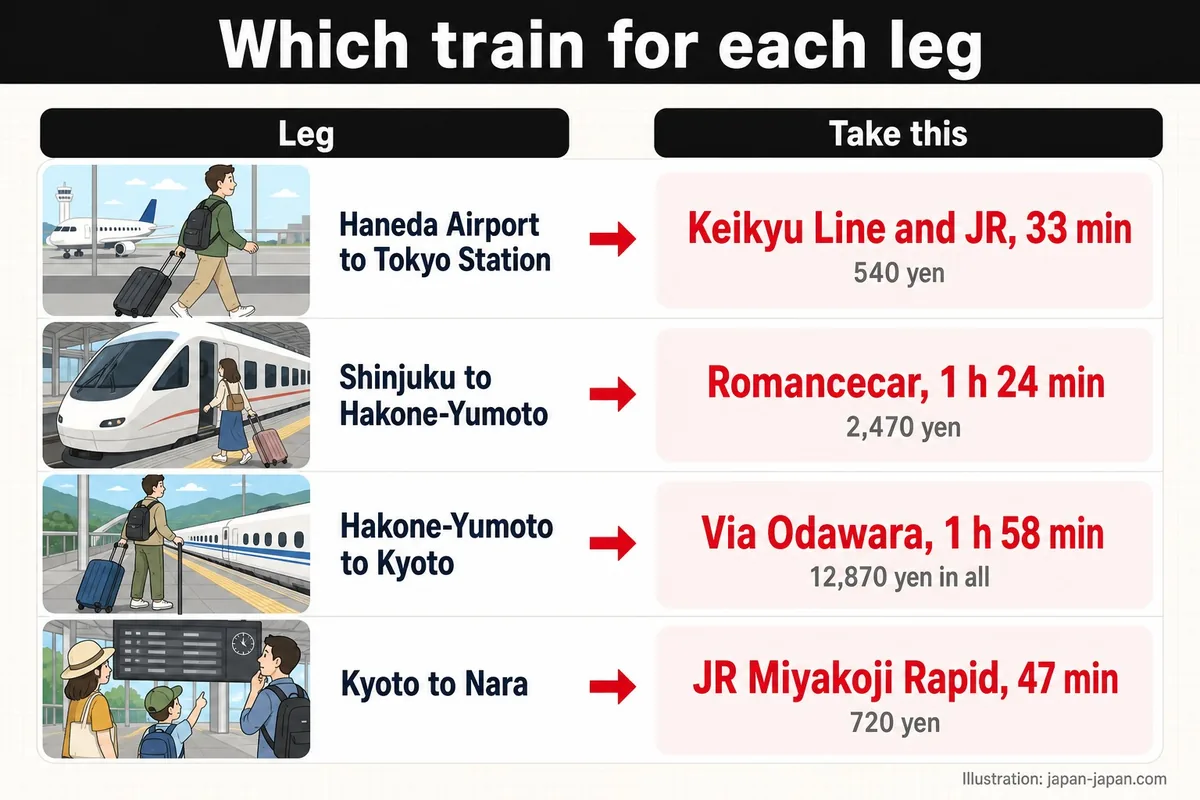
The illustration below sums up the first four train rides of the trip, with the time and fare for each.
Day 9: Kyoto to Osaka. Between Kyoto and Osaka Station, the JR Special Rapid takes 28 min for 580 yen. The Shinkansen between Kyoto and Shin-Osaka takes 13 min but costs 1,450 yen, so take the Special Rapid. Our Osaka to Kyoto page lists both. Stay near Osaka Station, where your airport train leaves.
Day 10: fly home from Kansai. Between Osaka Station and Kansai Airport, the JR Kansai Airport Rapid Service takes about 65 min with no change. The limousine bus takes 68–70 min for 1,800 yen. See Kansai Airport to Osaka Station and our Kansai Airport guide.
Train fares and the JR Pass
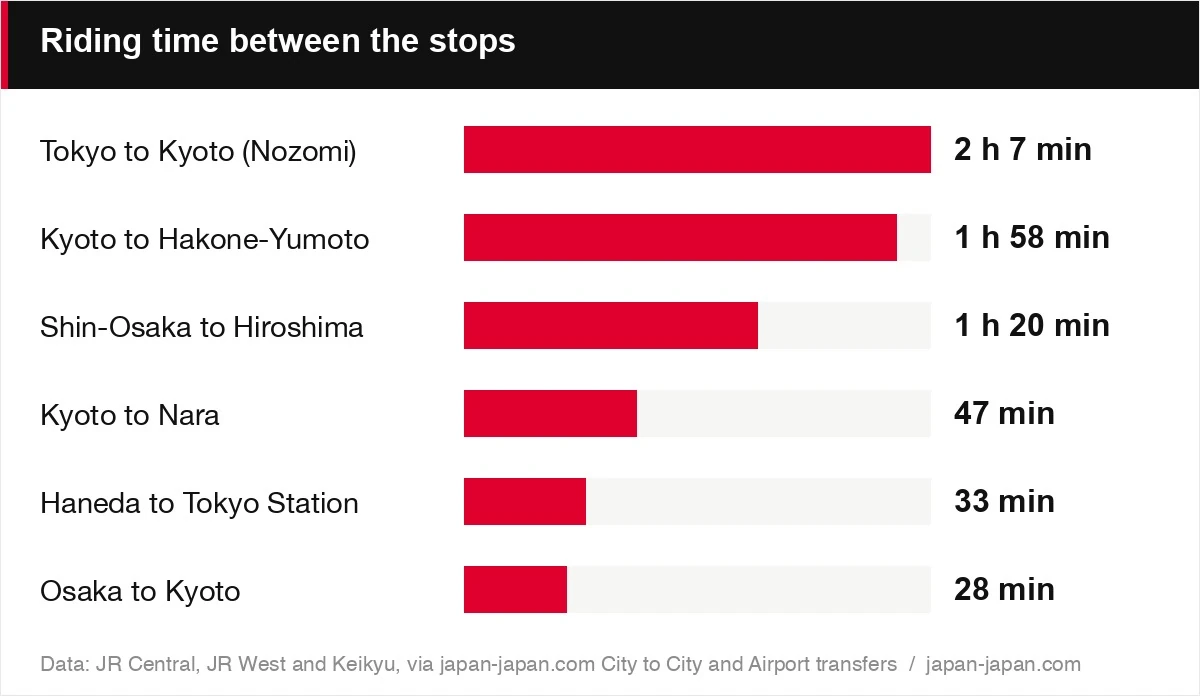
The chart compares the riding time of each leg in this guide.
| Item | Value |
|---|---|
| Tokyo to Kyoto (Nozomi) | 127 min |
| Kyoto to Hakone-Yumoto | 118 min |
| Shin-Osaka to Hiroshima | 80 min |
| Kyoto to Nara | 47 min |
| Haneda to Tokyo Station | 33 min |
| Osaka to Kyoto | 28 min |
The longest ride in the chart, Tokyo to Kyoto on the Nozomi, belongs to the 7-day plan, and the Hiroshima leg to the 14-day plan. In the 10-day plan, no leg runs longer than 1 h 58 min.
Now the money. After Hakone, the route uses JR for four legs. Odawara to Kyoto costs 12,510 yen, Kyoto to Nara 720 yen each way and Kyoto to Osaka 580 yen. The airport train is the fourth. Added up, they come to less than half of the 50,000-yen Japan Rail Pass for 7 days, so buy a ticket for each leg.
Odakyu runs the Romancecar, and the Odakyu Hakone Group runs the Hakone Tozan Train. The JR Pass covers JR Group trains only, so neither Hakone leg counts.
The table below lists the prices on the official JAPAN RAIL PASS website. For every type, buying online there costs less than buying from a JR-designated agency outside Japan.
| Pass | Official website | Overseas agency |
|---|---|---|
| 7 days | 50,000 yen | 53,000 yen |
| 14 days | 80,000 yen | 84,000 yen |
| 21 days | 100,000 yen | 105,000 yen |
| Child, 7 days | 25,000 yen | 27,000 yen |
A 7-day pass costs 50,000 yen online against 53,000 yen at an agency, and a 21-day pass 100,000 yen against 105,000 yen. Children aged 6 to 11 pay 25,000 yen online for 7 days. A Green car pass costs 70,000 yen for 7 days online. You buy online through JAPAN RAIL PASS Reservation, with your passport and a credit card.
The pass does not cover the Nozomi or the Mizuho, the fastest Shinkansen trains. To ride one, a pass holder buys a special NOZOMI MIZUHO Ticket before boarding, each time. The JR Pass page on Nozomi and Mizuho trains lists 4,960 yen between Tokyo and Kyoto. It goes on sale one month before the day you ride. Otherwise, take the Hikari or the Kodama.
In Hakone, look at the Hakone Freepass instead. Bought in the Hakone area, it costs 6,000 yen for 2 days from Odawara, or 1,500 yen for a child. Hakone Navi says it covers eight kinds of transport, including the Hakone Tozan Train, the Hakone Ropeway and the sightseeing cruise. A 2-day pass runs until the last service on the next day, which fits a one-night stay. The Romancecar still needs its own limited express ticket.
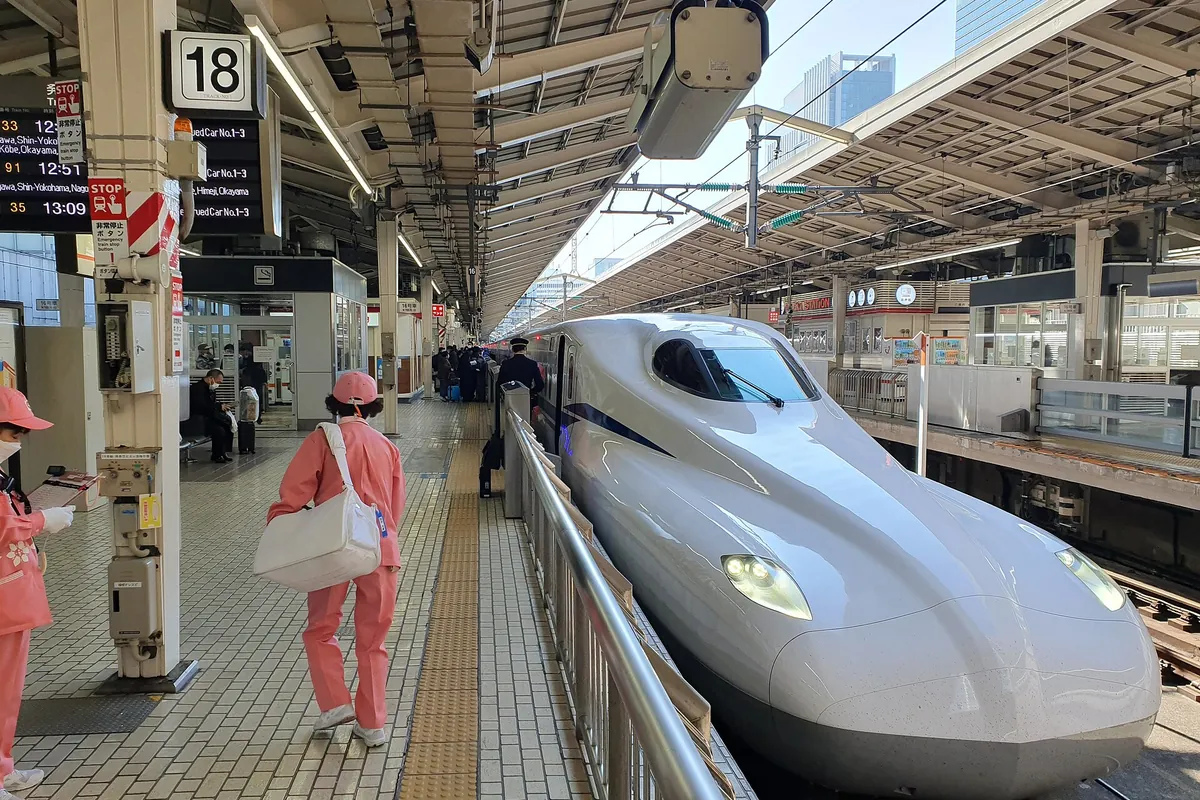
If you add more long rides, run your own numbers with our JR Pass check. The photo below shows a Tokaido Shinkansen train at Tokyo Station, where the Nozomi to Kyoto starts.
Japan itinerary 7 days: what to cut
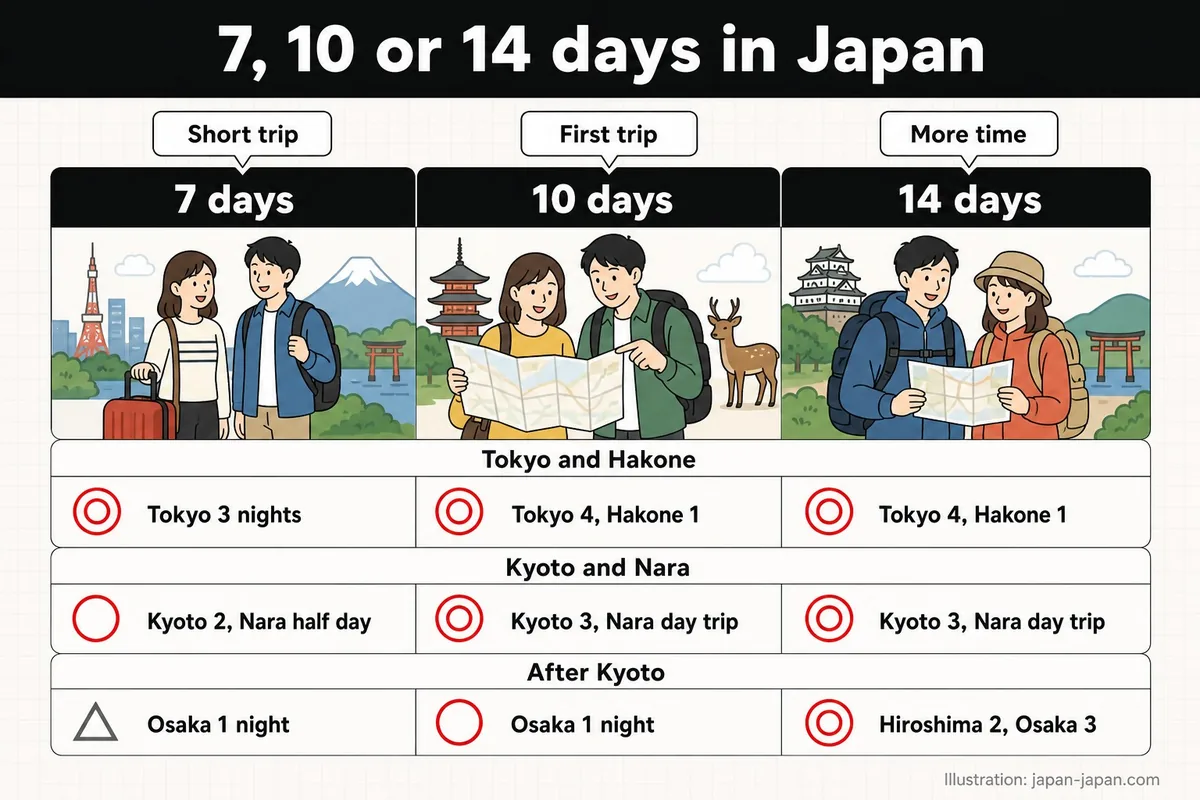
A Japan itinerary for 7 days drops Hakone and the day trip from Tokyo. Stay 3 nights in Tokyo, 2 in Kyoto and 1 in Osaka, and give Nara half a day from Kyoto. You still fly into Tokyo and out of Kansai.
The big move is Tokyo to Kyoto on the Nozomi, 2 h 7 min at the fastest. A reserved seat costs 14,170 yen, and a non-reserved seat 13,320 yen. JR Central’s timetable for Wednesday 14 October 2026 lists 155 trains a day from Tokyo Station to Kyoto. The first leaves at 06:00 and the last at 21:24. Details are on our Tokyo to Kyoto page. The JR fares still stay far below the 50,000-yen pass, which does not cover the Nozomi anyway.
With 2 nights in Kyoto, give the first afternoon to Gion and Higashiyama and start the next day early. The illustration below sets the 7-day, 10-day and 14-day plans side by side.
To end in Kyoto instead, move the Osaka night there and take the JR Haruka. Between Kyoto and Kansai Airport it runs without a change in about 75 min. Visitors with a foreign passport can buy a one-way ticket for 2,200 yen; see Kansai Airport to Kyoto.
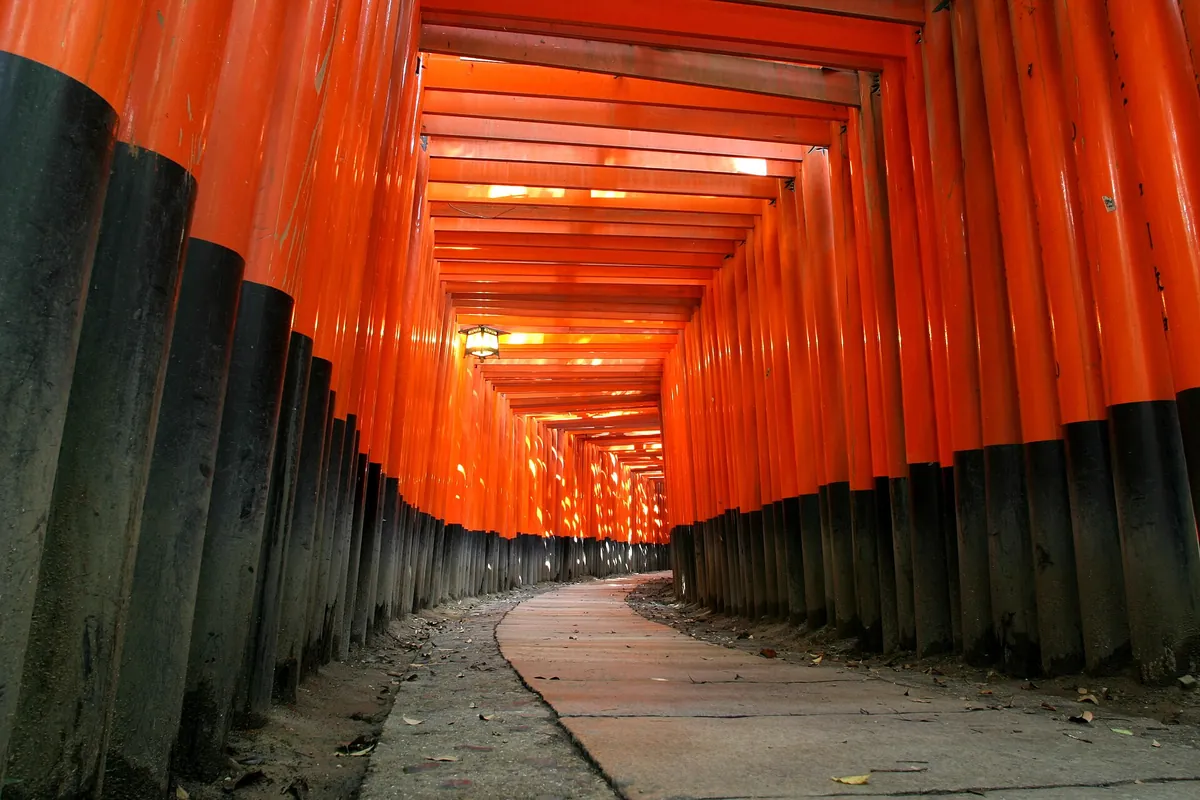
The photo below shows the torii gates on the path at Fushimi Inari Taisha in southern Kyoto, a good place for that early start.
Japan itinerary 14 days: Hiroshima and more
A Japan itinerary for 14 days adds Hiroshima and Miyajima to the 10-day route. Keep Tokyo 4 nights, Hakone 1 and Kyoto 3. Then spend 2 nights in Hiroshima and 3 in Osaka before you fly home from Kansai.
From Kyoto, ride the Shinkansen west; our Kyoto to Hiroshima page has the trains. For the ride back east, the Mizuho links Hiroshima and Shin-Osaka in 1 h 20 min for 10,950 yen with a reserved seat. JR Central’s timetable for 14 October 2026 lists 96 trains a day from Shin-Osaka to Hiroshima. The first leaves at 06:00 and the last at 22:29. See Osaka to Hiroshima for the rest.
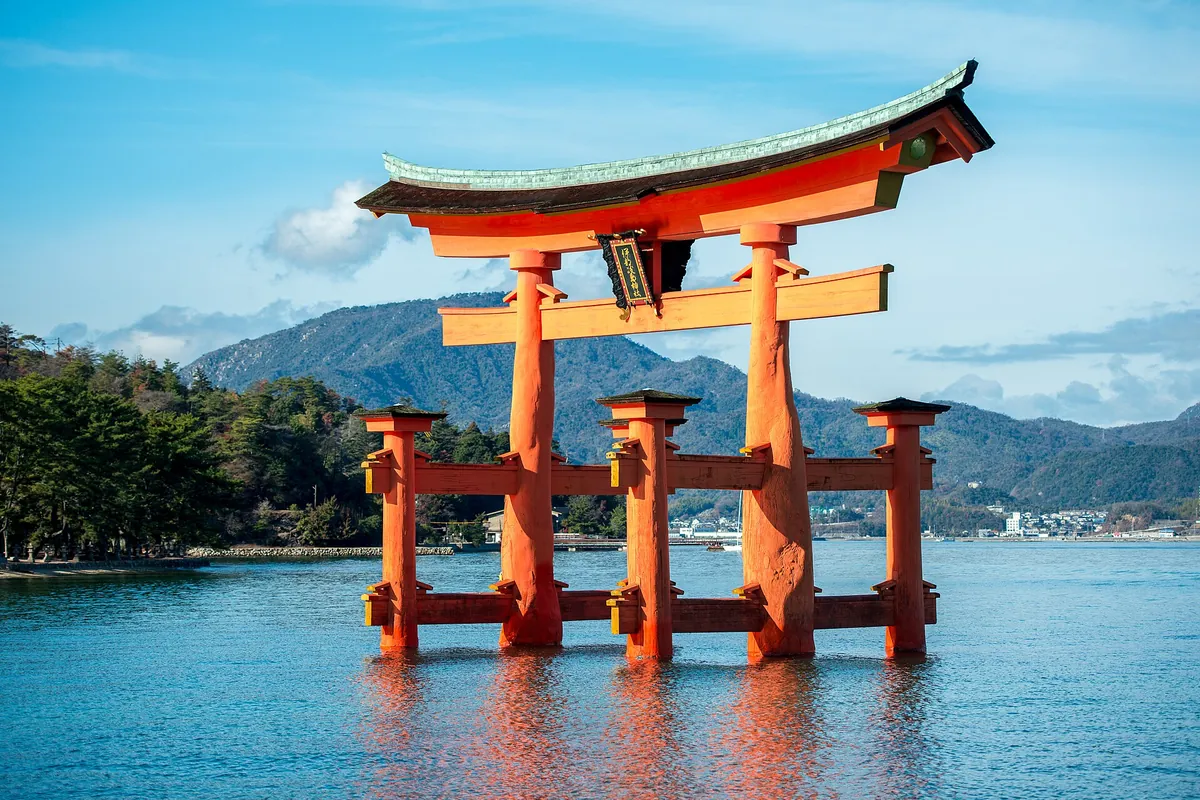
Use one Hiroshima day for Miyajima, the island with the shrine gate in the sea. Our Osaka to Miyajima page shows the Shinkansen, local train and JR ferry legs. The photo below shows that torii gate of Itsukushima Shrine.
The Mizuho, like the Nozomi, is outside the JR Pass. Pass holders buy the special ticket, 6,500 yen between Tokyo and Hiroshima, or ride the Hikari or Sakura. A 14-day pass costs 80,000 yen on the official website and 84,000 yen at an agency abroad. Even with Hiroshima, the JR fares on this route add up to less than the 50,000-yen 7-day pass, so skip the pass here too.
For snow, add Hokkaido. Flights from Haneda to New Chitose Airport take 1 h 30 min, with 56 a day; see Tokyo to Sapporo. Places to visit in Japan in winter gives the Sapporo Snow Festival dates. For a quieter add-on from Kyoto, look at Kyoto to Kanazawa.
Moving cities with a suitcase
On the Shinkansen, the size of your bag decides where it goes. JR Central sets the rule for the Tokaido, Sanyo and Kyushu Shinkansen, which covers every Shinkansen ride in this guide. Add the length, width and height of your bag together.
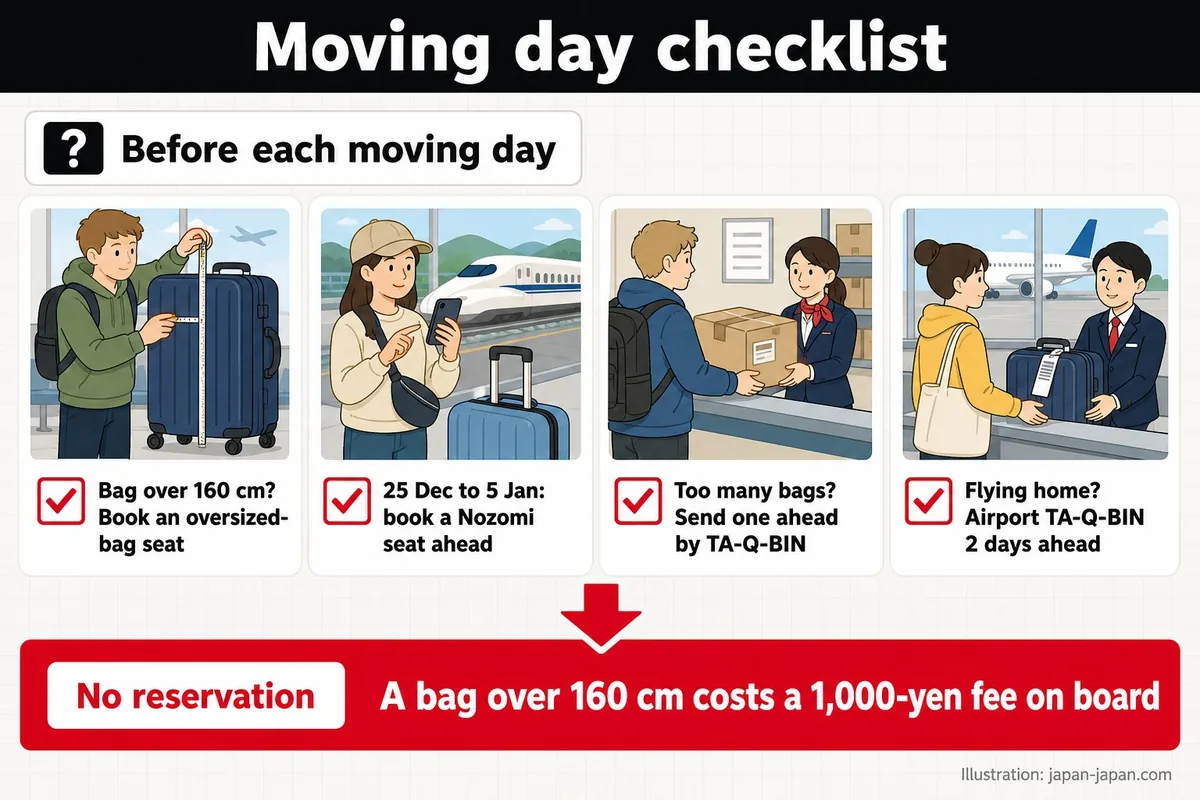
- 160 cm (63 inches) or less: put it at your feet or on the rack above the seats. The rack takes a bag such as 30 × 50 × 80 cm. A large bag of this size can also go in the baggage area on the deck, with no reservation.
- 161 to 250 cm (64 to 98 inches): reserve a seat with an oversized baggage area when you buy your ticket. The bag goes behind the last row of seats, and the seat costs the same as other reserved seats.
- Over 250 cm (98 inches): the bag cannot go on board.
Board with an oversized bag and no reservation, and you pay a 1,000-yen carry-on fee including tax. The conductor tells you where to put the bag. If every space is full, staff ask you to book another train. These seats go on sale one month ahead like other reserved seats, so book early. Ordinary JR lines, such as the Special Rapid to Osaka, need no baggage booking.
You can book the seat at a JR ticket office, at a reserved-seat ticket machine or online. JR calls many of its ticket offices みどりの窓口 (Midori-no-madoguchi). Show the staff these words: 特大荷物スペースつき座席 (tokudai nimotsu supēsu tsuki zaseki), meaning a seat with an oversized baggage area. JR Pass holders can also book it through JAPAN RAIL PASS Reservation.
The easier way is to send the big bag ahead. Yamato Transport’s TA-Q-BIN takes parcels up to 200 cm and 30 kg, and insures each one up to 300,000 yen. You can send them from convenience stores, though some do not take anything over Size 180. JR Central also points to LUGGAGE EXPRESS, a paid service. Leave a bag at your hotel or a station, and it reaches your next hotel the same day.
For the flight home, use Airport TA-Q-BIN. Drop the bag off by two days before your flight, or three days in some areas. Yamato delivers it to the airport by the day before, and you collect it at the airport counter on the day you fly. On this route, send it from your Kyoto hotel on Day 8. Bring the Sender Receipt from the waybill to collect it. The limit is 30 kg, and the rate includes the 660-yen airport fee.
Between moves, JNTO points to the coin lockers and luggage storage around Kyoto’s rail stations. The illustration below sums up what to sort out before each moving day.
Winter 2026-27: the busiest train days
Avoid moving cities on the days when every Nozomi is reserved-seat only. JR Central makes every Nozomi seat a reserved seat in the peak periods. Our New Year 2026–27 page and holidays guide list the dates:
- 10–12 October 2026, the next one.
- 21–23 November 2026.
- 25 December 2026 to 5 January 2027.
- 9–11 January 2027.
- 20–22 March 2027.
On those days the Nozomi’s 165 non-reserved seats become reserved seats. The Hikari, Kodama, Mizuho, Sakura and Tsubame keep their non-reserved cars, but JR Central warns they can get very crowded. With a non-reserved ticket you can only stand on the deck of a Nozomi’s ordinary car. Last winter’s busiest day was Sunday 4 January 2026, when 350,000 passengers headed to Tokyo.
So plan your moving days outside these dates, or book your seats first. The Shinkansen Online Reservation service sells some seats one year before the trip, from 5:30, and books up to 6 people at once. At stations, reserved seats go on sale at 10:00 one month before. JR Pass holders cannot ride the Nozomi without the special ticket, so reserve a Hikari seat early.
New Year’s Day falls on Friday 1 January 2027. It is the only national holiday in the break, but banks close from 31 December to 3 January and many sights close for several days. Read New Year in Japan for what stays open. The 2027 holiday calendar covers the rest of the year, and Japan in January lists the month’s events.
FAQ
Is 10 days enough for Japan?
Yes, for a first trip to Tokyo, Hakone, Kyoto, Nara and Osaka. This plan uses only 4 hotels, and its longest train ride is 1 h 58 min. With 14 days, add Hiroshima and Miyajima.
Do you need a JR Pass for 10 days in Japan?
Not for this route. The JR legs add up to less than half of the 50,000-yen 7-day pass, and the pass does not cover the Hakone trains. It also leaves out the Nozomi and Mizuho unless you buy a special ticket, such as 4,960 yen between Tokyo and Kyoto.
Can you take a large suitcase on the Shinkansen?
Yes, up to 250 cm in total length, width and height. A bag of 161 to 250 cm needs a seat with an oversized baggage area, booked with your ticket at no extra cost. Without that booking you pay 1,000 yen on board.
When is the Shinkansen busiest in winter 2026-27?
Every Nozomi is reserved-seat only from 25 December 2026 to 5 January 2027, and again on 9–11 January 2027. Last winter’s peak was Sunday 4 January 2026, with 350,000 passengers heading to Tokyo. Book online up to one year ahead, or move cities outside those dates.
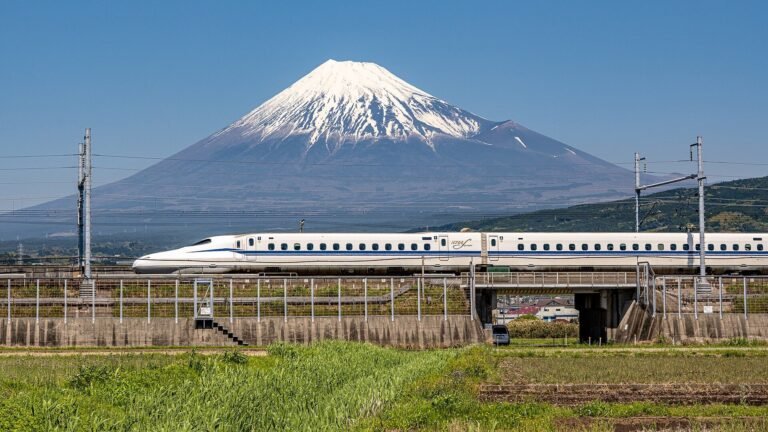
Photo: Shinkansen N700S series photographed at Higashi-Tagonoura with Mount Fuji in the background, 10 April 2023.jpg by Takeshi Aida (CC BY-SA 2.0, cropped), via Wikimedia Commons.