When Is Kyoto Least Crowded in November 2026?
Kyoto's autumn colour peaks from the second half of November into early December, and so do the crowds. Official dates, early starts and quieter areas.
By Shunta Fujii
November is the month most people picture when they imagine Japan in autumn.
In November, Kyoto is least crowded early in the morning, when the temple gates open, and again after dark. The Japan National Tourism Organization (JNTO) recommends both, along with the quieter areas outside central Kyoto. The leaves turn from mid-November to early December, and the crowds come in the same weeks. You cannot move the season, but you can move your day. The first week of December works too, because the city still has colour.
When the colours actually peak
The peak moves later as you go south and lower in altitude. In the mountains north of Kyoto the leaves turn in late October. In the city centre the peak is usually in the second half of November, and some temples stay colourful into early December.
JNTO gives a similar window for the whole country. Its guide to autumn in Japan says the trees turn red, orange and yellow from mid-November to early December. It calls Kyoto a perfect destination for autumn leaf viewing, with gardens and temples such as Kiyomizu-dera. The guide singles out two trees: the maple and the ginkgo.
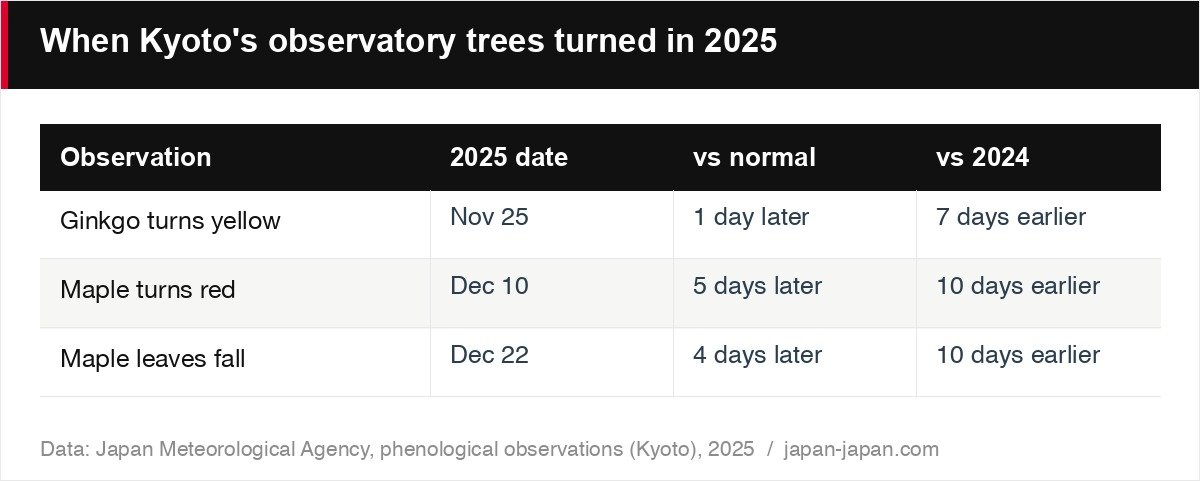
The Japan Meteorological Agency records the dates for those same two trees at its observatory in Kyoto. In 2025 the observatory’s ginkgo turned yellow on 25 November, 1 day later than normal and 7 days earlier than in 2024. Its maple turned red on 10 December, 5 days later than normal and 10 days earlier than in 2024. The maple leaves fell on 22 December, 4 days later than normal.
The agency’s pages are in Japanese. The screenshot below is the top of its maple page, with one row for each observatory. Read along a row: the place name, then the 2025 date (観測日), the difference from normal (平年差) and the difference from the year before (昨年差). In this screenshot the 2026 columns are still blank. Kyoto (京都) is further down the list, marked 12月10日, which means 10 December.
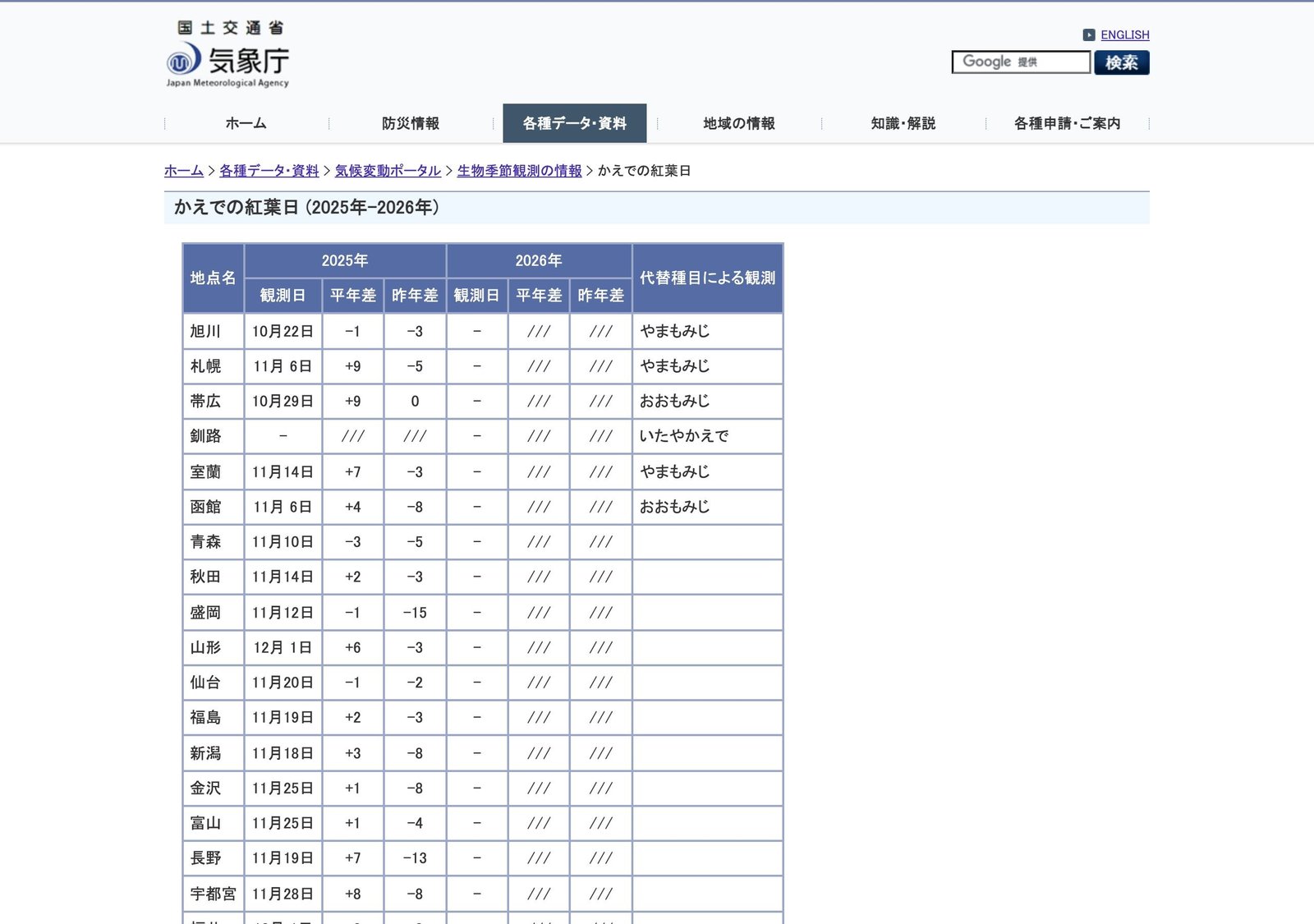
Read those dates with care. Each one is the day the observatory’s sample tree turned, not the best day in any temple garden. The agency measures each difference against its 2020 normal: a plus figure means later than normal, and a minus figure means earlier. What the dates do show is the order of the season. Ginkgo gold comes first, in the second half of November. The maples follow, and in 2025 they kept their leaves until 22 December.
North of the city, the season runs ahead. JNTO’s page on Ohara, a rural town in the mountains of northern Kyoto, says its autumn leaves burst into colour about one week earlier than the rest of Kyoto. If you arrive before the city centre has turned, start in the north. For the city itself, the table below sets out the observatory’s three dates for 2025.
What being crowded actually means here
At the most photographed temples, the queue starts before the gate opens. Inside, the walking route is one-way and you cannot stop. If you want a photograph without people in it, you are arriving at opening time or not at all.
JNTO says this openly. Its Kyoto page notes that the city sometimes gets too many visitors at particular times, in particular seasons and in particular areas. That makes life hard for the people who live there and can damage the natural surroundings. Its advice comes in three parts, and you can act on each one on the day.
Time your visit. JNTO recommends visiting popular temples in the early morning, when they open, or exploring the areas outside central Kyoto. For shrines it suggests the less busy hours: early in the morning, or late at night when they are lit up.
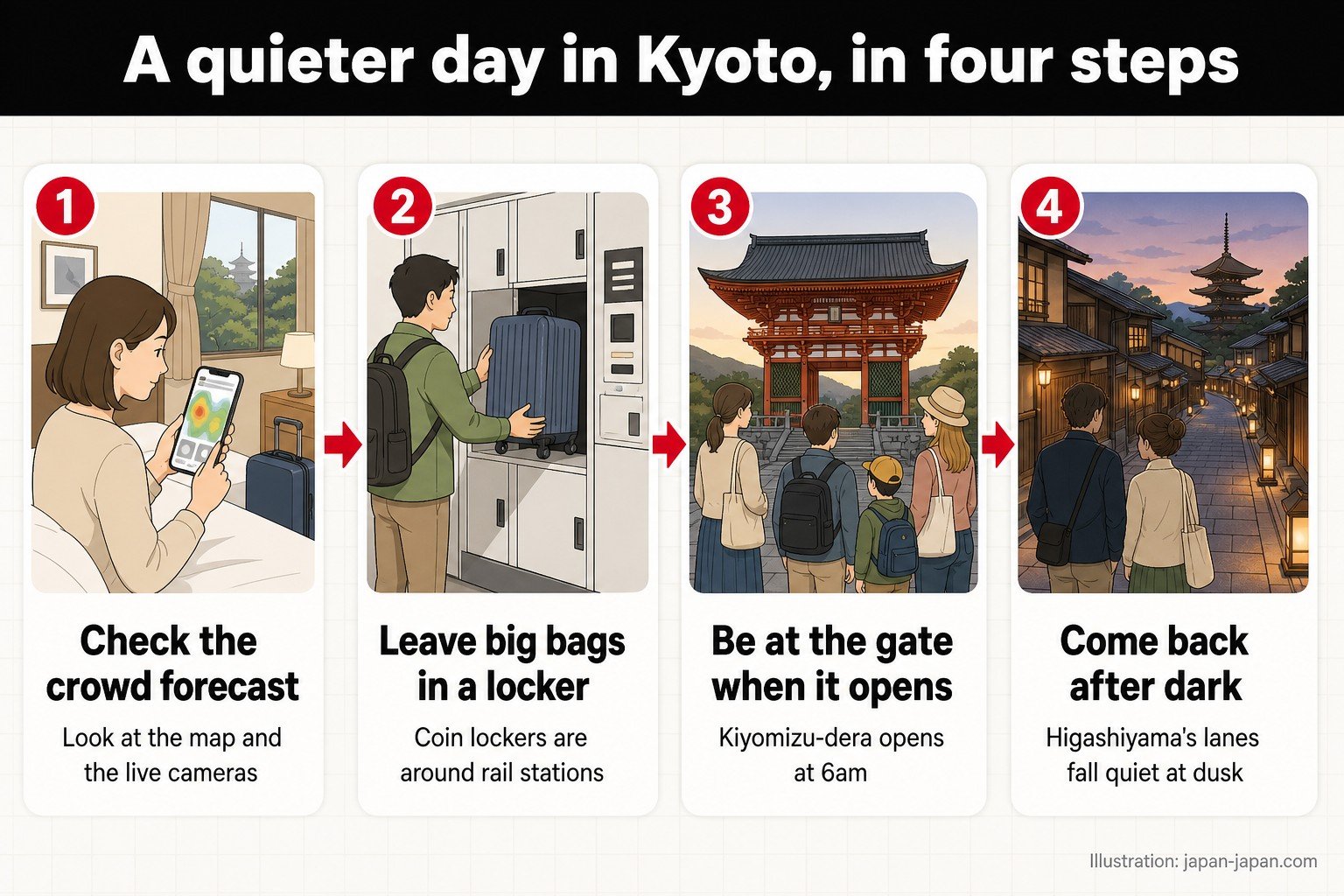
Check the crowds first. JNTO points to the Kyoto Travel Congestion Forecast, a map that shows when popular spots are crowded. It includes live cameras, so you can see how busy a place is in real time. Look before you leave your hotel. If the camera at your first stop shows a packed entrance, swap the order of your day.
Leave your luggage. There are coin lockers and luggage storage services around rail stations. JNTO says that leaving your bags there means you are not carrying them around town. It also reduces crowding on buses and trains and makes space for more people to ride.
The evening is the other quiet window. JNTO’s guide Kyoto at dawn and after dark says the backstreets of Higashiyama can be crowded during the day, but they fall quiet at dusk. The cobblestone lanes of Ninenzaka and Sannenzaka lead down from Kiyomizu-dera to Nene no michi, a path lit by small lights. The illustration below puts all of this into one day: check the forecast, leave your bags, be at the gate when it opens, and come back after dark.
Three ways around it
- Go early. The first hour is a different place from the rest of the day.
- Go north. The temples in the hills see a fraction of the visitors and turn colour earlier.
- Go in December. The first week still has colour in the city, and the crowds have gone home.
Going early
At Kiyomizu-dera, that first hour starts at 6am. JNTO’s early-morning guide lists the temple as open from 6am to 6pm and suggests arriving first thing to watch the sunrise from Higashiyama. Opening times differ from temple to temple, and they can change. The same guide notes that some venues have adjusted their hours, so check each temple before you go. If you are up before the gates open, walk. Kyoto Gyoen National Garden, in the centre of the city, is open 24 hours a day.
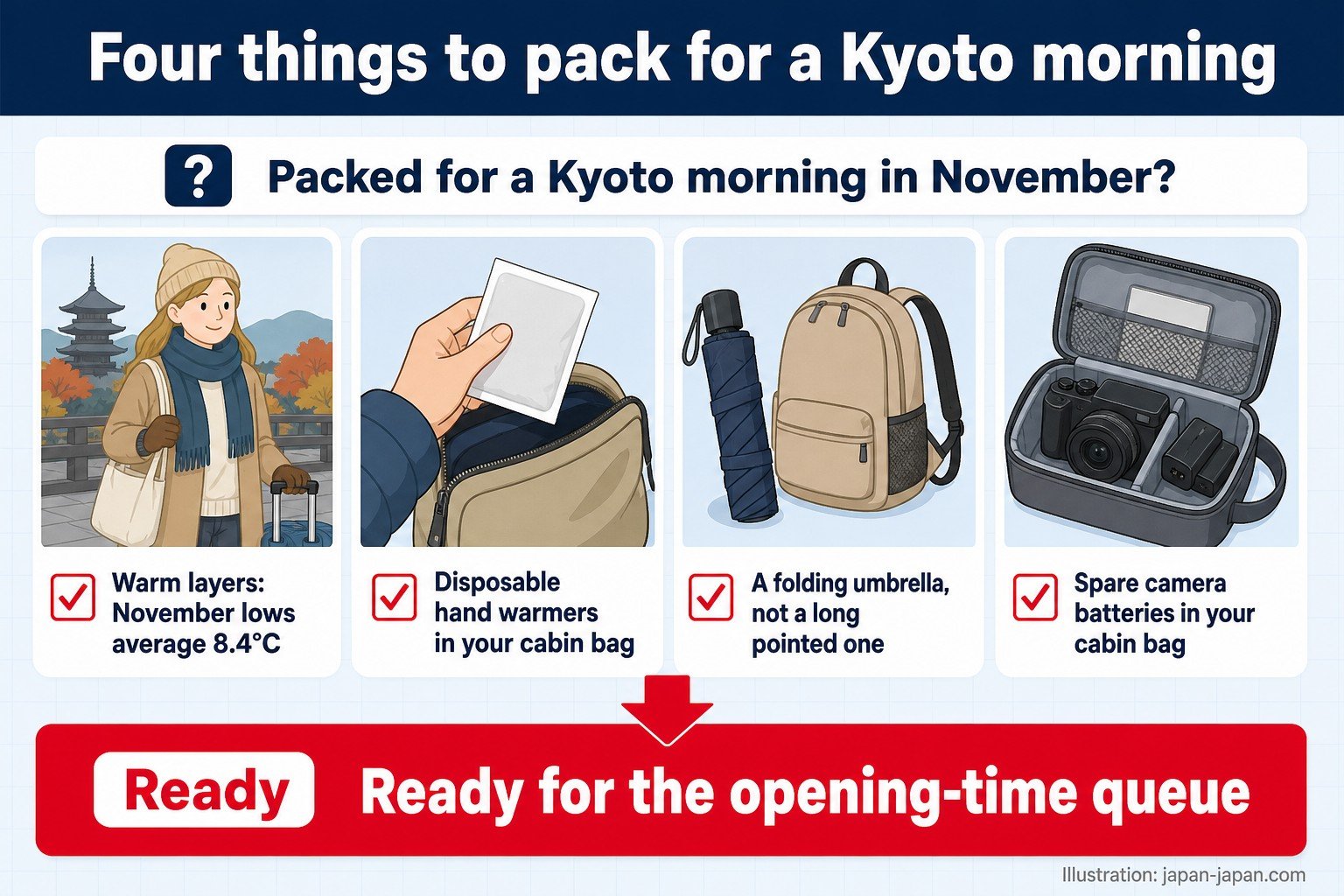
Dress for the wait. The Japan Meteorological Agency’s climate normals for Kyoto, averaged over 1991 to 2020, put the November daily low at 8.4°C. You will be standing still in a queue at the coldest time of day.
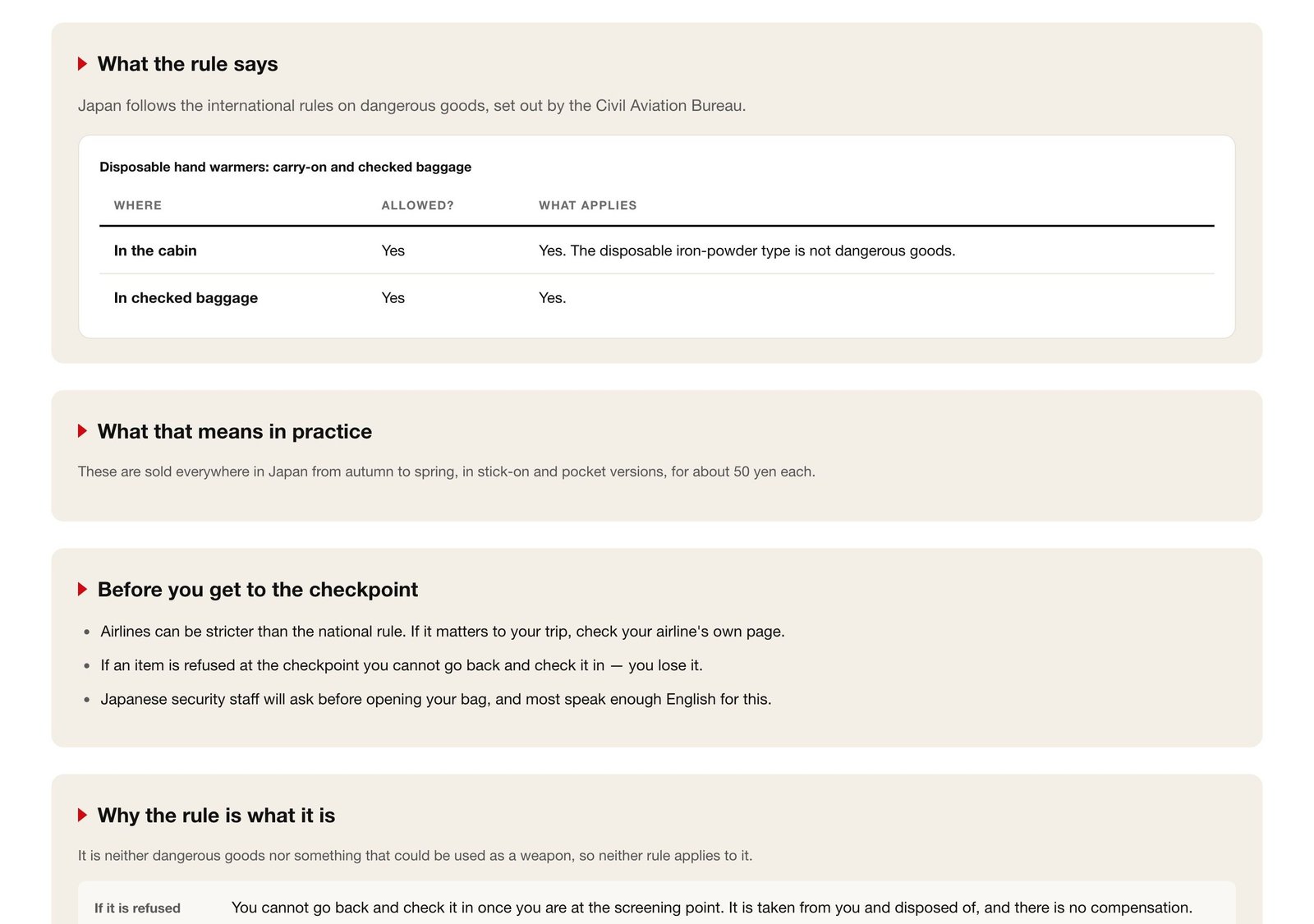
A disposable hand warmer helps. The iron-powder type is not dangerous goods, so it can go in your cabin bag or your checked bag. You may not need to pack any. Shops all over Japan sell them from autumn to spring, in stick-on and pocket versions, for about 50 yen each. Do not confuse them with refillable hand warmers. Fuel-burning and platinum catalytic warmers are not allowed in the cabin or in the hold. Our hand warmer page, shown below, sets out the rule in two lines: yes in the cabin, yes in checked baggage.
Going north
Ohara is the simplest escape. From Kyoto Station, bus no. 17 takes 40 minutes, according to JNTO’s Ohara page. The leaves there turn about one week earlier than the rest of Kyoto. The best-known temple is Sanzenin, a large complex with deep ties to the Imperial family. A walking trail links it with smaller temples in the mountains and leads on to the Otonashi Waterfall.
Jikkoin is a short walk from Sanzenin. Its garden has cherry trees that bloom in autumn, so you can see cherry blossoms and autumn leaves together. JNTO says the temple is generally quiet, as few guests visit except in the fall. You can sit with a cup of matcha and a Japanese sweet. Ohara also has a few ryokan with onsen if you want to stay the night.
Ohara is not the only option. JNTO’s Kyoto page says the Takao and Northern Kyoto areas are also easy to reach by bus from Kyoto Station. In northern Kyoto, the Keihoku and Miyama areas pair wide natural scenery with a traditional Japanese countryside.
Going in December
The observatory dates back up a December trip. In 2025 the Kyoto observatory’s maple turned red on 10 December, and its leaves did not fall until 22 December. JNTO’s window for the whole country also runs to early December. Keep in mind that 2025 ran late, with the red date 5 days later than normal. In an earlier year, the first week of December will sit closer to the end of the season.
You can follow the Kyoto dates on the agency’s maple page, where the 2026 column fills in once the tree turns. For the trip in from the airport, see our guides to Kansai Airport and Itami Airport.
What to pack for Kyoto in November
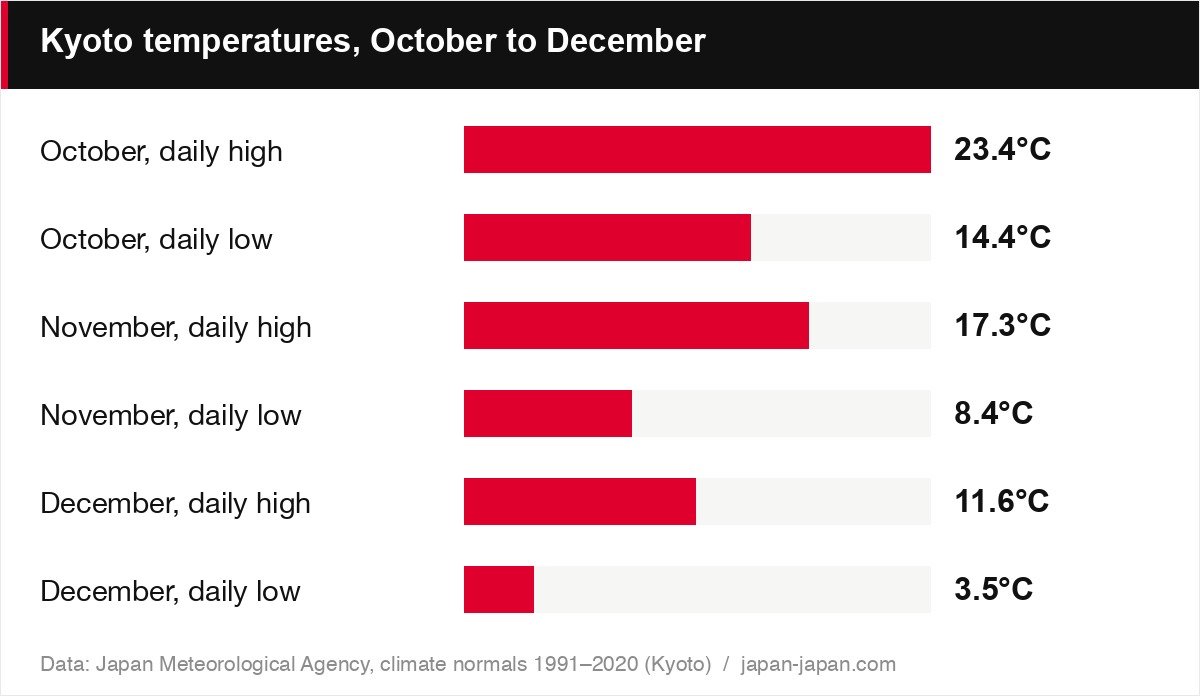
November in Kyoto is cool and fairly dry, with a wide gap between morning and afternoon. The Japan Meteorological Agency’s normals for Kyoto, averaged over 1991 to 2020, put the November daily mean at 12.5°C. That sits between October at 18.4°C and December at 7.2°C. The range within a day matters more than the average. In November the normal daily high is 17.3°C and the normal daily low is 8.4°C. October runs from 14.4°C to 23.4°C, and December from 3.5°C to 11.6°C.
Rain is less of a worry than in October. Kyoto’s normal rainfall is 143.2mm in October, 73.9mm in November and 57.3mm in December. So pack layers rather than rain gear. Wear a warm layer for the early queue and take it off by the afternoon. JNTO’s autumn guide gives the same advice: bring a few extra layers for the cooler evenings. The chart below sets the normal highs and lows for the three months side by side.
Pack for a wet day anyway. A folding umbrella can go in your cabin bag. A long umbrella with a metal point can be refused at the security checkpoint, so put it in checked baggage. You may not need to fly with one at all. Convenience stores in Japan sell clear plastic umbrellas for a few hundred yen, on almost every corner.
JNTO’s autumn guide also says to bring a camera for the autumn scenery. A camera can go in the cabin, and spare camera batteries must go there too. In checked baggage the camera itself is fine, but loose lithium batteries are not. If your camera bag goes in the hold, move the spare batteries into your hand luggage first.
If you want those photographs without people in them, you may also bring a tripod. A small tripod or a selfie stick is usually fine in the cabin. Anything over about 60cm, or with a heavy metal leg, can be refused. Tripods are allowed in checked baggage, so a full-size one is safer in the hold. A backpack for the day can go in the cabin as your personal item or your carry-on, as long as it fits the airline’s size limits. Before you close the suitcase, run through the four checks below.
Getting to Kyoto from Kansai and Itami airports
Kyoto’s two nearest airports are both in Osaka Prefecture. JNTO’s Kyoto page puts Itami about 1 hour from Kyoto and Kansai International about 1.5 hours away. If you are flying in from abroad, Kansai is the airport to aim for, because Itami handles domestic flights only.
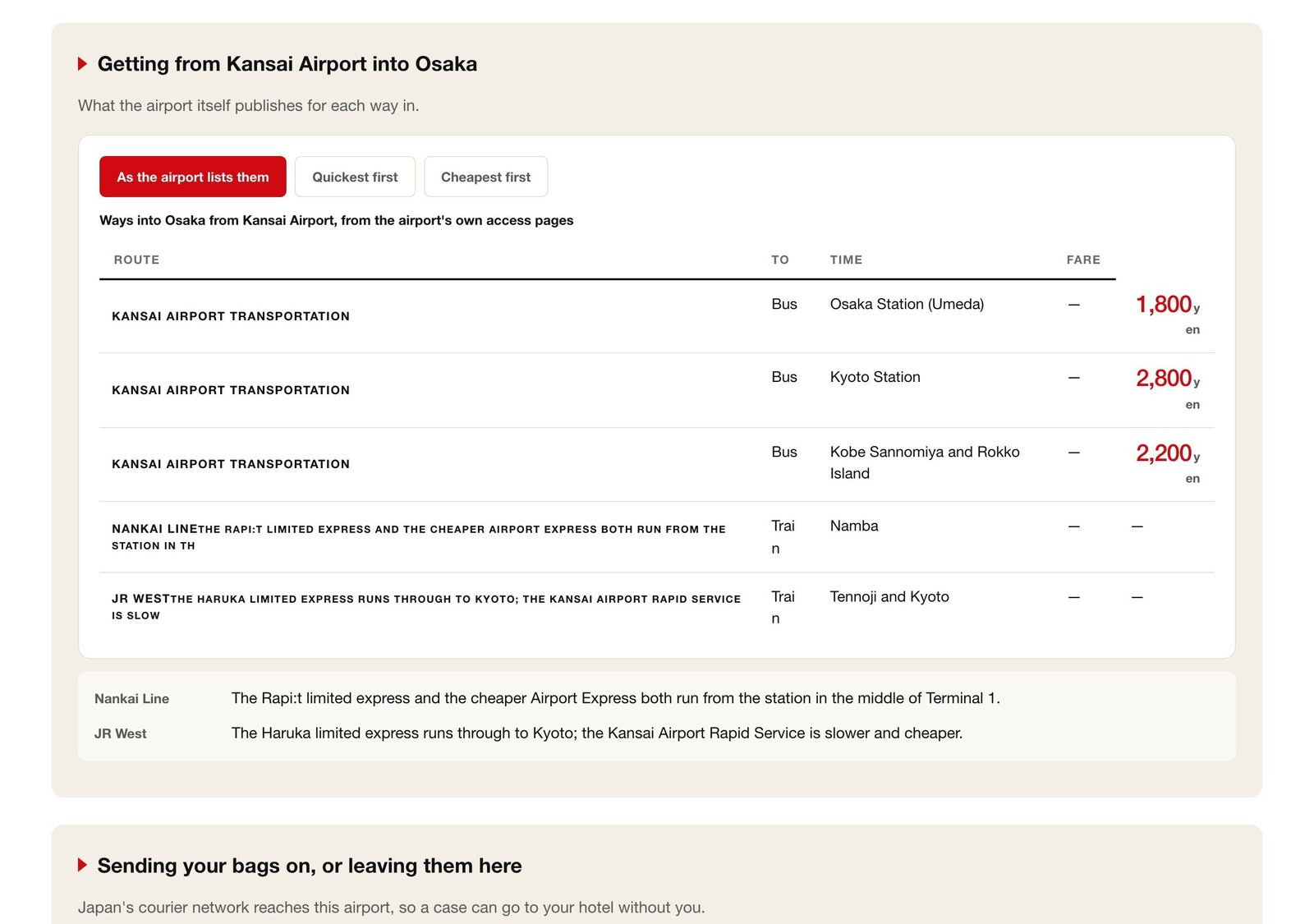
Our Kansai Airport guide describes it as western Japan’s international gateway, built on an artificial island in Osaka Bay. Terminal 1 takes most airlines. Terminal 2 is for Peach and Jetstar and sits a shuttle ride away. Trains run from the airport to Kyoto, and to Namba and Tennoji in Osaka. The limousine bus to Kyoto Station costs 2,800 yen.
The screenshot below comes from that guide. It lists each way out of the airport as the airport itself publishes it. For Kyoto, look at two rows: the bus to Kyoto Station at 2,800 yen, and the train to Tennoji and Kyoto.
Itami is Osaka’s city airport. If you land at Kansai and fly on within Japan, Itami is often where you leave from. It is also the way in if you are flying from another Japanese city. Buses run from Itami to Kyoto, as well as to Osaka Station (Umeda), Shin-Osaka, Namba and Kobe. The rail link is at Hotarugaike, for the Hankyu line. If you are already in Japan, JNTO notes that the Tokaido-Sanyo Shinkansen reaches Kyoto from Tokyo, Osaka, Nagoya and Fukuoka.
Both airports can take your suitcase off your hands. At Kansai, Yamato Transport has counters for sending bags on in Terminal 1, on North 4F and on 1F. At Itami the Yamato Transport counter is on 1F. In the leaf season, sending a suitcase ahead keeps it off buses and trains, which is what JNTO asks visitors to do. Our airport guides cover coin lockers and courier counters at each airport.
Rules in Gion, Kiyomizu and around Kyoto Station
Some of Kyoto’s rules carry penalties. Others are about respect for the people who live there. Everything below comes from JNTO’s Kyoto page.
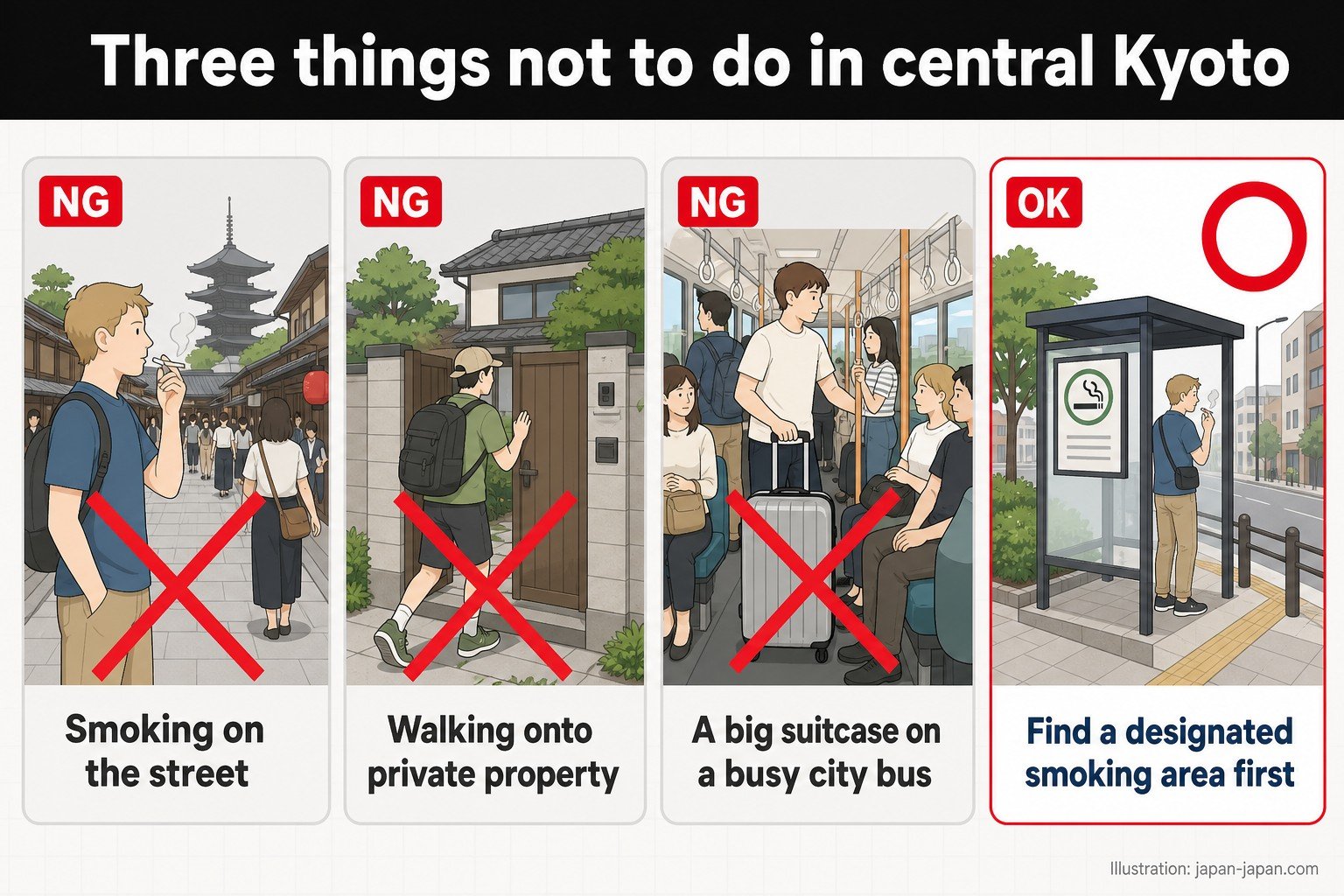
- Do not smoke on the street. Smoking on the street is strictly prohibited throughout Kyoto. In the city centre, including the Kiyomizu and Gion areas and around Kyoto Station, there are penalties for smoking outside designated areas. If you need to smoke, find a designated smoking area first, or you may be fined.
- Stay off private property. Do not walk onto private land or interfere with residents’ private lives, especially around Gion and the Ine boathouses.
- Let geiko and maiko pass. In Gion and Higashiyama you may see a geiko (the Kyoto word for geisha) or a maiko (a geisha in training). Do not stop them to ask for a photo, and do not touch their clothes. They are often in a hurry to reach their next appointment. If you want to meet a maiko, book a maiko experience at Gion Corner instead.
- Eat where you buy. At Nishiki Market, eat your food at the shop where you bought it and leave the rubbish there. Littering is strictly prohibited, so carry a plastic bag for rubbish in case there is no bin nearby.
The illustration below sums up three things to avoid in the busiest parts of the city.
Plan your evenings around closing times. Toji, with its five-storied pagoda, is open until 5pm daily, with last admission at 4:30pm, according to JNTO’s Kyoto at dawn and after dark guide. The pagoda is lit up at night and can be seen from a distance, and the temple often opens later for special events, with the gardens lit. Kyoto also holds night-time festivals, when temples and shrines stay open longer. Check what is on before you go.
FAQ
When do the autumn leaves peak in Kyoto?
In the city centre the peak is usually in the second half of November, and JNTO puts the autumn colour across Japan from mid-November to early December. In 2025 the ginkgo at the Japan Meteorological Agency’s Kyoto observatory turned yellow on 25 November, and its maple turned red on 10 December. Ohara, in the northern hills, turns about one week earlier than the rest of Kyoto.
What time should I get to a Kyoto temple in November?
Be there when the gate opens. At the most photographed temples the queue starts before opening, and JNTO lists Kiyomizu-dera as open from 6am. Opening times differ by temple and can change, so check before you go. Kyoto’s normal November low is 8.4°C, so dress warmly for the wait.
Is early December too late for autumn colours in Kyoto?
No. JNTO’s window runs to early December, and the first week still has colour in the city. In 2025 the Kyoto observatory’s maple turned red on 10 December, and its leaves did not fall until 22 December. Mornings are colder, with a normal December low of 3.5°C.
Where in Kyoto can I see autumn leaves with fewer people?
Go north. Ohara is 40 minutes from Kyoto Station on bus no. 17, and its leaves turn about one week earlier than the rest of Kyoto. JNTO also points to Takao and the Northern Kyoto area, both reached by bus from Kyoto Station. In the city, the lanes of Higashiyama fall quiet at dusk, after the daytime crowds.
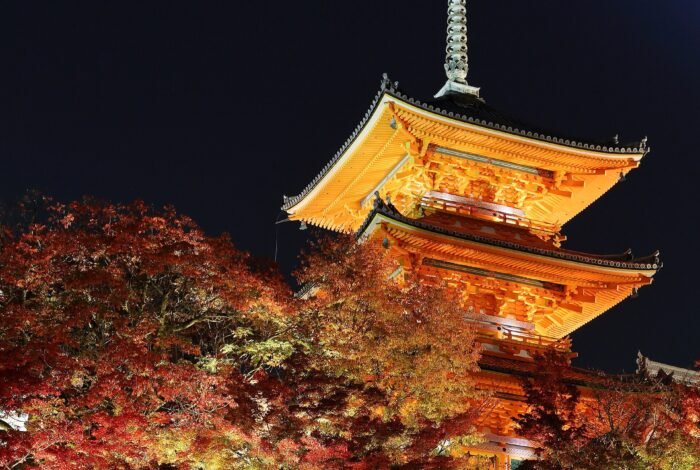
Photo: Kiyomizu-dera, Kyoto, November 2016 -07.jpg — Wikimedia Commons, CC BY-SA 4.0