Can You Use an Onsen With Tattoos in Japan? 2026 Rules
The rule is not a law, and it is not the same everywhere. Here is what to expect, and how to find a bath that will let you in.
By Shunta Fujii
Many hot springs in Japan display a sign saying guests with tattoos cannot enter. It is a house rule, not a law, and the reason is historical rather than aesthetic.
A sign on one door does not keep you out of every bath. You can pick a bath that accepts tattoos, book a private bath, take a room with its own bath, or cover a small tattoo with a sticker. The Japan National Tourism Organization (JNTO) publishes a list of tattoo-friendly onsen, and two towns on it are an easy start. At Dogo Onsen in Ehime, the baths in all three bathhouses accept tattoos. At Kinosaki Onsen in Hyogo, all 7 public baths do.
Where the rule is strictest
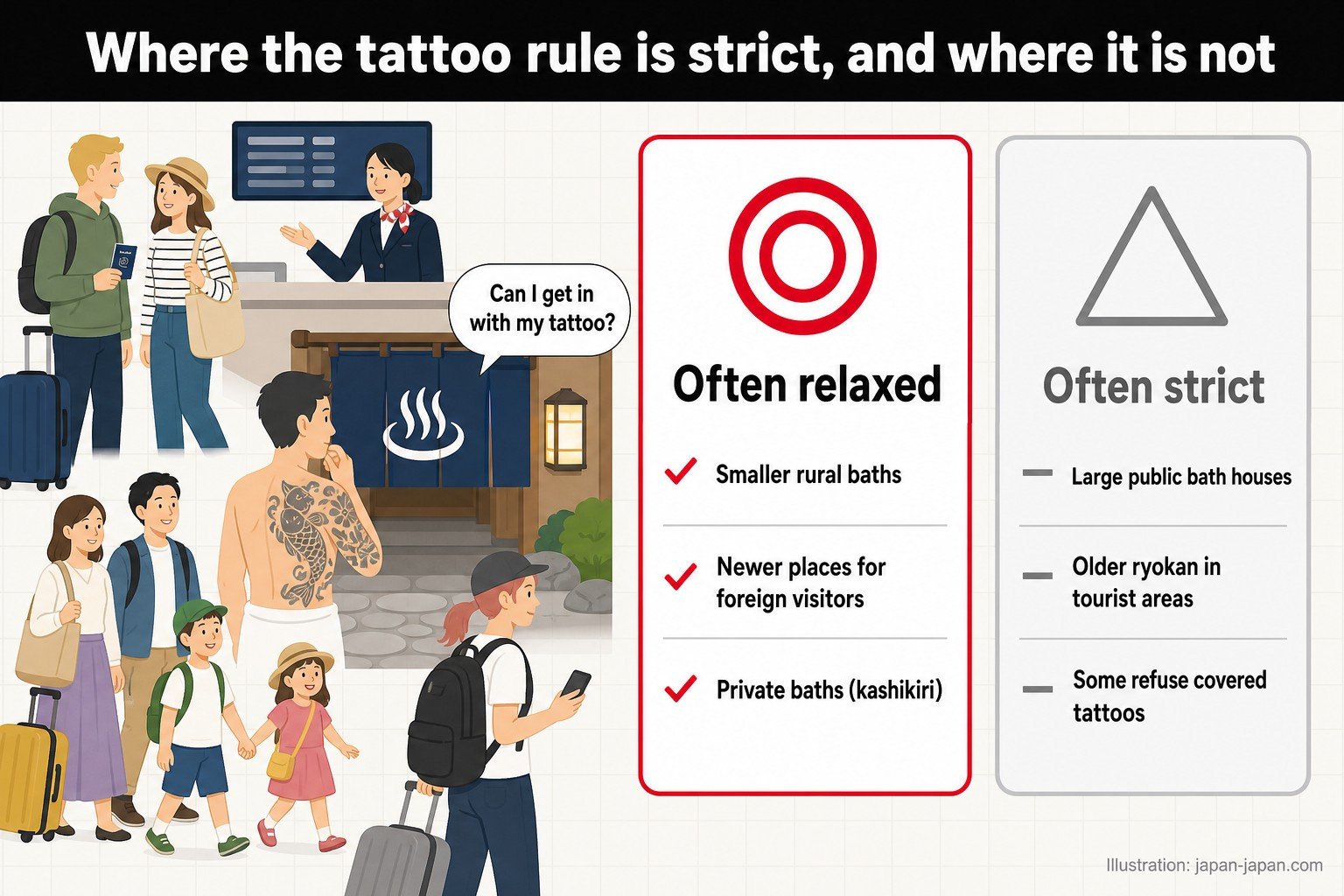
Large public bath houses and older ryokan in tourist areas tend to enforce it. Smaller rural baths and newer facilities aimed at foreign visitors often do not.
The illustration below sets the two kinds of place side by side, and adds private baths to the relaxed side.
The rule is not about how a tattoo looks. In Japan, tattoos are linked with organised crime, because Japanese gangsters are typically heavily tattooed. JNTO’s blog post Japanese Onsen and Ink says bath bans tend to come from a wish to keep other guests from feeling uneasy around people they see as dangerous. The Japanese word for tattoo, irezumi, carries the same link with crime and gangs.
The link is old. Long ago, tattoos were used as a punishment to brand criminals, and the government used them to keep track of offenders. In the Edo period (1603–1867), tattooing flourished as an art form. Criminals covered their brands with decorative designs, and many law-abiding people began getting tattoos too. Towards the end of the 19th century, the government outlawed tattooing, partly out of concern about how Japan looked in the West. The ban pushed tattooing underground until 1948, when the American occupation led to it being lifted. From the 1960s, films and television showed gangsters with tattoos, and the taboo stuck.
Each facility sets its own rule. In Kinosaki Onsen, all 7 public baths accept tattoos, yet each ryokan in the same town has its own rules. For public onsen, JNTO’s UK site calls the reality very case-by-case. Many owners do not mind. Other bathers will probably overlook a small tattoo in a hard-to-see place, and international visitors generally get more leniency.
At hotels and inns, a yes is still the minority answer. JNTO quotes a 2015 study by the Japan Tourism Agency. In it, about 30 percent of hotels and inns said a guest with a tattoo could use their shared baths. The number of tattoo-friendly onsen and sento is growing, partly because more tourists are coming. JNTO still says many do not allow tattooed guests.
It also helps to know the kinds of bath. An onsen uses water from a natural geothermal source. A sento is a neighbourhood public bath that uses ordinary heated water, and JNTO’s bath culture guide notes that some are marked only by the sign ゆ (yu, hot water). A super sento has a huge variety of baths plus extras such as massages and steam rooms. In its tips for tattooed visitors, JNTO suggests trying a local sento, where it says tattoos are typically accepted. It still advises checking first.
Three ways in
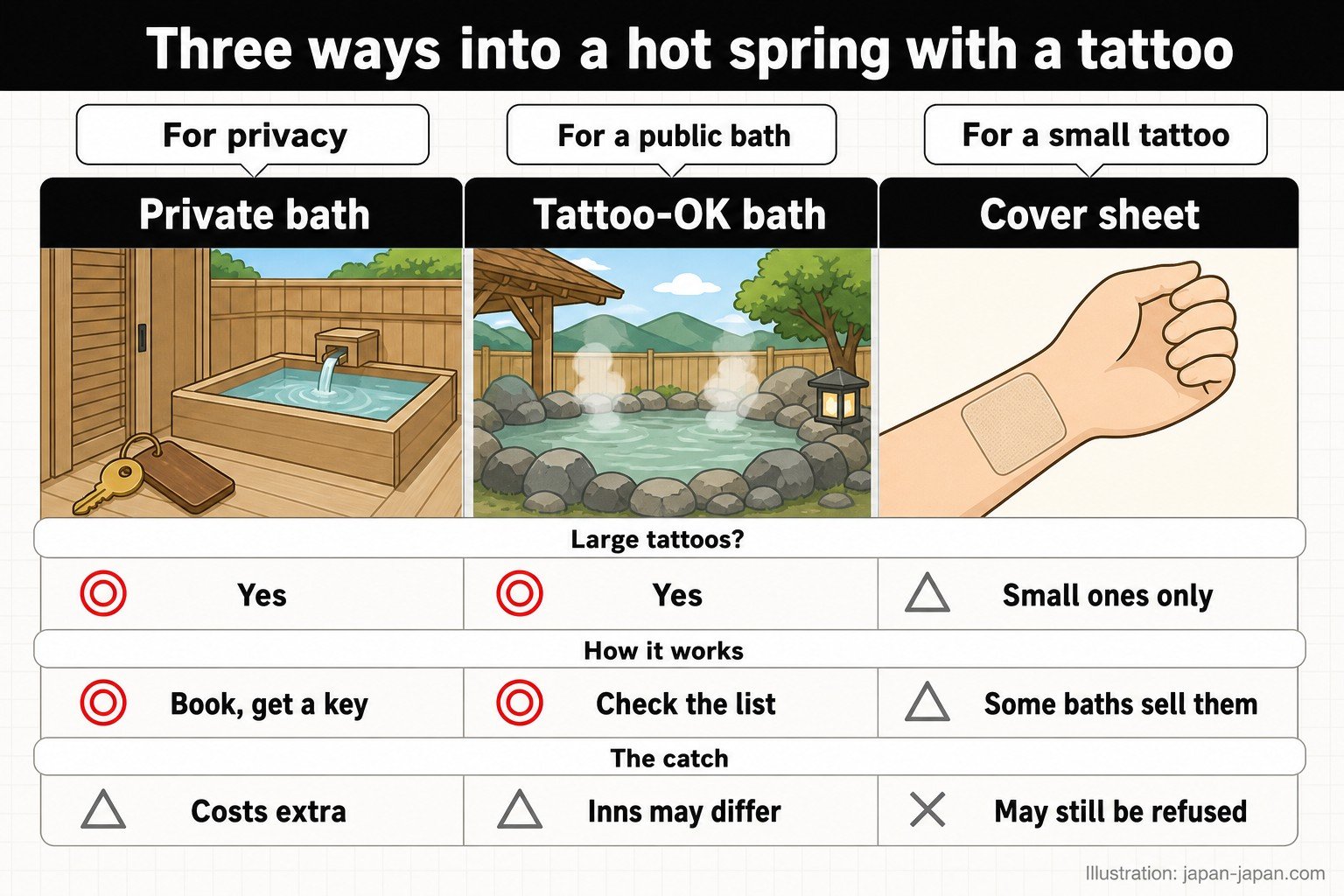
- Private baths. Most ryokan have a kashikiri — a family-sized bath you book by the hour. No one sees you, and the rule does not apply.
- Tattoo-friendly lists. A growing number of towns publish their own lists of baths that accept guests with tattoos. For a list that spans the country, start with JNTO’s 7 tattoo-friendly onsen in Japan.
- Cover it. Small tattoos can be covered with a skin-tone patch, sold at most drugstores. This does not work for large pieces.
The illustration below compares the three: whether a large tattoo is fine, how each one works, and the catch.
A private bath usually means a booking and an extra charge. JNTO says a kashikiri almost always comes at a cost. You reserve it in advance or at the front desk, where you receive a key. The shared bath at the same inn, by contrast, is almost always free for overnight guests. You can rent a kashikiri for a small group, so a partner, friend or family member can join you and split the bill. Some ryokan keep private baths in the main building that you reserve by the hour, which suits families who want to bathe together.
There is a fourth way in: a room with its own bath. Many ryokan and hotels offer rooms with a completely private en-suite onsen, and JNTO says the bath is included in the room price. Some rooms even have a small outdoor bath on the balcony. In its answer on tattoos, JNTO’s onsen guide suggests booking a private bath where you can relax all by yourself.
A cover sticker is the least certain option. It is a strip of skin-coloured plastic, almost like a plaster, and it only works for small tattoos. Some places will not allow tattoos even when they are covered, while others accept them under a certain size. Ask before you count on one.
Sometimes the answer is not a flat no. JNTO’s UK site says a bath may simply ask you to avoid peak times.
What to do if you are refused
Staff will usually apologise and explain. It is not personal and arguing will not change it. Ask whether they have a private bath — most do, and it is often only a few thousand yen.
The surest way to avoid a refusal is to ask before you go. JNTO’s onsen guide lists checking a bath’s tattoo policy in advance among its final tips. Look at the facility’s website first. If it says nothing about tattoos, email the facility and ask. JNTO’s UK site suggests doing this through your booking agency or online booking platform.
Read the signs too. JNTO says only a handful of onsen and sento advertise themselves as tattoo-friendly, on a sign or a website. More often, the sign forbids tattoos, which at least tells you where not to go. If there is no sign and you are unsure, ask whether tattoos are allowed.
JNTO’s UK site suggests these phrases for the front desk:
- Tatu ga haitte iru no desu ga, daijobu deshou ka? — I do have a tattoo, but am I okay to go in?
- Tatu ga haitte iru no desu ga, chiisai desu. — I have a tattoo, but it’s only small.
- Tatu wa koko ni haitte imasu. — My tattoo is here (point to it).
- Tatu shiiru ga arimasu ka? — Do you have any tattoo seals?
- Tatu ga haitte iru no desu ga, kashikiri-buro wa arimasu ka? — I have a tattoo. Do you have a private kashikiri bath?
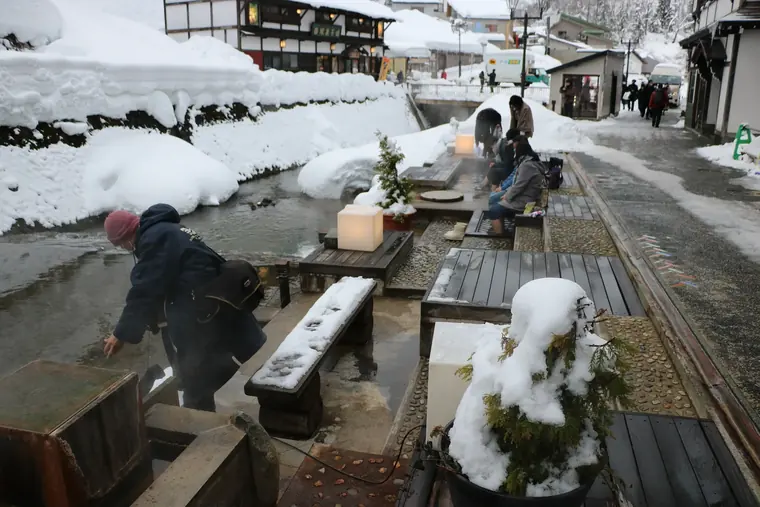
If the answer is still no, you can put your feet in. A foot bath, or ashiyu, is often found near a station or in the centre of town, with seats and a small roof. You stay dressed and soak only your feet. Kinosaki Onsen has foot baths around town that you can use for free.
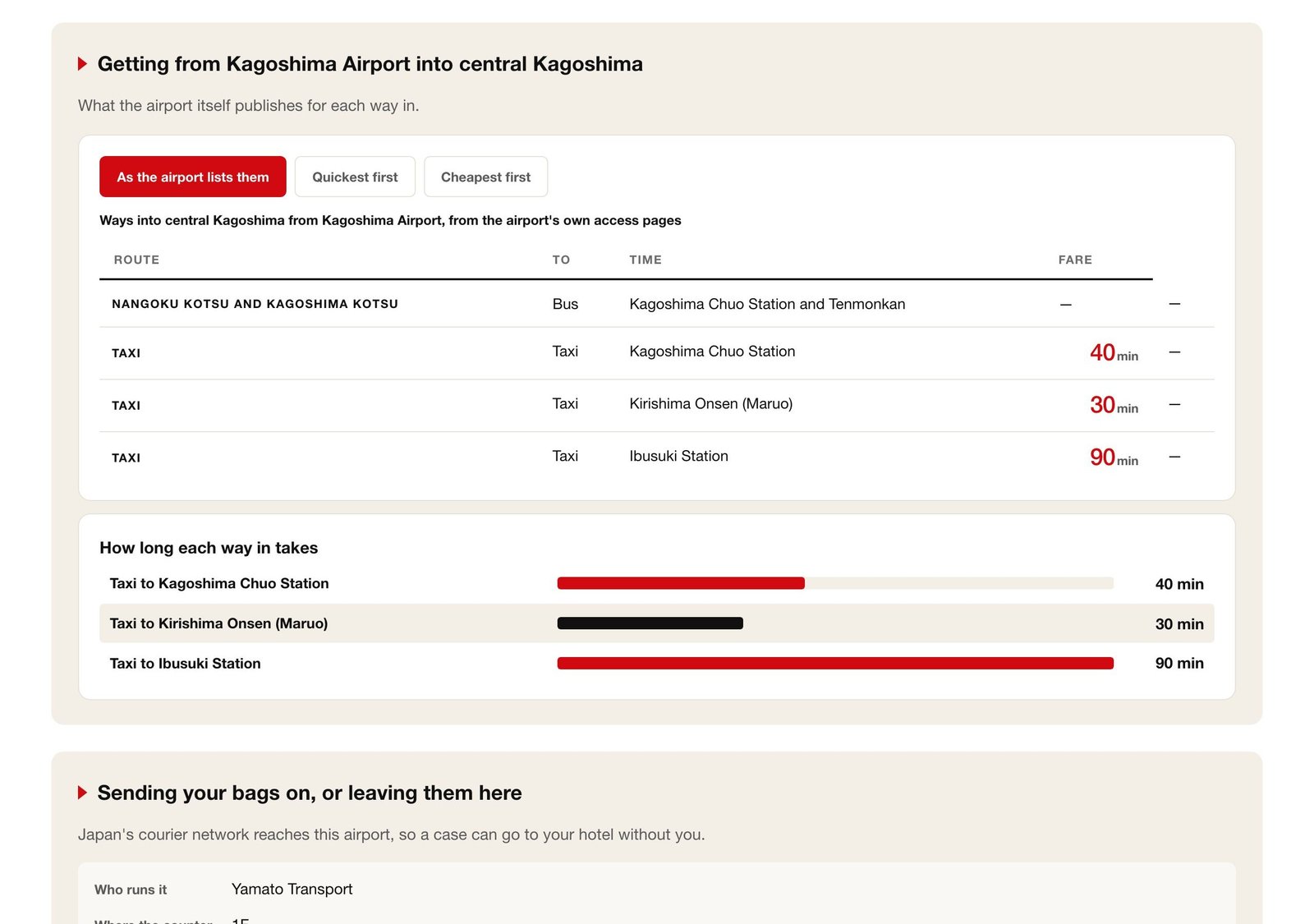
Kagoshima Airport has a free foot bath outside the terminal, and the airport sits near the hot springs of Kirishima. The screenshot below is from our Kagoshima Airport page. It lists each way out of the airport as the airport publishes it, including a 30-minute taxi ride to Kirishima Onsen (Maruo).
The other answer is to go where the public baths already accept tattoos.
Tattoo-friendly onsen towns, and how to get there from the airport
JNTO’s list of 7 tattoo-friendly onsen names individual baths. Two are in towns with a direct bus from the airport, one is a train ride from Kyoto, and one is close to Narita. You do not have to stay the night. JNTO’s onsen guide says many facilities in onsen towns offer day-use plans or drop-in bathing.
The chart below compares the trip from each airport, in minutes. Yufuin and Kirishima are on it for their access, not because JNTO lists them as tattoo-friendly.
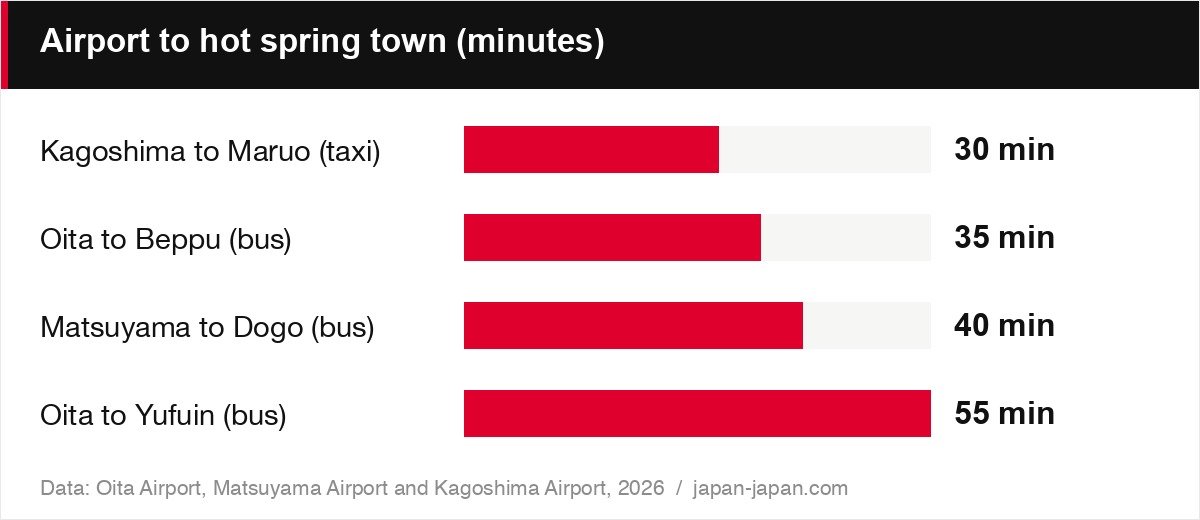
Dogo Onsen, Ehime: 40 minutes from Matsuyama Airport
Dogo Onsen is said to be one of Japan’s oldest hot springs, and it features in Natsume Soseki’s novel Botchan. Its symbol is Dogo Onsen Honkan, a three-storey wooden bathhouse recognised as a National Important Cultural Property. There are two more bathhouses: Asuka-no-Yu, with open-air baths in a style based on the Asuka period (550–710), and the more modern Tsubaki-no-Yu. JNTO says the baths in all three bathhouses are tattoo-friendly.
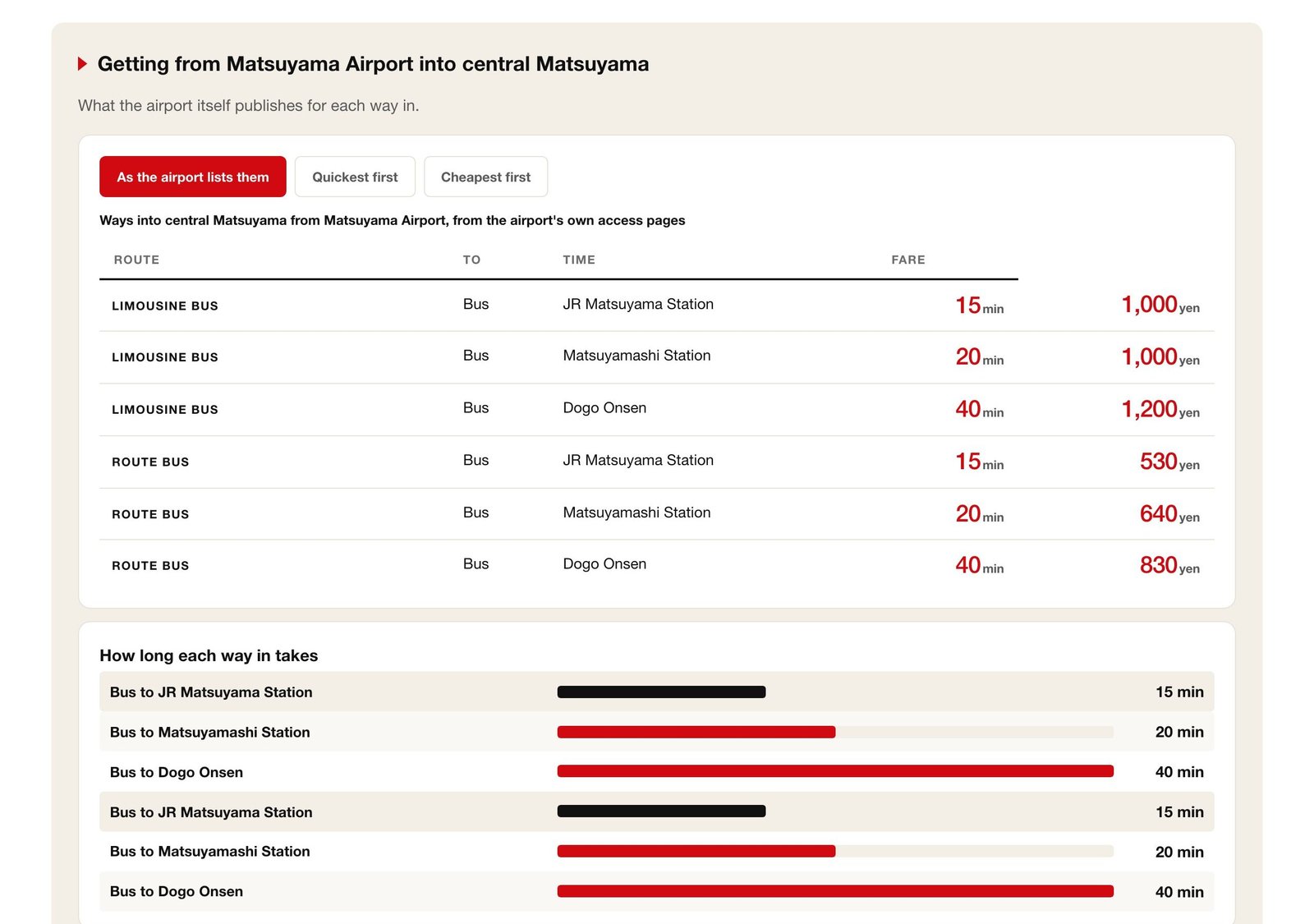
From Matsuyama Airport, the limousine bus reaches Dogo Onsen Station in 40 minutes. The adult fare is 1,200 yen in cash or 1,180 yen cashless, as of 1 April 2025. The ordinary route bus also stops at Dogo Onsen Station and costs 830 yen in cash or 810 yen cashless, as of 1 April 2026. Children pay half the adult fare, rounded up to the nearest 10 yen. The airport’s bus page links to the timetables for both.
The screenshot below is from our Matsuyama Airport page. It puts the two buses side by side, with the time and fare to each stop.
Beppu, Oita: 35 minutes from Oita Airport
Beppu is on JNTO’s list through Shibaseki Onsen, which has indoor, open-air, steam and private baths. The water comes at three temperatures, so beginners and regular bathers can each pick one that suits them.
From Oita Airport, the airport buses reach Kamegawa, the first stop in Beppu, in 35 minutes. The B bus goes on to JR Beppu Station, 53 minutes from the airport. No reservation is needed, and IC transport cards work on board. The airport’s bus page warns that departures can change when flights arrive late.
The same airport serves Yufuin. The Y bus runs nonstop on the expressway to JR Yufuin Station in 55 minutes. The adult fare is 2,000 yen one way. The airport’s taxi fare list puts a taxi to the station at 52 minutes and 18,500 yen. Check each bath’s rules on tattoos before you go, as you would anywhere else.
Kinosaki Onsen, Hyogo: 2.5 hours by train from Kyoto
Kinosaki Onsen has 7 public hot springs, all within walking distance of one another, and JNTO says all 7 are tattoo-friendly. If you stay at one of the town’s ryokan, you will usually get a pass to use the public baths free during your stay. Otherwise, you can buy a day pass that covers all 7. Each ryokan sets its own tattoo rules, so check yours when you book. Kinosaki is 2.5 hours by train from Kyoto City.
Yamato-no-Yu, Chiba: about 40 minutes from Narita Airport
JNTO puts Yamato-no-Yu about 40 minutes from Narita Airport, so it can fit into the first or last day of a trip. There are 8 open-air baths, including wooden tubs and Jacuzzis. You can also reserve a room with its own private outdoor bath. Children must be of primary school age or older.
Kirishima Onsen, Kagoshima: 30 minutes by taxi from Kagoshima Airport
Kagoshima Airport is near the hot springs of Kirishima. A taxi to Kirishima Onsen (Maruo) takes about 30 minutes and covers about 21 km. Taxis wait outside Exit 2 of the domestic terminal. The airport’s taxi page notes that times and fares can change with road conditions. Ask each inn or bath in Kirishima about its tattoo rules before you book.
Onsen manners that matter as much as the tattoo rule
With a tattoo, other bathers may notice you first. Getting the rest of the etiquette right gives them nothing else to object to. The same rules apply in every bath, private or public, and JNTO calls etiquette crucial for a relaxing onsen experience.
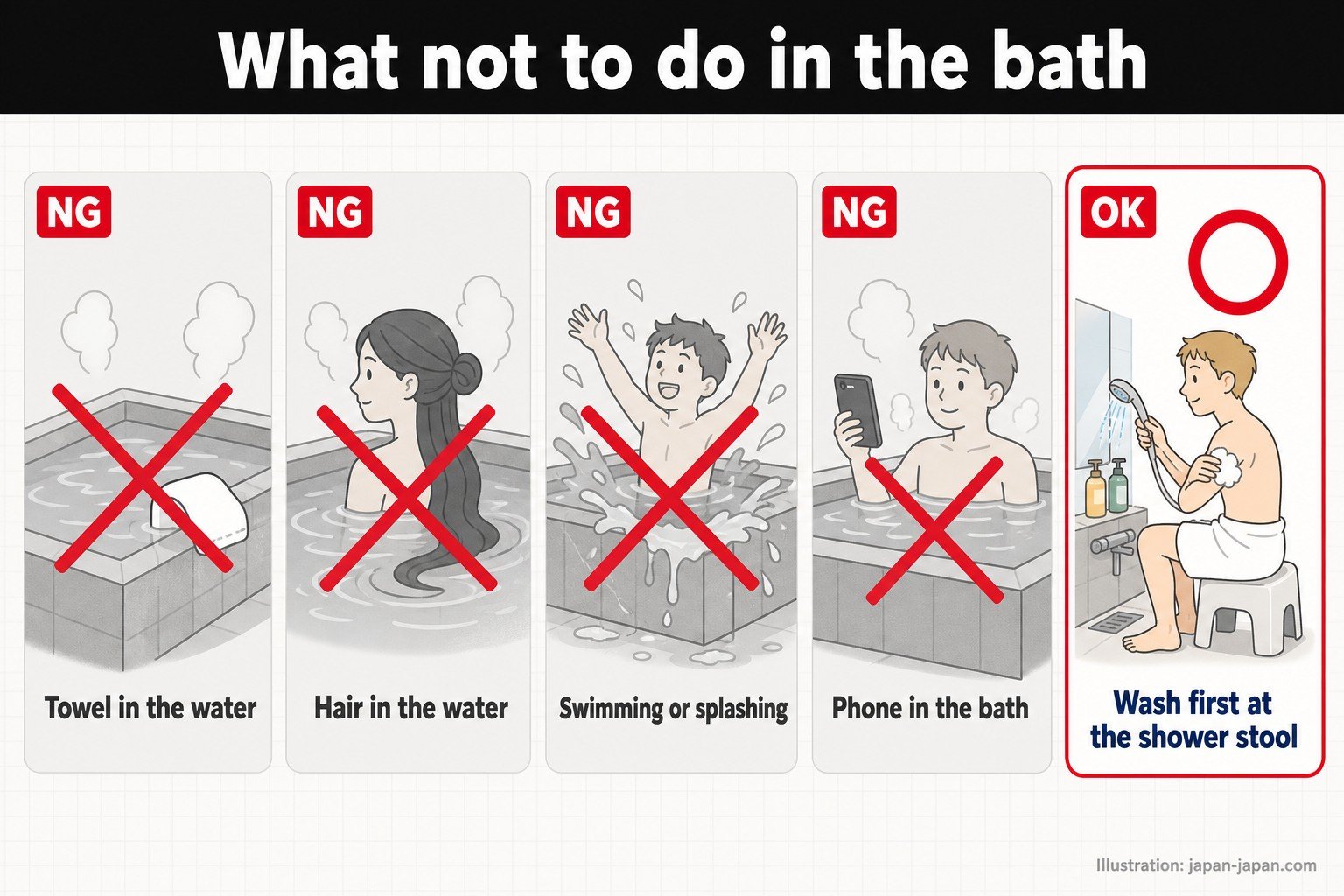
The illustration below shows four things not to do in the water, and the one thing to do before you get in.
- Undress completely. Onsen bathing is done in the nude, so leave all clothing, including swimwear, in the changing area.
- Wash before you get in. Sit at a washing station, where you will find a bucket, a stool, often a hand-held shower, and soap and shampoo. Wash your whole body, rinse off completely and remove any make-up. Then pour hot water over yourself, called kakeyu, to get used to the heat.
- Keep the small towel out of the water. Use it to wash, or to cover yourself on the way to the bath. Before you get in, fold it and put it on your head or on the side of the bath.
- Keep your hair out too. Tie up long hair or wrap it in a towel, and do not put your head under, even if your hair is short.
- Stay quiet and leave your phone behind. Speak softly in the changing and bathing areas. Phones and cameras are absolutely forbidden in the bath, to protect other people’s privacy, particularly children’s. Do not swim or splash.
- Do not stay in too long. JNTO’s UK site gives about 30 minutes as the most you should stay in a hot spring. Get out for a drink of cool water if you feel too hot, and do not drink alcohol before a bath.
What to pack, and what to bring home
Pack light for the bath itself. JNTO’s UK site says onsen changing rooms almost always have free shampoo, body wash and conditioner, plus hair dryers and even beauty products. You do not need full-size bottles or your own hair dryer. Onsen hotels and more upscale baths also provide towels and soap. A small local sento is different, so bring your own soap and towels there. If your hair is long, pack a hair tie.
If you plan to use cover stickers, get them before you reach the bath. JNTO’s UK site points to the chain store Don Quijote and online shops. Some onsen sell them at the front desk, but not all.
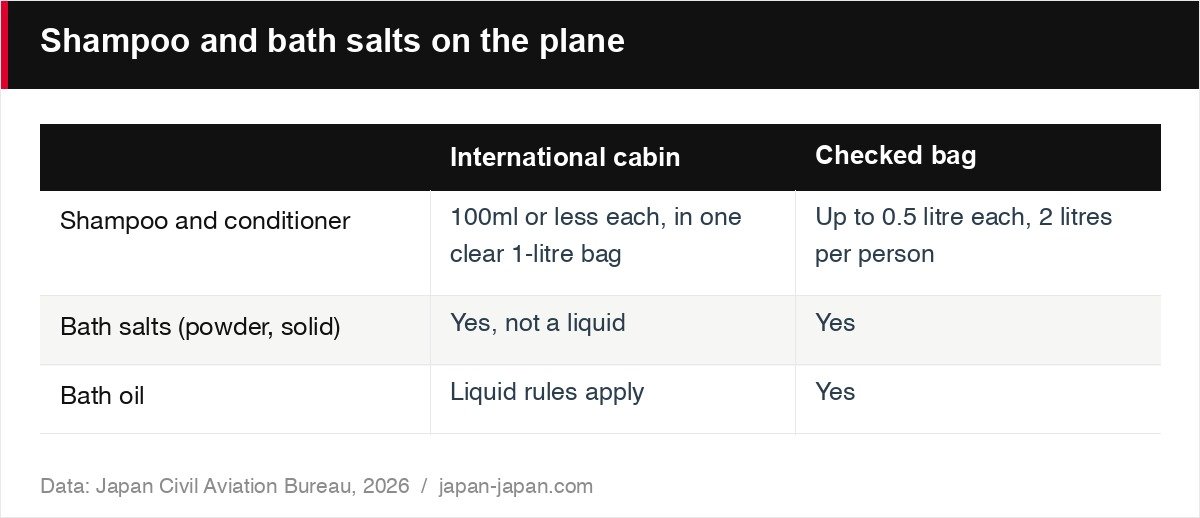
If you do bring your own shampoo or conditioner, the liquid rules apply on the plane. On international flights, each container in your cabin bag must be 100ml or less. All of them go in one clear resealable bag of 1 litre or less, one bag per person. Domestic flights within Japan do not use the 100ml rule. In checked baggage, each container can hold up to 0.5 litres, with 2 litres per person in total. Our shampoo and conditioner page has the limits from Japan’s Civil Aviation Bureau, and our list of what you can bring covers 143 items.
Bath salts make a good souvenir from an onsen trip, and they are sold in every drugstore in Japan. Powder and solid bath salts are not liquids, so the liquid rules do not apply to them in the cabin. Bath oil is different: it counts towards the liquid limits. Both can go in checked baggage. Our bath salts and bath oil page has the rule from the Civil Aviation Bureau.
The table below puts the plane rules for shampoo, bath salts and bath oil side by side.
FAQ
Is it against the law to go into an onsen with a tattoo in Japan?
No. The ban is a house rule that each facility sets for itself, not a law. It comes from history: tattoos were once used to brand criminals and later became linked with organised crime. Japan’s own ban on tattooing ended in 1948.
Will a tattoo cover sticker get me into an onsen?
Sometimes, if the tattoo is small. Some places will not allow tattoos even when they are covered, while others accept them under a certain size. Ask the facility before you go, and look for a private bath if the answer is no.
Which onsen towns are known to be tattoo-friendly?
JNTO lists Dogo Onsen in Ehime, where the baths in all three bathhouses accept tattoos, and Kinosaki Onsen in Hyogo, where all 7 public baths do. Its list also includes Shibaseki Onsen in Beppu and Yamato-no-Yu, about 40 minutes from Narita Airport. At Kinosaki, each ryokan still sets its own rules.
Do I need to book a private onsen in advance?
Yes, either in advance or at the front desk when you arrive. JNTO says a private kashikiri bath almost always costs extra and must be reserved, and the front desk gives you a key. To skip that step, choose a room with its own en-suite onsen, which is included in the room price.
Photo: Takanoyu Onsen Rotenburo 003.JPG — Wikimedia Commons, CC0