Can You Bring a Power Bank on a Plane to Japan? 2026 Rules
Yes, in your carry-on only: 160Wh or less, two per person at most. Since 24 April 2026 Japanese airlines also ban charging with one on board.
By Shunta Fujii
Short answer: a power bank goes in your carry-on bag, never in checked baggage, and Japanese airlines allow two of 160Wh or less per person. Keeping power banks out of checked baggage is a safety rule that applies to every airline flying in and out of Japan.
On Japanese airlines, two more limits have applied since 24 April 2026. You may carry no more than two power banks, each rated 160Wh or less. You also may not charge with one on board: not the power bank itself, and not your phone from it. Japan’s transport ministry (MLIT) set these rules in a notice written in Japanese only. This guide sets out what it says in English, next to the English pages of ANA, Skymark, Peach and StarFlyer.
The capacity limits
Power banks are rated in watt-hours (Wh). The number is usually printed on the back in small text, or you can work it out from the mAh and voltage.
- Under 100Wh — fine, no approval needed. Almost every phone-sized power bank is here.
- 100Wh to 160Wh — allowed with the airline’s approval, usually two per person. Large laptop banks are here.
- Over 160Wh — refused. It cannot fly as passenger baggage at all.
Since 24 April 2026, a count limit sits on top of these bands. MLIT now allows two power banks per person in the cabin, each 160Wh or less, whatever their size. Two small phone banks are fine. A third one is not, however small it is. The government’s guide to what you cannot take on a plane (2026 edition, in Japanese) gives the same limit: 160Wh or less, two per person.
If the label shows only mAh and volts, work out the watt-hours yourself: Wh = mAh ÷ 1000 × V. Use the rated capacity and the rated voltage printed on the case. Some products carry no Wh figure at all, and the government guide suggests asking the maker before you travel. ANA warns that it may refuse to carry an item if it cannot confirm before departure whether the item can fly.
Spare batteries are counted separately from power banks. A spare camera battery is the usual example. The government guide sets these limits for spares:
- 100Wh or less — no limit on the number.
- Over 100Wh up to 160Wh — two at most, and any power bank over 100Wh counts towards the same two.
- Over 160Wh — not allowed on board.
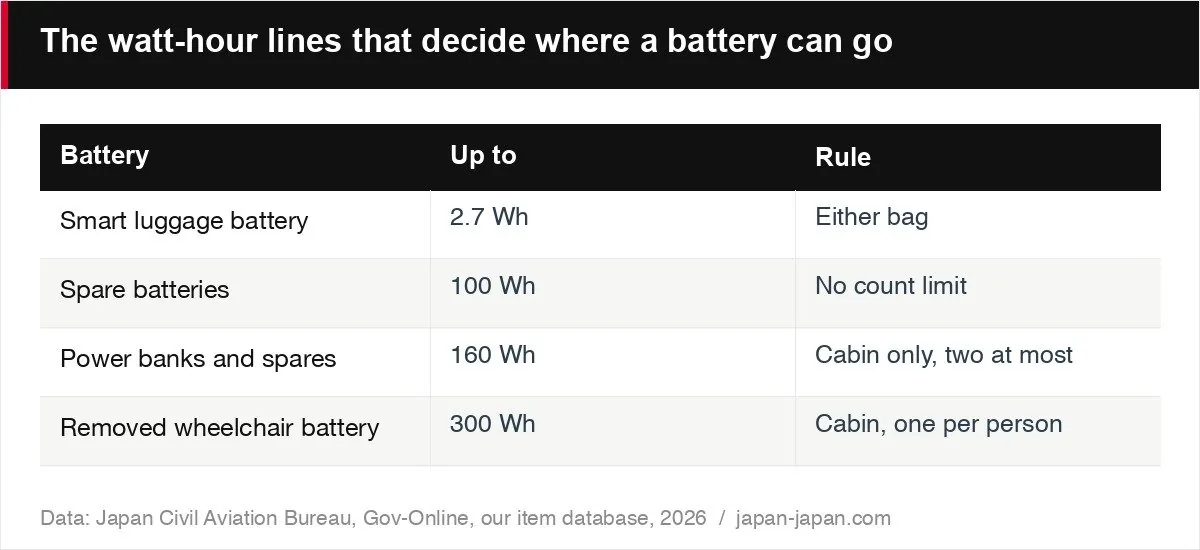
| Battery | Up to | Rule |
|---|---|---|
| Smart luggage battery | 2.7 Wh | Either bag |
| Spare batteries | 100 Wh | No count limit |
| Power banks and spares | 160 Wh | Cabin only, two at most |
| Removed wheelchair battery | 300 Wh | Cabin, one per person |
Protect every power bank and spare battery against short circuits. Put insulating tape over the exposed terminals, or keep each one in its own pouch or case. ANA asks for tape or a plastic bag. Skymark also asks you to keep power banks and spare lithium-ion batteries in separate bags. Our power bank entry lists the same bands, and our batteries entry covers AA, AAA and rechargeable cells.
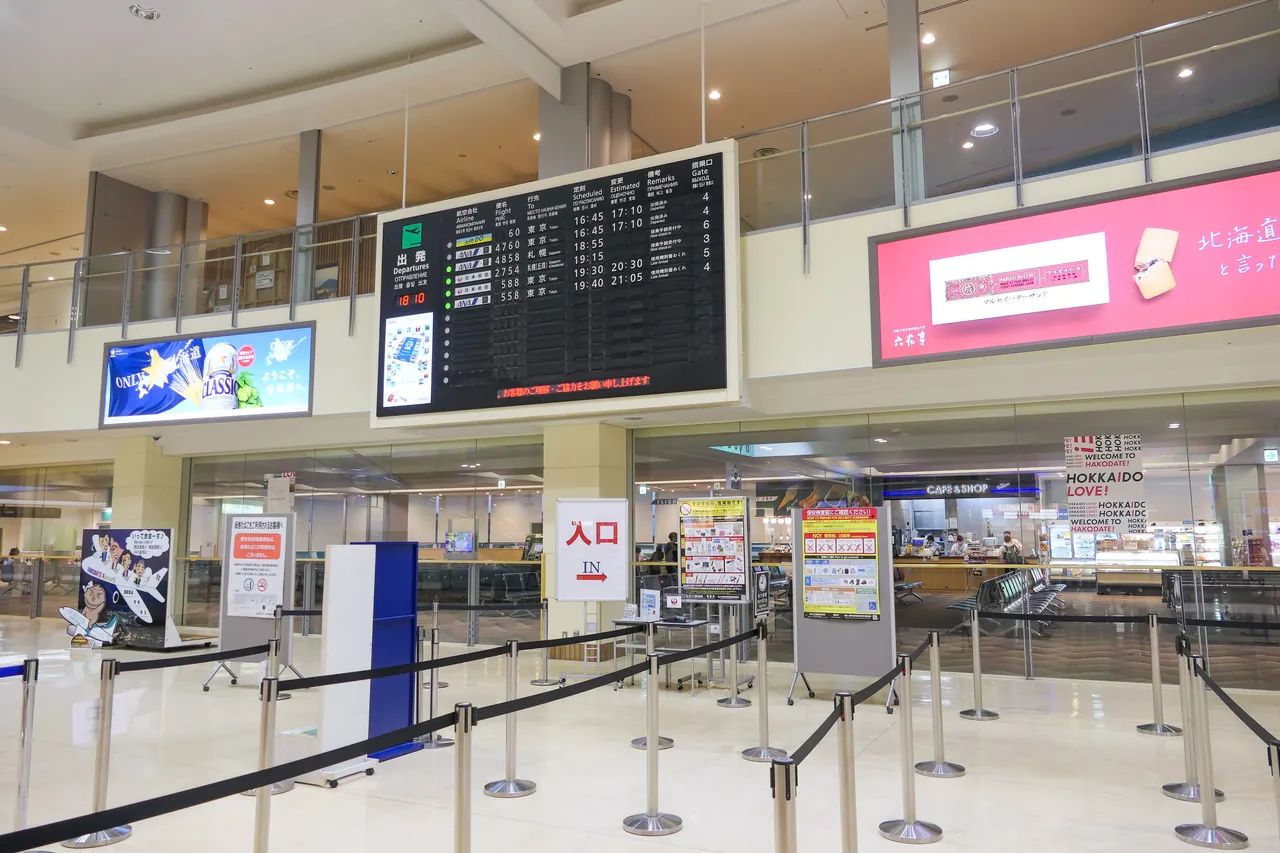
What happens if you pack it in the hold
Japanese airports screen checked baggage for lithium cells. If one is found, your bag is pulled off the belt and you are called back to the counter — which means missing your flight if you are already at the gate.
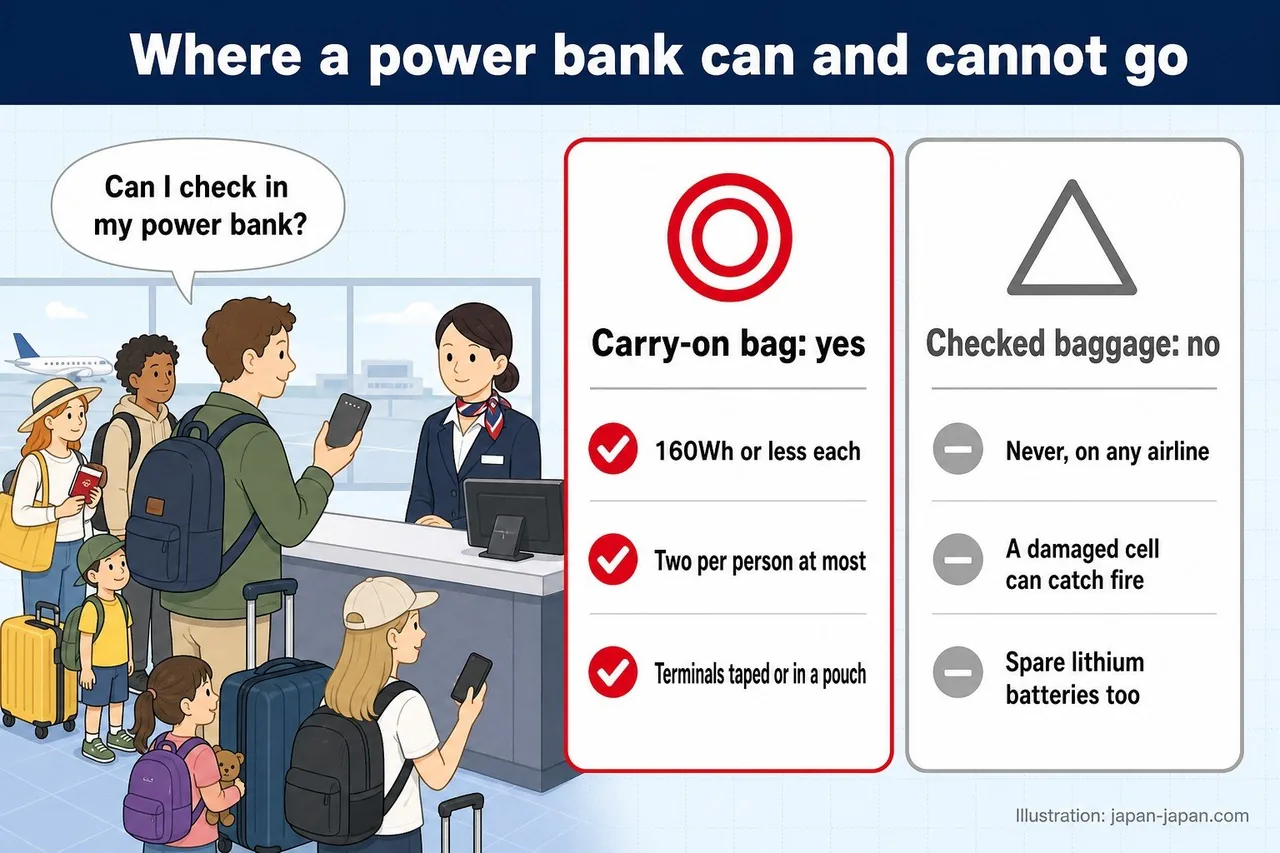
The rule exists because of fire. MLIT’s July 2025 notice explains that the lithium-ion cells in a power bank can overheat or catch fire. A knock from outside can short-circuit the cells inside, and overcharging can do the same. The government guide draws the practical line: a damaged power bank can catch fire through thermal runaway, so it must travel in the cabin. MLIT bans power banks from checked baggage under the international standard set by the International Civil Aviation Organization (ICAO).
Power banks have smoked or caught fire in aircraft cabins in Japan and abroad, MLIT says. On Japanese airlines, each case was spotted early and handled properly. Early detection is also why MLIT asks you to keep a power bank where you can see it, as the next sections explain.
The same ban covers other loose lithium batteries. Spare lithium batteries, including spare camera batteries, must travel in the cabin, while alkaline and dry cells can go in the hold. E-cigarettes, vapes and heated tobacco devices cannot go in checked baggage either, as our e-cigarette entry shows. The government’s table puts them next to power banks: cabin yes, hold no, and no charging on board.
At the security checkpoint the risk is different. Screeners may find an item that counts as dangerous goods. If you have no time to leave it in an airport locker, you may have to give it up on the spot. If you carry dangerous goods, tell the staff at the check-in counter or the security checkpoint. If you are unsure whether something counts, ask your airline.
Devices with a built-in battery follow gentler rules. Phones, laptops, wireless earphones and electric shavers can go in either the cabin or the hold, with conditions. They are covered item by item further down.
Using it on board
Since 2025, several Japanese carriers ask that power banks stay in sight rather than in the overhead bin while in use. Keep it in the seat pocket or your lap, not above your head.
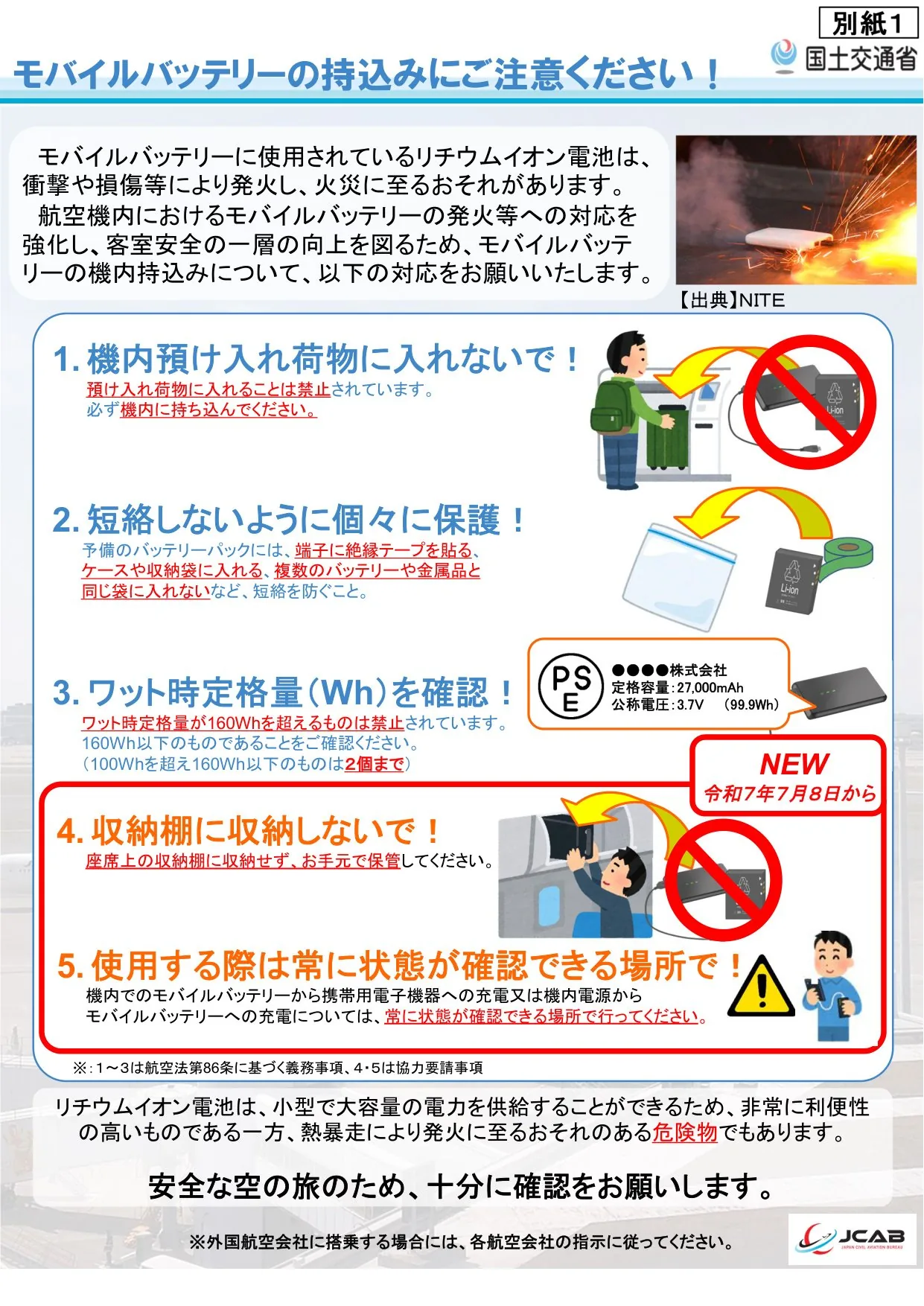
The request came from MLIT, and it covers more than the time you use the power bank. MLIT announced it on 1 July 2025. Working with the Scheduled Airlines Association of Japan, it had all of Japan’s scheduled airlines make two requests to passengers from 8 July 2025:
- Do not put a power bank in the overhead bin above your seat.
- When you charge a phone from a power bank, or charge a power bank from the seat outlet, do it where you can always see the power bank.
The first request applies for the whole flight. The aim was to spot smoke or fire early. The same notice tells passengers on foreign airlines to follow the instructions of their airline. From 24 April 2026 the second request became a ban on charging with power banks altogether, as the next section explains.
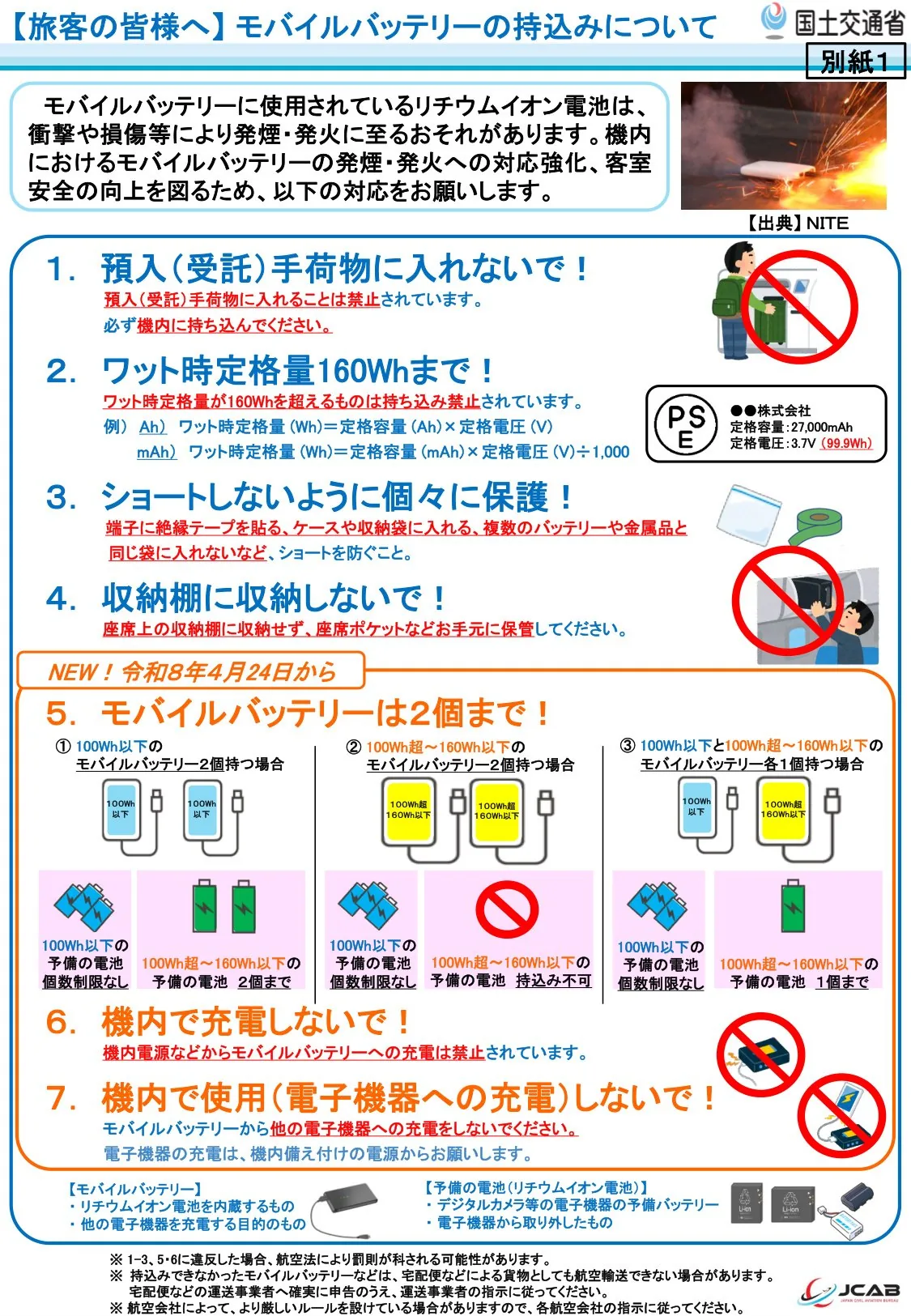
Below is MLIT’s July 2025 notice for passengers, in Japanese. The two requests sit in the red box marked NEW.
StarFlyer’s English page, which calls them mobile batteries, turns the MLIT requests into four instructions:
- Do not store power banks in the overhead compartments. Keep them with you, or somewhere you can watch them, such as the seat pocket in front of you.
- Do not use power banks. To charge a device, use the USB ports or power outlets on board.
- Do not charge power banks from the aircraft’s power supply.
- Cover the terminals with tape, or put the power bank in a plastic bag.
StarFlyer also asks you to tell the cabin crew at once if you notice anything unusual. The government guide lists the signs: the power bank heats up, swells, smokes or catches fire. StarFlyer adds that heated tobacco devices and e-cigarettes may not be charged anywhere on the aircraft. Our StarFlyer page lists its cabin bag size and weight.
This is one of 143 items we have checked against the official rules. The full list is in our What you can bring database, and our power bank entry puts the limits in this article on one card.
What changed on 24 April 2026
MLIT announced new power bank rules on 14 April 2026, and they applied from Friday 24 April 2026. They follow an emergency amendment to the international standard, because lithium battery fires on aircraft have been rising worldwide. The ICAO Council approved the amendment on 27 March 2026 (local time) and applied it the same day. Japan then changed its own standards to match.
MLIT lists three additions to the rules already in place:
- Two power banks at most in the cabin, each 160Wh or less.
- No charging a power bank on board.
- No charging other devices from a power bank on board.
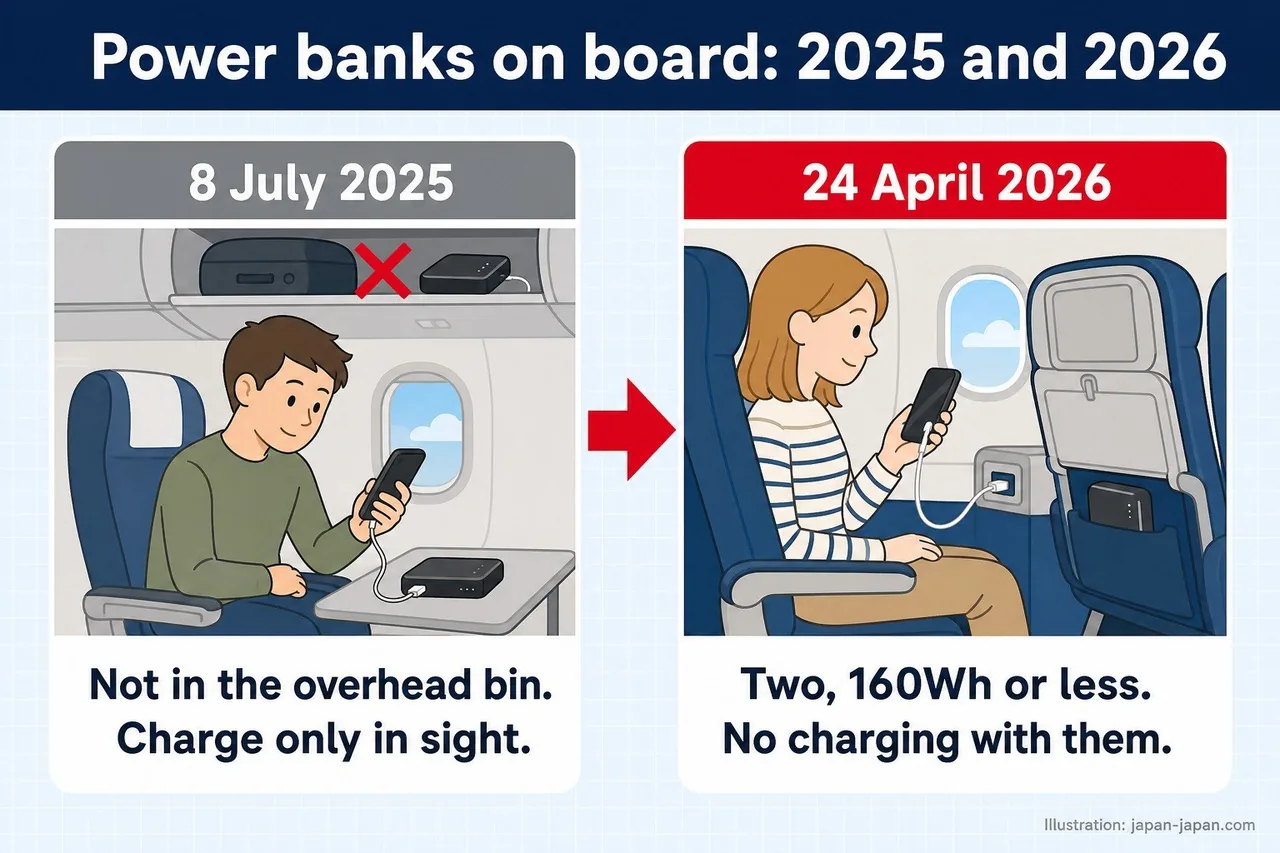
The checked-baggage ban and the capacity limits were already in force. The new parts are the count of two for every power bank and the end of charging with one in flight. If your phone runs low, use the seat’s USB port or power outlet instead.
MLIT’s April 2026 notice for passengers, in Japanese, is below. The older rules come first. The orange box marked NEW holds the new ones.
Each airline publishes the rules in English in its own words. ANA’s international baggage page applies them to flights boarding on or after 24 April 2026, so they cover ANA’s international flights, not only domestic ones. ANA explains the change as following ICAO’s new standard and MLIT’s revised guidelines. Its list: no power banks in checked baggage, 160Wh or less, up to two per person, and terminals protected with tape or a plastic bag. Charging power banks from the in-flight power outlet is prohibited, and ANA asks you to refrain from using them to charge other devices.
Skymark’s cabin baggage page numbers its measures one by one. Power banks travel as carry-on only, at 160Wh or less each, and no more than two per passenger. Keep them in separate bags from spare lithium-ion batteries, and out of the overhead compartments. Do not charge them from in-seat power outlets or USB ports, and do not use them to charge other devices on board. Skymark marks five of these measures, including both charging bans, as rules whose violation may bring penalties under the Civil Aeronautics Act.
Peach’s carry-on page presents the rules as required by MLIT. You may bring at most two power banks of 160Wh or less. Keep them with you at your seat and within sight, never in the overhead compartment. You may not charge a phone or other device from a power bank during the flight. You may not charge a power bank from the seat’s USB port or power outlet either.
The power bank rules are the same in substance on all four airlines. Cabin bag weight is not. ANA and Skymark allow 10kg in total for a bag and a personal item, while Peach allows 7kg for its two items. Check our pages for ANA, Skymark and Peach before you pack.
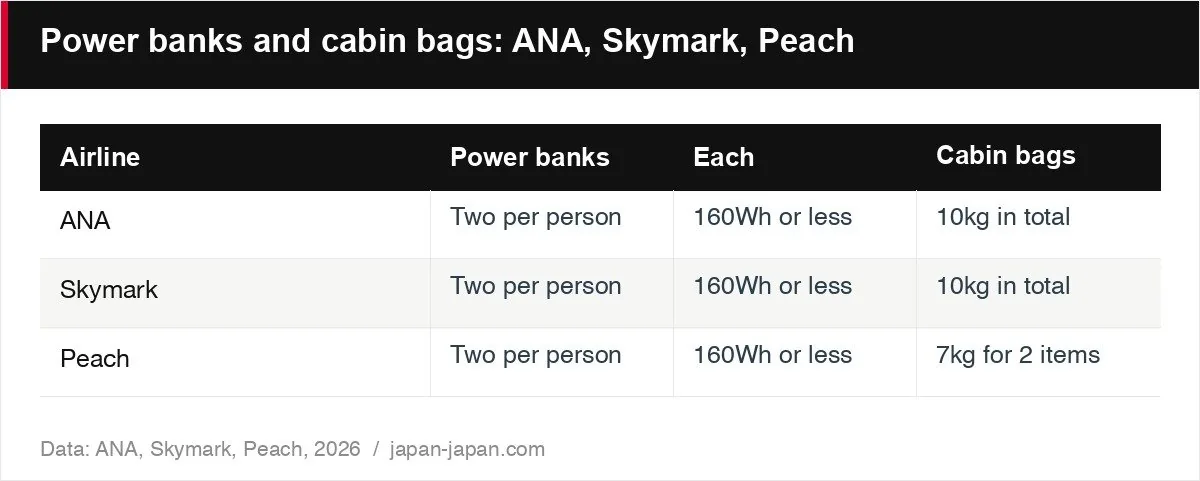
| Airline | Power banks | Each | Cabin bags |
|---|---|---|---|
| ANA | Two per person | 160Wh or less | 10kg in total |
| Skymark | Two per person | 160Wh or less | 10kg in total |
| Peach | Two per person | 160Wh or less | 7kg for 2 items |
Laptops, cameras and other things with a lithium battery
Most devices with a battery built in can travel in either bag, with conditions. This table sums up the entries in our item database.
| Item | In the cabin | In checked baggage |
|---|---|---|
| Laptops | Yes. Take it out of your bag at the X-ray in most Japanese airports. | Allowed if the battery is under 160Wh and the laptop is switched fully off. |
| Tablets and smartphones | Yes. | Allowed if switched fully off and protected from damage. |
| Cameras | Yes. Spare camera batteries must be in the cabin. | The camera yes, loose lithium batteries no. |
| Smart luggage | Only if the battery can be removed. Up to 2.7Wh: fine either way. Between 2.7Wh and 160Wh: cabin only unless the battery comes out. Over 160Wh: not allowed. | Only with the battery taken out. The removed battery goes in the cabin. |
| E-cigarettes and heated tobacco | Yes. You cannot use or charge them on board. | No. |
| Electric wheelchairs | A removed battery up to 160Wh: two per person. Up to 300Wh: one per person. | The chair itself, with the battery secured against short circuits. |
| Massage guns | Yes, with a built-in lithium battery under 160Wh. | Allowed if it switches fully off. |
Laptops, phones and tablets. In your cabin bag, protect a laptop or tablet with a case or clothing, the government guide says. If you check one in, switch it completely off, because sleep mode does not count. Wrap it in a case or clothing and pack it in a hard suitcase. Our laptop entry still recommends keeping it with you.
Wireless earphones and shavers. Wireless earbuds and electric shavers can go in either bag. Earbuds may go in checked baggage only with a lithium metal battery of 0.3g or less, or a lithium-ion battery of 2.7Wh or less.
Cordless hair straighteners. These heat up, so the rule is stricter. If the battery cannot be removed, or the heating part cannot be cut off from the battery, the iron cannot fly in either bag. Take the battery out, or use the product’s cut-off function, which some makers call flight mode. Switching it off or locking the plates shut is not enough. A removed battery must travel in the cabin. Irons that plug into the mains can go in either bag. See our hair straightener entry before you pack one.
Electric wheelchairs. The chair travels in the hold. A lithium-ion battery that is not well protected, and that you can take out by design, must come out. Removed batteries and spares must be 300Wh or less. You may bring one, or two if each is 160Wh or less, and they travel in the cabin. Japanese airlines ask for notice, usually 48 hours ahead, and will want the battery type and the chair’s dimensions. Read our wheelchair entry before you book.
Drones. You may bring a drone into Japan, and it travels in the cabin because of its battery. Flying it is the harder part. A drone of 100g or more must be registered with the Japanese authorities and carry a remote ID. You also need permission to fly near airports, over crowds, or in most of central Tokyo and Osaka. Registration is open to visitors but takes time, so start before you travel. Our drone entry has the details.
E-cigarettes on Peach. Peach bans e-cigarettes and smokeless tobacco outright on its flights to Hong Kong, Taipei (Taoyuan), Bangkok (Suvarnabhumi) and Singapore (Changi). The ban covers the cabin and the hold.
Before you leave for the airport
Run through these five checks while you pack.
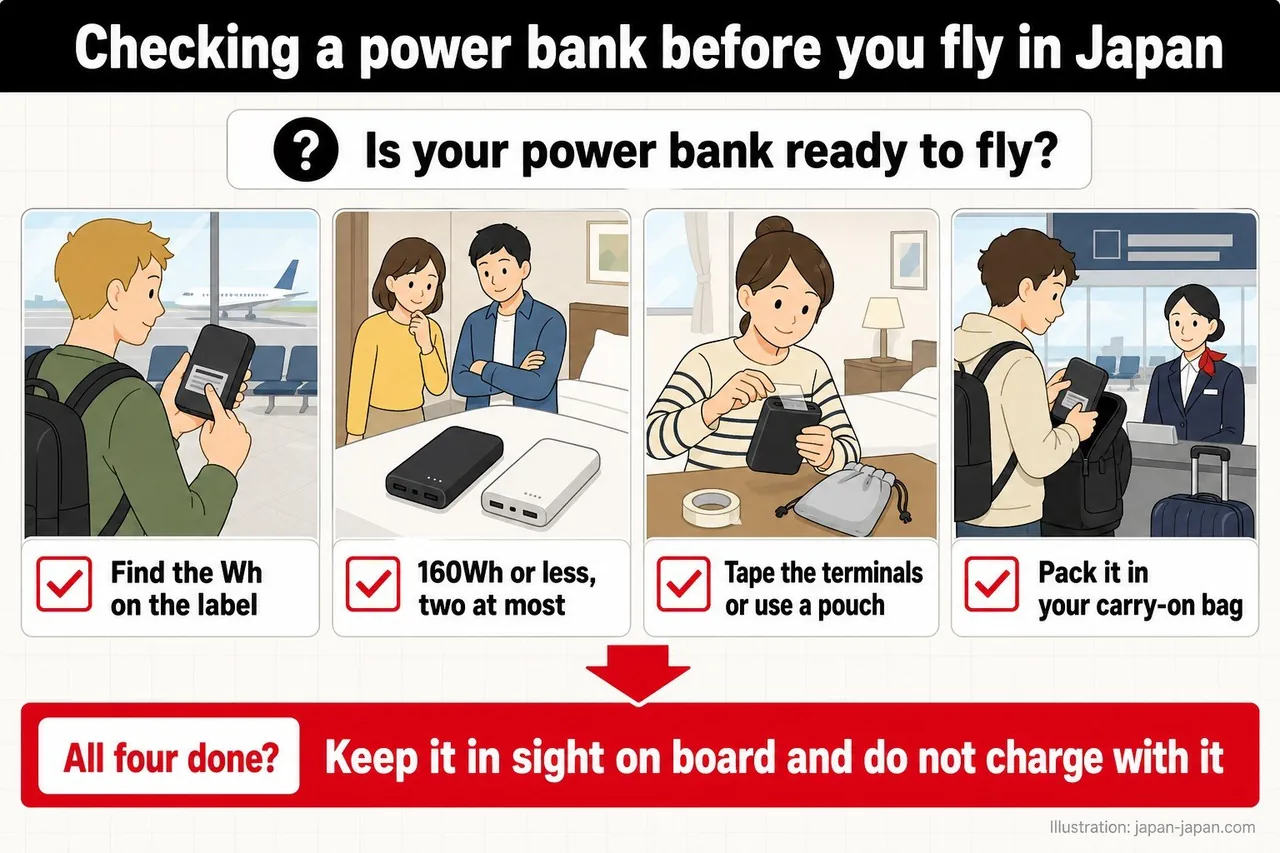
- Find the Wh. Read the label on the power bank. If it shows only mAh and volts, use Wh = mAh ÷ 1000 × V.
- Check the limits. Each power bank must be 160Wh or less, and a Japanese airline accepts two at most.
- Protect the terminals. Tape them, or put each power bank in its own pouch, case or plastic bag.
- Pack it in your carry-on. Never in the suitcase you check in.
- Keep it in sight on board. Use the seat pocket or keep it with you. Do not put it in the overhead bin, and do not charge with it.
Rules can differ by airline. The government guide says some airlines handle power banks differently and recommends checking in advance. Read your airline’s own page before you fly. This matters on a codeshare: ANA notes that when another airline operates part of your trip, that airline’s baggage rules may apply.
Recalled batteries are a separate case. Japan’s Civil Aviation Bureau has notified airlines of standards for carrying recalled lithium batteries and devices that contain them. ANA links to the details from its baggage page. If your power bank has been recalled, ask your airline before you pack it.
After you land, charging is simple. Japan uses type A plugs, with two flat pins, at 100V. Most phone and laptop chargers handle 100–240V and need only a plug adapter, not a transformer. Chargers and AC adapters can go in either bag, as our charger entry shows. Top up the power bank at your hotel before the flight home, because you cannot charge it on board a Japanese airline.
FAQ
How many power banks can I take on a plane in Japan?
Two per person at most on Japanese airlines, from 24 April 2026. Each must be rated 160Wh or less and travel in your carry-on bag. MLIT added the count limit, and the government guide repeats it. Spare batteries such as camera batteries are counted separately.
Can I charge my phone from a power bank on a Japanese flight?
No. Since 24 April 2026 you may not charge other devices from a power bank on board, or charge the power bank from the seat outlet. ANA, Skymark, Peach and StarFlyer all say so on their English pages. Use the seat’s USB port or power outlet for your phone instead.
How do I work out the watt-hours if my power bank only shows mAh?
Use Wh = mAh ÷ 1000 × V, with the rated capacity in mAh and the rated voltage in volts. The Wh rating is usually printed on the case, so look there first. If the product shows no Wh figure, the government guide suggests asking the maker before you travel.
Do the Japanese power bank rules apply if I fly a foreign airline?
The checked-baggage ban does: every airline flying to or within Japan refuses power banks in the hold. For handling in the cabin, MLIT’s July 2025 notice tells passengers on foreign airlines to follow their airline’s instructions. Check your airline’s page for its rules on the overhead bin, the number of power banks and charging.
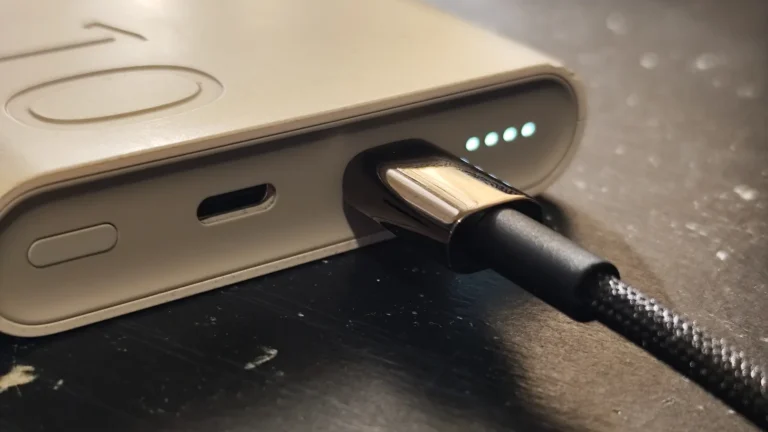
Photo: USB-C cable connected to a powerbank.jpg by Logant547 (CC BY 4.0), via Wikimedia Commons.