Do South Africans Need a Visa for Japan? Yes, About ¥15,000
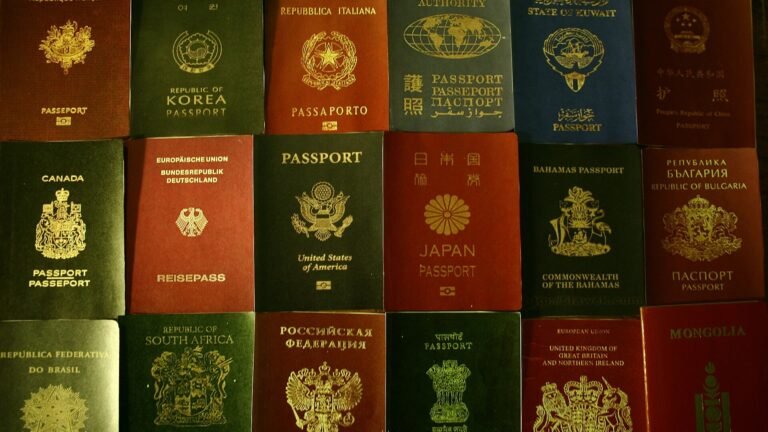
Two separate tests decide your trip. Your passport decides whether you need a visa at all. Where you live decides where and how you apply.
A South African citizen who lives in South Africa and travels for sightseeing can do the whole application on the JAPAN eVISA website. Visiting family or friends, a business trip or more than one entry means a paper application. You make it at the Embassy of Japan in Pretoria or the consular office in Cape Town.
Our Japan visa page for South Africa keeps the short version of these rules in one place. Below are the route that fits your trip, the new fee and the embassy’s document list. After that come processing times and what happens at the airport.
Why South Africans need a visa: Japan’s visa-free list
Japan lets visitors skip the visa when their country is on its visa exemption list. The Ministry of Foreign Affairs of Japan visa exemption list names 74 countries and regions, in a version dated 1 September 2025. South Africa is not on it.
Only three African countries appear on it: Lesotho, Mauritius and Tunisia. Most visa-free visitors get 90 days on landing. Indonesia and Thailand get 15 days, and Brunei and Qatar get 30 days.
The table below compares South Africa with six other African passports. The figures come from the ministry’s list and our own country pages.
| Passport | Visa for a short stay | Longest visa-free stay | Note |
|---|---|---|---|
| South Africa | Needed | No visa-free stay | Residents can apply with JAPAN eVISA |
| Lesotho | Not needed | 90 days | Machine-readable passport, since 1 April 2010 |
| Mauritius | Not needed | 90 days | Valid ordinary passport, no paid work |
| Tunisia | Not needed | 90 days | Valid ordinary passport, no paid work |
| Kenya | Needed | No visa-free stay | Apply before you travel |
| Nigeria | Needed | No visa-free stay | Applications go through VFS Global |
| Egypt | Needed | No visa-free stay | Apply before you travel |
Citizens of Lesotho need a machine-readable passport to use the exemption. Holders of a passport from Mauritius need only a valid ordinary passport.
Further north, Kenya, Nigeria and Egypt are in the same position as South Africa. The full list of exempt passports sits on our visa-free countries page.
Your passport, not your home address, decides the visa question. A South African who lives in London still needs a visa for Japan. That person applies through the system for UK residents, not through the embassy in Pretoria.
The reverse also holds. People who live in South Africa on another country’s passport should contact the embassy about extra requirements, as its visitor’s visa page asks.
You may also see news about JESTA, Japan’s planned travel authorisation. The law creating it passed on 29 May 2026. It starts on a date the Cabinet will set, no later than 31 March 2029.
JESTA is aimed at visitors from visa-exempt countries, so it does not replace the visa for South Africans. Our JESTA travel authorisation page follows its progress.
JAPAN eVISA for people living in South Africa
JAPAN eVISA is the Japanese government’s online visa system. You apply, upload documents and receive an electronic visa without a trip to the embassy. The embassy says residents of South Africa have been able to apply for tourist visas this way since 27 March 2023.
The Ministry of Foreign Affairs of Japan JAPAN eVISA page, dated 15 May 2026, lists nine places whose residents can apply directly. They are Australia, Brazil, Cambodia, Canada, Saudi Arabia, South Africa, Taiwan, the United Kingdom and the U.S.A.
The chart above reduces the choice to two questions. If you live in South Africa and the trip is tourism with one entry, use eVISA. If either answer is no, go to the embassy or the consular office.
- Residence: You live in South Africa, or another listed country, and you need a short-term visa.
- Passport: Only ordinary passport holders can apply on the website.
- Purpose: Tourism only. Visits to acquaintances or relatives, business and academic activities do not qualify.
- Visa type: Single-entry short-term stay, for 90 days or less.
- Travel: By air, or by sea on the scheduled international ferries between Japan and Busan or Shanghai.
Most applications run online from start to finish. During the process, the embassy may still ask you to come in person for an interview. The Embassy of Japan in South Africa general visa information page also warns about incomplete applications.
The embassy cancels them without processing, and you then have to submit a new application. Wrong details or poor uploads can delay the review too.
Fraud websites that look like the JAPAN eVISA website are a known problem. Open the real site from the link on the ministry’s eVISA page. For questions, the embassy lists the Japan Visa Information Hotline on +27-21-100-4824, with support 24 hours a day.
The real test comes at the departure airport, such as O. R. Tambo International Airport, shown here. With eVISA there is no sticker in your passport.
You log in to the JAPAN eVISA website and show the Visa issuance notice on your phone while connected to the internet. Airport staff will not accept a PDF, a screenshot or a printout of the page.
So charge your phone and buy data or find Wi-Fi before you reach the check-in desk. Our JAPAN eVISA page covers the system for every eligible country, including the agency rules that apply in some of them.
Applying in Pretoria or Cape Town
Use the embassy route when eVISA does not fit. That covers visits to relatives or friends, business trips and any double or multiple entry visa. An embassy visa comes as a sticker in your passport.
| Route | Who can use it | What it covers | How you get it |
|---|---|---|---|
| JAPAN eVISA (online) | People living in South Africa who need a short-term visa; ordinary passports only | Tourism only, single entry, 90 days or less | Electronic visa; show the Visa issuance notice online at the departure airport |
| Embassy of Japan, Pretoria | Applicants in person, Monday to Friday, 9:00 to 12:30 | All purposes, including relatives, business and multiple entry | Visa sticker in your passport |
| Office of Consul of Japan, Cape Town | People living in the Western Cape | All purposes, as at the embassy | Visa sticker in your passport; read the appointment notice first |
The table sets the three routes side by side. The embassy in Pretoria handles every purpose.
The office in Cape Town serves people who live in the Western Cape. Everyone else in South Africa goes to Pretoria.
The Embassy of Japan in Pretoria takes visa applications Monday to Friday from 9:00 to 12:30. That window covers both applications and collections. From 14:00 to 16:00 the counter handles collections only.
The embassy closes on South African public holidays and on some of its own holidays, and it posts the closure list on its visa page.
You must hand in the papers yourself. The embassy states that every visa application must be submitted by the applicant in person.
Before you travel to Pretoria, read the Embassy of Japan in Pretoria visa appointment notice. The same visa page also offers a visa appointment request sheet.
The box below collects its hours and the fee in one place.
| Place | Embassy of Japan in South Africa (Pretoria) |
|---|---|
| Price | Single-entry visa about 15,000 yen, multiple-entry about 30,000 yen, paid in rand (from 1 July 2026) |
| Hours | Mon-Fri 9:00-12:30 to apply and collect, 14:00-16:00 collection only. Closed on South African and some Embassy holidays |
| Official site | Embassy of Japan in South Africa general visa information |
If you live in the Western Cape, apply to the Office of Consul of Japan in Cape Town instead. The office is on the 21st floor of The Towers, 2 Heerengracht, at the corner of Hertzog Boulevard, Cape Town 8001.
It has its own appointment notice on the embassy’s visa page, so read that before you go. You can email the office at consul-cpt@pr.mofa.go.jp.
| Place | Office of Consul of Japan in Cape Town |
|---|---|
| Price | Single-entry visa about 15,000 yen, multiple-entry about 30,000 yen, paid in rand (from 1 July 2026) |
| Access | 21st Floor, The Towers, 2 Heerengracht Cnr, Hertzog Blvd, Cape Town 8001. For applicants living in the Western Cape |
| Official site | Embassy of Japan in South Africa general visa information |
Plan ahead if you need more than one entry. The Embassy of Japan in South Africa temporary visitor’s visa page covers this case.
Anyone who needs a double or multiple entry visa should contact the visa officer well in advance. Work, study and cultural visas follow separate rules, so send those questions straight to the embassy.
The embassy also suggests one simple habit. Contact the Consular Section to confirm the procedure for your own case. Rules vary by nationality and purpose, and the embassy may ask for documents that its website does not mention.
Japan visa fee for South Africans
Japan raised its visa fees on 1 July 2026. The Ministry of Foreign Affairs of Japan visa fee revision page sets the new level at about 15,000 yen for a single-entry visa.
A multiple-entry visa costs about 30,000 yen. Both apply to applications accepted on or after that date.
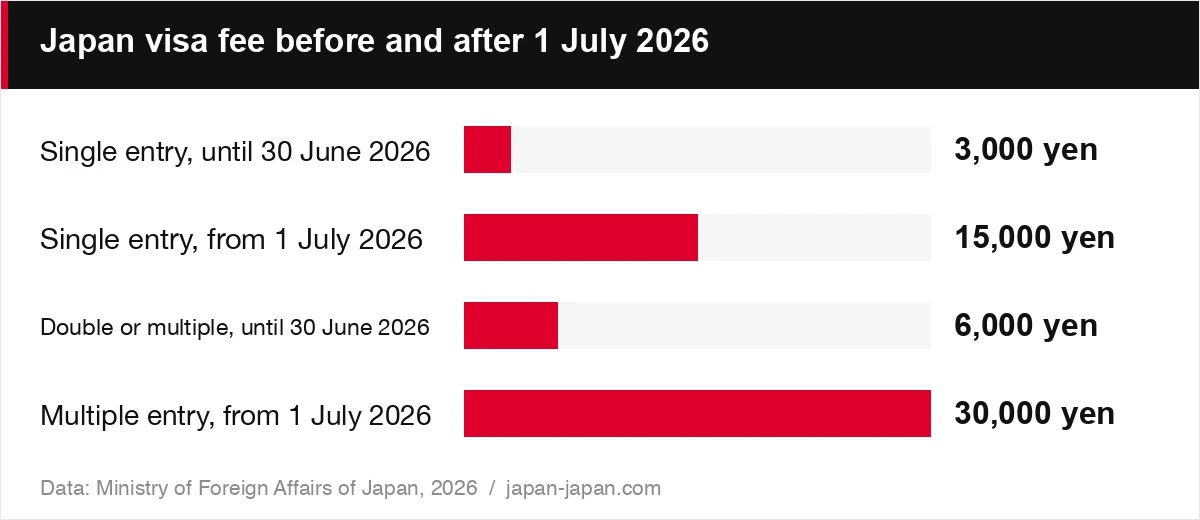
| Item | Value | Note |
|---|---|---|
| Single entry, until 30 June 2026 | 3000 yen | about |
| Single entry, from 1 July 2026 | 15,000 yen | about |
| Double or multiple, until 30 June 2026 | 6000 yen | about |
| Multiple entry, from 1 July 2026 | 30,000 yen | about |
The bars show the size of the jump. Under the old rules on the Ministry of Foreign Affairs of Japan visa fees page, a single-entry visa cost about 3,000 yen.
A double or multiple entry visa cost about 6,000 yen, and a transit visa about 700 yen. The single-entry fee is now five times higher.
You do not pay in yen. The ministry says you pay in the local currency of the country where the embassy or consulate issues the visa. In South Africa, that means rand.
The embassy sets the rand amounts for fixed periods. Its visa page links three separate tables. They cover fees from 1 April 2025, from 1 April to 30 June 2026, and from 1 July 2026 to 31 March 2027.
Before you apply, look up your amount in the Embassy of Japan in South Africa consular fee table. Use the table that covers the date the embassy accepts your application, not the date you book your flight. Three more payment rules help with budgeting:
- No visa, no fee: If the embassy does not issue the visa, you pay nothing.
- Nationality and purpose: Some applicants pay a different amount, and some pay no fee.
- Agencies: An approved agency adds its own handling fee on top of the visa fee.
The embassy’s visa page also has a section on online payment of consular fees. Our Japan visa fees page explains the 1 July 2026 change in more detail.
Documents, photo size and processing time
The embassy accepts an application only when the form is complete and the required attachments come with it. For a single-entry visit, its temporary visitor’s visa page lists a short set of documents.

The checklist above shows the four items to bring to the counter:
- Passport: Your original passport. The embassy does not accept temporary passports.
- Form: One application form, completed in full. The embassy links the form and a sample on its visa page.
- Photo: One passport-size photo, 45mm x 45mm, on a white background. A printed copy will not do.
- Other documents: Anything else the embassy asks for. It can request more papers if it thinks they are needed.
The square photo is specific to this embassy, so do not reuse a photo cut for another country’s visa. Our Japan visa photo size guide compares the sizes that Japanese offices in other countries ask for. If the embassy requests supporting papers, our Japan visa itinerary example and Japan visa bank statement guide show the formats other Japanese embassies use.
Processing can be quick. Once the embassy has officially accepted an application, it may grant and issue the visa within two working days. The ministry’s general standard is 5 working days from the day after it receives an application.
A case referred to Tokyo can take more than a month. Our Japan visa processing time page explains what slows a case down.
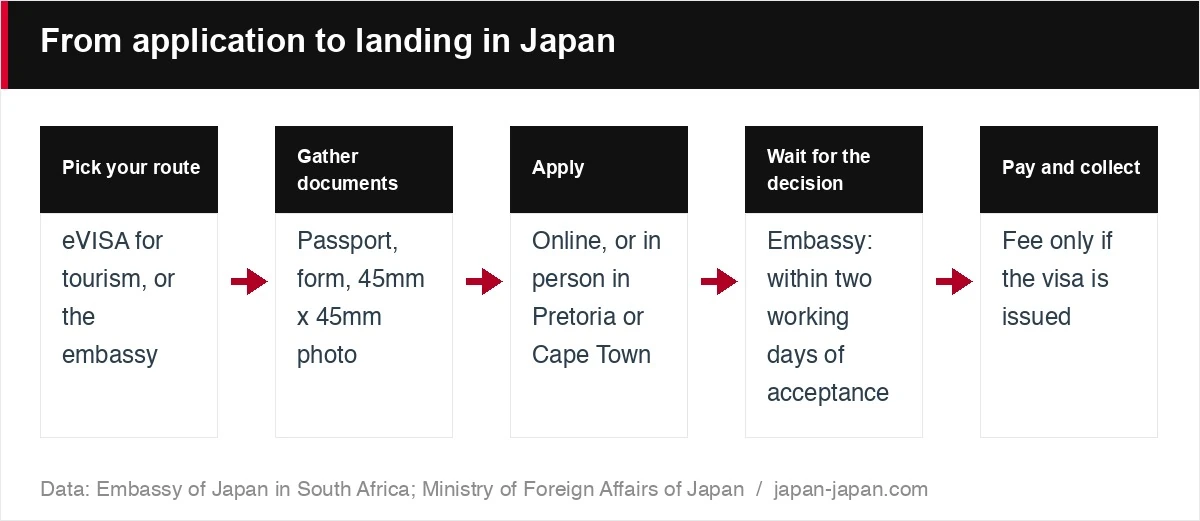
The flow above puts every step in order, from choosing a route to landing. Many South Africans travel to Japan in the December and January summer holidays, and that season squeezes both ends of the trip. The embassy shuts on South African public holidays, while Japan’s year-end changes how its cities run.
In Japan, banks close from 31 December to 3 January. JR Central makes every Nozomi bullet train reserved-seat only from 25 December 2026 to 5 January 2027.
Our New Year 2026–27 page lists the closures and the busy days. Apply weeks before a December flight, so a request for an interview or extra papers does not eat into your trip.
Landing in Japan with your visa
Your first check happens before you board. At check-in in South Africa, eVISA holders log in and show the Visa issuance notice on screen. Embassy visa holders show the sticker in their passport.
If you change planes in Dubai or Doha, check our Emirates baggage page or Qatar Airways baggage page for carry-on limits before you pack.
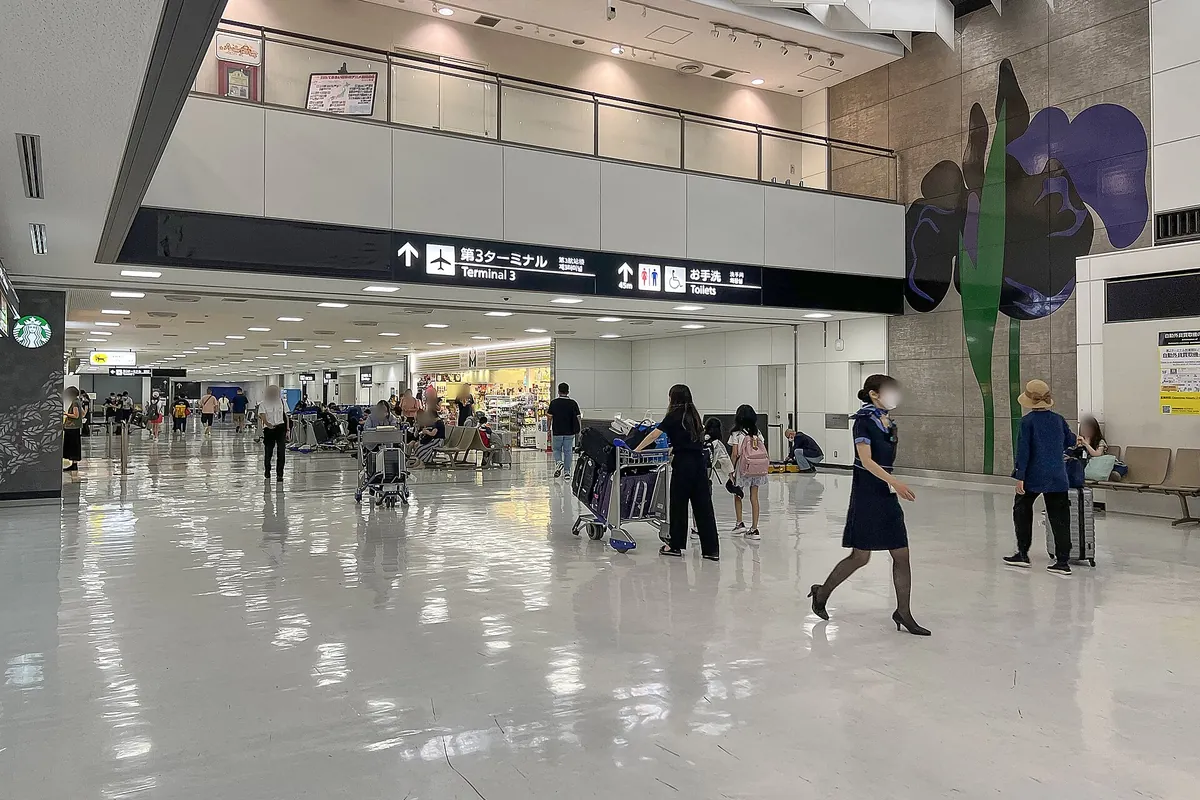
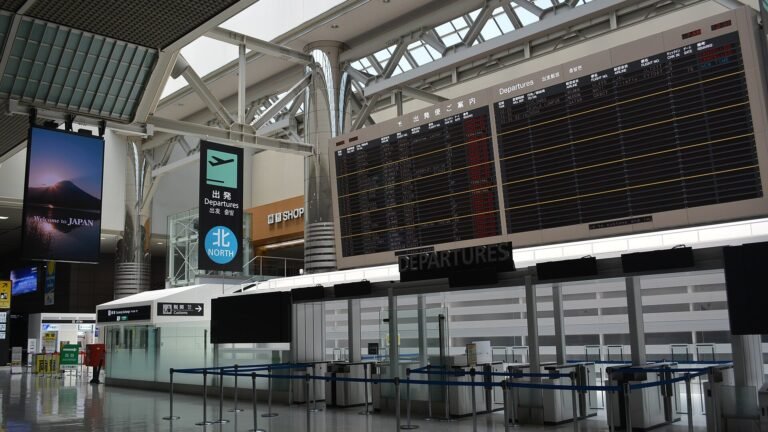
The photo shows the arrivals area at Narita, one of Tokyo’s two international airports. Arrival procedures follow a fixed order: quarantine, immigration, baggage claim, animal and plant quarantine, then customs.
The immigration officer grants landing permission and sets your period of stay. A tourist eVISA covers a stay of 90 days or less.
You can fill in the immigration and customs forms in advance with Visit Japan Web. One QR code covers both, as our Visit Japan Web QR code guide explains step by step.
Getting into Tokyo is simple from either airport. At Narita Airport, the Keisei Skyliner reaches Nippori in 36 minutes at the fastest. The Narita Express reaches Tokyo Station in 53 minutes for 3,140 yen.
The cheapest service we list to Tokyo Station is the AIRPORT BUS TYO-NRT at 1,500 yen. At Haneda Airport, the Keikyu train reaches Shinagawa in 11 minutes for 330 yen. The Tokyo Monorail runs to Hamamatsucho for 520 yen.

The picture above sums up the mistakes the ministry and the embassy warn about. Do not show a screenshot, PDF or printout of the eVISA notice at the airport. Do not apply on a look-alike website.
Do not send an incomplete application, because the embassy cancels it and you start again. At the counter in Pretoria or Cape Town, do not bring a temporary passport.
FAQ
Can South Africans get a visa on arrival in Japan?
No. Japan does not issue visas on arrival, and the foreign ministry states that visas cannot be obtained at the port of entry. South Africa is not among the 74 visa-exempt countries and regions. Get your eVISA or embassy visa before you fly.
Can South Africans living in the UK apply for a Japan eVISA?
Yes, for a tourist trip. The ministry’s eVISA page, dated 15 May 2026, lists the United Kingdom among the places whose residents can apply directly. You apply as a UK resident, not through the embassy in Pretoria. The same goes for South Africans living in Australia, Canada or the U.S.A.
How long can South Africans stay in Japan on a tourist visa?
A tourist eVISA covers one entry and a stay of 90 days or less. The immigration officer sets your exact period of stay when you land. For a different purpose, apply at the embassy for the visa that matches it.
Will JESTA replace the Japan visa for South Africans?
No. JESTA is a travel authorisation for visitors from visa-exempt countries, and South Africa is not on that list. The law creating it passed on 29 May 2026, and it must start by 31 March 2029. South Africans will still need a visa.
About the author