Japan Packing List for Winter: What to Wear and Carry On

This Japan trip packing list is built from official numbers rather than product picks. The weather figures are 30-year climate normals for 1991-2020 from the Japan Meteorological Agency. The bag rules come from the Japan Civil Aviation Bureau and our own checked pages on what you can bring. Use it as a Japan packing checklist for any trip between December and February.
How cold Japan gets in winter, city by city
Japan is long from north to south, so one winter can mean two very different suitcases. Tokyo and Kyoto rarely freeze during the day. Sapporo, on the northern island of Hokkaido, stays close to freezing even at noon and sits under snow for most of the season.
| Item | Value | Note |
|---|---|---|
| Sapporo | -6.4 °C | Daily high -0.4°C |
| Tokyo | 1.2 °C | Daily high 9.8°C |
| Kyoto | 1.5 °C | Daily high 9.1°C |
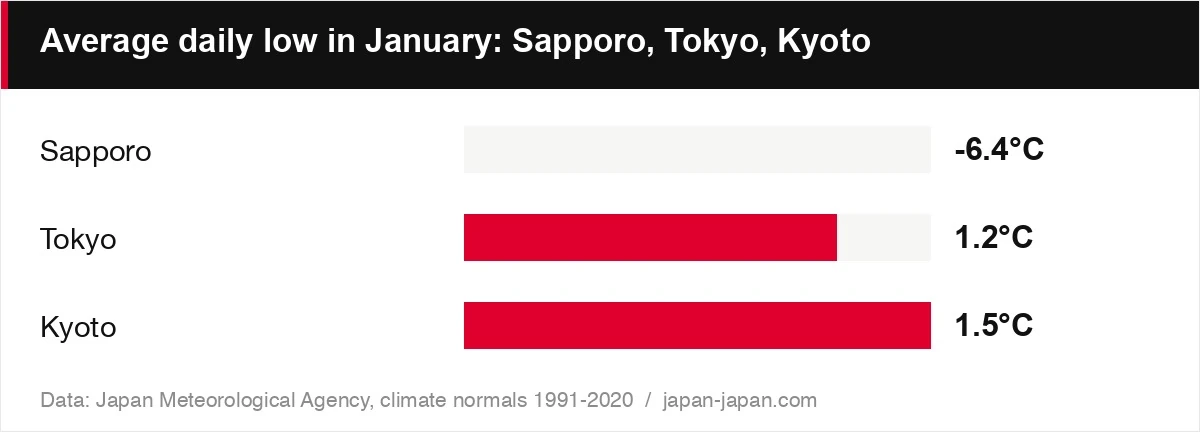
The chart shows the average daily low in January, the coldest month in all three cities. Sapporo averages -6.4°C at night, while Tokyo averages 1.2°C and Kyoto 1.5°C. The gap between Hokkaido and central Japan is about the same every month from December to February.
Here are the full winter normals. The Japan Meteorological Agency Tokyo climate normals give a December average of 7.7°C, with highs of 12.0°C and lows of 3.8°C. January in Tokyo averages 5.4°C, with highs of 9.8°C. February warms slightly, averaging 6.1°C, with highs of 10.9°C and lows of 2.1°C.
Kyoto is a little colder at the start of the day. The Japan Meteorological Agency Kyoto climate normals show a December average of 7.2°C, with highs of 11.6°C and lows of 3.5°C. In January Kyoto averages 4.8°C, with highs of 9.1°C. February averages 5.4°C, with highs of 10.0°C and lows of 1.6°C.
Sapporo is in another climate. The Japan Meteorological Agency Sapporo climate normals list a December average of -0.9°C, with highs of 2.0°C and lows of -4.0°C. January averages -3.2°C and February -2.7°C. The February high is only 0.4°C, and the low is -6.2°C.
Snow is the bigger difference. Sapporo gets 113cm of snowfall in December, 137cm in January and 116cm in February on average. The deepest snow cover averages 47cm in December, 76cm in January and 95cm in February. Snow falls on 29.1 days of an average January. Tokyo, by contrast, averages only 4cm of snowfall in January and 4cm in February.

The photo shows central Sapporo under that snow. For a month-by-month view of more cities, see our Japan temperature by month guide and the events in Japan in January.
Clothes to pack: layers for Tokyo, Kyoto and Hokkaido
Pack for the outdoor numbers, then plan to take layers off. Trains, shops, museums and hotel rooms in Japan are heated. You will move between cold streets and warm rooms many times a day. A heavy sweater under a thin jacket is harder to manage than a light base layer, a mid layer and a coat you can open.
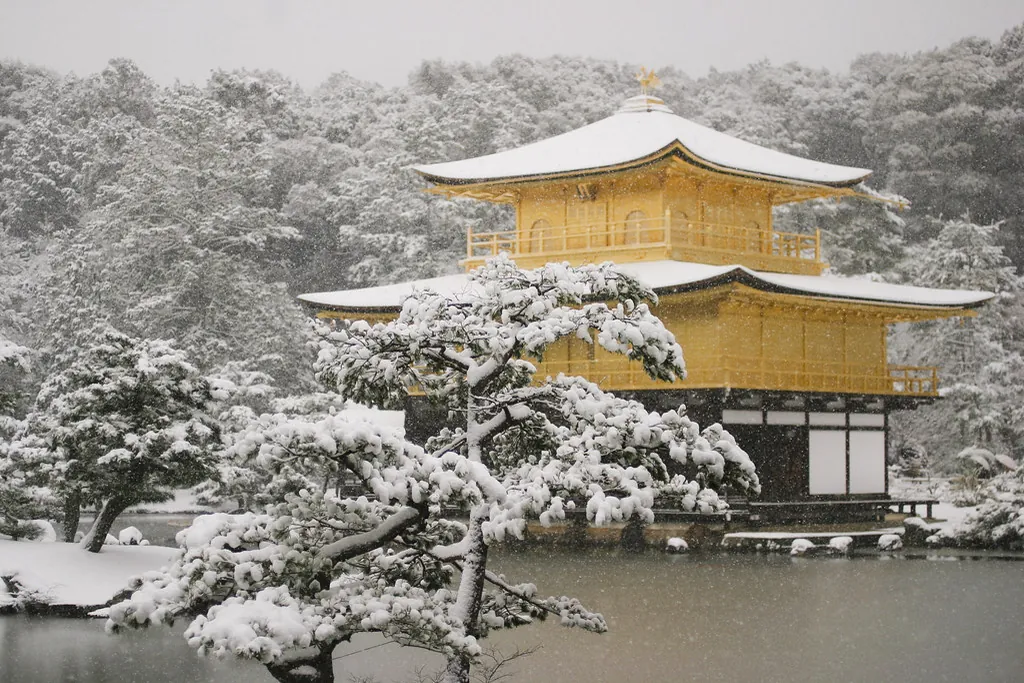
The photo of Kinkaku-ji under snow is a reminder that Kyoto does get a dusting some mornings. On most winter days, though, Kyoto and Tokyo are dry and cool. The illustration below matches each city to the clothes it needs.
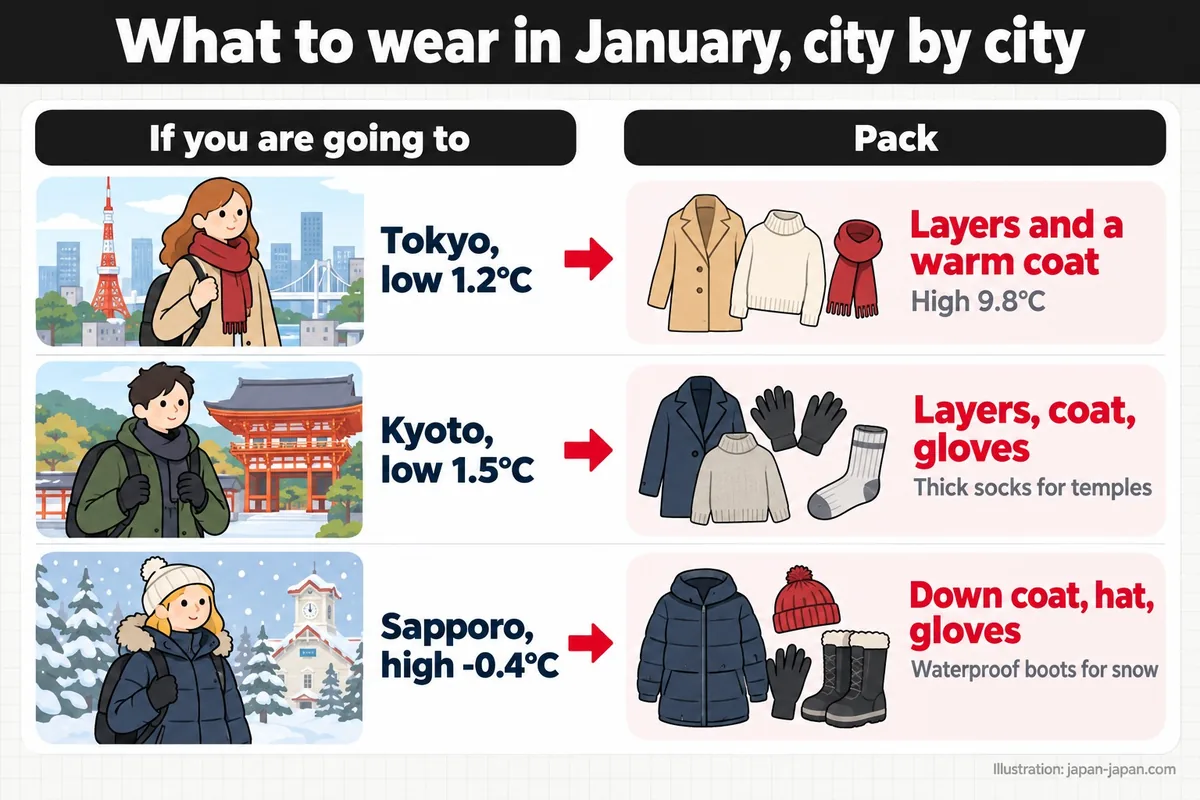
Tokyo. January lows average 1.2°C and highs 9.8°C. A thermal top, a sweater or fleece, and a warm coat cover the day. Mornings and evenings feel much colder than early afternoon, so carry a scarf you can stuff in a bag. Our page on Japan in December lists what is on while you are there.
Kyoto. January lows average 1.5°C and highs 9.1°C. The numbers look close to Tokyo, but you will spend long hours outside at temples and gardens. Many temple halls ask you to take your shoes off, and the wooden floors are cold. Thick socks and gloves help here, along with the same coat you would wear in Tokyo.
Sapporo and Hokkaido. January highs average -0.4°C, so the air stays below freezing for much of the day. Bring a padded or down coat, thermal tops and leggings, a hat that covers your ears, and gloves. Waterproof trousers are worth packing if you plan to walk in snow parks or ski.
For a longer trip, pack fewer outfits and wash them. Coin laundries are common near hotels in Japanese cities, and many hotels have their own machines. Base layers dry fast and take little space, so they are the easiest items to rotate.
Plan a few heavier pieces only if you are going north. If your route covers both Tokyo and Hokkaido, wear the bulkiest coat on the plane and keep the rest of the suitcase for layers.
Shoes and snow gear for Hokkaido
Shoes matter more than coats in Sapporo. With 76cm of snow on the ground in an average January and 95cm in February, sidewalks are packed snow and ice for weeks. Pack waterproof boots with a deep rubber tread. Street shoes with smooth soles slip on the frozen paths around stations and crossings.
In Tokyo and Kyoto you will not need snow boots. Snow days are rare, and Tokyo averages 2.8 days with snow in January. Comfortable walking shoes that you can slip on and off are more useful, since you will remove them at temples, ryokan and some restaurants.
Skiers and snowboarders face a bag rule as well. Skis and snowboards travel in checked baggage, as our skis and snowboards page explains. For wax, our ski and snowboard wax page sets out the split. Solid wax can go in either bag. Liquid, paste and powder wax is refused in both, unless it is a liquid with a flash point above 60°C.
Spray wax follows the aerosol rule: only cans with no flammable or toxic gas, 0.5 litres or 0.5kg per can, and 2 litres or 2kg per person. On international flights aerosols for sporting goods cannot go in the cabin, so a can of spray wax goes in checked baggage.
Many visitors fly on from Tokyo to ski. Flights from Haneda to New Chitose Airport take 1 h 30 min, with 56 a day, according to our Tokyo to Sapporo route page. If you are heading to the slopes near the city, our guide to Sapporo Teine ski resort covers tickets and the bus. For more snow towns, see places to visit in Japan in winter.
Hand warmers, liquids and sprays in your carry-on
Disposable hand warmers are the easy part. They are not on Japan’s list of restricted items, so they can go in your carry-on or your checked bag. See our disposable hand warmers page for the rule and its source. You can also buy them all over Japan from autumn to spring, in stick-on and pocket versions.
| Item | Carry-on | Checked bag | Condition |
|---|---|---|---|
| Disposable hand warmers | Yes | Yes | Not a restricted item |
| Refillable (fuel) hand warmers | No | No | Oil-filled and platinum catalytic types |
| Lotion, creams, lip and hand care | Yes | Yes | Cabin: 100ml containers in one 1 litre bag per person |
| Toiletry sprays | Yes | Yes | 0.5 litres or 0.5kg per can, 2 litres or 2kg per person |
| Power banks | Yes | No | 160Wh or less each, two per person |
| Skis and snowboards | No | Yes | Check them in |
| Solid ski wax | Yes | Yes | Liquid, paste and powder wax refused |
| Spray ski wax | No | Yes | No flammable or toxic gas |
The table sums up the winter items people ask about most. Refillable hand warmers are the exception that catches people out. The Japan Civil Aviation Bureau items carried by air page sets the rules on dangerous goods. Under them, oil-filled pocket warmers and platinum catalytic warmers cannot go in the cabin or in the hold. Our refillable hand warmers page has the details.
If you forget yours, buy them on arrival rather than packing a fuel model.
Winter skin care is the next question. Dry, heated rooms mean most people pack lotion, lip balm and hand cream. On international flights, the Japan Civil Aviation Bureau liquids restriction page covers liquids, aerosols and gels in the cabin. Each container must hold 100ml or less. All of them go inside one transparent re-sealable bag of 1 litre or less, and each person gets one bag.
Our liquids page walks through the 100ml rule item by item. Toiletries also have a separate limit in both bags: 0.5 litres or 0.5kg per container and 2 litres or 2kg per person. Bigger bottles of moisturizer belong in your checked bag. See the toner and lotion page for creams and ointments.
Sprays need one more check. Toiletry aerosols, such as hairspray or deodorant, are allowed within 0.5 litres or 0.5kg per can and 2 litres or 2kg per person. On international flights they also count as liquids in the cabin. Our aerosol cans page explains which gases are refused. Domestic flights inside Japan are simpler: the 100ml liquid limit does not apply to them.
Plugs, power banks and medicine
Japan uses Type A plugs, with two flat parallel pins, and 100V throughout the country. Eastern Japan, including Tokyo, runs at 50Hz. Western Japan, including Kyoto and Osaka, runs at 60Hz. Our page on 50Hz and 60Hz in east and west Japan shows where the line falls.
You only need a voltage converter for a device whose input does not include 100V. Phone and laptop chargers rated 100-240V work without one, though you may still need a plug adapter. Check the label on a hair dryer or curling iron before you pack it. Our hair dryers page covers that case.

The checklist above is the last thing to run through before you leave for the airport. Power banks are the strictest item on it. Each one must be 160Wh or less and travel in your carry-on, never in checked baggage. Since 24 April 2026 the limit is two power banks per person, and you may not recharge them on board or use them to charge another device.
Keep the power bank at your seat rather than in the overhead bin. The two-per-person count includes power banks of 100Wh or less and those over 100Wh up to 160Wh. Protect each one against short circuits, for example in its own pouch. Our power banks page lists the full rule.
Cold and flu medicine is common in winter bags. Most medicine is fine: you can bring up to a 1 month supply of prescription drugs and a 2 month supply of other drugs without paperwork. Above that, you need Import Confirmation before you travel. Our medicine quantity page has the details for each type.
The Ministry of Health medicine personal import page covers the import process. Part of the application can now be made online. Some medicines cannot come in at all, even with a prescription; Adderall and other amphetamine drugs are on that list.
Send your suitcase instead
Winter clothes are bulky, and a big suitcase is hard to drag through busy stations. Yamato Transport can carry it from the airport to your hotel on the same day. You drop the bag at a counter after landing and go sightseeing.
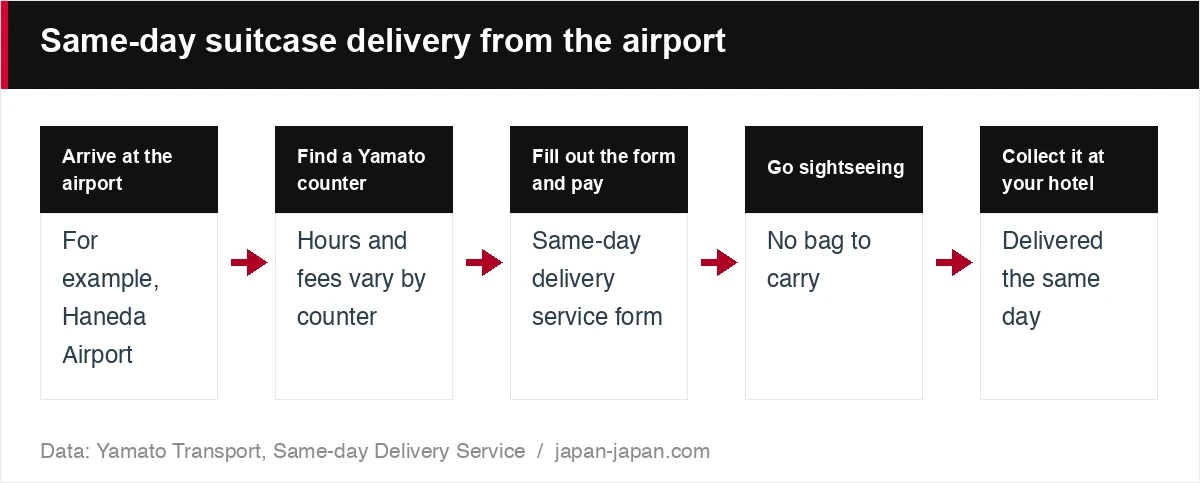
The flow above follows the steps on the Yamato Transport same-day delivery service page. No reservations are required. Find a service counter, fill out the same-day delivery service form, and pay at the counter. Your bag reaches the hotel on the same day, and you collect it when you check in.
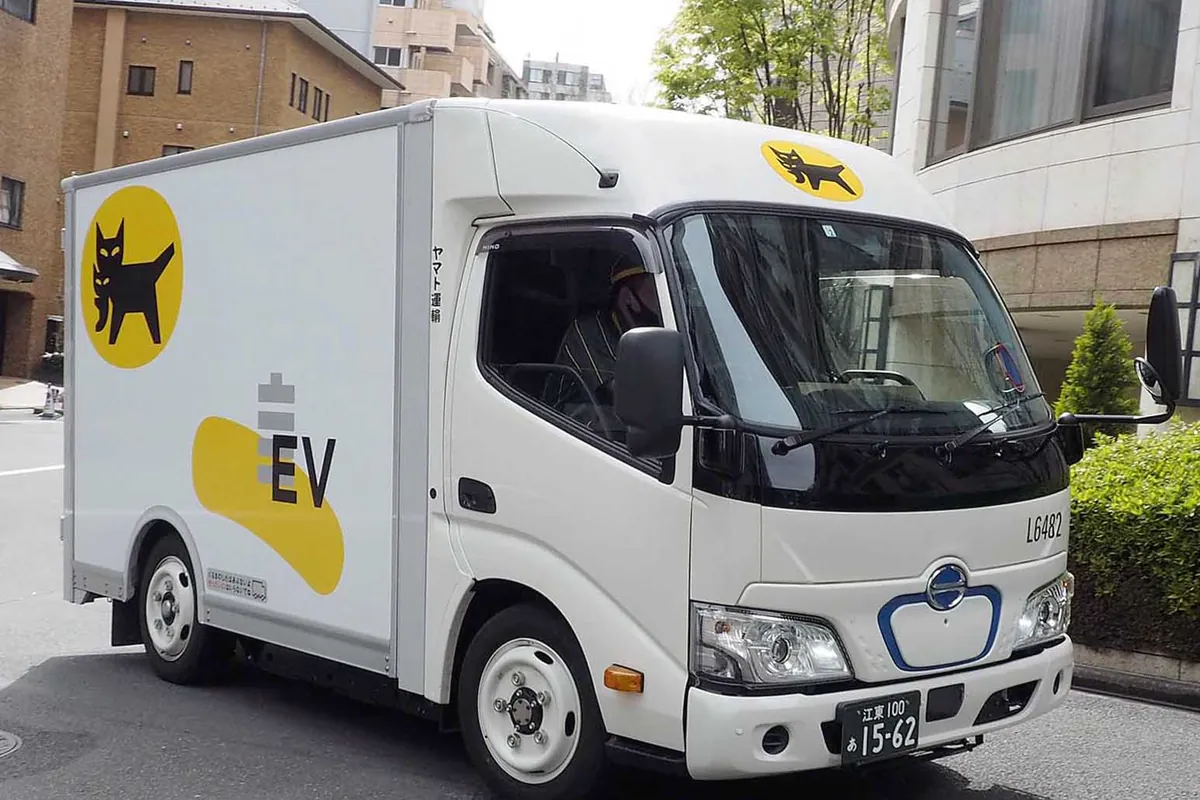
Look for the black cat logo in the photo at the airport counter. Yamato’s fee example for delivery within the 23 wards of Tokyo from Haneda Airport is 5,780 yen per piece for a 160 size bag. From the Kyoto Station service counter to a hotel within Kyoto city, the example is 3,470 yen per 160 size piece.
Fees vary by bag size and service counter, and so do the cut-off time and the delivery time. Same-day delivery runs only to limited destinations from limited sales offices. Weather, traffic and parcel volume can delay it. Our Narita Airport guide and Haneda Airport guide show the counters and the trains into the city.
Sending bags makes the most sense over New Year. JR Central makes every Nozomi reserved-seat only from 25 December 2026 to 5 January 2027. Banks close from 31 December to 3 January. Our New Year in Japan page lists the closures and last winter’s busiest days.
What to leave off your Japan packing list
Airport security in your home country may let some foods through that Japan stops at arrival. The rules below apply when you land, at the animal and plant quarantine counters.
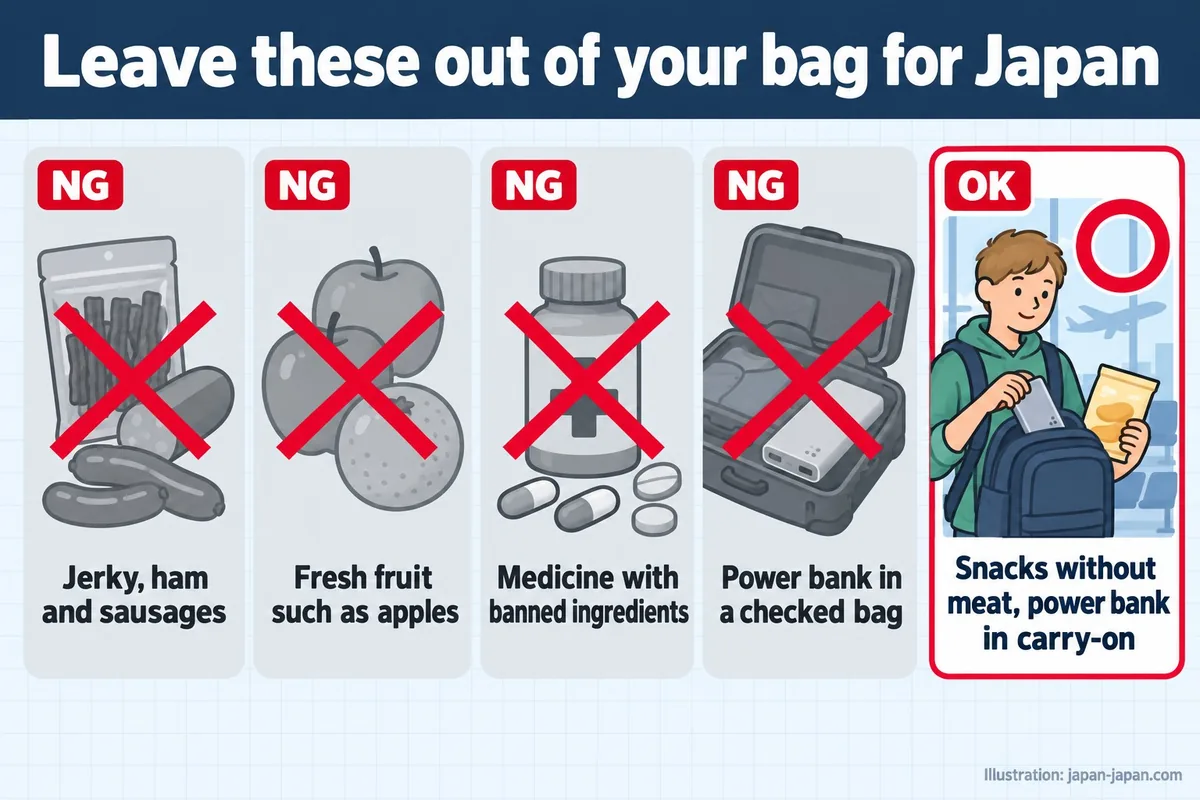
The illustration shows the four things to take out of your bag. The first is meat. The Animal Quarantine Service animal products import page names jerky, ham, sausages, bacon and meat buns as examples. Items without an inspection certificate from the exporting country’s government cannot come in. That applies even if they are vacuum packed, heat processed or bought at a duty-free shop.
The penalty is up to 3 years in prison or a fine of up to 3 million yen. Quarantine detector dogs check both checked and carry-on bags at international airports. See our pages on jerky and dried meat and meat and meat products.
The second is fresh fruit. Most fresh fruit is prohibited, and mangoes, citrus fruits, pears and apples are named. Our fresh fruit page covers the plant quarantine rule. Eat that airport orange before you board.
The third is any medicine with a banned ingredient, as described in the section above. The fourth is a power bank in your checked bag: move it to your carry-on before you check in. For the complete list, read what you cannot bring into Japan.
FAQ
Do I need snow boots for Tokyo in winter?
No. Tokyo averages 4cm of snowfall in January and 2.8 days with snow. Comfortable waterproof walking shoes are enough. Pack real snow boots only if you are going to Sapporo or other parts of Hokkaido.
Can I bring disposable hand warmers on a plane to Japan?
Yes. Disposable hand warmers can go in both your carry-on and your checked bag. Refillable fuel hand warmers, including oil-filled and platinum catalytic types, are not allowed in either.
What plug adapter do I need for Japan?
Japan uses Type A plugs with two flat parallel pins, at 100V. Chargers rated 100-240V work with a simple plug adapter. You only need a voltage converter for a device whose input does not include 100V.
How much medicine can I bring into Japan?
Without paperwork, you can bring up to a 1 month supply of prescription drugs and a 2 month supply of other drugs. For more than that, you need Import Confirmation before you travel. Medicines containing amphetamine, such as Adderall, cannot be brought in even with a prescription.
About the author


.JPG)
.jpg)
