What Is Japan Airlines’ Checked Baggage Allowance? 2026 Fees
On international flights, Japan Airlines Economy includes two free checked bags of 23kg, up to 203cm. Business and First get three of 32kg. Here are the fees.
By Shunta Fujii
Japan Airlines checked baggage allowance: the short answer
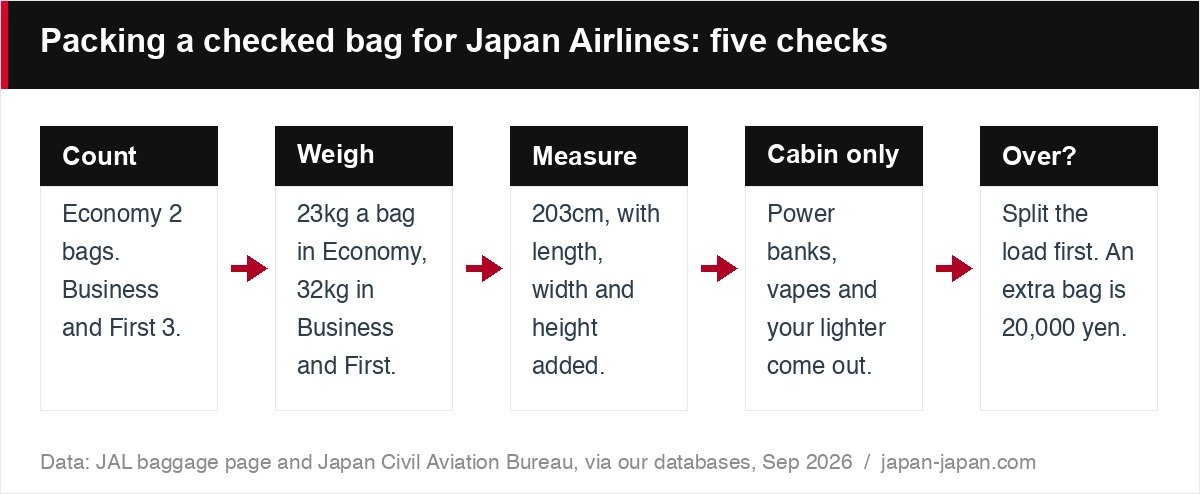
On international flights, Japan Airlines lets you check two bags free in Economy. Each bag can weigh up to 23kg, and its length, width and height added together must stay within 203cm. Business and First passengers get three free bags of up to 32kg each. Premium Economy also includes two free bags.
Cabin bags sit outside that allowance. On JAL you can take one bag plus one personal item on board. The bag must fit within 55 × 40 × 25cm, or 115cm across the three sides, and the two pieces together can weigh 10kg.
We took these figures from JAL’s international baggage page for our JAL baggage entry in September 2026. The entry sits in our baggage rules by airline, which puts 17 airlines flying to and within Japan side by side.
Going over costs between 10,000 and 60,000 yen per bag on international routes. Some items also have to leave the checked bag altogether, starting with power banks. The five checks below follow the order you pack in.
Allowance by cabin, and how JAL measures a bag
The free allowance depends on the cabin class printed on your ticket. This is what our JAL entry records for international flights.
| Cabin | Free checked bags | Weight per bag | Size per bag |
|---|---|---|---|
| Economy | 2 | 23kg | 203cm, three sides added |
| Premium Economy | 2 | Listed on JAL’s baggage page | 203cm, three sides added |
| Business and First | 3 | 32kg | 203cm, three sides added |
The weight limit applies to each bag, not to your bags as a pair. A heavy bag and a light bag do not balance out. If one Economy bag goes over 23kg, that bag is overweight, however little the other one weighs.
Size is a single number. Measure the length, width and height of the bag in centimetres and add them up. Measure over the wheels and the handle as well as the shell, so you get the bag’s real outside size. For JAL, the total has to be 203cm or less.
That limit is generous. ANA, Korean Air and United all cap a checked bag at 158cm, which United spells out as 76 × 52 × 30cm. JAL gives you 45cm more to share across the three sides. A suitcase too big for the free allowance on those airlines can still fly free on JAL in Economy. It only has to stay at 23kg or less.
Business and First add weight as well as a third bag. Each of the three bags can weigh 32kg, 9kg more per bag than in Economy.
Weigh each bag at home with a hand-held luggage scale. If one bag is over, move things into your other free bag, or into your cabin bags while the two pieces stay within 10kg together.
What JAL charges for an overweight or extra bag
JAL charges by the bag on international routes, and the amount depends on how far over you go. Our JAL entry lists three charges:
- 10,000 yen for a bag over 23kg and up to 32kg.
- 60,000 yen for a bag over 32kg and up to 45kg.
- 20,000 yen for each bag beyond your free number of bags.
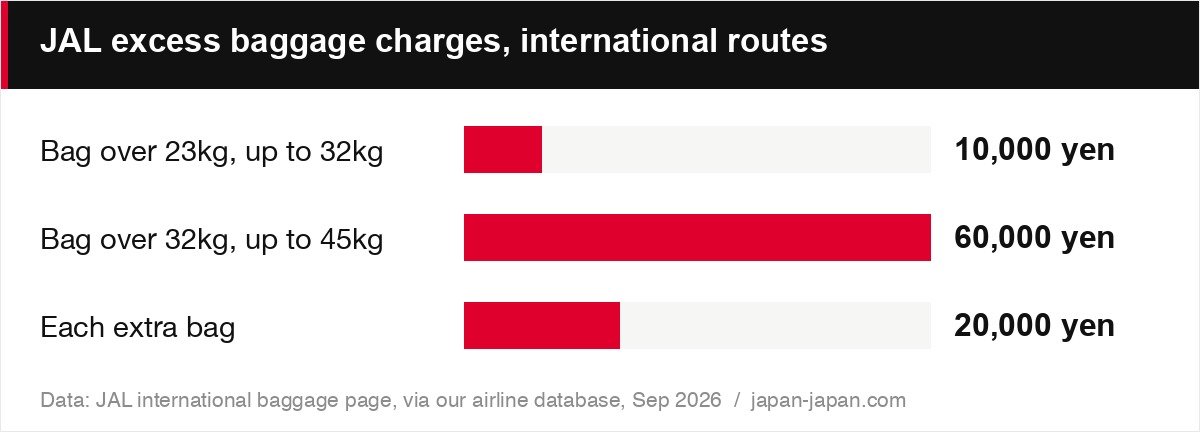
The step at 32kg is the one to plan around. A bag just over 32kg costs six times as much as a bag just over 23kg, so take things out at home rather than at the check-in counter.
Three moves keep the bill down. Try them in this order:
- Fill your second free bag. In Economy you can check two bags at no charge. Move weight from the heavy bag into the lighter one until both are at 23kg or less.
- Pay the overweight charge on one bag. If both free bags are already full, one bag between 23kg and 32kg costs 10,000 yen, half the price of an extra bag.
- Add an extra bag rather than overload one. An extra bag costs 20,000 yen. A single bag over 32kg costs 60,000 yen, three times as much.
These charges apply to JAL’s own international routes. Other airlines price excess baggage their own way, so read the page for the airline that runs your flight.
Japan Airlines vs ANA, ZIPAIR and other airlines flying to Japan
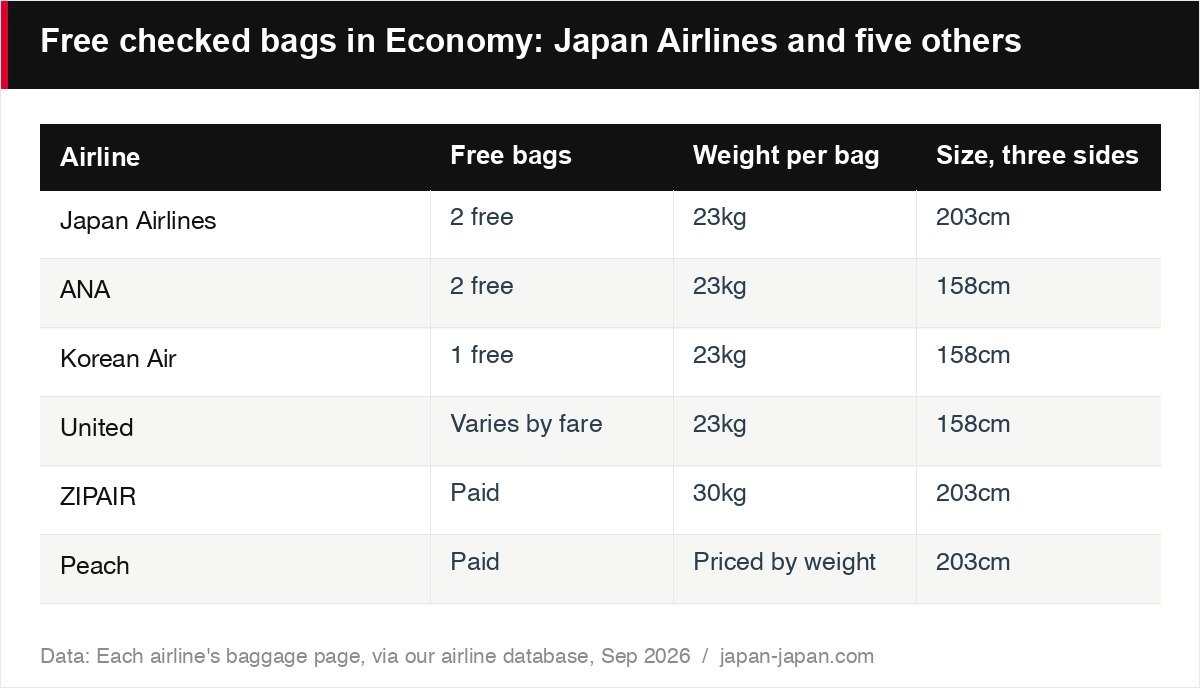
JAL and ANA give the same free allowance in Economy: two bags of 23kg each. The difference is size. JAL takes a bag up to 203cm across three sides, while ANA stops at 158cm. The table sets JAL next to five other airlines that fly to Japan or within it.
ANA gives its Premium Class three free bags of 32kg each. Its cabin rules match JAL’s: 115cm, within 55 × 40 × 25cm, and 10kg for both pieces. Since 1 July 2026, ANA has also limited the personal item to 40 × 30 × 20cm, so check your day bag if it is a large one.
Korean Air, Korea’s flag carrier, includes one free bag in Economy, at 23kg and 158cm. That is half of JAL’s count, so a second suitcase costs extra from the start.
United sets the number of free bags by fare. Each bag can weigh 23kg in Economy and 32kg in premium cabins, within 158cm. On Basic Economy the carry-on allowance is restricted as well, which catches people out. United flies from Tokyo, Osaka and Nagoya to its US hubs.
ZIPAIR is JAL’s long-haul low-cost arm, but it does not copy JAL’s free allowance. Every checked bag is paid for. You buy it with the fare or add it later, and it costs more if you leave it until the airport. In return, each bag can weigh 30kg and measure 203cm, as listed on ZIPAIR’s baggage page. In the cabin you get 7kg across your two pieces. ZIPAIR flies from Narita to Los Angeles, San Jose, Honolulu, Seoul, Bangkok, Singapore, Manila and San Francisco.
Peach, Japan’s largest low-cost carrier and based at Kansai, also charges for every checked bag. It prices bags by weight, takes up to five, and accepts 203cm. Buying the bag online before you reach the airport costs less than paying at the counter. The 7kg cabin limit covers both pieces together, and Peach weighs them at the gate.
Across the 17 airlines in our database, three charge for every checked bag: Peach, Jetstar Japan and ZIPAIR. On a codeshare booking, check which airline operates each flight. ANA’s international baggage page warns that when a codeshare flight or a flight run by another airline is part of the itinerary, that airline’s baggage rules may apply.
What cannot go in a Japan Airlines checked bag
Some things have to come out of your suitcase before you hand it over at the JAL counter. Japan’s Civil Aviation Bureau splits luggage into two kinds. Carry-on baggage stays with you in the cabin, and checked baggage is what you hand over at the check-in counter or an automated bag drop. Its guide to restricted items says airlines may set stricter rules than the national list, so follow JAL’s instructions where they differ.
Take these out of the checked bag and carry them on board:
- Power banks and spare lithium batteries. Every airline flying to or within Japan refuses them in checked baggage. In the cabin you can carry two per person at up to 160Wh each, as our power bank entry explains. Tape the terminals or keep each one in its own pouch. Our guide to power banks on planes in Japan covers the rest, including the 2026 rules on charging during the flight.
- E-cigarettes, vapes and heated tobacco devices such as IQOS, glo and Ploom. They must travel in the cabin, and you cannot use or charge them on board. Our entry on vapes and heated tobacco has the detail.
- One lighter. You may carry one per person, on your body rather than in a bag, and none in the hold. A second lighter is taken off you at the security checkpoint, and electric arc and plasma lighters are not allowed at all. Our lighter entry lists which types pass.
Leave matches at home. They are not allowed in the cabin or the hold, which is stricter than some countries, where a book of safety matches is permitted.
Pack these in the hold only under conditions:
- Smart luggage with a built-in battery can go in the hold only with the battery taken out. The removed battery goes in the cabin. A battery up to 2.7Wh is fine either way, and anything over 160Wh is not allowed. See our smart luggage entry.
- Alcohol follows the same strength limits in the hold as in the cabin. Up to 24% alcohol there is no limit. Over 24% and up to 70%, you can take 5 litres per person. Over 70% is not allowed at all. Each drink must stay in the retail bottle it was sold in, as our alcohol entry explains.
Landing in Japan adds a second limit on alcohol. Japan Customs lets each adult bring in 3 bottles duty free, with a bottle counted as about 760cc. Above that you pay duty, at 200 yen per litre for wine and beer and 800 yen per litre for whisky and brandy. You must be 20 or over, and our duty-free alcohol entry sets out the rest.
Pack these in the hold only:
- Knives of every kind go in checked baggage, wrapped so nobody handling the bag can be cut. Once you land, carrying a blade over 6cm without a good reason is an offence in Japan. If you buy a kitchen knife here, have the shop wrap it, pack it in your checked bag and take it straight to your hotel. Our knife entry covers pocket knives too.
If you reach the airport with something that cannot fly, tell a member of staff. The Civil Aviation Bureau warns that the same item may be refused by courier companies too, so declare it before you try to send it on. Our What you can bring database covers 143 items in the same format.
Flying JAL inside Japan: what changes on domestic flights
The JAL figures above are for international flights. A few rules change as soon as your flight stays within Japan.
- Liquids. International flights cap each container at 100ml, inside one transparent resealable bag of 1 litre or less per person. Domestic flights within Japan have no limit on how much liquid you carry. The alcohol strength limits above still apply on both.
- Small aircraft. On domestic JAL flights, the carry-on size drops to 100cm across three sides on aircraft with fewer than 100 seats. ANA’s baggage page sets the same 100cm limit on its aircraft with fewer than 100 seats, within 45 × 35 × 20cm.
- Free checked bags. Our airline database notes that the free checked allowance on Japanese carriers is often larger on international routes. Check the domestic allowance on your JAL booking before you pack for a flight within Japan.
Other Japanese airlines count checked bags differently. Skymark flies only within Japan and gives 20kg free per person, with no limit on the number of bags. Each bag can measure up to 50 × 60 × 120cm. Because the 20kg is per person, one large case suits it better than two small ones. Peach and Jetstar Japan charge for every checked bag. Jetstar Japan sells checked baggage up to 40kg and adds a charge for a bag over 1m on any side.
If you fly into Japan and connect to a domestic flight, you clear immigration and customs at the first airport you land in. The order there is quarantine, immigration, baggage claim, animal and plant quarantine, then customs. Plan the connection around the baggage hall as well as the queues. At Haneda, the international and domestic terminals are a free shuttle bus apart. Between Narita and Haneda it is a 90-minute journey across Tokyo.
Too much luggage? Send a bag to the airport with TA-Q-BIN
If you have more luggage than you want to drag through stations, Yamato Transport can carry it to the airport for you. Its Airport TA-Q-BIN service sends suitcases and bulky bags to the airport, and from the airport to your home or hotel. It does not change JAL’s allowance. The bag still counts as one of your checked bags when you hand it over at the JAL counter, and the charges above still apply.
The timing works backwards from your flight:
- Two days before departure: drop the bag at a counter by its sending deadline. In some areas the deadline is three days before, and each counter sets its own.
- The day before: Yamato delivers the bag to the airport. It covers all major Japanese airports.
- Departure day: collect the bag at the airport counter and check it in with JAL. The counter hands the bag over in exchange for the Sender Receipt from your waybill, so keep that receipt with your passport.
Check Yamato’s limits before you pack. It does not accept a parcel heavier than 30kg. Its largest band is Size 200, which means up to 200cm across three sides and up to 30kg, and no single side may be longer than 170cm. A suitcase right at JAL’s 203cm limit is therefore too big for Yamato. Yamato uses the size band or the weight band, whichever is larger, and some convenience stores cannot take anything over Size 180.
The rate table on Yamato’s page already includes a 660 JPY fee for delivery to the airport. Each rate covers one parcel, one way, tax included, and each parcel is insured up to 300,000 JPY. Write a detailed list of what is inside on the waybill, because a vague description can delay the parcel or stop it being delivered.
If you fly out and back to the same place in Japan, Round Trip TA-Q-BIN covers the return as well. On the way back you drop the bag at the airport counter with no new waybill to write, and get 100 JPY off per parcel. The return leg has to be used within one month of the first drop-off.
Pickup counters at Narita, Haneda and Kansai are listed below. Yamato’s full counter list also covers New Chitose, Chubu Centrair, Itami, Fukuoka and other airports.
- Narita: Terminal 1, North Wing and South Wing (collect on 4F), Terminal 2 (collect on 3F) and Terminal 3 (1F).
- Haneda: Terminal 1 and the domestic side of Terminal 2 (1F), the international side of Terminal 2 (collect on 3F) and Terminal 3 (2F).
- Kansai: Terminal 1 (collect on 4F).
The service also runs the other way. When you land on a JAL flight, you can send a heavy bag from the airport to your hotel instead of taking it on the train. Our airport guides note that Narita and Haneda run a same-day service to hotels in central Tokyo if you drop the bag off before late morning. Elsewhere the bag reaches most of the country the next day. Yamato’s English line is 03-6834-7503, from 8:00am to 9:00pm, 365 days a year.
FAQ
How many checked bags can I take on Japan Airlines in Economy?
Two, free of charge, on JAL’s international flights. Each bag can weigh up to 23kg and measure up to 203cm across three sides. Premium Economy also gets two free bags, and Business and First get three of up to 32kg each. A bag beyond your free number costs 20,000 yen.
How much does Japan Airlines charge for an overweight bag?
On international routes, JAL charges 10,000 yen for a bag over 23kg and up to 32kg. A bag over 32kg and up to 45kg costs 60,000 yen. The charge is per bag, so the cheapest fix is to move weight into your second free bag, which costs nothing.
Can I pack alcohol in my checked bag on Japan Airlines?
Yes, within the same limits that apply in the cabin. Drinks up to 24% alcohol have no limit, drinks over 24% and up to 70% are capped at 5 litres per person, and anything over 70% cannot fly. Keep each drink in its retail bottle. Japan Customs lets adults aged 20 or over bring in 3 bottles duty free.
Does ZIPAIR include checked baggage like Japan Airlines?
No. ZIPAIR is JAL’s long-haul low-cost arm, and every checked bag is paid for. You buy it with the fare or add it later, and it costs more at the airport. Each bag can weigh up to 30kg and measure up to 203cm.
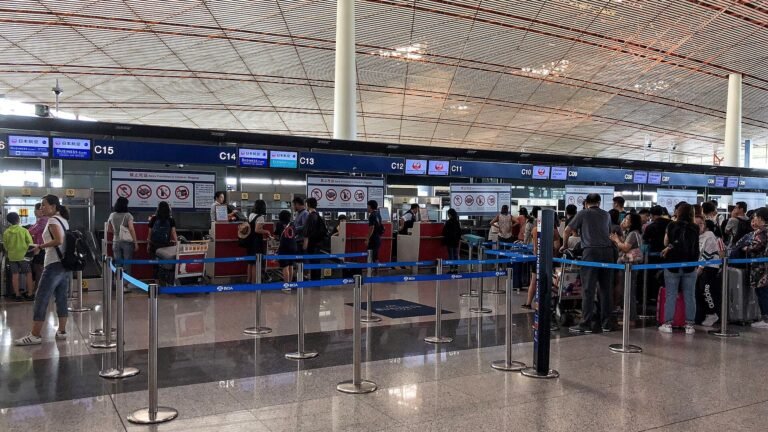
Photo: Japan Airlines check-in counters at ZBAA (20180816083018).jpg by N509FZ (CC BY-SA 4.0), via Wikimedia Commons.
.jpg)