Nishiki Market vs Kuromon and Tsukiji: 2026 Hours and Rules
Nishiki Market asks you to eat at the shop, Kuromon welcomes eating as you stroll, and Toyosu shuts on Sundays. Hours, closed days and manners for 2026.
Nishiki Market vs Kuromon and Tsukiji: the short answer
At Nishiki Market in Kyoto, eat in front of the shop where you bought the food. Kuromon Market in Osaka welcomes eating as you stroll. In Tokyo, Tsukiji Outer Market’s public hours are 9:00 to 14:00, and Toyosu Market closes on Sundays and public holidays.
The four markets are different kinds of places. Nishiki and Kuromon are covered streets lined with food shops. Tsukiji Outer Market serves professional buyers first and the public later in the morning. Toyosu is a wholesale market run by the Tokyo Metropolitan Government, and visitors follow a set route.
The table below lines up hours, closed days and the eating rule for all four, as each market’s official website gives them.
| Market | Hours | Closed | Eating |
|---|---|---|---|
| Nishiki, Kyoto | Set by each shop, e.g. 10:00–18:00 | Set by each shop | In front of or inside the shop |
| Kuromon, Osaka | Set by each shop, e.g. 9:00–18:00 | Some shops: Sundays, public holidays | Eating as you stroll is welcome |
| Tsukiji Outer Market, Tokyo | Public 9:00–14:00 | Days off on the Tokyo market calendar | Inside the eatery or an eating space |
| Toyosu Market, Tokyo | Visitor walkway 5:00–17:00 | Sundays, public holidays, market holidays | In the dining area, not the walkways |
Opening hours and closed days at each market
Tsukiji and Toyosu set hours for the whole market. At Nishiki and Kuromon, each shop keeps its own hours and days off.
Nishiki. The market’s requests page lists eat-in shops that accept food bought anywhere in the market. Their hours include 10:00 to 18:00 and 10:30 to 18:30. One closes on Mondays and others on irregular days. Another closes its eat-in space at 17:00 and shuts on 1 January.
Kuromon. The shop guide on Kuromon’s English site gives each shop’s hours. Listed shops open as early as 7:00, one stays open until 22:30, and a supermarket in the market is open 24 hours. Many close on Sundays, a few also on public holidays, and some list no regular holiday. One tuna shop closes when everything is sold out.
Tsukiji Outer Market. The market splits the day into three blocks: 6:00 to 9:00 for professional buyers, 9:00 to 14:00 for the public, and flexible hours after 14:00. Its calendar page shows the business days of the Tokyo Central Wholesale Market. It also asks you to check each shop’s own schedule.
Toyosu Market. The visitor walkway, which includes the dining and shopping area, is open 5:00 to 17:00 on market days. The Toyosu section further down has the full timetable.
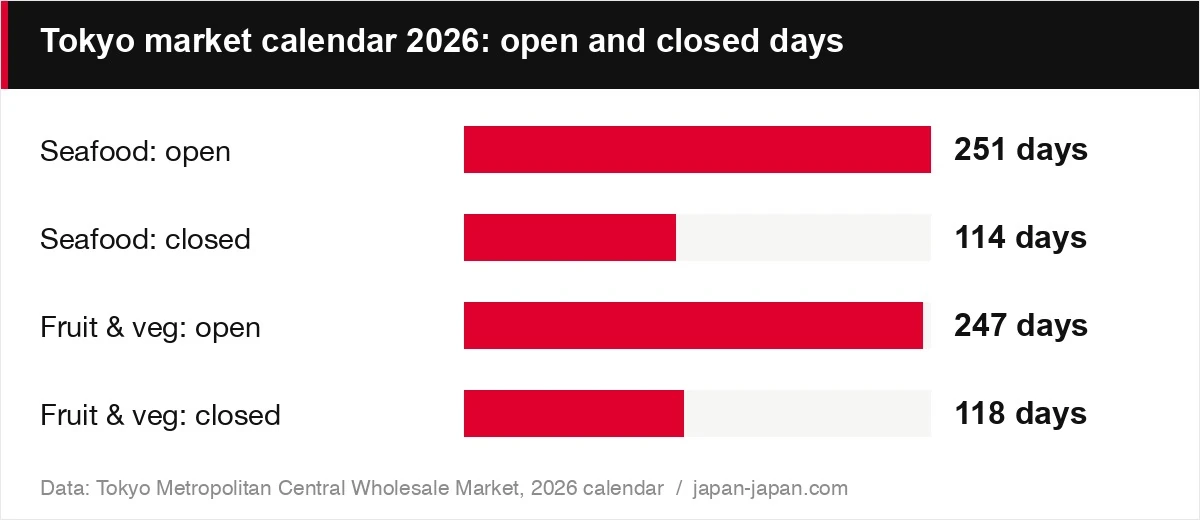
The Tokyo Metropolitan Central Wholesale Market publishes a calendar of open and closed days each year, and Toyosu follows it. In the 2026 calendar, the seafood markets (Toyosu, Ota and Adachi) have 251 open days and 114 closed days. The calendar page below shows the seafood section in Japanese.
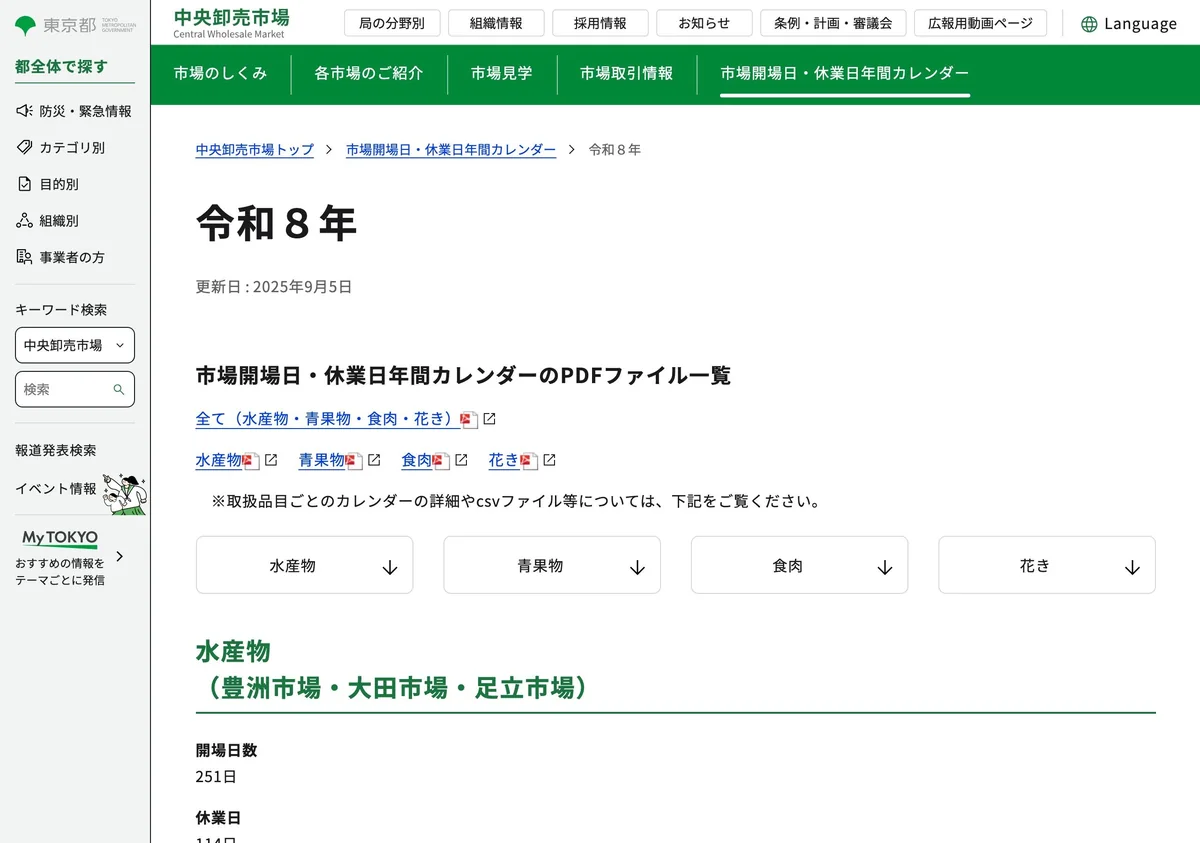
The fruit and vegetable markets, Toyosu included, have 247 open days and 118 closed days. Four dates close for fruit and vegetables only: 14 October, 4 November, 25 November and 30 December. The chart below compares the two calendars.
| Item | Value | Note |
|---|---|---|
| Seafood: open | 251 days | Toyosu, Ota and Adachi |
| Seafood: closed | 114 days | Toyosu, Ota and Adachi |
| Fruit & veg: open | 247 days | Toyosu and other markets |
| Fruit & veg: closed | 118 days | Toyosu and other markets |
Public holidays matter at Toyosu, which shuts on them, and at the Kuromon shops that list them as days off. Our list of public holidays in 2026 has every date, such as Sports Day on Monday 12 October and Culture Day on Tuesday 3 November. For a trip next year, use the 2027 holiday calendar.
New Year needs its own plan. Nishiki’s history page says the market gets very crowded at the end of the year and over the New Year holidays. Just moving forward takes effort, and the market calls that a Kyoto tradition too. Banks close from 31 December to 3 January, and our New Year guide lists other closures and the busiest train days.
Eating while walking: the rule at each market
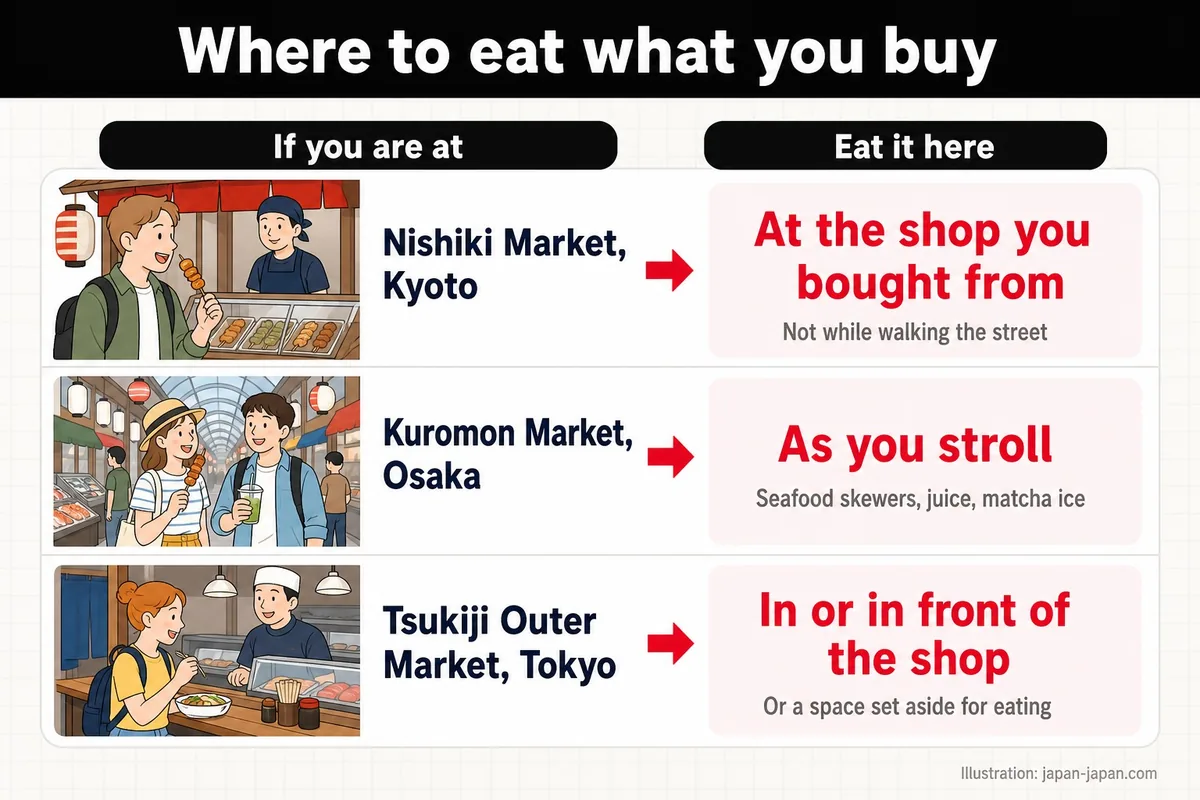
The rule flips between Kyoto and Osaka. Nishiki and Tsukiji ask you to stop and eat at the shop, while Kuromon invites you to eat as you walk.
Nishiki. The market’s requests to visitors start with one ask: refrain from walking in the market while eating. In a crowded street, food can stain other customers’ clothes or cause other problems. Eat in front of or inside the shop where you bought it.
The eat-in shops listed on that page have house rules. Some ask for one order per person, a drink or a dish, and children count too. The page writes this rule as おひとりさま ワンオーダー (ohitorisama wan ōdā), meaning one order per person. Staff may check that you bought your food at Nishiki, then show you to a seat. When the shop is full, you may have to wait.
Tsukiji Outer Market. The official site asks you to stay inside the eatery or in front of the store when you eat. Wandering around while eating can bother passersby, so eat inside or in a space set aside for eating.
Kuromon. The market’s own site calls it a perfect place for Tabe Aruki, an Osaka culture of eating as you stroll. It suggests seafood skewers at a fish shop, fresh fruit juice from a fruit shop and matcha soft-serve ice cream at a tea shop.
The illustration below sums up where to eat what you buy at the three street markets.
Toyosu has a rule of its own. You may not eat or drink in the walkways or on the benches, so eat in the restaurants of the dining and shopping area.
Nishiki Market: what to eat in Kyoto’s kitchen
Nishiki Market is often called Kyoto’s kitchen. Its shops sell Kyoto vegetables, freshwater fish from Lake Biwa, hamo (pike conger), guji (tilefish), sasa flounder, yuba (soy milk skin) and fu (wheat gluten cake).
These seasonal ingredients go into the dishes of Kyoto’s high-end restaurants and into obanzai, the city’s home cooking. The market says that asking shop staff how to eat something is part of the fun. Try it when a vegetable or a fish is new to you.
The street has traded food for centuries. A record from 1311 already mentions fish stores here. In 1615 the shogunate named Nishiki one of Kyoto’s three privileged fresh fish wholesalers. The market calls this its first step toward a full-scale fish market.
Water explains why the market grew on this spot. The groundwater stays at 15 to 18 degrees Celsius all year, and it is known as Nishiki no mizu, or Nishiki water. Each store once had a well that worked as a refrigerator for fresh produce. Kyoto City approved a shared well water project for the market in 1965.
The painter Ito Jakuchu was born in Nishiki Market to a greengrocery wholesaler family. A monument near the west entrance marks the site of his home. From 1771, as head of the district, he fought to keep the market open after a rival market’s scheming. The market won official recognition in 1774.
The market has a role in July too. Since 1947 the Nishiki Mikoshi Kai has carried the Nishigoza, an octagonal portable shrine of Yasaka Shrine with a phoenix on its roof. It reaches the otabisho at Shijo Teramachi on the evening of 17 July and returns to the shrine on the 24th.
These dates come from the market’s own history page.
| Year | What happened |
|---|---|
| 1054 | Emperor Goreizei is said to rename the street Nishiki-koji. |
| 1615 | The shogunate names Nishiki one of Kyoto’s three privileged fresh fish wholesalers. |
| 1927 | Many stores move to the new Kyoto Central Wholesale Market. |
| 1928 | Fruit, vegetable and meat sellers join, and the street starts again as Kyoto’s Kitchen. |
| 1993 | The current arcade is completed, built without pillars. |
| 2006 | Nishiki signs a friendship agreement with San Lorenzo Market in Florence. |
Kuromon Market: eating as you stroll in Osaka
Kuromon Market is in Minami, in the centre of Osaka. It is a roofed market about 580m long, with about 150 shops.
Its most famous fish are hamo (conger pike) in summer and fugu (blowfish) in winter. At least 10% of its seafood shops specialise in fugu and hamo. Beyond fish, the market has soft-shelled turtle specialists, restaurants, fruit and vegetable shops, butchers, pickles, dried food, Japanese sweets and Western cakes.
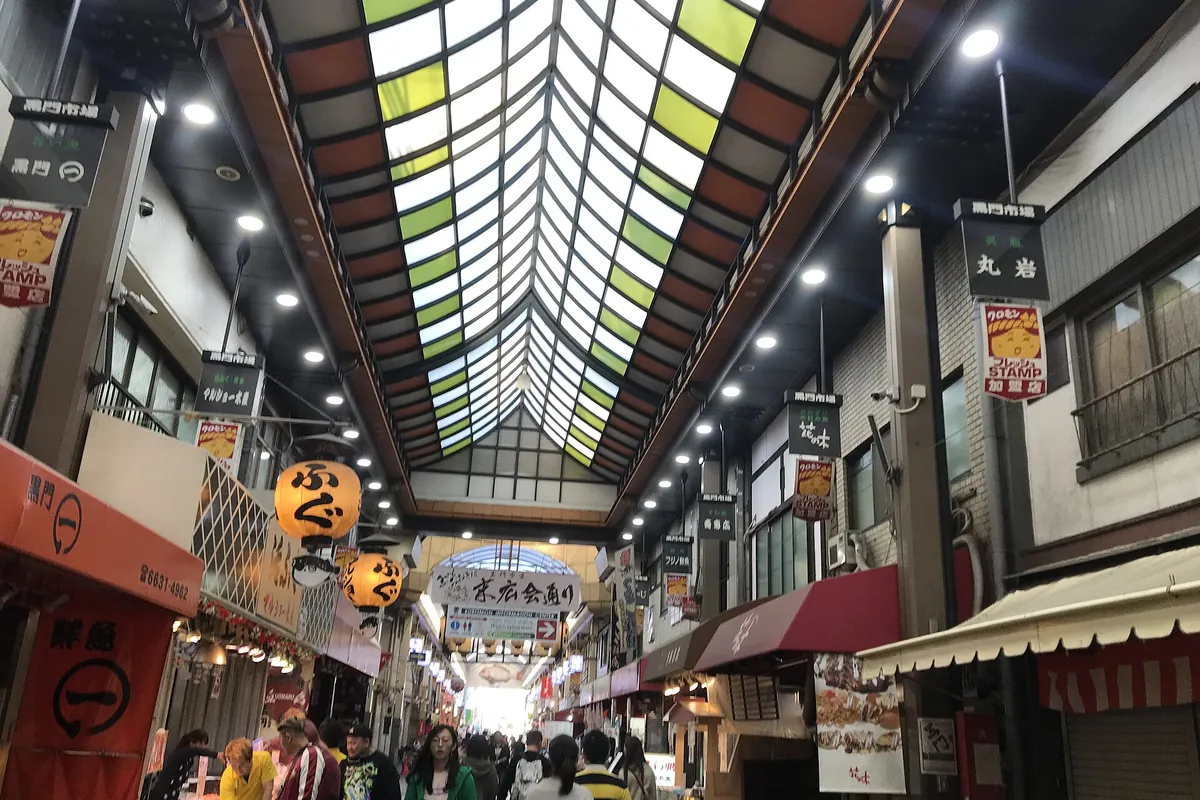
The photo below shows food stalls under the market’s roof.
Eating on the move is the whole idea here. The market’s site promises you will never be bored strolling down the street and tells you to prepare to eat until you have had enough. It links this to kuidaore, an Osaka word it translates as eat till you faint.
The official shop guide sorts shops into categories, and Eat-in, Vegetarian, Vegan and Halal are among them. Hana no Ki, listed under Vegetarian, opens 10:00 to 16:00 and closes on Sundays and public holidays. Our guide to vegetarian food in Japan covers what to ask before you order.
Kuromon’s address is 2-4-1 Nipponbashi, Chuo-ku, Osaka. The access page on its site gives directions from Kansai Airport, Osaka Airport (Itami) and Shin-Osaka Station.
Tsukiji Outer Market: hours and eight manners
Tsukiji Outer Market is a district of narrow streets and small shops. Its official site says it has to serve professional buyers and tourists from around the world at the same time. That is why the early hours belong to the professionals.
The site lists eight manners for visitors. Here they are in the market’s order.
- Professional buyers take priority in the morning. Until 9:00, give way to people buying for their business and keep out of their path.
- Stay inside the eatery or in front of the store when eating. Wandering while eating bothers passersby.
- Leave your luggage behind. Put large bags in a coin locker. Plat Tsukiji, the information centre, keeps strollers for 500 yen each.
- Move in small numbers. The streets are narrow, so avoid big groups and hold your child’s hand.
- Ask before taking pictures. Ask the shopkeeper first. Some shops post signs that ban photography.
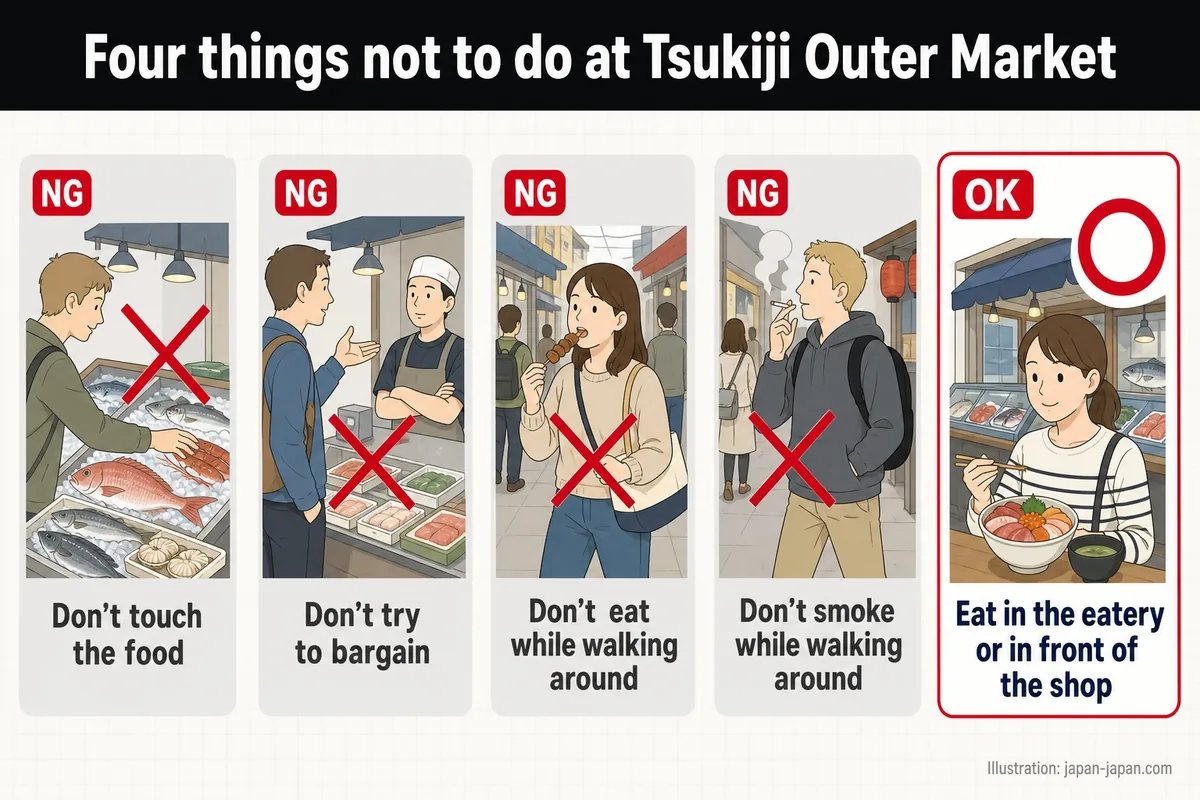
- Don’t touch the foods. Touching or poking lowers their value, raw food above all. Ask the shopkeeper if you need to check something.
- Don’t try to bargain. Goods sell at wholesale prices, and haggling is not the custom at Tsukiji.
- Smoke only in designated areas. Do not smoke while walking or drop cigarette butts.
The illustration below picks out four of the don’ts.
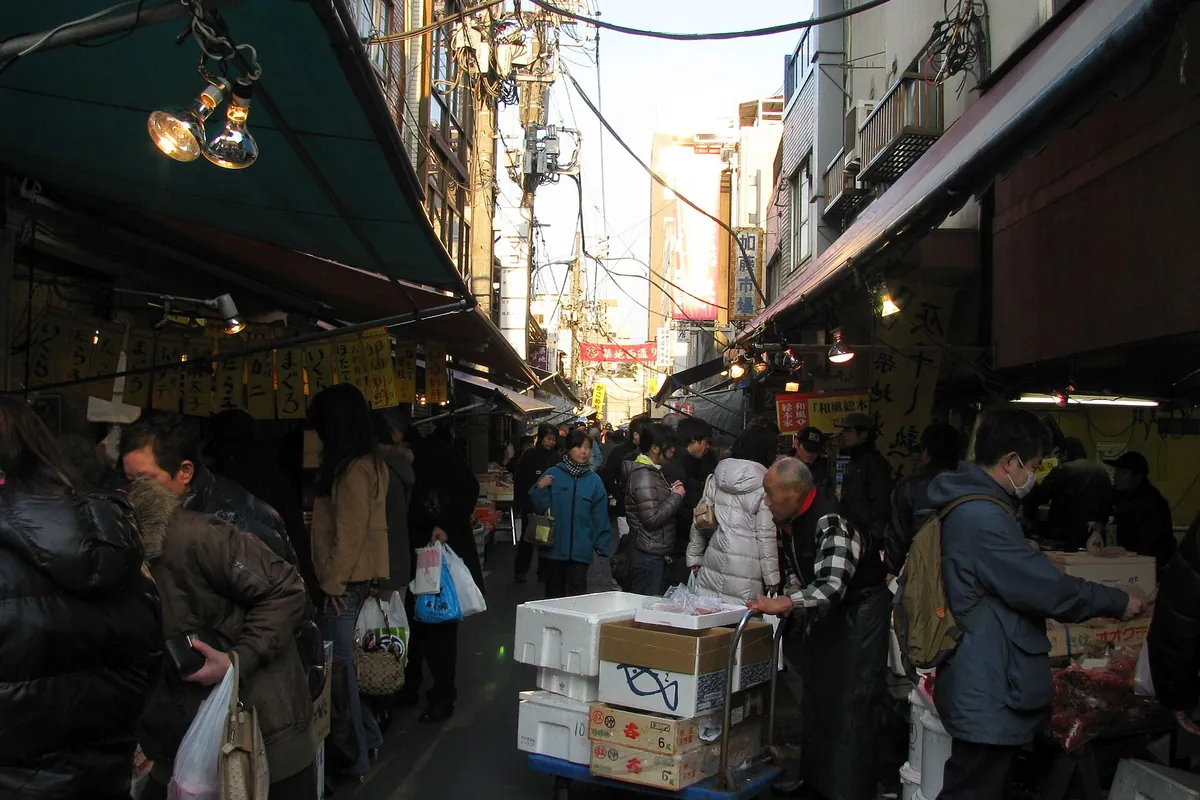
Most of these manners come down to space. The photo below shows the kind of narrow lane they are written for.
For sushi, our conveyor belt sushi guide covers prices and how to order, so this guide stays with the market rules.
Toyosu Market: what visitors can see and when
Toyosu Market is one of Tokyo’s central wholesale markets. Visitors follow a set route, and its hours open and close in layers through the day.
Here is the visitor’s day in time order, from the Tokyo Metropolitan Government’s visitor information page.
- 5:00. The visitor walkway opens, dining and shopping area included. The rooftop garden opens at the same time.
- 8:30. The Toyosu Market PR corner opens.
- 11:30. On Saturdays, the PR corner closes.
- 14:30. On other market days, the PR corner closes.
- 17:00. The visitor walkway closes.
- 23:00. The rooftop garden closes.
The official page below sets out these hours in Japanese.
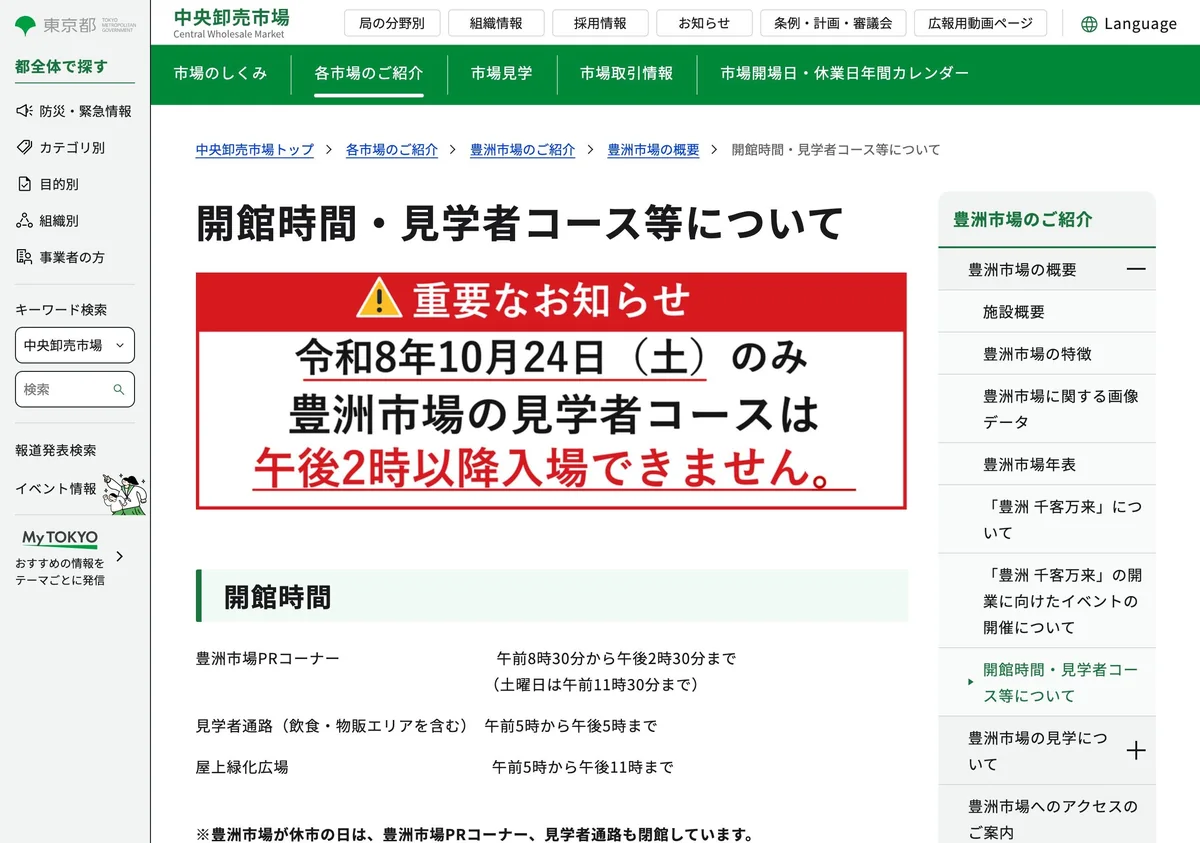
On market holidays, the PR corner and the visitor walkway stay shut. On Sundays, public holidays and other market holidays, you cannot enter Toyosu Market, restaurants and shops included. The rooftop garden is the exception, and it keeps its hours even on market holidays.
Visitors come in from the pedestrian deck through three entrances, one per block. Restaurant and shop hours differ from the visiting hours, and some close before the walkway does.
For those hours, the market’s page points to two cooperative websites. Toyosu Gurume covers the restaurants, and Uogashi Yokocho covers the shops. The intermediate wholesale floor sells to businesses that buy above a set quantity, such as supermarkets, fish shops and restaurants. Members of the public cannot buy there.
The early-morning tuna auction viewing takes an advance application, and a lottery decides who gets in. Places do not go to the first in line, so a pre-dawn queue will not help. The tuna auction viewing page links to the application form.
There is no parking for visitors’ cars or bicycles. Come by public transport, on a route bus or the Yurikamome line. The visitor information page also offers a pamphlet to download in English, Chinese (simplified and traditional) and Korean.
If you want both Tokyo markets in one morning, the diagram below lines up the official times.
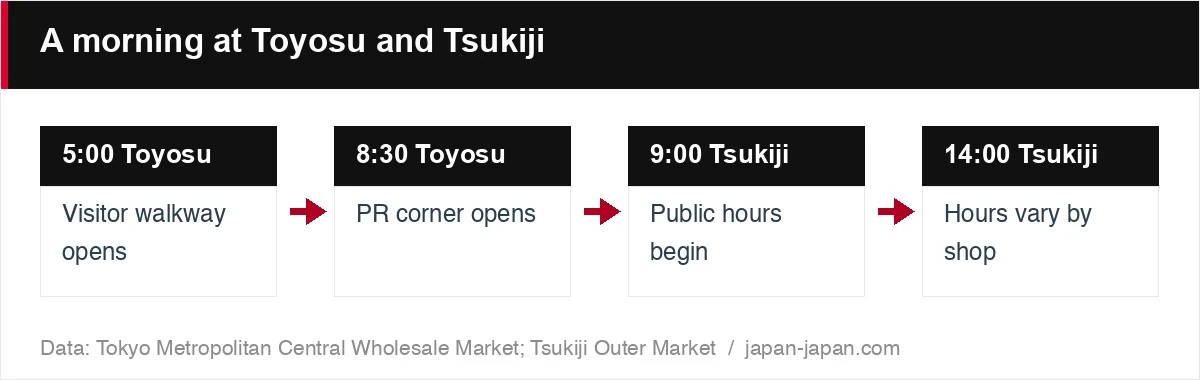
Walk the Toyosu route early, then move on to Tsukiji, where public hours begin at 9:00. Toyosu’s PR corner opens at 8:30 if you want to see it first.
Getting there and taking market food home
All three market cities have a direct train from the airport.
- Kyoto. The JR Haruka limited express runs from Kansai Airport to Kyoto in about 75 minutes. Visitors with a foreign passport can buy the HARUKA One-way Ticket for 2,200 yen. Our Kansai Airport to Kyoto page also covers the limousine bus, at 2,800 yen.
- Osaka. Nankai trains run from Kansai Airport to Namba without a change. The Rapi:t takes 34 to 49 minutes for 1,670 yen, and the Airport Express costs 970 yen. Times and last trains are on our Kansai Airport to Namba page.
- Tokyo. If you stay in Ginza, take the Keikyu Line and Toei Asakusa Line from Haneda Airport. The trip takes about 29 minutes for 550 yen, with no change. Our Haneda Airport to Ginza page compares two other routes.
Market food is easy to buy and harder to fly with. Check these rules from our database of what you can bring before you pack.
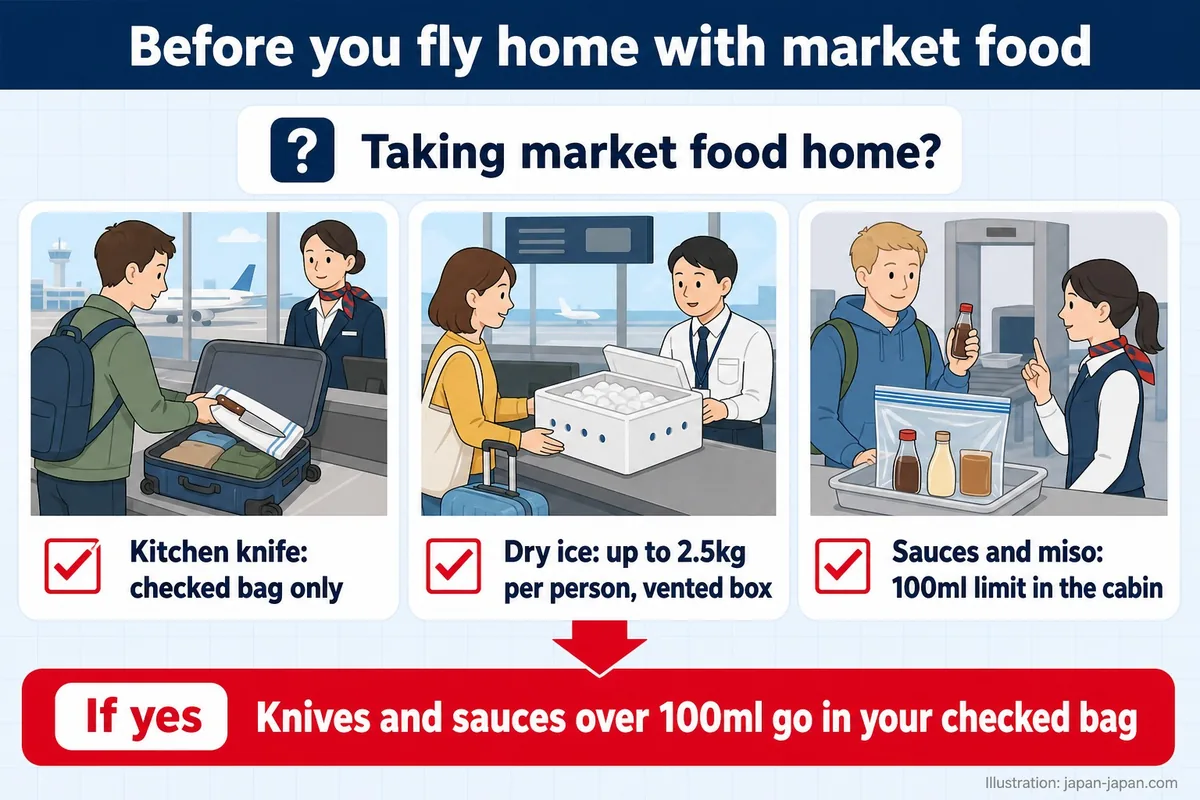
- Kitchen knives. A knife goes in checked baggage. In the cabin, Japan allows only something like a blunt butter knife that the screener judges cannot be used as a weapon. See our knives page.
- Dry ice. You can carry up to 2.5kg per person in the cabin or the hold, to keep perishable food cold. The package must let the carbon dioxide gas escape. Narita Airport notes that airlines may set a different limit or require a label, as our dry ice page explains.
- Sauces, miso and other wet food. Solid food can go in the cabin. On international flights, liquid, gel and paste foods fall under the 100ml limit, including miso, soup, curry, sauces, jam, honey and tofu packed in water. Larger containers can go in your checked bag, as our food page sets out.
- Fish. Your home country decides which fish it lets in. For Japan’s own rule on arrival, our fish and seafood page explains when dried fish is checked.
The illustration below runs through three checks before you pack.
Snacks, sweets and sake raise other questions, from tax-free refunds to your home country’s customs. Our guide to Japanese snacks to bring home covers them.
Tax-free shopping itself changes on 1 November 2026, and food counts too: what you can buy tax-free.
Other cities have markets of their own, such as Omicho Market in Kanazawa, Nijo Market in Sapporo and the Hakodate Morning Market. Check each market’s own site for its hours and eating rule before you go, as this guide does for these four.
FAQ
Can you eat while walking at Nishiki Market?
No. Nishiki Market asks visitors not to walk while eating, because food can stain other customers’ clothes in the crowded street. Eat in front of or inside the shop where you bought it, or at an eat-in shop that takes food from the market.
What time should you go to Tsukiji Outer Market?
Go between 9:00 and 14:00, the public hours. Until 9:00 professional buyers have priority, and after 14:00 each shop decides its own hours. For closed days, check the calendar on the market’s site, which follows the Tokyo Central Wholesale Market.
Is Toyosu Market open on Sundays?
No. On Sundays, public holidays and other market holidays, you cannot enter Toyosu Market, including its restaurants and shops. Only the rooftop garden opens on market holidays, from 5:00 to 23:00. The 2026 seafood calendar has 114 closed days.
Can you take market food home on the plane?
Yes, with limits. Solid food can go in the cabin, but on international flights miso, sauces and other liquid foods fall under the 100ml limit. Kitchen knives go in checked baggage. Dry ice is limited to 2.5kg per person, in a package that lets the gas escape.
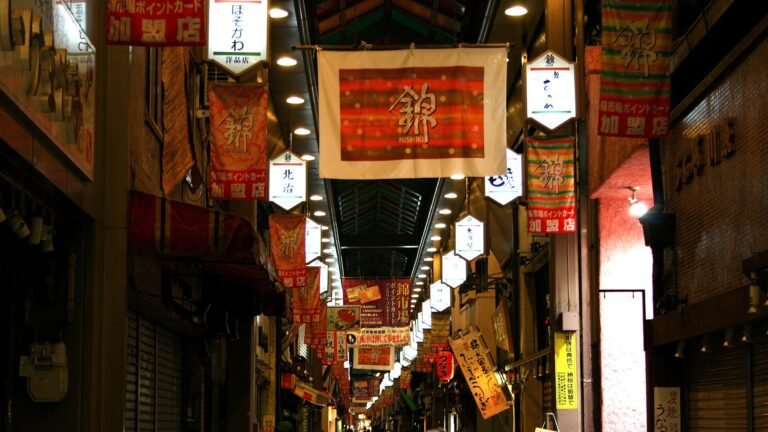
Photo: Nishiki Ichiba by pokpok313 in Kyoto.jpg by pokpok313 from Nishiki Ichiba, Nakagyo, Kyoto (CC BY-SA 2.0), via Wikimedia Commons.