Japan Honeymoon Route Splits 14 Nights Across 4 Stops

Best months for a honeymoon in Japan
Choose the month by what the two of you want to see. Cherry blossom, red maples and a warm sea each have their own window. Once you pick one, the dates follow.
Cherry blossom: the last days of March
The Japan Meteorological Agency cherry blossom full-bloom normals put full bloom on 31 March in Tokyo. Kyoto follows on 4 April. These are averages for 1991 to 2020.
Recent springs have run early. In 2026 Tokyo’s sample tree reached full bloom on 28 March, and Kyoto’s on 30 March.
Tokyo’s tree opened on 19 March in 2026, 5 days earlier than its average of 24 March. Our cherry blossom dates by city list the opening and full-bloom days for each region.
For a cherry blossom honeymoon, aim to be in Tokyo in the last week of March and in Kyoto in the first days of April. Our guide to cherry blossom season in Japan has the recent early springs.
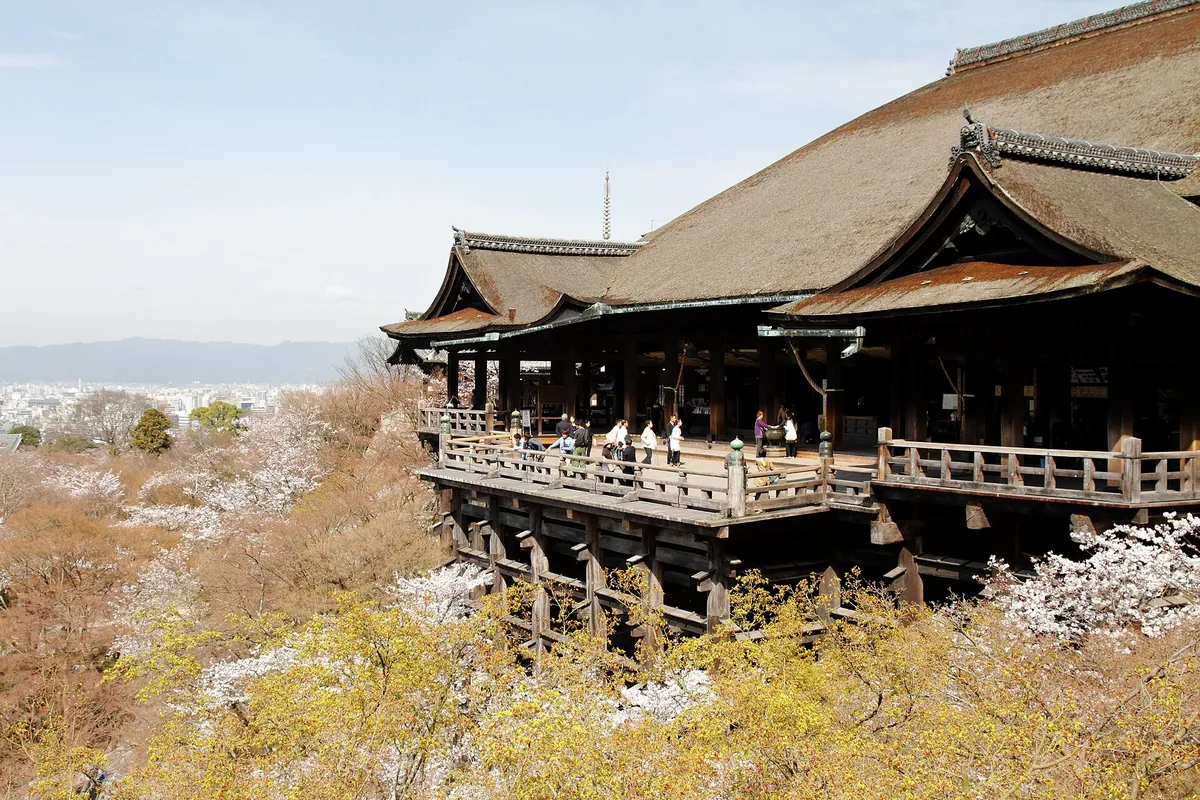
The photo shows Kiyomizu-dera in Kyoto with the cherry trees out. Spring nights are cool. The Japan Meteorological Agency Tokyo climate normals give an average of 9.4°C in March and 14.3°C in April, with daily highs of 19.4°C in April.
Pack a light coat for evening walks. The Japan in April page lists the spring festivals and night viewings.
Autumn leaves: late November into December
Autumn colour comes later than many visitors expect. The Japan Meteorological Agency’s sample ginkgo in Kyoto turns yellow around 24 November.
Its sample maple turns red around 5 December and has lost most of its leaves by 18 December. In 2025 the maple turned red on 10 December, 5 days late. Our Kyoto autumn leaves page tracks both trees.
In Tokyo the sample maple turns red around 28 November. Across Kansai the maples turn red from about 21 November in Nara to 6 December in Wakayama.
A trip from the last week of November covers Tokyo and Kyoto in colour. November is also one of Tokyo’s drier months, with 96.3 mm of rain against 234.8 mm in October. See Japan in November for the light-ups.
The chart above matches each sight to its month. Use it as a first filter, then check the exact dates below.
Warm sea and the rainy season
For beach days, Okinawa stays warm when Tokyo cools down. Naha averages 22.5°C in November and 19.0°C in December. The rainy season is the month to avoid.
In an average year it runs from about 10 May to 21 June in Okinawa and from about 7 June to 19 July around Tokyo.
The Japan Meteorological Agency Naha climate normals show June as the wettest month there, with 284.4 mm of rain. Tokyo gets 167.8 mm in June. Our Japan in June page and Okinawa by month page have the full year.
Dates to avoid: Golden Week, Obon and New Year
Three holiday periods send much of Japan travelling at once. Hotels, ryokan and Shinkansen seats fill up early, and prices rise. Move your trip a week either side if you can.
Golden Week
The Cabinet Office national holidays of Japan list Showa Day on Thursday 29 April 2027. Constitution Memorial Day, Greenery Day and Children’s Day follow on 3, 4 and 5 May.
That gives 5 days off in a row, from Saturday 1 May to Wednesday 5 May 2027. Our Golden Week 2027 page shows the busiest days.
The good news for spring couples: in an average year Kyoto’s cherry trees reach full bloom on 4 April. That is more than three weeks before Golden Week starts, so the two rarely meet.
Obon and New Year
Obon falls in mid-August, when many people visit their home towns. In 2027 the Mountain Day holiday is Wednesday 11 August.
Summer is also hot. Tokyo averages 26.9°C in August, with daily highs of 31.3°C. Our Obon page explains how the week works.
New Year’s Day is Friday 1 January 2027. Families travel home in the days before and after it.
Some shops and sights close for the first days of January. See our New Year 2026–27 page for what stays open.
One smaller jam sits inside cherry season. In 2027 the spring equinox holiday is Sunday 21 March, so Monday 22 March is also a day off.
Expect busy trains and gardens that weekend. In autumn, Culture Day falls on 3 November and Labour Thanksgiving Day on 23 November.
| Month | Tokyo: temp, rain | Naha: temp, rain | What is on |
|---|---|---|---|
| March | 9.4°C, 116.0 mm | 19.1°C, 142.8 mm | Tokyo full bloom 31 March; holiday 21 to 22 March 2027 |
| April | 14.3°C, 133.7 mm | 21.5°C, 161.0 mm | Kyoto full bloom 4 April; Golden Week starts 29 April 2027 |
| May | 18.8°C, 139.7 mm | 24.2°C, 245.3 mm | Golden Week 1 to 5 May 2027; Okinawa rains from about 10 May |
| June | 21.9°C, 167.8 mm | 27.2°C, 284.4 mm | Rainy season in Tokyo from about 7 June |
| November | 12.5°C, 96.3 mm | 22.5°C, 119.1 mm | Kyoto ginkgo 24 November; Tokyo maples 28 November |
| December | 7.7°C, 57.9 mm | 19.0°C, 110.0 mm | Kyoto maples 5 December; New Year holidays at month end |
The table puts the weather and the busy dates for each candidate month side by side. The temperatures come from the Japan Meteorological Agency’s 1991–2020 normals, shown in the screen below.
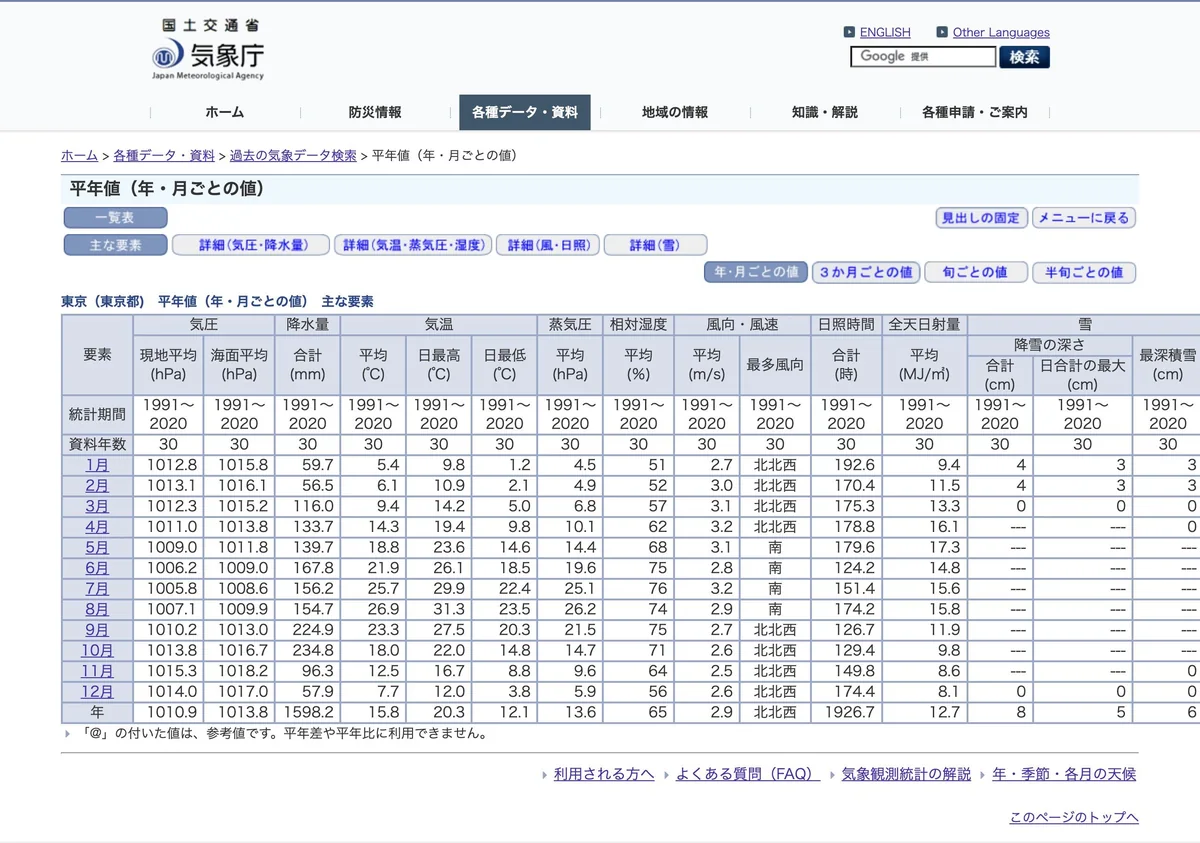
This is the agency’s page of monthly normals for Tokyo, in Japanese. Each row is a month. The columns give rain in millimetres and temperature in degrees Celsius.
A two-week route: Tokyo, Hakone, Kyoto and Okinawa
Split the 14 nights into 4 stops: 4 nights in Tokyo, 2 in Hakone, 4 in Kyoto and 4 in Okinawa. You get a big city, a hot spring town, the old capital and a beach. Each move takes half a day or less.
Tokyo, 4 nights
Land at Haneda if you can. The Keikyu train runs to Shinagawa for 330 yen, and our Haneda to Shinagawa page has the other options. Spend the first nights getting over the flight before the ryokan part of the trip.
Hakone, 2 nights
Hakone is the closest onsen town to Tokyo. Our Tokyo to Hakone route gives the trains and fares. Book your ryokan here, and take the ropeway over the volcanic valley on the full day.

The photo shows a gondola above Owakudani. The Hakone Navi Hakone Ropeway page lists 4 stations: Sounzan, Owakudani, Ubako and Togendai. Each section takes about 10 minutes.
Gondolas seat 18 and leave about every minute. Between Sounzan and Owakudani you cross a valley about 130 m above the ground. On clear days you can see Mount Fuji and Lake Ashi.
| Place | Hakone Ropeway |
|---|---|
| Hours | February to November 9:00-17:00; December and January 9:00-16:15. Stops in bad weather or high volcanic gas |
| Access | Sounzan Station connects to the Hakone Tozan Cable Car from Gora; Togendai Station connects to the Lake Ashi boats and buses |
| Official site | Hakone Navi Hakone Ropeway page |
The ropeway runs from 9:00 to 17:00 from February to November, and from 9:00 to 16:15 in December and January. It stops in strong wind, thunder or typhoons. It also stops when the volcanic gas level rises, so check the gas reading on the day.
Kyoto, 4 nights
From Hakone, go back down to Odawara and take the Tokaido Shinkansen west. From Tokyo, the Nozomi to Kyoto costs 14,170 yen per adult with a reserved seat, or 13,320 yen in a non-reserved car.
Our Tokyo to Kyoto route has the times. Four nights leave room for temples by day and a slow dinner in Gion.
Okinawa, 4 nights
End the trip on the beach. From Kyoto, fly to Naha from Itami Airport in 2 h 5 min, with 6 flights a day.
The first leaves at 08:15 and the last at 14:50, so plan a morning start. Kansai Airport has 9 flights a day on the same route. Our Kyoto to Okinawa route lists both.
To get to Kansai Airport, the JR Haruka takes about 75 minutes from Kyoto. Visitors with a foreign passport pay 2,200 yen one way. See our Kansai Airport to Kyoto page.
Want Okinawa in the middle instead? Haneda has 35 flights a day to Naha, taking 2 h 30 min. See our Tokyo to Okinawa route.
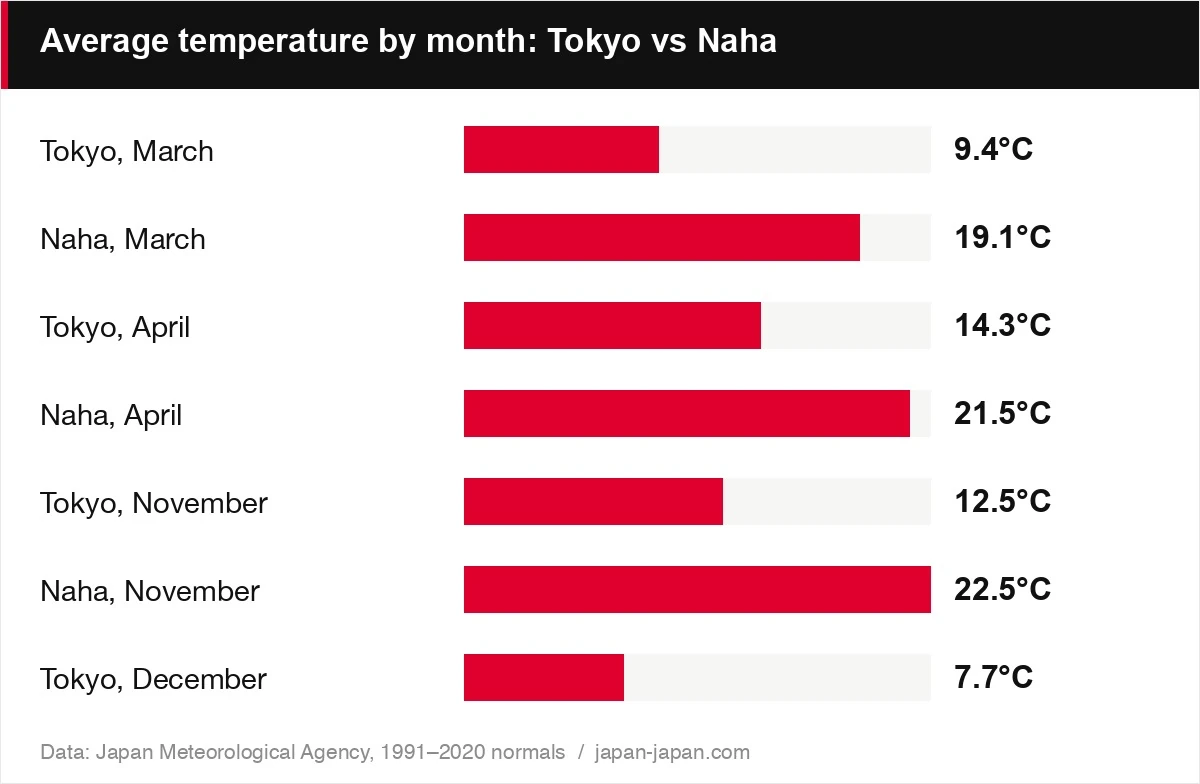
| Item | Value |
|---|---|
| Tokyo, March | 9.4 °C |
| Naha, March | 19.1 °C |
| Tokyo, April | 14.3 °C |
| Naha, April | 21.5 °C |
| Tokyo, November | 12.5 °C |
| Naha, November | 22.5 °C |
| Tokyo, December | 7.7 °C |
| Naha, December | 19 °C |
The chart shows why Okinawa makes a good last stop in spring and autumn. Naha averages 21.5°C in April against 14.3°C in Tokyo, and 22.5°C in November against 12.5°C. Our Naha Airport page covers the trip into town.
Ryokan with a private bath
A night or two in a ryokan is the part most couples remember. The JNTO guide to staying at a Japanese ryokan lists the common features.
Expect tatami floors, futon bedding and yukata robes. Private baths are sometimes outdoors, and meals run to a kaiseki dinner and a Japanese breakfast.
How to bathe together
The large shared bath in a ryokan is split into a men’s side and a women’s side. If you want to bathe together, you have two choices.
Book a room with its own bath, often an open-air one. Or reserve the private bath, called 貸切風呂 (kashikiri-buro, private bath), for a set time slot.
Ask about the private bath when you book, as slots go fast in busy weeks. Tattoo rules are set by each bath. Our guide to tattoo-friendly onsen in Japan explains what to expect.
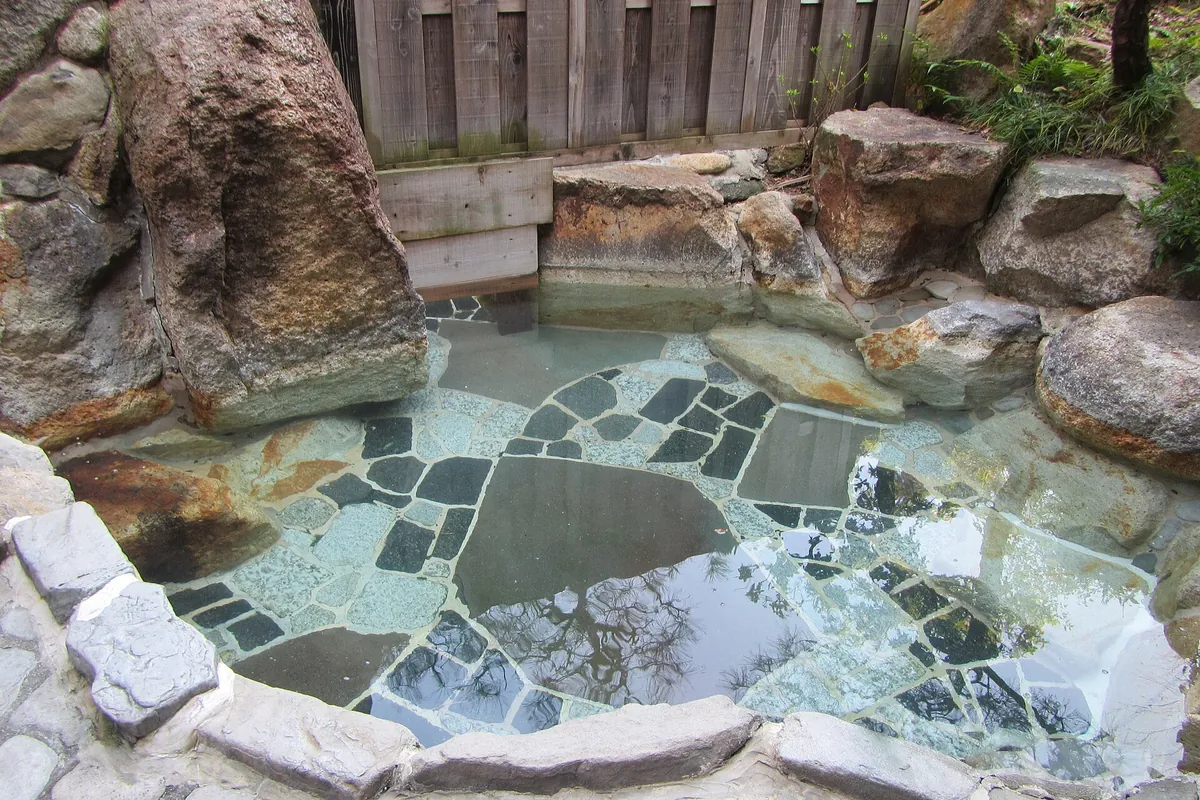
A bath like the one in the photo is what you are booking when you choose a room with a private open-air bath.
Meals, yukata and price
A ryokan stay usually includes dinner and breakfast. Meals are served in a dining hall or in your room, depending on the ryokan.
Ask for in-room dining if you want a private dinner. The staff explain the customs on arrival: take off your shoes indoors, wear the yukata, and take the bath.
JNTO puts the average ryokan stay at around 15,000 yen per person per night, with meals usually included. High-end ryokan charge more. Prices are per person, so a couple pays twice the listed rate.
Some cities also add a local tax per guest per night, covered in our Japan accommodation tax guide. Our ryokan vs hotel comparison helps you decide how many ryokan nights to book.
What a Japan honeymoon costs for two
Hotels, food and shopping depend on your taste. This section covers the fixed costs you can price today.
Is Japan cheap to visit? The rail pass and the ryokan rate give you a solid base for the budget.
| Item | Per person | For two | Source |
|---|---|---|---|
| Japan Rail Pass, 7 days, Ordinary Car, online | 50,000 yen | 100,000 yen | JR Group |
| Japan Rail Pass, 7 days, Green Car, online | 70,000 yen | 140,000 yen | JR Group |
| Nozomi Tokyo to Kyoto, reserved seat, one way | 14,170 yen | 28,340 yen | japan-japan.com routes |
| Ryokan, average night with meals | About 15,000 yen | About 30,000 yen | JNTO |
| Tax-free minimum, one shop, one day | 5,000 yen before tax | Per shop | Japan Tourism Agency |
The table doubles each price for two adults. The Japan Rail Pass official prices page lists a 7-day Ordinary Car pass at 50,000 yen online. The 7-day Green Car pass costs 70,000 yen.
From an overseas agency the same passes cost 53,000 yen and 74,000 yen. A 14-day pass costs 80,000 yen, or 110,000 yen in the Green Car, online.
Does the rail pass pay off on this route?
Add up your own rides before you buy. On this route, the long JR trip is the one to Kyoto, and the flights to Okinawa are separate. A Nozomi from Tokyo to Kyoto costs 14,170 yen with a reserved seat.
The pass does not cover the Nozomi or Mizuho unless pass holders buy a special ticket for them. Our Japan Rail Pass page lists what the pass covers.
Taxes and refunds
Japan’s departure tax is charged per traveller and added to your air fare. Our Japan departure tax page has the current rate. For shopping, the tax-free minimum is 5,000 yen before tax, in the same shop on the same day.
From 1 November 2026 you pay the price including tax and get the refund after a customs check. You must leave Japan within 90 days.
Our tax-free steps page walks through it. At the airport, scan your passport at a tax-free terminal before you check in your bags, as our airport customs check page shows.

Your beach days in Okinawa, like the bay in the photo, cost little beyond the flight and the hotel.
Moving between cities without your suitcases
Do not drag two large suitcases onto the Shinkansen and up to a ryokan. Send them ahead with TA-Q-BIN, Yamato Transport’s delivery service, and travel with one small bag.
The Yamato Transport TA-Q-BIN delivery service page accepts parcels from Size 60 to Size 200, up to 200 cm in total length and 30 kg. A large suitcase usually falls in Size 160, up to 160 cm and 25 kg.
Each parcel is insured up to 300,000 yen. You get 100 yen off per parcel when you drop it at a convenience store or a Yamato sales office.
The discount for sending several parcels together does not apply to suitcases of Size 160 or larger. So two big cases are charged one by one. Rates for each size and route are in our Japan luggage forwarding guide, with the airport cut-off times.
A plan that works for this route
Send both suitcases from your Tokyo hotel straight to your Kyoto hotel. Take one overnight bag to Hakone for the 2 nights there.
Yamato’s counters at 22 airports say a bag reaches most of the country the next day. The cases will be waiting when you arrive in Kyoto.
At the hotel front desk, say 宅急便でお願いします (takkyubin de onegai shimasu, by TA-Q-BIN, please). The staff fill in or help with the waybill. Write a clear description of the contents, or the parcel may be delayed.
When you land, Narita and Haneda also deliver on the same day. Narita delivers to hotels in ten central Tokyo wards and Urayasu.
Haneda delivers to hotels in Urayasu, Odaiba and Maihama. Yamato’s English phone line, 03-6834-7503, runs from 8:00 to 21:00, 365 days a year.
Before you fly: a checklist for two
Do these four things together, a few weeks before the flight. Each one is easy to miss when two people each assume the other has done it.
- Rail pass: Buy it online only if your rides cost more than the pass. Compare the fares on our route pages first.
- Private bath: Book the private bath or a room with its own bath at each ryokan.
- Visit Japan Web: Each traveller needs their own entry. Our Visit Japan Web QR code guide shows the steps.
- Baggage: On 22 of 26 low-cost airlines, the cheapest fare has no checked bag. Check your fare on our baggage rules by airline pages.
Pack power banks in your carry-on. Since 24 April 2026 Japan allows 2 per person, each 160Wh or less, and none in checked bags.
On domestic flights from Haneda, 6 airlines take checked bags until 30 minutes before departure, including JAL and ANA. For the trip from each airport into town, use our airport transfers pages.
FAQ
How many days do you need for a Japan honeymoon?
Two weeks fits four stops at a slow pace: 4 nights each in Tokyo, Kyoto and Okinawa, and 2 in Hakone. With one week, pick two stops, such as Tokyo and Kyoto. The Nozomi links them for 14,170 yen per adult with a reserved seat.
Is Japan expensive for a honeymoon?
JNTO puts the average ryokan stay at around 15,000 yen per person per night, with meals usually included. A 7-day Japan Rail Pass costs 50,000 yen per adult online. City hotels, food and shopping vary with your style. The tax-free refund starts at 5,000 yen spent in one shop on one day.
Do ryokan have private baths for couples?
Many do. Ask for the private bath, kashikiri-buro, which you book for a time slot, or a room with its own bath. The large shared bath is split by gender, so couples cannot use it together.
Is winter a good time for a honeymoon in Japan?
It can be. Tokyo averages 7.7°C in December and 5.4°C in January, with under 60 mm of rain in each month. Naha averages 17.3°C in January. Avoid the New Year holidays, and note the Hakone Ropeway closes at 16:15 from December to January.
About the author