Best Time to Visit Japan 2027: Hotels Emptiest in January
Mild here means average highs of 15-25°C and fewer than 12 days with 1 mm of rain or more. We counted it for the 34 places in our Japan by month guide that have a Japan Meteorological Agency (JMA) station, using the 1991-2020 normals. Hakone is the one place in the guide without a JMA station.
Hotel occupancy is the share of rooms filled each night. It tells you how easy it is to find a room, not what the room costs.
We read it for every prefecture and every month from 2023 to 2025. We then lined it up with Japan’s 2027 holidays, the big holidays in nearby countries and the weather normals.
Best time to visit Japan in 2027, month by month
January averaged 50.3% hotel occupancy in 2023-2025. October and November tied for the top at 64.4%, and they stay level at 64.37% before rounding.
The table sets three things side by side. They are hotel occupancy, Japan’s 3-day weekends in 2027 and the number of mild places.
| Month | Hotel occupancy, 2023-25 average (%) | 3-day+ weekends in 2027 | Mild places (of 34) |
|---|---|---|---|
| January | 50.3 | 1-3 Jan, 9-11 Jan | 1 |
| February | 56.9 | None | 3 |
| March | 59.0 | 20-22 Mar | 7 |
| April | 58.4 | None | 22 |
| May | 58.7 | 1-5 May | 25 |
| June | 57.1 | None | 7 |
| July | 59.8 | 17-19 Jul | 1 |
| August | 63.8 | None | 0 |
| September | 61.2 | 18-20 Sep | 5 |
| October | 64.4 | 9-11 Oct | 22 |
| November | 64.4 | None | 16 |
| December | 58.5 | None | 3 |
Occupancy comes from the Japan Tourism Agency’s confirmed figures for all accommodation types, averaged over 2023-2025 by japan-japan.com. The weekends come from the Cabinet Office holiday list. The mild places come from JMA 1991-2020 normals.
Winter is the season of free rooms and cold days. In January, 25 of the 34 places average highs under 10°C. Our guide to when it snows in Japan has the first-snow dates by city.
Spring brings cherry blossoms and the most foreign visitors. In an average year cherry trees reach full bloom on 31 March in Tokyo and 4 April in Kyoto and Osaka. April has 22 mild places, and May has 25, the most of any month.
May also starts with Golden Week, so plan the first five days with care.
Summer is hot and wet. The rainy season in Kanto-Koshin, the region around Tokyo, normally runs from about 7 June to about 19 July.
In July, 16 of the 34 places average highs of 30°C or more, and in August, 24 do. Typhoons come close to Japan’s main islands 5.8 times a year on average, most often in September (1.9) and August (1.6).
Autumn brings the second mild stretch, with 22 mild places in October and 16 in November. Our autumn leaves dates by city list when the maples turn red.
For each month’s events and weather, see Japan in September, Japan in October and Japan in November. Our Japan temperature by month page has the temperatures month by month.
The drawing below sums up the month to pick for each goal.

Japan peak and low season in 2027: the dates that fill up
Japan has seven long weekends of three days or more in 2027. They fall in January, March, May, July, September and October.
Lunar New Year, a big travel date for nearby markets, falls on 6 February. The two tables list the dates in order.
December 2026 to March 2027
| Date | What | Who travels | Source |
|---|---|---|---|
| 25 Dec 2026-5 Jan 2027 | Year-end and New Year; every Nozomi all-reserved | Japanese travellers | JR Central, JR West |
| 29 Dec-3 Jan | Government offices closed | Japanese travellers | Act on Holidays of Administrative Organs |
| 1‑3 Jan | New Year’s Day weekend | Japanese travellers | Cabinet Office |
| 9‑11 Jan | Coming of Age Day weekend; every Nozomi all-reserved | Japanese travellers | Cabinet Office, JR Central |
| 6 Feb | Lunar New Year’s Day | Hong Kong, Taiwan | GovHK, DGPA |
| 6‑9 Feb | Seollal break | Korea | KASA |
| 9‑10 Feb | Substitute days off | Taiwan | DGPA |
| 20‑22 Mar | Vernal Equinox weekend; every Nozomi all-reserved | Japanese travellers | Cabinet Office, JR Central |
The worst dates in 2027 for crowded trains are the New Year week and Golden Week. The JR Central and JR West Nozomi all-reserved periods release covers the Tokaido and Sanyo Shinkansen.
Every Nozomi is reserved-only from 25 December 2026 to 5 January 2027. The same rule covers 9-11 January and 20-22 March. JR calls this 全席指定席 (zenseki shiteiseki), meaning all seats are reserved.
On these dates a non-reserved ticket (自由席, jiyuseki) lets you ride a Nozomi only in the deck area, without a seat. The Hikari and Kodama keep their non-reserved cars as usual.
For the full year of days off, see our 2027 public holiday calendar. The Cabinet Office National Holidays 2026 and 2027 page lists 16 national holidays a year, plus 22 March 2027 as a substitute day off.
April to October 2027
| Date | What | Who travels | Source |
|---|---|---|---|
| 31 Mar, 4 Apr | Cherry full bloom, average year: Tokyo, then Kyoto and Osaka | Everyone | JMA |
| 1‑5 May | Golden Week, five days off | Japanese travellers | Cabinet Office |
| 17‑19 Jul | Marine Day weekend | Japanese travellers | Cabinet Office |
| 11 Aug | Mountain Day, a Wednesday | Japanese travellers | Cabinet Office |
| 14‑16 Sep | Chuseok break | Korea | KASA |
| 18‑20 Sep | Respect for the Aged Day weekend | Japanese travellers | Cabinet Office |
| 9‑11 Oct | Sports Day weekend | Japanese travellers | Cabinet Office |
Golden Week is the second hard stretch. Showa Day on Thursday 29 April opens it, and 1-5 May is five days off in a row.
Our Golden Week 2027 page has the day-by-day list. Obon in mid-August is not a national holiday. The only national holiday in August 2027 is Mountain Day on 11 August.
As of 30 October 2026, JR Central and JR West had not announced Nozomi all-reserved dates for Golden Week or Obon 2027. Mainland China’s 2027 holiday dates had not been announced either.
Holidays abroad matter too. The GovHK General Holidays for 2027 page puts Lunar New Year’s Day on Saturday 6 February. The Taiwan DGPA 2027 Government Office Calendar gives 9-10 February off in place of the weekend.
The KASA 2027 Calendar Guidelines announcement sets Korea’s Seollal break at 6-9 February and Chuseok at 14-16 September. Our Lunar New Year in Japan 2027 guide covers that week in detail.
Cherry blossom dates move every year. The JMA cherry blossom full bloom dates table shows Tokyo’s tree in full bloom on 28 March 2026, three days before its 31 March normal.
Our cherry blossom season guide has the opening dates by city. If you can only travel in February, the early Kawazu cherry blossoms bloom then.
Which month are Japan’s hotels emptiest? We counted 47 prefectures
January is the emptiest month in most of Japan. It was the lowest month in 32 of 47 prefectures in 2025, and in 43 of 47 on the 2023-2025 average.
We used the Japan Tourism Agency Overnight Travel Statistics time series tables. They give confirmed monthly occupancy for every prefecture and every type of accommodation.
For each prefecture and year we found the month with the lowest figure. The bar chart below shows how many prefectures had January as their lowest month.

| Item | Value |
|---|---|
| 2023 | 44 prefectures |
| 2024 | 38 prefectures |
| 2025 | 32 prefectures |
| 2023-2025 average | 43 prefectures |
In 2025 the other 15 prefectures split like this. June was lowest in 6, December in 3 and April in 2.
March, July, September and October were lowest in 1 each. Saga had the same figure in October and December.
On the three-year average only four prefectures miss January. Hokkaido is emptiest in April. Nagano ties March, April and December.
Oita is emptiest in July and Miyazaki in June. At the other end, November is the fullest month in 29 of 47 prefectures, October in 8 and August in 8.
January is filling up faster than the rest of the year. Nationwide occupancy in January rose from 46.0% in 2023 to 54.6% in 2025, up 8.6 points. October rose 4.7 points over the same years and November 2.4.
We do not claim to know why, but two facts sit next to each other. Foreign guests spent 6,417,530 nights in Japan’s hotels in January 2023 and 15,235,390 in January 2025. And Lunar New Year fell in January in 2023 (22 January) and in 2025 (29 January).
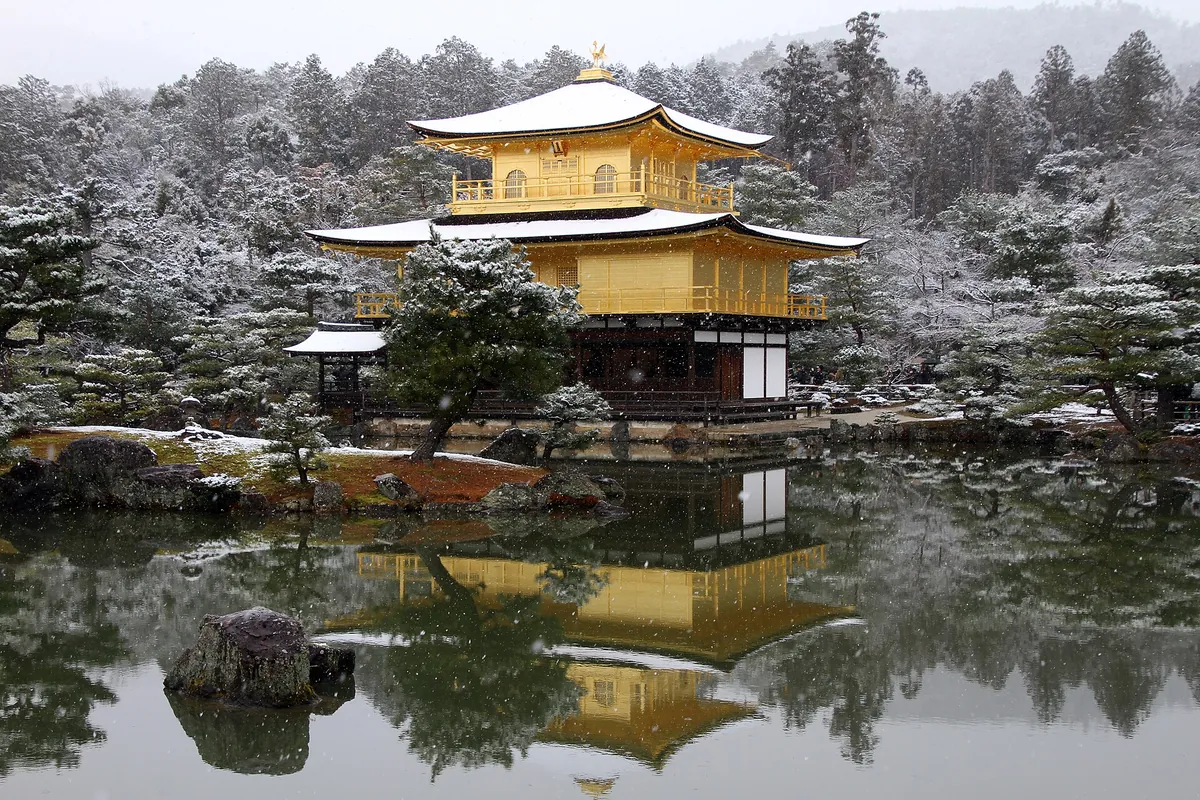
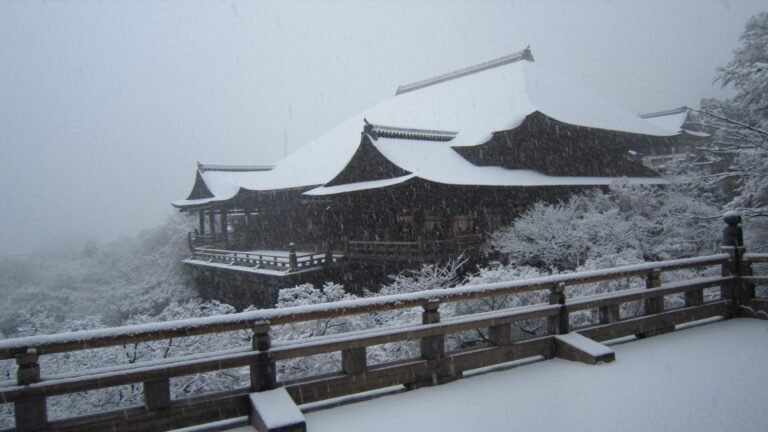
The photo above shows Kinkaku-ji in Kyoto under snow. Kyoto’s hotels averaged 45.2% occupancy in January over 2023-2025, against 73.1% in November.
This article stops at 2025 because the agency changed its sampling in January 2026. The Japan Tourism Agency Overnight Travel Statistics survey page says the survey now sorts hotels by guest rooms, not staff numbers. It warns that 2026 changes against the year before may include that effect.
Is February the quietest month in Japan? It depends what you count
Hotel occupancy bottoms out in January, foreign arrivals in February and foreign guest-nights in September. All three come from 2025 data. Many guides and AI summaries call February the quietest month, and by arrivals they are right.
The JNTO visitor arrivals by nationality and month table shows 3,258,491 visitors in February 2025, the lowest month. April had the most at 3,909,128, 1.20 times as many. The table below sets the three measures side by side.
| Measure | Source | Lowest month | Highest month |
|---|---|---|---|
| Hotel occupancy, all guests | Japan Tourism Agency | January 54.6% | October 66.6% |
| Foreign visitor arrivals | JNTO | February 3,258,491 | April 3,909,128 |
| Foreign guest-nights in hotels | Japan Tourism Agency | September 12,834,640 | April 17,218,330 |
The measures disagree for two reasons. First, occupancy counts Japanese and foreign guests together, and foreign guests took 27.2% of hotel nights in 2025. So Japanese travellers shape most of the occupancy curve.
Second, the agency divides rooms used by rooms available times the days in the month. February’s 28 days shrink its totals, but not its occupancy rate.
That is why total guest-nights in 2025 were lowest in February (47,966,040) and highest in August (67,204,490). Occupancy was still lowest in January. The drawing below shows which month each measure picks.

For finding a room, occupancy is the measure that matters. For crowds of other visitors at the big sights, arrivals and foreign guest-nights tell you more. Foreign guest-nights peaked in April 2025 at 17,218,330, 1.34 times the September low.
Least crowded time to visit Tokyo, Kyoto, Osaka and 3 more areas
On the 2023-2025 average, Tokyo’s hotel occupancy swings 13.0 points across the year; Kyoto’s swings 27.9. The table shows each area’s two emptiest and two fullest months.
| Area | Emptiest (%) | Fullest (%) | Gap (points) |
|---|---|---|---|
| Tokyo | Jan 66.4, Feb 72.9 | Nov 79.5, Oct 79.2 | 13.0 |
| Kyoto | Jan 45.2, Feb 50.8 | Nov 73.1, Oct 72.0 | 27.9 |
| Osaka | Jan 62.8, Feb 68.1 | Oct 80.6, Nov 79.6 | 17.8 |
| Hokkaido | Apr 44.2, Mar 51.8 | Jul 70.9, Aug 70.8 | 26.8 |
| Okinawa | Jan 47.0, Dec 50.0 | Oct 61.5, Jul 61.4 | 14.5 |
| Fukuoka | Jan 61.4, Jun 66.7 | Nov 76.9, Oct 74.7 | 15.5 |
Across all 47 prefectures the middle gap is 18.4 points. Yamanashi has the widest at 29.3 points, and Saga the narrowest at 6.9.
Kyoto’s January is changing fastest. Its occupancy rose from 36.7% in 2023 to 46.0% in 2024 and 52.8% in 2025, up 16.1 points in two years.
Foreign guests took 66.2% of Kyoto’s hotel nights in April 2025 and 48.5% in February. Kyoto’s foreign guest-nights in April were 2.04 times its February level, against 1.32 times in Tokyo.
Hokkaido runs the other way. Its emptiest months are April (44.2%) and March, and its fullest are July and August.
Its foreign peak is in winter: Hokkaido’s foreign guest-nights in January 2025 were 3.06 times its April level. Niigata reached 6.76 times and Nagano 4.44 times, both with January as the foreign peak.
Okinawa is emptiest in January (47.0%) and December (50.0%), and fullest in October and July. Fukuoka’s quietest months are January and June. Osaka’s emptiest month, January, still averages 62.8%, and October reaches 80.6%.
Cheapest time to visit Japan: what hotel data can and cannot tell you
There is no official month-by-month price table, so this article gives no prices. Occupancy, the share of rooms filled, is the closest official measure.
What the data does show is where the free rooms are. January has the most free rooms: Japan’s hotels were 54.6% full in January 2025, the lowest month of the year. When more rooms sit empty, you have more choice of hotel and area.
January 2027 also has one thing that January 2023 and 2025 did not. Lunar New Year fell on 22 January 2023, 10 February 2024, 29 January 2025 and 17 February 2026. In 2027 it falls on 6 February, so the whole of January is clear of it.
Two parts of January are still busy. The New Year rush runs to 5 January, and 9-11 January is a long weekend in Japan. Snow areas are the other exception: Hokkaido’s hotels were 62.1% full in January 2025, against 46.3% in April.
The drawing below turns this into four steps.

The figures in this article come from the agency’s survey. The page below is the Japan Tourism Agency’s survey page, where it posts each month’s results and the time series tables.

Who travels when: foreign visitors by month and market
Foreign guests took 32.5% of hotel nights in April 2025 and 21.0% in August. Across the whole of 2025 they took 27.2%, up from 19.4% in 2019.
Each market has its own peak. The busiest months in 2025 by JNTO arrivals were:
- Korea: December, 974,239 visitors.
- Hong Kong: December, 291,133 visitors.
- China: August, 1,018,747 visitors.
- Taiwan: August, 620,753 visitors.
- United States: June, 345,150 visitors.
- Australia: January, 140,185 visitors.
- United Kingdom: April, 69,496 visitors.
That is five different months for seven markets. So there is no single month when every visitor group stays home. If you want to avoid your own country’s travellers, check your school holidays against this list.
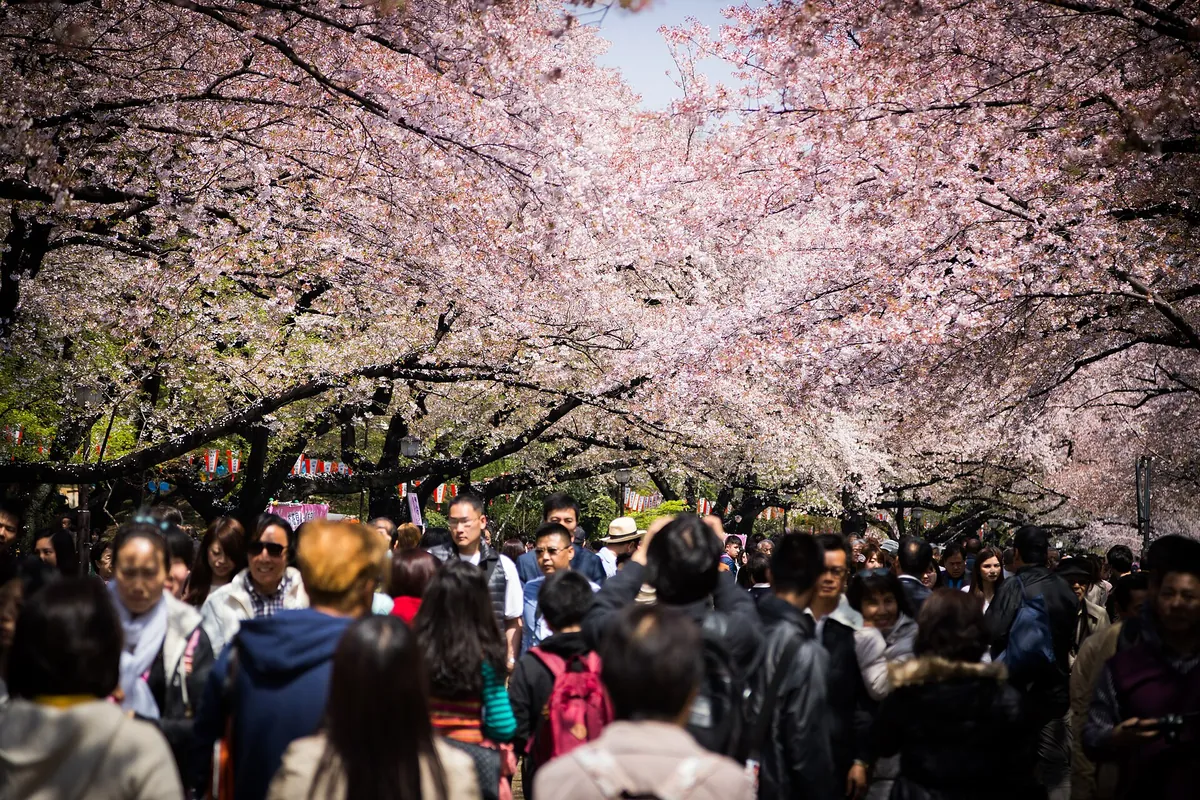
The photo above shows Ueno Park in Tokyo at full bloom. April is when foreign guests take their largest share of Japan’s hotel nights.
Lunar New Year week, from 6 February in 2027, is a holiday in Hong Kong, Taiwan and Korea. Plan around it with our Lunar New Year guide.
FAQ
What’s the cheapest month to go to Japan?
January has the most free hotel rooms. Japan’s hotels were 54.6% full in January 2025, the lowest month, against 66.6% in October. The Japan Tourism Agency measures occupancy, not prices, so use it as a guide to availability.
What are the best and worst months to visit Japan?
For mild weather, May leads with 25 of our 34 places mild, then April and October with 22 each. The hardest dates are Golden Week (1-5 May 2027) and New Year, when every Nozomi is reserved-only from 25 December 2026 to 5 January 2027. Hotels are fullest in October and November, at 64.4% on the 2023-2025 average.
Is January a good time to visit Japan?
Yes, if you want free rooms and can handle cold. January was the emptiest hotel month in 32 of 47 prefectures in 2025, and 25 of our 34 places average highs under 10°C. Avoid 1-3 and 9-11 January, which are long weekends in Japan. Ski areas are the exception, with Hokkaido 62.1% full in January 2025.
Is April busy in Japan?
Yes. April 2025 had the most foreign arrivals of the year (3,909,128) and the most foreign hotel nights (17,218,330). In an average year cherry trees reach full bloom on 31 March in Tokyo and 4 April in Kyoto and Osaka. April 2027 has no long weekend in Japan, and Golden Week starts on 1 May.
About the author