Is the JR Pass Worth It in 2026? Check It in Two Minutes
Only if your long-distance fares add up to more than the pass: 50,000 yen for 7 days on the official website, or 53,000 yen at an overseas agency from 1 October 2026.
By Shunta Fujii
The Japan Rail Pass used to be an easy recommendation. After the price rise in October 2023 it is not. From 1 October 2026 an overseas agency charges 53,000 yen for a 7-day adult pass in ordinary cars, while the official website still sells it online for 50,000 yen. Whether it pays depends entirely on how far you actually travel.
How to check in two minutes
Add up the one-way fares for the long-distance trips you will definitely take, using a route search. Compare that total against the pass price for the same number of days. If the fares do not exceed the pass, buy tickets individually.
From 1 October 2026 the number to beat depends on where you buy. The official Japan Rail Pass website lists an adult pass for ordinary cars at 50,000 yen for 7 days when you buy online, and 53,000 yen when you buy at an overseas JR-designated agency. The 14-day pass costs 80,000 yen online or 84,000 yen at an agency, and the 21-day pass 100,000 yen or 105,000 yen. JR Central tells visitors to choose 7, 14 or 21 days to fit their schedule, so round your trip up to one of those.
| Pass (adult) | Official website, online | Overseas agency |
|---|---|---|
| Ordinary, 7 days | 50,000 yen | 53,000 yen |
| Ordinary, 14 days | 80,000 yen | 84,000 yen |
| Ordinary, 21 days | 100,000 yen | 105,000 yen |
| Green Car, 7 days | 70,000 yen | 74,000 yen |
Count only the long rides. The pass does not include municipal subways or private suburban lines, so JNTO says it is best used to cover distance. Short hops inside a city go on an IC card, which we cover further down. Leave out any long ride that is only a maybe. For the fares, JNTO points to route planners such as Japan Transit Planner (Jorudan) and NAVITIME.
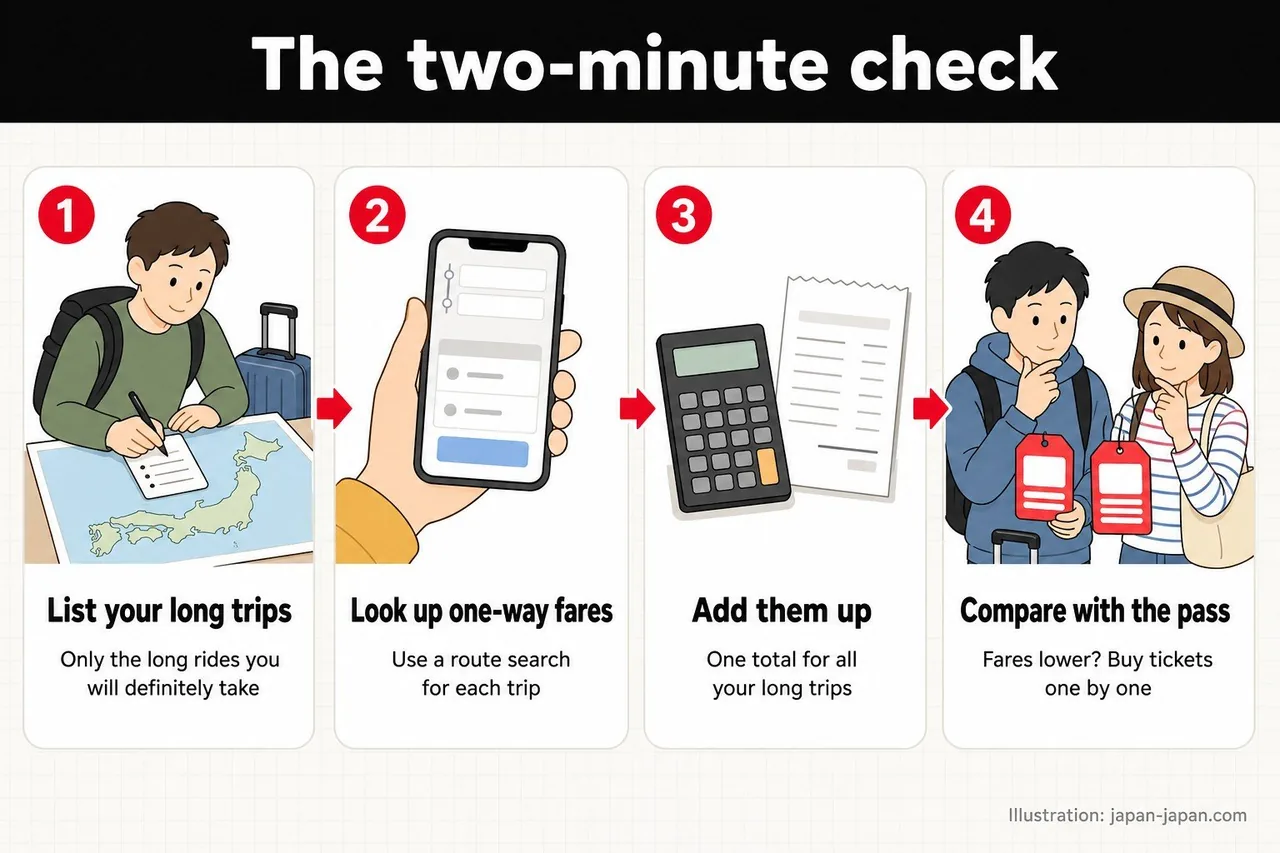
The illustration below turns the check into four steps. List your long trips, look up each one-way fare, add them up, and set the total against the pass.
JR Hokkaido runs this exact sum on its own pass page. A round trip from Sapporo to Hakodate plus a round trip from Sapporo to Otaru costs 23,140 yen in regular tickets (19,540 yen plus 3,600 yen). The 5-day Hokkaido Rail Pass costs 22,000 yen, so the pass wins. Buy the same pass at a station in Hokkaido, though, and it costs 23,000 yen, only just ahead. JR Hokkaido’s other two examples work the same way.
| Round trips from Sapporo | Regular tickets | Pass instead | Pass price |
|---|---|---|---|
| Hakodate, plus Otaru | 23,140 yen | Hokkaido Rail Pass, 5 days | 22,000 yen |
| Noboribetsu, plus Otaru | 13,380 yen | Sapporo-Noboribetsu Area Pass, 4 days | 10,000 yen |
| Furano via Asahikawa | 13,520 yen | Sapporo-Furano Area Pass, 4 days | 11,000 yen |
Do the same with your own route and the new nationwide price. If your long rides for a one-week trip add up to less than 50,000 yen online, or 53,000 yen through an agency, the nationwide pass costs you money.
Where the pass still wins
- Tokyo to Kyoto to Hiroshima and back within seven days.
- Any trip that includes a return leg the full length of the country.
- Trips where you genuinely move every day or two.
JNTO’s pass guide notes that the shinkansen now runs all the way from Hokkaido to Kyushu. The pass covers most shinkansen, plus rapid, express and local JR trains.
The Tokyo, Kyoto and Hiroshima route has a catch. The nationwide pass does not include the Nozomi or the Mizuho, the fastest trains on the Tokaido-Sanyo and Sanyo-Kyushu Shinkansen. On the Tokaido Shinkansen the pass covers only the Hikari and the Kodama, so check the train name before you board.
The illustration below draws that line. The Hikari and Kodama run on the pass alone. The Nozomi and Mizuho need an extra ticket, bought before you board.
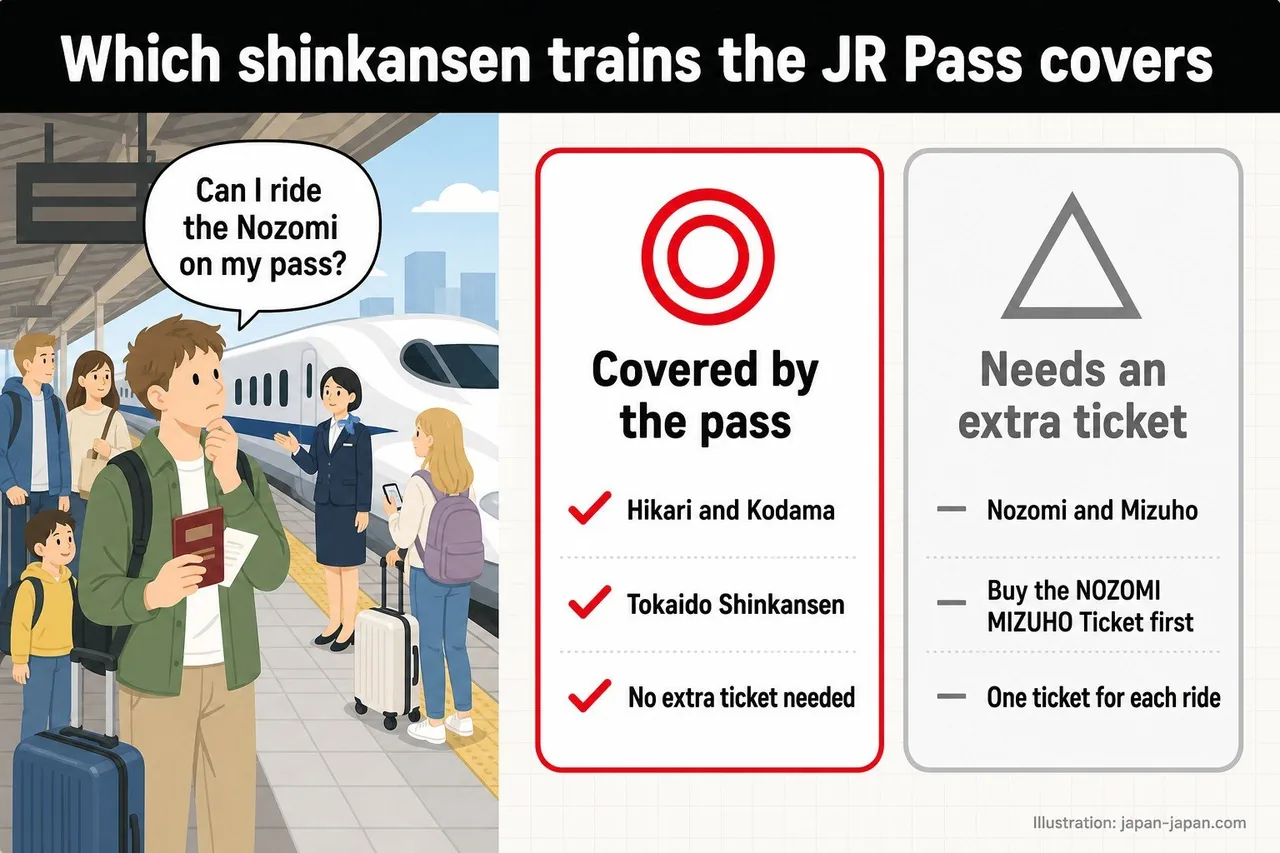
JR Central says the Nozomi runs up to 13 times an hour. On the Hikari or Kodama you may have to change trains on the way to Kyoto or Hiroshima. The Nozomi gets you there without a change, although not every Nozomi goes as far as Hiroshima.
To ride the Nozomi or Mizuho on the pass, buy the [ONLY WITH JAPAN RAIL PASS] NOZOMI MIZUHO Ticket, one for each ride. Get it at a reserved seat ticket machine or a JR ticket office, from one month before the day you travel. You cannot book it online before you arrive in Japan.
One price covers a Green Car, reserved or non-reserved seat, but an ordinary-car pass cannot buy the Green Car version. JR Central’s page lists the ticket at 4,960 yen from Tokyo or Shinagawa to Kyoto or Shin-Osaka, and 6,500 yen to Hiroshima. From Nagoya to Hiroshima it is 4,960 yen. If your plan uses the Nozomi, add these tickets to the pass side of your two-minute sum.
During long holidays every Nozomi runs with reserved seats only, so buy the reserved-seat version of the ticket.
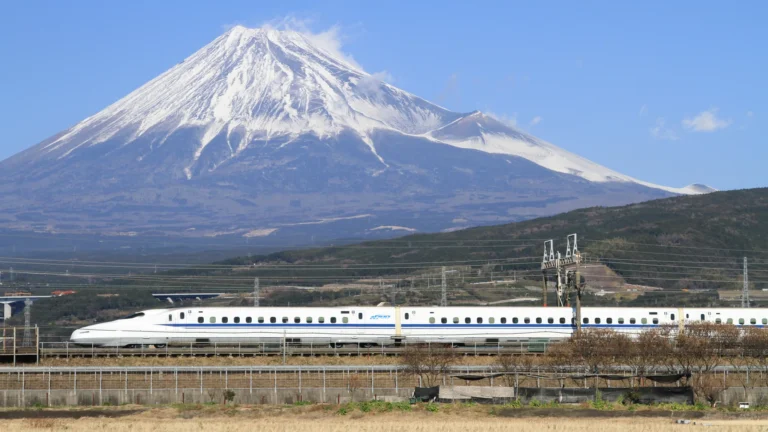
Moving every day or two works best with seat reservations. With the pass, reserving on most shinkansen and limited express trains costs nothing extra. Some trains have no non-reserved seats, such as the Hayabusa on the Tohoku Shinkansen and the Kagayaki on the Hokuriku Shinkansen. On those you must reserve. Heading from Tokyo towards Kyoto and Osaka, ask for a window seat on the right to see Mt. Fuji.
Hiroshima adds a ferry. The pass covers the JR West Miyajima Ferry between Miyajimaguchi and Miyajima, and the tourist loop bus in Hiroshima. At the ferry, show your pass at the service window and pay the Miyajima Visitor Tax separately. JR West gives the tax as 100 yen as of October 2023, paid when you board the ferry.
If you fly into Hiroshima Airport, there is no rail link. Almost everyone takes the limousine bus, about 50 minutes into the city. It stops at the Shinkansen exit of Hiroshima Station, where your rail trip can start.
Where it does not
A week based in Tokyo with one day trip to Kyoto will not come close. Neither will a trip that stays inside one region — the regional passes are cheaper and cover the same ground.
JNTO’s advice points the same way. If you will spend most of your time in Tokyo or Osaka, it suggests subway passes or area rail passes. The nationwide pass does not cover Tokyo’s subway and metro lines. As of March 2026, the Tokyo Subway Ticket gives 24 hours of unlimited rides on Tokyo Metro and Toei Subway lines for 1,000 yen. The 48-hour and 72-hour tickets cost 1,500 yen and 2,000 yen.
For a trip inside one region, JNTO says regional and private passes may be better value than the full JR Pass. For western Japan, it points to JR West’s passes. JR Hokkaido and JR Kyushu sell their own.
Kansai-Hiroshima Area Pass. JR West sells it at 17,000 yen for 5 consecutive days, or 8,500 yen for a child aged 6 to 11. It covers reserved seats on the Sanyo Shinkansen between Shin-Osaka and Hiroshima, limited expresses such as the HARUKA, and the Miyajima Ferry. It does not cover the shinkansen on to Tokyo or Hakata. JR West lists these prices as of 1 August 2024.
Hokkaido Rail Pass. JR Hokkaido charges 22,000 yen for 5 consecutive days, 28,000 yen for 7 and 37,000 yen for 10 if you buy in advance. At a station in Hokkaido the same passes cost 23,000 yen, 29,000 yen and 38,000 yen. The pass covers all JR Hokkaido lines except the Hokkaido Shinkansen. Every JR Hokkaido limited express is fully reserved, so collect a seat ticket before you board.
Sapporo-Noboribetsu and Sapporo-Furano Area Passes. JR Hokkaido sells these for 10,000 yen and 11,000 yen for 4 consecutive days in advance, or 11,000 yen and 12,000 yen at a station. Both include New Chitose Airport, Sapporo and Otaru. The first adds Noboribetsu, and the second adds Furano, Biei and Asahikawa.
JR Kyushu Rail Pass. JR Kyushu sells three versions. All Kyushu costs 22,000 yen for 3 days, 24,000 yen for 5 and 26,000 yen for 7. Northern Kyushu costs 15,000 yen for 3 days and 17,000 yen for 5. Southern Kyushu costs 12,000 yen for 3 days and includes Miyazaki. Unlike the nationwide pass, All Kyushu includes the Mizuho between Hakata and Kagoshima-Chuo. No version covers the shinkansen between Kokura and Hakata.
The table below sets the nationwide pass next to one pass from each region, at the adult price. Each regional pass costs far less, but it only covers its own area.
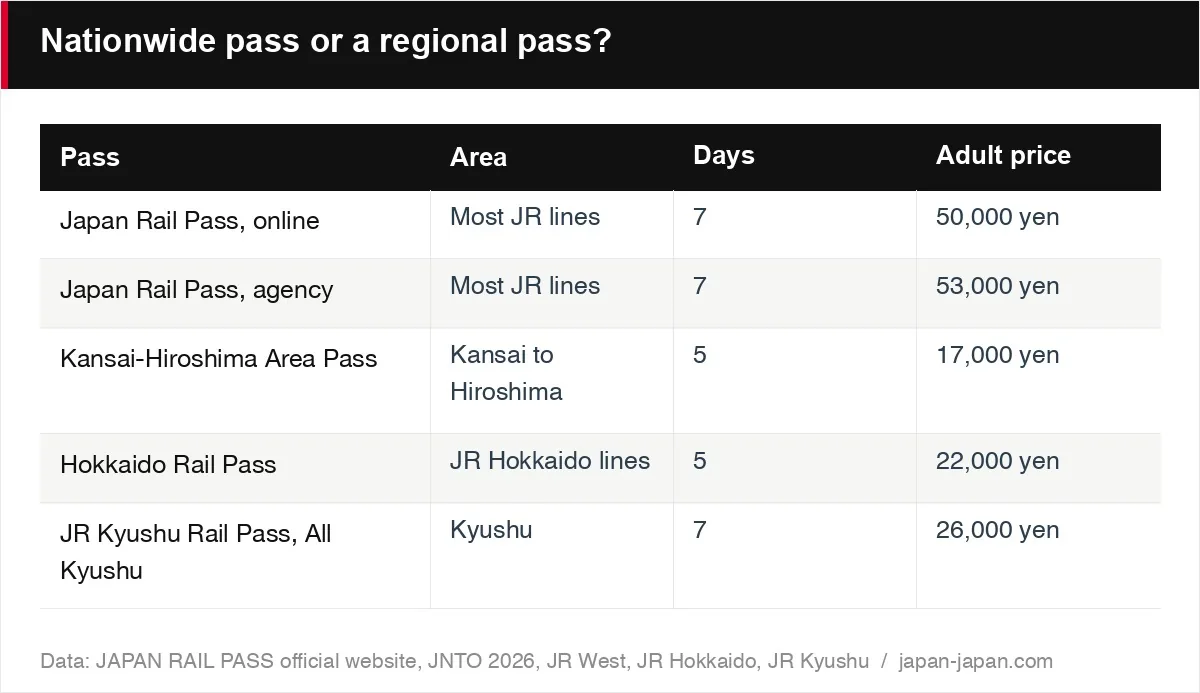
| Pass | Area | Days | Adult price |
|---|---|---|---|
| Japan Rail Pass, online | Most JR lines | 7 | 50,000 yen |
| Japan Rail Pass, agency | Most JR lines | 7 | 53,000 yen |
| Kansai-Hiroshima Area Pass | Kansai to Hiroshima | 5 | 17,000 yen |
| Hokkaido Rail Pass | JR Hokkaido lines | 5 | 22,000 yen |
| JR Kyushu Rail Pass, All Kyushu | Kyushu | 7 | 26,000 yen |
JR Hokkaido’s passes are open to more people: its page says any non-Japanese passport holder can use them. The nationwide pass is only for foreign visitors staying as temporary visitors, and JR West and JR Kyushu set the same condition.
Where you land matters too. New Chitose Airport has its own JR station under the domestic terminal, and the quickest train reaches Sapporo in 30 minutes. Both Sapporo area passes include the airport, so the first ride is covered. At Kansai Airport, the HARUKA express runs direct to Tennoji, Osaka, Shin-Osaka and Kyoto, and JR West’s Kansai Area Pass includes it.
In Kyushu, Fukuoka Airport is the closest airport to a city centre anywhere in Japan. The subway reaches Hakata Station in a few minutes, but JR passes do not cover the subway, so tap an IC card for that ride. Miyazaki Airport is one of the few in Japan with a JR line running right into the terminal, and Miyazaki lies inside the Southern Kyushu area.
The alternative most people should use
An IC card (Suica, Pasmo, ICOCA — they all work nationwide now) for local trains, plus individual shinkansen tickets booked online. Less to think about, and usually less money.
JNTO’s rail guide describes Suica, Pasmo and ICOCA as tap-and-go cards valid nationwide. On a phone, you can use Welcome Suica Mobile or PASMO, but not all overseas models are supported.
Your first train in Japan is usually the one from the airport. From Haneda Airport, the Tokyo Monorail reaches Hamamatsucho in 13 minutes for 520 yen. Our Haneda page lists that monorail first, then the Keikyu trains to Shinagawa and Yokohama and the airport buses into Tokyo.
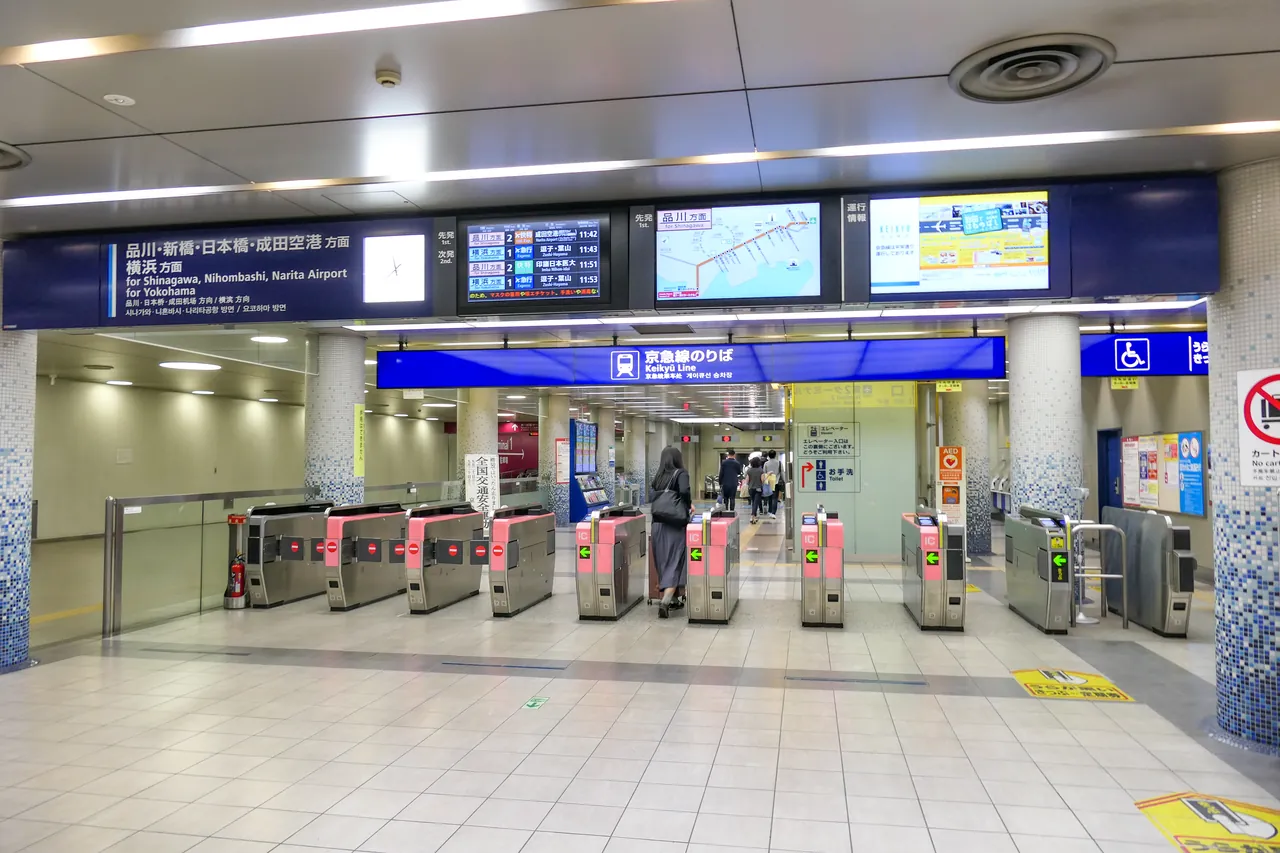
An IC card also fills the gaps in the JR Pass. The pass does not include private suburban lines, and private railways reach many popular places. Keisei runs to Narita Airport, Keikyu to Haneda Airport, Odakyu to Hakone and Tobu to Nikko. JNTO notes that a prepaid IC card works on both private railways and JR lines.
From Narita Airport, the quickest trains reach Nippori and Keisei Ueno in 36 minutes, and a return ticket to Tokyo Station is listed at 6,280 yen. Our guide to getting from Narita or Haneda into Tokyo compares the two airports.
For the long legs, book single tickets. Local, rapid and express trains need no reservation. The shinkansen, some limited express trains and sightseeing trains require or recommend one. Book at JR ticket counters, at ticket machines, or online with SmartEX or the JR East app.
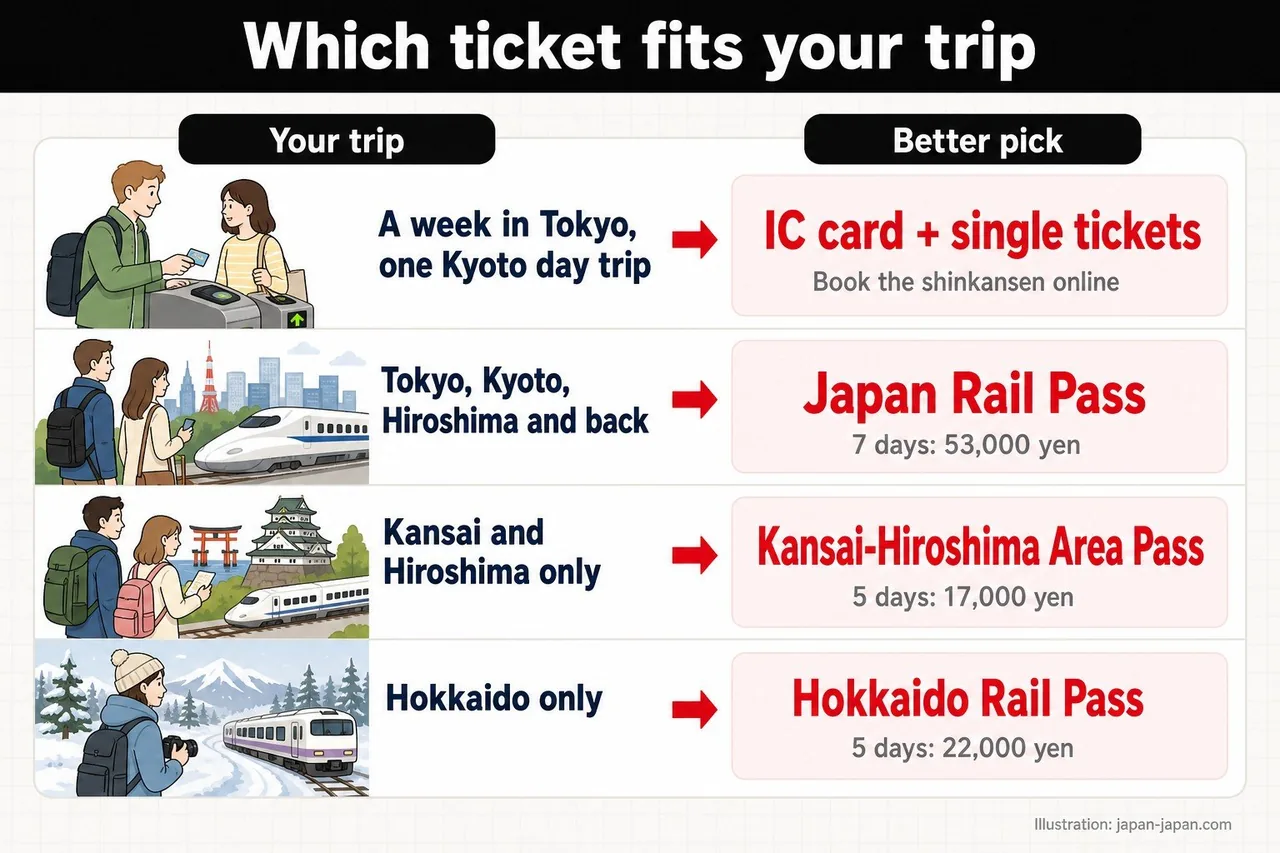
The illustration below matches four common trips to the ticket that suits each one.
Two price rises: October 2023 and October 2026
The nationwide pass has gone up twice. The first rise, on 1 October 2023, was the steep one. According to JNTO’s notice of 2 August 2023, a 7-day adult pass for ordinary cars had cost 29,650 yen from an authorized retailer or 33,610 yen direct from JR. It became 50,000 yen.
The 14-day pass went from 47,250 yen or 52,960 yen to 80,000 yen. The 21-day pass went from 60,450 yen or 66,200 yen to 100,000 yen. The rise also ended the cheaper price at overseas retailers, with one price across every sales channel.
The same change let pass holders ride the Nozomi and Mizuho for the first time, with the extra ticket described above.
The second rise applies from 1 October 2026. JR Group announced it in a press release on 9 April 2026, and JNTO published the new prices on 20 April. The new price applies by the local time where you buy the pass. Ordinary passes for 7, 14 and 21 days went from 50,000 yen, 80,000 yen and 100,000 yen to 53,000 yen, 84,000 yen and 105,000 yen. Green Car passes went from 70,000 yen, 110,000 yen and 140,000 yen to 74,000 yen, 116,000 yen and 147,000 yen. On 2 October 2026 the official website still listed the lower prices for online purchases: 50,000 yen, 80,000 yen and 100,000 yen for ordinary passes, and 70,000 yen, 110,000 yen and 140,000 yen for Green Car passes.
The chart below tracks the 7-day adult pass for ordinary cars, from the two old prices to the two that apply now.
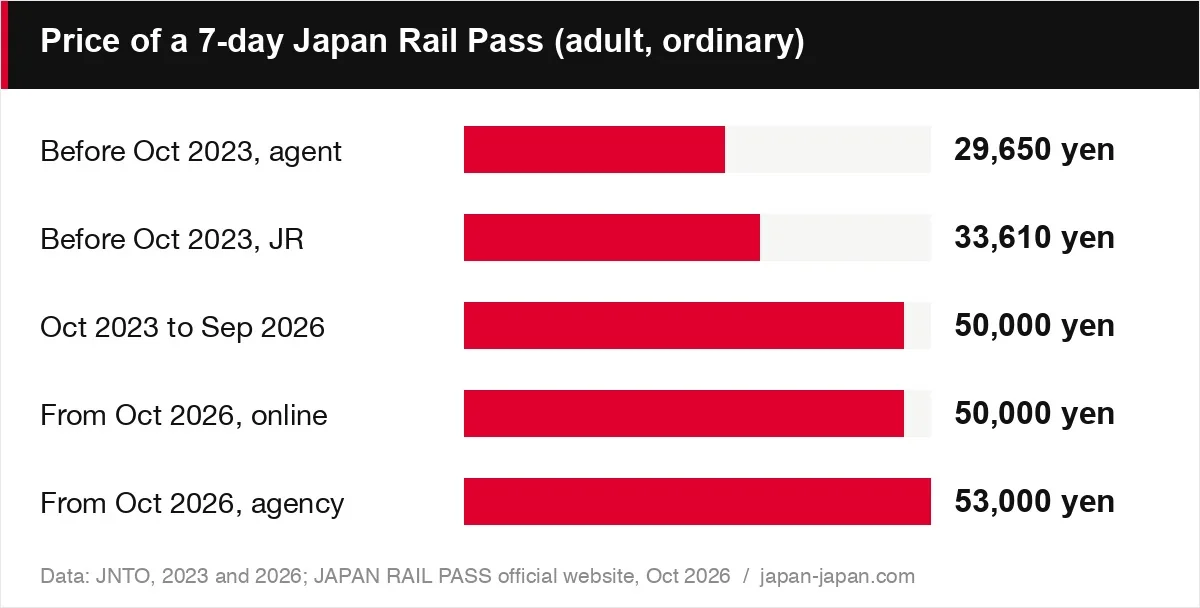
| When and where you buy | 7-day pass |
|---|---|
| Before Oct 2023, agent | 29,650 yen |
| Before Oct 2023, JR | 33,610 yen |
| Oct 2023 to Sep 2026 | 50,000 yen |
| From Oct 2026, online | 50,000 yen |
| From Oct 2026, agency | 53,000 yen |
From 1 October 2026, children aged 6 to 11 pay 27,000 yen, 42,000 yen and 53,000 yen at an overseas agency for ordinary-car passes of 7, 14 and 21 days, or 25,000 yen, 40,000 yen and 50,000 yen online. In the Green Car they pay 37,000 yen, 58,000 yen and 74,000 yen at an agency, or 35,000 yen, 55,000 yen and 70,000 yen online.
JNTO reported in April 2026 that, for a limited time, people booking on the official Japan Rail Pass website would get the pre-October prices. On 2 October 2026 the website’s price page still listed 50,000 yen for a 7-day ordinary pass bought online, against 53,000 yen at an overseas JR-designated agency. Compare that price with your retailer’s before you pay.
For the two-minute check, use the price you will actually pay. Compare your fares with 50,000 yen for a week if you buy on the official website, or 53,000 yen if you buy through an overseas agency. A route that only just beats the online price may fall short at an agency.
If you do buy it: where to get it and how to use it
As of 1 October 2026, JNTO says the pass is sold in two ways: through the official website or through an authorized overseas distributor. Buy on the official website and you can also reserve seats on the shinkansen and limited express trains before you reach Japan.
When you land, go to a designated pickup location to collect the pass or exchange your voucher. Have your passport, the temporary visitor stamp or sticker in it, and your exchange order or reservation number ready at the counter. After that, the pass is your ticket. Take any free seat in the non-reserved cars, or reserve a seat and receive a seat ticket. Pass holders can use the automatic ticket gates where available.
If you enter Japan through an automated gate, still get proof of temporary visitor status. JR Kyushu tells travellers who use the automated gates to ask airport staff for a stamp or seal in their passport. It also asks pass users to carry their passport at all times.
A few trains need more than the pass. Reserve ahead for trains with no non-reserved seats. For the Nozomi or Mizuho, buy the NOZOMI MIZUHO Ticket before you board. Some suburban liner express trains on JR need a separate ticket too.
In Hokkaido, an exchange order is valid for 3 months from the date of issue, or 90 days for an e-ticket. From 20 October 2026, JR Hokkaido is putting ticket machines with passport readers at Sapporo Station and New Chitose Airport Station. You scan your passport to buy or exchange a pass without queuing at a counter. The airport station gets one machine, next to the JR Information Desk.
If you land at New Chitose, pick up your pass before your first train. Our New Chitose page lists the JR Rapid Airport to Sapporo first: 30 minutes with no change of train, from the station in the basement of the domestic terminal.
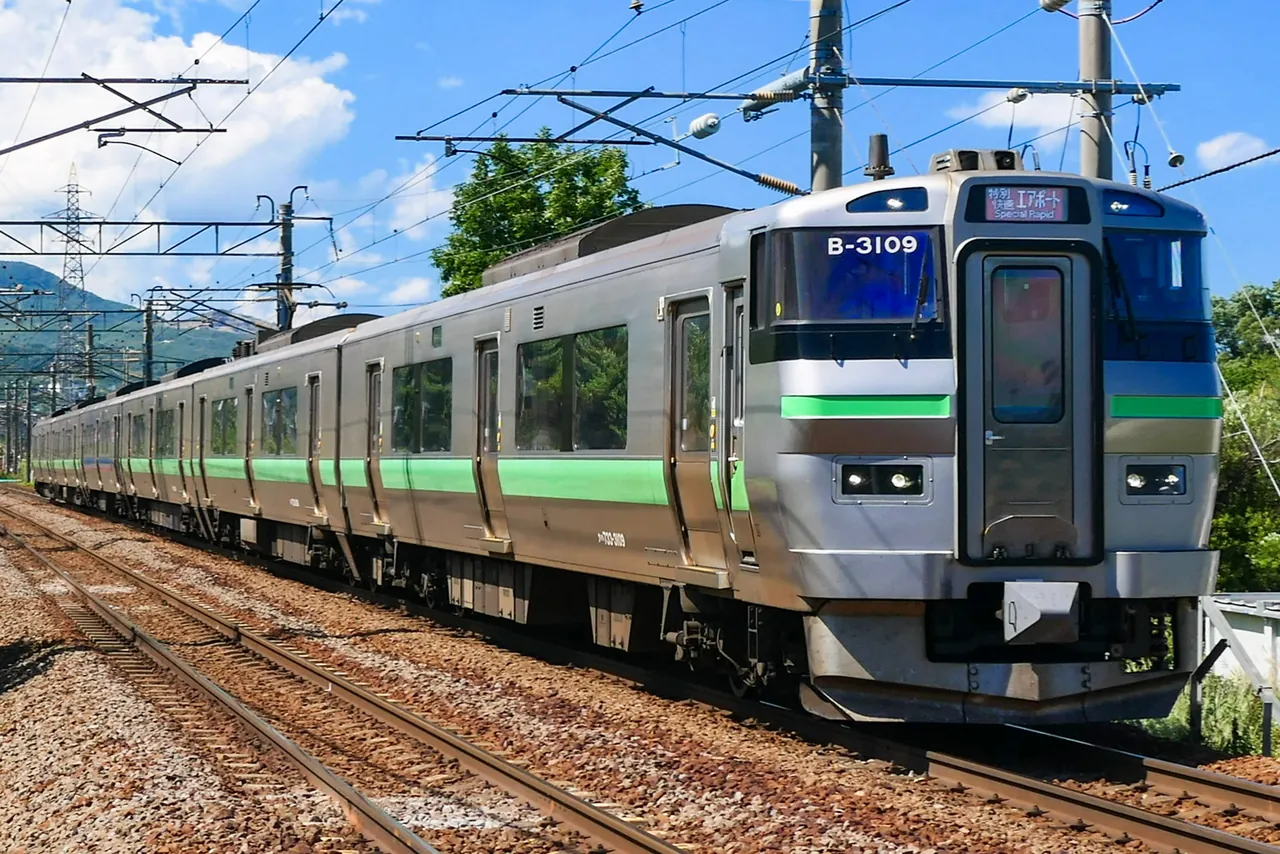
You can exchange the Sapporo area passes only at New Chitose Airport and Sapporo, or at Noboribetsu or Asahikawa depending on the pass. JR Hokkaido warns that its counters get very busy in peak season, so leave time.
FAQ
How much is a 7-day JR Pass from 1 October 2026?
On the official website, an adult pass for ordinary cars costs 50,000 yen for 7 days, 80,000 yen for 14 days and 100,000 yen for 21 days. At an overseas JR-designated agency the same passes cost 53,000 yen, 84,000 yen and 105,000 yen from 1 October 2026. A 7-day Green Car pass costs 70,000 yen online or 74,000 yen at an agency, and a 7-day ordinary pass for a child aged 6 to 11 costs 25,000 yen or 27,000 yen.
Can you ride the Nozomi with a Japan Rail Pass?
Not on the pass alone. You also need the [ONLY WITH JAPAN RAIL PASS] NOZOMI MIZUHO Ticket, one for each ride, bought before boarding at a JR ticket machine or office. It cannot be booked online before you arrive. JR Central lists it at 4,960 yen from Tokyo or Shinagawa to Kyoto.
Is a regional JR pass cheaper than the nationwide pass?
Yes, if your trip stays inside its area. The Kansai-Hiroshima Area Pass costs 17,000 yen for 5 days, the Hokkaido Rail Pass 22,000 yen for 5 days and the All Kyushu pass 22,000 yen for 3 days. The nationwide pass costs 50,000 yen for 7 days online, or 53,000 yen at an overseas agency, but a regional pass covers only its own area.
Do Suica, Pasmo and ICOCA work all over Japan?
Yes. JNTO describes them as tap-and-go cards valid nationwide. On a phone you can use Welcome Suica Mobile or PASMO, though not all overseas models are supported. The cards also work on private railways, which the JR Pass does not cover.
Photo: Shinkansen N700 with Mount Fuji.jpg by tansaisuketti (CC BY-SA 3.0), via Wikimedia Commons.