Suica Japan 2026: Welcome Suica, PASMO and Where to Buy
Suica in Japan: buy a Welcome Suica or TOURIST PASMO with no 500 yen deposit, or a visitor ICOCA for 2,000 yen. Where to buy, top up and use them in 2026.
Suica Japan short answer: get a Welcome Suica or TOURIST PASMO, which skip the 500 yen deposit that most IC cards charge. With one card you tap through gates, and Haneda to Tokyo Station costs 540 yen by train.
This guide covers what an IC card pays for, where you buy one at Narita and Haneda, how Suica, PASMO and ICOCA compare, and where a card stops working. Every price comes from the operator pages or from our own airport transfer database.
Suica Japan Basics: Do You Need a Card?
You do not need a card to ride trains in Japan, but you will want one. The Japan National Tourism Organization (JNTO) IC card guide says an IC card lets you transfer between train lines and board buses and boats with little fuss. You can also use it at many vending machines, convenience stores, some taxis and other services.
A paper ticket works for one trip on one fare. You read the fare chart, pick the amount at a machine and feed the ticket into the gate. An IC card skips all of that. You load money onto the card in advance. At the gate you touch the card to the reader, and the system deducts the fare when you leave the destination station.
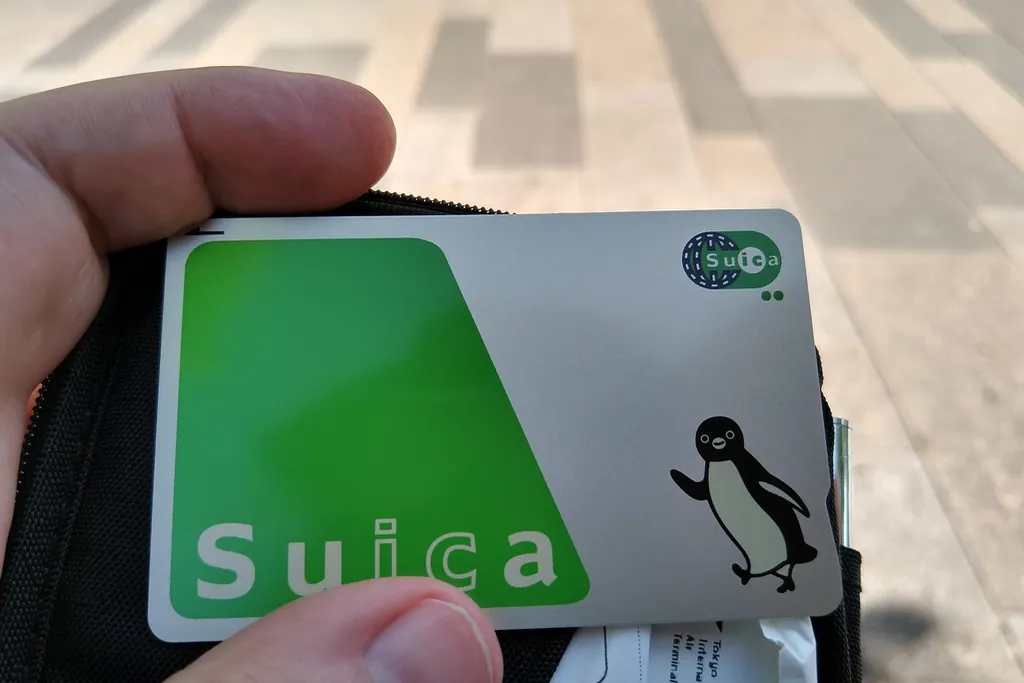
Most regions in Japan have their own IC card, each with its own name and mascot. JNTO notes that these cards work nationwide. Suica comes from JR East, PASMO from the private railways and subways around Tokyo, and ICOCA from JR West in the Osaka and Kyoto area.
For a short trip, pick one of the cards made for international visitors. JNTO names Welcome Suica and TOURIST PASMO as cards you can buy without a deposit. A regular card adds 500 yen on top of your first load. If your phone supports it, you can skip the plastic card and use a mobile card instead.
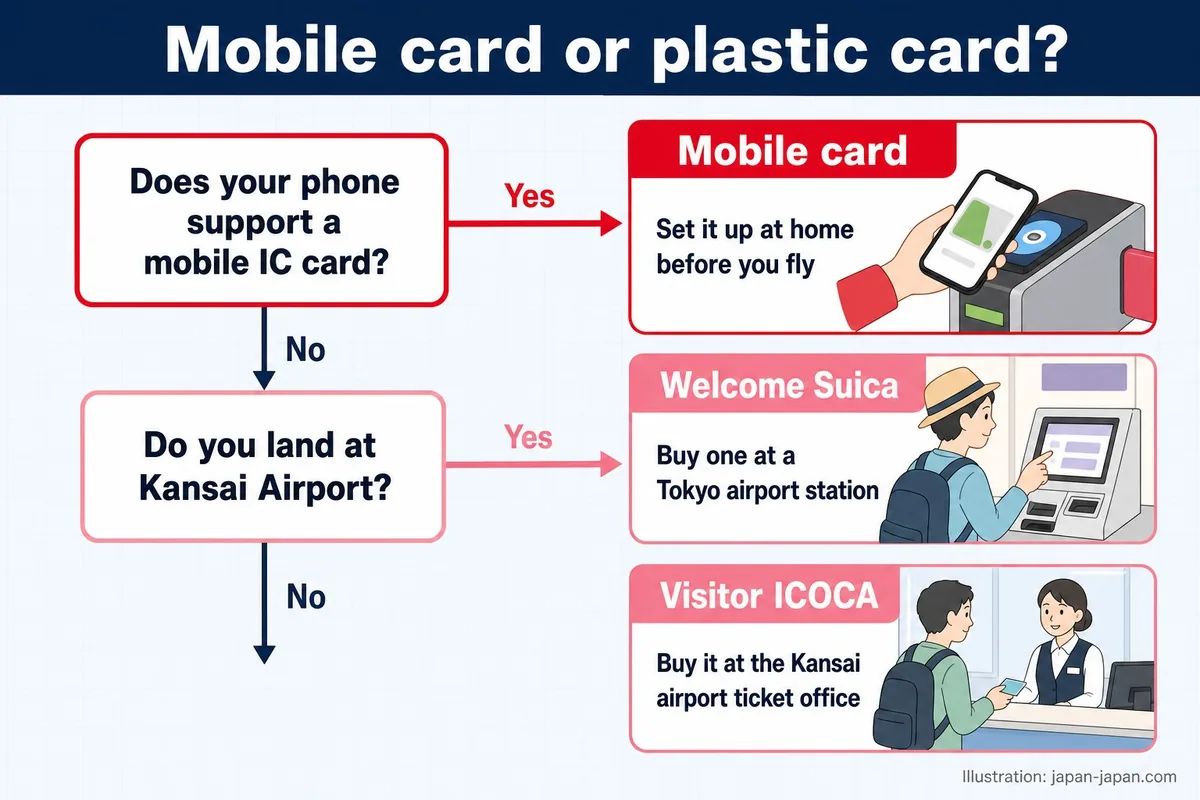
The chart above asks two questions. Does your phone support a mobile IC card? Which airport do you land at? If your phone works, set up the mobile card before you fly. If not, buy a Welcome Suica in Tokyo or the visitor ICOCA at Kansai Airport.
Welcome Suica: Price, Validity and Refunds
Welcome Suica is the JR East card made for short-term visitors. The main difference from a regular Suica is the deposit. JNTO lists it among the cards you can buy with no deposit, while most IC cards charge 500 yen. You keep all of the money you load for fares and shopping.
JR East publishes the current price, validity period and refund rules on its Welcome Suica page. Read that page on the day you travel, because JR East changes the details from time to time. The card has a set period of use, so plan to spend the balance before you fly home.
A deposit-free card changes how you leave Japan. With a regular Suica you can hand the card back and collect the 500 yen deposit, as the Tokyo Monorail Suica page explains. With a deposit-free card there is no deposit to collect. Use the last of the balance at a convenience store or a station kiosk on your final day.
Its sister card, TOURIST PASMO, follows clear rules. According to PASMO’s visitor page, TOURIST PASMO is valid for 28 days from the date of purchase. Value you add to it will not be refunded. If you plan a stay longer than 28 days, a regular card with a deposit may suit you better.
Where to Buy Suica at Narita and Haneda
Most visitors land at Narita or Haneda, and both airports have train stations below the terminals. You buy an IC card at the station ticket machines or the ticket counter. At Haneda, the Tokyo Monorail station sits inside the terminal building, so you can buy a card and board in a few steps.
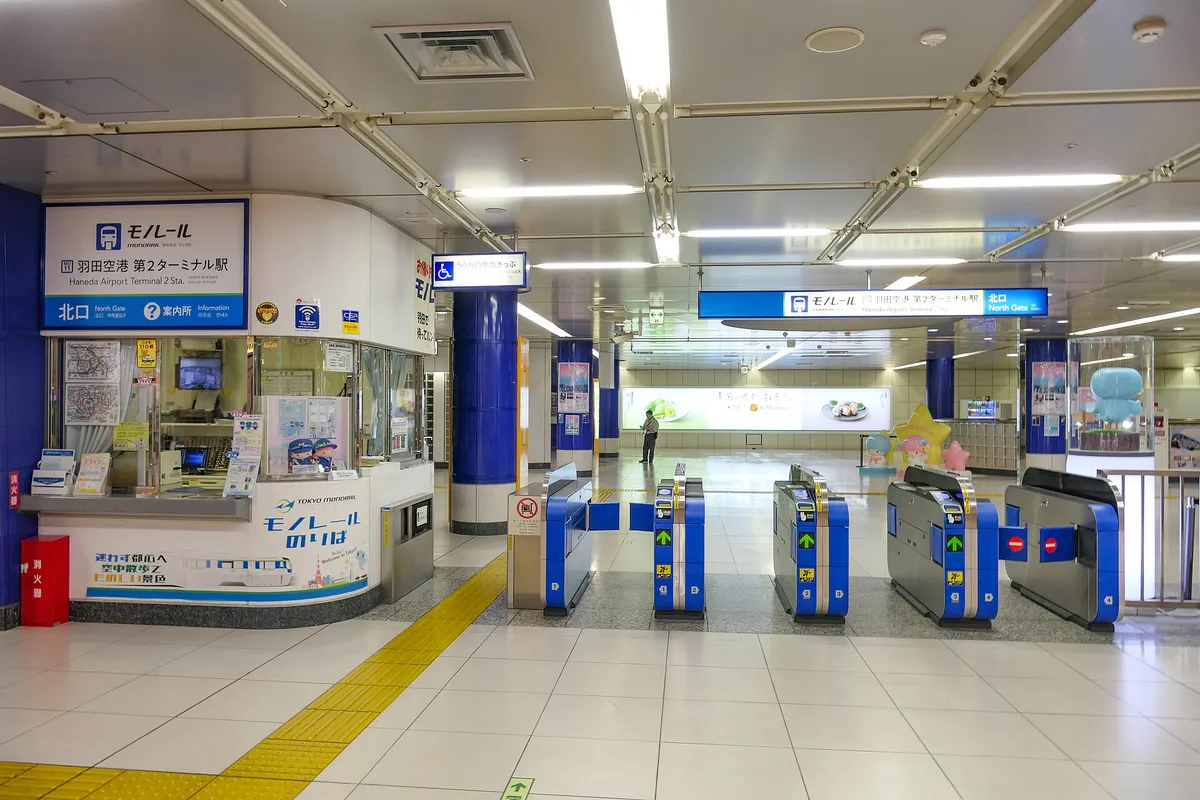
The photo shows the monorail station at Haneda, with the ticket machines next to the gates. The Tokyo Monorail sells Suica and runs to Hamamatsucho. See our Tokyo Monorail guide for stations and times. From Hamamatsucho you change to the JR Yamanote Line.
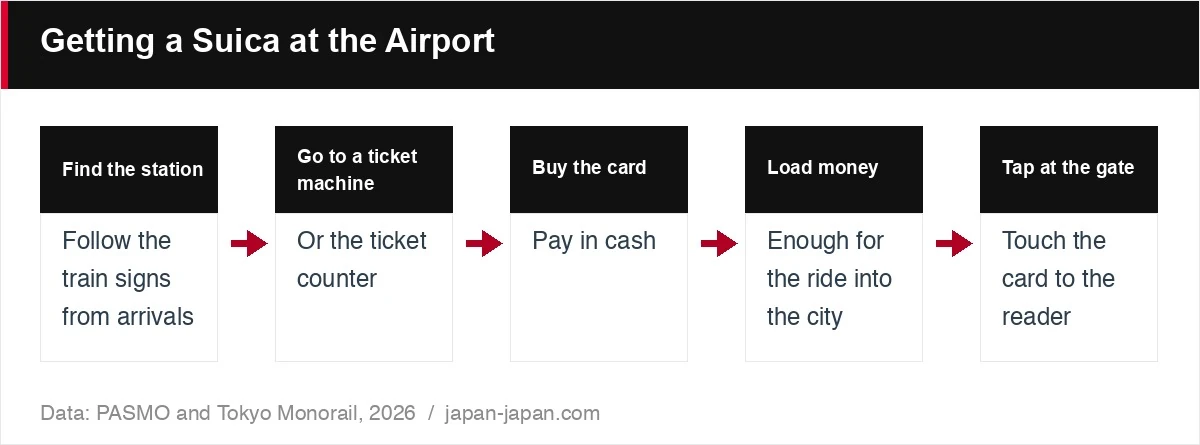
The flow above shows the order at the airport. Find the station, buy the card at a machine or counter, load money and walk to the gate. Load enough for the ride into the city before you queue at the gate, so you do not have to pay a shortfall at the other end.
Once you hold a card, you can pay for most rides into central Tokyo with it. Our Haneda to Tokyo Station page lists the Keikyu Line and JR at 540 yen and about 33 minutes. The Tokyo Monorail and JR Yamanote Line cost 720 yen. Our Haneda Airport guide shows where each terminal station is.
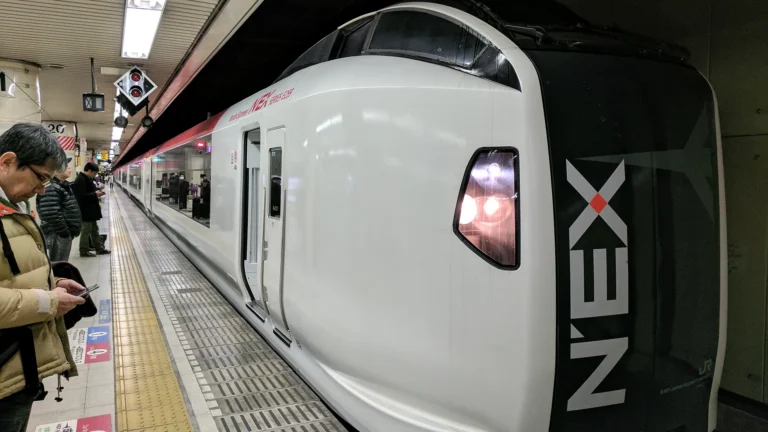
At Narita, the Narita to Tokyo Station page lists the Narita Express at 3,140 yen and 53 minutes at the fastest. The AIRPORT BUS TYO-NRT costs 1,500 yen and takes about 65 minutes. Check our Narita Airport guide for the terminal layout and the Narita Express guide for its stops.
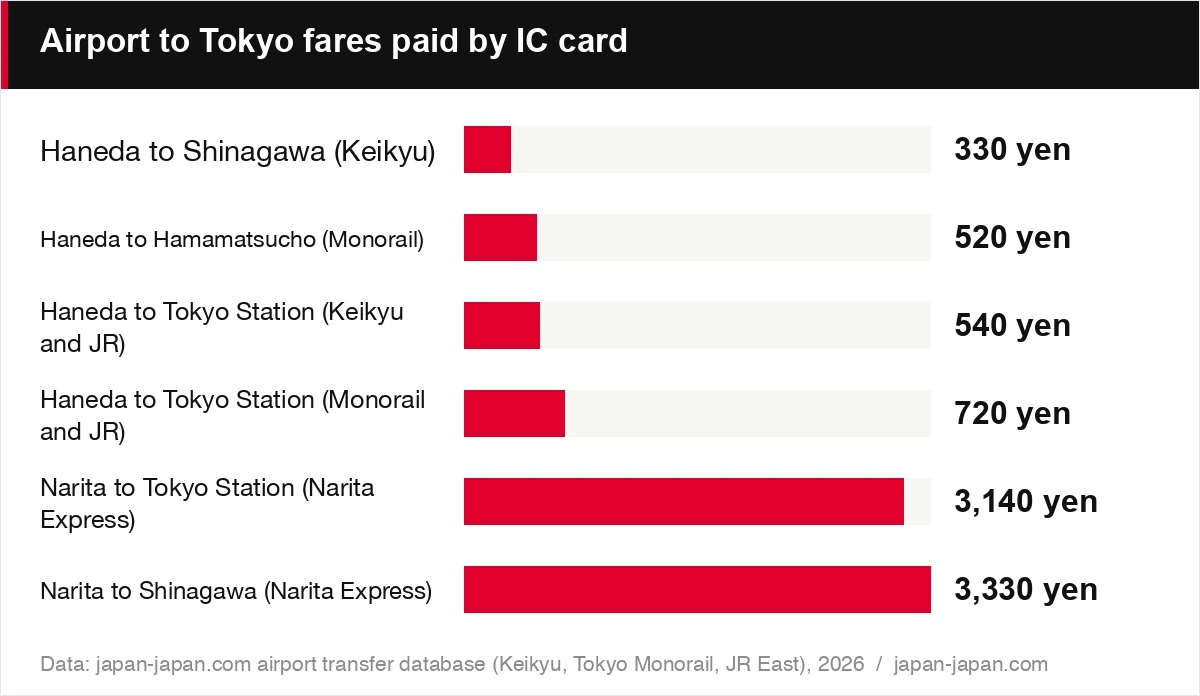
| Item | Value | Note |
|---|---|---|
| Haneda to Shinagawa (Keikyu) | 330 yen | 18 min |
| Haneda to Hamamatsucho (Monorail) | 520 yen | 20 min |
| Haneda to Tokyo Station (Keikyu and JR) | 540 yen | 33 min |
| Haneda to Tokyo Station (Monorail and JR) | 720 yen | |
| Narita to Tokyo Station (Narita Express) | 3140 yen | 53 min |
| Narita to Shinagawa (Narita Express) | 3330 yen |
The chart compares rail fares from both airports. The cheapest train from Haneda to Shinagawa costs 330 yen on the Keikyu Airport Line and takes 18 minutes. The Tokyo Monorail to Hamamatsucho costs 520 yen and takes 20 minutes. From Narita, the Narita Express to Shinagawa costs 3,330 yen.
If you land at Kansai Airport instead, buy the visitor ICOCA at the JR ticket office in Kansai-airport Station. Station staff call this office the みどりの窓口 (Midori-no-madoguchi), which means the green window. Look for the green sign above the counter.
Suica vs PASMO vs ICOCA
Suica, PASMO and ICOCA work the same way at the gate. The difference lies in who issues the card, what you pay up front and which visitor version you can buy. PASMO lists ICOCA, Kitaca, PiTaPa, TOICA, manaca, HAYAKAKEN, nimoca and SUGOCA among the 10 cards that also work in PASMO and Suica areas.
| Item | Welcome Suica | TOURIST PASMO | Visitor ICOCA |
|---|---|---|---|
| Issuer | JR East | PASMO | JR West |
| Deposit | None | None | 500 yen, included in price |
| Price | See JR East page | See PASMO page | 2,000 yen |
| Valid for | See JR East page | 28 days from purchase | See JR West page |
| Added value refunded | See JR East page | No | See JR West page |
| Where to buy | JR East stations | Participating operators | Kansai-airport Station ticket office |
| Limit | See JR East page | See PASMO page | 1 per person |
The table compares the three visitor cards. Welcome Suica and TOURIST PASMO carry no deposit. The visitor ICOCA costs 2,000 yen, and that includes a 500 yen deposit. TOURIST PASMO is valid for 28 days and does not refund the value you add.
PASMO
PASMO covers the Tokyo private railways, subways and buses. PASMO lists several types. A blank PASMO card works for anyone but uses adult fares and cannot be reissued if lost. A personalized card needs your name, gender, date of birth and phone number, and staff can reissue it for a fee.
A new PASMO adds a 500 yen deposit to the price, according to the PASMO purchase page. The deposit cannot pay fares or shopping. You get the 500 yen back when you turn in the card. You cannot buy a PASMO with a credit card, so bring cash to the machine.
The older PASMO PASSPORT is gone. PASMO posted a notice on October 4, 2024 about abolishing its rules of use. On April 17, 2026 PASMO announced TOURIST PASMO, a card for international visitors with a design using kanji characters. If you read an older guide that mentions PASMO PASSPORT, buy TOURIST PASMO instead.
ICOCA
ICOCA is the JR West card used around Osaka, Kyoto and Kobe. JR West’s ICOCA page says you can use it across Japan on railways and buses, and at stores with the IC mark. ICOCA also runs on Apple Pay on an iPhone.
JR West sells an original design ICOCA only to foreign visitors. You need a passport issued by a government other than Japan and the Temporary Visitor (短期滞在, tanki taizai) status. The limit is 1 card per person, and it costs 2,000 yen including the 500 yen deposit.
How to Top Up and Pay
You top up, or charge, an IC card at a station ticket machine. JR West describes ICOCA as a card you top up and use again and again, and the same goes for Suica and PASMO. Machines usually show an English button on the first screen.
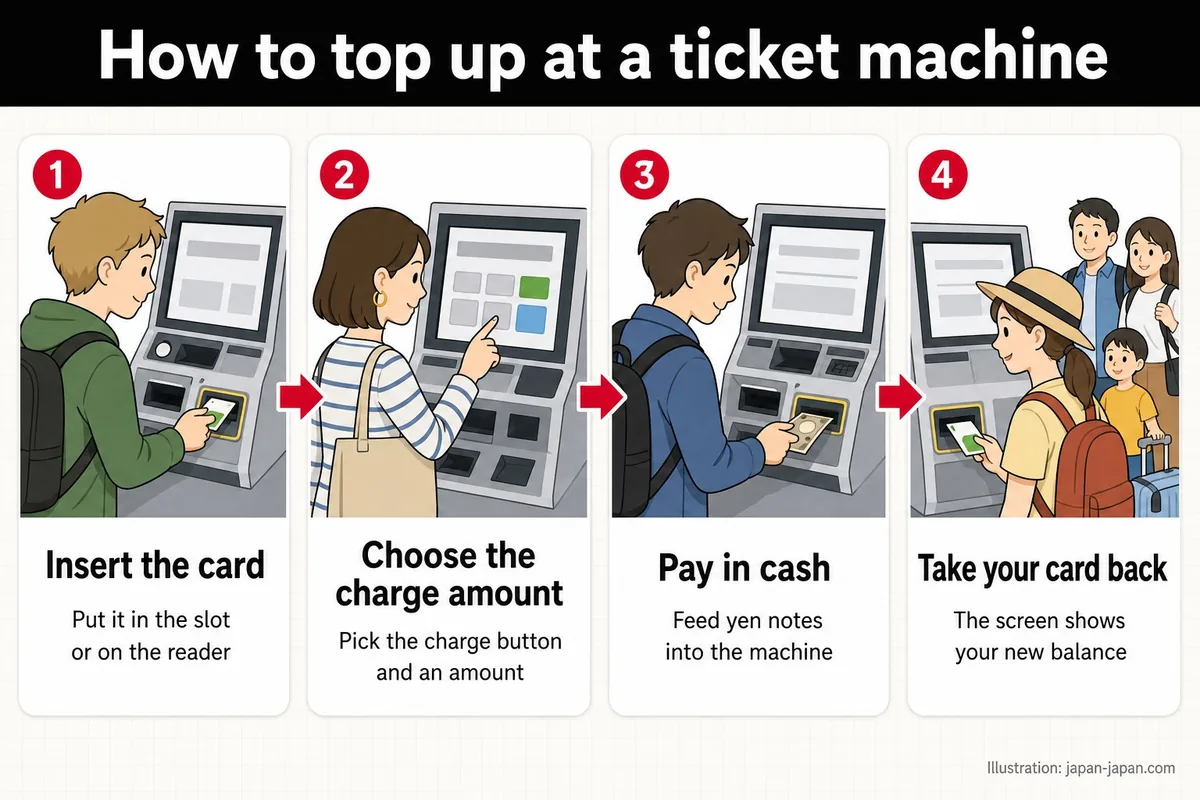
The steps above show a charge at a ticket machine. Put the card in the slot or on the reader. Choose the charge option and the amount. Insert cash, then take the card back. The screen shows your new balance.
Pay with cash at the machine. PASMO states that it does not accept credit cards for buying PASMO, so carry yen notes when you buy or load a card at a station. Many convenience stores also let you add money at the register. Hand the card to the clerk and say チャージお願いします (chāji onegaishimasu), which means “a charge, please.”
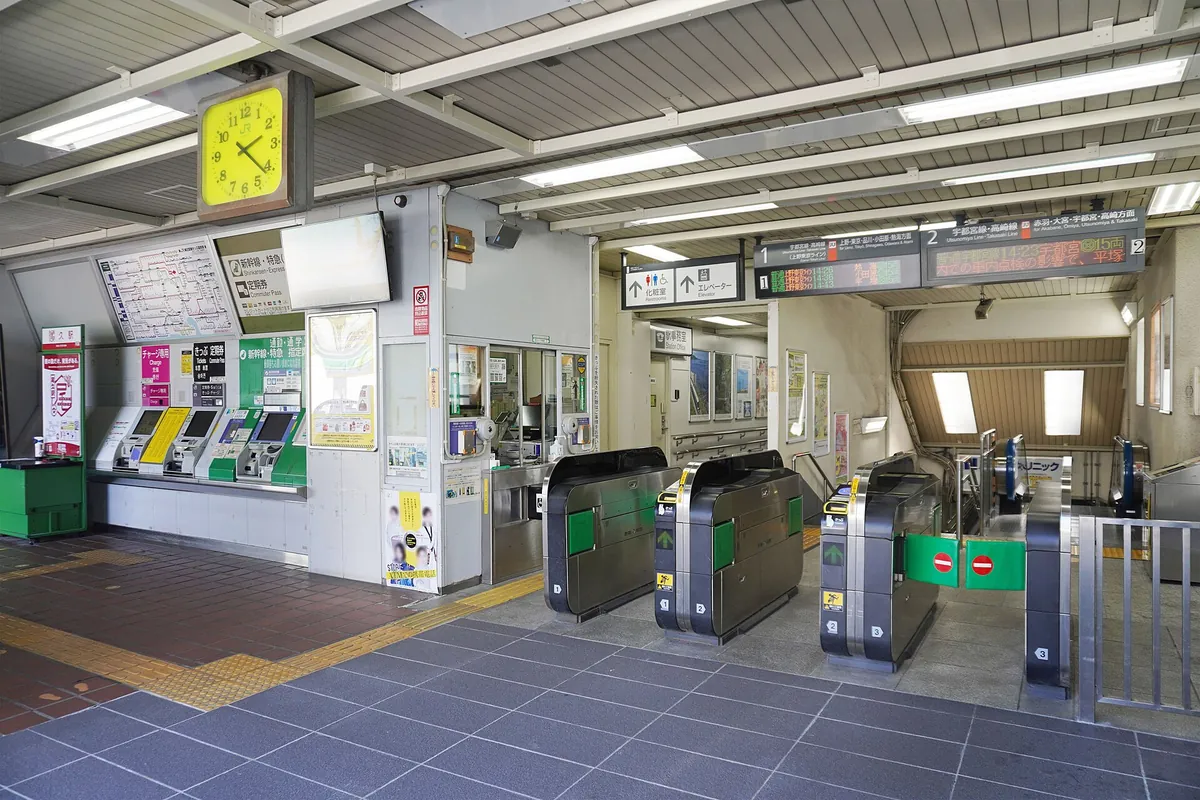
The gate in the photo has a blue reader on the right side. Touch the card flat on the reader for a moment and walk through. The gate shows your remaining balance on a small screen. If the gate closes, your balance is short. Go to the fare adjustment machine near the exit, add money and tap again.
For shopping, look for the IC logo at the register. Tell the clerk you want to pay by Suica or ICOCA, then hold the card on the reader until it beeps. The same card pays for buses. On most city buses you touch the card to the reader on the farebox, as PASMO describes.
Suica on iPhone and Android
A phone can replace the plastic card. JNTO links to Welcome Suica Mobile, the JR East app for visitors, on its Welcome Suica Mobile page. You set up the card in the app, load money and tap your phone at the gate in the same way as a card.
ICOCA also works on Apple Pay. JR West says ICOCA on Apple Pay lets you use the card on your iPhone. Add the card in the Wallet app, then load it from the card you already have on file in Wallet.
Set up the mobile card at home before your flight. You then walk from the arrival hall straight to the gate and skip the queue at the ticket machines. Keep your phone charged, because a dead battery means no card.
Check that your phone and region support the app before you rely on it. If the setup fails, buy a physical card at the airport. Welcome Suica and TOURIST PASMO still give you a card with no deposit.
Suica Japan Limits: Where IC Cards Do Not Work
IC cards cover most city trains and buses, but not all of them. PASMO notes that it is not accepted on all train and bus networks in Japan. It also warns that the other regional cards cannot be used on some lines, so ask the train or bus operator.
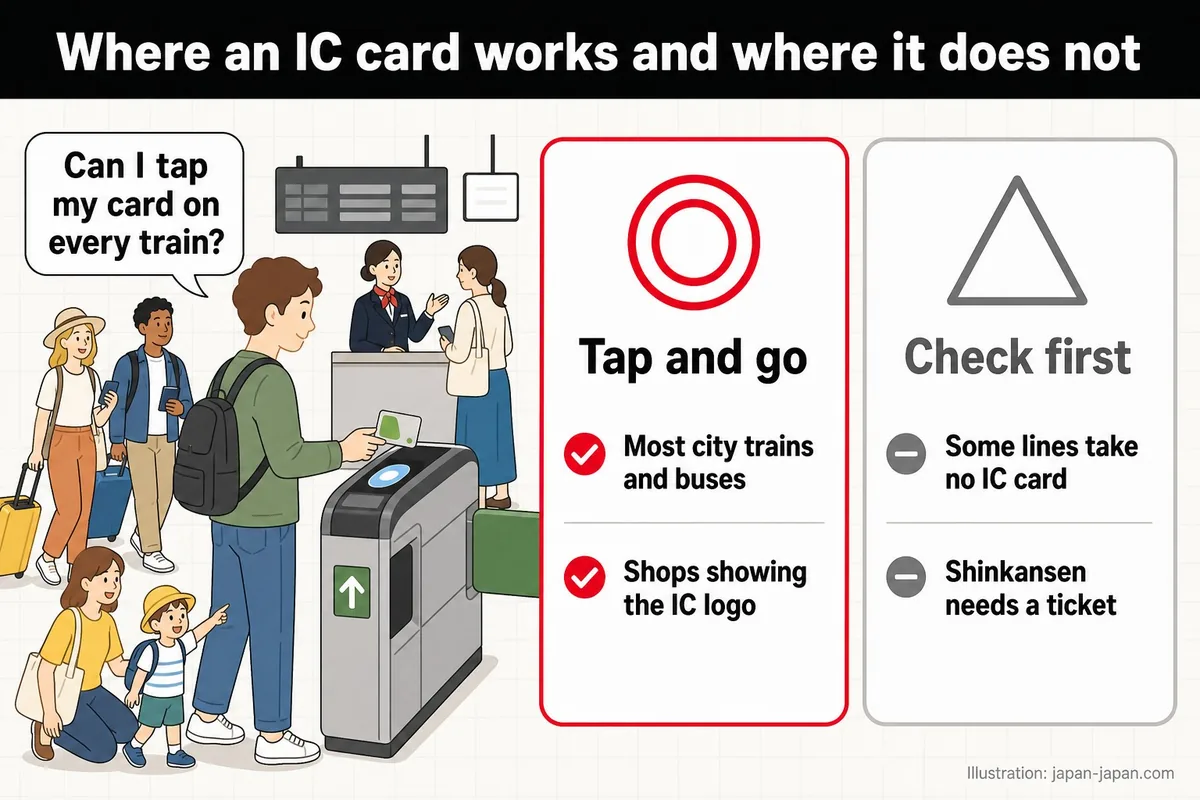
The picture above shows where you can tap your card and where you cannot. Some lines accept only Suica and PASMO. On the Kanto Railway and the Chiba Monorail, PASMO says only PASMO and Suica IC cards work. PiTaPa does not support the nationwide electronic money service, so you cannot shop with it outside its home area.
Shinkansen trips need their own ticket. Buy the ticket at the Midori-no-madoguchi or a reserved-seat ticket machine before you go to the platform. Ask station staff before you tap an IC card at a shinkansen gate.
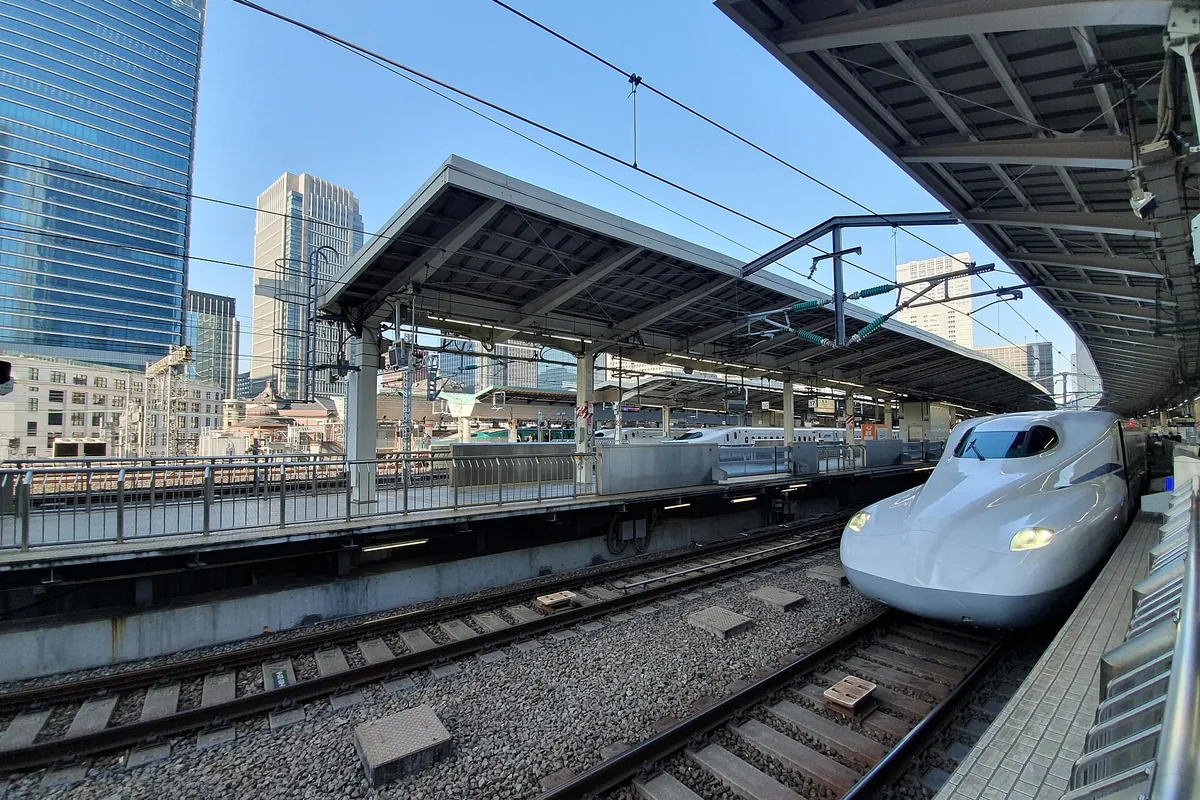
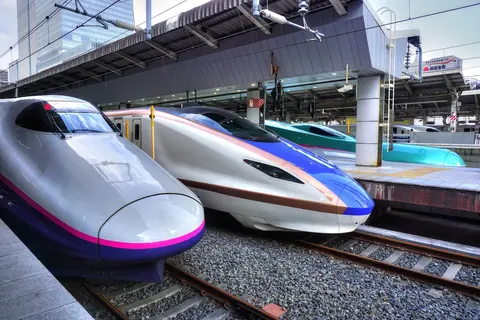
The photo shows a shinkansen at Tokyo Station. If you plan several long rides, compare the cost with the Japan Rail Pass. The pass covers JR trains, so you would use your IC card mostly for subways, private lines, buses and shops. Our rail pass guide lists regional passes too.
Children need their own card type. PASMO states that a Child PASMO is valid up to March 31 of the year the child turns 12. From April 1 the holder can keep using it as an adult PASMO after the needed procedures. A blank card always charges adult fares.
If you travel at busy times, such as the new year, check the Japan holidays guide first. Queues at airport ticket machines grow long, and a card you already hold saves time.
FAQ
Can tourists still buy a regular Suica card in 2026?
PASMO’s notices show that sales of Suica and PASMO cards were suspended for a time in 2023. The Tokyo Monorail still describes the regular Suica with a 500 yen deposit that you get back when you return the card. For a short stay, JNTO points visitors to Welcome Suica and TOURIST PASMO, which need no deposit.
Is Welcome Suica refundable when you leave Japan?
Welcome Suica has no deposit, so you have no deposit to collect at the end. Check JR East’s Welcome Suica page for the current rule on unused balance. Its sister card TOURIST PASMO does not refund added value, so spend the balance at a shop before your flight.
Can you use Suica in Osaka and Kyoto?
Yes, in most places. ICOCA is the local card in Osaka and Kyoto, and PASMO lists it among the 10 cards that work across each other’s areas. Suica works on most trains and buses there as well. Ask staff on smaller lines, because some lines do not accept every card.
Can you use Suica on the shinkansen?
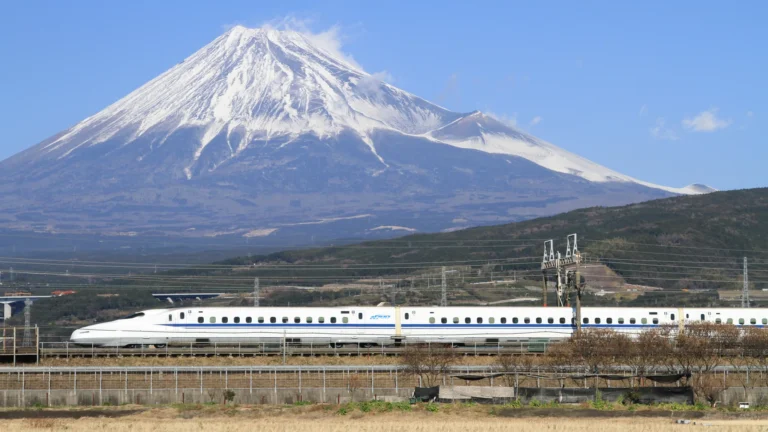
Plan to buy a separate shinkansen ticket. Get it at the Midori-no-madoguchi or a reserved-seat ticket machine, and ask staff at the gate if you are unsure. A Suica still pays for the local train or subway that takes you to the shinkansen station.


.jpg)