Ramen Etiquette: Is Slurping Rude? 150 People in Japan Say
Cutting in line topped the list for 111 of the 150 respondents. Everyone who answered lives in Japan, so these numbers show what locals do at the counter and what they hope travellers will do.
How we asked 150 people living in Japan
We ran an online survey of people living in Japan. 221 answers came in between 18 and 21 October 2026, and we removed 71 of them. In 12, the written answers looked machine-written. 3 failed the attention check. 51 clearly contradicted themselves, such as saying they had never used a ticket machine and then describing one. 5 were second answers from people who had already answered.
Every valid respondent passed the attention check. A few answers with smaller contradictions were kept. The questionnaire had 87 questions: 82 multiple-choice, including one uncounted attention check, and 5 required free-text questions. Follow-up questions were counted only among people they applied to, such as the 89 who have been to Ichiran. Groups under 10 are given as numbers of people, and percentages for groups under 30 are a rough guide. Free-text answers were written in Japanese and translated by japan-japan.com.
The results have limits. Respondents answered an open online call, so they do not represent everyone in Japan. Prices are what they remember paying. Their answers about visitors are what they have noticed, not counts.
The chart shows who answered by age. People in their 30s were the largest group at 32.7% (49 of 150). Next came their 40s at 24.0% and their 20s at 21.3%.
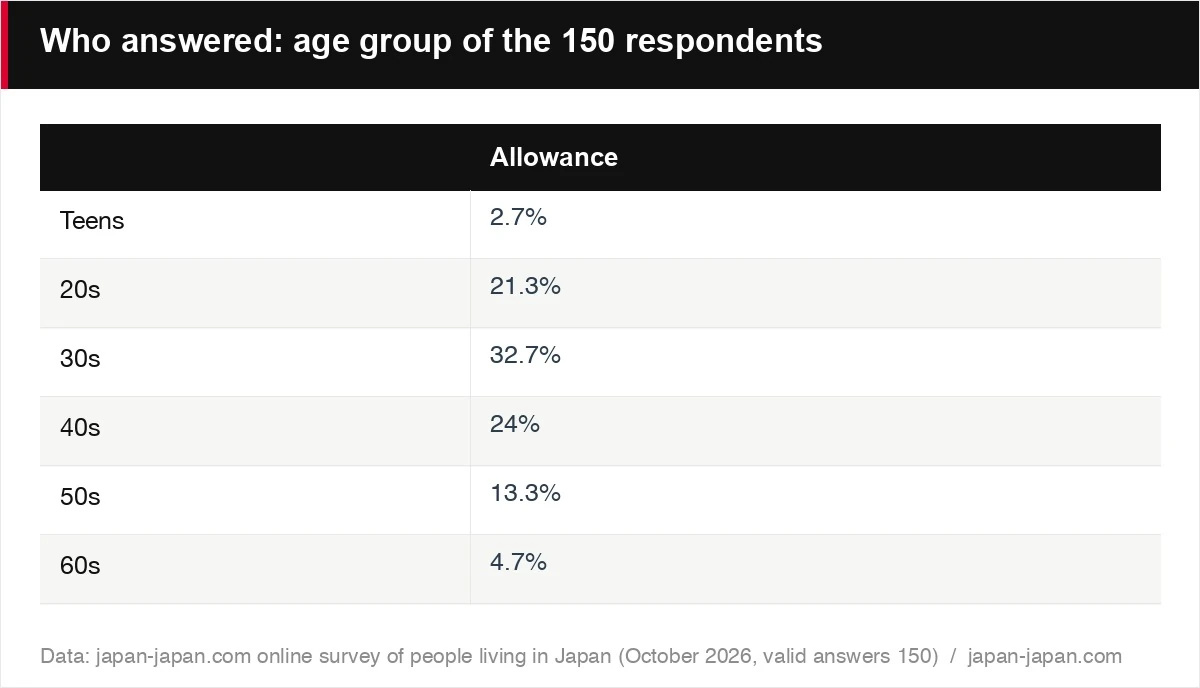
| Item | Value | Note |
|---|---|---|
| Teens | 2.7 % | 4 of 150 |
| 20s | 21.3 % | 32 of 150 |
| 30s | 32.7 % | 49 of 150 |
| 40s | 24 % | 36 of 150 |
| 50s | 13.3 % | 20 of 150 |
| 60s | 4.7 % | 7 of 150 |
| 70 or older | 1.3 % | 2 of 150 |
By gender, 68.0% were female (102 of 150) and 27.3% male. The largest regional groups were Kanto outside Tokyo (24.0%), Chubu (20.7%) and Kinki, also called Kansai (18.0%), and 10.0% live in Tokyo. 77.3% (116 of 150) eat ramen at a restaurant about once a month or more.
To cite these results, write: japan-japan.com online survey of people living in Japan (October 2026, valid answers 150).
The full questionnaire (all 87 questions, translated from Japanese)
Respondents saw every question in Japanese, and every question was shown to everyone. Follow-up questions were counted only among people the question applied to. Q43 was an attention check and is not counted. Questions 80 to 84 were required free-text questions.
- Q1. How often do you eat ramen at a restaurant (including tsukemen and mazesoba)? (choose one)
Twice a week or more / About once a week / 2–3 times a month / About once a month / A few times a year / I don’t eat ramen at restaurants - Q2. At what time of day do you most often eat ramen at a restaurant? (choose one)
Morning / Lunchtime / Late afternoon / Evening / Late at night after drinking / I don’t eat ramen at restaurants - Q3. When you eat ramen at a restaurant, who are you most often with? (choose one)
Alone / Family / Friends or a partner / People from work or school / I don’t eat ramen at restaurants - Q4. Which kind of ramen shop do you go to most? (choose one)
Independent shop (not a chain) / Ramen chain / Food court in a shopping center / Local Chinese-style diner or Chinese restaurant / Other / I don’t eat ramen at restaurants - Q5. How much was the basic bowl (no toppings) the last time you ate ramen at a shop? (choose one)
Under ¥600 / ¥600–799 / ¥800–999 / ¥1,000–1,199 / ¥1,200–1,499 / ¥1,500 or more / Don’t remember / I don’t eat ramen at restaurants - Q6. That time, how much did you pay per person including toppings, an extra noodle serving, rice and drinks? (choose one)
Under ¥800 / ¥800–999 / ¥1,000–1,199 / ¥1,200–1,499 / ¥1,500–1,999 / ¥2,000 or more / Don’t remember / I don’t eat ramen at restaurants - Q7. Up to how much would you pay for an everyday bowl (no toppings)? (choose one)
Up to ¥800 / Up to ¥900 / Up to ¥1,000 / Up to ¥1,200 / Up to ¥1,500 / Up to ¥2,000 / More than ¥2,000 is fine / Not sure - Q8. From what price does a bowl of ramen feel expensive? (choose one)
From ¥800 / From ¥900 / From ¥1,000 / From ¥1,200 / From ¥1,500 / From ¥2,000 / No price feels expensive / Not sure - Q9. In the past year, how many times did you eat ramen that cost ¥1,000 or more for the basic bowl? (choose one)
Never / 1–2 times / 3–5 times / 6–11 times / 12 times or more / Don’t remember / I don’t eat ramen at restaurants - Q10. Has the ramen shop you go to most raised its prices in the past year? (choose one)
Yes, prices went up / No / Not sure / No regular shop - Q11. What do you think of tourist spots serving ramen at ¥2,000 or more a bowl aimed at foreign visitors? (choose one)
Good / Fairly good / Neither good nor bad / Not very good / Not good / Not sure - Q12. What do you think of a shop charging foreign visitors more than other customers (a foreigner price)? (choose one)
Good / Fairly good / Neither good nor bad / Not very good / Not good / Not sure - Q13. Which ramen chains have you been to? (choose all that apply)
Ichiran / Ippudo / Tenkaippin / AFURI / Kyushu Jangara / Moko Tanmen Nakamoto / Machida Shoten (Yokohama iekei) / Ichikakuya (Yokohama iekei) / Ramen Yamaokaya / Ramen Butayama / Menya Musashi / Ramen Santouka / Dotonbori Kamukura / Kinryu Ramen / Hakata Ikkousha / Hakata Ramen ShinShin / Hidakaya / Kourakuen / Sugakiya / Rairaitei / Ramen Kagetsu Arashi / Ramen Kairikiya / Marugen Ramen / None of these - Q14. Of those, which chain do you go to most? (choose one)
Ichiran / Ippudo / Tenkaippin / AFURI / Kyushu Jangara / Moko Tanmen Nakamoto / Machida Shoten (Yokohama iekei) / Ichikakuya (Yokohama iekei) / Ramen Yamaokaya / Ramen Butayama / Menya Musashi / Ramen Santouka / Dotonbori Kamukura / Kinryu Ramen / Hakata Ikkousha / Hakata Ramen ShinShin / Hidakaya / Kourakuen / Sugakiya / Rairaitei / Ramen Kagetsu Arashi / Ramen Kairikiya / Marugen Ramen / None of these - Q15. If you recommended one chain to a friend visiting Japan for the first time, which would it be? (choose one)
Ichiran / Ippudo / Tenkaippin / AFURI / Kyushu Jangara / Moko Tanmen Nakamoto / Machida Shoten (Yokohama iekei) / Ichikakuya (Yokohama iekei) / Ramen Yamaokaya / Ramen Butayama / Menya Musashi / Ramen Santouka / Dotonbori Kamukura / Kinryu Ramen / Hakata Ikkousha / Hakata Ramen ShinShin / Hidakaya / Kourakuen / Sugakiya / Rairaitei / Ramen Kagetsu Arashi / Ramen Kairikiya / Marugen Ramen / No chain I’d recommend / Not sure - Q16. For a friend from abroad eating ramen for the first time, would you recommend Ichiran or Ippudo? (choose one)
Ichiran / Ippudo / Either is fine / Neither / I don’t know either - Q17. Why do you choose ramen chains? (choose all that apply)
Clear prices / Same taste every time / Little or no wait / Open late / Easy to go in alone / Near the station / Cashless payment / Coupons or points / Other / I don’t go to chains - Q18. How did you find Ichiran’s flavor-concentration counter (single seats with dividers)? (choose one)
Liked it / Neutral / Didn’t like it / Don’t remember / Never been to Ichiran - Q19. What is the longest you have waited at Ichiran before getting a seat? (choose one)
No wait / Under 15 minutes / 15–30 minutes / 30 minutes–1 hour / 1 hour or more / Don’t remember / Never been to Ichiran - Q20. At an iekei ramen shop where you can choose how strong the flavor is, how much fat and how firm the noodles are, how do you order? (choose one)
Everything standard / I change the settings to my taste / I don’t know how to order that way / Never been to an iekei shop - Q21. At shops where you order by saying how much garlic, vegetables and back fat you want (such as Ramen Butayama), have you ordered that way? (choose one)
Often / I have / I know how but haven’t / I don’t know how to order that way / Never been to that kind of shop - Q22. Which ramen flavors or styles do you like? (choose all that apply)
Shoyu (soy sauce) / Miso / Shio (salt) / Tonkotsu (pork bone) / Tonkotsu shoyu (iekei and similar) / Seafood and pork bone / Creamy chicken (tori paitan) / Niboshi (dried sardine) / Tantanmen / Tsukemen (dipping noodles) / Jiro-style / Mazesoba or aburasoba (soupless) / Other / I don’t like ramen - Q23. Of those, which flavor or style do you like most? (choose one)
Shoyu (soy sauce) / Miso / Shio (salt) / Tonkotsu (pork bone) / Tonkotsu shoyu (iekei and similar) / Seafood and pork bone / Creamy chicken (tori paitan) / Niboshi (dried sardine) / Tantanmen / Tsukemen (dipping noodles) / Jiro-style / Mazesoba or aburasoba (soupless) / Other / I don’t like ramen - Q24. For a friend from abroad eating ramen for the first time, which flavor or style would you recommend for their first bowl? (choose one)
Shoyu (soy sauce) / Miso / Shio (salt) / Tonkotsu (pork bone) / Tonkotsu shoyu (iekei and similar) / Seafood and pork bone / Creamy chicken (tori paitan) / Niboshi (dried sardine) / Tantanmen / Tsukemen (dipping noodles) / Jiro-style / Mazesoba or aburasoba (soupless) / Other / Not sure - Q25. Which regional ramen have you eaten in the place it comes from (where you live or on a trip)? (choose all that apply)
Sapporo ramen (miso) / Asahikawa ramen (shoyu) / Hakodate ramen (shio) / Kitakata ramen / Shirakawa ramen / Chilled ramen (Yamagata) / Sano ramen / Iekei ramen (Yokohama) / Tsubame back-fat ramen (Tsubamesanjo) / Toyama black / Takayama ramen (Hida-Takayama) / Taiwan ramen (Nagoya) / Kyoto ramen / Wakayama ramen / Onomichi ramen / Tokushima ramen / Hakata ramen / Kurume ramen / Kumamoto ramen / Kagoshima ramen / None of these - Q26. Of those, which regional ramen did you enjoy most? (choose one)
Sapporo ramen (miso) / Asahikawa ramen (shoyu) / Hakodate ramen (shio) / Kitakata ramen / Shirakawa ramen / Chilled ramen (Yamagata) / Sano ramen / Iekei ramen (Yokohama) / Tsubame back-fat ramen (Tsubamesanjo) / Toyama black / Takayama ramen (Hida-Takayama) / Taiwan ramen (Nagoya) / Kyoto ramen / Wakayama ramen / Onomichi ramen / Tokushima ramen / Hakata ramen / Kurume ramen / Kumamoto ramen / Kagoshima ramen / None of these - Q27. Which regional ramen would you like to travel to its home area to eat? (choose one) (choose one)
Sapporo ramen (miso) / Asahikawa ramen (shoyu) / Hakodate ramen (shio) / Kitakata ramen / Shirakawa ramen / Chilled ramen (Yamagata) / Sano ramen / Iekei ramen (Yokohama) / Tsubame back-fat ramen (Tsubamesanjo) / Toyama black / Takayama ramen (Hida-Takayama) / Taiwan ramen (Nagoya) / Kyoto ramen / Wakayama ramen / Onomichi ramen / Tokushima ramen / Hakata ramen / Kurume ramen / Kumamoto ramen / Kagoshima ramen / None in particular - Q28. If you recommended one regional ramen to a friend traveling in Japan, which would it be? (choose one)
Sapporo ramen (miso) / Asahikawa ramen (shoyu) / Hakodate ramen (shio) / Kitakata ramen / Shirakawa ramen / Chilled ramen (Yamagata) / Sano ramen / Iekei ramen (Yokohama) / Tsubame back-fat ramen (Tsubamesanjo) / Toyama black / Takayama ramen (Hida-Takayama) / Taiwan ramen (Nagoya) / Kyoto ramen / Wakayama ramen / Onomichi ramen / Tokushima ramen / Hakata ramen / Kurume ramen / Kumamoto ramen / Kagoshima ramen / Not sure - Q29. Does the area where you live have a ramen known as its regional ramen? (choose one)
Yes / No / Not sure - Q30. At the last ramen shop you went to, how did you order? (choose one)
Bought a ticket from a ticket machine / Told the staff / Tablet at the seat / Scanned a QR code with my phone / Filled in an order sheet / Don’t remember / I don’t eat ramen at restaurants - Q31. Which ways to pay did the last ticket machine you used accept? (choose all that apply)
Cash / Credit card / Transit IC card (Suica, PASMO, etc.) / QR code payment (PayPay, etc.) / Other e-money (iD, QUICPay, etc.) / Not sure / Never used a ticket machine - Q32. At the last ramen shop you went to, how did you pay? (choose one)
Cash / Credit card / Transit IC card / QR code payment / Other e-money / Don’t remember / I don’t eat ramen at restaurants - Q33. Have you ever had trouble at a ramen shop because it took cash only? (choose one)
Often / Sometimes / Never / I always pay cash, so no problem / I don’t eat ramen at restaurants - Q34. Has a ticket machine ever refused one of the new banknotes issued from July 2024? (choose one)
Yes / No / Never put a new note into a ticket machine / Don’t remember - Q35. Has a ticket machine ever refused a ¥10,000 note? (choose one)
Yes / No / Never put a ¥10,000 note into a ticket machine / Don’t remember - Q36. Have you seen ramen shop ticket machines that can switch to English or other languages? (choose one)
Often / Sometimes / Never / I don’t go to shops with ticket machines - Q37. Do you slurp your noodles? (choose one)
Always / Sometimes / No, I don’t slurp - Q38. If a foreign visitor ate noodles without slurping, would it bother you? (choose one)
Not at all / Not much / A little / A lot - Q39. Does the sound of the person next to you slurping bother you? (choose one)
Not at all / Not much / A little / A lot - Q40. How much of the soup do you drink? (choose one)
All of it / About half / Just a little / Hardly any - Q41. Do you think leaving soup is rude to the shop? (choose one)
Not at all / Not really / A little / Very much - Q42. Do you order kaedama (an extra serving of noodles)? (choose one)
Often / Sometimes / I have, but not usually / Never / I don’t go to shops that offer kaedama - Q43. This is an attention-check question. Please choose “Summer”. (choose one)
Spring / Summer / Autumn / Winter - Q44. At shops where you can choose how firm the noodles are, how do you order? (choose one)
Firm / Standard / Soft / I don’t choose / I don’t go to shops where you can choose - Q45. How do you feel about sharing a table with strangers at a busy shop? (choose one)
Doesn’t bother me / A little uncomfortable, but it’s fine / I’d rather avoid it / I’d go to another shop - Q46. At a busy shop, how soon after finishing do you think you should leave your seat? (choose one)
Right away / Within about 3 minutes / Within about 5 minutes / Within about 10 minutes / I don’t think about it - Q47. How long would you wait in line at a popular ramen shop? (choose one)
I don’t wait in line / Up to 15 minutes / Up to 30 minutes / Up to 1 hour / More than 1 hour - Q48. What is the longest you have ever waited in line at a ramen shop? (choose one)
Never waited in line / Under 15 minutes / 15–30 minutes / 30 minutes–1 hour / 1–2 hours / 2 hours or more / Don’t remember - Q49. What do you think of taking photos of ramen inside the shop? (choose one)
Fine / Fine if it’s one or two photos / I’d rather they didn’t / I’d like them not to / Not sure - Q50. What do you think of two people sharing one bowl (not ordering one bowl each)? (choose one)
Fine / Fine if the shop isn’t busy / I’d rather they didn’t / I’d like them not to / Not sure - Q51. Have you ever tipped staff at a ramen shop? (choose one)
Yes / No - Q52. Which ramen shop manners would you like foreign visitors to know? (choose all that apply)
Buy the meal ticket first / Order one bowl per person / Line up once the whole group is there / Don’t cut in line / Don’t linger after eating / Don’t save seats with bags / Don’t talk loudly / Slurping is fine / It’s fine to leave soup / Put the empty bowl up on the counter / No tipping / None in particular - Q53. Of those, which one would you most like them to know? (choose one)
Buy the meal ticket first / Order one bowl per person / Line up once the whole group is there / Don’t cut in line / Don’t linger after eating / Don’t save seats with bags / Don’t talk loudly / Slurping is fine / It’s fine to leave soup / Put the empty bowl up on the counter / No tipping / None in particular - Q54. At ramen shops, what have you seen foreign visitors have trouble with? (choose all that apply)
Using the ticket machine / Can’t read the menu / Cash only / Line rules / Ordering noodle firmness and other preferences / Not knowing if there is pork or meat / Large portions / Small shop, no room for luggage / Other / Haven’t noticed anything - Q55. If you took a friend visiting Japan for the first time to just one ramen shop, what kind would you choose? (choose one)
An independent shop locals go to / A famous shop with a line / A well-known chain / A place to try several shops, such as a ramen museum or alley / A shop in or near a station / A shop that has been in the Michelin Guide / Not sure - Q56. When you recommend a ramen shop to a friend from abroad, what matters to you? (choose all that apply)
Taste / Price / Short wait / Close to the station / English menu / Cashless payment / Pork-free options / Easy to go in alone / Open late / Other / None in particular - Q57. Have you noticed more foreign customers at the ramen shop you go to most in the past year or two? (choose one)
A lot more / A few more / No change / Fewer / Not sure / No regular shop - Q58. Have you seen a shop where foreign visitors made up most of the line? (choose one)
Often / Sometimes / Never / I don’t go to shops with lines - Q59. Which of these have you seen on a ramen shop’s menu or at its entrance? (choose all that apply)
Vegetarian or vegan ramen / Halal ramen / Ramen with pork-free soup / Ramen with wheat-free noodles / None of these - Q60. Which ramen venues or events have you been to? (choose all that apply)
Shin-Yokohama Ramen Museum / Cup Noodles Museum Yokohama / Cup Noodles Museum Osaka Ikeda / Tokyo Ramen Street (Tokyo Station) / Tokyo Ramen Kokugikan Mai (Odaiba) / Tokyo Ramen Festa (Komazawa) / Ganso Sapporo Ramen Yokocho / Asahikawa Ramen Village / Hokkaido Ramen Dojo (New Chitose Airport) / Kyoto Ramen Koji (Kyoto Station Building) / Ramen Stadium (Canal City Hakata) / Ramen Runway (Fukuoka Airport) / None of these - Q61. Of those, which did you like best? (choose one)
Shin-Yokohama Ramen Museum / Cup Noodles Museum Yokohama / Cup Noodles Museum Osaka Ikeda / Tokyo Ramen Street (Tokyo Station) / Tokyo Ramen Kokugikan Mai (Odaiba) / Tokyo Ramen Festa (Komazawa) / Ganso Sapporo Ramen Yokocho / Asahikawa Ramen Village / Hokkaido Ramen Dojo (New Chitose Airport) / Kyoto Ramen Koji (Kyoto Station Building) / Ramen Stadium (Canal City Hakata) / Ramen Runway (Fukuoka Airport) / None of these - Q62. At a ramen venue or event, how many bowls did you eat in one visit (most recent visit)? (choose one)
1 bowl / 2 bowls / 3 or more / Didn’t eat / Don’t remember / Never been to a ramen venue or event - Q63. At a ramen venue or event, how long did you wait before your first bowl (most recent visit)? (choose one)
No wait / Under 15 minutes / 15–30 minutes / 30 minutes–1 hour / 1 hour or more / Don’t remember / Never been to a ramen venue or event - Q64. At which airports have you eaten ramen? (choose all that apply)
Haneda / Narita / Kansai / Chubu (Centrair) / New Chitose / Fukuoka / Naha / Another airport / Never eaten ramen at an airport - Q65. Have you eaten ramen at an expressway service area or a roadside station (michi-no-eki)? (choose one)
Often / Yes / Never / I don’t travel by car - Q66. On trips in Japan, do you eat the local ramen? (choose one)
Always / Often / Sometimes / Never / I don’t travel in Japan - Q67. Have you ever gone somewhere mainly to eat ramen? (choose one)
Yes, an overnight trip / Yes, a day trip / Both overnight and day trips / No - Q68. How far one way would you go for a bowl of ramen? (choose one)
Up to 30 minutes / Up to 1 hour / Up to 2 hours / 3 hours or more / I don’t travel for ramen - Q69. When you go out to eat ramen, how do you travel most often? (choose one)
Car / Train / Shinkansen or limited express / Plane / Bus / Walking or cycling / I don’t travel for ramen - Q70. What do you use to find ramen shops when traveling? (choose all that apply)
Google Maps / Restaurant review sites / Instagram / X (Twitter) / TikTok / YouTube / Guidebooks or magazines / Ask hotel staff or locals / Find one walking around / Other / I don’t look for ramen shops when traveling - Q71. On trips, how much do you spend per person on one lunch or dinner? (choose one)
Under ¥1,000 / ¥1,000–1,999 / ¥2,000–2,999 / ¥3,000–4,999 / ¥5,000 or more / No set amount / I don’t travel in Japan - Q72. When you eat the local ramen on a trip, how much more than usual would you pay? (choose one)
About the same as usual / About ¥200 more / About ¥500 more / About ¥1,000 more / Price doesn’t matter / I don’t eat ramen on trips / I don’t travel in Japan - Q73. Do you have plans for a trip in Japan this autumn or winter (October 2026 to February 2027)? (choose one)
Yes, planned / Want to, not decided yet / No plans - Q74. How much is your budget per person for one trip in Japan (including transport and accommodation)? (choose one)
Under ¥10,000 / ¥10,000–19,999 / ¥20,000–29,999 / ¥30,000–49,999 / ¥50,000–99,999 / ¥100,000 or more / I don’t travel in Japan - Q75. How often do you eat cup noodles or packet instant ramen? (choose one)
Twice a week or more / About once a week / 2–3 times a month / About once a month / A few times a year / Never - Q76. Which cup noodles or packet instant ramen do you eat often? (choose all that apply)
Cup Noodle / Chicken Ramen / Nissin Raoh / Sapporo Ichiban / Maruchan Seimen / Myojo Charumera / Acecook Super Cup / Moko Tanmen Nakamoto (7-Eleven’s Seven Premium) / Ichiran instant noodles (packet or cup) / Cup noodles named after other famous shops / Convenience-store-only cup noodles / Regional ramen in packets / Other / I don’t eat instant noodles - Q77. If you recommended one cup noodle or packet ramen to a friend visiting Japan as a souvenir, which would it be? (choose one)
Cup Noodle / Chicken Ramen / Nissin Raoh / Sapporo Ichiban / Maruchan Seimen / Myojo Charumera / Acecook Super Cup / Moko Tanmen Nakamoto (7-Eleven’s Seven Premium) / Ichiran instant noodles (packet or cup) / Cup noodles named after other famous shops / Convenience-store-only cup noodles / Regional ramen in packets / Other / Not sure - Q78. Have you bought regional packet ramen or cup noodles as a souvenir from a trip? (choose one)
Often / I have / Never / I don’t travel in Japan - Q79. How do cup noodles named after famous shops compare with a bowl at the shop? (choose one)
Close to the shop’s taste / Good, but as a different food / Quite different from the shop / Haven’t tried one - Q80. Please give advice to foreign visitors eating ramen in Japan (choosing a shop, ordering, paying, manners and so on). (free text (required))
- Q81. Tell us about a ramen you enjoyed where you live or on a trip (regional ramen or a locally popular shop) and why. (free text (required))
- Q82. About the price of a bowl of ramen: what price feels expensive, and what ramen would you still pay that much for? (free text (required))
- Q83. Tell us about times you saw foreign visitors who seemed to have trouble at a ramen shop, or when you helped them. (free text (required))
- Q84. Which cup noodles or packet ramen would you recommend as a souvenir, and why? (free text (required))
- Q85. Age group (choose one)
Teens / 20s / 30s / 40s / 50s / 60s / 70 or older / Prefer not to say - Q86. Gender (choose one)
Female / Male / Other / Prefer not to say - Q87. Where you live (choose one)
Hokkaido / Tohoku / Tokyo / Kanto (outside Tokyo) / Chubu (Hokuriku, Koshinetsu, Tokai) / Kinki (Kansai) / Chugoku / Shikoku / Kyushu / Okinawa / Outside Japan / Prefer not to say
Is it rude to slurp ramen?
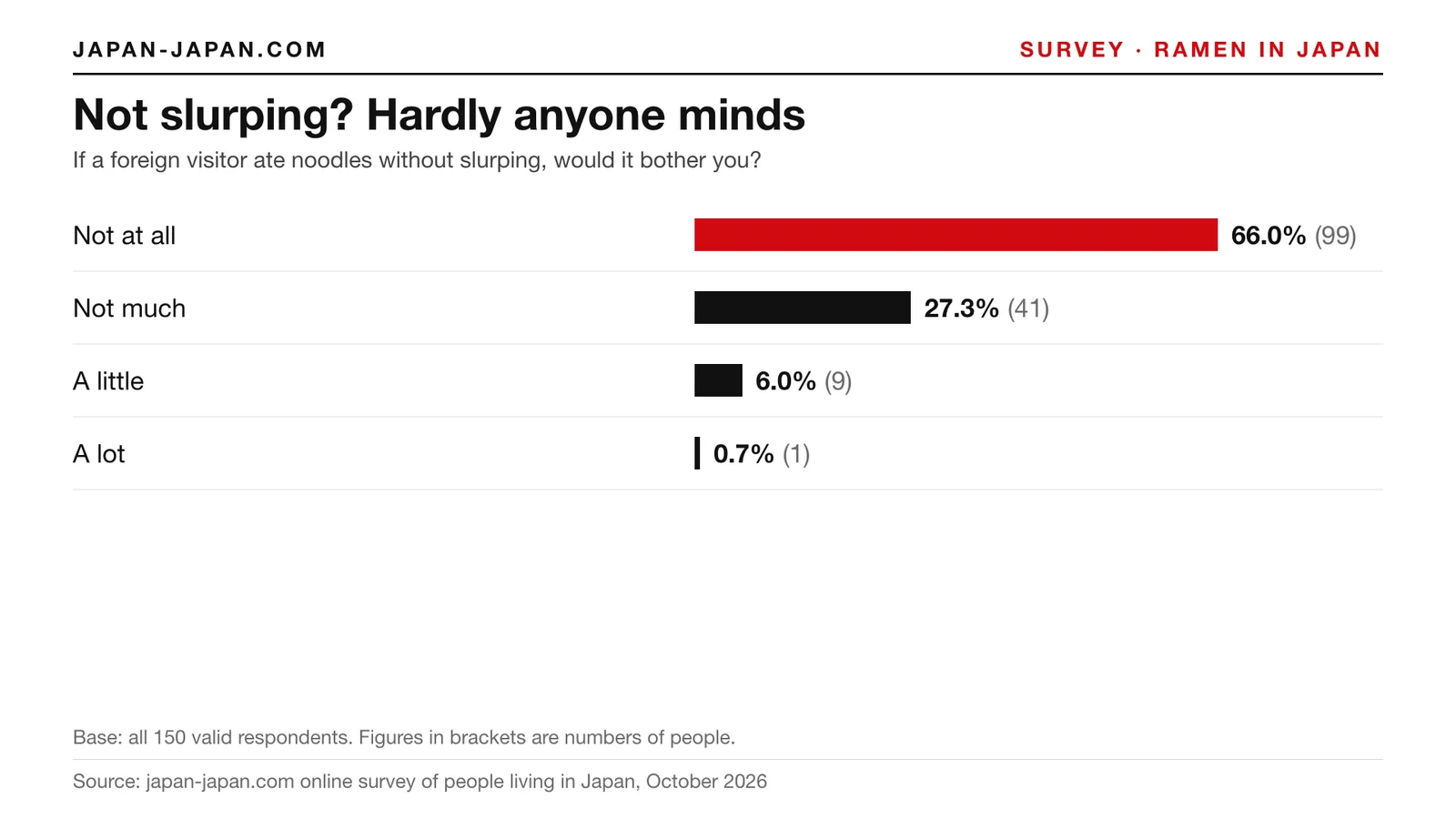
We asked three questions. Do you slurp? Would a visitor who doesn’t slurp bother you? Does the person next to you bother you when they slurp? The answers say the same thing: slurp if you like, and eat quietly if you prefer.
Most respondents slurp. 67.3% always slurp (101 of 150) and 20.7% sometimes do. Together, 88.0% slurp at least sometimes (132 of 150). Only 12.0% (18 of 150) said they don’t slurp.
Most also don’t mind if you stay quiet. 66.0% (99 of 150) would not be bothered at all by a visitor eating without slurping, and 27.3% not much. That adds up to 93.3% (140 of 150). Just one person, 0.7%, said it would bother them a lot.
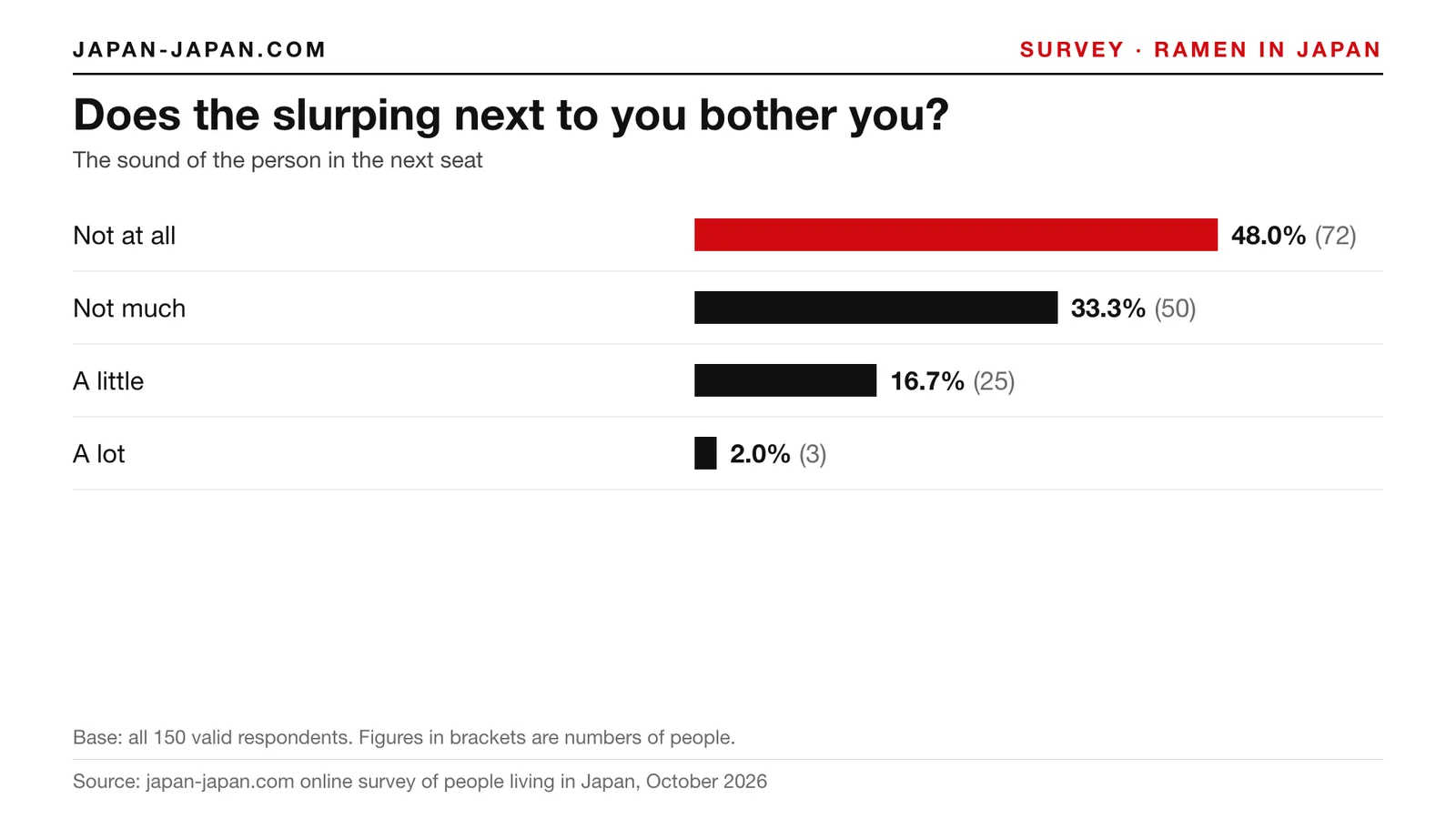
The sound itself splits people a little more. 48.0% are not bothered at all by the slurping of the person next to them, and 33.3% not much. But 18.7% (28 of 150) are bothered a little or a lot. At a counter you sit close to strangers, so a loud slurp reaches the next seat.
Two women in their 30s gave opposite tips. “Don’t force yourself to slurp,” wrote one from Kanto (outside Tokyo). “It isn’t bad manners, so do try slurping your noodles,” wrote one from Kinki (Kansai).
Do you have to finish the soup?
No. Most people in Japan leave some soup. About half was the most common answer to how much soup they drink, at 46.7% (70 of 150). Just a little came next at 30.7%, then all of it at 14.7% (22 of 150) and hardly any at 8.0%. Half or all adds up to 61.3% (92 of 150).
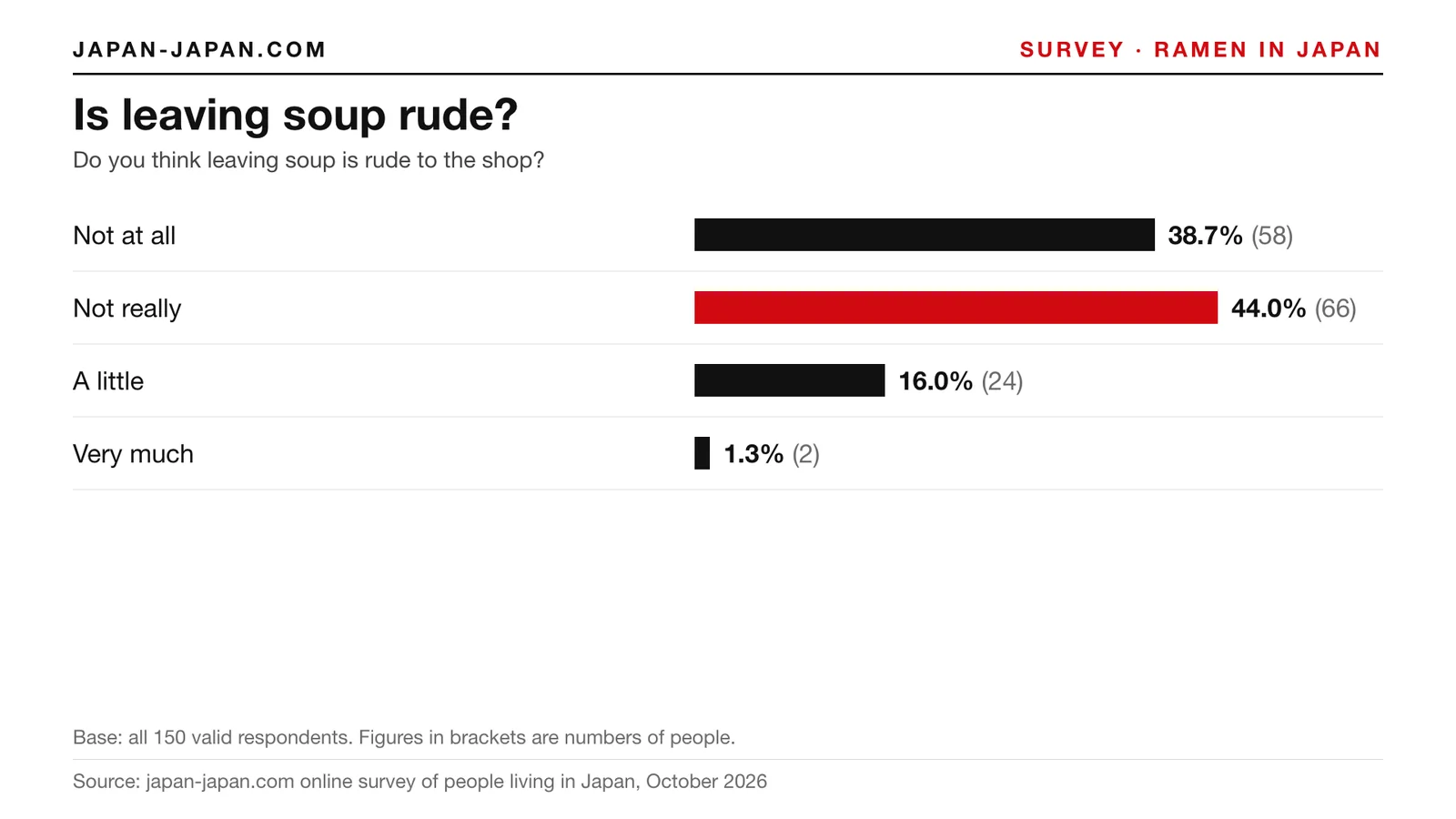
We also asked whether leaving soup is rude to the shop. 44.0% said not really and 38.7% said not at all. Together, 82.7% (124 of 150) do not see it as rude. 16.0% think it is a little rude, and 1.3% very rude.
“Soup can splash when you slurp, so it’s better not to wear whitish clothes,” added a woman in their 50s from Chubu. The table puts the slurping and soup answers side by side.
| Question | Answer | Share of 150 |
|---|---|---|
| Do you slurp your noodles? | Always or sometimes | 88.0% (132) |
| Would a visitor not slurping bother you? | Not at all or not much | 93.3% (140) |
| How much of the soup do you drink? | Half or all of it | 61.3% (92) |
| Is leaving soup rude to the shop? | Not at all or not really | 82.7% (124) |
Kaedama and noodle firmness
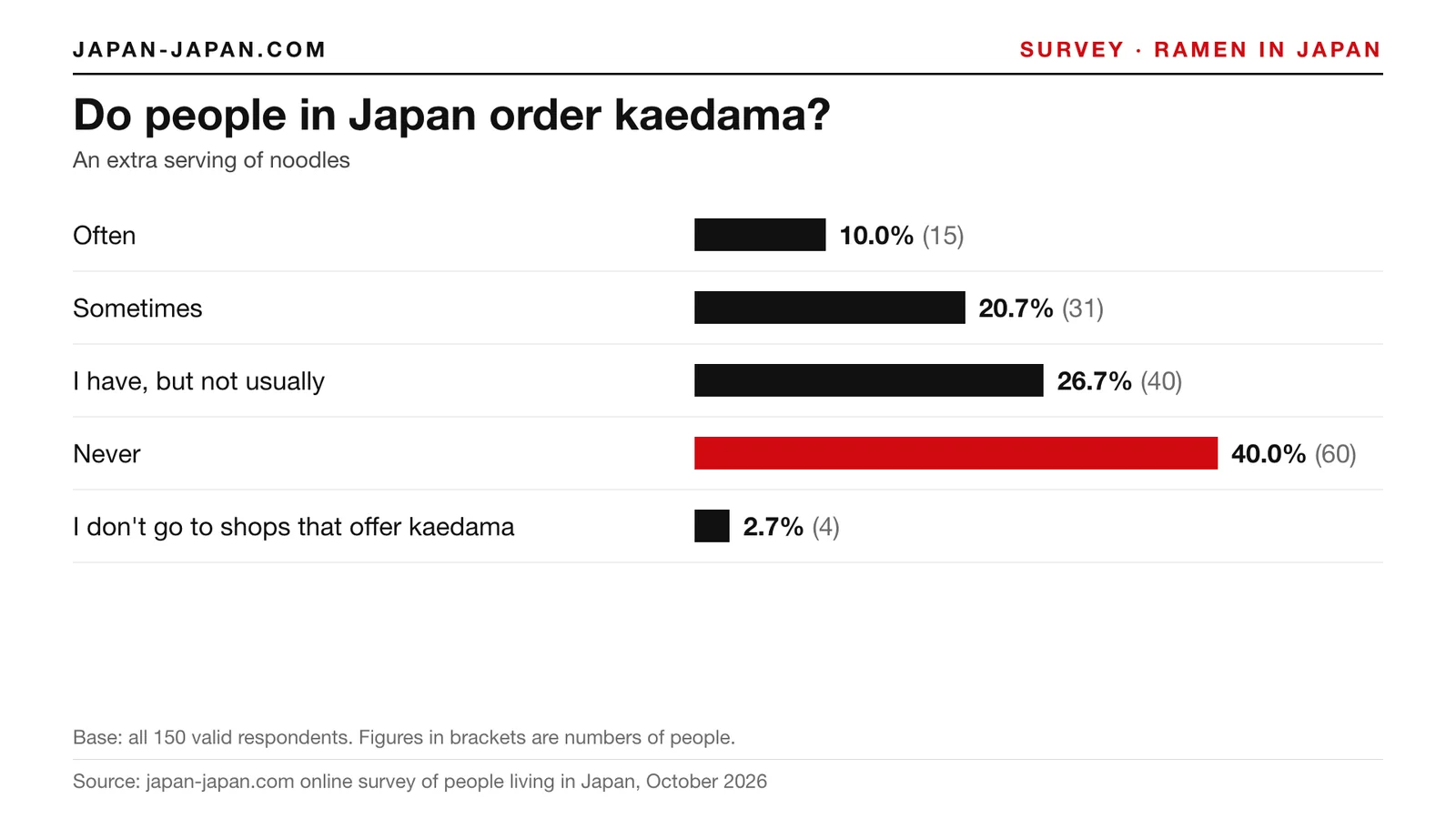
Kaedama is an extra serving of noodles for the soup you already have.
Many people in Japan never order it. Never was the single largest answer at 40.0% (60 of 150). 26.7% have ordered it but not usually, 20.7% order it sometimes and 10.0% often.
Leaving out the 4 people who don’t go to shops that offer kaedama, 58.9% have ordered it at least once (86 of 146). 31.5% order it often or sometimes (46 of 146). You don’t need kaedama to fit in.
Some shops let you choose how firm the noodles are. Standard was the top choice at 52.7% (79 of 150), and firm came next at 33.3%. Soft got 4.7%, and 7.3% don’t choose. Among the 147 respondents who go to shops with this choice, 34.0% order firm (50 of 147).
A man in their 40s from Kinki (Kansai) had one more tip. “I’d like visitors to know there are lots of options, such as noodle firmness or extra green onions, and they’re free,” they wrote.
The manners people in Japan most want visitors to know
We showed a list of ramen shop manners and asked which ones visitors should know. Respondents could pick several, so the shares add up to more than 100%. 96.7% (145 of 150) picked at least one.
Don’t cut in line came first at 74.0% (111 of 150). Don’t linger after eating came second at 63.3%. Next came don’t save seats with bags (48.0%), buy the meal ticket first (47.3%) and don’t talk loudly (44.7%).
We then asked the 145 people who picked at least one manner to name the one that matters most. Don’t cut in line won again with 37.9% (55 of 145). Don’t linger after eating came second at 15.9%, and buy the meal ticket first third at 9.7%.
Slurping and soup sit low on both lists. Slurping is fine got 34.7%, and it’s fine to leave soup got 27.3%. Respondents cared more about how visitors share the shop than about how they eat. The table compares both questions.
| Manner | Want visitors to know | Most important |
|---|---|---|
| Don’t cut in line | 74.0% | 37.9% |
| Don’t linger after eating | 63.3% | 15.9% |
| Don’t save seats with bags | 48.0% | 5.5% |
| Buy the meal ticket first | 47.3% | 9.7% |
| Don’t talk loudly | 44.7% | 7.6% |
| No tipping | 40.0% | 6.9% |
| Line up once the whole group is there | 38.0% | 6.2% |
| Order one bowl per person | 36.7% | 6.9% |
| Slurping is fine | 34.7% | 3.4% |
“Cutting in line is strictly off-limits, so please never do it. Whether you slurp or not is up to you,” wrote a woman in their 30s from Kanto (outside Tokyo). Their Japanese was 割り込みはご法度 (warikomi wa gohatto): cutting in line is strictly off-limits.
Lines, sharing tables and how long to stay
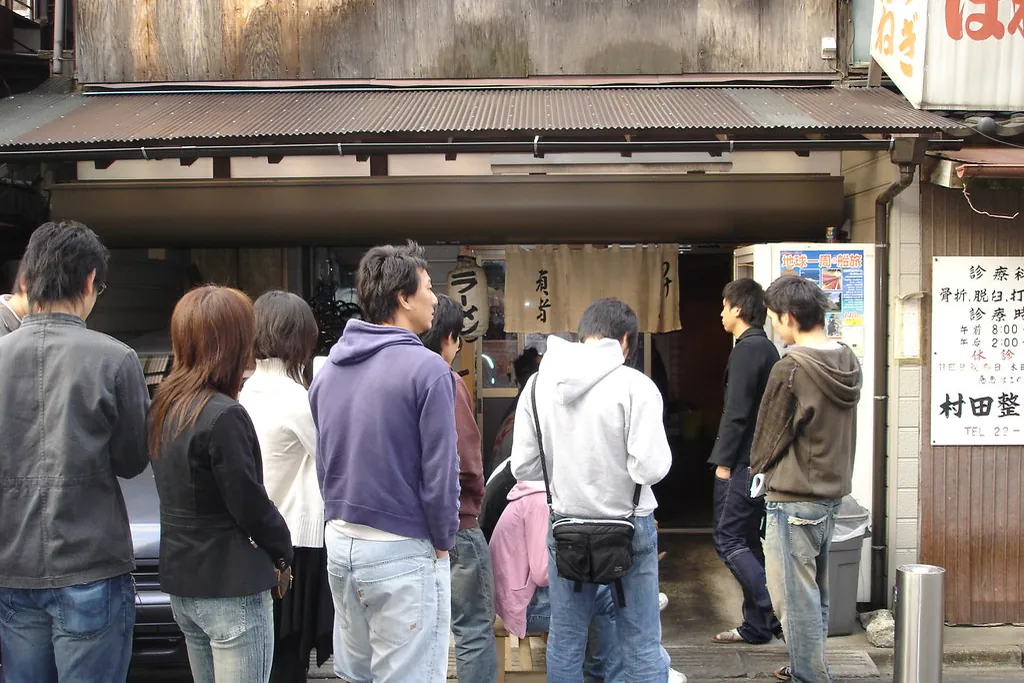
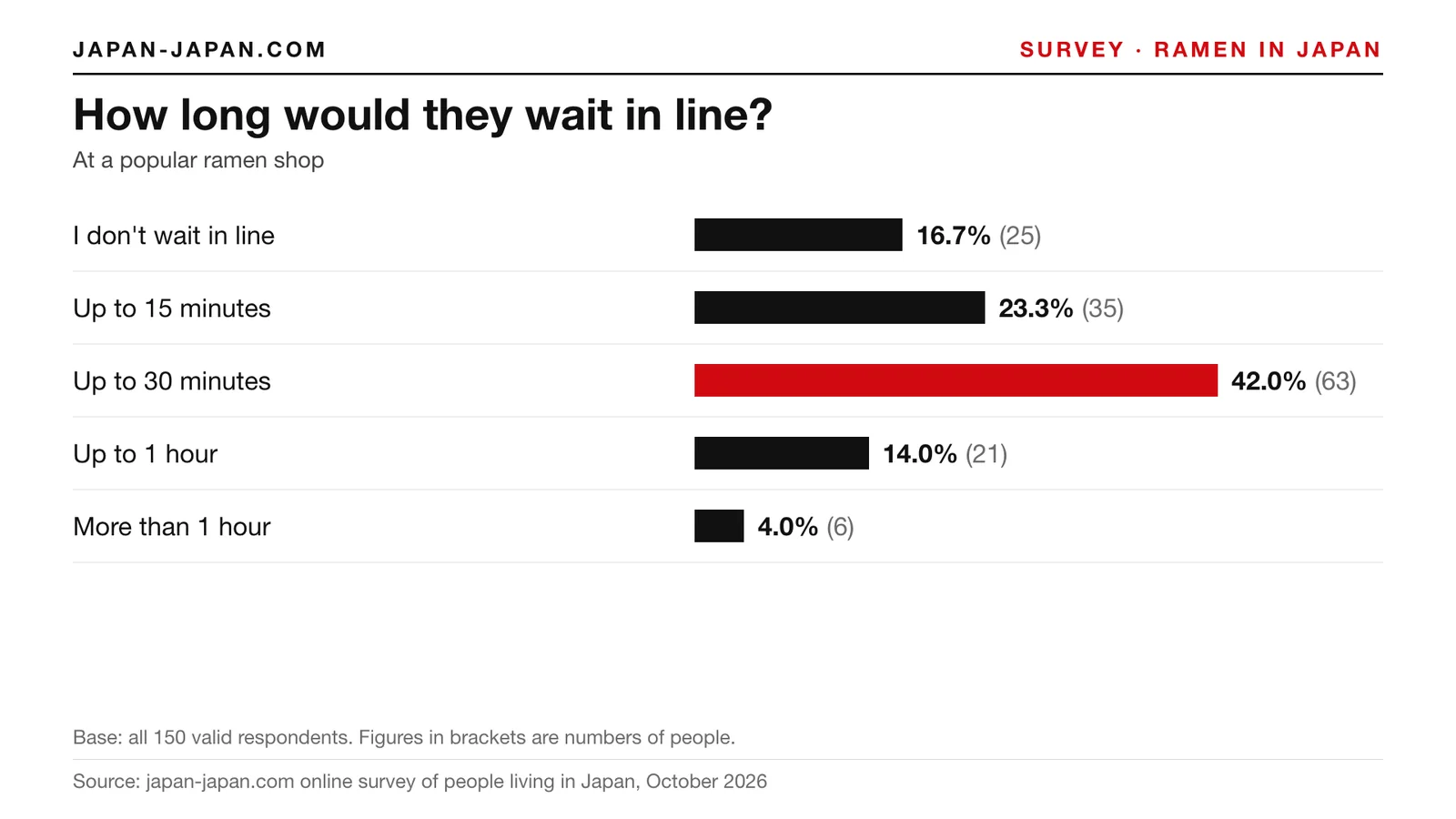
Most respondents have a limit of 30 minutes or less. For a popular shop, up to 30 minutes was the top answer at 42.0% (63 of 150). Up to 15 minutes came next at 23.3%, and 16.7% don’t wait in line at all. 18.0% (27 of 150) would wait up to an hour or more.
Their longest real wait was most often 15–30 minutes (29.3%). 36.0% (54 of 150) have waited 30 minutes or more at least once, including 1.3% who waited 2 hours or more.
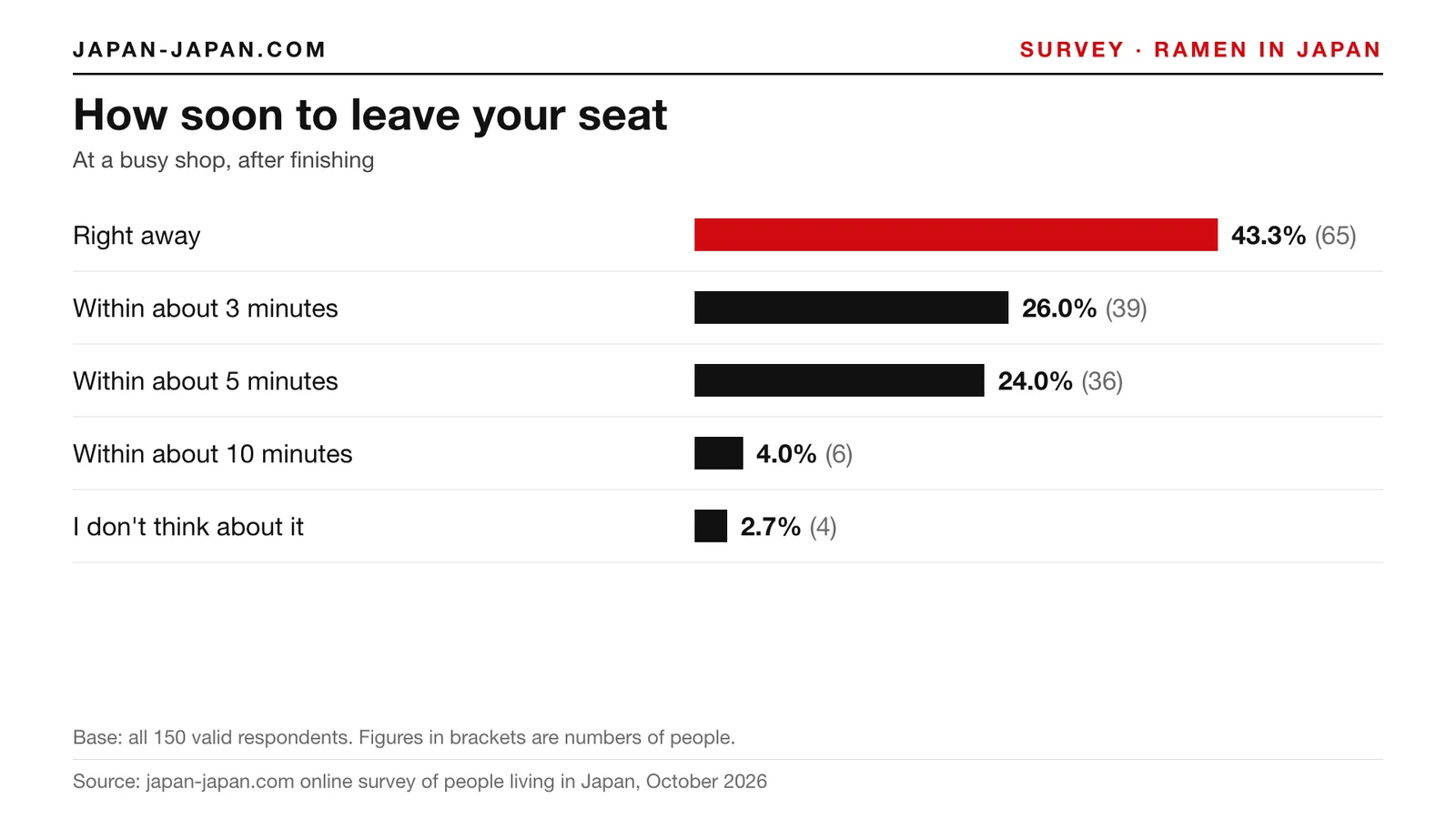
Inside, people expect you to leave soon after you finish. At a busy shop, 43.3% (65 of 150) think you should leave your seat right away. Another 26.0% say within about 3 minutes, which makes 69.3% (104 of 150). “Please keep to leaving as soon as you finish eating, so the shop can seat the next people,” a Kinki woman in their 30s wrote.
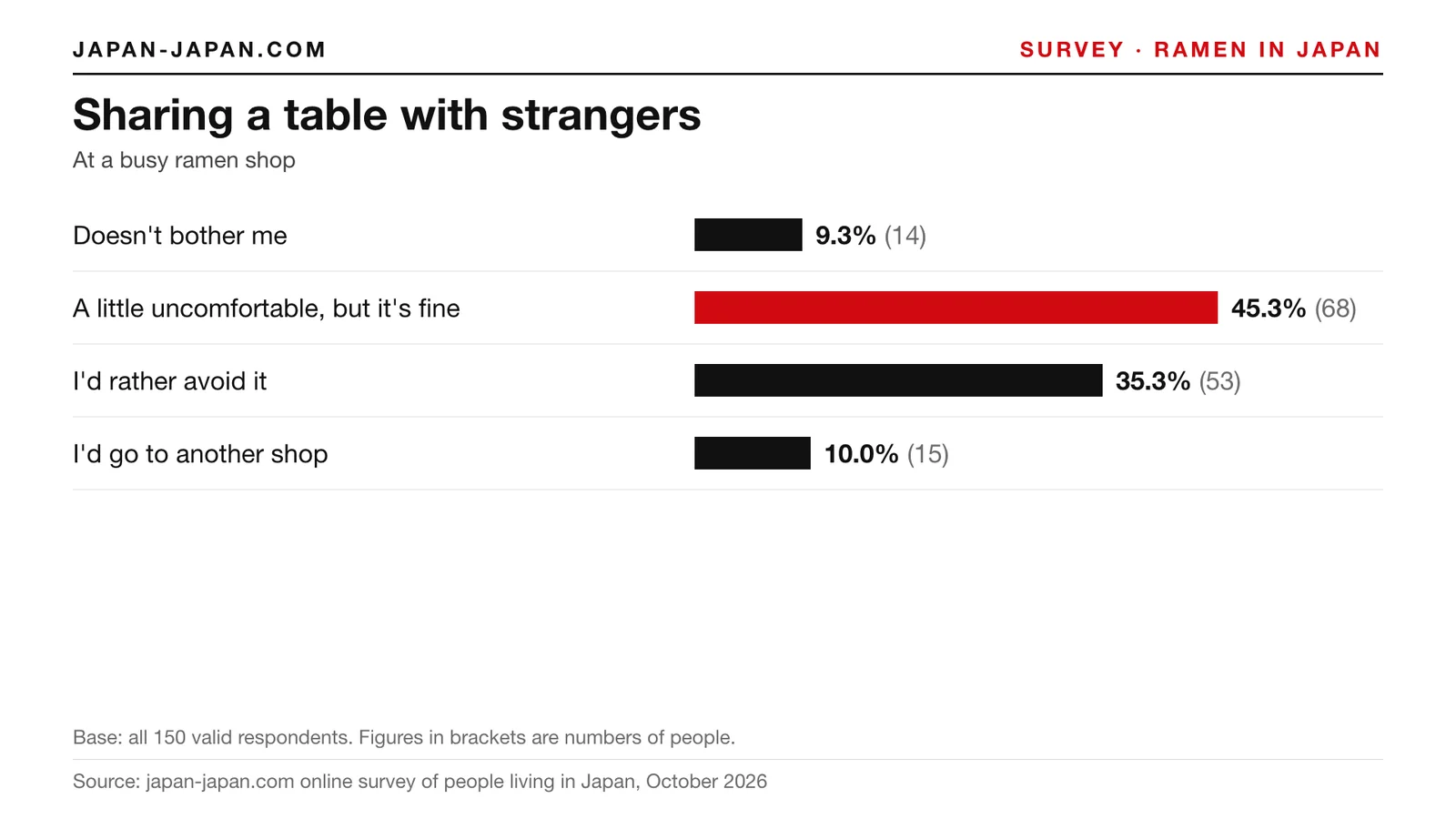
Sharing a table with strangers splits opinion in half. 45.3% (68 of 150) find it a little uncomfortable, but fine. Another 45.3% would rather avoid it (35.3%) or would go to another shop (10.0%). Only 9.3% are not bothered at all.
Photos, sharing a bowl and tipping
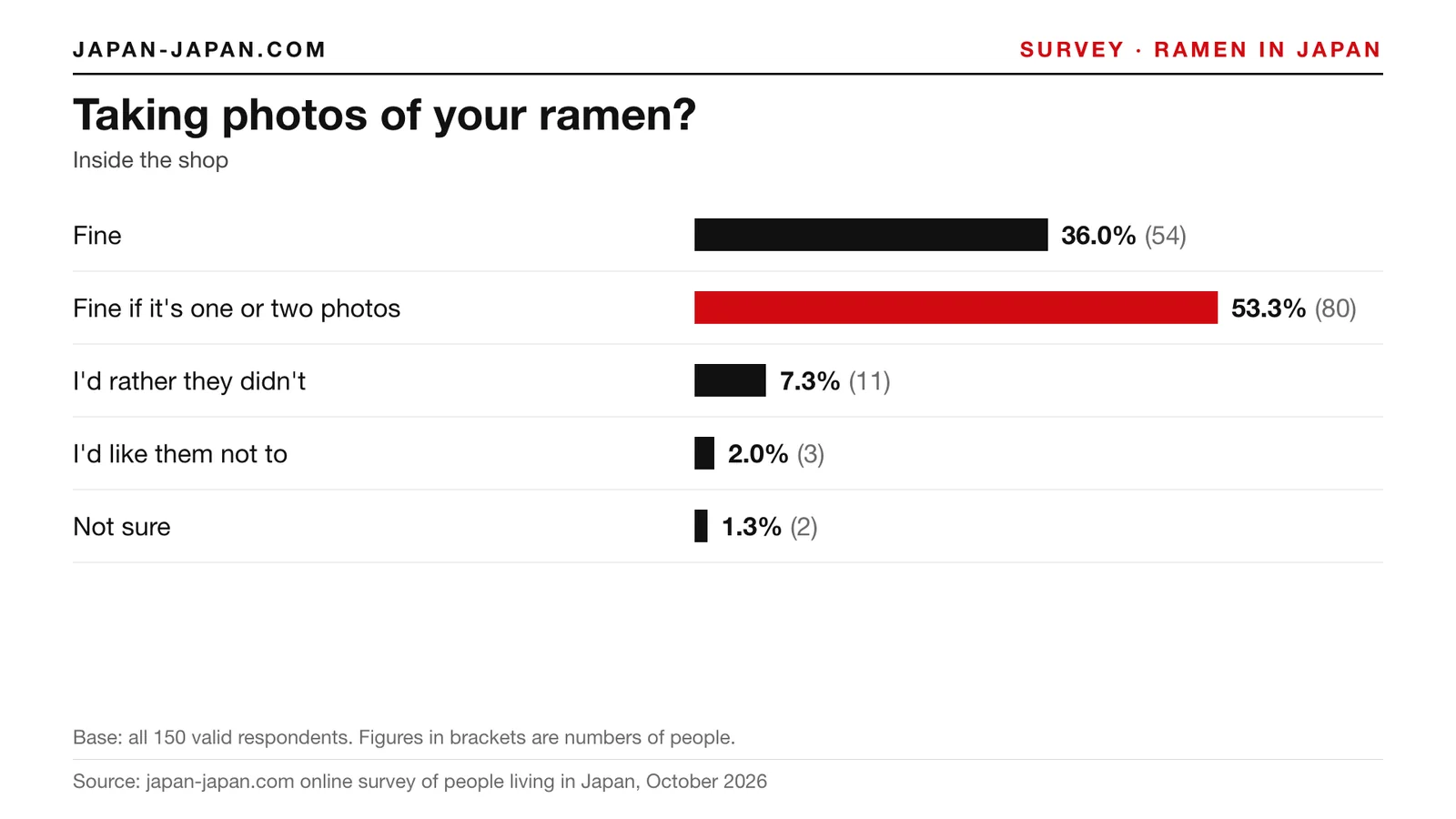
Taking a photo of your bowl is fine with most people. 53.3% (80 of 150) said it is fine if it’s one or two photos, and 36.0% said fine. Together that is 89.3% (134 of 150). 7.3% would rather visitors didn’t, and 2.0% would like them not to.
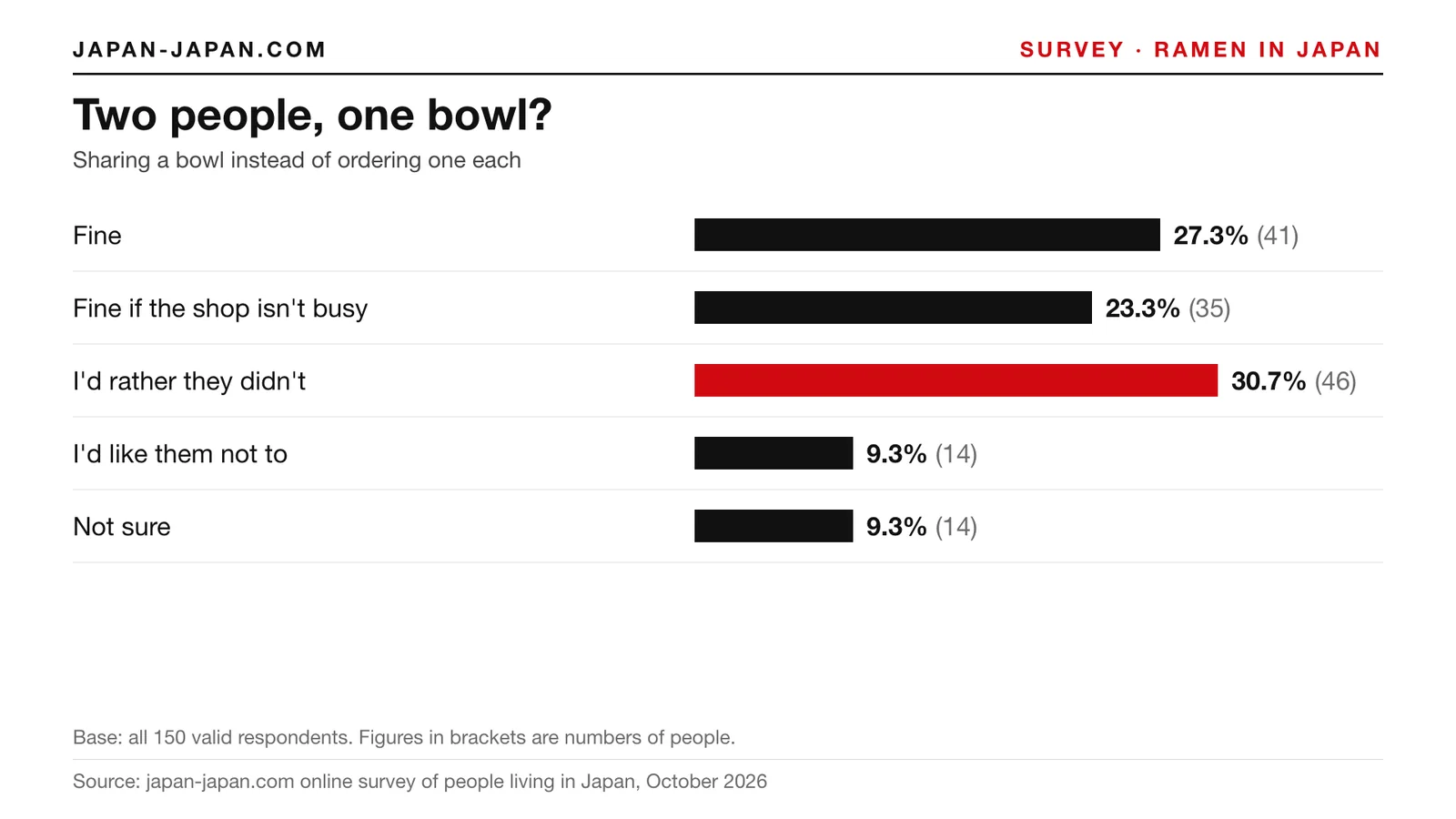
Sharing one bowl between two people divides opinion. The single biggest answer was I’d rather they didn’t, at 30.7% (46 of 150). Add I’d like them not to (9.3%) and 40.0% (60 of 150) would rather you didn’t share.
On the other side, 27.3% said fine and 23.3% said fine if the shop isn’t busy, a total of 50.7% (76 of 150). Order one bowl per person was also on the manners list, picked by 36.7%.
Tipping is simple: don’t. 99.3% (149 of 150) have never tipped staff at a ramen shop. No tipping was picked as a manner for visitors by 40.0% (60 of 150). Our guide to tipping in Japan covers tipping across Japan.
Ordering and paying: ticket machines, cash and ¥10,000 notes
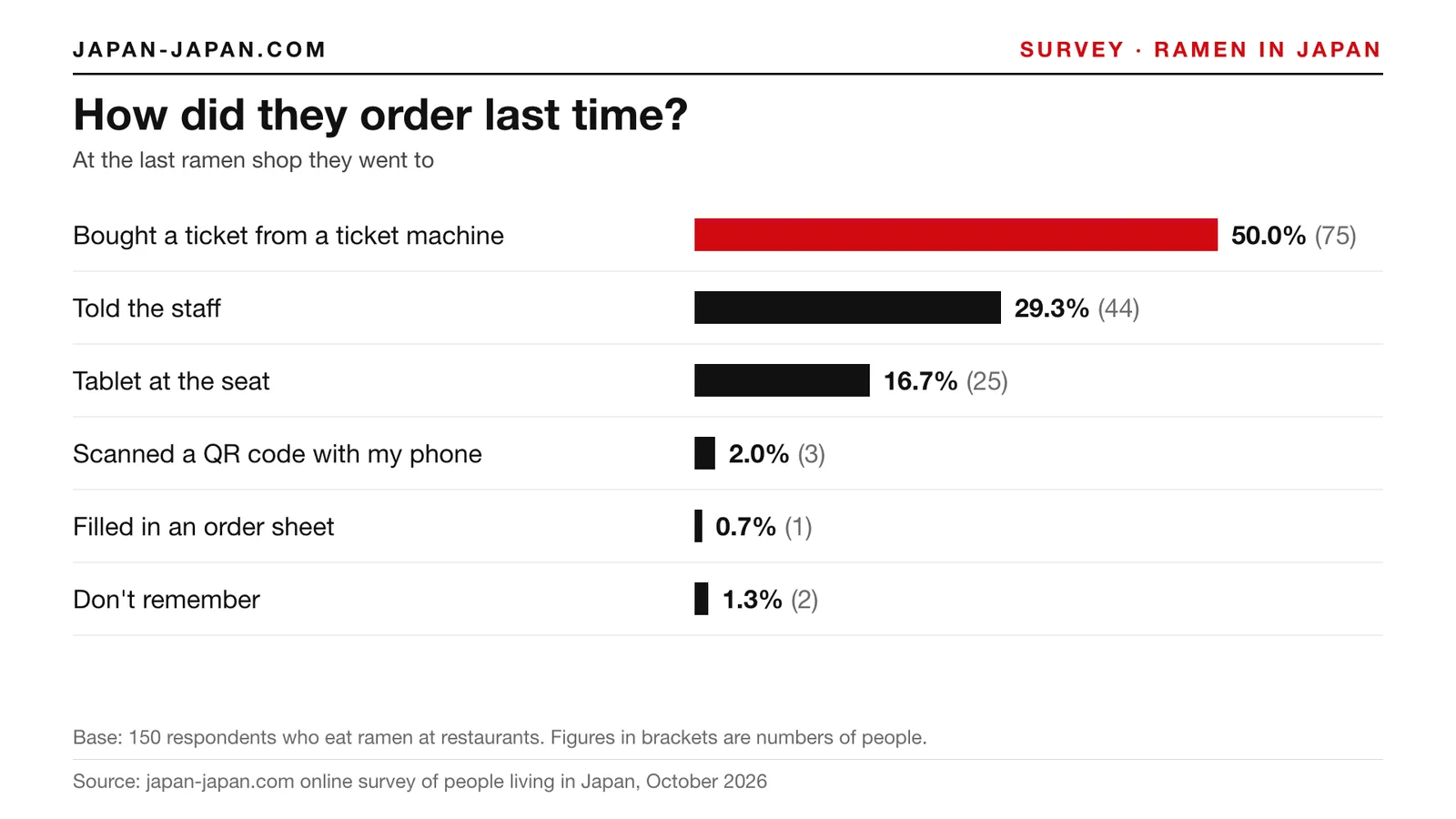
Half ordered from a ticket machine. At their last ramen shop, 50.0% (75 of 150) bought a ticket from a machine. 29.3% told the staff and 16.7% used a tablet at the seat.
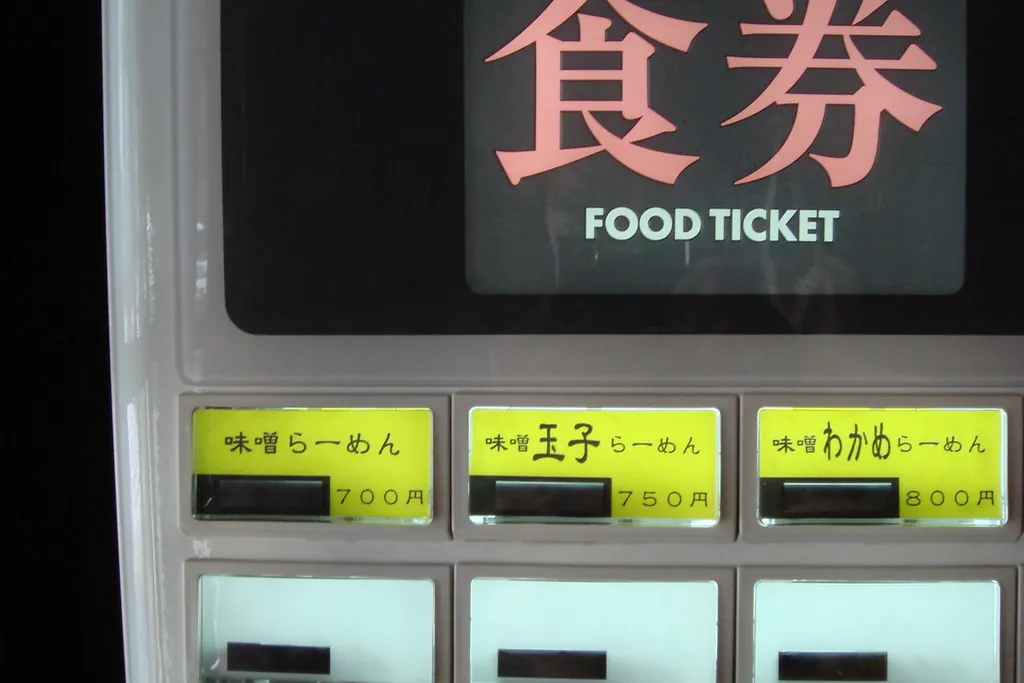
Cash still leads. 80.7% (121 of 150) said the last ticket machine they used took cash. Only 48.0% (72 of 150) said it took at least one cashless method. At their last shop, 65.3% (98 of 150) paid cash. Leaving out one person who didn’t remember, 34.2% (51 of 149) paid cashless. The table sets what the machine took next to how people paid.
| Payment | Last ticket machine took it | Paid this way last time |
|---|---|---|
| Cash | 80.7% | 65.3% |
| QR code payment | 37.3% | 18.7% |
| Credit card | 25.3% | 14.0% |
| Transit IC card | 12.0% | 1.3% |
Don’t count on a transit IC card for ramen. Only 12.0% saw one accepted at their last ticket machine, and 1.3% paid with one. Our guide to Suica, PASMO and ICOCA explains the cards.
34.7% (52 of 150) have had trouble at a cash-only ramen shop, often or sometimes. “Many independent shops can’t take credit cards or QR code payments, so be sure to bring cash in yen,” wrote a man from Hokkaido.
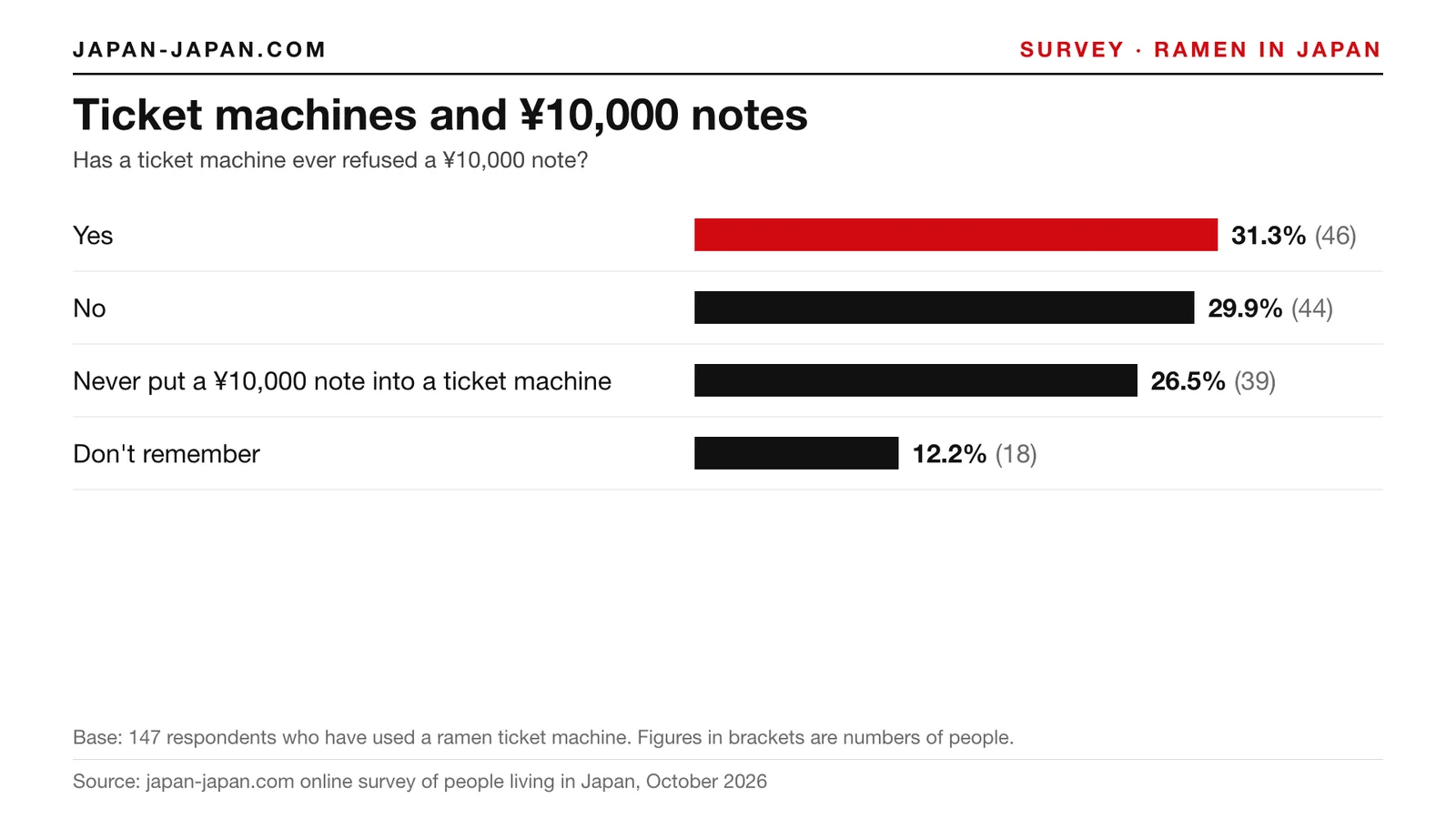
Machines also refuse some notes. Of the 147 respondents who have used a ramen ticket machine, 31.3% (46 of 147) have had a ¥10,000 note refused. Counting only the 90 who have put one in and remember, that is 51.1%. A new banknote issued from July 2024 has been refused for 17.7% (26 of 147). Carry ¥1,000 notes and coins.
38.0% (57 of 150) have seen ticket machines that switch to English or other languages. 59.3% never have, so be ready for a screen in Japanese only.
What people in Japan see visitors struggle with
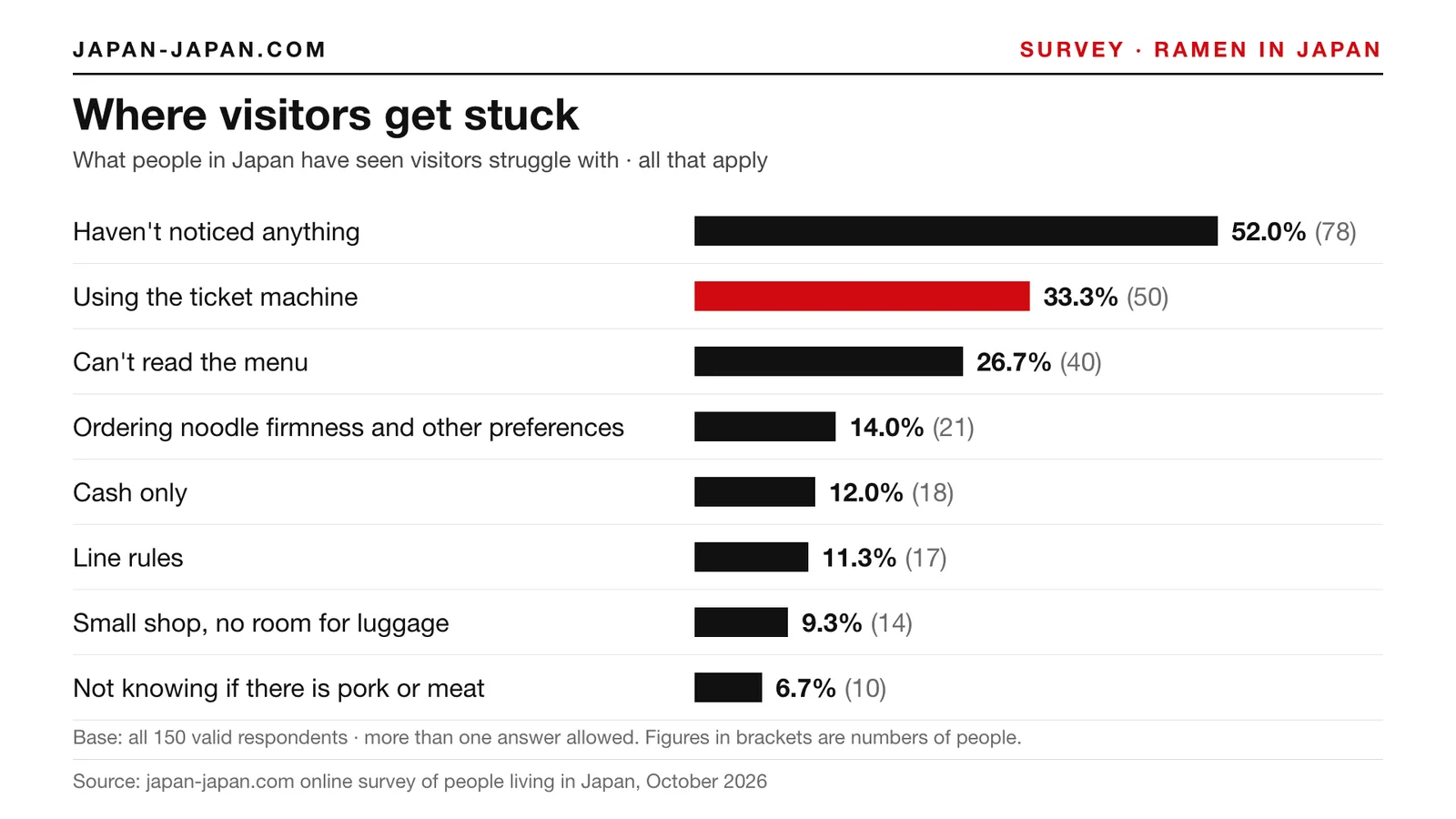
Most respondents have not seen visitors struggle. Haven’t noticed anything was the top answer at 52.0% (78 of 150).
The other 48.0% (72 of 150) have seen at least one problem. Using the ticket machine led at 33.3% (50 of 150), then can’t read the menu at 26.7%. Ordering noodle firmness got 14.0%, cash only 12.0% and line rules 11.3%. No room for luggage in a small shop got 9.3%.
“If you go into a ramen shop, please leave big luggage at your hotel or in a locker first,” wrote a woman from Tokyo.
Not knowing if there is pork or meat got 6.7%, and diet labels are rare. 75.3% (113 of 150) have seen none of the options we listed on a ramen shop’s menu or entrance. 12.0% have seen vegetarian or vegan ramen, 6.0% pork-free soup and 4.0% halal ramen. If you avoid pork or meat, read our guide to vegetarian, vegan and halal food in Japan. Our ramen chain guide lists the pork-free options at big chains.
45.5% (45 of 99) of those who could judge have seen more foreign customers at their regular shop in the past year or two. 33.3% (50 of 150) have seen a line made up mostly of foreign visitors.
Where people in Japan would take a first-time visitor
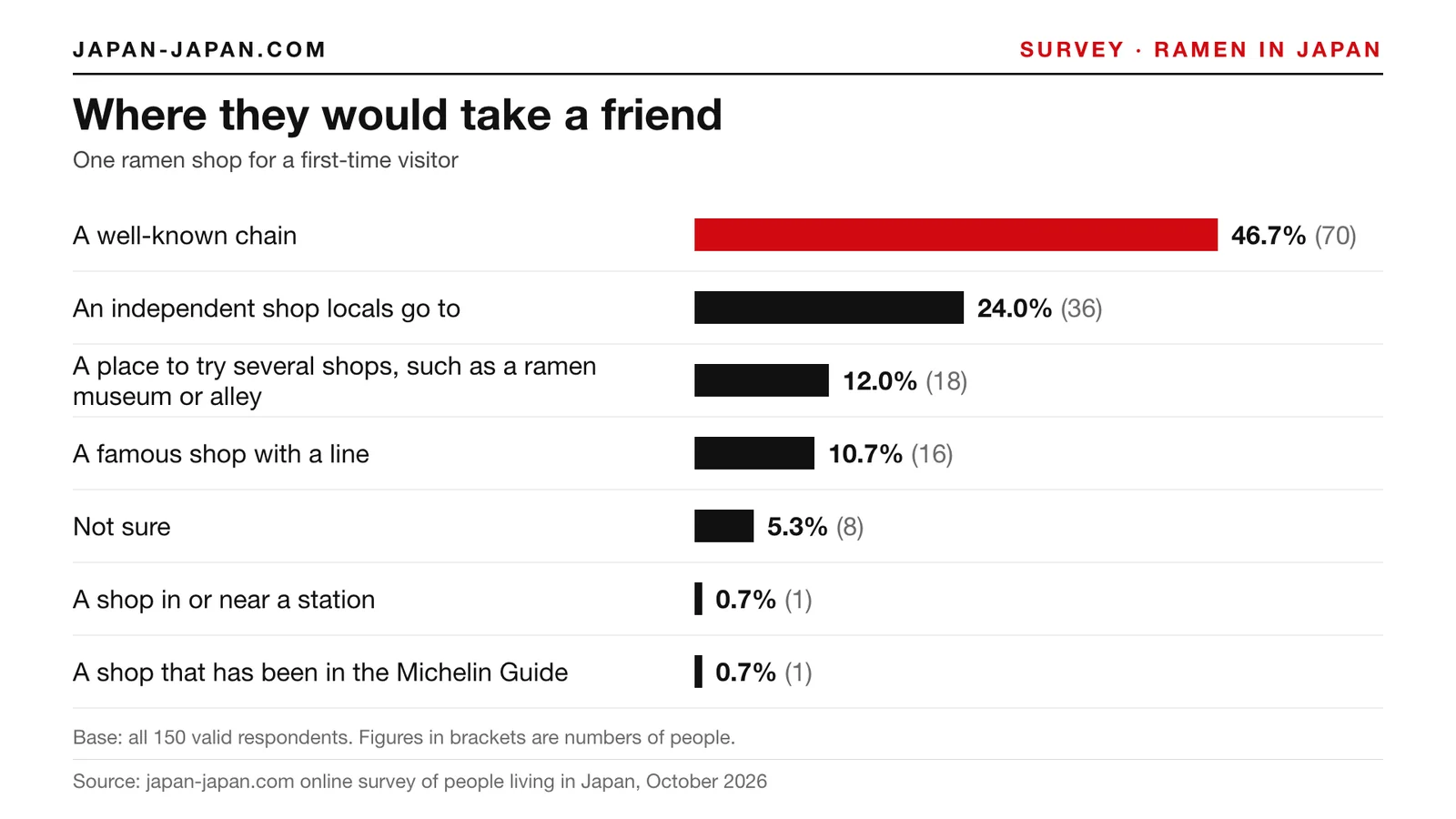
A chain was the top pick. For one shop with a first-time visitor, 46.7% (70 of 150) would choose a well-known chain. 24.0% would pick an independent shop locals go to, and 12.0% a ramen museum or alley.
Taste matters most when they recommend a shop (84.0%). Price follows at 34.7%, then a short wait at 26.0% and an English menu at 22.7%.
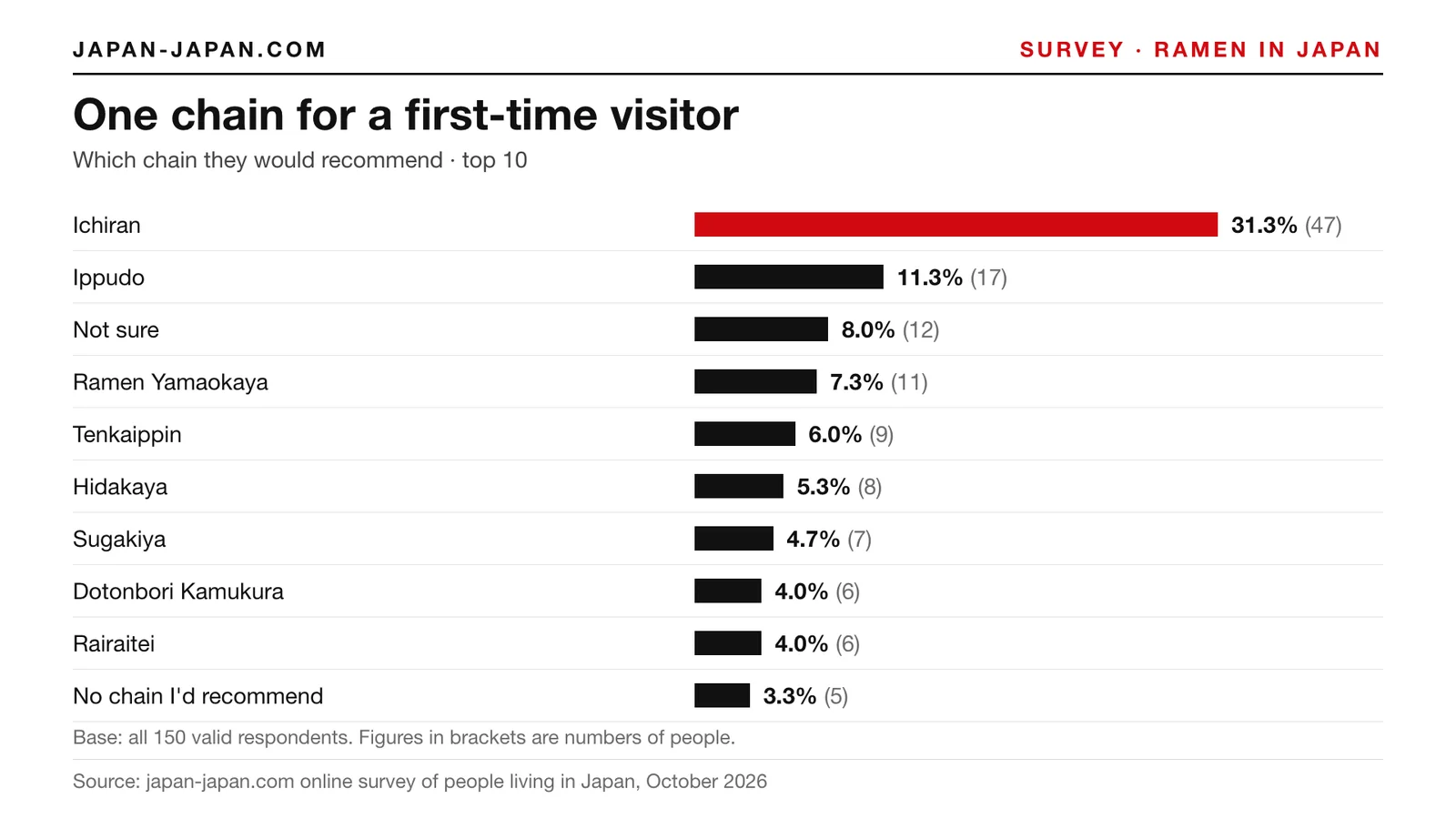
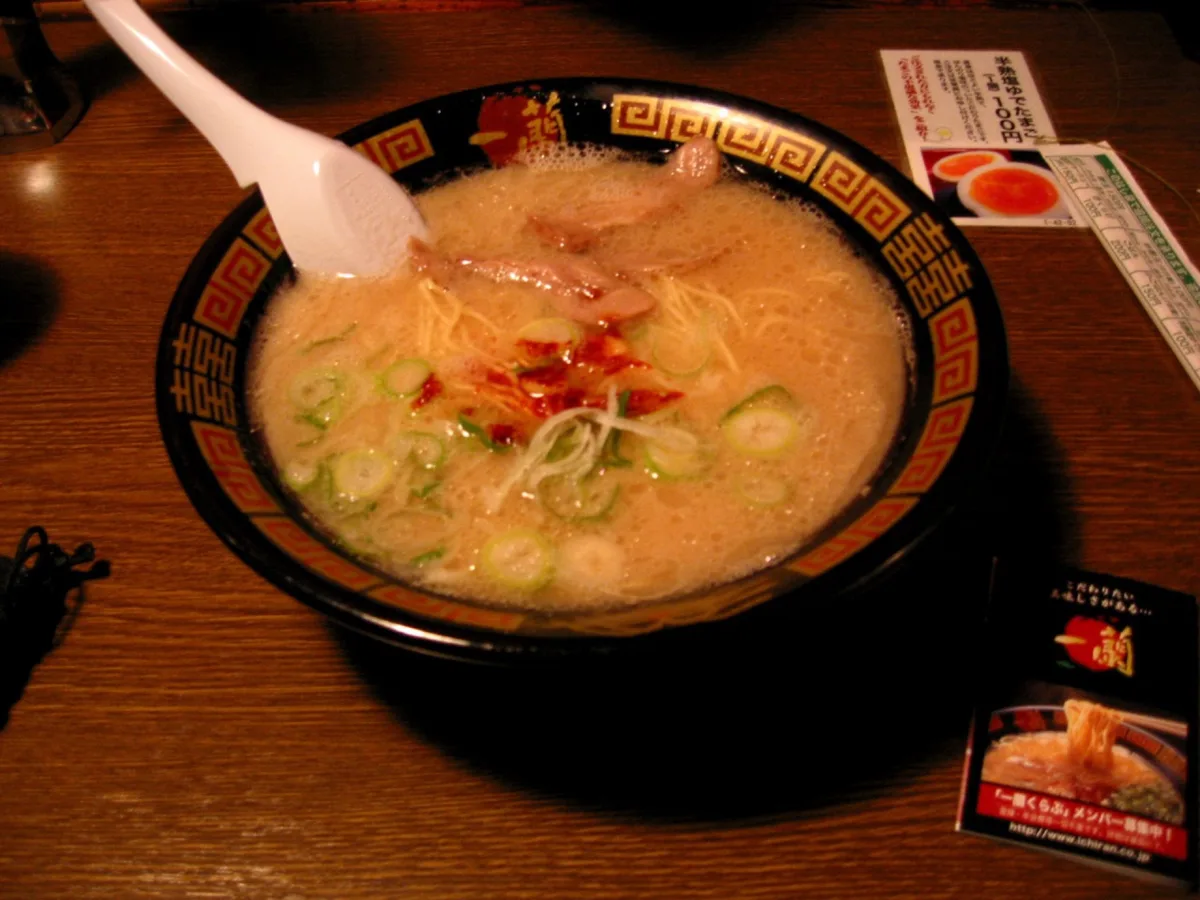
Asked to recommend one chain, 47 people named Ichiran (31.3%) and 17 named Ippudo (11.3%). Ramen Yamaokaya got 11 and Tenkaippin 9. Between Ichiran and Ippudo, 66 picked Ichiran (44.0%), 40 picked Ippudo (26.7%) and 25 said either is fine. Of the 89 respondents who have been to Ichiran, 66.3% (59 of 89) liked its single seats with dividers.
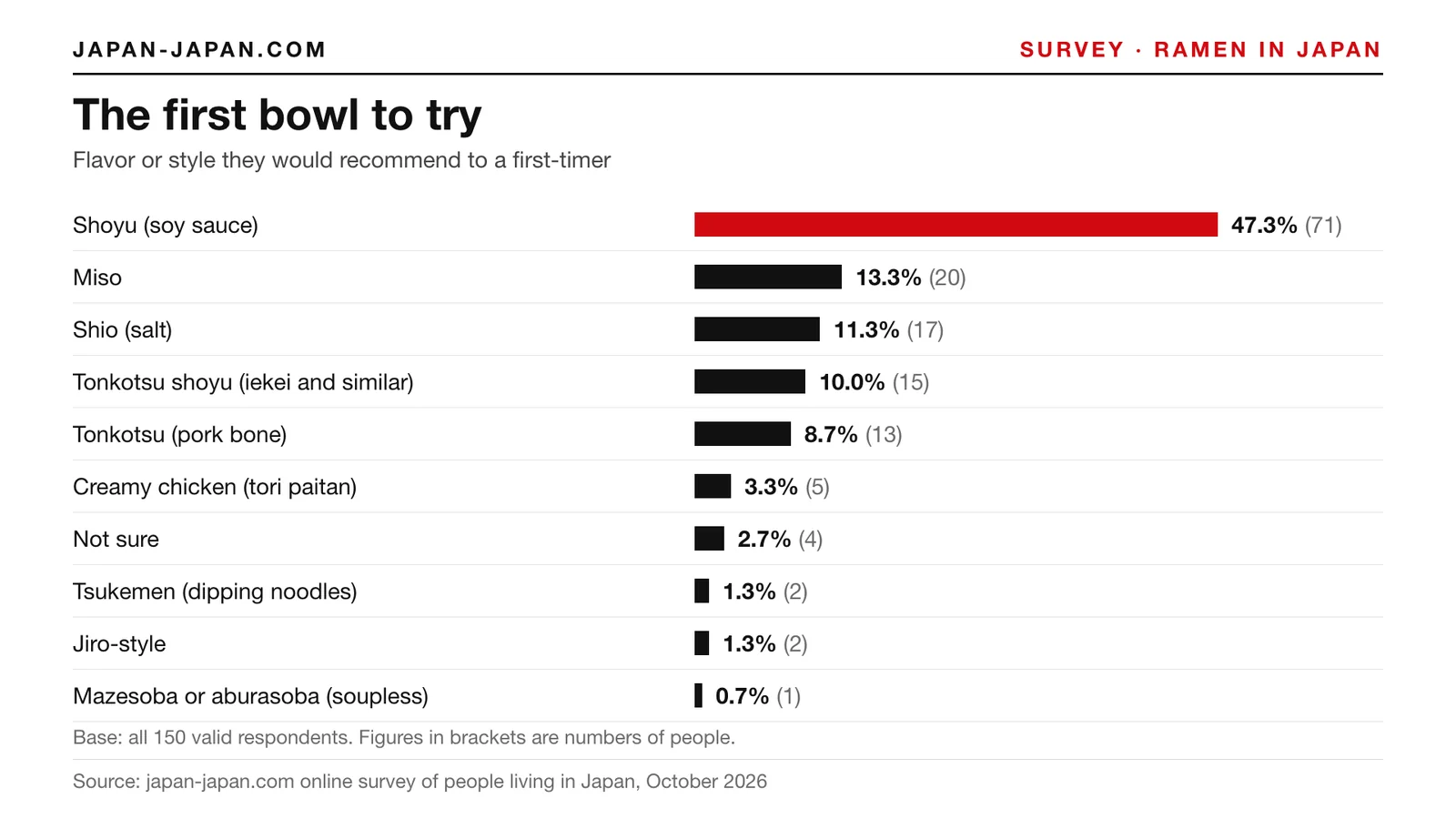
For a first bowl, 47.3% (71 of 150) would recommend shoyu, the soy sauce style. Miso got 13.3% and shio, the salt style, 11.3%. Our guide to the types of ramen in Japan explains each style. If you are in Tokyo, our guide to ramen in Tokyo counts chain shops by area and opening hours.
More results from the survey
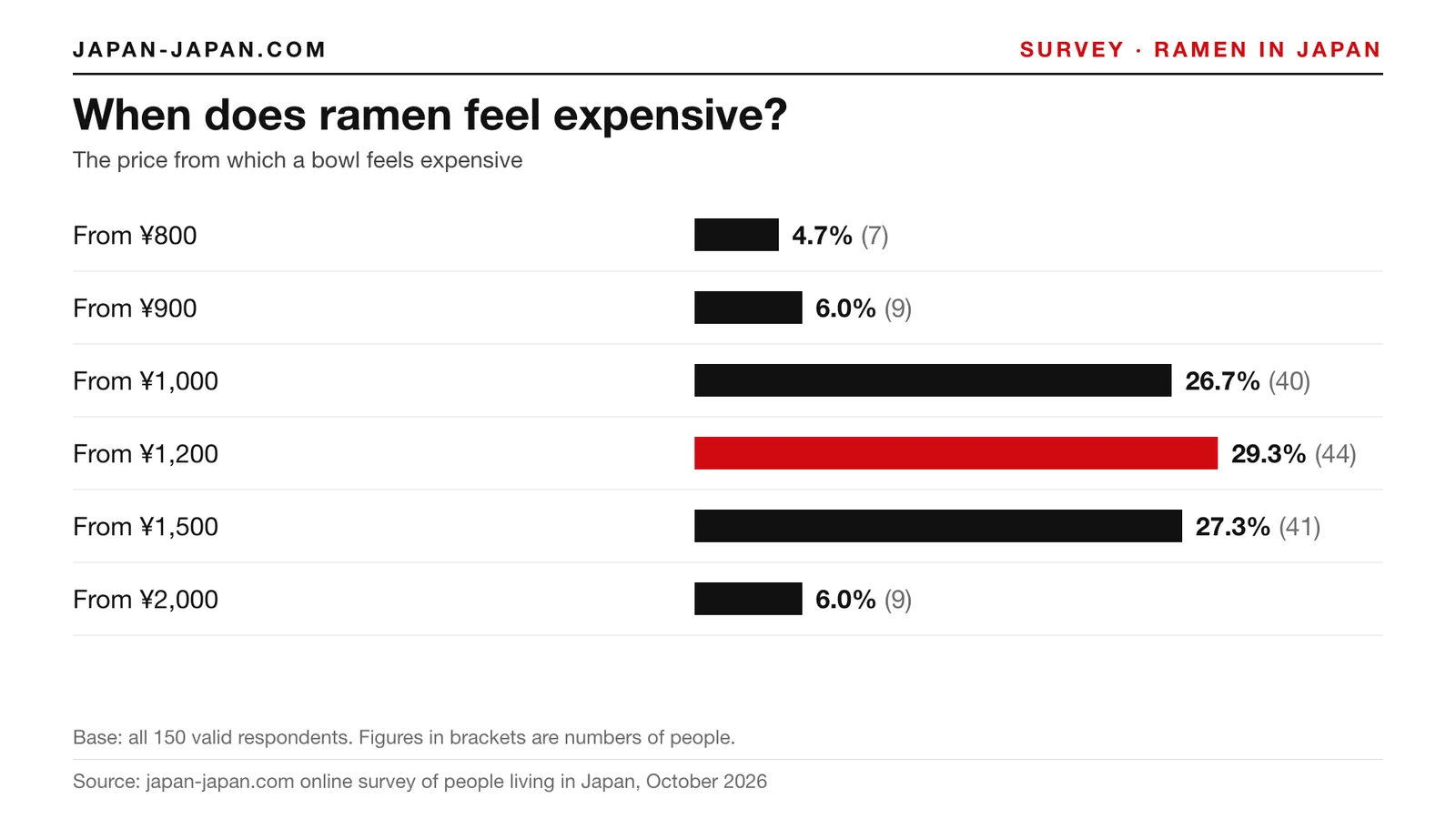
Prices: the last basic bowl most often cost ¥800–999 (52.7%). 68.5% (102 of 149) would pay up to ¥1,000 at most for an everyday bowl without toppings. For 66.7% (100 of 150), a bowl feels expensive from ¥1,200 or less.
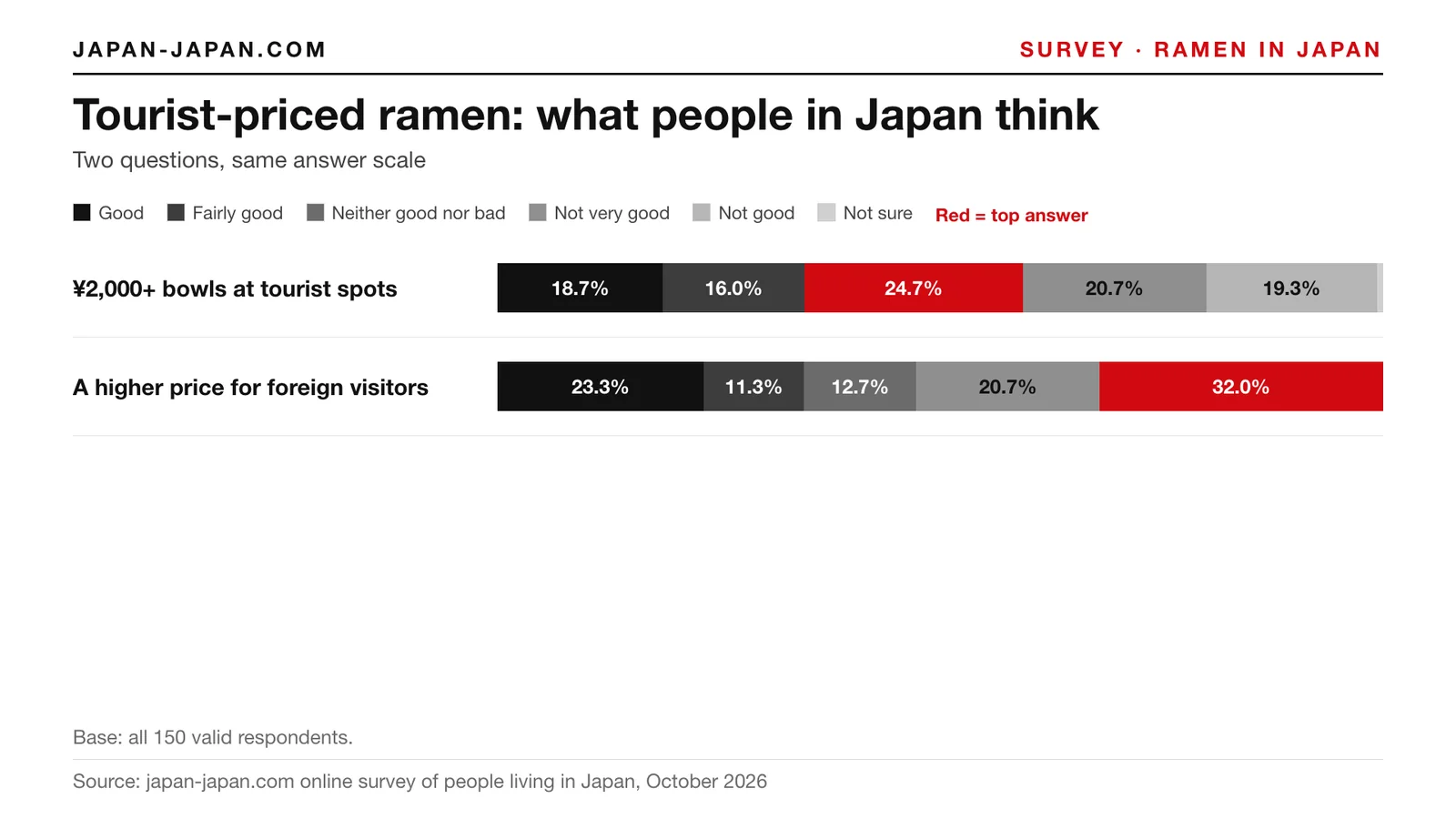
Tourist prices: we asked about ¥2,000-plus bowls aimed at visitors at tourist spots. 34.7% (52 of 150) said good or fairly good, and 40.0% (60 of 150) not very good or not good. On a higher price for foreign visitors, 34.7% said good or fairly good and 52.7% (79 of 150) not very good or not good.
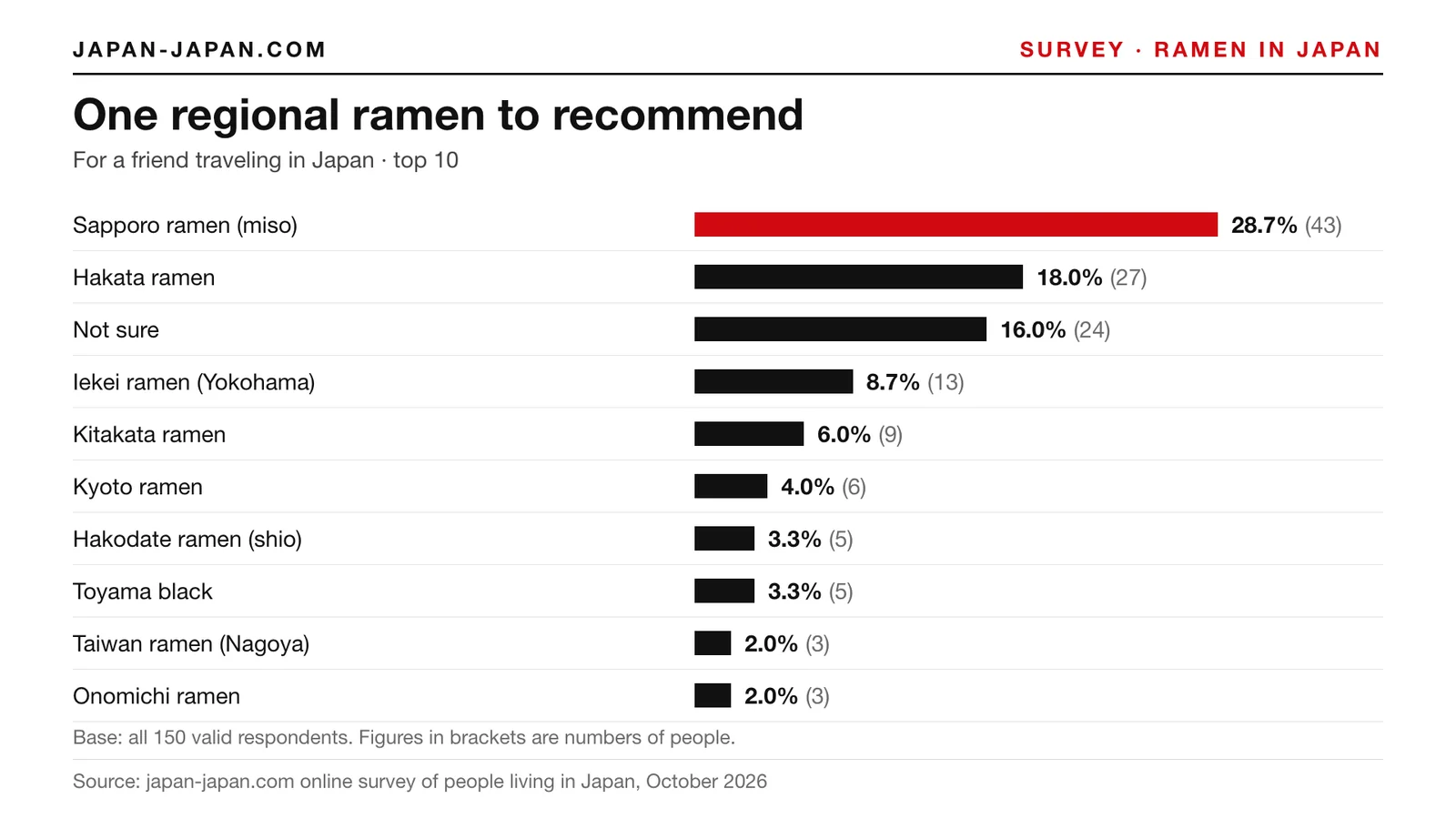
Regional ramen: asked to recommend one regional ramen, 28.7% (43 of 150) named Sapporo ramen (miso) and 18.0% Hakata ramen. On trips in Japan, 86.4% (127 of 147) eat the local ramen at least sometimes. Our regional ramen guide shows where each style comes from.
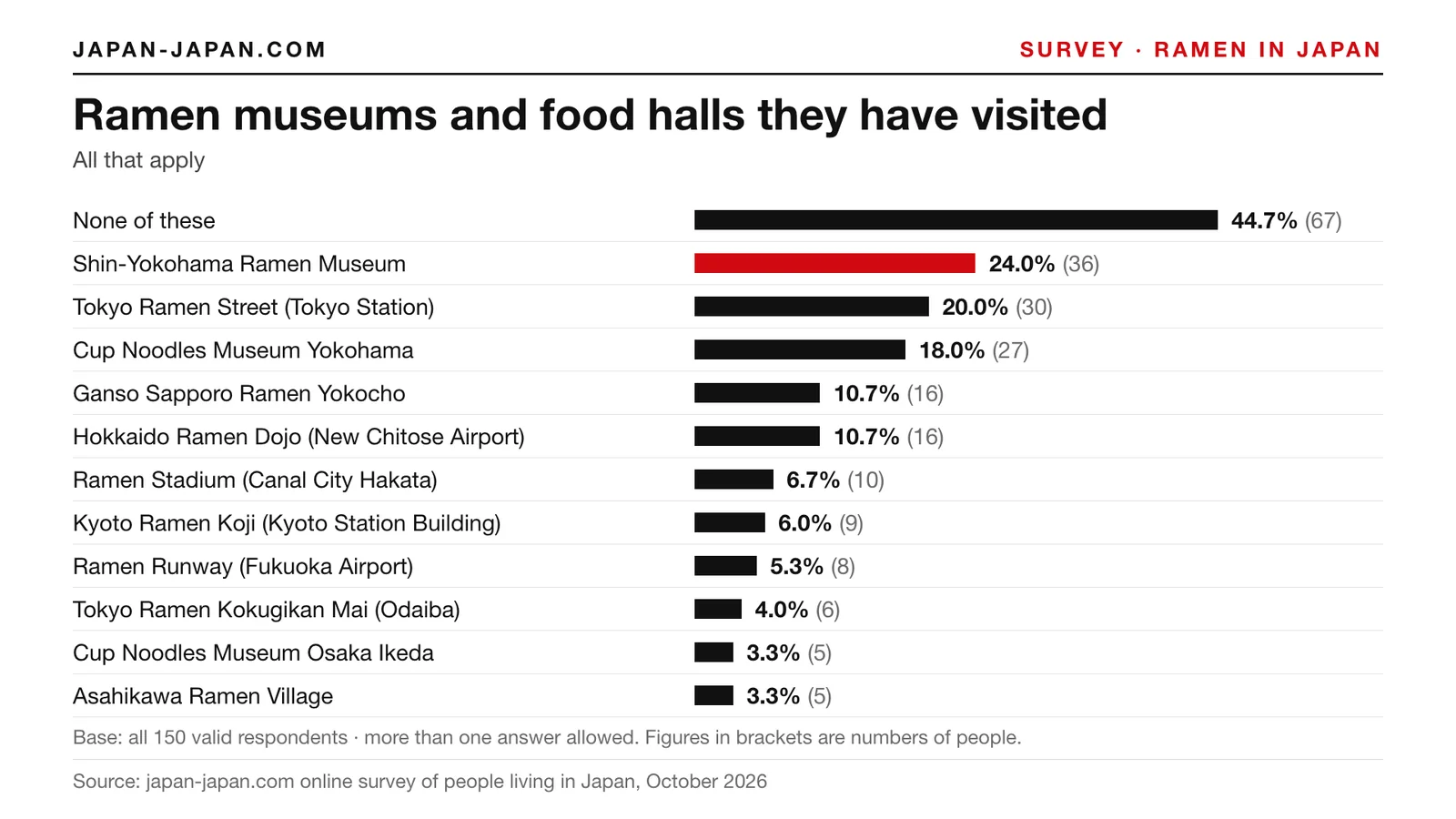
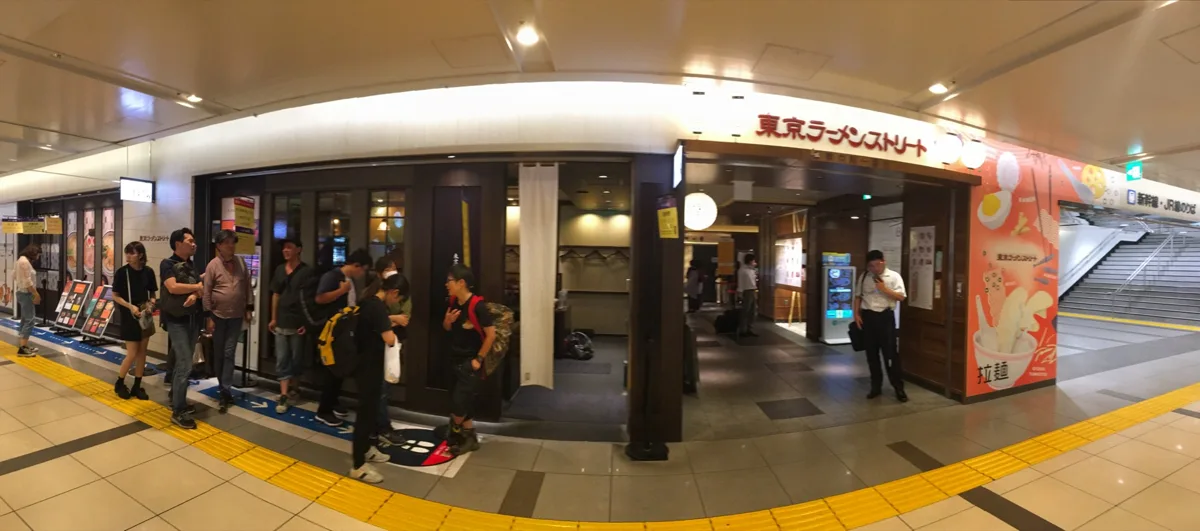
Ramen venues: 55.3% (83 of 150) have been to at least one venue on our list. The Shin-Yokohama Ramen Museum got 24.0% and Tokyo Ramen Street at Tokyo Station 20.0%. Our guide to ramen museums and ramen streets lists entry fees and hours.
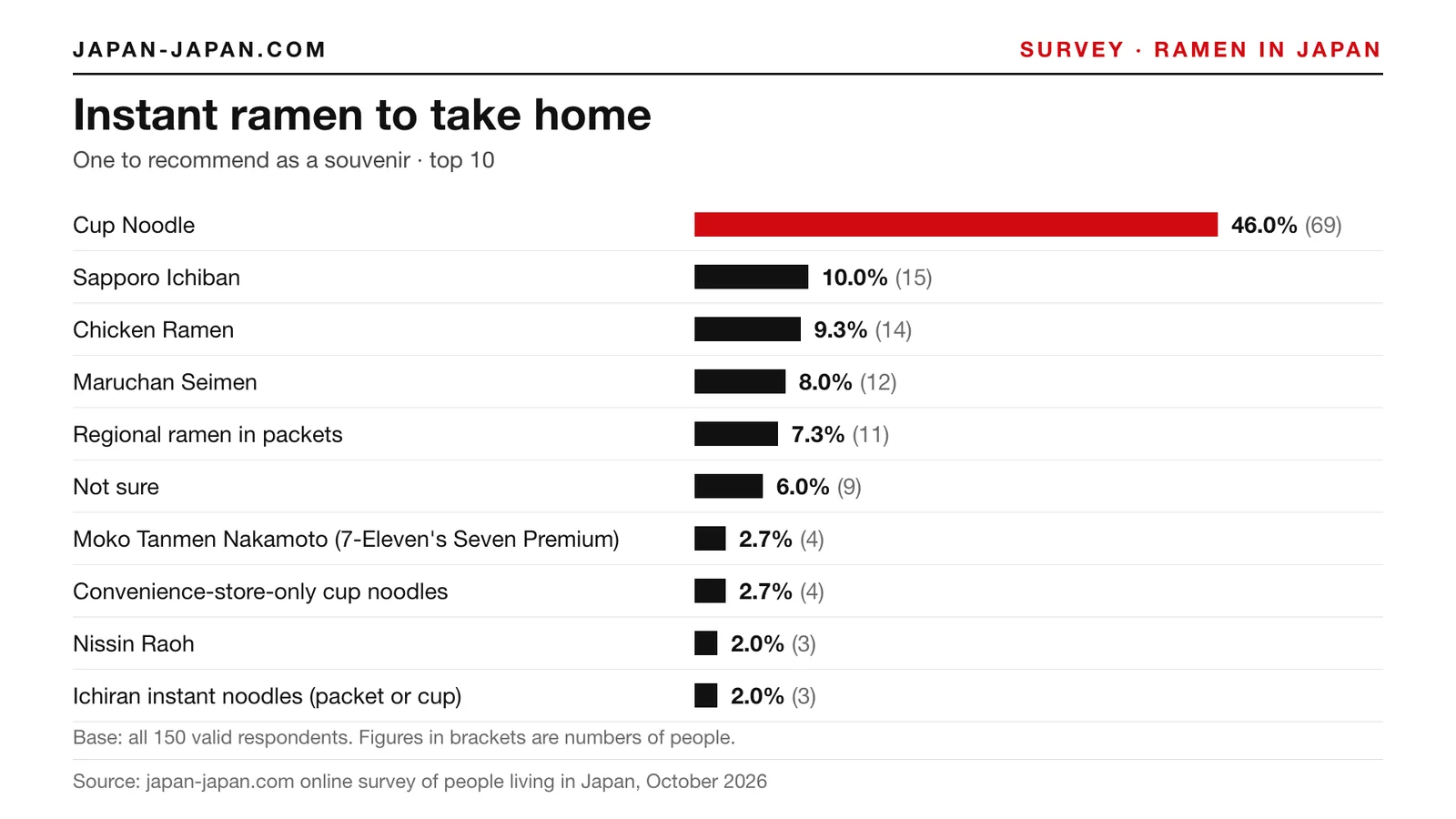
Airports and souvenirs: 34.7% (52 of 150) have eaten ramen at an airport. As a cup noodle or packet ramen to take home, 46.0% (69 of 150) would recommend Cup Noodle.
What respondents wrote
All five free-text questions were required, so every one of the 150 respondents wrote something. Here are some of their answers, translated from Japanese by japan-japan.com. Age, gender and region are as respondents reported them.
“Abroad, slurping food is said to be bad manners, but in Japan slurping noodles is normal, so please don’t mind if other people slurp.”
— Woman in their 60s, Chubu. Original Japanese (excerpt): 「外国では食べ物をすするのは行儀の悪い事だといわれているが、日本では麺類はすすって食べるのが普通なので他の人がすすっていても気にしないでほしい。」
“Even if Japanese people are slurping loudly, it isn’t bad manners, so please don’t look at them coldly.”
— Woman in their 40s, Hokkaido. Original Japanese (excerpt): 「音を立てながらすすっている日本人がいても、マナー違反じゃないのよ、白い目で見ないでねと言いたいです。」
“People in Japan don’t really watch how foreign visitors eat their ramen, so you don’t need to worry.”
— Woman in their 20s, Chubu. Original Japanese (excerpt): 「日本人は大して外国人のラーメンマナーについて見てないから気にしなくていい。」
“You can slurp your noodles with noise, you don’t have to drink all the soup, and the manner is to leave as soon as you finish.”
— Woman in their 60s, Kanto (outside Tokyo). Original Japanese (excerpt): 「麺は、音を立ててすすってもいい、スープは全部飲まなくてもいい、食べたらすぐに出るのがマナーだと思います。」
“A visitor with a lot of luggage at a counter seat had nowhere to put it, so I told them it was fine to put it behind my seat.”
— Woman in their 40s, Kanto (outside Tokyo). Original Japanese (excerpt): 「荷物が多めでカウンター席だと置く場所がなく困っている様子であったため自分の席の後ろに置いてもらっても大丈夫と声を掛けたことがある。」
“Staff can’t always stand by the ticket machine and few of them could help, so a line built up behind, and in the end the foreign customers left the line without eating.”
— Woman in their 30s, Chubu. Original Japanese (excerpt): 「スタッフも食券機の前に常時待機できるわけでもなく、また対応できるスタッフも限られていたため、その後後ろに行列ができ、外国人のお客さんは結局食べずに列を離れていった。」
“At a shop with no line, I once saw visitors walk past the ticket machine, sit down and wait for someone to come and take their order.”
— Woman in their 30s, Kinki (Kansai). Original Japanese (excerpt): 「並んでいないお店だったので、券売機をスルーして、席についてしまって、注文をとりにくるのも待っていたのを見かけたことがある。」
“There were probably more than ten people inside, and I think the visitor was surprised that nobody talked and all you could hear was the ramen being made.”
— Woman in their 50s, Kanto (outside Tokyo). Original Japanese (excerpt): 「店内には10人は超える人がいたと思うので誰も話さないラーメンを作る音だけ聴こえるのがびっくりしたのだと思います。」
“I think it’s better to bring cash in small notes.”
— Woman in their 40s, Kanto (outside Tokyo). Original Japanese (excerpt): 「細かいお札の現金は持って行った方が良いと思います。」
“If pork is out for religious reasons, start by searching for shops that don’t use pork.”
— Woman in their 40s, Tokyo. Original Japanese (excerpt): 「もし宗教的に豚がだめなら、豚を使っていないお店をまず検索する。」
“You don’t need to tip!”
— Woman in their 20s, Kanto (outside Tokyo). Original Japanese (excerpt): 「チップは要らないですよ!」
“Honestly, over ¥1,000 feels expensive, but with recent price rises I think up to ¥1,500 can’t be helped.”
— Man in their 20s, Kinki (Kansai). Original Japanese (excerpt): 「正直1000円を超えると高いと感じるが、直近の物価上昇を考えると1500円までなら仕方ないと思う。」
Ramen etiquette FAQ
Is it rude to slurp ramen in Japan?
No. In our survey of 150 people living in Japan, 88.0% slurp at least sometimes. 93.3% would not mind if a visitor ate without slurping, so you can do either.
Is it rude to leave ramen soup?
No. 82.7% of respondents do not think leaving soup is rude to the shop. Only 14.7% drink all of it themselves, and about half was the most common answer.
Do you tip at ramen shops in Japan?
No. 99.3% of respondents (149 of 150) have never tipped staff at a ramen shop. Pay the price on the ticket or bill and nothing more.
Can I share one bowl of ramen?
Opinions split. 50.7% think sharing is fine, or fine if the shop isn’t busy, but 40.0% would rather you didn’t. Order one bowl per person was a manner 36.7% want visitors to know, so ordering your own bowl is the safe choice.
Do I need cash for ramen in Japan?
Bring cash. 80.7% said their last ticket machine took cash, but only 48.0% said it took any cashless method. 65.3% paid cash at their last shop. Carry small notes, since 51.1% of those who tried a ¥10,000 note had it refused.
About the author