Is Japan Visa Free for Filipinos? No, but the Fee Is Waived
The Embassy of Japan in the Philippines visa page puts it in one line. The Temporary Visitor visa, for a stay of 90 days at most, remains gratis for Philippine nationals. The page carrying that notice is dated 24 June 2026, a week before Japan’s new visa fees took effect.
So you still apply, wait and carry a visa in your passport. You just do not pay the visa fee itself. The Japan Visa Center, which handles the paperwork, charges its own handling fee on top.
Only one group of Philippine passport holders skips the visa. Japan and the Philippines have exempted each other’s diplomatic passport holders since 1 October 2024. Everyone on an ordinary passport applies before the trip, and the Japan Visa Center takes in the applications. Our Japan visa page for Philippine passports keeps the same rules in a short checklist.
Who Can Visit Japan Visa Free, and Why Filipinos Cannot
Japan has reciprocal visa exemption arrangements with 74 countries and regions. The MOFA Japan visa exemption countries list, dated 1 September 2025, names every one of them. The Philippines is not on it, and neither is Vietnam.
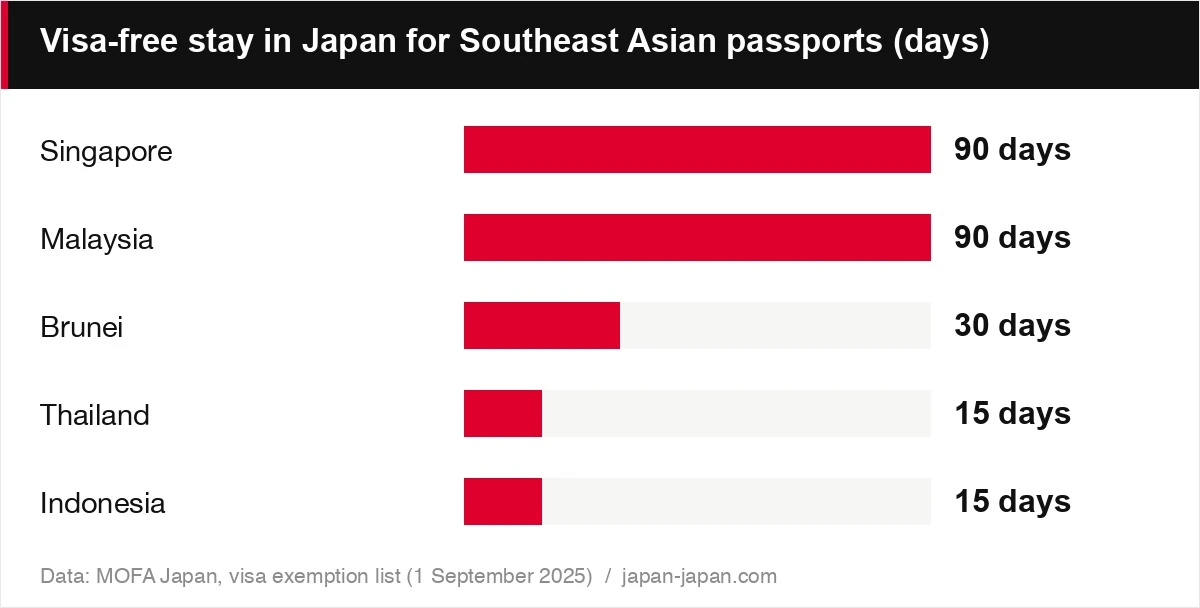
Five of the Philippines’ neighbours in Southeast Asia are on the list, each with its own stay limit. Singapore and Malaysia get 90 days. Brunei gets 30 days. Thailand and Indonesia get 15 days. Elsewhere in Asia, the list also covers the Republic of Korea, Hong Kong, Macao and Taiwan.
Several of those passports come with conditions. Malaysians and Thais need an ePassport that meets ICAO standards, a rule in place since 1 July 2013. Indonesians must first register their ePassport with a Japanese mission in Indonesia. That registration lasts three years or until the passport expires, whichever comes first.
| Item | Value | Note |
|---|---|---|
| Singapore | 90 days | |
| Malaysia | 90 days | ICAO ePassport only |
| Brunei | 30 days | |
| Thailand | 15 days | ICAO ePassport only |
| Indonesia | 15 days | Registered ePassport only |
The chart above lines up those stay limits. The Philippines and Vietnam have no bar, because their ordinary passport holders need a visa for any short stay. You can check any other passport on our list of visa-free countries for Japan.
The purpose of the trip does not change the answer. A Filipino visiting a sister in Osaka needs a Temporary Visitor visa, just like a tourist. The embassy files business trips, conferences, visits to friends and visits to relatives under the same Temporary Visitor heading.
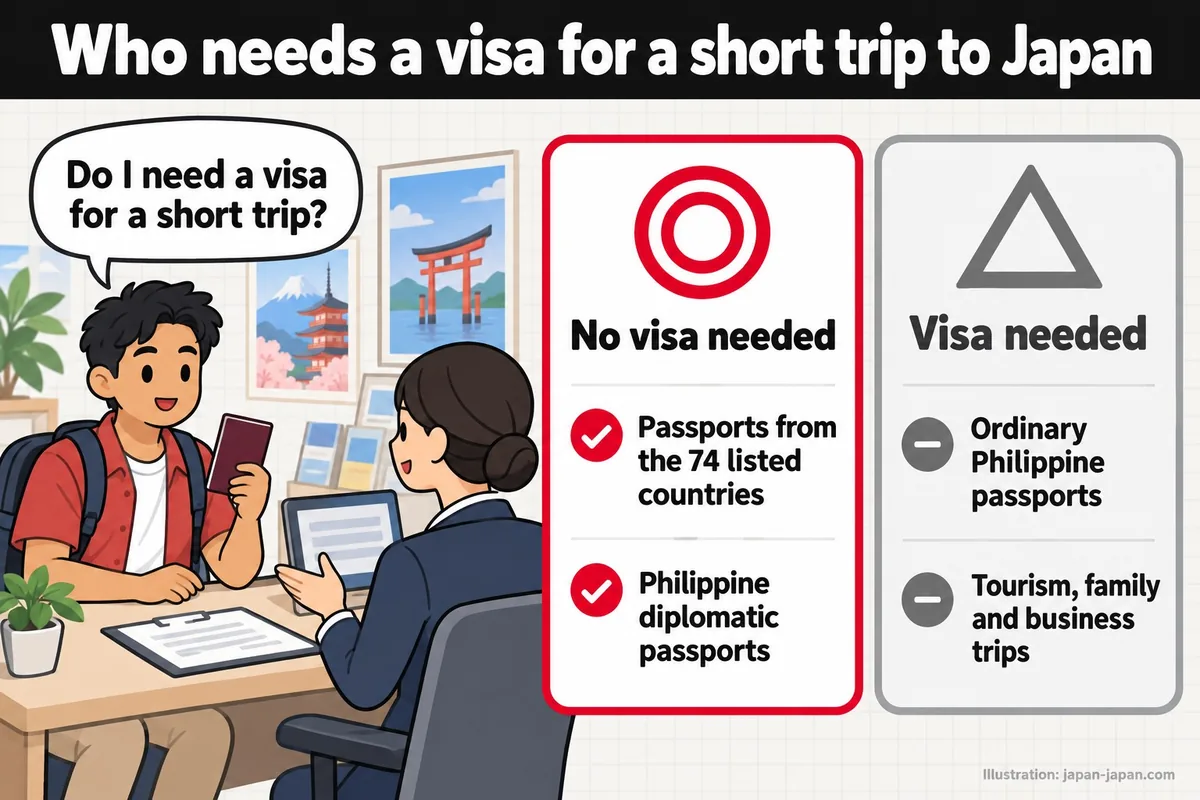
The illustration shows where the line falls. Ordinary Philippine passports sit on the visa side for every short trip. Diplomatic passports, and passports from the 74 listed countries and regions, sit on the visa-free side.
Japan Visa Fee for Filipinos: Still Gratis
Japan changed its visa fees on 1 July 2026. The MOFA Japan visa fees page sets the new rate at about 15,000 yen for a single-entry visa. A multiple-entry visa costs about 30,000 yen. Applicants pay in the local currency of the country where the issuing embassy or consulate sits.
The same page adds that fees may not be required, or may differ, depending on your purpose and nationality. That clause is what keeps Filipinos at zero. The embassy confirmed that the Temporary Visitor visa for Philippine nationals stays gratis, which means free of charge.
The gratis rule covers the visa fee only. MOFA notes that an agency approved by the embassy charges a separate handling fee. In the Philippines, that agency is VFS Services Philippines, which runs the Japan Visa Center, so ask for its current handling fee when you book.
The fee page has one more rule worth knowing. If Japan does not issue the visa, it charges no visa fee. For Filipinos on a Temporary Visitor visa the point is moot, since the fee is already waived.
The embassy’s wording names the Temporary Visitor visa for stays of up to 90 days. That heading covers the tourist, family-visit and business categories on the embassy list. For other nationalities and other visa types, our Japan visa fees page sets out the standard rates.
Japan Visa Documents Required and Processing Time
You apply through the Japan Visa Center, which opened on 7 April 2025. VFS Services Philippines Private, Inc. runs it from five branches. Book a slot on the VFS website before you go, and send questions to the help desk at info.Japanphp@vfshelpline.com.
- Parañaque: Parqal Abaca Building 5, Aseana City, Metro Manila
- Makati: Makati Circuit Corporate Tower Two, Makati City
- Quezon City: Gateway Tower Mall, Araneta City
- Cebu: Faustina Center, Bonifacio District, Cebu City
- Davao: Felcris Centrale, Quimpo Boulevard, Davao City
Every document has an age limit. The Embassy of Japan in the Philippines document submission notes say each paper must be issued within 3 months of your application date. Birth and marriage certificates get more time: 1 year.
The notes also fix the format. Use A4 paper, and copy any other size onto A4. Never staple the pages, and remove any issuance receipts. Documents issued in the Philippines must be originals. Anything not in English or Japanese needs a translation with the date, the translator’s name and a signature.
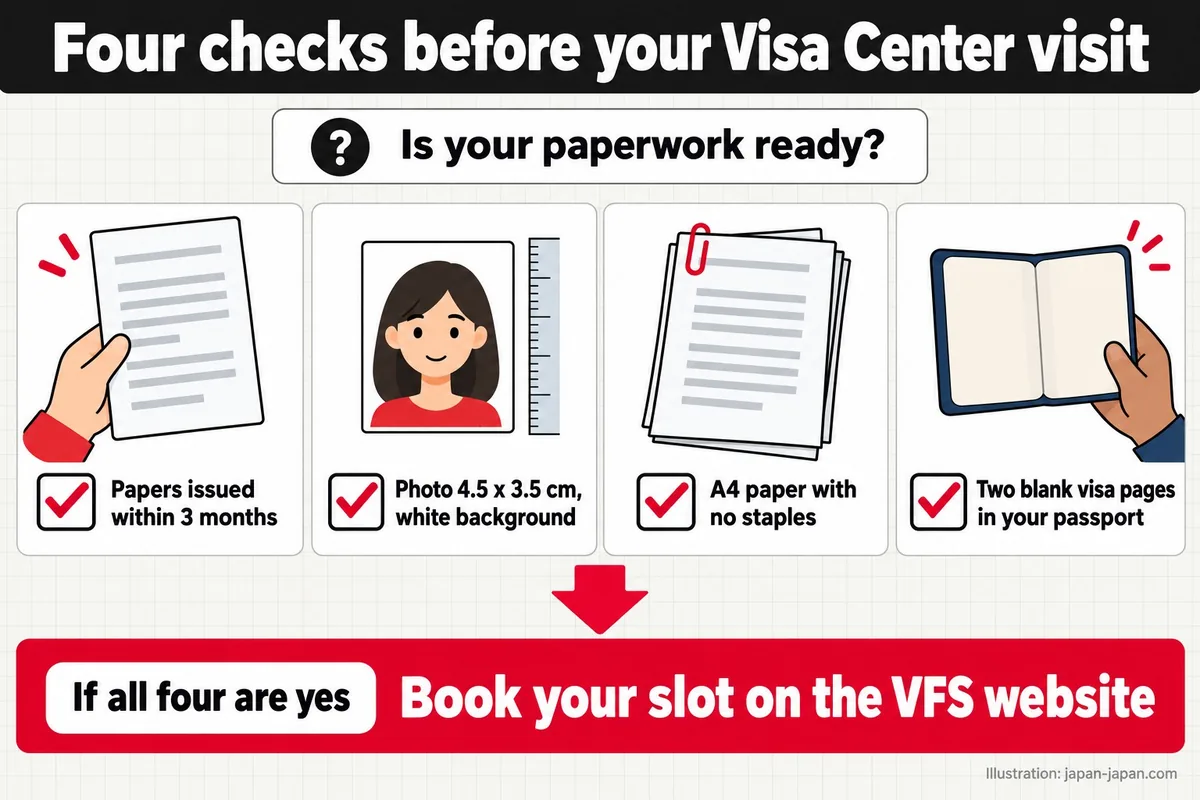
The checklist above covers four things to check before your appointment. Your passport needs two blank pages for the visa and must not be broken, damaged or soiled. Your photo must be 4.5 x 3.5 cm, taken within 6 months, on a white background. Write your full name and date of birth on the back of it.
Fill in every item of the application form in English, and write N/A where an item does not apply. For the date of application, write the day you hand the form to the Visa Center. Our guide to the Japan visa photo size puts the photo rules for paper forms and eVISA side by side.
The itinerary in Japan is a day-by-day table of your trip. The embassy notes say you do not need to book flights or hotels to fill it in. Enter your planned entry and exit dates, plus the name, address and phone number of each place you stay. Our Japan visa itinerary example shows a filled-in plan.
Outside a package tour, a tourist visa normally needs proof that you can pay for the trip. The embassy’s package tour page names proof of financial capacity as one of the papers those tours let you skip. Our article on the Japan visa bank statement covers how recent the statement must be.
If a relative or friend in Japan invites you, they write the invitation letter. The embassy rejects vague reasons such as Sightseeing or Visiting Relatives in that letter and wants the actual activities. Their papers may include a 住民票 (juminhyo, residence certificate), which must list every member of the household. If they also sign as guarantor, our guide to the Japan visa guarantee letter explains that form.
Processing takes time. The embassy warns that a tourist visa application may take several weeks because so many people are applying. It also says this is a standard time and does not guarantee your passport comes back by a set travel date.
Timing cuts both ways. A single-entry tourist visa is valid for travel within 3 months of the date it is issued. Do not apply earlier than 3 months before your trip, or the visa could run out before you fly.
If the embassy needs more papers, the request comes through the Visa Center. Send them within 1 month of the request, or the embassy ends your application.
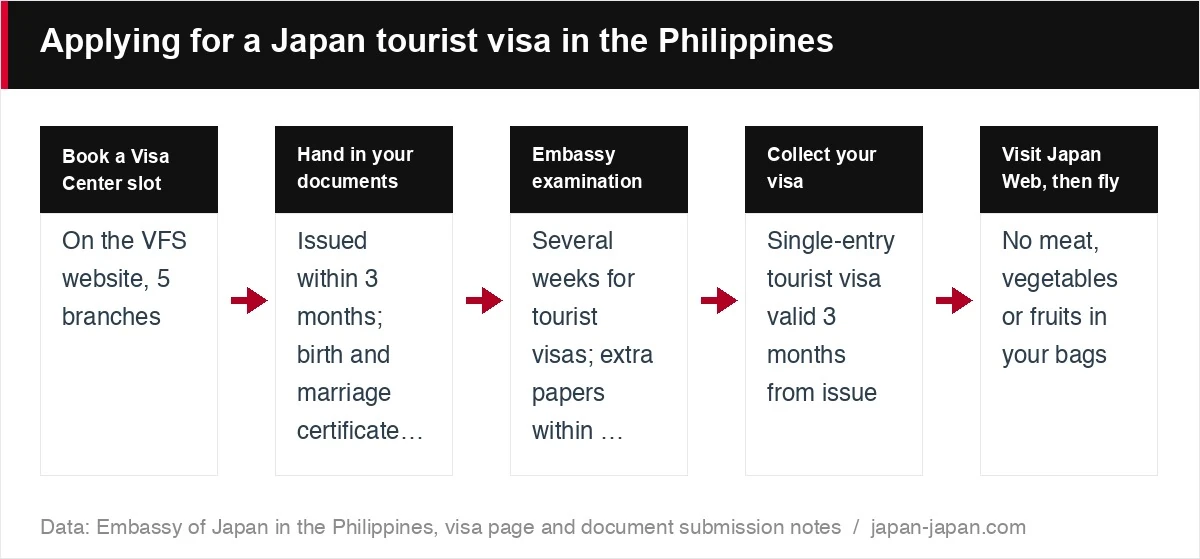
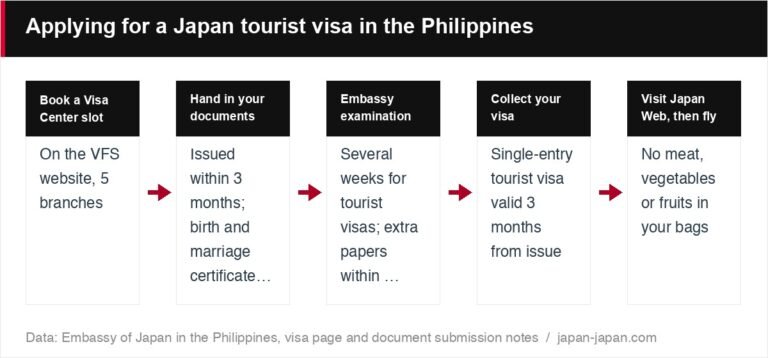
The flow chart traces those steps from booking a slot to boarding your flight. For the standard document set that embassies around the world ask for, see our tourist visa requirements page.
Package Tours and the 15-Day eVISA
A package tour cuts the paperwork. Since 20 November 2014, Filipinos joining tours run by registered travel agencies have used a simpler procedure. The Embassy of Japan in the Philippines package tour visa page says some requirements, such as proof of financial capacity, may be dropped.
The tour has to meet three conditions. A registered travel agency must organise, advertise and run it, for tourism only. The agency must book your round-trip flights, every night of accommodation and any domestic transport, from shinkansen to ferries. Your stay in Japan cannot go over 15 days.
The document list is short: passport, application form, photo, birth certificate and, if you are married, your marriage contract. If your passport, old or current, holds a used Japanese visa, you can skip the birth and marriage certificates. You must also live in the area that a Japanese embassy or consulate in the Philippines covers.
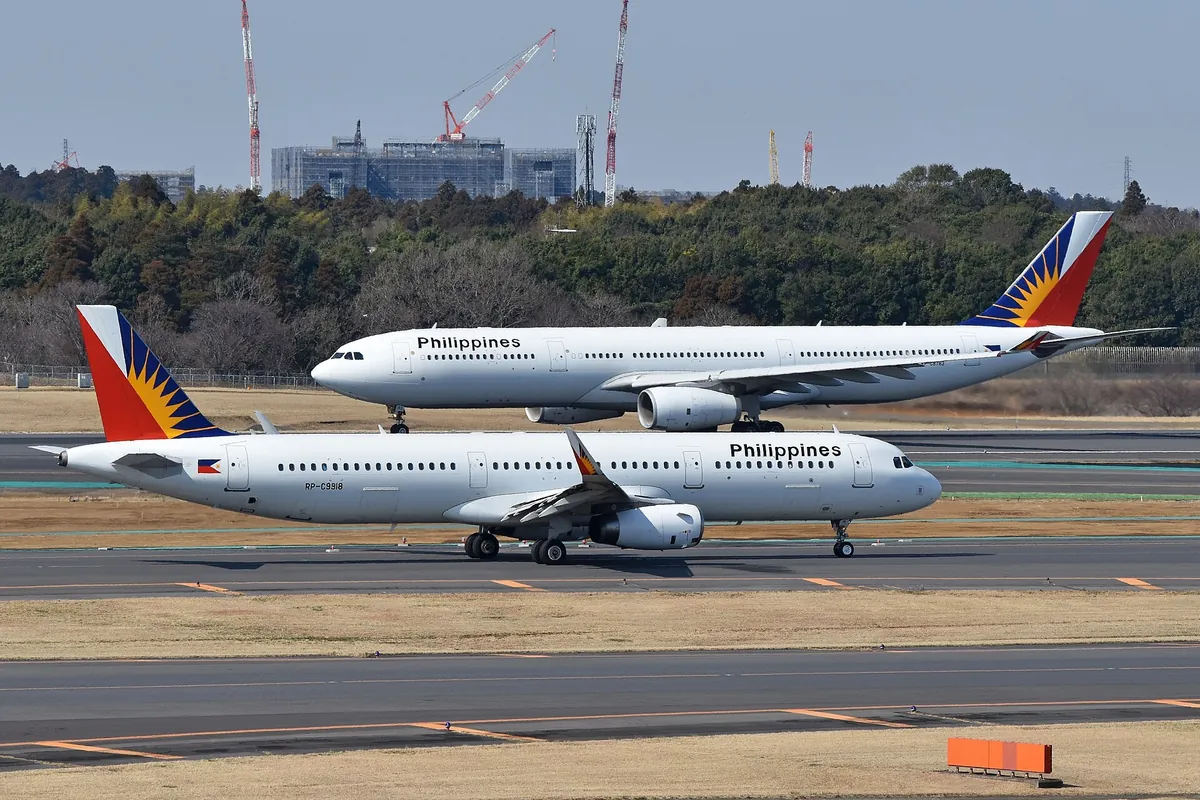
The photo shows a Philippine Airlines plane at Narita Airport. If your tour flies with the airline, check the cabin bag limits on our Philippine Airlines baggage page before you pack.
The eVISA came next. The embassy began issuing electronic visas on 15 December 2025, and Filipinos must apply for them through the Visa Center. The MOFA Japan JAPAN eVISA system page, updated 15 May 2026, sets the limits. Only Philippine nationals who live in the Philippines and join a package tour by a designated travel agency can use it.
The stay on a Filipino eVISA is 15 days. You get no visa sticker in your passport. At the airport you show the Visa issuance notice on a phone with an internet connection. A PDF, a screenshot or a printed copy will not be accepted.
Two more rules apply. The eVISA works only for travel by air or by scheduled ferry from Busan or Shanghai, and only on ordinary passports. MOFA also warns about fake websites that copy the JAPAN eVISA site. Our JAPAN eVISA guide covers the system for every country that can use it.
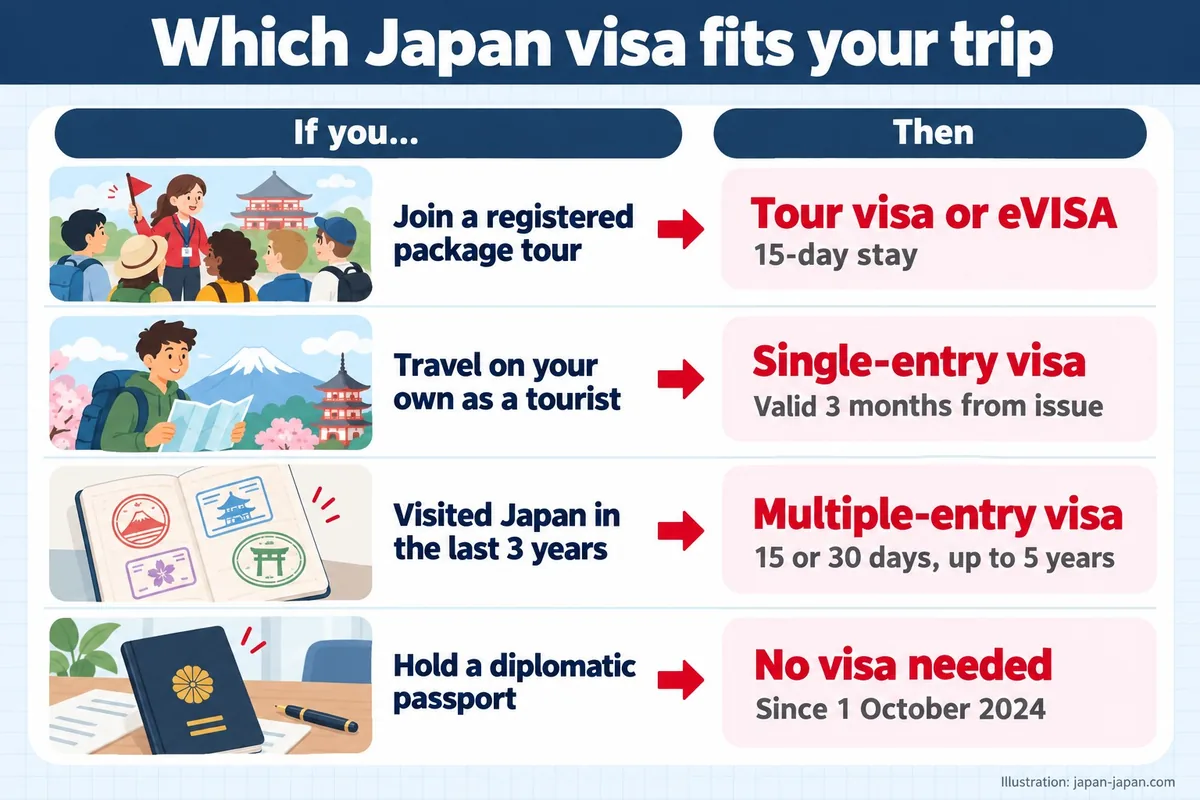
The lookup chart matches each kind of trip to its visa. Find your row before you call an agency, so you ask for the right product.
| Route | Stay in Japan | Valid for | How to apply |
|---|---|---|---|
| Single-entry tourist visa | Up to 90 days | 3 months from issue | Japan Visa Center (VFS) |
| Package tour visa | Up to 15 days | One trip | Registered travel agency |
| eVISA (from 15 Dec 2025) | 15 days | One trip, shown online | Designated agency via the Visa Center |
| Multiple-entry visa | 15 or 30 days per visit | Up to 5 years | Japan Visa Center (VFS) |
| Diplomatic passport | No visa needed | Since 1 Oct 2024 | Not needed |
The table puts the routes side by side, with the stay each one allows and where you apply.
Multiple-Entry Visa: 15 or 30 Days, Up to 5 Years
Frequent visitors can ask for a multiple-entry visa instead. Japan started issuing them to Filipinos with ordinary passports on 1 July 2013, for the 40th year of ASEAN-Japan friendship. The conditions were relaxed on 30 September 2014, at the same time as for Vietnam and Indonesia.
You need a machine-readable passport that meets ICAO standards, or an IC passport, and a short-stay purpose. Then you must meet any one of four conditions on the Embassy of Japan in the Philippines multiple-entry visa page.
- You visited Japan as a temporary visitor in the last 3 years without breaking any rules, and you can pay for your trip.
- You visited Japan in the last 3 years without problems, and you also travelled to G7 countries other than Japan several times in that period.
- You have sufficient financial capacity.
- You are the spouse or child of a person who qualifies under the third condition.
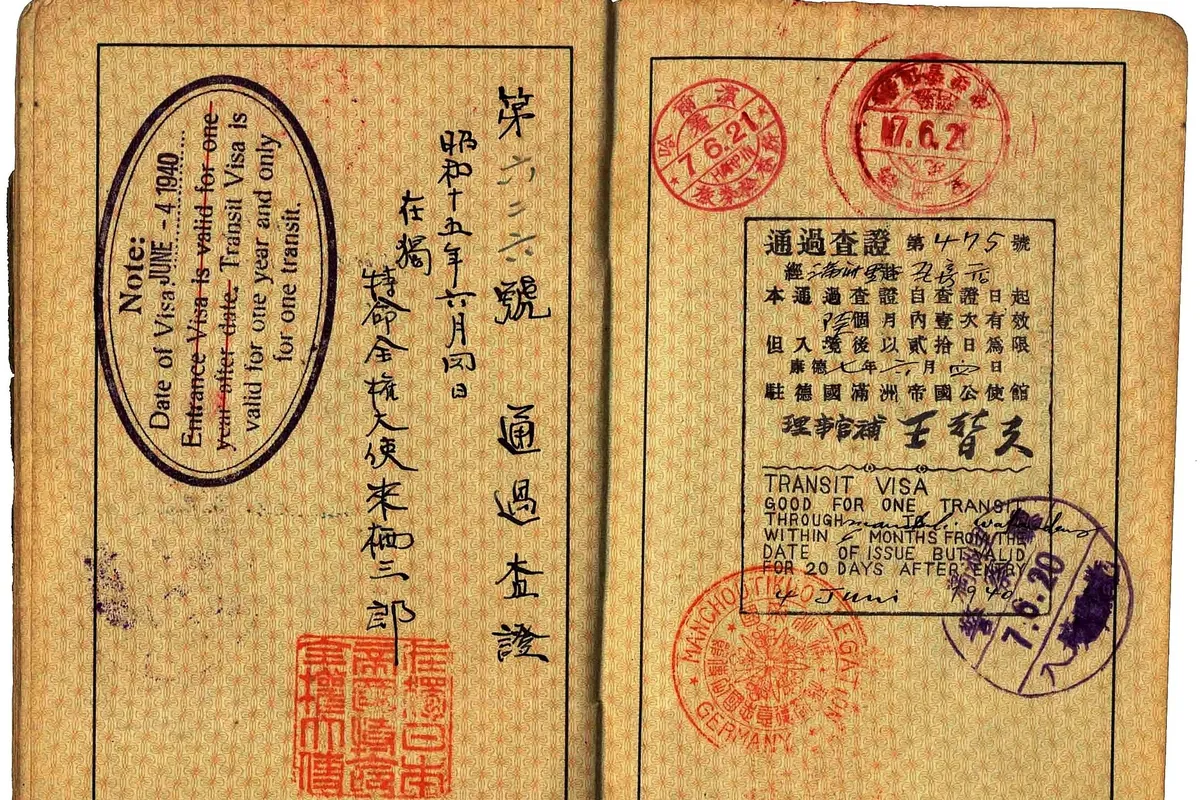
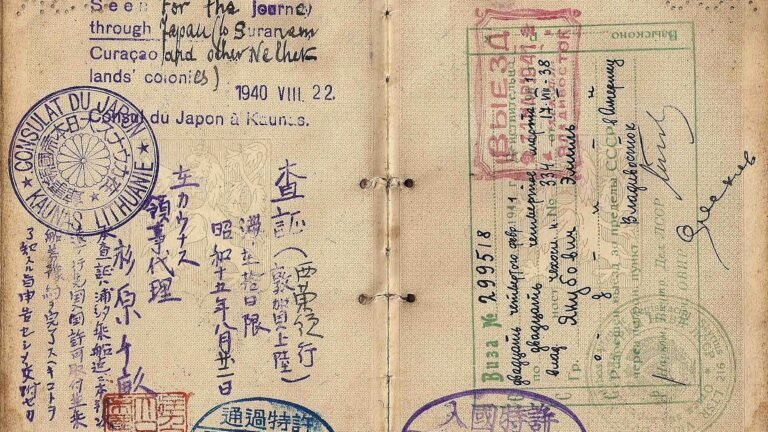
A regular Japanese visa is a sticker in your passport, like the one in this photo. A multiple-entry sticker lets you come back again and again while it is valid. Each stay is 15 or 30 days, and the visa can be valid for up to 5 years.
The embassy adds a warning. After the examination, you may not get the multiple-entry visa, the validity you asked for or the stay you asked for. The document list is the same for all four conditions:
- Application form with photo
- Passport, machine-readable or IC
- Proof of earlier trips to Japan, such as old visas, landing permits and entry stamps
- Bank certificate and employment certificate
- A letter explaining why you want a multiple-entry visa
- Clear copies of your income tax return on BIR Form 1701 or 2316
On fees, MOFA’s general rate for a multiple-entry visa is about 30,000 yen from 1 July 2026, though the amount can differ by nationality. The embassy’s gratis notice names the Temporary Visitor visa, so confirm the fee with the Visa Center when you book. Our Japan multiple entry visa guide compares the rules for other passports.
Landing in Japan With Your Visa
The visa gets you on the plane. The arrival steps come next. The embassy asks visitors to use Visit Japan Web for smoother immigration and customs procedures. Register before you fly, then follow our Visit Japan Web QR code guide for the screens you show on arrival.
Pack food with care. The embassy page links a Ministry of Agriculture, Forestry and Fisheries notice: you must not bring any meat products, vegetables or fruits into Japan. That rules out longganisa, tocino and fresh mangoes in your bags. Our list of what you cannot bring into Japan covers the rest.
COVID-19 paperwork is gone. Since 29 April 2023, travellers to Japan need neither a vaccination certificate nor a negative test. The embassy also links a Japan Tourism Agency page that recommends buying private medical insurance for your trip.
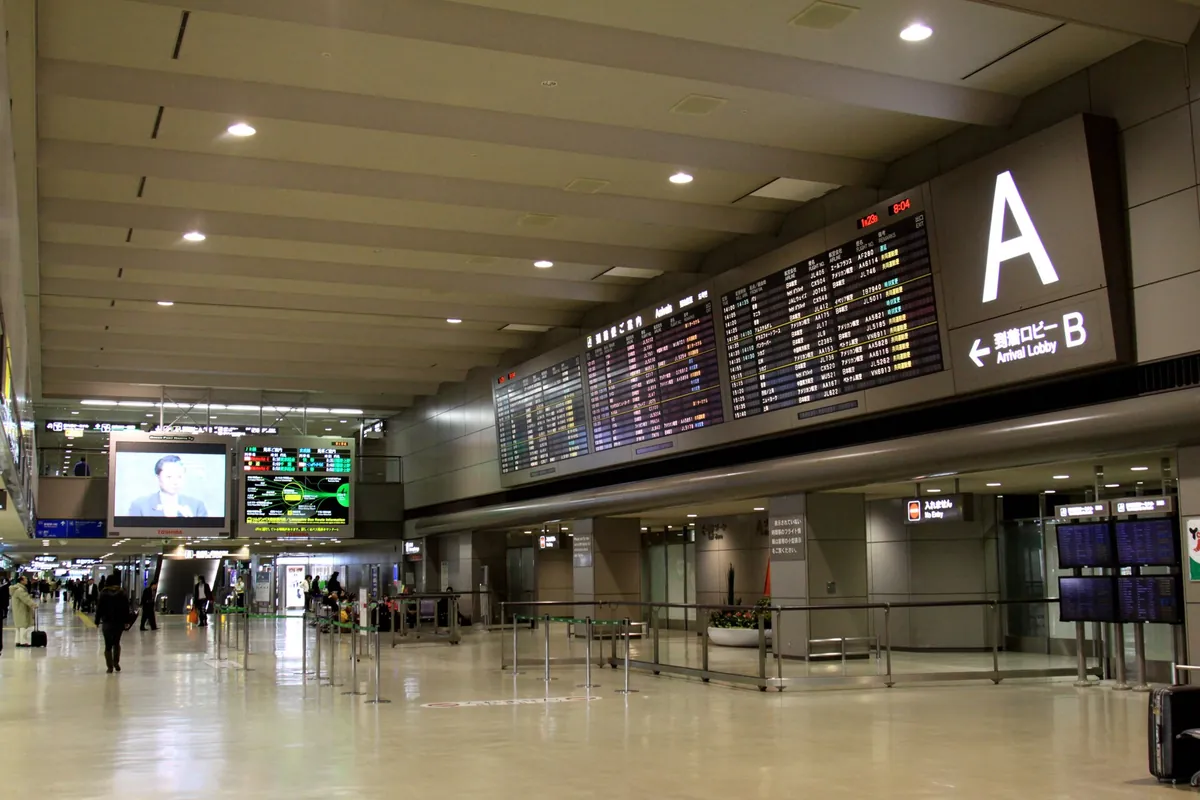
The photo shows the arrivals lobby at Narita Airport. If you land there, our Narita Airport guide lists the trains and buses into Tokyo. A tourist visa does not cover moving to Japan. Japan’s pre-entry tuberculosis screening, called JPETS, applies to people entering from the Philippines for a mid- to long-term stay.
You will not be alone in the queue. Japan issued 7,862,060 visas in 2025, about 9% more than in 2024, according to the MOFA Japan number of visas issued in 2025 release. Only 2019 was higher, with 8,277,340. Nationals of China, the Philippines and Vietnam received nearly 80% of all visas, and the Philippines ranked second of the three.
FAQ
How much does a Japan visa cost for Filipinos?
The visa fee for a Temporary Visitor visa of up to 90 days is gratis for Philippine nationals. The Japan Visa Center charges its own handling fee on top. For comparison, Japan’s standard fee from 1 July 2026 is about 15,000 yen for a single-entry visa.
How long does Japan visa processing take in the Philippines?
The embassy says a tourist visa may take several weeks because of the number of applications. Apply well ahead, but not earlier than 3 months before your trip, since a single-entry tourist visa is valid for 3 months from issue. If the embassy asks for extra papers, send them within 1 month.
Can Filipinos apply for a Japan eVISA online?
Not on your own. Filipinos living in the Philippines get an eVISA only through a designated travel agency’s package tour, and the application goes through the Visa Center. The stay is 15 days, and you show the Visa issuance notice online at the airport.
How long can Filipinos stay in Japan on a tourist visa?
A Temporary Visitor visa covers stays of up to 90 days. Package tour visas and eVISAs allow 15 days. A multiple-entry visa allows 15 or 30 days per visit and can be valid for up to 5 years.
About the author