Capsule Hotels in Shinjuku: Tax-Free Under ¥13,000 in 2027
The licence matters more than the word capsule on the sign. Tokyo’s current tax applies to places licensed for hotel or ryokan business. A capsule hotel with that licence adds 100 yen to a night of 10,000 yen or more. Below 10,000 yen, no type of lodging in Tokyo charges the tax.
So the tax question has a simple rule of thumb. Check the room-only price per person, and check the date of your stay. Everything else in this guide covers what you do on the ground: where your suitcase goes, when Tokyo fills up, and how to reach Shinjuku from the airport.
What a capsule hotel is under Japanese law
A capsule hotel is a building full of bed-sized pods with shared toilets, showers and lounges. The JNTO Travel Japan capsule hotels guide says the first one opened in 1979 in Osaka’s Umeda district. It served office workers who missed the last train home. Today the pods draw visitors in their own right, and newer chains compete on cleanliness and design.
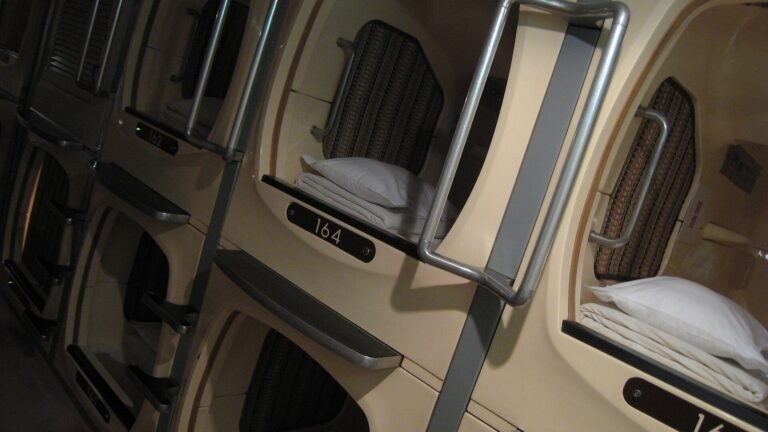
The photo shows the usual layout: rows of pods in two levels, each closed by its own curtain or door.
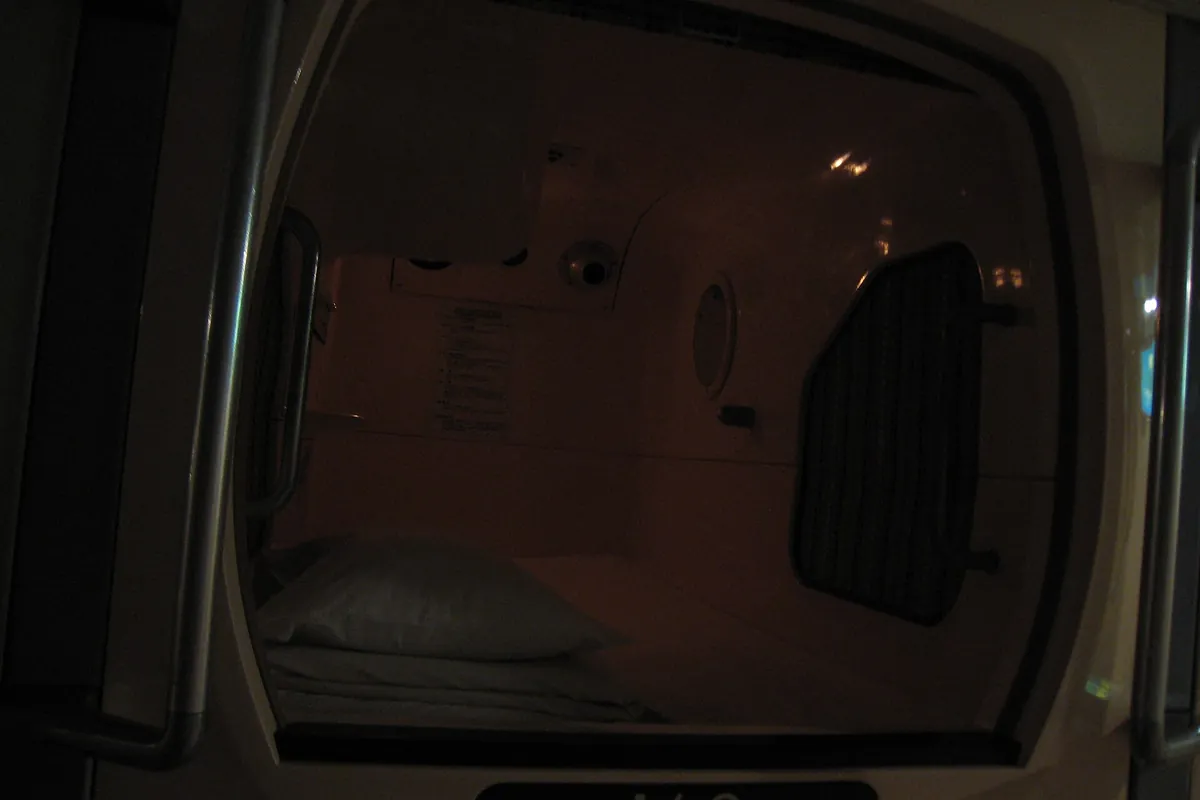
A standard pod holds a mattress, a pillow, a shelf, power outlets and Wi-Fi. Some add a small TV. JNTO warns that the curtain or door gives privacy but is not soundproof. Toothbrushes and pajamas are often provided, and many places have a lounge where you can read, work or meet other guests.
Japanese law sorts paid lodging into licence types under the Inns and Hotels Act (旅館業法, Ryokangyō-hō). One type is simple lodging, 簡易宿所 (kan’i shukusho), for places where guests share the sleeping space. Hostels and many capsule hotels sit in this group. Other capsule hotels hold a full hotel licence.
You will rarely see the licence on a booking site. It matters in one place: the tax line on your bill. The Tokyo Metropolitan Government accommodation tax revision page sets the old and new rules side by side. Its comparison table names 簡易宿所 among the taxpayers from 1 April 2027.
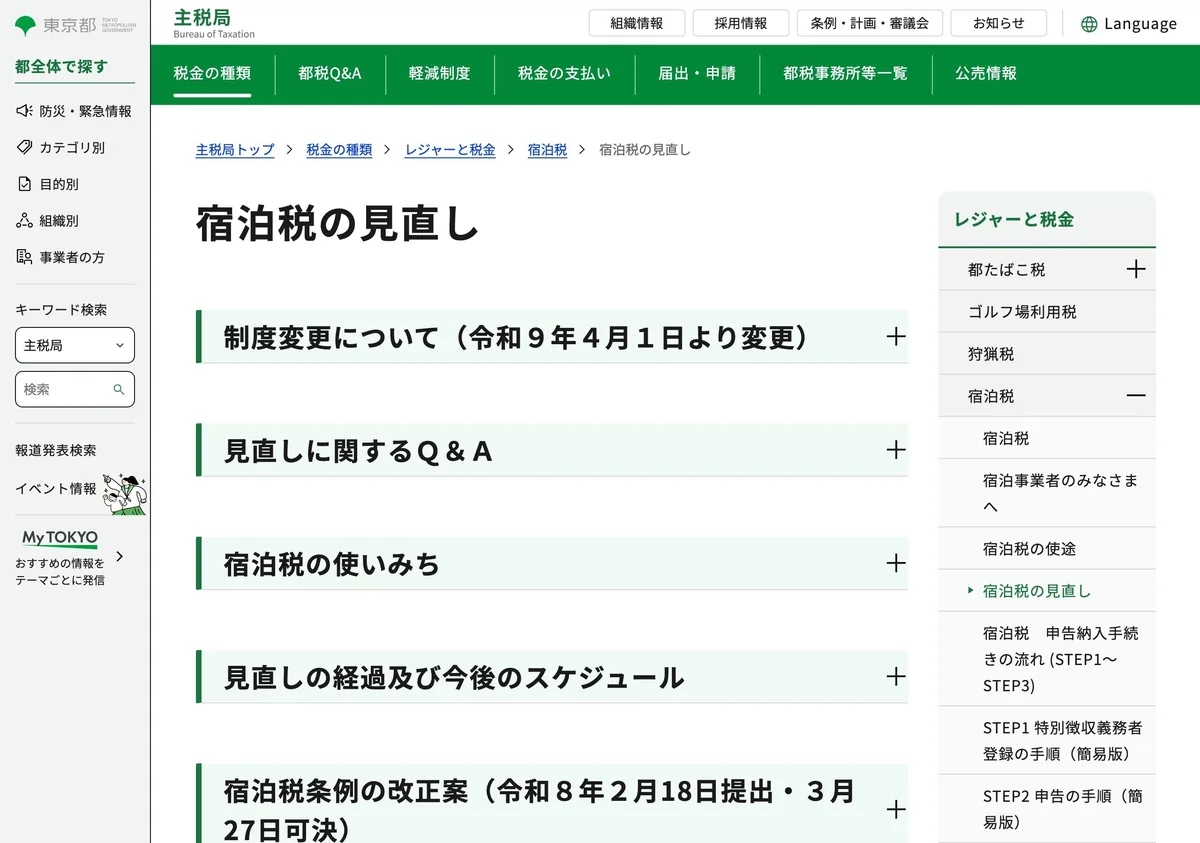
The screenshot is that Japanese table. The left column shows the rules after the change, and the right column shows the rules in force today.
Capsule hotels used to take men only. Now you can choose mixed hotels and women-only hotels. JNTO says some mixed hotels share pod rooms, while others split men and women by room or by floor. Nadeshiko Hotel Shibuya, one of the five hotels JNTO picks, takes women only. In Shinjuku, JNTO names Luxury Capsule Hotel Anshin Oyado Tokyo Shinjuku Ekimae, with square pods, Simmons bedding and an LCD TV.
If you have not picked an area yet, our Shinjuku or Shibuya comparison sets out the fares and train lines for both bases.
Tokyo accommodation tax: now and from April 2027
The Tokyo Metropolitan Government accommodation tax page sets out both systems. Today only hotel and ryokan guests pay. From 1 April 2027 the tax also covers guests at simple lodging and minpaku, so capsule hotels with a simple lodging licence come in.
| Rule | Now | From 1 April 2027 |
|---|---|---|
| Who pays | Hotel and ryokan guests | Hotel, ryokan, simple lodging and minpaku guests |
| Tax-free below | 10,000 yen | 13,000 yen |
| Rate | 100 yen (10,000 to under 15,000 yen); 200 yen (15,000 yen or more) | 3% of the room rate |
| Collected by | The lodging, for Tokyo | The lodging, for Tokyo |
The table puts the two systems line by line. Three changes matter to a capsule guest: who pays, where the tax-free line sits, and how the amount is worked out.
The tax-free line rises from 10,000 yen to 13,000 yen per person per night. Above it, the flat 100 yen or 200 yen gives way to 3% of the room rate. Tokyo says it raised the line because room prices have gone up. It expects more than 70% of school-trip rates to fall under the new line.
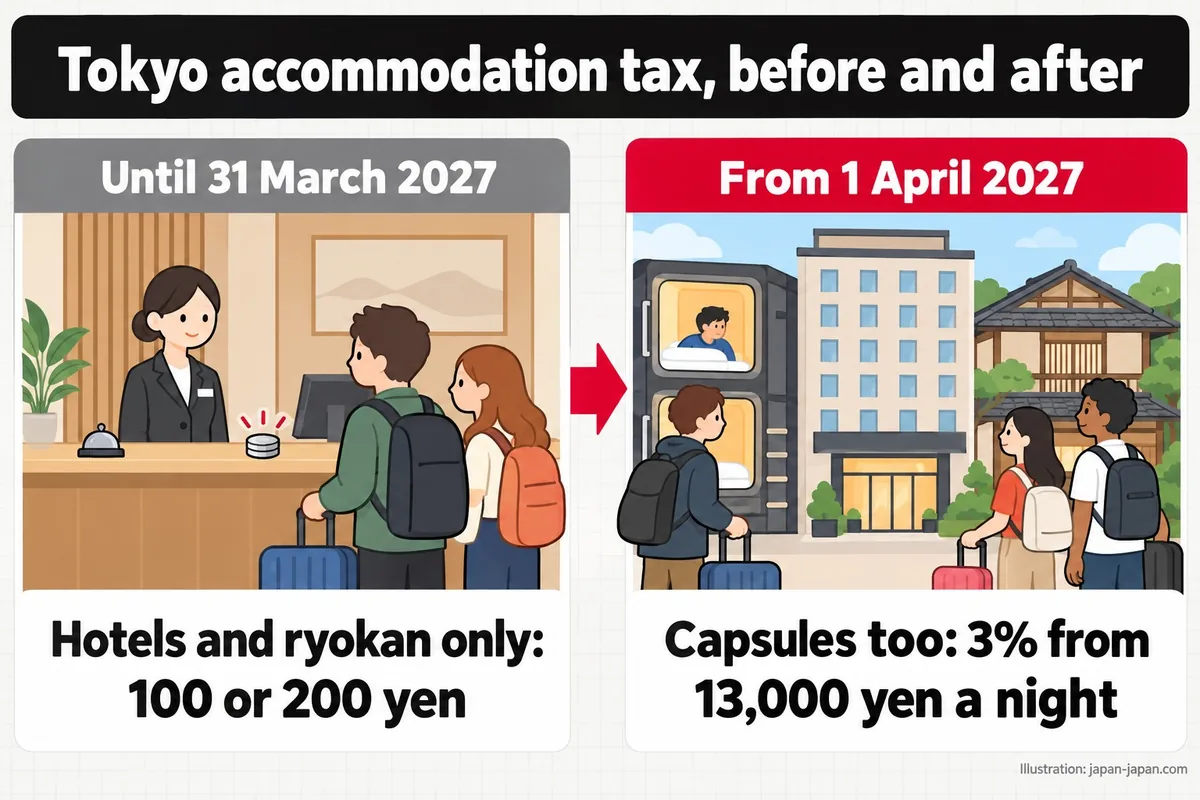
The illustration shows the switch from a flat charge to a percentage, and which places it reaches.
What counts as the room rate
The tax uses the room-only price per person per night, before consumption tax. Meals, drinks from the fridge, parking, laundry and other extras stay out of the sum. Children pay too once their own rate reaches the line. In a shared room, divide the room price by the number of guests to find each person’s rate.
For most capsule guests the 2027 change adds nothing, because JNTO notes that pods usually cost less than a regular hotel. A premium pod on a peak night can cross 13,000 yen, though. Then 3% applies to the whole rate, not just the part above the line.
How you pay and when it changes
You pay the hotel, and the hotel passes the tax to Tokyo. The guest page warns that the front desk may ask for it separately from your room charge. On a Japanese receipt, look for the word 宿泊税 (shukuhaku-zei), which means accommodation tax.
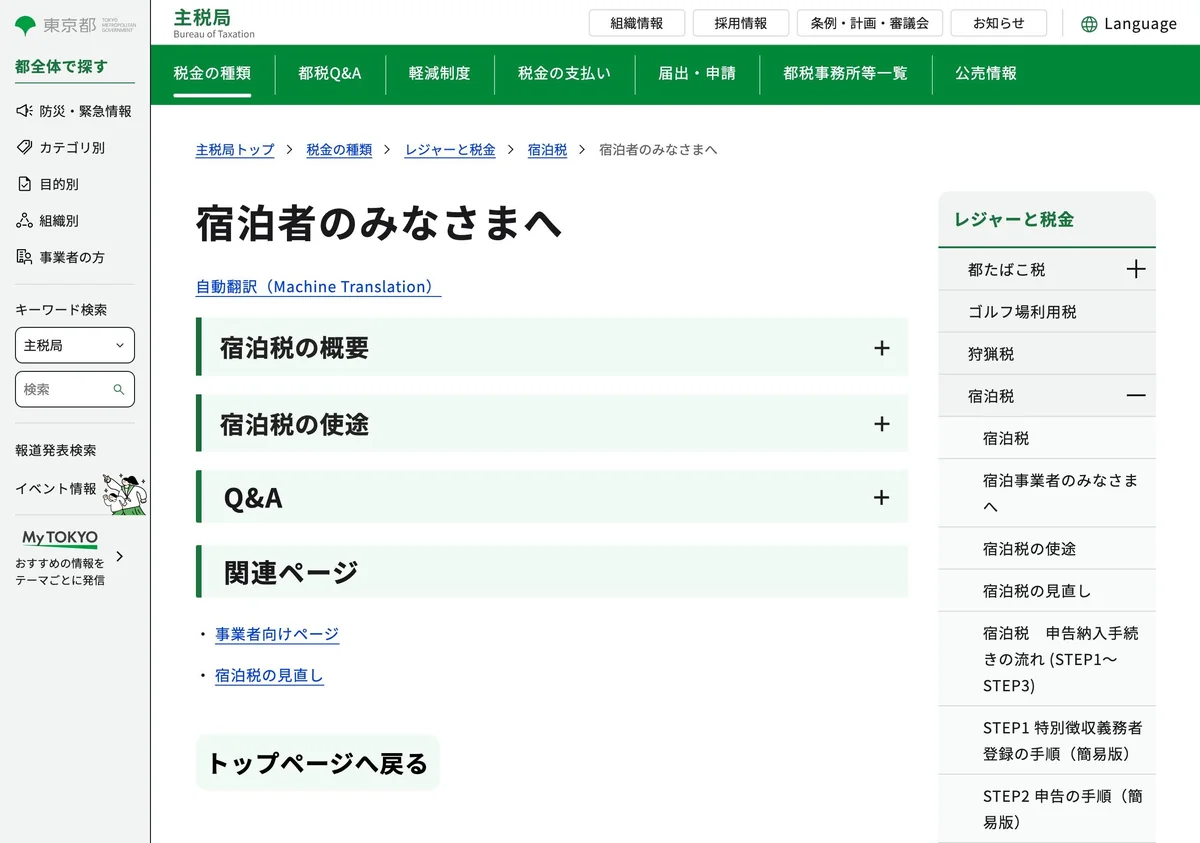
The screenshot shows the guest page in Japanese, with the 100 yen and 200 yen rates above the rules from 2027.
The Tokyo assembly passed the change on 27 March 2026. The minister for internal affairs gave consent on 30 June 2026, and Tokyo published the revised ordinance on 1 July 2026. It takes effect on 1 April 2027. The city took 110 public comments on the draft. It treats every guest the same, with no split by nationality or home address. Its draft estimate puts tax revenue after the change at about 19 billion yen.
Other cities in Japan run their own taxes at different rates. Our Japan accommodation tax guide lists them city by city.
Check-in, lockers and big suitcases
Plan your luggage before you book. A pod has room for you and a small bag. JNTO says you get a locker for your bag, while large suitcases normally stay at reception. Read the check-in time on your booking page, because each property sets its own.
Have your passport ready at the front desk. Our Japan hotel booking guide explains what to show at check-in and how cancellation fees work. If you land early, ask whether reception will hold your case until the pod is ready.
If the staff speak little English, point to your case and say: スーツケースを預かってもらえますか? (Sūtsukēsu o azukatte moraemasu ka?). It means “Can you keep my suitcase?”
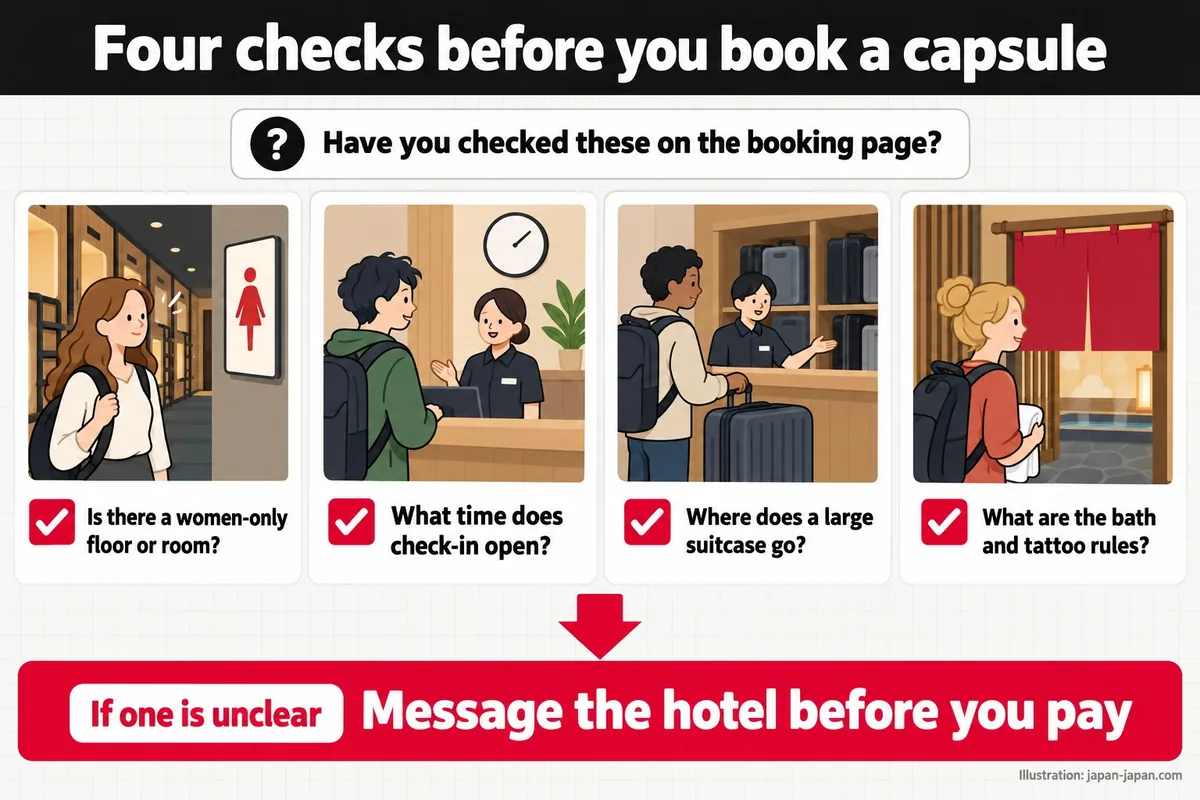
Before you pay, run through the four checks in the illustration. Each one differs from hotel to hotel, and the booking page is the fastest place to confirm it.
Station lockers and luggage delivery
A station coin locker is the other choice. Our coin lockers in Japan guide lists the box sizes, prices and time limits.
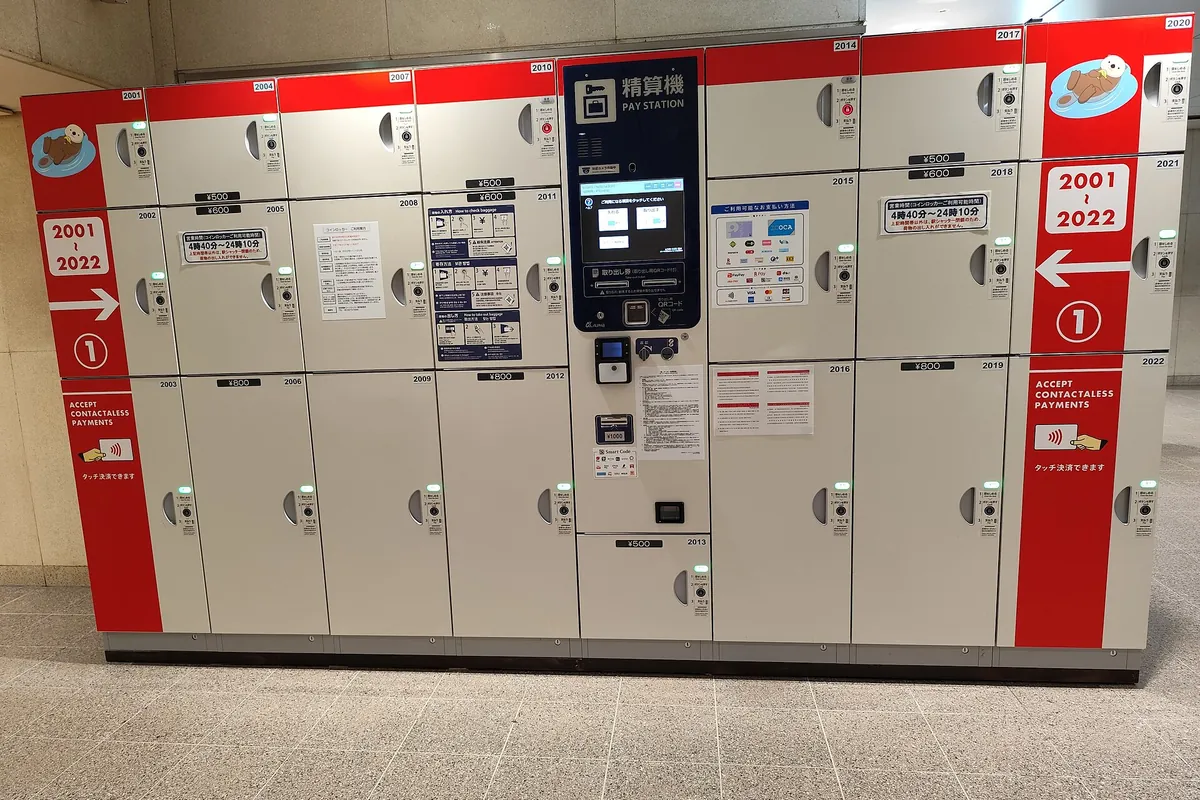
Lockers like these line the passages of large Tokyo stations. Pick one near the exit you will use for your hotel.
To skip carrying the case at all, send it. The Yamato Transport Airport TA-Q-BIN page says luggage can go from the airport to your home or hotel. Ask the capsule hotel first whether it takes parcels for guests. Yamato does not accept parcels over 30 kg. Size is the total of length, width and height, from Size 60 to Size 200. A Size 160 parcel can be up to 160 cm and 25 kg.
For the trip home, drop the bag off two days before your flight, or three days in some areas. Rates for sending to an airport include a 660 yen airport fee. A drop-off at a convenience store takes 100 yen off, and each parcel is insured up to 300,000 yen. Yamato’s English line is 03-6834-7503, open 8:00am to 9:00pm, 365 days a year. Our luggage forwarding guide compares the rates and airport cut-offs.
Pack earplugs and an eye mask. The curtain blocks light but not snoring. Both items are fine in your hand luggage, as our earplugs and eye masks page confirms.
When capsule hotels in Tokyo fill up
The Japan Tourism Agency overnight travel statistics track how full Japan’s rooms are each month. The first preliminary figure for August 2026, published on 30 September 2026, puts room occupancy across all lodging at 64.4%. Each month gets a first preliminary figure, then a second, then a confirmed figure for the full year.
Capsule hotels in Shinjuku serve two crowds. Visitors book them as a cheap base, and local workers still use them after missing the last train. JNTO notes that capsule hotels tend to sit near train stations. In Shinjuku, the busiest nightlife area is Kabukicho, on the north-east side of the station.
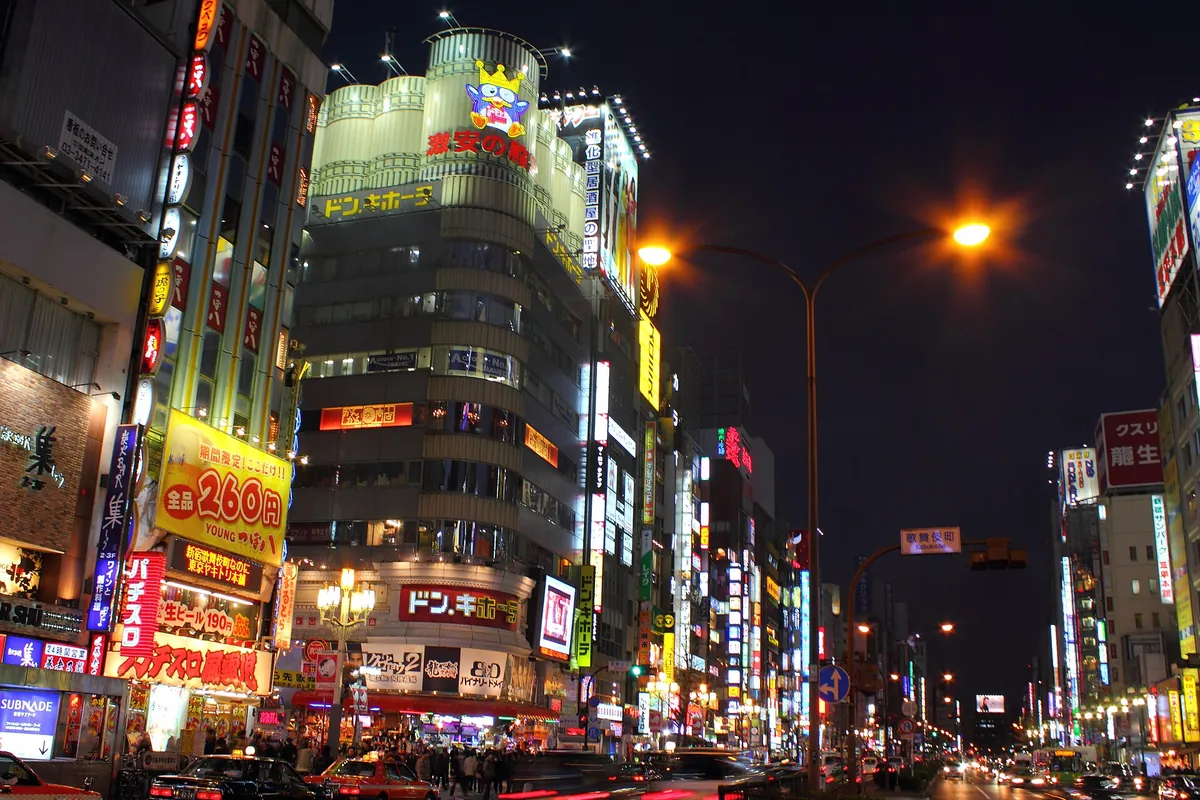
The photo shows Kabukicho at night. Hotels near it serve both late-night crowds, so book your dates as soon as your flights are fixed.
Japan’s own holidays fill rooms the fastest, because domestic travellers join the visitors. Book early for the New Year 2026–27 holiday and for Golden Week 2027. Both pages list the busiest days and what closes.
Prices rise on those dates, and that matters for tax after 1 April 2027. A pod under 13,000 yen on a normal night can cross the line on a holiday weekend. Then the 3% tax applies to the whole night. Golden Week 2027 falls after the change, so check the room-only price per person when you compare offers.
Getting to a Shinjuku capsule hotel from Narita and Haneda
Haneda is the cheaper airport for Shinjuku. The Keikyu Line to Shinagawa and JR on to Shinjuku take 43 minutes for 590 yen. The Tokyo Monorail and JR Yamanote Line cost 780 yen. The Airport Limousine bus runs without a change to the west exit of Shinjuku Station, in 40 to 55 minutes for 1,400 yen. Our Haneda Airport to Shinjuku page gives the bus stops and last departures.
The Haneda Airport access by train page gives about 50 minutes to Shinjuku Station by rail. At Terminal 3, the Keikyu gates for central Tokyo are in the arrival lobby on the 2nd floor. The bus to Shinjuku leaves Terminal 3 from stop 3, Terminal 2 from stop 5 and Terminal 1 from stop 4.
From Narita, the Narita Express runs to Shinjuku without a change for 3,330 yen. The Airport Limousine bus also runs direct, in 80 to 105 minutes for 3,600 yen. Our Narita Airport to Shinjuku page has the bus stop numbers for each terminal.
| From | Route | Journey | Fare |
|---|---|---|---|
| Haneda | Keikyu Line and JR | 43 min, change at Shinagawa | 590 yen |
| Haneda | Tokyo Monorail and JR Yamanote Line | One change | 780 yen |
| Haneda | Airport Limousine bus | 40-55 min, no change | 1,400 yen |
| Narita | Narita Express | No change | 3,330 yen |
| Narita | Airport Limousine bus | 80-105 min, no change | 3,600 yen |
The table sets the main routes side by side. Pick by arrival airport first, then by whether you want to change trains with a big case.
The Narita Airport access by train page lists Shinjuku among the Narita Express stops, after Tokyo, Shinagawa and Shibuya. Terminal 1 is a 5-minute walk from Narita Airport Station. Terminal 2 and Terminal 3 are a 5-minute and a 10-minute walk from Airport Terminal 2·3 Station.
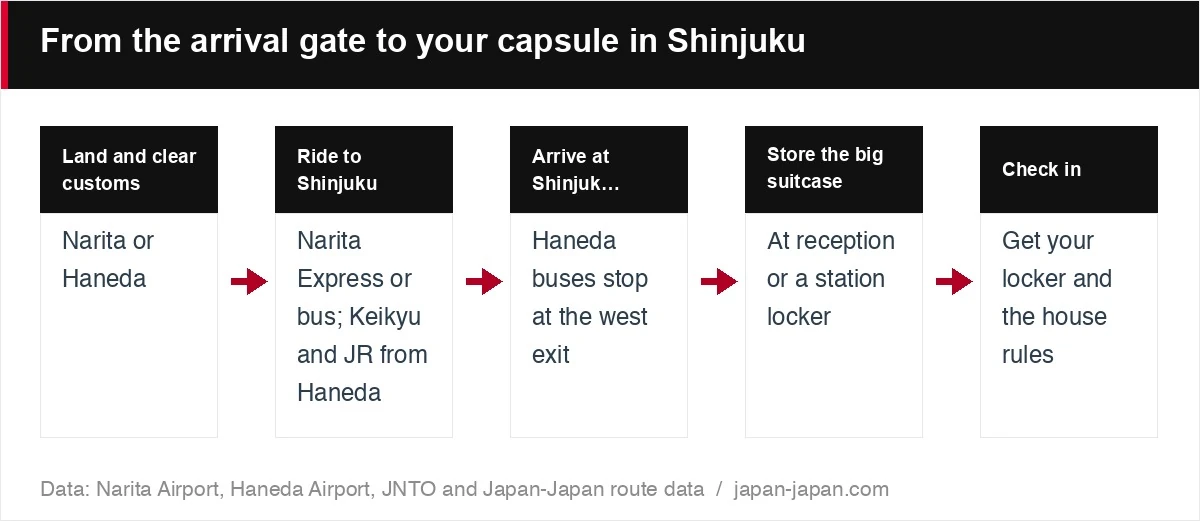
The flow runs from the arrival gate to your pod. Drop the big case before you check in, so you do not drag it through a pod room at night.
Arriving late
The last Airport Limousine bus to Shinjuku leaves Narita Terminal 1 at 23:05 and Haneda Terminal 3 at 23:40. First buses leave at 07:15 from Narita and 06:15 from Haneda. The bus operator revised its timetable on 1 October 2026. Our Airport Limousine bus page has the full list of fares.
From Haneda, the last Keikyu train to Shinagawa is listed at 00:08. You still need a JR train from Shinagawa to Shinjuku, so check that connection before you rely on it. The Haneda Airport page and the Narita Airport page list the other routes into Tokyo.
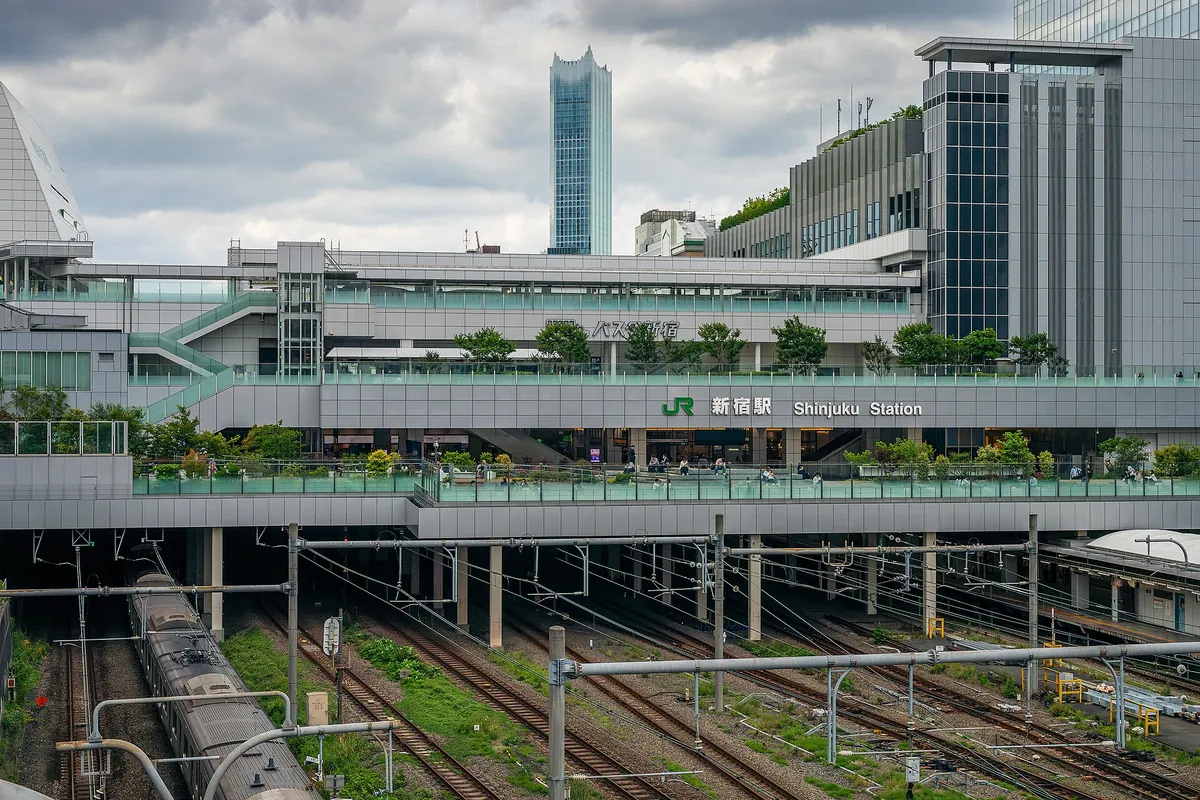
Shinjuku Station has many exits. Note the exit your hotel gives you before you arrive, and follow the signs for it from the platform.
Capsule hotel manners: noise, bathing and tattoos
The main rule is quiet. JNTO asks guests to use headphones for TV or music and to take care with morning alarms. Some pods have light alarms that wake you without sound. Take phone calls in the lounge, never inside the pod.
Food is the next rule. Avoid anything with a strong smell, and many hotels ban food of any kind inside the pods. Eat in the lounge if the hotel has one.
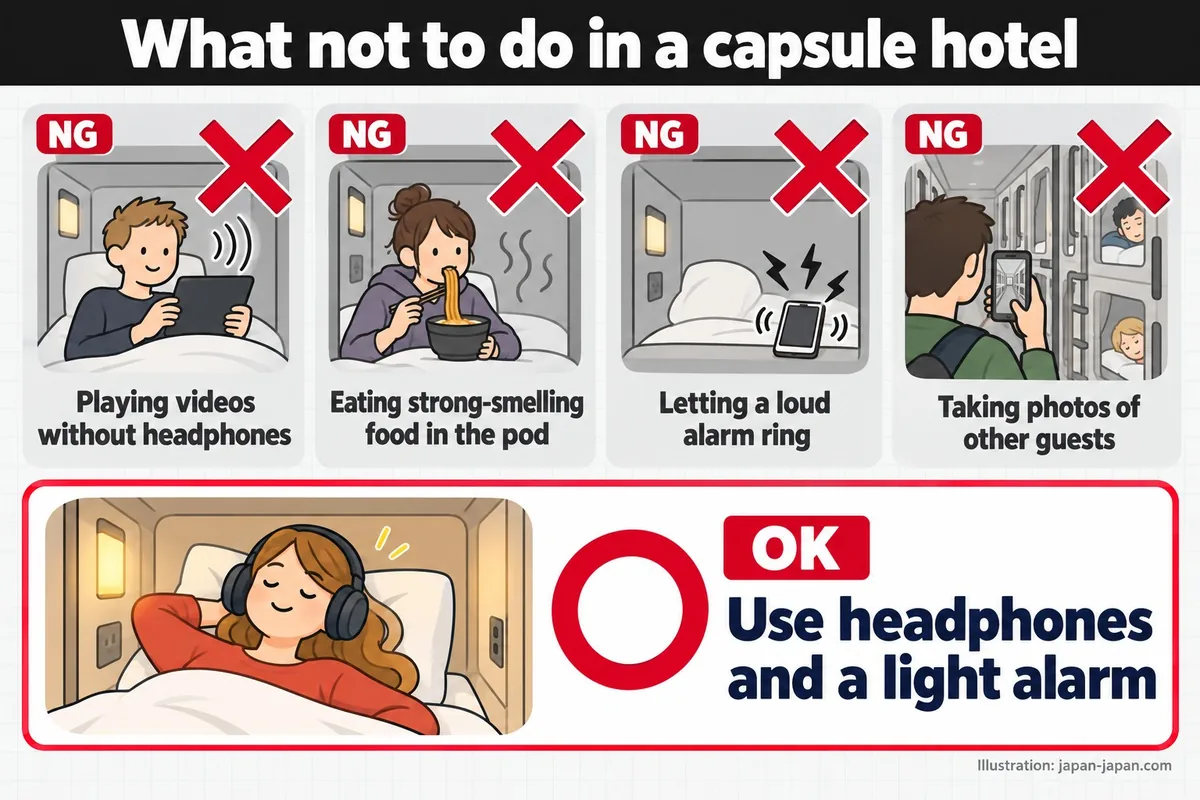
The illustration shows four habits that bother the guests around you, and the one fix that covers most of them.
Photos are fine, but keep other guests out of your shots and mind the shutter sound. The hotel explains its own rules when you check in. If something is unclear, follow those rules.
Some capsule hotels have a large shared bath. Anshin Oyado Shinjuku Ekimae has an artificial onsen, and Nadeshiko Hotel Shibuya has a traditional bath and a tatami lounge. Each house sets its own bath rules, including whether guests with tattoos may use the bath.
If you have a tattoo, ask before you book and read the rules you get at check-in. Our tattoo-friendly onsen guide explains how these house rules work and how to find a bath that will let you in.
FAQ
Do capsule hotels in Shinjuku charge Tokyo accommodation tax?
Not if the hotel holds a simple lodging licence, until 31 March 2027. A capsule hotel with a full hotel licence adds 100 yen to a night of 10,000 yen or more. From 1 April 2027 every capsule hotel charges 3% on nights of 13,000 yen or more per person.
Can I store a large suitcase at a capsule hotel?
Yes, usually at reception, because a large case will not fit in the pod or the guest locker. Ask the hotel before you book if you carry more than one big bag. A station coin locker or Yamato’s Airport TA-Q-BIN are the other choices.
Are there capsule hotels in Shinjuku for women?
Yes. Many mixed capsule hotels split men and women by room or by floor, and some take women only. Nadeshiko Hotel Shibuya is a women-only option a short ride away. Check the booking page for a women-only floor before you pay.
How do I get from Narita Airport to a capsule hotel in Shinjuku?
Take the Narita Express to Shinjuku without a change for 3,330 yen. The Airport Limousine bus also runs direct, in 80 to 105 minutes for 3,600 yen. The last bus leaves Narita Terminal 1 at 23:05.
About the author