Japan Train Delay Certificate: Proof Only, Refund at 2 Hours
The Japanese name is 遅延証明書 (chien shōmeisho), which means delay certificate. Commuters in Japan show it at work or at school when a late train makes them late. People who search for a Japan train delay apology note are usually looking for this record. Rail operators post it on their own websites, one line at a time.
The certificate and the refund are two separate systems. The certificate is proof for your manager, your teacher or your tour guide. The refund comes from the rules attached to your limited express ticket, and it only starts after a long delay. This guide uses the official pages of Kintetsu, JR Central, the smartEX booking service, JR Kyushu and Odakyu to explain both.
What a Japan train delay certificate shows
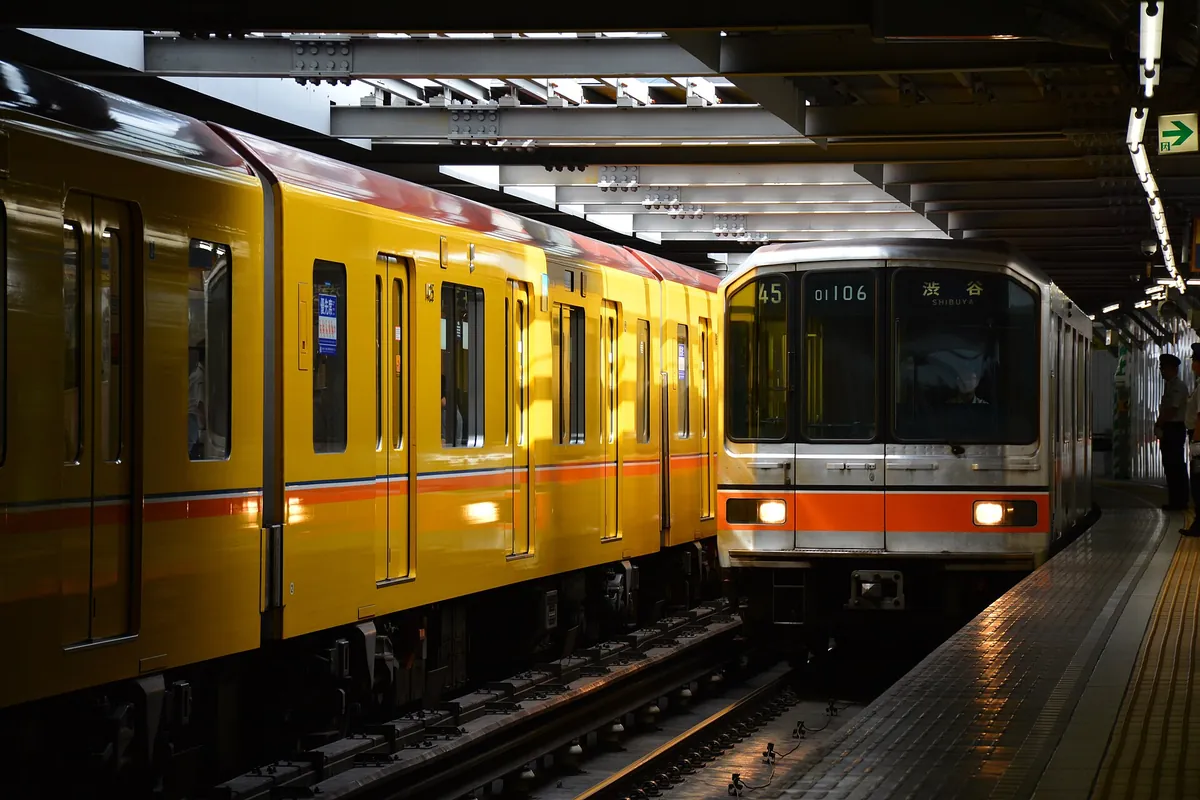
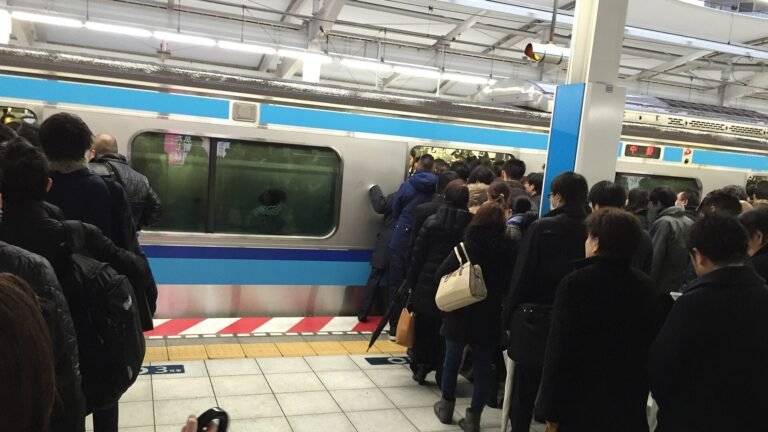
The photo above shows a Tokyo Metro Ginza Line train. Tokyo Metro runs an English delay certificate page for each of its lines, including the Ginza Line and the Tozai Line.
Each operator sets its own format, so this section uses the Kintetsu Railway delay certificate page as the worked example. Kintetsu runs trains in Osaka, Nara, Kyoto, Nagoya and Mie. Its page lists a delay once it reaches 5 minutes. It then rounds the figure up to the next 5 minutes. A delay of 61 minutes or longer simply reads 61 minutes or more.
The page splits each day into five time bands. They run from the first train to 8:00, then 8:00 to 9:00, 9:00 to 10:00, 10:00 to 17:00, and 17:00 to the last train. Each line gets one row. Each band shows a number of minutes or a dash.
Here is what the page looked like on 19 October 2026, with an update stamped 11:47. The Kyoto, Kashihara and Tenri lines showed 10 minutes from the first train to 8:00. The same row showed 10 minutes again from 10:00 to 17:00. The Osaka Line showed 10 minutes in the 8:00 to 9:00 band and in the 9:00 to 10:00 band. Every other line showed a dash.
The table below sums up how a Kintetsu certificate reads.
| Item | Kintetsu rule |
|---|---|
| Smallest delay listed | 5 minutes |
| Rounding | Up to the next 5 minutes |
| Longest figure | 61 minutes or more |
| Time bands | First train-8:00, 8:00-9:00, 9:00-10:00, 10:00-17:00, 17:00-last train |
| How long it stays online | 45 days, including the current day |
| Fixed update times | About 6:00, 8:30, 9:30, 10:30, 17:30 (Keihanna Line and cancellations) |
| What it proves | Worst delay on that line in that band, not your train |
Two rules in the table matter when you hand the page to someone. The certificate shows the largest delay on that line in that band, not the delay of your own train. It also does not prove that you were on board. Kintetsu says both things on the page itself.
Kintetsu also counts only delays to its own trains. A delay that came from a missed connection is outside the certificate. If you changed from another railway, check that railway’s page too. The Kintetsu certificate appears in Japanese, so match the line name on the page with the name on the station sign. Tokyo Metro and JR East publish their delay certificate pages in English as well.
How to get a delay certificate online, step by step
You do not have to queue at a station office. You need three things: the operator, the line and the date. The pages are open to anyone with a browser, on a phone or a laptop.
The illustration below shows the same four steps on a phone screen.
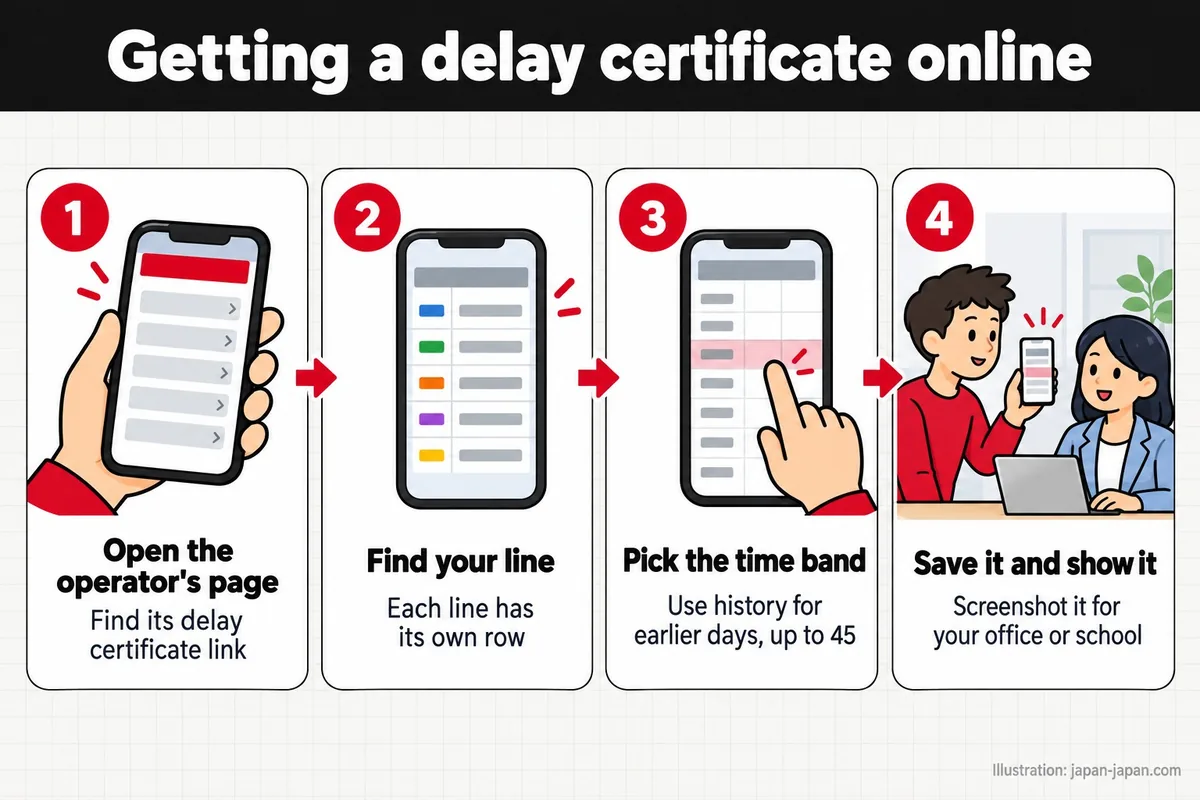
- Open the operator’s delay certificate page. On Kintetsu the heading reads 遅延証明書 (chien shōmeisho).
- Find your line in the table. Kintetsu groups some lines in one row, such as the Namba Line with the Nara Line.
- Find the time band when you travelled. For an earlier day, tap the history link (履歴, rireki) next to the line.
- Save the screen as a screenshot or print it. Then show it to your office, school or tour company.
Timing matters on Kintetsu. The page keeps 45 days of records, including the current day. The Keihanna Line, and any delay caused by a cancelled train, update at about 6:00, 8:30, 9:30, 10:30 and 17:30. Kintetsu adds that these times can slip when service is disrupted.
Other figures change through the day. The page shows the largest delay up to the moment you open it. If you opened it in the morning, reload it before you save it in the evening. Otherwise your screenshot may show a smaller number than the final one.
Kintetsu forbids reposting the certificate on a website or changing its layout. Show it as it is, with the line name, the band and the update time all visible. That also makes it easier for the person reading it to check.
If you use a Kintetsu pass, such as the Kintetsu Rail Pass, the certificate works the same way. It records the line and the band, not your ticket. The same goes for trips on our Osaka to Nara route, where Kintetsu is one of the ways in.
Who accepts a Japan train delay certificate, and what it does not cover
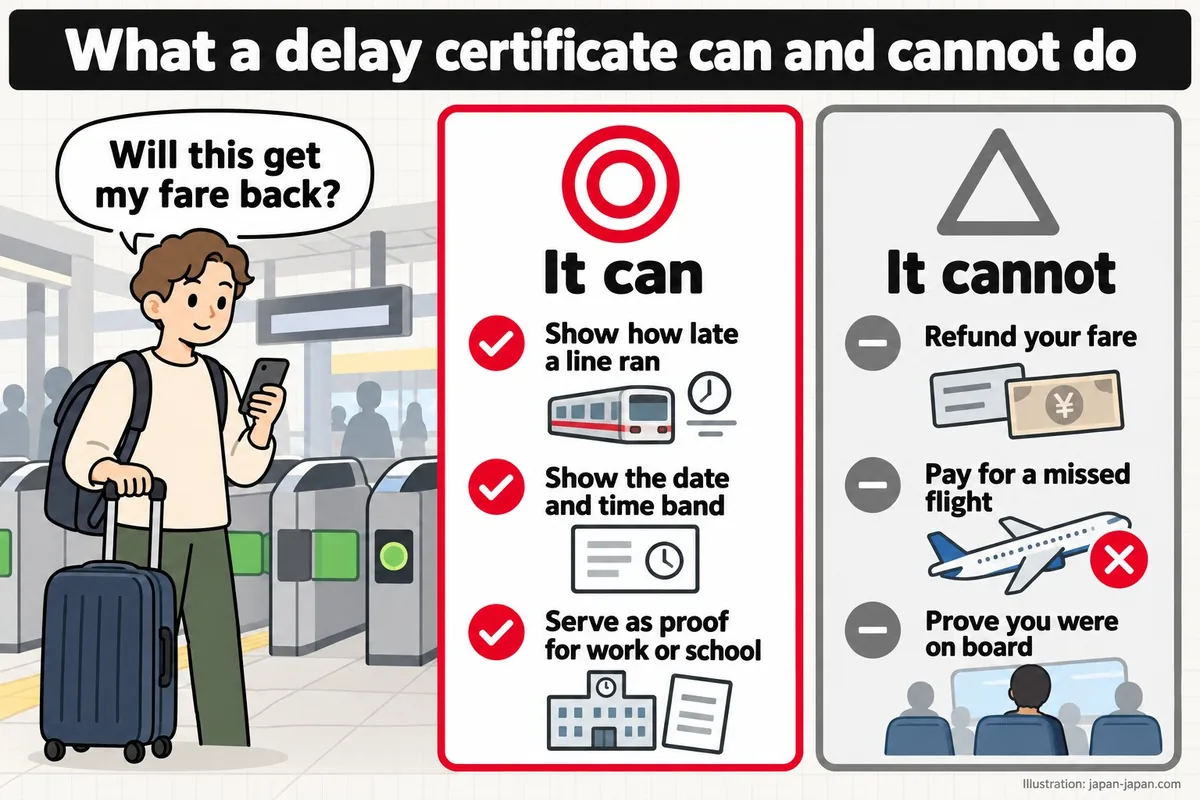
The illustration above sorts what the certificate can and cannot do. It works as evidence that a line ran late. Workplaces and schools in Japan know the format. A language school, a tour company or a client can read the line, the date and the minutes on it.
The certificate does not pay you anything. Kintetsu states that it is not proof that the railway will pay for losses caused by the delay. If a late train makes you miss a bus, another train or a flight, Kintetsu does not pay for that loss. Refunds for other companies’ tickets, plane tickets and travel vouchers follow the terms of the company that sold them.
JR Central takes the same position. The JR Central guide to delays and suspended trains says JR follows its transport rules. It is not responsible for anything outside them. The smartEX FAQ on Shinkansen delays of 2 hours or more says the same for online Shinkansen bookings. Neither railway pays for a missed flight or a lost hotel night.
So plan around the gap. Leave a margin before a flight, a ferry or a tour pickup. If you are heading to Narita for a flight, our Narita Airport guide lists the train and bus options from central Tokyo. A spare train in your plan is worth more than any certificate.
Shinkansen 2 hours late: getting the limited express charge back
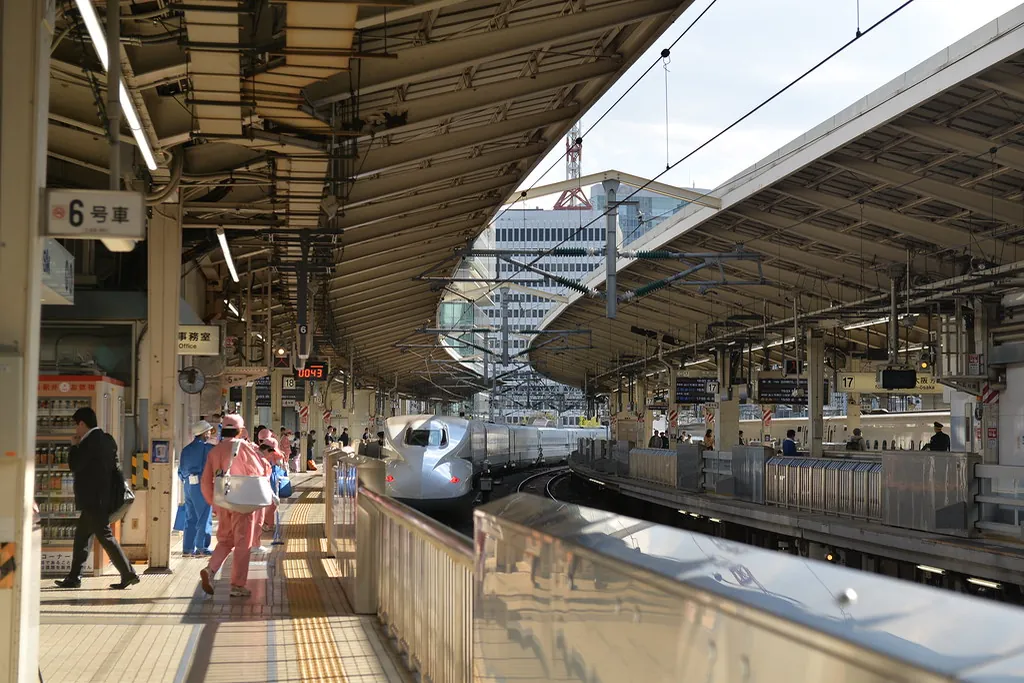
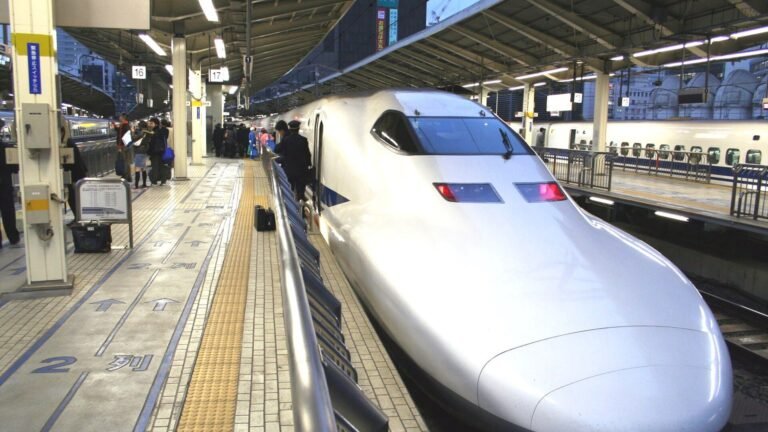
The photo shows a Tokaido Shinkansen at Tokyo Station. A long-distance ticket in Japan has two parts. The base fare pays for the distance. The limited express charge pays for the fast train.
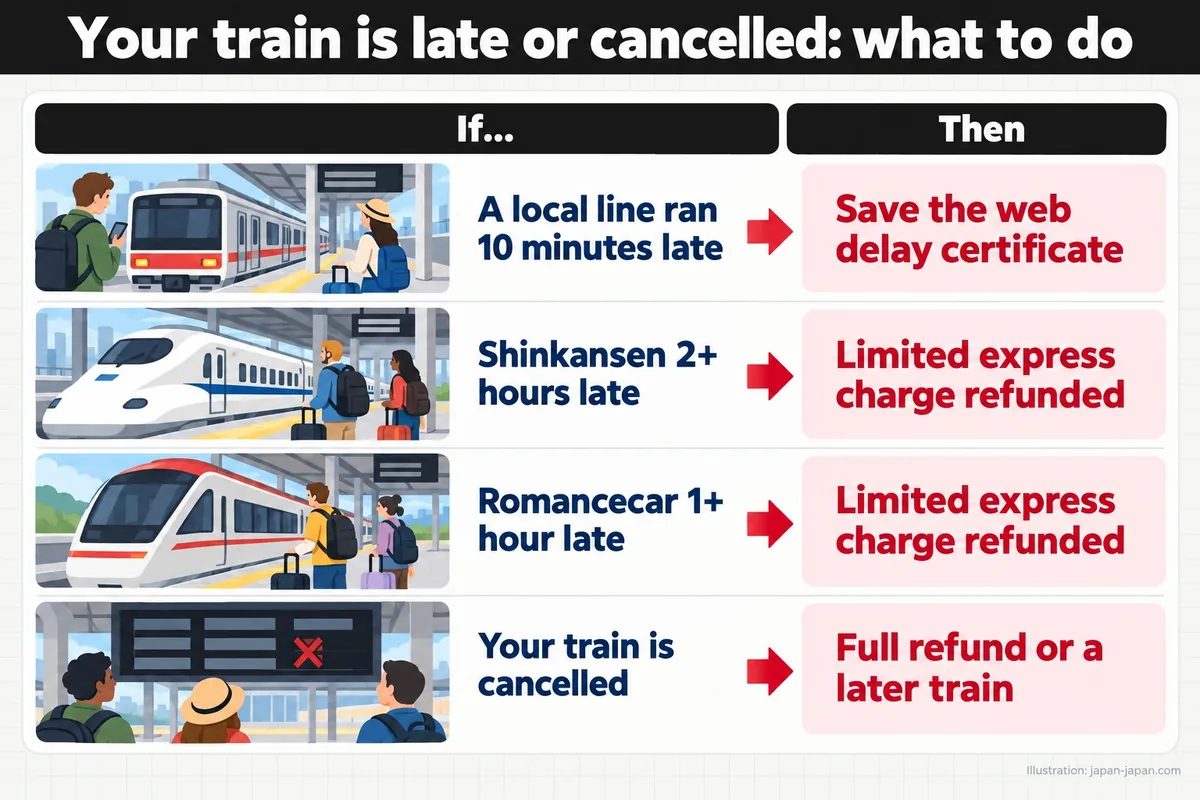
The rule is short. JR Central refunds the full limited express and express charges when the train arrives more than two hours after its scheduled time. The JR Kyushu changing and refunding tickets page sets the same 2-hour line for its express trains. JR Kyushu adds that the refund covers only the express fare, with no refund of the base fare.
A delay just short of 2 hours therefore returns nothing. A delay of 2 hours or more returns the whole charge, not part of it. On a Nozomi trip on our Tokyo to Osaka route, the charge is a large share of the ticket price.
A missed connection can count too. Say a late train makes you miss your transfer, and you arrive more than two hours late. JR Central treats that trip like one cancelled halfway. That opens the refund rules for cancelled trips in the last section of this guide.
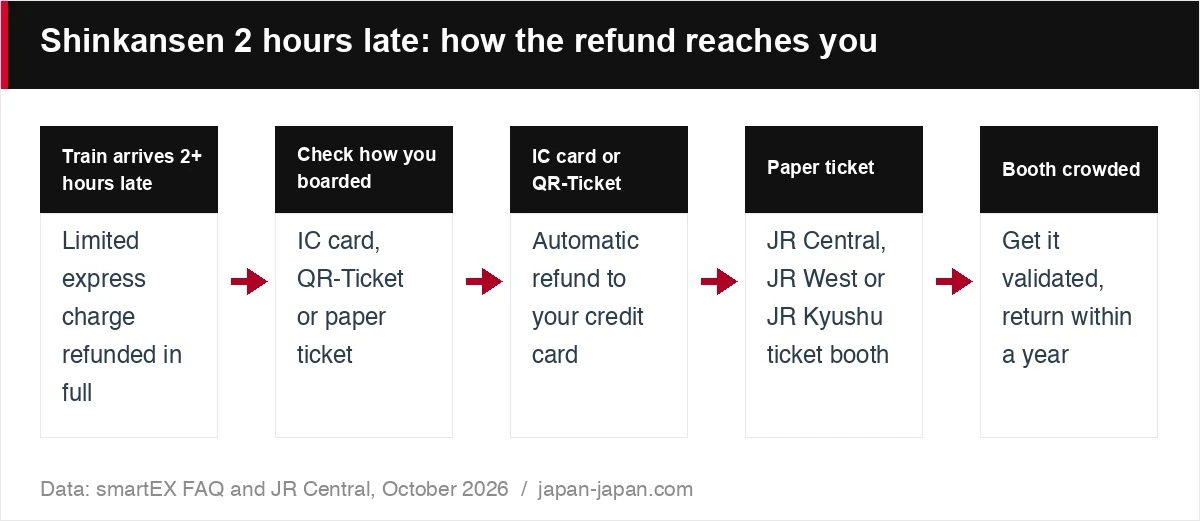
How the money reaches you depends on how you paid. The smartEX service sells Tokaido, Sanyo and Kyushu Shinkansen seats online. If you boarded with an IC card on your smartEX booking, such as a Suica, or with a QR-Ticket, the refund is automatic. smartEX reads the gate record and pays the credit card you used, and you do not have to apply.
Paper tickets work differently. Take them to a ticket booth or a fare adjustment office at a JR Central, JR West or JR Kyushu station. If the booths are crowded, ask staff to mark your ticket as validated for a refund. Bring it back to one of those offices within a year of the validation date.
The diagram below shows the two paths side by side.
On smartEX the refund for a 2-hour delay is a specified amount for each reserved section. The FAQ points to its refund reservations page for the exact amount. Rail pass holders should ask at the ticket office. JR Central says discounted tickets are handled differently by ticket type, and that includes the Japan Rail Pass.
Romancecar and other private limited expresses
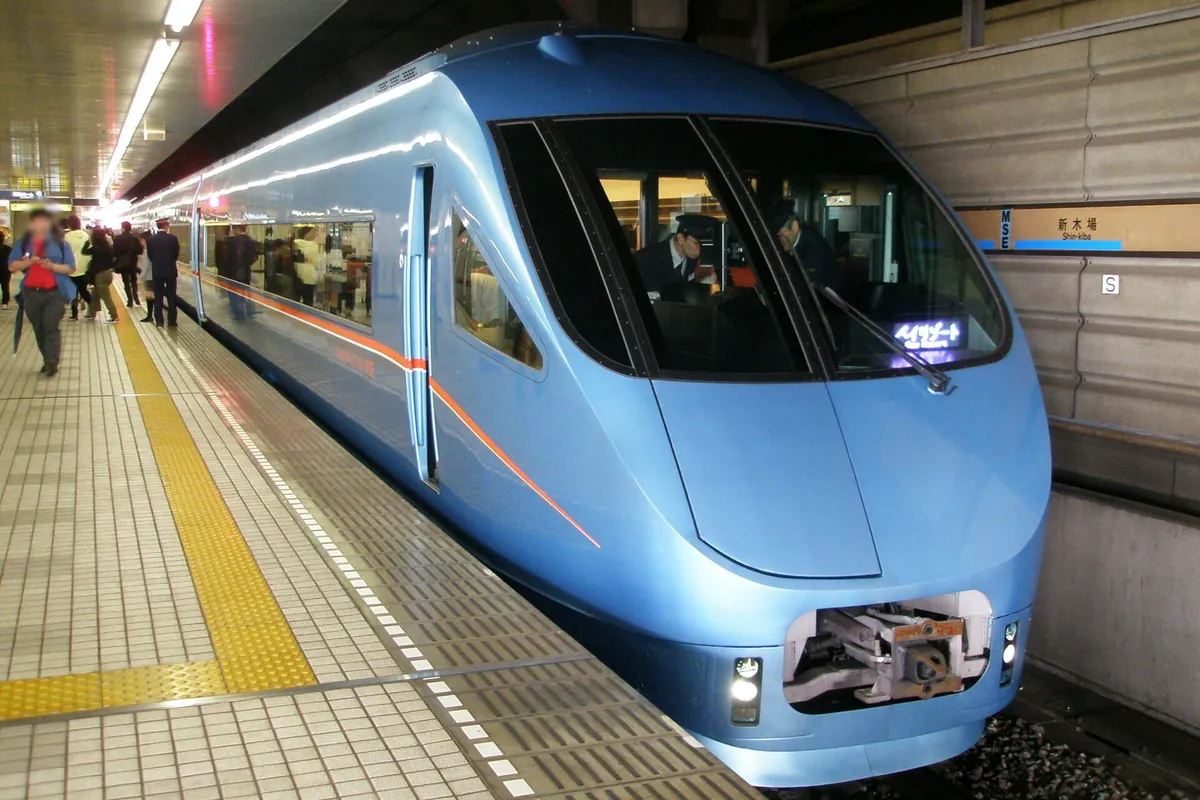
The photo shows an Odakyu Romancecar, the limited express from Shinjuku towards Odawara and Hakone. Private railways write their own refund rules. Odakyu’s line sits lower than JR’s.
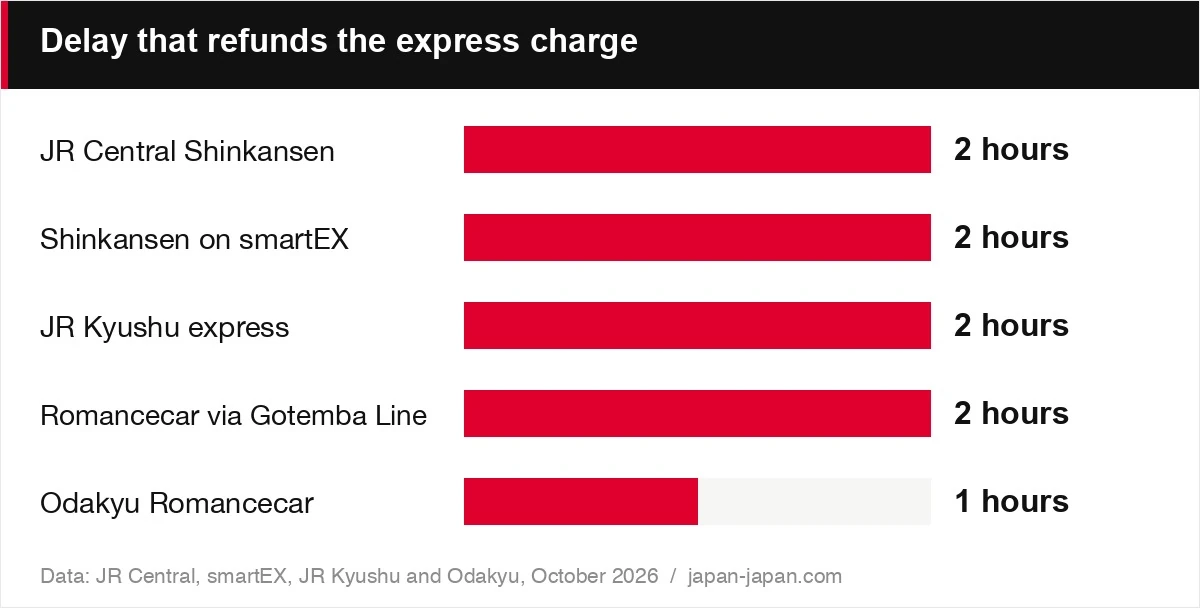
The Odakyu Romancecar cancellation and refund page refunds the full limited express charge when a Romancecar runs 1 hour or more late. It counts lateness at either the arrival time or the departure time. Trains that run through onto the JR Gotemba Line use 2 hours instead.
The chart below compares the delay each operator needs before the charge comes back.
| Item | Value | Note |
|---|---|---|
| JR Central Shinkansen | 2 hours | More than 2 hours at arrival |
| Shinkansen on smartEX | 2 hours | Automatic for IC card and QR |
| JR Kyushu express | 2 hours | Base fare not refunded |
| Romancecar via Gotemba Line | 2 hours | |
| Odakyu Romancecar | 1 hours | Arrival or departure time |
In the chart, the Romancecar is the only service with a 1-hour line. Every JR service shown needs 2 hours.
To claim, go to the window where you bought the ticket or to any Odakyu station. Show the staff the ticket and say 特急券の払いもどし (tokkyūken no haraimodoshi), which means refund of a limited express ticket. If you bought online through Romancecar@club, e-Romancecar, the EMot app or EMot online tickets, Odakyu returns the money on its own.
The online refunds take time. Romancecar@club returns limited express points, which can take 2 to 3 days. e-Romancecar and EMot pay back the credit card you used. That can take until the card statement after next.
A Romancecar cancellation also refunds the whole charge. A refund you ask for yourself is different. Before departure, Odakyu keeps a 100 yen handling fee per ticket. For questions, the Odakyu Customer Center answers on 044-299-8200. Our Tokyo to Hakone route guide compares the Romancecar with the slower options.
| Service | Delay before refund | What comes back | How you get it |
|---|---|---|---|
| JR Central Shinkansen | More than 2 hours at arrival | Full limited express charge | Station ticket office |
| Shinkansen on smartEX | 2 hours or more | Specified amount per reserved section | Automatic for IC card and QR-Ticket |
| JR Kyushu express | 2 hours or more | Express fare only | Ticketing office |
| Odakyu Romancecar | 1 hour or more | Full limited express charge | Window or any Odakyu station, online tickets automatic |
If your train is cancelled: refund or a later train
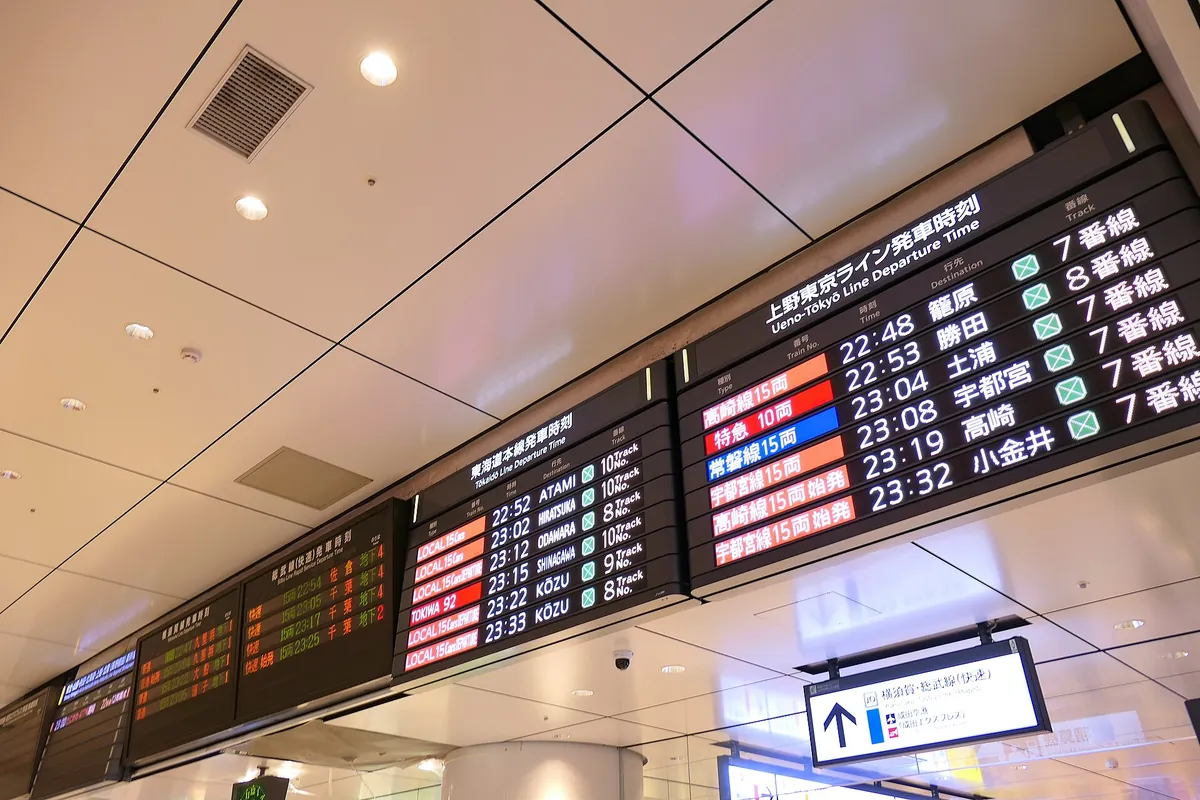
The photo shows a departure board at a JR station in Tokyo, where cancellations appear first. A cancelled train gives you more choices than a late one.
JR Central’s guide sets out the main rules. If you cancel the trip because your train is cancelled, JR refunds the full fare and charges. If the trip ends partway, JR refunds the fare for the rest of the journey and the full limited express charge of the cancelled train. You can also ride back to your departure station free of charge and get a full refund.
Commuter and multi-ride tickets have their own rule. If the disruption lasts more than five days, JR Central extends their validity or refunds them. Sleeper cars get a full refund only if you cannot use them at any time between boarding and 6:00 a.m.
Online Shinkansen bookings follow similar lines. On smartEX, if your reserved train is suspended, you can change to another train or cancel with a full refund and no fees. If your train stops partway, you can take a later Tokaido, Sanyo or Kyushu Shinkansen. You also get back the specified amount for each reserved section.
One exception applies to Tokyo. When trains cannot run between Shinagawa and Tokyo, JR Central refunds only the difference for that short stretch. smartEX treats Shinagawa as your arrival station in that case.
JR Kyushu works the same way. If a cancellation makes you call off the trip, it refunds the fare and all other fees. If you cancel after departure, it refunds the unused part of the fare and charges.
Compare that with a refund you choose to make. JR Kyushu keeps a 220 yen handling charge on an unused base fare ticket. A reserved seat ticket costs 340 yen to refund up to 2 days before departure. From the day before, the fee rises to 30%, with a minimum of 340 yen.
Missing your own train is different again. JR Kyushu says a reserved seat ticket becomes invalid once the train leaves. You can still ride in a non-reserved seat on a train later the same day.
Airport trains are limited expresses too. The Narita Express is a JR East limited express. If it is cancelled or late before your flight, ask at a JR East ticket office.
The illustration below matches common situations to the right step.
FAQ
How long can I get a train delay certificate after the delay?
Each operator sets its own period. Kintetsu keeps 45 days of records, including the current day. Use the history link next to your line for earlier dates.
Is a Japan train delay certificate available in English?
Some operators publish one. Tokyo Metro has an English delay certificate page for each line, and JR East has an English page too. The Kintetsu page is in Japanese, but the line names and minutes are easy to match.
Do I get money back if my train is late in Japan?
Not for a short delay, and never through the certificate. JR refunds the limited express charge after 2 hours, and Odakyu does so after 1 hour on the Romancecar. The base fare stays with the railway.
Does a delay certificate cover a missed flight or hotel?
No. Kintetsu says it does not pay for losses when a delay makes you miss a bus, train or flight. JR Central says it is not responsible for anything outside JR’s transport rules. Leave extra time before flights and tour pickups.
About the author