Ceremonial Grade Matcha from Japan: 2 of 15 Tea Shops Say It
We read the matcha lists of 15 Japanese tea shops, each on the brand’s official online store, on 17 and 18 October 2026. We read them in Japanese, and we also read 5 of their overseas shops in English. On 19 October 2026 we counted again. Our matcha shops database holds 155 matcha and hojicha products from those 15 brands, with prices per gram and shop hours.
14 of the 155 products carry the word ceremonial, in the product name or in the category. 5 are at Itohkyuemon and 9 are at Morihan. No other brand in the database uses it on its Japanese list. So on Japanese tea brands’ own online lists, the phrase is rare.
On these lists, a matcha comes with a name, a weight, a price and sometimes a label for how to drink it. The rest of this article shows which labels Japanese shops use and what each one costs per gram.
Which Japanese tea shops write ceremonial
Here is where the word appears across the 20 shop lists we read: 15 Japanese lists and 5 English ones. Only two brands use it, and they use it in different places.
| Shop | Where it says ceremonial | Products |
|---|---|---|
| Itohkyuemon (Japanese list) | In product names, in katakana | 5 |
| Morihan (Japanese list) | Category name: matcha for tea ceremony | 9 in our database |
| Nakamura Tokichi global shop | Image descriptions (alt text) only | 0 in product names |
| Other 13 Japanese lists | Not used | 0 |
| Other 4 English shops | Not in visible text | 0 |
Itohkyuemon writes it in the product names. The Itohkyuemon official online shop Uji matcha list shows 7 items. 5 of them are 20 g cans with セレモニアルグレード under the name. That is the Japanese spelling of ceremonial grade, read seremoniaru gurēdo.
Those 5 cans run from 1,944 yen for Uji Midori to 10,800 yen for Houkyu, with tax. In between sit Seiju-no-mori at 3,780 yen, 碾上 at 5,940 yen and 寿久 at 8,640 yen. Per gram, that is 97.2 yen for the cheapest can and 540 yen for the most expensive.
The same list sells a 100 g bag named お徳用抹茶 for 3,218 yen, marked お菓子作り お料理: for baking and cooking. Our Itohkyuemon page lists its 5 shops in Uji and Kyoto city with hours and stations.
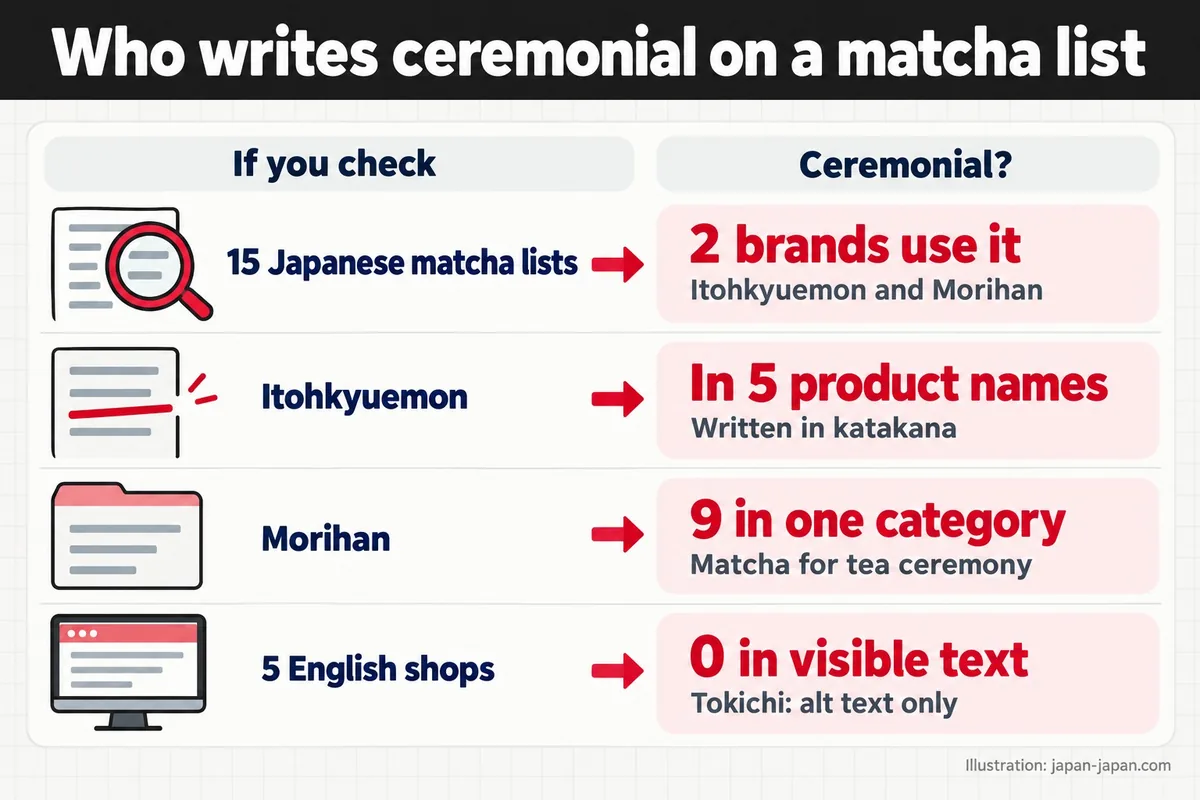
The chart above sums up the count in four lines. Morihan takes a different route from Itohkyuemon. The Morihan official online shop matcha for tea ceremony category is named お点前用抹茶 – Ceremonial Grade Matcha -. The Japanese part means matcha for otemae, the making of tea in a tea ceremony.
The English words sit next to Morihan’s other matcha categories: Single Cultivar Matcha, Organic Uji Matcha and Commercial Grade Matcha. Our database counts 9 Morihan matcha in the ceremonial category. They cost from 1,944 yen for a 30 g can from Kagoshima to 8,100 yen for a 30 g can from Minamiyamashiro in Kyoto. That is 64.8 to 270 yen per gram.
Nakamura Tokichi in Uji leaves the word out. The Nakamura Tokichi Honten official online shop matcha list shows 20 products in Japanese. Its filters sort them by how you drink them: 濃茶 (koicha), 薄茶 (usucha) and 冷薄茶 (cold usucha). Another filter marks matcha for 料理・菓子作り, cooking and baking.
The Nakamura Tokichi global online shop for overseas buyers also keeps the word out of product names. It uses Ceremonial Grade only in the image descriptions (alt text). Our Nakamura Tokichi page lists its 9 shops in Uji, Kyoto city, Tokyo and Osaka.
The Ippodo Tea Global Online Shop matcha page is one of the English shops without the word. It sorts matcha by strength: Rich, Balanced and Light. It also sorts by style of preparation, with Koicha, Usucha and Latte as the choices. There is even a filter for tea ceremony school, with Ura-Senke as the option. None of those filters says ceremonial.
What Japanese shops write instead: usucha, koicha and for cooking
Japanese tea shops mostly tell you how to drink a matcha, not what grade it is. 6 of the 15 brands mark some matcha as usucha (薄茶) or koicha (濃茶). They are Gion Tsujiri, Horii Shichimeien, Jugetsudo, Kanbayashi Shunsho, Nakamura Tokichi and Saijoen. 4 brands mark matcha for cooking or sweets: Hoshino Seichaen, Itohkyuemon, Nanaya and Tsuen.
| Label | Brands | Products | Median per gram |
|---|---|---|---|
| Usucha (thin tea) | 5 | 17 | 93.2 yen |
| Koicha (thick tea) | 3 | 11 | 162 yen |
| Koicha and usucha | 2 | 2 | 311.2 yen |
| For cooking or sweets | 4 | 5 | 32.3 yen |
Usucha is the largest group. 17 products at 5 brands carry it, and 8 of them list grams. Those 8 cost 48.6 to 118.8 yen per gram, with a median of 93.2 yen. Koicha covers 11 products at 3 brands: Gion Tsujiri, Kanbayashi Shunsho and Saijoen. The 5 that list grams cost 75.6 to 216 yen per gram, with a median of 162 yen.
Two products are marked for both koicha and usucha, one at Horii Shichimeien and one at Jugetsudo. They cost 262.5 and 360 yen per gram, the highest median of any label at 311.2 yen. Matcha for cooking or sweets sits at the other end. 5 products at 4 brands carry that label, and the 4 with grams cost 20 to 51.6 yen per gram.
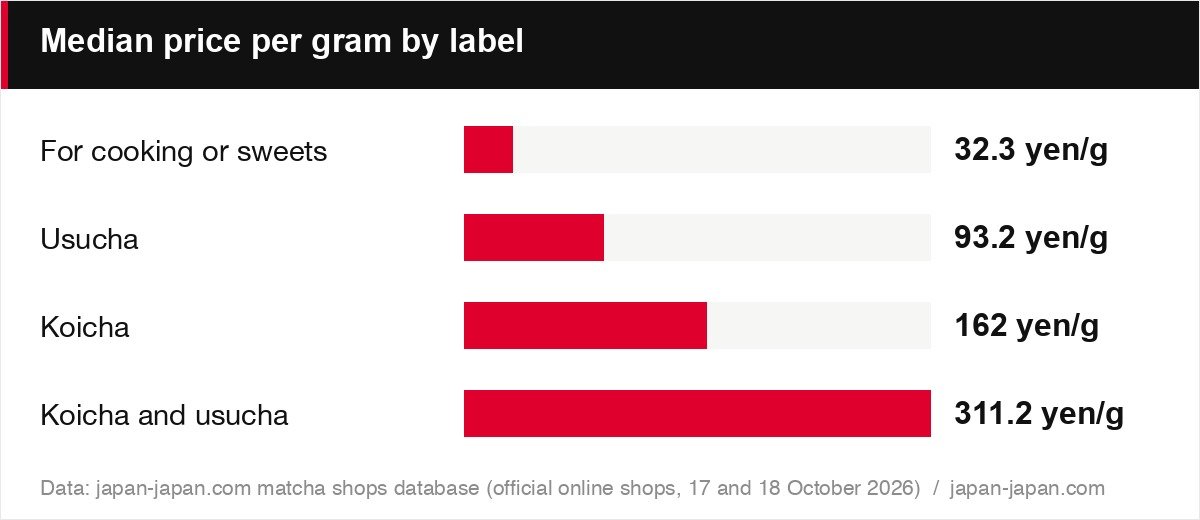
| Item | Value | Note |
|---|---|---|
| For cooking or sweets | 32.3 yen per gram | 4 products with grams |
| Usucha | 93.2 yen per gram | 8 products with grams |
| Koicha | 162 yen per gram | 5 products with grams |
| Koicha and usucha | 311.2 yen per gram | 2 products |
The bar chart puts the four medians side by side. A gram of matcha for cooking costs a median 32.3 yen. A gram labelled usucha costs 93.2 yen, and a gram labelled koicha costs 162 yen.
Another word turns up far more often than ceremonial. 41 of the 155 product names include 昔 (mukashi), at 10 brands. Hatsu-mukashi (初昔) is one example. It is part of a tea name, and the same name sells at very different prices. Ippodo’s Japanese list sells a 20 g box of 初昔 at 864 yen with tax. Nakamura Tokichi’s Japanese list sells a 30 g can of 初昔 at 17,500 yen with tax.
Some famous names add no label at all. Ippodo and Marukyu Koyamaen give names only on their Japanese lists, with no usucha, koicha or ceremonial tags. Our Ippodo Tea page shows 11 teas from 864 to 16,200 yen with tax, a median of 124.2 yen per gram. Our Marukyu Koyamaen page shows 12 matcha from 2,052 to 43,200 yen, a median of 110.7 yen per gram.
For every brand’s prices in one place, read how much matcha costs in Japan. Across 124 matcha at the 15 brands, the median is 125.1 yen per gram.
How tencha becomes matcha, in the ministry’s words
Japan’s Ministry of Agriculture, Forestry and Fisheries (MAFF) defines matcha by how it is made. The steps below come from the October 2026 edition of its tea situation report, linked from the MAFF tea page.
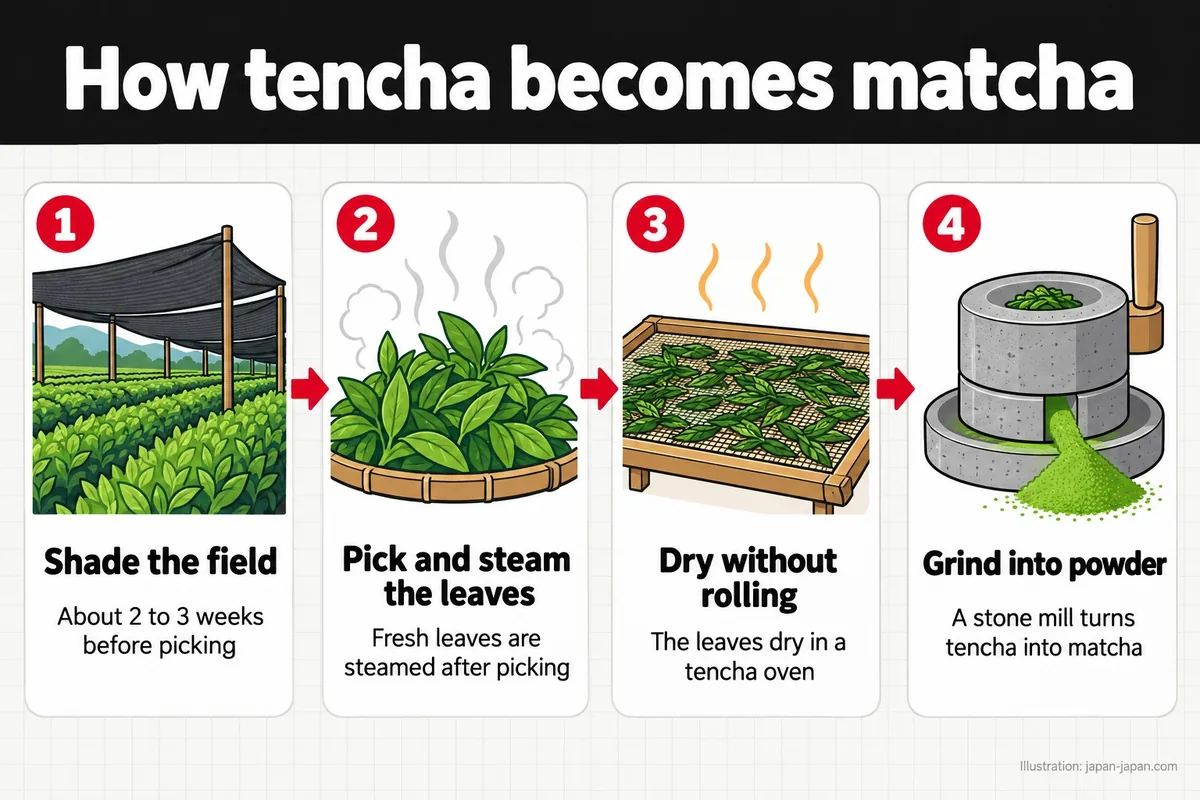
The four steps in the drawing follow the report. Growers shade the tea field with reed screens, straw mats or cloth for about two to three weeks before picking. The leaf from that field is tencha. After picking, the leaves are steamed and then dried in a tencha oven without rolling. Matcha is tencha ground into a fine powder with a stone mill or similar.
Shading puts tencha in a family with two other teas. Gyokuro, kabusecha and tencha together are called ooicha, or shaded teas. The report also names two powders that are not matcha. Powdered tea (funmatsucha) is tea ground in a grinder, and the ministry lists it separately from matcha. Konacha is the fine siftings separated out when tea is finished.
Only a small part of Japan’s tea becomes tencha. Tencha is 8.6 percent of Japan’s crude tea output. It is also the most expensive of the main teas.
The report gives average crude-tea prices for 2025, across all seasons. Tencha sold for 8,562 yen per kg, gyokuro for 3,699 yen and kabusecha for 2,387 yen. Sencha sold for 1,746 yen per kg. So tencha sells for about 4.9 times the price of sencha before anyone grinds it.
You can try the last step yourself in Uji. Kanbayashi Sannyu lets you grind Uji tea with a stone mill and then whisk it, for 1,650 yen. Fukujuen runs a 40 min session to grind your own matcha for 2,750 yen. Our tea ceremony in Uji page lists both with booking rules.
Is ceremonial grade matcha real?
As a phrase on Japanese tea brands’ online lists, ceremonial grade matcha is rare. 2 of the 15 Japanese lists use it. The other 13 do not, and none of the 5 English shops shows it in visible text.
The ministry’s own terms work on a different axis. Its tea types follow how the leaf is grown and processed: shaded or not, rolled or not, ground in a stone mill or in a grinder. Ceremonial grade does not appear among them. So the phrase is a shop’s description, not one of the ministry’s tea types.
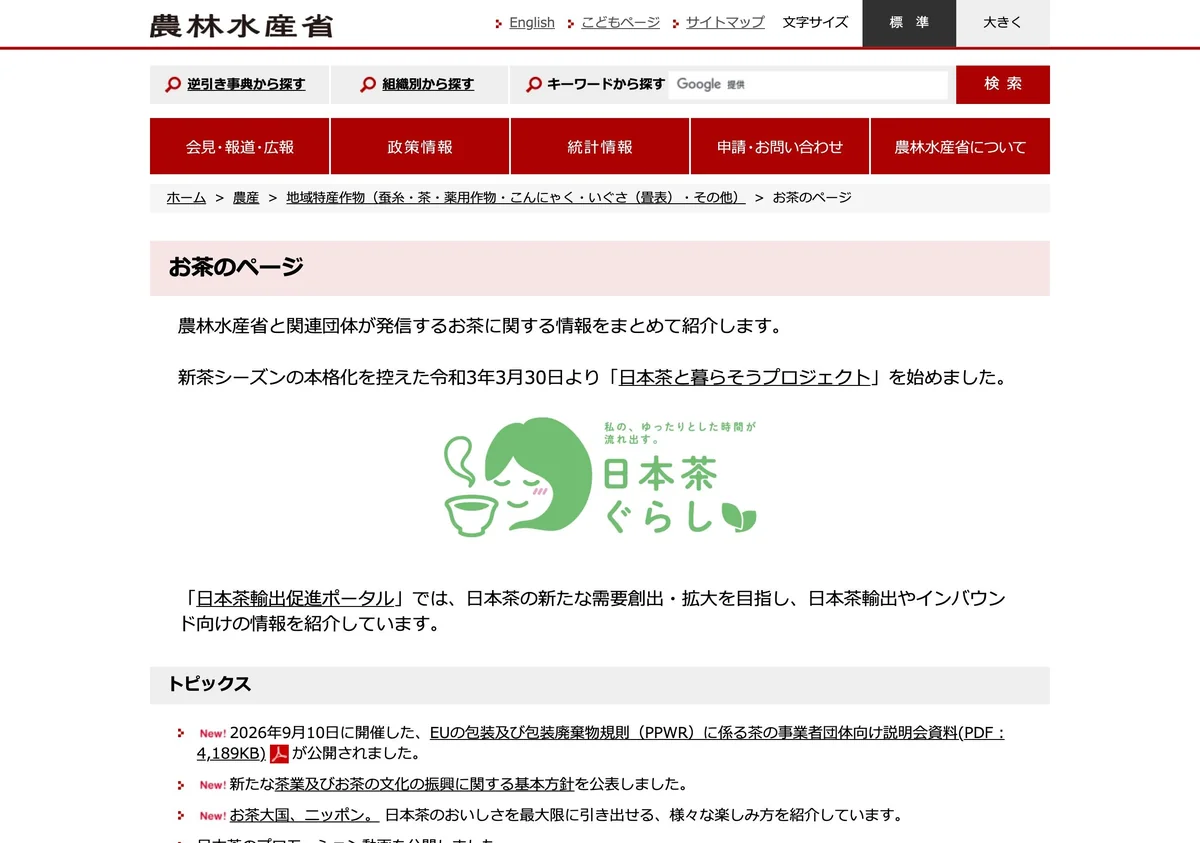
The screenshot shows the top of the ministry’s tea page. Its section on basic tea information links the full tea report, split into parts for download. Its leaflet section also links an English version of the ministry’s tea brewing manual.
The 14 products that do say ceremonial cover a wide price range. They run from 64.8 yen per gram for Morihan’s Kagoshima can to 540 yen per gram for Itohkyuemon’s Houkyu. The cheapest of them costs less per gram than the usucha median of 93.2 yen.
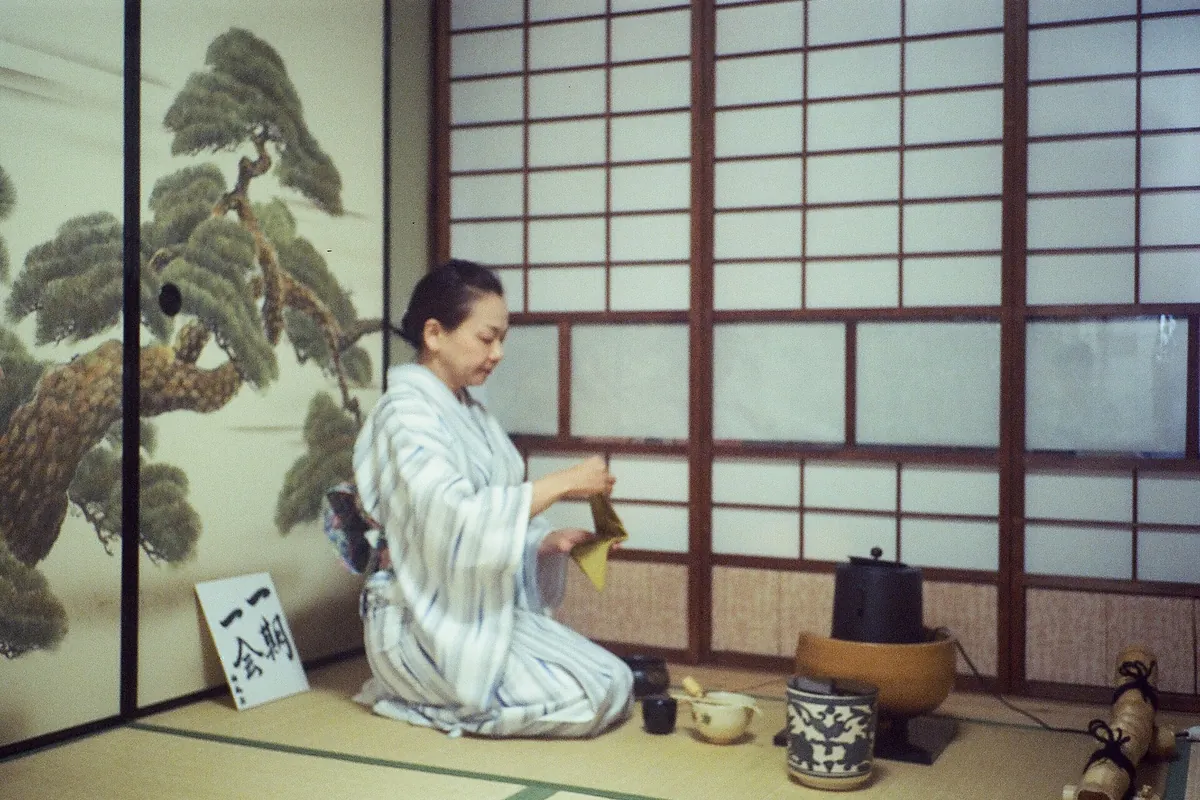
The word ceremony points to the tea room. At Taihoan in Uji, a bowl of thin tea costs 1,500 yen. In Kyoto, Koto runs a 45 min shared session in English for 3,300 yen.
Our tea ceremony prices page compares sessions by price per 45 minutes, English and chairs.
How to read a matcha tin or bag in Japan
These are the label words we found on the brands’ Japanese online lists, with how to read them.
- 薄茶 (usucha): thin tea. The label used by 5 brands for 17 products.
- 濃茶 (koicha): thick tea. The label used by 3 brands for 11 products.
- お菓子作り・お料理 (okashi-zukuri, o-ryōri): for baking and cooking. Itohkyuemon prints it on its 100 g value bag.
- お点前用 (otemae-yō): for the tea ceremony. Morihan uses it as a category name.
- セレモニアルグレード (seremoniaru gurēdo): ceremonial grade, in katakana. Only Itohkyuemon prints it in product names.
- 昔 (mukashi): part of a tea name, as in 初昔 (Hatsu-mukashi). It appears in 41 product names.
- g: the weight. Most cans hold 20 g or 30 g, so compare by price per gram.
- 税込 (zeikomi): the price includes tax.
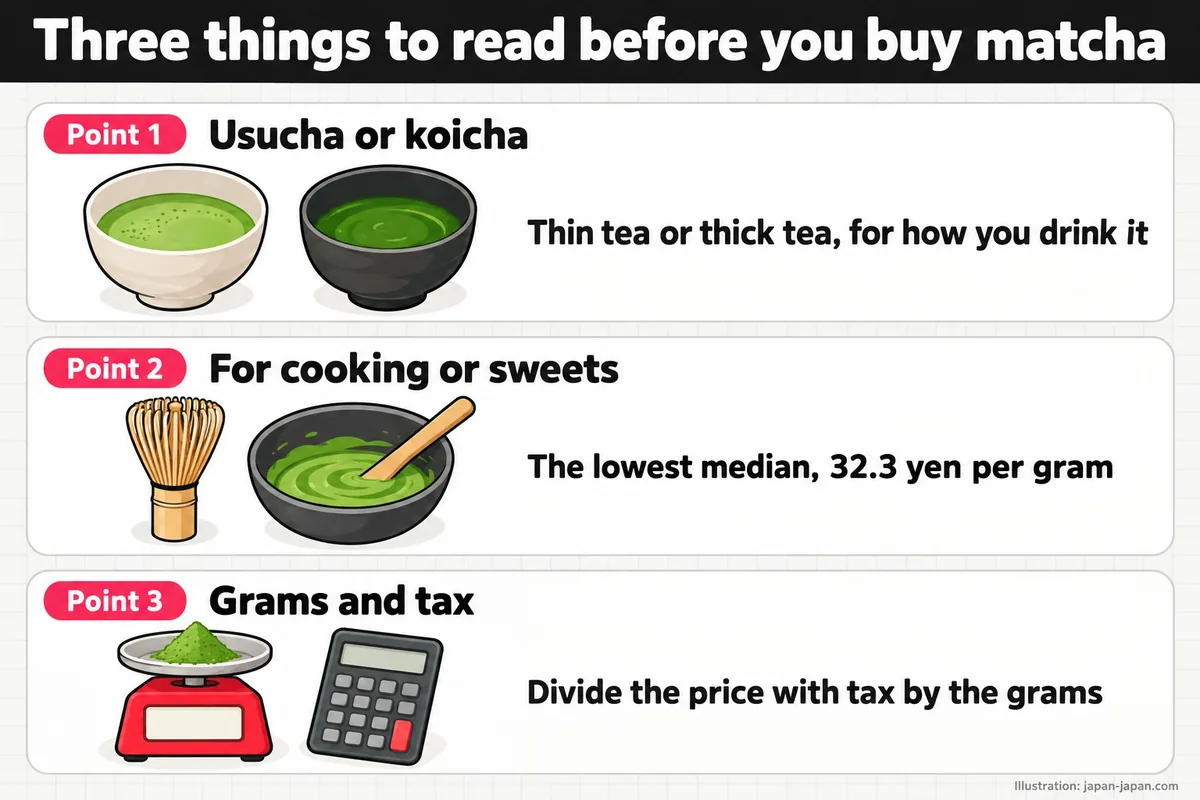
The drawing shows the three checks in order: the label, the use, then grams and tax. Divide the price with tax by the grams to get a price per gram. That one number lets you compare a 20 g box with a 30 g can.
Tax is not always marked. Itohkyuemon marks each price as including tax. Ippodo shows prices with tax once at the end of its list. Marukyu Koyamaen does not say whether its prices include tax, so we show its prices as the shop lists them.
Prices also move. Nakamura Tokichi raised some prices for orders from 1 September 2026, and Ippodo set new matcha prices from 1 October 2026. Prices in a shop can differ from the online list, so check the tag on the day.
Some brands limit online matcha orders. Our article on the matcha shortage in Japan lists the limits at every brand.
Japan’s tax-free rules change on 1 November 2026, so read our tax-free shopping guide before you go. To pick a brand by price per gram, see our best Japanese matcha brands comparison.
Ceremonial grade matcha FAQ
Is ceremonial grade matcha real?
The phrase exists, but Japanese shops rarely use it. Only 2 of 15 Japanese tea brands write it on their Japanese matcha lists: Itohkyuemon and Morihan. Japan’s agriculture ministry defines matcha as tencha ground into fine powder, and a ceremonial grade is not among its tea types.
Do Japanese tea shops say ceremonial grade?
Two do. Itohkyuemon writes セレモニアルグレード in 5 product names, and Morihan names a category お点前用抹茶 – Ceremonial Grade Matcha -. The other 13 Japanese lists we read do not use the word, and none of 5 English shops shows it in visible text.
What do Japanese tea shops write instead of ceremonial grade?
They write how to drink the tea. 6 of 15 brands mark matcha as usucha (thin tea) or koicha (thick tea), and 4 brands mark matcha for cooking or sweets. Many simply give a tea name, and 41 of 155 product names include 昔 (mukashi).
Is culinary matcha cheaper than usucha or koicha matcha in Japan?
Yes, in our count. Matcha marked for cooking or sweets costs a median 32.3 yen per gram. Usucha costs a median 93.2 yen per gram and koicha 162 yen. Products marked for both koicha and usucha cost the most, at a median 311.2 yen per gram.
About the author