Japan Hotels 2026-27: Room Types, City Taxes and Check-In
Japan hotel tax is up to 200 yen per person a night in Tokyo, 500 in Osaka and 10,000 in Kyoto. Plus room types, the passport rule and winter 2026-27 dates.
By Shunta Fujii
Japan hotels: the short answer
Japan hotel tax varies by city: up to 200 yen per person a night in Tokyo, 500 yen in Osaka and 10,000 yen in Kyoto. Visitors without an address in Japan show their passport at check-in, and the hotel copies it.
You pay the tax to the hotel together with the room charge. The amount depends on the price per person per night. Kyoto’s top rate of 10,000 yen, for example, applies only to rooms of 100,000 yen or more per person.
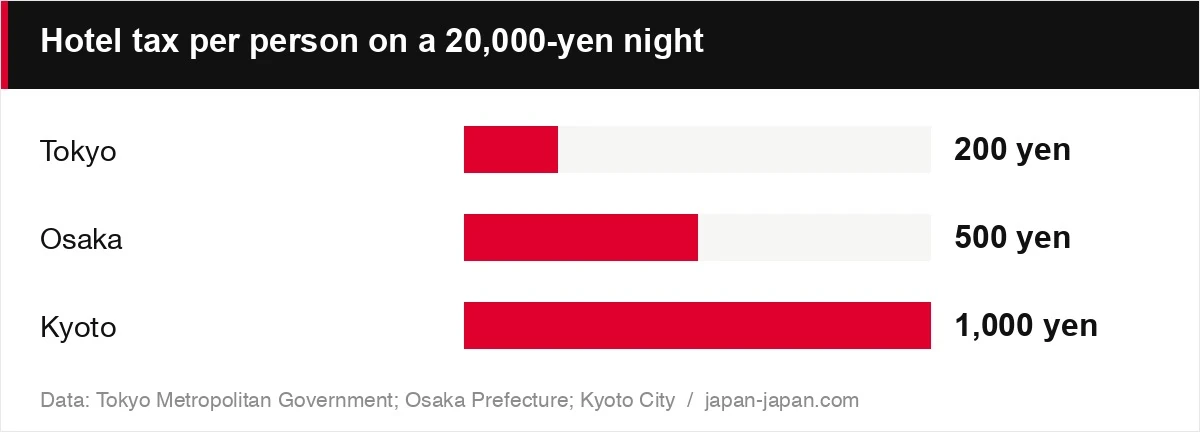
At 20,000 yen per person a night, the tax comes to 200 yen in Tokyo, 500 yen in Osaka and 1,000 yen in Kyoto. The chart below compares the three cities at that price.
| Item | Value | Note |
|---|---|---|
| Tokyo | 200 yen | Band of 15,000 yen or more, until 31 March 2027 |
| Osaka | 500 yen | Band of 20,000 yen or more, since 1 September 2025 |
| Kyoto | 1000 yen | Band of 20,000 to under 50,000 yen, since 1 March 2026 |
Plan around a few dates. Tokyo switches to 3% of the room charge for stays from 1 April 2027. In winter, book early for New Year and for the 2027 Sapporo Snow Festival, which runs from 4 to 11 February.
Below are the three types of stay and the tax in Tokyo, Osaka, Kyoto and Niseko. After that come the check-in steps, the busiest winter dates and the ride from the airport.
Japan hotel rooms: hotel, ryokan or capsule
Japan hotel rooms come in three types: a standard hotel room, a ryokan room with tatami and futon, or a capsule hotel pod. They differ in price, in what you share and in how much luggage you can keep with you.
The Japan National Tourism Organization (JNTO) says capsule hotels are usually cheaper than a regular hotel. It puts the average ryokan stay at around 15,000 yen per night. Tax differs too: Tokyo taxes hotel and ryokan guests today and adds simple lodging houses and minpaku rentals from 1 April 2027.
Ryokan: tatami, futon and dinner
A ryokan is a traditional Japanese inn. According to JNTO’s ryokan guide, ryokan are said to date back to the 8th century. That may make them the oldest form of hotel in the world.
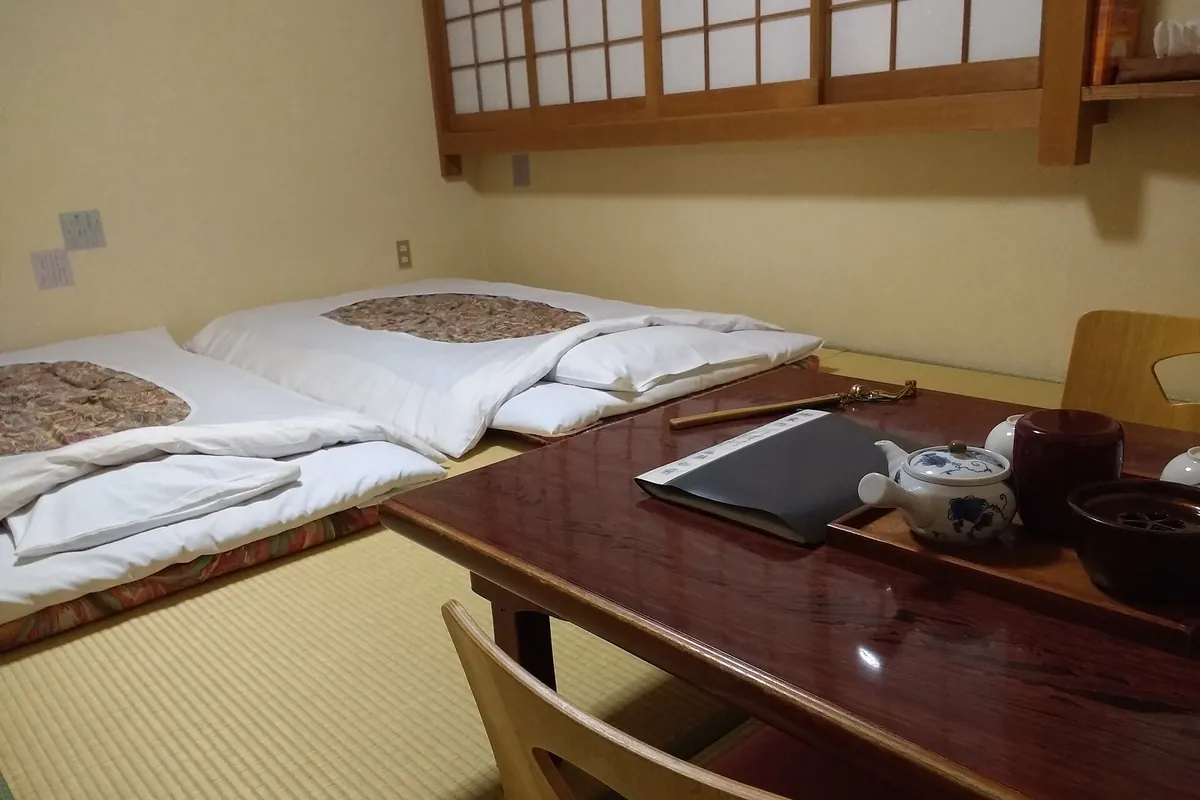
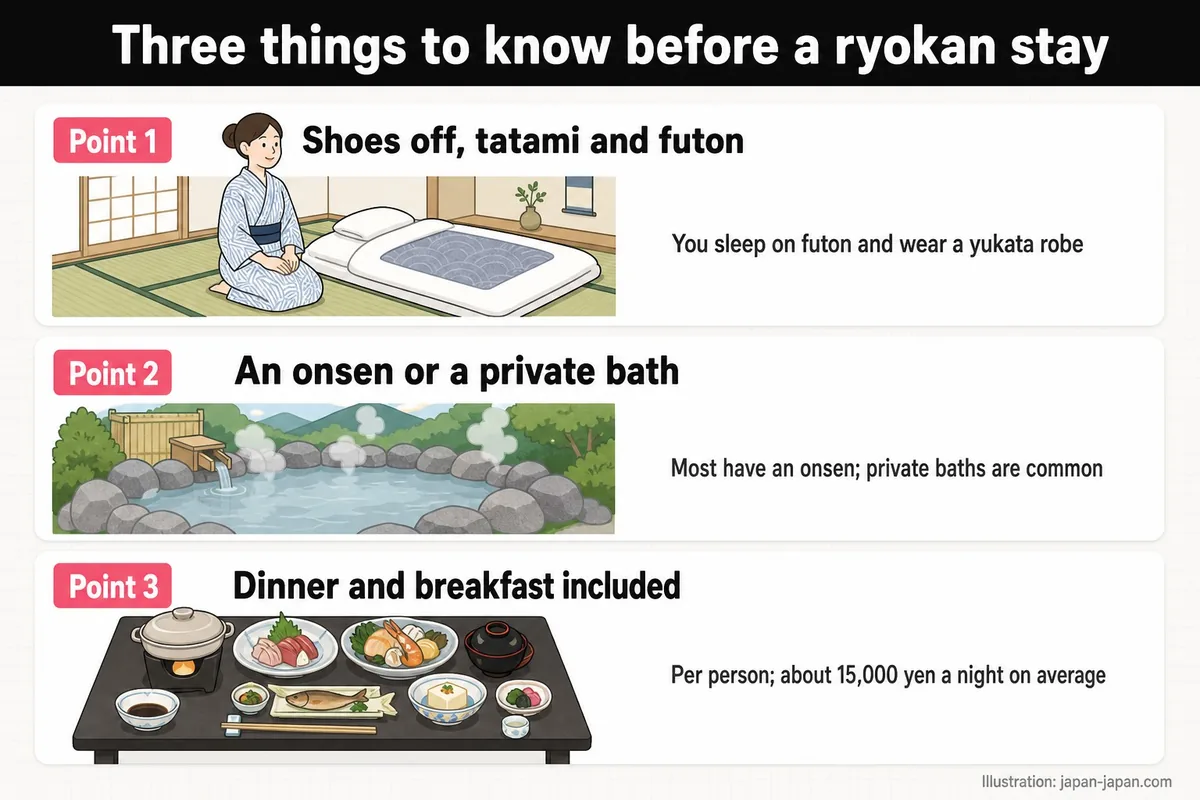
Expect tatami flooring, futon bedding and a yukata, the cotton robe guests wear around the inn. Private baths, sometimes outdoors, are common, and most ryokan have an onsen, a hot-spring bath. Staff will explain the customs, such as taking off your shoes indoors. The photo below shows a ryokan guest room with tatami flooring.
A stay usually includes a kaiseki dinner, a formal multi-course meal, and a traditional Japanese breakfast the next morning. Depending on the ryokan, you eat in a shared dining hall or in your room. Some ryokan also offer stays without meals.
JNTO says ryokan stays are priced per person, per room, with meals usually included. High-end ryokan charge more than that 15,000-yen average. Before you compare a ryokan with a hotel, check that both prices are per person. The illustration below sums up the three things to expect.
In Kyoto, meals do not count toward the tax band, so a ryokan dinner does not push you into a higher one. If you have tattoos, onsen rules differ from place to place; our guide to using an onsen with tattoos explains what to expect.
Capsule hotels: a pod and a locker
A capsule hotel is made up of rows of compact, bed-sized capsules. Each one gives you a private place to sleep, and you share the toilets and showers. The world’s first opened in 1979 in Osaka’s Umeda district, for office workers who had missed the last train home.
A standard pod has a mattress, a pillow, shelf space, power outlets and Wi-Fi, and sometimes a TV. A curtain or door gives you privacy, but it is not soundproof. Hotels often provide toothbrushes and even pyjamas, and many have a lounge.
You get a locker for your bag, but large suitcases normally have to stay at reception. Capsule hotels used to be for men only. Today there are mixed-gender and female-only hotels, and some mixed ones split guests by room or floor.
Capsule hotels tend to sit near train stations in most major cities. The pods can feel cramped if you are tall, and you may hear noisy neighbours. Keep your voice down, use headphones, and check the food rule, since many hotels ban eating inside the pods.
Japan hotel tax by city in 2026-27
Japan hotel tax is a local tax, so each place sets its own rates. Tokyo, Osaka Prefecture, Kyoto City and Niseko Town all charge one, and the hotel collects it from you with the room charge. The table sets out the rates now and the next change in each place.
| City | Tax now | What changes |
|---|---|---|
| Tokyo | None under 10,000 yen; 100 yen from 10,000 yen; 200 yen from 15,000 yen | From 1 April 2027: 3% of the room charge, none under 13,000 yen; minpaku and simple lodging houses collect it too |
| Osaka | None under 5,000 yen; 200, 400 or 500 yen | Current rates since 1 September 2025 (before: 100, 200 or 300 yen, none under 7,000 yen) |
| Kyoto | 200, 400, 1,000, 4,000 or 10,000 yen in five bands; no tax-free band | Five bands since 1 March 2026 (before: 200, 500 or 1,000 yen) |
| Niseko | A fixed amount until 31 October 2026 | From 1 November 2026: a percentage of the room charge (tax introduced 1 November 2024) |
Tokyo: 100 or 200 yen now, 3% from April 2027
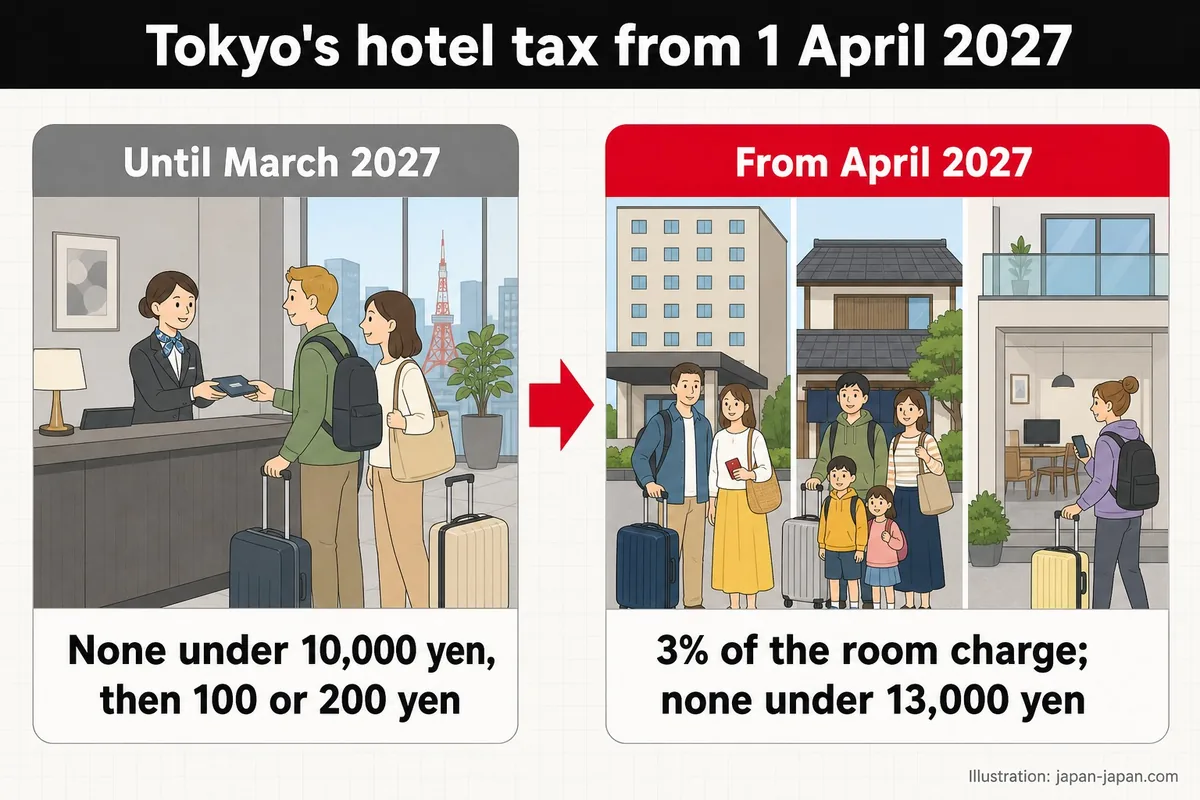
Tokyo taxes guests at hotels and ryokan. Under 10,000 yen per person per night, you pay nothing. From 10,000 yen to under 15,000 yen, the tax is 100 yen; at 15,000 yen or more, it is 200 yen.
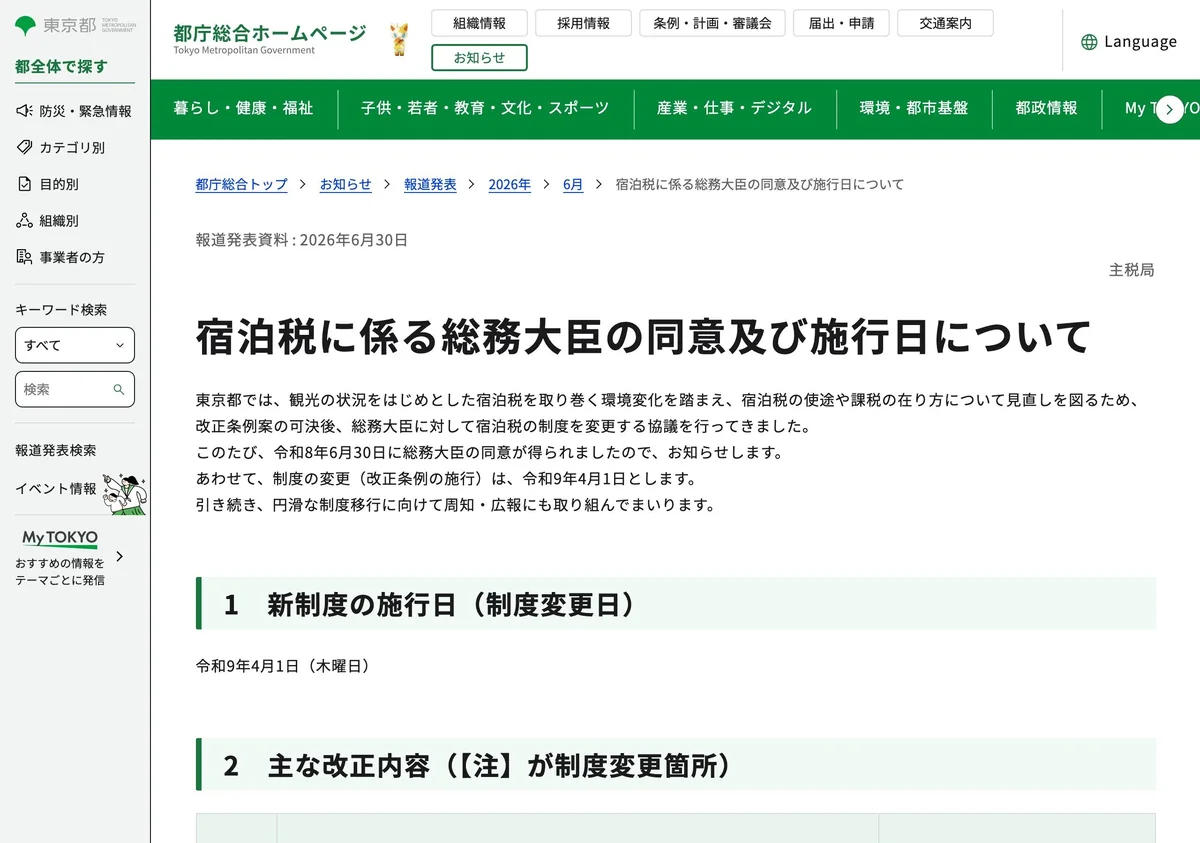
The system changes for stays from Thursday 1 April 2027. The tax becomes 3% of the room charge, and stays under 13,000 yen per person per night are exempt. Simple lodging houses (kan’i shukusho) and both types of minpaku private rental must collect it too.
The date is set. The Tokyo Metropolitan Government announced that the Minister for Internal Affairs and Communications agreed to the change on 30 June 2026. If your trip runs past 31 March 2027, the nights from 1 April fall under the new rule. The illustration shows the rules before and after the switch.
Osaka: 200 to 500 yen since September 2025
Osaka Prefecture raised its rates for stays from 1 September 2025. Under 5,000 yen per person per night, there is no tax. From 5,000 yen to under 15,000 yen, you pay 200 yen.
From 15,000 yen to under 20,000 yen the tax is 400 yen, and at 20,000 yen or more it is 500 yen. Before September 2025 the bands were 100, 200 and 300 yen, and stays under 7,000 yen paid nothing.
Osaka asks you to pay the tax to the hotel with the room charge. A price you prepaid on a booking site may not include it. In that case the way you pay depends on the hotel, so ask at the front desk.
Kyoto: five bands since March 2026
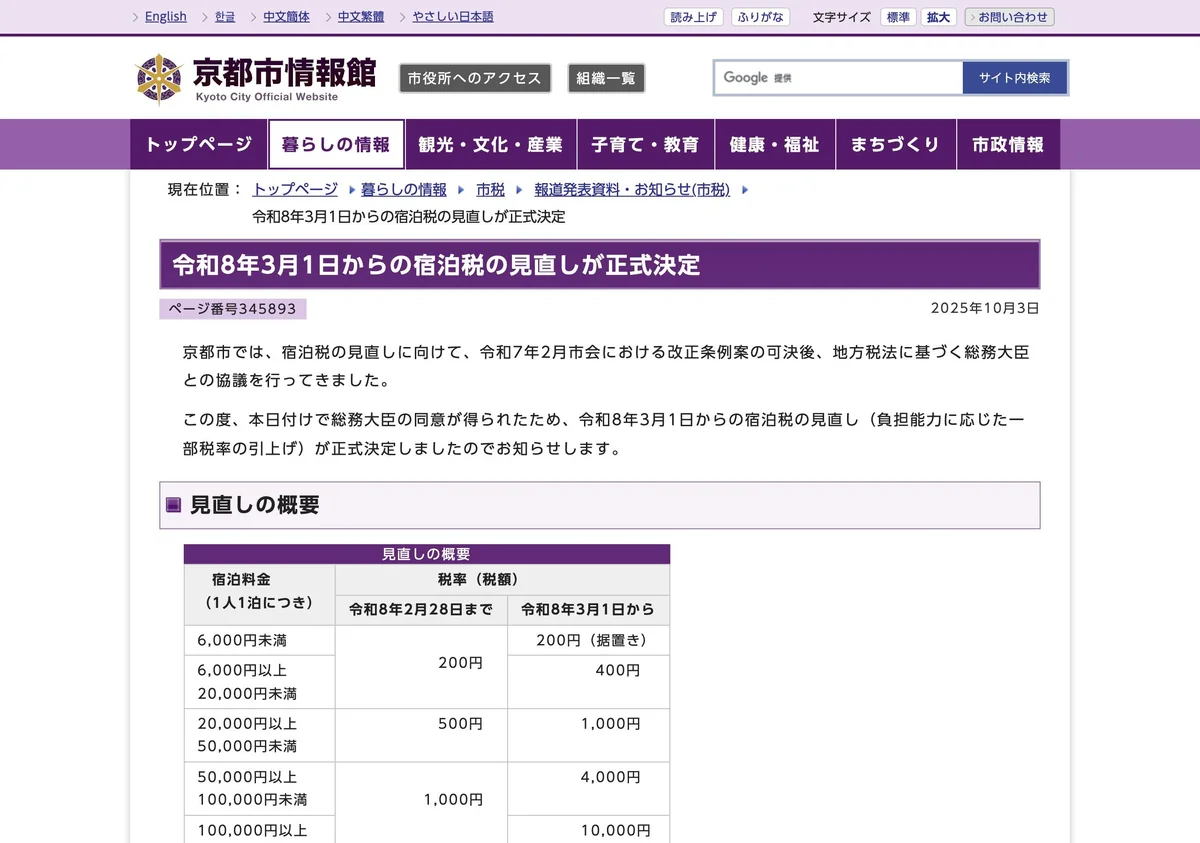
Kyoto City moved to five bands on 1 March 2026, and it has no tax-free band. Under 6,000 yen per person per night, the tax stays at 200 yen. From 6,000 yen to under 20,000 yen it is 400 yen, and from 20,000 yen to under 50,000 yen it is 1,000 yen.
Rooms from 50,000 yen to under 100,000 yen pay 4,000 yen, and rooms of 100,000 yen or more pay 10,000 yen. Until 28 February 2026 the rates were 200, 500 and 1,000 yen.
Kyoto counts the room-only price, without meals and consumption tax. The city gives its own example: two nights in a 10,000-yen room cost 400 yen × 2, or 800 yen, in tax. Its announcement, shown below in Japanese, lists the old rates beside the new ones.
Niseko: a percentage from November 2026
Niseko Town, the Hokkaido ski resort, introduced its own hotel tax on 1 November 2024. On 1 November 2026 it switches from a fixed amount to a percentage of the room charge. Every night of a Niseko trip this winter falls under the new system. The town’s page also points to a separate Hokkaido accommodation tax.
Checking in: passport and hotel register
Hotels in Japan keep a register of guests. Without an address in Japan, you must add your nationality and passport number to your name, address and contact details.
The government also requires you to present your passport and have it photocopied, according to the Ministry of Health, Labour and Welfare. At the front desk, hand over the passport and let the staff copy it.
The ministry publishes this request in Japanese, English, Korean and Chinese. Its Japanese heading reads パスポート呈示等のお願い (pasupōto teiji-tō no onegai): a request to show your passport. If you see that heading at a front desk, it refers to this rule.
The request applies whenever you stay at a lodging, so a ryokan or a capsule hotel follows the same steps. The chart shows them in order.
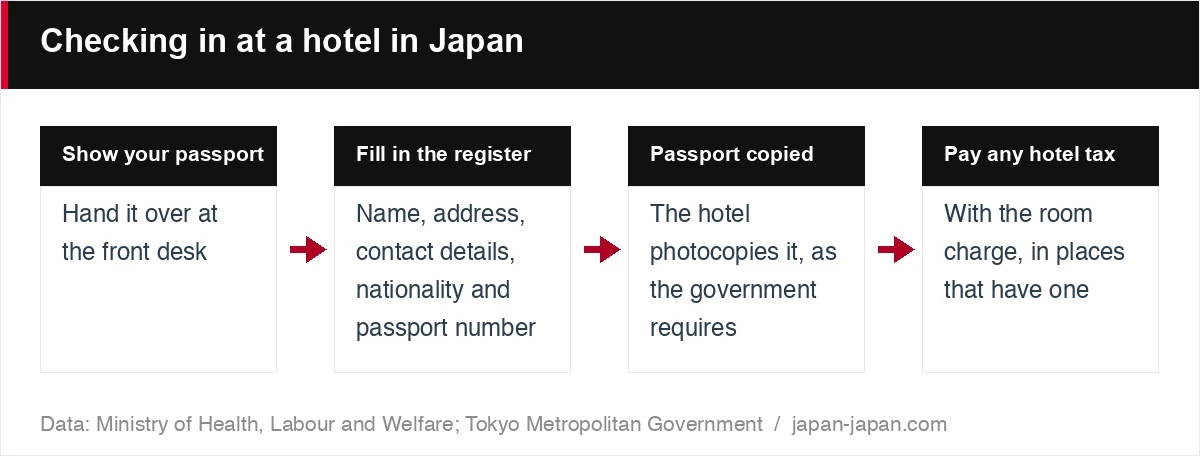
The last step is the tax. Tokyo’s announcement describes it as a tax on the stay that the lodging operator collects. A prepaid booking may leave it out, as Osaka’s page warns, so ask at check-in whether your price includes it.
That announcement, shown below in Japanese, opens with the start date of Tokyo’s new system: Thursday 1 April 2027.
On arrival day, keep the passport in your carry-on bag. If you send your suitcase ahead from the airport, the passport still has to reach the front desk with you.
When hotels fill up in winter 2026-27
New Year is the busiest stretch for travel. New Year’s Day, Friday 1 January 2027, is the only national holiday. Even so, banks close from 31 December to 3 January, and many sights close for several days.
The trains show the peak. JR Central makes every Nozomi reserved-seat only from 25 December 2026 to 5 January 2027. Its busiest day last winter was Sunday 4 January 2026, when 350,000 passengers headed to Tokyo.
A second rush follows. Every Nozomi is reserved-seat only again from 9 to 11 January 2027, ending with Coming of Age Day on Monday 11 January.
December has no public holidays in 2026 or 2027, yet 3,617,791 visitors arrived in December 2025, the 5th busiest month of that year. January 2025 drew more, with 3,781,629 visitors.
February is quieter: 3,258,491 visitors arrived in February 2025, the fewest of any month that year. It has two holidays, National Foundation Day on Thursday 11 February 2027 and the Emperor’s Birthday on Tuesday 23 February 2027.
In Sapporo, February brings the city’s major winter event. The 77th Sapporo Snow Festival runs for 8 days, from Thursday 4 February to Thursday 11 February 2027. Its last day is the National Foundation Day holiday.
The festival uses three sites: Odori, from West 1-chome to West 11-chome; Tsudome; and Susukino. Five large snow sculptures form the centre of the Odori site. The Sapporo Snow Sports Park 2027 follows from 12 to 14 February at the Daiwa House Premist Dome.
Before you book a winter stay, run through the four checks in the illustration.
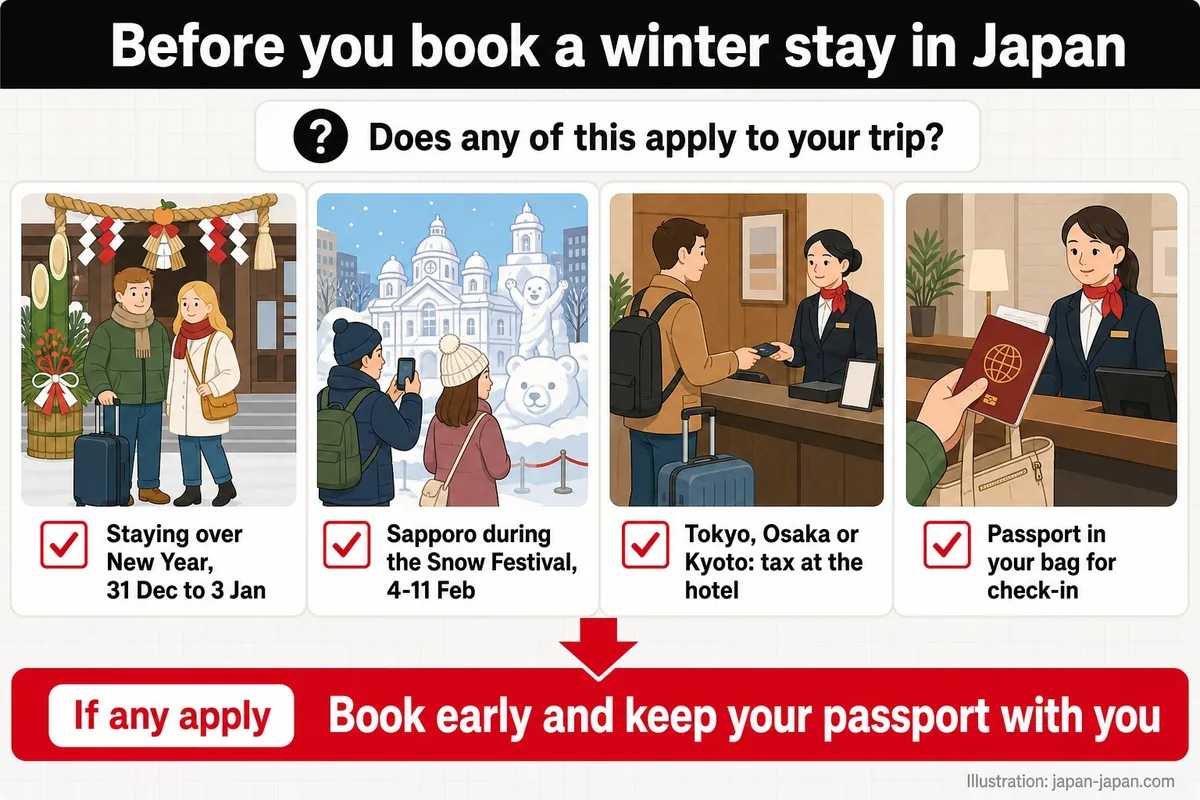
If any of them apply, book early and keep your passport with you. Our 2027 holiday calendar lists every date with its weekday.
From the airport to your hotel
Choose the ride by where your hotel is. The table lists the routes from our airport transfer pages that serve the cities in this guide.
| Route | Ride | Time and fare |
|---|---|---|
| Narita to Ginza and Hibiya hotels | Airport Limousine bus | 90–115 min, 3,600 yen |
| Haneda to Shinagawa | Keikyu train | 11 min by Keikyu’s estimate, 330 yen |
| Kansai Airport to Osaka Station (Umeda) | Kansai Airport limousine bus | 68–70 min, 1,800 yen |
| Kansai Airport to Osaka Station (Umeda) | JR Kansai Airport Rapid Service | About 65 min |
| Kansai Airport to Kyoto | JR Haruka | About 75 min; 2,200 yen one way with a foreign passport |
| New Chitose Airport to Sapporo | JR Rapid Airport | About 30 min |
In Tokyo, the Airport Limousine bus from Narita runs to the hotels in Hibiya and Ginza by way of Tokyo Station. Board at stop 10 at Terminal 1, stop 17 at Terminal 2 or stop 9 at Terminal 3. It runs 15 times a day from Terminal 1, with the first bus at 07:25 and the last at 20:45.
Landing at Haneda instead? Keikyu trains run to Shinagawa, and the Tokyo Monorail runs to Hamamatsucho for 520 yen. Our guide to Narita or Haneda to Tokyo Station compares the two airports.
In Osaka, the Kansai Airport limousine bus serves three stops around Osaka Station, with 67 departures a day from Terminal 1. JR’s Kansai Airport Rapid Service runs there without a change. For Kyoto hotels, the JR Haruka also needs no change, and the limousine bus costs 2,800 yen.
In Sapporo, New Chitose Airport has its own JR station under the domestic terminal. The international terminal is a short walk away along a connecting passage. The JR Rapid Airport reaches Sapporo in about 30 minutes.
Plan your luggage before you check in to a capsule hotel. You get a locker for your bag, and large suitcases normally have to stay at reception. The capsules are bed-sized, as the photo shows, so there is no floor space for an open case.
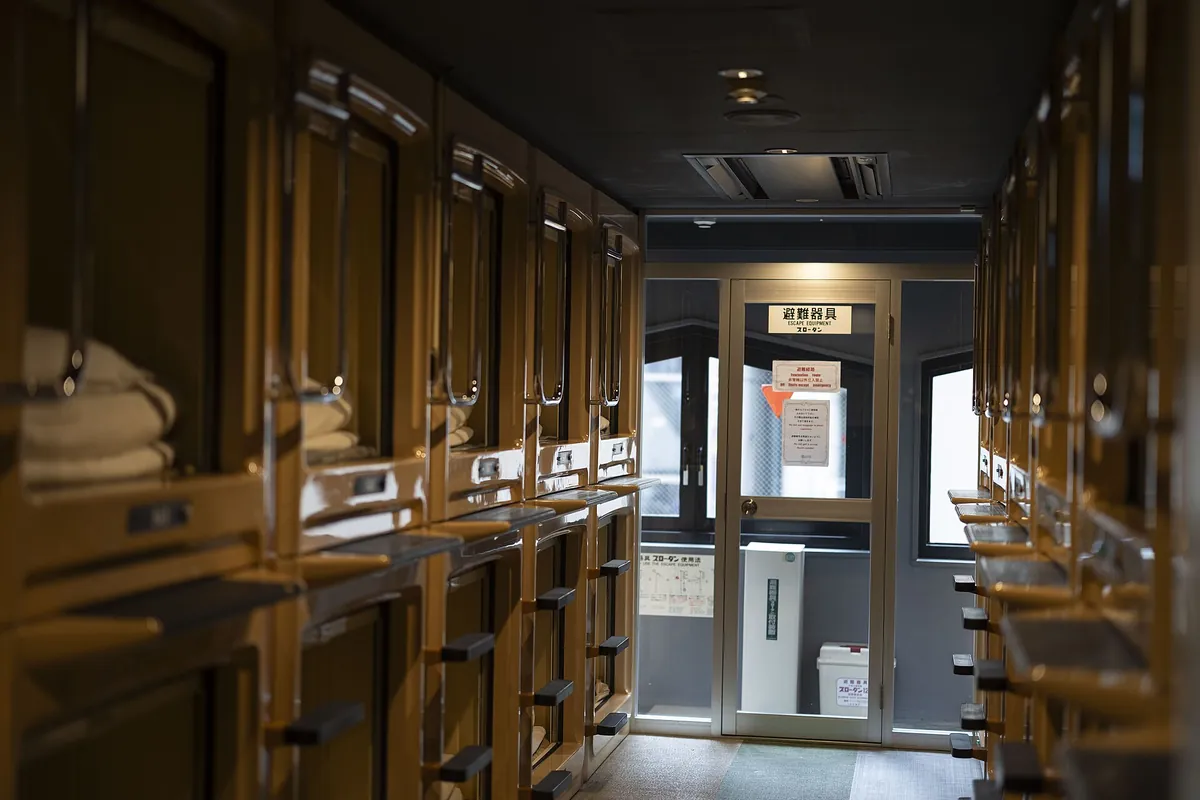
One answer is to send the big bag on. Yamato Transport runs courier counters at 16 of the airports in our guide, and the bag reaches most of the country the next day. Narita and Haneda also offer same-day delivery to hotels in central Tokyo if you drop the bag off before late morning.
At New Chitose, Yamato counters sit on the 1st and 2nd floors of the domestic terminal and the 3rd floor of the international terminal. Coin lockers there start at 400 yen a day, in 3 sizes.
FAQ
How much is the hotel tax in Japan?
It depends on the city and on the room charge per person per night. Tokyo charges 100 or 200 yen, Osaka 200 to 500 yen, and Kyoto 200 to 10,000 yen in five bands. Tokyo exempts stays under 10,000 yen and Osaka stays under 5,000 yen, but Kyoto has no tax-free band.
Will Tokyo’s hotel tax change in 2027?
Yes. For stays from 1 April 2027, Tokyo charges 3% of the room charge, and stays under 13,000 yen per person per night are exempt. Simple lodging houses and minpaku rentals start collecting it too. Nights up to 31 March 2027 stay under the current rules.
Do I need my passport to check in at a hotel in Japan?
Yes, if you have no address in Japan. The hotel records your nationality and passport number in its guest register. The government also requires you to show the passport and have it copied, so keep it in your carry-on bag.
When are hotels in Japan hardest to book this winter?
Around New Year and during the Sapporo Snow Festival. Banks close from 31 December to 3 January, and every Nozomi is reserved-seat only from 25 December 2026 to 5 January 2027. The festival runs from 4 to 11 February 2027 and ends on a public holiday.
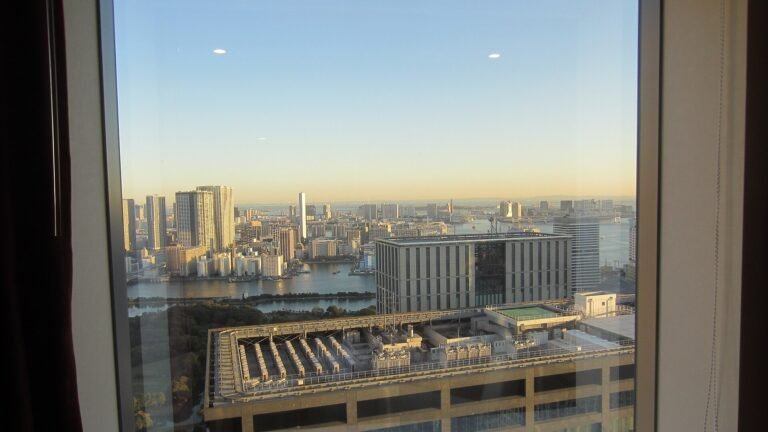
Photo: View from a room in the Park Hotel Tokyo in Tokyo, 2019 – 331.jpg by Another Believer (CC BY-SA 4.0), via Wikimedia Commons.