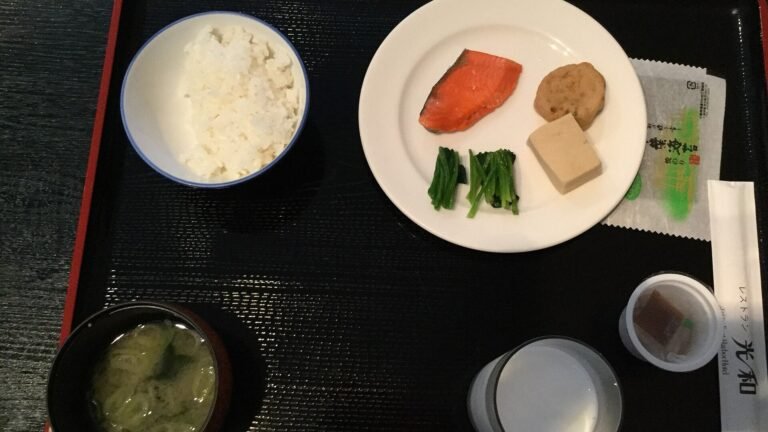
Japan Breakfast 2026: Teishoku, Kissaten and Where to Eat
A Japanese breakfast is rice and miso soup with fish, pickles and egg. Eat it at your ryokan, a teishoku chain, a kissaten morning set or a morning market.
Japan breakfast: the short answer
A traditional Japan breakfast is rice and miso soup with small dishes of fish, pickles, tofu, seaweed and egg. Eat it at your ryokan, or go out to a teishoku chain, a kissaten, a konbini (many open 24 hours) or a morning market.
Breakfast at your hotel is often the quickest way to start the day, says JNTO, Japan’s national tourism organisation. Outside the hotel, pick by time and appetite. A konbini sells onigiri rice balls, sandwiches, fruit and coffee to carry. A chain restaurant serves a hot set meal, and many branches stay open around the clock. A kissaten, an old-style coffee shop, adds toast and an egg to your coffee on weekday mornings. Hakodate Morning Market opens at 5:00 from May to December and at 6:00 from January to April.
This guide takes each option in turn. It ends at Narita, Haneda and Kansai airports, for travellers who land before dawn. The illustration below matches four common mornings to the place that suits them.
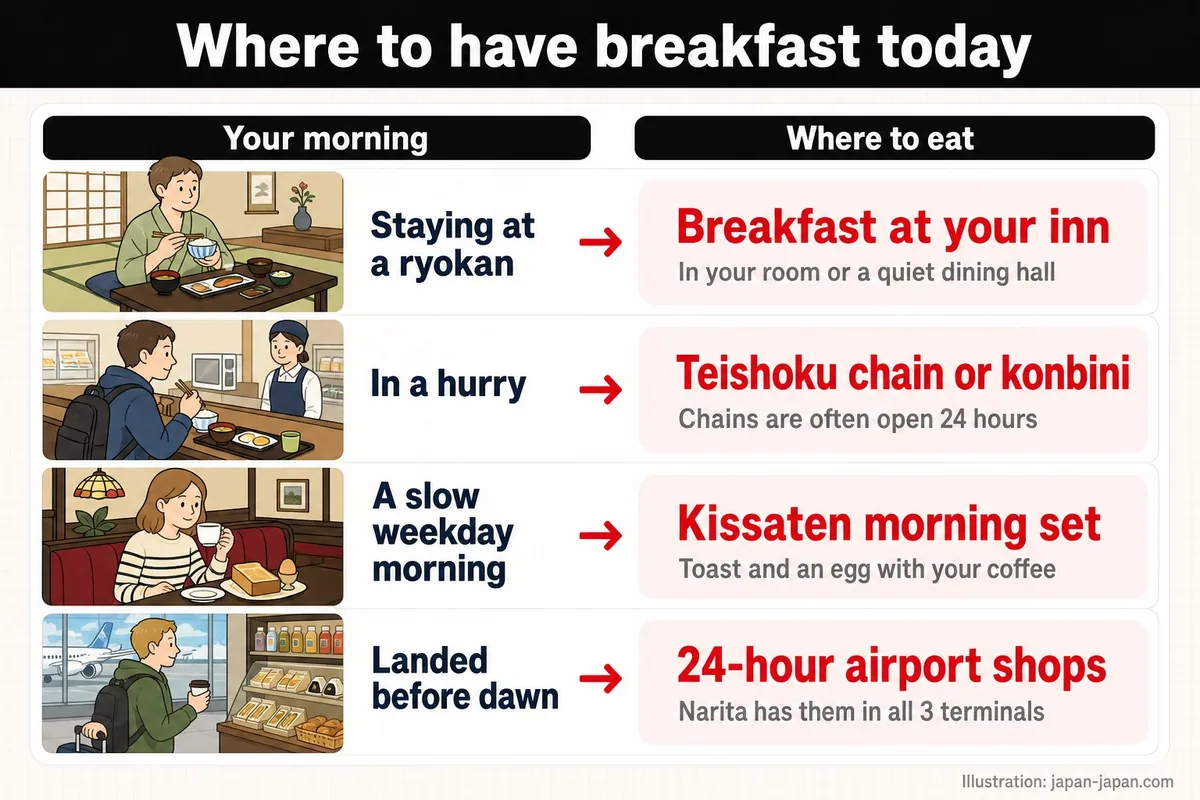
Konbini are the fallback almost everywhere. JNTO says they stand on nearly every street corner, and 7-Eleven, FamilyMart and Lawson all run English websites. Our pick of convenience store food worth buying goes through the shelves in detail.
The table below sums up the six main places to eat, with the hours that the official guides give.
| Place | Hours in the sources | What you get |
|---|---|---|
| Konbini (convenience store) | Often open 24 hours | Onigiri, sandwiches, fruit and coffee |
| Family and chain restaurants | Often open 24 hours | Rice, miso soup and grilled fish, or a Western set |
| Stand-up soba and udon | Open early, in or by major stations | Noodles with meat, vegetable or fried toppings |
| Kissaten (coffee shop) | Morning set, generally weekdays only | Toast and a boiled egg with your drink |
| Ryokan (Japanese inn) | Ask about serving times before booking | A full Japanese-style breakfast |
| Hakodate Morning Market | 6:00 Jan–Apr, 5:00 May–Dec | Seafood rice bowls at market diners |
What is a traditional Japanese breakfast?
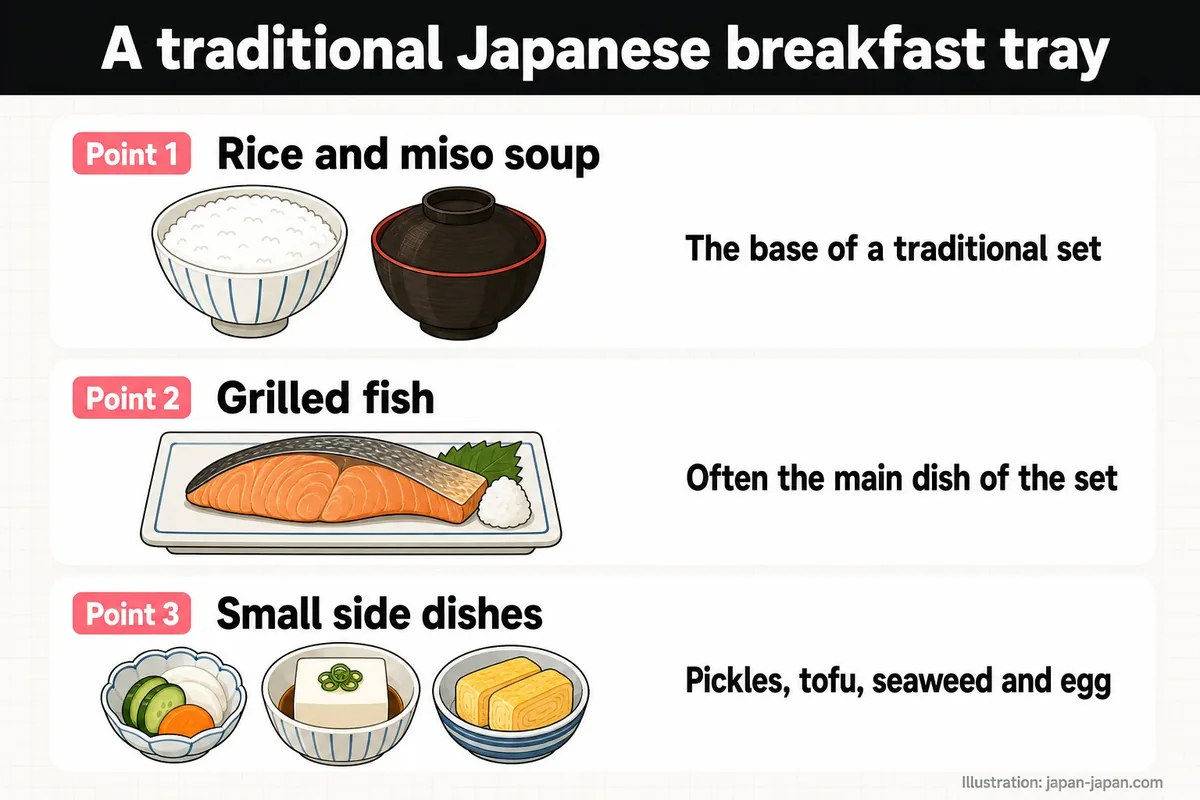
JNTO says a traditional breakfast often comes as several small dishes rather than one large plate. The base is rice and miso soup. Around them sit fish, pickles, tofu, vegetables, seaweed and egg dishes, and JNTO calls the result a nutritionally balanced meal.
GO TOKYO, the official Tokyo travel guide, puts it more simply. In some countries breakfast is a light meal of cereal and fruit. A Japanese breakfast is more substantial, often white rice, miso soup and grilled fish. You will almost certainly get one if you stay at a ryokan, and many hotels offer it as well. The photo below shows a breakfast tray of this kind.
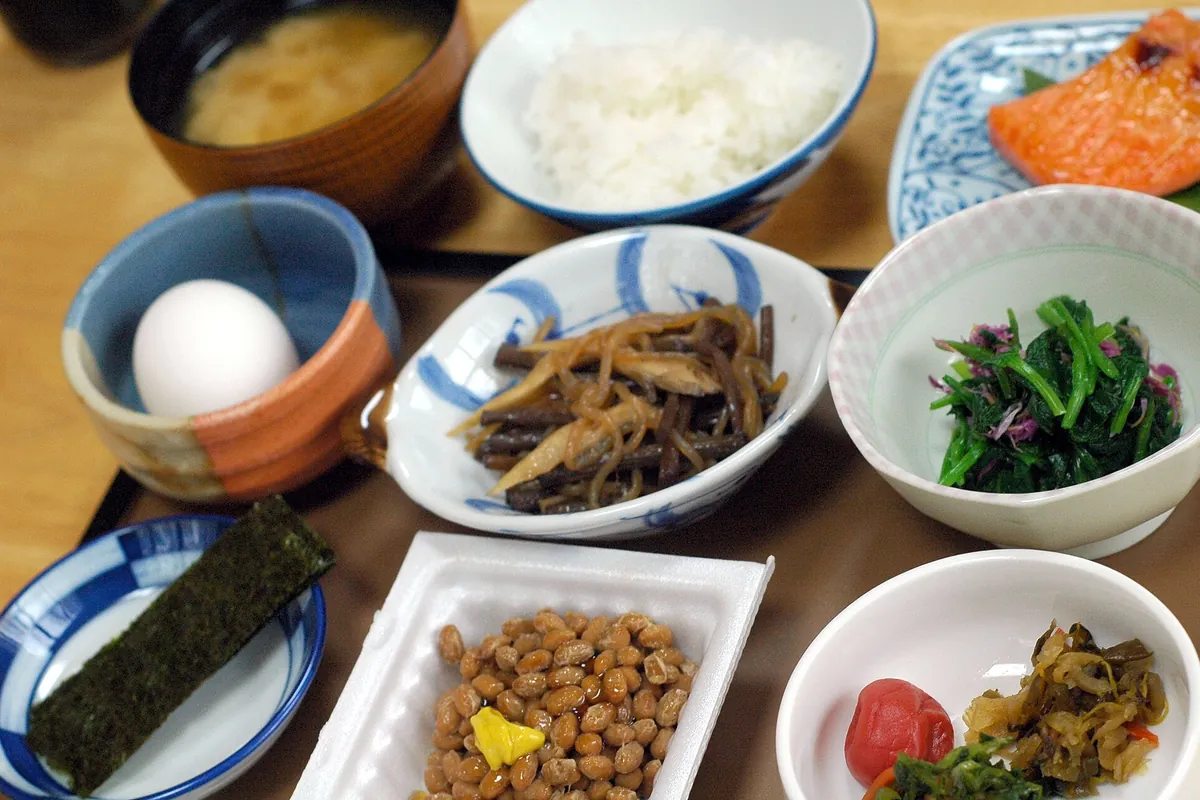
Teishoku is the restaurant version of the same idea. JNTO’s vocabulary guide translates the word as meal set, pronounced tay-show-ku. You order a main dish, and white rice, miso soup, sozai (side dishes) and tsukemono (pickled vegetables) come with it. Common mains are grilled meat, deep-fried pork or fish, and broiled dishes such as salmon broiled in soy sauce. Noodles such as udon and ramen, and Chinese dishes such as gyoza, also come as teishoku.
If savoury food first thing feels like too much, JNTO says it is perfectly fine to skip it. Choose what suits your appetite that day. Vegetarian, vegan and halal travellers can find suitable choices too, and our guide to vegetarian food in Japan explains what to ask.
To try the traditional style without a ryokan, GO TOKYO points to two places in the downtown Shitamachi area. Misojyu in Asakusa specialises in miso soup made with organic vegetables and also serves onigiri. An English information board inside makes ordering easy. Risaku in Sendagi is an onigiri cafe that cooks its rice in a traditional hagama pot and offers set menus. The illustration below picks out the three parts of a breakfast tray.
Teishoku breakfast at chain restaurants
Teishoku at a chain restaurant is a fast, hot breakfast, and JNTO calls these chains affordable and efficient. Its breakfast guide lists Yoshinoya, Matsuya, Sukiya, Gusto and Denny’s, which all have English websites. Besides gyudon beef bowls and Western-style dishes, they often serve Japanese set meals. Some have multilingual touch-screen ordering, which saves time. Locals and busy commuters make these chains a popular morning choice.
GO TOKYO adds detail for family restaurants and chains. The Japanese set meal is rice, miso soup and grilled fish. The Western one has scrambled eggs, sausages and toast, and some branches serve seafood bowls or run a buffet. A drink bar often makes orange juice and coffee all-you-can-drink. Multilingual touch screens, cashless payment and free Wi-Fi are common, and many branches are open 24 hours a day.
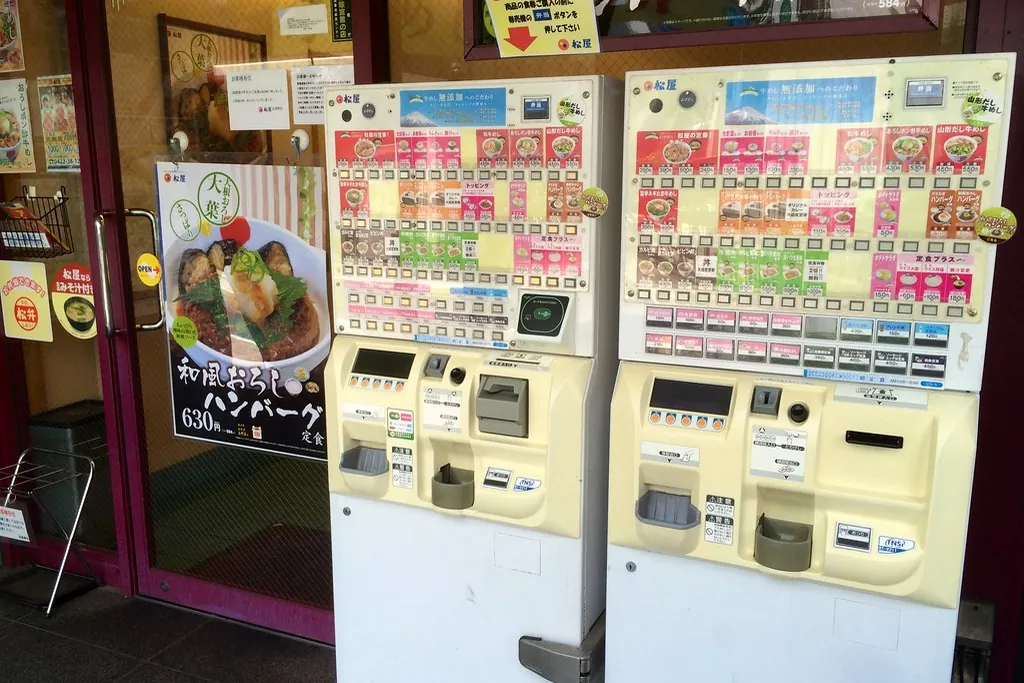
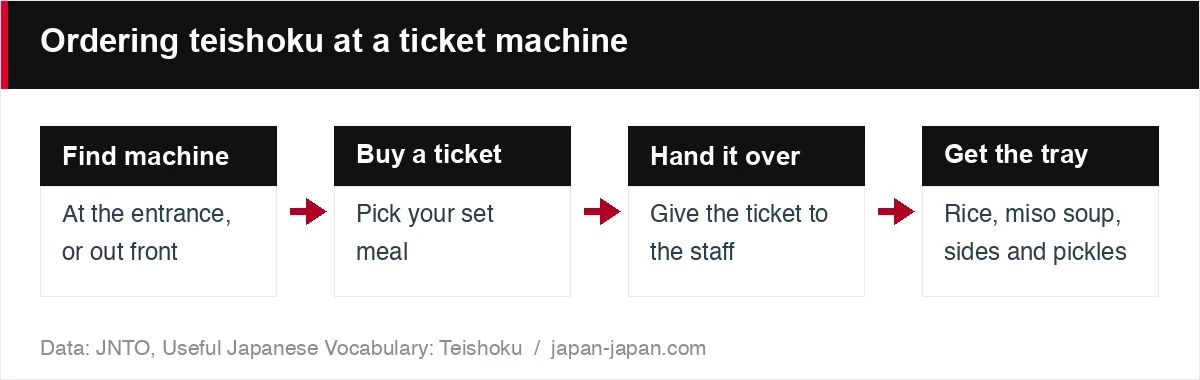
Many teishoku restaurants are run cafeteria style, JNTO says, with a meal ticket machine out front or near the entrance. You buy a ticket there and hand it over to receive your meal. These places cluster near stations in big cities and near colleges, and students and office workers on a budget eat there. The photo below shows a meal ticket machine of the kind you will meet at the door.
The chart below sets out the four steps from the machine to your tray.
Stations are the other early option. GO TOKYO says stand-up soba and udon counters sit inside or in front of major stations and open early in the morning. You eat standing next to commuters and choose toppings such as meat, vegetables or fried food. Some counters also serve curry, katsudon and ramen.
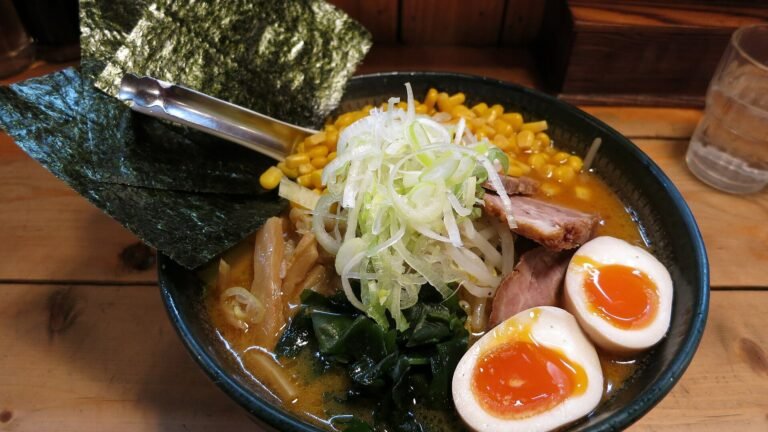
For something newer, try asa-raa, or morning ramen. GO TOKYO says the custom has long existed in some parts of Japan and has recently spread nationwide. Several popular ramen shops in Tokyo Station serve it. The breakfast bowl often has a lighter soup, and many shops offer early-bird deals.
Kissaten morning sets and Nagoya’s Morning Service
A kissaten is an old-style Japanese coffee shop. JNTO’s kissaten guide says they first appeared in the early 20th century as an alternative to French-style cafes. The word kissa first meant drinking tea, but the shops soon became tied to coffee. They took off in the Showa era, which ran from 1926 to 1989. At their peak there were over 150,000 kissaten across Japan.
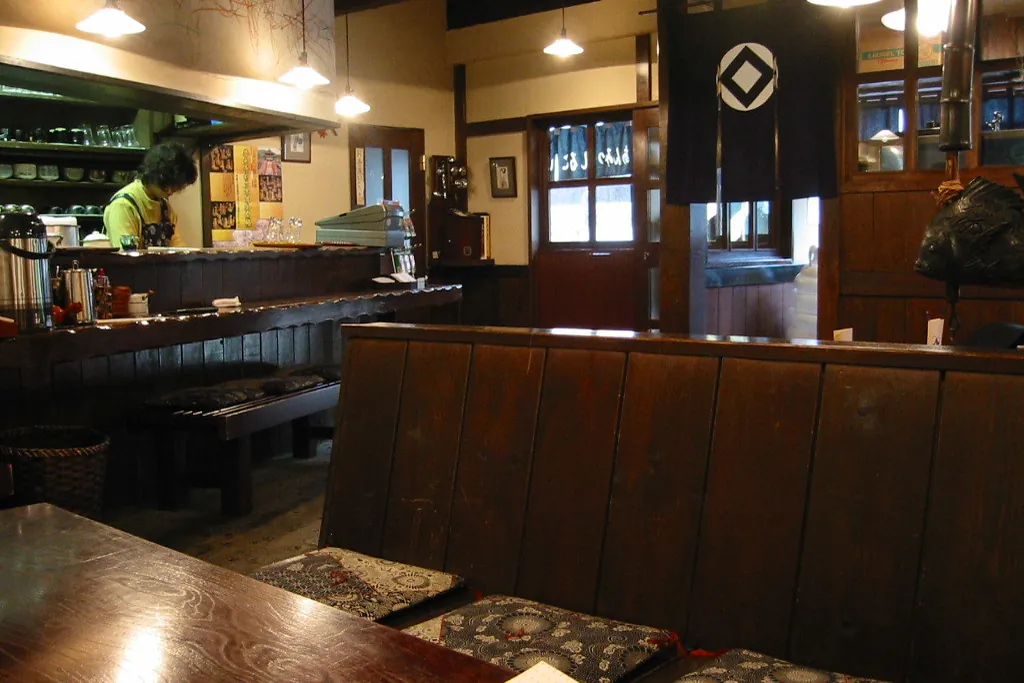
Expect darker roasts brewed by pour-over or syphon, and do not expect espresso drinks. Many shops roast their own beans, and Kyoto’s Smart Coffee, founded in 1932, still does it on the premises. Menus run to sandwiches, napolitan spaghetti and pizza toast, plus cheesecake, caramel pudding and ice cream sundaes. The photo below shows the retro look that many kissaten keep.
For breakfast, look for a morning set. JNTO says it is generally available on weekdays only, and the price of a tea or coffee also gets you a small plate of food. Sometimes that is just a slice of toast and a boiled egg, but it can be much more. JNTO’s breakfast guide describes cafe breakfast sets in a similar way: toast, eggs, salad and a drink, served only in the morning.
Nagoya takes the deal furthest. JNTO’s Nagoya itinerary says that at some kissaten and cafes, breakfast comes free when you order a coffee. It is often a slice of toast, a boiled egg and other sides that vary by shop and area. Some shops serve Ogura toast, which is toast filled with sweet red bean paste.
The custom is known as Morning Service, or simply Morning. JNTO says it probably began in Ichinomiya or Toyohashi, two other cities in Aichi Prefecture. The story dates from the 1950s, when business owners met in cafes to get away from the noise of their factories. Cafe owners began giving them free breakfasts to say thank you.
Flying into Chubu Centrair for a Nagoya morning? The Meitetsu mu-SKY reaches Nagoya in 28 minutes for 1,430 yen, and the limited express costs 980 yen. Our page on Chubu Centrair Airport to Nagoya compares the trains, buses and taxis.
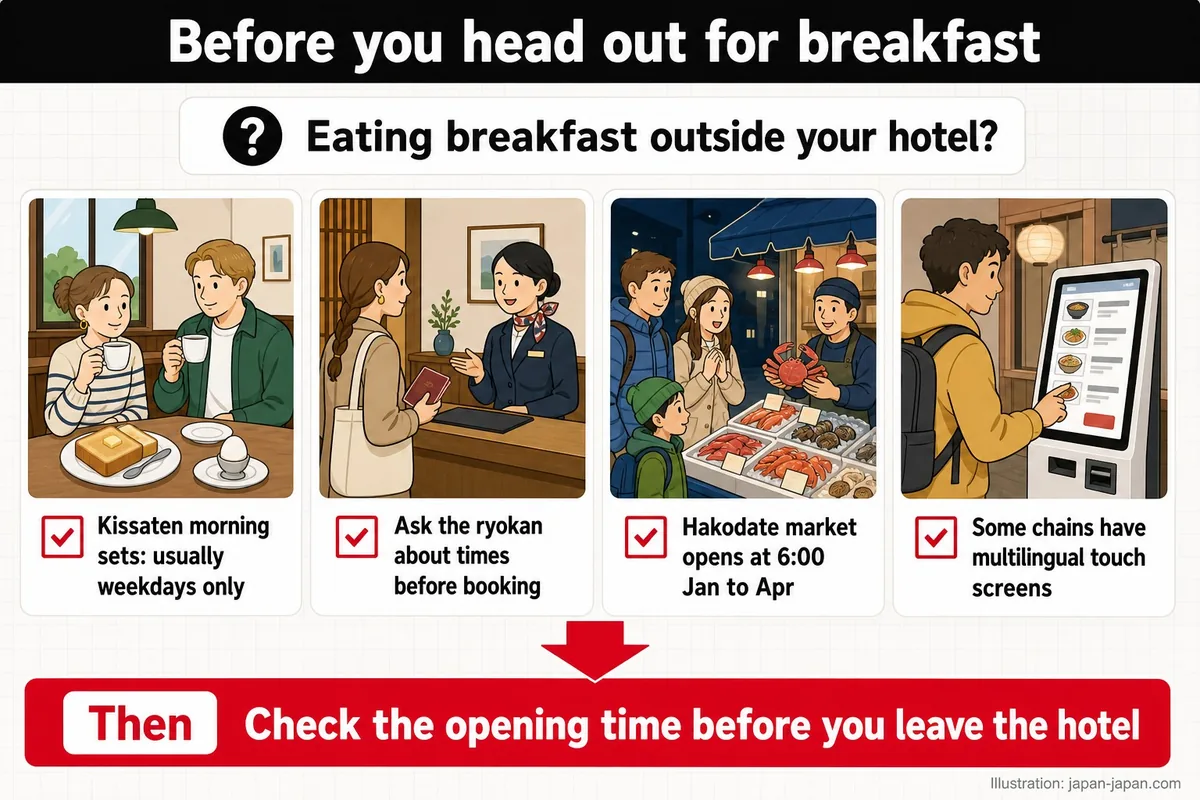
Morning sets, ryokan hours and market hours all have small catches. The illustration below lists four things to check before you head out.
Hotel and ryokan breakfast
A hotel breakfast is the easy choice on a first visit. JNTO calls it a convenient option, especially for first-time visitors. Where there is a buffet, you will often find Japanese and Western-style dishes side by side. That lets you mix familiar food with something new, and GO TOKYO adds that most hotels offer a Western-style breakfast.
Buffet manners are simple. JNTO says it is good manners to take only what you can finish. Go back for seconds if you are still hungry, rather than filling your plate on the first trip.
A ryokan breakfast is more formal. JNTO says many ryokan take pride in a full Japanese-style breakfast, usually served in your room or in a quiet dining hall. If you have questions about the menu, the portion size or the serving time, ask the inn before you book. Some ryokan sell room-only or dinner-only plans, which suit anyone who would rather not eat unfamiliar food first thing.
Our ryokan guide covers prices, meals and booking. For room types, city taxes and check-in, read our guide to hotels in Japan.
If the buffet gets repetitive, GO TOKYO suggests a Western breakfast in Daikanyama or Omotesando. Ivy Place in Daikanyama serves its breakfast menu until 10:45, with pancakes, granola, egg dishes and smoothies. In Omotesando, crisscross serves pancakes and homemade toast on an open terrace and runs a bakery called breadworks. World Breakfast All Day serves breakfasts from around the world, with a menu that changes every two months.
Morning markets: Hakodate and Tsukiji
Hakodate Morning Market opens at 5:00 for most of the year. Its official site gives the hours as 6:00 to just after 14:00 from January to April. From May to December, the hours are 5:00 to just after 14:00, and each shop sets its own times. Under regular days off, the site lists 年中無休 (nenjū mukyū), which means open every day of the year. Here too, each shop sets its own days.
On a winter trip, that later 6:00 start matters if you want breakfast before a morning train. The market covers about 3 hectares and has about 250 shops. About 150 belong to the market’s federation and display its recommended-shop sign, and about 100 do not. Besides crab, salmon and other seafood, the stalls sell produce straight from farms, salted and dried fish, rice, flowers and clothes.
For breakfast, head to the diners that serve very fresh seafood rice bowls. The official site estimates more than 1.5 million visitors a year and 3,000 on an average day. The market began in the Showa era, when farmers from around Hakodate sold vegetables in a corner of the square in front of Hakodate Station. Today it has an information counter for visitors, wheelchair access, wheelchairs to borrow and accessible toilets.
From Hakodate Airport, the shuttle bus to Hakodate Station takes 20 minutes and costs 700 yen. The rapid 8 route bus takes 25 minutes for 500 yen, and route bus 96 is the cheapest at 340 yen in 33 minutes. See Hakodate Airport to Hakodate Station for all three buses, and our Hakodate Airport guide for the rest of the airport.
In Tokyo, GO TOKYO calls Tsukiji still a great place for an early breakfast. Tsukiji was home to one of the world’s most famous fish markets from 1935 to late 2018. The inner market then moved to nearby Toyosu, but the outer market stayed. You can still eat very fresh sushi for breakfast in the surrounding restaurants. Inside the outer market, Tsukiji Uogashi has around 60 shops, and you can watch a professional fillet a whole tuna.
If you would rather skip fish, the nearby streets have plenty of cafes with hearty breakfasts. Some are nostalgic cafes that have served strong coffee and thick toasted sandwiches to market workers for generations.
Tsukiji is a ten-minute walk from Ginza. You can also take the Hibiya Line to Tsukiji Station, or the Toei Oedo Line to Tsukijishijo Station, 21 minutes from Shinjuku. By train, GO TOKYO gives 45 minutes from Haneda Airport and 90 minutes from Narita. Our Haneda Airport to Ginza page lists the current train routes and fares. For Tsukiji’s hours and manners next to Nishiki and Kuromon, read our guide to the three food markets.
Breakfast at the airport after an early landing
Narita, Haneda and Kansai all have food that opens before dawn. At Narita, the airport’s page on night and early-morning use lists the hours floor by floor. In Terminal 1, 1F and B1F are open 24 hours, and 2F to 4F open from 05:00 to 24:00. In Terminal 2, B1F, 1F and 2F stay open around the clock, and 3F and 4F keep the 05:00 to 24:00 hours. In Terminal 3, 1F and 2F are both open 24 hours.
The 24-hour food is a short list. Terminal 1 has a LAWSON convenience store on B1F. Terminal 2 has a 7-Eleven on B1F and a 24-hour Yoshinoya restaurant in the Main Building. Terminal 3 has a LAWSON and a Matsuya, both on 2F and both open all night. Flights at Narita only operate from 06:00 to midnight, so you cannot wait overnight after security.
Our pages on Narita Terminal 1, Terminal 2 and Terminal 3 list the airlines, stations and overnight hours for each building. A capsule hotel in Parking P-2, directly connected to Terminal 2, is open 24 hours, and the airport recommends booking ahead.
At Haneda, the international Terminal 3 is open 24 hours. Our Haneda Terminal 3 page lists Air LAWSON on 1F, before security. A 7-Eleven on 3F is in the departure area after security. Terminal 1 and the domestic areas of Terminal 2 open at 05:00 and close at midnight.
Kansai Airport is open 24 hours a day, but some entrances close at night. Kansai Terminal 2 handles Peach, Jeju Air and Spring Airlines. Its COCO’S Airport Dining on 1F opens from 04:00 to 02:00 the next morning. A free shuttle bus links Terminal 2 with Aeroplaza and Terminal 1 through the night, except from 01:00 to 02:00. The table below lists the food that stays open all night, or close to it, at the three airports.
| Terminal | Where to eat | Hours | Floor |
|---|---|---|---|
| Narita Terminal 1 | LAWSON (convenience store) | 24 hours | B1F |
| Narita Terminal 2 | 7-Eleven (convenience store) | 24 hours | B1F |
| Narita Terminal 2 | Yoshinoya (restaurant) | 24 hours | Main Building |
| Narita Terminal 3 | LAWSON and Matsuya | 24 hours | 2F |
| Haneda Terminal 3 | Air LAWSON | 24 hours | 1F, before security |
| Haneda Terminal 3 | 7-Eleven | 24 hours | 3F, after security |
| Kansai Terminal 2 | COCO’S Airport Dining | 04:00 to 02:00 next day | 1F |
One warning if you plan to carry breakfast from home. Most meat and meat products cannot be brought into Japan, even cooked, vacuum packed or bought at an airport shop. Check our page on bringing food and packed meals into Japan before you pack a ham sandwich. For the ride into town, our airport transfer pages compare times and fares route by route.
FAQ
What do Japanese people eat for breakfast?
A traditional breakfast is rice and miso soup with small dishes such as fish, pickles, tofu, vegetables, seaweed and egg. GO TOKYO calls it a more substantial meal than cereal and fruit, often with grilled fish. JNTO calls konbini an essential part of Japan’s morning culture, and chain restaurants serving set meals are popular with commuters.
What is a kissaten morning set?
It is a breakfast deal at a kissaten, a traditional Japanese coffee shop. The set is generally sold on weekdays only, and the price of your tea or coffee also gets you a small plate. That is often toast and a boiled egg. In Nagoya the custom is called Morning Service, and some shops serve Ogura toast with sweet red bean paste.
What time does Hakodate Morning Market open?
Shops open at 6:00 from January to April and at 5:00 from May to December. Most close a little after 14:00, and each shop sets its own hours and days off. The official site estimates an average of 3,000 visitors a day.
Where can I eat breakfast at Narita Airport early in the morning?
Narita lists 24-hour food in all three terminals. Terminal 1 has LAWSON on B1F, and Terminal 2 has 7-Eleven on B1F and Yoshinoya in the Main Building. Terminal 3 has LAWSON and Matsuya. In Terminal 1, the floors from 2F to 4F open at 05:00, while 1F and B1F stay open all night.
Photo: イーストハーバーホテル 根室市 (27780446459).jpg by inunami (CC BY-SA 2.0, cropped), via Wikimedia Commons.

.jpg)