
Japanese Snacks to Bring Home in 2026: Tax-Free and Customs
Japanese snacks go in your carry-on in any amount; sake bought before security goes in the hold. From 1 November 2026 the tax comes back after a customs check.
Japanese snacks to bring home: the short answer
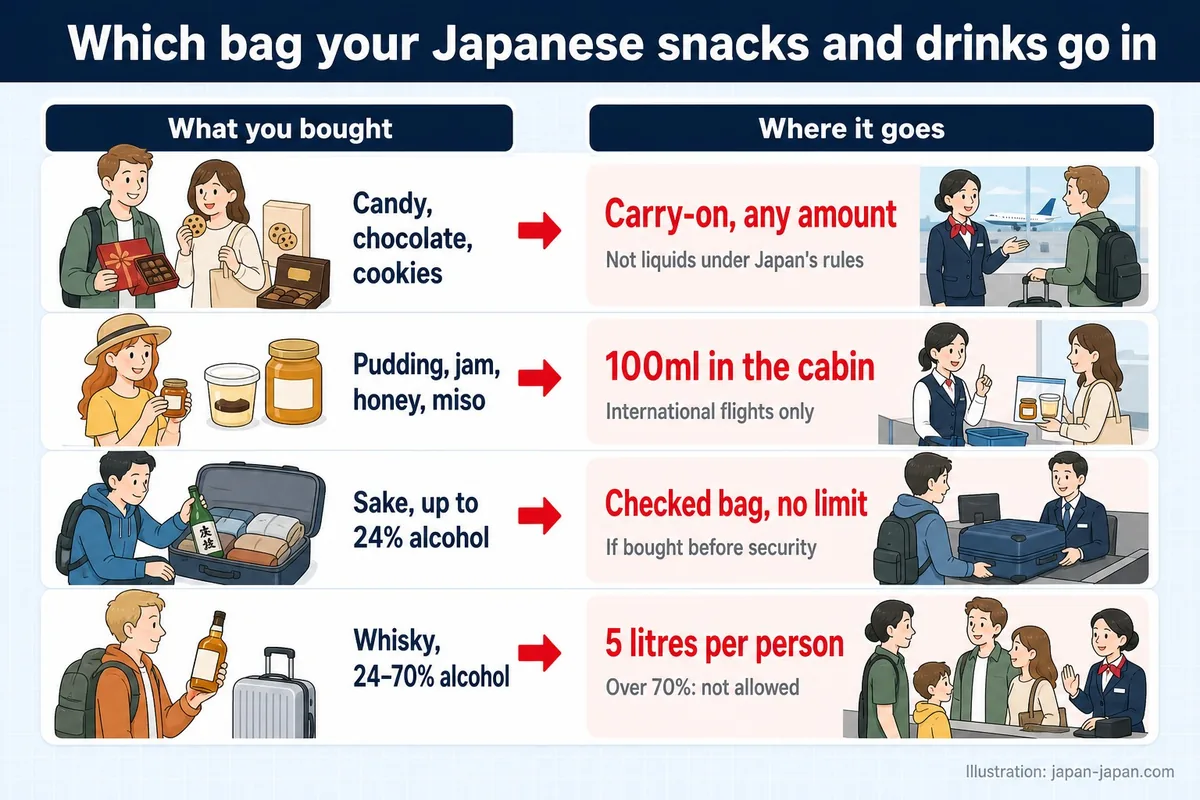
Japanese snacks such as candy, chocolate and cookies can go in your carry-on in any amount. Pudding, jam and honey count as liquids, so international flights cap them at 100ml per container.
Drinks and the new tax-free rules add five more points.
- Sake: it typically contains 15 to 16% alcohol, according to the National Tax Agency. Japan sets no limit on drinks up to 24%, but on international flights a bottle bought before security goes in your checked bag.
- Whisky and other spirits: drinks over 24% and up to 70% alcohol are limited to 5 litres per person. Anything over 70% cannot fly at all.
- Tax-free: from 1 November 2026 you pay the price with tax and pass a customs check at the airport. The refund is 8% on food and 10% on alcohol.
- Eating it first: if you open and eat one tax-free snack, nothing on that receipt is refunded.
- At home: declare food when you land. The US, the UK and Australia each publish their own lists and allowances.
The illustration below sorts the usual purchases by the bag they go in.
What to buy in Japan: omiyage and regional sweets
Omiyage are the boxed sweets and snacks people bring back from a trip. Each region has its own, so a box from the place you visited makes the most personal gift.
The Japan National Tourism Organization’s guide to Hiroshima souvenirs shows how this works. It starts with momiji manju, a famous cake baked in the shape of a maple leaf. It was created on Miyajima in the early 1900s to represent Momijidani, the island’s maple-viewing spot.
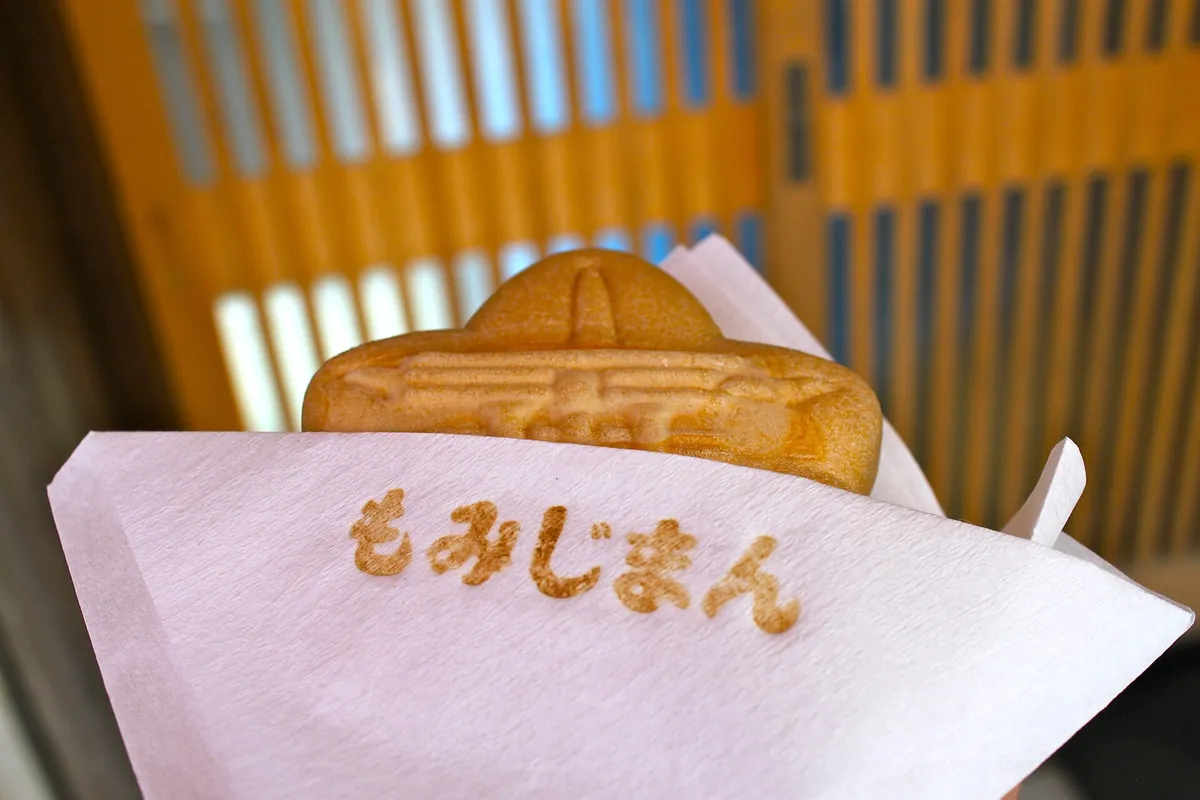
The photo above shows momiji manju in their maple-leaf shape. The filling is traditionally sweet red bean paste, and today you can also find matcha, cheese, custard or chocolate. You can watch them being made on Miyajima, and shops across Hiroshima Prefecture sell them.
The same guide lists other local sweets and snacks. Each one is tied to a place or a local product.
- Shakushi senbei: rice crackers shaped like a rice ladle. The shakushi is a good luck charm from Miyajima with a history dating back to 1700.
- Monaka: a wafer shell filled with sweet bean paste. Tsurukame Monaka uses a less-sweet paste and makes a sake-flavoured version in autumn and winter.
- Prawn crackers: Calbee’s prawn crackers originated in Hiroshima.
- Lemon cake: Hiroshima grows more than half of Japan’s lemons in the Setoda area. The most popular lemon souvenir is a madeleine cake baked in the shape of a lemon.
- Sake sweets: the breweries of Saijo make sake manju, sake fruit cake and sake karinto. Karinto is a fried dough snack, coated here with sake lees.
Away from Hiroshima, two kinds of shop make the hunt easy. Department store food halls, or depachika, are the place for boxed sweets, and our ekiben guide covers them and the shops at Tokyo Station. Convenience stores sell single packs of candy and chocolate, and our convenience store food guide picks out what is worth buying.
Japanese snacks and candy: what counts as a liquid
Japan’s cabin rule turns on one question: is the food a liquid? According to the snacks and sweets entry in our carry-on database, candies, chocolate, cookies, cakes and doughnuts are not treated as liquids. You can carry them in any quantity, in the cabin or in the hold.
Soft and runny foods are different. Pudding, milk shakes, smoothies and ice cream count as liquids. So do jam, honey, miso, yogurt, soup and curry, as our food and packed meals page lists. On international flights each container must hold 100ml or less.
All of those containers go into one transparent re-sealable bag of 1 litre or less, with a length and width of 20cm or less. Each passenger gets one bag. Domestic flights within Japan do not apply the limit, and our liquids page has the full rule.
Larger jars and pots can travel in your checked bag. A liquid you buy after security, inside the restricted area, is also excepted from the 100ml rule.
The table sorts the usual snack purchases by Japan’s rule for international flights.
| What you bought | Japan’s rule | Where to pack it |
|---|---|---|
| Candy, chocolate, cookies | Not a liquid | Carry-on or checked, any amount |
| Cakes and doughnuts | Not a liquid | Carry-on or checked, any amount |
| Pudding, ice cream, smoothies | Liquid | Cabin: 100ml containers in the bag. Larger: checked |
| Jam, honey, miso, yogurt | Liquid or paste | Cabin: 100ml containers in the bag. Larger: checked |
| Matcha and other powders | Not on the liquids list | Carry-on or checked |
Matcha and other powders are not on Japan’s liquids list. The list also leaves out dried spices such as pepper and curry powder, and soup stock in cubes or powder. A tin of matcha can therefore go in either bag. Other countries do screen powders, and our powder page lists extra conditions in Australia.
The photo below shows the kind of snack shelf you will find in shops across Japan.
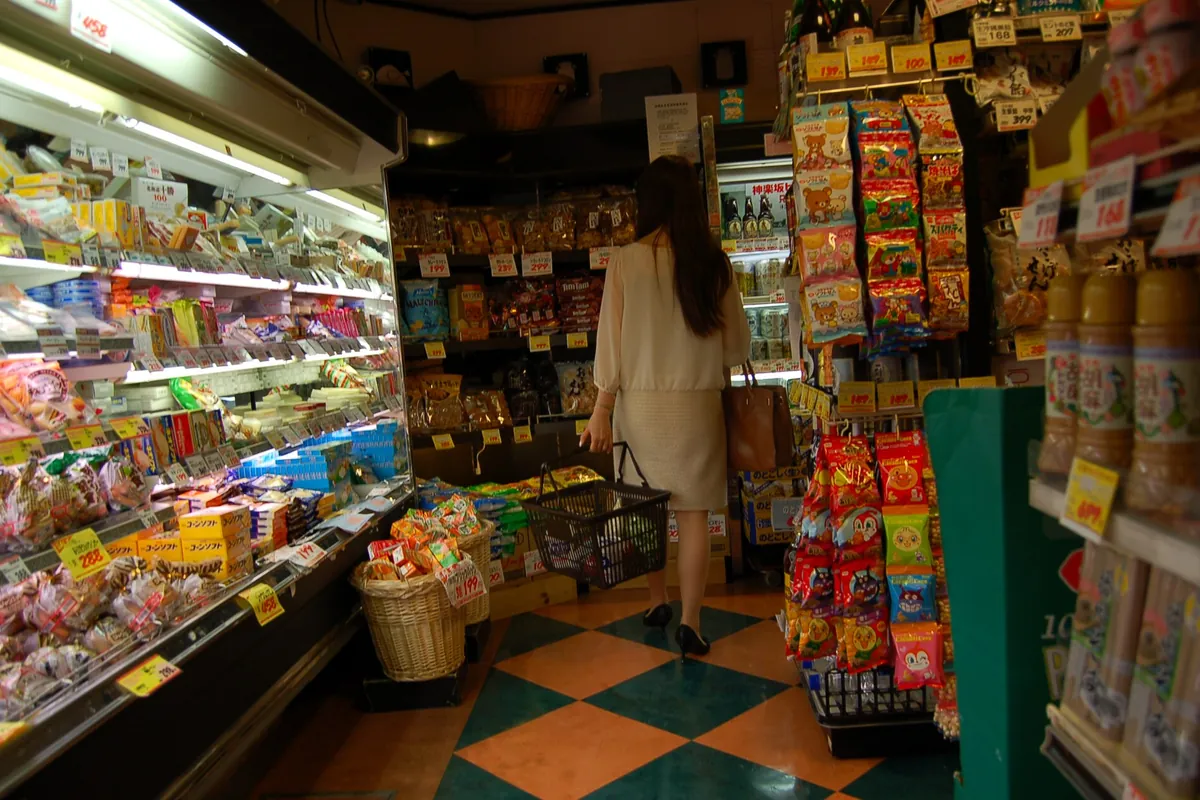
Before you fill a basket, read the ingredients for meat. The US and UK customs pages covered below both turn away meat products.
Sake and Japanese whisky: the 24% and 70% lines
For alcohol, Japan’s rule depends on the strength printed on the label. Our alcohol page, based on the Japan Civil Aviation Bureau’s list, sets three bands.
- Up to 24% alcohol: no limit.
- Over 24% and up to 70%: 5 litres per person.
- Over 70%: not allowed at all, in the cabin or in the hold.
Keep each drink in the retail bottle it was sold in, because decanting into a flask is not accepted. On international flights the 100ml liquid rule also applies in the cabin. So a bottle you buy in town, before security, goes in your checked bag. On domestic flights within Japan the 100ml rule does not apply.
The table below puts the three bands side by side.
| Strength | Per person | Note |
|---|---|---|
| Up to 24% | No limit | Sake typically contains 15 to 16% |
| Over 24% up to 70% | 5 litres | Check the strength on a whisky label |
| Over 70% | Not allowed | Refused in the cabin and in the hold |
Sake sits far below the 24% line. The National Tax Agency says sake typically contains 15 to 16% alcohol. Its averages for the five years from 2008 to 2012 are 15.39% for ordinary sake and 15.91% for ginjo. Junmai averages 15.46% and honjozo 15.54%.
The same page explains the words you will see on labels. Junmai sake is made only from rice, koji and water, and it tends to taste drier and richer. Ginjo sake is brewed from highly polished rice by the ginjo-zukuri method, and its fruity aroma comes from esters that taste like banana and apple. Honjozo sake is made from polished rice, koji, water and jozo alcohol. Anything else is ordinary sake.
Hiroshima is one of Japan’s top three sake-producing areas, according to JNTO, and its town of Saijo draws sake lovers.
Japanese whisky is a different case, so read the strength on the label before you pack. If it shows more than 24% and up to 70%, you can take up to 5 litres per person.
For the bottles themselves, our glass bottles page notes that an empty bottle or jar is not dangerous goods. The liquid inside decides the rule.
Tax-free food and drink from 1 November 2026
Japan switches to a refund system for purchases made from 1 November 2026. You pay the price with tax in the shop. Customs then confirms at the airport that the goods are leaving Japan, and the tax comes back. The Japan Tourism Agency page for travellers sets out the change, and our summary of the new rules has the details.
The illustration below compares the old and new ways of buying tax-free.
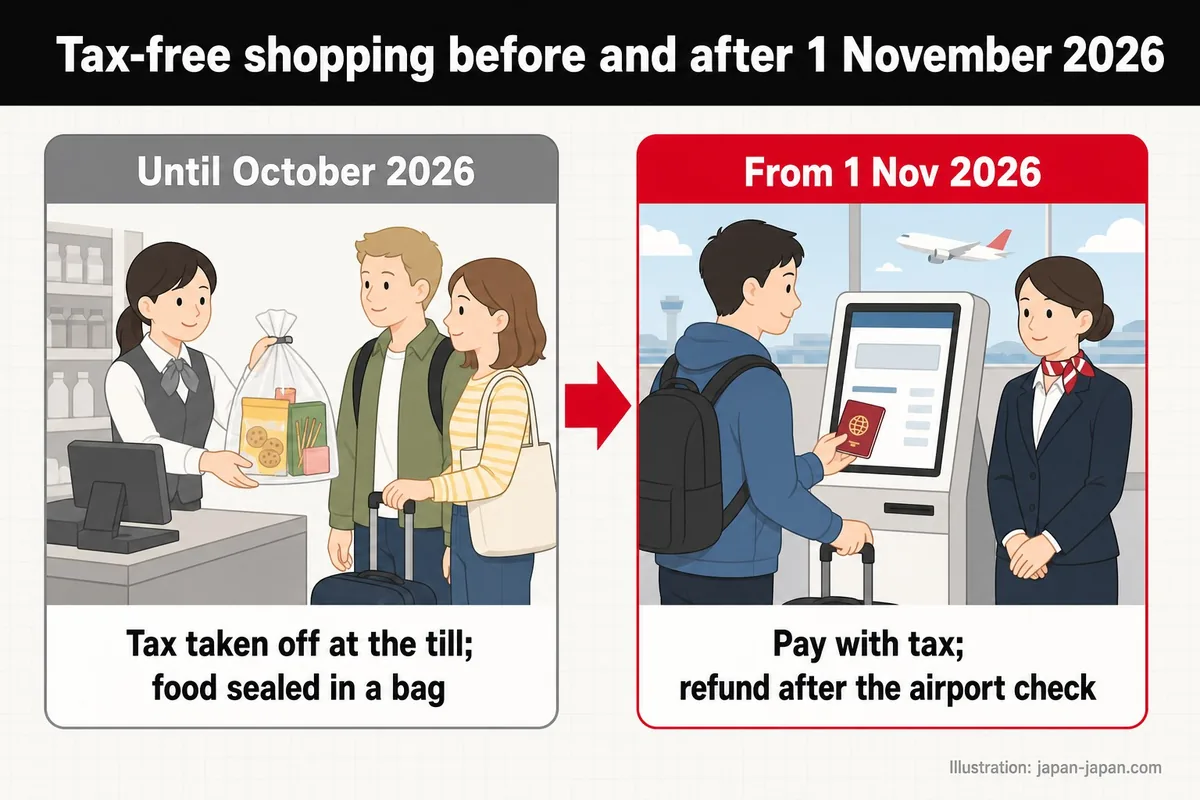
The minimum spend does not change. It is 5,000 yen or more before tax, in the same shop on the same day. At the 10% rate that is 5,500 yen at the till. From 1 November 2026 general goods and consumables such as food count together, as our page on what you can buy explains. There is no upper limit in yen, but you can only buy what you can carry out of Japan yourself.
The refund is the consumption tax in the price, and food carries a lower rate than alcohol. Snacks and other food are taxed at 8%, while sake, whisky and other alcohol are taxed at 10%. The refund comes from the shop or a refund company working for it, so ask the shop how it pays.
The table below shows the same 10,000 yen spent on each.
| What you buy | Before tax | You pay | Refund |
|---|---|---|---|
| Snacks and other food (8%) | 10,000 yen | 10,800 yen | 800 yen |
| Sake and other alcohol (10%) | 10,000 yen | 11,000 yen | 1,000 yen |
You must pass the customs check within 90 days of the purchase, and our page on the 90-day deadline shows how to count it.
The sealed bag also ends on 1 November 2026, and that change catches out snack buyers. Using any part of tax-free food, drinks, medicine or cosmetics in Japan cancels the refund for that receipt. Customs checks goods one receipt at a time. If one item on a receipt is missing, nothing on it is confirmed.
If you have eaten some of it, the Japan Tourism Agency says to skip the kiosk and tell a customs officer at the counter. The agency’s Q&A leaflet, shown below in Japanese, answers this exact question about sweets and cosmetics.
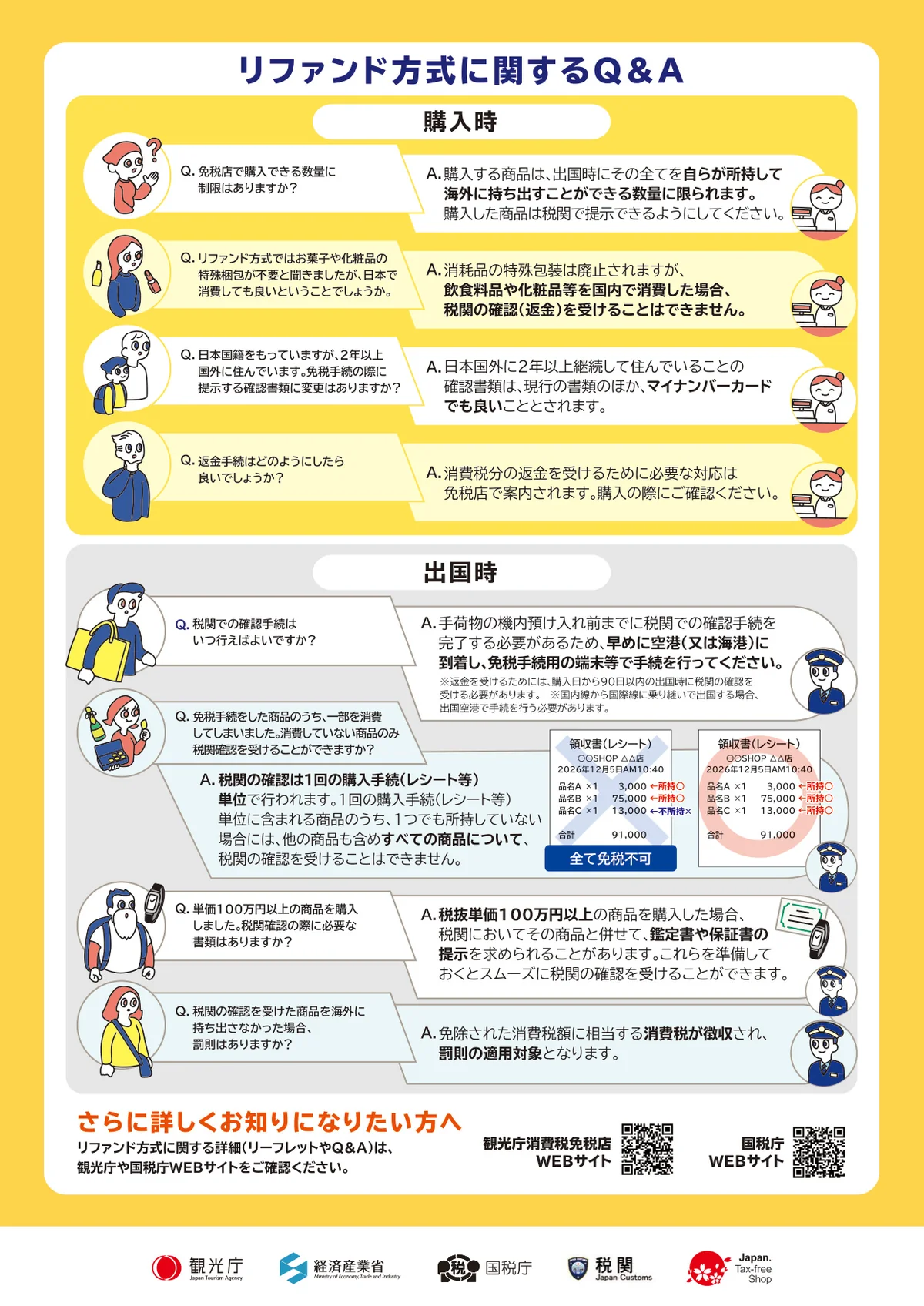
Its answer is that you get no refund on food or cosmetics used in Japan. Further down the page, two sample receipts show the rule: the receipt with a missing item is crossed out in blue. The fix is simple: buy the snacks you want to eat on the trip on a separate receipt from the boxes you are taking home.
Posting snacks home yourself does not get the tax back either. The separate shipment method was abolished on 31 March 2025, so goods you post yourself are not refunded. A shop can ship abroad for you as an export if it offers that service. Our page on sending purchases home explains the difference.
At the airport: customs kiosk, check-in, security
On your departure day, the order matters: customs kiosk first, then check-in, then security. The kiosks stand in the international departure lobby, before baggage check-in, as our airport page shows. The illustration below walks through the four steps.
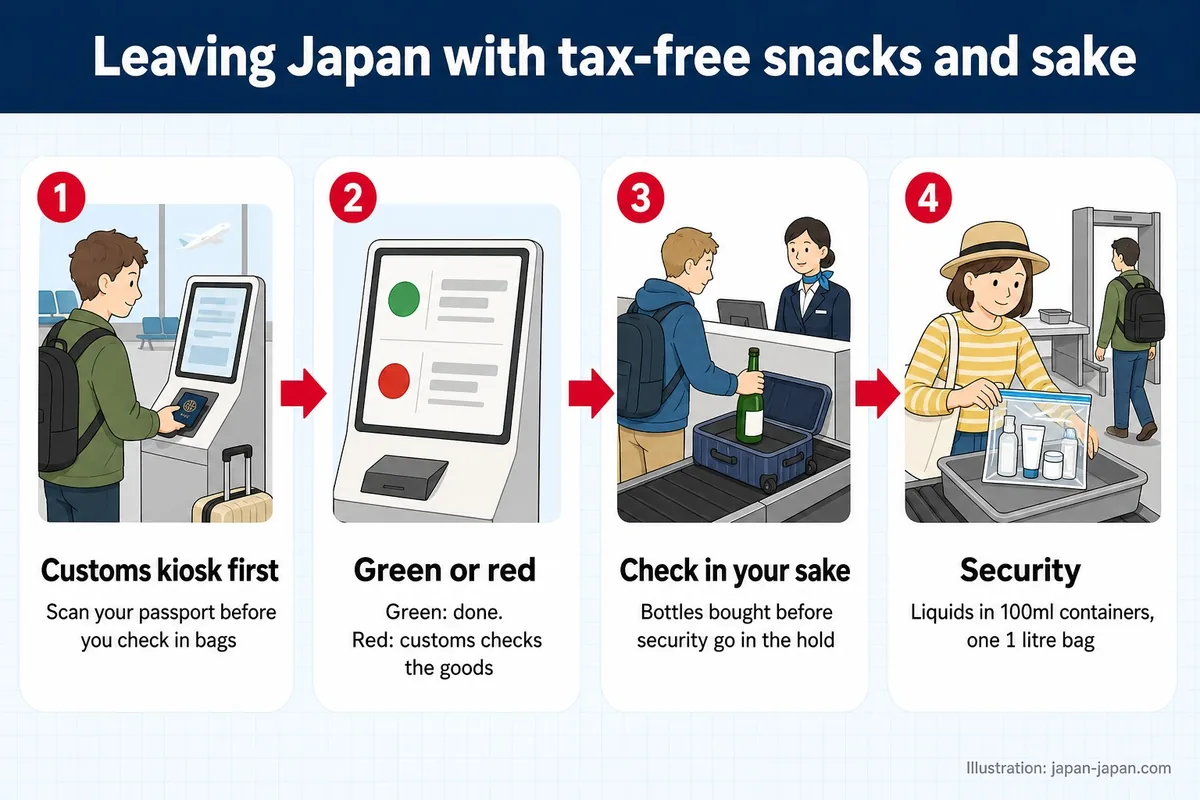
At the kiosk you scan your passport, and the screen shows whether customs needs to inspect your goods. A green result means the procedure is finished. A red result means you take the goods to the customs inspection area. The Japan Tourism Agency calls the machine 免税手続用の端末 (menzei tetsuzuki-yō no tanmatsu), the tax-free procedure terminal, and customs is 税関 (zeikan).
You must have every tax-free item with you when you scan your passport. Once a bag is checked in, you cannot do the procedure for what is inside. The airline will not hand a checked bag back for it either. Keep your sake and boxed sweets with you until the kiosk is done.
Seven busy airports also accept Visit Japan Web instead of the kiosk: Narita, Haneda, Kansai, Chubu, Fukuoka, New Chitose and Naha. You do it online on the airport’s dedicated wireless network, in the area before security.
If you fly a domestic flight first and connect to an international one, do the check at the last airport before you leave Japan. Our page on connecting flights and cruises covers the special cases. Allow enough time, because the check and any inspection must be finished before boarding procedures. The agency states that neither airlines nor customs compensate travellers who miss a flight because of it.
The Japan Tourism Agency’s page for travellers, shown below in Japanese, draws the whole procedure as a flow from the shop to the refund.
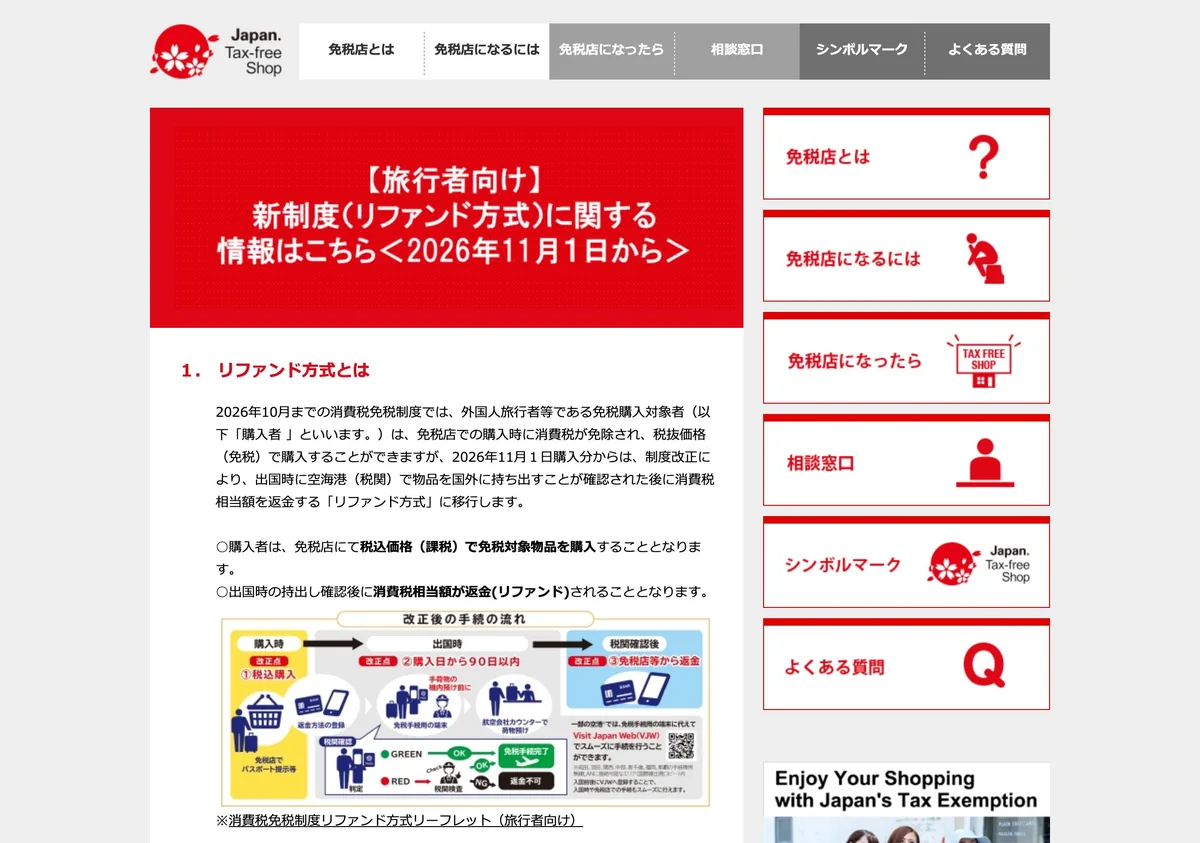
Its middle panel puts the kiosk before bag drop. A green route leads to the end of the procedure, and a red one to a customs inspection. After the kiosk, check in your bags with the sake inside.
At security, liquids in the cabin must be in containers of 100ml or less, all in one transparent bag of 1 litre or less.
Customs at home: the US, UK and Australia
Your own country decides what food and drink gets in. Declare food whenever you are not sure. Here is what the official pages for three countries say.
United States
The US Customs and Border Protection list says you may bring bakery items and certain cheeses. As a general rule, condiments, vinegars, oils, packaged spices, honey, coffee and tea are admissible. Almost anything containing meat products, such as bouillon or soup mixes, is not.
Declare every agricultural item. CBP sets the civil penalty for failing to declare at $300 for a first offence, rising to $500 for a second.
Returning US residents have an $800 duty-free exemption, according to the CBP duty page. It can include one litre of alcohol if you are at least 21 and the bottle is for your own use. Above that, you pay duty and tax on the rest. The law of the state where you first arrive also governs how much alcohol you can bring, so check it before you fly.
United Kingdom
GOV.UK lets you bring several snack types into Great Britain from any country without restrictions. The list includes biscuits, cakes without fresh cream, and chocolate and confectionery not made with a lot of unprocessed dairy ingredients. Noodles without meat, packaged soup, stocks and flavourings are on it too.
From a country outside the EU, such as Japan, you cannot bring meat, meat products, milk or milk-based products. Honey is limited to 2kg per person. If you do not declare banned food, you could be fined up to £5,000 in England or prosecuted.
The UK alcohol allowance depends on the type of drink. You can bring 42 litres of beer and cider, 18 litres of wine, and 4 litres of spirits over 22% ABV. Other alcoholic products up to 22%, not counting beer, cider or wine, have a 9-litre allowance. Other goods are allowed up to £390, and there is no alcohol allowance for anyone under 17.
Australia
The Australian Border Force sets duty-free limits of AUD900 in general goods for adults and AUD450 for children. The duty-free alcohol limit is 2.25 litres. Families on the same flight can pool their limits, so two adults and two children share AUD2,700. Go over a limit and you pay duty on everything in that category. Its advice on declaring is short: if in doubt, always declare.
The chart below sets these alcohol allowances next to Japan’s 5-litre flight limit for strong drinks.
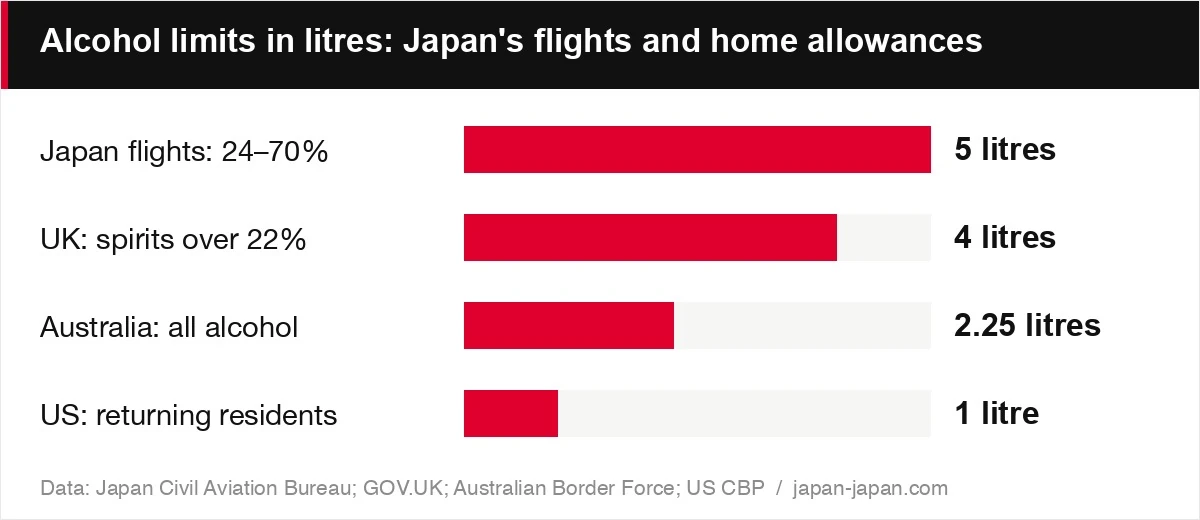
| Item | Value |
|---|---|
| Japan flights: 24–70% | 5 L |
| UK: spirits over 22% | 4 L |
| Australia: all alcohol | 2.25 L |
| US: returning residents | 1 L |
For any other country, check your own customs authority’s website before you buy.
FAQ
Can you take Japanese snacks on a plane?
Yes. Candies, chocolate, cookies, cakes and doughnuts are not liquids under Japan’s rules, so they can go in either bag in any amount. Pudding, milk shakes, smoothies and ice cream count as liquids. International flights limit them to 100ml containers in the cabin.
How much sake can you bring home from Japan?
Japan sets no flight limit on drinks up to 24% alcohol, and sake typically contains 15 to 16%. On international flights, bottles bought before security go in your checked bag. The duty-free allowance at home is smaller: 1 litre for returning US residents and 2.25 litres in Australia.
Can you eat tax-free snacks before leaving Japan?
Yes, but you lose the refund. From 1 November 2026 food is no longer sealed in a bag, but eating any of it cancels the refund for the whole receipt. Tell a customs officer at the counter instead of using the kiosk. Buy snacks for the trip on a separate receipt.
Can you bring matcha powder home from Japan?
Yes, as far as Japan is concerned. Powders are not on Japan’s liquids list, so matcha can go in your carry-on or checked bag. US Customs and Border Protection lists tea as generally admissible. Some other countries screen powders at security, and Australia has extra conditions.
Photo: Sweet Snack (41957536).jpeg by Victor Cormier (CC BY 3.0), via Wikimedia Commons.
.jpg)
.jpg)
.jpeg)