Narita Airport Terminal 2, 1 or 3: Airlines, Access (2026)
Narita Terminal 2 is JAL's, Terminal 1 is ANA's, and Terminal 3 has no station. Airlines by terminal, train stops, free shuttle buses and how early to arrive.
Narita Airport Terminal 2, 1 or 3: the short answer
Narita Airport Terminal 2 handles 42 airlines, including Japan Airlines, and Terminal 1 handles 47, including ANA and United. Terminal 3, the low-cost terminal, has 9 airlines and no station, and for international flights you should arrive at least 2 hours before departure.
Your airline decides the terminal. Narita’s departure guide for international flights says some airlines use one terminal for international flights and another for domestic ones. It also says check-in counters can move from day to day. So search your flight on the departure date, or check the flight information screens and the information counter at the airport.
Code-share flights need one more check. When one airline sells the ticket and another flies the plane, the check-in counter may differ from the usual one. Narita’s flight information page shows the right counter for each flight.
The table below compares the three terminals: the number of airlines, the station and the check-in floor for international flights.
| Terminal | Airlines | Station | Check-in |
|---|---|---|---|
| Terminal 1 | 47, including ANA, United, Korean Air and ZIPAIR | Narita Airport Station, 5 min on foot | 4F |
| Terminal 2 | 42, including JAL, American, British Airways and Qantas | Airport Terminal 2 Station, 5 min on foot | 3F |
| Terminal 3 | 9, including Jetstar Japan, Spring Japan and Jeju Air | No station: 10–13 min on foot from Airport Terminal 2 Station, or the free bus | 2F |
Terminals 1 and 2 each have a station on B1F, right under the building. Terminal 3 has none, so you walk from Airport Terminal 2 Station or ride the free shuttle bus. The airline counts come from Narita’s own airline list, which we checked on 2 October 2026.
The illustration below sums up four checks to make before you set off for the airport.
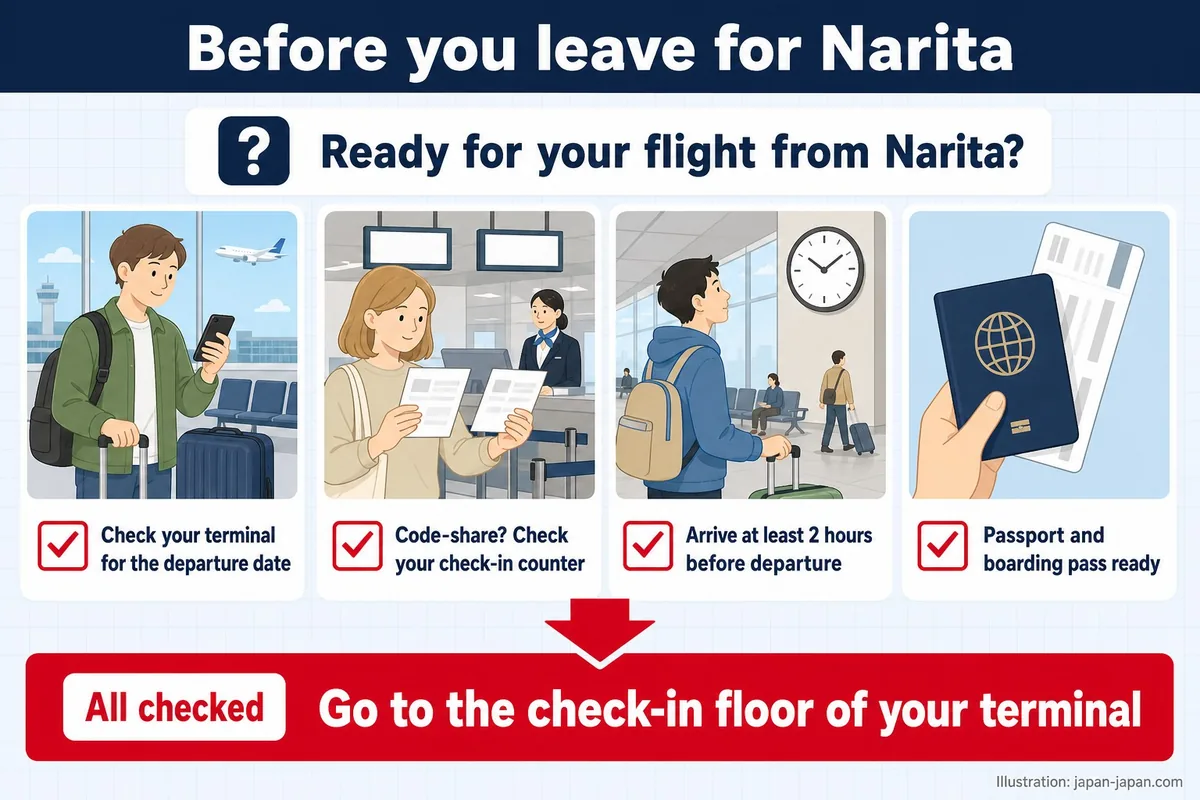
You need your passport at check-in, at security and at passport control.
Which airlines use Narita Airport Terminal 2
Japan Airlines is the main airline at Terminal 2. JAL runs both its international and its domestic flights from this building, so a JAL flight inside Japan also leaves from here.
Terminal 2 has 42 airlines in all. Here are the best-known, by region.
- Japan: Japan Airlines, for international and domestic flights.
- North America: American Airlines.
- Europe: British Airways.
- Australia: Qantas.
- Middle East: Emirates and Qatar Airways.
- Asia: Cathay Pacific and China Airlines.
Our Narita Terminal 2 guide lists the other 34 airlines. It also covers the 8 lounges, the showers, the SIM counters and the ATMs, so this article leaves them out. Before you pack, check the bag allowance on our Japan Airlines page.
International check-in at Terminal 2 is on 3F, the international departure floor. Domestic departures, including JAL’s domestic flights, use 1F, the same floor as international arrivals.
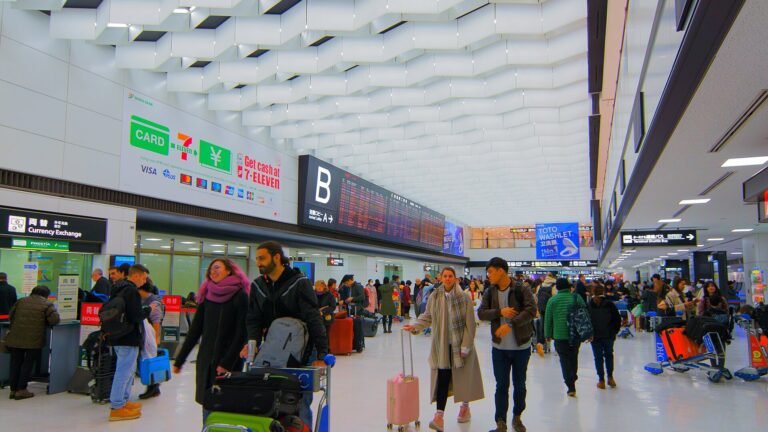
The photo below shows the departure lobby at Terminal 2, with its airline check-in counters.
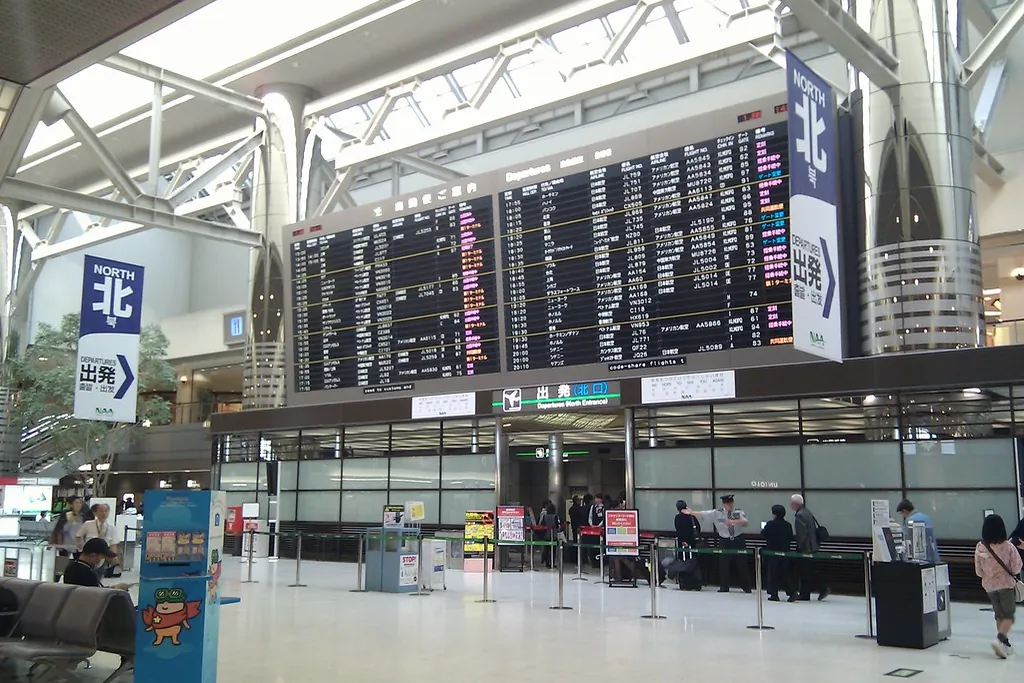
JAL and ANA passengers on international flights can use Face Express, Narita’s boarding procedure with facial recognition. Passengers of some other airlines can use automatic check-in kiosks and self-service bag drops.
For security, Terminal 2 has three international checkpoints on 3F of the Main Building: South, Central and North. In October 2026, Narita’s security hours page listed 07:00 as the opening time for all three.
Narita Airport Terminal 1: ANA, United, Korean Air and ZIPAIR
Terminal 1 has the most airlines of the three: 47. The building has two wings, and your airline decides which wing you check in at.
- South Wing: ANA, United Airlines, Air Canada and Singapore Airlines, among others.
- North Wing: Korean Air, Air France, KLM, Delta Air Lines and ZIPAIR, among others.
Asiana Airlines, EVA Air and Thai Airways also use Terminal 1. Our Narita Terminal 1 guide has the full list, plus the 11 lounges, the showers and the ATMs.
International check-in is on 4F. Domestic departures share 1F with international arrivals, and domestic arrivals use 3F.
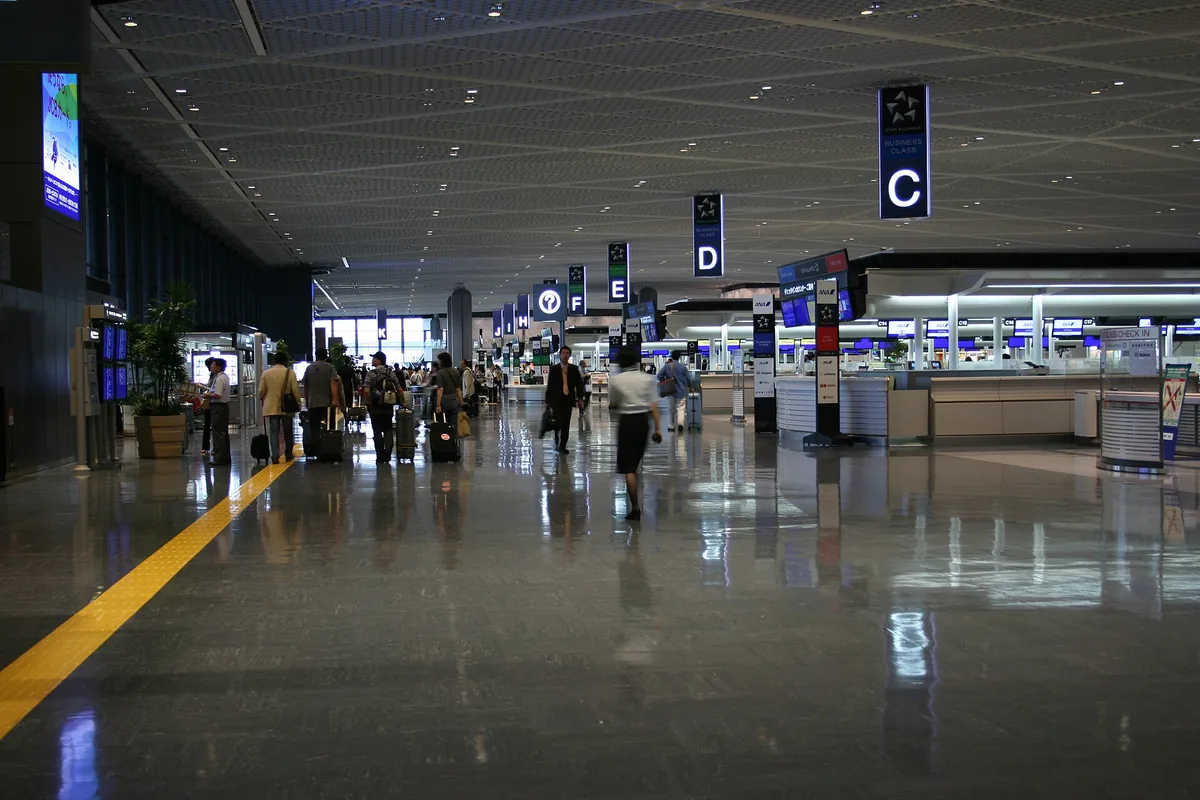
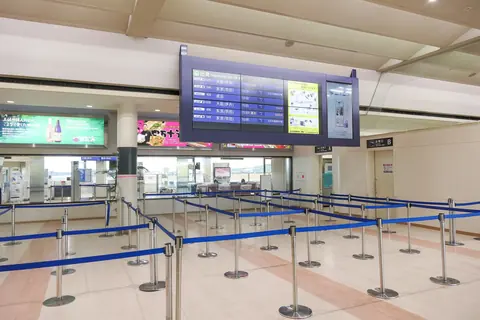
The photo above shows the departure hall at Terminal 1, where you check in before security.
Terminal 1 has three international security checkpoints, all on 4F. In October 2026, Narita listed these opening times.
- South Wing, checkpoint D: from 07:00.
- South Wing, checkpoint G: 14:00 to 18:00.
- North Wing checkpoint: from 07:00.
Narita’s map shows where each checkpoint is and how busy it is. Narita Airport Station is on B1F, and the official rail page puts Terminal 1 a 5-minute walk from it.
Narita Airport Terminal 3: low-cost airlines, no station
Terminal 3 is Narita’s low-cost terminal. Nine airlines check in here, including Jetstar Japan, Jetstar Airways, Spring Japan, Spring Airlines, Jeju Air, Aero K and Eastar Jet.
There is no train station at Terminal 3. Get off at Airport Terminal 2 Station, then walk or take the free shuttle bus. Narita’s pages give two walking times.
- The rail page says Terminal 3 is a 10-minute walk from the station.
- The access corridor page says about 13 minutes, from the station’s ticket gates to the information counter in the Terminal 3 departure lobby on 2F.
Plan on 13 minutes, since that figure runs all the way to the departure lobby. It leaves out the walk on to your check-in counter, and construction work can change the route.
The ride on the free shuttle bus is shorter. The direct bus takes about 6 minutes from Terminal 2 to Terminal 3, and about 3 minutes back.
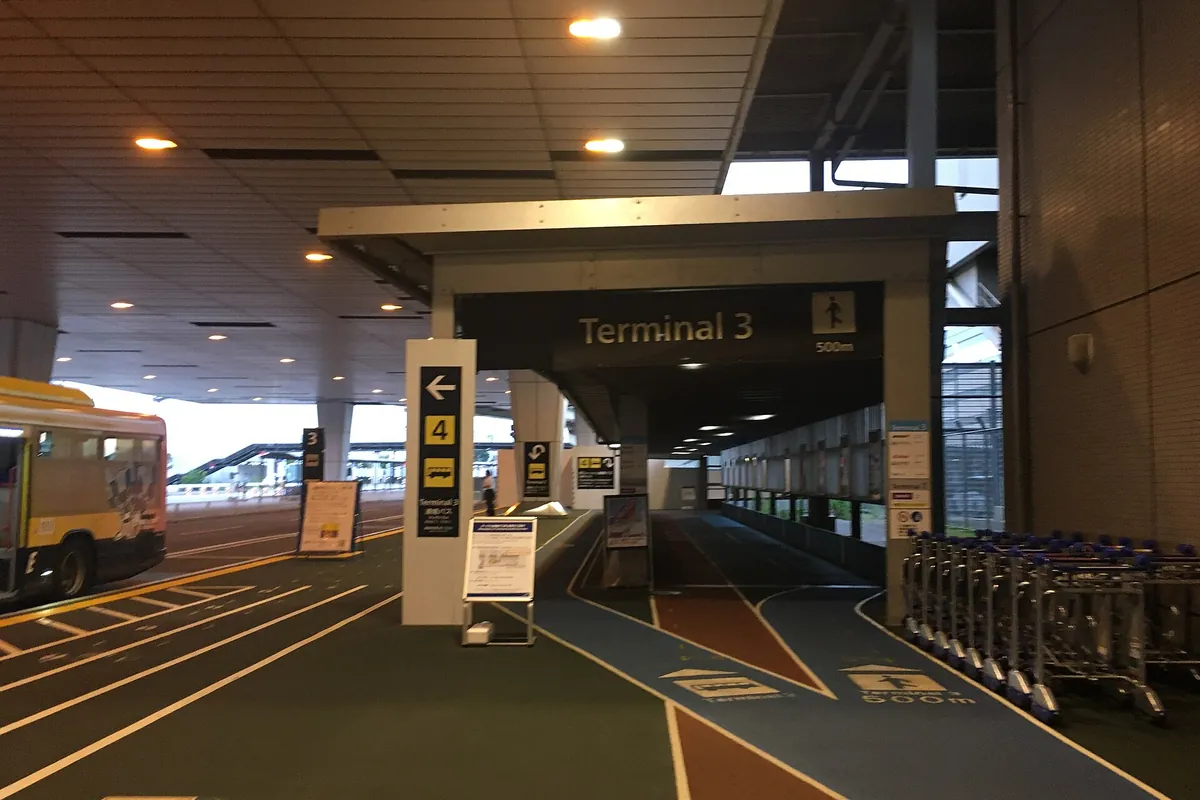
Check-in is on 2F, the floor for both international and domestic departures, and arrivals use 1F.
The international security checkpoint is on 2F as well. Narita says its opening hours can move earlier or later depending on the flight, so check them for your flight on the security hours page.
Terminal 3 stays open all night. Both floors, 1F and 2F, are open 24 hours, and so are the LAWSON convenience store and the Matsuya restaurant. There are no airline lounges. Our Narita Terminal 3 guide covers the SIM counters, the 4 ATMs and the lockers.
If you fly Jetstar Japan, check the bag allowance on our Jetstar Japan page before you pack. Leaving from Terminal 3 also costs less in airport charges, as the section on charges explains.
Trains: which station for each terminal
Narita has two airport stations. Narita Airport Station is under Terminal 1, and Airport Terminal 2 Station serves both Terminal 2 and Terminal 3.
The five rail services that reach the airport all stop at both stations: Skyliner, Access Express, Keisei Main Line, Narita Express and JR line trains. Whichever train you ride, get off at the station for your terminal.
The Terminal 2 station has more than one name. Narita’s rail page uses both Narita Airport Terminal 2·3 Station and Airport Terminal 2 Building Station, and our pages say Airport Terminal 2 Station. All three mean the same stop.
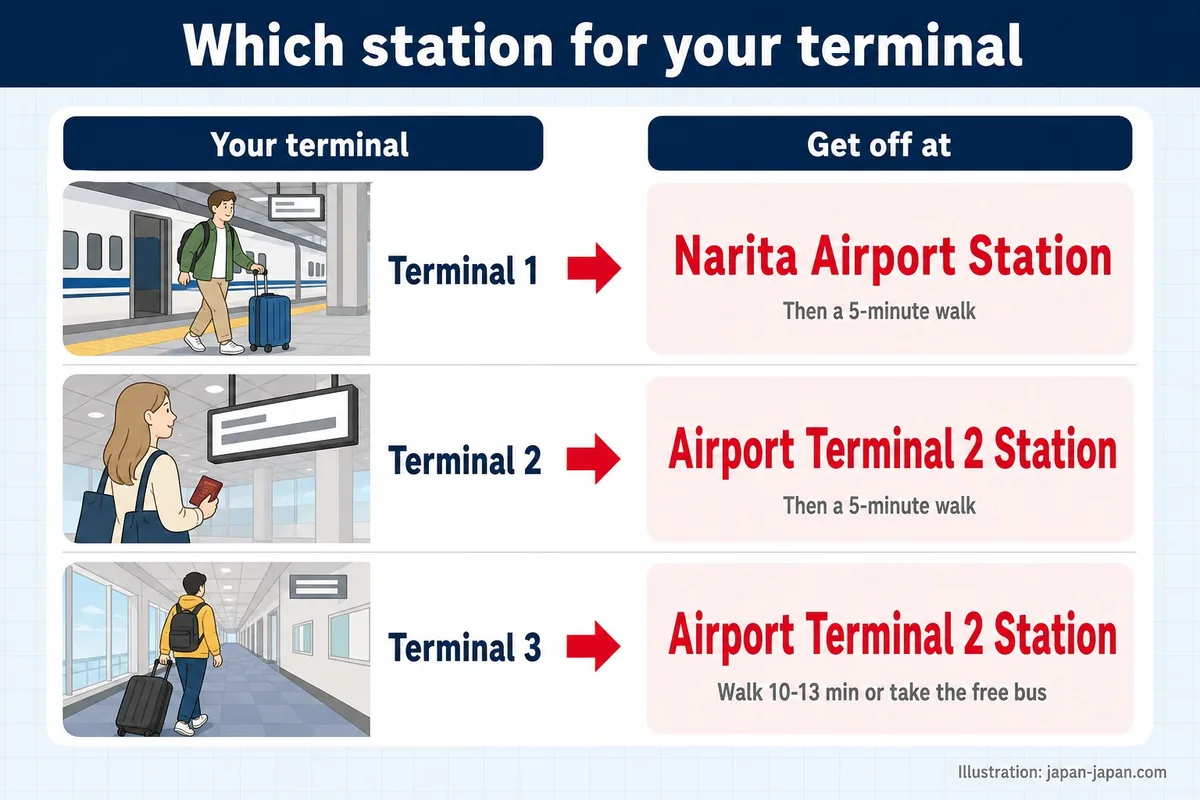
Get off here for each terminal.
- Terminal 1: Narita Airport Station, then a 5-minute walk.
- Terminal 2: Airport Terminal 2 Station, then a 5-minute walk.
- Terminal 3: Airport Terminal 2 Station, then a walk of 10 to 13 minutes, or the free bus.
The illustration below turns the same list into a quick look-up.
Pick the train by where you are going in Tokyo. The Keisei Skyliner runs to Nippori and Keisei Ueno with every seat reserved, and Keisei gives 36 minutes to Nippori at the fastest. The Narita Express runs to Tokyo, Shinagawa, Shibuya, Shinjuku and Yokohama without a change. JR East gives 53 minutes to Tokyo Station on the fastest train.
The Access Express and the Keisei Main Line also reach Nippori and Keisei Ueno, with more stops on the way. You can buy train tickets at the railway ticket counters inside the airport.
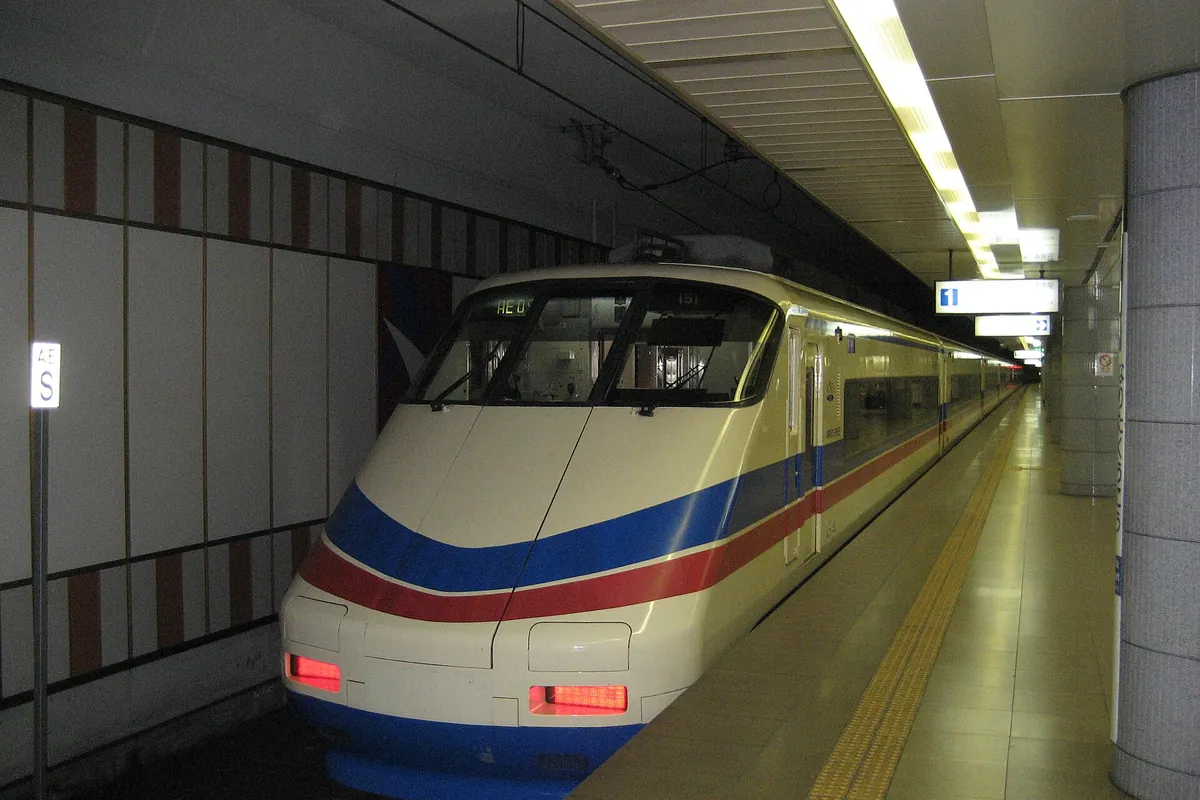
The photo above shows a Keisei Skyliner, the airport express to Nippori and Ueno.
Airport buses work differently, because the stop number changes with the terminal and the destination. The Airport Limousine bus to Tokyo Station leaves from stop 10 at Terminal 1, stop 17 at Terminal 2 and stop 9 at Terminal 3. Our Narita to Tokyo Station page has its last departures.
Our Airport Limousine bus page has the timetables and stops for other destinations. For fares and times into the city, see Narita Airport to Tokyo and our comparison of Narita and Haneda routes to Tokyo Station.
Changing terminals: free bus or walkway
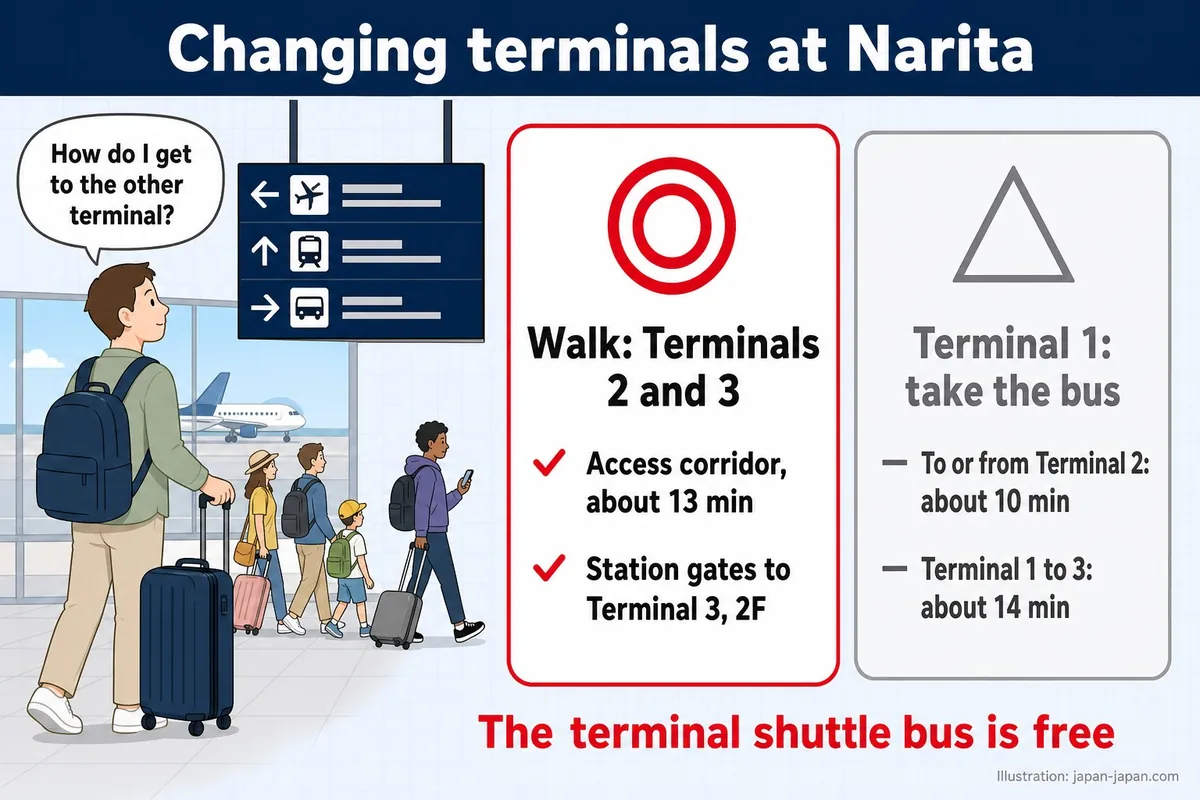
Before security, change terminals on the free shuttle bus. Between Terminals 2 and 3 you can also walk through the access corridor.
Three shuttle routes run in the area before security, according to Narita’s page on traveling between terminals.
- The loop calls at all three terminals in this order: Terminal 1, Terminal 3, Terminal 2. Terminal 1 to Terminal 3 takes about 14 minutes, and Terminal 3 to Terminal 2 about 3 minutes. From Terminal 2 back to Terminal 1 takes about 10 minutes.
- The direct bus between Terminals 1 and 2 takes about 10 minutes each way.
- The direct bus between Terminals 2 and 3 takes about 6 minutes from Terminal 2 to Terminal 3, and about 3 minutes back.
From Terminal 1 to Terminal 2, take the direct bus, because the loop goes to Terminal 3 first. From Terminal 2 to Terminal 3, take the direct bus or walk.
Each terminal has its own shuttle stops.
- Terminal 1: stop 6.
- Terminal 2: stop 1 for buses to Terminal 3, and stops 8 and 18 for buses to Terminal 1.
- Terminal 3: stops 2 and 3.
Narita’s shuttle page lists the intervals and the first and last departures at each stop. Road traffic can slow the buses down, so leave extra time if you change terminals before a flight.
To walk, use the access corridor. It takes about 13 minutes from the ticket gates of Airport Terminal 2 Station to the Terminal 3 departure lobby on 2F. Coming back from the arrival lobby on 1F to the gates also takes about 13 minutes.
The illustration below shows which moves you can walk and which need the bus.
International connecting passengers who have passed the transit security check use separate transit shuttle buses in the secure area. Narita’s shuttle page links to their details.
How early to get to Narita in winter 2026-27
Arrive at least 2 hours before an international flight. That is Narita’s own advice for international departures.
Each airline sets its own check-in start time, so check yours before you travel.
Security is most crowded from early morning to noon and again in the evening, according to Narita. The pattern shifts with the day of the week and the flight schedule.
On an early flight, check when security opens. Most international checkpoints at Terminals 1 and 2 listed 07:00 as their opening time in October 2026. Narita warns that security may not be open yet for some morning flights.
The diagram below shows the order of the steps once you reach the terminal.
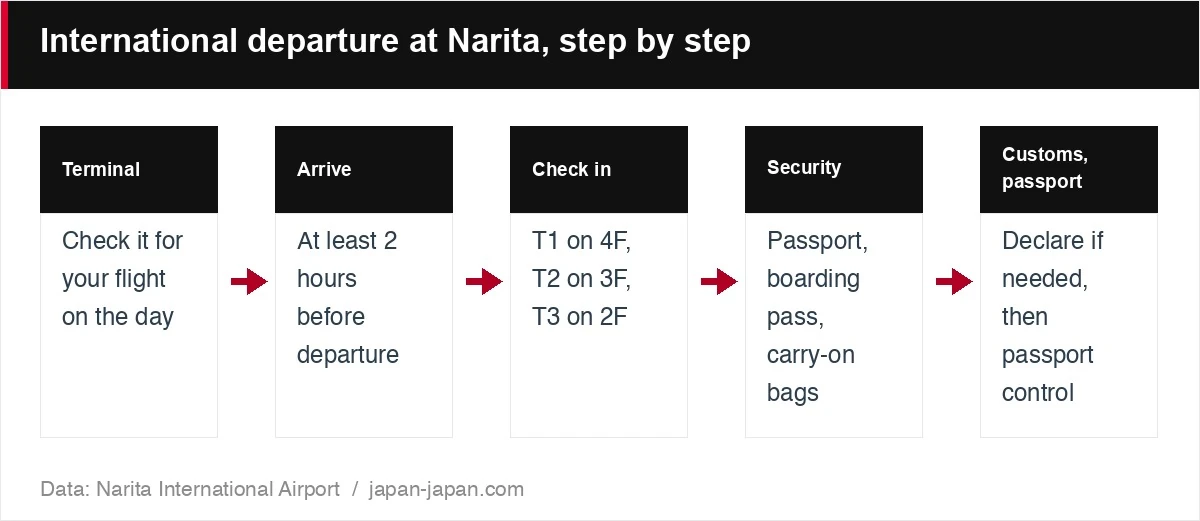
Check in first, then go through security with your passport, boarding pass and carry-on bags. Customs comes next, but you stop there only if you have something to declare. Passport control follows, and then you walk to your gate.
You declare at the customs counter in three cases.
- You carry cash or similar worth more than 1 million yen out of Japan.
- You take foreign-made goods out of the country, such as the watch or necklace you are wearing.
- You bought goods duty-free.
If those purchases are in your checked bag, customs must see them before you hand the bag to your airline. For goods bought tax-free, Japan’s refund method puts this check in the international departure lobby, before check-in. You scan your passport at a tax-free procedure terminal. A green result means you are finished, and a red result means a customs officer inspects the goods.
Our customs check at the airport page walks through it, and our tax-free shopping guide covers the refund.
Do any money exchange, cash withdrawals, phone roaming and travel insurance before security, as Narita’s departure guide suggests. If you use a facial recognition gate or an automated gate at passport control, you get no stamp in your passport. Ask the staff if you want one.
For a very early flight, plan where you wait. Flights only operate from 06:00 to midnight, so you cannot spend the night after security. These floors stay open all night, according to Narita’s night and early morning page.
- Terminal 1: 1F and B1F are open 24 hours, and the 4F international departure floor opens from 05:00 to 24:00.
- Terminal 2: 1F, 2F and B1F are open 24 hours, and the 3F international departure floor opens from 05:00 to 24:00.
- Terminal 3: 1F and 2F are open 24 hours.
Terminal 1 has a 24-hour LAWSON on B1F. Terminal 2 has a 24-hour 7-Eleven on B1F and a 24-hour Yoshinoya restaurant. A capsule hotel in the P-2 car park, which connects directly to Terminal 2, is open 24 hours. It can be full on the day you fly, so book it ahead.
Around New Year, check the holiday dates too. New Year’s Day falls on Friday 1 January 2027, banks close from 31 December to 3 January, and many sights close for several days. Our New Year 2026–27 page has the details.
Terminal charges and the 3,000 yen departure tax
Narita adds two charges to each international departure. The Passenger Service Facility Charge (PSFC) pays for the lobbies, lifts, flight information system and baggage carts. The Passenger Security Service Charge (PSSC) pays for security checks and baggage inspections.
Your terminal sets the amount, according to Narita’s page on the PSFC and PSSC.
- Terminal 1 or 2: 2,460 yen PSFC plus 700 yen PSSC, or 3,160 yen for an adult. A child pays 1,240 yen plus 700 yen, or 1,940 yen.
- Terminal 3: 1,370 yen plus 700 yen, or 2,070 yen for an adult. A child pays 690 yen plus 700 yen, or 1,390 yen.
Adults are 12 and over, and children are 2 and over. A child on an adult ticket pays the adult charges. The chart below compares the four totals.
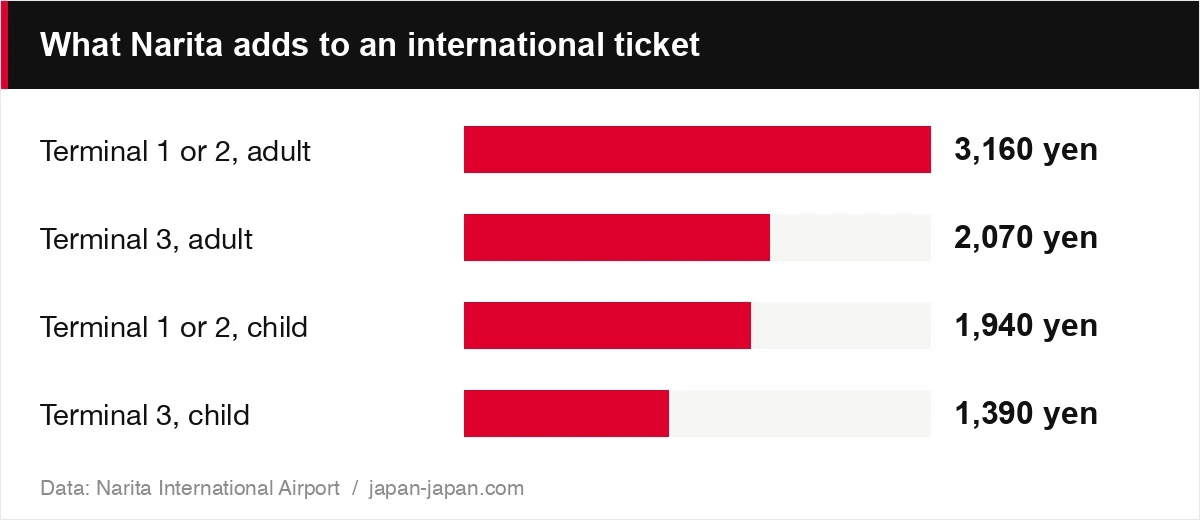
| Item | Value | Note |
|---|---|---|
| Terminal 1 or 2, adult | 3160 yen | 2,460 + 700 yen |
| Terminal 3, adult | 2070 yen | 1,370 + 700 yen |
| Terminal 1 or 2, child | 1940 yen | 1,240 + 700 yen |
| Terminal 3, child | 1390 yen | 690 + 700 yen |
You pay both with the air fare when you buy your ticket. Passengers arriving on international flights pay none.
Connecting on the same day costs less. The connecting rate is for passengers who arrive on an international flight and leave Narita on another international flight that day. An adult then pays 1,930 yen from Terminal 1 or 2 and 1,390 yen from Terminal 3. Leave on a later date and the full rate applies.
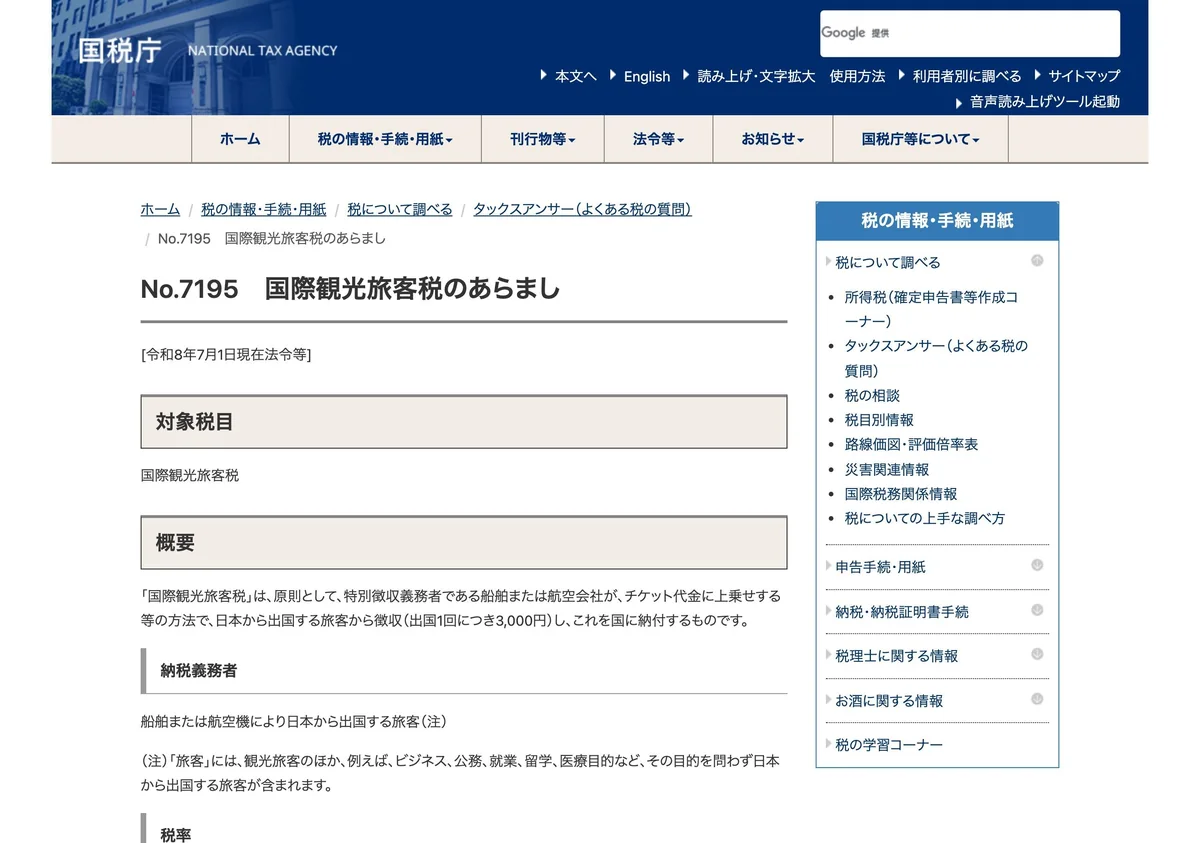
On top of these, Japan charges a departure tax, the International Tourist Tax. The National Tax Agency’s Tax Answer No. 7195 sets it at 3,000 yen per departure from 1 July 2026. Airlines and shipping companies collect it, usually by adding it to the ticket price, and pay it to the government.
A lower rate still applies in one case. A departure on or after 1 July 2026 under certain transport contracts made before that date is taxed at 1,000 yen.
The tax applies to passengers leaving Japan by plane or ship, whatever the purpose of the trip: tourism, business, work, study or medical care. Children under 2 are exempt, and so are transit passengers who leave within 24 hours of entering Japan.
So an adult flying out of Terminal 2 pays 3,160 yen in Narita charges and 3,000 yen in tax, both normally added to the ticket. In Japanese the tax is 国際観光旅客税 (kokusai kankō ryokaku zei), which means international tourist tax. The screenshot below shows the tax agency’s page with the 3,000 yen rate.
FAQ
Is Japan Airlines at Narita Terminal 1 or Terminal 2?
Terminal 2. Japan Airlines uses Terminal 2 for both its international and domestic flights, with international check-in on 3F. If another airline operates your JAL code-share flight, check the counter for your flight number on the departure date.
Can you walk from Narita Terminal 2 to Terminal 3?
Yes. The access corridor links the two terminals. From the ticket gates of Airport Terminal 2 Station to the Terminal 3 departure lobby, the walk takes about 13 minutes. The free shuttle bus takes about 6 minutes from Terminal 2 to Terminal 3.
Is there a train station at Narita Terminal 3?
No. The nearest station is Airport Terminal 2 Station, which serves Terminals 2 and 3. From there, walk 10 to 13 minutes through the access corridor or take the free shuttle bus.
How early should I get to Narita Airport for an international flight?
At least 2 hours before departure, which is Narita’s own advice. Check your airline’s check-in start time too, and allow extra time from early morning to noon and in the evening, when security is most crowded.