Japan Tax-Free Shopping from 1 Nov 2026: How Refunds Work
From 1 November 2026 you pay the tax in the shop, pass a customs check at the airport within 90 days, and the shop refunds the 10% tax (8% on food).
Japan tax-free shopping: the short answer
Japan tax-free shopping becomes a refund for purchases made from 1 November 2026. You pay the price with tax, pass a customs check at the airport within 90 days, then the shop refunds the tax.
Anything you buy up to 31 October 2026 stays under the old system, where the shop charges no consumption tax at the till. The minimum spend does not change: 5,000 yen or more before tax, in the same shop on the same day.
What comes back is the consumption tax in the price: 10% on most goods, or 8% on food and drink except alcohol. The shop pays it, or a refund service provider that the shop uses, after customs confirms the goods are leaving Japan. The Japan Tourism Agency page for travellers sets out the new system in Japanese.
The sections below cover what changes, the three steps, who qualifies, the airport check, how refunds get lost and how much comes back. Each rule also has its own page in our tax-free shopping guide.
Japan tax-free shopping changes on 1 November 2026
The Japan tax-free changes apply by purchase date. Goods bought up to 31 October 2026 follow the old system, and goods bought from 1 November 2026 follow the new one. The illustration below puts the two side by side.
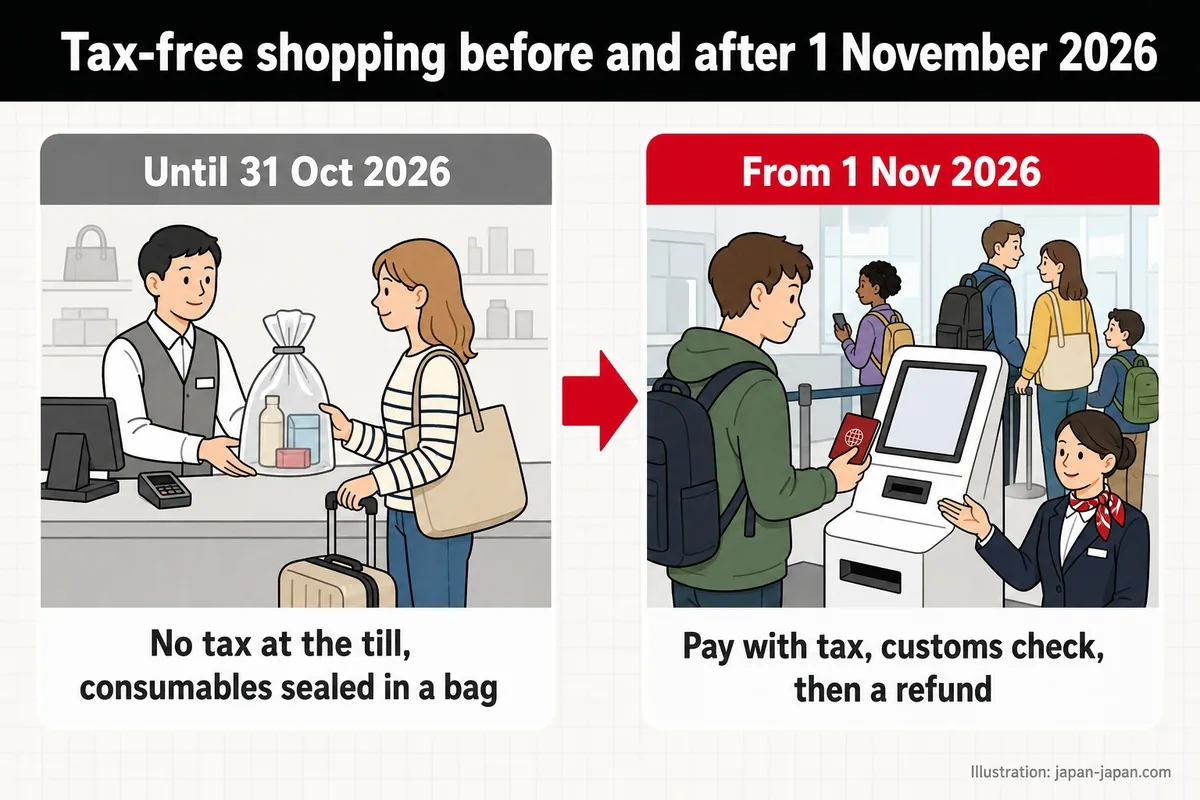
Until 31 October 2026. You pay the tax-free price in the shop, so no consumption tax is charged. Consumables, meaning food, drinks, medicine and cosmetics, go into a special sealed bag. Consumables also have a cap of 500,000 yen.
From 1 November 2026. You pay the full price with tax. The sealed bag and the 500,000 yen cap both end. General goods and consumables now count together toward the 5,000 yen minimum. There is no upper limit in yen, though you can only buy what you can carry out of Japan yourself. When you leave, a customs check comes first, and the refund follows.
One related rule changed earlier. The separate shipment method, which let shoppers post tax-free goods home themselves, ended on 31 March 2025. Our page on what changes on 1 November 2026 lists each difference with its official source.
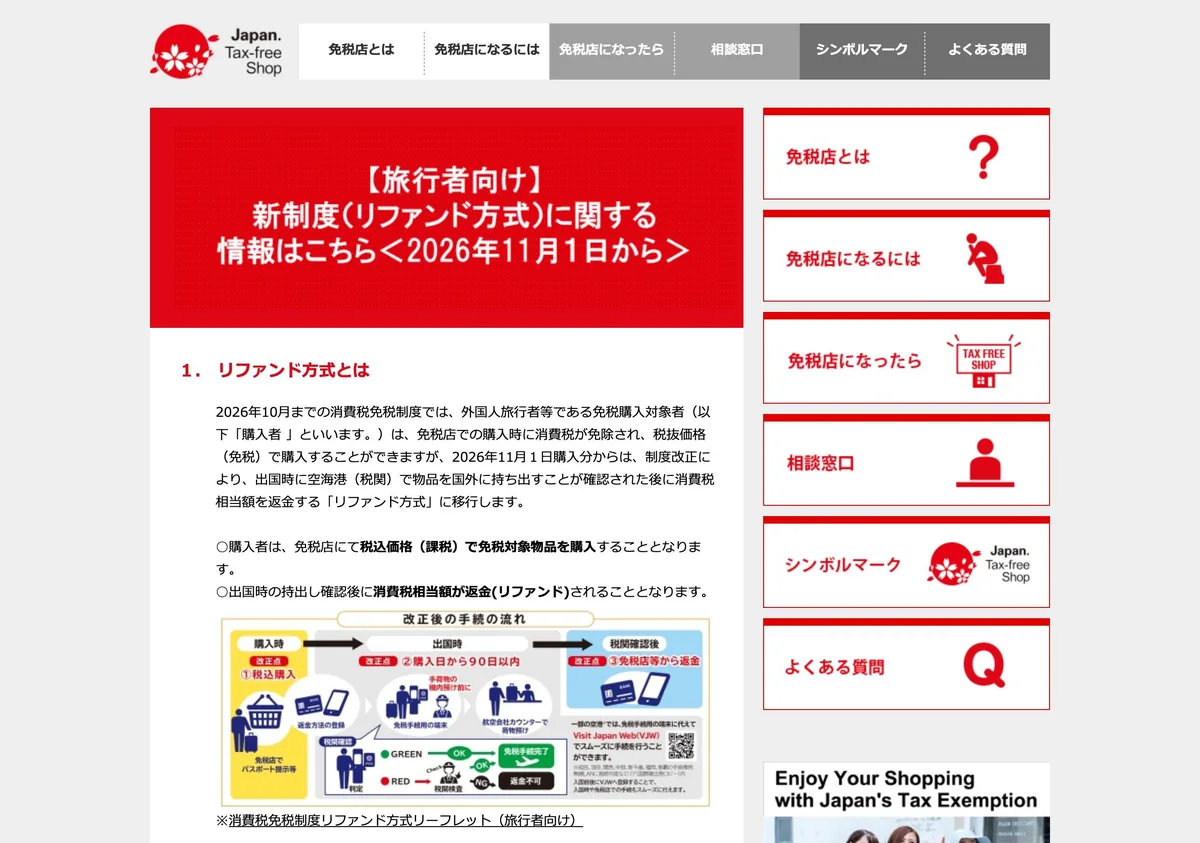
The Japan Tourism Agency page for travellers, shown below, draws the new flow as a diagram in Japanese. The page shows three stages: buying with tax, the customs check within 90 days of the purchase, and the refund from the shop.
How does tax-free work in Japan now? Three steps
Tax-free shopping in Japan now works in three steps: the shop, the airport, then the refund. The illustration below follows one shopper through them.
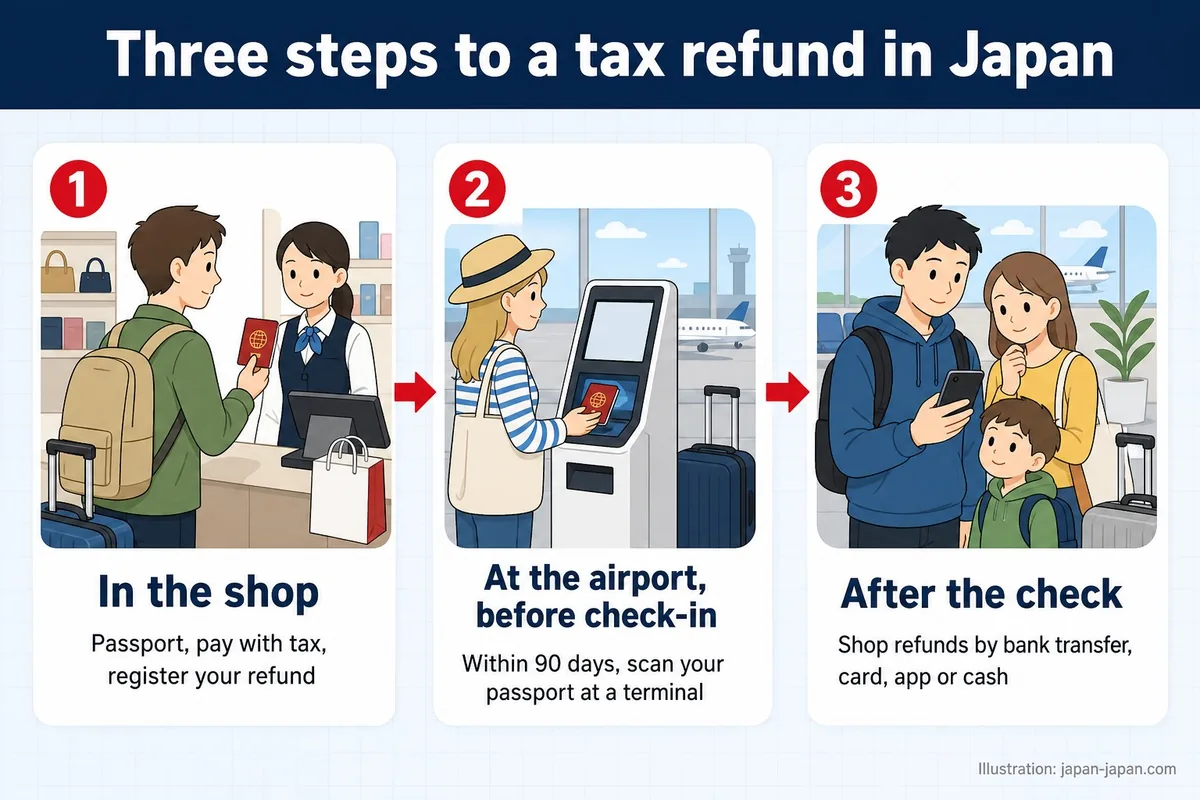
Step 1: in the shop. Show your passport and pay the price with tax. You need to spend 5,000 yen or more before tax in that shop on that day. With 10% tax added, that minimum is 5,500 yen at the till. The shop then explains how to register your refund method, and you register it there.
Every tax-free shop must explain three points when you buy, according to the National Tax Agency. You must show your passport to customs when you leave Japan within 90 days of the purchase. You must be able to show the goods if customs asks. You must take the checked goods out of Japan without delay, or the tax is collected.
Step 2: at the airport or seaport. Within 90 days of the purchase, scan your passport at a tax-free procedure terminal before you check in your bags. Seven airports also let you do this step online with Visit Japan Web. The airport section below walks through the day you leave.
Step 3: the refund. After the customs check, the shop or its refund service provider pays the tax back. The agency’s English FAQ lists four possible ways: bank transfer, credit card, an app, or cash at the airport or seaport you leave from. Each shop decides which of these it offers, so ask before you pay.
Japan’s consumption tax law sets no rules for how the refund is paid, the National Tax Agency says. So the method depends on the shop. Our pages on how the three steps work and getting the refund cover each step with its official source.
Japan tax-free rules: who and what qualifies
The Japan tax-free rules answer three questions: who can buy, what counts, and where you can shop.
Who can buy. Foreign visitors with Temporary Visitor status qualify if they entered Japan less than 6 months ago. They show a passport in the shop. Diplomats and officials qualify too. Cruise passengers who landed with a landing permission for cruise ship tourists show that permit with their passport. Our page on who can shop tax-free covers the other statuses on the official list.
Japanese nationals qualify if they have lived outside Japan for 2 years or more in a row and came back less than 6 months ago. They show a passport and one document that proves the time abroad. Three documents are accepted: a copy of the family register attachment (koseki no fuhyō), a Certificate of Residence, or a My Number Card. The My Number Card works from 1 November 2026 and must show that the holder moved abroad. Details are on our page for Japanese nationals living abroad.
What counts. You need 5,000 yen or more before tax in the same shop on the same day, with general goods and consumables added together. Gold and platinum bullion and coins are excluded, and so are goods that carry no consumption tax. There is no upper limit in yen. The limit is what you can carry out of Japan yourself, and every item must be ready to show to customs when you leave. See what you can buy and the 5,000 yen minimum.
For one item of 1 million yen or more before tax, customs may ask for its certificate of authenticity or warranty. Have those papers ready at the airport. The shop also records details that identify the item, such as the brand name, model number and serial number. Our page on items of 1 million yen or more has the rest.
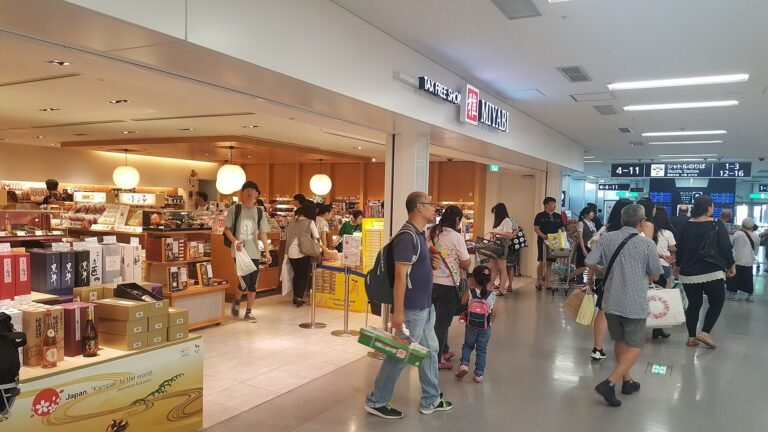
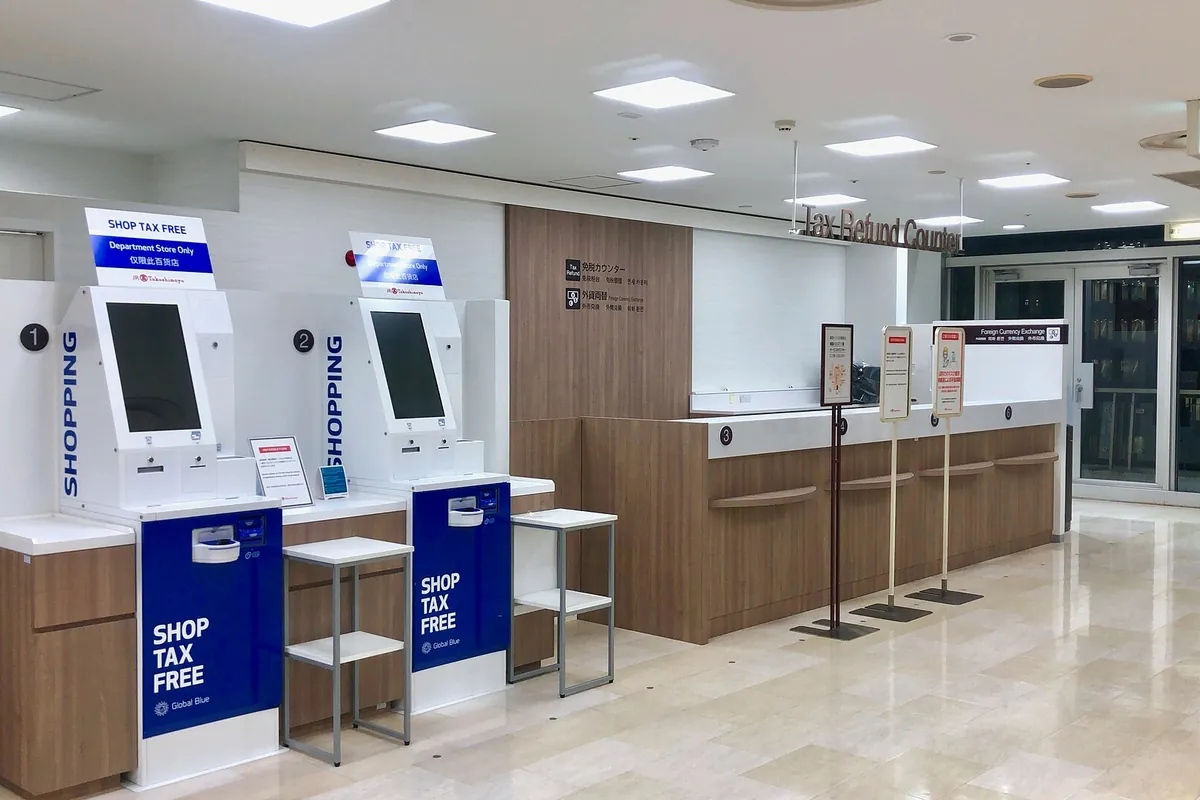
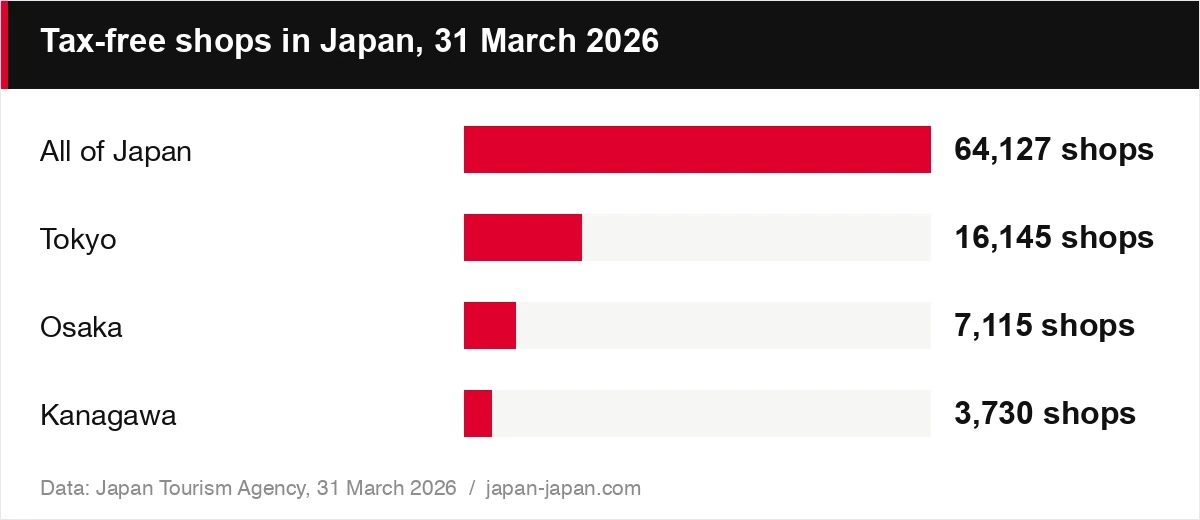
Where to shop. Japan had 64,127 tax-free shops on 31 March 2026, according to the Japan Tourism Agency. Tokyo has the most with 16,145, followed by Osaka with 7,115 and Kanagawa with 3,730. The three big metropolitan areas hold 62.0% of all the shops. The photo below shows a tax-free sign at a shop in Japan.
The chart below compares the four counts. Our list of tax-free shops by prefecture ranks all 47 prefectures.
| Item | Value |
|---|---|
| All of Japan | 64,127 shops |
| Tokyo | 16,145 shops |
| Osaka | 7115 shops |
| Kanagawa | 3730 shops |
At the airport: the customs check before check-in
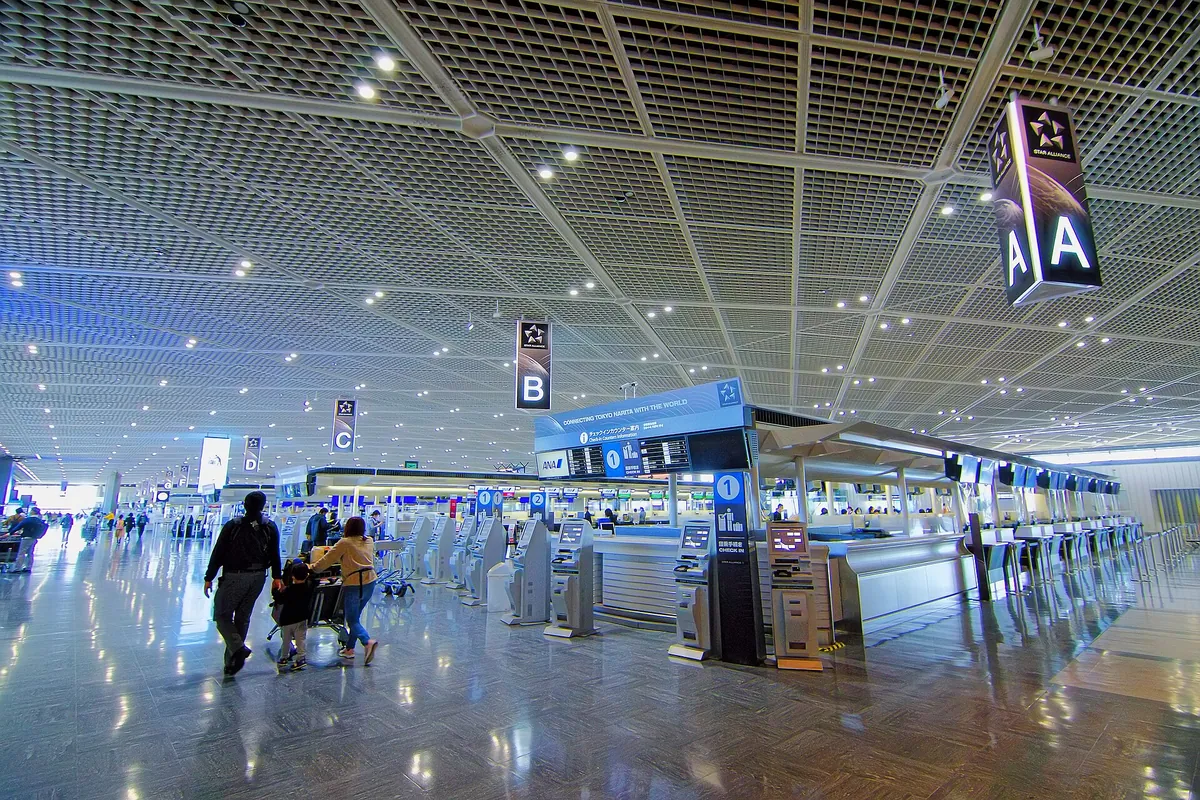
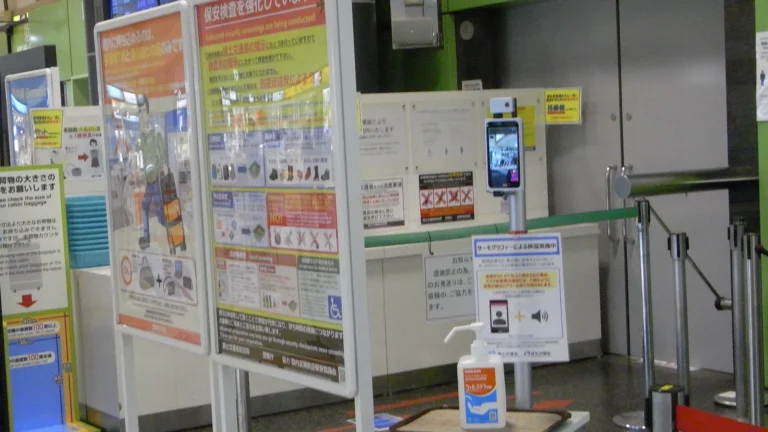
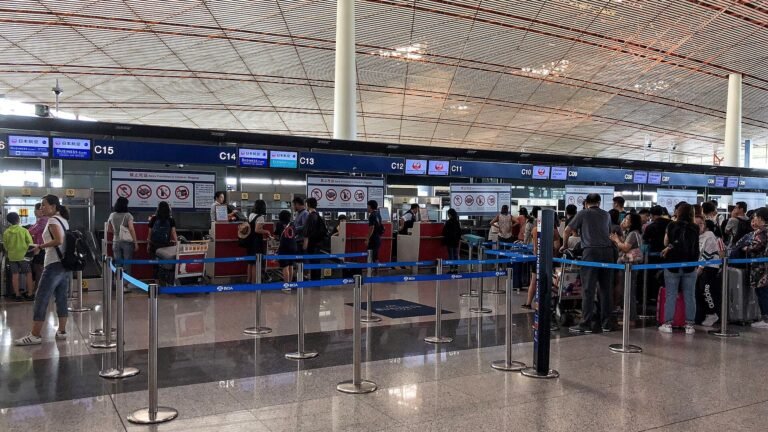
Do the customs check before you check in your bags. The tax-free procedure terminals, which are kiosk terminals or electronic terminals, are in the international departure lobby before baggage check-in. The customs inspection area is there too. The photo below shows the departure lobby at Narita Airport, with its airline check-in counters.
Bring every tax-free item to the terminal and scan your passport. The result appears within a few seconds. Green means the procedure is finished. Red means you take the goods to the customs inspection area and show them to a customs officer. The diagram below puts the steps of the day in order.
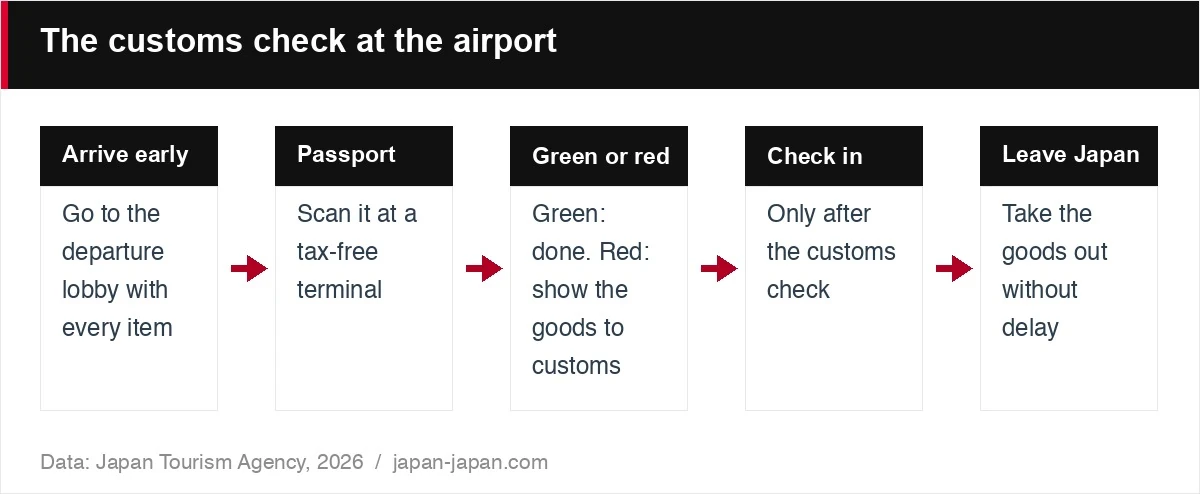
Check in your bags only after the customs check. If you check in a suitcase first and then get a red result, the airline cannot give the bag back for the procedure. Finish the check, including any inspection, before your airline check-in. If you stop an inspection halfway, for example to catch a flight, it does not count as a customs check. Airlines and customs pay no compensation if the procedure makes you miss your flight, so arrive early.
At Narita, Haneda, Kansai, Chubu, Fukuoka, New Chitose and Naha, you can do the check online with Visit Japan Web instead of the terminal. It works inside the dedicated wireless LAN area of the international departure lobby, up to the security checkpoint. Our guides to Narita Airport, Haneda Airport and Kansai Airport show the trains and buses to each one.
If you cannot find the terminal, ask staff: 免税手続用の端末はどこですか? (menzei tetsuzuki-yō no tanmatsu wa doko desu ka; “Where is the tax-free procedure terminal?”).
Connecting flights and cruises. If you fly a domestic leg first, do the check at the last airport, where you leave Japan. On a cruise that starts and ends outside Japan, use the electronic terminal at the last port in Japan before you check in baggage. Fly and cruise means a cruise that starts in Japan, calls abroad and returns, then a flight home. In that case, do the check for the whole stay at the airport you fly home from. You do not need to do it when the ship leaves Japan briefly during the cruise. See connecting flights and cruises.
After the check, take the goods out of Japan without delay. If you do not, you are charged the consumption tax that was exempted, and penalties apply. Normal cabin-bag rules still apply to anything you carry on board. Before you pack bottles, check our pages on liquids and alcohol. Our page on the customs check at the airport has the official wording.
Ways to lose your tax refund
The illustration below shows four mistakes that cancel a refund. Missing the 90-day deadline also cancels a refund.
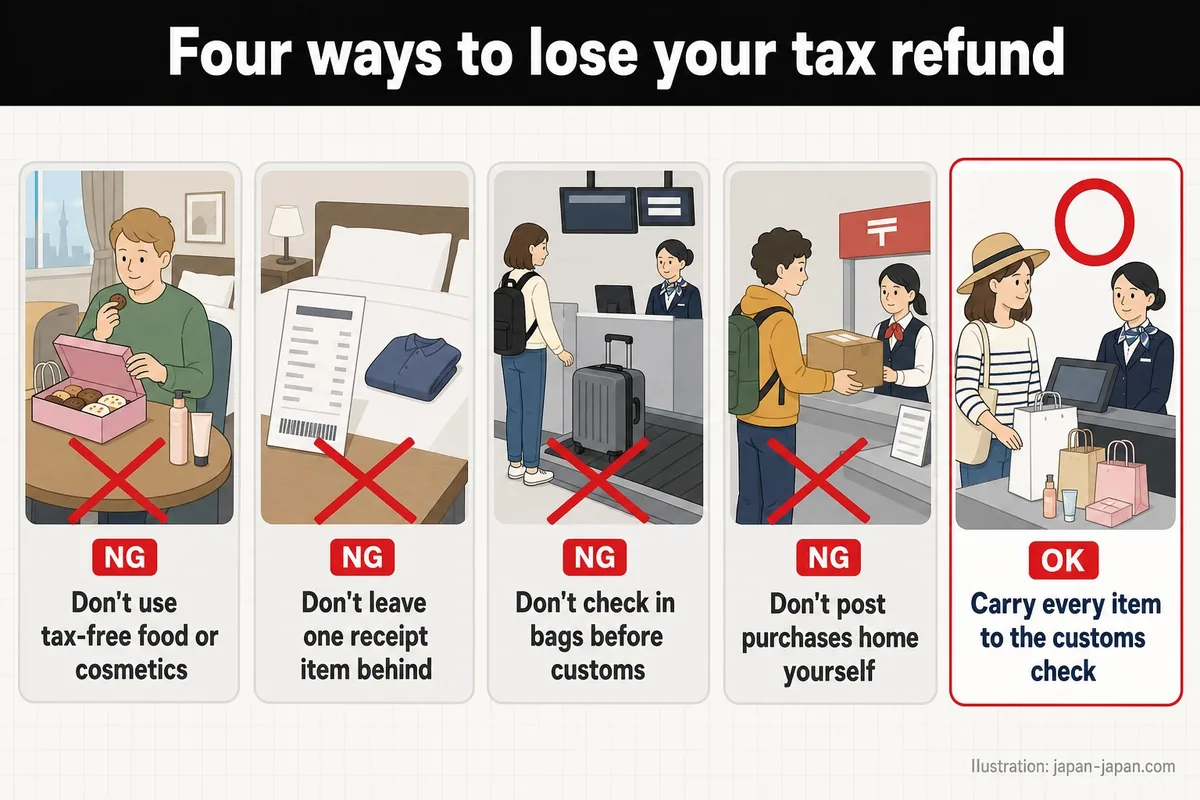
Using food, drinks, medicine or cosmetics. If you eat, drink or use any part of them in Japan, customs cannot confirm that receipt, and nothing on it is refunded. In that case, skip the terminal and tell a customs officer at the counter. Goods that are not consumables can be used in Japan, as long as you take them out. See using what you bought before you leave.
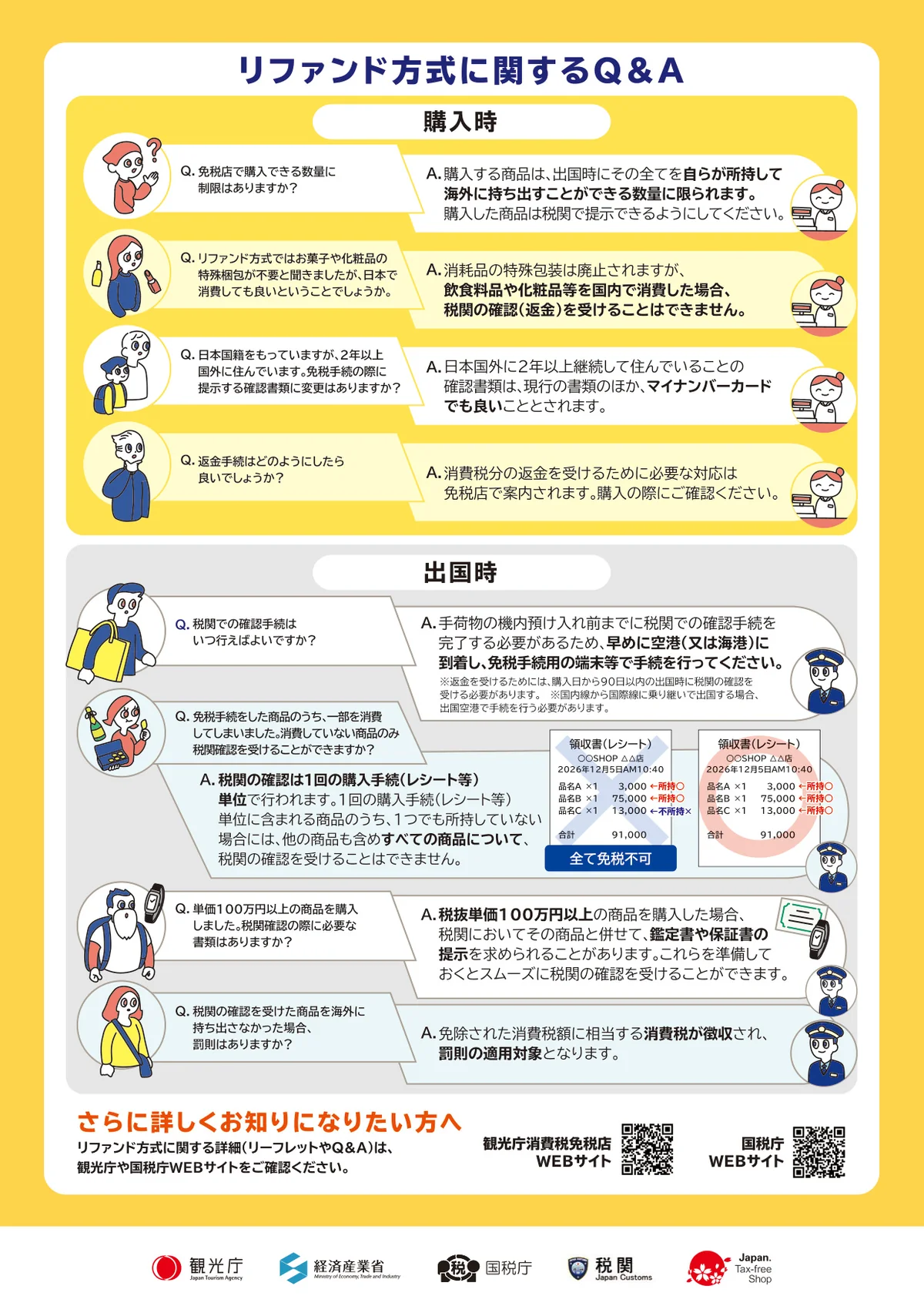
Leaving one item behind. Customs checks each receipt as one purchase. If even one item from a receipt is missing, none of the goods on that receipt can be checked, so none of them is refunded. The document below is page 2 of the Japan Tourism Agency leaflet for travellers on the refund method, in Japanese. The document shows a receipt crossed out in full because one item is missing.
Checking in bags too early. Once a bag is checked in, it cannot be taken back for the procedure. Keep everything you bought tax-free with you until the check is done.
Missing the 90-day deadline. The count starts on the day after the purchase, which is day 1. Buy on 1 November 2026, and the last day for the customs check is 30 January 2027. Our page on the 90-day deadline has more examples of the count.
Posting goods home yourself. The separate shipment method ended on 31 March 2025, so goods you send abroad by post or as a parcel yourself get no refund. A shop can ship your purchase abroad for you, which is tax-exempt as an export. Ask the shop whether it ships overseas, or read sending purchases home.
Boxes of sweets and snacks are food, so eating even one piece cancels the refund for the whole receipt. Our guide to Japanese snacks to bring home covers tax-free buying and customs for food gifts.
Japan tax refund: how much comes back
A Japan tax refund returns the consumption tax included in the price. The standard rate is 10%. Food and drink are taxed at a reduced 8%, except alcohol and eating out. The National Tax Agency explains both rates in No.6303 and No.6102.
Each rate has two parts. The 10% is 7.8% consumption tax plus 2.2% local consumption tax. The 8% is 6.24% plus 1.76%.
On goods priced at 10,000 yen before tax, you pay 11,000 yen and get 1,000 yen back. On food at the same price, you pay 10,800 yen and get 800 yen back. On a 100,000 yen purchase at 10%, the refund is 10,000 yen. If you only know the price with tax, divide it by 11 to find the 10% tax. The table below sets the three cases side by side.
| Goods | Rate | Before tax | Refund |
|---|---|---|---|
| General goods, including alcohol, medicine and cosmetics | 10% | 10,000 yen | 1,000 yen |
| Food and drink, except alcohol and eating out | 8% | 10,000 yen | 800 yen |
| General goods | 10% | 100,000 yen | 10,000 yen |
Alcohol is the catch. Sake and whisky are drinks, but as alcohol they are taxed at 10%. Medicine and cosmetics are not food, so they are at 10% too. A snack sold with a toy is a special case. It is taxed as food at 8% only if it costs 10,000 yen or less before tax and is at least two-thirds food by value.
Shopping for Christmas gifts? Our guide to Christmas in Japan has the 2026 dates for markets and lights. For the official figures behind each example, see how much comes back.
FAQ
Can I put tax-free items in my checked baggage?
Yes, once the customs check is done. Scan your passport at the terminal with every item on hand first, then check in your bags. A bag checked in before the check cannot be taken back, even if the terminal then shows red.
Is there a limit on how much I can buy tax-free in Japan?
There is no upper limit in yen for purchases from 1 November 2026. You can buy only what you can carry out of Japan yourself and show to customs. The minimum is 5,000 yen before tax, in one shop on one day.
How long do I have to take tax-free goods out of Japan?
You must pass the customs check as you leave Japan within 90 days of the purchase. The count starts on the day after you buy, so goods bought on 1 November 2026 must be checked by 30 January 2027. After the check, take them out without delay.
Can I use Visit Japan Web for the tax-free customs check?
Yes, at seven airports: Narita, Haneda, Kansai, Chubu, Fukuoka, New Chitose and Naha. You need to be inside the dedicated wireless LAN area of the international departure lobby, before the security checkpoint. At other airports and seaports, use a tax-free procedure terminal.
Photo: Tax Free Shop Miyabi in Kansai Airport, Osaka.jpg by Choi2451 (CC BY-SA 4.0), via Wikimedia Commons.

.JPG)
