Matcha Survey Japan: 44% Feel Tea Shops Cost More
Respondents live in Japan. For most of them, matcha means lattes, ice cream and chocolate, with whisked tea far behind.
How we ran the matcha survey
japan-japan.com ran an open online survey of people living in Japan. We received 140 answers between 18 and 25 October 2026.
We removed 40 of them. Eleven had written answers that looked machine-written, 1 failed the attention check and 28 clearly contradicted themselves.
One example: saying “I have never been to Uji” and then describing a day there. That left 100 valid answers, all of which passed the attention check.

The questionnaire had 87 questions: 82 multiple-choice, including the attention check, and 5 required free-text questions. We translated the Japanese free-text answers into English.
Follow-up questions went only to people they applied to, such as people who have been to Uji. For groups under 10 people we give numbers of people, not percentages. For groups under 30, read the percentages as a rough guide.

| Item | Value |
|---|---|
| Teens | 3 % |
| 20s | 27 % |
| 30s | 31 % |
| 40s | 22 % |
| 50s | 15 % |
| 60s | 2 % |
The chart shows the age spread. The largest group was people in their 30s at 31.0%, followed by the 20s at 27.0% and the 40s at 22.0%. Most respondents were women: 87 of 100.
Respondents answered an open call, so they do not represent everyone in Japan. Their answers about visitors are their own views.
Prices they would pay are opinions, and prices they paid are what they remember. To cite these numbers, use: japan-japan.com online survey of people living in Japan (October 2026, valid answers 100).
The full questionnaire (all 87 questions, translated from Japanese)
Respondents saw every question in Japanese, and every question was shown to everyone. Follow-up questions were counted only among people the question applied to. Q41 was an attention check and is not counted. Questions 80 to 84 were required free-text questions.
- Q1. How often do you have matcha foods and drinks (matcha drinks, sweets, ice cream and so on)? (choose one)
Almost every day / 2–6 times a week / About once a week / 1–3 times a month / Once every few months / Hardly ever - Q2. Which matcha foods and drinks have you had in the past year? (choose all that apply)
Matcha powder, whisked or dissolved and drunk / Matcha latte at a cafe / Matcha latte from a convenience store or supermarket (cup or bottle) / Matcha parfait or cake (in a shop) / Convenience-store matcha desserts / Matcha ice cream / Matcha chocolate or snacks / Matcha Japanese sweets (daifuku, warabi mochi and so on) / Dishes made with matcha, such as cha soba / Other / None in the past year - Q3. Of those, which do you have most often? (choose one)
Matcha powder, whisked or dissolved and drunk / Matcha latte at a cafe / Matcha latte from a convenience store or supermarket (cup or bottle) / Matcha parfait or cake (in a shop) / Convenience-store matcha desserts / Matcha ice cream / Matcha chocolate or snacks / Matcha Japanese sweets (daifuku, warabi mochi and so on) / Dishes made with matcha, such as cha soba / Other / None in the past year - Q4. Why do you have matcha foods and drinks? (choose all that apply)
I like the taste / It’s a nice change of pace / It seems good for my health / It goes well with sweets / Seasonal and limited products come out / I see it on social media or TV / I have it at tea ceremony or other lessons / Someone recommended it / Other / I don’t have matcha foods or drinks - Q5. Do you have matcha powder or a chasen (the bamboo whisk for matcha) at home? (choose one)
Both matcha powder and a chasen / Matcha powder only / A chasen only / Neither - Q6. What is your favourite way to drink matcha? (choose one)
Matcha whisked with hot water (usucha) / Matcha latte (with milk or soy milk) / Cold matcha mixed with water / Sweet matcha milk / I don’t drink matcha - Q7. In which season do you have matcha foods and drinks most? (choose one)
Spring / Summer / Autumn / Winter / It doesn’t change by season / I don’t have matcha foods or drinks - Q8. In the past year, did you buy matcha powder yourself (including as a gift)? (choose one)
4 times or more / 2–3 times / Once / I bought it more than a year ago / Never - Q9. Where have you bought matcha powder? (choose all that apply)
In a tea shop / Department store counter / Supermarket / Drugstore / Souvenir shop at a station or airport / A tea shop’s official online store / Shopping sites (Amazon, Rakuten and so on) / Baking-supply shop / Other / I have never bought matcha powder - Q10. How much matcha powder did you buy last time? (choose one)
Single-serving sticks or sachets / 20 g / 30 g / 40 g / 50–100 g / More than 100 g (such as a large baking bag) / I don’t remember / I have never bought matcha powder - Q11. How much did the matcha powder you bought last time cost (with tax)? (choose one)
Under ¥500 / ¥500–999 / ¥1,000–1,499 / ¥1,500–1,999 / ¥2,000–2,999 / ¥3,000–3,999 / ¥4,000–4,999 / ¥5,000 or more / I don’t remember / I have never bought matcha powder - Q12. What did you mainly use the matcha powder you bought last time for? (choose one)
Whisked and drunk / Matcha latte or matcha milk / Baking / Cooking / Souvenirs or gifts for others / I don’t remember / I have never bought matcha powder - Q13. If you bought 20 g of matcha for whisking and drinking (usucha) at a tea shop, how much would you pay at most? (choose one)
Under ¥500 / ¥500–999 / ¥1,000–1,499 / ¥1,500–1,999 / ¥2,000–2,999 / ¥3,000 or more / I don’t buy matcha powder / Not sure - Q14. If you bought 30 g of matcha for whisking and drinking (usucha) at a tea shop, how much would you pay at most? (choose one)
Under ¥500 / ¥500–999 / ¥1,000–1,499 / ¥1,500–1,999 / ¥2,000–2,999 / ¥3,000–3,999 / ¥4,000 or more / I don’t buy matcha powder / Not sure - Q15. If you bought 40 g of matcha for whisking and drinking (usucha) at a tea shop, how much would you pay at most? (choose one)
Under ¥1,000 / ¥1,000–1,499 / ¥1,500–1,999 / ¥2,000–2,999 / ¥3,000–3,999 / ¥4,000–4,999 / ¥5,000 or more / I don’t buy matcha powder / Not sure - Q16. Compared with two or three years ago, how do matcha prices at tea shops feel? (choose one)
Much more expensive / A little more expensive / About the same / Cheaper / Not sure - Q17. What have you changed because of matcha price rises or shortages? (choose all that apply)
I buy less / I switched to a cheaper brand or supermarket matcha / I switched to baking or latte matcha / I buy more when I find it / I waited for restock notices or pre-orders / I switched to hojicha or sencha / Other / Nothing in particular / I don’t buy matcha powder - Q18. In the past year, have you seen matcha powder sold out or marked “waiting for stock”? (choose one)
Many times / Once or twice / No / I don’t look at matcha counters or online stores - Q19. Have you seen a limit on how much matcha one person can buy (such as “up to ◯ per customer”)? (choose one)
On a notice in a shop / On an online store page / Both in shops and online / No, never - Q20. Where did you see the purchase limit? (choose all that apply)
Tea shops in Uji / Tea shops in Kyoto city / Tea shops in Tokyo / Tea shops elsewhere / Department store counter / Airport shops / A tea shop’s official online store / Other shopping sites / Other / I have never seen a limit - Q21. Of the limits you saw, what was the lowest number per person? (choose one)
1 per person / 2 per person / 3 per person / 4–5 per person / 6 or more per person / I don’t remember / I have never seen a limit - Q22. Have you gone to buy matcha and not been able to buy as much as you wanted because it was sold out or limited? (choose one)
Yes, because it was sold out / Yes, because of a limit / Yes, both / No / I have never gone to buy matcha - Q23. What do you think of limits on how much matcha one person can buy? (choose one)
For it / Somewhat for it / Neither for nor against / Somewhat against it / Against it - Q24. What do you think are the reasons for matcha shortages and price rises? (choose all that apply)
Matcha became more popular overseas / More travellers are coming to Japan / It became a social media trend / The weak yen / Some people buy it to resell / Tea production can’t keep up / Heat and other weather / There are fewer tea farmers / Other / Not sure - Q25. When a visitor buys matcha as souvenirs, up to how many tins or bags per person would not bother you? (choose one)
Up to 1–2 / Up to 3–5 / Up to 6–10 / Any number is fine / Not sure - Q26. Which matcha and tea shops do you know by name? (choose all that apply)
Ippodo Tea / Marukyu Koyamaen / Nakamura Tokichi Honten / Gion Tsujiri (Saryo Tsujiri) / Itohkyuemon / Fukujuen / Kanbayashi Shunsho Honten / Horii Shichimeien / Morihan / None of these - Q27. At which shops have you bought matcha powder or sweets, or had something in the shop? (choose all that apply)
Ippodo Tea / Marukyu Koyamaen / Nakamura Tokichi Honten / Gion Tsujiri (Saryo Tsujiri) / Itohkyuemon / Fukujuen / Kanbayashi Shunsho Honten / Horii Shichimeien / Morihan / None of these - Q28. Of those, which shop do you like best? (choose one)
Ippodo Tea / Marukyu Koyamaen / Nakamura Tokichi Honten / Gion Tsujiri (Saryo Tsujiri) / Itohkyuemon / Fukujuen / Kanbayashi Shunsho Honten / Horii Shichimeien / Morihan / None of these - Q29. If you recommended just one shop to a foreign friend buying matcha in Kyoto, which would it be? (choose one)
Ippodo Tea / Marukyu Koyamaen / Nakamura Tokichi Honten / Gion Tsujiri (Saryo Tsujiri) / Itohkyuemon / Fukujuen / Kanbayashi Shunsho Honten / Horii Shichimeien / Morihan / Not sure - Q30. Why do you recommend that shop? (choose all that apply)
The matcha tastes good / Reasonable prices / It’s famous, so people are pleased / The tins and wrapping suit souvenirs / It also has a cafe or sweet shop / The shop has a nice atmosphere / It’s easy to reach from the station / Other / I wouldn’t recommend a shop - Q31. Which places come to mind when you hear “matcha-growing area”? (choose all that apply)
Uji (Kyoto) / Wazuka (Kyoto) / Nishio (Aichi) / Shizuoka / Kagoshima / Yame (Fukuoka) / Other / None come to mind - Q32. Of the matcha you have drunk or bought, which growing area do you like best? (choose one)
Uji (Kyoto) / Wazuka (Kyoto) / Nishio (Aichi) / Shizuoka / Kagoshima / Yame (Fukuoka) / Other / I don’t pay attention to the area / I don’t drink matcha - Q33. Can you explain the difference between usucha (thin matcha) and koicha (thick matcha)? (choose one)
Yes / Roughly / I’ve heard of it but can’t explain it / I’ve never heard of it - Q34. Have you seen or heard the term “ceremonial grade” (for the tea ceremony) for matcha? (choose one)
Seen it and know what it means / Seen it but not sure what it means / No, never - Q35. What matcha would you recommend to a foreign friend who wants to make matcha lattes at home? (choose one)
Affordable baking or latte matcha / Affordable matcha for whisking (usucha) / Expensive matcha for whisking / Matcha for koicha / Sweetened matcha latte powder / Not sure - Q36. Which matcha sweets have you eaten in the past year? (choose all that apply)
Matcha parfait / Matcha soft-serve ice cream / Matcha shaved ice / Matcha cake (such as roll cake) / Matcha tiramisu / Matcha warabi mochi / Matcha nama yatsuhashi / Matcha chocolate / Matcha ice cream (shop-bought cups and so on) / Matcha cookies or baked sweets / Matcha daifuku or dango / Other / None in the past year - Q37. Of those, which matcha sweet do you like best? (choose one)
Matcha parfait / Matcha soft-serve ice cream / Matcha shaved ice / Matcha cake (such as roll cake) / Matcha tiramisu / Matcha warabi mochi / Matcha nama yatsuhashi / Matcha chocolate / Matcha ice cream (shop-bought cups and so on) / Matcha cookies or baked sweets / Matcha daifuku or dango / Other / None in the past year - Q38. How often do you buy matcha products (sweets, ice cream, drinks, snacks) at convenience stores? (choose one)
At least once a week / 1–3 times a month / Once every few months / Only when new or seasonal products come out / I don’t buy them - Q39. Which matcha products have you bought at convenience stores? (choose all that apply)
Matcha latte (cup or bottle) / Matcha ice cream / Matcha cakes or desserts (chilled shelf) / Matcha bread / Matcha chocolate or snacks / Matcha Japanese sweets (such as daifuku) / Other / I have never bought any - Q40. Which convenience store do you think has the best matcha products? (choose one)
7-Eleven / FamilyMart / Lawson / Another convenience store / I can’t tell the difference / I don’t buy convenience-store matcha products - Q41. This is an attention-check question. Please choose “Grapes”. (choose one)
Apple / Mandarin orange / Grapes / Peach - Q42. Have you done a tea ceremony experience or whisked matcha yourself? (choose one)
I take tea ceremony lessons now / I used to take tea ceremony lessons / I joined a class or an experience while travelling / At a school or community event / No, never - Q43. Where did you do the tea ceremony or matcha experience? (choose all that apply)
Kyoto city / Uji / Tokyo / Kanazawa / Near where I live / At school / Other / I haven’t done one - Q44. How much did you pay per person for the experience (most recent)? (choose one)
Free (school or community event) / Under ¥1,000 / ¥1,000–1,999 / ¥2,000–2,999 / ¥3,000–4,999 / ¥5,000–7,999 / ¥8,000 or more / I don’t remember / It was part of lessons, so I didn’t pay an experience fee / I haven’t done one - Q45. What did you do in the experience? (choose all that apply)
Drank matcha whisked for me / Whisked matcha myself / Ate a Japanese sweet / Learned the etiquette / Wore a kimono / Went into a tea room / Ground matcha with a stone mill / Visited a tea field or tea factory / Other / I haven’t done one - Q46. What do you think is a fair price per person for a tea ceremony experience for foreign travellers (about 45 minutes, with matcha and a Japanese sweet)? (choose one)
Under ¥2,000 / ¥2,000–2,999 / ¥3,000–3,999 / ¥4,000–4,999 / ¥5,000–6,999 / ¥7,000–9,999 / ¥10,000 or more / Not sure - Q47. For a tea ceremony plan where you wear a kimono, how much extra for the kimono do you think is fair? (choose one)
If it costs extra, I don’t need the kimono / Under ¥1,000 / ¥1,000–2,999 / ¥3,000–4,999 / ¥5,000 or more / Not sure - Q48. What would you most like foreign travellers to enjoy in a tea ceremony experience? (choose one)
The taste of matcha / Japanese sweets / The etiquette and the idea of hospitality / The feel of the tea room and garden / Wearing a kimono / Whisking it themselves / Not sure - Q49. Would you like to try a tea ceremony or matcha-making experience in the future? (choose one)
Yes, definitely / If I get the chance / Not really / No / Not sure - Q50. On trips and days out, do you go into matcha shops (tea shops, cafes, traditional sweet shops)? (choose one)
I sometimes go out just for matcha shops / I go in if there is one where I am / Not often / No - Q51. In which towns have you gone out for matcha shops, or gone into a matcha shop while there? (choose all that apply)
Uji / Kyoto city / Tokyo / Osaka / Nishio (Aichi) / Shizuoka / Yame (Fukuoka) / Other towns / I have never gone out for, or gone into, a matcha shop - Q52. Have you been to Uji (Uji City, Kyoto Prefecture)? (choose one)
In the past year / 1–3 years ago / More than 3 years ago / I live (or lived) in Uji / Never - Q53. What did you do in Uji? (choose all that apply)
Saw Byodoin Temple / Visited Ujigami Shrine / Went round the tea shops on Byodoin Omotesando / Bought matcha powder or tea / Went into a matcha cafe or sweet shop / Had a meal made with matcha, such as cha soba / Did a matcha-making or tea ceremony experience / Walked along the Uji River / Went into The Tale of Genji Museum / Other / I haven’t been to Uji - Q54. How did you get to Uji (most recent trip)? (choose one)
JR / Keihan train / Car / Sightseeing or tour bus / Other / I don’t remember / I live (or lived) in Uji / I haven’t been to Uji - Q55. Where did you travel to Uji from (most recent trip)? (choose one)
Around Kyoto Station / Elsewhere in Kyoto city (Gion, Shijo and so on) / Osaka / Nara / Shiga / Other / I don’t remember / I live (or lived) in Uji / I haven’t been to Uji - Q56. About how many hours did you spend in Uji (most recent trip)? (choose one)
Under 2 hours / 2–4 hours / 4–6 hours / 6 hours or more (most of the day) / I stayed overnight / I don’t remember / I live (or lived) in Uji / I haven’t been to Uji - Q57. About how much did you spend per person in Uji (most recent trip, not counting transport there and back)? (choose one)
Under ¥1,000 / ¥1,000–2,999 / ¥3,000–4,999 / ¥5,000–9,999 / ¥10,000 or more / I don’t remember / I live (or lived) in Uji / I haven’t been to Uji - Q58. About what time did you arrive at a matcha shop in Uji, including cafes and sweet shops (most recent trip)? (choose one)
Before opening / From opening to 11:00 / 11:00–13:00 / 13:00–15:00 / After 15:00 / I don’t remember / I didn’t go into a matcha shop / I haven’t been to Uji - Q59. How long did you queue to get into a matcha cafe or sweet shop in Uji (the longest time)? (choose one)
No queue / Under 15 minutes / 15–30 minutes / 30 minutes to 1 hour / 1–2 hours / 2 hours or more / I don’t remember / I didn’t go into a cafe or sweet shop / I haven’t been to Uji - Q60. Do you think it is worth spending half a day going from Kyoto or Osaka to Uji for matcha? (choose one)
Very much so / Yes / Hard to say / Not really / No / Not sure - Q61. In which parts of Kyoto city have you gone into a matcha shop (tea shop, cafe, sweet shop)? (choose all that apply)
Around Kyoto Station / Around Gion and Yasaka Shrine / Around Shijo-Kawaramachi and Nishiki Market / Around Teramachi Street and Nijo / Around Kiyomizu-dera and Ninenzaka / Arashiyama / Other / I haven’t been into a matcha shop in Kyoto city - Q62. In which parts of Tokyo have you gone into a matcha shop (tea shop, cafe, sweet shop)? (choose all that apply)
Ginza / Marunouchi or Tokyo Station / Nihonbashi / Omotesando or Harajuku / Shibuya / Shinjuku / Asakusa / Haneda Airport / Other / I haven’t been into a matcha shop in Tokyo - Q63. How long would you queue for a matcha parfait or soft-serve ice cream? (choose one)
I wouldn’t queue / Up to 15 minutes / Up to 30 minutes / Up to 1 hour / Longer than 1 hour - Q64. On days out for matcha, what did you eat or drink? (choose all that apply)
Matcha parfait / Matcha soft-serve ice cream / Matcha shaved ice / Whisked matcha with a Japanese sweet / Matcha latte / Cha soba / Matcha zenzai (sweet bean soup) / Matcha dango / Other / I have never gone out for matcha - Q65. What do you use to look up matcha shops and cafes? (choose all that apply)
Google Maps / Instagram / Tabelog / X (formerly Twitter) / TikTok / YouTube / The shop’s official website / Travel guidebooks or magazines / Generative AI (ChatGPT and so on) / Family and friends / Other / I don’t look anything up - Q66. Where do you plan to go for matcha this autumn and winter (2026)? (choose all that apply)
Uji / Kyoto city / Matcha shops in Tokyo / Nishio (Aichi) / Shizuoka / Other / No plans - Q67. What is your budget per person for a day trip for matcha, including transport? (choose one)
Under ¥3,000 / ¥3,000–4,999 / ¥5,000–9,999 / ¥10,000–19,999 / ¥20,000 or more / I don’t go out for matcha / Not sure - Q68. For yourself, which do you prefer, matcha or hojicha? (choose one)
Matcha / Hojicha / Both about the same / I drink neither - Q69. Which would you recommend to a foreign friend, matcha or hojicha? (choose one)
Matcha / Hojicha / Both / Not sure - Q70. Which matcha items would you recommend to a foreign friend as souvenirs? (choose all that apply)
Matcha powder from a tea shop (tin or bag) / Single-serving matcha sticks / Matcha latte or matcha milk powder (sweetened) / Matcha KitKat / Matcha nama yatsuhashi / Matcha chocolate / Matcha cookies or baked sweets / Tools such as a chasen or tea bowl / Other / Nothing I’d recommend - Q71. Of those, which one would you recommend most? (choose one)
Matcha powder from a tea shop (tin or bag) / Single-serving matcha sticks / Matcha latte or matcha milk powder (sweetened) / Matcha KitKat / Matcha nama yatsuhashi / Matcha chocolate / Matcha cookies or baked sweets / Tools such as a chasen or tea bowl / Other / Nothing I’d recommend - Q72. Up to about how much do you spend on one matcha souvenir? (choose one)
Under ¥500 / ¥500–999 / ¥1,000–1,999 / ¥2,000–2,999 / ¥3,000–4,999 / ¥5,000 or more / Not sure - Q73. If a foreign friend bought matcha souvenirs, where would you recommend? (choose one)
Tea shops / Department stores / Station souvenir shops / Airport shops / Supermarkets or drugstores / Convenience stores / Not sure - Q74. Have you bought matcha souvenirs (powder or sweets) at an airport? (choose one)
At a domestic airport / At an international airport / At both / No - Q75. Have you taken or sent matcha powder abroad? (choose one)
I took it myself / I sent it by post or courier / Both / No - Q76. When you took it, where did you pack it (most recent time)? (choose one)
Carry-on baggage / Checked suitcase / Both carry-on and checked baggage / I don’t remember / I have never taken it - Q77. Once you open matcha powder, how long does it take you to use it up? (choose one)
Within 2 weeks / Within a month / 2–3 months / Longer than 3 months / I often don’t use it all / I don’t use matcha powder - Q78. Where do you keep opened matcha powder? (choose one)
Fridge / Freezer / A dark place at room temperature / On a shelf in the tin / No set place / I don’t use matcha powder - Q79. Did you know the tea-ceremony saying that matcha is at its best in November and December (around kuchikiri, the opening of the new tea jar)? (choose one)
I knew / I’ve heard of it / I didn’t know - Q80. What way of drinking or eating matcha would you recommend to a foreign friend trying it for the first time, and why? (free text (required))
- Q81. What do you look for when choosing matcha powder (if you have never bought it, what would you look at)? (free text (required))
- Q82. What do you feel or have you seen recently about matcha price rises and shortages? (free text (required))
- Q83. Which town or shop would you recommend for a matcha day out, and why (if you have not been, where would you like to go)? (free text (required))
- Q84. Which matcha item would you recommend as a souvenir for foreign visitors, and why? (free text (required))
- Q85. Age (choose one)
Teens / 20s / 30s / 40s / 50s / 60s / 70 or older / Prefer not to say - Q86. Gender (choose one)
Woman / Man / Other / Prefer not to say - Q87. Where you live (choose one)
Hokkaido / Tohoku / Tokyo / Kanto (outside Tokyo) / Chubu / Kinki (Kansai) / Chugoku / Shikoku / Kyushu / Okinawa / Overseas / Prefer not to say
How often they have matcha, and in what form
Matcha is a regular treat for most respondents. 67.0% (67 of 100) have matcha foods or drinks at least once a month. 20.0% (20 of 100) have them about once a week or more.
In the past year, matcha ice cream was the most common item at 66.0%. Matcha chocolate or snacks came next at 61.0%, and a matcha latte at a cafe at 49.0%. Only 24.0% whisked or dissolved matcha powder and drank it. The item people have most often is matcha chocolate or snacks at 27.0%.
Taste drives it. 84.0% said they have matcha because they like the taste. Seasons matter little: 62.0% said their matcha habit does not change by season.

A bowl and whisk are rarer at home than you might expect. 31.0% (31 of 100) have matcha powder, a chasen or both at home. Only 15.0% own a chasen.
Asked about their favourite way to drink it, half chose a latte.
| Favourite way to drink matcha | Share | People |
|---|---|---|
| Matcha latte (with milk or soy milk) | 52.0% | 52 |
| Whisked with hot water (usucha) | 19.0% | 19 |
| Sweet matcha milk | 16.0% | 16 |
| I don’t drink matcha | 10.0% | 10 |
| Cold matcha mixed with water | 3.0% | 3 |
One respondent in their 30s in Kyushu suggested starting with an easy latte, because “some people don’t like matcha’s bitterness”.

Buying matcha powder and what they would pay
About half have ever bought matcha powder. 51.0% (51 of 100) have bought it at some point, and 27.0% (27 of 100) bought it in the past year.
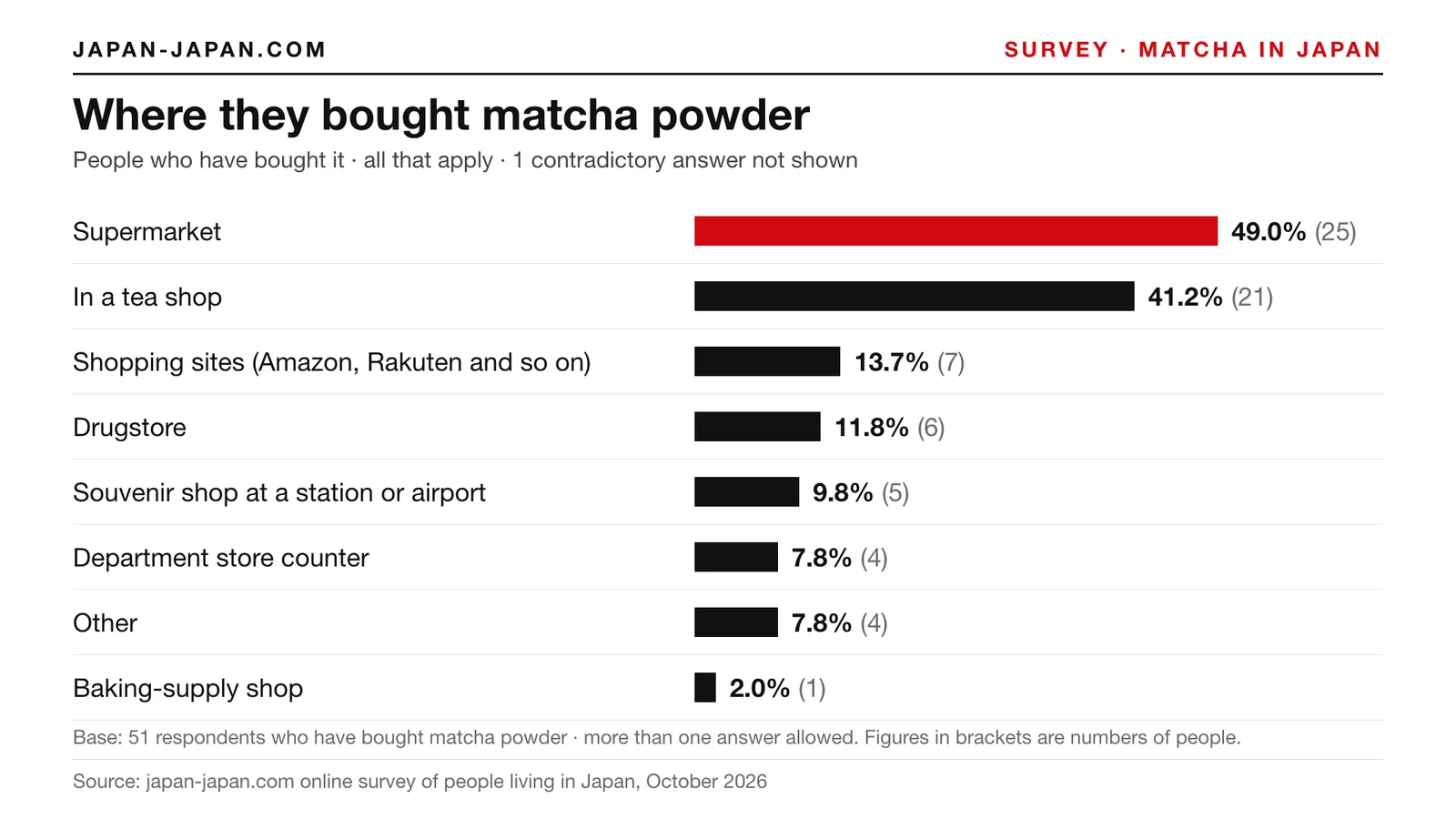
Among those 51 buyers, the supermarket was the most common place at 49.0% (25 of 51). A tea shop came second at 41.2% (21 of 51). On their last purchase, the most common price band was ¥500–999 at 29.4% (15 of 51). Most used it for a latte or matcha milk: 43.1% (22 of 51).
Powder lasts a long time in most homes. Of the 51 who use it, only 21.6% (11 of 51) finish an opened pack within a month. A third, 33.3% (17 of 51), keep it in the fridge or freezer.
We then asked what people would pay at most for usucha matcha at a tea shop. For 20 g, 88.1% (59 of 67) of those who named a price would pay at most ¥1,499. For 30 g, 68 people named a price.
| Answer | Share | People |
|---|---|---|
| Under ¥500 | 9.0% | 9 |
| ¥500–999 | 18.0% | 18 |
| ¥1,000–1,499 | 16.0% | 16 |
| ¥1,500–1,999 | 15.0% | 15 |
| ¥2,000–2,999 | 6.0% | 6 |
| ¥3,000–3,999 | 4.0% | 4 |
| I don’t buy matcha powder | 26.0% | 26 |
| Not sure | 6.0% | 6 |
Of the 68 who named a price, 85.3% (58 of 68) would pay at most ¥1,999. Another 14.7% (10 of 68) would pay ¥2,000 or more.
Tea-shop prices sit well above that. In our database, 2 of the 33 matcha teas sold in 30 g at 6 tea brands cost under ¥2,000 with tax. Prices ran from 1,944 to 17,500 yen, with a median of 4,320 yen. We took them from the brands’ official online shops, such as the Ippodo Tea official matcha collection page, on 17 and 18 October 2026.
For a full price list by brand and by gram, see how much matcha costs at 15 tea brands in Japan.

Price rises, sold-out matcha and purchase limits
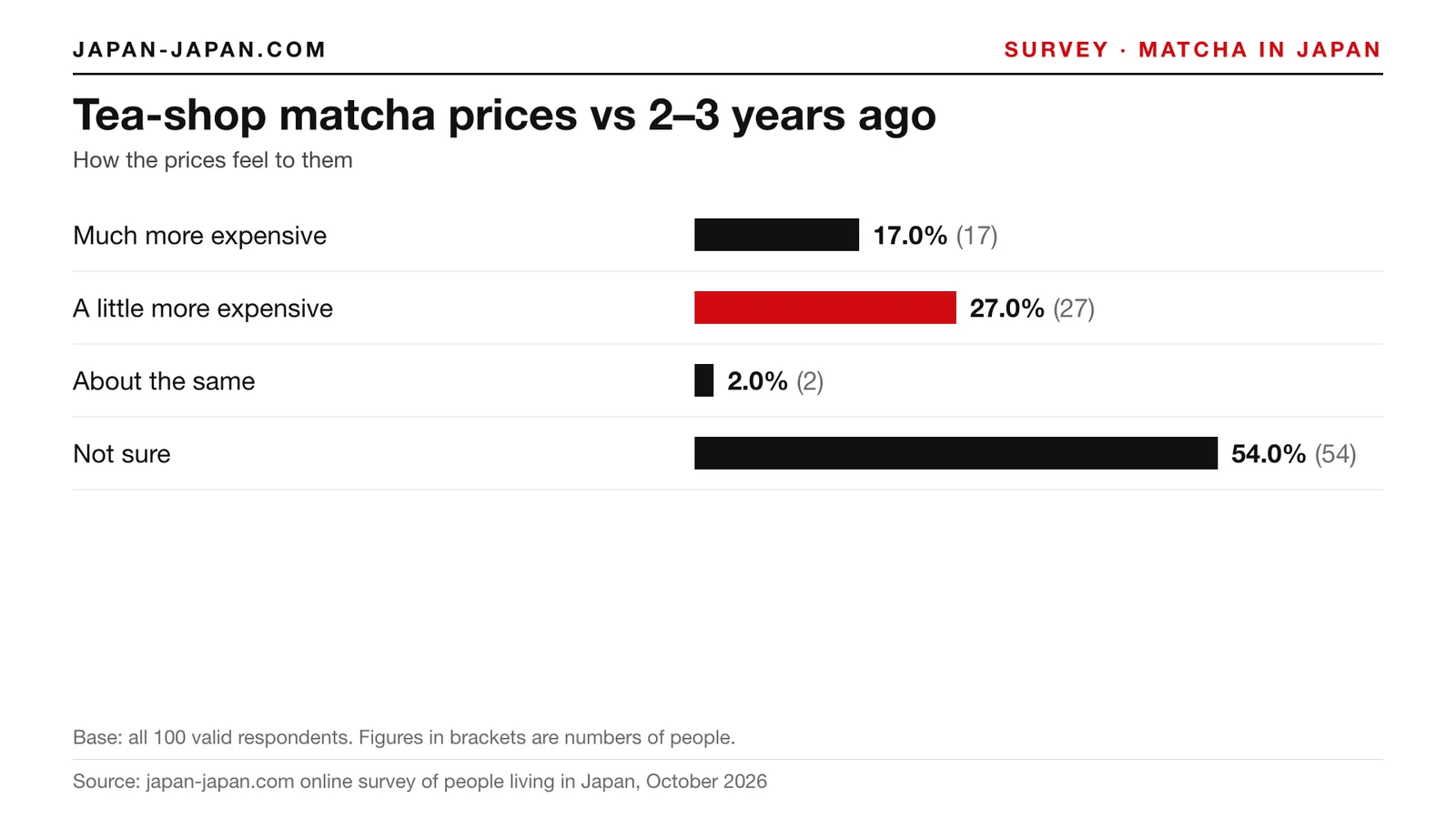
Most people who follow matcha prices feel they have gone up. 44.0% (44 of 100) said tea-shop matcha costs more than two or three years ago.

Another 54.0% (54 of 100) are not sure. Among the 46 who gave a view, 95.7% (44 of 46) feel prices are higher.
28.0% (28 of 100) changed at least one habit because of price rises or shortages. 12.0% buy less, and 12.0% switched to a cheaper brand or supermarket matcha.
Shortages and limits are rarer in daily life. In the past year, 10.0% (10 of 100) saw matcha powder sold out or marked “waiting for stock”. 6.0% (6 of 100) have seen a limit on how much one person can buy. Of those 6 people, 2 saw it at tea shops in Uji and 2 at tea shops in Kyoto city. The lowest limit they remembered was 1 per person for 2 people and 2 per person for another 2.
A sign may read 1人2点まで (hitori ni-ten made), meaning “two items per person”. One respondent in their 40s in Kansai wrote: “I went all the way to Kyoto to buy some, but a sign said two per person. I was really disappointed.”
Opinions on limits lean towards support. 43.0% are for or somewhat for them, 7.0% are against and 50.0% are neither. We also asked how many tins or bags a visitor could buy before it bothered them. For 75.0% (75 of 100), up to 5 would not bother them, and 16.0% said any number is fine.
Respondents gave their own reasons for the shortage. 74.0% pointed to matcha becoming more popular overseas, 40.0% to heat and other weather and 39.0% to fewer tea farmers. For what tea brands and growers report, read why there is a matcha shortage in Japan.


Tea shops they know and the one they’d recommend in Kyoto
Nearly everyone knows a tea shop by name. 92.0% (92 of 100) know at least one of the nine shops we listed.
Gion Tsujiri was the best known at 81.0%, followed by Itohkyuemon at 65.0% and Fukujuen at 62.0%. 59.0% (59 of 100) have bought something from, or eaten at, at least one of the nine. Gion Tsujiri led there too at 51.0%, and 44.0% named it the shop they like best.
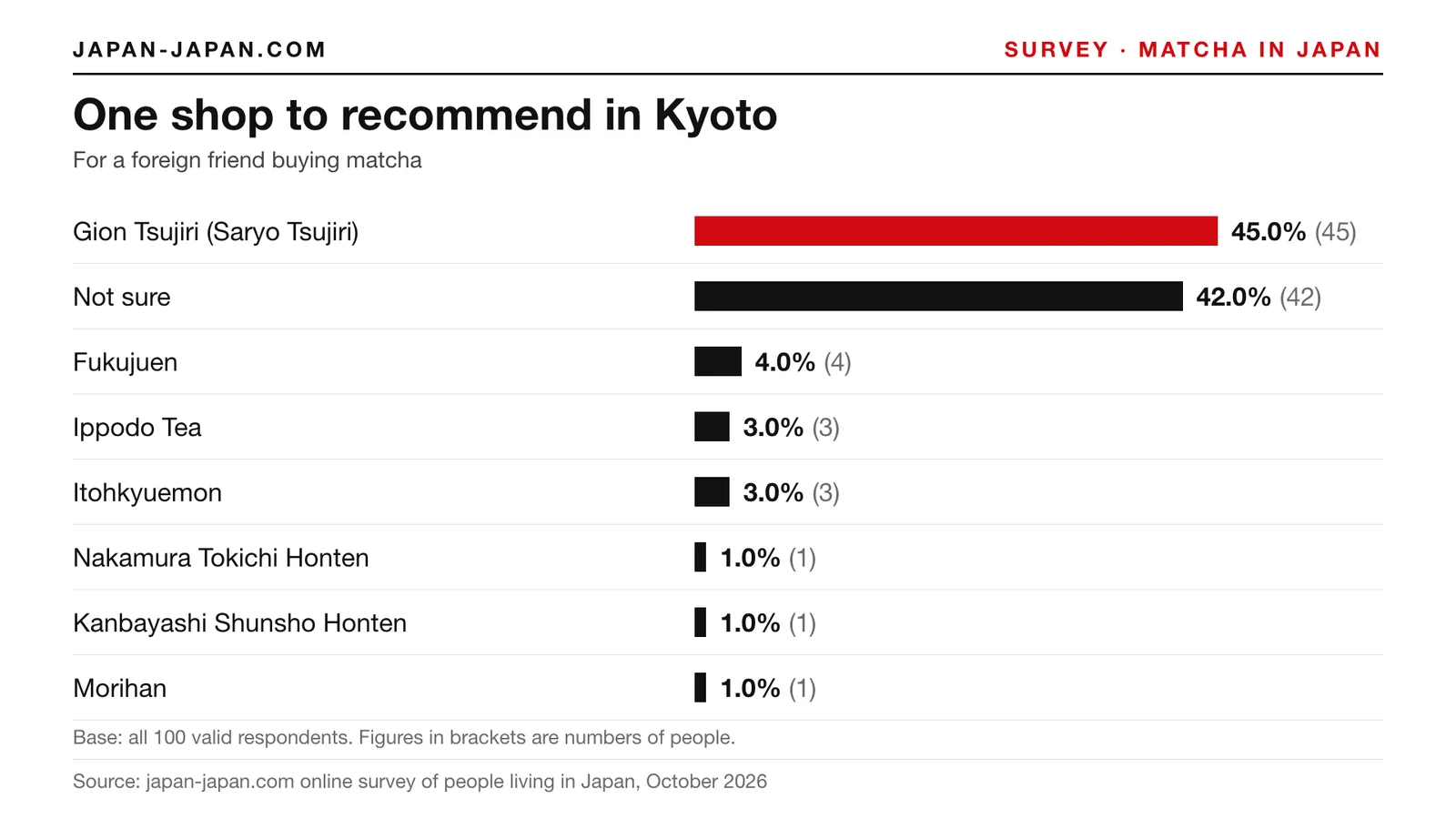
We asked which one shop they would recommend to a foreign friend buying matcha in Kyoto. 45.0% (45 of 100) chose Gion Tsujiri, and 42.0% were not sure. Among the 58 who named a shop, 77.6% (45 of 58) picked Gion Tsujiri. That makes it the shop most recommended by respondents. It reflects their preference, not sales or a ranking of quality.
Of those 58, 58.6% (34 of 58) said it is famous, so people are pleased, and 46.6% (27 of 58) said the matcha tastes good. One respondent in Tokyo wrote: “Tsujiri’s Gion shop in Kyoto. The matcha parfait was good.” To compare brands, prices per gram and order limits, use our matcha shop database.

Growing areas, usucha and koicha, and ‘ceremonial grade’
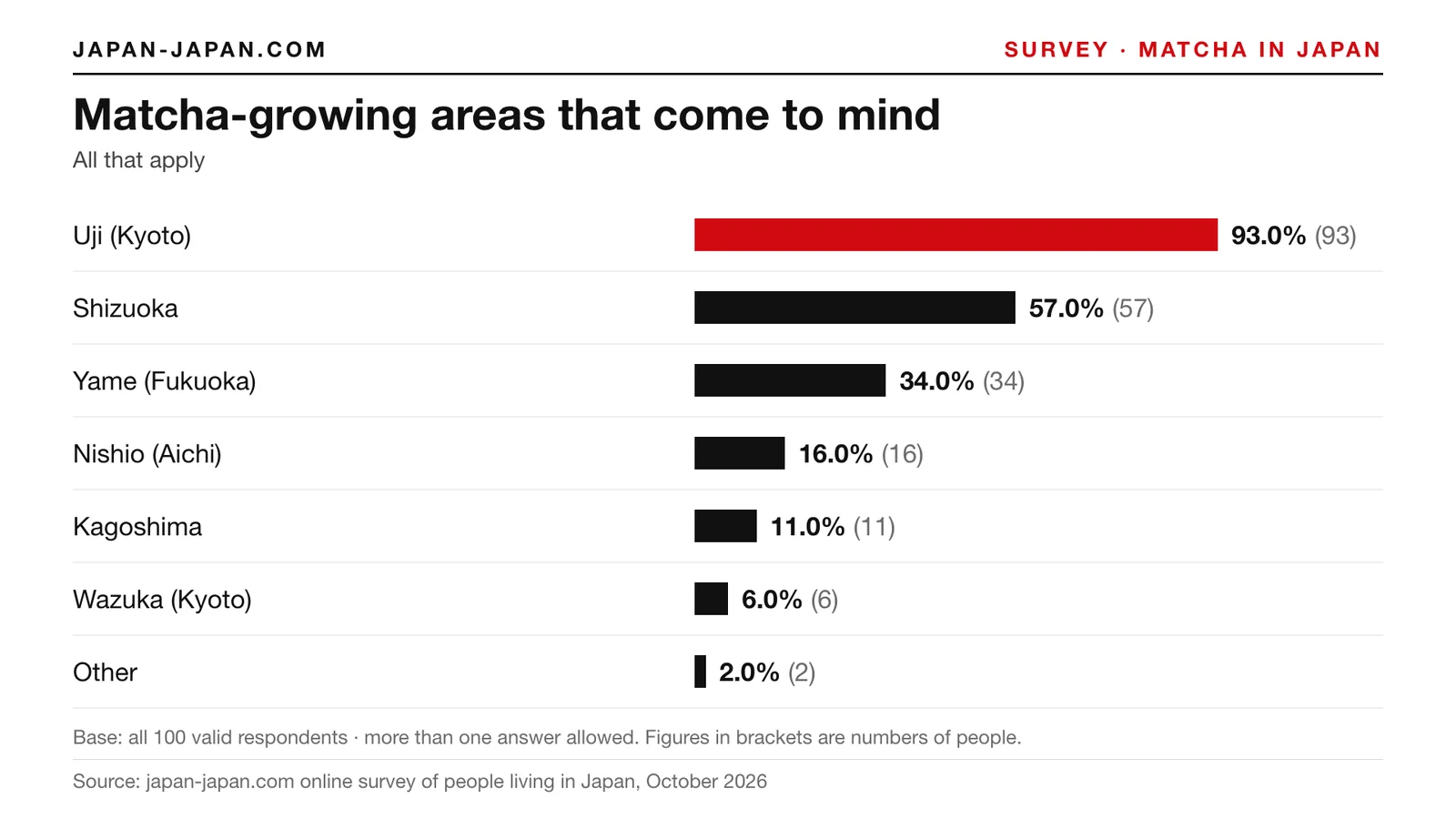
Uji dominates the mental map. 93.0% (93 of 100) think of Uji when they hear “matcha-growing area”.
Shizuoka came second at 57.0% and Yame in Fukuoka third at 34.0%. When asked which area they like best, 39.0% chose Uji. Another 32.0% don’t pay attention to the area. Our guide to where matcha is grown in Japan covers what each region produces.

The MAFF Japan tea industry overview page says Japan has more than 100 kinds of tea.
The finer points of matcha are less familiar. Only 16.0% (16 of 100) can explain, or roughly explain, the difference between usucha (thin matcha) and koicha (thick matcha). Just 14.0% knew or had heard that matcha is said to be at its best in November and December. That is around kuchikiri, the opening of the new tea jar.

The screenshot is from the Ministry of Agriculture, Forestry and Fisheries tea page, titled “Japan, a great tea nation”. It introduces tea types, food pairings and brewing temperatures in Japanese.
Few respondents know the English label “ceremonial grade”. Only 8.0% (8 of 100) have seen or heard it. Our page on ceremonial grade matcha from Japan explains what tea shops call their grades. For a friend making lattes at home, 49.0% would suggest affordable baking or latte matcha, and 27.0% sweetened latte powder.

Matcha sweets and convenience stores
Sweets are where most people meet matcha. In the past year, 68.0% ate matcha ice cream and 61.0% matcha chocolate.
Matcha soft-serve came third at 47.0%. Matcha parfaits reached 27.0%.
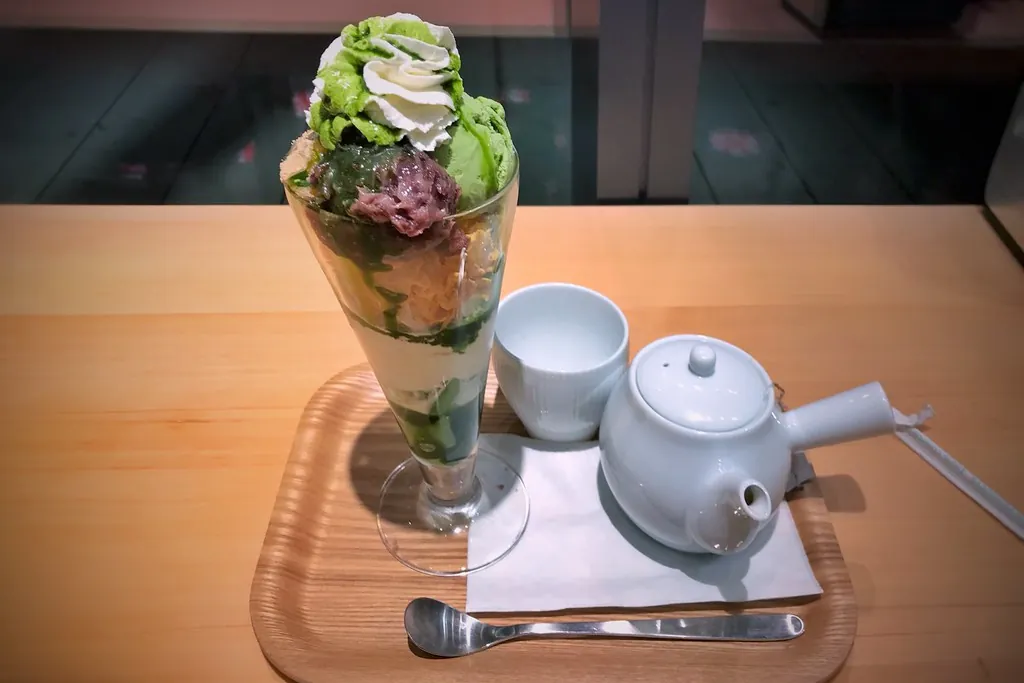
When people picked one favourite, shop-bought matcha ice cream won. The chart lists the top answers.
| Favourite sweet | Share | People |
|---|---|---|
| Matcha ice cream (shop-bought cups) | 31.0% | 31 |
| Matcha soft-serve ice cream | 20.0% | 20 |
| Matcha chocolate | 15.0% | 15 |
| Matcha parfait | 7.0% | 7 |
| Matcha daifuku or dango | 7.0% | 7 |
| Matcha cake (such as roll cake) | 4.0% | 4 |
| Matcha cookies or baked sweets | 4.0% | 4 |
Convenience stores are a big part of the picture. 85.0% (85 of 100) buy matcha products there at least sometimes, and 89.0% (89 of 100) have bought at least one. Ice cream was the most bought item at 60.0%.
Which chain does matcha best? The most common answer was “I can’t tell the difference” at 41.0%. Among the chains, 7-Eleven got 27.0%, Lawson 14.0% and FamilyMart 7.0%.


Tea ceremony experiences and a fair price
Most respondents have tried a tea ceremony at least once. 64.0% (64 of 100) have done an experience or whisked matcha themselves.
For most, that happened at school. Among the 64, 48.4% (31 of 64) did it at school, and 51.6% (33 of 64) paid nothing. Only 17.0% of all respondents joined a class or experience while travelling. 85.9% (55 of 64) ate a Japanese sweet, and 76.6% (49 of 64) whisked matcha themselves.
We asked what a fair price would be for a 45-minute tea ceremony for foreign travellers, with matcha and a Japanese sweet. 86 people named a price. 36.0% (31 of 86) chose under ¥3,000, 40.7% (35 of 86) chose ¥3,000 to ¥4,999 and 23.3% (20 of 86) chose ¥5,000 or more. 74.0% would accept some extra charge for wearing a kimono.
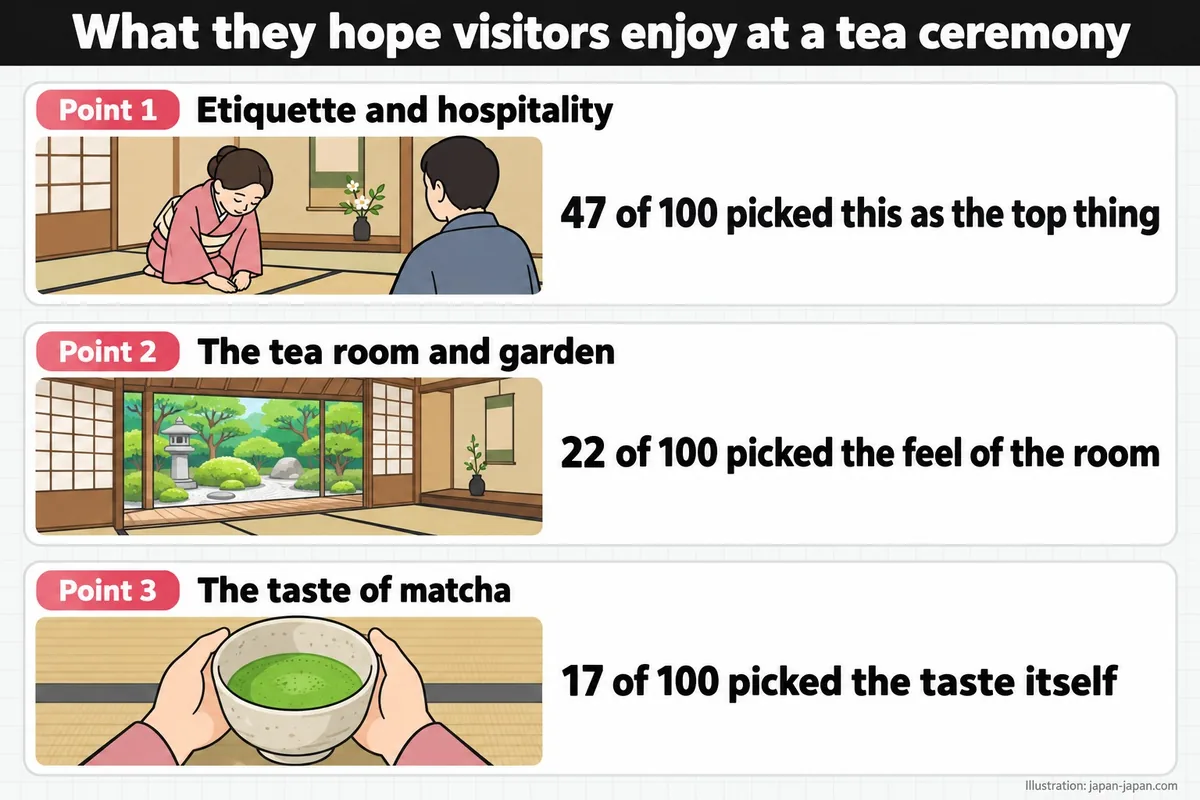
Asked what they most want visitors to enjoy, 47.0% chose the etiquette and the idea of hospitality, 22.0% the feel of the tea room and garden and 17.0% the taste of matcha.
Interest stays high. 84.0% (84 of 100) would like to try a tea ceremony or matcha-making experience in the future. For prices, English support and chairs at each venue, compare tea ceremony prices in Japan.


Uji and matcha days out
Matcha shops are a common stop on trips. 69.0% of respondents go into one when travelling, either on purpose or when they pass one.
Kyoto city was the top matcha town at 35.0%, and Uji came next at 23.0%. In total, 47.0% (47 of 100) have been to Uji.

Byodoin Temple was the main sight. Among the 47 who went, 72.3% (34 of 47) saw Byodoin, and 44.7% (21 of 47) went into a matcha cafe or sweet shop. 38.3% (18 of 47) arrived by JR. The most common stay was 2–4 hours at 27.7% (13 of 47), as respondents remember it.
Queues were short for many. 68.1% (32 of 47) went into a matcha cafe or sweet shop, and 46.9% (15 of 32) of them recall no queue at all. Across all respondents, 71.0% would queue 15 minutes at most for a matcha parfait or soft-serve. 29.0% would wait 30 minutes or more.
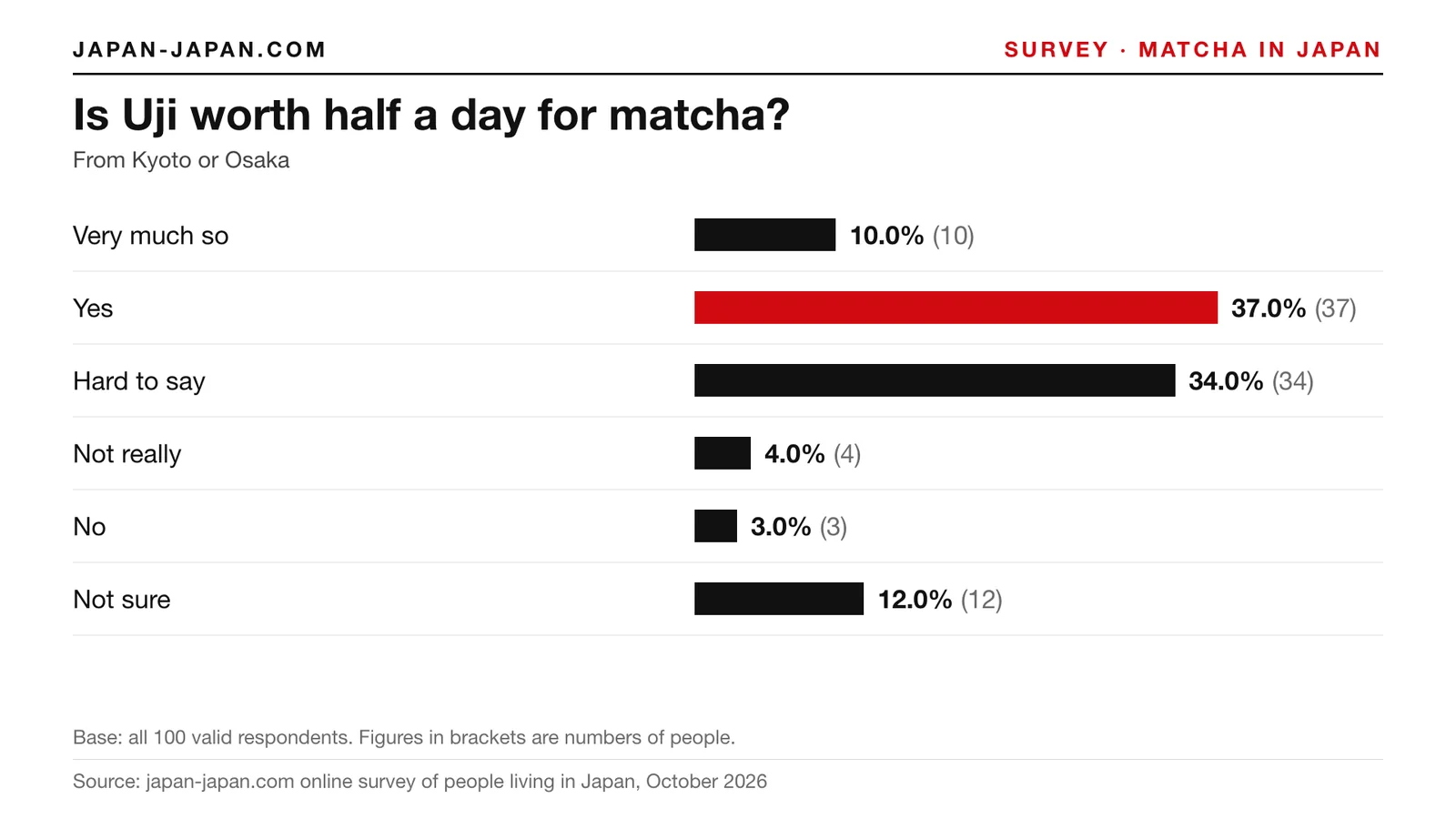
Is Uji worth the trip? 47.0% (47 of 100) say a half-day trip from Kyoto or Osaka for matcha is worth it, and only 7.0% say it is not. To find shops, 60.0% use Google Maps and 55.0% use Instagram. Only 9.0% plan a matcha day out this autumn or winter.
For trains, times and shops, read our Uji matcha day trip guide and the Kyoto to Uji route page.


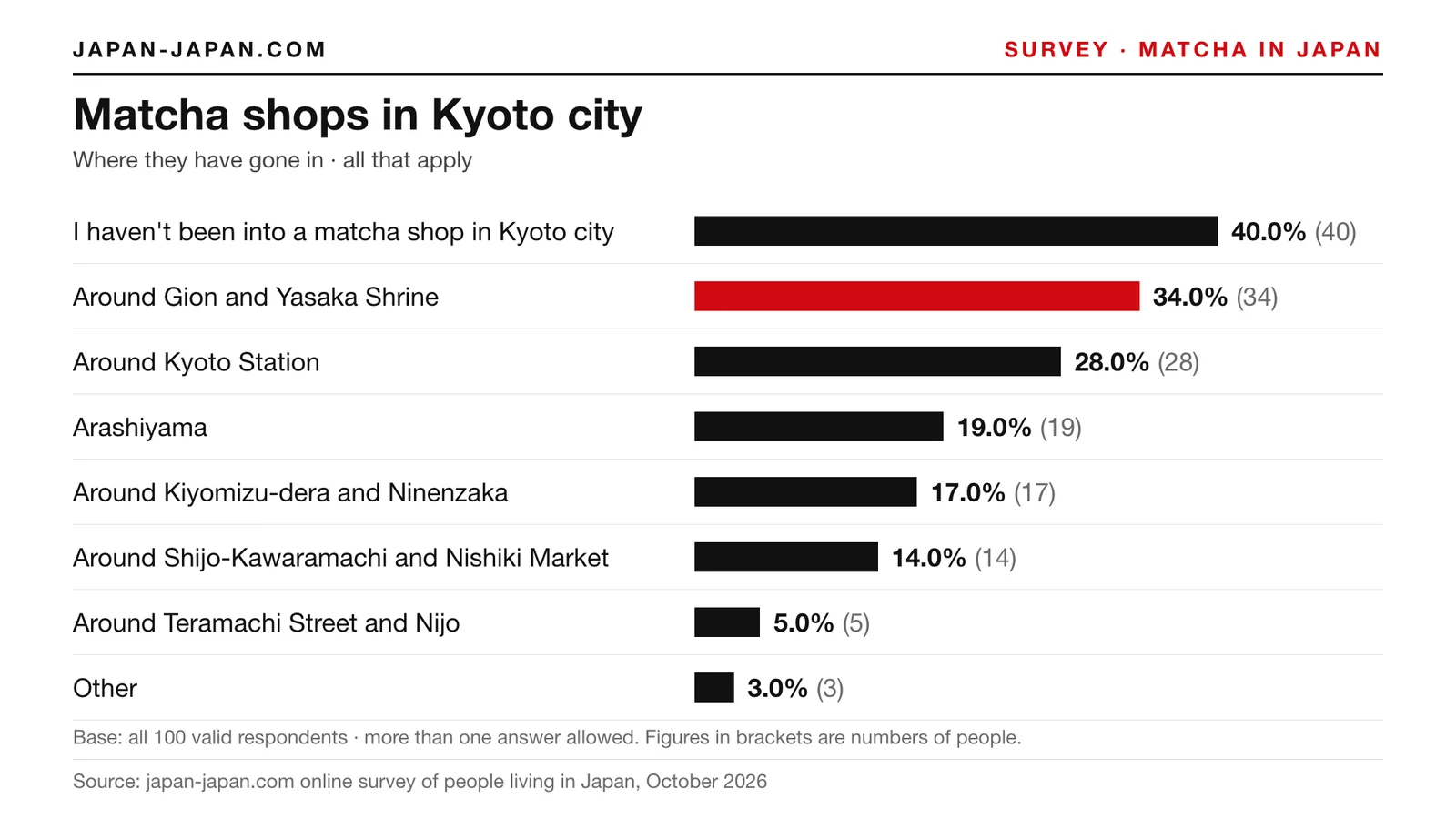
Matcha shops in Kyoto city and Tokyo
Kyoto city is where most respondents have sat down for matcha. 60.0% (60 of 100) have gone into a matcha shop somewhere in the city.
The area around Gion and Yasaka Shrine led at 34.0%. Kyoto Station followed at 28.0% and Arashiyama at 19.0%. Our list of where to buy matcha in Kyoto sorts the shops by area.
Tokyo trails. 35.0% (35 of 100) have gone into a matcha shop in Tokyo, most often in Asakusa at 14.0% and Ginza at 9.0%. For shops by neighbourhood, see where to buy matcha in Tokyo.

Matcha or hojicha
For themselves, respondents lean towards matcha. 47.0% prefer matcha, 27.0% hojicha and 25.0% like both about the same.
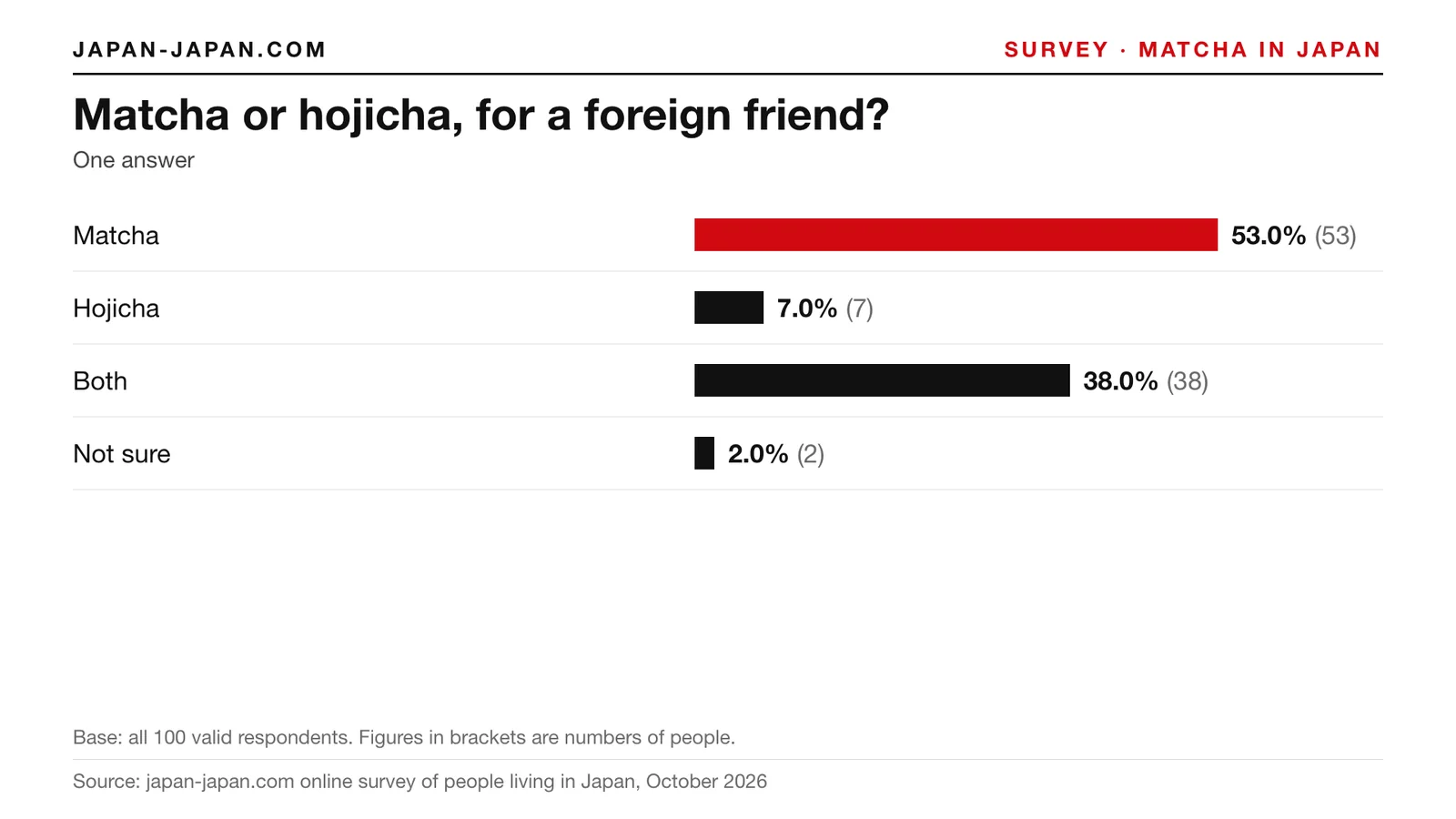
For a foreign friend, matcha gains ground. 53.0% would recommend matcha, 38.0% both and 7.0% hojicha. That means 91.0% (91 of 100) would recommend matcha alone or together with hojicha. Our comparison of matcha, green tea and hojicha explains how the teas differ.
Souvenirs, airports and taking matcha abroad
Matcha KitKat topped the souvenir list. 49.0% would recommend it to a foreign friend, just ahead of matcha chocolate at 48.0% and single-serving matcha sticks at 47.0%.
Asked for one top pick, 25.0% chose the single-serving sticks. One respondent warned that with powder, “they might not use it all, or it might not suit them”. Of the 94 who named a budget, 80.9% (76 of 94) spend under ¥2,000 on one matcha souvenir. Our guide to matcha souvenirs from Japan lists what each tea brand sells.
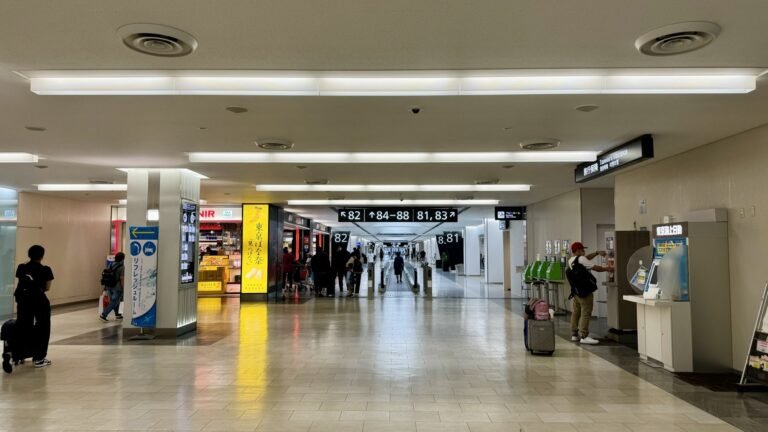
On where to buy, 53.0% would send a friend to tea shops. Only 13.0% (13 of 100) have bought matcha souvenirs at an airport. If your trip ends there, see matcha at Narita Airport after security. Larger purchases may qualify for tax-free shopping.
10.0% (10 of 100) have taken or sent matcha powder abroad. Of the 7 who carried it themselves, 6 packed it in a checked suitcase. Before you pack, check our page on bringing powders on a plane.


What respondents wrote
All five free-text questions were required, so every one of the 100 respondents wrote something. Here are some of their answers, translated from Japanese by japan-japan.com. Age, gender and region are as respondents reported them.
“Start with an easy matcha latte. Some people don’t like matcha’s bitterness, so a latte is easier to drink.”
— Woman in their 30s, Kyushu. Original Japanese (excerpt): 「まずは気軽に抹茶ラテを飲んでほしい。抹茶の苦味が好きでない人もいるので、ラテの方が飲みやすいと思う。」
“I’d like them to drink properly whisked matcha with a Japanese sweet, sitting on tatami.”
— Woman in their 20s, Kyushu. Original Japanese (excerpt): 「お抹茶としてちゃんと点てたお抹茶と和菓子を畳の上で飲んで欲しいです」
“If they drink bitter matcha, I’d suggest having a sweet Japanese confection with it.”
— Woman in their 20s, Kinki (Kansai). Original Japanese (excerpt): 「苦い抹茶を飲むなら、甘い和菓子を一緒に食べることを勧めたい。」
“Abroad, many people think matcha means a sweet matcha latte, so I’d like them to know what real matcha is like.”
— Woman in their 30s, Kanto (outside Tokyo). Original Japanese (excerpt): 「外国行くとMatchaといえば甘い抹茶ラテと思っている人が多いから、本物の抹茶とはこういうものだということを知ってほしいと思った。」
“When I once recommended plain matcha, it didn’t go down well: they said it tasted like grass.”
— Woman in their 40s, Kinki (Kansai). Original Japanese (excerpt): 「以前薦めた時に、普通の抹茶だと「草の味がする」と不評だったので。」
“Kneeling in a tatami room and whisking matcha is something you can only do in Japan, so it would make a great memory.”
— Woman in their 20s, Kanto (outside Tokyo). Original Japanese (excerpt): 「和室で正座して抹茶を立てるという体験は日本でしかできない貴重なものでとてもよい思い出になるだろうと思うから。」
“Really, I’d like them to buy the tools and try koicha.”
— Woman in their 50s, Chubu. Original Japanese (excerpt): 「本当は道具を購入してもらって濃茶を勧めたい。」
“I care most about whether it comes in small portions, because I can never use it all up.”
— Woman in their 30s, Tokyo. Original Japanese (excerpt): 「小分けになっているかどうかを重視する。(なかなか使い切れないから)」
“I choose finely ground matcha so it doesn’t go lumpy.”
— Woman in their 20s, Kyushu. Original Japanese (excerpt): 「マダラにならないように決めが細かい抹茶を選ぶようにしている」
“I’d tell them to check the ingredients so they buy real matcha powder, not latte powder by mistake.”
— Woman in their 20s, Tokyo. Original Japanese (excerpt): 「本物の抹茶の粉を買えるように原材料名を注意してみることを教えます。」
“Whether it says where it was grown, down to the prefecture.”
— Woman in their 30s, Tokyo. Original Japanese (excerpt): 「産地(日本の都道府県まで)が書かれているかどうか。」
“When I bought matcha recently, a brand I’d bought before had doubled in price. I was shocked.”
— Woman in their 50s, Tohoku. Original Japanese (excerpt): 「最近抹茶を買ったら、以前買ったことのある銘柄の抹茶の値段が、倍になっていてびっくりした。」
“A sweet shop’s matcha sweets had disappeared, so I asked, and they said ingredient costs had risen too much to make a profit.”
— Woman in their 30s, Kyushu. Original Japanese (excerpt): 「抹茶を扱っているお菓子屋さんの抹茶スイーツがなくなっていたため尋ねたら、原材料費が高騰しすぎて採算が取れないとのことだった。」
“I’m glad matcha is popular abroad, but it’s sad if people in Japan can no longer afford to drink it.”
— Woman in their 30s, Tokyo. Original Japanese (excerpt): 「抹茶が海外で人気が出るのは嬉しいが、それに伴って日本人が価格高騰で飲めなくなるのは悲しい。」
“Even at the supermarket, almost everything is close to 1,000 yen. A cheaper range would be easier to pick up.”
— Woman in their 20s, Chugoku. Original Japanese (excerpt): 「普段スーパーでも1,000円近いものばかり置いてあるため、もっと安い値段帯のものがあれば手に取りやすいのにと思います。」
“I don’t use it every day, so I’d like visitors to buy plenty.”
— Woman in their 40s, Kyushu. Original Japanese (excerpt): 「普段使いはしないので、インバウンドの方にどんどん買ってほしいです」
“Uji is the best, I think. The town and the approach to the temple have atmosphere, and the matcha tastes even better there.”
— Woman in their 50s, Kyushu. Original Japanese (excerpt): 「宇治が一番だと思う。町や参道に風情があり、抹茶も一層美味しく感じるため。」
“Around Kyoto Station there are lots of matcha cafes just by wandering about, so it’s a safe choice.”
— Woman in their 30s, Kanto (outside Tokyo). Original Japanese (excerpt): 「京都駅付近にはふらふらしてるだけで抹茶カフェが多くあるので無難です。」
“(Arashiyama) There’s plenty of area to stroll, so you can enjoy all kinds of matcha sweets.”
— Woman in their 20s, Kyushu. Original Japanese (excerpt): 「散策エリアが充実しているので色んな抹茶スイーツを楽しめるから」
“Kyoto has many famous shops and gets crowded, but Nishio’s matcha isn’t as well known, so I think you can enjoy it at a slower pace.”
— Woman in their 40s, Chubu. Original Japanese (excerpt): 「京都は有名なお店がたくさんあり混雑していますが、西尾市の抹茶は京都ほど知られていないと思うので、ゆっくり抹茶を楽しむことができると思うからです。」
“Ginza has surprisingly many matcha sweets, upmarket and unusual ones you won’t find in other areas.”
— Man in their 50s, Tokyo. Original Japanese (excerpt): 「銀座が意外と抹茶を使ったスイーツが多く、高級で他のエリアにはないような変わった物があるのでお勧めです。」
“(Matcha KitKat) It’s easy to buy at supermarkets in Japan, and easy to hand out after you get home.”
— Woman in their 20s, Kinki (Kansai). Original Japanese (excerpt): 「お土産として日本でもスーパーなどで手軽に買いやすく、持ち帰った後も配りやすいと思ったからです。」
“With powder, they might not use it all, or it might not suit them.”
— Woman in their 20s, Kanto (outside Tokyo). Original Japanese (excerpt): 「粉だと、使い切れなかったり、合う合わないがありそうなので。」
“Real matcha powder, which is hard to find abroad, also makes a good memento of Japan.”
— Woman in their 30s, Kanto (outside Tokyo). Original Japanese (excerpt): 「外国ではなかなか手に入らない本物の抹茶の粉も、日本の思い出の品になるのですすめたい。」
“(Cookies and matcha drink sticks) They don’t mind the temperature, keep fairly well compared with fresh sweets, and are easy to share back home.”
— Woman in their 20s, Chugoku. Original Japanese (excerpt): 「気温などに左右されにくく、生物に比べると比較的日持ちもするし、帰国後も誰かとシェアしやすいからです。」
“I’d like them to choose matcha itself and a full set of tools to whisk it, so they can understand a bit of Japanese culture.”
— Woman in their 30s, Kyushu. Original Japanese (excerpt): 「抹茶そのものとたてる道具を一式選んで欲しい。日本の文化を少しでもわかってもらえそうだから。」
“Proper Japanese sweets don’t keep long, so for a friend far away, sweets from a confectionery maker, matcha powder and the basic tea tools should be enough to enjoy it.”
— Woman in their 30s, Kanto (outside Tokyo). Original Japanese (excerpt): 「本格的な和菓子は賞味期限が短そうなので、遠くの友達へ送る時は、お菓子メーカーのお菓子と、抹茶の粉と最低限の茶道具があれば楽しんでもらえると思います。」
FAQ
Do people in Japan think matcha has become more expensive?
Many do. 44.0% (44 of 100) felt tea-shop matcha costs more than two or three years ago. Among the 46 with a view, 95.7% feel prices are higher.
Have people in Japan seen limits on buying matcha?
Few have. 6.0% (6 of 100) have seen a limit on how much one person can buy, in a shop or online. Of those 6, the lowest limits they remember were 1 per person and 2 per person.
Which matcha shop in Kyoto do people in Japan recommend?
Gion Tsujiri. 45 of 100 respondents would recommend it to a foreign friend, which is 77.6% of the 58 who named a shop. Most said it is famous and the matcha tastes good.
Is Uji worth a half-day trip for matcha, according to people in Japan?
Nearly half say yes. 47.0% (47 of 100) think a half-day trip from Kyoto or Osaka to Uji for matcha is worth it, and 7.0% think it is not. Another 34.0% said it is hard to say.
About the author