Japan Multiple Entry Visa: Who Gets 3, 5 or 10 Years
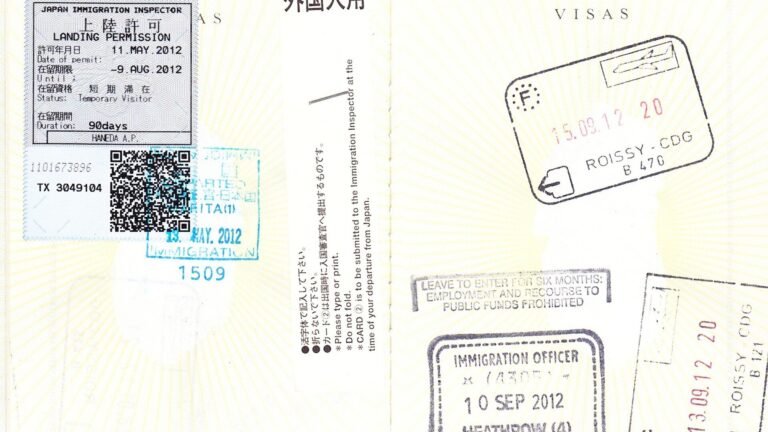
The MOFA Japan validity of a visa page says Japan issues multiple-entry visas to business travellers and others. You can use one any number of times while it is valid. Since February 15, 2016, business visitors and cultural or intellectual figures from Vietnam and India can get up to 10 years.
Check your passport first. Nationals of 74 countries and regions can enter Japan without a visa for a short stay, as our list of visa-free countries for Japan shows. Everyone else applies at a Japanese embassy or consulate, or through the channel it names.
Single Entry vs Multiple Entry Visa
A single-entry visa works once.
MOFA sets its validity at three months. The visa stops working as soon as you apply for landing at a Japanese port of entry, or when it expires, whichever comes first. You cannot extend the validity of a visa.
A multiple-entry visa is valid for 1 to 5 years under the same MOFA rule. You can use it any number of times in that period. Each visit is still a short stay, though. Depending on the type, you can stay up to 30 days or up to 90 days on each entry.
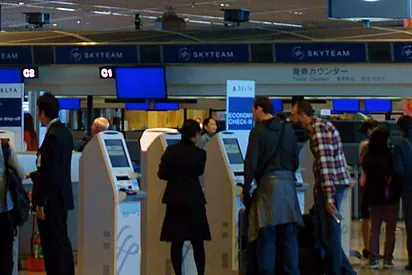
The photo above shows the departure lobby at Narita Airport. With a multiple-entry visa, you can fly out and come back on a later trip without a new application.
The money side is simple. The MOFA Japan visa fees page sets new fees for applications accepted on or after July 1, 2026. A single-entry visa costs about 15,000 yen and a multiple-entry visa about 30,000 yen. Two trips on single-entry visas cost about the same as one multiple-entry visa.
The online route covers single entries only. JAPAN eVISA issues a single-entry tourist visa, as our JAPAN eVISA guide explains. For a multiple-entry visa, you apply at the Japanese embassy or consulate for the place you live, or at an agency it approves.
Who Qualifies: Travel Record, Income or Business
You qualify through one of three routes.
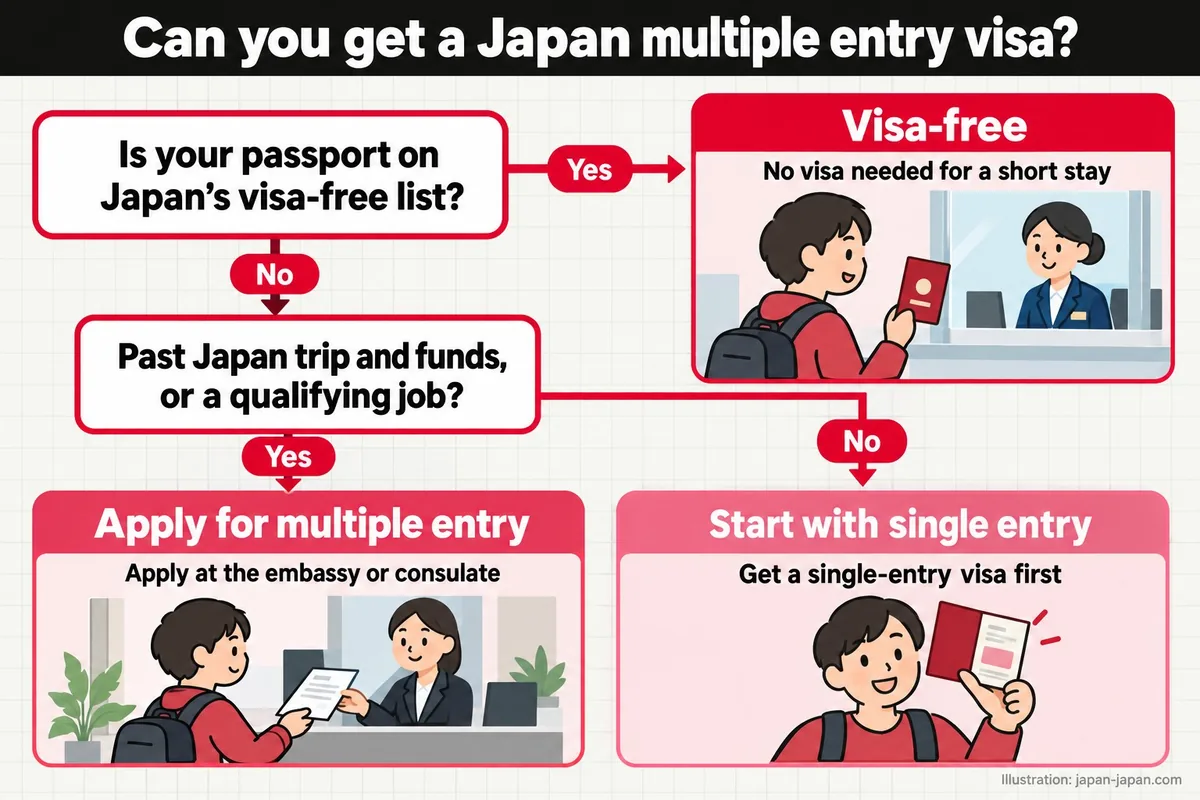
The illustration above turns the first check into two questions. If your passport is visa-free, you can stop there.
Route 1: a travel record to Japan
This route rewards past visits.
The Consulate-General of Japan in Boston travel record multiple visa page covers nationals of Indonesia, the Philippines, Russia, Ukraine and Viet Nam. You need at least one trip to Japan on a temporary visitor visa in the last three years. You also need sufficient financial capability. The same rule covers twelve Pacific countries: Fiji, Kiribati, Marshall, Micronesia, Nauru, Palau, Papua New Guinea, Samoa, Solomon, Tonga, Tuvalu and Vanuatu.
Indian nationals face a tighter count. They need two or more trips to Japan on a temporary visitor visa in the last year, plus sufficient financial capability. For applicants at the Boston consulate, this visa is valid for 1 to 3 years. Each stay can last up to 30 days.
Route 2: income, for Chinese nationals
Chinese nationals can qualify on income alone.
The MOFA Japan visa information for Chinese nationals page lists two income levels. A sufficient level of financial capability gives a visa valid for 3 years, with up to 30 days a stay. A substantially high income gives 5 years, with up to 90 days a stay. Family members can apply under both. The China section below has the full rules.
Route 3: business
Business travellers qualify through their employer.
The Consulate-General of Japan in Boston business multiple visa page lists a visa valid for 1 to 3 years. Each stay can last up to 90 days. Nationals of India, Viet Nam and the Philippines must meet one of three conditions.
- You work full time for a government enterprise, a listed company or another firm on the consulate’s list.
- You made a business trip to Japan and more than two trips to G7 countries, both in the last three years.
- You made more than three business trips to Japan in the last three years, each on a business visa.
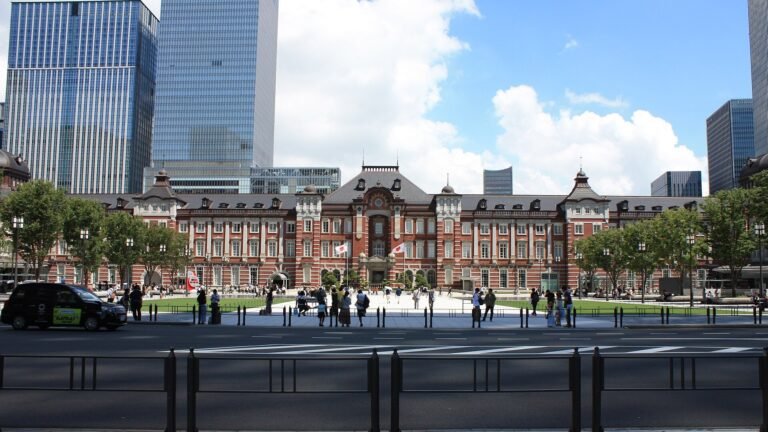
The photo above shows office towers in Marunouchi, near Tokyo Station.
The rules change with nationality. Nationals of China, Russia, Ukraine, Saudi Arabia and ten other countries on the Boston list can qualify through the same employers. They can also qualify with more than three business trips to Japan in the last year, or more than ten in the last three years. For the remaining nationalities, you must work full time at a qualifying firm. You must also be a section chief or have worked there longer than a year.
The table below puts the six main types side by side.
| Type | Who applies | Validity | Each stay |
|---|---|---|---|
| Travel record | 1+ trip to Japan in 3 years (India: 2+ in the last year), with funds | 1-3 years | Up to 30 days |
| Business | Full-time staff of a listed or other qualifying firm | 1-3 years | Up to 90 days |
| India, frequent visitor | 2+ trips to Japan in the last year | Up to 5 years | Up to 90 days |
| China, sufficient funds | Sufficient financial capability | 3 years | Up to 30 days |
| China, high income | Substantially high income | 5 years | Up to 90 days |
| China, Okinawa or Tohoku | 1 night in Okinawa or Tohoku, with funds | 3 years | Up to 30 days |
Each embassy or consulate applies these rules to the people it serves, so read the page of the mission for the place you live. Our guide to applying for a Japan visa shows which mission or agency handles your country.
Japan Multiple Entry Visa for Indians
Indian nationals get the shortest document list.
The MOFA press release on visa relaxation for India, dated November 14, 2017, cut the paperwork from January 1, 2018. Indian ordinary passport holders now apply for a multiple-entry visa with three documents in principle.
- A passport.
- A visa application form with a photo.
- Proof of financial capability for tourism, or proof that you belong to a qualifying company for business.
You can leave out two papers that most other nationalities still send: the employment certificate and the letter explaining why you want a multiple-entry visa.
Frequent visitors get an even shorter list. If you travelled to Japan twice or more in the last year, you can apply with only your passport and the application form. MOFA’s announcement gives this visa a validity of up to 5 years, with stays of up to 90 days.
Treat 5 years as the ceiling. At the Consulate-General of Japan in Boston, the travel-record visa for Indians runs 1 to 3 years with stays of up to 30 days. The mission that reviews your file decides the validity you actually receive.
In India, you hand in the application through VFS, and no appointment is needed. Our Japan visa guide for Indians lists the visa fee for Indian nationals as 500 INR, from the Embassy of Japan in India. MOFA notes that fees can differ by nationality and purpose, so check the amount for your own passport.
Indian business travellers and cultural or intellectual figures have one more option. Since February 15, 2016, they can get a multiple-entry visa valid for up to 10 years, covered in the next section.
China and the 10-Year Multiple Entry Visa
Chinese residents of China apply through an approved travel agency.
The MOFA page for Chinese nationals sends individual tourists to an approved Chinese travel agency for single-entry and multiple-entry visas alike. For a multiple-entry visa, the agency arranges your itinerary and books your accommodation for the first visit. From the second visit on, you no longer need to book through the agency.
MOFA lists three multiple-entry types for individual tourists.
- Okinawa or Tohoku: Stay at least one night in Okinawa or in one of the six Tohoku prefectures (Aomori, Iwate, Miyagi, Akita, Yamagata, Fukushima). The visa is valid for 3 years, with up to 30 days a stay.
- Sufficient financial capability: The visa is valid for 3 years, with up to 30 days a stay and no rule on where you go. Two or more trips to Japan on certain individual tourist visas in the last three years can also qualify.
- Substantially high income: The visa is valid for 5 years, with up to 90 days a stay. It covers tourism, short-term business and visits to relatives or acquaintances.
The Okinawa and Tohoku visa has its own money rules. If you stay in Okinawa, you need sufficient financial capability. A certain level of financial capability also works if you made at least one short-term trip to Japan in the last three years. If you stay in Tohoku, a certain level of financial capability is enough. Your family can come with you or travel on their own.
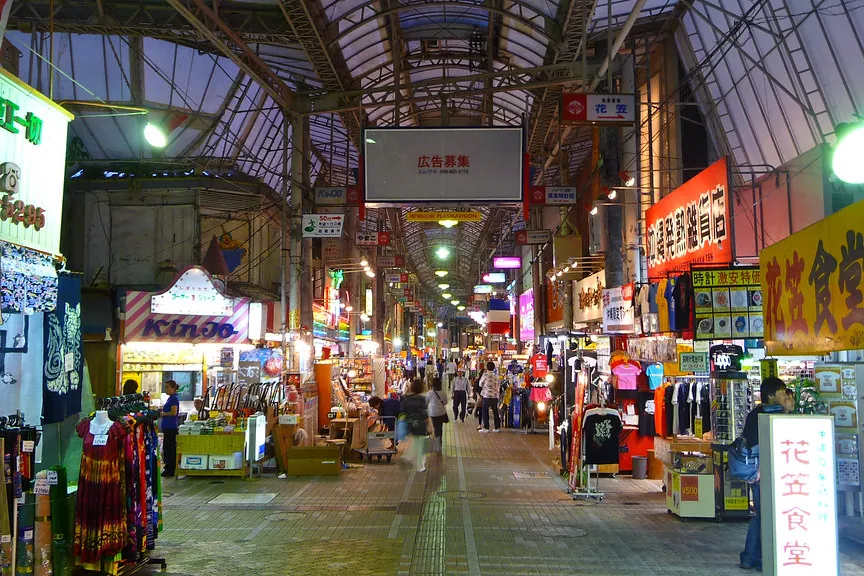
The photo above shows Kokusai Street in Naha, Okinawa. One night in Okinawa meets the destination rule, and our Naha Airport guide covers the ride into town.
Group tours follow different rules. Group tourists travel with a tour escort on a single-entry visa, and the period of stay is up to 15 days. Group tour visas do not count toward the travel record for the visa based on financial capability.
Holders of the high-income visa may not do business that generates revenue or receive any pay in Japan. For business trips or family visits on other visas, MOFA tells you to get a short-term business or visiting-relatives visa instead of a tourist visa.
Chinese nationals who live outside China apply to the Japanese embassy or consulate for the area where they live. The same MOFA page gives them 5 years with up to 90 days a stay for a substantially high income. A sufficient level of financial capability gives 3 years with up to 30 days a stay. Our Japan visa guide for Chinese citizens lists the 7 Japanese missions in China and the fee in yuan.
The 10-year visa began with business travel. The MOFA press release on 10-year multiple entry visas raised the validity from five years to up to 10 years from February 15, 2016. It covers nationals of Viet Nam and India travelling on business or as cultural or intellectual figures. MOFA called it the first time Japan issued a multiple visa valid for 10 years.
Your first trip on that visa must be for business or cultural work. From the second trip, you can also use it for tourism or to visit relatives.
A tourist version for Chinese citizens came later. On December 25, 2024, Japan announced new multiple-entry tourist visas for Chinese citizens, valid for 10 years. The announcement came at a ministers’ meeting, summarised on the MOFA Japan-China people-to-people dialogue, December 2024 page. Ask an approved Chinese travel agency which validity you can apply for now.
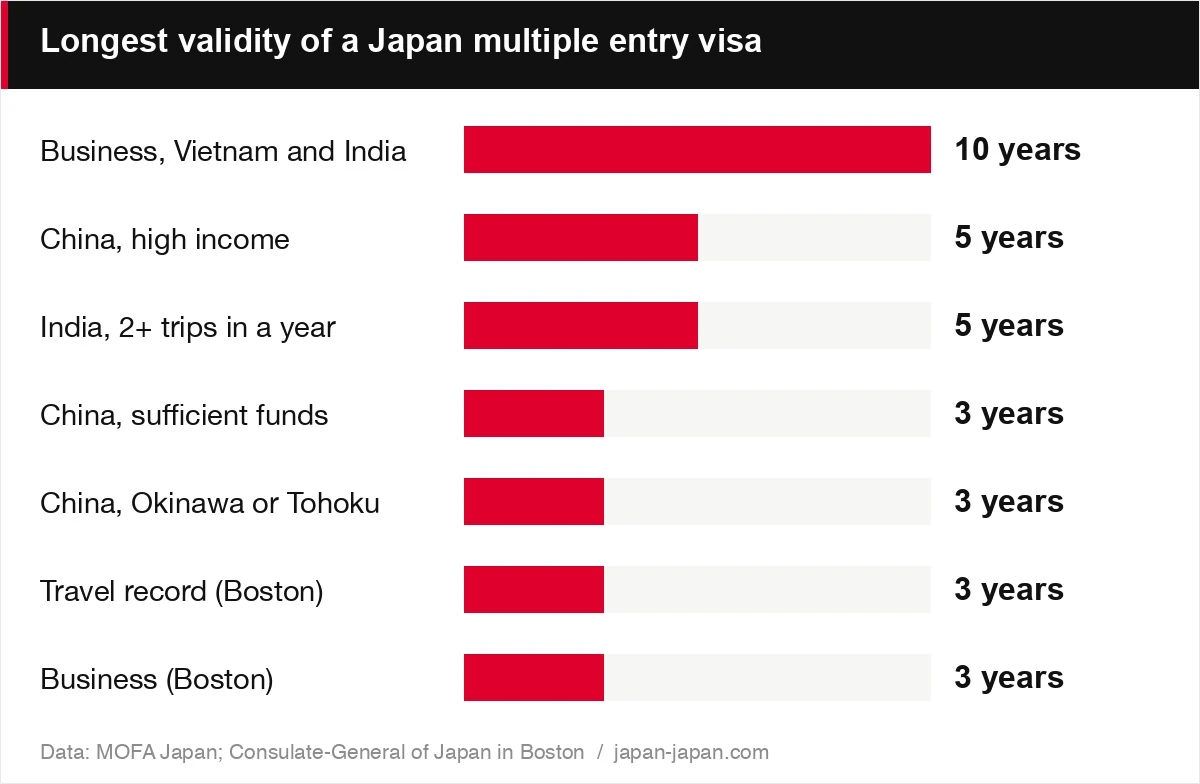
The chart below compares the longest validity of each type.
| Item | Value | Note |
|---|---|---|
| Business, Vietnam and India | 10 years | Since 2016 |
| China, high income | 5 years | |
| India, 2+ trips in a year | 5 years | |
| China, sufficient funds | 3 years | |
| China, Okinawa or Tohoku | 3 years | |
| Travel record (Boston) | 3 years | |
| Business (Boston) | 3 years |
The 10-year business visa for Vietnam and India is the longest in the chart, and four of the seven types stop at 3 years.
Japan Multiple Entry Visa Form and Documents
You start from the standard visitor visa papers.
For a single-entry tourist visa, MOFA’s checklist asks for six things. They are a valid passport, the application form, one photo, a flight itinerary, proof you can pay for the trip, and an itinerary in Japan. Our Japan tourist visa requirements page explains each one, including the 45 mm × 35 mm photo space on the form.
For a multiple-entry visa, you add papers that show why you need repeat entries. At the Consulate-General of Japan in Boston, every applicant starts with documents No. 1 to No. 7 from its temporary visitor visa list. Applicants of every nationality except India then add the first two papers below.
- Certificate of employment: If you work for a company, it must state your salary, your position and the start date of your employment.
- Reason letter: A letter stating why you are applying for a multiple visit visa, including how long you intend to stay in Japan.
- Previous passport: Any applicant may need it to prove the travel record.
Nationals of India, Indonesia, the Philippines and Viet Nam also prove money or travel. You can hand in a current bank statement in US dollars. Or show passports with trips to G7 countries in the last three years: Canada, France, Germany, Italy or the UK. Trips to France, Germany or Italy must be on a Schengen visa issued by one of those three countries. Other nationalities hand in the US dollar bank statement.
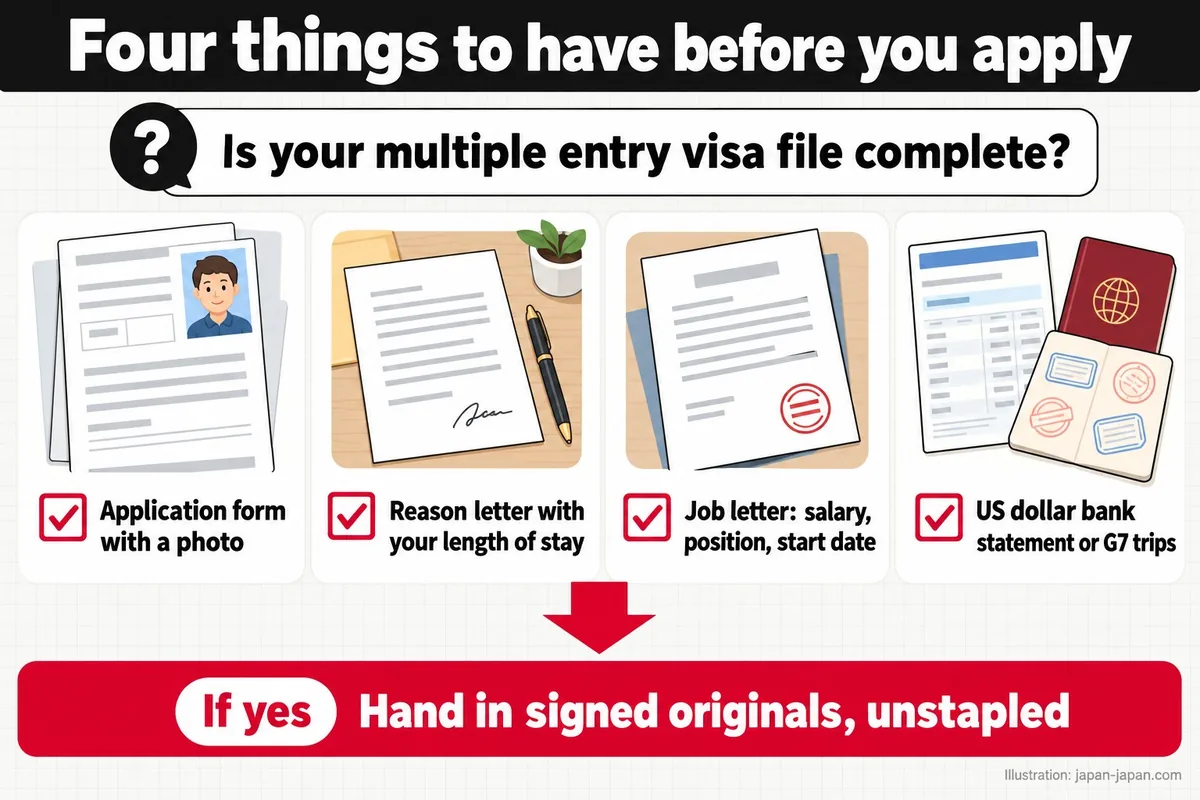
The illustration above sums up the four things to have ready before you submit.
Business applicants add papers that prove the company qualifies. Most also add a company letter requesting the visa, or an invitation letter from the host company in Japan. Nationals of Brunei, Cambodia, Papua New Guinea, Peru and Thailand skip that letter.
The Boston consulate also sets handling rules. Do not staple your application. Letters and certificates must be originals with handwritten signatures, and the consulate does not accept electronic signatures. It will not make copies for you, declines incomplete files and may ask for more documents during the review.
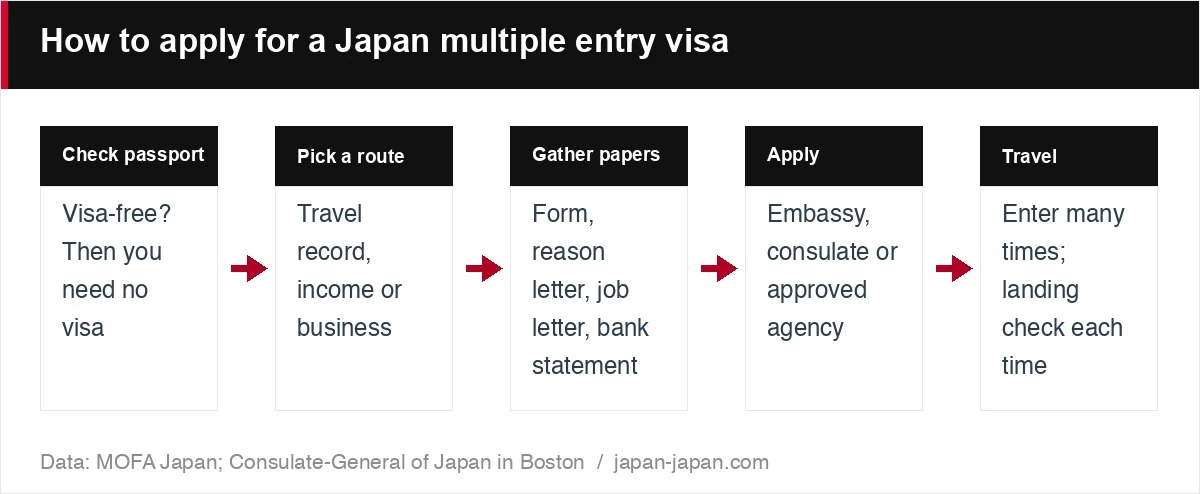
The diagram below shows the whole application in five steps.
Hand in your file at the Japanese embassy or consulate for the area where you live, or at an agency it approves. In China, that is an approved Chinese travel agency. In the Philippines, applications go through VFS Services Philippines Private, Inc. In Vietnam, they go through travel agencies accredited by the mission. Our Japan visa guide for Filipinos and Japan visa guide for Vietnamese citizens give the details.
Fee, Processing and Using the Visa
Budget about 30,000 yen for the visa itself.
That is the MOFA fee for multiple-entry applications accepted at an overseas mission on or after July 1, 2026. As a rule, you pay in the local currency of the country where the embassy or consulate is. You pay no fee if the visa is not issued. If you apply through an agency approved by the embassy or consulate, the agency adds its own handling fee.
Some passports pay less or nothing, because MOFA says the fee depends on nationality and purpose. The Embassy of Japan in the Philippines, for example, says the short-term visa is free of charge for Philippine nationals. Our Japan visa fees page lists the amount by embassy.
Apply well before your first trip. Our Japan visa processing time page collects the waiting times that missions publish.
Once you have the visa, use it as often as you like until it expires. The validity cannot be extended, so plan a new application before the old visa runs out.
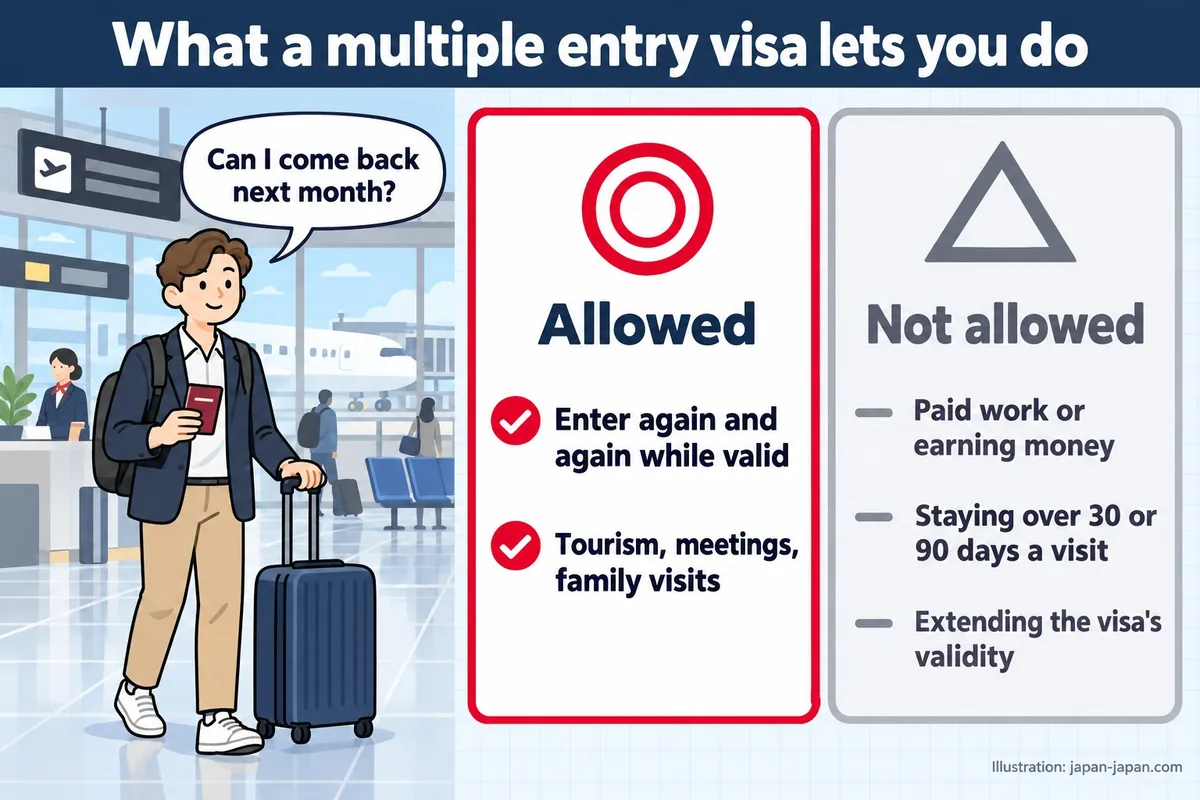
The illustration above draws the line between what the visa covers and what it does not.
A visa does not let you skip the border check. Each time you arrive, you apply for landing with an immigration inspector at the port of entry. Before each trip, you can register your immigration and customs details on Visit Japan Web. Our guide to the Visit Japan Web QR code walks through the steps.
For the wider picture, our Japan visa requirements guide covers who needs a visa and the new fees. The Japan visa database has a page for each passport.
FAQ
How long is a Japan multiple entry visa valid?
MOFA sets the validity of a multiple-entry visa at 1 to 5 years. Business visitors and cultural or intellectual figures from Vietnam and India can get up to 10 years, a rule in force since February 15, 2016. Each stay is limited to 30 or 90 days, depending on the type.
Can I get a 10-year multiple entry visa for Japan?
Yes, if you are a national of Vietnam or India travelling on business or as a cultural or intellectual figure. Your first visit must be for that purpose, and later visits can include tourism. For Chinese citizens, Japan announced a 10-year multiple-entry tourist visa on December 25, 2024. Ask an approved Chinese travel agency about it.
Can I apply for a multiple entry visa through JAPAN eVISA?
No. JAPAN eVISA issues a single-entry tourist visa. For a multiple-entry visa, apply at the Japanese embassy or consulate for the place you live, or through the agency it approves.
Do I need a multiple entry visa if I can visit Japan visa-free?
No. Nationals of the 74 visa-free countries and regions enter without any visa for a short stay, most of them for up to 90 days. Indonesians qualify only with a registered ePassport and get up to 15 days, so other Indonesian passport holders still need a visa.
About the author



.JPG)

