Japan JESTA: Not Live Yet, Who Needs It, the 2029 Deadline

JESTA stands for Japan Electronic System for Travel Authorization. It will cover foreign visitors who enter without a visa for a short stay, such as a holiday. It works like the ESTA for the United States or the ETA for the United Kingdom. You send your details online and get cleared before you fly.
Until the start date arrives, you enter Japan the way visitors do now. You show your passport at immigration, and you can prepare your arrival details in Visit Japan Web. Our JESTA travel authorisation page tracks the status and will change when a date is fixed.
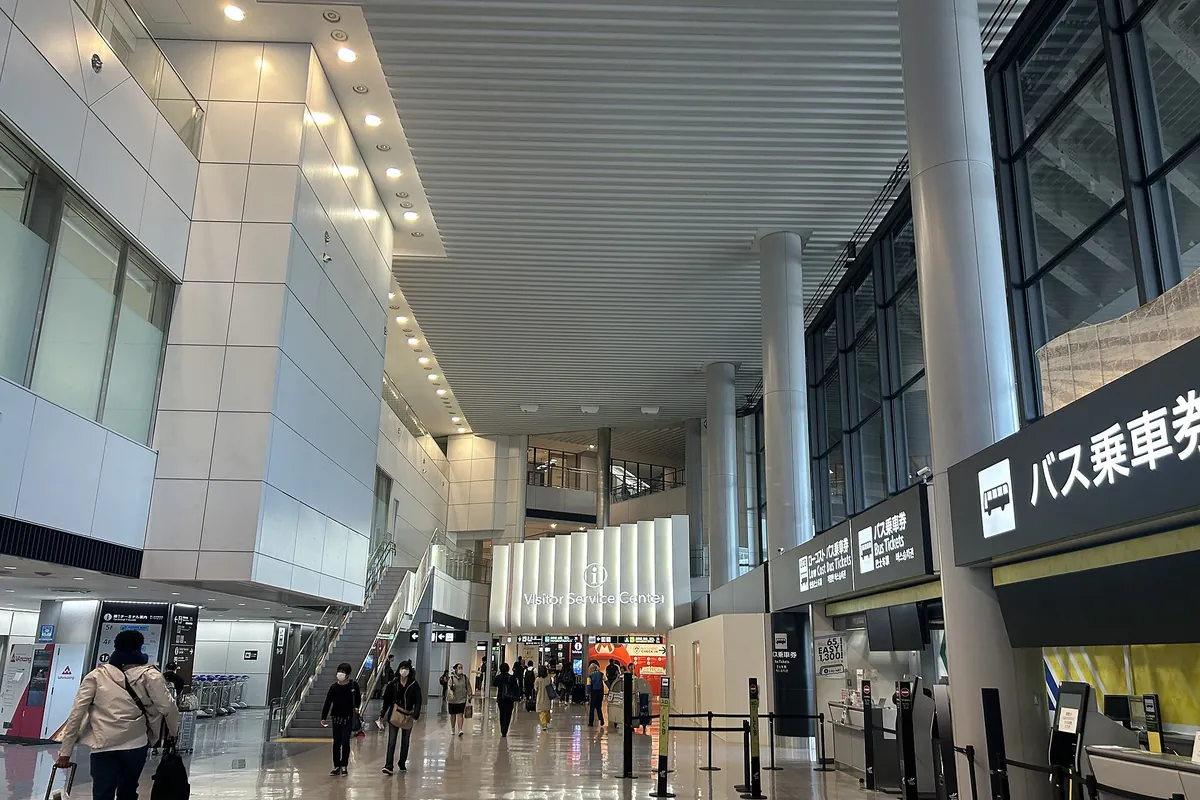
The photo shows an arrivals area at Narita Airport. Every visitor in that hall today has come through the current process, with a landing stamp or sticker in the passport. JESTA will change what happens before the flight, and it will change that stamp too.
Japan JESTA travel authorization: what the 2026 law decided
JESTA comes from an amendment to the Immigration Control and Refugee Recognition Act. The Cabinet submitted the bill to the 221st Diet on 10 March 2026 as Cabinet bill No. 20. The House of Councillors passed it by majority vote in its plenary session on 29 May 2026.
The government promulgated the law on 5 June 2026 as Act No. 32 of 2026. The Immigration Services Agency 2026 Immigration Act amendment page lists those dates and gives the two main parts of the law. One part creates JESTA. The other raises the upper limits of fees for residence permits, which matters to foreign residents and not to tourists.

The screenshot above is the English version of that agency page. It names the law in full and links to the outline document. This guide uses Immigration Services Agency pages checked on 11 October 2026. It also uses the Cabinet Secretariat progress table dated the end of June 2026.
The law sets two different start dates. The Immigration Services Agency amendment act effective dates page gives them side by side:
- Residence permit fees: a date set by Cabinet Order, no later than 31 March 2027.
- JESTA: a date set by Cabinet Order, no later than 31 March 2029.
Work on the computer system has already begun. The Cabinet Secretariat progress report on foreign nationals measures (June 2026) says procurement for the system’s design and development began in December 2025. The contract was signed in April 2026.
The government also explains why it wants JESTA. In 2025 about 8 in 10 people who landed for tourism and other short stays were visa-exempt. They entered without any visa check. JESTA moves part of that check to before the flight. The government says the aim is to stop people who plan to overstay, and to cut waiting times at immigration.
JESTA timeline: from the 2026 law to the 2029 deadline
The dates below come from the law and from government plans. Only the law dates are binding. The fiscal 2028 target is a plan, and the government can still move it within the legal deadline.
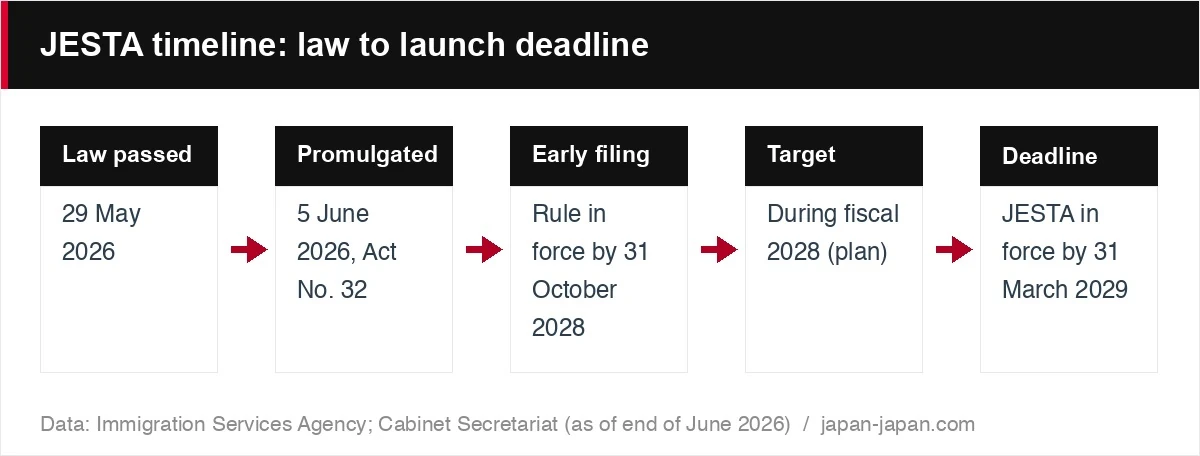
The chart shows five steps. Two are already done: the law passed on 29 May 2026 and was promulgated on 5 June 2026. The other three are deadlines and targets that have not arrived.
- By 31 October 2028: A provision of the law that lets travellers apply and receive authorization before the main start date comes into force. It also starts on a day set by Cabinet Order.
- During fiscal 2028: This is the government target. The progress table as of the end of June 2026 still lists JESTA for introduction during fiscal 2028.
- By 31 March 2029: The JESTA rules must be in force by this date at the latest.
The target used to be later. The government’s comprehensive measures decided on 23 January 2026 say JESTA was first planned for introduction by 2030. They brought it forward to fiscal 2028. The Immigration Services Agency’s English plan says the same thing: it aims to introduce JESTA in FY2028, ahead of the original schedule of 2030. The Ministry of Justice’s second basic plan for immigration, dated July 2026, repeats the fiscal 2028 aim.
No exact start day exists yet. When the Cabinet sets it, the order will name the day. If your trip falls in 2028 or early 2029, check again a few months before you book.
Who needs JESTA, and who does not
JESTA is for people who come to Japan without a visa. The law lists the groups in the Immigration Services Agency summary of the amendment act. Use the list below to find your case.
- Visa-free short-stay visitors: Foreign nationals who do not need a visa and come for tourism or similar short visits. They will need JESTA. Japan currently has visa exemption arrangements with 74 countries and regions, listed on our visa-free countries page.
- Taiwan residents: A special act covers people designated by Cabinet Order, which today means residents of Taiwan. They are part of the visa-free group, so they will need JESTA. Our Taiwan visa page explains the current passport rule.
- Cruise passengers: Foreign nationals who arrive on a designated cruise ship and want to land for sightseeing. They will need JESTA.
- Some transit passengers: Part of the group who enter Japan for a short time to change planes or ships. The law does not draw the line here; a later rule will.
- Direct transit passengers: People who pass through Japan to another country without landing. The bill outline says they may not enter Japan unless they have authorization.
- Visa holders: If you hold a Japanese visa, the visa does the job. The law bans entry only for foreign nationals who have neither authorization nor a visa.
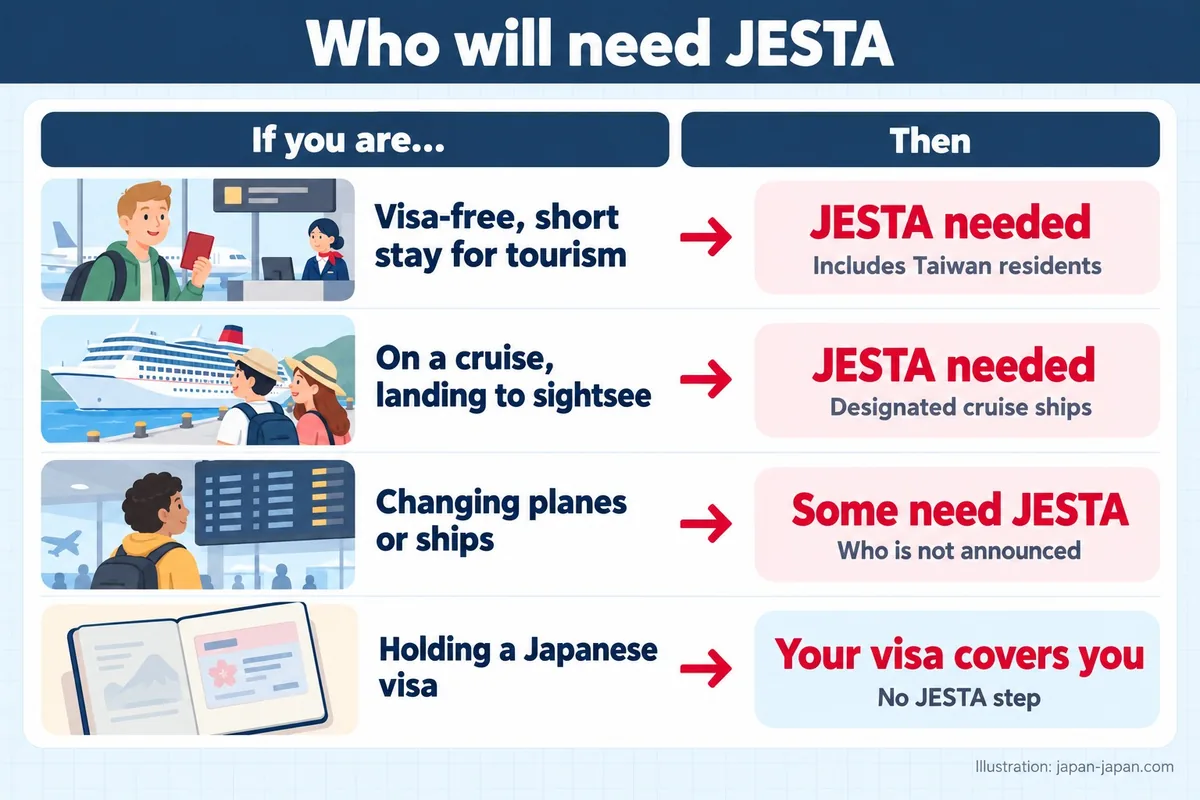
The lookup chart puts those cases in four rows. Find the row that matches your trip, then read the answer on the right. If you need a visa today, JESTA does not add a step for you.
Visa rules depend on your passport, so check them first. Most nationals on the visa-free list get up to 90 days. If you are not on the list, start with our guide to tourist visa requirements. Some nationals can apply online through JAPAN eVISA, which currently issues single-entry visas for tourism stays of up to 90 days.
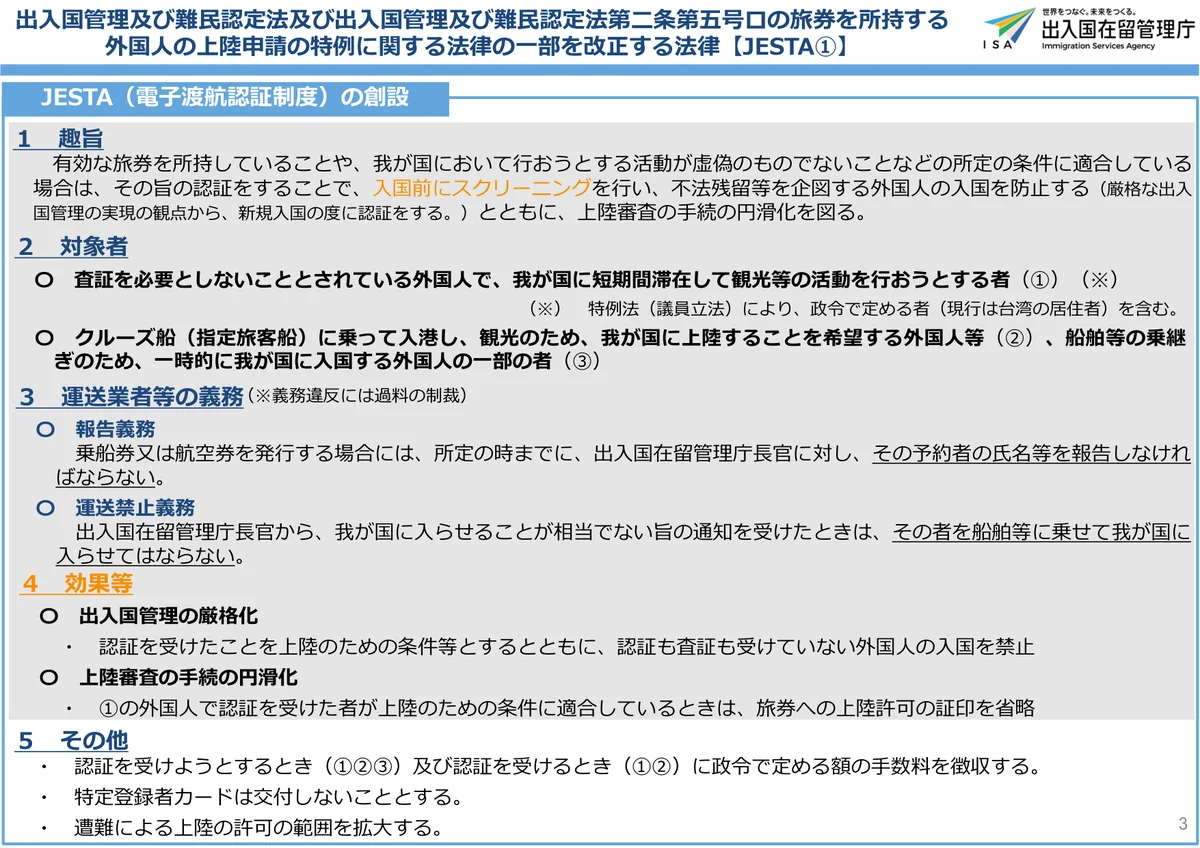
This page from the agency’s summary is the official outline of JESTA, in Japanese. Section 2 lists the three groups covered: visa-exempt short-stay visitors, cruise passengers and some transit passengers. Section 3 sets the duties for airlines and shipping companies, and section 4 explains the effects.
How Japan’s electronic travel authorization will work
The law sets the basic shape of the Japan JESTA new system. Many details will come later in Cabinet Orders and ministry ordinances. Here is what is already fixed.
- Every new entry: You need authorization each time you newly enter Japan.
- Two conditions: You must hold a valid passport, and the activities you plan in Japan must not be false.
- Online only: You prove those conditions by sending information electronically.
- No landing stamp: If you have authorization and meet the landing conditions, the officer skips the landing permission stamp in your passport. In practice the government plans to use walk-through gates.

The before-and-after drawing compares the two systems. Today there is no JESTA step and the stamp goes in your passport. After the start date, you apply online before travel and the stamp is dropped.
Airlines and shipping companies get new duties too. When they issue a ticket, they must report the names and other details of each booking to the agency’s Commissioner by a set time. If the Commissioner tells a carrier that a person should not be allowed into Japan, the carrier must not carry that person. A carrier that breaks these duties faces a fine. A May 2025 agency briefing paper said visitors without authorization would in principle not be able to board.
The fee works in two stages. Japan will collect a fee when you apply and again when authorization is given. The amount for each stage will be set by Cabinet Order. The government says it will set the JESTA fee taking into account the levels in major countries.
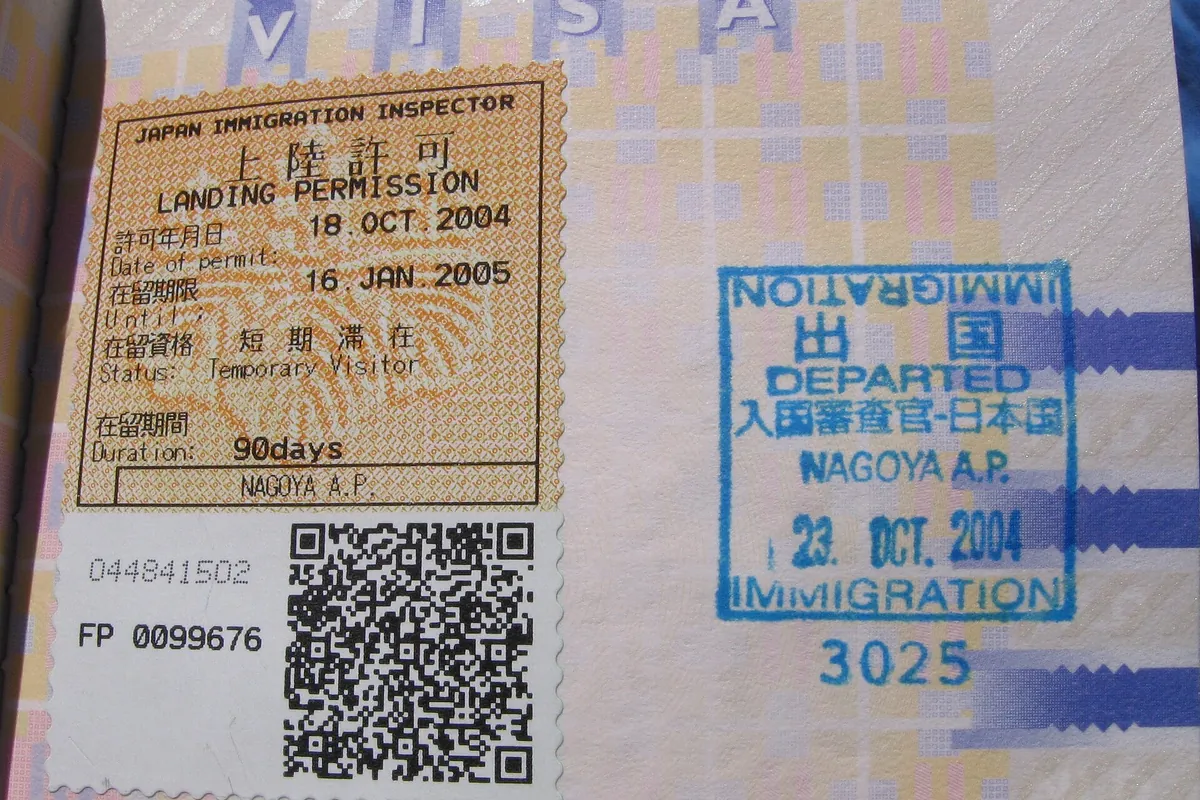
A landing permission sticker like the one in this photo is what JESTA travellers will stop receiving. Keep your passport valid for the whole trip, because a valid passport is one of the two JESTA conditions.
The law also has a soft start. For foreign nationals named by Ministry of Justice ordinance as low risk, the entry ban will not apply for six months from the start date. Who falls into that group is still to be set.
What is not decided yet
Much of what travellers want to know is still open. As of October 2026, no JESTA application has opened. The table splits what the law fixed from what the government has not announced.
| Decided by the 2026 law | Not announced yet |
|---|---|
| Who is covered: visa-free visitors, cruise passengers, some transit passengers | Start date |
| Authorization for each new entry | Fee amount |
| Conditions: valid passport, true purpose of visit | How long an authorization lasts |
| Information sent online | When to apply and how long review takes |
| Landing stamp omitted for authorized visitors | Rules for children |
| Fee set by Cabinet Order, charged at two stages | Which transit passengers need it |
| In force by 31 March 2029 | Application screen and questions |
Seven points are open:
- Start date: Not announced. Only the 31 March 2029 deadline and the fiscal 2028 target exist.
- Fee amount: Not announced. The law says a Cabinet Order will set it.
- How long an authorization lasts: Not announced.
- When to apply and how long a review takes: Not announced.
- Children: Not announced.
- Which transit passengers need it: Not announced. The law covers only part of this group.
- The application screen and questions: Not announced.
Some websites already quote fees, validity periods or links to other systems. They are guesses. No official JESTA application exists yet, so a site that asks for a JESTA payment today is not an official one. The official start date and fee will appear on Immigration Services Agency pages once the Cabinet Orders are made.
Until JESTA starts: how entry works now
For now, you enter Japan the usual way. Visitors from visa-free countries show a passport at immigration and do not apply for anything in advance. Everyone else needs a visa before travel.
Visit Japan Web is the free service many visitors already use. The Digital Agency describes it as a web service for registering the information needed for immigration, the customs declaration and tax-free purchases. Our Visit Japan Web QR code guide walks through the steps.
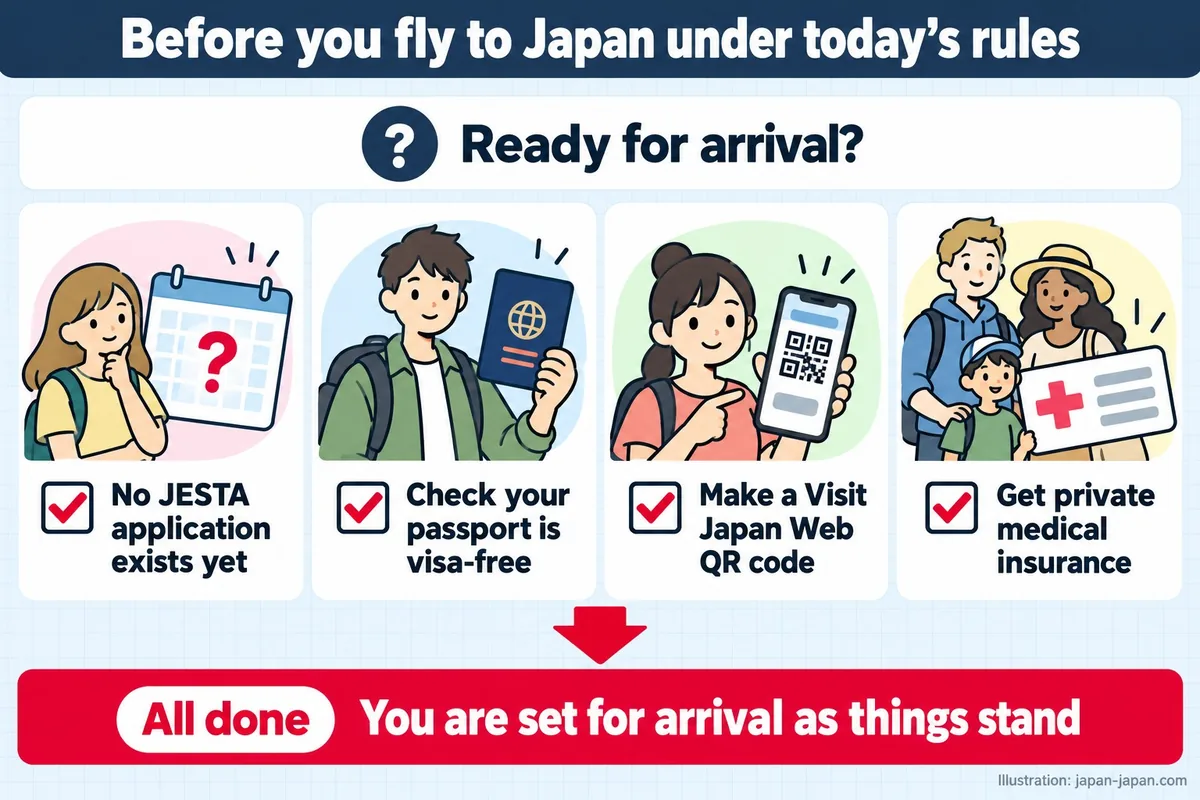
The checklist covers four things to sort out before you fly under today’s rules. None of them is a JESTA step, because that step does not exist yet.
At several airports you can scan that code at a joint kiosk. Look for signs reading 共同キオスク (kyodo kiosuku, “joint kiosk”). You scan the Visit Japan Web QR code and your IC passport. The kiosk then sends your passport details, a facial photo and your declaration to customs and immigration in one go. Foreign visitors who finish at the kiosk go to a dedicated booth for kiosk users.
Families need to do this one person at a time. Each family member creates a QR code in Visit Japan Web and completes the kiosk on their own.
The Japan Customs joint kiosks at Narita Terminals 1 and 2 notice lists where the kiosks run:
- Kansai Airport: Terminals 1 and 2.
- Haneda Airport: Terminals 2 and 3.
- Narita Airport: Terminal 3, plus Terminals 1 and 2 from 24 September 2026.
- Fukuoka Airport.

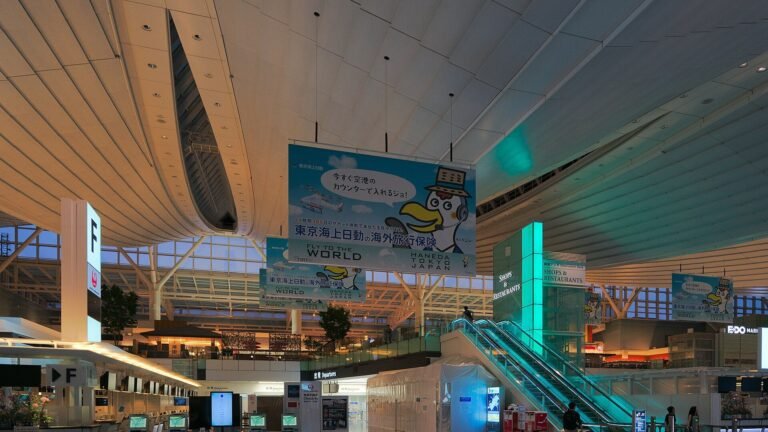
Haneda Terminal 3, in the photo, is the airport’s international terminal and one of the kiosk sites. Arrivals there connect straight to the train station on the arrivals floor.
Health cover is the other thing to sort out. The Ministry of Health private medical insurance notice for visitors strongly recommends private health insurance with enough coverage. It warns that medical bills in Japan can be very costly. The government is also studying a rule that would require insurance before entry, but it has given no date.
Other Japan entry rule changes in 2026
JESTA is years away, but several other rules changed in 2026. Some cost visitors money now. The table lists them by date.
| Date | What changed | Who it affects |
|---|---|---|
| 1 April 2026 | Unpaid medical bills of 10,000 yen or more are registered | Visitors who use hospitals |
| 1 July 2026 | Visa fees: about 15,000 yen single, about 30,000 yen multiple | Visitors who need a visa |
| 1 July 2026 | Departure tax rises to 3,000 yen | Everyone leaving Japan, with exceptions |
| 24 September 2026 | Joint kiosks at Narita Terminals 1 and 2 | Arrivals at Narita |
| 1 October 2026 | Residence permit fees raised | Foreign residents, not tourists |
| 1 November 2026 | Tax-free shopping moves to a refund | Visitors who shop tax-free |
1 April 2026: unpaid medical bills
Japan records foreign visitors who leave hospital bills unpaid. For bills that arose on or after 1 April 2026, a cumulative unpaid balance of 10,000 yen or more is registered. For bills from 10 May 2021 to 31 March 2026, the line was 200,000 yen or more. The health ministry shares the information with the Immigration Services Agency, which uses it in immigration checks. The ministry’s wording for visitors is that unpaid bills may result in stricter immigration procedures on future visits.
1 July 2026: visa fees
The Ministry of Foreign Affairs visa fees page sets new fees for applications accepted on or after 1 July 2026. A single-entry visa now costs about 15,000 yen and a multiple-entry visa about 30,000 yen. Before that, the fees were about 3,000 yen and 6,000 yen. The Foreign Minister said the old amounts had been set in 1978.
You pay in the currency of the country where the embassy or consulate issues the visa. Some nationalities pay a different amount or nothing. At the Embassy of Japan in India, Indian nationals pay 500 INR. At the Embassy of Japan in the Philippines, the temporary visitor visa for Philippine nationals is free. The separate transit visa category is gone. Our Japan visa fees page has the amounts by country, and the Japan visa guide covers who needs one.
1 July 2026: departure tax
The National Tax Agency international tourist tax overview sets the tax at 3,000 yen per departure. Airlines and shipping companies usually add it to your ticket price. The old 1,000 yen rate still applies to departures under certain transport contracts made before 1 July 2026. Children under 2 and transit passengers who leave within 24 hours of entering do not pay. More detail is in our Japan departure tax guide.
24 September 2026: more joint kiosks at Narita
Joint kiosks started at Narita Terminals 1 and 2. Before that, Narita had them only at Terminal 3.
1 October 2026: residence permit fees
This change is for foreign residents of Japan, not tourists. For example, the permanent residence permit fee at the counter rose from 10,000 yen to 200,000 yen.
1 November 2026: tax-free shopping becomes a refund
From sales on 1 November 2026, shops charge consumption tax at the till. You get it back after customs at the airport or port confirms the goods are leaving Japan. At 7 airports (Narita, Haneda, Kansai, Chubu, Fukuoka, New Chitose and Naha), you can complete this check online with Visit Japan Web. Our guide to the 1 November 2026 tax-free changes and the Japan tax-free shopping article explain the steps.
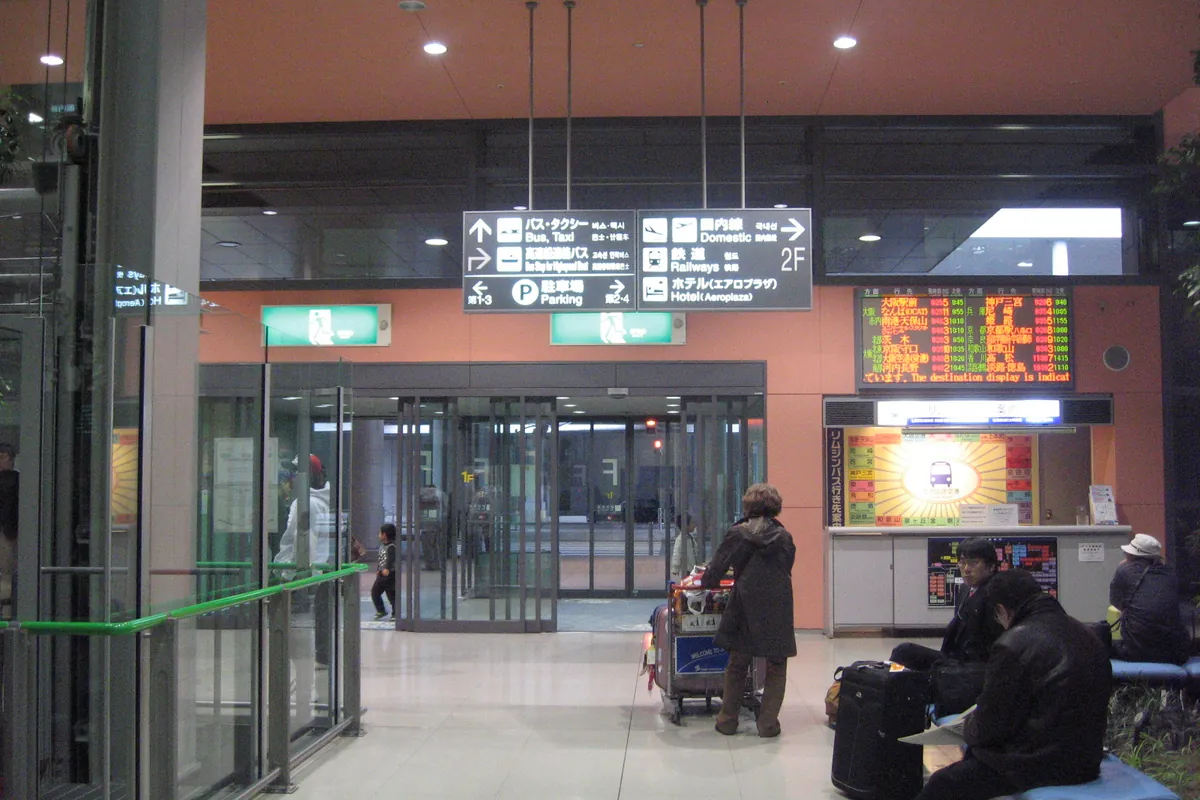
Kansai Airport, in the photo, is one of the 7 airports where the online tax-free check works. It also has joint kiosks at both terminals for arrivals.
FAQ
Do I need JESTA to visit Japan in 2026?
No. JESTA is not in force, and there is no application to make. The law requires it to start by 31 March 2029. Visa-free visitors enter with a passport, as before.
How much will JESTA cost?
The amount has not been announced. The law says Japan will collect a fee when you apply and when authorization is given, with the amount set by Cabinet Order. The government says it will take into account the levels in major countries.
Is JESTA the same as a Japan ETA?
Yes, in practice. People who search for a Japan ETA or a Japan electronic travel authorization mean JESTA. The official name is Japan Electronic System for Travel Authorization. It works on the same idea as the ESTA for the United States.
Will transit passengers need JESTA?
Some will. The law covers part of the group who enter Japan briefly to change planes or ships. It also covers direct transit passengers who pass through without landing. The exact line for who needs it has not been announced.
About the author