What Can You Not Bring Into Japan? 2026 Customs Rules
Meat, most fresh fruit, amphetamine medicines and fake brand goods are stopped at Japan's border, even when airport security lets them through. The full list.
By Shunta Fujii
What cannot be brought into Japan: the short answer
Japan bans four groups of goods at the border, whatever the amount and whatever the reason: illegal drugs and stimulants, guns and explosives, counterfeit money and fake brand goods, and obscene material. Quarantine stops a second group: meat, eggs, most fresh fruit and vegetables, and soil. Other restricted goods come in only with a permit or a certificate, or within a quantity limit.
- Drugs: heroin, cocaine, MDMA, opium, cannabis and stimulants. Amphetamine medicines such as Adderall count as stimulants, so a prescription does not help.
- Weapons: firearms, ammunition, pistol parts, explosives and precursor materials for chemical weapons.
- Fakes: counterfeit money and securities, forged credit cards, and goods that infringe a trademark or copyright.
- Obscene material: pornography and other articles that may harm public morals, and child pornography.
Those four come from the Japan Customs list of prohibited articles. Meat, eggs, fresh produce and soil are handled by animal and plant quarantine instead, and most travellers cannot bring any of them in.
Some goods need paperwork arranged before you fly. Swords and hunting guns need a Japanese possession permit, and plants and seeds need a phytosanitary certificate. Ivory, some coral and crocodile leather need CITES permits, and some prescription medicines need an import permit. Ordinary medicine and cosmetics are allowed up to a set quantity.
We checked 143 items for our What you can bring database, and 32 of the rules we recorded concern Japan’s border and customs rather than the flight. This guide pulls those rules into one place, with the official page behind each one.
Airport security and Japan’s border are two separate checks
Your bag goes through two checks, and they look for different things. Security at your departure airport protects the aircraft, so it looks for dangerous goods. The checks after you land protect Japan itself. Quarantine officers look for animal diseases and plant pests. Customs officers look for drugs, weapons and goods banned by law.
Fresh fruit is not dangerous goods, so fresh food passes airport security, and so does packed food. Plant quarantine then takes the mangoes when you land. Medicine is even exempt from the 100ml liquid rule on international flights, as our entry on tablets and prescriptions explains. A box of Adderall is still stopped at Japanese customs.
The difference also runs the other way. A sword cannot go in the cabin, but it can travel in checked baggage. It still needs a Japanese possession permit before it can enter the country. The table puts the two answers side by side for six common items.
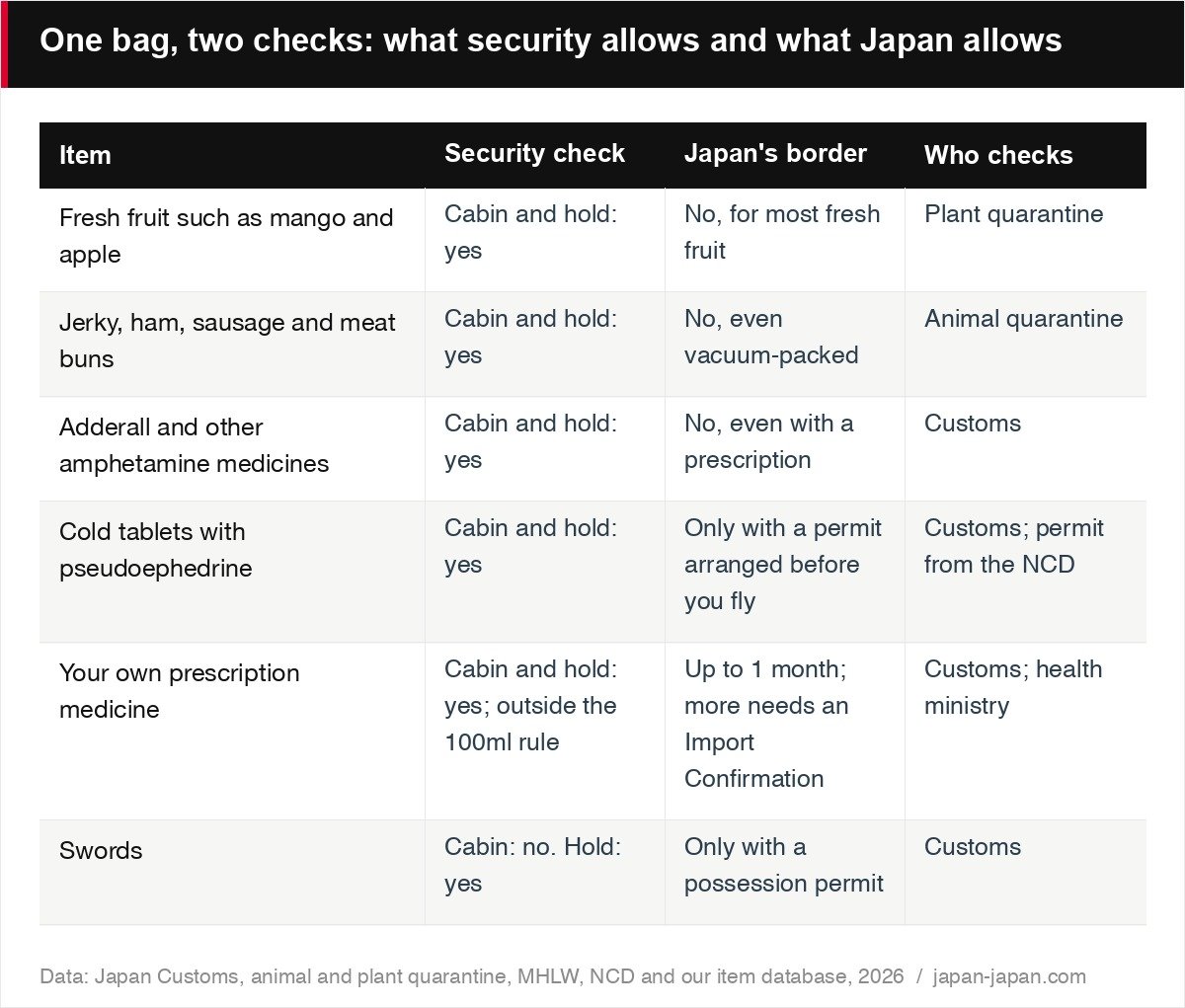
When the two answers disagree, the border answer decides what you keep. Japan Customs also sets the order on arrival: plants and animals must be shown to the quarantine officer before customs examination. Our database answers the two questions on separate pages for this reason, so check both before you pack.
Meat and eggs: no exceptions for vacuum packs or duty-free shops
You cannot bring meat into Japan, raw or cooked, whole or as an ingredient. The Animal Quarantine Service covers meat and organs from cattle, pigs, sheep, goats, deer, horses and poultry, which includes chicken, duck, goose and turkey.
Processed meat counts too: the service names jerky, ham, sausages, bacon and meat buns. The Plant Protection Station’s notice to visitors goes further: any product that uses meat at all is banned, including dumplings, hamburgers, ham sandwiches, gimbap, chicken feet and meat floss. Our entries for meat, ham and sausage and meat buns and dumplings all give the same answer: not allowed.
Packaging and place of purchase make no difference. These are the official answers to the usual questions:
- Vacuum sealed: still banned.
- Heat processed or cooked: still banned.
- Bought at a duty-free shop, including one at an airport, even if the shop assistant said it was fine: still banned.
- A small amount for yourself or as a souvenir: still banned.
- Labelled in Japanese: still banned, says the Plant Protection Station.
The one legal route is an inspection certificate from the exporting country’s government, which is hard to get for personal purchases. Some products sold in Australia and New Zealand come with a certificate for Japan attached. Keep those sealed, because an item opened before inspection may be refused.
Eggs follow the same rules as meat, and eggshells count too. Preserved eggs are covered, and so are processed foods where egg is a main ingredient.
Fish is the main exception. Dried fish and other fish products without livestock meat or eggs are outside animal quarantine, though an officer may check them for meat on arrival. Our fish and seafood entry rates them as generally allowed. The animal quarantine list also leaves out dairy products carried in passenger baggage.
The penalties went up on 1 July 2020. Bringing in meat or animal products illegally can now mean a custodial sentence of up to 3 years or a fine of up to 3 million yen. The previous maximum fine was 1 million yen. A business can be fined up to 50 million yen. Officers can ask what you carry, inspect your luggage and dispose of illegal items.
Jerky and dried meat are among the items most often found in visitors’ bags. If you have any meat with you, take it to the animal quarantine counter in the baggage claim area before you reach customs.
Fresh fruit, vegetables, plants and soil
Most fresh fruit and fresh vegetables cannot come into Japan. The Plant Protection Station names mangoes, longans, guavas, lychees, red peppers, citrus fruits, pears and apples as examples. The rule keeps out plant pests and diseases such as the oriental fruit fly and fire blight, which can travel inside fresh produce.
Quantity makes no difference, and the rule applies in your bag, in cargo and in international mail. Ask family and friends not to post fruit, vegetables or meat to you in Japan.
Processing changes the answer. Dried, roasted and processed vegetable products are usually fine. Fresh produce needs a phytosanitary certificate from the exporting country and an inspection on arrival. A few fruits from a few countries can enter that way, but the certificate has to be arranged before you travel. Nobody issues one at the airport.
Plants need paperwork even when they are allowed. Seedlings, seeds, grain and beans need a phytosanitary certificate issued by a government agency of the exporting country. Cut flowers need a certificate and an inspection on arrival too. Some plants are prohibited outright, and so are certain live insects.
Soil is banned outright, including soil attached to a plant or stuck to your boots. Clean your boots before you pack them.
Your in-flight meal counts as well. Sandwiches, cut fruit and anything else on the tray with meat, fresh fruit or vegetables cannot leave the plane. Eat it on board or leave it behind.
Livestock diseases also travel on shoes and clothes. The quarantine services ask visitors to stay away from livestock facilities and live animal markets before the trip. If you did touch livestock or visit a farm, stop at the animal quarantine counter when you land and ask them to disinfect your shoes and clothes.
Expect questions, and possibly a dog. Quarantine detector dogs at international airports and post offices are trained to smell meat and plants in checked and carry-on bags. Do not touch them. Officers may record your passport and boarding pass details, so the inspection can take time. The penalties match the meat rules, and the police are notified when officers judge that items were brought in maliciously.
Medicine: banned, permit needed, or limited by quantity
Most medicine for personal use can come into Japan, but it falls into one of three tiers. Your prescription from home does not decide which one. Check the active ingredient on the box, because Japan’s list of controlled substances does not include brand names.
Tier one: banned even with a prescription. The Narcotics Control Department (NCD) says no individual traveller can bring in medicine containing heroin, opium powder, methamphetamine, amphetamine (including dexamphetamine) or methaqualone. Adderall is the best-known case. Its active ingredient is amphetamine, which Japan controls as a stimulant, so it cannot be imported even for treatment. See medicines banned in Japan.
Cannabis sits in this tier too, in any form, even where it is legal at home. CBD products pass only if they contain no THC at all and you can prove it. See narcotics and cannabis.
Tier two: allowed with a permit arranged before you fly. Narcotics such as morphine, fentanyl, oxycodone, codeine and tapentadol need a permit. So do stimulants’ raw materials, a separate category that includes lisdexamfetamine and pseudoephedrine. Lisdexamfetamine is sold as Vyvanse or Elvanse, so Vyvanse can come in with the permit while Adderall cannot. Tramadol is not a narcotic in Japan.
Pseudoephedrine is the one that catches ordinary travellers. It is in some cold and sinus tablets sold over the counter in other countries, including some Sudafed and Vicks products. A prescription alone does not get these in. Without the permit, customs stops them.
Send the NCD an application form, a medical certificate and photos of the medicine package by email, fax or post. The certificate must come from the prescribing doctor and be issued within 3 months. It must give your name, your address, the specific reason you take the medicine, each medicine with its dose and strength, and the doctor’s signature. ‘For personal use’ or ‘for travel’ is not accepted as a reason.
Apply to the NCD office that covers your arrival airport at least 14 days before you travel. The Tokyo office does not accept last-minute applications. Carry the medicine yourself rather than posting it, and show the import certificate to customs when you land.
Psychotropics are treated more lightly. The NCD lists methylphenidate, zolpidem, alprazolam, clonazepam, diazepam and buprenorphine as examples. Up to the amount in the NCD’s table, you need neither a permit nor a doctor’s certificate. Above that amount, or in injection form, carry a certificate from your doctor.
Tier three: everything else, limited by quantity. The health ministry lets you bring these amounts for personal use with no paperwork:
- Prescription medicine: up to 1 month’s supply.
- Non-prescription medicine for external use: up to 24 per item.
- Injectable medicine: up to 1 month’s supply, for pre-filled syringes and self-injection kits only.
- Other medicine and quasi-drugs: up to 2 months’ supply.
- Cosmetics: up to 24 per item, so 24 lipsticks whatever the brand or colour.
- Disposable contact lenses: up to 2 months’ supply.
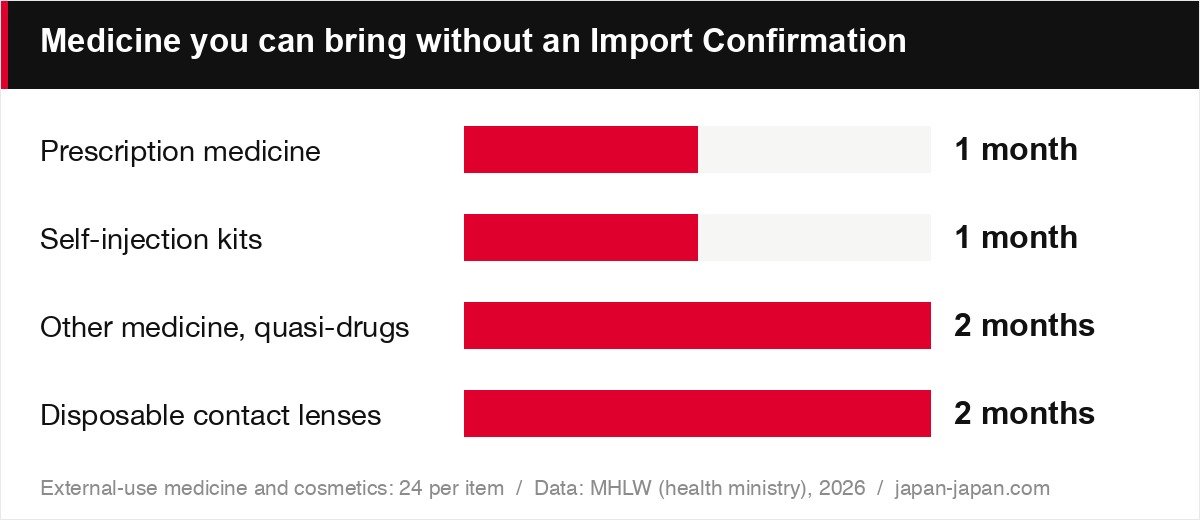
Above those amounts you need an Import Confirmation, known as Yakkan Shoumei, before you leave home. Some applications can now be made online, and you show the confirmation to customs on arrival.
Keep medicine in its original packaging and carry the prescription. Vitamins and supplements count as medicine if they contain an active pharmaceutical ingredient. Our entries on how much medicine you can bring and how many cosmetics you can bring set out the limits item by item.
Weapons, fake goods, adult material and protected species
Japan Customs bans firearms such as pistols, their ammunition and pistol parts. Explosives such as dynamite and gunpowder are banned too, along with precursor materials for chemical weapons and germs likely to be used for bio-terrorism.
Hunting guns, air guns and swords work differently. They need a possession permit before you arrive, separate from the airline rules, and even with the permit a sword travels in checked baggage. Realistic replicas are treated as firearms at the border. For the airline side, see our entry on guns and replica guns. Buying a sword in Japan and taking it home is a different process: the shop arranges the export paperwork.
Counterfeit, altered or imitation coins, notes and securities are banned, and so are forged credit cards. Goods that infringe a trademark or copyright are confiscated too, even a single item for personal use. Copy handbags, watches and clothing bought abroad are seized and destroyed. You are not fined for one personal item, but you lose it, as our entry on counterfeit and copy goods explains.
Pornography and other articles that may harm public safety or morals are banned, and so is child pornography. Japan draws its own line on obscenity, and it may not match your country’s, as our entry on adult material explains.
Products from protected species need two documents: an export permit from the country where you bought them and an import permit for Japan. The rule covers ivory, tortoiseshell, some coral, crocodile and python leather, and traditional medicines made with protected species. Without the paperwork the item is seized at the airport, whether or not you knew. See ivory, coral and crocodile leather.
Arriving in Japan: where to declare and what happens if you don’t
All passengers entering Japan must declare their belongings to customs. Japan Customs recommends doing it electronically on Visit Japan Web. You register the details before you land, then show a 2D code at immigration and customs. You can register on a PC, but you need a smartphone or tablet to show the code. Paper declaration forms are handed out on the plane and are also available at customs. Electronic declaration gates, called e-Gates, are available at 7 international airports.
After landing, the order is quarantine, immigration, baggage claim, animal and plant quarantine, then customs. If you carry meat, fruit or plants, show them at the quarantine counters in the baggage claim area first.
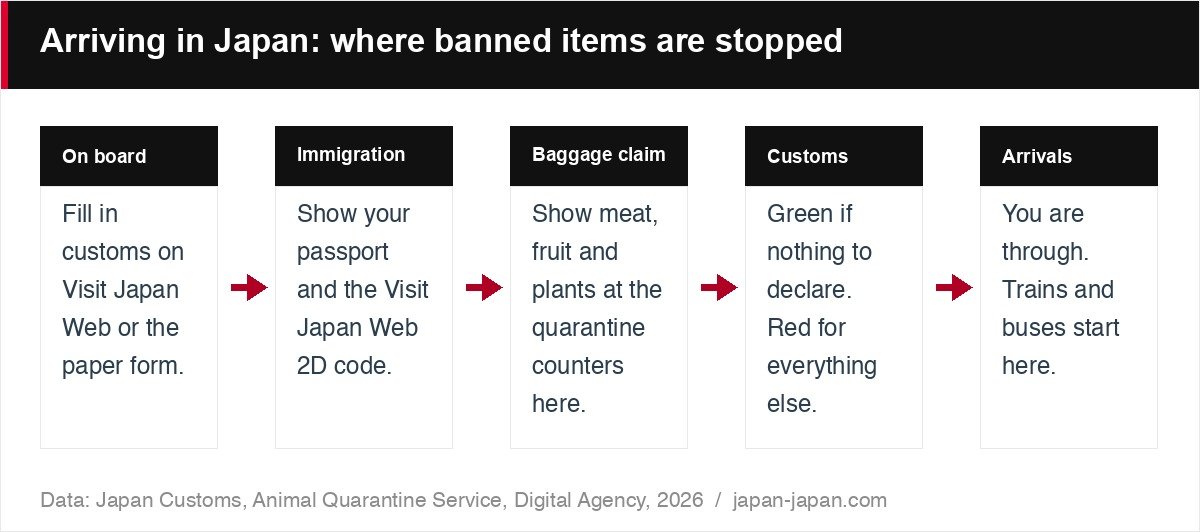
At customs you choose a channel. The green channel is for passengers with no goods subject to duty or tax and nothing prohibited or restricted. The red channel is for everyone else. You must declare cash over 1 million yen, and the same threshold applies to cheques, securities and other means of payment.
Take the red channel as well if you are over the duty-free allowance for an adult. The allowance is 3 bottles of alcohol of about 760cc each, 200 cigarettes and 2 ounces of perfume. Everything else is capped at 200,000 yen in total at overseas market value, and any item under 10,000 yen is left out of that total. Rice has its own limit of 100kg a year. Any duty or tax on the excess is paid at the bank in the customs inspection zone.
Declaring costs you the item and nothing more. Hand banned food to the quarantine officer and walk on, because there is no penalty for declaring it. Meat or animal products that you fail to declare are punishable if officers find them, and people have been arrested for it.
Border rules are half the packing job, and your airline sets the other half. Japanese full-service carriers allow cabin bags of 115cm across three sides and 10kg across both pieces. Low-cost carriers allow the same size but only 7kg, as our baggage rules by airline show. Once you are through customs, our guides to Narita, Haneda and Kansai cover the trains and buses into the city.
FAQ
Can I bring vacuum-sealed beef jerky into Japan?
No. Jerky and dried meat are banned on the same terms as fresh meat, and the Animal Quarantine Service says vacuum sealing makes no difference. The only way in is a government inspection certificate for Japan from the exporting country. If you have jerky with you, hand it in at the animal quarantine counter before customs.
Can I bring fruit into Japan if I declare it?
Declaring does not make banned fruit legal, but it keeps you clear of the penalties. You hand the fruit to plant quarantine and go on to customs. A few fruits from a few countries can enter with a phytosanitary certificate from that country’s government. You have to arrange it before you travel.
Can I bring cold medicine with pseudoephedrine to Japan?
Only with a permit arranged before you fly. Japan classes pseudoephedrine as a stimulants’ raw material, and it is in some Sudafed and Vicks products. Apply to the Narcotics Control Department at least 14 days before you travel, with a medical certificate issued within 3 months. A prescription alone is not enough.
Can I bring CBD oil into Japan?
Only if it contains no THC at all and you can prove it. Japan bans cannabis in every form, including products that are legal where you bought them. Many travellers have had CBD products seized. If you cannot show that the oil is free of THC, leave it at home.
Photo: Underground tunnel at Narita Airport.jpg by Grendelkhan (CC BY-SA 4.0), via Wikimedia Commons.