Is Japan Vegetarian-Friendly? A Vegan and Halal Food Guide
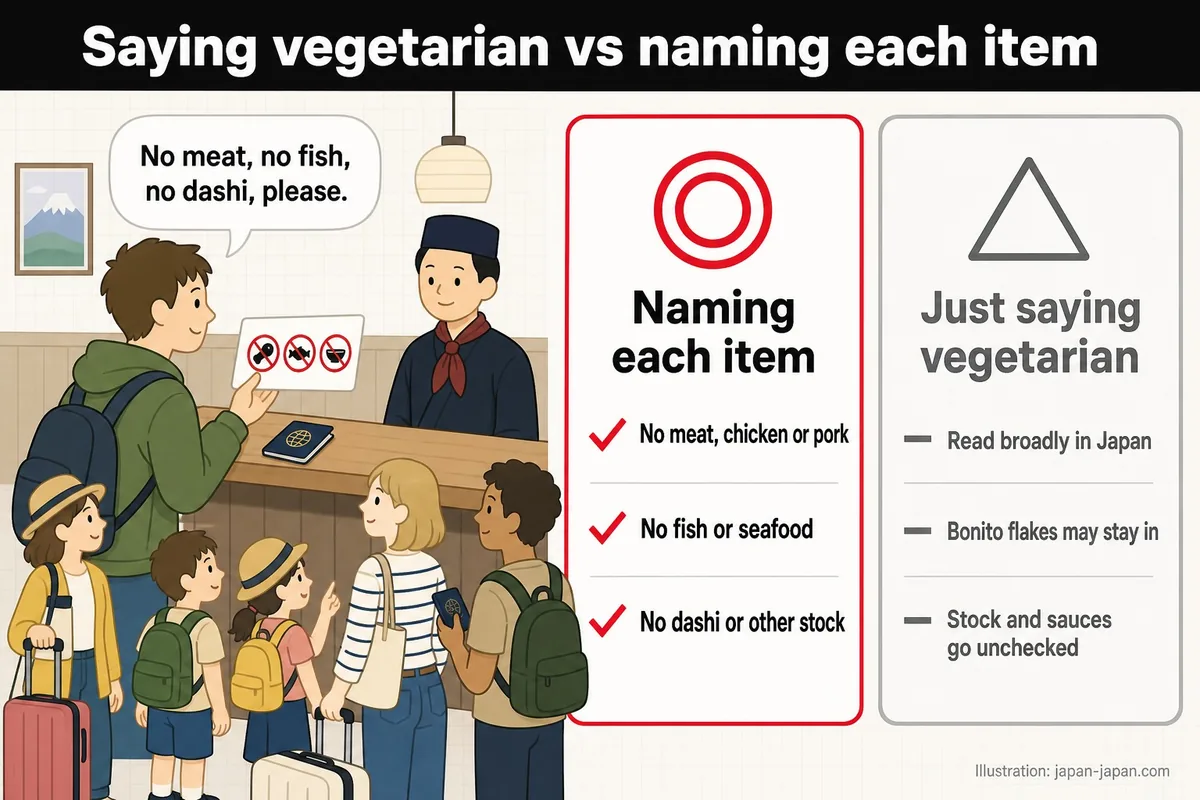
In its vegetarian and vegan guide, JNTO (the Japan National Tourism Organization) says the word vegetarian is often read broadly in Japan. Asking for a vegetarian meal may not be enough. Say what you cannot eat, one item at a time: meat, fish, seafood and dashi.
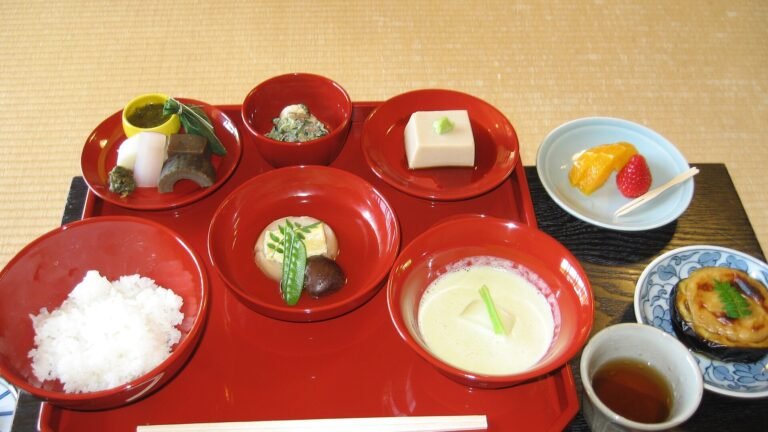
For a traditional meat-free meal, look for shojin ryori, the Buddhist temple cuisine that Kyoto lists among its specialties. For halal food, JNTO points to official certificates issued by the Halal Japan Business Association or the Japan Muslim Association.
Allergies need the most care. Sakai City’s food safety page explains the Consumer Affairs Agency’s labelling standard: only processed foods sold in a container or wrapper must list 9 allergens. Restaurants, and bento or side dishes sold over the counter without packaging, have no duty to label anything.
The guide below matches each diet with the first thing to check.
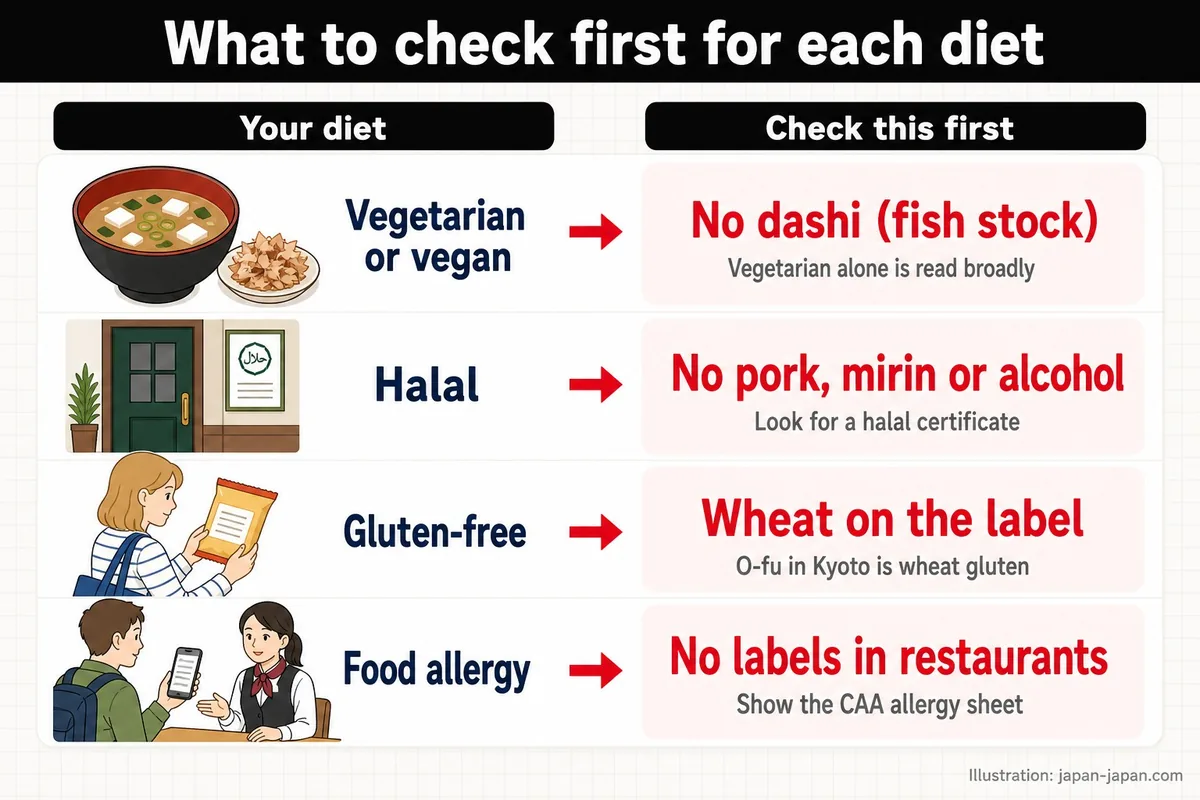
The rest of this guide covers each diet in turn, then the airport: prayer rooms and the meat to leave at home.
Vegan food in Japan and the dashi problem
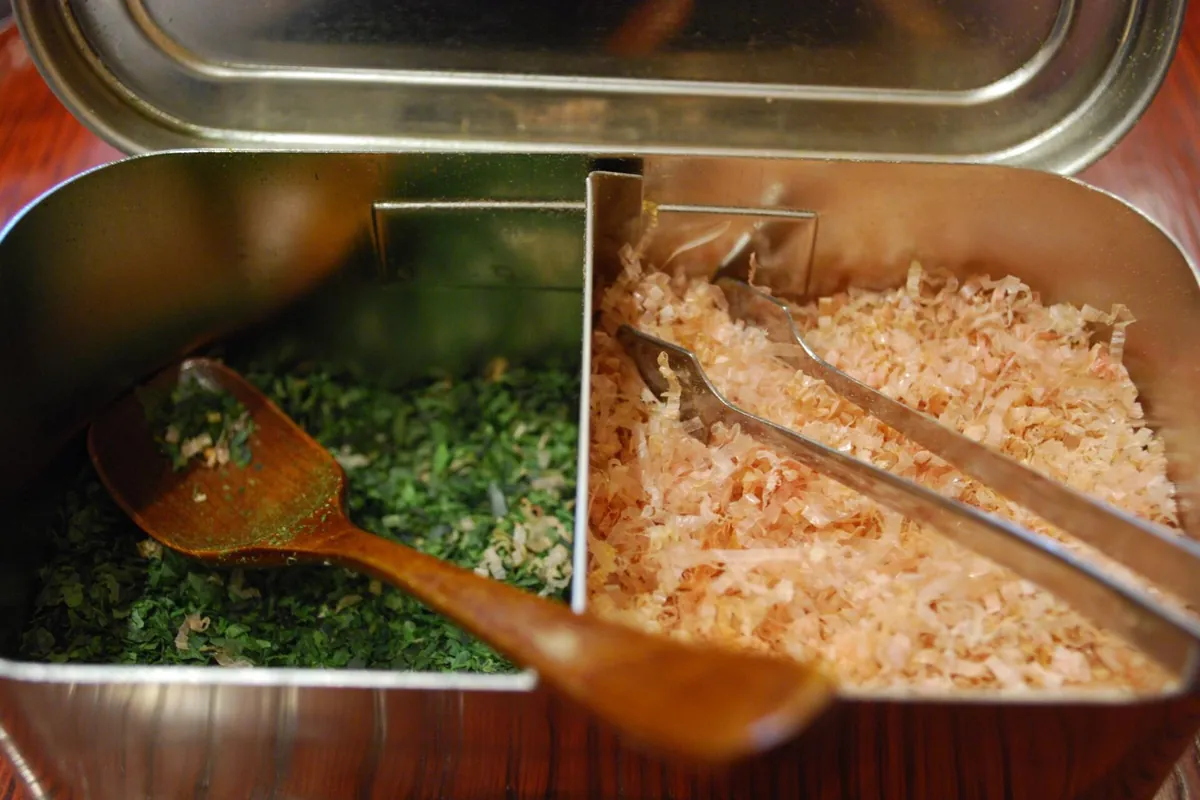
JNTO puts it plainly: Japanese cooking uses a lot of meat and fish. Even stocks and sauces usually contain some meat. A dish can look free of meat and fish and still hide meat or bonito flakes. That is what makes many dishes unsuitable for vegans.
The photo below shows katsuobushi, the bonito flakes that JNTO warns about.
Natto, the fermented soybeans sold in ready-to-eat packs, is a good example. The beans suit a vegan diet, but JNTO notes that the sauce packed with them is often dashi.
Kyoto’s official tourism site says the same about local food. Obanzai, the everyday home-style dishes of Kyoto, are seasoned with dashi stock. The seasoning base of Kyo-kaiseki, the city’s formal multi-course cuisine, is made from fish and vegetables. A modern kaiseki meal may also include meat and seafood, although kaiseki began as vegetarian food.
So order by naming items rather than using a label. JNTO’s advice is to say no meat, no seafood and no animal products, including dashi or other stocks. If the server seems unsure, repeat that no meat also means no chicken, no pork and no fish. What looks like reluctance is often a simple gap in understanding.
The comparison below shows why the second way of asking works better.
Several Japanese dishes are a good place to start, once you have checked the stock and the sauce. JNTO lists vegetable tempura, tsukemono (pickled vegetables), tofu and tofu skin, and nasu dengaku (grilled eggplant with miso). Kappa maki (cucumber rolls) and takuan maki (pickled daikon rolls) are on the list too. Vegetarians can also look for okonomiyaki made without meat. It contains egg, so it does not suit vegans.
To find restaurants, JNTO points to search sites such as HappyCow, Vegewel and Japan VegeMap. Outside the big cities, a ryokan can prepare a vegetarian meal if you send your dietary needs ahead of time.
Convenience stores fill the gaps between meals. JNTO suggests onigiri (rice balls) filled with umeboshi (sour pickled plum) or kombu (kelp). Inarizushi (rice in a tofu pocket), edamame, packaged beans and simple salads also work. Vegetarians who eat dairy and eggs can add cheese strings and quail eggs. Our guide to Japanese convenience store food explains how to read the labels.
JNTO also suggests carrying your own soy sauce for a splash of fish-free flavour. A vegetable stock powder from home is easy to pack too. Our page on powders notes that Japan does not restrict powders in the cabin. Some countries do screen powders over 350ml on flights leaving their airports. Pick one without meat extract, because Japan bans meat and anything made with it at the border. Our page on food and packed meals covers the rest of the flight rules.
Shojin ryori: Buddhist vegetarian food in Kyoto
Shojin ryori is Japan’s Buddhist vegetarian cuisine, made without meat or fish. Kyoto’s tourism site says it arrived in the Kamakura period (1185–1333) with a new wave of Buddhism from China. Monks cooked and ate it in their monasteries. Vegetables are the main ingredient, and in Kyoto that means kyo-yasai, the city’s own vegetables.
JNTO says shojin ryori is found almost only in Buddhist temples. You cannot rely on it for every meal unless you stay at shukubo (temple lodgings) for the whole trip. The meal is light and built on soybean foods such as tofu, with seasonal vegetables. The cooks waste little, and even the tops of vegetables go into the stock.
Make two checks before you book. Traditional shojin ryori is vegan and even leaves out garlic and onion. JNTO adds that some modern monks use dairy, because they do not consider it harmful to animals. Kyoto’s site warns that some restaurants specialising in shojin ryori use a fish-based broth. Book ahead, and ask about both when you reserve.
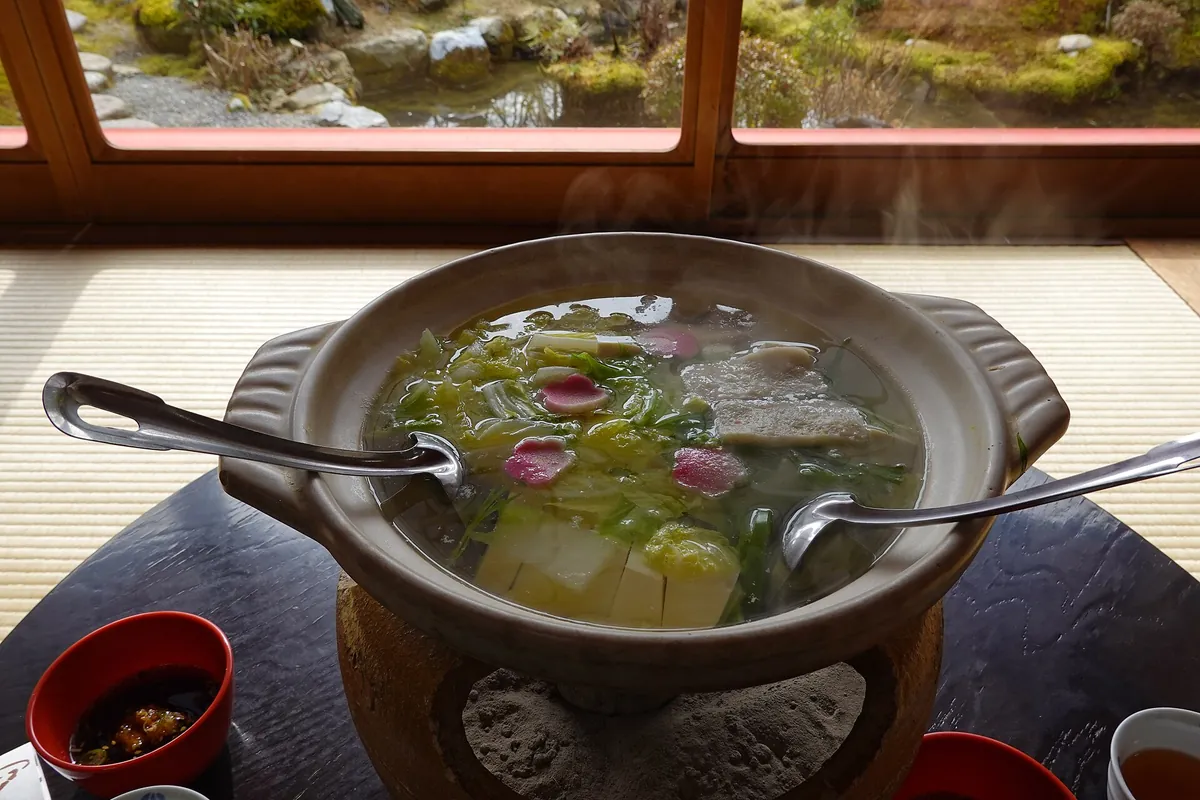
Yudofu is the dish to look for in winter. Kyoto’s site calls it one of the city’s signature winter dishes. Cubes of tofu simmer in a ceramic pot over low heat at the table, and you dip them in a sauce. Ask what goes into the sauce before you eat.
The photo below shows a pot of yudofu.
Gluten-free travellers should watch for o-fu. Kyoto’s site describes it as an ingredient made from wheat gluten. It comes raw as nama-fu or baked as yaki-fu and goes into hot pots such as sukiyaki. Yuba, the skin that forms when soy milk is boiled, is made from soy instead.
Kyoto’s site also credits the city’s chefs with the work that led UNESCO to recognise washoku, Japanese cuisine, as intangible heritage in 2013.
Halal food in Tokyo, Kyoto and Osaka
Halal food is easiest to find in the big cities. JNTO’s Q&A for Muslim travellers says Muslim-friendly restaurants and shops are found especially in Tokyo, Osaka, Kyoto and Fukuoka. They serve Japanese, Turkish, Indian, Indonesian and Malaysian food, among others.
To find them, JNTO suggests online platforms and apps that list Muslim-friendly places, and its vegetarian guide names Halal Gourmet Japan. Look for an official halal certificate from the Halal Japan Business Association or the Japan Muslim Association.
JNTO gives the examples below. Check opening hours and current certification before you go.
- Halal Ramen Honolu: ramen made with Muslim-friendly ingredients, with branches in Tokyo, Kyoto, Osaka and Aichi Prefecture.
- Sushiken Asakusa: a halal-certified sushi restaurant a short walk from Kaminarimon gate in Tokyo. It also serves tempura.
- Kobe Beef Steak Sakura: halal-certified wagyu, grilled in front of you at the counter in Kobe. JNTO recommends booking ahead.
- Matsuri: a Muslim-friendly Japanese restaurant in Osaka with a prayer space and a wudu facility.
- Le Temps at Hotel Granvia Kyoto, next to Kyoto Station: a halal-certified restaurant serving Japanese-style Western food. Give two days’ notice for a Muslim-friendly meal. The hotel also provides prayer mats, the qibla direction and mosque information.
Kyoto’s tourism site warns that haram food turns up in surprising places in Japan, such as bread or salad with pork mixed in. Some Kyoto restaurants mark which menu items are halal, and some serve only halal food.
Many Muslims live in Kobe, JNTO notes, and some Kobe restaurants serve halal-certified Kobe beef. Kobe Muslim Mosque, built in 1935, is Japan’s first and oldest mosque. Outside the big cities, JNTO highlights Hokkaido, Shizuoka, Gifu, Hyogo and Okayama for their work with Muslim travellers.
Kosher food is much harder to find. JNTO says that, by the strictest standards, there are almost no restaurants in Japan that specialise in kosher food. Kosher Japan certifies kosher food and sells certified products by mail order and delivery.
How to ask: pork, mirin, alcohol and stock
JNTO publishes a Muslim Services Inquiry Sheet with each question in English and Japanese, side by side. Show it on your phone. Staff tick Yes or No and hand it back.
The sheet defines a non-pork menu strictly. It means no pork, bacon or other pork-derived ingredients, including sausages, lard, gelatin, shortening and emulsifier. It also means no alcohol and nothing derived from alcohol. The questions for restaurants are these.
- Can this restaurant provide vegetarian or seafood dishes?
- Can it provide dishes free from alcohol or mirin, a sweet rice wine used in cooking?
- Can it offer shoyu-free dishes? Naturally fermented shoyu (soy sauce) with no added alcohol is acceptable.
- Does it store ingredients separately, and keep cooking and eating utensils apart?
- Does it provide disposable plates and chopsticks?
- Are alcoholic drinks served to other customers?
Show this line for mirin and alcohol: この店は、お酒やみりんを使わない料理を提供できますか? It reads Kono mise wa, osake ya mirin o tsukawanai ryōri o teikyō dekimasu ka? In English: can this restaurant provide dishes free from alcohol or mirin?
The hotel questions ask whether staff can clear the alcohol from your room and whether there is a prayer space. You can also ask to borrow a copy of the Quran, a prayer mat or clothing for women to pray in. A compass that shows the direction of Mecca is on the list too. For shops, the sheet asks whether a product contains pork-derived items, any meat including chicken and beef, or ingredients with alcohol.
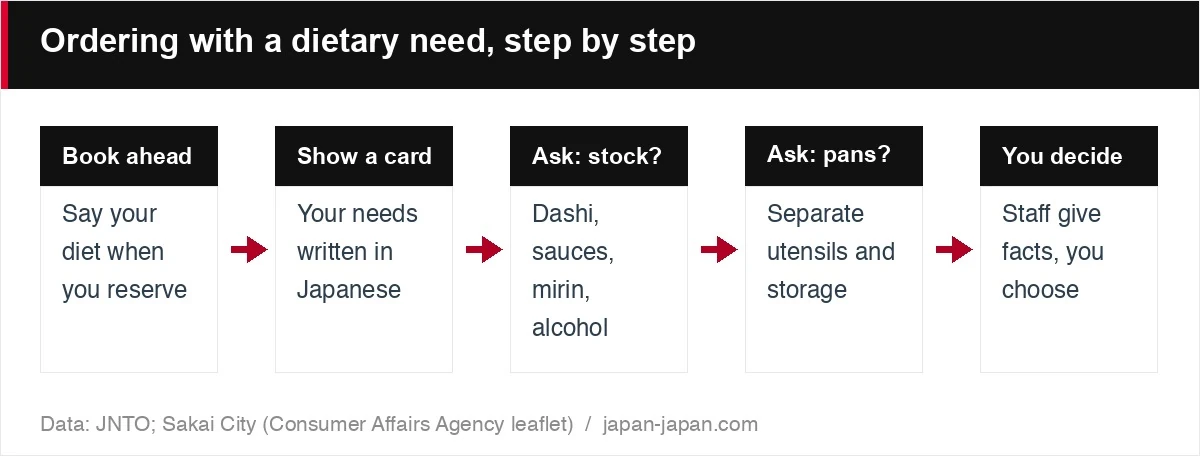
JNTO has separate tips for vegetarians and vegans. It suggests printing a card that explains your diet in Japanese. Photo menus help, but check the dashi and base ingredients anyway. Tell the restaurant about your diet when you book, especially for a set menu, and keep a translation app such as Google Translate on hand. Kyoto’s site also recommends booking ahead, because in many cases the kitchen needs to make special preparations.
The steps below sum up how to order with a dietary need.
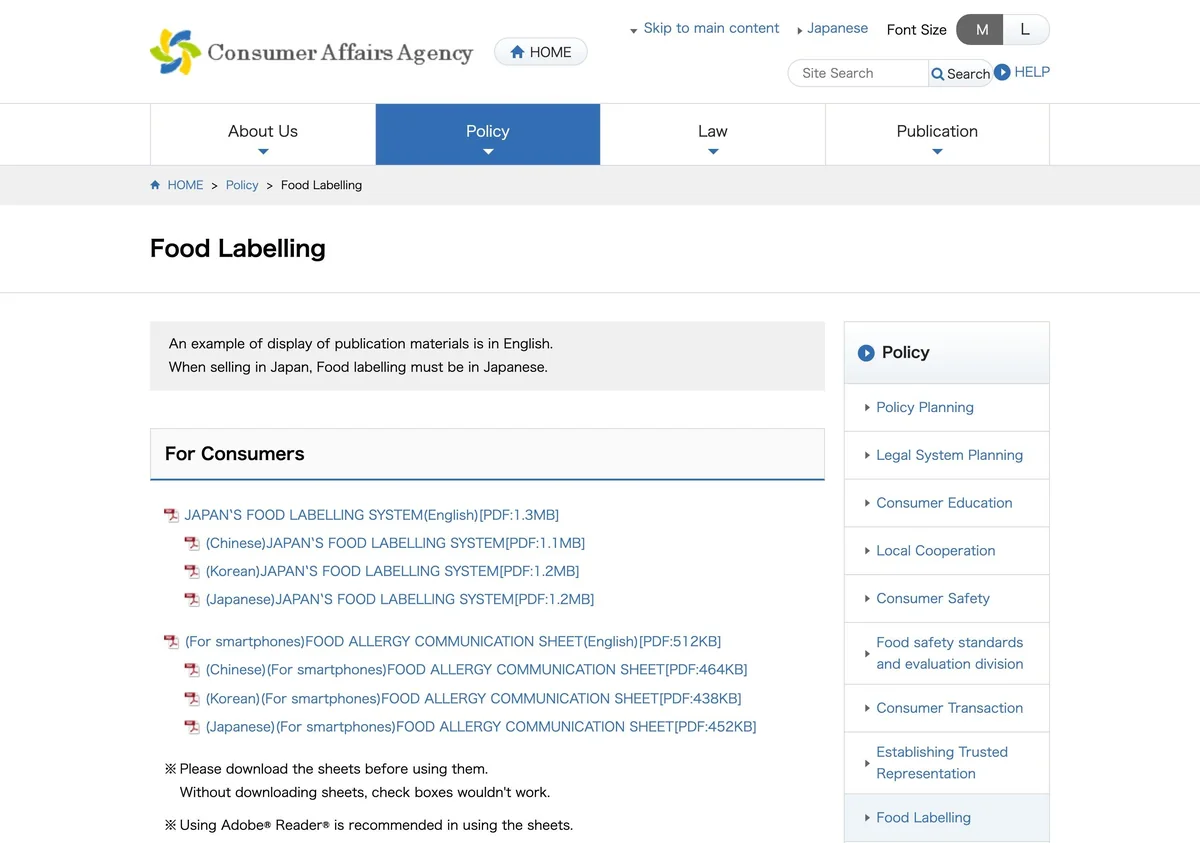
For allergies, the Consumer Affairs Agency (CAA) offers a Food Allergy Communication Sheet for smartphones in English, Chinese, Korean and Japanese. Download it before your trip. The CAA says the check boxes do not work unless you download the sheet first, and it recommends Adobe Reader.
The screenshot below shows the CAA’s English food labelling page, where the sheets are listed by language.
Gluten-free and allergies: Japan’s 9 labelled allergens
Japan’s allergen label covers 9 items. It applies to processed food sold in a container or wrapper. Under the Food Labeling Act, makers of these foods must show which of the 9 the food contains. The 9 are shrimp, cashew nuts, crab, walnuts, wheat, buckwheat (soba), egg, milk and peanuts.
Cashew nuts joined the list on 1 April 2026, when the labelling standard changed. Makers have until 31 March 2028 to switch their labels, so you may still find older packs that do not mention cashews.
Another 20 items are recommended rather than required. They include beef, chicken, pork, gelatin, sesame, soybeans, almonds, macadamia nuts, salmon, mackerel and pistachios, which joined on 1 April 2026. Because these are only recommended, pork or gelatin may not appear in the allergen box at all. Halal and vegetarian travellers should read the whole ingredient list.
The label will be in Japanese. The CAA says food labelling must be in Japanese when food is sold in Japan. The table below sorts the items you are most likely to look for.
| Item | Label rule | Matters for |
|---|---|---|
| Wheat (小麦) | Required | Gluten-free, wheat allergy |
| Egg (卵), milk (乳) | Required | Vegan, egg or milk allergy |
| Shrimp (えび), crab (かに) | Required | Shellfish allergy |
| Buckwheat (そば) | Required | Soba allergy |
| Peanuts (落花生), walnuts (くるみ) | Required | Nut allergy |
| Cashew nuts (カシューナッツ) | Required from 1 April 2026 | Nut allergy |
| Pork (豚肉), gelatin (ゼラチン) | Recommended only | Halal, vegetarian |
| Beef (牛肉), chicken (鶏肉) | Recommended only | Vegetarian, halal |
| Pistachios (ピスタチオ) | Recommended from 1 April 2026 | Nut allergy |
| Sesame (ごま), soybeans (大豆) | Recommended only | Sesame or soy allergy |
Restaurants work differently. As Sakai City’s page explains, eating out, and bento or side dishes sold face to face without packaging, carry no labelling duty. The CAA leaflet for restaurants, quoted on the same page, asks staff to give up-to-date, accurate information and to avoid vague answers. Staff should also tell you about possible cross-contamination, and the customer makes the final call on whether to eat.
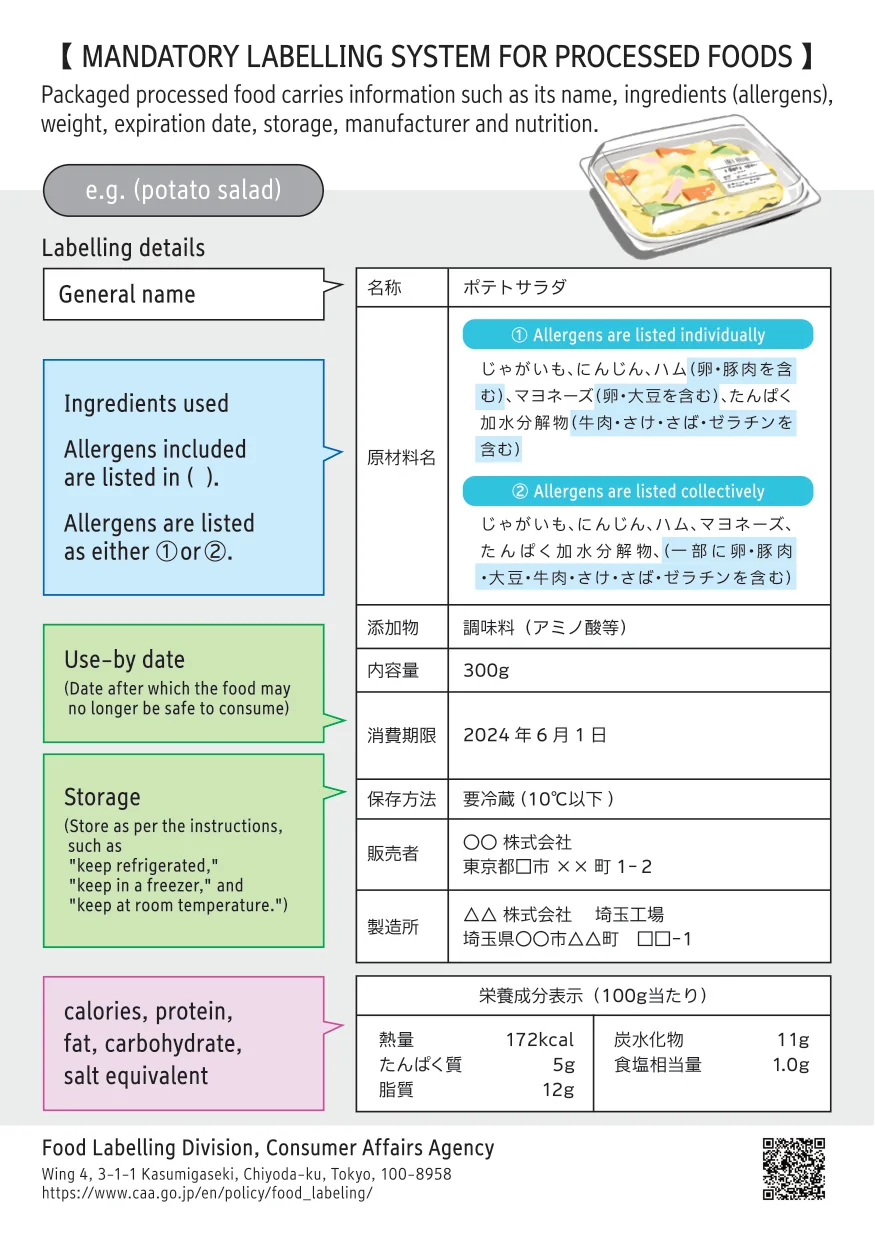
The CAA’s English leaflet on food labels shows a sample label for potato salad. Allergens appear in brackets, either after each ingredient or together at the end of the ingredient list. In the sample, pork (豚肉) and gelatin (ゼラチン) are listed this way.
For a gluten-free diet, look for 小麦 (komugi, wheat) on packaged food. In Kyoto, watch for o-fu, which is wheat gluten, and for udon, which Kyoto’s site describes as noodles made from flour with salt water. The same site lists wheat flour among the main ingredients of kyo-gashi, the city’s traditional sweets.
Airport prayer rooms and food you cannot bring in
Both Tokyo airports have prayer rooms, but not every terminal has one. Narita Airport lists six, open for any prayer, devotion, meditation or quiet reflection. Terminals 1, 2 and 3 each have one room before the security check and one after it for international flights.
At Haneda Airport, the prayer rooms are in the Terminal 3 departure lobby and in Terminal 2’s international departure lobby and airside area. Terminal 1 has none, so check which terminal your flight uses. Haneda says the rooms have purification facilities for washing before worship.
The table below lists each room by terminal, place and security side.
| Terminal | Where | Before or after security |
|---|---|---|
| Narita Terminal 1 | Central Building, 3F | Before |
| Narita Terminal 1 | Central Building, 2F | After (international flights) |
| Narita Terminal 2 | Main Building, 1F | Before |
| Narita Terminal 2 | Main Building, 1F | After (international flights) |
| Narita Terminal 3 | Main Building, 2F | Before |
| Narita Terminal 3 | Main Building, 3F | After (international flights) |
| Haneda Terminal 2 | International departure lobby | Before |
| Haneda Terminal 2 | Airside area | After |
| Haneda Terminal 3 | Departure lobby | Before |
Our terminal guides cover each building in more detail: Narita Terminal 1, Haneda Terminal 2 and Haneda Terminal 3. If you land in Osaka, start with Kansai Airport Terminal 1.
The food rules on arrival matter as much as the prayer room. Japan bans meat at the border. Our page on meat and meat products explains that the ban covers raw meat and anything made with it, however it is packed or cooked. Vacuum packing, cooking, a duty-free shop or a Japanese label makes no difference.
That rules out bringing halal meat from home. Ham, sausage, bacon and salami are banned whether cured or not, and so are beef jerky and meat floss. Dried meat is one of the items most often found in visitors’ bags. Bringing meat in without declaring it can mean up to three years in prison or a fine of up to 3 million yen.
If you are carrying any, hand it in at the animal quarantine counter before customs; there is no penalty for declaring it. On arrival, the animal and plant quarantine counter comes after baggage claim and before customs.
Plan your last meal on the plane too. An in-flight meal with meat, fresh fruit or vegetables cannot leave the aircraft, so eat it on board or leave it behind. Fish and seafood are a different matter, because the animal quarantine ban on meat does not cover them. Processed or dried seafood for personal use is normally fine. Our article on what you cannot bring into Japan covers the rest of the list.
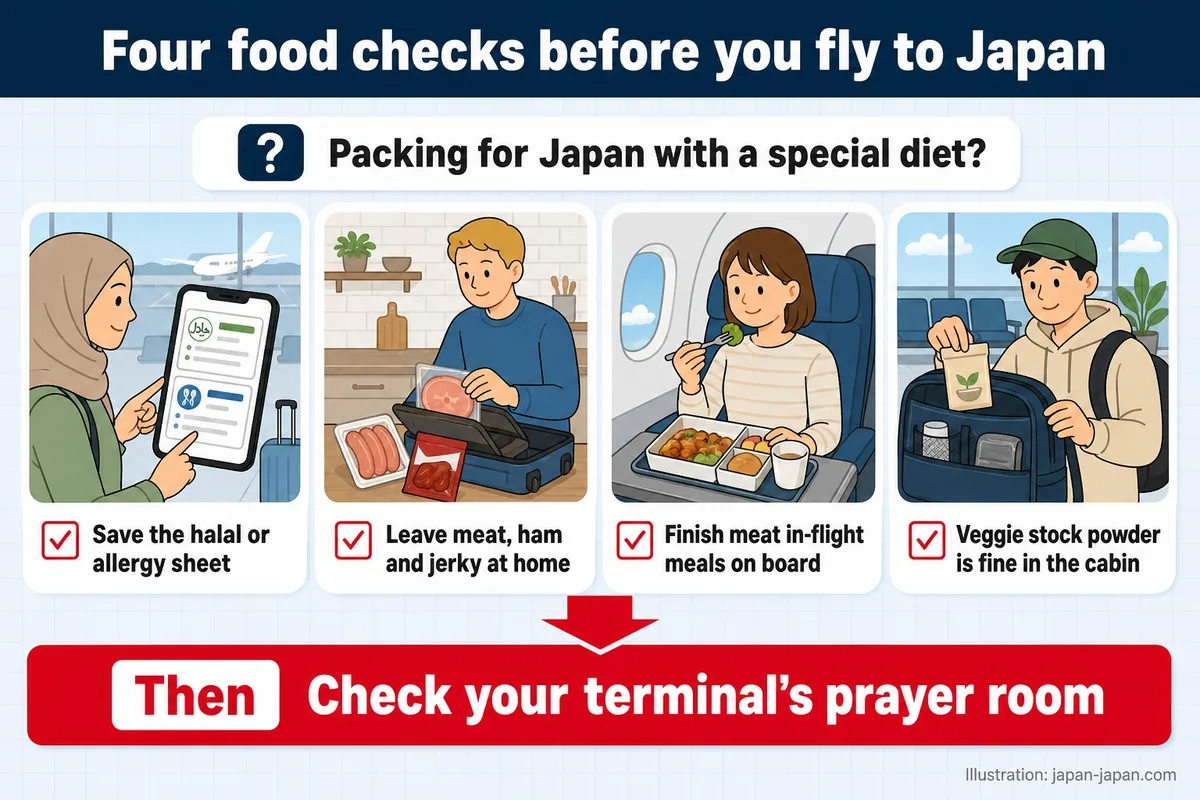
The checklist below sums up what to sort out before you fly.
FAQ
Is Japan vegan friendly?
Yes, with some planning. Vegan dishes exist, but dashi hides in many soups and sauces, so name each item you avoid. JNTO says many vegetarian and vegan restaurants now display a sticker from the Japan Vegan Society, VegeProject Japan or the Japan Vegetarian Association.
Is Japan Muslim friendly?
It is getting easier, especially in the big cities. JNTO says Muslim-friendly restaurants and shops are easiest to find in Tokyo, Osaka, Kyoto and Fukuoka. Narita and Haneda both have prayer rooms. Carry JNTO’s inquiry sheet to ask about pork, alcohol and mirin.
Can you bring halal meat or meat snacks into Japan?
No. Japan bans meat and anything made with it, including vacuum-packed or cooked meat, ham, sausage and beef jerky, even when it is halal. Fish and seafood are not covered by the meat ban. Plan to buy halal food after you land.
Do restaurants in Japan have to label allergens?
No. Only packaged processed foods must label the 9 specified allergens. Restaurants and over-the-counter bento have no labelling duty, so ask the staff and show the CAA’s Food Allergy Communication Sheet. The final decision on whether to eat is yours.
About the author