Can You Bring Hand Warmers on a Plane? Japan’s 2026 Rules
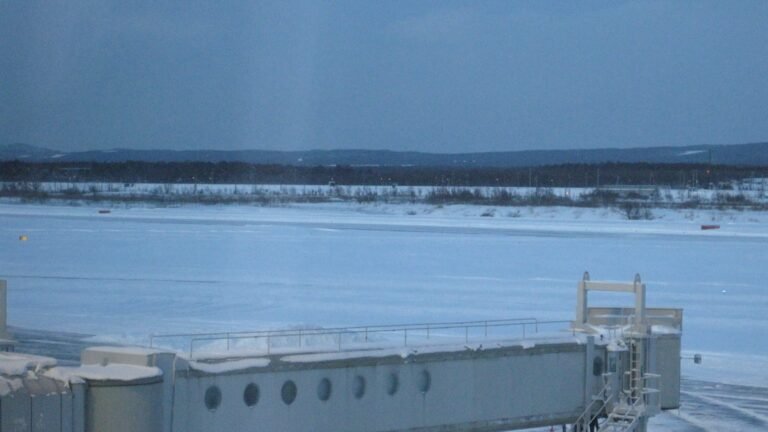
The rest of this guide covers 10 winter items, from the thermos in your daypack to the wax in your ski bag. Each rule comes from Japan’s Civil Aviation Bureau, part of the Ministry of Land, Infrastructure, Transport and Tourism (MLIT), or from ANA’s baggage pages.
Hand warmers on a plane: disposable, oil-filled and platinum
Airport security in Japan treats three kinds of hand warmer differently. The disposable kind is called kairo (カイロ). It is the small pack you open, shake and slip into a pocket or stick inside a jacket. Our page on disposable hand warmers notes that shops all over Japan sell them from autumn to spring, in stick-on and pocket versions.
Security staff work from the MLIT Civil Aviation Bureau restricted items examples (Japanese). One row reads オイル充填式携帯カイロ、白金カイロ (oiru juutenshiki keitai kairo, hakkin kairo). That means oil-filled pocket warmers and platinum warmers. The row shows a cross in the carry-on column and a cross in the checked column. The MLIT Examples of Dangerous Goods by Air Transportation is the English edition, and it gives the same answer under the date 24 April 2026.
ANA explains the reason. The ANA items not permitted on domestic flights says oil-filled pocket warmers use a flammable liquid as fuel, which falls under the dangerous goods regulations. Platinum warmers sit on the same MLIT row, so treat them the same way. Our page on refillable fuel hand warmers marks both bags as no.
Disposable heat packs have no row on the MLIT list, which names only the fuel-burning kind. We checked the list on 16 October 2026, and it still carried the 24 April 2026 update. If your warmer has a fuel tank that you refill, it belongs to the banned group. If it is a sealed pack with no fuel to add, it is the disposable kind.
The label in a Japanese shop helps too. A product described as オイル充填式 (oil-filled) or 白金 (platinum) is one to leave at home.
Japan winter carry-on rules for 10 items
Hand warmers are only one item in a winter bag. The table below puts 10 common winter items side by side. It draws on the MLIT list, the MLIT power bank notice and ANA’s page for international flights. Read the Condition column first, because most answers depend on size, type or which bag you use.
| Item | Carry-on | Checked | Condition |
|---|---|---|---|
| Disposable hand warmers (kairo) | Not on MLIT list | Not on MLIT list | Only the fuel kind is named |
| Oil-filled and platinum warmers | No | No | Flammable liquid fuel |
| Thermos or vacuum flask | Not on MLIT list | Not on MLIT list | International: drink inside follows 100 ml rule |
| Skis and snowboards | No | Yes | Short skis of 60 cm or less: carry-on OK |
| Ski poles | If folded to 60 cm or less | Yes | No pointed metal tip |
| Liquid, paste or powder wax | No | No | Liquid with flash point above 60°C: OK |
| Solid ski wax | Yes | Yes | ANA international flights |
| Wax spray with flammable gas | No | No | ANA international flights |
| Self-heating meals and drinks | No | No | Heating agent |
| Power banks | Yes | No | 160Wh or less, 2 per person |
Counted across the 10 rows, 4 items are banned in both carry-on and checked bags. They are oil-filled and platinum warmers, liquid or paste or powder wax, flammable-gas wax sprays and self-heating meals. Only solid ski wax goes in either bag with no condition, according to ANA. 3 items depend on size or bag: skis and snowboards, ski poles and power banks. The last 2, disposable hand warmers and a thermos, are not on MLIT’s restricted list.
The lookup below answers four of those rows at a glance, with the one question to ask for each item.

MLIT adds two warnings at the top of its list. An airline’s own rules can be stricter than the list. An item can also be refused if its safety cannot be confirmed at the airport. On international flights, foreign authorities may restrict items further, so check with your airline before you pack.
For anything outside this table, our carry-on checker for 180 items gives each item a carry-on answer, a checked-bag answer and the official source.
Thermos and drinks: the 100 ml liquids rule
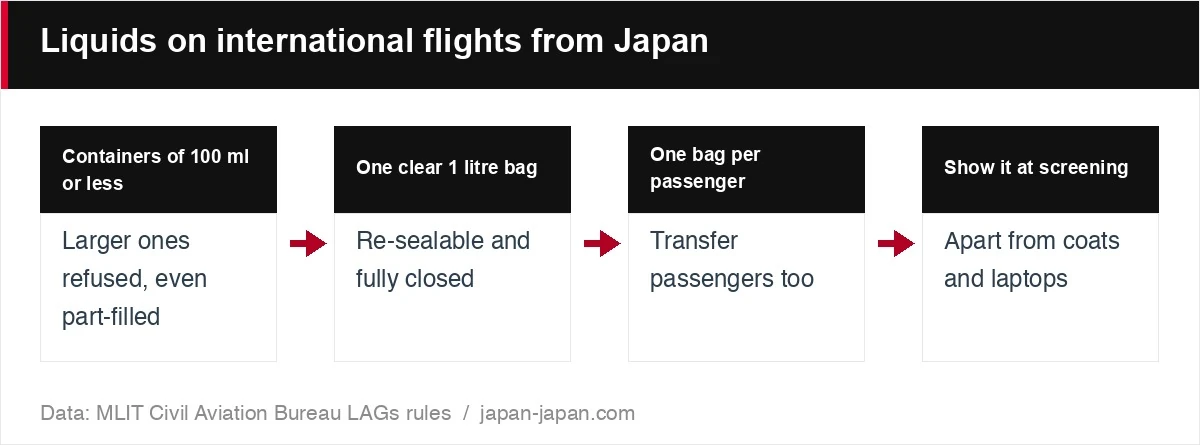
A thermos has no row on MLIT’s restricted list, so the drink inside decides the answer. On international flights from Japan, the MLIT liquids, aerosols and gels screening rules for international flights require every liquid in cabin baggage to be in a container of 100 ml or less. That is about 3.4 US fluid ounces. A larger container is refused even when it is only part-filled, so a half-full flask fails the check.
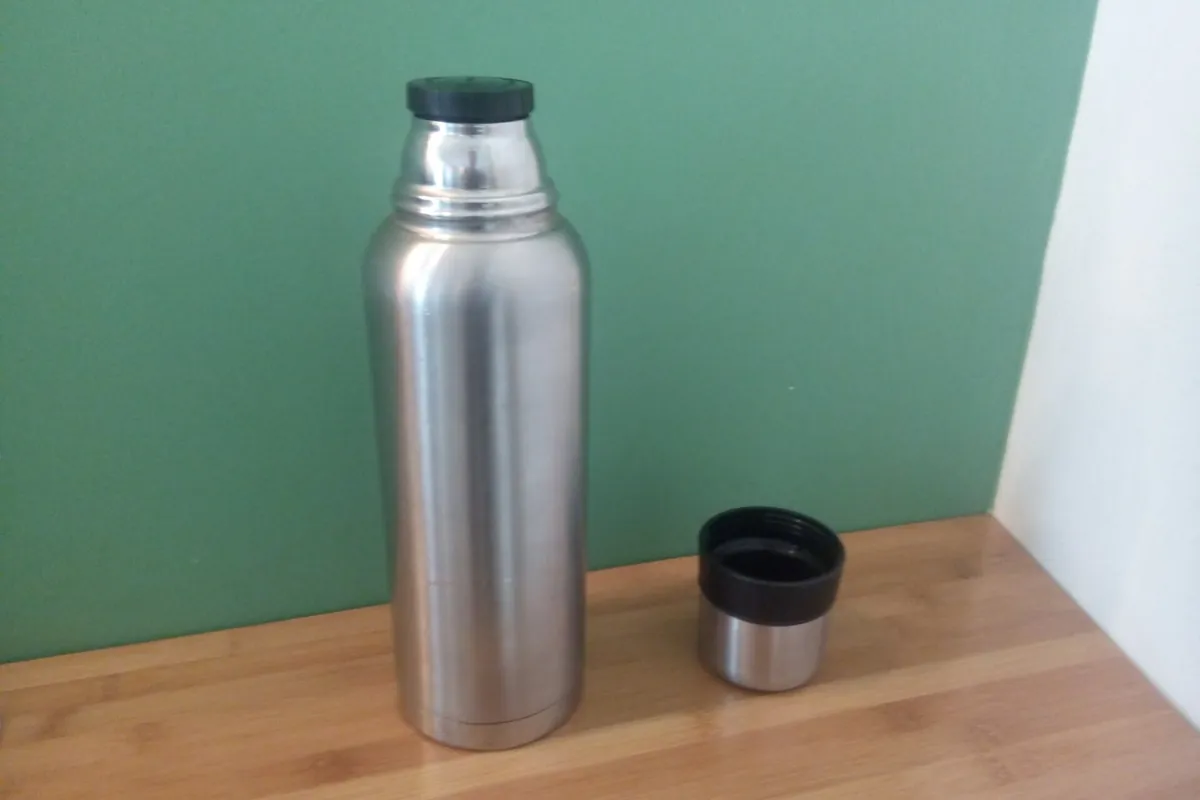
The simple fix is to empty the flask before you reach security. Our page on the water bottle or thermos marks an empty one as fine in the cabin. A filled one falls under the 100 ml limit on international flights. A thermos of hot water for baby formula can go in the cabin after inspection, when the infant travels with you.
A steel flask like the one below is easy to carry once it is empty.
Small containers go in one transparent, re-sealable plastic bag that holds 1 litre or less. The bag must close completely, and each passenger may present only one. MLIT’s diagram shows sides under 20cm and a total length and breadth of about 40cm. Take the bag out at the checkpoint so it goes through the X-ray apart from coats, jackets and laptops.
Transfer and transit passengers follow the same rule. It covers cabin baggage only, so liquids in your checked suitcase are outside it. The flow below shows the four steps in order.
Some liquids are exempt. Medicines, baby milk and baby food, and special dietary needs can go through in larger amounts. Liquids you buy in shops after security at a Japanese airport are exempt too. MLIT warns that a transit airport in another country may still confiscate them, so a duty-free bottle can be lost on a connection.
Toiletries have their own size cap on top of this. The Government Public Relations Online items not allowed on planes (2026) allows cosmetics-type liquids up to 500 ml per container and 2 litres per person, in carry-on and checked bags. The 100 ml rule is for international flights, and our thermos page notes that it does not apply on domestic flights inside Japan. To see how each airline handles duty-free bags and transfers, open our liquids rules by airline.
Skis, snowboards, ski poles and wax
Skis and snowboards cannot go in the cabin. They travel as checked baggage. The MLIT list makes one exception for short skis of 60 cm or less, about 23.6 inches. Those may be carried on.
Ski poles follow a length test. If they are 60 cm or shorter when folded and have no pointed metal tip, you can carry them on. Any other pole goes in your checked bag. An ice axe cannot go in the cabin at all, but you can check it. Our page on skis and snowboards lists the same rules.
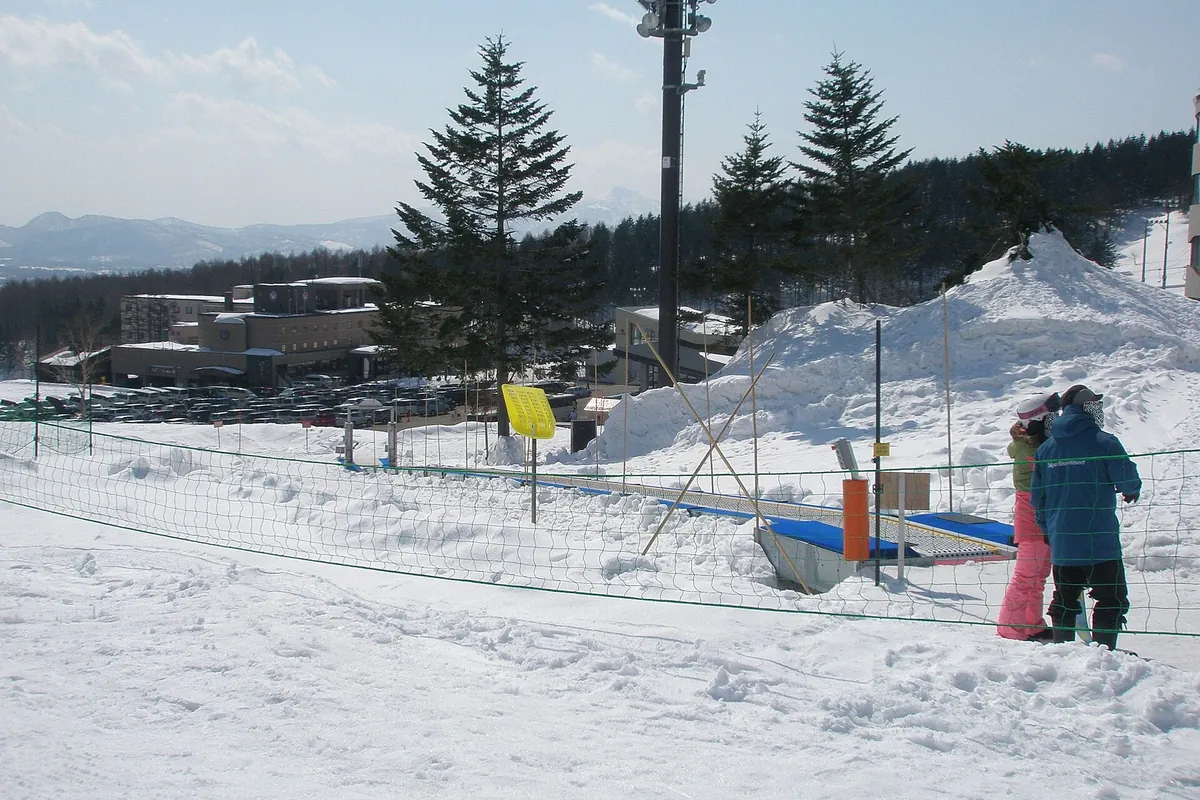
Wax has three separate rules. Liquid, paste and powder wax are banned in carry-on and checked bags, and so is wax remover. The one exception is a liquid with a flash point above 60°C. Our page on ski and snowboard wax adds that such a liquid also falls under the 100 ml limit on international flights.
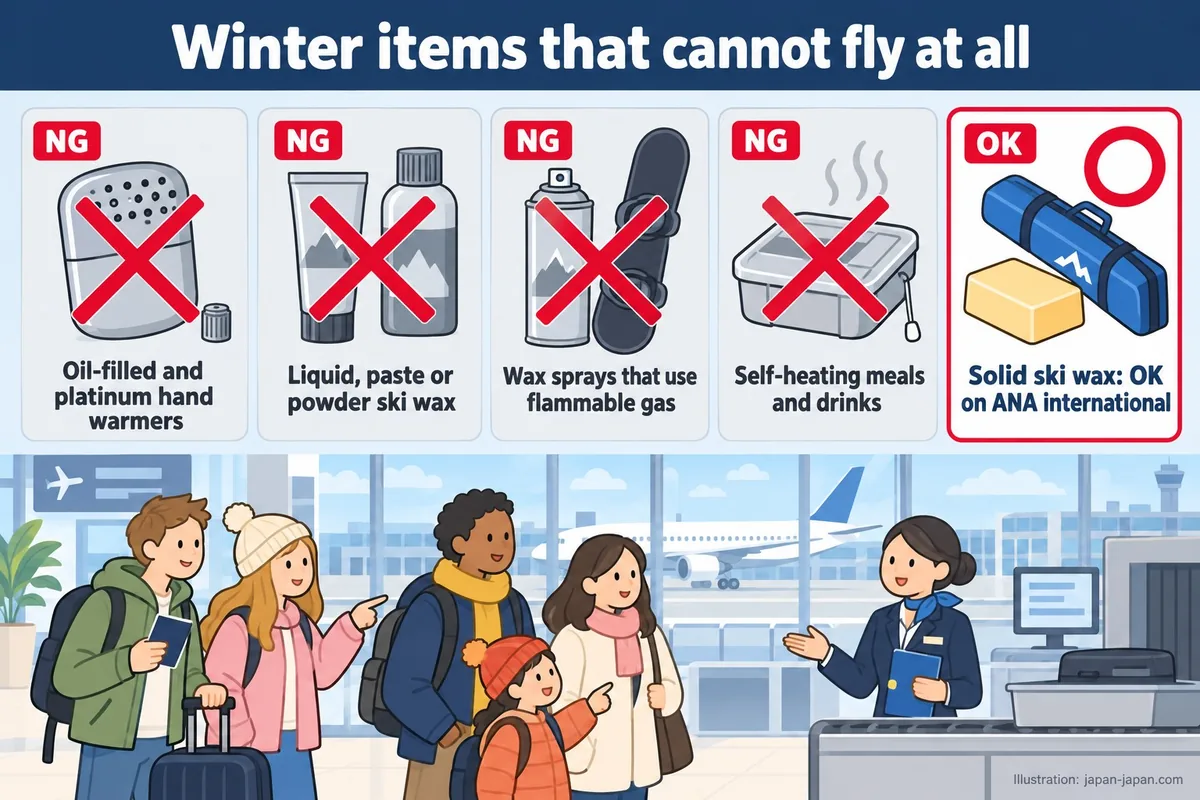
Solid wax is the easy case. The ANA conditional items on international flights page allows solid ski wax in both carry-on and checked baggage. The same page lists sprays that use flammable gas, including ski and snowboard wax sprays, among the sprays you cannot carry on or check in. If you wax your own board, pack a solid block and leave the spray at home.
Ski bags count toward your checked allowance, and airlines set their own fees and size limits. Ask your airline about sports equipment before you book. If you are heading north, our Hokkaido in January guide covers the snow season and the events around Sapporo and Niseko.
Power bank rules on a Japan flight
A power bank is the winter item with the most rules. The MLIT Civil Aviation Bureau power bank notice for passengers sets them out in seven points. Never put a power bank in checked baggage. Always carry it into the cabin.
Each power bank must be rated 160Wh or less. From 24 April 2026, each passenger may carry 2 power banks at most. That puts the ceiling at 320Wh per person, 2 x 160Wh. If your power bank shows only mAh, MLIT gives the formula: Wh equals mAh times volts, divided by 1,000. Its own example is 27,000mAh at 3.7V, which comes to 99.9Wh.
Protect each battery from short circuits. Tape over the terminals, or put it in a case or pouch. Do not keep several batteries or metal items loose in the same bag. On board, keep the power bank in the seat pocket or in your hands, and do not put it in the overhead bin.
Two charging rules apply in flight. You may not charge the power bank from the aircraft’s power supply. You also may not use the power bank to charge your phone or other devices. Use the seat outlet for that instead.
Spare batteries have a separate limit. Batteries of 100Wh or less have no count limit. Batteries over 100Wh up to 160Wh are limited to 2, counted together with any power bank over 100Wh.
For a rechargeable hand warmer or a heated vest, follow the general lithium battery rules and ask your airline before you fly. MLIT notes that some airlines set stricter rules. Air New Zealand, for example, limits each of its 2 power banks to 100Wh or less.
Our page on power banks has the full rule with its source. For the background to the 24 April 2026 change, read our guide to Japan power bank rules. To compare carriers, see our power bank rules by airline.
Winter items that cannot fly at all
A few winter items stay off the plane in every bag. Self-heating meals and self-heating drinks are the first. They come with a heating agent, and the MLIT list bans them from carry-on and checked baggage. The government’s 2026 guide names one type in particular: lunch boxes that heat up when quicklime (calcium oxide) reacts with water. Our page on self-heating meals gives the same answer.
Lighter fuel is next. The government guide says refill gas and refill oil for lighters cannot go in either bag. Oil lighters without absorbent cotton, the tank type, are banned in both bags as well.
You may still carry one smoking item. ANA allows one small lighter or one small box of safety matches per person. You carry it on your body, and it goes in the cabin only, never in checked baggage. Our page on lighters explains which lighter types count.
The picture below groups the four winter items that cannot fly, plus the one wax that can.
Penalties apply in the cabin. The MLIT security screening precautions and penalties page sets out the penalty under the Civil Aeronautics Act. Taking a restricted item into the aircraft can mean up to 2 years in prison or a fine of up to 1 million yen.
If security finds a banned item and you have no time to store it, you must give it up on the spot. The government guide asks you to tell the check-in counter or the security staff if you carry dangerous goods. If you are unsure about an item, ask your airline.
Packing for a winter flight from Japan
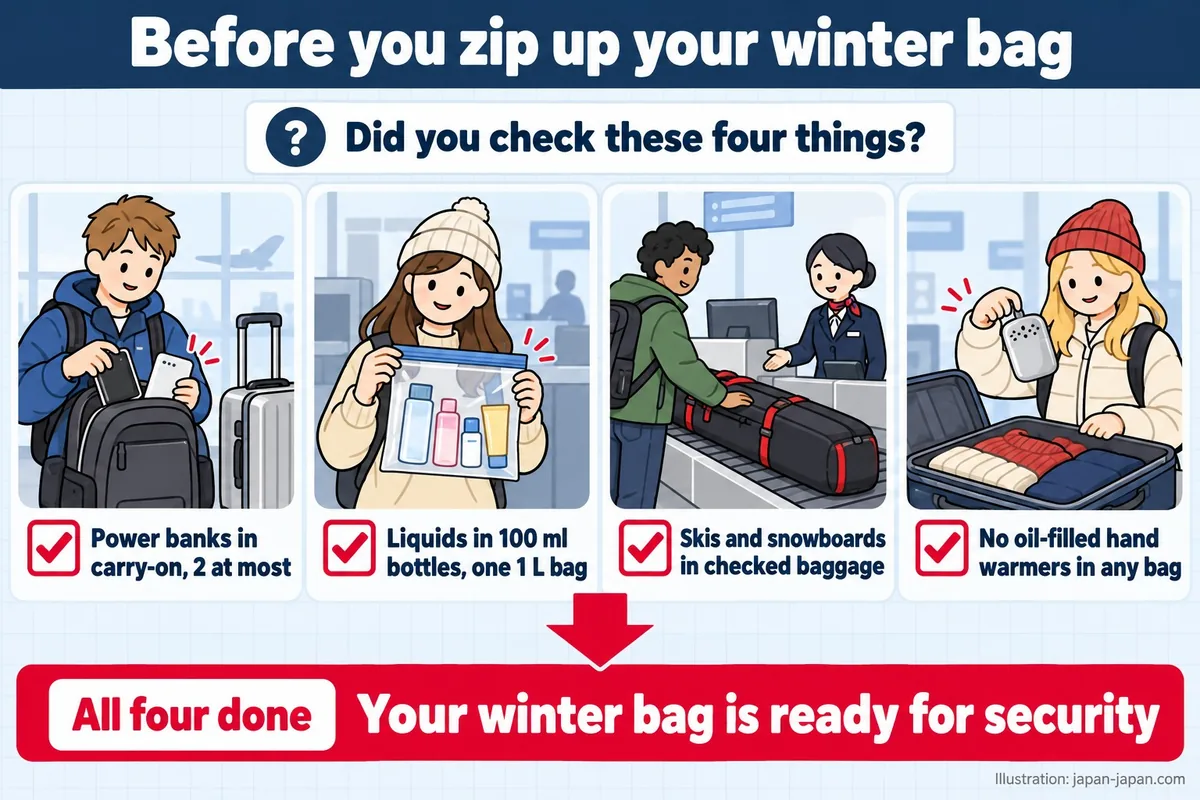
Sort your bags the night before you fly. Put power banks in your carry-on, never in the suitcase. Move liquids into 100 ml bottles and one 1 litre bag. Check in skis and snowboards. Bring disposable kairo, and leave oil-filled or platinum warmers at home.
The checklist below covers those four steps.
Our carry-on checker gives each winter item a mark. OK means both bags are fine, IF means there is a condition, and NO means one bag is closed to it. The table shows the marks for eight winter items as our pages show them. Where a mark and the official text differ in detail, follow the official text in the sections above.
| Item | Carry-on | Checked | Mark on our page |
|---|---|---|---|
| Disposable hand warmers | Yes | Yes | OK |
| Refillable hand warmers (fuel type) | No | No | NO |
| Water bottle or thermos | Conditions | Yes | IF |
| Skis and snowboards | No | Yes | NO |
| Ski and snowboard wax | Conditions | Conditions | IF |
| Self-heating meals | No | No | NO |
| Lighters | Conditions | No | IF |
| Power banks | Conditions | No | IF |
The full MLIT list comes in Japanese and English. The Traditional Chinese, Simplified Chinese and Korean versions on MLIT’s page cover only a leaflet on hair-care devices. If you read the list in English, use the MLIT Examples of Dangerous Goods by Air Transportation PDF linked above.
New Chitose Airport in Hokkaido, below, is where many ski trips end.
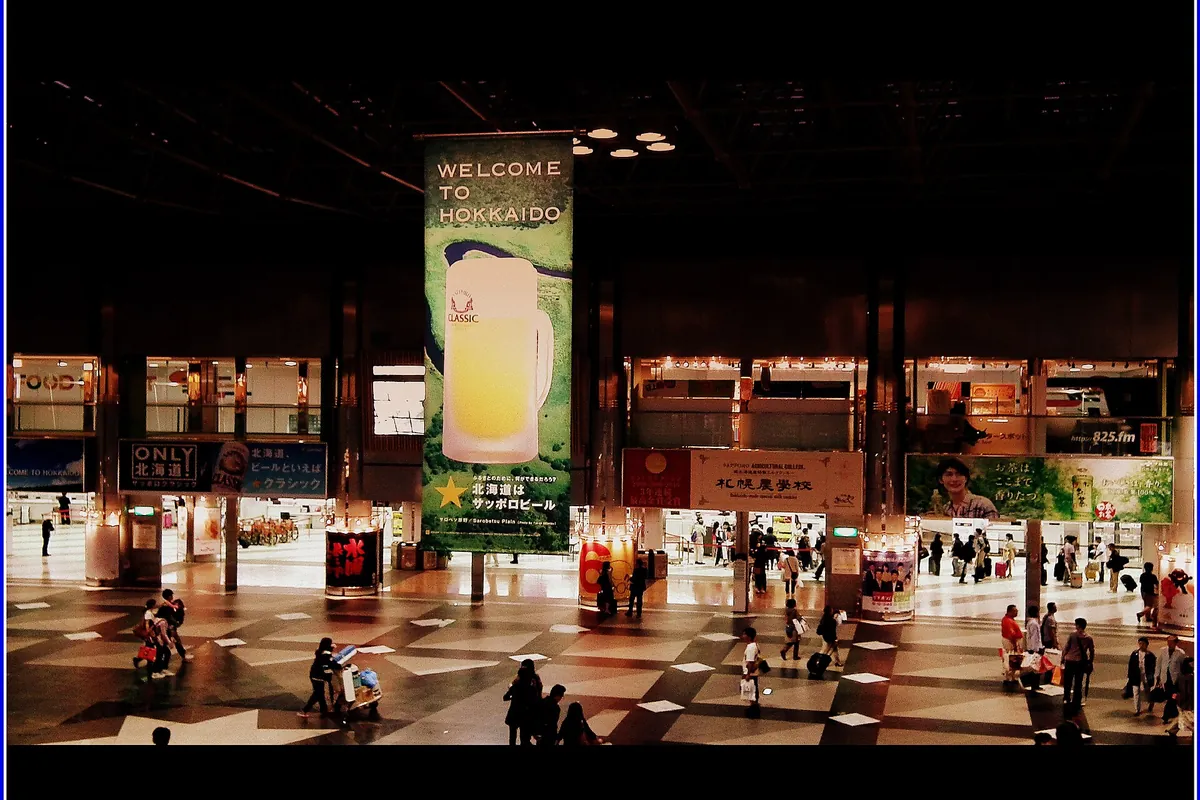
If you fly home from New Chitose, our guide to New Chitose Airport to Sapporo helps you plan the ride back to the terminal. For what to wear and pack in general, read our Japan packing list for winter.
FAQ
Are disposable hand warmers flammable on a plane?
Disposable hand warmers have no row on MLIT’s restricted list, so security does not treat them as dangerous goods. The banned warmers are the oil-filled and platinum kinds. ANA says oil-filled warmers use a flammable liquid as fuel.
Can I put hand warmers in checked luggage?
Disposable packs can go in checked luggage, and our checker marks them OK for both bags. Oil-filled and platinum hand warmers cannot go in checked luggage or in the cabin. MLIT marks both columns with a cross.
Can I bring an empty thermos through security in Japan?
Yes, an empty thermos is fine in the cabin. On international flights, any drink must be in a container of 100 ml or less. A larger flask with liquid in it is refused. Our thermos page notes that the 100 ml limit does not apply on domestic flights inside Japan.
Can I carry ski poles on the plane?
Yes, if they are 60 cm or shorter when folded and have no pointed metal tip. Any other ski pole goes in checked baggage. Skis and snowboards always go in the hold, except short skis of 60 cm or less.
About the author





.jpg)


