Nozomi vs Hikari: Is 33 Minutes Worth 320 Yen?
All times and fares here come from our routes database. It uses JR’s own search for Wednesday 14 October 2026 and JR Central’s timetable for that day, for one adult travelling one way. Both trains run on the same Tokaido Shinkansen tracks with the same 16-car trains. The gap comes from two things: how many stations each train stops at, and what the reserved seat adds to the price.
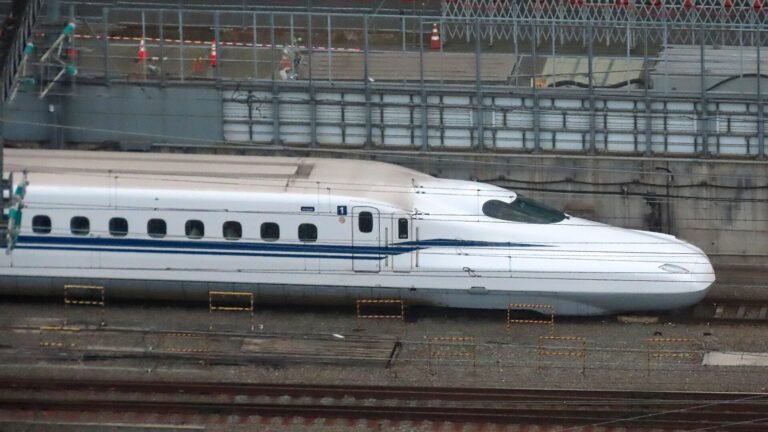
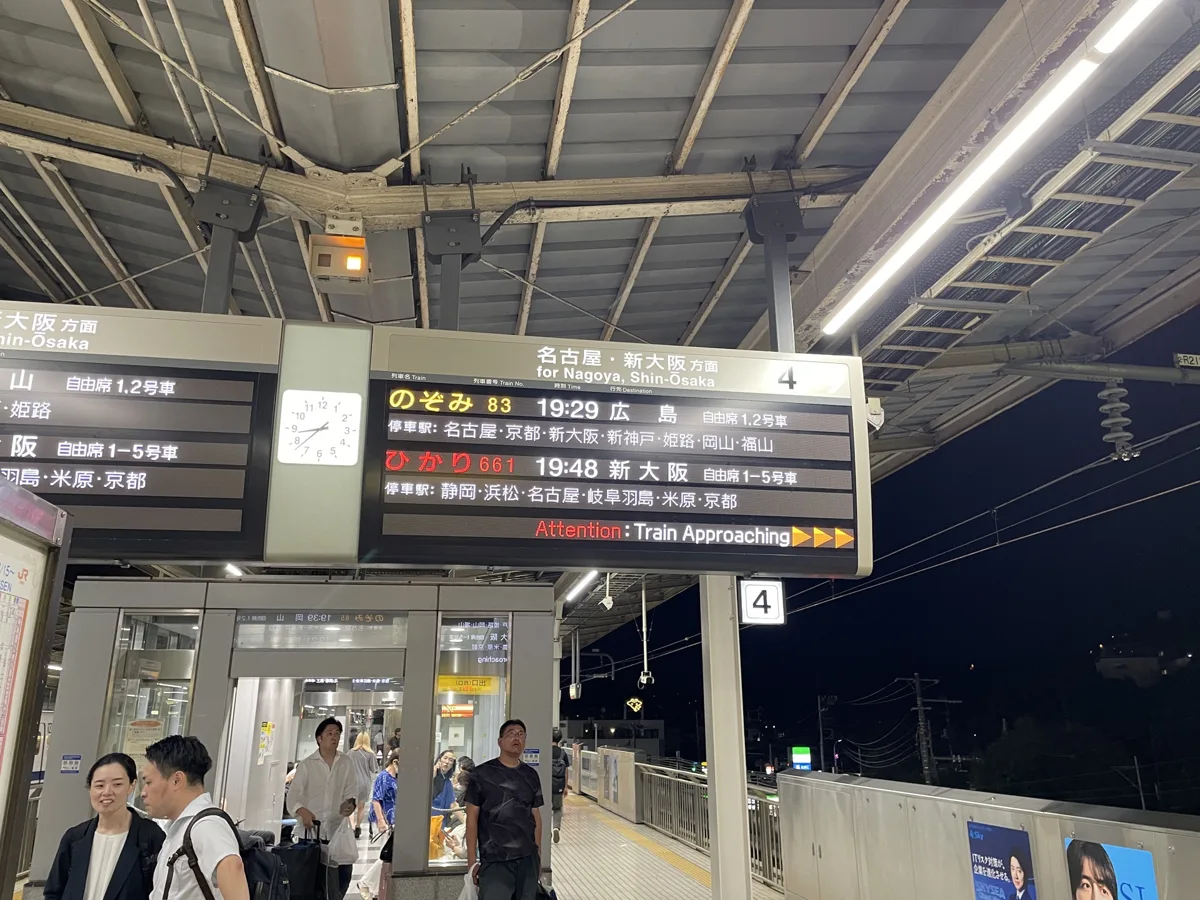
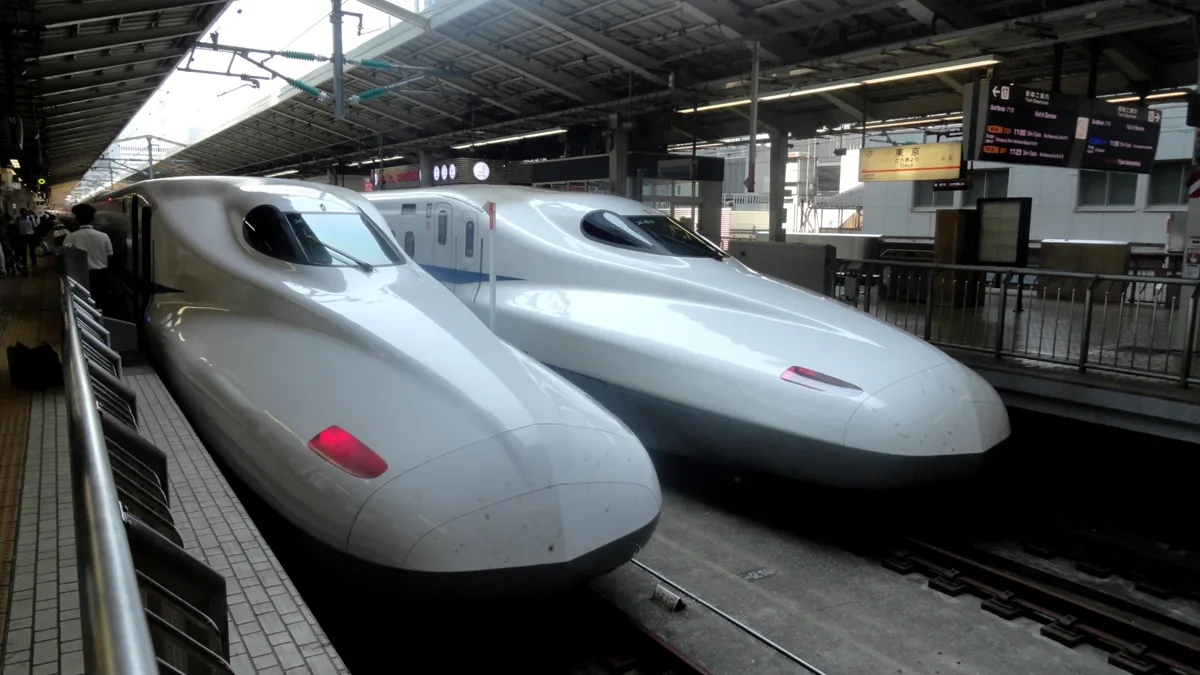
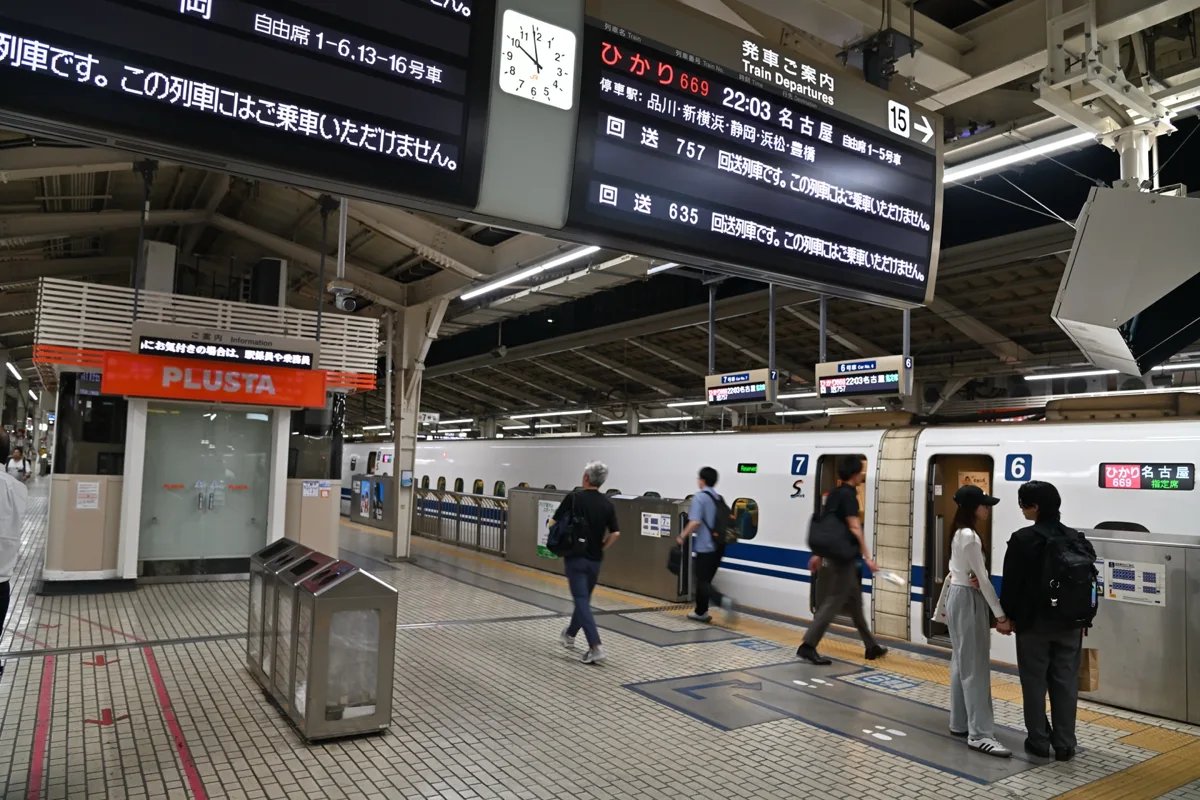
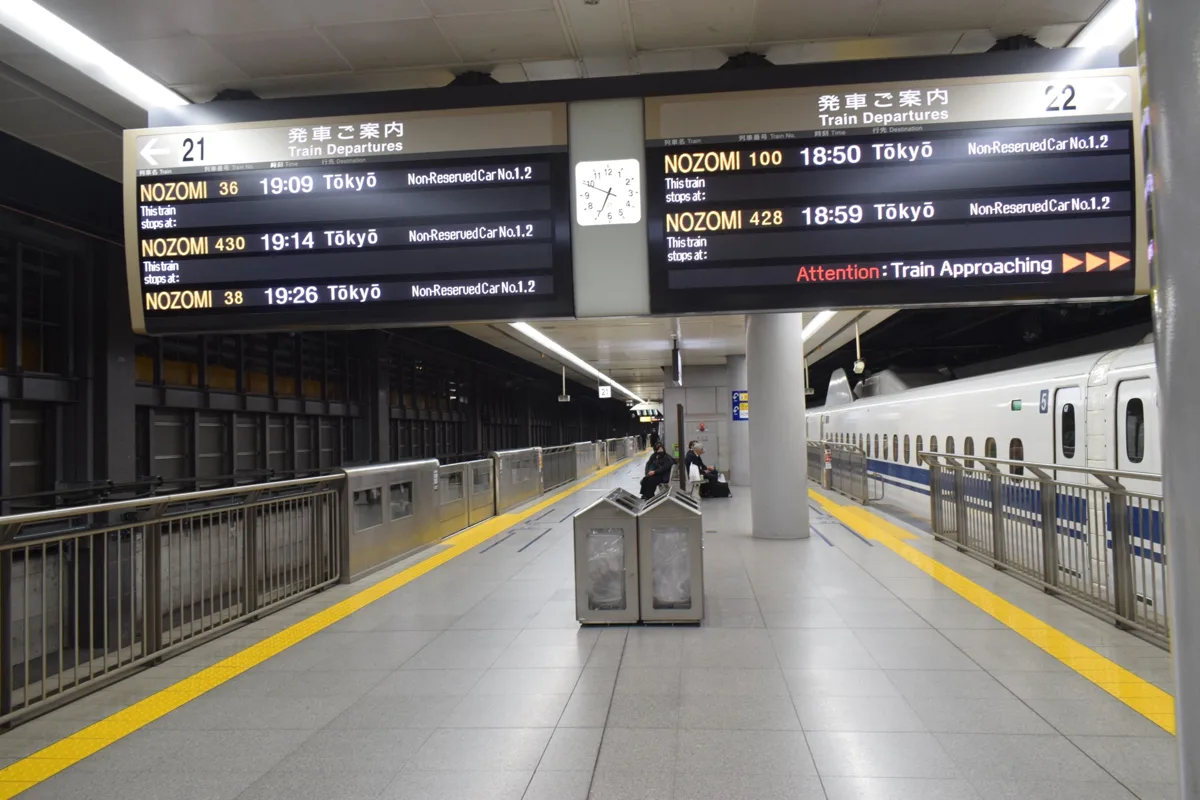
From the outside, a Nozomi and a Hikari look the same, as the train in the photo shows. Read the train name on the departure board instead. The JR Central Tokaido Shinkansen guide for visitors explains the colours: yellow for the Nozomi, red for the Hikari and blue for the Kodama. The boards switch between Japanese and English, so wait a few seconds if you only see Japanese.
Nozomi and Hikari side by side
The difference between Nozomi and Hikari is easiest to see on one route. The table compares them over the full Tokaido Shinkansen, from Tokyo to Shin-Osaka.
| Item | Nozomi | Hikari |
|---|---|---|
| Journey time | 2 h 21 min (fastest) | 2 h 54 min (Hikari 707) |
| Reserved seat | 14,720 yen | 14,400 yen |
| Non-reserved seat | 13,870 yen | 13,870 yen |
| Trains a day | 116 of 155 | 28 of 155 |
| Stations (of 17) | 6 | 8 to 11, by train |
| Non-reserved cars | Cars 1 and 2 | Cars 1 to 5 |
| Japan Rail Pass | Needs a 4,960 yen ticket | Covered |
| All-reserved days | No non-reserved seats | Non-reserved seats as usual |
Three rows matter most. The Nozomi is faster because it stops at only 6 of the 17 stations. The Hikari has more non-reserved cars, cars 1 to 5 against cars 1 and 2. And the Japan Rail Pass covers the Hikari but leaves the Nozomi out.
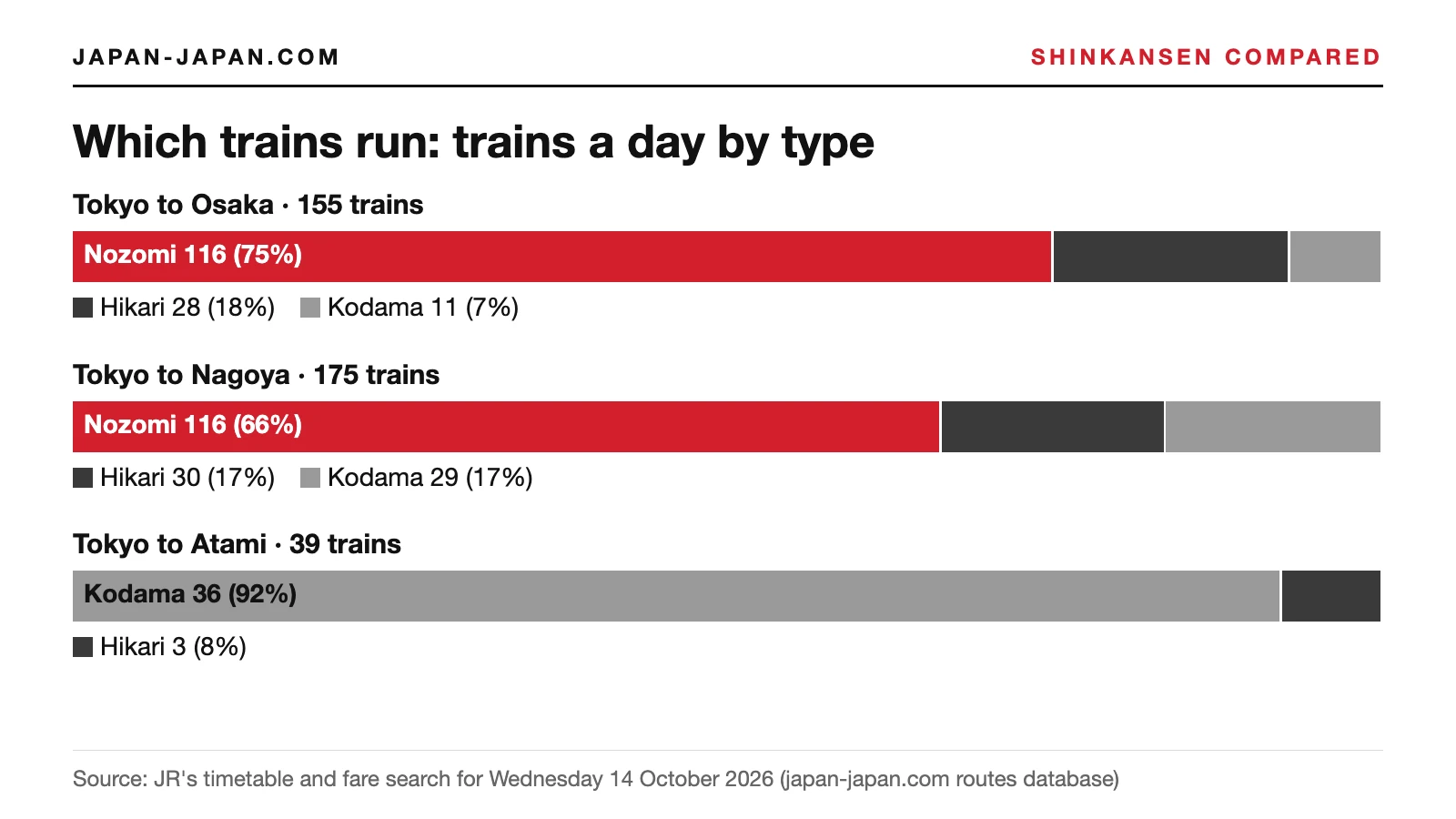
The Nozomi also wins on frequency. JR Central’s timetable for 14 October 2026 lists 155 trains from Tokyo to Shin-Osaka: 116 Nozomi (75%), 28 Hikari (18%) and 11 Kodama (7%). If you turn up at Tokyo Station without a plan, the next train is most likely a Nozomi.
The third type, the Kodama, stops at all 17 stations. You need it for the small stations that no Hikari serves: Shin-Fuji, Kakegawa and Mikawa-Anjo. For a trip between big cities, it is the slowest choice.
The fares are built the same way on both trains. On the Nozomi from Tokyo to Shin-Osaka, the 14,720 yen reserved seat price is a basic fare of 8,910 yen plus a limited express charge of 5,810 yen. Children aged 6 to 11 pay half of both parts, on either train.
Nozomi vs Hikari price and time on 7 routes
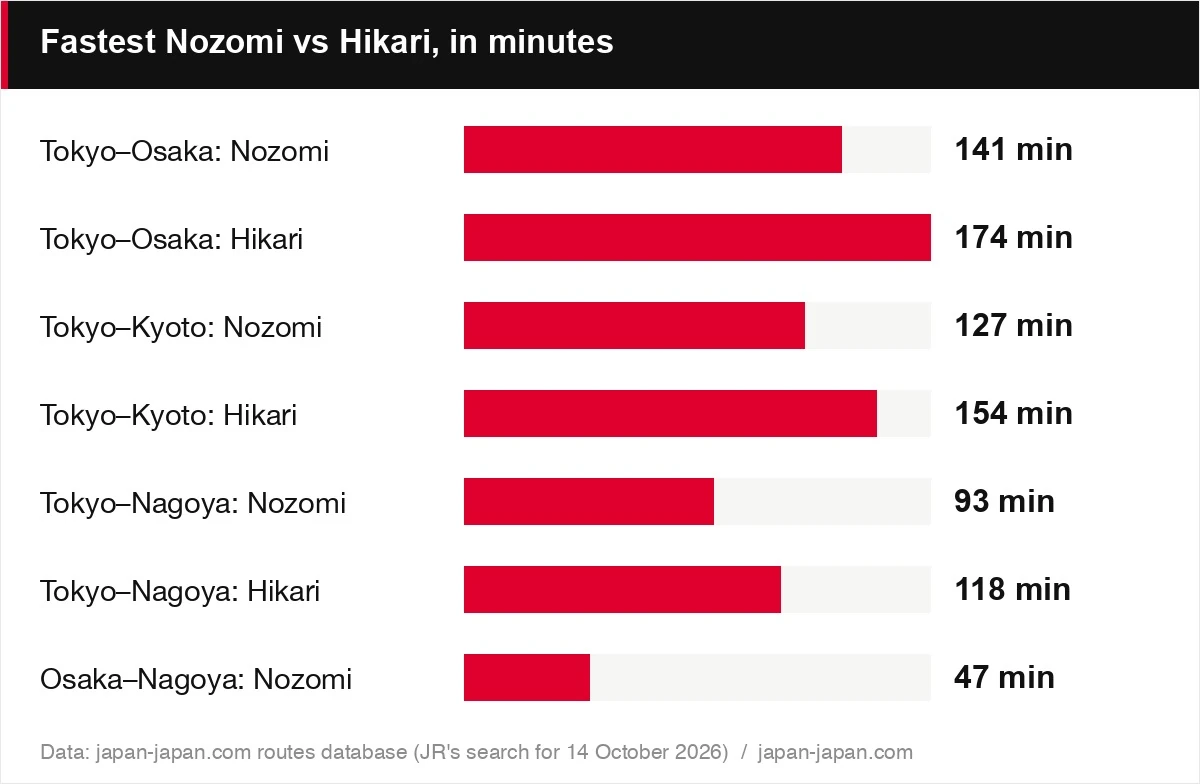
We compared the fastest Nozomi with one named Hikari on 7 routes. For the Hikari, we used the trains our routes database lists for a morning trip. These are the Hikari 707 leaving Tokyo at 10:03, the Hikari 646 leaving Shin-Osaka at 10:18 and the Hikari 702 leaving Kyoto at 10:07.
| Item | Value | Note |
|---|---|---|
| Tokyo–Osaka: Nozomi | 141 min | |
| Tokyo–Osaka: Hikari | 174 min | Hikari 707 |
| Tokyo–Kyoto: Nozomi | 127 min | |
| Tokyo–Kyoto: Hikari | 154 min | Hikari 707 |
| Tokyo–Nagoya: Nozomi | 93 min | |
| Tokyo–Nagoya: Hikari | 118 min | Hikari 707 |
| Osaka–Nagoya: Nozomi | 47 min | |
| Osaka–Nagoya: Hikari | 67 min | Hikari 646 |
The chart shows the journey times on four routes. The Nozomi saves 33 min to Shin-Osaka, 27 min to Kyoto and 25 min to Nagoya. Between Shin-Osaka and Nagoya it saves 20 min. The table below adds the prices and three more routes.
| Route | Nozomi | Hikari | Nozomi saves / costs more |
|---|---|---|---|
| Tokyo to Shin-Osaka | 2 h 21 min, 14,720 yen | 2 h 54 min, 14,400 yen | 33 min, 320 yen |
| Tokyo to Kyoto | 2 h 7 min, 14,170 yen | 2 h 34 min, 13,850 yen | 27 min, 320 yen |
| Tokyo to Nagoya | 1 h 33 min, 11,300 yen | 1 h 58 min, 11,090 yen | 25 min, 210 yen |
| Shin-Osaka to Nagoya | 47 min, 6,680 yen | 1 h 7 min, 6,470 yen | 20 min, 210 yen |
| Kyoto to Nagoya | 33 min, 5,910 yen | 35 min, 5,700 yen | 2 min, 210 yen |
| Shin-Osaka to Shin-Yokohama | 2 h 3 min, 14,390 yen | 2 h 35 min, 14,070 yen | 32 min, 320 yen |
| Kyoto to Shin-Yokohama | 1 h 49 min, 13,500 yen | 2 h 17 min, 13,180 yen | 28 min, 320 yen |
The Kyoto to Nagoya row stands out. The Nozomi takes 33 min and the Hikari 702 takes 35 min, so the gap is just 2 min. On a short hop like this, board whichever train leaves first.
The price gap comes only from the reserved seat. A non-reserved seat costs the same on both trains: 13,870 yen from Tokyo to Shin-Osaka, 13,320 yen to Kyoto and 10,560 yen to Nagoya. Booking a seat adds 530 yen on the Hikari. On the Nozomi it adds 850 yen on the long routes and 740 yen on the routes to and from Nagoya. That is where the 320 yen and 210 yen gaps come from.
So in a non-reserved car, the Nozomi costs no more than the Hikari. You only pay the extra 210 or 320 yen when you book a seat.
Some Hikari are quicker than others. JR West’s timetable for 13 October 2026 shows the 28 Hikari from Tokyo to Shin-Osaka taking 2 h 48 min to 3 h 06 min, with a middle value of 2 h 54 min. The fastest that day is the Hikari 661, leaving Tokyo at 19:30 and reaching Shin-Osaka at 22:18. JR Tokai Tours puts the Hikari at about 3 hours for the trip.
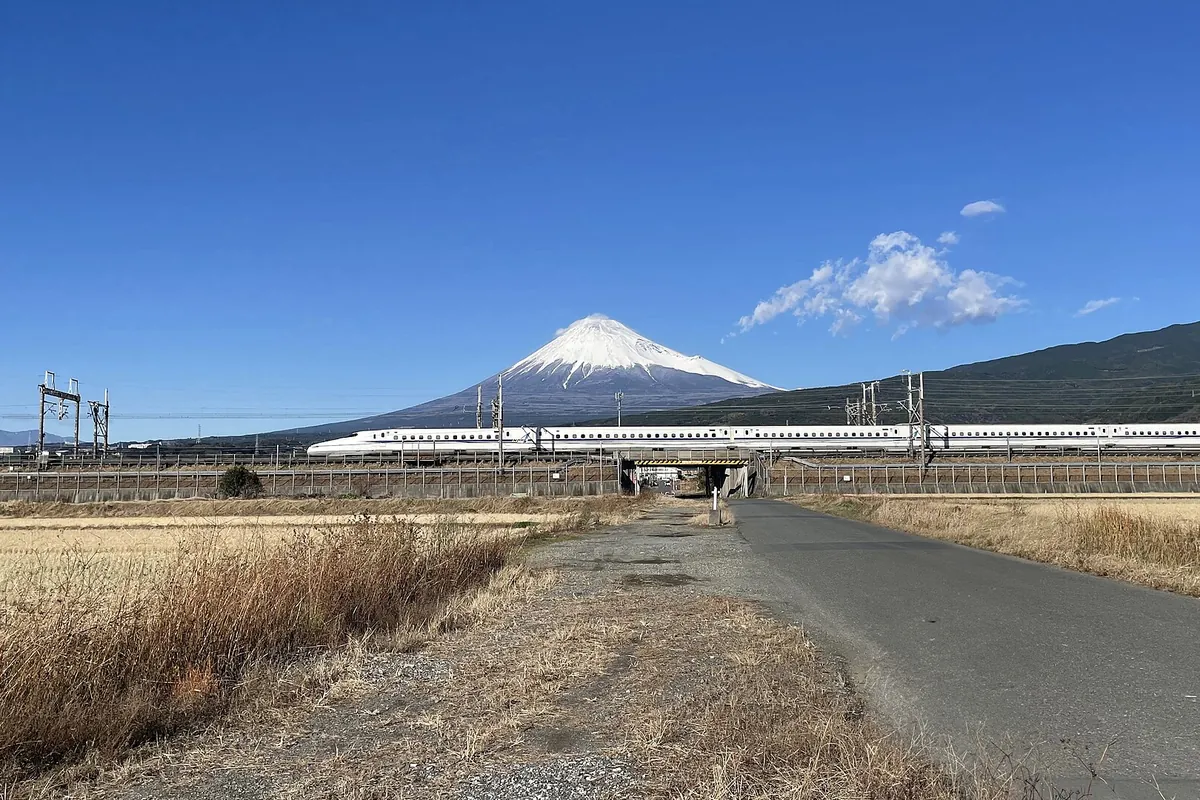
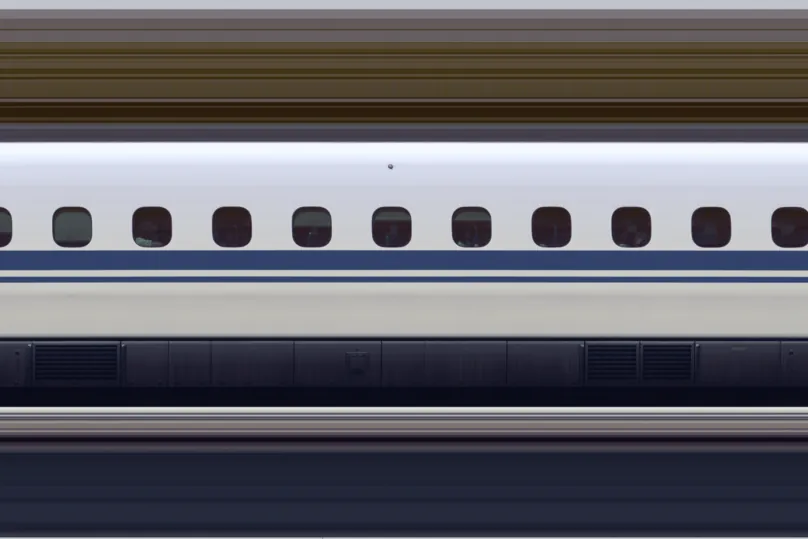
Both trains pass Mount Fuji, as in the photo above, so the view is the same whichever you pick. JR Central’s guide suggests Seat E in Standard Class or Seat D in Green Class for the best view of the mountain.
Where each train stops
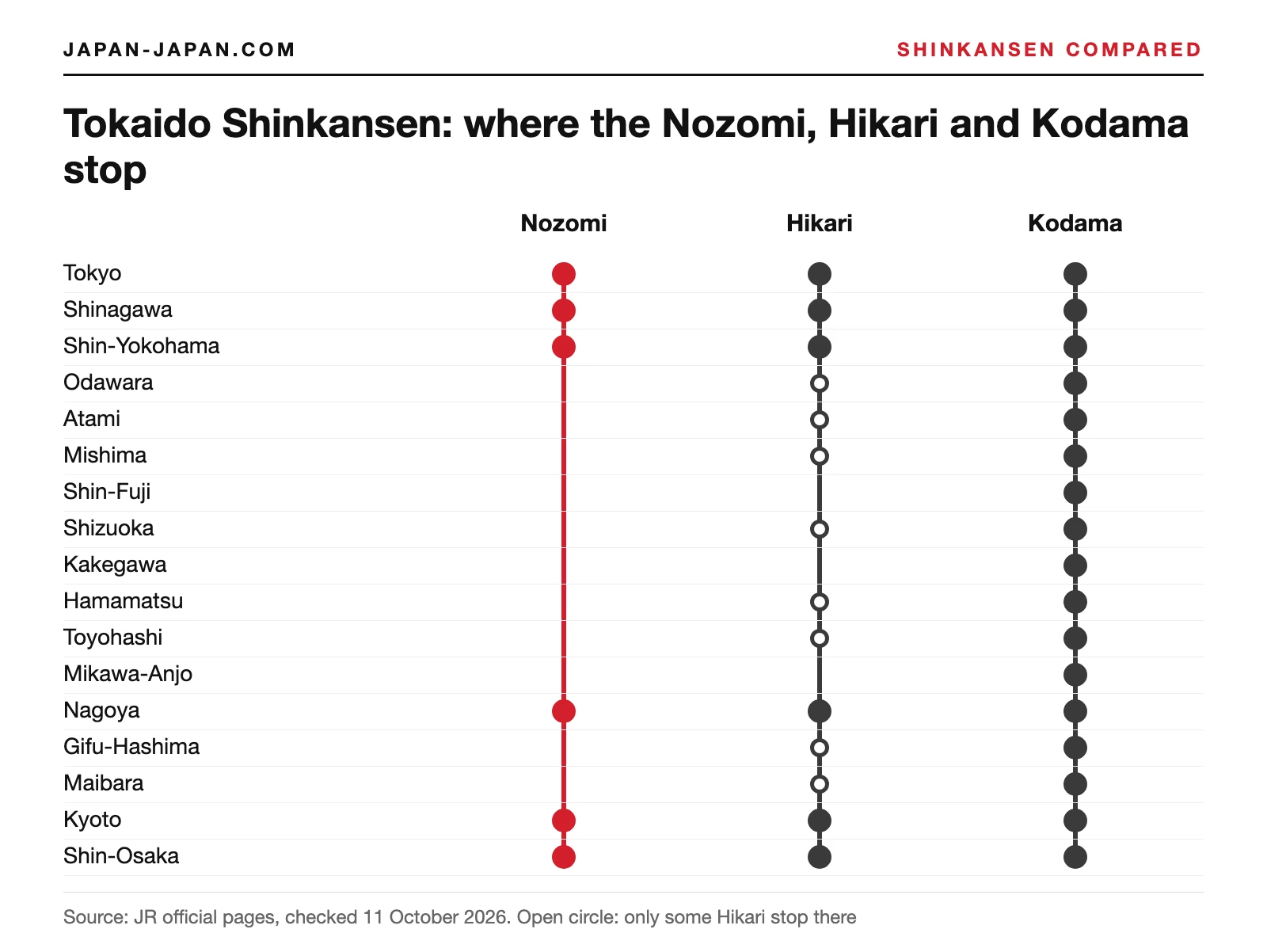
The Nozomi keeps it simple. Between Tokyo and Shin-Osaka, every Nozomi stops only at Tokyo, Shinagawa, Shin-Yokohama, Nagoya, Kyoto and Shin-Osaka. That is 6 of the 17 stations on the 552.6 km line, which opened in 1964. Some Nozomi carry on west onto the Sanyo Shinkansen.
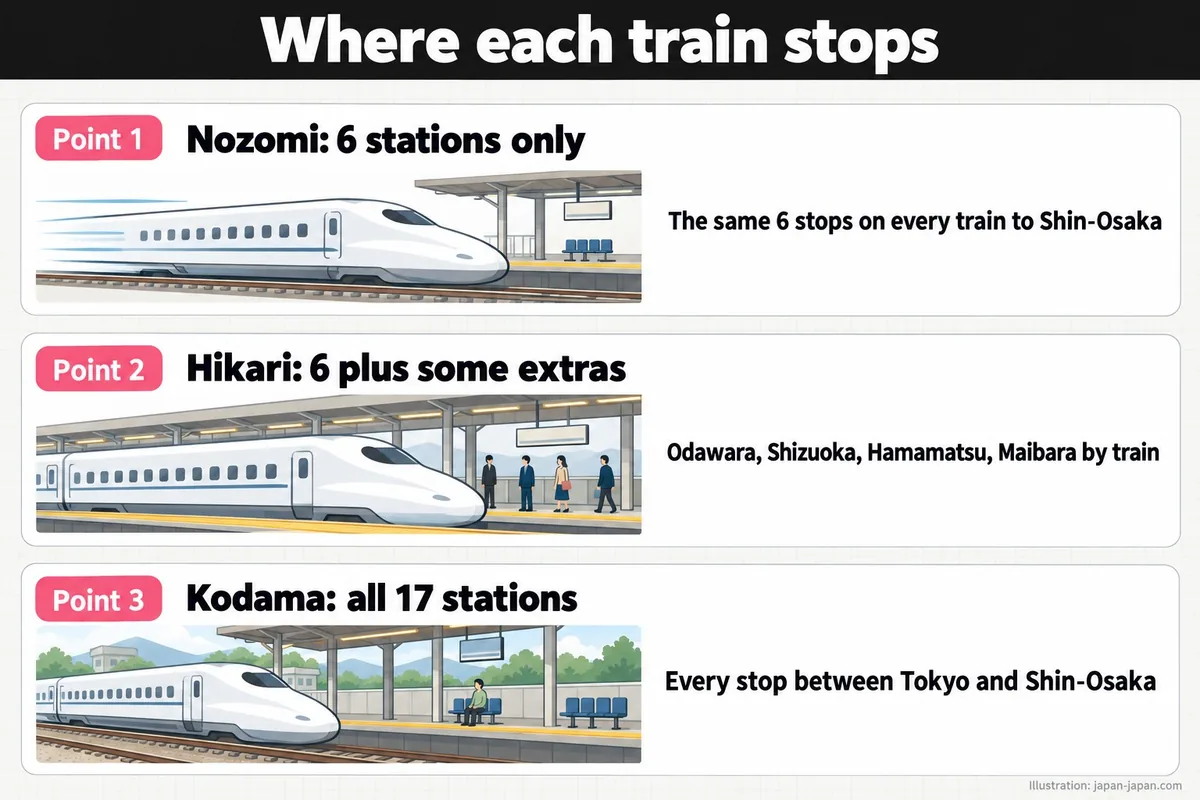
The illustration shows the three patterns. The Hikari always stops at the 6 Nozomi stations. Depending on the train, it also stops at some of Odawara, Atami, Mishima, Shizuoka, Hamamatsu, Toyohashi, Gifu-Hashima and Maibara.
The JR Tokai Tours Tokaido Shinkansen stops by train type page gives a rough guide to how often. In the daytime, Shizuoka, Hamamatsu, Gifu-Hashima and Maibara get a Hikari about once an hour. Odawara, Mishima and Toyohashi get one about every 2 hours, and Atami gets only a few a day.
The patterns really do vary. On JR West’s timetable for 13 October 2026, the 28 Hikari from Tokyo to Shin-Osaka use 11 different stopping patterns. Each stops at between 8 and 11 of the 17 stations. Before you board a Hikari for a smaller station, check that your exact train stops there.
Shin-Osaka is the end of the Tokaido Shinkansen. Trains that run further west use the Sanyo Shinkansen, and the Japan Rail Pass rule stays the same there. The Hikari and Sakura are covered, while the Nozomi and Mizuho are left out.
West of Shin-Osaka, the Hikari becomes rare. Our database lists 60 trains from Kyoto to Hiroshima on 14 October 2026, and only 3 are Hikari. The Nozomi takes 1 h 36 min for 11,940 yen, while the Hikari 703 takes 2 h 9 min for 11,300 yen.
Non-reserved cars and all-reserved dates
Every Tokaido Shinkansen train has 16 cars, and the Green Cars are cars 8 to 10. On a normal day, the Nozomi has non-reserved seats in cars 1 and 2. The Hikari usually has them in cars 1 to 5, though this varies by train. The Kodama uses cars 1 to 6 and 13 to 16.
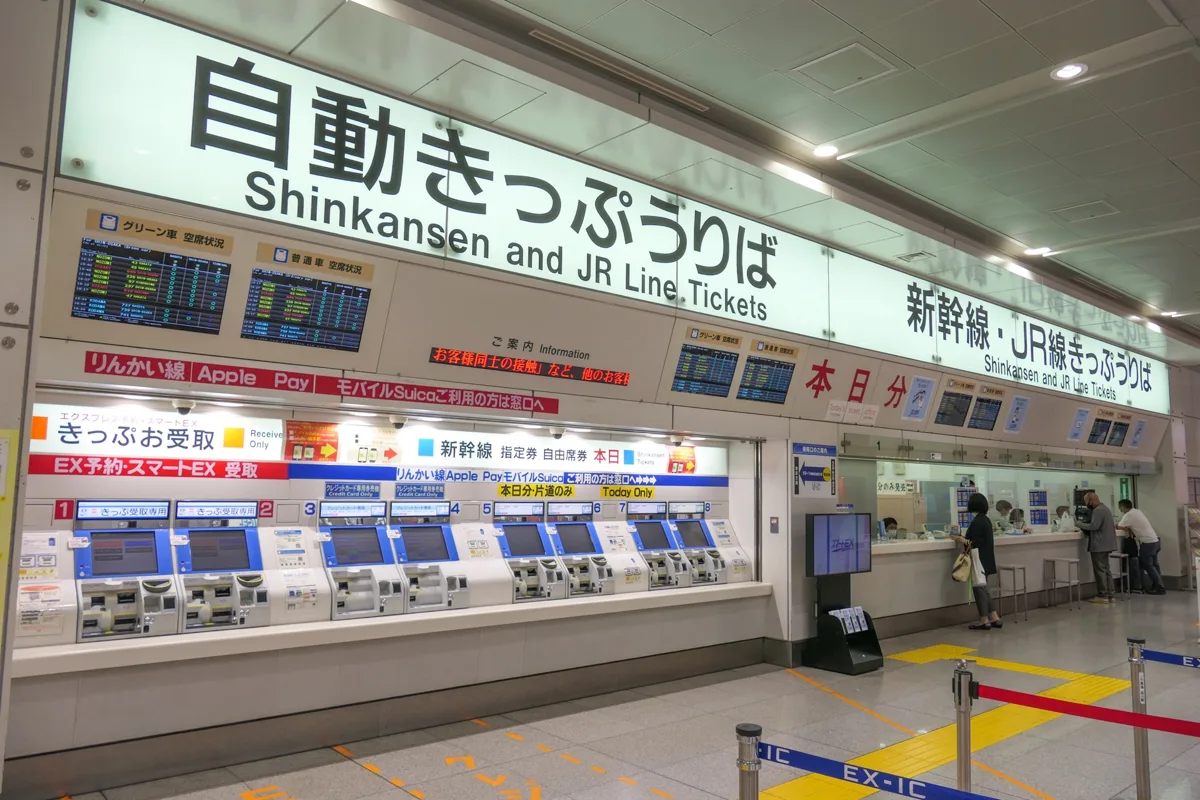
Non-reserved seats are first come, first served, and you can take any train on the date of your ticket. If you ask station staff for help, the two words to know are 自由席 (jiyuseki, non-reserved seat) and 指定席 (shiteiseki, reserved seat).
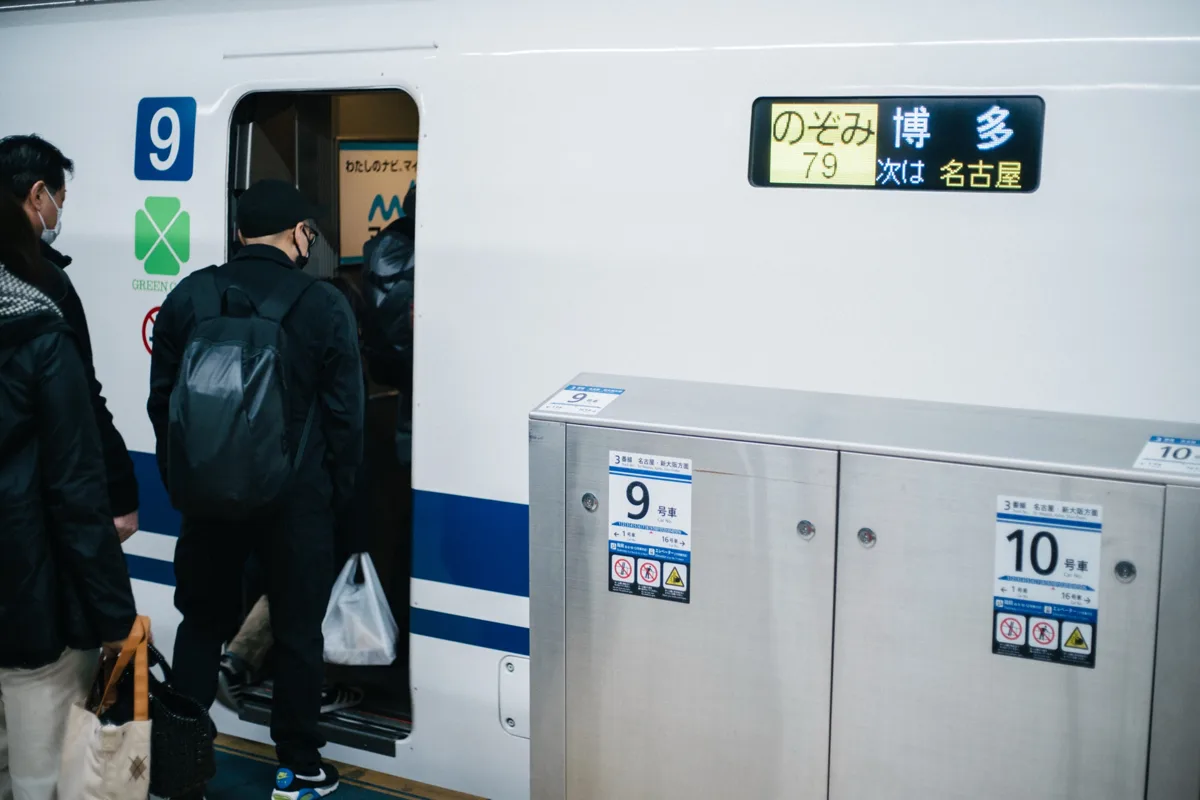
On the platform, people queue at the door markers for their car, as in the photo from Shin-Yokohama. Go to the markers for cars 1 and 2 for a Nozomi non-reserved seat, or cars 1 to 5 for a Hikari.
On the busiest days, every Nozomi becomes reserved-seat only. JR Central switches cars 1 and 2 to reserved seats, which turns 165 non-reserved seats per train into reserved ones. The rule covers every Nozomi between Tokyo and Hakata. During these periods, the Hikari, Kodama, Mizuho, Sakura and Tsubame keep their non-reserved seats as usual.
For fiscal 2026, the periods for Golden Week, Obon and Silver Week have already passed. The JR Central Nozomi all-reserved periods notice lists these dates as still to come:
- Labor Thanksgiving weekend: 21 to 23 November 2026.
- Year end and New Year: 25 December 2026 to 5 January 2027.
- Coming of Age Day weekend: 9 to 11 January 2027.
- Vernal Equinox weekend: 20 to 22 March 2027.
With a non-reserved ticket on these days, you can still board a Nozomi. You stand in the deck between cars, and crowds may stop you getting on. JR Central also warns that Hikari and Kodama non-reserved cars get very crowded, because these trains run less often. For trips between Nozomi stations, it suggests booking a Nozomi reserved seat.
Reserved seats go on sale at 10:00, one month before the travel date. On Smart EX and Express Reservation, you can book from one year ahead, from 5:30. Last winter, JR Central’s busiest single day was Sunday 4 January 2026, with 350,000 passengers heading to Tokyo.
Our New Year travel dates page lists the busy days around the year end. For spring, our Golden Week page shows the 2027 holiday, which runs from Saturday 1 May to Wednesday 5 May.
With a Japan Rail Pass
The Japan Rail Pass covers no seat on the Nozomi or the Mizuho, reserved or non-reserved. The JAPAN RAIL PASS valid trains and routes page tells pass holders to use the Hikari, Sakura, Kodama and Tsubame. On those trains, reserved seats cost nothing extra.
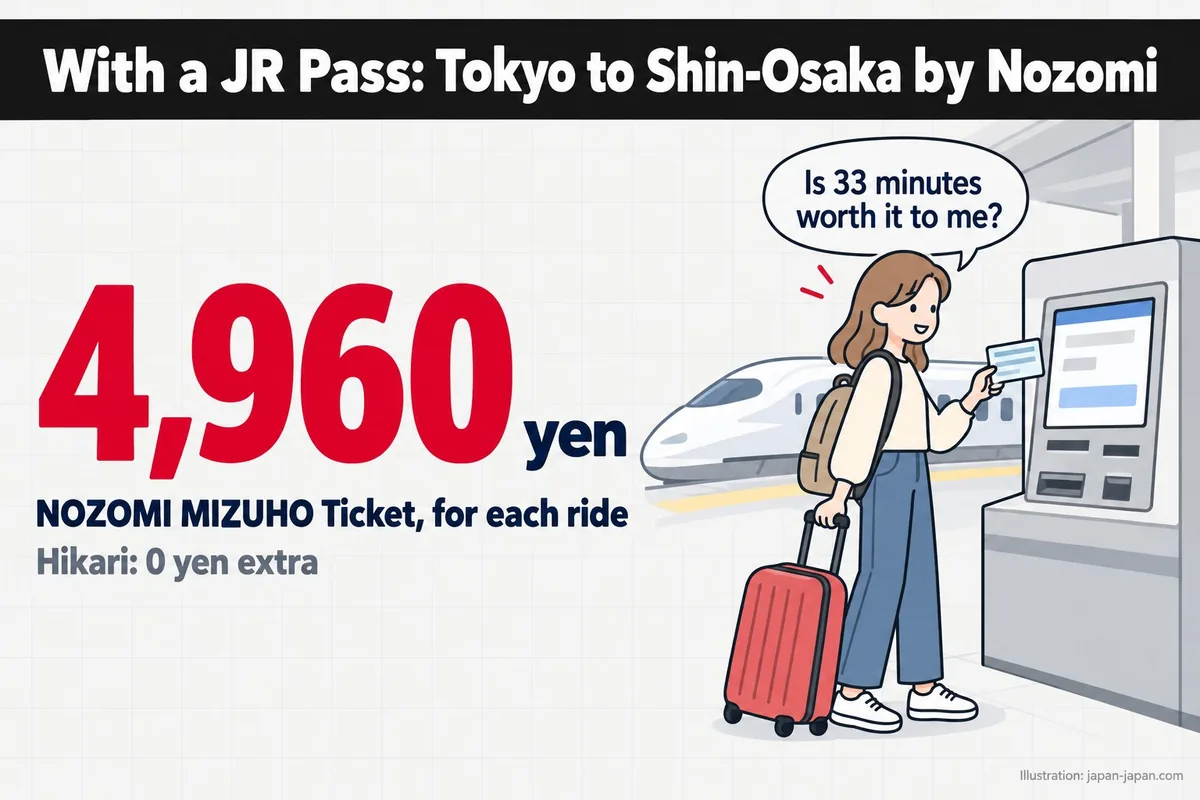
The number in the illustration is what a pass holder pays to ride the Nozomi. Since 1 October 2023, pass holders can buy a NOZOMI MIZUHO Ticket before boarding. From Tokyo to Shin-Osaka it costs 4,960 yen for an adult and 2,480 yen for a child.
- One ticket per ride: You buy a new ticket each time you board a Nozomi or Mizuho.
- Same price for any seat: Green Car, ordinary reserved and non-reserved seats cost the same.
- Green Car needs a Green pass: Standard pass holders can buy ordinary seats only.
- Where and when: Reserved seat ticket machines and JR ticket offices (Midori-no-madoguchi), from one month before travel up to the day.
- Refunds: Only before use, minus a 340 yen fee for reserved or Green Car tickets and 220 yen for non-reserved.
The JAPAN RAIL PASS NOZOMI MIZUHO Ticket page sets out the rules. JR Central’s guide calls the same ticket the Nozomi Option Ticket. Ask for either name at the ticket office.
| Route | Nozomi fare | Hikari fare | Pass + Nozomi |
|---|---|---|---|
| Tokyo–Nagoya | 11,300 yen | 11,090 yen | +4,180 yen |
| Tokyo–Kyoto | 14,170 yen | 13,850 yen | +4,960 yen |
| Tokyo–Shin-Osaka | 14,720 yen | 14,400 yen | +4,960 yen |
| Tokyo–Hiroshima | 19,760 yen | 18,910 yen | +6,500 yen |
| Tokyo–Hakata | 23,810 yen | 22,750 yen | +8,140 yen |
| Kyoto–Hiroshima | 11,940 yen | 11,300 yen | +4,170 yen |
The table puts the extra cost next to the normal fares. The special ticket costs 4,180 yen from Tokyo to Nagoya and 4,960 yen to Kyoto or Shin-Osaka. It costs 6,500 yen to Hiroshima, 8,140 yen to Hakata and 2,530 yen between Nagoya and Shin-Osaka.
Now weigh it on the main route. With a pass, the Hikari 707 gets you from Tokyo to Shin-Osaka in 2 h 54 min for 0 yen extra. The fastest Nozomi gets you there in 2 h 21 min for 4,960 yen. In other words, you pay 4,960 yen to save 33 min.
On longer trips the time gap grows. From Tokyo to Hiroshima, the Hikari 707 takes 4 h 48 min and the fastest Nozomi 3 h 47 min. To Hakata, the Hikari 707 takes 5 h 56 min and the fastest Nozomi 4 h 52 min.
Whether the pass pays off depends on your whole trip. Our Japan Rail Pass page lists every price, from 50,000 yen for 7 days in an Ordinary Car on the official website. For a trip-by-trip answer, read is the JR Pass worth it.
Which one should you take?
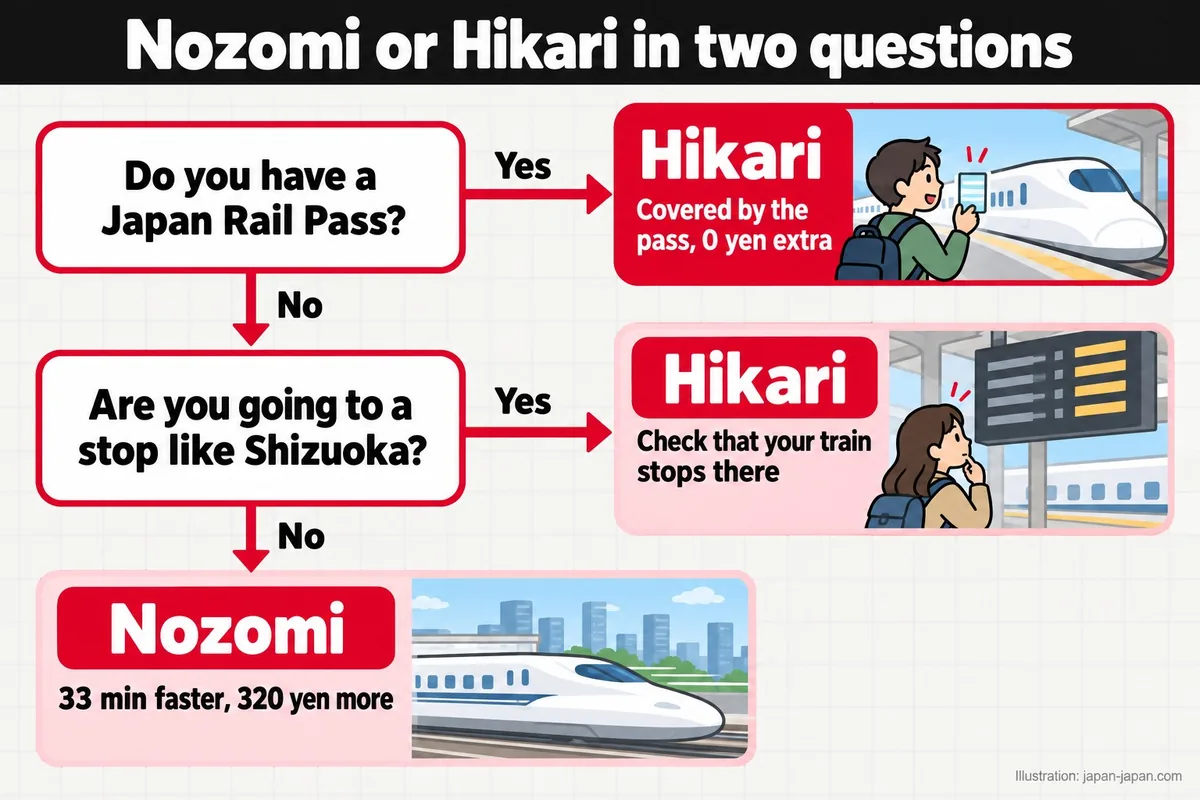
The chart above narrows the choice to two questions: do you have a pass, and are you going to a smaller station? Most trips fit one of these cases.
- No pass and in a hurry: Take the Nozomi. It is 33 min faster to Shin-Osaka, and it runs far more often.
- Japan Rail Pass: Take the Hikari for 0 yen extra, or pay 4,960 yen to ride a Nozomi to Shin-Osaka.
- Shizuoka, Hamamatsu, Maibara or Odawara: Take a Hikari that stops there, or a Kodama.
- Holiday dates without a seat: Use a Hikari non-reserved car, or book a reserved seat on either train.
- Kyoto to Nagoya: The gap is 2 min, so take the next train.
Large suitcases follow the same rules on both trains. Bags up to 160 cm in total go on the overhead racks with no booking. Bags from 161 to 250 cm need a seat with an oversized baggage area, booked when you buy the ticket. If you board without one, you pay a 1,000 yen fee, and bags over 250 cm cannot go on board.
Missed your train? If you hold a reserved Nozomi ticket, you can ride the non-reserved cars of a later Hikari or Kodama on the same day. With a QR ticket from Smart EX, you can also change your booking for free up to 4 minutes before departure.
A few comforts are the same on both trains. Free Wi-Fi runs on all Tokaido Shinkansen trains, and restrooms are in the odd-numbered cars. Car 7 on 16-car Nozomi, Hikari and Kodama trains is the S Work car, set aside for people who want to work.
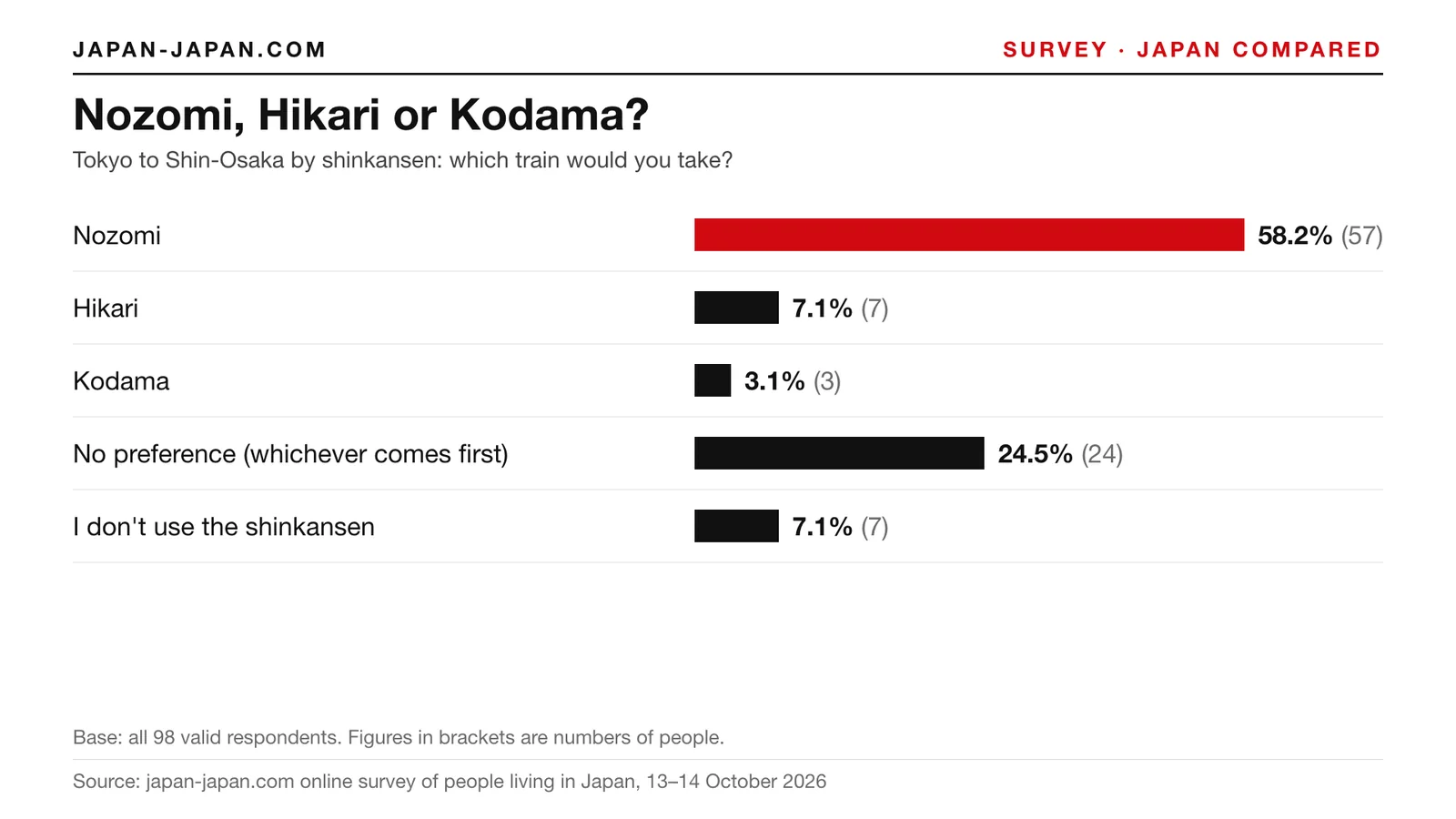
Nozomi or Hikari: what 98 people in Japan chose
On 13–14 October 2026, japan-japan.com ran an online survey of people living in Japan about 32 travel choices. 130 people answered. We removed answers that looked machine-written, one from outside Japan and most of those that contradicted themselves, which left 98. Shares below are of the 98 respondents unless a smaller group is named; they describe these people, not all travellers in Japan. See all 32 comparisons and how we asked.
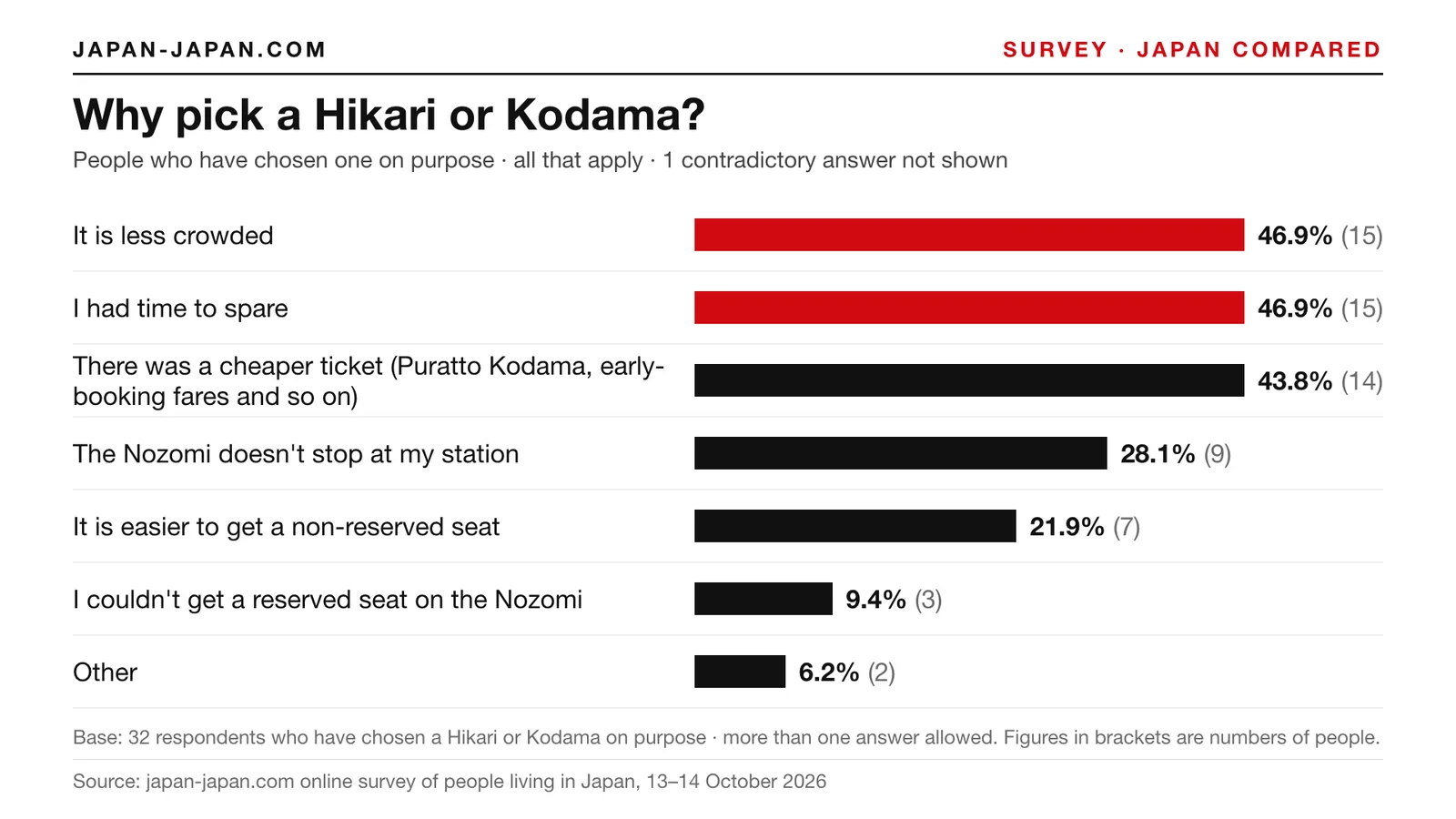
Asked which train they would take from Tokyo to Shin-Osaka, 58.2% (57 people) chose the Nozomi, 7.1% (7 people) the Hikari and 3.1% (3 people) the Kodama. 24.5% (24 people) said whichever comes first. 32.7% (32 people) have taken a Hikari or Kodama on purpose instead of a Nozomi. Of those 32, the reasons they gave most were fewer crowds (46.9%), having time to spare (also 46.9%) and a cheaper ticket such as Platt Kodama or an early-booking fare (43.8%).
On what they knew, 42.9% (42 people) knew a Nozomi reserved seat costs a little more than on the Hikari, and 44.9% (44 people) knew the Nozomi becomes all-reserved at New Year and on holiday weekends. Only 2.0% (2 people) knew that the Japan Rail Pass for overseas visitors does not cover the Nozomi on its own.
Nozomi vs Hikari FAQ
Is the Nozomi faster than the Hikari?
Yes. From Tokyo to Shin-Osaka the fastest Nozomi takes 2 h 21 min and the Hikari 707 takes 2 h 54 min, a gap of 33 min. Between Kyoto and Nagoya the gap shrinks to 2 min.
Can I ride the Nozomi with a Japan Rail Pass?
Only with a NOZOMI MIZUHO Ticket, bought before you board. It costs 4,960 yen from Tokyo to Shin-Osaka and 4,180 yen from Tokyo to Nagoya, for each ride. Without it, take the Hikari, which the pass covers.
Is the Hikari cheaper than the Nozomi?
Only for reserved seats. A reserved seat from Tokyo to Shin-Osaka costs 14,400 yen on the Hikari and 14,720 yen on the Nozomi, so the Hikari saves 320 yen. A non-reserved seat costs 13,870 yen on both.
Does the Hikari have non-reserved seats during Golden Week and New Year?
Yes. When every Nozomi is reserved-seat only, the Hikari and Kodama keep their non-reserved cars. The New Year period runs from 25 December 2026 to 5 January 2027. Expect crowds, because Hikari and Kodama trains run less often.
About the author



.jpg)


.jpg)


