
Izakaya in Japan 2026: Otoshi, Drinking Age and Golden Gai
An izakaya is a Japanese pub: otoshi arrives as a seating charge, you order drinks first and do not tip. The drinking age is 20, even though adults are 18.
Izakaya in Japan: the short answer
An izakaya is a Japanese pub where you order drinks first, then small plates to share. A small dish called otoshi comes with a seating charge, nobody tips, and you must be 20 to drink.
Japan lowered the age of adulthood to 18 on 1 April 2022. Drinking and smoking still start at 20, according to the government’s public relations site, Gov-Online. The rest of a first night comes down to five habits.
- Expect the otoshi. GO TOKYO, the official Tokyo travel guide, says this small dish is included in a seating charge called otoshidai.
- Order a drink first. Then add small dishes with each round.
- Pay where the shop expects you to. The bill usually comes to your table. In yokocho alleys you pay at a cash register by the door.
- Skip the tip. Tipping is not customary at any restaurant in Japan.
- Read the door sign. In Tokyo even non-smoking restaurants must post a sign about smoking.
What is an izakaya? A typical night
The word izakaya (居酒屋) is written with three characters meaning stay, drink and place. GO TOKYO says an izakaya is closer to a tapas bar or gastropub than a plain bar. They range from small places run by one owner to huge chains.
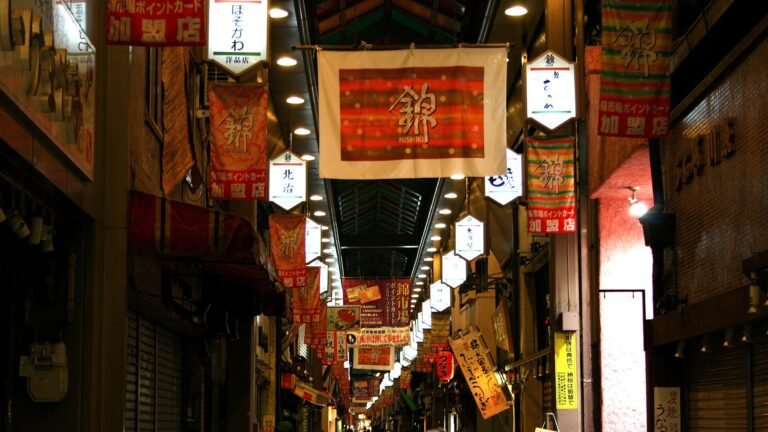
Look for the noren, a cloth curtain that marks the entrance. In the drinking alleys, red or white lanterns with the shop’s name in brush lettering hang outside as well. Inside, space is tight. Some places seat fewer than 10 people, many have only a counter, and tachinomi (standing bars) are common.
Seating varies. Some izakaya have low tables where you sit on a cushion on the floor, and others have Western chairs. If staff ask you to take off your shoes, leave them in the cubby by the entrance or in the spot near your table. The photo below shows the kind of room to expect, with drinks and small dishes for sharing.

How you order depends on the size of the place. At larger chains you order on an electronic tablet. Smaller places usually have menus in Japanese only, some of them handwritten. In the alleys the menu may be paper slips on the wall. GO TOKYO notes that your neighbours can be a good source of suggestions.
The food is simple and made for sharing. Expect yakitori (grilled chicken skewers), karaage (fried chicken), edamame, pickles and grilled fish. Western snacks such as French fries and potato salad are common too. Portions are small, so order a few dishes at a time and add more with each round.
For drinks, expect beer, sake, shochu, whisky and wine rather than craft cocktails. The two mixed drinks you will see everywhere are the highball (whisky and soda) and the sour (shochu and soda with fruit flavour). Tea, juice and other soft drinks are on almost every menu.
Izakaya open in the evening, typically at 17:00 or 18:00. Many close at 23:00 or midnight, around the time the last trains leave, and some stay open until the early hours. Last orders usually come 30 minutes to an hour before closing.
Otoshi, nomihodai and paying the bill
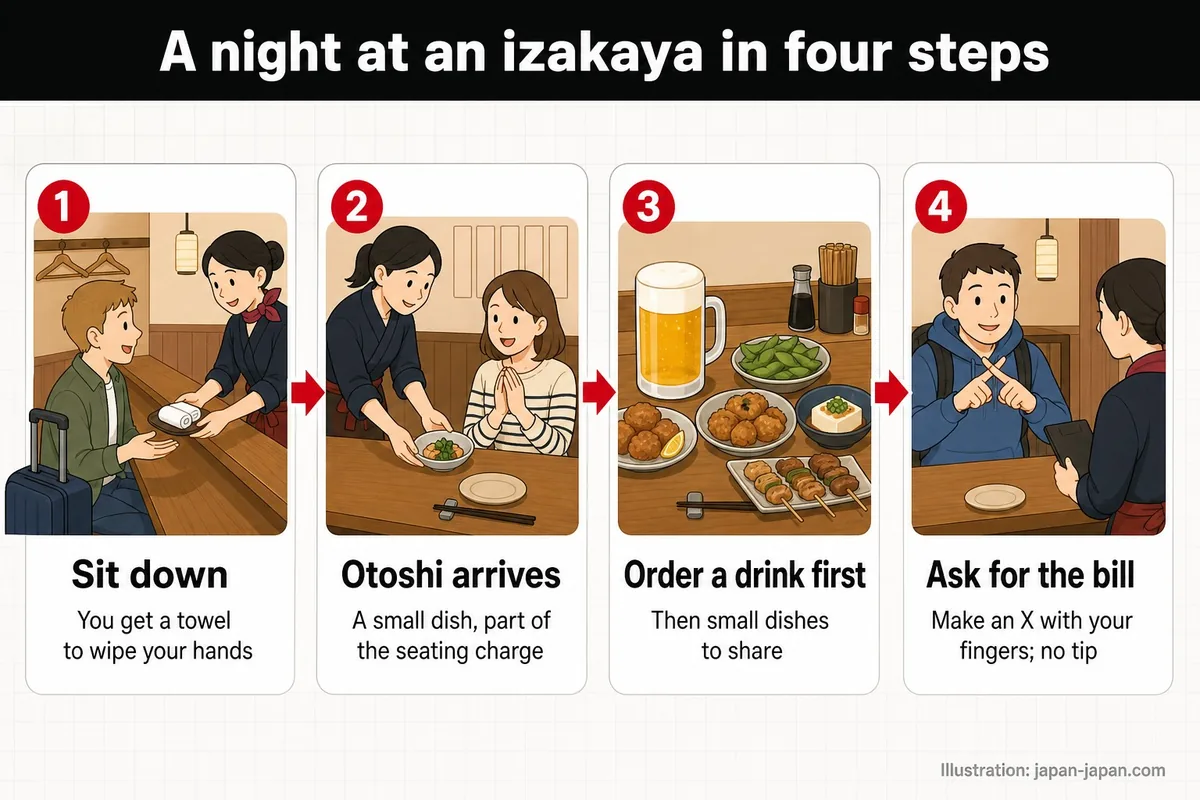
Staff bring an oshibori, a hand towel, and a small dish called otoshi as you sit down. GO TOKYO says the otoshi is included in a seating charge, the otoshidai, so you pay for it as part of the bill. The dish changes from place to place, from stewed vegetables to fresh fish.
If you do not eat meat or fish, tell the staff before the food arrives. GO TOKYO warns that most izakaya are not very vegan- or vegetarian-friendly. It suggests asking staff directly, so a salad does not come with cheese or bacon on top. Our guide to vegetarian food in Japan shows how to ask.
Order a drink first, then food. In the alleys, GO TOKYO says people often start with sashimi and move on to grilled meat, fish or seasonal vegetables. If you are still hungry at the end, grilled rice balls are the classic way to finish.
Many izakaya sell nomihodai, an all-you-can-drink deal. You pay a set amount and drink as much as you like for a fixed time, usually 1 to 2 hours. Many also offer happy hour prices in the early evening.
To ask for the bill, say “okaikei onegaishimasu” (お会計お願いします, “the bill, please”) or cross your index fingers to make an X. The bill then comes to your table. In yokocho alleys you usually pay at a cash register by the door instead.
The bill is almost never itemised, so groups usually split the total evenly. Do not tip. GO TOKYO says tipping is not customary at izakaya, as at every other restaurant in Japan. The illustration below sums up the night in four steps, from the hand towel to the X sign.
Japan drinking age: 20, and drink-driving rules
The drinking age in Japan is 20. A change to the Civil Code lowered the age of adulthood from 20 to 18 on 1 April 2022. The government kept 20 as the age for drinking, smoking and betting on public races (Gov-Online). Its reasons were health, preventing delinquency and protecting young people.
For visitors aged 18 or 19, the table shows what changed and what did not.
| Allowed from 18 | Still only from 20 |
|---|---|
| Signing a contract, such as a phone plan or credit card, without a parent. | Drinking alcohol. |
| Marrying, now at 18 for women and men alike. | Smoking. |
| Getting an ordinary driving licence, as before. | Buying tickets for horse, bicycle, motorboat and auto races. |
The same line applies at the border. Travellers under 20 get no duty-free alcohol allowance when they land in Japan. The illustration below puts the rule in one picture: adult at 18, but no alcohol until 20.

If you rent a car, the rule that matters most is simple: do not drive after drinking. The National Police Agency sets out two offences.
- Drunk driving (sakeyoi unten). Breath alcohol of 0.5mg per litre or more, or being unable to drive normally because of alcohol. The penalty is up to 5 years in prison or a fine of up to 1 million yen.
- Driving over the limit (shukiobi unten). Breath alcohol of 0.15mg per litre or more. The penalty is up to 3 years in prison or a fine of up to 500,000 yen.
- Below 0.15mg. Driving with alcohol in your body is still against the law.
The 0.5mg figure is new. An amendment to the Road Traffic Act took effect on 21 July 2026 and added it to the definition of drunk driving. Before that, the definition had no number. The police give a rough guide. A person weighing 60kg who drinks about two large bottles of beer, or 360ml of sake at 15%, may reach that level 30 minutes later.
The law also reaches the people around the driver. Whoever lent the car faces the same maximum penalties as the driver. Anyone who served the alcohol or rode along faces up to 3 years or 500,000 yen when the driver was drunk. When the driver was over the limit, it is up to 2 years or 300,000 yen. The chart below compares the top fines for each role.

| Item | Value | Note |
|---|---|---|
| Driver: drunk driving | 1,000,000 yen | Or up to 5 years in prison |
| Driver: over the limit | 500,000 yen | Or up to 3 years in prison |
| Car lender: drunk driving | 1,000,000 yen | Or up to 5 years in prison |
| Car lender: over the limit | 500,000 yen | Or up to 3 years in prison |
| Server/passenger: drunk | 500,000 yen | Served the drinks or rode along; or up to 3 years in prison |
| Server/passenger: over limit | 300,000 yen | Served the drinks or rode along; or up to 2 years in prison |
Two habits help. The police promote the Handle Keeper campaign, in which a group picks one person who stays sober and drives everyone home. Restaurants that support it may give that person a badge, so staff do not serve them alcohol, and some offer them free soft drinks. If you drank late into the night, the police also advise against driving the next morning, because alcohol may still be in your body.
Smoking in izakaya: check the door sign
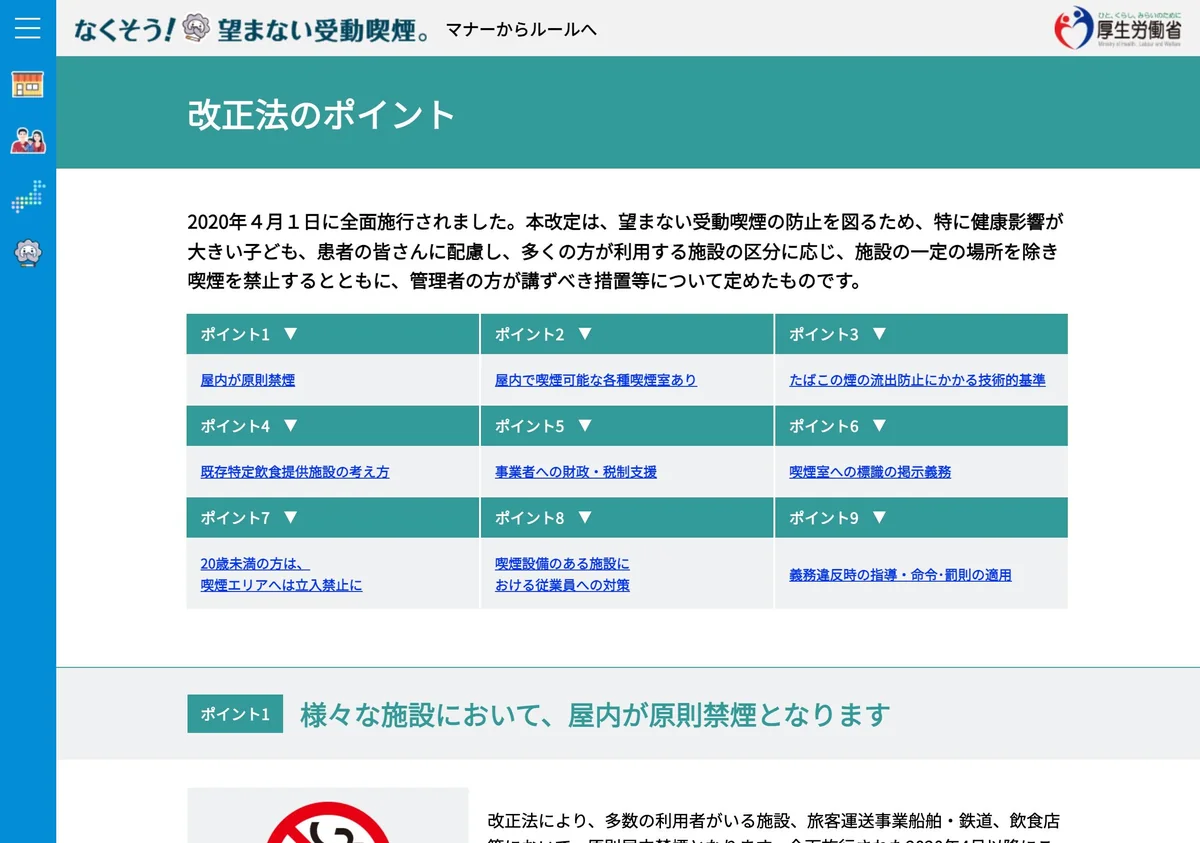
Indoor smoking in Japanese restaurants has been banned in principle since 1 April 2020. That is when the revised Health Promotion Act took full effect, according to the Ministry of Health, Labour and Welfare. People may smoke indoors only in designated smoking rooms that meet the technical rules. The screenshot below shows the top of the ministry’s page on the revised law, in Japanese, which opens with that date.
The law allows four kinds of smoking room, and only some of them let you eat and drink. The table sets out which is which. A smoking-purpose room may serve food and drinks but no staple food, which the ministry describes as rice, bread and noodles.
| Room | Smoking | Food and drinks | Who can have one |
|---|---|---|---|
| Smoking-only room | Yes | Not allowed | Any restaurant |
| Heated-tobacco room | Heated tobacco only | Allowed | Any restaurant |
| Smoking-allowed room | Yes | Allowed | Small places open on 1 April 2020, with capital of 50 million yen or less and seating of 100 square metres or less |
| Smoking-purpose room | Yes | Allowed, except staple food | Places whose main purpose is smoking |
The room that matters most in izakaya is the smoking-allowed room. A small restaurant can turn all or part of its space into one if it meets three conditions. It was already open on 1 April 2020. Its capital is 50 million yen or less. Its seating area is 100 square metres or less. This is how some small, long-running bars still allow smoking.
Every place with a smoking room must post an official sign, and a misleading sign is an offence in itself. In a small bar, look for a sticker reading 喫煙可能室あり (kitsuen kanoshitsu ari), meaning “smoking-allowed room on the premises”. The Tokyo Metropolitan Government goes further and makes non-smoking restaurants post a sign too. It asks visitors to check the notice at the entrance before going in.
Age matters here too. Nobody under 20 may enter a smoking area, even if they do not smoke, and that includes staff. Tokyo’s own ordinance adds rules to protect under-20s and employees. Heated tobacco counts under these rules, the same as rolled cigarettes.
Smoking where it is banned starts with a warning. A person who keeps smoking after repeated guidance can be ordered to stop and fined up to 300,000 yen. In the yokocho alleys, smoking and drinking on the street outside is prohibited as well, GO TOKYO says.
If you smoke, plan the flight too. Lighters travel in the cabin only, one per person and carried on your body. E-cigarettes and heated tobacco devices also go in the cabin and never in checked baggage. On arrival in Japan, the duty-free tobacco allowance is 200 cigarettes or 10 packages of heated tobacco per adult, and nothing for under-20s.
Golden Gai and Omoide Yokocho in Shinjuku
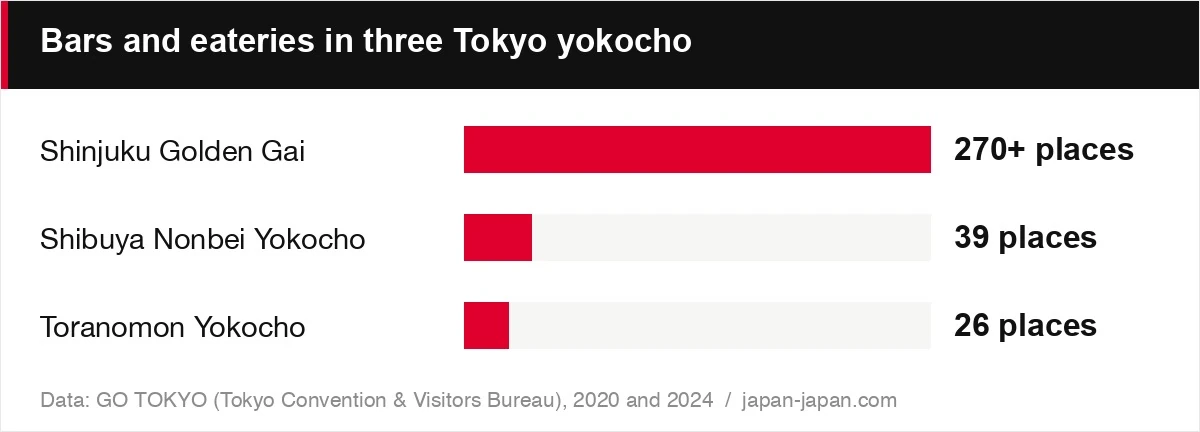
Yokocho means alley, and in Tokyo it now refers to narrow lanes packed with izakaya and bars. Shinjuku has two of the best known. Shinjuku Golden Gai packs more than 270 bars and eateries into 7 alleys (GO TOKYO yokocho guide). They range from classy wine bars to dive bars that are not so welcoming.
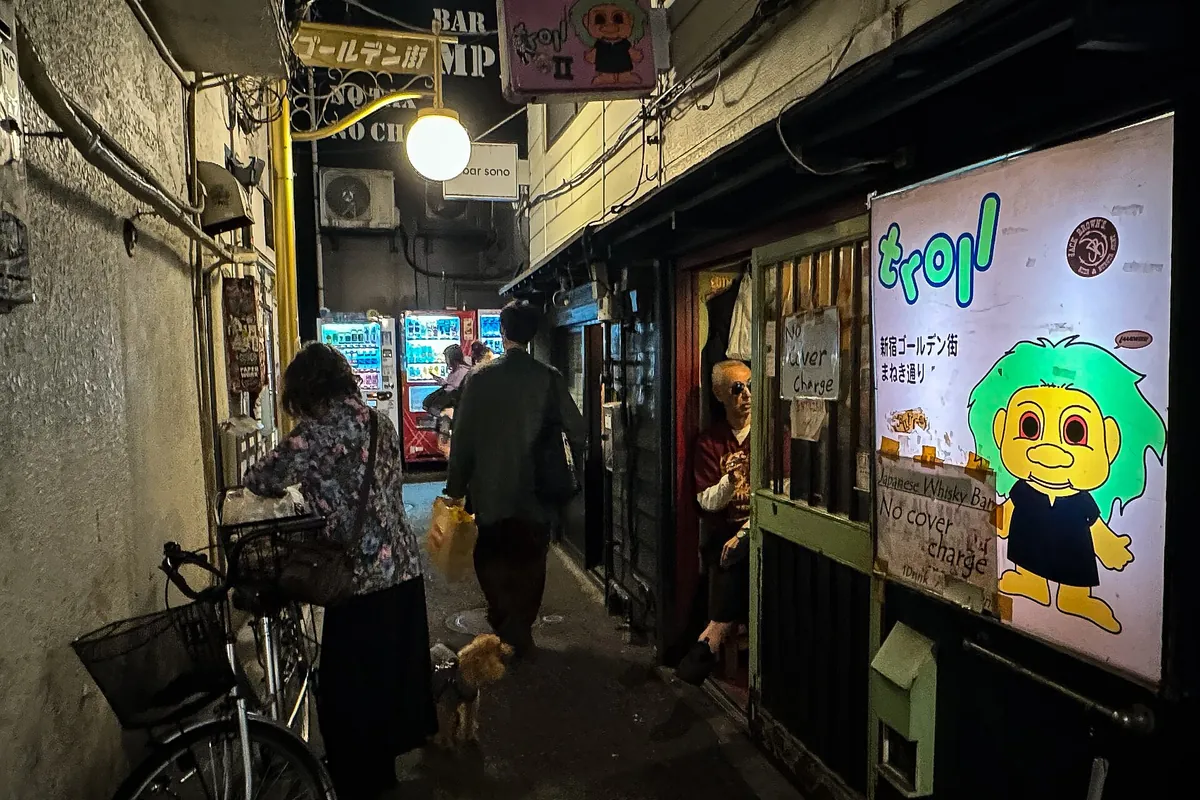
GO TOKYO’s yokocho tips apply here. Avoid going in a large group, because many bars are tiny. Some bars have a cover charge, and some serve a small dish in place of a seating charge. You pay at the register by the door, and you do not tip. The photo below shows one of Golden Gai’s narrow alleys and the signs of its small bars.
Omoide Yokocho (思い出横丁) sits on the west side of Shinjuku Station, 2 minutes on foot from the JR, Odakyu, Keio and Marunouchi lines. GO TOKYO describes an alley that barely fits two people across, marked by a dim green sign and red lanterns. The shops serve yakitori and beer, and each one seats only five or six customers.
The same alley rules apply in both places. Drinking and smoking on the street outside is prohibited, so do not carry a glass out of the bar. Avoid large groups too, because a party of six can fill a whole shop here.
From Haneda Airport, the Airport Limousine bus to Shinjuku takes 40–55 minutes and costs 1,400 yen, with no change. The Keikyu Line and JR cost 590 yen and take 43 minutes, with a change at Shinagawa. If you land late, the last bus leaves at 23:40. From Narita Airport, the Narita Express to Shinjuku costs 3,330 yen and needs no change.
Nonbei Yokocho and Tokyo’s newer yokocho
Shibuya Nonbei Yokocho, the “drunkard’s alley”, dates back to the early 1950s. It sits just metres from Shibuya Station. GO TOKYO counted 39 small bars and eateries there in its 2024 yokocho feature. Some are so tiny that 4 or 5 people fill them, and the alley is known for yakitori.
Seats are few and many customers are regulars. GO TOKYO asks visitors to come in a small group, for example 2 people, and to order, eat and drink in good time. It also asks people not to visit just to take photos. Not every shop can easily serve guests in English, but most welcome new customers. The illustration below sums up what to avoid in a small yokocho bar, and what to do instead.

Newer yokocho bring the same idea indoors. Shinjuku Kabuki Hall – Kabuki Yokocho sits in Tokyu Kabukicho Tower, which opened in April 2023. It is a food hall with 10 restaurants serving dishes from around Japan, and several are open around the clock. Its menus are easy to follow and come with English translations.
Toranomon Yokocho opened in the summer of 2020 on the third floor of Toranomon Hills Business Tower. Its 26 shops are branches of well-known restaurants, including the Michelin-starred yakitori restaurant Bird Land. You get famous names in a more casual setting.
Ebisu Yokocho, to the south, is known for its food, and most places stay open all night. Shimbashi, to the east, has yokocho near office buildings where people unwind after work. For a first visit, a newer hall with English menus is an easy start before an older alley. The chart below compares how many bars and eateries each alley holds.
| Item | Value | Note |
|---|---|---|
| Shinjuku Golden Gai | 270 places | More than 270, across 7 alleys |
| Shibuya Nonbei Yokocho | 39 places | Some fit only 4 or 5 people |
| Toranomon Yokocho | 26 places | Opened in summer 2020 |
For Nonbei Yokocho, the Keikyu Line and JR from Haneda to Shibuya take about 37 minutes and cost 540 yen. You change once at Shinagawa. A direct Airport Limousine bus takes 49–69 minutes and costs 1,300 yen. From Narita, the Narita Express stops at Shibuya and costs 3,330 yen.
Taking sake home on the plane
If you find a sake you like, you can fly it home, but the strength decides how much. Japan’s rules for alcohol on a plane set no limit up to 24% alcohol. Above 24% and up to 70%, you can take 5 litres per person, and nothing above 70% may fly. The same limits apply in the cabin and in checked baggage.
Sake at 15%, the strength in the police example, sits in the no-limit band. Keep the sake in the bottle it was sold in, because pouring it into a flask is not accepted. On international flights the 100ml liquid rule also applies in the cabin. A bottle bought before security therefore goes in your checked bag. On domestic flights inside Japan the 100ml rule does not apply.
From 1 November 2026, sake bought tax-free also needs a customs check at the airport before that bag is checked in: how the check works.
Flying into Japan with bottles is a customs question. Each adult may bring 3 bottles duty free, a bottle being counted as about 760cc, and simplified duty rates per litre apply above that. For souvenirs to pack and the customs rules in other countries, see our guide to Japanese snacks to bring home.
FAQ
Do you have to pay for otoshi at an izakaya?
Usually, yes. GO TOKYO says the small dish you receive when you sit down is included in a seating charge called otoshidai. It can be anything from stewed vegetables to fresh fish. Some yokocho bars take a cover charge and serve a small dish in place of a seating charge.
Can you drink alcohol at 18 in Japan?
No. Japan made 18 the age of adulthood on 1 April 2022, but the minimum age for drinking stayed at 20. The same applies to smoking and to betting on horse, bicycle, motorboat and auto races. Travellers under 20 also get no duty-free alcohol allowance on arrival.
Do you tip at an izakaya in Japan?
No. GO TOKYO says tipping is not customary at izakaya or at any other restaurant in Japan. You pay the total on the bill, at your table or at the register by the door. Bills are rarely itemised, so groups usually split them evenly.
Can you smoke inside an izakaya in Japan?
Only in a designated smoking room, or in a small bar that has made its space a smoking-allowed room. Restaurants have been non-smoking indoors in principle since 1 April 2020, and heated tobacco counts. Check the sign at the entrance before you go in. Nobody under 20 may enter a smoking area, staff included.
Photo: 4 Chome Koyasumachi, Hachiōji-shi, Tōkyō-to 192-0904, Japan – panoramio (74).jpg by 運転太郎 (CC BY 3.0), via Wikimedia Commons.
.jpg)
.jpg)
.jpg)