Japan Ski Report 2026-27: Deepest Snow by Month and Resort
Those figures are averages, so they tell you where and when to aim, not what fell last night. For today’s depth, open the resort’s own report each morning. This guide sets the 30-year numbers for five ski areas next to Grand Hirafu’s real season data. Use it to pick a month and an area before you book.
Japan ski report: where to check today’s snow
For live conditions, use two kinds of page. The Japan Meteorological Agency Analysis and Forecasts of Snow page maps snow depth and new snow across the country in English. Each ski resort then posts its own numbers from its own measuring points.
Resort numbers depend on where they are taken. Niseko Grand Hirafu measures new snow on the Shirakaba course, at about 850 m. Its lower snow depth comes from the bottom of the Holiday course. The lifts run from 260 m up to 1,200 m, so one storm can leave very different depths at each end.
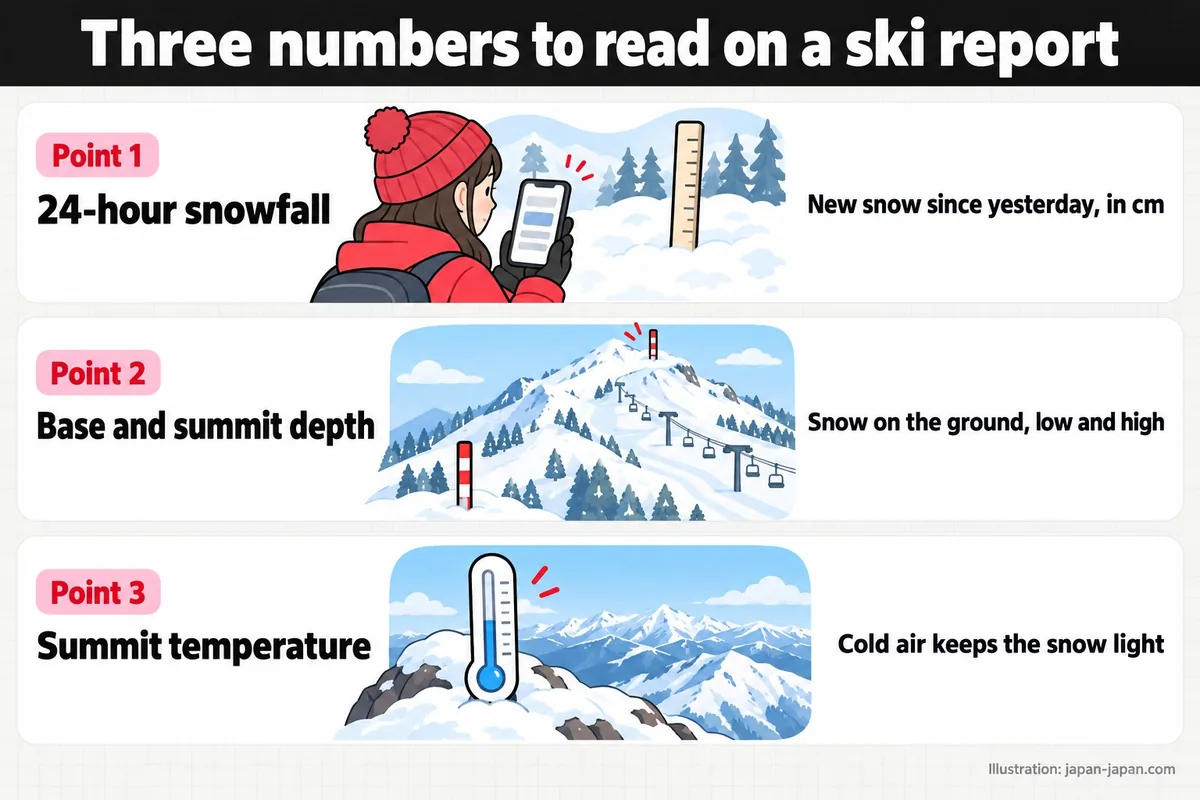
The drawing above shows the three numbers to read first. The 24-hour snowfall is new snow since the day before. Base and summit depth are the snow already on the ground, low and high on the mountain. Summit temperature tells you whether that snow stays light and dry.
Japanese resort pages use two words you should know. Look for 積雪 (sekisetsu), the snow on the ground, and 降雪 (kousetsu), the new snow that fell. A big kousetsu number means fresh powder. A big sekisetsu number means the base is deep enough for off-piste runs and tree areas.
Monthly snowfall totals work the same way everywhere. At Grand Hirafu, staff measure the 24-hour snowfall before the lifts open, then reset the gauge. The monthly figure adds up those daily readings.
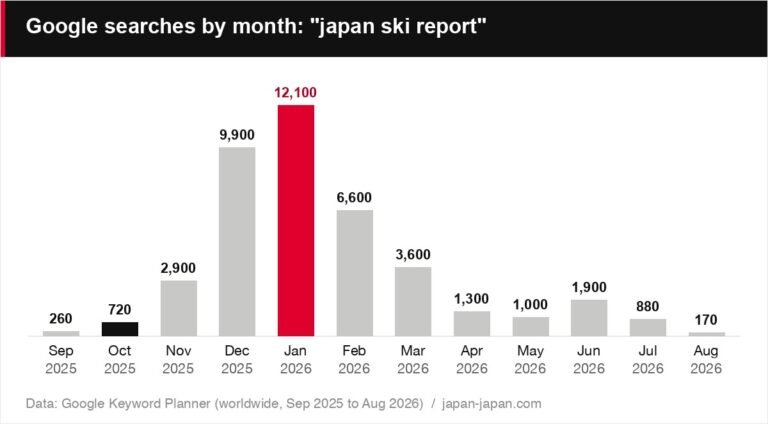
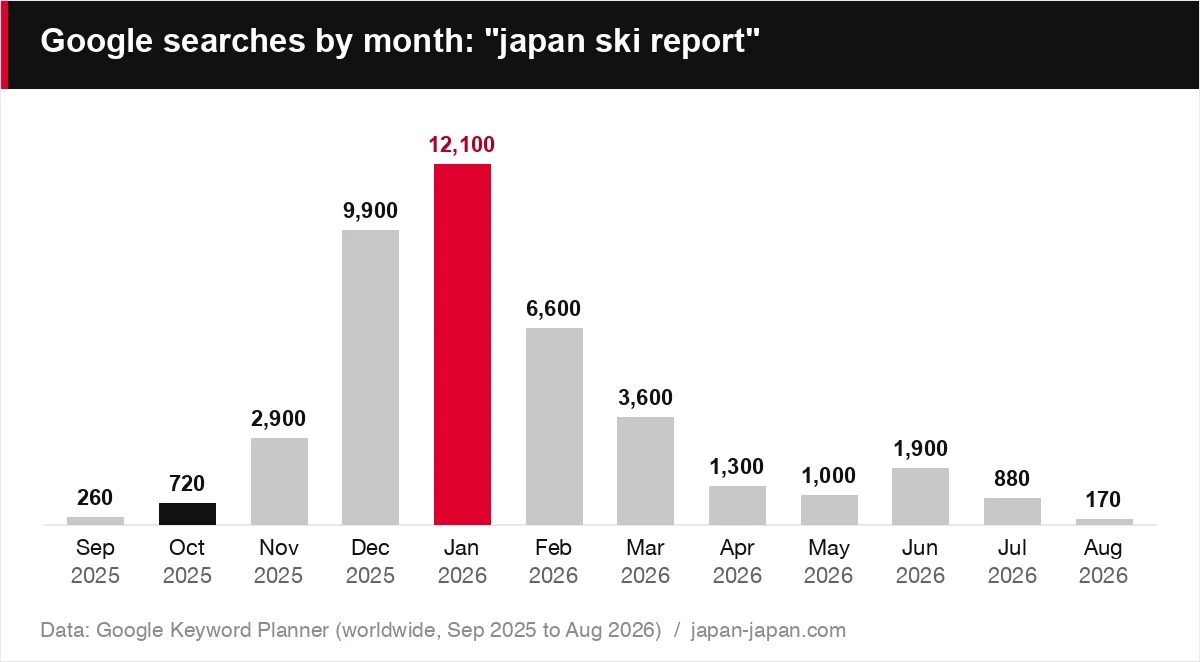
Interest in snow reports climbs fast once the lifts start. Worldwide searches for “japan ski report” were 720 in October 2025 and peaked at 12,100 in January 2026, 16.8 times higher. December 2025 had 9,900.
| Month | Searches |
|---|---|
| Sep 2025 | 260 |
| Oct 2025 | 720 |
| Nov 2025 | 2900 |
| Dec 2025 | 9900 |
| Jan 2026 | 12,100 |
| Feb 2026 | 6600 |
| Mar 2026 | 3600 |
| Apr 2026 | 1300 |
| May 2026 | 1000 |
| Jun 2026 | 1900 |
| Jul 2026 | 880 |
| Aug 2026 | 170 |
The chart shows that search curve month by month, from 260 in September 2025 to the January peak. Searches had already reached 2,900 in November 2025, before most resorts opened. If you want a room near the slopes in January, decide on your area while the curve is still low.
Snow by month near 5 Japan ski resorts
To compare areas fairly, use the Japan Meteorological Agency climate normals. These are 30-year averages for 1991 to 2020. We took five weather stations near well-known Japan ski resorts: Kutchan for Niseko, Furano, Hakuba, Nozawa Onsen, and Yuzawa in Niigata.
Two numbers matter. Snowfall is the total new snow in a month. Deepest snow is the deepest that the snow on the ground gets in that month, on average.
| Area (JMA station) | January snowfall | February deepest snow | Snowfall in a year |
|---|---|---|---|
| Yuzawa (Niigata) | 377 cm | 202 cm | 1,054 cm |
| Nozawa Onsen (Nagano) | 366 cm | 199 cm | 1,087 cm |
| Kutchan (Niseko, Hokkaido) | 253 cm | 181 cm | 921 cm |
| Hakuba (Nagano) | 216 cm | 97 cm | 655 cm |
| Furano (Hokkaido) | 145 cm | 73 cm | 628 cm |
Snow builds from November and takes off in December. December snowfall averages 253 cm at Kutchan, 223 cm at Nozawa Onsen and 210 cm at Yuzawa. Furano gets 159 cm and Hakuba 130 cm.
January brings the most new snow at Yuzawa, Nozawa Onsen and Hakuba. Kutchan gets the same 253 cm in December and January. Furano peaks a month earlier, with 159 cm in December.
The snow on the ground keeps rising after the heaviest snowfall. All five stations reach their deepest average in February. In March the depth is still high: 170 cm at Kutchan, 164 cm at Nozawa Onsen and 159 cm at Yuzawa.
| Item | Value | Note |
|---|---|---|
| Yuzawa | 202 cm | Niigata |
| Nozawa Onsen | 199 cm | Nagano |
| Kutchan (Niseko) | 181 cm | Hokkaido |
| Hakuba | 97 cm | Nagano |
| Furano | 73 cm | Hokkaido |
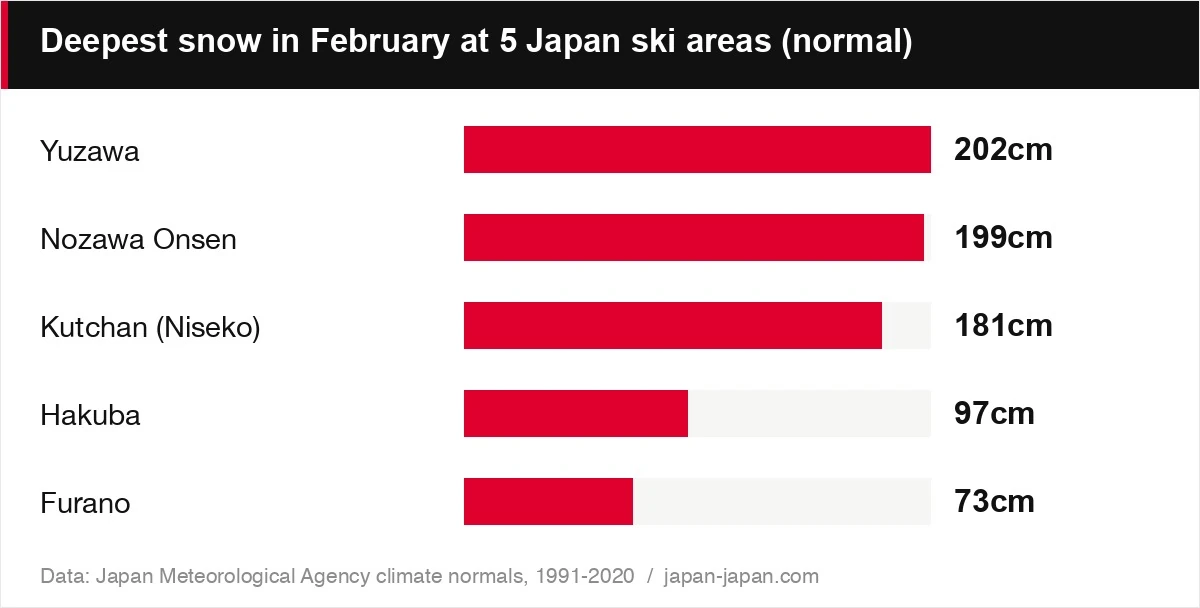
The bar chart ranks the five stations by February depth. Yuzawa and Nozawa Onsen sit near 2 m, Kutchan is close behind, and Hakuba and Furano stay under 1 m at station level.
Weather stations sit in towns, below most of the runs. Kutchan’s February average is 181 cm, while Grand Hirafu’s upper measuring point has averaged 400 cm in February since the 2020-21 season. Read the table as a ranking of snowy areas, and the resort report as the depth you will ride on.
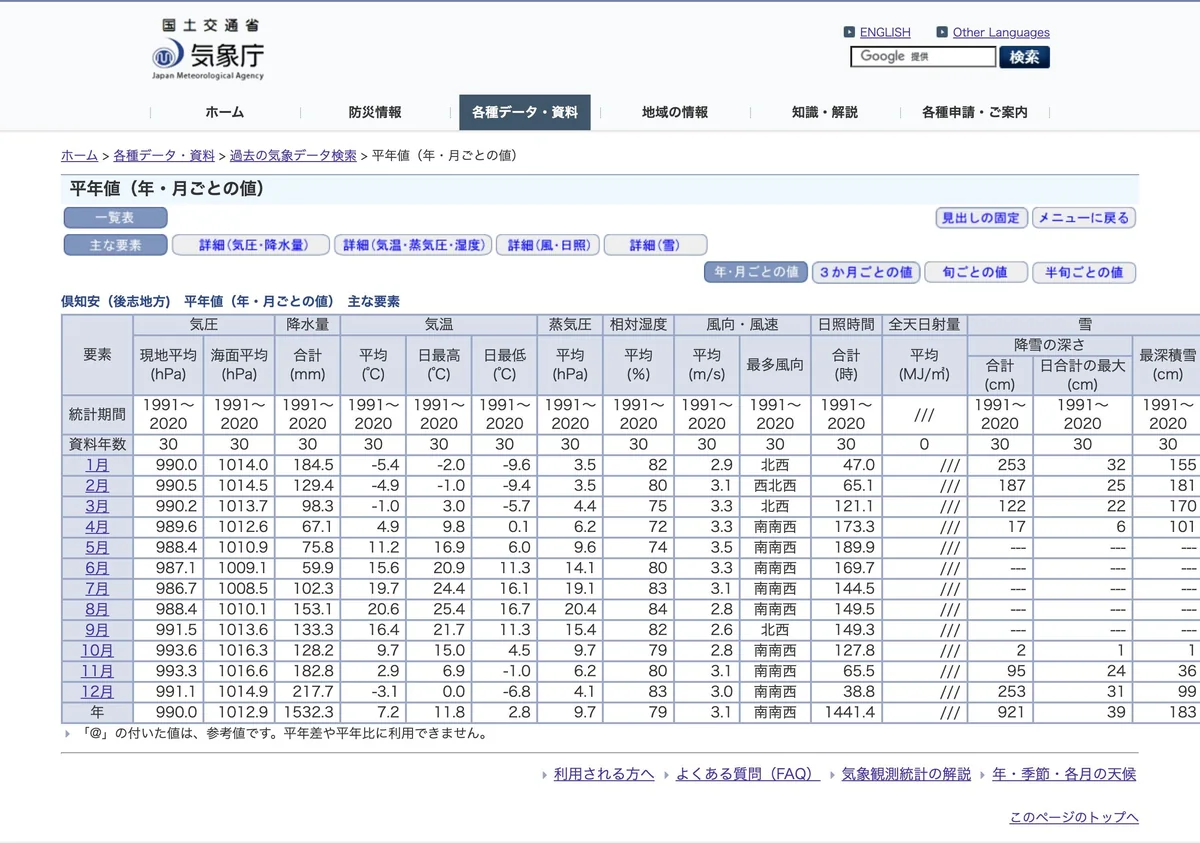
The screenshot is the Japan Meteorological Agency Kutchan climate normals page, in Japanese. Each row is a month, and the snow columns near the right end show snowfall and deepest snow. The bottom row gives the 921 cm yearly total.
Niseko Grand Hirafu: 2026-27 dates and snow data
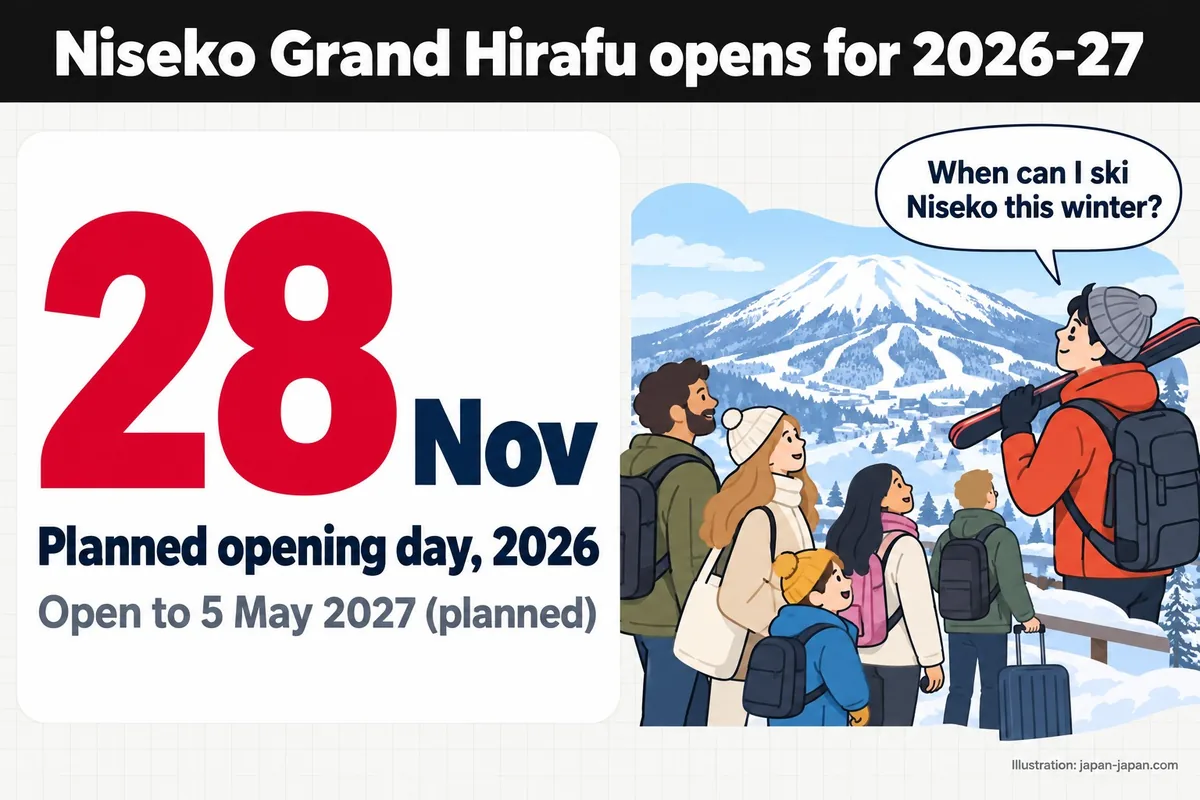
The date in the drawing is the one to note. Niseko Tokyu Grand Hirafu plans to run its 2026-27 season from 28 November 2026 to 5 May 2027. Night skiing is planned from 12 December 2026 to 22 March 2027. The resort says the opening can move with the snow, so check again in late November.
The Niseko Tokyu Grand Hirafu 2026-27 winter season page lists 22 courses: 9 beginner, 6 intermediate and 7 advanced. Two gondolas and seven lifts cover 135 ha, with a vertical drop of 940 m. The longest run is 5,300 m, and the steepest slope is 40 degrees.
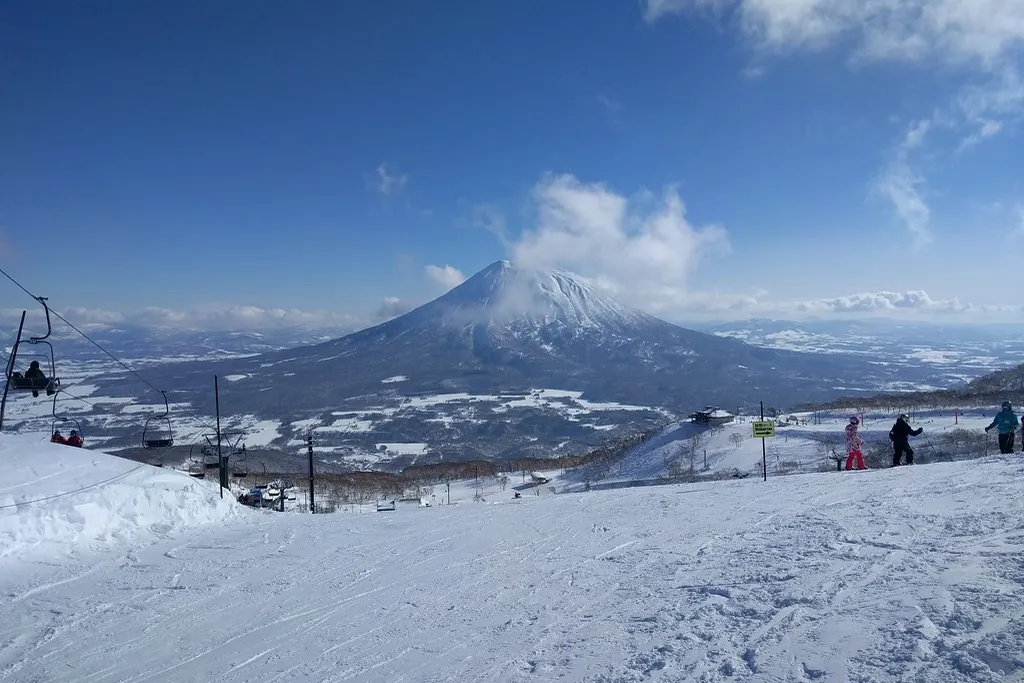
The photo shows why people come here: the runs face Mount Yotei, one of Japan’s 100 famous mountains. On clear nights in high season, night skiing heads straight down toward the lights of Hirafu village.
The resort publishes snow numbers by month. Snowfall is from the 2025-26 season. Snow depth is the average of each month’s deepest reading from 2020-21 to 2025-26.
| Month | Snowfall 2025-26 | Base depth | Summit depth |
|---|---|---|---|
| December | 386 cm | 75 cm | 210 cm |
| January | 620 cm | 175 cm | 380 cm |
| February | 263 cm | 170 cm | 400 cm |
| March | 75 cm | 110 cm | 380 cm |
| April | 15 cm | 55 cm | 315 cm |
January 2025-26 brought 620 cm of new snow, the most of any month. Depth keeps climbing after that. The upper point averages 400 cm in February and still 380 cm in March. At the base, depth peaks at 175 cm in January and falls to 110 cm in March.
It is cold on the upper slopes. On open days in January, the upper point averages -7.4°C at its warmest and -11°C at its coldest. In March those figures rise to 1.5°C and -3.2°C.
The resort splits the winter into four parts:
- Early season: opening to mid-December. Quieter before the winter holidays, with early-season tickets on sale.
- High season: late December to February. The most snow, the most events and the biggest crowds.
- March: more sunny days, a snow park with kickers, and fewer people on the slopes.
- Late season: April and May. Lighter clothing and cheaper late-season lift tickets.
| Place | Niseko Tokyu Grand Hirafu |
|---|---|
| Hours | Season 28 Nov 2026 to 5 May 2027; night skiing 12 Dec 2026 to 22 Mar 2027 (both planned) |
| Access | About 2 h 5 min by car from New Chitose Airport, or about 3 h 30 min by JR to Kutchan Station plus a 20 min bus |
| Official site | Niseko Tokyu Grand Hirafu 2026-27 winter season page |
Rentals for 2026-27 booked early get 10% off. If you stay nearby and rent from the resort, it keeps your skis, board and boots overnight. English lessons come from GoSnow, in groups or private. The official school teaches groups in Japanese and private lessons in Japanese or English.
Furano ski: colder, drier Hokkaido snow
Furano gets less snow than Niseko but keeps it in much colder air. January at the Furano station averages -8.3°C, with an average daily low of -14.4°C. Kutchan, the station for Niseko, averages -5.4°C in January, with a daily low of -9.6°C.
Furano is also drier. Its January precipitation averages 44.3 mm, against 184.5 mm at Kutchan. Snowfall follows that gap: 145 cm in January and 628 cm across the year at Furano, compared with 921 cm a year at Kutchan.
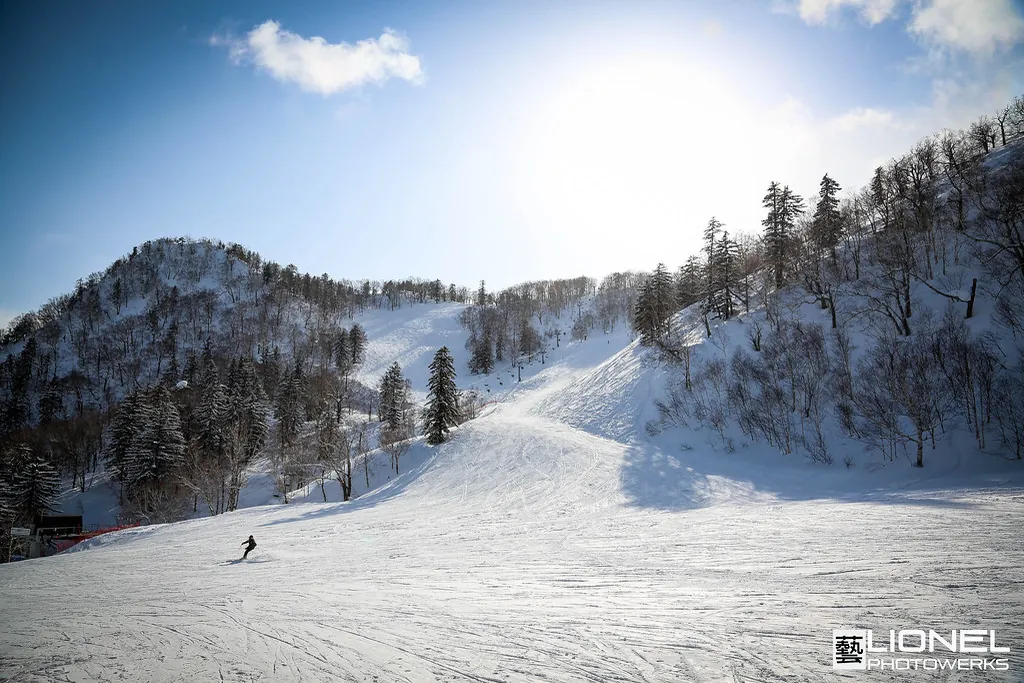
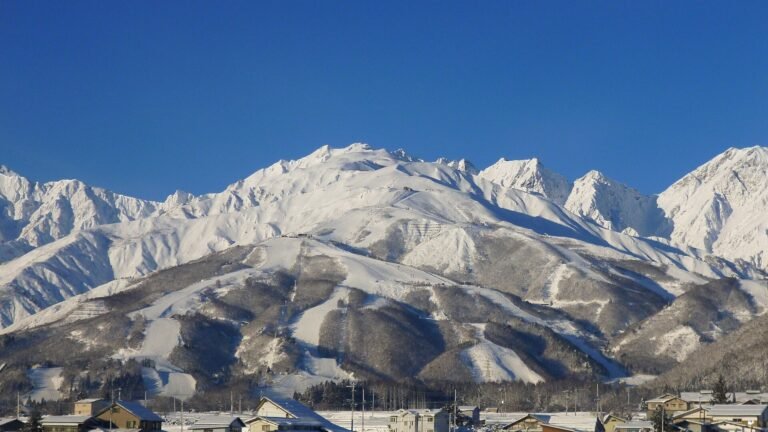
The photo shows Furano’s slopes in winter. Cold air keeps what falls there. Furano’s deepest snow averages 73 cm in February and still 71 cm in March, before dropping to 23 cm in April.
The cold changes what you pack. With lows near -14°C, bring a neck warmer, mittens and layers you can add on the lift. Disposable hand warmers can go in both carry-on and checked bags in Japan. Our Japan packing list for winter covers clothing for Hokkaido in more detail.
Furano is on the JR network from Sapporo. The Sapporo-Furano Area Pass costs 11,000 yen for 4 days, or 5,500 yen for children. It covers trains around New Chitose Airport, Sapporo, Otaru, Furano, Biei and Asahikawa.
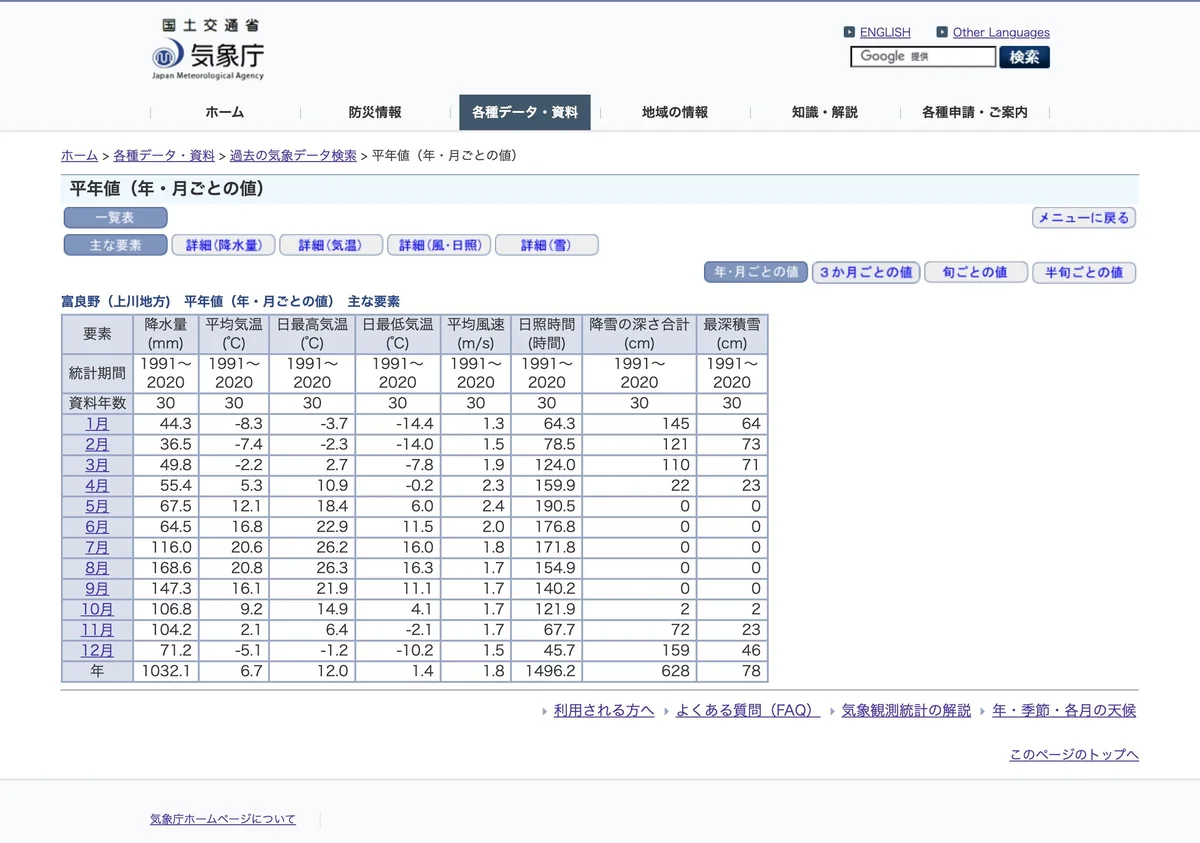
This screenshot shows the Japan Meteorological Agency Furano climate normals page. The last two columns are monthly snowfall and deepest snow, and the bottom row gives the 628 cm yearly total.
Honshu powder: Hakuba, Nozawa Onsen and Yuzawa
Honshu is Japan’s main island. Two of its ski towns get more snow than any Hokkaido station in this guide. Snowfall averages 1,087 cm a year at Nozawa Onsen and 1,054 cm at Yuzawa. Kutchan, the snowiest Hokkaido station here, gets 921 cm.
January is the big month. Yuzawa averages 377 cm of snowfall and Nozawa Onsen 366 cm. By February, the snow on the ground averages 202 cm at Yuzawa and 199 cm at Nozawa Onsen.
The air is milder than in Hokkaido. January averages -0.4°C at Yuzawa and -1.6°C at Nozawa Onsen, against -8.3°C at Furano. Days on the hill feel less harsh, though snow can still fall for days on end.
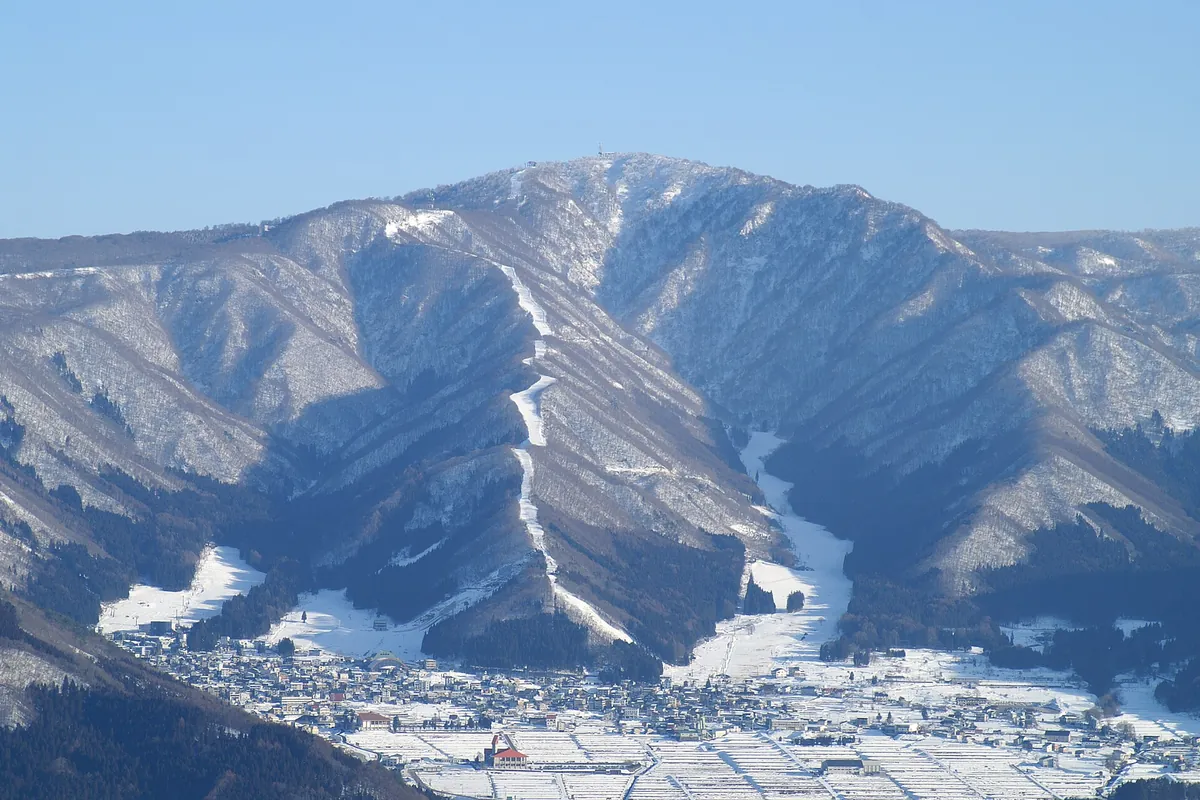
The photo shows Nozawa Onsen in winter, where the village streets sit right below the ski area. Snow stays deep here into spring: 164 cm in March on average, and 77 cm in April.
Hakuba gets less at its valley station: 216 cm of snowfall in January and a deepest average of 97 cm in February. Its yearly snowfall is 655 cm. Like Niseko, the upper runs sit well above the station.
December decides whether a Christmas trip works. December snowfall averages 223 cm at Nozawa Onsen, 210 cm at Yuzawa and 130 cm at Hakuba. The deepest December snow averages 92 cm at Yuzawa, 88 cm at Nozawa Onsen and 46 cm at Hakuba.
Each station has its own page with every month. Hakuba is on the Japan Meteorological Agency Hakuba climate normals. Nozawa Onsen is on the Japan Meteorological Agency Nozawa Onsen climate normals. Yuzawa is on the Japan Meteorological Agency Yuzawa climate normals. For trains into Nagano from the capital, see our page on Tokyo to Nagano.
Best weeks to ski in 2026-27: snow vs crowds
Pick your week by snow depth and by crowds. The drawing below matches each part of the 2026-27 winter to what you can expect.
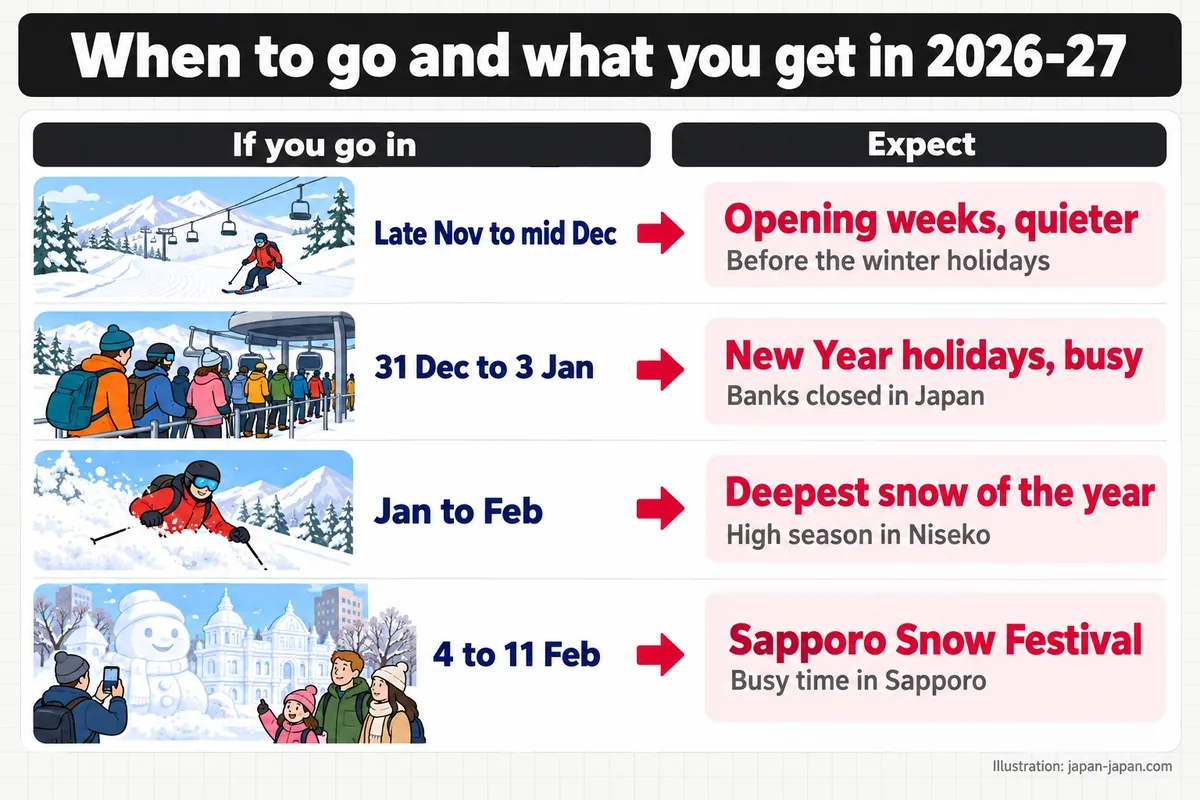
Late November to mid-December. Grand Hirafu opens on 28 November, and the resort calls the weeks before the winter holidays quieter. December depth at the stations averages 99 cm at Kutchan and 92 cm at Yuzawa. Night skiing at Grand Hirafu starts on 12 December.
New Year. New Year’s Day falls on Friday 1 January 2027, and banks close from 31 December to 3 January. JR Central makes every Nozomi reserved-only from 25 December 2026 to 5 January 2027. The busiest day last winter was Sunday 4 January 2026, with 350,000 passengers heading to Tokyo. Our New Year 2026-27 holiday guide lists what closes.
January. This is the deepest powder month for new snow, and Grand Hirafu is in high season. Coming of Age Day on Monday 11 January 2027 makes a long weekend in Japan. Sapporo hotels were 62.1% full in January 2025. See Japan in January for weather and events across the country.
Early February. The 77th Sapporo Snow Festival runs from 4 to 11 February 2027, 8 days in all. It uses three sites: Odori Park, Tsudome and Susukino. The Sapporo Snow Festival 2027 dates announcement also lists the Sapporo Snow Sports Park on 12 to 14 February. 11 February is a public holiday in Japan, so check February public holidays before you fix dates.
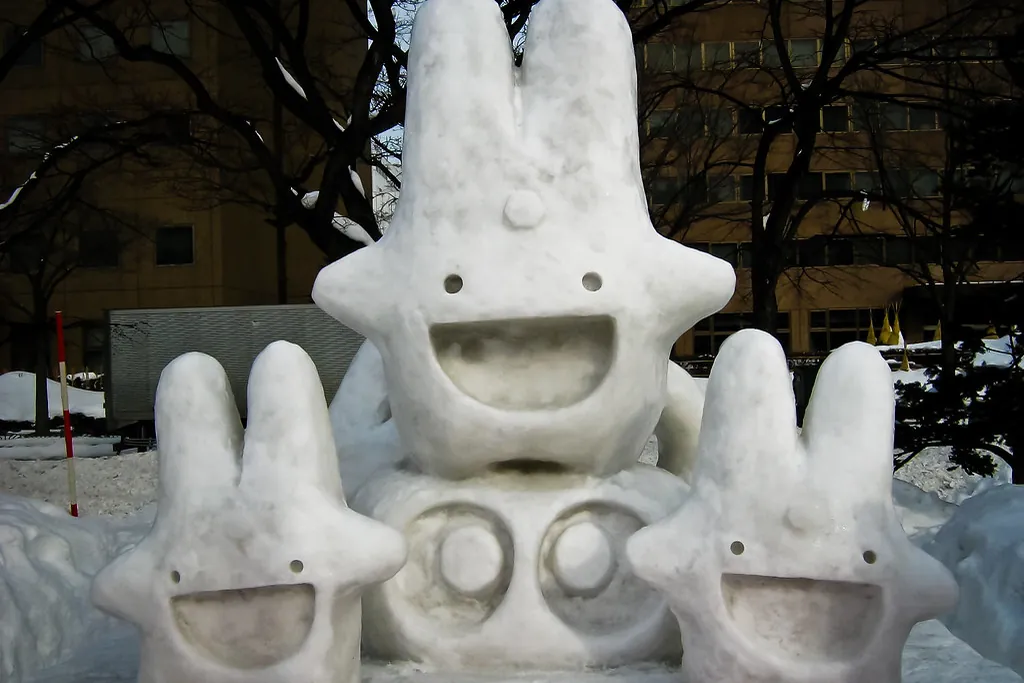
The photo shows the large snow sculptures in Odori Park, where the festival places its five biggest pieces. Sapporo hotels were 68.0% full in February 2025, higher than in January. Our Sapporo in February page has the weather and crowd figures.
March. Grand Hirafu says the slopes get quieter, and the upper point still averages 380 cm. Kutchan’s station depth averages 170 cm. For deep snow with fewer people, March is the strongest choice.
Getting to the slopes with skis
Most Hokkaido ski trips start at New Chitose Airport. Flights from Haneda take 1 h 30 min, with 56 a day, on our Tokyo to Sapporo page. The New Chitose Airport has its own JR station under the domestic terminal.
The Niseko Tokyu Grand Hirafu access page gives these travel times.
- By car: about 2 h 5 min from New Chitose Airport via Route 276 and Bifue Pass.
- From Sapporo by car: about 2 h via Nakayama Pass, or about 1 h 45 min on the expressway.
- By train: about 3 h 30 min in total. Take JR via Sapporo and Otaru to Kutchan Station, then a bus of about 20 min or a taxi of about 15 min.
- By direct bus: winter buses run between New Chitose Airport and Niseko.
If you stop in Sapporo first, the JR Rapid Airport takes 33 min and costs 1,230 yen. Our New Chitose Airport to Sapporo page compares it with the buses. For a day on the snow without the long drive, read our guide to Sapporo Teine Highland Ski Center.
Your own skis go in the hold. Under Japan’s rules, skis and snowboards cannot go in the cabin. Short skis of 60 cm or less are the exception. Poles may come on board if they are 60 cm or less when folded and have no pointed metal tip.
Solid ski and snowboard wax is fine in carry-on and checked bags. Liquid, paste and powder wax are not, with a narrow exception. Check your airline’s sports baggage terms too: our pages for JAL and ANA list their bag sizes and weights.
FAQ
When does ski season start in Japan in 2026?
Niseko Grand Hirafu plans to open on 28 November 2026 and run to 5 May 2027. The resort says the opening date can move with the snow. Station snow is still thin in November, with Kutchan’s deepest snow averaging 36 cm.
Which month has the most snow at Japan ski resorts?
February has the deepest snow on the ground at all five stations in this guide, led by Yuzawa at 202 cm. January brings the most new snow at most of them, with 377 cm at Yuzawa and 366 cm at Nozawa Onsen.
Is there enough snow to ski in Japan in December?
Usually, yes, from mid-December at the snowiest areas. December depth averages 99 cm at Kutchan and 92 cm at Yuzawa. Grand Hirafu’s upper point has averaged 210 cm in December, against 75 cm at the base.
Where can I check the snow depth in Japan today?
Use the Japan Meteorological Agency Analysis and Forecasts of Snow page for the whole country in English. Then open your resort’s own snow report each morning. Check where it measures: Grand Hirafu reads new snow at about 850 m on the Shirakaba course.
About the author