Can You Visit Ginzan Onsen in Winter Without a Reservation?
Ginzan Onsen’s winter 2026-27 page is still a draft, so dates, fares and the booking link may change. The Ginzan Onsen Association Winter Access 2026–2027 page says final dates will be announced once they are confirmed.
This guide keeps the draft plan for this winter apart from what actually happened last winter (2025-26), when the same park-and-ride system ran as a pilot.
Planned Winter Rules for Day Trips
Under the draft, day-trip cars will not drive into Ginzan Onsen from December 2026. Drivers park at Taisho Roman-kan and ride a shuttle for the last stretch.
The plan covers private cars and other vehicles on the restricted list. They must go to Taisho Roman-kan instead of entering the hot spring town directly. After parking, you board the shuttle at the time on your booking, and it takes the designated route into town.
The association gives a plain reason for the rule. There is only one access road to Ginzan Onsen. One car stuck in the snow can quickly back up traffic and block ambulances and fire engines. Keeping private cars out leaves that road open, so help can reach someone after a fall, sudden illness or accident.
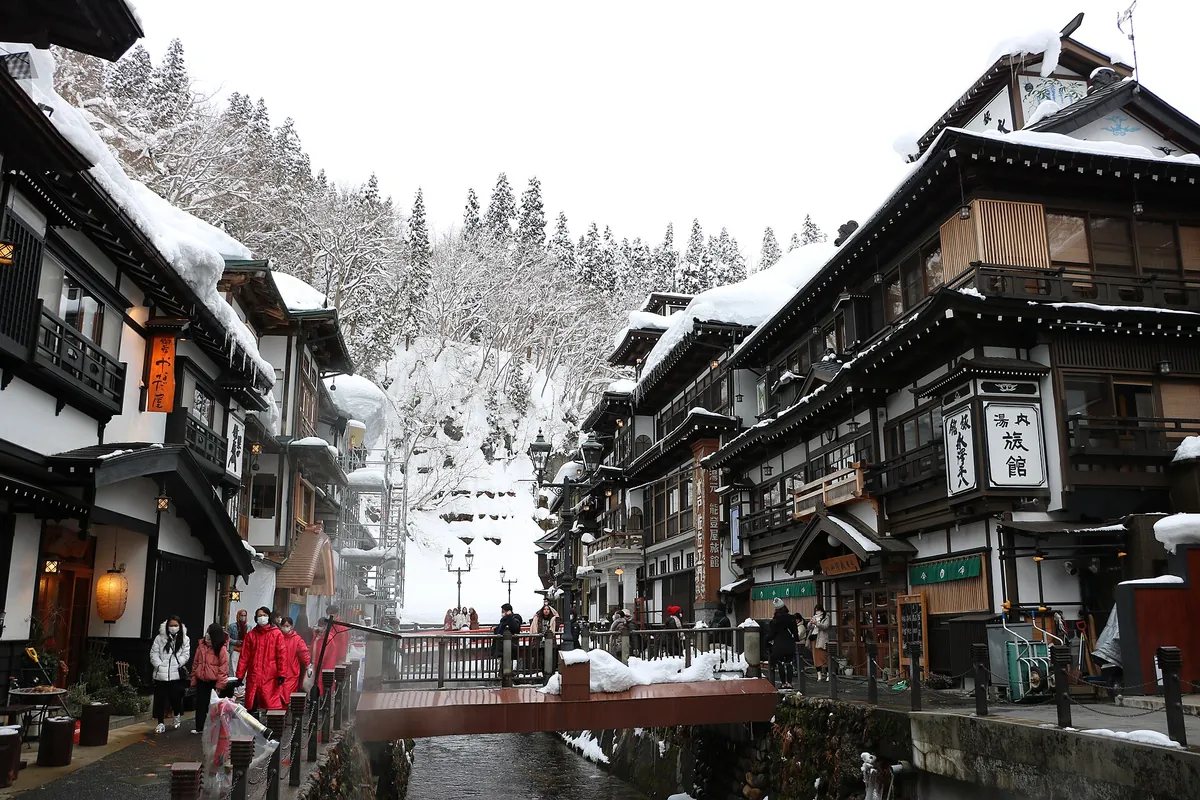
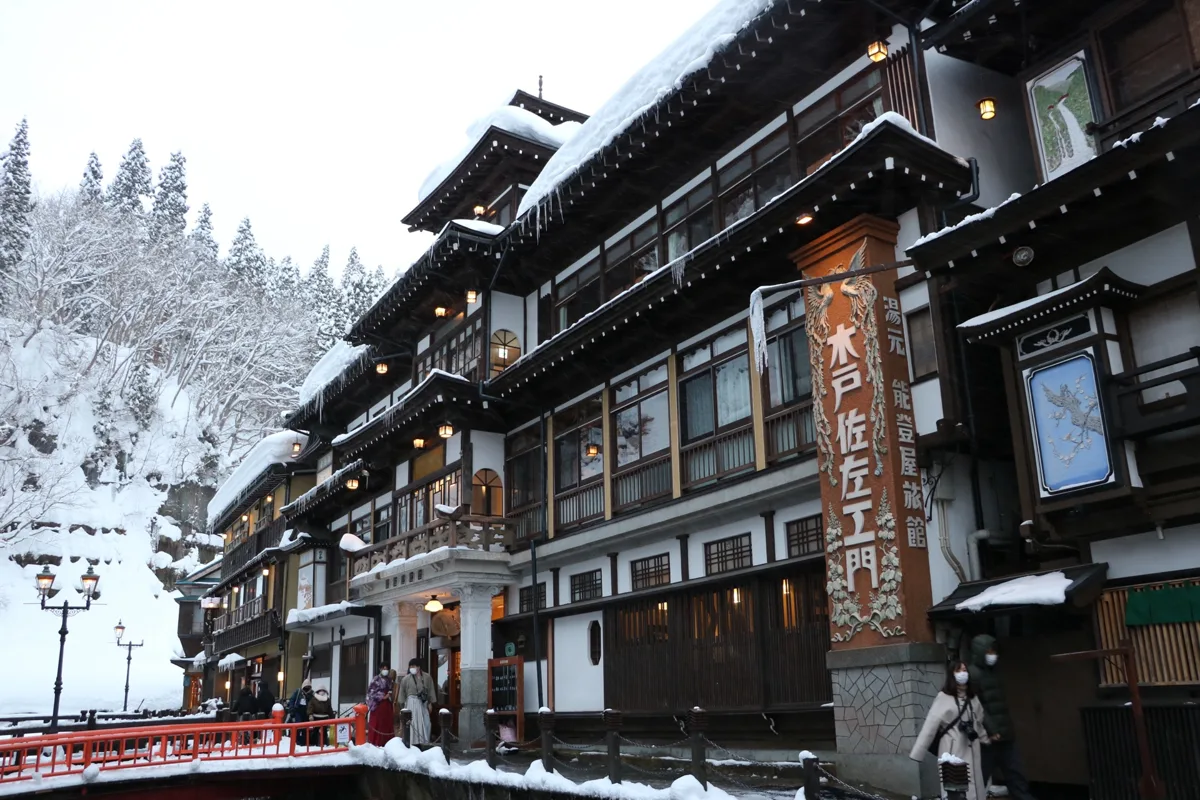
The photo below shows the wooden inns that line the river through the town.
Entry to the street is also managed by time slot. In winter, snow can fall from the rooftops, so the building-side half of the street cannot be used for walking. The draft says the limits keep enough walking space for overnight guests, day visitors, residents and staff.
We checked the draft on 15 October 2026, and the Priority Pass booking link was not open yet. The page shows “Reservation link coming soon”, and the start date for bookings has not been announced.
Last winter (2025-26), the rules applied to day-trip visitors only. The association’s 2025-26 guide named Taisho Roman-kan, 364 Kamiyanagiwatarito, Obanazawa City, as the base where every day-trip visitor arriving by car had to park. That included rental cars. If you plan to drive, our guide to renting a car in Japan covers the permit you need and winter driving.
Shuttle Times, Fares and Return Buses
The draft sets three outbound time bands from Taisho Roman-kan, each with a shuttle every 20 minutes. The provisional Priority Pass fare is JPY 1,300, JPY 1,000 or JPY 1,500, depending on when you leave.
The table below sets out the planned times, fares and return rules for each band.
| Outbound departures | Planned fare | Frequency | Return bus |
|---|---|---|---|
| 9:00–10:40 | JPY 1,300 | Every 20 minutes | 1 h 20 min after outbound (9:00 → 10:20) |
| 11:00–13:40 | JPY 1,000 | Every 20 minutes | Any return up to 15:20 |
| 14:00–18:00 | JPY 1,500 | Every 20 minutes | 1 h 20 min after outbound (a 14:00 bus may return up to 15:20) |
The draft says these fares and times are provisionally based on last season. Final arrangements for 2026-27 are yet to be confirmed. All times are Japan Standard Time in 24-hour format. Outbound means Taisho Roman-kan to Ginzan Onsen, and return means the other way.
Booking the Priority Pass
Book ahead once the link opens. The association expects very few same-day places and strongly recommends booking in advance. It tells visitors not to count on buying a pass on arrival.
How the return bus works
New for 2026-27, your return shuttle is normally assigned for 1 hour 20 minutes after your outbound departure. The draft gives two examples. A 9:00 outbound bus comes with a 10:20 return, and a 10:20 outbound bus comes with an 11:40 return.
On your assigned return, you board with priority and skip the standby queue. Be at the boarding point in time for departure. You can take an earlier bus only if seats are free, and then you join the normal queue. Your priority does not carry over to the earlier bus.
If you miss your assigned return, you lose priority boarding. You then wait in the normal queue for a bus with free seats.
There is one exception for lunch. If your outbound shuttle leaves between 11:00 and 14:00 inclusive, you may take any return bus up to and including 15:20. You get no single assigned return in that case. A 14:00 outbound bus is the odd one out. It falls in the JPY 1,500 fare band, but its return follows the lunchtime rule.
The illustration below matches each outbound time with the return rule that goes with it.
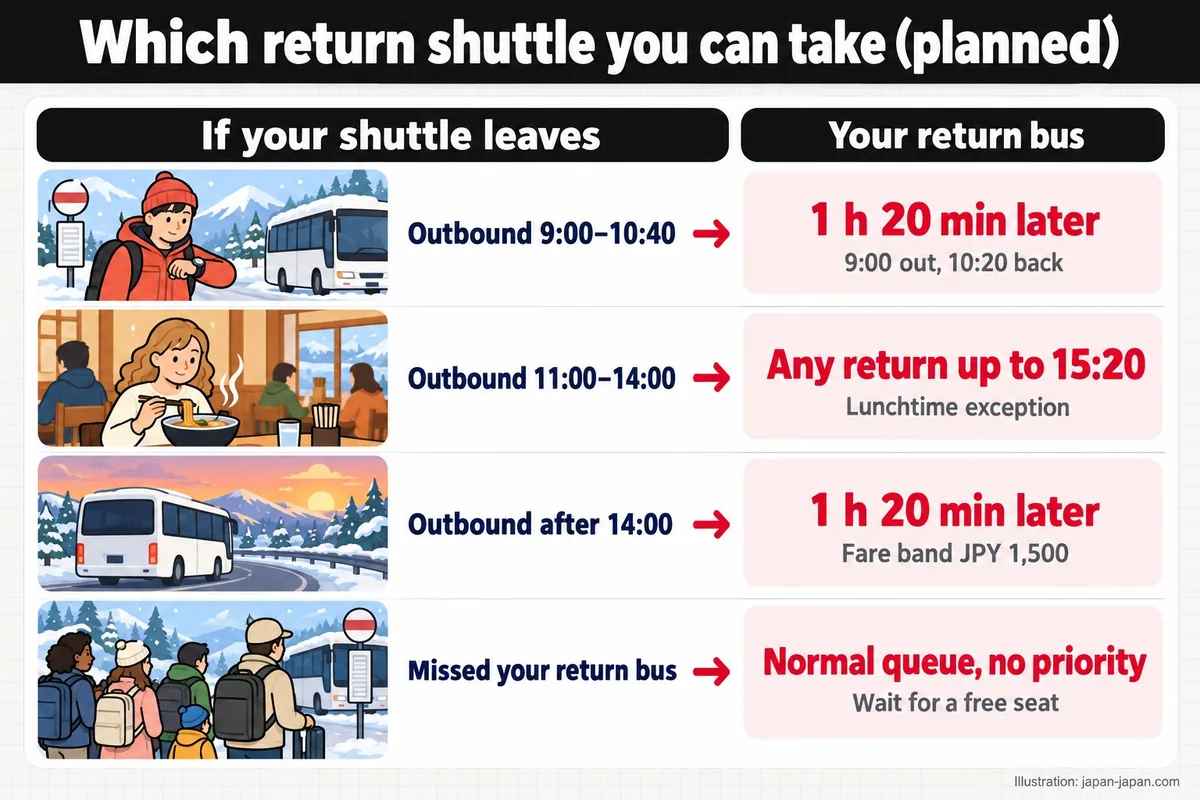
Last winter, the price had two parts. The 500-yen Priority Pass came on top of a round-trip fare that changed by time. That fare was 800 yen from 9:00, 500 yen from 11:00 and 1,000 yen from 14:00. Added up, that makes 1,300, 1,000 and 1,500 yen, the same amounts as this winter’s draft.
Last Winter vs the 2026-27 Plan
Last winter’s rules are the best guide to this winter. The draft says its fares and times are based on last season. The table below compares what applied in 2025-26 with the 2026-27 draft.
| Item | Last winter 2025-26 | 2026-27 plan (draft) |
|---|---|---|
| Period | 20 Dec 2025 to 1 Mar 2026 | December 2026 to early March 2027, dates to be announced |
| Price | Round-trip fare 800 / 500 / 1,000 yen + Priority Pass 500 yen | JPY 1,300 / 1,000 / 1,500 (provisional) |
| Return bus | No assigned return; last return 19:30 | Assigned 1 h 20 min after outbound |
| Booking | Up to 10 people: 13 days before to 17:00 the day before | Reservation link coming soon |
| Who transfers | Day-trip visitors arriving by car | Day trips by car, plus route-bus riders without a reservation |
What applied in 2025-26
The Priority Pass ran from Saturday 20 December 2025 to Sunday 1 March 2026. Obanazawa City’s own pilot period was shorter, from 20 December 2025 to 31 January 2026. The Obanazawa City report on the 2025-26 car restriction pilot gives the restriction hours as 9 am to 9 pm.
The pass came with six rules worth knowing before this winter.
- It was valid on the outbound shuttle from Taisho Roman-kan only.
- It was optional. You could ride the shuttle without one, but you might have to wait.
- Parties of up to 10 could buy it from 13 days before the travel date until 17:00 the day before.
- Groups of 11 or more had to buy it by 17:00, 14 days before the travel date.
- If you reached Taisho Roman-kan after your reserved time, the pass became void with no refund.
- The person who booked showed the booking number and a driving licence or other photo ID. Copies were not accepted.
Overnight guests staying in Ginzan Onsen did not need the pass. The association asked every other visitor to buy one.
The shuttle ride took about 10 minutes, with videos about Ginzan Onsen and Obanazawa shown on board. It stopped at Ginzanso-mae, about a 10-minute walk from the onsen district. Outbound buses left Taisho Roman-kan between 9:00 and 18:00. The last return left Ginzan Onsen at 19:30, and no buses ran after that.
Taxis had their own rules. Only ordinary dispatched taxis holding an entry permit issued in advance could drive into Ginzan Onsen. Sightseeing taxis, chartered taxis and hire cars could not. Taxis from outside Yamagata Prefecture could not enter at all.
What went wrong last winter
The city’s report says the car restrictions cut the number of stuck vehicles and cars parked on the road. It also records problems. Around the year-end and New Year holidays, more visitors came than expected, and long traffic jams built up.
Some visitors arrived outside the restriction hours, late at night or early in the morning. Others tried to get around the rules, and some walked to the town instead of taking the shuttle. The draft for this winter speaks to both. It tells tour operators and charter buses not to assume entry is allowed at night or when no traffic marshal is on duty. It also tells everyone not to walk the road.
Getting to Ginzan Onsen From Tokyo and Sendai
By train, take the Yamagata Shinkansen (Tsubasa) to JR Oishida Station, then the Ginzan Line bus. The JR East Oishida Station Yamagata Shinkansen Timetable lists Tsubasa trains leaving Oishida toward Shinjo, which is the direction you travel from Tokyo.
On weekdays, those Tsubasa departures from Oishida include 9:41, 12:17, 15:16 and 17:27. Check the Saturday and holiday timetable separately on the same JR East page.
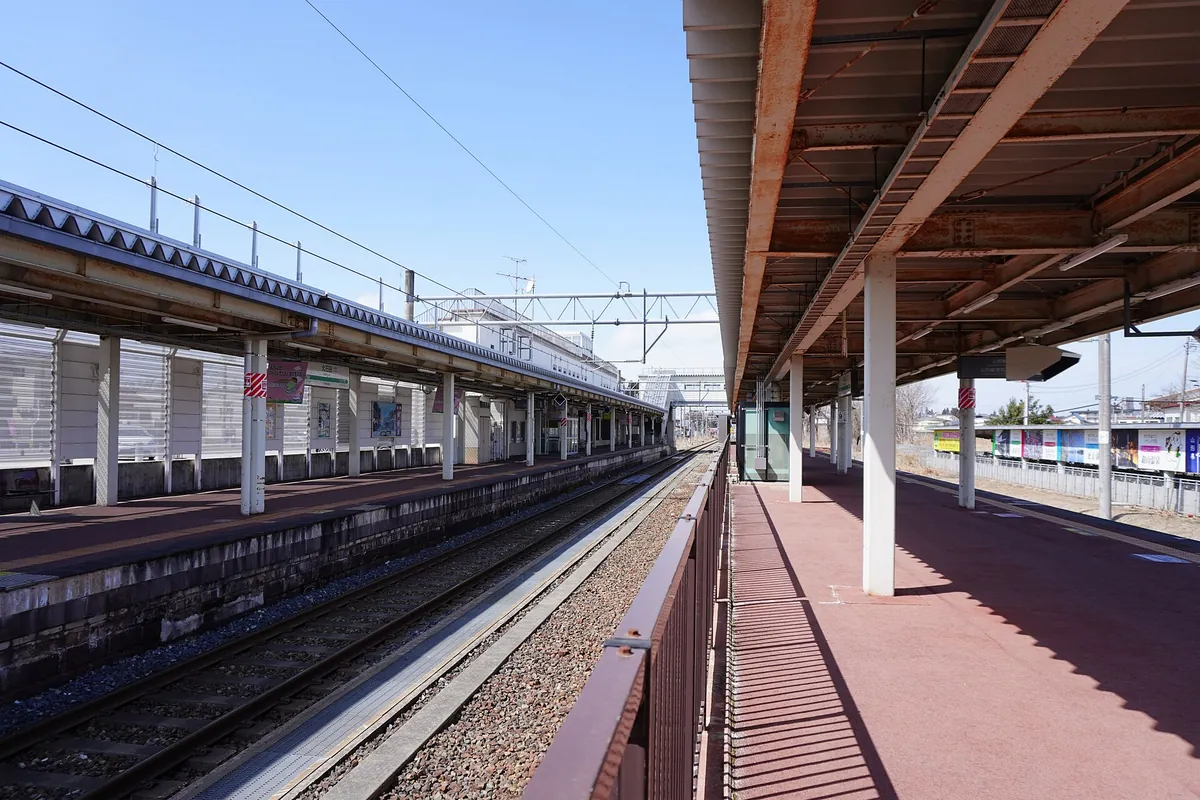
The photo below is from Oishida, where you leave the Shinkansen for the bus.
The Ginzan Line is a privately run route bus of Hanagasa Bus (tel. 0237-22-2206). The Obanazawa City Ginzan Line bus timetable lists buses from the station at 9:50, 12:35, 14:10, 15:55 and 17:45. They reach Ginzan Onsen at 10:26, 13:11, 14:53, 16:31 and 18:21.
Going back, buses leave Ginzan Onsen at 8:25, 10:35, 13:25, 14:55, 16:35 and 18:21. They reach JR Oishida Station at 9:01, 11:11, 14:01, 15:31, 17:11 and 18:51. A 7:05 bus also leaves Ginzan Onsen, but it ends in central Obanazawa. Some runs do not operate from 31 December to 3 January, so check the notes on the PDF before a New Year trip.
Snow can upset the schedule. The Obanazawa City Route Bus Timetables page warns that falling and lying snow can disrupt public transport timetables.
The planned bus transfer at Taisho Roman-kan
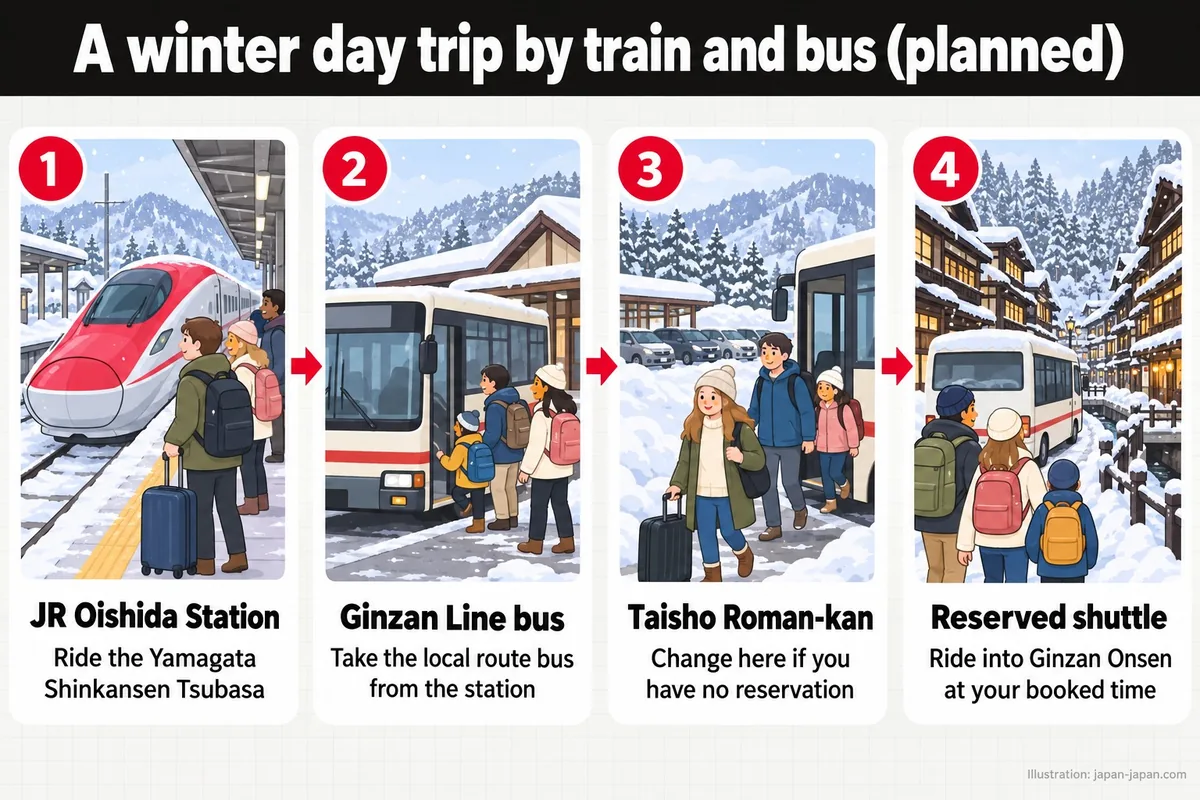
This winter’s draft changes the last stretch for many bus riders. Passengers without an advance admission reservation must get off at Taisho Roman-kan and transfer to a shuttle. That applies even if the front of the bus shows 銀山温泉 (Ginzan Onsen, the name of the town). The association says final transfer arrangements will be confirmed with the bus operator.
The illustration below shows the four legs of a winter day trip by train and bus under the plan.
By car from Sendai or Tokyo
The Ginzan Onsen Association Access Page splits the drive from Sendai into three legs. Take Route 48 to Higashine for about 1 hour, then Route 13 to Obanazawa IC for about 30 minutes. From the interchange, Ginzan Onsen is about 30 minutes away.
From Tokyo, the same page gives about 5 hours on the Tohoku and Yamagata expressways to Yamagata JCT. Then comes about 30 minutes on the Tohoku-Chuo Expressway to Obanazawa IC, and about 30 minutes more to the town. In winter, day-trip drivers stop at Taisho Roman-kan under the plan.
The association tells drivers never to use Prefectural Road 29 (Seaburi Pass) from Murayama City. It is an extremely narrow mountain road.
Check any paid ride before you pay. The draft asks you to confirm that a taxi or transfer is legally allowed to carry passengers for payment. Ask for the operator’s name and its licence. “Shiro-taku” means unauthorised paid transport, and no paid ride can get you around the access rules.
Rail passes and flights
For the train leg, compare the JR EAST PASS with single tickets. The older JR EAST PASS (Tohoku area) is no longer sold, so do not plan around it. If you are going to Sendai first, our Tokyo to Sendai route guide covers that trip.
Flying in? From Sendai Airport, the Sendai Airport Access Line reaches Sendai Station in 25 minutes for 680 yen. From Sendai, follow the driving route above.
Walking in the Snow: Two Safety Rules
The draft sets two walking rules for winter. Do not walk between Taisho Roman-kan and the town, and inside the town keep to the river side of the street.
Rule 1: Do not walk from Taisho Roman-kan
The association calls “It is only about 2 km” a dangerous reason to walk here. The sidewalk cannot be kept clear of snow, so anyone on foot ends up in the roadway. In some sections, snow and snowbanks push about 1–1.5 metres in from the sides.
The road also winds. A driver may see you and still be unable to stop in time. Blizzards and wind-blown snow can cause a whiteout, when you cannot see even a few metres ahead. The draft’s advice is direct: even if you have to wait for a bus, do not walk this route.
Last winter, the city’s report noted visitors who walked to the town instead of riding the shuttle. This rule is aimed at exactly that.
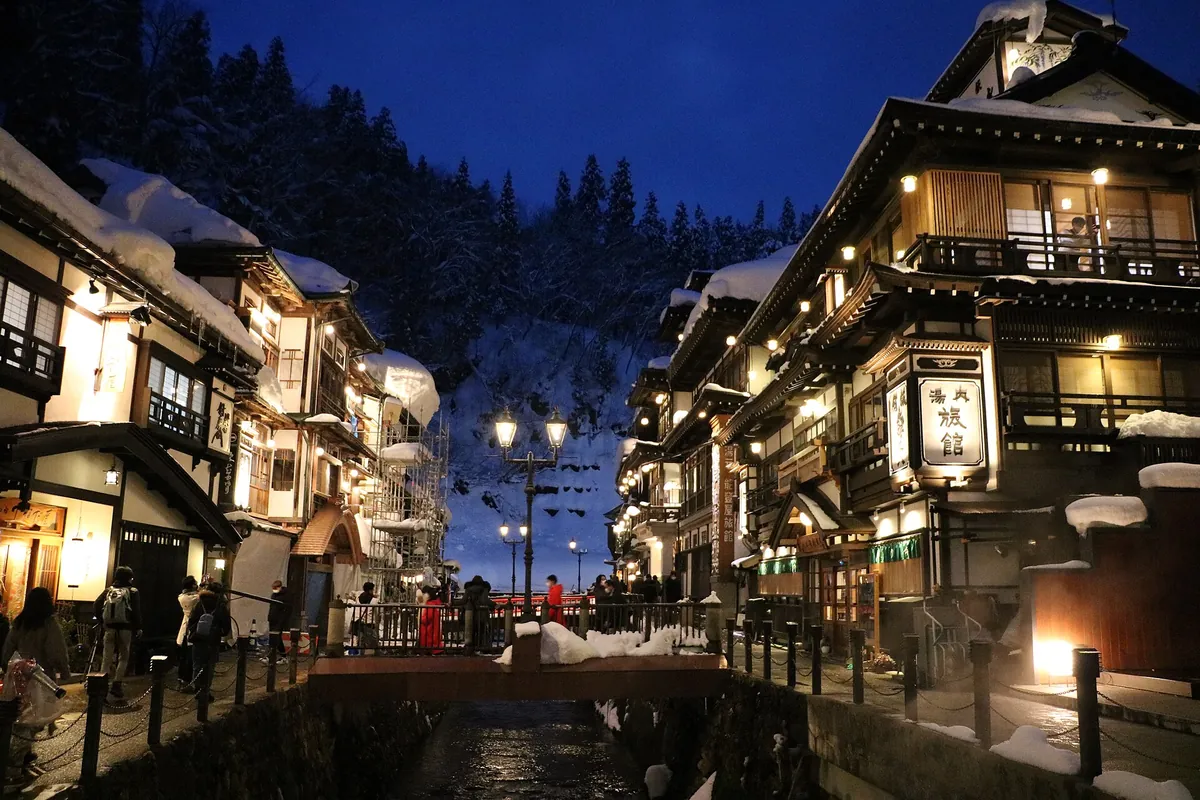
The photo below shows the riverside street and its gas lamps, where the second rule applies.
Rule 2: Walk on the river side of the diamond markers
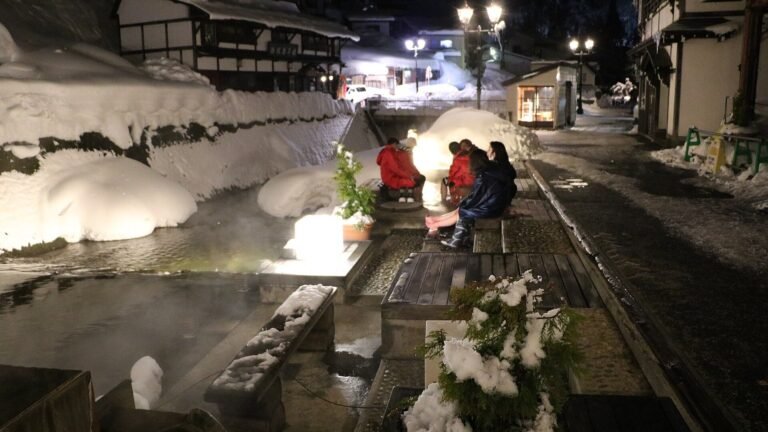
Inside the town, snow can slide off the roofs. That closes the building-side half of the street to walkers. Diamond-shaped tiles or plates mark the centre of the street. Keep to the river side of these markers, away from the buildings, and follow the signs and staff.
The draft adds that this lowers your exposure to falling roof snow but does not remove every hazard. It also lists ice among the winter dangers, so wear boots with grip.
Ginzan Onsen Weather and What to Wear
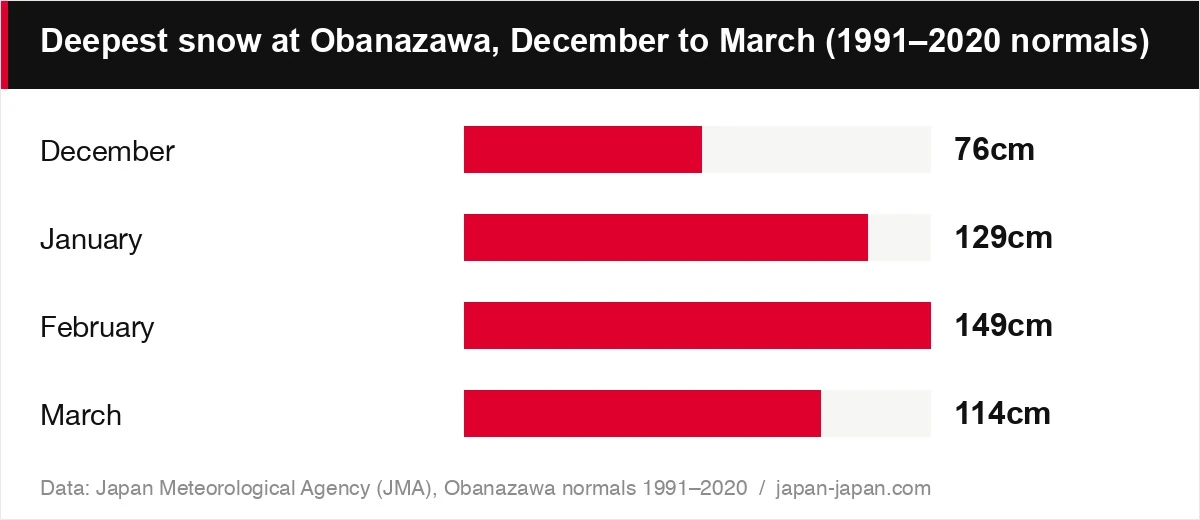
Expect hard frost and deep snow. The JMA Obanazawa Climate Normals 1991–2020 give January a mean daily low of −4.1°C and a deepest snow depth of 129 cm. February reaches 149 cm.
For Ginzan Onsen weather, Obanazawa is the JMA station for the city that includes the town. The Obanazawa City Ginzan Onsen Pilot Results page puts Ginzan Onsen about 16 km from the city centre. Treat the numbers as a guide to the area.
January and February are the coldest months, with mean daily highs of 1.7°C and 2.7°C and lows of −4.1°C and −4.3°C. December averages 4.2°C by day and −1.5°C at night, and March 6.4°C and −2.1°C. Snowfall adds up to 322 cm in January alone.
The chart below shows how the snow on the ground builds through the season. It goes from 76 cm in December to a peak of 149 cm in February, and still stands at 114 cm in March.
| Item | Value |
|---|---|
| December | 76 cm |
| January | 129 cm |
| February | 149 cm |
| March | 114 cm |
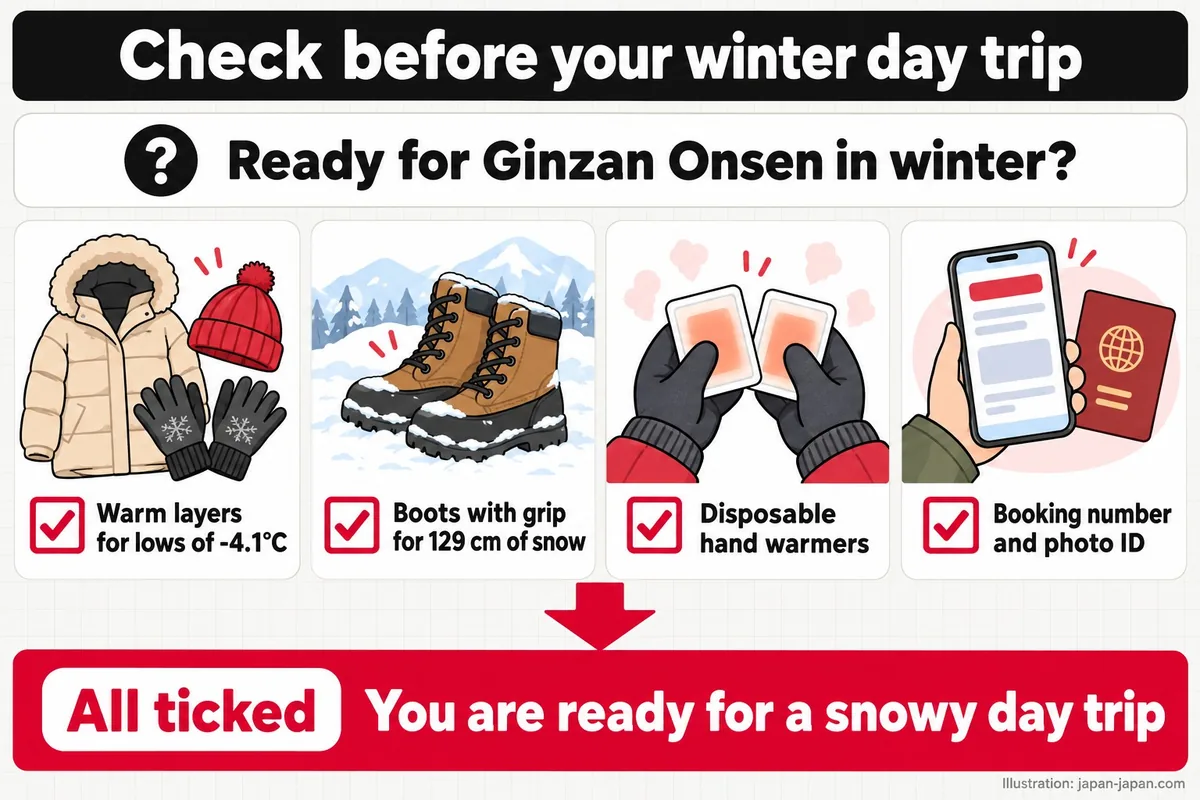
Dress for those numbers. Days stay just above freezing in midwinter, and nights drop below it. Wear warm layers, a hat, gloves and boots with grip. With more than a metre of snow on the ground in midwinter, low shoes fill with snow at the first bank.
For comparison, our Tohoku in January page shows Sendai averaging 5.6°C by day and −1.3°C at night. The Tohoku in February page covers the next month.
Disposable hand warmers help in the shuttle queue, and you can fly with them. Our hand warmers page explains that only the fuel-burning kind is restricted. The Japan winter packing list covers the rest of your bag.
The illustration below is a short checklist to run through before you set out.
When to Go and Related Guides
Avoid the year-end and New Year holidays if you can. Last winter, Obanazawa City reported more visitors than expected around those days, and long traffic jams followed.
Our New Year 2026–27 holiday guide shows what closes. New Year’s Day, Friday 1 January 2027, is the only national holiday, but banks close from 31 December to 3 January. The January holidays page covers Coming of Age Day, the other public holiday that month.
Within the planned time bands, 11:00 to 13:40 has the lowest provisional fare at JPY 1,000. It also comes with the lunchtime return rule, so it suits a slower visit with lunch in town.
If snow is not the goal, think about autumn. Our Yamagata autumn leaves page shows the JMA sample maple in Yamagata turning red around 25 November on average. The Tohoku weather by month guide compares the whole year. Our ryokan guide explains meals and onsen manners if you want to stay the night.
FAQ
Can you visit Ginzan Onsen in winter without a reservation?
Do not rely on it. The 2026-27 draft expects very few same-day places and strongly recommends booking a Priority Pass in advance. Last winter you could ride the shuttle without a pass, but you might have to wait.
When do the Ginzan Onsen winter rules start in 2026-27?
The draft plans them for December 2026 to early March 2027. Final dates will be announced once confirmed. Last winter the Priority Pass ran from 20 December 2025 to 1 March 2026.
How do you get to Ginzan Onsen from Tokyo?
Take the Yamagata Shinkansen (Tsubasa) to JR Oishida Station, then the Ginzan Line bus. The first bus from the station leaves at 9:50. Under the winter plan, riders without a reservation change to a shuttle at Taisho Roman-kan. By car, the association gives about 5 hours from Tokyo to Yamagata JCT, then two legs of about 30 minutes each.
What should you wear to Ginzan Onsen in winter?
Wear warm layers, a hat, gloves and boots with grip. In Obanazawa, January nights average −4.1°C and the snow on the ground reaches 129 cm. Pack disposable hand warmers for the shuttle queue.
About the author