Japan Solo Trip: 110, 119 and the 24-Hour Visitor Hotline
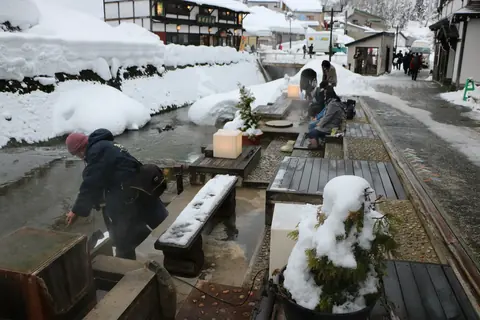
Travelling alone changes a few small things. Nobody watches your bag while you buy a ticket. Nobody calls the ambulance for you if you cannot speak Japanese. Nobody shares the cost of a room. The sections below cover each of these with the official numbers, our own database pages and the dates that fill up first.
Is Japan good for solo travel?
Japan works well for one person. The JNTO Staying Safe in Japan page puts it plainly: Japan is very safe and the crime rate is quite low. The same page still asks you to watch your surroundings and to know what to do if something goes wrong. That advice matters more when you are the only person in your group.
Most of the travel system in Japan is already built around one traveller. You tap your own IC card at the ticket gate. You hold your own rail pass. You check in at hotels with your own passport. Very little of it needs a second person to work.
The gaps show up when something goes wrong. Here is what a solo traveller has to cover alone:
- Calling for help: the Japan Visitor Hotline takes direct calls from visitors, but as a rule it does not run three-way interpretation or make bookings for you.
- Your luggage: you need a locker or a delivery service whenever you want both hands free.
- Medical bills: clinics generally take cash only, so you need cash or insurance that pays the hospital directly.
- Documents: if your passport is stolen, you collect the police report and contact your embassy yourself.
None of this is hard. It only needs to be set up before you fly, while you still have time and Wi-Fi.
Is Japan safe for a solo trip? The numbers to save
Japan has two emergency numbers. Dial 110 for the police when there is a traffic accident or a crime such as robbery or assault. Dial 119 for the fire department when there is a fire, a traffic accident or someone who is seriously sick or injured. The JNTO Japan Visitor Hotline page lists both and notes that most of these organisations have English-speaking staff.
The third number is the one most solo travellers forget. JNTO runs the Japan Visitor Hotline on 050-3816-2787, 24 hours a day, 365 days a year. From outside Japan, dial +81-50-3816-2787. Staff answer in English, Chinese and Korean. They help with accidents, illness and natural disasters, and they also answer general tourist questions.
The table below puts every number from JNTO’s pages in one place. Save the first four in your phone before you leave home.
| Number | Service | Use it for | Hours and languages |
|---|---|---|---|
| 110 | Police | Crime or a traffic accident | Urgent line; most services have English-speaking staff |
| 119 | Fire and ambulance | Fire, or someone seriously sick or injured | Urgent line; most services have English-speaking staff |
| 050-3816-2787 | Japan Visitor Hotline (JNTO) | Illness, accidents, natural disasters, travel questions | 24 hours, 365 days; English, Chinese, Korean |
| 03-3501-0110 | Tokyo Metropolitan Police English helpline | Police help in English in Tokyo | 24 hours, 365 days |
| 050-3416-0010 | JNTO TIC Call Center | Tourist information across Japan | 9 a.m. to 5 p.m. daily |
| 0570-550-142 | Lost & Found | Things you have lost | Listed by JNTO under the police |
| 03-5774-0992 | Tokyo English Life Line (TELL) | Mental health support | Mon to Thu 9 a.m. to 11 p.m.; Fri to Sun 9 a.m. to 2 a.m. |
In Tokyo, the Metropolitan Police also run an English helpline on 03-3501-0110, open 24 hours a day, 365 days a year. For travel questions that are not urgent, the JNTO TIC Call Center answers on 050-3416-0010 every day from 9 a.m. to 5 p.m. JNTO lists the Lost & Found number, 0570-550-142, under the police.
If you are not sure which number fits your problem, use the chart below. The rule is short: crime goes to 110, fire and sudden illness go to 119, and everything else goes to the hotline.
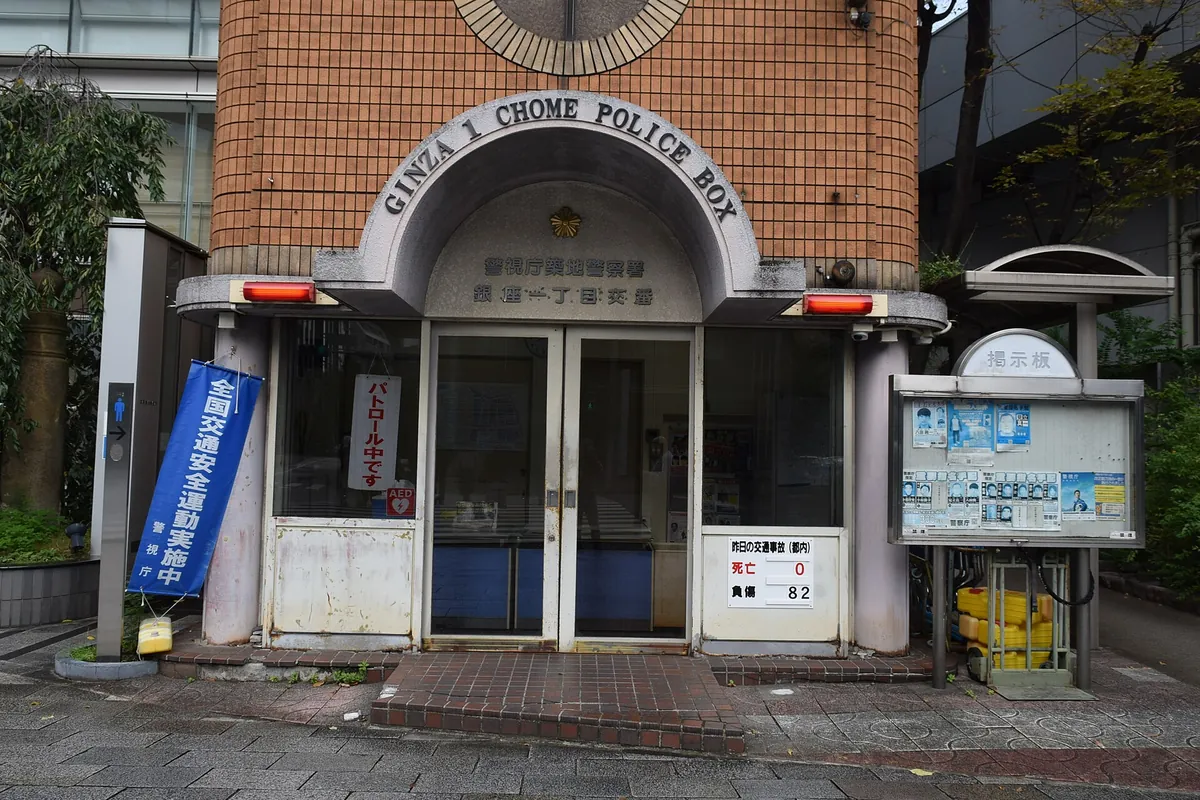
For smaller problems, walk to a koban. These are the small police boxes you will see on street corners all over Japanese cities. If you do not know where one is, ask anyone nearby. You need a police report to have a passport reissued or to claim insurance after a theft or loss. The local police station writes it for you. If you are staying at a hotel, JNTO suggests asking the front desk to help.
Solo female travel in Japan: koban, helplines and clinics
Solo female travel in Japan uses the same safety net as any other trip. A few extra points are worth knowing. The koban is the first stop for any trouble on the street, day or night. The photo below shows the kind of small police box you are looking for.
For mental health support, JNTO lists Tokyo English Life Line (TELL) on 03-5774-0992. TELL answers from 9 a.m. to 11 p.m. Monday to Thursday, and from 9 a.m. to 2 a.m. Friday to Sunday. If you want to talk to someone in English late at night and you are not in danger, this is the line to call. If you are in danger, call 110.
Medical care is where solo women need to plan ahead. The JNTO guide for when you are feeling ill lets you search hospitals by area, language and department, including Obstetrics and Gynecology. Its symptom chart sends abdominal pain to Internal Medicine, Gastroenterological Medicine or Obstetrics and Gynecology. It sends pregnancy concerns, such as pain, spotting or water breaking, to Obstetrics and Gynecology.
One line in that guide is easy to miss: travel insurance does not cover perinatal medical care, which can make it expensive. If you are pregnant, read your policy before you book the flight.
A few habits help on any solo trip:
- Keep your phone fully charged. JNTO calls a charged phone indispensable in any emergency.
- Note your embassy’s address and phone number before you arrive.
- Make two copies of your passport. Keep one with you and leave one at home.
- When you check in, look at where the evacuation routes are.
Where to stay alone: hostels, capsules and single rooms
A solo traveller pays for the whole room. So the type of bed you book matters more than it does for a couple. Hostels and capsule hotels sell a single bed or pod. Guesthouses and business hotels sell small rooms for one.
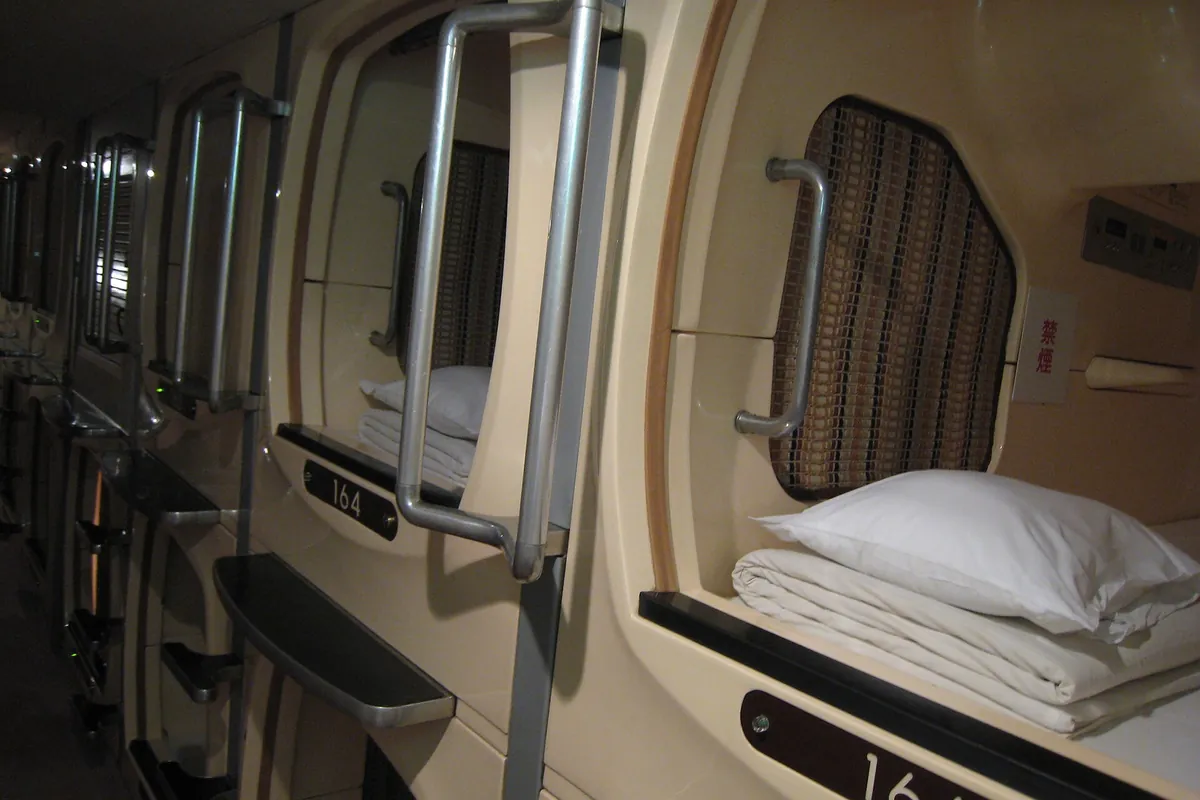
The capsule pods in the photo are one bed each, stacked in rows, with a shared bathroom down the hall. Our guide to guesthouses, hostels and minpaku in Japan explains which licence each type holds and what you show at check-in. Our Japan hotel booking guide covers check-in rules and cancellation fees. If you want one night in a traditional inn, read ryokan vs hotel before you book.
A late flight is the other thing to plan when you are alone. At Narita Airport Terminal 1, the 1F and B1F floors stay open 24 hours, and floors 2F to 5F open from 05:00 to midnight. Flights run only from 06:00 to midnight, so you cannot stay airside overnight. The LAWSON convenience store on B1F is open 24 hours. The Dayroom has a single nap room with a shower, and a shower on its own costs 1,500 yen.
Wherever you sleep, do two things at check-in. Ask the front desk where the evacuation route is. Then ask where the nearest koban is, so you know where to go if something is stolen.
Getting around alone: rail passes, IC cards and luggage
An IC card is the first thing to sort out. You tap it at the gate and the fare comes off the balance, so you never stand at a ticket machine with your bags. Three cards matter for visitors, and the table compares them using our database.
| Card | Price | Deposit | Valid for |
|---|---|---|---|
| Welcome Suica | 1,000 to 10,000 yen | No deposit | 28 days from purchase |
| TOURIST PASMO | 2,000 yen at Narita; 1,000 to 10,000 yen at Haneda | No deposit | 28 days from purchase |
| Suica | 1,000 to 10,000 yen | 500 yen | Invalid after 10 years unused |
Welcome Suica is JR East’s card for temporary visitors. Since 27 March 2025, JR East sells it at its listed locations, and in principle only one card goes to each person. It holds up to 20,000 yen and it cannot be refunded, so load only what you will spend. You can buy it at the JR EAST Travel Service Centers at Narita Airport Terminal 1, Narita Terminal 2・3 and Haneda Terminal 3 stations. Our Welcome Suica vs TOURIST PASMO comparison shows which one is easier to buy at each airport.
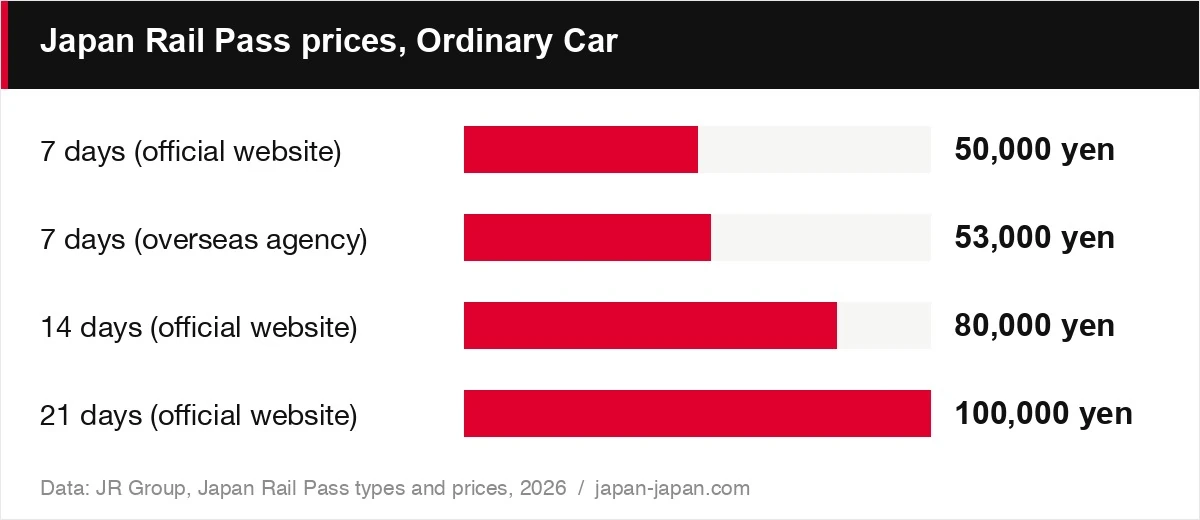
The Japan Rail Pass is the bigger decision. It covers all JR Group trains, including the Shinkansen, but not the Nozomi or Mizuho on the Tokaido, Sanyo and Kyushu Shinkansen. The chart below shows the Ordinary Car prices.
| Item | Value | Note |
|---|---|---|
| 7 days (official website) | 50,000 yen | |
| 7 days (overseas agency) | 53,000 yen | From October 1, 2026 |
| 14 days (official website) | 80,000 yen | |
| 21 days (official website) | 100,000 yen |
The official website charges 50,000 yen for 7 days, 80,000 yen for 14 days and 100,000 yen for 21 days. Children pay 25,000 yen for 7 days. From October 1, 2026, the 7-day pass costs 53,000 yen from an overseas agency. The official website keeps the 50,000 yen price for a limited time, so buy there.
Check the pass against one long trip. Tokyo to Sapporo takes 7 h 45 min on the Hayabusa and the Limited Express Hokuto, for 30,120 yen one way. A flight from Haneda takes 1 h 30 min, with 56 flights a day. For short hops inside Tokyo you do not need the pass at all. Haneda Airport to Ginza takes 29 min by the Keikyu Line and Toei Asakusa Line for 550 yen on an IC card.
Shinkansen platforms like this one at Tokyo Station are where luggage becomes a problem for a solo traveller. You cannot leave a suitcase by the door while you buy a bento. Two services solve this.
- Coin lockers: a small locker at a Japanese airport costs between 200 and 500 yen a day. At Narita Terminal 1, lockers start at 400 yen. At Narita the day ends at midnight, not 24 hours after you start. Our guide to coin lockers in Japan has the sizes and time limits.
- Luggage delivery: Yamato Transport runs courier counters at 22 airports, and a bag reaches most of the country the next day. Narita and Haneda also deliver the same day, to hotels in central Tokyo and nearby areas such as Urayasu. See our luggage forwarding guide for the cut-off times.
The airport guides list 35 airports where you can send your bags on. You can land, hand over the suitcase and take the train with a small bag.
If you get sick or lost on your own
Getting sick alone is the part most solo travellers worry about. JNTO’s guide splits the choice into three paths. For an emergency, go to an emergency hospital, which is open 24 hours a day, 365 days a year. If you need a doctor but it is not an emergency, visit a clinic or general hospital during regular hours. Outside those hours, go to an after-hours reception. If you do not need a doctor, go to a pharmacy or drugstore.
The chart below shows the order to follow when you are on your own.
The Japan Visitor Hotline can introduce medical institutions where you can consult in a foreign language. The JNTO search shows up to 30 results, sorted by straight-line distance from where you are. JNTO asks you to call the hospital before you visit when you can.
If you need an ambulance and cannot make the call, show this line to someone nearby. 救急車を呼んでください。 It reads Kyūkyūsha o yonde kudasai and means Please call an ambulance. You cannot choose which hospital the ambulance takes you to.
At the hospital, the steps run in a fixed order. The flow below follows the JNTO guide.
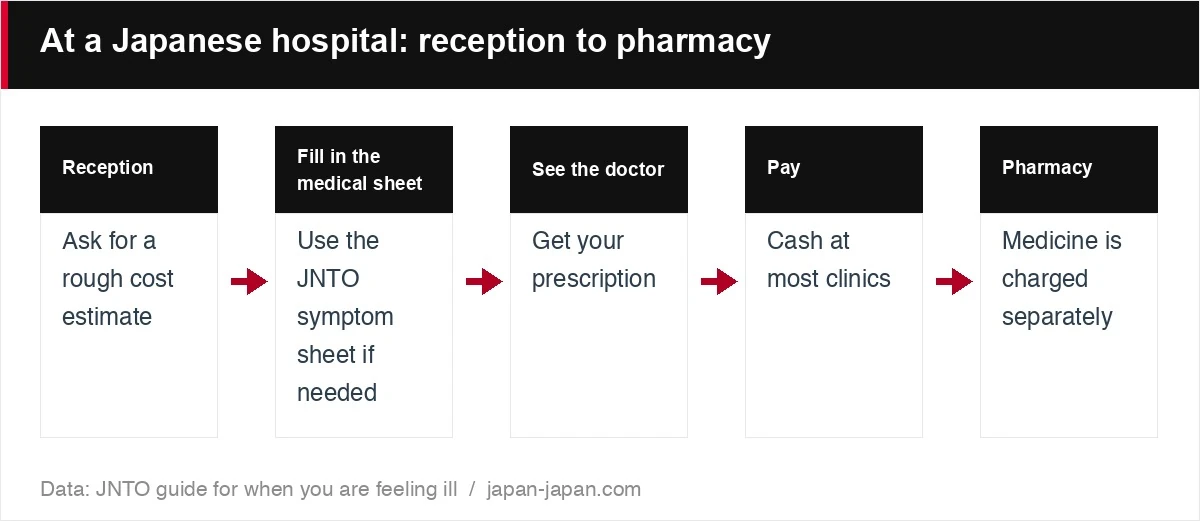
Ask for a rough estimate of the cost at reception. Fill in the medical sheet, see the doctor and get a prescription. Then pay. Only major hospitals take credit cards, and clinics generally accept cash only. Last, take the prescription to a pharmacy, which charges for the medicine separately.
Not sure which department to ask for? This short list from the JNTO symptom chart helps.
| Symptom | Department to ask for |
|---|---|
| Fever, sore throat, cough, runny nose | Internal Medicine |
| Headache | Internal Medicine, Neurosurgery |
| Injury or wound | Surgery, Plastic Surgery |
| Bone fracture or joint pain | Orthopedic Surgery |
| Toothache | Oral Health |
| Not sure | General Diagnosis and Treatment |
Insurance is the part to sort out before you land. JNTO shows two real cases. A bicycle collision with surgery, a 19-day hospital stay and a business-class flight home came to 7.5 million yen. A heart attack with a 45-day stay came to 10,000,000 yen. Some private medical insurance can be bought online after you enter Japan, with coverage up to 10 million yen and cashless payment. JNTO also warns that visitors who do not pay their medical bills may be refused entry to Japan in the future.
For a mild fever or headache, a drugstore is enough. Some medicines cannot be sold when the pharmacist is away, so ask for a pharmacist if you cannot find what you need. Our page on paracetamol in Japan shows the Japanese name on the box. Tylenol A, for example, has 300 mg of acetaminophen per tablet, and the adult dose is 1 tablet up to 3 times a day.
If you lose your passport, go to a koban for a police report and then contact your embassy for a replacement. The Ministry of Foreign Affairs keeps the list of foreign missions in Japan. For things left on a train or in the street, call Lost & Found on 0570-550-142.
Planning a Japan solo trip route and the dates to avoid
The dates matter more than the route. On holidays, the Japanese travel too, and single beds and Shinkansen seats go first. Our calendar of public holidays in 2027 counts 17 days off in 2027, including 6 three-day weekends.
Three periods are the hardest to book:
- Golden Week 2027: Showa Day is Thursday 29 April 2027. Then 5 days are off in a row, from Saturday 1 May to Wednesday 5 May 2027.
- New Year 2026–27: JR Central makes every Nozomi reserved-seat only from 25 December 2026 to 5 January 2027. Banks close from 31 December to 3 January.
- Long weekends: JR Central also makes the Nozomi reserved-seat only on 21–23 November 2026, 9–11 January 2027 and 20–22 March 2027.
JR Central’s busiest single day last winter was Sunday 4 January 2026, with 350,000 passengers heading to Tokyo. If you fly in around then, book your bed and seat first and plan the sightseeing after.
The checklist above sums up the four things to do before you leave. Buy travel insurance with medical cover. Save 050-3816-2787 in your phone. Decide on an IC card. Book your beds before the holiday dates fill.
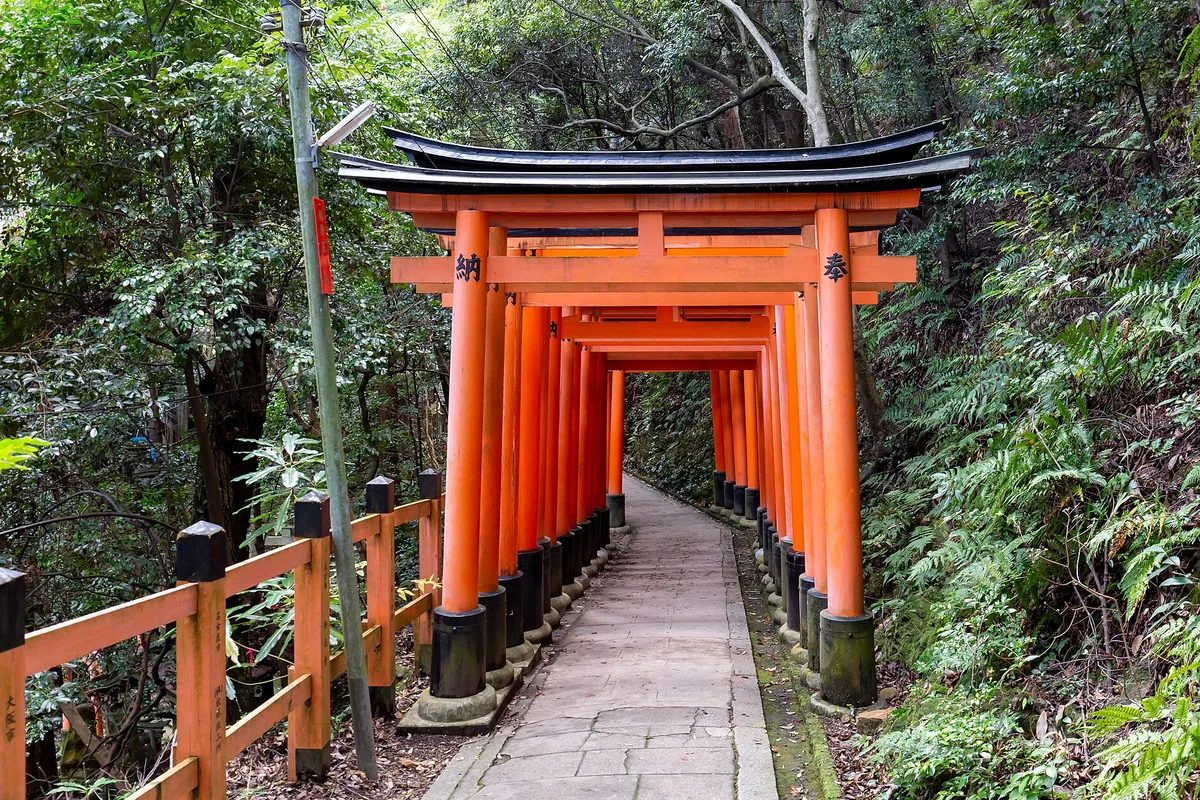
A route like Tokyo, Kyoto and Osaka suits a first solo trip. The trains are frequent and the main sights sit close to a station. If Fushimi Inari Taisha in Kyoto is on your list, plan it for a weekday outside the holiday dates above. Our Japan trip planner counts back from your flight date and shows what to book at each stage.
FAQ
Is Japan good for solo travel?
Yes. JNTO says Japan is very safe and the crime rate is quite low. IC cards, rail passes and hotel check-in all work for one person. The main things to set up are travel insurance, a way to store your bags and the Japan Visitor Hotline number.
Is Japan safe for solo female travelers?
JNTO describes Japan as very safe, and the same help is open to everyone. Go to a koban for trouble on the street, call 110 in danger, and use the 24-hour Japan Visitor Hotline for anything else. Check your insurance, because travel insurance does not cover perinatal medical care.
What number do I call in an emergency in Japan?
Call 110 for the police and 119 for fire and ambulance. For help in English, Chinese or Korean at any hour, call the Japan Visitor Hotline on 050-3816-2787. In Tokyo, the police English helpline is 03-3501-0110.
Can I call the Japan Visitor Hotline from outside Japan?
Yes. From overseas, dial +81-50-3816-2787. The line runs 24 hours a day, 365 days a year. It does not make bookings for you or run three-way interpretation, so call it yourself.
About the author