Can You Take an Electric Toothbrush in Hand Luggage? Yes
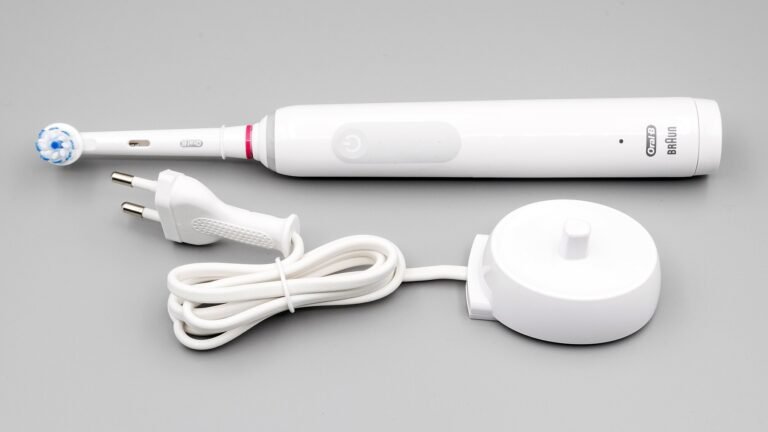
The brush itself is the easy part. The trouble at security comes from what sits next to it: the spare battery, the toothpaste, and the other gadgets in the wash bag. This guide answers each one with the numbers Japan’s airports and airlines publish.
Most rules here come from Japan’s Civil Aviation Bureau. It sets the dangerous goods rules for every flight leaving a Japanese airport. Airlines then add their own rules on top, mostly for power banks.
What Japan’s carry-on list says about electric toothbrushes
Japan does not treat a toothbrush as dangerous goods. Our toothbrush check in the What you can bring database gives a plain yes for both manual and electric models. You can pack an electric toothbrush in hand luggage, in a checked suitcase, or split the brush and the charger between the two.
The battery is what the rules look at. Narita Airport answers this directly in the Narita Airport prohibited items FAQ. It says there is no restriction on lithium-ion batteries built into products such as computers, digital cameras and mobile phones. A rechargeable toothbrush works the same way, with the battery sealed inside the handle.
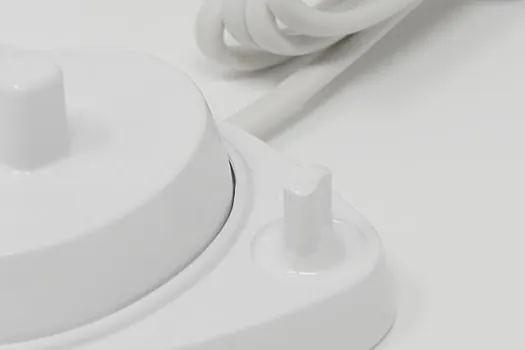
The base has no battery, so it travels like any other cable or plug. Our page on chargers and AC adapters lists a charger with no battery inside as an ordinary electrical item.
The national rules sit on the Japan Civil Aviation Bureau carry-on and checked items list. That page explains that carrying dangerous goods on aircraft is banned under Article 86 of the Civil Aeronautics Act. It also tells passengers to ask their airline whether a specific item can go in the cabin or the hold.
For a cordless gadget with a lithium-ion battery, Japan applies the portable electronic device rule. Our hair clippers check spells it out: a cordless device is accepted with a lithium-ion battery of 160Wh or less. A toothbrush battery is a tiny fraction of that size, so the limit never comes into play for a normal brush.
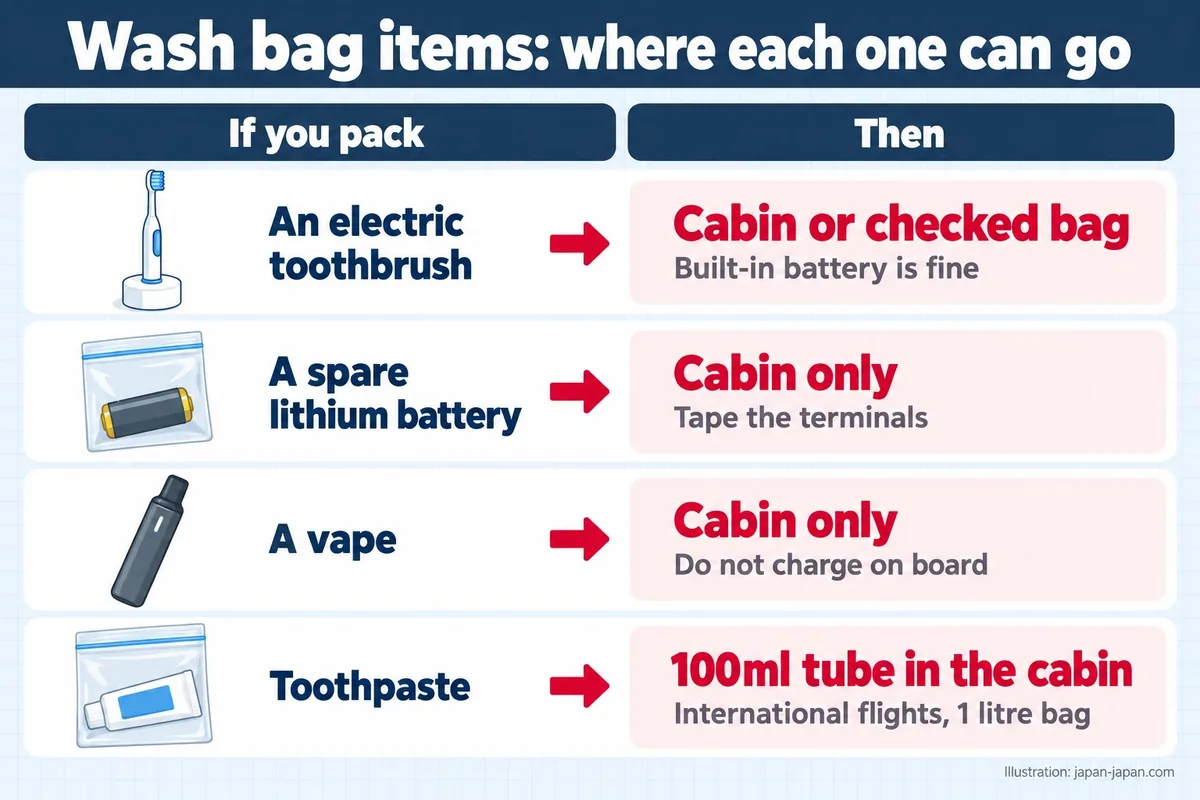
The lookup above puts the four items people pack together side by side. The brush goes anywhere. The spare battery and the vape stay with you in the cabin. The toothpaste is the only one with a size limit on international flights.
Checked luggage: switch it off and stop it turning on
You can put an electric toothbrush in checked luggage on flights to and within Japan. The risk in the hold is not the battery itself. It is the brush switching on by accident, buzzing for hours and draining or heating up while nobody can reach it.
Narita Airport explains why the two kinds of bag are screened differently. Carry-on bags are checked for anything that could be used as a weapon. Checked bags are checked for goods that cannot be carried at all, such as explosives. A buzzing case in the hold can get pulled aside for a closer look, which can mean a delay or a missed connection for your bag.
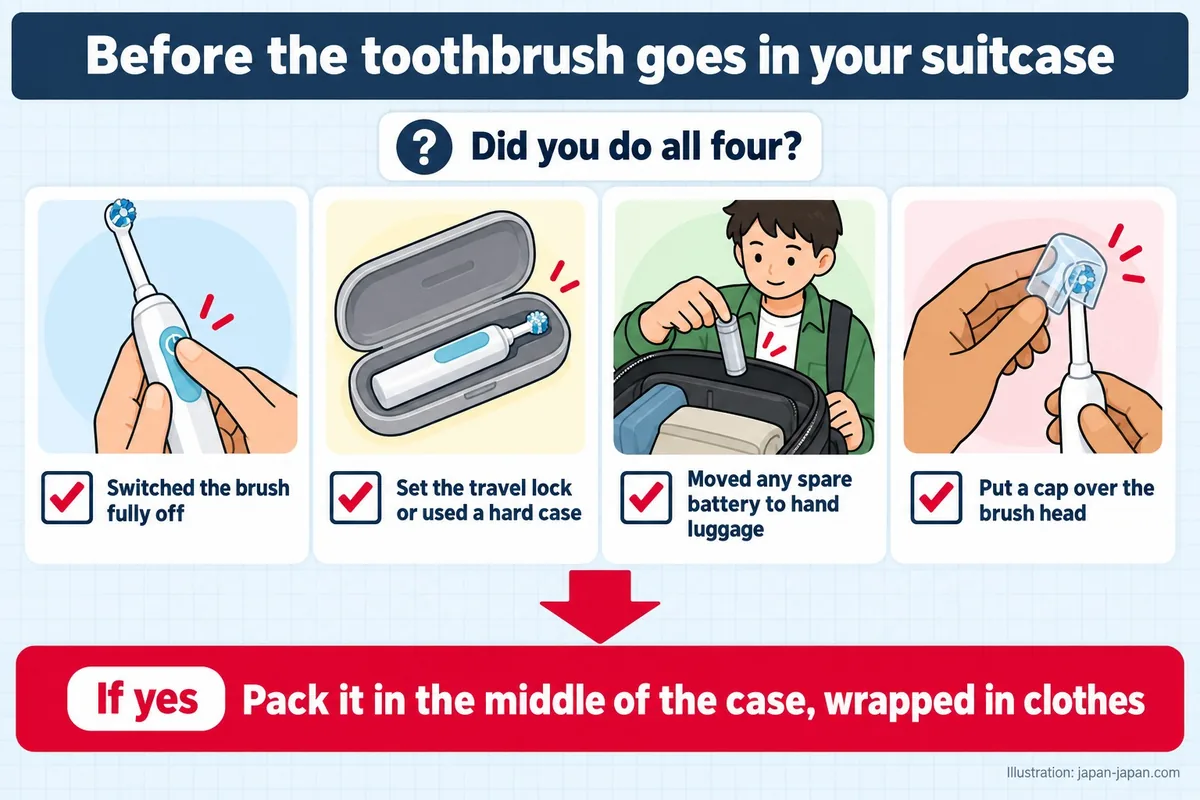
The checklist covers the four things to do before you close the suitcase. Most brushes have a travel lock: on many models you hold the power button for a few seconds until the light flashes. Your brush’s manual shows the exact method. If your brush has no lock, take the head off or pack the handle in its hard case so nothing presses the button.
- Switch off: Turn the brush fully off, not just paused between modes.
- Lock: Use the travel lock or a hard case so the button cannot be pressed.
- Remove spares: Any loose rechargeable battery moves to your hand luggage.
- Cover the head: A cap keeps the bristles clean and stops the head snapping off.
Pack the brush in the middle of the suitcase, wrapped in clothes. That protects the handle if the case is dropped. Keep the charging base with it if you will not need it on the way.
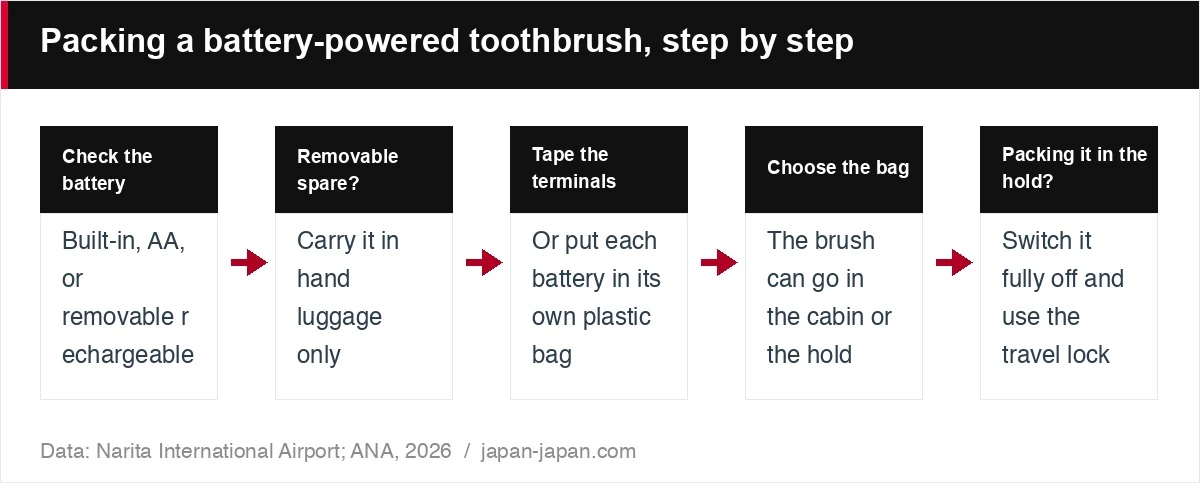
The flow above shows the whole decision. Start with the battery: if it comes out, the battery rides in the cabin. If it stays in, the brush can go in either bag, and the hold only needs the off-and-locked step.
Batteries: built-in, AA and spares
Batteries fall into three groups, and each one has a different answer. Get these right and the toothbrush question answers itself.
Built-in rechargeable batteries. Narita Airport lists no restriction on lithium-ion batteries embedded in products. Most electric toothbrushes from the big brands work this way.
AA and AAA batteries. Some travel brushes run on dry cells. Narita says alkaline and other non-lithium batteries are allowed in both carry-on and checked baggage. Our batteries check adds that dry cells and nickel-metal hydride batteries are not dangerous goods.
Spare lithium batteries. These go in hand luggage only. Narita Airport’s FAQ tells travellers to bring backup lithium-ion batteries in carry-on baggage, up to two pieces. Our lithium batteries check sets out the size bands behind that rule.
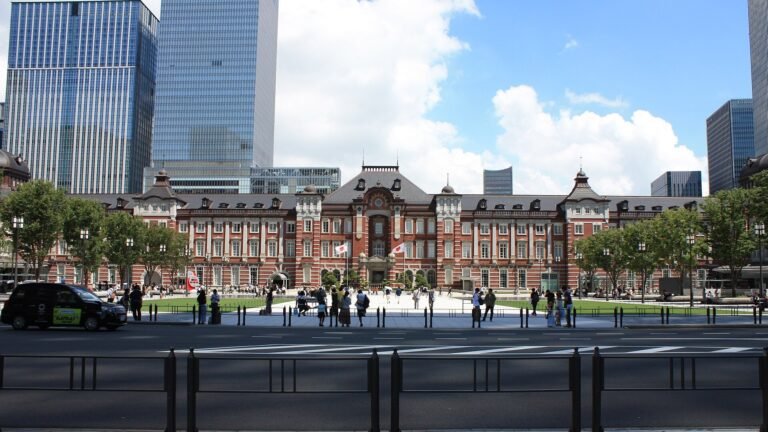
Security lanes like these at Narita are where a forgotten spare in a checked bag turns into a problem. Japanese airlines write the size bands into their own pages. IBEX Airlines allows up to 2 spare lithium-ion batteries over 100Wh up to 160Wh per person. AIRDO counts power banks and spare batteries in that same band together, 2 in total. Anything over 160Wh cannot go on board at all.
Protect every spare from short circuits. ANA asks passengers to cover the terminals with tape or put each battery in its own plastic bag. A small zip bag per battery is enough.
Power banks follow the same logic, with extra limits. The ANA international baggage guide lists the rules that apply to flights boarding on or after 24 April 2026. Power banks cannot be checked in. Each one must be 160Wh or less, and you can bring up to 2 per person. You cannot charge a power bank from the seat outlet, and ANA asks you not to use one to charge other devices. Our guide to Japan’s power bank rules covers the full set.
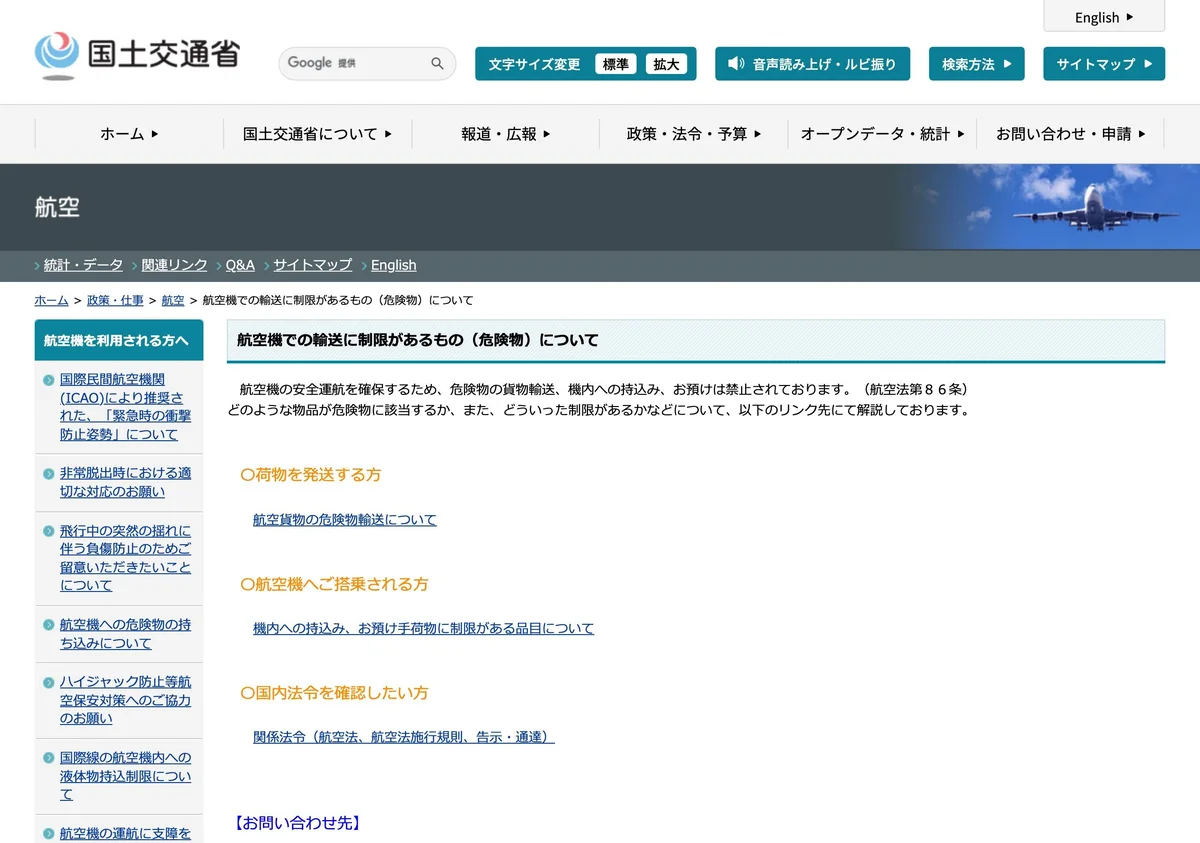
This is the Civil Aviation Bureau page on items restricted on aircraft. Its Japanese title uses the word 危険物 (kikenbutsu), meaning dangerous goods. You will see the same word on security signs and leaflets at Japanese airports, next to pictures of batteries, sprays and lighters.
Toothpaste and mouthwash: the 100ml rule
Toothpaste is where most travellers lose something at security. On international flights from Japan it counts as a liquid. Each tube must hold 100ml or less, and all your liquid containers go in one clear re-sealable bag of 1 litre or less. Japan allows one bag per person.
The Japan Civil Aviation Bureau liquids restrictions page is the national source for this rule. It has an outline, a list of covered items and an FAQ. Our toothpaste check applies it to tubes: 100ml (100g) or less, inside the 1 litre transparent bag. Gels count too. Narita Airport lists shaving cream and hair gel under the same restriction.
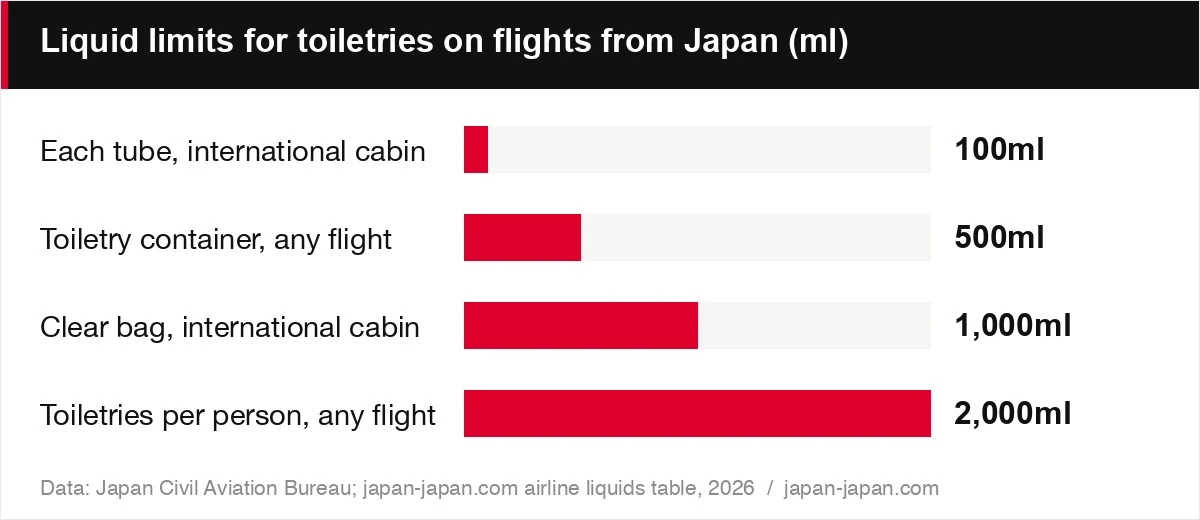
| Item | Value | Note |
|---|---|---|
| Each tube, international cabin | 100 ml | |
| Toiletry container, any flight | 500 ml | 0.5 litres |
| Clear bag, international cabin | 1000 ml | 1 litre, one per person |
| Toiletries per person, any flight | 2000 ml | 2 litres |
The chart puts the four liquid limits on one scale in millilitres. The 100ml tube limit and the 1 litre bag apply only to the cabin on international flights. The 500ml container limit and the 2,000ml total apply to toiletries on any flight, in either bag.
Mouthwash follows the toiletry rule. Our mouthwash check lists it at 0.5 litres or 0.5kg per container and 2 litres or 2kg per person on any flight. On international flights a bottle in your hand luggage must also meet the 100ml rule. Full-size bottles go in the checked suitcase.
The bag itself has a size rule. Narita’s FAQ describes it as a transparent zip bag of 1 litre, with no side over 20 cm. It also accepts a 24 cm by 17 cm bag, because its sides add up to about 40 cm. Pictures and printing on the bag are fine as long as you can see the contents.
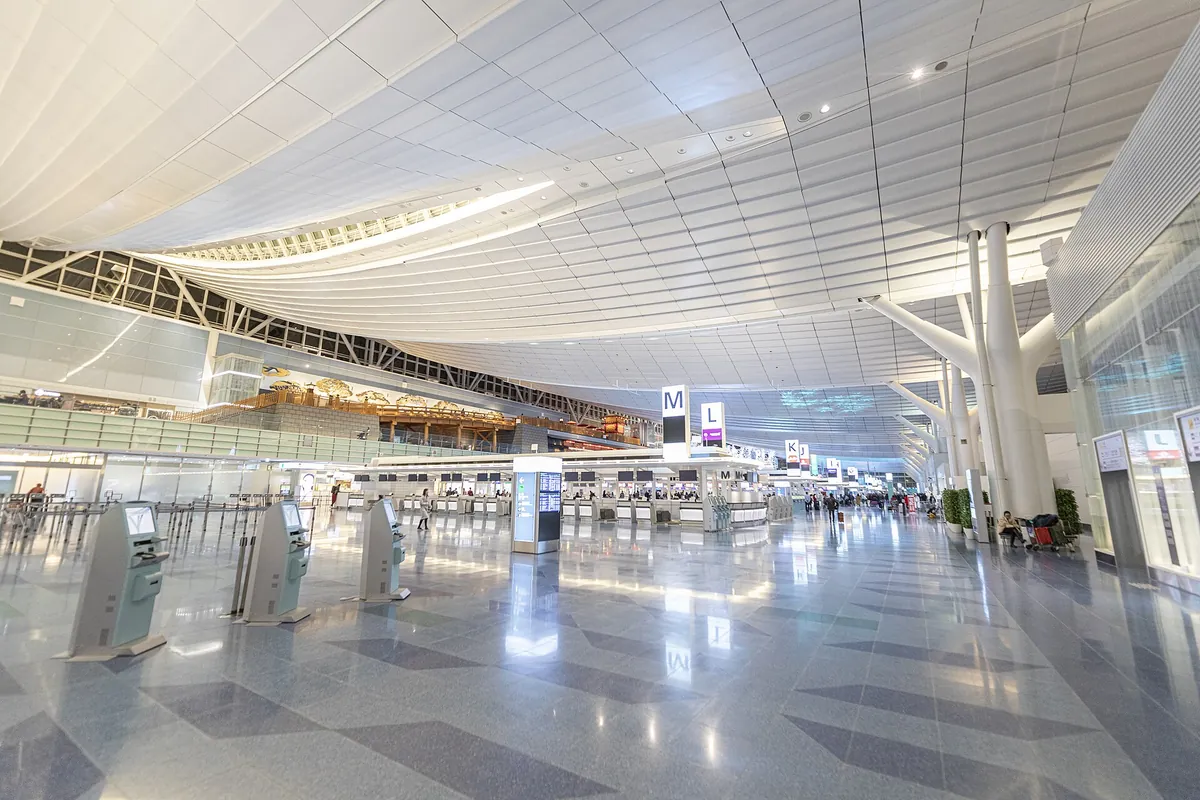
Connecting at Narita between two international flights? The liquid limits apply at the transfer security check too. Narita says liquids over the limit must be thrown away there. If you enter Japan first, you can repack liquids into your checked bag.
On domestic flights inside Japan the 100ml rule does not apply. Toiletries are still capped at 0.5 litres per container and 2 litres per person. Our liquids and duty-free table for 99 airlines shows where individual airlines differ.
Electric shavers, trimmers and hair straighteners
Most wash bags hold more than a toothbrush. The good news is that the other battery gadgets follow the same rules, with one exception: cordless hair irons.
Electric shavers. Our electric shaver check says shavers can be carried on. The UK government table lists electric shavers as allowed in both hand and hold luggage.
Trimmers and hair clippers. Japan’s list has no separate entry for clippers. A cordless clipper is a portable electronic device, accepted with a lithium-ion battery of 160Wh or less.
Razors. Blades are a different question from batteries. Our razors check says T-shaped razors and small cosmetic razors can be carried on. Other razors go in checked baggage. For tweezers and nail clippers, see our tweezers guide.
| Item | Hand luggage | Checked bag | Condition |
|---|---|---|---|
| Electric toothbrush | Yes | Yes | Switch off and lock in the hold |
| Electric shaver or trimmer | Yes | Yes | Lithium-ion battery 160Wh or less |
| Cordless hair iron | Yes | Yes | Only with the battery detached |
| Vape (e-cigarette) | Yes | No | Do not charge on board |
| Spare lithium battery or power bank | Yes | No | Terminals taped; 160Wh or less |
The table puts the five battery items from this guide in one place, with the cabin answer, the hold answer and the condition that applies.
Hair straighteners and curlers. These depend on the power source. Narita Airport sets out three cases in its FAQ:
- Plug-in iron: Allowed in carry-on and checked baggage.
- Rechargeable iron: Not allowed with the battery attached. Detach the battery and the iron can go in either bag, while the battery stays in the cabin.
- Gas iron: Filled with hydrocarbon gas, with the safety cover firmly fixed over the heater. One per person, in either bag. Refill gas cartridges cannot go anywhere on the plane.
Our hair straightener check gives the same split. If your cordless iron has a battery you cannot remove, leave it at home or buy a plug-in model.
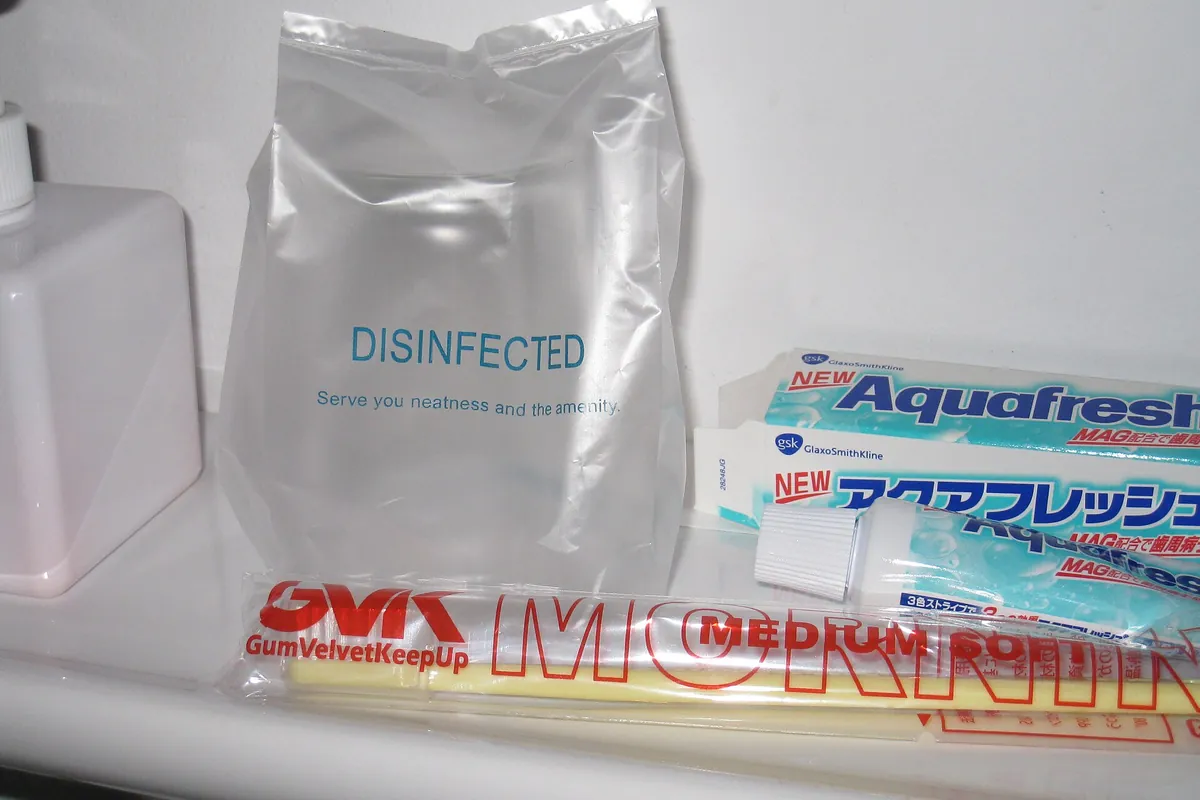
You may not need to pack some of these at all. Many Japanese hotels leave a toothbrush in a sealed packet by the washbasin. The free brush is manual, so bring your electric one if you care about the routine. Shaving foam and gel count as toiletries, with the 0.5 litre container limit.
Vapes and other cabin-only devices
Some items in a wash bag cannot go in the hold at all. The most common are electronic cigarettes, spare lithium batteries and power banks. Put these in your hand luggage before you reach the check-in counter.
Vapes and heated tobacco. Our e-cigarettes and heated tobacco check says electronic cigarettes travel in the cabin only. Japan’s list has one entry for them and does not name vapes or heated tobacco devices separately. Do not charge a vape on board.
The GOV.UK hand luggage rules for electronic devices give the same split for flights to the UK. E-cigarettes are allowed in hand luggage and not in hold luggage. Mobile phones, laptops, shavers and hair straighteners are allowed in both.
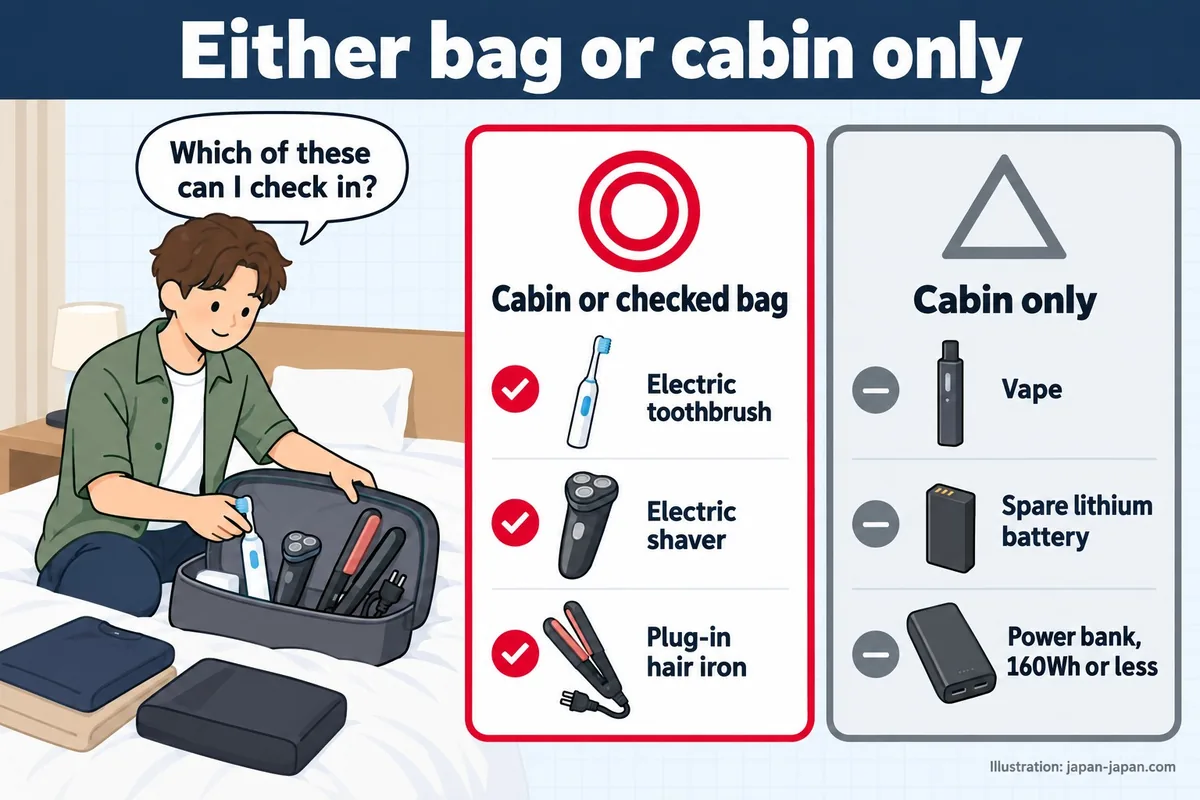
The split above is the easy way to pack. Items on the left can go in either bag. Items on the right travel at your seat, every time.
Power banks. All 93 airlines in our power bank table that mention checked bags say a power bank must not go there. Of 99 airlines flying to Japan, 77 say a power bank is not to be used on board. Our power bank rules by airline lists each one.
Lighters. If you smoke, one lighter or one box of safety matches is allowed per person, carried on your body. A lighter never goes in checked baggage.
Flying home or within Japan: what changes
The toothbrush answer stays the same on the way home and on domestic flights. The liquids rule and some airline details change.
Domestic flights in Japan. The 100ml rule does not apply, and you can bring drinks through security. Toiletries keep the 0.5 litre and 2 litre limits. Power banks keep the 160Wh and 2 per person limits from 24 April 2026 on Japanese airlines.
Flying to the UK. GOV.UK asks you to charge your devices before you travel. If a device does not switch on when security asks, you will not be allowed to take it onto the aircraft. Keep your toothbrush charged in your hand luggage on that route. The UK page also allows gas hair curlers if the safety cover stays fitted, but not separate gas cartridges.
Codeshares and other airlines. ANA notes that if your trip includes a codeshare flight or a flight operated by another airline, that airline’s baggage rules may apply. ANA also warns that if it cannot confirm an item before departure, the item may be refused.
Power bank sizes vary most between airlines. Our table shows 52 airlines that allow up to 160Wh and 27 that stop at 100Wh.
Before you fly, open your airline’s page in our database. The ANA baggage rules page and the JAL baggage rules page both list carry-on limits of 115cm and 10kg. Peach allows 7kg in the cabin, so a heavy wash bag counts more there.
FAQ
Do I need to take the battery out of my electric toothbrush before flying?
No. Built-in lithium-ion batteries have no restriction, according to Narita Airport’s FAQ. You only remove a battery if your brush uses a loose rechargeable battery that you also carry as a spare. That spare then goes in your hand luggage with the terminals taped.
Can I put an electric toothbrush in checked luggage on a flight to Japan?
Yes. Switch it fully off and use the travel lock or a hard case so it cannot turn on in the hold. Take any spare lithium batteries out and carry them in the cabin.
Is toothpaste allowed in hand luggage on international flights from Japan?
Yes, in tubes of 100ml or less inside one clear re-sealable bag of 1 litre or less, one bag per person. Larger tubes go in checked baggage. On domestic flights in Japan the 100ml rule does not apply.
Can I charge my electric toothbrush on the plane?
Charge it fully before you fly. Japanese airlines ban charging a power bank from the seat outlet. They also ask you not to use a power bank to charge other devices, so it cannot top up the brush in flight. On flights to the UK, a charged device also matters if security asks you to switch it on.
About the author